|
FAQs on Freshwater Protozoan Parasite Disease
Related Articles:
Freshwater Fish Diseases,
Freshwater Diseases,
FW Disease Troubleshooting,
Ich/White Spot Disease,
Choose Your Weapon: Freshwater Fish Disease Treatment Options by Neale Monks,
Formalin/Formaldehyde,
Malachite Green,
Related FAQs: Diagnosing/Identifying FW Protozoan
Diseases, FW Fish Parasitic Disease 1,
Hexamita/Octomita in Freshwater
Systems, & FAQs on: Diagnosis/Identification of Parasites,
Internal Parasites, FW Parasite Treatments, Freshwater Protozoan Parasite Diseases,
Diagnosing/Identifying FW Protozoan
Diseases, ( Ich/White Spot
Disease, Costia,
Trichodina, Freshwater
Velvet, Sporozoan Parasites, Whirling Disease, Hexamita/Octomita in Freshwater Systems,)
& Cichlid Disease, African Cichlid Disease, Aquarium
Maintenance, FW Infectious
Disease, Freshwater
Medications, African
Cichlid Disease 1, Cichlid Disease,
Betta Disease 1,
|
|
|
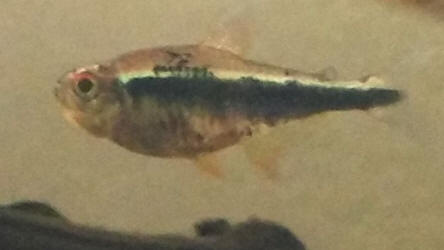
marks on Black Neon tetra 8/10/15
Dear WWM Masters,
<Howdy Dev!>
Thanks a ton for the incredible service you provide to let us take better care
of our charges. Much appreciated.
<Glad we can share>
The attached picture is of one of my shoal of 8 Black Neons. Any idea what the
markings might mean? Others do not have anything similar. They are 4 months in
the tank, no change in appetite or behaviour.
<Yikes.... Remove and isolate (or... destroy) the affected fish.... This appears
to be an incidence of "Neon Tetra Disease" (Pleistophora, a Microsporidean)...
yes, does infests other fishes.... Not curable (at this point)>
This 'warm water' tank is 30X15X12(H), about a year old, filtered by a 500l/hr
HOB packed with ceramic and bioballs and a similar flow internal power similarly
packed. NH3, NO2, NO3 0,0,<10; pH 7.3, kH 3, TDS 150, tankmates 6 Sterbai Cory,
4 each of Rummynose and Cardinal tetras, 1 male Pearl Gourami and a Red Lizard
Plec. Crypts, Anubias, Java Fern, floating
pennywort and duckweed, Indian Almond leaves, submerged roots, river stones,
caves, sand substrate. Temp is now above 30C from an Indian summer.
It has a laminar flow fan blowing across the surface, no artificial lights.
20% weekly water change, feeding from Hikari Micro pellets, sinking wafers,
Ocean Nutrition Brine Shrimp plus and Spirulina flakes and Tetra bits.
Freeze dried bloodworms occasionally. I dose K2SO4 as per EI and Seachem
Flourish Comprehensive and Iron.
Should I be concerned?
<Yes; and sorry to be the bearer of such bad news. DO search re the terms
above... this could be another Microsporidean, Protozoan, even some worms.... As
usual/always I (and I'd go far to say many other WWM Crew)
state simply what we would do given similar/same circumstances. NOT worth
waiting... isolate or euthanize this black Neon>
Thanks again.
Regards
Devakalpa (India)
<Welcome. Bob Fenner>
|
 |
|
Re: marks on Black Neon tetra
8/11/15
Dear Bob,
<Dev>
Thanks for the inputs. I shall act accordingly.
<Ah, good. Please keep us informed; send along your observations. BobF>
Regards
Devakalpa
Re: marks on Black Neon tetra
8/17/15
Dear Bob,
<Dev>
Apologies for the delay in updating. I went the clove oil route the day I heard
from you, it seemed to be the safest (but tough) option.
<Yes>
Since then no signs of contamination yet; the remaining Black Neons, Cardinals
and Rummy Noses are doing fine.
<Glad to read>
Thanks again
Devakalpa
<Welcome. Bob Fenner>
|
resistant Spironucleus (supposedly)
in angelfish... Overtreated w/ Metronidazole
7/13/14
Hello,
I am a frequent reader and first time poster. Your advice on these
forums has been extremely helpful over the
1.5years I have had an aquarium.
I have reoccurring Spironucleus in my Philippine blue angelfish
<... ? Freshwater I take it; not marine>
and Metronidazole does not work; perhaps it is
a resistant case.
<How are you sure this fish has Spironucleus? Are you referring to HLLE?
As this being a likely causative agent? I would have you read here:
http://wetwebmedia.com/FWSubWebIndex/hexoctfwfs.htm
and the linked files above>
angelfish symptoms- stops eating (gradual reduction in appetite until
stops eating completely). clear string like feces (weeks-months of
acting and eating normally, until feces becomes more and more clear and
fish shows other signs of illness).
<... there could be other causes here>
tank parameters- nitrate 30 (I know I need to improve this),
<Yes; this alone might be a principal factor/cause of the symptoms you
list>
nitrite 0,
ammonia 0, pH 6.6,
<A bit low>
temp 80F. I do a 50% wc once per week.
stress levels- angelfish nip at each other, some minor chasing: no
injuries. aggression spread around (9 angelfish). no fish hides.
65 gal tank residents: 9 angelfish (near adult age--5 are stunted
growth--long story/got from bad breeder who lied about age), 3 honey
gourami, 2 Bolivian ram, 3 false julli cories (phasing them out r/t
temperature of tank), 7 sterbai Cory, 2 Otos (before I understood the
parameters they needed). Yes, overstocked, there is a long story why I
have 9 angelfish---I only intended to have 5.
I thought I cured them 3 months ago. All of the angelfish except for one
had stopped eating. I put them in a hospital tank and heated it to 96F.
I used metro bath and AngelsPlus metro medicated flakes. I treated for
two weeks (I wanted to be sure to finish the course).
<See WWM re the use of Metronidazole... it is dangerous to
expose fishes (or humans for that matter) to this compound for longer
than a few days... is nephrotoxic... kills the kidneys>
I also used treated the main tank without the heat treatment and cleaned
out all the infected feces
(turned off UV sterilizer). Even the angelfish who had not eaten for
nearly 2 weeks survived and returned to good health. Everything was
great until about 1.5months ago. One angel showed signs of the stringy
feces. I did not wait until they stopped eating this time. I turned off
the UV sterilizer. I used a metro bath and brand new metro flakes (they
were eating voraciously) for two weeks. There was only a small
improvement in symptoms. I felt defeated and just hoped it would go
away. One month later, most of the other angels are starting to get the
stringy feces.
Every angel except for one are still very active and eating voraciously.
My Pearlscale angel stopped eating the floating NLS pellets and only
nibbles on the bottom NLS wafers (her favorite). Her feces are now 100%
clear and her activity has decreased. The ram show no signs of disease.
One honey gourami had Spiro feces and was successfully treated in main
tank during the first outbreak. No gourami currently show signs of
disease.
If the ill angel stops eating entirely, I am going to move her into the
hospital tank and heat it up again. However, this seems like only a
temporary solution and I will end up repeating this for every angel
again.
How do I eradicate the Spiro so that it will not return?
<... I'd take a few steps back here. Do you have access to a microscope
of a few hundred power? Am not so sure this is Spironucleus... or even a
Protozoan involvement>
Thank you so much for your time and help,
Laura
<Welcome. Bob Fenner>
Re: resistant Spironucleus in angelfish 7/15/14
Thank you so much for your quick response!
<Welcome>
Yes, freshwater. They do not have any body lesions to suggest
HLLE, but isn’t it caused by the same parasite?
<Can be... usually Octomita (formerly Hexamita) necatrix is the
causative organism according to some... Read through WWM's coverage of
HLLE>
A nitrate of 30 could cause all of these problems? Do you think
that I may have had an actual
Hexamita/Spironucleus outbreak the first time they were ill?
<Can only tell via microscopic examination>
If not, why do you think 96F helped them?
<... can't say>
The parameters in the sick tank started out better, but ended up
nitrate 30 by end of the three weeks they were in it (We keep getting
stuck at nitrate 30).
I know 30 is too high, but I did not realize it was lethal!
<Not lethal>
Aside from the one Pearlscale, the other fish are all very active. I
will be doing a series of 3 50%WCs this week. I cannot seem to raise the
pH. We use RO water because water comes out of the tap at pH
8.1, hard (GH 13 drops API test), with 5 nitrate. We add SeaChem
replenish minerals and neutral regulator as a buffer. The GH is
5 drops- API test. I ran out of the neutral regulator and am now using
API perfect 7.0 buffer. Is pH6.6 harmful for the angels? Would pH 8.1
hard water be an improvement? Half RO seems to reach pH 7.8.
There is so much conflicting information on the internet about the use
of Metronidazole!
<... just read the MSDS, many human citations>
I will not treat for so many days in the future. I appreciate you for
correcting me on this; I am fortunate that my fish did not suffer
apparent harm.
I do not have a microbiology minilab for confirmation. I have read so
much on the hex/Spiro and have matched up every listed symptom. I even
looked at pictures which matched the appearance of my angels’ feces. I
hope that my angels do not have parasites; that would be good news.
What should I do if I bring the nitrates down to 10 and the symptoms do
not improve and/or worsen?
<This is posted as well. Please don't write w/o searching, reading>
Or the Pearlscale stops eating completely or other angels demonstrate
decreasing appetite?
Thank you so much for your help!
Laura
<Welcome. Bob Fenner>
Re: resistant Spironucleus in angelfish 7/15/14
I honestly have searched the forums and other sites in
depth..... many many hours. I just get overwhelmed with all the
contradicting information I find on the internet
<Stop. Please; just read WWM... it is by and large internally
consistent, accurate...>
which is why I am seeking your help. If they do not get better, I
honestly do not know what I should do beyond throwing them in a hospital
tank and heating it to 96 degrees as I did last time.
<Please review a copy of Ed Noga's "Fish Disease, Diagnosis and
Treatment. B>
I do not think I will medicate with Metronidazole again as it appears to
either not work or the angels do not have the parasites metro treats.
Apologies,
Laura
Re: resistant Spironucleus in angelfish 7/15/14
It is a $133 book. Anything you suggest that is less expensive?
<The Kindle version, or borrowing from an institution. B>
Disappearing tumor? 4/24/12
Hello, I apologize in advance for the lack of photographic evidence.
Four months ago I bought 6 X-ray tetras to start my 20 gallon tank. The
tank was fishless-cycled with ammonia 0, nitrite 0, nitrate 10, temp.
77F. Three weeks ago one of the tetras developed an inclusion in its
back---a pale sphere, about 1.5 mm in diameter, above the spine and
below the dorsal fin but attached to neither. There was no external sore
or swelling (if the fish weren't transparent, I wouldn't have been able
to see the thing.) The fish behaved and ate normally and showed good
coloration. Now, three weeks later, the "tumor" has shrunk and looks
like a grain of sand suspended in its back. The fish still seems healthy
and none of the others show any sign of this thing. Is this a parasite?
Have you seen or heard of this before?
Thank you for any insight you can give! -Julie
<Does read like a Microsporidean, Microsporozoan (colony) by colour,
size, shape... as far as I know there are no specific "treatments" for
such. Just good care, appropriate foods, water quality... Bob Fenner>
What does my pictus catfish have? &
Costia/Protozoan FW dis f' 3/1/10
Hi Guys! I love your site...lots of good information. I have a well
established 55 gallon freshwater community tank (1 giant Pleco, Danios,
3 Goramis, 1 upside down catfish, 2 clown loaches and 2 pictus catfish)
Everybody seems very content, but I have noticed in just the past two
days that one of my pictus is not doing too well. His typical shiny
skin has become dull and his markings are not as vivid.
<Do check he isn't bullied, and that the aquarium conditions are
optimal for the species. They can become a little duller with age, but
should always look silvery and alert. Excessive slime production can
dull their colours, and this is often a sign of stress, whether social
or environmental. Diet needs to be sufficiently varied too, with
particular importance placed on balance. Pimelodus pictus is a
predator, but this doesn't mean live fish should be used. Feeder
fish are a great way to introduce all sorts of bacterial and parasite
problems. Thiaminase is another issue with predators, and if you've
used too many prawns and mussels, and not enough foods that don't
have Thiaminase, you can create problems in the long term with vitamin
B1 deficiency. It seems fairly apparent that this is a big problem with
predatory fish.>
I have been looking carefully for any kind of fuzziness or
"soft" look, thinking it may possibly be a fungal infection,
but his skin appears to be smooth, just cloudy and dull looking.
<Difficult to say, though I'd be aware of Costia ("Slime
Disease") as this tends to cause excessive mucous production.
It's contagious and difficult to cure once established. But still,
I'd nudge my thoughts towards stress, particularly if this fish is
otherwise in good health.>
I am very hesitant to use any kind of medication in the tank for fear
it will do more harm than good. Do you have any recommendations? As
much as I would hate to do it, I would rather euthanize this fish than
jeopardize the rest of my tank (many of these fish are 7+ years old).
This tank has good aeration (bubbler, 60G filter, and a powerhead),
temp runs @ 79 degrees, nitrate less than 10ppm, nitrite 0, hardness
(GH) 75 ppm, alkalinity and pH chronically run a tad low..KH 60ppm and
pH about 6.5.
Any advice you have would be great!
Thanks
Heather
<The low pH and low hardness, does make me worry that instability
with regard to water chemistry might be a factor. Your tank is also far
too warm for this species. Like most Pimelodidae, Pimelodus pictus
prefers fairly cool water, around 22-24 C/72-75 F, much like things
like Neons and Corydoras. This is a general issue with South American
fish, far too many people overheating them, and in the long term, this
can cause problems. So, without a photo can't say anything
specific, but hope there are a few things for you to think about.
Cheers, Neale.>
Re: What does my pictus catfish have? 3/1/10
Thanks so much for your quick reply!
<Happy to help.>
This pictus seems to otherwise be healthy...eating well with no
abnormal behavior.
<Good.>
I think you are right; this probably is due to the water pH and
hardness being a bit low.
<Okay.>
I am currently treating the tank to bring those up a bit and he is
already looking a little better.
<Good.>
As far as the Costia, what are the preferred methods to try to treat
it? I know that scaleless fish like the pictus and loaches are super
sensitive, and if I ever had to treat for it I would like to know how
to go about it.
<Either salt (a combination of dips and constant exposure in the
aquarium) or some proprietary medication. The former is perhaps best
with catfish.>
Also, in regard to food, what foods do you recommend to prevent the B1
deficiency?
<Do read here:
http://www.wetwebmedia.com/ca/volume_6/volume_6_1/thiaminase.htm
In general, if your catfish is mostly eating pellets and wet-frozen
bloodworms, this isn't going to be an issue. But predatory fish
that just eat seafood and fish need to be handled with a bit more
care.>
I am so glad your website is out there...it is astounding how hard it
is to get the right information for maintaining healthy tanks...even
the companies that manufacture the goods don't seem to be sure
about what is actually good for fish!
Thanks again
Heather
<You're welcome. Cheers, Neale.>
Possible Chilodonella??? 3/5/09
Hi. I am pretty much a novice when it comes to fish, so I apologise for
not knowing what they're all called, I can only describe. <All
Goldfish are the one species, so it really doesn't matter much.
Carassius auratus to its friends, but call 'em all Goldies if you
want!> We have had our 20L tank for only 4 weeks, it came with 2
goggle eyed goldfish. <Are you kidding me? Twenty litres? Seriously,
this is FAR TOO SMALL for Goldfish. Nothing I say, do, or recommend can
help these fish. For multiple Goldfish the minimum tank size is about
125 litres (30 gallons). Goldfish are big (20 cm/8 inches, minimum) and
extremely messy animals. They CANNOT be kept in such a small tank. End
of story! Any retailer who told you a 20-litre (5 gallon) tank was
adequate needs his license to sell animals revoked. Please please tell
me this is a typo, and you actually mean 200 litres. That would be a
great aquarium for Goldfish.> A present for our 3 year old.
<Nope. Don't buy animals for infants. They don't care about
animals in any meaningful way and can't understand the
responsibilities involved. By all means buy fish for yourself, and let
the little ones enjoy them, but if you personally don't want to
spend the time/money involved, then buy children toys they can break or
ignore without lives being lost.> We changed the water, used water
treatment and anti stress solution, set up the filter and cleaned
everything. Everything was fine. <On day one, anyway...> We got 2
more small fish, a black moor? and a red cap? to join them. But sadly
one of our original fish died. We have no idea why. <Tank is too
small. Like trying to keep a Blue Whale in a garden pond. Honestly,
this is cruel and wrong.> We got another black moor as a replacement
and some live plants, we were told they were good for the fish?
<Well yes, Goldfish eat plants and it's good for them.> But
slowly all the fish have been dying. <No surprises at all.> We do
a water change/treatment every time, in case it's something to do
with the water. <Well, the "something" is the Goldfish.
They're in too little water.> And we took out the plants as the
water was turning green and we weren't sure if they were making the
fish ill. <Nope; the green tint to the water was because it was
basically sewage.> We have replaced most of the dead fish, but are
now left with 3 very poorly fish. 2 black moors and a red cap.
<Doomed...> The black moors are turning grey. One floats at the
top, looking dead, with a fine layer of skin peeling off and it's
tail disintegrating. The other lays on the floor with the same symptoms
and is scratching against the stones. The red cap, mostly white so
can't see if it has got the same grayness, seems to stay in the
same place just wiggling? None of them swim around. <It's your
fault for keeping them in a tank too small for them. They're being
poisoned by their own wastes. Understand this please: they nee an
aquarium A LOT BIGGER to have any chance of survival. The money you
spent on a 20-litre tank, plus any other bits and bobs, was money
flushed down the loo. As for the fish, they're just being killed by
what you bought. Please please please understand I'm trying to be
nice while horrified about all these dead fish (and if I didn't
like fish, I wouldn't be volunteering here!). But until you've
read up on what Goldfish need, you really shouldn't try to keep
them. Do please see here:
http://www.wetwebmedia.com/FWSubWebIndex/goldfish101art.htm> I have
looked up their symptoms and it all seems to point to Chilodonella.
What do you think? <Irrelevant.> What is the best treatment?
<Bigger tank, then treatment for Finrot.> Or is it already too
late? :( <Depends if you're prepared to buy a bigger (125-litre)
tank. If not, yes, too late. These animals WILL DIE.> I would be
very grateful for your help. I hate to see them suffering. <I hate
to hear about them suffering, too.> Thanks. Lisa <Hope this
helps, Neale.>
|
Aftermath of parasites, FW
7/5/07 Hello all, <<Hello, Eric. Tom
here.>> First, I'd like to thank you so much for this
wonderful service, and for the wealth of information one can find
here! <<Thank you for the kind words, Eric. Much
appreciated by all, I'm sure.>> I'm writing about a
recently set up 130g aquarium. It came down with a ich
infestation about a month ago when we introduced two young jack
Dempseys without quarantine (a mistake I will *never* make again,
I assure you!). <<Good man! Sorry it was a hard lesson
learned, though.>> It seemed like the problem had been
mated after a week and a half of high temperature and malachite
green treatments, but 2 or 3 days after we stopped medicating,
one of the jacks and a Severum came down with signs of
Chilodonella (constantly staying near the surface in spite of
abundant aeration -- one air pump and ample water-return
disturbance at the surface -- and bluish/white patches just over
the eyes and around the gill area). That's when I decided I
had had it with paying a fortune to medicate the display tank,
bought a quarantine tank, and moved everyone to it (the Severum
and the two jacks. The 4 Corydoras and 2 clown loaches we had
unfortunately all succumbed during treatment). <<So far,
Eric, this response is writing itself. Bob's going to thank
you for helping me keep my mouth shut.>> The QT is a 20g
with basic filtration and heating. I'm medicating with
Seachem Paraguard at 1ml/8L (recommended dosage). I also gave
daily salt baths to all fishes so long as they looked infected.
They have been in the QT for two weeks now. They are all doing
much better now, and unless something pops back up, I will
discontinue medication tomorrow. <<Glad to hear things are
on the upswing for you and your pets!>> The Severum
actually made an impressive recovery: he passed from extremely
laboured to completely normal breathing, and his minor case of
(what I take to have been) stress-induced fin rot has all but
disappeared. Everyone is eating as well.
<<Excellent.>> Now my question is the following: what
do I do with the main tank? It's been running empty for 2
weeks now, and I changed about 60% of the water. I intend on
keeping the fishes in observation in the QT for another week at
least, but in the meantime, should I medicate the display tank in
any way, or is it safe to assume that parasites will have all
died out without hosts? <<Keep the temperature up and add
carbon to your filter, if you haven't already done so, to
remove any remaining med's. Water changes will assist in this
as well. Given a time frame of, at least, three weeks of elevated
temperatures and no host fish, if there's a parasite left
(even at this point) you'll have presented the hobby a whole
new ball game where Ick is concerned. (There are known strains of
Ick that have survived temperatures to 90 degrees F. but there is
no dormancy involved with this pest so you should be
'golden', even now.)>> Also, will it have to
re-cycle, after having been fish-less for this long? <<Very
little question about it, Eric. Supply and demand. Count on
re-cycling before re-introducing your fish. I'd give you my
patented 'BIO-Spira' pep talk but noted above that your
spelling of 'labored' is 'laboured' which leads
me to believe that it probably isn't available where you
live. In fact, I know it isn't. (Been through this with
another "friend" from Montreal.) You know the cycling
'drill' already though and there are other methods of
'jump starting' the process.>> Thanks a lot in
advance! Best, Eric <<Best to you as well, Eric. Sorry for
your losses but I'm relieved to hear that things have gone
well, in a manner of speaking, for your Cichlids. Continued good
luck. Tom>>
Re: Aftermath of parasites,
FW 7/7/07 Thanks Tom for your
reply! <<Sure thing, Eric.>> I just have one other
quick question: > have all died out without hosts?
<<Keep the temperature up and add carbon to your filter, if
you haven't already done so, to remove any remaining
med's. Water changes will assist in this as well. Given a
time frame of, at least, three weeks of elevated temperatures and
no host fish, if there's a parasite left (even at this point)
you'll have presented the hobby a whole new ball game where
Ick is concerned. (There are known strains of Ick that have
survived temperatures to 90 degrees F. but there is no dormancy
involved with this pest so you should be "golden", even
now.)>> Actually, it's the Chilodonella I was the most
worried about. <<Ahhh, and my apologies for skipping over
this.>> I remember reading somewhere that it's
temperature resistant, and that it could survive in dormancy in
filter media, substrate, plants, etc. Is there any truth to that?
<<Yes, there is, on both counts.>> If so, what's
the best way to make sure the aquarium is safe to accommodate the
fishes again? Massive dose of medication, standard medication
over several days, salt? <<Actually, the good news is that
there are a variety of treatments at your disposal. Salt for a
couple of weeks will do well but I don't recommend this
because of the plants. A combination of malachite green and
formalin, copper (Aquarisol, for instance), Acriflavine or
Methylene blue are all recommended/suggested. A single treatment
should do it but since you're currently 'fishless'
and will be re-cycling anyway, I wouldn't be reluctant to
provide a couple of treatments with water changes between
each.>> In any case, I'm probably going to re-cycle the
tank fishless with ammonia, so whatever I end up doing will
involve a 70%-ish water change at the end to remove nitrates
anyway. I just want to make sure I'm not under treating the
problem. <<I don't think you'll be under-treating
at all with two treatments of any of the products mentioned
earlier, Eric.>> Thanks so much again! <<You're
quite welcome.>> Best, Eric <<Best to you, Eric.
Tom>>
UV filtration with 2 filters,
and parasitic FW sys. f' 7/26/07 Hello again!
I'm the one who recently asked about treating a 130g tank
that had gone through a nasty outbreak of Chilodonella, before
reintroducing the then cured fishes. I followed the advice I
received, and treated with Malachite green/formalin for a few
days, coupled with massive water changes. I cycled the tank, and
have since successfully transferred all afflicted fishes back
(and some more) and so far, everyone is doing very well. No signs
of ill-health at all. Thanks again for the advice!
<Congrats!> My question this time has to do with the set up
itself, especially filtration. The tank is 72 x 24 x 16 inches
and filtration is provided by an Eheim Pro II 2028. I've come
to realise that I'm probably under filtering: the Eheim is
rated for 277 GPH, which I hear corresponds to the flow-rate
without any media in the box. This means that in actual practice
I'm probably getting my volume turned over at most 1.5x an
hour. <Yes> So I figured I probably should get another
filter, and in any case, it certainly can't hurt.
Wouldn't you agree? <I do> I'm especially leaning
towards the Filstar XP4, since I can get one on sale for rather
cheap. Flow rate seems a bit high to me (450GPH), but I suppose
with a spray bar turned in towards the glass, the fishes
(Severums, Geophagus and jack Dempseys) wouldn't mind the
flow. <Not at all> Now, I also wanted to add a turbo-twist
(Coralife) UV steriliser, but was wondering what the most
efficient way to set it up would be. Does it make a difference
which filter I mount the lamp on? <In this case... not
really... both will/would provide adequate circulation... both
magnetic driven pumps will be about the same
mal-influenced...> I figured the one with the higher flow rate
would be preferable, since the water would get to meet the light
more often. <Mmm... oh, I see you address this below> So, I
figured the best option would be to get the 36W model, for
flow-rates between 400 and a 1000 GPH, and mount it on the
Filstar. <Yes... these would be well-matched> Then again, I
was worried that once loaded with media, the actual performance
of the filter could fall below this. <You are correct> How
damaging would that be in practice? <Mmm, not enough to be
overly concerned> Would I be better off getting the lower
powered lamp (18W) and reducing the flow-rate to below 400GPH?
<Yes... IMO this would be fine> That would put me on the
higher-end of the scale and, I fear, would reduce efficiency due
to decreased exposition time. What would you recommend I do?
<I'd go with the 18 watt unit... and hook it up to the new
filter> I'll set up the filter first, to test the actual
flow rate, but should I find it to be below 400GPH, which of the
two filters should I mount the lamp on? Ideally, I'd have one
on each but, well, one's funds are never unlimited... Thanks
again for this truly wonderful service you are providing. Best,
Eric <Welcome! Bob Fenner>
|
|
Trichodina spreading rapidly in my Gourami
tank 11/25/06 Hi everyone. <<Hello, Sara.
Tom here.>> First I'd like to express gratitude to you
guys for sharing your time and knowledge. Your website is truly
fish lifesaving. Thanks. <<We're happy to help and your
kind words are very much appreciated.>> I have
a 29 gal. tank with 2 adult gold gouramis, 1 adolescent pearl
Gourami, 1 young blue Gourami, 1 young gold Gourami and 11 aeneus
catfish of all ages who are constantly
reproducing. Earlier this evening I noticed Jeb, my
blue Gourami, slightly rocking back and forth. I immediately went
to your website for info on treating Trichodina infestation.
<<A conclusive determination of this would require a
microscopic examination, Sara. Probably as good a 'guess'
as anything else but without visible evidence it's still a
guess. I mention this because, obviously, we first want to be
sure of what we're treating for or, as close to it as a
reasonable person could conclude. Second, there are parasitic
infestations that don't respond at all to certain medications
which could leave us with a three-fold problem, i.e. we've
incorrectly medicated our fish (never good), we've lost
valuable time in a virtually worthless regimen and we've
still got the original problem.>> Merely four hours later
and all of my gouramis are rocking back and forth and flicking
against the filter intake. It's 2:00 am and the only thing I
have on hand is "Tank Buddies - Parasite Clear Fizz
Tabs" by Jungle Labs. Are you familiar with this remedy?
<<The latest generation of this product contains
Praziquantel, Metronidazole and Acriflavine. Sort of a
'shotgun-approach' medication. Praziquantel may be toxic
to Corys and, reportedly, isn't advised as a treatment
regimen with young/juvenile fish. Personally, I wouldn't risk
using it.>> If so, should I use it or wait until I can get
something else? The box indicates usage for both external and
internal parasites. The ingredients are based on dimethyl
phosphonate and Metronidazole. If you have time to respond, it
would be greatly appreciated. <<Since healthy fish normally
deal with Trichodina at tolerable levels with no ill effects, an
'outbreak' has some root cause that must be corrected
before any treatment will be truly successful. I don't
consider over-crowding to be the problem so I'd turn to water
quality as the source of the stress in your fish -- the reason
for the 'population boom' in the parasites. Change out
25%-30% of your tank's water and premix 4-5 tablespoons of
aquarium salt to the new water before adding this back to the
aquarium. While Corys aren't particularly tolerant of salt,
this level shouldn't prove an issue with them and is safer,
in the long run, than many medications would be. Of course,
you'll want to monitor your fish closely for both the
effectiveness of this regimen and for signs of stress in the
Corys, specifically. Again, I don't consider salt at this low
level to be a problem but fish have an amazing talent for
surprising me.>> Thanks again, Sara <<There are more
aggressive measures that could be taken here, Sara, but let's
not go after the 'fly' with a sledgehammer just now. If
the infestation is, in fact, Trichodina, it's probably the
least of the common parasitic problems that our fish may have to
face. Nothing to disregard, certainly, as the added stress can
lead to bigger problems but, in itself, doesn't scream out
for aggressive treatment. With a little luck, your pets should be
back to normal soon. Best regards. Tom>>
Re: Trichodina and "Fizz Tabs"
II 11/26/07 Hi. <<Hi, Sara. Tom
again.>> Sorry to bother you guys again. <<No
bother...>> I just read the article on DTHP which answered
my question. So, I will go ahead with the Fizz Tabs. <<Keep
a close eye on the Corys, Sara. Still need to find/eliminate the
root cause as well.>> Thank you. Sara <<You're
welcome. Tom>>
Re: Trichodina spreading rapidly in my
Gourami tank III 11/26/07 Thanks so much, Tom.
<<Happy to help, Sara. (Guess my response caught up with
you, eh?)>> I won't use the Fizz Tabs but instead
I'll try changing the water and adding the salt. I'll let
you know how it turns out. <<I'd appreciate that, Sara.
The Corys are still likely to be the "weak link" as
they would with just about any treatment but I consider this the
wiser way to go right now. For what it's worth, I use this
concentration of salt in my community tank in conjunction with my
regular water changes and my Emerald Green Corys (Brochis,
actually) are fine with it. Please, do keep me posted.>>
Sara <<Tom>>
|
How Do Fish Get Protozoa Infection How do fish get protozoa
infection? My aquarium is not new and I just got done cleaning it and I
put that Ich-rid in it. Thank you for the information and you helped me
A LOT!! Samantha <As with any infection, first it must be present in
your tank. And then, in most cases, the fish must be stressed to a
point that lowers his immunity. Wrong temp, poor diet, bad water can
all cause stress. Why did you add Rid Ich? Did you have Ich? Never
treat unless you must. Keeping a stable temperature, feeding high
quality foods and frequent partial water changes will do far more for
your fish than chemicals randomly dumped in your tank.
Don>
I really don't think it's ich Hi, I'm writing
about a problem with my Pleco. I bought a clown Pleco
recently and put it in my tank, and a few days later noticed a few
white bumps on his body. I don't think it's ich...
I've had fish with that before, and ich looks like sugar or salt
sprinkled on the body, right? <Usually, yes> This
looks more like he has warts. They're about the size of
his eye or larger. I read up to see if it was a fungus, but
all the stuff on fungus described it as "cottony"...and this
isn't cottony, it's smooth. Yesterday it spread to
our loaches... I don't know what it is, so I'm not sure how to
treat it. On that note, though, all I have in the tank are
Cory cats, upside-down cats, loaches and the one Pleco. So
would I need a special medication, since they're all scaleless?
<I would treat this as it has spread... and may well be parasitic in
nature... with a less toxic "ich" medicine (are good for most
all external parasites) at half dose, raising your water temperature to
the mid 80's F., and possibly adding a teaspoon of salt per five
gallons of water (okay for Corydoras at this concentration) over a
period of three days> It's a 55-gallon with an undergravel
filter, if that helps... Thanks for your help, Sarah <Does help. Do
monitor your nitrogen cycle and have new water available in case you
need to change... Bob Fenner>
Single celled question thank you chuck, but what is a
protozoa?? < It is a pathogen that has a complex life cycle that is
also very motile so they can spread disease rapidly in an aquarium.>
Also I got this food its called Pepso or something and it said that it
killed parasites. < That medicated food is used for internal
parasites.> Another thing is my fish's eyes look like they
popped out of their head. My pH is high but my nitrites are unsafe.
< Do a 30% water change to reduce the nitrites and treat the fish
with Metronidazole for pop-eye.-Chuck>
|
|

