|
FAQs about Fungiid Coral Health/Disease
2
FAQs on Fungiid Disease:
Fungiid Disease 1,
Fungiid Disease 3, Fungiid Disease 4, Fungiid Health 5,
Fungiid Health 6, Fungiid Health 7,
FAQs on Fungiid Disease by Category:
Diagnosing,
Environmental (Pollution/Poisoning, Lighting...),
Nutritional, Social (Allelopathy),
Trauma,
Pathogenic (Infectious, Parasitic, Viral)
Predatory/Pest, Treatments
Related Articles: Coral Pests and Disease; pests, predators,
diseases and conditions by Sara Mavinkurve, Fungiid Corals,
Related FAQs: Coral Disease, Fungiid Corals 1, Fungiid Corals 2, Fungiid Identification, Fungiid Behavior, Fungiid Compatibility, Fungiid Selection, Fungiid Systems, Fungiid Feeding, Fungiid Reproduction, Stony/True Coral, Coral System Set-Up, Coral System Lighting, Stony Coral Identification, Stony Coral Selection, Coral Placement, Foods/Feeding/Nutrition, Disease/Health, Propagation, Growing Reef Corals, Stony Coral Behavior,
|
.jpg)
|
|
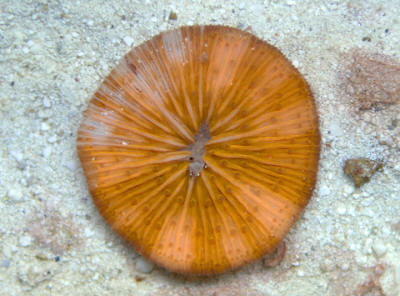
Sick Fungia -02/25/08 Hi. I hope you can help me. <me
too> I picked up a small orange plate coral (Fungia) about
three days ago. I drip acclimated as I normally do any coral I
get. The first night, he seemed as happy as a clam. Mouth was
visible and his tiny little tentacles were extended. Sometime in
the night, something horrible happened. Something in my tank
seems to have snacked on him. <Hmm... no, looks like tissue
recession to me.> It is missing tissue that was fine when the
lights went off. My GUESS is a peppermint shrimp. <not
likely> I also have some blue leg hermits and snails. As far
as fish, I only have a couple bar gobies, a canary wrasse and a
Firefish. After I found him the next day, I quarantined it in the
tank so nothing can get to it. It's now in a slotted breeder
box (with sand in the bottom) held in the middle of the tank by a
magnet scraper (feel free to laugh, but its working). It's
little tentacles still extend, except for the part where the
flesh is injured. I have given it a small piece of Mysis to see
if it would still react to it, and it grabbed hold and pulled it
slowly towards its mouth. However, his mouth is not visible. By
that I mean, it's wide open. Maybe looking at a picture of it
would help (see attached jpeg). That is actually a piece of Mysis
he has in the 'mouth' (the black dot is a Mysis eye I
believe). <It looks like, maybe, the mouth is just very, very
retracted.> Should I keep spot feeding this guy every couple
days to see if he comes back around? <Yes> Do you think
there is a snowballs chance he'll make it?? <Oh yeah, sure
there is. Though these corals are not necessarily easy to keep,
they are capable of some remarkable recoveries. And your coral is
not in all that bad a shape. It's struggling for sure, but
it's far from doomed.> (in the photo, the missing tissue
is towards the edge of the top left) :-( -wuf <Good luck, Sara
M.>
Re: sick Fungia... shrimp bothering
3/2/08 Thank you for your response on my stressed out/damaged
Fungia. However, after several days of it recouping in a
segregated box, I have to respectfully disagree with your
conclusion. Here is why (if you are interested): After keeping
the plate coral in a separate container in the tank and spot
feeding it, it came back to it's 'normal self'. It
was polyping out fully and the mouth was no longer gaping. Not 2
hours after I placed it back in the bottom of the tank, I found
TWO peppermint shrimp sitting on top of it picking at it. Of
course, all tentacles were pulled back in and the mouth was
starting to gape. I immediately pulled it out and put it back
into it's separate area. I also found the peppermints
harassing my tongue coral. That being said, I believe that
peppermints can be more of a nuisance to these LPS's than
some would like to believe. <Hmmm, I must not have been very
articulate with what I was saying before. I didn't mean to
say that these shrimp can't be a nuisance to these corals.
Rather, I mean to say that it's unlikely that they are
actually *eating* the coral. However, there are plenty of other
ways they can be a nuisance. They can steal food (even from out
of the mouths of the corals). They might also be picking at the
coral's mucus. Even just their "standing" on the
coral can cause the coral to retract and be stressed (as
you've seen).> Just my 2 cents...... <Thank you for the
update. Great to hear your coral is doing better! Best,
Sara M.>
|
|
|
Long Tentacle Plate Coral - Green Patches
9/4/07 Hey Guys, fantastic website. <thank
you> Only found it a couple of months ago but has already been a big
insight with many questions answered. Although there are two questions
I have not seem to find the answer to. I have a LT Plate Coral which
has four main calcareous structures one in the middle and three evenly
round the outside, this was brought attached to a small rock about the
same size in diameter. <Without a picture, it sounds like this coral
once had a significant dying-off episode and has since recovered
(leaving behind parts of its former shape/skeleton.)> It is situated
on the substrate. The first question is that it occasionally seems to
have one or two tentacles drop off for no reason, is this normal
regeneration behavior? <That's bizarre. I've never heard of
the tentacles falling off. Are you sure they're actually falling
off and not disintegrating or retracting back into the coral?>
Secondly the calcareous structures have what look like a green algae
growing on them but instead of it being raised on the surface it looks
as though it is eating into the coral!!? <The calcareous structures
are most likely dead coral skeleton that are (or were at one time)
deeply grooved. The algae is probably not eating the coral but growing
out from within the dead skeleton's grooves.> The coral seems
happy enough and is fully extended through the day, but does shrink
right down at night so none of tentacles are at all visible apart form
the very tips. <This is normal.> Your help is very appreciated
and keep up the great work! <Thank you.> Wayne Tunnah <Best,
Sara M.>
Fungiid emergency surgery
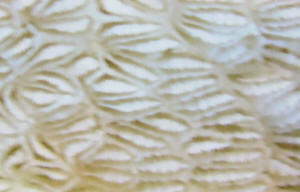
8/30/07 Hi, At my LFS today I saw this beautiful tongue coral
with some issues (mainly brown jelly disease). So the guy there
gives me the coral for FREE. I was really excited! free coral!! He
looked at me like I was crazy for wanting it. He doesn't think
I can save it. Ha! Brown jelly is no match for a Dremel saw! ;-) So
check this out, I took some pre-op and post-op photos. What do you
think? Oh, and I was able to ID it to the species Polyphyllia
talpina using the dead piece of skeleton I cut out. Best,
Sara
<Well done all the way around. BobF> |
.jpg) |
 |
Withering plate coral? Heliofungia... misplaced and
period. 5/23/07 Hello. Like most questioners, I am
newer to the hobby. <Is a blast eh?> I searched this site for an
article on long tentacle plates and was unable to find one. Please help
me investigate this situation. <Hmmm, the monotypic genus
Heliofungia? Please see here: http://www.wetwebmedia.com/fungiids2.htm
and the linked files above re the care of the family, Fungiidae> My
24 gal tank <Very hard to keep this family of stony corals in such
small volumes... just too unstable chem-, phys, biolog- ically> has
been running for about 4 months right now. Ph, nitrate, nitrite, and
ammonia levels have been great all along. I have a 12 lb block of live
rock that is the home for my star polyp coral, which has been doing
fantastic. <And is an organism "high" on a scale of
"winning" allelopathically...> I have a few scarlet crabs
and some snails as well as a green Chromis that seems healthy. I
recently added a Kenya tree and a long tentacle plate coral. <This
species, H. actiniformis, is very difficult to keep...> They are
based at the bottom middle/front of the tank and are receiving plenty
of light and a steady water flow. I feed them Kent's essential
elements once a week along with some ZooPlex every couple of days. The
plate also seems to like krill. Both the Kenya tree and the long
tentacle plate were adjusting well until this week when i noticed the
tentacles on the plate are somewhat withering and shrinking. Is it
dying or is this just a process it goes through? <Is likely dying...
due to the vagaries of collection et al., the small/changeable system,
the presence of the other Classes of stinging-celled life... It would
be surprising if this organism were doing well here...> I also
noticed a bubble at the base of the plate. Could you explain this to
me, please? Elizabeth <This last may be a reproductive/bail-out/last
ditch effort mechanism at reproduction... You will read about this in
searching the above link. Please adapt/adopt a/the process of
investigating new purchases BEFORE their acquisition. Bob
Fenner>
Plate corals... hlth. 5/11/07 I have
a 155gal reef tank with a Birdsnest branching coral, xenia, polyps,
candy cane, hammer, and mushroom corals everyone of those are fine. I
bought a large plate coral it did fine for three months so I bought a
lone tentacle plate <? Is a common name am not familiar with... a
Fungia species? Heliofungia?> it did fine for about two months they both ate and
I read everything I could about them so I would care for them right and
they both at the same time started looking almost like there skin was
being cut or going away and there bones were showing they would
sometimes heal and then it got so bad they both died within a week of
one another. They were not close to and other corals and they were
about three feet from one another and none of my fish picked on them I
watched day and night were they could not see me I do water changes and
put calcium in there and have read about seven books about them. Any
idea what may have gone wrong I would love to have another one. <Not
w/ the paucity of information presented... What re set-up, maintenance,
circulation, water quality tests, foods/feeding...?> My tank has
been set up for about three years. If you could please help. Thank you.
<Please read here: http://www.wetwebmedia.com/fungiidae.htm and the linked files
above. Bob Fenner>
| Crazy Worm? -- 02/27/07 I just got home to my
poor stressed tank and see something very strange on my clump of
dish coral. Two or three corals have developed close
together and it looks like some type of segmented worm going from
one to the other. Or could they be transferring
material? I am not sure if I should get it with tweezers
or not. I am sending a photo along. Thanks, Cathy
<<Well Cathy I can't really make anything out from the
photo, but this doesn't look like a worm to me...it appears
more to be mucus/excrement...and likely nothing to be concerned
about. Regards, EricR>> |
|
Re: Crazy Worm? -- 02/28/07 Thanks again Eric.
<<Hi Cathy!...quite welcome>> I just wanted to follow
up. In fact, it was a brown segmented worm.
<<Ah, thank you for this...I did not get that from the
photo>> Have you ever heard of this before.
<<Mmm...many, many, MANY species of worms about (in excess
of 10,000 I do believe). Do you have any (missing?)
fan/tube worms? Possibly one of these exited its
parchment tube and was actually being consumed by the coral
rather than the other way around>> It was as if it was
going into the mouth of my dish coral. <<Yes...did see
this>> I did yank it out and had it move around
awhile. I could not identify it. <<Too bad you
didn't take/send a close-up pic>> Seemed more like an
earthworm than bristle worm. <<From what I could discern,
yes, would agree it was not a bristle worm>> Thanks again
for all your advice. Cathy
<<Always happy to try to
assist. EricR>>
|
|
|
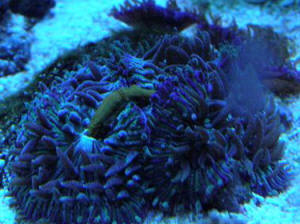
Heliofungia actiniformis tissue recovery 12/1/06 Hi Crew,
<Hey Mohamed, JustinN with you this morning> I have a Heliofungia
which has lost a bit of tissue. The question is will the tissue grow
back? Thanks Mohamed <Well, Mohamed, with regular meaty feedings,
pristine water conditions, and overall good husbandry skills, there
should be no problems. If the recession is not increasing any further,
you should be fine. Hope this helps you! -JustinN>
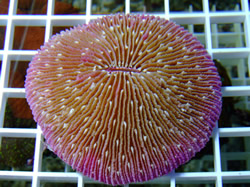
Fungia repanda looks ill... was "stunningly
pink"... 10/27/06 Hi guys, <And gals...>
I've had the Fungia repanda for about 2 weeks now. When I got
it, it was a stunning pink <... very likely dyed... a
suiting homonym for died...> but over the last couple of days it
has got a lot lighter in colour and now is a mixture of light
brown and white. The flesh appears to have sunk into the spiky
skeleton, which is now very obvious, and the mouth is open.
I've been feeding small pieces of lancefish once a week.
<...> The plate I placed on the sand under 216w of T5's
and with little flow around it. My calcium is 420 and Alk is
6dkh (been at this level for months!! currently using
SeaChem to try to raise it to around 8dkh). I would be
most grateful if you could shed some light on what is
happening and what I can do to restore the coral to its former
glory. <Can't be done... You've been swindled. Please
read here: http://www.wetwebmedia.com/dyedcorals.htm and the
linked files above. BobF>
Cheers
Kev, Yorkshire (UK) |
| Re: Fungia Repanda looks ill... 10/29/06 Hi Bob, <Kev> thanks for
your reply, it certainly surprised me. I've included a link
below to the site where I bought the coral and it includes a
picture of the coral when I first got it. Do you think
it has been dyed? _Purple Plate Coral :: Archived Coral
( Already Sold Items ) :: Archived Items :: Reefstore_ (
http://www.reefstore.co.uk/cart/Pu
rple-Plate-Coral-pr-17083.html) <Mmm, no... or at
least not by this photo. The flesh itself is what I had taken as
being pink... not simply the light red coloring along the edge of
the skeleton shown. This can indeed be "just natural">
A forum member suggested the plate could be suffering due to
chemical warfare. I have a group of 3 Sarcophytons about 8
inches away on a higher rock and several small Capnella
frags about 4 inches away. Could these be causing a problem?
<Oh yes... along with the fact that these and most all other
Fungiids are not easily kept in/under aquarium conditions
period> I noticed during the night a Halloween crab sat on the
plate. Could this have caused the problem? <Yikes...
Yes> Thanks again for replying. Kind Regards Kev <Welcome...
You have read re Plate Coral husbandry on WWM I take it.
BobF> |
|
|
|
|

