|
FAQs about Fungiid Coral Health/Disease
4
FAQs on Fungiid Disease:
Fungiid Disease 1, Fungiid Disease 2, Fungiid Disease 3,
Fungiid Health 5,
Fungiid Health 6, Fungiid Health 7,
FAQs on Fungiid Disease by Category:
Diagnosing,
Environmental (Pollution/Poisoning, Lighting...),
Nutritional, Social (Allelopathy),
Trauma,
Pathogenic (Infectious, Parasitic, Viral)
Predatory/Pest, Treatments
Related Articles: Coral Pests and Disease; pests, predators,
diseases and conditions by Sara Mavinkurve, Fungiid Corals,
Related FAQs: Fungiid
Disease 1, Fungiid Disease 2,
Fungiid Disease 3, Fungiid Health 5, Fungiid Health 6, Fungiid Health 7, & Coral Disease, Fungiid Corals 1, Fungiid Corals 2, Fungiid Identification, Fungiid Behavior, Fungiid Compatibility, Fungiid Selection, Fungiid Systems, Fungiid Feeding, Fungiid Reproduction, Stony/True Coral, Coral System Set-Up, Coral System Lighting, Stony Coral Identification, Stony Coral Selection, Coral Placement, Foods/Feeding/Nutrition, Disease/Health, Propagation, Growing Reef Corals, Stony Coral Behavior,
|
|
|
Fungia disease or normal behaviour??
1/9/11
Hi, Bob I'm literally impressed for the tons of useful
information that I can find in you're website and in your
book.
<Am glad they are of use to you>
I've browsed a lot within the forum for different
issues/advices and I often fond what I've been searching for
but not this time..
Before asking about the problem that I'm facing with my
Fungia, let me first briefly introduce my reef tank and it's
values:
tank: Askoll Tenerif 120 (220 liters) + sump 80 ltr
light: ATI Sunpower 6*T5 (54 Watt). 4 white ATI, 1 ATI Aquablue
Spezial & 1KZ Fiji Purple
Skimmer H&S F2001
Zeolite reactor (XAQUA method)
Carbon in the sump (changed once a month)
Anti-phosphate resin in the sump (changed every 45 days)
Living Rocks 60 kg
Clima: Resun CL450
Salt: Tropical Reef Pro
H2O values:
Density 1025/1026
Temp 25°/26° Celsius
PH 7,9 (morning) 8.3 (night)
KH 9
Ca 450 mg/l
Mg 1300 mg/l
NO2 not present
NO3 not present
PO4 not present
<Mmm, both NO3 and HPO4 are essential nutrients...>
Living stocks:
1 Zebrasoma veliferum (M)
1 Labroides (S)
1 Pseudocheilinus hexataenia (M)
4 Anemone BTA
4 Amphiprion ocellaris (M/S)
1 Stenopus Hispidus (M
1 Paracanthurus hepatus (S)
1 Siganus vulpinus (M)
1 Pseudanthias Squamipinnis (M)
1 Chromis Viridis (S)
2 Turbo snails
1 Pagurus zampe blu
1 Salarias Fasciatus (M)
1 Diadema
2 Arcasther typicus
LPS/SPS (sorry for the not-precise scientific names...) :
Trachyphyllia geoffrey
Pachiclavularia violacea
Pocillopora damicornis
Seriatopora caliendrum
Euphyllia Divisa
Turbinaria mesenterina
Acropora (white, brown, violet, yellow)
Fungia
The tank is 3 years now and I didn't have major incidents
(except the dying of 4 fishes due to a sudden water oxygenation
lack, caused by electrical issues).
<Yikes>
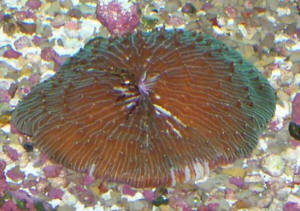
By some days now I've noticed that my Fungia during the first
hours of the morning it's quite big and seems that it has
been inflate (see picture 1) .
Yesterday morning it seems like a football ball!?!??!
After some time it assume the right shape (see picture 2)...
Is it as normal behaviour or do I have to worry about it?
<Is not normal... something is amiss here. Could be nutrient
deprivation (as stated above) or allelopathy w/ other
Cnidarians... I would... Oh I see summat re this below>
P.S.: I didn't directly feed my corals because I think that
they directly get what they need from the fishes' food &
waste. Is it ok or do you suggest me to feed my LPS/SPS too??
<I do indeed suggest this. Oh, have an article on Stony Coral
nutrition, but this is out, awaiting publication. Do read the
FAQs files though: http://wetwebmedia.com/corlfdgfaq3.htm
and the linked files in the series above.>
I'll really appreciate your feed backs/advice :)
Regards,
Leonardo
<And you, Bob Fenner>
|
|
[1].jpg) [1].jpg)
|
Fungia Coral Regeneration 9/24/11
Good Evening WWM Crew,
I bought a Fungia about a year ago. Approximately, 6 months ago, my 90
gallon tank experienced a bout of chemical warfare following the
addition a new coral. The Fungia was one of the innocent bystanders
caught in the crossfire. In a matter of 48 hours, the Fungia lost
approximately 2/3 of its tissue. When I realized what was happening, I
added a fresh bag of carbon to the sump, removed the 2 warring corals
and did several water changes to reduce chemical toxicity levels.
Immediately things settled down. The Fungia has since survived and
appears to be flourishing.
However, 2/3 of the dead skeleton is still exposed. The remaining 1/3
of the Fungia tissue appears to be growing outwardly. Can I cut the
dead skeleton away from the remaining Fungia tissue or will the Fungia
eventually re-cover the dead skeleton?
<Could do either, but I'd opt for the second choice. Can indeed
regenerate live tissue over the skeleton>
Will cutting away the dead skeleton increase chances of the Fungia
regenerating into its original circular pattern?
<Mmm, not as likely as doing what you can to reduce algal growth,
foster growth over the exposed skeletal remains, no>
As always, thank you for your help!
Sincerely,
Tom
<Welcome, Bob Fenner, who should have asked re iodide-ate usage
here; and will now
|
Irregularly Shaped Tentacles on Fungiid
12/21/2009
Good Evening,
<G'morrow now here>
I recently received a coral from a fellow reefer at a local fish
club (M.A.R.S.)
<Oh, up in Sacto. Was just up there a couple mo.s back giving
a pitch>
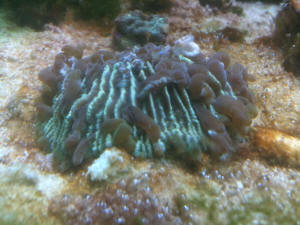
and am puzzled by the anatomy of it. The coral in question is a
Fungiid (please see attached picture). This is the second Fungiid
that I have owned; the first still doing very well after 5 months
(sticks to a regular cycle of inflation / deflation, eats well
every other day and has grown). What I am puzzled by is the
irregular tentacle shape on the new Fungiid upon arrival. The
tentacles themselves each individually look unique. They are
rather thick toward the base and stay that width for roughly 3/4
of the total length. Some of the tentacles then thin to a very
fine point. On others there is a fine line of a contrasting color
running up the side, almost like there is a stitch where the
tentacle had been sewn up. Some of the tentacles have multiple
bumps toward the ends and have a twisted appearance (reference
the far right edge in the photo). The tentacles have not
undergone any changes in shape as a result of being placed in my
tank.
The coral does not seem interested in feeding on Mysid shrimp nor
silverside and I am rather concerned about this as well, not
eating is never a good sign. It may also be important to note
that the coral in question is one of three fragments created from
a single larger polyp. I am unsure how long ago the fragmentation
was performed;
<Quite a while, considering the near-circular (regrowth)
appearance presently>
however, the skeletal disk is very near circular and a mouth has
developed and appears to be structurally mature.
This leads me to believe the coral has recovered from the initial
trauma of fragmentation.
Now that you have an idea about what I am viewing we come at last
to my questions: Are there Fungiids or corals in general in which
the polyp tentacles are non-uniform?
<Mmm, not really... sometimes appear to be more
"miniaturized" toward the center, but otherwise about
the same conformation>
If not, then is it likely this be a mutation or disease of some
kind?
<The latter is my guess... this environment is trouble.
Obvious BGA about where the Fungiid is placed... either the
predisposing conditions are unfavourable to the Coral and/or the
Cyanobacteria is poisoning it>
I have understood that generally coral polyps should have
tentacles which are symmetrical, with each one identical to the
next.
If this is a mutation, should this coral *not* be propagated and
distributed to others?
<Nah; you need to study, fix whatever is allowing the Cyano to
predominate here>
I want to preserve and propagate healthy specimens that are true
representations of life that exists in the natural reef.
Your insight and assistance is most appreciated.
Best Regards,
James
<Umm, start here:
http://wetwebmedia.com/bluegralgae.htm
and the linked files above...
And have you read on WWM re Fungiids in general, their systems?
You should.
Bob Fenner>
|
 |
|
Long Tentacled Plate Coral, losing, gen. --
10/31/09
Howdy once again.
<Erik... where's the prev. corr.?>
My Plate Coral has gotten worse. I originally had it in a fairly
linear flow of strong current. It did not appear to like that
location, so I moved it to an area where the tentacles can wave
back and forth gently.
The area that received the heavy linear flow is not dead and
there are small pods crawling on it. I assume they eat the
decaying flesh.
<... no>
However, I have a Blue Zoanthid frag that closed over a week ago
and will not open. I have seen these pods on it as well.
[cid:image003.jpg@01CA594E.E4504F30]
Rough picture, but you can make out two long antennae, two short
tail lines. This one is rather darker than most. The others are
very clear and hard to get on camera.
Water
79 F
NH3 - 0
NO2 - 0
NO3 <10
Alk - 2.0 milli equivalents per liter
PO4 - .01
PH - 8.3
Ca - 450
<[Mg]?>
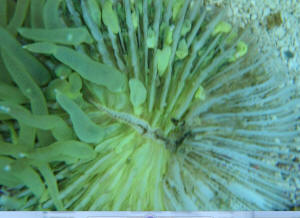
Here is the how the plate coral looks now.
[cid:image007.jpg@01CA594E.E4504F30]
Is there anything I can do to help this coral or the Blue
Zoanthid?
<Likely so...>
All my other corals are doing extremely well. They are growing
strong and in the case of one Paly are spreading around the tank.
My Xenia, Tubastrea, Duncansoma, Palys, Star Polyps are all going
strong and spreading. I am at a loss to figure out what steps to
take. I even had an early Paly attacked by a crab and the body
mass of the Paly's disappeared into the reef, it has since
popped up out of the coral sand is now spreading.
<Not atypical... and likely this is the "winning"
organism at the others expense here>
I feed Oyster feast every other day or third day.
<... You need to read re the nutrition of the life you're
keeping>
Kind Regards,
Erik Hayes
<And here: http://wetwebmedia.com/cnidcompppt.htm
and the linked files above... Bob Fenner>
|
  |
Re: Pistol Shrimp Trapped, Fungiid hlth.
4/16/09
Boy was I wrong!
<Ahh!>
I took out the rock with the suspected pistol shrimp and carefully
looked at the hole where I thought he was residing. Needless to say,
The blood red carapace was actually the empty shell of a razor clam.
Back to trying to find the location of the mysterious clicking.
<I see>
Since I have your rapt attention, I would like to ask your opinion on
one more item developing in my tank. My plate coral (Fungia) has
started separating from its skeleton, inflating itself to let the
current assist in
separation. I know that this is one way that they can ultimately
reproduce this way, but should I be concerned that something else might
be causing this?
<Yes... Look to other cnidarians nearby, or not... Ones may well be
mal-influencing this Fungiid>
The water conditions are acceptable with low nitrates and nitrites. Any
suggestions are, as always, greatly appreciated.
By the way, Bob, let me know if you'll be driving through Irvine
soon - it's Guinness time!
<I'll say!>
Regards,
The other Scott F.
<BobF>
Re: Pistol Shrimp Trapped, now Fungiid hlth.
4/16/09
Thanks Bob.
There are no other life forms near the plate coral to cause this kind
of reaction. Should I continue to target feed it in hopes that it will
either return to health or reproduce, or should I just let it go to see
what
happens?
<I would target feed Fungiids... Please read here:
http://wetwebmedia.com/fungiidfdgfaqs.htm
and the linked files above. BobF>
Regards,
The other Scott F.
|
Cycloseris algae removal -- 03/03/09 hey
gang, I recently bought an orange Cycloseris online, when it came
in I opened the box and to my dismay it had two spots covered in
algae. <It's about dead if not there already... Write,
call, ask for credit, replacement> A little slice of dead
tissue for lack of better wording was covered in algae and a spot
by the corals mouth was also covered in algae...looks like a hair
algae to me but im no expert. After searching through your great
site looking for ways to remove algae on the corals dead tissue I
found no answers so I used my great man instinct...and didn't
ask for help. I took a toothbrush and cut down a lot of the
bristles so it would be more course. <Mmm, no... not a valid
course of action here...> I scrubbed the spots plagued with
the green nuisance and did the best I could while doing my best
not to harm this little creature. I got most of it off but today
I looked at it and it appears as if most of it grew back. It is
feeding (frozen Mysis shrimp) and its tentacles are present all
day, by the looks of it I would say that it is doing alright. My
only questions are is there a better way to remove it? <Not
really a useful question...> and if so how? any other
suggestions as always are greatly appreciated!! thanks, -Alex
<If anything Alex, I'd fragment this Fungiid... see WWM
re... outside the system... and toss the algae-present pieces...
they're shot. Bob Fenner>
|
 |
|
Plate Coral Problems 02/15/09 Hello to all. I
haven't had to write you for quite a while as all has been
going well in my system. Parameters: 125 gallon mixed Sps and
LPSs, SG= 1.023, DKH= 10, Nitrate = 1 ppm, Phosphate = 0,
Ammonia
= 0, Temp = 74 degrees F Water change = 30 - 40 gallons bi
weekly, Filtering = 2 Eheim wet dry filters + 4 oscillating power
heads No skimming and no UV <74F, SG of 1.023... wet/dry
filtration and no skimming?! ...man, you're killing me! >
plenum under 4" sand bed 150 lbs live rock covered in
coralline algae and sponge Many little critters and corals along
with main stock of LPS (Even visible copepods in the sand bed) I
have had this short tentacled plate coral for over a year.
Recently my blood shrimp pair set up house in reach of the plate
and lo and behold, the instant the plate coral catches some food,
the shrimp dive on him and steel it. I created a cage so that I
could feed it in peace but, I have noticed damage to the tissue
around its "mouth". My assumption is that the shrimp
are still stealing even after the coral has actually consumed the
food. This is supported by me catching one with its pincer half
way down the feeding orifice. The question is this, what can I do
about the tissue damage? There is already algae growth on the
exposed skeleton. The coral is still feeding and otherwise
appears happy but I am concerned about the tissue damage since it
does not appear to be regenerating and is not likely to grow over
the algae. I actually read an article about fragging these corals
and was wondering if I should try it as a last ditch effort to
save it. If I can successfully frag it, I can move the pieces to
the other side of the tank away from the shrimp. <Well, when a
Fungia loses its mouth, it's a challenge to get it to
recover, but it's certainly not impossible. It just needs a
lot of TLC... in the long term though, sounds like you might have
to move those shrimp. Cheers, Sara M.>
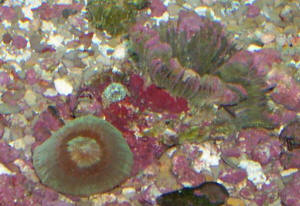
Re: Plate Coral Problems 02/16/09
I thought I would send on some pictures of the plate I want to
save. I also include a picture of a "rescue" brain that
although the main portion of the animal failed, appears to be
doing something similar to the Fungia described in your articles
by producing a "daughter" coral.
<I think you're referring to when Fungia produce
anthocauli. What's going on with your rescue Mussid might
look similar, but it's not the same deal.
What happens sometimes with the open brain corals... when they
die off, but there's a glob or lump of healthy tissue left...
they can regrow. But they don't regrow into the dead
skeleton. They just start growing a whole new skeleton. So
it's not so much a true "anthocauli" because the
"offspring" is not really an offspring at all, but the
parent colony regenerating the small bit of it that was left
after most of it died. With the Fungia and anthocauli, the whole
parent colony dies off, but springs these offspring.
There are some reports though, that Fungia might produce
anthocauli even when they're not dying. In any case, it's
a different scenario than when, rather, you just have a
regenerating bit of coral. Do you understand what I'm
saying/describing?>
I have decided to leave that one alone and see what happens. The
picture of the plate shows where the algae has begun growing on
the original damage by the mouth. This whole process is now
months old. Just wondering if I should
continue to leave it alone.
<I would just leave it alone... unless you can very easily
pull the algae off. I've had this happen to me with Fungia at
least twice before. They can come back if you just be careful
with them (keep your water quality high... good feeding,
lighting, water movement, etc.).
Cheers,
Sara M.>
|
 |
|
Re: Plate Coral Problems
02/19/09
Hi Sara and thanks again for the advice on the plate coral. As
for lower temp and salinity, this is not the only method I use
just an added stabilizer. The two spray bars and four oscillating
powerheads pretty much ensure rapid turn over of the water in the
tank along with providing surface turbidity. Since it is also
known that lower salinity and temperature increases the amount of
dissolved oxygen that water can hold, I keep it at the lower ends
of the acceptable parameters.
<Ok, but... why do you assume that having maximum dissolved
oxygen is more important than having ideal temperature and
salinity? Well, in any case, it's your system.>
I realize with a larger volume of water I should probably not
worry about a few degrees of temp or .002 increase in SG but, it
does help me maintain peace of mind. Thanks again for your rapid
responses and I will continue to
follow your postings. Keep up the good work. ;)
<Same to you, thanks.>
Sincerely
Beth Beardsley
<Cheers,
Sara M.>
|
Tongue Coral, hlth., data shortage, reading -
02/08/09 Dear WetWebMedia; I have recently added a tongue
coral to the sand in my tank. Within the last few days it has developed
a large "jelly" spot on the side, it is all gooey in that
area <Mmm, bad sign. Perhaps just touched roughly in this area>
We have been feeding all the corals twice per week with the liquid
phytoplankton and keeping the coral lights (220 watts) on for 8 hours,
as recommended by the aquarium shop. The other corals in the tank seem
to be doing fine. We have a 50 gallon tank, two fish, some peppermint
shrimps, a couple of starfish, and some scooters. Should I be doing
something more for the tongue? Thank you. ~Julie Santa Rosa, CA
<Mmm, don't know from the data presented... An image of the
Fungiid might help... knowing water quality tests as well as the types
of foods... Please read here: http://wetwebmedia.com/fungiidae.htm The
linked files above: Systems, Feeding... Bob Fenner>
Fungia recovering? 2/5/09 Dear Crew,
<Carolyn> Sorry to pester you twice in one week! I rehomed a
green Fungia coral last August which lived in the tank seemingly
happily until December when I noticed that it wasn't expanding its
polyps. It went from being quite a fleshy, mobile animal one week to
what looked like a coral skeleton that you sometimes see on sale,
although it retained its green colouration. Sad at its apparent loss, I
couldn't bring myself to remove it from the tank so there it
stayed... last night I was feeding the tank as normal and noticed that
the Fungia had opened its mouth and appeared to be feeding on the
lobster eggs I'd just added. Sure enough, when I checked again
later the mouth had closed again. Either I'm seeing things or my
coral has exhibited behaviour that I wasn't aware was possible?!
<Is very possible that some life remains, Fungiids can look
"about all gone" and make comebacks> The water parameters
are: ammonia/nitrite/nitrate 0 phosphate 0 calcium 420ppm magnesium
1320ppm pH 8-8.2 dKH 14 salinity 1.025 temperature 25 Celsius (77F)
I'm concerned that the dKH is high and wondered if that might have
affected the Fungia? <Mmm, maybe a factor> I dose with iodine
daily <I would only do this weekly...> and use Salifert all in
one additive weekly as required. Many many thanks for once again
reading my ramblings, Carolyn
<Thank you for sharing. Bob Fenner>
|
|



