|
FAQs about Bivalve Mollusk
Behavior
Related Articles: Tridacnids, Bivalves, Mollusks,
Related FAQs: Bivalves 1, Bivalves 2, Bivalve
Identification, Bivalve
Compatibility, Bivalve
Selection, Bivalve Systems,
Bivalve Feeding, Bivalve Disease, Bivalve Reproduction, Tridacnids, Tridacnid Clam Business, Tridacnid Identification, Tridacnid Selection, Tridacnid Compatibility, Tridacnid Systems, Tridacnid Lighting, Tridacnid Placement, Tridacnid Feeding, Tridacnid Disease, Tridacnid Reproduction, Flame Scallops,
|
|
|
Turkey Wing Bivalve fell off the rock!
2/19/19
Hi,
<Morning. Mandy>
I have some man made live rock from Florida,....and it is as the gentleman told
me when we spoke, all covered in filter feeders.
<Neat!>
I am having a wonderful time looking very very close and seeing all the fan
worms and other filter feeders on it. Some are so tiny!
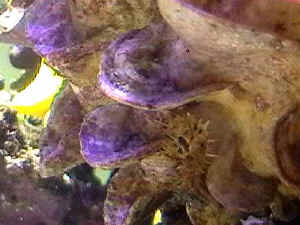
Like this hydroid colony. Some are bigger....and the clams are huge!
It also came with 4 clams. I believe they are Turkey Wings....there are two huge
ones, one middle size one and one tiny one.
<Yes, they are Ark clams>
I feed Coral Frenzy coral food 2 times a week,...with the power head on and the
filter off for about 1/2 an hour.
<Good>
I never see any of these clams open, I see a little white tube sticking out of
one of the big ones all the time and they do shift their positions sometimes.
But other than that, they don't seem to ever open up. Maybe Turkey Wings don't
open?
<They do, when feeding or moving but remain most of the time closed>
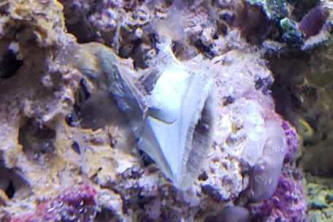
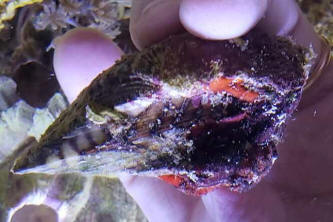
I am worried that the one that fell off the rock might die and kill off my
tank......how can I tell if he's dead or alive?
<When they die, they get loose/opened>
He's very heavy, if that helps, and he's very tightly close up. I can't even see
where the foot fell off!
Here are pictures, let me know what you think, I don't want to take him out if
he's not dead, but don't want him to die in the tank either.
< Take it out of the water for a moment and do a simple “smell test”, it should
have a fresh ocean smell.>
Hope these help,....the other clams look just about the same. Are they supposed
to OPEN up? They do react when I get close to them,....but I never see any sign
of them opening up any appreciable amount. }
<As long as they react when you touch them, they are likely fine.>
Thank you very much again,
Mandy <Welcome. Wil.>
|
  |
|
Re: Turkey Wing Bivalve fell off the rock!
2/19/19
Thank you, Wil,!!
<You’re welcome!>
I just went over and reached up over the clam to check his smell, and he moved!
He saw me coming!
<Ahh… great!>
They don't even have eyes, do they??????
<They don’t have eyes, but photoreceptor cells… that’s why it “saw you coming”>
So, I guess he's ok. I put him up in the middle of some rock where there is a
nice soft flow of water.
<Good>
Will he make a new foot?
<Did you actually saw the foot fall? >
Mandy
<Cheers. Wil.>
Re: Turkey Wing Bivalve fell off the rock! 2/19/19
I don't know, I saw the part that was attached to the rock,...I sent you a
picture. It's still there.
<Mmm… that looks like something else, I'd try to remove it with tweezers...I
think your bivalve is fine. please keep me/us posted. Wil.>
Re: Turkey Wing Bivalve fell off the rock! 2/19/19
But the clam was attached to that! Wasn't he? How else did he hand onto the
rock?
<I see;….as long as the clam looks fine I wouldn't worry, if it has lost part of
the appendage,
it will heal on its own in a few days; just keep an eye on it and if possible
remove the remains on the rock. Wil.>
Re: Turkey Wing Bivalve fell off the rock! 2/19/19
I looked bivalves up on Google and the Encyclopedia Britannica had a really good
article on them,....it said that some like to live in the sand, others like the
rocks and some of those that choose rocks make themselves a kind of shoe with
glands on their foot....to hold on. I think what I see is what is left on the
rock, It's a hollow shoe that's attached to the rock by some fibers. I tried to
remove it, but it's really on there tight, and it really is just a sheath. The
inside is empty. Like an empty shoe. How awesome is that!
Here, I copied the important part for you.
"A triangular form, ventral flattening, and secure attachment to firm substrates
by byssal threads (byssus; proteinaceous threads secreted by a gland on the
foot) have allowed certain bivalves to colonize hard surfaces on wave-swept
shores. The byssus is a larval feature that is retained by adults of some
bivalve groups, such as the true mussels (family Mytilidae) of marine and
estuarine shores and the family Dreissenidae of fresh and estuarine waters. Such
a shell form and habit evolved first within sediments
(endobyssate), where the byssus serves for anchorage and protection when formed
into an enclosing nest. "
https://www.britannica.com/animal/bivalve here is the link to the article.
I think this article is saying that his foot secreted a fiber which they use to
make a safe enclosed space for their "foot", so the foot is safe from predators
and held firmly to the rock.
I guess he just decided to move and that was him letting go of the shoe he made
for himself. I never realized how much the Encyclopedia helped with research.
It's so "Old school", but the article was great.
I guess we both learned something new tonight!
Have a good night and thanks for trying to help.
Mandy
<Thanks to you for sharing, Mandy! Wil.>
|
|
Clam question.. And Valenciennea nutrition --
11/12/09
Salutations to those who worship at the Marine Altar,
<Heeeee! All bow down>
First I would like to give you an earnest thank you from the
bottom of my heart for all that you do in educating the
masses.
<Am frequently wondering what/where the reward is otherwise...
Keep looking for that paycheck!>
I only wish the
LFS's in my area followed your advice as gospel like I
do.
<Mmm, collectively we have MUCH more experience than
"they". Even just I myself have been involved more than
full time actively involved in the trade for more than 40
years>
They currently have a 14" nurse shark in a 55 gallon
tank-
<Ugh!>
enough to lose my business forever I am afraid. My question is
simple enough, but I will give you some background on my
setup.
75 gallon marine running for 2.5 months
7" DSB
120 lbs. live rock
79 degrees
PH 8.3, ammonia, nitrite, nitrate all 0.0
calcium 450. I dose the tank with Iodine and chelated Iron for my
bumper crop of Gracilaria. (Side question- when I add these
supplements after a water change do I dose based on total tank
volume, or based on the new water added to system?
<The calculated, best guess as to total actual water volume;
i.e., deduct for displacement by the DSB et al.>
I have been dosing based on new water only....)
<Likely this is fine as well>
Eheim magnum
<Mmm, Eheim and Magnum (MarineLand) are too different
companies>
canister filter with carbon and filter floss (Changed and cleaned
weekly for water polishing purposes only)
Remora C protein skimmer cleaned daily removing 3/4 of a cup of
tea colored skimmate each day that I attribute to light
bio-load
3 Maxi-Jet 1200 powerheads
Cora-Life Power compact hood with (2) 96watt 10,000K bulbs on a
12/12 light cycle
Livestock is as follows- (2) 1" Tomato clowns, (1) 1
1/2" Coral Beauty and 1 4" *Valenciennea strigata** *(I
will explain later)
Colony of fast spreading Star polyps,
<Do keep these steadily trimmed back>
various sponges and feather dusters growing and spreading like
wildflower,
<Neat literary device, metaphor>
number of clams and scallops that came encrusted on liverock, 5
snails, 5 hermits, and a few different types of yet unidentified
macro-algae growing on rock.
<Great diversity!>
My question concerns one of the larger clams that came on the
liverock.
This clam was extremely active as far as opening and closing
went, but differed in the respect that it was attached to the
rock seemingly from the front inside of the clam, instead of the
side of the shell being attached to the rock like the other
clams. I feed the clams and feather dusters every few days with
Phyto-Feast, which is 1- 15 micron concentrated live micro algae
food. A few days ago I adjusted a power head from the back of the
tank to the front, so the visible parts of the rock would get
better flow, and it was in a position where the clam could barely
feel it, as opposed to not feeling it all before moving. The next
day i noticed the clam was missing, and all that remained was a
grey colored "foot" where the opening to the clam was
previously attached. I looked high and low for the shell, and
then noticed the clam had moved directly into the blast zone of
the power head! I was unaware it could move like that,
<Some bivalves are very mobile indeed>
and wondered if that foot was integral to the clams heath in any
way, and should I be concerned that the clam is directly in the
flow of the power head?
<Mmm, no>
Or does the clam know what is best for itself and I should leave
well enough alone?
<If it can move...>
I also want to explain that your site is my home page, and I
often spend time reading about various species and have done so
for years.
Unfortunately before finding your site and Mr. Fenner's CMS
and Mr. Calfo's RI I was victim to poor advice coupled with
lack of research- much to the dismay and demise of previous
livestock.... Enter my desire to own some sort of Gobioid
creature for my underwater utopia. I swear I researched each and
every specie only to purchase a *Valenciennea strigata*, and upon
quarantining the fish and logging on to Wet Web Media I realized
my serious error in research. I felt like someone with a Black
Tipped reef shark in a 20 gallon tank with a dozen Cleaner
Wrasses for food.
<Heeee! Not that bad!>
Fast forward to me feeding him all sorts of standard aquarium
fare- Mysis, pellets, and after reading that they fed on pods I
bought Arcti pods- only even after watching him feed on all the
above with enthusiasm he was still wasting away. I thought he was
done for and went on fishbase.org and saw they also fed on nano
plankton as well. My last ditch effort was mixing Mysis,
Phyto-Plex, Arcti- pods, spectrum pellets, Oyster Feast, and
Spirulina together and freezing it. I then chopped it into cubes
and lightly covered it with sand in his favorite forage zone. He
is now filling out at an incredible rate, and is a completely
different fish- color wise, not hiding all the time and returns
to the spot with ferociousness every time i stick the frozen
goods there.
<Ah good>
I think adding the micro organisms was essential to his health
and wanted to share that information- freezing was an important
part as there was no other way to get oyster eggs and micro algae
to settle in one place in the substrate to ensure he ingested
them.
<I will share/post your statements. You have saved many
animals through your investigation, efforts and sharing>
Sorry for such a long winded email, but it is the first time I
wrote after years of admiring.... I also wanted to ask if a 30%
water change a week is too much?
<Not too much; particularly if the water is pre-made, assured
of consistency ahead of use>
Thank you very much for all you do in tolerating the ignorant
masses like myself who think they know everything only to find
the error of their ways at the expense of a fish's life- and
here's to not making those mistakes ever again!
'ciao!
<Thank you Leon, mi bello. Bob Fenner> Re:
native marines, art. by NealeM 2/9/08 It'll be the
usual 2500 words, plus or minus. I think I wrote it for PFK, but
they've pretty much dropped coldwater stuff apart from
goldfish/koi. Because, I think, the recent laws to stop the
spread of exotic species to the UK. Anyway, I can't find the
damn thing, but will look. Yes, I have photos. <Ahh, very good
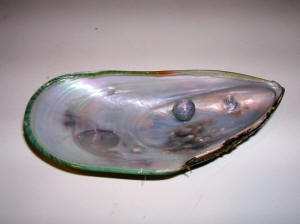
indeed!> By the way, I attach a photo of a pearl I found in
the Perna viridis I had for my lunch the other day. Might amuse.
Have no idea if Perna often make pearls; they're not
native to the UK so I haven't really looked at them much.
<Have seen such encrustations in many bivalves... and a few
gastropods> Cheers, Neale <Are you keen to come out
with us for Interzoo and/or diving in Jordan and Egypt in May?
BobF>
|
|
|
Old Clam 10/29/07 Bob, Crew, <Neale> An
interesting news item on the BBC. World's oldest animal is a marine
clam (apparently Arctica islandica though it doesn't say). Probably
says a lot about the way the world works that we are fishing for these
clams in the North Atlantic to chop up and use in seafood soups.
Surely, no fishery that demands 400-year old livestock can possibly be
sustainable? http://news.bbc.co.uk/1/hi/sci/tech/7066389.stm
<Interesting> I do wonder whether corals get older than this; I
always assumed colonial corals lived a very long time. <Me too...
depends on the criteria used to measure, discern for sure... What is
the age for instance or our individual cells? Tissues, organ systems?
Aren't we as old as our mothers, and their mothers into the past
ova?> Cheers, Neale <And to you, BobF>
Oh No! Another Flame Scallop Question! Fdg., beh.
3/16/07 Hi Guys and Gals, <Marti> I have been reading (a lot)
over the past year and a half, before finally starting my salt water
tank in January. Included in the reading list was The
Conscientious Marine Aquarist (of course!) and Aquarium Corals by
Borneman, among many others. I have also spent many (happy) hours
researching specific topics on your wonderful web site. OK, enough with
the praises, now on to my question. After my aquarium had
been running with live sand and live rock for about two months, I was
given a Flame Scallop as a "present". I never would have
bought one, or even patronized a LFS that sells them. But there he is,
sitting in my tank. I have been feeding him a mixture of DT's live
phytoplankton and Cyclop-eeze (per recommendations I found on this
site) with a turkey baster, leaving the filter and powerhead off for
1/2 hour while doing so. My question is, How do you know if
they are eating? <Mmm... principally behavior/appearances... that
the animals stays open, colored... and alive> Do they move their
jaws (shell) up and down? <Sometimes... in reaction to shadows,
animal movement near by> Do they suck in all their tentacles like
little hungry hands? <Mmm, no> Please pardon me for sounding so
stupid, but I really appreciate all the helpful advice you have given
everyone, and I know you can answer a "simple" question like
this. Best Regards, Marti <Adding a good sized refugium... in
addition to your current feeding efforts... is about "it".
Bob Fenner>
Flame Scallop creating electricity? - 1/19/05 Hello from the
"Blue Tarp State"! <Hello from the Sunshine State!> I
am totally in love with your website ... refer to it almost
everyday. :o) <Great to hear, Lisa> After
surviving four hurricanes, and almost a month without electricity, I am
ecstatic to say that I lost NOTHING in my tank, thanks in part to you
guys (and my handy generator!). <Awesome> I have a question about
my 8-month old flame scallop ... he's very content and looks
healthy. <Cool. This animal tends to be on the difficult side of pet
fish keeping. Here is an excellent article written by a friend of mine:
http://www.advancedaquarist.com/issues/july2002/toonen.htm>
I noticed the other day that part of his fleshy, red mantle
"flashes" constantly. It's a very thin area, almost the
width of a needle, and it changes from bright red to white in a matter
of a nanosecond, and back again. <This seems to be fairly hard to
explain as there is not much in writing that I could find, but I do
know that in past discussions it has been stated that this is a flap of
tissue (membrane) that is moved back and forth. It may actually reflect
or refract a portion of light which may give it this glow or look like
a quick electric arc. My feeling is that it is not electrical in any
way.> Have any of you seen this reaction? <I have> If so, do
you know why they do this? <Oh many possible reasons. Simple
anatomical structure (just happens), food attraction ( planktonic
animals are attracted to light), possible a deterrent to fish
predators....these would be my guess but again, very likely just a
result of respiration or a feeding.> It doesn't seem to be a
problem, but I was curious as to what it means, if anything. <Not
hurting the animal at all. I have seen this done in the wild by this
species ~Paul> Thanks for everything! Lisa C.
Florida
|
|

