 |
|
| Home | Marine Aquariums |
Freshwater Aquariums |
Planted Aquariums |
Brackish Systems |
Ponds,
lakes & fountains |
Turtles & Amphibians |
Aquatic Business |
Aquatic Science |
Ask the WWM Crew a Question |
| Please visit our Sponsors | ||||
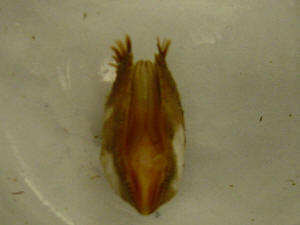
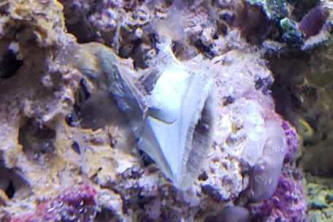
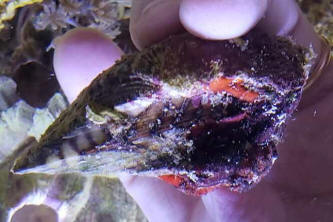
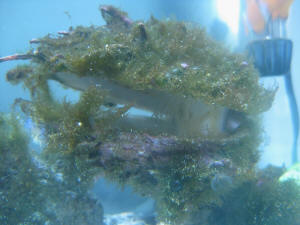
Something eating my clam 9/10/09 Re: Something eating my clam Flame scallop diseased? Scallop Mold; Starfish Predation....and 4x4 livestock 3/4/07 Thank you for writing me back Adam J. <Welcome, we try to respond to all questions within 24 hours.> I had inquired about grayish white tufts growing on my flame scallop. <Right I vaguely remember that one.> They remind me of mold. Someone told me that they are just normal growth on a scallop, but in the three months that I have had him, I never saw them until recently. <In short mold/fungus is rare in marine aquaria and I'm not familiar with any type colonizing on flame-scallops. I can't really read into more without a picture or seeing the animal in person. What I believe to be happening is deterioration, that the animal is slowly starving and dying which is common with this species in marine aquaria. Most captive systems can simply not support them and they starve within months. Fishless refugiums and dosing of phytoplankton can be helpful in prolonging this process but usually....they still perish. What is your set-up like? What are your water-parameters?> I also now have a problem with an orange star that is in my tank. <Okay I will see if I can help.> Recently it has become very battered and may even be on the brink of death. It appears as though someone has been nipping at him incessantly but I have yet to catch the culprit. <Do you know what type of star it is, most are very sensitive (some more than others) to water quality.> In my tank I have a clownfish (not sure what kind), a coral beauty, a Sohal <Acanthurus sohal tang? Hardy but gets very large, some wild specimens reach 20"+ and are very aggressive. Should typically not be housed with other surgeons.> , a pacific blue tang, a four wheel drive, <I'm going to assume you meant wrasse? I don't believe you keep an SUV in your aquarium....> two three stripe damsels, a scooter dragnet, and a mandarin. <These latter are both in the dragonet family and have very specific dietary needs, I REALLY hope this is a large aquarium with copious amounts of microfauna and a fishless refugium.> None of these are supposed to be a threat to starfish but I find it hard to believe that the star has done this to itself. <Could be disease if not predation.> If you have any info for me I would be happy to receive it. <It's hard to say without knowing more re: the system or species of the Seastar.> Thank you. <Welcome, Adam J.> Flame Scallop Sick, likely just starved... 2/26/07 I have had a flame scallop for about three months now and it seems to be doing fine, or it was until yesterday. It recently changed locations after I moved some live rock around and I noticed tufts of grayish mold-like growths on its shell. What are these and should I remove the scallop or attempt to treat it? <I honestly cannot identify the problem without more detail and preferably a picture. I will suggest reading the FAQ's on flame scallops as most slowly deteriorate and starve in captivity. What's your set-up like? AJ.> Flame Scallop Hello there, I've been keeping a flame scallop for past 3 months. Recently had remove some rocks where the scallop attached itself. Tried to move it but it got 'stuck' to the rock. Tried several times with slight tug each time. Got it loose but the problem is after the 'move', it refused to open. The tentacles are still out but the scallop does not open more than 3-4mm. Can't see the 'flame' at all. Still continue to feed it with small pipette. Please help. Thanks >>Sounds like you are in trouble. Flame scallops are difficult to keep in general - most don't last more that 6 months even in the best tanks. Scallops attach themselves to rocks and removing them can hurt them. I suspect that yours in injured. It may not be, and may open wonderfully in a week or so. Either way, try to keep feeding it and see what happens. And, if it attaches to a rock again, leave it alone. Hope that helps. Rich?>> Re: Flame Scallop Hi there, Thank you so much for the info. Appreciate it very much. I only knew that Flame Scallops are difficult to keep after visiting WWM but too late. Already bought one. Well, it had attached itself to a nearby rock again but still not opening itself yet. Will do as advised and continue feeding it. Thanks. Pat >>Keep us updated! Rich>> Re: Flame Scallop Hi Rich>> My scallop is still not opening but the tentacles came out longer. Is there anything I should do?:-( >>Nothing I can think of. Sorry!>> Love WWM. Gain a lot of info. Great job guys. >>Thanks. Sorry I couldn't be more helpful here!>> Not A Flame Scallop Again! >Ok first I have had a flame scallop for a week or so and it now does not inflate its little tentacles and generally looks like its is withering. I was >told it was a filter feeder and didn't have to feed it. It is not bothered by any other of my tanks fish....and the water quality is great...what is >happening? also Is there a mail-order fish place like FFExpress closer to my home state of Michigan that you know of? thank you for the help, Adam C >> Yikes... well, sorry to state, but these pen shells, (Lima scabra only looks like a scallop) rarely live in captivity for any length of time... because as you state, they're filter feeders and there's simply not enough to keep them alive in the way of food in captive settings... Some folks have success occasionally spritzing them with blended food materials or moving them to more "cultured" settings where they can "beef up"... And don't know about the other mail-order places... but you should be able to find out where they're located through contacting them... finding their URL's by way of Freshwater and Marine Aquarium magazine ads... maybe also the various Search Engines on the Net... Bob Fenner Mussel on Rock Hello and thank you for hours of study on the
ol' internet....not to mention your book which is now totally
unbound and carried around with a big rubber band around it....think we
read it a lot? <Yikes, more than I!> Anyway to the point, I have
received some live rock and am busily checking ammonia levels and
chasing mantis shrimp....but those are pretty standard. What I am
worried about is a large (to me) 4" mussel looking critter who is
attached to my rock....He or she seemed to move quite a bit in the
beginning but not so much now and I am a little scared that it has
died. How can I tell? should I just assume its demise and take it out?
<In your size, type tank... should be okay... and you will likely
know as it will gape pretty good, may cause the water to go cloudy and
smell a bit...> Any help would be appreciated...I am worrying my way
through this process of changing from my fish only tank to my new 75
gallon, hopefully someday reef tank...It's very fun.....but I am
waiting for the restful heart rate thing that is supposed to happen
when you gaze calmly into your tank....Isn't that why it's a
tax write-off if it's at your place of business? <You're
cracking me up... yes to all> ...(right now I'm paying people to
help me do water changes and catch shrimp...we got one too!!!) Thank
you so much. I look forward to your reply. Helene <Be chatting my
friend. Bob Fenner> |
|

|
Features: |
|
| Featured Sponsors: |