|
FAQs about Bivalve Mollusk Identification
Related Articles:
Tridacnids, Bivalves,
Mollusks,
Related FAQs:
Bivalve ID 2,
Bivalve ID 3, Bivalve ID 4, & Bivalves 1, Bivalves 2, Bivalve Behavior,
Bivalve Compatibility, Bivalve Selection,
Bivalve Systems,
Bivalve Feeding, Bivalve Disease, Bivalve Reproduction, Tridacnids, Tridacnid Clam Business, Tridacnid Identification, Tridacnid Selection, Tridacnid Compatibility, Tridacnid Systems, Tridacnid Lighting, Tridacnid Placement, Tridacnid Feeding, Tridacnid Disease, Tridacnid Reproduction, Flame Scallops,
|

|
|
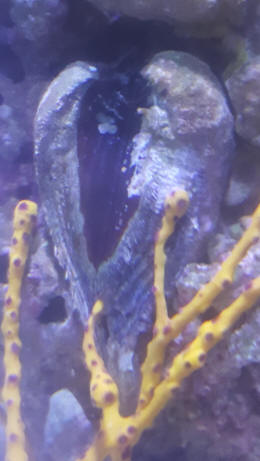
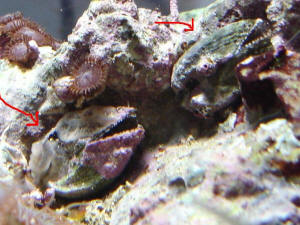
Any idea
3/19/18
Any idea on what this might be. It's on a piece of live rock I have. I saw the
first signs of life out of it yesterday and I have had the tank setup for
roughly 5 months now. Thanks
<Arca; a bivalve. No worries. Bob Fenner>
|
 |
|
Sponge... mysterious motive/moving source!
–
06/18/14
I've had this sponge for about 6 months.
<A beauty!>
It'll suddenly lift and then sink back down into the sand.
<Interesting>
Today I noticed that the rock the sponge is attached to (when I bought
it) has a mouth-like opening....and that is what has been causing it to
lift and fall throughout the day. Any idea what this is?
<Heeee! Yes... a bivalve/clam... no worries>
Here's a clip of it opening and closing, along with a pic.
http://youtu.be/0w8Mdn6eyBg
<Neato! Thank you for sharing. Bob Fenner>
|
 |
|
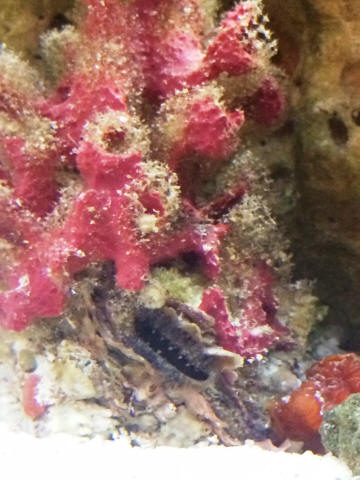
ID on snail/bivalve thing!
1/11/14
Hello! I've been recommended your site as a great place to get things
identified. I don't even know what section to put this thing in. It
looks like a bivalve but moves like a snail! Every time it came out of
the shell and I tried to take a picture, I startled it and it retreated.
It's about the length of a little finger nail and about half that in
width.
Thanks in advance for your help!
Jenny
<This appears to be a bivalve of the genus Arca. Bob Fenner>
|
.jpeg)
 |
Re: ID on snail/bivalve thing!
1/12/14
Thank you!!! I've literally spent all day trying to identify it, I can sleep
now ;) he's back in my tank now... Scooting along the sand!! I'm surprised
at how fast he moves!
<Strange to see the genus moving thus... all I've ever encountered were
attached... Is there some other animal (like a hermit) occupying the empty
shell? BobF, down in FLA diving>
<Ahh, I see some species are "slow moving":
http://www.britannica.com/EBchecked/topic/32429/Arca
BobF>
Re: ID on snail/bivalve thing!
1/13/14
Thanks for the link! The speed he was moving at was what initially made me
think it couldn't possibly be a bi-valve, I watched him crawl across the
sand about 8" in half an hour then up onto a rock. He found a shaded area
under a rock full of Zoas (the exact same area he was headed for before I
fished him out!) and is still there this afternoon.
I have a few other bi-valves in my tank that have never moved more than
doing a little "jiggle" or an inch or two when I moved a rock and disrupted
their shade. I don't have any hermits so it's definitely just a fast moving
little guy!
<Ah, cheers. B> |
|
Any idea what this is? 3/14/13
Is this some kind of clam growing on the side of my bubble coral?
<Mmm, yes; quite common>
or is this just how they grow. There are two on this side and one on the
other. they open and close like a clam.
<Neat! Do see here:
http://www.wetwebmedia.com/bividfaqs.htm
Bob Fenner>
|
 |
|
oyster? Scallop?
4/30/12
Dear Mr. Fenner,
<Hello David>
Hello,
this is David Huang here. Do you remember me from NCPARS?
<Ah yes>
I was the kid who asked you to autograph your book. If you don't, oh
well(but I hope you do!). Anyway, at Williamsport high school where the
NCPARS frag swap was held, they had a fish room. Just asking, but did
you go in there?
<Yes>
If you didn't, there was a fish room with a bunch of tanks full of
corals, and in one tank there was a shipment from Florida with an
oyster/scallop/??? inside! The thing was about an inch long. At the end
of the frag swap, Mrs. and Mr. Flint, the two very nice science teachers
there, said that I could take a couple of frags from the Fish Room. So I
asked for the oyster/scallop/whichamajig, and he said yes! So I brought
it back home (about three hours away) and acclimated into the tank. it
seems really happy, swimming around, and opening extremely quickly. I
fed it phytoplankton. Do you think feeding it maybe two to three times a
week would be enough? If not, I could feed it more. Would you know what
species? I'll attach a pic.
<I don't see the image attachment. Please do send this along; and in the
meanwhile do read here:
http://wetwebmedia.com/bividfaqs.htm
and the linked files above. Bob Fenner>
Ahh! I do see the attachment. This is a scallop of some sort. BobF
|
 |
|
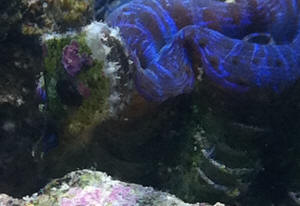
Baby clam?/Clam ID? 3/1/12
I found this attached to my new crocea clam. At first I just
thought it was a piece of old shell from maybe another clam. I
tried to (gently) to pull it off but it's good and stuck, but
pliable. Since I got the crocea the little piece has moved up
it's shell maybe 1/4 inch. Yesterday I noticed that it reacts
to shadows just like my crocea - slams shut and pulls in the
little white frill you can see on its upper edge. Could it be a
baby crocea? Maybe some other type of clam or oyster? I can't
seem to hunt down any pictures online of a crocea that small. Any
ideas?
<Do you like oysters on the half shell?>
Thanks
<You're welcome. James (Salty Dog)>
Angela
|
|
 Bivalve, Pinna? B Bivalve, Pinna? B
|
Re Baby clam?/Clam ID? 3/1/12
Sorry if I seem daft but you're saying this is in fact an
oyster? Would it hurt to leave it?
<Sure looks like an oyster to me if what I'm looking at is
what you are referring to. Is fine to leave in the
system.>
Thanks again
<You're welcome Angela. James (Salty Dog)>
Angela |
|
Please help ID bivalve 1/7/12
Good Morning WWM Crew!
I appreciate your excellent advice in information on your web
pages. I have searched your site and bivalve ID sites in general,
but have not been able to ID these animals in my aquarium, so am
attaching a couple of photos of one of them. I have found two in
my tank and both are on rocks they did not "arrive" on
- in fact one of the rocks had been stored in a dry box out of
the tank for awhile and had been scrubbed (so I know he
didn't arrive on the rock), which has now been back in the
tank for a couple of years. Both of these tiny "clams?"
have shiny intense blood red shells and are about the size of a
dime or slightly smaller. I recently discovered them when
rearranging some rock because I decided to give up two overgrown
(almost 1 ft diameter) devil's hands (they just got out of
control!).
<Ah yes>
I have a very mature system - with a lot of mixed hard and soft
coral, 30 fish (mostly species of Anthias, wrasses, a couple
tangs, blennies, and mandarins), and I have lots of inverts
(derasa clam, bubble anemone, tuxedo urchin, cucs, stars, shrimp,
crabs, etc) in a 300 gallon tank with about 40 gallons running
through my refugium. I don't check my parameters very often
and am not the most diligent with water changes, but I do run a
super reef octopus skimmer, have a remote deep sand bed, a
phosphate reactor, and a turbotwist UV filter. I only use RO
water, I don't use a lot of mechanical filtration, and
everything thrives and grows. I have only added frags for well
over a year so I have no idea where/how these little
"clams?" got into my tank, or if possibly there is a
"mother" in the system and these are new babies that
have spawned in the system - is that possible for clams?.
<Probably came in as small spat... settled where they are
now>
I do have lots of interesting volunteer sponges, worms, etc., but
this is the first time I have observed these beautiful little
"clams?" I's like help identifying these beautiful
bivalves and if you have any idea of their eventual mature size -
if they are going to remain tiny or hopefully, grow larger and be
more showy in time. Thank you for any assistance! Nancy
<I can't make out what these are from your pix... not
well-enough resolved.
Bob Fenner>
|
|
.jpg) .jpg)
|
|
Clam ID 10/16/11
Good Day,
<Mike>
After having a piece of rock for over a year now, I was excited
to discover that there was a clam attached to it! The clam
responds by closing when I get too close to it and usually stays
open. I was hoping someone could help me ID this clam as it looks
different than any I was able to find on my own.
Thank you,
Mike
<Mmm, is a bivalve of some sort... perhaps a Pedum species
that's washed out... maybe a Mytilid... Bob Fenner>
|
|

|
|
need help identifying my newest addition to my
tank..... 6/8/11
Help!
My live rock is more than a LIVE ROCK...
<... 4 megs pic...>
We just bought this yellow Fiji leather
<Sarcophyton sp. (elegans?)... though this looks more like a
phony/dyed specimen... Read here: http://wetwebmedia.com/alcyoniidsii.htm
and: http://wetwebmedia.com/dyedcorals.htm
and the linked files above>
from a LFS and from the beginning we thought the rock looked a
little weird. Well now we think it is even weirder! At night it
is closed, during the day when the lights are on it is open and
breathing. Is it a clam, mussel, oyster?
???? I have never seen anything like it. I have posted it on
several blogs and NO one has a clue. Can you help identify what
this creature is?
<The organism underneath is a bivalve... a
clam. Bob Fenner>
--
Jennifer Opstad
|
|

|
|
Re: need help identifying my newest addition to my
tank..... Help! 6/8/11
Is it a bivalve. A bivalve looks so little, this thing is huge!
6in length 3-4in tall and is cherry pink on the inside?
<Read here: http://wetwebmedia.com/bivalvia.htm
and the linked files above. BobF>
Re: need help identifying my newest addition to my
tank..... 6/8/11
> Hello Bob,
<Neale>
> I'm fairly sure the mystery bivalve there is a Chama
species, the so-called "Jewel Box Clams". My dad had
one rather similar in shape and size in his reef tank.
They're somewhat shaped like a cupcake, with the smaller
upper valve lifting up, revealing the siphons as they do so. The
mantle doesn't extend much beyond the shell.
<Is a good guess... but want to have this person/these folks
do their own bit of look-seeing... The process in this case is a
good bit of the message. Cheers, B>
> Cheers, Neale
|
bivalve question... ID
8/21/10
I recently received live rock for my saltwater aquarium (I am new to
this hobby), and noticed several oval shaped tubes extending off the
live rock which got my curiosity. Yesterday I was finishing up placing
the rock and accidently moved one of the large bivalves (hinged side is
on top, open side towards the rock), it came loose and what remained
attached to the rock was the same oval shaped structure. Below is a
picture of some bivalves that look almost identical to the one in my
tank?
<No such pix t/here. Maybe try re-sending as attachments of proper
size, resolution>
I looked up information on Arca Turkey wing bivalve still am unsure
what I am looking at.
<The attached pic was lifted from WWM...>
The bivalve is still tightly closed is it dead (I thought they would
open if they were dead)? What is the name of this remaining structure
and how does it attach the bivalve to the rock?
Thanks for your help
Jim
<Mmm, read here: http://wetwebmedia.com/bividfaqs.htm
and the linked files above. Bob Fenner>
|
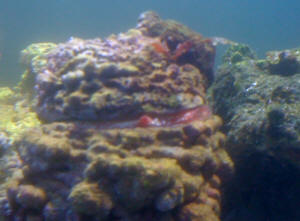
clam id? 8/20/10
Hello,
<Hi there>
First off, this is a great, informative website! I have learned
so much perusing your pages.
<Ah, good... along w/ requisite stimulation, urging folks to
(appropriate) action, this is our desire/plan>
Anyway, last night I was observing my aquarium, trying to see the
little critters that come out at night, when , out of the corner
of my eye, I saw the top half of a piece of live rock suddenly
move. I thought I was seeing things, then this morning I made a
concerted effort to observe this rock.
That's when I saw the rock move again, and I noticed it had 2
"holes", and one looked like it was expelling water.
This leads me to believe that I have some sort of clam but I
haven't a clue as to what kind.
<Mmm, looks to be a Spondylus species of some sort... but
can't be sure>
In the picture attached, you can make out the "mouth",
it is the red line that runs through the live rock. It
doesn't have the wavy "mouth" other clams at the
LFS have, could you possibly give me clues as to what I have?
Is it safe to assume it is safe to keep in my reef aquarium?
<Is very safe, fun to have, and evidence of your good
care>
Thank you in advance,
Gabe
<And you for sharing. Bob Fenner>
|
 |
|
Re: clam id?, Comp. 8/23/10
Thank you for getting back to me! Another question regarding this
new inhabitant...do I need to worry about the bioload because of
the clam?
<Not likely, no. Is low metabolism, and not likely to either
be eating, or egesting much>
I understand the clam is basically covered in live rock, but he
is much larger than anything else I have in the aquarium.
<No worries. Will grow, metabolize to the extent of food
availability here>
I currently have a juvenile yellow tang, 2 juvenile TR Ocellaris,
a flame angel, a Tailspot blenny, 3 blue green Chromis, a
yellow-tail blue damsel, a pink sea serpent, 2 peppermint shrimp,
2 skunk cleaner shrimp, 2 emerald crabs, 50 or so snails (mostly
Astrea),
<Mmm, not a fan of having so many snails myself.. Do keep an
eye on these health/activity wise... If they should perish for
whatever reason/s, the resultant pollution might be of
concern>
10 or so tiny blue legged hermits, a rock boring urchin
(hitchhiker) and some Asterina and tiny brittle stars that I
haven't been able to count yet. I also have 2 heads of
frogspawn, a large toadstool, several morphs of Zoanthids, a
small mushroom that just recently started growing another tiny
mushroom, and about 25 Ricordeas.
My main tank is 90 gallons, with about 100 lbs of LR, and I have
a 20 gallon sump with about 10 lbs of live rock (I would have it
bare but I have a large hermit crab that lives down there).
Parameters as follows:
PH: 8.4-8.2 (day/night)
NH3: 0.0
NO2: 0.0
NO3: 0.0
CA: 480
KH: 12.2
<I'd add Magnesium to your test protocol... read about it,
understand its importance in such systems with biomineralizing
life as yours>
I appreciate any feedback regarding my system, but I would really
like to know about the impact this unforeseen hitchhiker
presents.
<Really, none appreciable>
Do I need to do anything different in the way of feeding?
<Mmm, no... but I'd be careful re changing too much too
soon... to avoid disrupting endogenous food production... Do you
understand this?>
I don't want it to die and foul up my system.
<Understood>
Thank you in advance for your response.
Gabe
<Welcome Gabriel. Bob Fenner>
|
|
Clammed And Confused!!/Clam ID 1/21/10
Hi all!
<Hello Sabrina>
I have been wanting a clam for a long time but had to hold off
because of a few problems (glass anemones GRR) and swings in pH
(not really sure what's going on here)
<Do search our site re pH.>
Anyway, yesterday I rearranged the LR in my tank so that the
glass anemones that are in there will be eaten by my Raccoon B/F
once she/he is out of quarantine in a day or two. Any who, I did
this and the tank looks great
but then I notice this thing I have never seen in the tank
before..... A CLAM??? Its about the size of a quarter opens and
closes and has eyelash like hair "thingies" (yeah I
know great technical term there) coming from the opening almost
like a Venus Fly trap. Is pretty thin though it is only a quarter
size and its inside looks pretty dark maybe a dark purple and it
has a kind of velvet look to it. Do you have any idea what this
may be? I am sending a picture but it is really blurry so I
don't know how much help it will really be.
<Yes, much too blurry for any of us to attempt an ID. I would
just enjoy the newly found hitchhiker.>
Thank you for your help in advance.
<You're welcome. James (Salty Dog)>
Sabrina
|
 |
|
Possessed Rock? No, clam! -- 10/28/2009
Good Morning WWM Crew!
<Morning Liz! JustinN here with you, from South Texas!>
I hope today finds you all well. We're having a wonderful
sunny day here in C. Texas after some much needed rain (droughts
are really no fun).
<Indeed... but this brisk cool that came along with the rain
is sure nice!>
I have another questions for y'all (didn't see that
coming, now did ya?).
<*GASP* I never!>
I purchased a lovely green Ricordea from a fellow reef club
member a few weeks ago that was mounted on what seemed to be an
ordinary hunk of rubble.
All appears standard... Ricordea foot firmly attached to the
outside of a chunk of rubble that's approx 1" long and
about 1/2" wide. After a few days I noticed the bottom
section of the chunk of rubble would open up! If the rock was
tapped it would quickly snap shut. Being new to salt water
aquarium keeping I don't know if this is the Ricordea or
something else living in the rock. I searched all over the
website and haven't found anything that talks about mounting
rocks mysteriously opening and closing.
I've never seen anything come out of the rock when it's
open. There are no protrusions or any other signs that the rock
is anything but a single rock when it's closed. The Ricordeas
foot doesn't appear to go down into the rock, but I suppose a
central portion of it could extend down through a hole that
can't be seen...
<Indeed, I see what you are speaking of here -- and this is
simply a relatively common filter-feeding clam. You will find
them surprisingly abundant in live rock, though you won't
often notice them till you see the 'flick' of them
closing up. Nothing to worry about, just another of the fun
little hitchhikers that come with this hobby.>
I've attached a couple (slightly blurry, sorry) pictures that
illustrate the issue clearly even if their overall quality is a
little lacking.
<Adequate enough for identification, yes -- quite a lovely
Ricordea as well!>
If this is just what Ricordea do feel free to chuckle at me
(haha, silly newbies... someday I'll be looking back and
laughing at myself so it's all good). If not, then what's
up here? Do I call in an exorcist or enjoy an unexpected
hitchhiker (umm, and what might it be?)?
<Just sit back and enjoy -- and expect to see some more things
that'll have you scratching your head!>
Thanks so much and y'all keep up the *GREAT* work!
Liz
<Glad to be of assistance, Liz! Let us know if you have any
more questions!
-JustinN>
|
  |
Re: Possessed Rock? No, clam! --
10/28/2009
Hi Justin,
<Liz>
Neat that you are in Texas as well. And yep, the cool weather is
wonderful.
We have to enjoy it while it lasts.
<Indeed! It will, of course, be gone all too soon... but
that's the price we pay living here!>
How awesome! A clam! My boys are ecstatic. We've been having so
much fun watching things come alive in our tank. We just got our
fuge & sump running (10 gal dedicated fuge, 20 gal sump for our
125 gal tank) and it's amazing all the living things we're
seeing.
<Ah yes, and this will only increase as time goes on! The wife
and I have as much fun watching the emerging critters from our
tanks as we do any of our intentionally placed inhabitants -- the
variety of life really is astounding!>
Thank you very much for helping solve the mystery. :) The WWM site
is truly an amazing resource. Y'all do aquatic hobbyists such a
wonderful service.
Liz
<Glad to help! -JustinN> |
|
Can You Identify These Creatures in My Refugium?
Harmless Bivalves -- 10/22/09
Hi,
<Hello, Lynn here today.>
..recently I noticed some creatures in my 30 gal refugium. Can
you identify them?
<No worries, they're harmless, filter-feeding bivalves.
For more information on these neat little creatures, please see
the following links (as well as the related links at the top of
each page): http://www.wetwebmedia.com/bivalvia.htm
http://www.wetwebmedia.com/bividfaqs.htm >
Pics are below:
Thank you
<You're very welcome. Take care, LynnZ>
|
 |
|
Mystery Bivalve: Likely Mussel -- 8/6/09
Greetings Bob & Crew!
<Greetings Ray!>
I just recently moved my tank
<You have my sympathies!>
..and in placing the 50 or so pounds of live rocks (you can never
get them the same twice in a row),
<Too true>
I noticed some sort of bivalve. Never seen it before. Looks
harmless enough and I have searched and it is the only one that I
can see. This is perhaps the ONLY thing that I like about moving
is that I tend to find new stuff every time,
<There's always a silver lining somewhere!>
..even though I have not added anything in a very long time. I
tried doing some searches, but have come up empty handed. The
local reef club members are also scratching their head. Looks
just like a Zebra mussel (now being in the Great Lakes area), but
I am pretty sure they are strictly freshwater.
<Yes, Dreissena polymorpha (family Dreissenidae), is an
invasive, strictly freshwater species.>
Any ideas?
<It does appear to be very mussel-like in appearance but ID
beyond that would require more information: locale of origin,
size, views of the exterior - taken from the sides/ends, as well
as both valve halves, and optimally, several of the shell's
empty interior -- particularly the hinge area. Unfortunately, the
only way you'd really be able to get those photos would be to
remove and kill the animal, which would literally be overkill.
Suffice it to say, this is a neat, harmless, little mussel-like
bivalve that makes for a nice addition to your system.>
Safe to have?
<Yes, no worries with this little guy.>
Looks like it is getting along with its neighbors just fine so I
would hate to have to pull it out if I don't have to.
<I'd leave and enjoy.>
Pic attached.
<Thanks>
Thanks!
<You're very welcome!>
-Ray
<Take care, LynnZ>
|
 A
Mytilid of some sort. RMF A
Mytilid of some sort. RMF |
LR Hitchhiker - 02/13/2006 Hello! I've
been a saltwater hobbyist for just a few months now and couple of
months ago bought my tank red kelp on a piece of live rock. Recently I
adjusted it to where there was a little bit more of the live rock
facing me, and a couple of weeks after I noticed (what from all my
Internet research), looks like two fan worms growing from it, and what
looks like a clam? <Have to love those freebies!> After two
months of being unfed can this be true, can it survive and if it is
what can I do for it? <It could in fact be a bivalve of some sort,
living off what it can filter from your water. Can also be the remains
of what had been a bivalve (more often the case). Try to establish for
certain that it is alive before you worry yourself about it (at night
with a flashlight is easiest). Most likely, you will only need to
maintain optimal water quality, let it filter feed for itself. Look
here http://www.wetwebmedia.com/bivalvia.htm
for a possible ID. - Josh>
| Thank You for the Bivalves, Various Means of Contact
11/9/05 Hello Mr. Fenner, Thank you for the prompt reply to my
query regarding problems contacting WWM crew with a question. Also
thank you for the alternative route offered through your personal
e-mail - very kind. <Welcome> Here is a copy of the bulk of
the original e-mail that is probably floating around in the ether
of cyberspace or has been picked up by the secret services as the
creature in question has escaped from area 51's aquatic
section.... either that or Freeserve are trying to get me to update
to Broadband by making my dial-up really lousy,( or I'm
paranoid!)... <<You better watch out for that lot running
Freeserve! MH>> <Heeee! Me too I guess> Hello WWM
Crew, About a fortnight ago I bought three 'Supa-doopa'
turbo snails, all of the top shell variety and the largest I've
seen at over 5cm high. I'm unsure exactly of their variety or
even which ocean they're native too, but they are the best
algae eaters I've had, clearing the entire back of my tank of
all algae,( except the desirable coralline types), in their first
week of residence - an area of almost 2 square metres. On closer
inspection of one of the snails I noticed what at first appear to
be an area of damaged shell that had healed, but looking again I
realized it was in fact 2 small clam/oyster type bivalves one with
an obvious 'zig-zag' opening, <Yes... and good pix>
both of which appear to be live and well as they open and close
throughout the day especially when food has been placed in the
tank. There is also some form of tube worm living between them -
quite a little ecosystem for one snail to carry round! On searching
your site I have come up with 3 possible species for the
clam/oyster - Lopha cristagalli, Dendostea frons and Hyotissa
hyotis. Unfortunately you give no size for these species, and I
have no idea of the bivalves age anyway,( perhaps it's a baby
giant clam in which case the snails going to have real problems in
a few years!), <Mmm, this last I doubt... not Tridacnids... but
could be other than the species listed for sure> and as I said
not knowing where the snails are from stops me narrowing the
search. The snails themselves are quite attractive, the sides of
their foot being a speckled granite colour and their heads striped
with black and white rings. Any help would be greatly appreciated,
I attach two pictures of the snail and its hitchhiker. Thank you
for your help, Bob Mehen, Cornwall, UK. <Wish I could help
you... perhaps sending these about to folks in the science of
bivalve mollusks would be of help. Cheers, Bob Fenner> |
|
 
|
| What it is... an oyster? 9/11/05 Hi! I found something
that look like an oyster in my tank... I would be very pleased if
you could tell me what it is. http://www.aquarecifal.com/phpBB2/album_pic.php?pic_id=154&sid=f33e511395354d66a43594e5a079d468
thanks a lot!! Marie <Is apparently a bivalve of some sort...
evidence of your good care, original health of your live rock. Bob
Fenner> |
|

|
| Bivalve ID, Paracanthurus nutrition
8/16/05 Hello again WWM crew, I recently discovered an unknown
animal in my live rock. I got it out on the sand so I could take a
picture of it. I looked through some of the ID articles and found
nothing matching its description. I have attached two pictures of
it. Its basically shaped like a clam, and it has a white appendage
that comes out of its shell that it moves itself around with. If
you can ID it for me so that I can research if it is harmful or
not. <An Arca clam... a common "hitchhiker"... not
harmful> Also my Hippo Tang that I purchased this weekend has
been rather finicky thus far. He hides in his little cave half of
the time and cautiously swims around the rest. <What they
do...> He eats a little of the fresh romaine lettuce I put in,
<Not a good idea> I know its not the best, but as of now its
all I've got him to eat. I've tried frozen blood worms,
frozen brine shrimp, some formula 2 flakes, and seaweed selects. I
have also tried adding some garlic to the meaty mixes. Do I have
any reason to worry yet, or should I stay the course. All my water
parameters are fine and he looks very healthy. Thanks again, Rick
<... please read here: http://www.wetwebmedia.com/paracfdgfaqs.htm and learn
to/use the indices, search tool on WWM. Bob Fenner> |
|

|
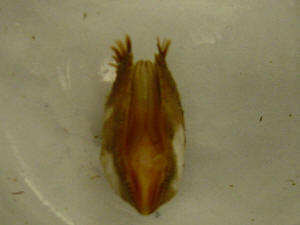
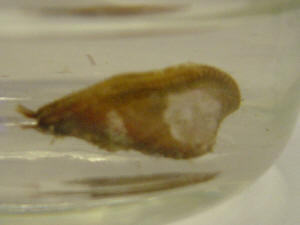
Mystery Critter ID What's up
Crew!<< Just typing away. >> I found this critter
clamped onto my Hammer Coral's skeleton. It took mucho strength
to pry it off. It opens up split from the middle and sticks out a
pinkish tongue-like flesh. << Haven't seen the pic yet,
but already sounding like a bivalve mollusk. >> It's
pretty alien looking IMO. I'm attaching two photos top and side
views. Really appreciate if you can help me ID it and let me know
if it is predatory towards any of my corals or inverts. <<
Well it appears to be some sort of Bivalve. Looks cool.
Unfortunately with about 14,000 species of Bivalves, I don't
think I can be much more descriptive. I'll bet it isn't
predatory and is a great addition to your tank. This type of
biodiversity is exactly what you want in a reef tank, so I say keep
it. Please continue to watch it, and if it on a coral let us know.
Otherwise keep it growing (it needs live rock, and that's about
it) and please take pictures again. Looks pretty cool, and I'm
sorry I can't identify it. >> Thanks a bunch! Roy
<< Adam Blundell >> |
 |
 |
What is it? Hello; How are you? <hungry and sleepy
but still happy. Thanks for asking... I hope you are well too:) > I
was wondering if you could help me identify something on my live rock.
<I can and will or I'll make up something very convincing> I
have a 29 gallon tank, with 25 lbs of live rock. It is hard to describe
in words but I will try. Last night, my emerald crab was eating stuff
off the top of one of the live rocks. As I watched him move around, he
touched the top most part of the rock with his claw. (it is kind of a
pointed section on top of the rock.) When he touched this part, it sank
down into the rest of the rock. When this happened, it scared him, and
he ran down off the rock. After about a minute the pointed section rose
back up to where it was before he touched it. Is this some type of
bi-valve such as a clam or oyster. <Where is the rock from? If
Atlantic, reference the Turkey Wing (Arca zebra) ... quite common>
It just looks like the rest of the rock to me, and I had no idea there
was something living there. After searching my tank, I found a couple
other places where the rock is moving. (I guess another reason to call
it live rock!!!) <bingo... hand that man a stinky Kewpie doll> If
they are bi-valves, will they survive by adding phyto plankton to the
water? <yes... but bottled phyto must be whisked in a blender before
every use to reduce particle size or it is hardly useful. Hmmm...
don't read that on all the bottles do you :) Research shows...>
Thanks for all your help (both now and my past questions), Kevin
<best regards, Anthony>
Re: Arca zebra Thanks Anthony, on the speedy reply.
<my great pleasure> What you wrote was right along my thinking.
<are you sure that you just aren't feeling gassy instead?>
These guys really aren't going to like burst of water from a turkey
baster. They close up when a shadow passes. <exactly> Not that I
blame them. <yep... the shadow or unnatural and "large"
burst of water indicate a potential predator> I have a degree in
biology (wanted to be a marine biologist...sometimes life just
doesn't work out) <I understand... and Mariah Carrey wanted to
be a singer> so I figured that phytoplankton would be my best bet.
<agreed> Right now I have a bloom of diatom algae so they are
probably ok for now. <helpful> Naturally, I'd like to rid
myself of the algal bloom and then will have to actually feed them.
These guys are pretty cool and I'd hate to lose them, especially
since that end will probably wipe out my tank. <indeed a significant
mass to be rotting suddenly> I plan on adding a refugium to my setup
anyway, so I'm glad that you think this will help. <very much so
with the right plants... do avoid Caulerpa for this purpose at
least> But, in the meantime, I may buy some phyto and blenderize it.
I'm looking forward to you being at That Fish Place in Lancaster,
PA later this month. Perhaps we'll get any opportunity to chat
there. <Looking forward to it!> Thanks again, Mike <with kind
regards, Anthony>
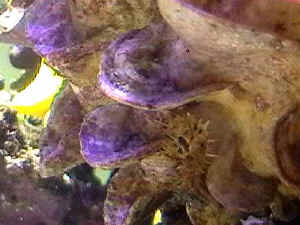
| Bivalve ID 3/18/03 Howdy! Dave here from
Sydney, <cheers, mate... Anthony Calfo in your service>
brilliant site, have not made a purchase without looking here first
since two months in from setting up my tank ( running now for 18
months) and have not lost a life since. That included a bout of
Whitespot which I didn't beat till I found this site
<outstanding to hear!... wishing you continued success in your
endeavors :)> I recently purchased a T. Squamosa from my LFS and
after 2 weeks of QT is now in my display tank. I did notice what
looks like a clam of some sort, it's the hairy thing partially
open in the bottom left of the picture below. <indeed... it is a
small oyster. Tough to ID from the photo... perhaps a little Chama
sp. from my refs/perspective> I haven't removed it not
wanting to kill something unnecessarily but would like some
reassurance. <it is completely harmless (non-burrowing) and
incidental. Enjoy it my friend> Thanks in advanced. Thanks from
my fish and soft corals as well. <kind regards, Anthony> |
|
|
Bivalve ID- Turkey Wing- Arca species To
Anthony - what is this? Howdy Anthony! I've attached a picture of
something that is growing near the bottom of one of my live rocks.
<very cool... a Turkey Wing bivalve (Arca species)> Looks sort of
like a furry clam, but is long and skinny, and looks as if the shell
had formed around a pencil, near the bottom, then the pencil was taken
away. (This is where the red spot is, with the shell forming two
"hooks".) Hope the pic is clear enough - <fine enough>
as the critter is near the bottom of the tank, tis hard to get a good
angle without taking the rock out of the tank! Is the pic and
description good enough for you to tell me what this is? Does it need a
special diet? <it is a filter feeder. Variable success in captivity.
Would likely do best in a fishless refugium. Occasional feedings with
meaty juices (small amount) from thawed foods may help.> (Or, do I
need a better picture? - lol) THANK YOU! >>-Cathy in Texas
<>< <best regards, my friend. Anthony>
Arca Turkey Wing Bivalve 12/9/03 <howdy,
Charles> I have an identification question for the Gods of
Bi-valves. <I'm sure there is a witty retort to that
somewhere... it slips me right now <G>> My 7 year old
grandson spotted a shell that moved in my 55 G reef tank. Sure that
he mistook a leftover that was being moved by random currents I
stuck my hand into the tank to demonstrate that it was empty by
wiggling the shell. Understand, I know that I haven't
purposefully added any such class of animal to the tank. And, the
shell that moved was heavily encrusted with coralline algae.
<nifty!> Plus, my system has gone through a long period of
less than benign neglect. That guy has been there for a while and
is quite a survivor. <some bivalves indeed are enduring. Think
of the trip that the zebra mussel made to get into the great
lakes> At any rate, as my hand got within a few inches of the
critter when he slammed his shell shut. Firmly. I've since
glimpsed a little of him and watched as sudden shadows trigger the
critter to "clam" up. The angle to the front of the tank
isn't the greatest and I hate to move rock around unless there
is a real need, so this shot is as good as it is going to get in a
while. In the attached photo, the critter in question is about one
inch below the scale, straight down from the 10 1/8 inch mark.
Hinging seems to be along the top, tilted a little away from the
camera and the back side shell is firmly anchored to the rock
beneath him. The scale had been there, shading him a little for a
few minutes before the shot so the shell is as open as it gets.
<it appears to be an Arca Turkey wing bivalve or Tree Oyster
(Isognomon)... the former (Arca) being famously hardy and
long-lived in aquaria> You can also see patches of red and
purple coralline algae as well as small "cacti gardens"
of some kind of filter feeders (ID?). This shot is the best my
digital camera can manage so I cannot get a better shot of them
either. <no worries... clear enough> So, what is the mystery
bi-valve, if you could hazard a guess? BTW, I understand that
Anthony is going to be at Aquatic Gallery in Milpitas, Ca. on the
17th. Since I bought a copy of his and Fenner's book, can I get
that autographed? <it would be my pleasure!> Regards, Charlie
H.
<be seeing you in the Bay Area soon :) Anthony> |
|
|
Oyster Drill snail? 7/18/04 Hello all, I was reading
thru your site (one of my favorite things to do in my spare time :) and
I came across some pictures on this page: http://www.wetwebmedia.com/swsnailfaq3.htm
, the comments state that it is an Oyster Drill (Cymatium aquatile)
..... Well, I have searched, your site and all over, and I am not
finding any good information on these creatures. <they are not used
in the aquarium trade for this very reason (hence the void in
literature on their husbandry). Tridacnid clams and numerous other
desirable bivalves are in greater favor than drab predatory snails
<G>> The few pictures I could find of living Oyster Drills do
not look like the pictures on the above linked page, and the only other
pics I could find are of empty shells, which tells me nothing at all
about the creature. <there can be considerable variety in form among
members of the same family... even in the same genus> The reason I
am asking is because I have one of these things, it was sold to me as
"some kind of conch". I found the hairy shell and spotted
body very attractive, so I bought it. <this (buying live animals
with unknown needs) combined with neglecting to quarantine new
specimens is a recipe for disaster in your tank in the long run
(introduction of a pest, predator or disease). Please do resist.>
Now, I am wondering, if it is not a conch, and IS an oyster drill, what
can I/should I feed it? Do I need to buy oysters? Do they have to be
live? Are there other foods it might accept? What kind of conditions
does it need? It's been in my tank for nearly two weeks, always
moving around and active, but I'm worried that maybe it is
starving. Where can I find more/better information on this creature?
Any help is greatly appreciated! Barb <the first step is a correct
ID of what you have. Without any picture or description of your snail
other than general resemblance, it would be unfair and unrealistic for
me to speculate. Ask your retailer for more info about where it came
from. They should know or their collector/wholesaler at least will know
what waters it was collected from. Then take that info and use it to
refine your search among the many shell collecting sites. They are your
best option in the absence of extensive ID and husbandry info for
aquarium use. Anthony>
Bad decisions... wrong species, right admiration
5/27/04 Well, I'm not sure what sea this cowry comes from. I
got it from a friend's tank because I'm an invert lover and I
think cowries are really cool. ;] <fascinating yes. Do check out our
coverage of gastropods in "Reef Invertebrates" by Calfo and
Fenner too> I can give you a basic description and see if you can
make anything of it. <nearly impossible from a text description. A
photo at least would be helpful> It's about an inch long, the
shell is creamy white w/out any visible markings. The mantle is white
w/ dark purple circular spots all over it. The foot is
white/translucent w/ the outer perimeter being purple/dark magenta
colored. I'm not too sure what it eats, maybe algae maybe snails.
Who knows? ;] It is nocturnal for sure. <It never ceases to amaze
and disappoint me that people bring pets into their home without
knowing what they eat/need to survive> Thanks for any info you can
give. Morgan Mok ps: Do you know where a person can get electric
scallops? ;] <they are near impossible to keep for anything that
approaches a natural lifespan in captivity... unless you have figured
out a way to magically culture bacteria, nanoplankton and other
necessary plankters> Also, do spiny scallops/oysters (can't
remember the name) need temperate waters in order to survive? Thanks!
<Ughhh... if you are referring to Thorny Oysters... they are near
impossible just the same. These Azooxanthellates bivalves are some of
the most difficult reef invertebrates to keep alive in aquaria. They
slowly starve over a period of weeks to months categorically (very few
exceptions). Please be a responsible aquarist and avoid these
specimens. Read more about why on our free content website,
wetwebmedia.com, or our last book if its handy. Anthony>
|
|

