|
FAQs about Sedentary, Tubiculous, Featherduster
Worm Identification 4
Related Articles: Featherduster Worms,
Polychaete Worms,
Related Worm ID FAQs by Group/Phylum:
Tubeworm ID 1, Featherduster ID 2, Featherduster ID 3, & Polychaete Identification, Polychaete ID 2, & Flatworm Identification ID, Nemertean, Proboscis, Ribbon Worm ID,
Nematode, Roundworm ID,
Nematomorpha,
Horsehair Worm ID, Acanthocephalans,
Thorny-headed Worm ID, Tubeworm ID, Hirudineans, Leech ID, Sipunculids, Peanut Worm ID, Echiuran Worm ID, & LR Hitchhiker ID 2, LR
Hitchhiker ID 3, Non-Vert IDs
1, Featherduster Worms 1,
Featherdusters 2, Tubeworms 3, Tubeworm Behavior, Tubeworm Compatibility, Tubeworm Selection, Tubeworm System, Tubeworm Feeding, Tubeworm Disease, Tubeworm Reproduction, Polychaete Identification, Polychaete Behavior, Polychaete Compatibility, Polychaete System, Polychaete Selection, Polychaete Feeding, Polychaete Disease, Polychaete
Reproduction,
|
|
|
White growths on LR
4/14/15
Hey Bob, I just finished cycling my 55g QT with LR. After almost 2 weeks all
readings are at 0. My wife noticed these little white fuzzy things
growing all over the rock. It kind of resembles lymph in some spots. What do
you think, worms? sponges? Is this normal?
<Small tubiculous worms; likely Serpulids>
Thanks,
-Jay
|
|
|
Critter id please
7/18/14
I just bought my first reef tank off of a friend whose wife wanted it
gone.
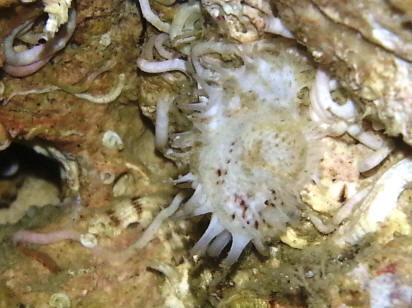
Every day things keep popping up in there and most I can find but these
are throwing me for a loop. This is in a 65 gallon tank.
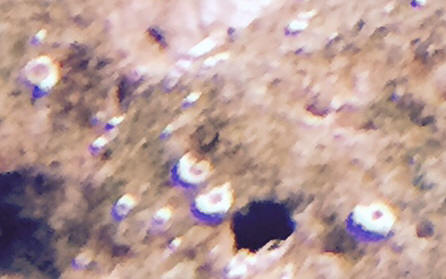
think this one is a feather duster but not sure as its under a ledge of
rock and is about the size of a stickpin head
[image: Inline image 1]
<The one with the duster head and obvious radioles is such>
This one I shared with a group and they told me it
was a sea apple but after looking at sea apple images and such it looks
nothing like it and a guy today who looked at it said it might be a
bivalve. now I have noticed 2 of them on opposite ends of the tank.
I appreciate any information that you can give me these. Thank you
Misty Hodges
<The other white bit is likely a sponge. Bob Fenner>
|
 |
|
snails, crabs and HITCH HIKERS!
1/31/14
Hi Crew!
<Pam>
I just ordered a ton of snails and crabs to help with the sifting of my
deep sand bed, as it has formed a crust, and when I siphoned it
during a water change, the smell was WORSE that my skimmer! That's bad!
<Heee!>
I'm hoping this is "the ticket" to a healthier dsb!
<Yes; do read our/my input re DSB maint.... Includes periodic (weekly)
stirring, vacuuming of at least part/half>
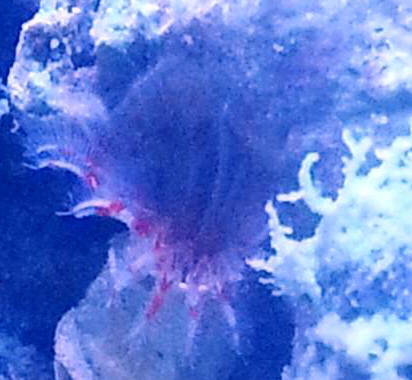
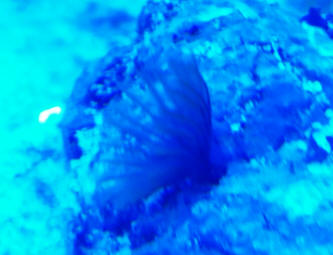
I've attached a picture and I know it's a bit blurry, but there's a
little hitch hiker on one of the Turbo snails.
It's amber in color and about a half inch in size. Would this be a
feather duster? It's very sweet :)
<Ah yes; and yes>
Thanks for the help/ advice as always!
Pam
<Only state what I might do given similar (stated) circumstances. BobF>
|
 |
|
Re: Hitchhiker ID
12/11/12
Lynn... what is this? B
<I think I might just know! If I'm right, it's a species in the
genus Lygdamis (family Sabellaridae). Check out the photo at this link
for comparison:
http://www.kudalaut.eu/en/dph/3705/Photos-Sale/Sabellid-worm .
I'll go ahead and send a reply to Alex asap. Take care, Lynn
<Yes! I believe you're right. B>
Hitchhiker ID: Sabellarid, Lygdamis spp. – 12/12/12
Hi,
<Hello Alex, Lynn here this evening.>
I was wondering if y'all might be able to help me ID something.
<Fire away.>
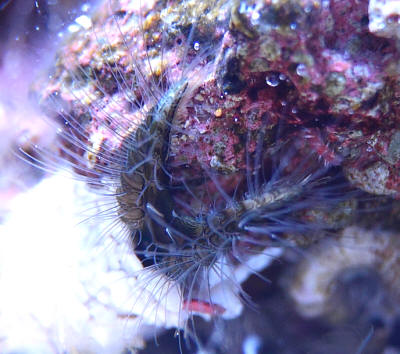
Here is a picture:
http://i558.photobucket.com/albums/ss28/awpong/WeirdHitchhikerID.jpg
Here is a video: http://youtu.be/Xb1i9xWjoPo
<I believe what you have is a neat little Sabellarid (family
Sabellaridae) in the genus Lygdamis.>
This hitchhiker has 2 tentacles that are about 1 cm each and are covered
in hairs. The entire creature lives inside of the sand-tube shown
in the picture, and as seen in the video, it will retract when
disturbed.
<Yep, all of this is typical. The two, almost “horn-like”, appendages
are covered with feeding tentacles and the tube is constructed of mucus
and bits of sand/shell/debris. Please see the following link for
examples of the genus (series of 8 photos):
http://doris.ffessm.fr/photo_gde_taille_fiche2.asp?varpositionf=&varSQL=SELECT
* FROM fiche_liste wherefiche_numero =
1233&varposition=1&varSQLphoto=SELECT * FROM vue_photos where
photo_fiche = 1233 ORDERBY photo_ordre&fiche_numero=1233&origine=
The following link does a good job of describing anatomy, habitat, and
behavior:
https://repositorio.uac.pt/bitstream/10400.3/142/1/pp37_42_Nishi_Nunez_17A.pdf
>
I've never seen anything like this before, and I haven't been able to ID
him.
<I’ve never seen one of these show up as a hitchhiker, that's for sure!
It’s certainly a neat little creature and a nice addition to the
biodiversity of your system.>
He has been in my tank for about a year without spreading. This is just
the first time I've been able to photograph him. He was originally
attached to the rock base of one of my SPS, but he moved after I buried
him in the sand.
<Yep, they can build another tube elsewhere if the occasion calls for
it.>
The only way I can describe him is by making bunny ears with my index
and forefinger.
<Heheee!>
Thanks in advance,
<You’re very welcome.>
Alex
<Take care, Lynn Z>
|
 |
|
Two ID's requested, please 6/28/12
Hi wonderful experts!
<Tim>
I am always running into unexpected critters in my tanks.
<Wonderful freebies, well most of the time...>
Usually "Reef Invertebrates" helps me to identify them, but these two have
me stumped.
<I'll see what I can do.>
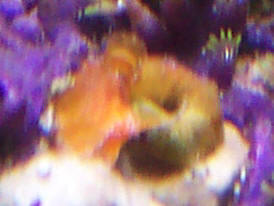
The first is a worm-like thing living in the midst of a small colony of
star polyps. I apologize for the poor picture, but I tried like crazy,
and this is the best I can do. I'll try to describe it. You
can tell the size from context. It is curled in a small spiral, an
obviously soft worm encased in a hard tube (except for its head).
The color, not done justice in this photo, is a brilliant orange, almost
Day-Glo. It has two prominent, long, thin antennae. It also
has a short tube-like orifice that convulses rhythmically. I am
almost certain that it is pumping water in (or out) through the visible
orifice on its head, and pumping it out (or in) via some other orifice
whose location I cannot see. Enough of the head extends from the
end of the tube to allow it to continually 'look around' itself, almost
as if it's searching for something, although I cannot see anything that
looks like eyes.
<Likely a worm from Family Serpulidae. Not a cause for concern, unless
you are a copepod or bacteria.>
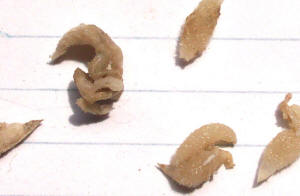
I found the other when I removed a pump for cleaning. I laid them
on a 3x5 card so that you can see their size via the ruled lines on the
card. I have not seen them anywhere else in the tank, but there
were many of them on and near the pump. They are very soft-bodied,
with no features such as antennae, eyes or mouth that I could see.
<These are Syconoid sponges, commonly called Pineapple or Q-tip sponges.
They are harmless filter feeders that live in low light/high flow areas.
Check the inside of your skimmer and under rocks- you will find more.>
Any thoughts on IDing these things would be appreciated. Thanks!
<Anytime>
Tim
<Jordan>
|
 |
|
Snail or Conch? Likely Columbellid Snails and Spirorbids -
4/17/12
Hi Crew,
<Hello Dave, Lynn here this evening.>
We've had an explosion of births of some kind of snail or conch in both of
our salt water tanks. It happened several weeks ago and the little critters
are now about the size of elbow macaroni (sorry, I couldn't think of a
better comparison!). Anyway, I did quite a bit of reading here on WWM
and have looked at quite a few photos but I'm still not convinced of what
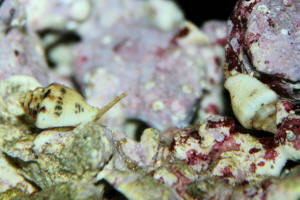
they might be. I attached a photo showing two of them hanging out on
some live rock together. They look like they have a proboscis. Their shells
are growing as they grow.
<The snails appear to be harmless/beneficial Columbellids (family
Columbellidae), aka “Dove” snails that feed on film algae, possibly diatoms,
and tend to be prolific breeders. For more information, please see the
following link:
http://wetwebmediaforum.com/showthread.php?336-Critter-of-the-Week-Columbellid-snails&highlight=columbellid
>
I guess the reason I'm worrying a little bit is because I've read that some
species of conch are not good to keep with other invertebrates and are
carnivorous. We do have several Fighting Conch but they are very
peaceful and spend most of their time below the sand bed. Also, I'm
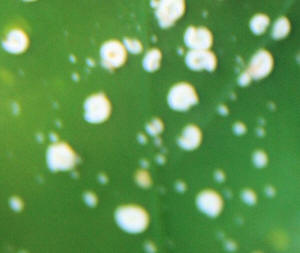
not sure if it's related, but we've also seen an explosion of tiny white
circular crusty adhesions, about the size of a pinhead,
<No worries, those are tiny, harmless, filter-feeding, feather dusters
called Spirorbids.>
…stuck to the glass and all of the structures. They are everywhere.
<This is typical, especially in new systems. Eventually, the
population will taper off to a more manageable level but in the meantime,
you can remove any unwanted individuals from the glass with a scraper (an
old credit card works well for this).>
I included a photo of an artificial leaf from one of our tanks showing them.
Are these egg packets or something? Or is this some form of algae?
<Nope, they’re Spirorbids. If you take a close look, you can see the
feathery feeding appendage on some of the individuals in your photo.
For more information/photos, please see the following links:
http://www.wetwebmedia.com/feather.htm
http://www.sms.si.edu/irlspec/spirorbis_spp.htm >
Thanks, as always, for your help and insight.
<You’re very welcome.>
Things are going quite well in our tanks right now because of your past
guidance.
<Thanks, that’s great to hear/read.>
There is no better feeling than stable fish tanks.
<That’s way up there on the list for sure!>
DaveZ
<Take care, Lynn Z>
|
 |
|
What Is This Wonderful Creature?/Spaghetti Worm ID
11/27/11
Hi kind experts.
<Hello Tim>
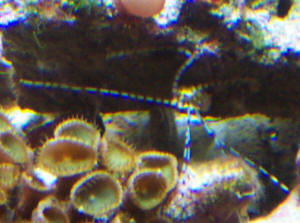
I'm curing a batch of live rock, and I am overwhelmed with
the diversity of life appearing. I'm slowly going through
books and web sites to identify whatever I can, but this one has
me stumped. I have several holes in live rock from which numerous
tentacles sweep out. These smooth tentacles are at most a
millimeter in diameter, probably less, and as long as eight
inches or more! They are alternating bands of brown and blue.
They can completely retract into their hole and vanish, but
usually they are sweeping around the tank. Somehow this creature
(I think it's one being as opposed to a bunch of worms, but
of course I can't know for sure) builds a little white tube
like structure over its hole, about 3 mm in diameter and 5 or so
mm long. The tentacles come out the end of this tube. Once, a
clumsy snail completely knocked the tube off of the rock,
revealing the bare hole in the rock. The next morning the tube
was completely rebuilt.
Any idea what this is?
<Sure sounds like a Spaghetti Worm to me. Spaghetti worms
build elaborate tubes for themselves, either in the substrate or
in small holes/cracks in the rocks.
The worm secretes its own cement from glands on its belly, then
lines its tube home with coarse sand and small shell fragments.
They are harmless and can be beneficial in cleaning up detritus
and uneaten food bits. >
Thanks!
<You're welcome. James (Salty Dog)>
Tim
|
|
Re What Is This Wonderful Creature?/Spaghetti Worm ID
11/28/11
James - Thank you!
<You're welcome, Tim.>
I had run across spaghetti worms in my search, but the first few
pics I looked at did not look like what I had. But after
you ID'd it, I did a more detailed search and found a few
that look exactly what I have. There is a huge variety in
appearance.
<Definitely so. There are many species of Spaghetti
worms which are included in the 8,000+ known species of marine
worms.>
Thanks!
<You're welcome. James (Salty Dog)>
Tim
|
|
Tube Worm or Feather Duster: Neither! Vermetid
Gastropod -- 11/15/11
Hi there,
<Hey there Fanny, Lynn here this evening.>
I have a 50 gallon marine tank that is over a year established
and doing fairly well except for the loss of coral as of late. I
just noticed this unidentified 'tube worm/snail' I've
attached a picture. It is about the size of a dime (judging by
the pink coiled tube) and a snail like head is popping
out of the right end, the shape of which is spade like
with two antennae. It does not seem to leave the tube but it
sends out a mucus to catch particles and then it pulls it back in
to eat.
<Great observations!>
After searching the internet and this site I cannot identify this
creature, can you help? I suspect it to be a barnacle or an ugly
feather duster, but neither of those seem to have only two
antennae...
<It's actually a Vermetid Gastropod, a variety of sessile
snail that casts out a mucus net/web then reels it back in to
feed. These snails are mostly harmless and beneficial, but their
webs can on occasion irritate nearby corals just through constant
contact. For more information, please see the related FAQ's
at the following link:
http://www.wetwebmedia.com/MolluscPIX/Gastropods/Prosobranch%20PIX/Vermetids/tubesnailidf.htm
>
Thank you for the help!
<You're very welcome!>
I refer to this site often and it has always helped so much.
<Thank you, that's great to hear/read!>
Fanny Fishtank
<Take care, Lynn Z>
Re: Tube Worm or Feather Duster: Neither! Vermetid Gastropod --
11/16/11
<Hello there, Fanny>
Oh thank you again!
<You're very welcome! Take care, Lynn Z>
|
|
|
|
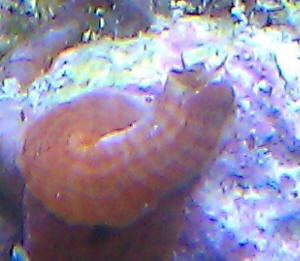
Re: What is this? Aiptasia or tube worm,
maybe? 10/26/11
Sorry, this is the best I can do.
<Ahh, I do see your worm...>
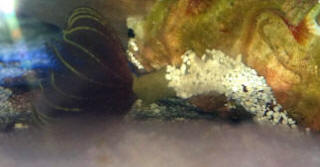
However, if these aren't good enough to be sure, can you
answer this?
Is it possible that an Aiptasia would jerk rapidly (split second)
down into its base at the sight of a human walking near the
tank?
I'm guessing "no" and now think this is almost
certainly a (harmless) feather duster worm.
Thanks
John
<Is just a Sedentariate Polychaete worm of some sort.
BobF>
|
|
|
Re: What is this? Aiptasia or tube
worm, maybe? 10/26/11
Thank you, Bob, much appreciated.
John
<Thank you for your patience John... have been delirious
(sick)... Cheers, B> |
|
Christmas Tree Worm in Star Horseshoe Worm?
5/3/11
Hi All!
<Lea>
I have a general fan worm question - not really concerned, but
curious.
<A good trait... positive survival value plus>
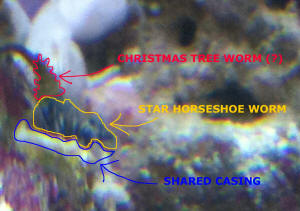
I've attached two pictures of one of my favorite hitchhikers
- the blue star horseshoe worm. He's been tenacious - holding
on through the algae bloom that temporarily covered him when
others of his kind gave up, so I'm partial to him (and
consequently check in on him every day). Today I noticed some
sort of tiered fan worm (or, at least, I'm assuming
that's what it is) growing out of his casing. I know
they're at least sharing the same casing as they both retract
at the same time, though the visitor does still protrude a bit
when retracted. Have you ever seen a worm "mooching" on
another's casing?
<Rarely, but yes>
Or is this perhaps a reproductive thing? I have no idea, though I
can say that while I have many hitchhiking fan worms (mostly star
horseshoes) I've never seen a tiered worm of any sort and I
haven't introduced anything in nearly 6 months (in fact
Ranger and his pistol shrimp, Bullet, were the last addition and
I don't think livestock usually bring things with them).
The particulars:
I have 24g JBJ Nano cube with about 20lbs live rock, 3" live
sand/rubble, a few hermit crabs, 2 snails, Ranger, Bullet (a
tiger pistol shrimp), and 3 heads of Ricordea.
SG: 1.026
Temp: 78-80
NO3-: 20ppm (high, I know, but I'm working on getting it down
right now with daily partial water changes)
NO2-: 0ppm
Phos: 0.5ppm
Ca2+: 500
KH: 10.5 dKH (~185ppm)
pH: 7.8
Thanks for your help and posting all the good information!
Lea
<Thank you for sharing. Bob Fenner>
|
|
|
|
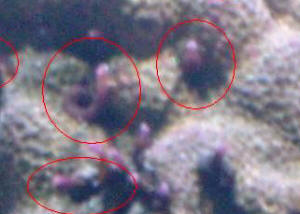
Trying to identify if the attached pictures are
worms/tunicates/or something else 3/12/10
Hello Crew,
<Hello Chip>
I hope you can help me identify my fisherman.
<I'm going to try!>
Well aged tank and live rock. I've had these guys in my tank
since before I upgraded from a 30 to a 75.
<Ok>
They form what feel like calcareous tubes which protrude from the
live rock. During feeding I see long mucous like
strands coming from them catching bits and pieces and appear to
slowly real them in.
<This is a BIG clue>
They sprout like crazy and hopefully won't hinder the
movement of the anemones too much.
<Doubtful, but why do you want your anemones to move? This is
the worst thing they can do>
I have attached two pics (best I could do with focus).
<I see these.. not possible to identify from these
alone..>
Any hints would be helpful.
<Ok, I'll give you one here... WORMS! Yes, I do believe
that is what you have here, a beneficial life form indeed, enjoy
the biodiversity and have a read on some of these:
http://www.wetwebmedia.com/polychaetes.htm
http://www.reefkeeping.com/issues/2002-06/rs/index.php
http://www.chucksaddiction.com/hitchworms.html>
Thanks,
<No worries>
Chip (Arlington, Va)
<Simon (Truro, Cornwall at the moment)><<Perhaps w/
coralline algae growing on the outside of the tubes.
RMF>>
|
 |
Re: Trying to identify if the
attached pictures are worms/tunicates/or something else.
3/12/10
<Hello Chip>
You may not have expected an answer, but here's one.
<Ok...>
I appreciate the fact that you are trying to help people with their
problems and questions...but don't make them look like a jerk
in the process.
<I did not mean to Chip, at all. I have no idea of your level of
expertise>
See below. I know an anemone shouldn't move if it is healthy
and in a good environment...perhaps you should have explained why
it isn't good for an anemone to move or explain why it would
move here.
<There is plenty to be read on the subject:
http://www.wetwebmedia.com/marine/inverts/cnidaria/anthozoa/anemones.htm>
Just an etiquette FYI.
<Thank you for this, Simon><<"Chip" on his
shoulder? B>> |
I have a new "flowering" tube
worm, can you help me identify? 3/6/10
Hello, I have searched the internet web and images trying to find
something that resembles a new creature I just found in my saltwater
tank. Recently one of my feather dusters lost its crown, and we were
unable to even see where the leftover tube was, but then about a week
later, I noticed when feeding that something moved quickly (the way the
feather dusters go back in the tubes when touched) and I looked closer,
and there was a hole, the same size as the tubes, in the algae near
where the other feather duster was. There is <are> also 2 feather
dusters close by that area, but when I sat and watched, this really
dark brown thing started coming out of the hole, it was dark brownish
red, and has a tip of cream color on the edges, but as it came out
farther, about 1/4 in. if that, I resembles a rose blooming, and then
as if using the petals to search the sand around the edges.
<Neat!>
I'm not sure if that's what the feather duster would look like
if the crown fell off or not,
<Could be>
then I noticed it came out farther when I turned the light back on
today, it was out about 1in. and the top part is the only part that
resembles flower petals, the rest is worm like, with scales.
<Might be the worm itself... the crown... the Featherduster
appearing part, is only part of the feeding apparatus>
Is this just my feather duster, or do I have something new growing in
my tank. I cant find any pictures. l just want to make sure that its
not something that is harmful. Thanks so much!
<I wouldn't be concerned here... Is likely the worm,
regenerating its crown. Happens. Read here:
http://wetwebmedia.com/featherbehfaqs.htm
Bob Fenner>
Polychaete question, that or tubiculous
snail ID 1/02/10
Hey their Guys,
<Howsit?>
I know Polychaete questions and bristle worms can become annoying but I
have scoured the internet for this one and cannot find anything close
to it. Anyways The worm in the tank is white and has 4 antennae. Now
this is rather normal but it gets better. It lives in some sort of
calcium type white egg it is oval and about 1/4" in diameter. It
is slightly opaque and I can see him inside of it during the day. It is
really shy but it apparently like to collect stuff and put it around
its egg house. Right now it collected red seaweed, a very tiny clam,
and another piece of seaweed.
It comes out of the egg type deal for a few seconds and then backs up
into it immidetly so a picture is rather hard to capture. Have you come
across any worms or Polychaetes or bristles that live in a semi
transparent opaque white circular egg thing?
<Mmm, yes... though this might also be a tubiculous snail...>
Any information would be great. Also it resembles a centipede and does
not contain bristles on its body and has 4 antennae around its mouth
area.
<Many Sedentariate Polychaetes appear smooth-sided... There are
thousands of species... Do you have pix to send along? Please read
here:
http://wetwebmedia.com/HighInvertInd.htm
the second tray... FAQs on Worm ID's, further down on
Polychaetes... Bob Fenner>
Re: Polychaete question
1/4/2010
Ok guys,
I have finally identified the questionable animal it is a Eunice
norvegica.
<A neat animal>
If anyone describes a worm like creature that has no bristles,
<Mmm, actually, this species does have noto- and para-podia>
looks like a centipede, and builds cocoons out of bits and pieces of
seaweed, clams, or corals it is most likely what I currently have
living in my tank. They can also be rest assured that they are safe,
excellent scavengers, and have a relationship with corals by taking sps
corals and "gluing" them to their tube for protection.
Cheers, Jerry
<Thank you for sharing Jerry. Bob Fenner>
Distinguish Between Hydroids And Bispira Cluster
Dusters 9/12/09
Hello,
<Hi Vivian>
First of all I would like to thank you for this wonderful resource. I
have and continue to learn SO MUCH in this great (but addictive
hobby).
<You are welcome my dear, glad you enjoy.>
In any case, I have been searching through all your pages, but I cannot
resolve this issue. I have little beasts in my LR which, according to
pictures from some web sites are described as beneficial Bispira fun
worms . On the other hand, in some of your pages you do show pictures
of hydroids that look awfully similar to photo 1 (see photo).
<What photo?>
Do you have any pointers on how to distinguish between hydroids and
Bispira?
<Hydroids are any of numerous, usually colonial marine coelenterates
having a polyp rather than a Medusoid form as the dominant stage of the
life cycle. Hydroids have a simple cylindrical body with a mouth like
opening surrounded by tentacles. Most species form colonies with
individual hydroids branching off from a common hollow tube that is
probably used for sharing ingested food.
Bispira are basically a tubeworm and/or feather duster where the
"duster" is the crown of a worm that lives in a tube, and it
is both a feeding apparatus and a breathing gill.
Hydroids do not have or retract into a tube. I nice pic of a smaller
colony of Bispira for comparison can be seen here.
http://commons.wikimedia.org/wiki/File:Bispira_sp._(Tubeworm).jpg>
Thank you SO MUCH
<You're welcome. James (Salty Dog)>
best,
Vivian
Re Distinguish Between Hydroids And Bispira
Cluster Dusters 9/13/09
Thank you SO much James.
<You're welcome.>
That is a beautiful picture! From the practical point of view, given
that my Bispira or hydroids are so very tiny (I have to get a magnifier
glass) that I can not really go through the description with the
necessary detail, Do you think that then, an easy way to tell would be
to touch the prospective crow/ tentacles to see if they retract?
<Do try, if they are dusters, the crown will retract instantly,
revealing the tube..>
As an aside, I HAVE seen these tiny jellyfish kind of thingies beating
around the tank ( I do not have a camera good enough to show, but they
look like brown transparent umbrella shaped creatures of about
5mm.....I guess that would be consistent with hydroid medusas
(no?).
<Can be, dusters/fanworms do not roam.>
all the best,
<And to you. James (Salty Dog)>
Vivian
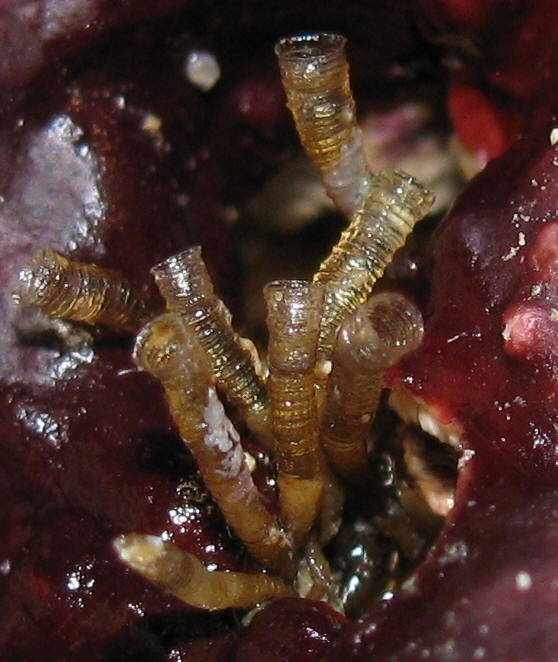
Tube worm? 7/15/2009
Hi there,
<We're as happy as can be...>
As always, when in doubt, ask WWM! your website is truly a wealth
of information. Here is my question. I recently examined my tank
and noticed a bunch of brown 'anemone' like creatures
growing on a small piece of live rock.
<Mmm>
Fearing the worst (Aiptasia) I took the rock out of the water and
noticed that each of the 'flowers' (for lack of a better
word) had retracted into individual semi-rigid, semi-transparent
brown tubules that bend when pressed but snap into place when
released. Am I dealing with a pest or is it something benign like
tube worms?
<The latter... Sedentariate Polychaetes make all sorts (or none)
of tubes... some are chitinous, others of "sand", and
some are rigid as yours here... No problemo>
I've attached a picture for your reference. Your help is
greatly appreciated.
Regards,
Luis.
<Thank you for being part of it. Bob Fenner> |
 |
|
Re: Tube worm? - 7/16/09
Hi Bob,
<Luis>
Thanks for the speedy response! Just one more question to put
this one to rest: someone who saw the pictures (same ones I sent
on my first message) suggested they may be Hydrozoans. Any chance
of that being the case?
<About as close to none as we'll ever get>
I will certainly defer to your expert opinion. Once again, your
helpful insight is greatly appreciated.
Regards, Luis.
<And you, BobF>
|
|
Feather Duster? ...Yes, Yes it is.
6/7/09
Hi there!
<Hi here!>
Just a small question tonight,
<Good, I'm tired and small questions suit me fine right
now.>
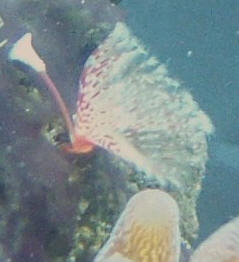
we are having trouble identifying our new feather duster on the
rock.
<Is a feather duster... on a rock.>
We have tons of feather dusters on all of our rocks but this is
completely different.
<Does look unusual.>
My husband and I are stumped by the bell shape at the end of it.
Any ideas?
<No actually, I'm not sure I'm understanding what
I'm seeing, is it possible to get another shot? I mean
photo... no more shots please, I've had enough!>
Sherri Clark
<Mich>
"Take each day as it comes, live only for today and
don't worry about what tomorrow will bring"
<Yay! No need to worry about retirement!>
|
 Plus... RMF Plus... RMF |
|
Aiptasia? Please Help 4/20/09
I am sending a picture, it is not very clear. Can anyone tell me
what these things are, and what I can do to get rid of it. I was
told Berghia Nudibranchs would help.
<Not Aiptasia, picture a little blurry, but they appear to be
fan worms, Bispira. I call them cluster dusters, and are safe, no
need to get rid of them, desirable. James (Salty Dog)>
|
 |
|
Hard white worms?? 2/23/09 Hello,
<Hi Heather, Mich here.> I had a question about identifying
something I found in my filter of my saltwater tank recently. I
have had my tank for about a year and it is doing just fine. I
have a Picasso trigger fish and a flame angel fish as well as an
algae "lawnmower" blenny. I was doing a water change
and happened to notice some weird white things that looked like
small worms. They don't move at all and when I touched one it
was hard. I broke it open and there was something red inside of
it. I also found a few of these things on a magnetic glass
cleaner that I always keep in my tank. I didn't know what
these are or if they are something I should be concerned about.
Will they harm my fish or clog my canister filter? <They are
tiny feather dusters, part of the family Serpulidae and are
harmless, beneficial filter feeders. They will live happily in
your filter, their tubes are calcareous but stay pretty small and
usually attach pretty firmly. But you may have to remove a few
depending on their location. More here:
http://www.wetwebmedia.com/feather.htm > I really appreciate
the help!! <I'm happy to assist!> Thanks, Heather.
<Welcome, Mich>
|
 |
|
Hydroids? Maybe Not -- Possible Spirorbids?
1/21/09 <Hello there> I have these strange white
spots that started on one side of my 125g reef tank and have
started to spread across the whole tank, including the LR. I read
on another forum that it very well may be hydroids.
<Unfortunately, I can't see any individual well enough to
determine exactly what you have. They could be the extremely
common and harmless Spirorbids (filter feeders) or Hydrozoans.
Take a close look at one with a magnifying glass. If it looks
like a very small (no larger than a couple of mm) hard white
spiral, then it's a Spirorbid. If it looks like a soft white
blob with tentacles, then it's likely a Hydrozoan. Please see
the following links for more information/photos: Spirorbid (see
photo on the right at FAQ titled 'Oh Mich.... ID Spirorbis
spp. and possibly Collonista spp. -- 09/29/07"):
http://www.wetwebmedia.com/snailid12.htm Hydrozoan (see FAQ
titled 'Help identifying 2 pics? 06/21/08'):
http://www.wetwebmedia.com/hyzoidf5.htm I have had coral, Zoas
and mushrooms, for about 6 months. I have attached links to the
photos. If it is hydroids, I have read that tear down and
sterilization is the only way to eradicate them. Am I, and my
coral, doomed? <Not necessarily! Let's first confirm
exactly what you have and go from there!>
http://s488.photobucket.com/albums/rr249/mantisman51/?action=view¤t=hydroids003.jpg
http://s488.photobucket.com/albums/rr249/mantisman51/?action=view¤t=hydroids001.jpg
<I'm hoping that you do indeed have Spirorbids instead of
Hydrozoans, but if not, let me/us know. Take care, -Lynn>
|
|
|
|