|
FAQs about Marine Snail
Identification 10
Related Articles: Gastropods, Sea Slugs, Mollusks, Abalone,
Related FAQs: Snail ID
1, Snail ID 2, Snail ID 3, Snail
ID 4, Snail ID 5, Snail ID 6, Snail
ID 7, Snail ID 8, Snail ID 9, Snail ID
11, Snail ID 12, Snail ID 13, Snail
ID 14, Snail ID 15, Snail ID 16, Snail ID
17, Snail ID 18, Snail ID 19, Snail ID
20, Snail ID 21, Snail ID 22, Snail
ID 24, Snail ID 25, Snail ID 26, & Marine Snails 1, Marine Snails 2, Marine Snails 3, Invertebrate ID, Snail Behavior, Snail Selection, Snail Compatibility, Snail Systems, Snail Feeding, Snail Disease, Snail Reproduction, Mollusks, Sea
Slugs, Abalone,
|
.jpg)
|
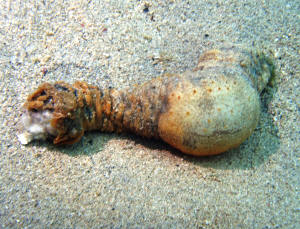
| Tulip mollusk, actually Brown Tun question
5/10/07 Hi, <Hello there>
I live part time on the island of Bonaire and do one or
more shore dives on most days. <Ah yes... have been there... the
Lower Antilles... usually stay at Cap'n Don's... or nearby
at Sand Dollar...> I was coming in from a dive couple days ago
when I noticed a mollusk on top of the sand in about 10 feet of
water. The mollusk, which our resident naturalist identified as a
Tulip mollusk, <Mmm, no... this is a Tonna galea. (Linnaeus,
1758). Giant Tun... NOT a "True" Tulip, Fasciolaria
tulipa...> had evidently just crawled out of the sand and was
moving across the sand trailing a cord, which was still attached to
the mollusk (see picture #1). The other end of the cord was buried
in the sand. When the mollusk had traveled about 12 - 15 inches,
the cord broke off from the mollusk (see picture #2). The mollusk
then traveled about 10 - 12 feet further and then buried itself
under the sand. The following day I checked the
"cord" and found that it had shriveled up and had a bulge
in the middle (see picture #3). Today, the bulge was gone, and the
cord was turning black and disintegrating.
What is this cord?
Thanks, Marge <Mmm, appears to be
fecal/waste material... perhaps this large snail ate a sea
cucumber... at least this is what this appears to me superficially.
Bob Fenner> |
|
|
| Re: Tulip mollusk question
5/10/07 Hi, <Marge>
Thanks for the prompt reply. We own a townhouse at Sand
Dollar. <Oh!> Next time you come down here, ask the dive shop
if Marge is around. It would be great to meet you and discuss some
of the other fascinating things I've seen. <Will gladly do
so, thank you... Have a bunch of fond memories from the pier...
and... Green what restaurant that used to be to the right... and
that ding dang reef Tarpon scaring the pants off of me whomping
down reef fishes that photographers have temporarily, err, make
that permanently have blinded with their dive lights! Maybe later
this year... Cheers, BobF>
Marge |
| Re: Snail ID: Possibly Sundial snail (Heliacus
sp.) 4/22/07 Hello to all of you, It has taken me
awhile to follow up with the snail id--plural at this point as
there are at least twelve--but the opercula is flat and oblong,
bearing no resemblance to that of Heliacus. The snails are
approximately 1 to 2mm by 1/2 to 1mm in size, making them difficult
to observe. I have enclosed another image with two of the snails
present. If you have any additional ideas while I continue to
search, please drop me a line. Thank-you, Jane <<Jane:
It's really hard to tell from the picture what you
have. Since you have access to the snails, try putting
them in a container by themselves and take the clearest picture you
can. Best of luck, Roy>> |
|
|
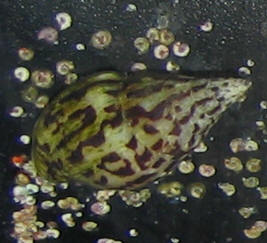
Snail ID - 4/21/07 Hello everyone, <Hello
Tony> Thanks so much for all your work on this site, I have used
it a ton in the last year for answers, advice, education........
<Thank you, I'm glad we were able to help!> Usually can
find any answer to any question with a little searching, but now I
am stumped trying to ID this little snail. <Understandable --
many, many species.> It came as a hitchhiker on something and I
caught him and moved him to my spare tank. In both these pictures
you can't see the striped proboscis that is out when it is
exploring <'Sniffing' for food. Usually means the snail
is a scavenger or predator. It could be harmless, but I
wouldn't risk it.> ...(stripes are rings on the proboscis,
not longitudinal). <Pretty, but longitudinal would be so much
more slimming!> Additionally there is far more white
in the shell coloration than is shown in the pictures, they came
out very dark. I first thought it might be a cone, Conus
eberneus, but it doesn't appear that the aperture runs the full
length of the shell. <Yes, the shape is wrong for a cone, which
is good news. You don't want one of those in your
tank!> I also thought it might be an Engina zonalis
as the shape is right, but the shells on those tend to be much
rougher and the suture lines are more
distinct. Doesn't look like any Ceriths I have seen.
Any ideas? <Hmmm, I'd need to see the underneath/aperture of
the shell. The best I can do right now is refer you to the first
place I go when I need to ID a gastropod. It's a database which
includes a 'search by shape' function. Each photo at this
page is a link: http://shell.kwansei.ac.jp/~shell/pic_book/shape15.html
Here's the home page: http://shell.kwansei.ac.jp/~shell/pic_book/index.html >
Tony
<You're very welcome! -Lynn> |
|
|
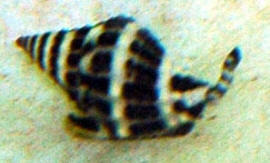
| Snail ID, Whelk - 4/13/07 Hello again <Hi
there!> I have a snail which I cannot identify from reading on
your site. This snail is about 3/4 of an inch long, black and
white. <Pretty!> He mysteriously appeared, I am assuming out
of my live rock, last week. I put him in a floating container, to
be able to photograph him later. Well, he just up and crawled right
out of there. <The nerve!> Saw him again today, so I took a
few photos, two of which I am attaching. <Thanks, that makes a
world of difference when it comes to these Id puzzles!> He is
very pretty, but I am not sure if he is a predator. <Yep, he
is!> I am leaning toward that he is because of his bright
markings and daytime prowling. Have put him into a container which
now has a lid with small holes. Any help would be appreciated.
<Well, I'm not sure where your rock is from but I'm
guessing it's from the Pacific, western Pacific that is. After
looking around a bit I think you may well have a species of Engina,
possibly Engina zonalis(?): http://www.gastropods.com/4/Shell_3214.html http://shell.kwansei.ac.jp/~shell/pic_book/data37/r003656.html
Here's another link with good photos of snails in this
subfamily (Pisaniinae). There are several that look similar to
yours: http://www.gastropods.com/Taxon_pages/TN_Family_BUCCINIDAE_PISANIINAE.html
If this is what you have (or one in this family), these snails are
in the Buccinidae family, commonly called Whelks. Whelks are
scavengers and predators, and if that were my snail, he
wouldn't be going back in the tank! Please read here for more
info on these interesting, if not reef friendly snails: http://www.reefkeeping.com/issues/2005-11/rs/index.php>
Thank you Dietmar <You're very welcome, is was my pleasure!
--Lynn> |
|
|
Strange Critter ID Please: Chiton
5/10/07 Hello there! <Hi Jo, Mich here!> I
know that you guys are really busy but I was hoping you might be
able to help me ID this critter. <Certainly will try!> We are
currently setting up our second reef tank. The LR is from Indonesia
as far as I know and this "thing" has showed up twice
now, both times at night with all lights off. It seems quite shy
and retracts slowly back in its hole as soon as the room light is
put on. I find watching the LR and the critters on it
one of the best things in this hobby. <Heee! Yes, I
would agree. One of my favorite parts
too! When I was setting up my tank most people just
didn't understand when I would tell them how excited I was
watching all the life emerge from the LR. I would get
comments, with undertones questioning my sanity: "So
you've spent the last hour staring at rocks?" > We had
new forms of life coming up in our 2.5 years old reef right up to
the end and managed to ID most of them but this is really unusual.
Any thoughts? It is flesh colour and I thought it was some sort of
bivalve but it seems quite soft, a bit like an anemone. <Looks
like a Chiton to me. They are reef safe and generally
graze on algae. A lucky addition! Do enjoy
it!> Many thanks for your time and looking forward to hearing
from you soon Best regards,
Jo Vasey |
| Re: strange critter ID please photo now added,
Chiton 5/12/07 Hi Mich and thanks for
the quick reply! <Hi Jo! You are quite welcome.>
Are Chitons what some call "Stomatellas" (please forgive
me if I've spelled this wrong)? <No, they are two different
critters and your photo is not a picture of a Stomatella snail.>
I did a search on Google but the critter doesn't look much like
the search returned on Chiton - the main difference being the lack
of a shell on his back. <Many different species, not all have
the "classic" Chiton look.> The 2 black holes/openings
look a little bit like craters? <I think you will find there are
more than two "holes", there are likely 8
"holes" or eight linearly arranged overlapping
articulating plates, which make up the shell on his back.> Any
more thoughts? <Nope, I still think it is a
Chiton. Please see similar photos here:
http://www.wetwebmedia.com/invertidfaqs.htm Chiton ID
9/9/03 and here: http://www.wetwebmedia.com/snailidfaq3.htm Prehistoric
worm...errr...??????? 1/30/04> I think I saw it last night quite
longer and stretched inside the rock which is very porous and you
can see through but could be wrong. <Likely so, they do tend to
stay in the same location emerging typically at night to
feed. The behavior you described in your prior email is
also consistent with a Chiton.> It is really bugging me now. My
LFS is kindly looking after my livestock during house move and
upgrading the tank. We are getting our corals back soon - I am
trying to decide if I should remove the piece of rock with the
critter to the sump where it won't be tempted to munch on
anything? <Most are harmless algae eaters. If it were
me/mine, I would not be concerned.> Many thanks again and
looking forward to hearing from you again! <You're
welcome! Hope this gives you more confidence in the
ID. Mich> Jo |
| Re: strange critter ID please photo now added...
Polyplacophoran 5/12/07 Hi Mich, <Hello again
Jo!> Thanks for the links. <You're welcome!> Yes, it
looks very much like the one in the first link and thanks God
it's not 6" (yet!) like the one in the second link.
<Heee!> Thank you for helping me ID it, I didn't mean to
doubt you but my not very in depth search on Google returned
completely different images. <I can appreciate and
understand. And just found another photo
here: http://www.wetwebmedia.com/invertid24.htm Can you
identify 3/16/2007 > As for the 8 "holes" I
did think that there might be more than 2 but couldn't see
properly as it wouldn't come out of the rock enough to see
properly. <Yes, Chitons can be quite shy.> I will continue to
observe it and will try to learn a bit more about its feeding
habits. <Excellent!> Many thanks again! <You're quite
welcome! A pleasure to assist! Mich>
Jo |
|
.jpg)
|
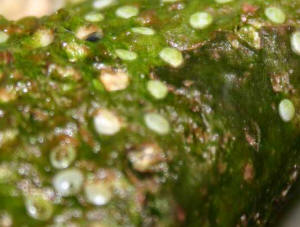
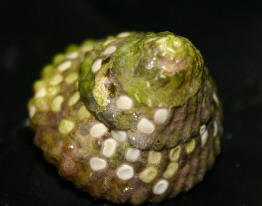
Unknown White Growths...Nerite Snail
Eggs 5/15/07 Hello all... <Hi David, Mich
with you tonight.> First I would like to mention that I love
your site and I find a lot of much needed information on it that I
use in the daily maintenance of my tanks. <Thank you
for this fine compliment!> Now, to my
problem/dilemma. Over the past two weeks I have been
having a problem with ich and some other parasites attacking the
swim bladder that caused me to lose 9 fish in 2 1/2 days
<Yikes!!! I'm very sorry for you large loss.>
(believe it or not, this is not my problem). <Ok,
I'm a little scared now!> The other day when I woke up I
went to look at my tank to see how the survivors are doing and much
to my surprise all my live rock and even the snail shells were
covered with these white growths (I've attached two pictures,
one of the snail shell (IMG_0485) and one of a piece of my live
rock(IMG_0504)). I've searched your website, along
with some others, and I may be missing something or using the wrong
keyword but I cannot find anything that resembles or sounds like
this outbreak. I'm guessing that it has nothing to
do with the ich and other parasites that have taken over my tank
but I would like to know what these unknown growths are and how to
treat them. <Seems like you have some frisky Nerite snails in
you tank. These would be Nerite snail eggs, they
generally don't mature in captivity and there is nothing to
treat here. A photo here: http://www.wildsingapore.com/chekjawa/largfoto/r422fx.htm >
I took one of the snail shells to my LFS and after careful
examination the owner determined that it looked like this growth
feeds off of calcium. He came to this conclusion by
taking a razor blade to the growth and removing it. When
it came off the shell was all soft and a few layers could easily be
scraped off. When you took the razor blade to other
parts of the shell where no growths were, the shell was hard, as it
should be. Could this be clam or mussel
larvae? When I got home I was looking around my tank and
found a snail that had a growth (looks like a shell) on
it. I've attached that picture as well
(IMG_0512). I'm sorry about that picture but it was
as close as I could get to the turbo snail using my digital camera
and lens. Do you have any suggestions as to what this
problem could be? <This is not a problem or anything
to be concerned about. You will likely see these
"sesame seed" like eggs wax and wane in your system.>
If so, how do I treat it because my 125 gallon is stocked full of
these white growths. Thank you for your time and
continued knowledge. <Welcome! My pleasure to
assist.> Good night....Dave
<G'night! Mich> |
|
|
|
|