|
FAQs about Marine Snail
Identification 16
Related Articles: Gastropods, Sea Slugs, Mollusks, Abalone,
Related FAQs: Snail ID
1, Snail ID 2, Snail ID 3, Snail
ID 4, Snail ID 5, Snail ID 6, Snail
ID 7, Snail ID 8, Snail ID 9, Snail ID
10, Snail ID 11, Snail ID 12, Snail
ID 13, Snail ID 14, Snail ID 15, Snail ID
17, Snail ID 18, Snail ID 19, Snail ID
20, Snail ID 21, Snail ID 22, Snail
ID 24, Snail ID 25, Snail ID 26, & Marine Snails 1, Marine Snails 2, Marine Snails 3, Invertebrate ID, Snail Behavior, Snail Selection, Snail Compatibility, Snail Systems, Snail Feeding, Snail Disease, Snail Reproduction, Mollusks, Sea
Slugs, Abalone,
|
|
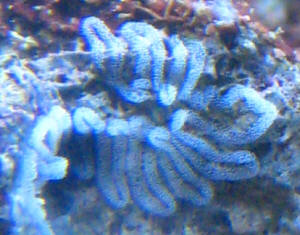
| Can You Identify This For Me? Snail Eggs, Likely Cerith
-- 8/28/08 <Hello Liz, Lynn here this evening.> I
have this white thing in my tank. At first it was in one place, and
then this morning I see it in a totally different place. Can you
tell me what it is? <It looks like what's commonly called a
'snail trail', a harmless, looping/squiggly, rope-like
strand of snail eggs. By any chance do you have any Cerith snails
in your tank? They lay eggs in patterns just like this. The strands
tend to last for several days then simply disappear, becoming part
of the food chain. It sounds like you either had two separate snail
trails (and the first was eaten), or the first strand came loose
and snagged at the second location. It's not at all uncommon
for this to happen. I'd love to be able to tell you that
you'll soon be seeing baby snails cruising about, but
unfortunately, the young have very little chance of surviving. On
the plus side though, it speaks well of your husbandry techniques.
Good job! Thank you Liz <You're very welcome. Take care
--Lynn> |
 |
| Reef Tank Newbie With Unknown Slug: Stomatella sp.,
Overcrowding Issues -- 8/27/08 Hi guys, <Hi there KC,
Lynn here this afternoon.> I have a 34 gallon Solana cube that
has been up and running for a little over three months now, one
month of which was spent cycling. It has approximately two inches
of live sand <Hmmm, please see this link for more information
regarding sand bed depth:
http://www.wetwebmedia.com/dsbdepth.htm> ..and about 30 pounds
of live rock. I am running a 250w MH SunPod lamp 10 hours a day and
have a CPR Bak Pak skimmer hanging off the side of the main
display. I also have the stock skimmer doing whatever it thinks it
is doing in the back sump. I wanted to move the CPR to the built-in
sump, but found out that the pump would not fit back there because
of the limited space even after removing the stock skimmer,
<Yep, that's frustrating all right.> so I thought it
wouldn't hurt to run both. <No, it could be redundant - but
that's not always such a bad thing! If the stock skimmer
isn't producing good skimmate (either in quality or quantity)
you could try running without.> The water readings are: calcium
-- 460 <Would let this fall a bit, to under 450. That is,
assuming that the numbers here are correct (the test kit's
reliable, not out of date). For more information regarding calcium,
please see this link (as well as related links at the top):
http://www.wetwebmedia.com/calcalkmar.htm> pH - 8.4 nitrate -- 0
phosphate - 0 alkalinity - (I use the Red Sea pH & Alk test kit
and it doesn't give a specific number for this. It has a color
chart that shows my water is in the "Normal Range - 1.7 -
2.8") <Not good -- you need specific numbers instead of a
range. I personally use/prefer Salifert for KH/alkalinity testing.
It's quick, easy to use, and most importantly, has a distinct
color change for better/more reliable results.> These are the
only things that I am testing for, should I be testing for more?
<Other than listing salinity/specific gravity, what you have
sounds fine to me. If you were having problems maintaining your
calcium level, I'd recommend a magnesium test kit, but that
doesn't seem to be necessary. Just keep in mind that if you
ever do consider adding supplements such as iodine/iodide,
magnesium, etc you'll need to first acquire those specific
kits. It's important to get a base-line reading as well as
monitor the levels as you increase them (not to mention making sure
they stay within recommended range thereafter.> I am still new
to this and am not too sure which elements I should be testing for.
<You should be good to go. Just be sure to keep up with regular
water changes. These make a big difference in helping to maintain
the extra supplements I mentioned (and more).> For inhabitants,
I have: 1 Fire Angel <I'm not familiar with this term.
I'm guessing it's a Flame Angel (Centropyge loriculus)? If
so, wow are they beautiful.> 1 Velvet Damsel 1 Three Stripe
Damsel <These damsels can become *very* aggressive, especially
in small/crowded systems such as this.> 1 Ocellaris Clown
<Would be nice to have a pair, but at this stocking point, I
wouldn't add one.> 1 Scooter Blenny 2 Fire Shrimp <These
are truly beautiful shrimp, if a bit shy (especially in systems
with strong lighting.> 1 feather duster <Can be difficult to
keep.> 1 2" Tridacna crocea <I would not have added this
until the tank was 6-12 months old at the very earliest.> 1
Turbo snail <Terrific herbivore.> 5 Margarita snails
<Unfortunately, these are cooler water snails that don't
live long in reef systems. The warmer water speeds up their
metabolism. It's a case of 'the candle that burns twice as
bright, burns half as long'.> 2 Cat Eye snails <These,
plus the Turbo listed above, have big appetites and will need a lot
of algae to survive. If there isn't a sufficient amount
existing in the tank, they'll starve to death. You may need to
supplement with dried seaweed/Nori sheets (available at most
regular grocery stores and Asian markets).> 10 or so hermits
<Hmmm, careful here. Hermits are neat, but many reef keepers
(like me) choose to avoid them. They tend to be opportunistic
little fellows that can cause trouble (picking at things, stealing
food from corals, killing small snails, even fellow hermits). This
is especially true when they're in high numbers, as is the case
here. It just makes for more competition for food. Keeping them
well fed, along with supplying plenty of (larger) empty shells,
will help deter (but not necessarily prevent) unwelcome
behavior.> 1 hammer coral 1 torch coral 1 small Acropora frag 1
plate coral a tiny patch of green star polyps that never come out
<Watch out. If/when these do come out, they can spread and take
over like you wouldn't believe. They'll even climb up the
sides of your aquarium. It's best to keep these separate and
away from your main rockwork so they can't spread and cause
problems.> a small rocks with a few Zoanthids on it 2 red
mushrooms <'Shrooms can also take over too, so watch
them.> 4 other bluish mushrooms that were given to me and I
don't know the names of. <Yikes, this is an overcrowded
tank, especially considering the fact that it's only 3 months
old! I would have skipped the Damsels, the Margarita snails, the
two 'Cat eye' snails, the feather duster, clam, and at
least 8 (or all) hermits. There's also a potential for serious
trouble down the road with the various corals you've listed. In
smallish systems such as this, you should really limit the variety
of species to those that will get along best in the long run.
Corals are like any other animal in that they'll fight to
ensure their survival. They do this in a variety of ways, including
chemical warfare or 'allelopathy' (for example many soft
corals/Gorgonians), direct contact with either sweeper tentacles
that sting (Euphyllids, like the hammer and torch coral you have
are particularly notorious for this) or mesenterial filaments that
digest the neighboring coral's tissues, or by simply
overgrowing (for example: green star polyps). Be sure to keep
enough space between the corals you have and move/remove as
necessary. I'd give the torch and the hammer corals at least a
6" buffer zone all the way around them, and keep an eye on
those green star polyps and mushrooms. Mushrooms (Actinodiscus),
although seemingly harmless, can sting adjacent, less aggressive
corals.> Each feeding, I soak the food in V3 Triple Strength.
The food alternates between flake, Cyclops-Eeze pellets, krill, and
Mysis. For the corals, clam and feather duster, I dose DT's
live marine phytoplankton once every other day, and dose Marine
Snow once a week. <I'm not personally crazy about this last
product, but hey if it works for you! Just be careful with these
two additives and decrease if you notice excessive algae
production.> Unfortunately, I bought basically every inhabitant
in the tank before learning the error of buying prior to research,
and am trying to keep them healthy and correct errors I have made.
<Good for you.> Is my tank overcrowded? <Oh yeah.> When
I bought all the equipment, sand, and rock, the LFS told me to
cycle it for a month, which I did. Other than that, they happily
sold me whatever I wanted and I admit that I lost a rose tip
anemone and Nudibranch that they sold me not long after I bought
them. <Oh no. What a shame.> It wasn't until that point
that I started doing research on the internet about trying to keep
the rest of the inhabitants alive. I didn't want to lose any of
the remaining inhabitants and felt like a real jerk for losing what
I did. <Well, we've all made mistakes in this hobby. I know
I've made my share and then some! The important thing is that
we learn from them. In your case, it sounds like you just trusted
people that were either lacking in knowledgeable or that were more
concerned with selling their livestock (or both). The good news is
that now you know better. You know to always do your research
*before* purchasing. That combined with quarantining new livestock
will save many lives and much frustration.> That was when I
stumbled across your guys' site and have learned TONS of
invaluable information. <Excellent!> That was less than a
week ago, and it has already saved my Zoanthids from Zoa-eating
Nudi's. <Yikes!> I cannot thank you guys enough for your
wisdom! <LOL While I would never doubt the wisdom of Bob or my
fellow crew-members, the closest I personally come to being wise is
wisecracking!> My question: I have had a couple of these slugs
running around the tank and was not sure if it was harmful to a
reef tank or my inhabitants. <Nope, not at all. They're
absolutely harmless and beneficial.> I was wondering if you guys
could ID it for me. <Yes we can. Oh, you want to know what it
is! It's a species of Stomatella (possibly Stomatella varia), a
commonly seen hitchhiker that reproduces readily in tanks and is
frequently seen grazing film algae.> I tried to search through
your guys' vast resources, but I could not find what this slug
is, or if it is harmful to my reef tank. <No worries, it's a
good guy.> I might have missed it though in the ID section, as I
was trying to find it during work hours, but I was hoping you could
give me a hand. <Sure thing. For more information on Stomatellid
snails, please see the following link:
http://bb.wetwebmedia.com/viewtopic.php?f=25&t=181 Be sure to
also check out the many FAQ's regarding these neat little
snails at WWM. Just go to our Google search engine, and enter the
term Stomatella:
http://www.wetwebmedia.com/WWMAdminSubWebIndex/question_page.htm
> Thanks in advance, your site has really opened my eyes to
aquariums and I would have no doubt lost everything in a matter of
time if I didn't stumble across your Web site. Thanks again! KC
<You're very welcome! Take care, -Lynn> |
 |
|
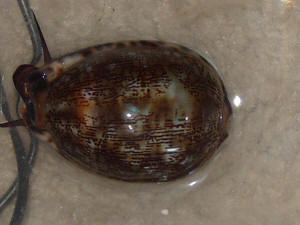
Cowry ID: Likely Arabian Cowry -- 8/16/08
Hey everyone, <Hi Doran, Lynn here this afternoon.> Love
your site. I account for 5-10 hits nearly everyday. <I'm
glad you're finding it useful!> I did what you're not
supposed to do. <Uh-oh> I bought a snail without knowing
for sure what it is. <Say it isn't so!> It's a
Cowry, but I can't figure out what species. <I think
it's most likely a variety of Arabian Cowry (genus Mauritia),
but it could also be something in the genus Leporicypraea.
Complicating matters is the degree to which these Cowries can
vary in appearance, along with the fact that we don't know
where yours came from. Please see the following links for
comparison: Arabian Cowry:
http://www.gastropods.com/7/Shell_37.html Asiatic Arabian Cowry:
http://www.gastropods.com/5/Shell_1715.html Giant Arabian Cowry:
http://www.gastropods.com/0/Shell_560.html Humped Cowry:
http://www.gastropods.com/1/Shell_4361.html Here's a terrific
site showing photos for both genera (each photo is a link):
http://www.gastropods.com/Taxon_pages/TN_Family_CYPRAEIDAE_CYPRAEINAE_MAURITIINI.html
> Picture is attached, feel free to use it as you see fit.
<Thank you!> Hopefully you can help, so I can figure out
how to take care of it. <Arabian Cowries (if that's indeed
what you have) are mostly herbivorous but will take the
occasional meaty fare. If the algae supply starts to run low, you
can try supplementing with something like dried Seaweed/Nori
sheets that are available at most fish stores and Asian
grocers/markets. I would also offer the occasional meaty bit (of
marine origin) as well.> Thanks again, Doran Figart
<You're very welcome. That's a pretty little Cowry
you've got there. Take care, -Lynn>
Re: Cowry ID: Likely Arabian Cowry --
8/16/08 Oops, now it's attached. Doran
<Take care, -Lynn>
|
|
|
|
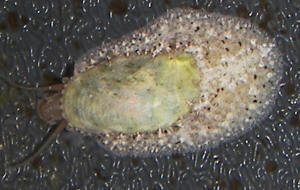
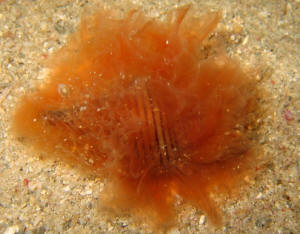
A strange shell or Nudibranch? 6/21/08 Dear Bob or Lynn,
<Greetings Tineke! Lynn here today.> Do you know what this
is? <Yes, it's pretty - hehe!> I thought it was a shell
with some algae, but on a site
(http://www.aqualifeimages.com/Default.aspx?ShowImage=66
http://www.aqualifeimages.com/Default.aspx?ShowImage=66&QueryIs=89%20results%20for%20%22Latest%20Images%22&sqlstr=SELECT%20*%20FROM%20IMAGES%20WHERE%20INACTIEF%20=%200%20AND%20Release%20=%2048%20ORDER%20BY%20NAAM&QueryIs=89%20results%20for%20"Latest
20Images"&sqlstr=SELECT%20*%20FROM%20IMAGES%20WHERE%20INACTIEF%20=%200%20AND%20Release%20=%2048%20ORDER%20BY%20NAAM)
<Unfortunately, I couldn't get through to the link (error
message), but was able to locate the photo - yay! For anyone
wanting to see this, please go to this site:
http://www.aqualifeimages.com, choose 'Nudibranch' in the
drop down menu under 'Aqualife subjects'. Once the page
has opened (may take awhile), go to the third row from the bottom
and see the photo on the far right. By the way, that's a neat
site!> ..I saw almost identical picture as an unknown
Nudibranch. <Yes, it looks like the same creature. Apparently,
it was photographed in the Red Sea so I'm guessing that yours
was taken there as well? You saw some neat things while you were
there, didn't you! That does it, I've got to go!> I
hope you know this one! <Well, at first I thought that this
should be fairly easy to ID, but after hours of searching and
exhausting every resource I have, I'm more than willing to
admit that I just don't know! The frilly exterior reminds me
of something in the genus Hydatinidae (family Acteonidae, Order
Cephalaspidea -- 'Head Shield' slugs and Bubble shells).
I didn't see any however, that had their shells completely
covered/obscured. See this species, for example:
http://www.seaslugforum.net/factsheet.cfm?base=hydaphys
http://www.seaslugforum.net/display.cfm?id=4463 Then I checked
various Cowries as some of these have very elaborate mantles
covering their shells. See these for example:
http://chemistry.csudh.edu/faculty/jim/cozaugo4-600/atlantic.jpg
http://www.seaslugforum.net/factsheet.cfm?base=ovulids . It's
a shame we can't see a bit more of the shell underneath, that
would be a big help! My recommendation to you, at this point, is
to send your photo and information along to Bill Rudman at
SeaSlugForum.net and see what he says. By the way, please let us
know if/when he does ID this neat little guy!> Greetings from
Holland, Tineke <Take care and good luck. I'm sorry I
couldn't ID this for you! --Lynn>
Re: A strange shell or Nudibranch? 6/21/08 Hi Lynn,
<Hi there!> I will send this one also to Bill. I didn't
get an answer yet on the other Nudi I sent him...no problem. I
will wait a little bit longer. <Well, from what I read on his
site earlier today, they had a problem recently with a hacker so
that might well be part of it.> No problem that you
haven't found it...still a mystery to solve! <Thank you
for understanding! I do love a good mystery and am looking
forward to seeing this one solved. I'm sure Bill Rudman will
have an answer for you soon!> Greetings
Tineke
<Take care, -Lynn>
|
|
 Shell and Rhodophyte, BGA? B. Shell and Rhodophyte, BGA? B.
|
|
Fw: Gastropod ID - a long time coming!
1/11/13
Well darn - after all that, I spelled the name wrong - doh! It's
not Galaga succincta, it's Gelaga succincta! Sorry about that, Bob!
-Lynn
<Heeeee! Will amend/append. B>
Gastropod ID - a long time coming! 1/11/13
Hi Bob,
I was going through some of my files, pulling out and organizing the
ID's I've worked on over the years and ran across an unsolved query
that's bugged me since day one (four years ago!). It's titled "A
strange shell or Nudibranch? 6/21/08" at this link:
http://www.wetwebmedia.com/invertidf37.htm?h=
The good news is that I was able to contact the original querior,
Tineke, and solve the puzzle. According to Phillipe Poppe (of
Poppe Images, son of Guido Poppe - THAT Poppe - yay!), the organism in
question is a gastropod known as Galaga succincta, aka the "Lesser
Girdled Triton" (family Ranellidae). Depending on where you look,
this species is also listed as Cymatium succinctum. Which one is
right...or more right...is not something I could figure out.
Interestingly enough, the orange exterior that I thought might be an
elaborate mantle of some sort is instead the snail's periostracum. I've
seen hairy, prickly versions before, but never one as elaborate and
delicate as this. At any rate, the snail is a type of triton, and
is therefore carnivorous. I was unable to find any specific diet
information, but in general, the genus preys on a variety of things
including echinoderms, tunicates, some Polychaetes, and other mollusks.
It may also be a bit of a scavenger as well. On the whole, it's a
beautiful little snail that's "gilded the lily" with an ornate exterior.
By the way, here's another site with additional photos for comparison:
http://www.jaxshells.org/gelagna.htm
Needless to say, I am very thankful to Tineke and Phillipe Poppe, for
solving this long-time question!
<The Poppes are amazing, tireless photographers, catalogers of
Mollusca... RMF>
Hope you had a terrific time over the holidays and are enjoying the new
year!
Take care,
Lynn Z
Re: Gastropod ID - a long time coming! 1/11/13
No kidding, I'd love to meet any one of them so that I could thank them
in person for all they've done. Their site has always been one of
my first "go to" sources when looking for photos. It's simply
awesome.
-Lynn
<Indeed; agreed. B>
|
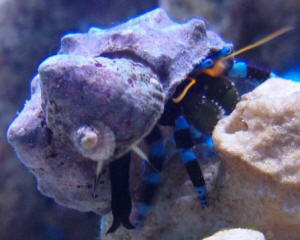
Mollusk Identification - Hipponicids 06/20/08 Hi all,
I'm hoping that somebody there can identify a strange
hitchhiker on the outside of one of my hermit crab's shells.
I've attached a picture. <Cool pic... thanks> For the
first week I didn't really realise that there was a hitchhiker
there at all. There was an extra lump on the snail shell that the
crab was using, but it was old, covered in coralline algae and
seemed to be embedded onto the snail shell. It's obviously been
there for a long time. <Indeed, I bet it was there when the
snail, that's now a shell for your hermit, was still alive.>
Yesterday evening, four of my crabs were feasting on an unfortunate
turbo snail and I (sorry, my girlfriend) noticed two pale coloured
antennae and a black "trunk" for want of a better word
come snuffling about from the edge of the extra lump on the snail
shell. The trunk has a little mouth in the end of it. It's
obviously some kind of mollusk but I'd like to know more and I
can't manage to ID it myself. <It's very likely a
Hipponicidae sp.-- a limpet-ish type creature. They're not
quite limpets, not quite snails... some people just call them
"Hippos." And it even looks like the Hippo on the crab
shell has a little (possibly juvenile) Hippo friend of its own
(that can happen too). These creatures also often start off in a
more spiral shape, then turn more slipper or cone shape as they
grow... so that's another clue. This is a nice page on them:
http://seashellsofnsw.org.au/Hipponicidae/Pages/Hipponicidae_intro.htm>
Interestingly, the hitchhiker has its own smaller hitchhiker too.
<Yep! That's not uncommon for these things.> I've
seen both snuffling about with their respective trunks at the same
time as the crab wandered about. The smaller one is not
"out" in the photo though. <They're pretty cool,
huh? And no worries, in captivity, they're not harmful to the
crab. In the wild they can make their hosts more vulnerable to
predators and a little more clumsy getting around. But in an
aquarium, it shouldn't make much a difference. The only thing
I'd suggest is that if the crab falls, and doesn't seem to
be able to right itself, you might want to help it up. ;-) >
Thanks for your help. It's a great website. Brian
<De nada,
Sara M.> |
|
|
|
Snail Infestation!! Help 6/16/08 Hi
again, <Hi Jarod> 55 gallon tank, water quality average or
better, community fish, and many leathers, a few SPS, and
cleaning crew. <Okay> I travelled this past weekend and got
back last night after the tank lights had turned off. I checked
to see if I had any floaters, and I noticed several little white
"things" on my rock. I turned the light on, and I had
dozens of little white snails on my rock and glass. They are the
size a small pea, white roundish shell with brown spots.
<I'd need a photo to confirm, but what you're
describing sounds a lot like harmless/beneficial little
Collonista snails. Please see this link for more information and
photos: http://bb.wetwebmedia.com/viewtopic.php?f=25&t=242
> Not only that, there were large "slugs" or snails
without shells on the glass, at least 6 that I could see.
<Again, a photo would be great, but these could easily be a
common, beneficial, hitchhiking snail in the genus Stomatella
(related to the ever popular Turbo and Astraea snails). Although
they do look very slug-like, they're most definitely snails,
with disproportionately small, flattish shells that are very
often overlooked. Please see this link for more
information/photos:
http://bb.wetwebmedia.com/viewtopic.php?f=25&t=181 > These
guys were the size of my Turbo snails. <Stomatellids can get
fairly large.> I have never seen them before, obviously they
are nocturnal, <This is often the case with both of these
snails. It helps them to avoid daytime predators such as various
fishes, etc.> ..but now I am concerned they are nuisance
snails and I need to know what they are and how to get rid of
them. Should I just pluck the ones I see each night? Should I be
concerned that they will kill my coral? <If they are what I
think they are, you're in good shape. These are both
beneficial and welcome hitchhikers that pose no threat to corals
or other livestock. Please check the links provided above for
confirmation. If what you have is something different, please let
me know. Also, please see the links at the bottom of both of
those info sheets. You'll find a link to WWM's Google
search engine. Just enter the terms Collonista or Stomatella.
You'll find quite a few FAQ's related to these
snails.> Thanks for your help! <You're very
welcome!> Jared S <Take care, -Lynn Z>
Re: Snail Infestation!! Help: Collonista and likely
Stomatellids -- 6/16/08 Lynn, <Hi Jarod!> Thanks a lot
for the links and the information. <You're very
welcome.> The little guys are definitely Collonista snails.
<Terrific!> The others I need to confirm and I will try and
get pictures of both. <Sounds good.> If these guys are all
beneficial, then I can't wait to see them all come out and
roam now. <LOL Yep, the terms 'harmless' and
'beneficial' are what you want to see when it comes to
hitchhikers. This is especially true when there are great numbers
of said hitchhikers!> I had no idea that the night life in my
tank was so fascinating and different than daytime hours. <Oh,
are you in for a treat! I think you'll be very surprised to
see the number and diversity of creatures that seem to come out
of the 'woodwork' after the lights go out. I have no
doubt that you'll see all sorts of pods scurrying here and
there, possibly some peanut worms (Sipunculids), etc, etc. By the
way, a flashlight with a red lens cover goes a long way to
improving visibility and not shocking the inhabitants. I can tell
you from experience that they do *not* like it when you shine a
white halogen flashlight in their tiny little eyes!> Jared S
<Have fun! --Lynn>
Re: Snail infestation!! Help: Collonista and Stomatella --
6/17/08 Lynn, <Hi Jarod.> Big body, little shell, the
others are definitely Stomatellids. <Excellent, those are
terrific little snails to have around.> I couldn't wait
until the lights went out last night to see everything.
<It's truly amazing, isn't it?> Of course I grabbed
a flashlight and shined it in their little eyes, I will get a red
lens tonight. <LOL They'll very much appreciate that!>
I did see some pods scurrying about, AND a small brittle
starfish. I have read that starfish aren't reef safe,
<Some are most definitely not. Among the Brittlestars, the
most notorious is the Green Brittlestar (Ophiarachna incrassata),
aka 'The Green Death'. These clever stars like to suspend
themselves in caves and drop down on unsuspecting fish at night -
yikes!> ..should I be worried about him? He was no bigger than
a quarter. <No worries. This is very likely a
harmless/beneficial species of mini-Brittlestar (Ophiuroid). They
range from about the size of a dime, up to about a Kennedy half
dollar and pose no threat to corals or other livestock. These
common little hitchhikers are detritivores/scavengers that like
to hide within/underneath the rockwork, many times extending an
arm or two out into the water column to catch food particles
drifting by. Most range in color from all white to a combination
of shades of white and gray, often with bands of darker gray on
the arms. A plus with these guys is that given good conditions,
they reproduce readily and sustain a healthy population of
clean-up crew specialists! For more information and photos,
please see these links:
http://www.wetwebmedia.com/brittlestaridfaqs.htm
http://www.wetwebmedia.com/brittlestars.htm > Thanks again,
<My pleasure!> Jared S <Take care, -Lynn>
|
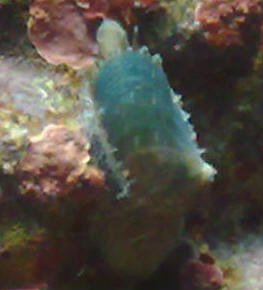
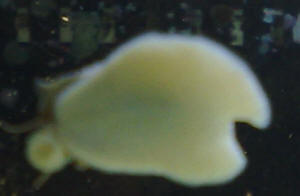
Pest or pleasant? Stomatellids - 6/13/08
Hello experts <I'm as much an 'expert' here as I am
a Tang! But happy to help...> In our 550L Reef tank we have
discovered this creature: is it a friendly Chiton or a snail pest?
<Neither! This is a Stomatellid snail. These little chaps are
tremendous algae eaters, besides being fun to watch. They'll
grow and reproduce in your aquarium as well, provided conditions
remain favorable.> It's body is much bigger than is small,
rather flat shell. OR. Am I looking two different animals??
<Nope, just one. Enjoy!> Kind regards <The same!>
Clive Rabson
<Benjamin> |
  |
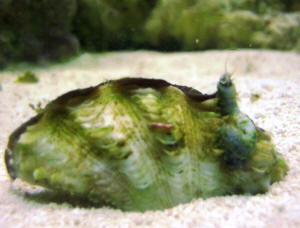
| Worm living in clam... Vermetid living on
Tridacnid 5/4/08 Hey guys, <Tom> First,
i <... I> just wanted to say I love this website. I use it to
research everything I see going on in my tank. It's always been
extremely helpful. Unfortunately, I couldn't find the answer to
this and am hoping someone can help. <I'll try> I just
purchased what I was told to be a Tridacna Clam a few hours ago.
<Is> When I got it home, about an hour after I placed the
clam in my tank, I noticed a worm coming out of the clam. <I
see... a Vermetid snail on the outside... end of the shell... is
this what you're referring to?> I read that there are worms
that can burrow it's way in, but the reason I thought this is a
different situation is that it looks as if the hole that it enters
is actually a hole that is part of the clam. It's as if
it's hole is a tunnel, and you can see it running down the
clam. In the picture, all you can see is the top of it's head
and antennae, everything below is actually part of the clam, not
the worm. Can someone help? Is this normal, is it a clam that
should quickly be quarantined and then returned to the LFS? Thank
you so much for your help!!! Tom. <Is a tubiculous snail... not
to worry... not destructive, deleterious... And even very
interesting... See the family name on the Net, WWM... Bob
Fenner> |
|
|
|
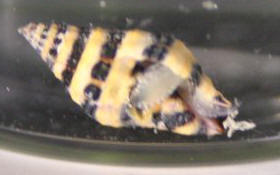
Black and yellow snail ID: Engina (Pusiostoma) sp. -
5/2/08 Hi, <Hi Johan> Thanks for a very good web site!
<Thank you!> I am wondering if you could help me ID this
little snail (image attached)? <It certainly is a pretty
little snail.> The snail is approximately 1 cm in length and
has a yellow base colour with black bands. I tried to find
something similar on the snail ID pages but failed. <It looks
like one of several different species in the genus Engina, also
referred to as 'Engina (Pusiostoma)' or just Pusiostoma
in some literature. They're in the family Buccinidae
(Whelks), otherwise known as Bumble Bee snails. These snails are
sometimes listed as omnivores, but they're actually predatory
carnivores that eat worms, sandbed fauna, sessile organisms and
the occasional snail. They don't eat algae.> It's in
QT for the moment, do you think it is reef safe? <If
you're asking whether it's safe around corals, likely so.
Although I've heard reports that Bumble Bee snails sometimes
eat Zoanthids/other polyps, those reports have only been through
second-hand information/rumors. I've never seen, or been able
to confirm their validity. The good news is that these snails
generally stay fairly small so if you have a large, mature
system, one individual shouldn't make too much of a dent in
the fauna (but I'd keep an eye on things anyway). If however,
it *is* a new system, or a small one, I'd definitely find the
snail another home - not within a refugium though! Please see the
following link for photos of various snail species within the
genus Engina (each photo is a link to more information and
usually more photos). Just bear in mind that these snails can
vary quite a bit within the same species, not just in color, but
also in shape. It certainly makes for a bit of a challenge!
I'm hoping that since you have the snail in a QT, you might
be able to see structures on the shell a little better than I can
and that they will help you to confirm an ID.
http://www.gastropods.com/Taxon_pages/TN_Family_BUCCINIDAE_PISANIINAE.html
> Thanks, Johan Andersson (Sorry, forgot to attach the image
the first time...) <No problem. Thanks for sending it along!
Good luck with your little snail. Take care, -Lynn>
Re: Black and yellow snail ID: Engina (Pusiostoma) sp. -
5/2/08 Thanks a lot! <You're very welcome!> It sure
looks like the Engina histrio. <I think so too.> I have to
get a camera with better macro, it sure is difficult to get good
pictures of these little critters... <It can be a real
headache but you did a good job with that little snail!> Johan
Andersson
<Take care, -Lynn>
|
|
|
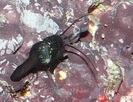
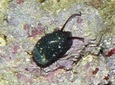
| Mystery Snails/Slugs? Stomatella sp. 4/19/08
Hi, <Hi Sharon!> I have found your forums really useful in
the first few months of setting up my first marine aquarium, thank
you. <It's our pleasure, and by the way, welcome to the
world of marine aquaria!> I wonder if you would be able to tell
me what species (I think a slug or snail) are in the 2 enclosed
photos please and are they one and the same? <Yes, they are.
They're both a common, harmless, herbivorous species in the
genus Stomatella. It looks like the individual in the second photo
either has the posterior end up its foot draw up, or has
lost/dropped it. They do this as a method of escaping predation
much like lizards detaching a portion of their tail (will
regenerate). Please see this link for more information, photos, and
links: http://bb.wetwebmedia.com/viewtopic.php?f=25&t=181>
We find something new in our tank every day, it's so
interesting. <Yes indeed, and it only gets more so with the
passing of time!> This morning was our day to find an Asterina
star feeding on our glass. <Yay!> Thank you, Sharon
<You're most welcome. Enjoy your new additions!
-Lynn> |
|
|
|
|