|
FAQs about Marine Snail
Identification 17
Related Articles: Gastropods, Sea Slugs, Mollusks, Abalone,
Related FAQs: Snail ID
1, Snail ID 2, Snail ID 3, Snail
ID 4, Snail ID 5, Snail ID 6, Snail
ID 7, Snail ID 8, Snail ID 9, Snail ID
10, Snail ID 11, Snail ID 12, Snail
ID 13, Snail ID 14, Snail ID 15, Snail ID
16, Snail ID 18, Snail ID 19, Snail ID
20, Snail ID 21, Snail ID 22, Snail
ID 23, Snail ID 24, Snail ID 25, Snail
ID 26, & Marine Snails
1, Marine Snails
2, Marine Snails 3,
Invertebrate ID, Snail Behavior, Snail Selection, Snail Compatibility, Snail Systems, Snail Feeding, Snail Disease, Snail Reproduction, Mollusks, Sea
Slugs, Abalone,
|
|
|
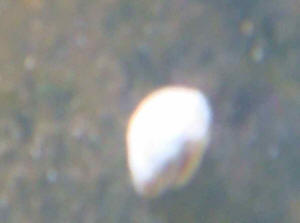
Please help identify this critter...
Snails 10/8/08 Hello crew! I was wondering
if someone might have a look at these photos to identify these
snails. My LFS told me that it was unrecognizable <?> and
that I should try to remove them... they are multiplying like
crazy! They really only come out after the halides turn off and
vary in size. Most are grayish white, but some are black. They
Jason <Look to me to be Trochids... look up the genus
Stomatella... mostly beneficial... Can be "picked off"
by some crustaceans, Labrids... Bob Fenner>
|
  |
|
If I could bother you or one of the other crew members
with a snail and parasite, ID, 9/27/08 Thanks,
Bob!!! <Welcome> If I could bother you or one of the other
crew members with a snail and parasite, ID, I'd appreciate
it. I have gone through all the snail ID pictures and
descriptions on all the 17 plus pages and of course, like most
people, no one has a snail "just like mine". I had it
narrowed down to the three most common ones people ask to have
ID'd, Nerite, Collonista and baby Turbo, but I went through
that site you have linked that shows all of the shells of those
and I could find a few that were similar, but, of course, none
"just like mine". They are primarily nocturnal but do
appear during the day. I find them every where. On the glass. On
the rocks. And on the corals, especially Zoas and leathers.
I've even found some under the microscope in water samples
that I couldn't see with the naked eye. It does have a
pattern similar to a sundial but it has a smooth shell and
doesn't have the pagoda shaped operculum. They also appear to
have calcareous egg shells on the rocks but they are not round or
sesame seed shaped, they are more like a pentagon. <I
don't see these in my ref. works either. Am sending your
query to friend and "shell nut" Marty Beals of Tideline
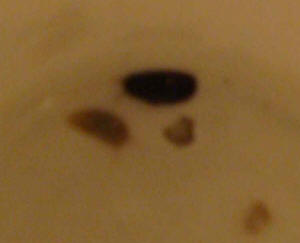
for his input> The parasites I got off of a small piece of
Acropora and Kenya Tree that I was given by a friend that I had
in quarantine. <Mmm, don't consider these parasites...
other than "space"... perhaps predators... Am pretty
sure these are Ostracods> They were both fine for about 3
weeks and then the Acropora went in less than 3 days. It started
losing tissue at the base and went right up to the tip. The Kenya
Tree started throwing off it's own branches but is still
doing okay in quarantine. Since the Acropora was already lost, I
did a dip in Iodine and all that came off were these little
critters. I dipped one of the branches of Kenya Tree and found
the same thing. One picture is magnified at 40 times, the other
is at 100 times. You can barely see the critter with the naked
eye. It looks like a flea with shorter legs. Iodine dip
doesn't seem to kill the critters. They were even alive after
a day in RO/DI water. You know microscopes are addictive when you
have a reef tank. <Ah yes> Once you think you've seen
everything in your reef tank, you are sadly mistaken until
you've seen it under a microscope. Thanks Everybody!!!!!
<I don't think these small crustaceans were/are the root
of the Cnidarians health issues. Bob Fenner>
|
  |
/Copepods/Reef_Parasites_001[1].JPG) /Copepods/Reef_Parasites_003[1].JPG) |
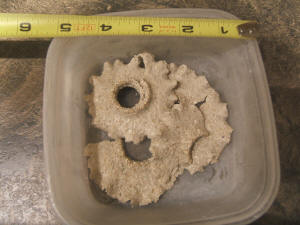
Circles of Ribbon-Like Sand: Likely Egg Collar -
9/8/08 <Hi Gerry, Lynn here this morning.> Over the
last couple of months these circles of ribbon-like sand appear in
my tank. They appear in different locations each time. The last
time they appeared was 3 weeks ago there were 2 of them. I removed
them when they appeared and took these pictures. Today I have
noticed a new one in my tank. Any idea what is making this?
<They look very much like what's commonly called a sand or
egg collar, a combination of mucus, sand grains, and eggs produced
by snails in the family Naticidae (commonly known as Moon snails).
Do you have any of these in your system? Here are some examples of
these egg masses for comparison:
http://farm3.static.flickr.com/2288/2250226721_f350b8a92a_o.jpg
http://jellyfishinthesea.files.wordpress.com/2008/04/img_4401.jpg
http://www.manandmollusc.net/Mystery_shell_pages/mystery_shell_steve.html>
Thanks, Gerry
<You're very welcome, Gerry. Take care, -Lynn> |
 |
|
Re: Circles of Ribbon-Like Sand: Likely Egg Collar -
9/9/08 <Hi Gerry> Yes, I believe that I have.
<Mystery solved!> Thanks, you have been a great help. Gerry
<You're very welcome Gerry, it was my pleasure. Take care,
-Lynn>
|
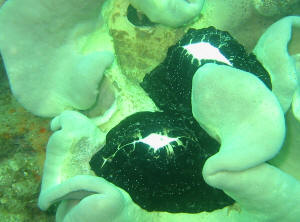
| Anemone identification -09/01/08 Hi there, In
July this year I photographed this pair of anemones <Mmm, no,
not anemones...> in about 30ft of water on a reef in North East
Tobago. I have no idea of their identity. Can you help please.
<They do look like Ovulids (Ovula sp.). Please scroll down and
see the pics of Ovula ovum on this page:
http://www.seaslugforum.net/showall.cfm?base=ovulids> thanks,
Rob Jackson <Ovula ovum is my guess. Best, Sara M.>
Re: Anemone identification - not anemones, Ovulids
09/01/08 P.S. Oh, I might also note that many Ovulids eat
soft corals (so it might make sense that you find these on/eating a
leather coral). :) Best, Sara M. Re: Anemone
identification... Ovulid et al. input... -09/02/08 Indeed,
I didn't want to say so, but I was thinking... how could this
picture have been taken in the "South Caribbean?" It must
have been taken elsewhere... either that or maybe there really are
clownfish off the cost of Kona... j/k lol ;) -Sara M. <Heeee!
May be! BobF> |
|
| Re: Anemone identification -Ovulids
09/02/08 Hi Sara, You have introduced me to a whole new
world with Seaslugforum.net Thanks so much. <Oh yes, it's a
fabulous site! You're most welcome :)> I am not a marine
biologist, but dive a bit and it's great to find a new link so
I can find my own answers. I have looked at lots of notes on Ovula
Ovum and that's what is going on the photo title. Bill Rudman
seems to say that these Ovulids are not common in the South
Caribbean, so maybe he will be interested if I send him the
details. <Yes. He might also be able to confirm the ID (or tell
you if it's actually some other Ovula sp).> Thanks again,
Rob Jackson (from UK) <De nada, Sara M. (from Cleveland, OH)>
<<Ummm, methinks this pic got somehow mixed up with others...
Neither the egg cowry, nor the soft coral (looks like a
Sarcophyton) occur in the tropical West Atlantic... More like
Indonesia, Malaysia, into the eastern Indian Ocean... Bob
Fenner>> |
Baby limpets? 8/31/08 Hi Crew! <Hello!> I
need some help identifying some new occupants. I noticed the 3 of them
last night on the return nozzle. I've attached a couple of pics.
Just a few notes..about 6 weeks ago my limpets were doing their
reproducing rituals..they do this a lot. The only thing new I've
added is some red Gracilaria. Also recently I've seen white worms
(about 1mm long) on the glass which I've never seen before. I did
go through the snail ID and reproduction pages and it looks like they
could be baby limpets but from what I've read in the past the
possibility of that actually happening in an aquarium in very remote.
Any help would be helpful..thank you! Jennifer <As for the worms,
there are thousands, if not millions, of possibilities that it would
take a live specimen and a specialist to identify. As for the picture,
it does indeed appear that you have some young limpets- these little
guys will commonly show up in home aquaria, and rarely get very
large.> <Benjamin>
Re: Baby limpets? - 8/31/08 Thanks for the quick
response, Benjamin. <No problem!> Sorry for the lack of info on
the worms...I had read that snail eggs sometimes look like worms
crawling on the glass so I just was following that logic. <Ahh, yes.
I assume these are some sort of benthic invert, not spawn, and I by no
means meant to criticize your description! I couldn't do better
myself, really.> Do you think these baby limpets were a product of
the spawning limpets? Why won't they get very big? <Well, if
they are the product of larger limpets, then they may become quite
large. As I can't say for sure what they are, this may be the case,
but there are also some very small, usually white limpets that are
common hitchhikers into aquaria.> Thanks again. Jennifer <No
problem! Benjamin>
|
|

