|
|
| Home | Marine Aquariums |
Freshwater Aquariums |
Planted Aquariums |
Brackish Systems |
Ponds,
lakes & fountains |
Turtles & Amphibians |
Aquatic Business |
Aquatic Science |
Ask the WWM Crew a Question |
| Please visit our Sponsors | ||||
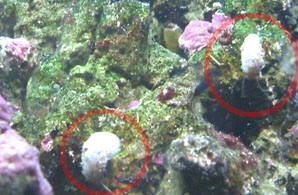
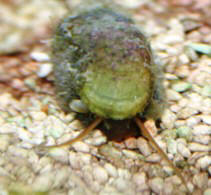
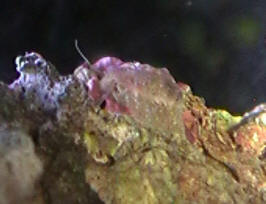
Worm-like growth ID sedentary snail (Petaloconchus spp.) 3/30/07 I have a hard worm-like structure growing out of my Pagoda coral as well as one growing out of the base of my torch coral. The thing seems to spew out this web-like substance that gets tangled around my rocks and structures. Any idea what this is? <Yes, sounds like a sedentary snail (Petaloconchus spp.)> Is it dangerous <Nope!> and how can I get rid of it? <I wouldn't.> Thanks. <Welcome! -Mich> Gastro ID Limpet? Stomatella? A picture says a thousand words. 3/21/07 Hello, long time reader, first time writer, <Oh, cripes! I bet you've always wanted to say that! ;) > I recently bought about 30 pounds of live rock to start stocking my new 55 gallon tank (moving up from 30) and I've noticed some odd unknown gastropods crawling around from time to time. <Happens.> They are about an inch long and look much like a snail with a grey mantle, but they have flat oval red shells, roughly the same shape as a scallop, only very small. <Hmm, an inch long, but very small? I'm confused.> There are two that I <I> have seen, but I <I> assume there are still some more, they don't <don't> seem to be doing anything, though I <I> read an article (while searching for what they were) that said many hitchhiking gastropods can be bad news so its <it's> best to identify it before letting it stay in your tank. <Undoubtedly.> If you need a picture, let me know and I'll try and get one. <Send one over!> I couldn't manage to find one today so I <I> didn't include a picture. <Please do send anything you can snap. Without pictures to go by, I would say they sound similar to a limpet, or maybe a Stomatella? Take a look here for a comparison to the Stomatella: http://www.reefcorner.com/SpecimenSheets/stomatella_varia.htm ; these are rather common hitchhikers and quite harmless, too. Limpets, on the other hand...> Thank you, Mike <Welcome -GrahamT> Re: Gastro ID Limpet? Stomatella? A picture says a thousand words. Reading/using WWM; Callionymid fdg. 3/23/07 Ah! My apologies about the confusion with the size (and the numerous capitalization problems you so kindly pointed out...). <Hotay> The critter itself is about 3/4 - 1" long, the shell is very small, taking up only a 1/4 or so of the actual animal. I'm confident it is not a limpet, thought the Stomatella is almost exactly what I saw, only mine have bright red shells. <Can, do vary in color> As soon as I manage to see one, I'll send a picture over. <Ah, good> One more thing, how long do you think I should wait before moving my scooter blenny over? <Mmm... "as soon as it is ready/established> He doesn't eat anything I put in for him, though its been living fine eating what it finds on rocks and in the sand for the past 3 or 4 months. <Is what they (Callionymids do...) Read here: http://www.wetwebmedia.com/mandfdgfaqs.htm and the linked files above> I added 10 pounds of Florida keys live sand over 1.5" or aragonite. Do you think that will suffice in populating my sand bed or should I buy a "pod pack" and throw in there to help speed things along? <The new LR should "do it" here... A separate refugium would be grand... Bob Fenner, sitting in for Graham as he's moving to a new house> Thanks again, Mike Worm Identification - 03/12/07 <Hi Vicki, Mich with you today.> Are you the person with whom I could speak about identification of a worm or two in my saltwater aquarium? I got your email address off the Saltaquarium website. <Well, Bob is the guru, but hopefully I can help, and please give our website a look too: www.wetwebmedia.com We hope you find it helpful.> I have two different worms that I am concerned about....the first one is about 2-3 inches long and is primarily nocturnal, so my siting <seeing?> of this thing was a fluke. It was half pink and white and half blue and white....maybe striped, but maybe the white were actually more like "feet" like a centipede...It's hard to say...I cannot remember and it didn't stay out long. It was climbing from one hole in the live rock to another. Seems to me it was more flat than round. Some kid at the local fish store said it was a mantis shrimp, but after looking at some of the pics online of those, I really don't think so. <Sounds like a Fireworm or a Bristleworm to me. There are many species. Some are beneficial, some are predatory, all have bristles (setae/chaetae), which can be quite painful if touched, so gloves are a must. Do a Google image search and see if you think that might be what you saw, you might search for Eurythoe spp., Chloeia spp. and Hermodice spp. More info here and the related links in blue: http://www.wetwebmedia.com/polychaetes.htm > The second worm was more rounded body and very small maybe an inch or a little more long. It was red and white striped. It seems to be coming out of a piece of live rock. It seems to have "pointy" ends. <A photo would be most helpful here. I am really only guess with the minimal info provided. It could be a type of bristle worm as mentioned about, or by you description, possibly a peanut worm (Sipunculid spp.) which are beneficial scavengers or perhaps a Bobbitt worm (Eunice spp.) which can be predatory.> If you can help me identify these things, or forward to someone who can, I'd appreciate it. If they are going to be a nuisance, I want to try to get rid of them ASAP. <Some are problematic, some are very beneficial. Without a photo it is difficult if not impossible to identify.> Thanks! <Welcome, Mich!> Vicki Re: Worm Identification 3/13/07 <Hello Vicki! Mich with you again.> Gee! Thanks for the quick response.. <You're quite welcome!> and sooooooo knowledgeable.... <Nah, just a little experience.> Yes, the first worm is a bristle worm, and the second one described looks like the peanut worm. <Ahh, good.> My husband says that he thinks the best way to get rid of the bristle worm is to take a piece of pvc and rubber band a piece of pantyhose over one end of the pvc....when the nocturnal creature emerges, he'll get stuck in the nylon material....yes? <May work, have heard of the method before, but never employed. If it's a bristle worm, there's really no need to remove it. They are beneficial scavengers. If it's a larger Fireworm, then yes, it should probably go.> The other thought was from the young man at the fish shop....he said to take the live rock out, put it in a bucket for several weeks....and then what? He didn't really say...it will starve him out? leave the rock out of the water and kill it? Hmmmmm not sure here what the kid was thinking....what are your thoughts? <Mmm, I would not do either. I really wouldn't be too concerned if it was smaller than say the width of a pencil. It doesn't sound like you have a monster on your hands. Not that I think you need to use it, but one method that I have found useful in trying to remove critters from live rock, is taking the live rock out placing it in a shallow under the bed type Rubbermaid container along with a couple of shells or pieces of pvc. Prop up one side of the container so one end has several inches of water and the shells and the other has none. Then gradually say every hour or so move the live rock into shallower and shallower water, many times the critter seek refuge in deeper waters. I have not tried this for bristle worms, but have had luck with extricating undesirable crabs using this method.> Thanks again! <You are quite welcome! Mich> Vicki Root The peanut worm sounds ok to keep... <Yes, a very beneficial creature.>
I.D. my Gastro and micro-crustaceans? 1/16/07 Hello WWM crew: <Hello, Beverly. Graham T. with you tonight.> I love all the information on your site, you have been a big help to me as a new Nano reefer. <I know exactly what you mean! Thank you for using us.> I have a couple of species that came on my live rock about 6 months ago that I have not been able to positively identify. <Happens, there *is* more life on the reef per square inch than anywhere else...> Unfortunately, I don't have a camera to take pictures of them but I think you may be able to get me in the right ballpark. <Will surely try...> The first one is a snail-type. Has a white abalone shape shell about a centimeter in length with slight gray marbling. The body is white about 2-3 cm. in length. It has a head like the trunk of an elephant and it uses this to graze on the live rock, looks much like a cow grazing. <Ahh... This is actually more of a "nose" than a mouthpart. Hard to say what sort of snail you have here, though maybe a Nassarius snail. There are many snails with this proboscis. they use it to sniff for their food as it diffuses it's scent into the water. > It also has two very long antenna. Lately, it has taken to climbing to the highest point on the rock and squirting stuff into the water, kind of looks like he's/she's sending up smoke signals. <Mmm... sort of like, sperm?> I'm hoping that's enough info to at least get me in the right direction for identifying. So far haven't found any pictures at all close. <Well, like I said, there are *many many* proboscis-equipped snails that range from harmless to ruthless murderers.> The other critters look like mantis shrimp from the pictures but they are only 1cm. long and have been reproducing like mad and have babies that are 1mm. in length. I've had them for 6 months and they never get any bigger. Do you know what kind of shrimp they may be? <If I have to guess, I'd say they're a type of amphipod... but I can't be sure with just a verbal description. Try this: http://www.wetwebmedia.com/amphipodfaqs.htm and see what you think.> I know this is a lot to ask (especially w/o pictures) but if you could point me in a direction that has pictures or more detailed (not scientific, I really don't understand the info when it gets that accurate) but just layman's info for help in identification I would be very appreciative. <See above.> Thank you for your consideration and whatever help you can offer. <You are welcome to my assistance, Beverly. Consider a little guy to devour the littler guys. -Graham T.>
Blobs = ? ...Stomatella Snails
1/8/07 Hi there, <Hello Lesley, Mich here.> Just
discovered your website, I've learnt so much from the FAQ. Its
really helpful. <This is good to hear.> I've got a couple of
really odd blobs appeared in my 35 gallon marine aquarium. Its just
over a year old, with fish and corals, but very little live rock. I
have an external filter which seems to do the job. <Live rock would
do a better job!> These blobs are pinkish white, with two antennae
in their heads. They are about 1/2 inch long, and appear to have a
small white hard shell on their backs which is much smaller than they.
I do know that they love algae, they spend all their time on patches of
algae either on the glass or on rock! <Sounds like Stomatella
Snails. See here: http://images.google.com/imgres?imgurl=http://www.reefland.com/rho/0305/images/stomatella.jpg&imgrefurl=http:// www.reefland.com/rho/0305/medprod3.php&h=300&w=400&sz=18&hl=en&start=
6&tbnid=mx9loS0E1H4E5M:&tbnh=93&tbnw=124&prev=/images%3Fq%3Dstomatella%2Bsnails%26svnum%3D10%26hl%3Den%26lr%3D%26safe%3Doff%26sa%3DG
Therefore, I am assuming they are good, and won't do the fish or
corals any harm. <If they are Stomatella Snails you are absolutely
correct!> Regards Lesley
|
|

|
Features: |
|
| Featured Sponsors: |