|
FAQs about Marine Snail
Identification 19
Related Articles: Gastropods, Sea Slugs, Mollusks, Abalone,
Related FAQs: Snail ID
1, Snail ID 2, Snail ID 3, Snail
ID 4, Snail ID 5, Snail ID 6, Snail
ID 7, Snail ID 8, Snail ID 9, Snail ID
10, Snail ID 11, Snail ID 12, Snail
ID 13, Snail ID 14, Snail ID 15, Snail ID
16, Snail ID 17, Snail ID 18, S
nail ID 20, Snail ID 21, Snail
ID 22, Snail ID 23, Snail ID 24, Snail
ID 25, Snail ID 26, &
Marine Snails 1, Marine Snails 2, Marine Snails 3, Invertebrate ID, Snail Behavior, Snail Selection, Snail Compatibility, Snail Systems, Snail Feeding, Snail Disease, Snail Reproduction, Mollusks, Sea
Slugs, Abalone,
|
|
|
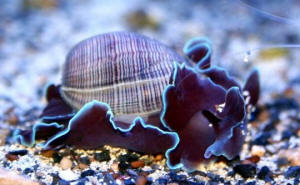
Snail ID: Hydatina physis - 3/20/09
Hi again!
<Hi, or should I say bonjour!>
I need your help for a snail identification.
<It's actually a neat little sea slug!>
I sent you a picture...
<Yes indeed, and it's a beaut.>
I'm pretty sure it's not reef safe
<Well, it's a predator alright, but one that feeds
exclusively on Cirratulid Polychaetes (aka 'hair-worms')
so everything else is safe. As with many sea slugs and
Nudibranchs, they're beautiful but difficult to keep long
term because of their specialized diets.>
...but can you tell me its name?
<Yep, it's Hydatina physis, a Cephalaspidean sea slug that
carries a thin shell around on its back. It's also commonly
called variations of the Brown-Lined Paper Bubble or Bubble
shell. Please see the following link for more information:
http://www.seaslugforum.net/showall.cfm?base=hydaphys >
Thank you very much!
<Thank you for sharing such a terrific photo of a beautiful
little creature! Take care, Lynn>
|
| Gorgeous. RMF |
|
Critter ID? Operculums and Possible Sand Anemone -
3/19/09
<Hello Christopher, Lynn here this morning.>
A shell of a what?
<More like what's in the shell!>
One might think that after 40+ years of fishkeeping, 8 years of
outright reef obsession, and being supported by the bountiful
resources of WW, I could tell, or at least easily discover, if
something is a mollusk or a worm, or neither.
<Heheee! I've been in the hobby since the early 70's
and believe me, it happens.>
I recently had the opportunity to go bigger (50g to 125g).
<Nice>
After the 6 months of preparation, moving, acclimation,
quarantine, and additions to the new system, I finally have my
dream tank, short of glass walls everywhere. Thanks to advice
found on your site, I have had great success, the move went
swimmingly and the only surprises have been how much both my reef
inhabitants and I enjoy the larger space and there are these
shells. I have identified dozens of the hundreds of
'hitch-hiking' organisms that have populated my system
over the years and continue to pop up. While moving the old sand
bed as a 'start' for the new larger one I decided to sift
out some of the rubble that had accumulated from generations of
free limpets, tubeworms, Chitons, Nerites, Vermetid snails and
from the not-so-free snails, hermit crabs, coral base rocks and
the like. (A pair of maroon clowns can tend to break a lot of
things around their house over the years) Among the remains, I
discovered those of an animal that I had never seen before but it
had obviously thrived and multiplied for some time. They appear
to live or have lived on the glass bottom under the sand. What is
left are disk-shaped hard shells with a completely flat, almost
polished bottom and an intricate spiral growth pattern on the
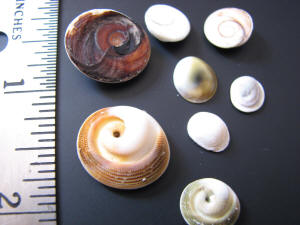
top. I have attached a photo of the 'shell remains' that
I found in great numbers (dozens, perhaps hundreds) in the sand.
The three at the top are turned upside down to show the bottom
surface.
<They're snail operculums/opercula - the trap door at the
opening of a snail that protects the soft animal inside from
predation, desiccation, etc. Some are thin, and flexible, while
others are thick and calcareous. Yours are obviously of the
latter variety and most appear to be from bygone Turbo snails.
See these links for more information/comparison:
http://aphriza.wordpress.com/2006/12/21/trapdoor-on-the-seafloor/
http://seashellplace.com/catalog/images/others_eye_green.jpg
http://farm4.static.flickr.com/3261/2319171639_4443687a10.jpg
http://en.wikipedia.org/wiki/Operculum_(gastropod) >
I later remembered a photo I took a few years ago of some other
unidentified animals that I occasionally saw poking out from the
sand. After scouring your site at the time I assumed them to be
some sort of small anemone. I never could get a real up-close
observation of it and the only photo I got was this poor one
taken before I read all of your cautions about using a zoom lens
to take a close up in my aquarium. Perhaps it will be clear
enough for you to tell what kind of creature it is and whether it
is perhaps the maker of the shells?
<I sure wish I could help with this one, but I can't see
it well enough to be able to determine what it is. If I had to
guess, I'd say that it might be some kind of anemone,
possibly a sand anemone (Phyllactis spp). Please see the photo at
the following link for comparison:
http://www.flickr.com/photos/lemurdillo/3044460357/in/set-72157605663802360/
>
As you can tell it is about twice the size of a typical xenia
polyp. It had what appeared to be a plume of translucent fleshy
brownish speckled tentacles protruding from the 4-5' sand bed
next to the base rock. I am stumped by these guys and can't
seem to find images or descriptions of similar organisms.
FYI: 125 Gallon, 20 gal sump/refugium, deep sandbed, all
parameters are good.
Lots of healthy live rock with colorful algae, sponges,
tunicates, worms, tiny Seastars, pods, macro algae, etc, etc. and
mature colonies of soft corals introduced years ago and
re-established over the rockwork.
Corals: Mushrooms, leathers, xenia and Zoanthids
A theme of relationships:
2 -- Maroon Clownfish (Premnas biaculeatus) mated pair (7 yr)
1 -- BTA (Entacmaea quadricolor) hosts above in separate
'bommie' (6 mo)
1 -- Pink Spotted Watchman Goby (Cryptocentrus leptocephalus) (4
yr)
1 -- Tiger Pistol Shrimp (Alpheus bellulus) (3 yrs)
5 -- Lyretail Anthias (Pseudanthias squamipinnis) (5 mo)
1 -- Blue Devil Damsel (Chrysiptera cyanea)
1 -- Midas Blenny (Ecsenius midas) (1 yr)
4 -- Canary Wrasse (Halichoeres chrysus) (1-5 yr, 3-4 mo)
2 -- Cleaner Shrimp (Lysmata amboinensis) (4 yr)
Grateful to have and to share it all. Any comments are
welcome.
Christopher Williams
Santa Barbara, CA
<Hope that helps! Take care, Lynn Zurik -- Everett, Wa>
|
  |
|
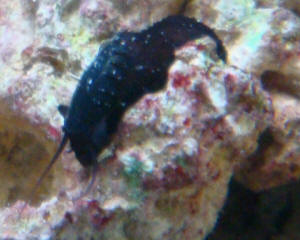
What is it? Stomatella sp. -- 2/2/09
<Hello> Can you tell me what type of sea slug or Nudibranch
is shown in attached pictures? <Well, it's actually not a
sea slug or Nudibranch at all, although they're often
confused as such. It's a harmless and very beneficial little
grazing snail, in the genus Stomatella. They're also very
common, so you'll find lots of information on them at WWM by
entering the term in our search engine:
http://www.wetwebmedia.com/WWMAdminSubWebIndex/question_page.htm
More information and a photo of another black Stomatellid here:
http://bb.wetwebmedia.com/viewtopic.php?f=25&t=181 Take care,
Lynn>
|
 |
|
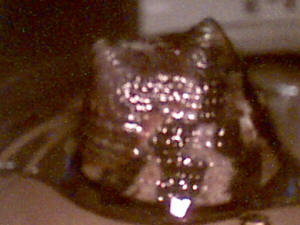
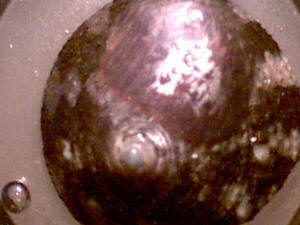
Weird Trochus Snail 01/31/09 I picked up some
snails at the LFS today. Two of them are Banded Trochus Snails.
One of these Trochus snails seems to have a shell with two
apexes. I can't tell if there is some second gastropod like a
limpet or something living tightly pressed against the shell of
the Trochus, <Hmm... the pictures are really poor, but I think
you have a Hipponicid on your snail. It's a gastropod that
"hitchhikes" on the back of snails. They're
harmless and kind of neat.> or if it's a weird shell
deformity, or maybe it's a partially developed conjoined
twin, or something. Here are some pictures I took with my USB
microscope at 10x. I'm sorry, I'm kind of a crumby
photog. The snail seems to move about and eat vigorously. <See
here (about 4 queries down the page):
http://www.wetwebmedia.com/snailid16.htm Does this look like what
might be going on with your snail? Cheers,
Sara M.>
|
 |
|
Re: Weird Trochus Snail
1/31/09 Cool... here are some more pics if they help:
http://seashellsofnsw.org.au/Hipponicidae/Pages/Hipponicidae_plate.htm
They can hitch a ride on just about anything... even each other!
Cheers, Sara M.
|
|
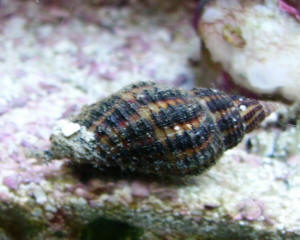
Snail/Conch ID 1/14/09 HI, <Hi Steve>
Love the site guys! I found this guy in my tank about a year ago.
He must have hitchhiked on one of my pieces of liverock. I have
no idea what he is. Looks like a conch of some kind to me. Can
you help me ID? If so, is he safe? <Looks more like a Cerith
Snail to me. If it is an inch or less long, it probably is.>
Thanks. <You're Steve
|
 |
|
|