|
|
FAQs about Yellow Tang Disease/Health 8
Related Articles: Yellow Tangs,
Related FAQs: Yellow Tang Disease 1,
Disease 2, Disease 3,
Disease 4, Disease 5,
Disease 6, Disease 7,
Tangs/Rabbitfishes & Crypt,
Black Spot Disease, &
Best Yellow Tang FAQs, Yellow Tangs 1,
Yellow Tangs 2, Yellow Tangs 3,
Yellow Tangs 4, & Yellow Tang FAQs:
Identification, Behavior,
Tang Behavior, Compatibility,
Selection, Systems,
Feeding, Reproduction, &
Purple Tangs, Striped Sailfin Tangs,
Zebrasoma Tangs, Zebrasoma
Identification, Zebrasoma Behavior,
Zebrasoma Compatibility, Zebrasoma
Selection, Zebrasoma Systems,
Zebrasoma Feeding, Zebrasoma
Disease, Zebrasoma Reproduction,
Surgeons In General,
Tang ID, Selection,
Compatibility, Systems,
Feeding, Disease,
Fish Worms Diseases, | 
|
Yellow Tang, Crypto, Reading -- 11/04/2009
Hi,
<Hey there! JustinN here!>
I have a yellow tang in a 55g tank i also have 3 yellow tail damsels, 1
bicolor Dottyback, and 2 scooter blennies. The tank has been up since
September-19-09.
<This tank is too small ultimately for the Tang, and likely too immature
to support even a single scooter blenny, much less two. The tang has
potential to outsize the tank very quickly, and the scooter blennies are
obligate fauna feeders -- they will pick your tank clean of their
necessary food source quickly.>
I got a yellow tang on October-3-09 and he was doing fine until I had a
ich infection which i treated with Kordon Rid-Ich+.
<Treated in your display? This should be done in a quarantine tank.>
I am still treating with this the yellow tang has no visible signs of
ich but the Dottyback does.
<Is parasitic, and communicable to all fish in a mixed display here.
This is why Quarantine is so important.>
I have just noticed (about 3 days ago) red spots on the Yellow tang and
they seem to be getting worst by the day.
<Sounds like chemical burn/irritation here>
He looks like he has hole in head. The red spots are at the tail. I
can't identify what they are. My tanks recent test values are as
follows: Nitrate-30, Nitrite-0, Alkalinity-300, pH-7.9.
<What is your Salinity at? Your pH is a bit low, should be in the
8.1-8.3 range -- Nitrate should be at, or as close to, 0 as possible.
The nitrate alone may be enough to cause the burning, but if the
Formalin/Malachite
solution is being dosed too highly, this could easily cause the
'burning' as well."
Their is a small electrical current measuring .002v in the tank.
<Most likely unrelated, but there shouldn't be stray voltage in your
tank.>
The filtration is a emperor 400 filter and a coral life super skimmer
for a 125g tank.
<The main thing you need here is some reading -- your tank is very
immature, and is likely still going through its establishing nitrogen
cycle. Exacerbating this is your stocking levels -- you have too many
fish, far too soon, and the tank is still attempting to establish its
biota balance. In addition to this, by treating your display tank with
the Formalin/Malachite compound, you are effectively killing all
beneficial bacterium/biological filtration available in your tank. These
medications treat indiscriminately. More reading is in order -- start
here:
http://www.wetwebmedia.com/formalinart.htm
http://wetwebmedia.com/stocking1.htm http://wetwebmedia.com/quaranti.htm
http://wetwebmedia.com/watrqualmar.htm
http://wetwebmedia.com/nitratesmar.htm
and related subheadings. -JustinN>
|
Rotting Fin After Freshwater Dip
10/29/09
Hi Bob. I have a quick question for you. My Yellow Tang had developed
some red blotches on its body (see attached picture entitled "Before
1").
Due to the fact that I had recently lost a fish to some disease, I
decided to quarantine the Tang. I placed it in my QT tank and later that
day freshwater dipped it (matching the temperature and PH). The dip took
about
15 minutes, during which time the Tang laid sideways, but did not act
irate. After the dip, I placed the Tang back into QT.
<So far...>
This morning all the red blotches were gone, but the tang's fins seemed
to be rotting (see attached pictures entitled "After 1," "After 2," and
"After 3"). This literally happened overnight. There is no other life in
the QT, so nothing could have eaten the fins. How is this possible for
this to happen overnight? The before and after pictures are 24 hours
apart. In the before picture, the fins are smooth, but in the after
picture, they are
ruffled and look rotten. Have you ever seen anything like this? What do
you recommend I do?
P.S.
The Tang is not eating, but is swimming about kind of aloof.
<I do think the dip is accountable here... and "general stress"
associated with it... This fish looks in good shape otherwise, and I do
think that if it was moved to propitious circumstances following the
bath, all should be fine here. Bob Fenner>
|
 |
|
Re: Rotting Fin After Freshwater Dip
11/6/09
Hi Bob. Thank you for the answer. The tang recovered and is eating
perfectly.
<Ahh!>
Unfortunately, the red blotches on its body are coming back (see
attached picture). It is still in quarantine, but not being treated with
anything. What do you recommend?
Thanks,
Eugene
<Time going by, good care. Read here:
http://wetwebmedia.com/ytangdisf7.htm
and as much of the linked files above as takes to convince you. The red
markings are environmental. BobF>
|
What's that stuff in my tank?? No pic... Yellow tg.
env. hlth.
10/2/2009
Hello - thank you for a wonderful site!
<Howdy. Welcome>
I have a 55 gal salt water tank and I have a Yellow Tang and some
damsels in it. The other day my daughter said that my Tang had some red
dots on his head - I could not see them - but well hey I wont mention my
age :)..
Yesterday when we came home from school my tank had a black growth (it
had long furry/grassy stuff) - anyway I went ahead and dug that stuff
out and did a 25% water change. What is that stuff?
<Could you send an image?>
It almost looked like black grass - maybe??
<Not a graminean assuredly>
Not sure how to explain it.
<A photo...>
The sand had a growth/crust as well. My tang was ok this morning - still
had the red blotches (looks like blood on his fins next to his body and
on his mouth). I read some other emails and answers you have given about
things like the bloody look on the tangs and have made sure he had
seaweed and flakes to eat.
<More likely environmental in origin...>
I guess my main questions is what is that black stuff? And is my "Tangy"
going to die? (The other fish are fine - and Tangy is acting somewhat
normal).
<Please read here: http://wetwebmedia.com/ytangdisf7.htm
and the linked files above...>
I've got two other tanks but one I just refilled and letting it cycle
and the other is a 90 gal tank that is real close to the 6 weeks cycle
and I can move fish in soon do I need to put Tangy in there and it be a
QT tank and do I need to put meds in this water?
<I would move this Zebrasoma now>
Have I confused you?
<No>
I'm just worried about Tangy - he is a funny fish and is VERY spoiled
and we really like to sit and watch him.
(Oh before I forget I have not done anything different or added anything
to the tank lately).
Thank you for everything! All this is a on going learning process.
Cecilia Lester
Paris Texas
<Ah yes. Cheers, Bob Fenner, San Diego, CA presently>
|
Sick Tang
09/15/09
Hi guys,
need help, a fellow reefer passed away last week and some of my reef
club members got together to help the widow out.
<Ah, good>
She wanted all livestock to go to good homes and remove the entire tank.
The tank was a 325 glass tank which may have been neglected due to the
owner's illness. Anyway, I took a 4" yellow tang and a royal gramma
along with some Tonga rock and some coral. Unfortunately it took about 7
hours to move the fish from an Instant Ocean pail to a 20 gal tank I had
setup at home. This was due to us emptying and moving the main display
tank. I have had the fish since Saturday and the Tang does not look
good. It is not eating and has a white film over both eyes and front of
head, see pics attached. Any suggestions to help the tang would be
appreciated. The gramma also had a few similar spots on it but looked
better today, also not eating.
thanks,
Frank
<Mmm, a toss up between causing further stress from manipulating this
animal (for what good it might do...) and just leaving be and hoping. IF
you are wanting to "do" something, I would net this fish out and
gingerly
daub a dilute solution of either an iodide or mercuric based (e.g.
Mercurochrome) liquid prep. (with a cotton swab) on the afflicted
area... yes, including the eyes... This may arrest the further
decomposition to an extent. Otherwise, "just time going by" in your good
care will prove whether these fishes will improve/survive. Bob Fenner>
re: Sick Tang 09/15/09
Bob,
Thank you for your prompt reply. I am assuming you took a look at the pics
provided, this condition is a result of stress/neglect? I was concerned that
it may be some type of fungus or other illness.
<To extent Frank... perhaps a physical injury was the origin>
If not, then I believe I will take your advise and hope that it will
recover. I'll keep water conditions pristine and hope for the best. I don't
think that netting it again will be advantageous.
thanks again,
Frank
<I agree. Thank you, BobF>
|
 |
Yellow tang didn't make the night... killed by improper env.
8/24/09
Hello WWM Crew,
<G>
I have a new 24g salt water set up.
<... this is way too small for a Zebrasoma species. Read here:
http://wetwebmedia.com/ytangsysfaqs.htm
RMF>
It's been cycled and water tests show good. I've had 3 blue chromis that
are doing fine. Unfortunately the
yellow tang I just got didn't make it through the night. Heart breaking
since I thought they're one of the tougher fish for a newbie. I
acclimated the tang to the water properly before I put him in and he
seemed fine. He seemed to be eating within the first few hours, so I
can't imagine why he didn't make it. I initially needed him since I have
green algae on the walls of the tank and it seems like darker brownish
algae that collects at the bottom. Any popular reasons he\she didn't
make it? What should I do to ensure the next one makes it? thanks
GeraldB
Yellow tang problem, 6/17/09
I got a 55 gallon fish only tank from a couple moving to Germany about a
month ago.
<Nice>
I have a very small amount of experience with saltwater fish (clown and
blue damsel in a 20 gallon tank for about 6 years now). The tank had
been badly neglected before I moved into my house. After the ordeal of
moving settled down for the native fish (green bird wrasse, maroon
clown, three striped damsel, 2 feather dusters, and a pencil urchin) I
decided to add a yellow tang about a week ago.
<Will outgrow this tank, and may get badly bullied by the current
livestock.>
The tang has lightened in color progressively worse over the last week
to a point of almost completely white with a yellow stripe. The tang has
been eating great; seaweed clipped to the side, and an assortment of
frozen foods from San Francisco bay brands, and even omega one flake
food. I wasn't too concerned about the color change after reading
multiple posts online about stress related "paleness".
<Stress can lead to may other problems, is something to be concerned
with.>
Tonight while feeding I noticed a deep red spot that slightly bulges out
on the base of the left pectoral fin, and I am concerned. Ammonia, and
nitrite levels are 0. Ph is 8.2. Temperature is 79. Nitrate it s pretty
high.
When I got the tank set up at my house last month the nitrate levels
were off the page (160 is as high as the card goes) I kept about 90% of
the original water. I have done about a 20% water change once a week to
get the nitrate level down to 50, still high but steadily dropping.
<This is probably part of your problem.>
I figured the nitrate level would be ok for a fish due to the good
health of the urchin (as much as an urchin looks healthy).
<Not necessarily, is probably causing a good part of your issues.>
Could the high nitrate level be to blame for the health of the tang?
<Yes>
Could it be some other health issue treatable with a fresh water dip?
<Not likely.>
Should I move the tang to the small tank and use the shotgun approach to
fish medical care?
<I would not.>
Any help would be appreciated.
Bill
<Improve the water quality first and foremost. After that I would
consider returning the tang as you are at the very minimum required to
keep it long term, and with your current aggressive tank mates I think
you will run into problems.>
<Chris>
Urgent issue with Yellow Tang - 06/05/09
Please help - I got my first fish two weeks ago after my local shop said
my water was ready for fish.
<Dubious qualification....do bear in mind they seek to sell fish.>
He seemed fine at first but last few days seemed to be darting about a
bit more and not just swimming naturally. However he was eating fine and
water tests showed to be ok.
<What are you testing for? Ammonia? NO2, NO3?
I've come home tonight to find him quite listless, a bit pale and
breathing quite fast. He also didn't react to feeding like he did this
morning. I've done a partial water change but as its nearly midnight I
only have about 15 litres of RO water here and the tank is holding
around 160 litres. This is obviously not enough but Im not going to be
able to get to the shop till they open in about 9 hours. I desperately
want to save him so is there
anything else I can do? Or what is the best way to treat tap water ready
to be mixed with the minerals as a temporary measure?
<Jo, this sounds to me like ammonia or nitrite poisoning. Was the tank
cycled? Do you realize this will be woefully inadequate space for a
yellow tang in the future? If the fish is still alive, do get your hands
on water
fit for making WCs (deionized from the grocery works in a pinch,
although it can be tough on the wallet) and run an airstone of some sort
into the water...keep an eye on pH. Do read on WetWebMedia re: cycling,
new aquariums, stocking, etc.>
Please help!
<Hope I have. Best of luck,>
Thanks, Jo
<Benjamin>
Desperation for anorexic
yellow tangs Tang health: Probable copper poisoning 5/31/2009
Hi there
<Hello>
I apologise in advance for the length of this message/question and would
also like to congratulate you on the most informative and helpful
website I have found.
<Thank you for your kind words.>
I am writing from the UK so will convert to litres.
<Liters, gallons, UK gallons, whichever you are most comfortable with.>
I have 3 marine tanks, 2 display (450l and 400l) and one QT (100l). The
QT is my problem NH4 -0, NO2 - 0, pH 8.0, NO3 currently about 10 SG-
1.020 for past week. (I only use in date Salifert test kits so I am sure
they are reliable measures, expensive but the best IMO) QT is completely
bare except a few plastic pots to hide in, is run by external Fluval
204, 1 wave p/head and 2 air pumps.
<Sounds fine.>
I have had 2 yellow tangs and a maroon clown in the QT for several
months now due to various problems/diseases. Within 3 weeks of getting
them both tangs developed white spot /ich and I treated this
successfully with a copper based treatment called Cuprazin (clown showed
no symptoms at all).
<Hmm, not familiar with the product.>
They all fed well until towards the end of the treatment when the tangs
stopped eating, but within 2 days of stripping it out and adding
vitamins they began eating again. All 3 seemed fine and I was at the end
of the
further 4 wk period, almost ready to transfer into display tanks when I
went away for a few days and neighbours clearly massively overfed whilst
I was gone.
<As neighbors tend to do. Read here:
http://www.wetwebmedia.com/feeding.htm >
NO3 was 15- 20 when I went and a huge 40+ when I returned. Consequently
all 3 fish were struggling /breathing more heavily, both tangs displayed
reddened areas on both sides at the back end and base of fins, and the
clown was covered in grey film patches and some white spots. I obviously
did repeated water changes to get control of NO3 again and added an anti
internal bacteria product by interpret, with no response, so after
required time I discontinued use, changed more water and stripped out (
using Polyfilter). LFS then recommended using a combined malachite green
and formalin product as they wondered if it was Brooklynella on the
clown?
<Hmm... not Brooklynella.>
I couldn't come up with an alternative diagnosis so I did as suggested
for required time, again with no response, so I stripped out ( using
carbon) and water changed etc.
<Do read here:
http://www.wetwebmedia.com/ca/volume_6/volume_6_1/brooklynella.htm >
At this point after searching on your site and everywhere else I decided
to just keep improving/maintaining water quality to see if they would
heal themselves and indeed this seemed to happen, very steadily the
patches became smaller and red colour went paler on tangs and, the clown
began to look more normal.
<Very good.>
Throughout these earlier treatments they all kept eating but the tangs
were slightly less interested than usual in Nori, however, just as they
appeared almost fully recovered one of the tangs started flashing
against the
plastic pots repeatedly (near its gills particularly) and stopped eating
and the breathing became more rapid. Spoke to LFS and they stated it
must be a parasite, not just bacterial due to this behaviour so I began
treating with the copper product I had previously used successfully.
<Hmmm....>
Both tangs seemed distressed by this and began doing some strange
behaviour - nose pointing upwards/ heavier breathing/ moving around less
and neither of them were eating whilst copper was used ( clown again
eating like a horse) . I became deeply anxious but continued to treat
until the flashing stopped, then stripped out (using Polyfilter) and did
30% water change.
<You need to stop dosing with copper. Copper is toxic, particularly to
the natural fauna that live in the digestive tract of Tangs.>
Again I left them to improve and again steadily the red colour continued
to fade and the greedier tang started eating again but only brine shrimp
(not mysis which is their usual staple) and occasional flake, no Nori
whatsoever. The other tang has not eaten since this time which must be
at least 4 weeks now, except for one day (when he ate some Nori and one
flake). I am astounded that he is still alive and am thoroughly
despondent at what to do for him ! He continues to have heavier
breathing and moves around but is almost skeletal. I have tried
everything I can think of : a huge range of formula flakes/ herbi flake,
live brine, mysis, enriched Spirulina/omega 3 frozen food, krill etc etc
I have added garlic and vitamins to both food and water. Nori is
constantly available and replaced daily. I have racked my brains for
changes as the other tang has now also stopped eating for the past 5
days and is getting rapidly thinner too. The clown continues to eat like
a horse and is eating for 3 now ! !
<As Clowns will do if given the chance. It doesn't look good for the one
Tang, just keep trying to get it to eat.>
In terms of symptoms the clowns have gone except for 1 tiny grey/white
spot above the eye. The tangs bodies are yellow again, although there is
light pink discolouration on the skeletal one at the back end and one
persistent small red patch on the other tang over his brow / forehead
and a few red/brown dots on his body.Both tangs still seem to be
breathing slightly heavier than their usual pattern.
<Stress, healing.>
The only changes I can think of in the past week are: reducing SG slowly
from NSW to 1.020 ( approx 1 week ago) in an attempt to aid healing and
breathing, adding extra vitamins to the water on a daily basis ( the
product suggests this if they are sick or weakened),adding a skimmer and
new carbon.
<Are they still in the QT tank, or are they in the main tank? If they
are still in QT, I would get them back in the main tank as soon as
possible.>
So my first question is could any of the above be making them anorexic ?
<Stress, repeated exposure to toxins that may or may not have been
beneficial>
my second question in desperation and complete confusion is please,
please, please do you have any ideas or advice of what else to try ? ? I
have scanned your site over and over in the hope of finding some answers
or inspiration but so far the only new thoughts I have had are adding
some coral sand from existing display tank that contains tangs in case
they have lost internal gut fauna/bacteria,
<This is likely.>
adding rotifers/ plankton in the hope they mistakenly ingest some and
adding other marine algaes Caulerpa/hair etc (which I did 2 days ago
with no success yet)
<I would put them back in the main display.>
Also what do you think the clown had ? and could the anorexia just be a
further declining stage before death and if so what disease do you think
they have had for future reference of how to treat etc ?
<Likely poor water quality and not necessarily a disease.>
Many thanks for any help you can give, I am absolutely desperate now or
would not have bothered you. Please respond quickly if at all possible.
Keep up the great work you do
Many thanks in advance.
<MikeV>
|
Identification Problems - Need
Guidance... Scuds, Myrionema and fish health problems. 5/13/09
Hello WWM Crew!
<Hi Christopher! Mich with you today.>
I've searched through the WWM website for a while now and I just can't seem
to find a positive identification for three different things/issues I am
having with my aquarium.
<Let's see if I can be of help.>
For starters, my 90 gallon aquarium has been established for a year and a
half. All water parameters are within normal ranges with 0
nitrates/nitrites/phosphates, calcium approx 420, pH 8.2-8.5. I have 2
percula clowns, 1 Firefish, 1 scooter blenny, 1 yellow tang, 1 powder brown
tang, 6 green chromis, 1 brittle star, 1 sandsifter star,
<Not a fan... decimate your sandbed and slowly starve to death. Best left in
the wild in my humble opinion.>
red hermit crabs,
<Not a fan of crabs either... or hermit crabs... Just not to be trusted.>
common snails, 1 rose bubble-tip anemone (clown host), frogspawn corals,
button polyps, yellow polyps, an beautiful Alveopora, various mushrooms, a
green brain coral, finger leather coral, disk coral, 2 feather dusters, 2
cleaner shrimp, and a large decorator crab.
<I'm skeptical with crabs... opportunistic omnivores in my experience.>
Everything is lit by 150W metal halide lamps and blue actinics. I have a
sump set up below tank with a protein skimmer, filter pads, and a carbon
bag. I do a 10% water change every other week.
<Good husbandry practices will serve you well.>
The first unidentified problem is with my yellow tang (picture attached). I
can't quite tell what the problem is
<Is difficult to see the damage on the tail section in your photo.>
- but there seems to be some damage developing along both sides near the
'nails' by the tail. Almost like erosion.
<I will bounce this to Christine, our resident sick fish expert.>
The lip of the tang also seems to be wounded and he is constantly twitching
up against the glass on one side of the tank.
<I do see the abrasion on the lip. This could be caused from the tang
rubbing against the glass, or both wounds may be aggression from tankmates,
perhaps the Powder Brown.>
When fed, he eats normally (which is a lot!) and his gills look okay.
<Good signs.>
I thought maybe HLLE but I really have no idea and this doesn't quite seem
to fit the descriptions.
<Doesn't look like HLLE to me from this photo. I would recommend
supplementing your food with Selcon for the HUFA's.>
No signs of any problems or damage with my powder brown tang or any of the
other fish.
<This would be my first guess as to where the trouble might be originating.>
The second is a sort of bug that first appeared in my overflow tank. There
are a bunch of tiny swimmers in there also and they recently have populated
the main section of my tank. These 'bugs' (picture attached) get pretty big
but they don't seem to hurt anything - but I like to get things identified
in my tank and do research just so I know. Any help with this one would be
much appreciated.
<Is a good "bug" is a Gammaridean amphipod also called a Scud. They are
harmless detritivores that make good food for your tank inhabitants.>
The last is a brown growth that has recently started taking over my tank
like an algae (maybe it is an algae).
<Oh! Bad news here. Is not an algae. Is a hydroid, likely a Myrionema, and
you will need to get rid of it. Not fun!
More similar images here:
http://www.wetwebmedia.com/hyzoidf3.htm>
I looked through my algae book and none of the pictures match this (picture
attached).
<Ya won't find it there!>
It is made up of bunches of tiny stemmed 'fuzzies' that now and again detach
and float somewhere else, where it lands and a new colony starts!
<Get it out ASAP!!!!>
I'm not sure what I can do about this stuff.
<Manual removal with gloves! Most hydroids can sting, not sure this variety,
but better safe than sorry.>
FEEDING: I feed the tank twice daily. The morning feeding is always the same
- Spectrum color-enhancing pellets, which all of the fish eat.
<Glad to hear.>
The evening feeding is always frozen food and I rotate between Spirulina
brine shrimp, mysis shrimp, and Emerald Entree.
<Very good.>
I very recently (last week) started supplementing with a Green Marine Algae
with garlic for the tangs.
<Am not familiar with this product.>
As of yesterday, I started supplementing with Marine Snow also, for the
filter feeders.
<Mmm, heard some not so good things about this product. Cyclopeeze seems to
have a better rep.>
ADDITIVES: I add liquid calcium to the tank nightly (as per the
instructions) and I also add Strontium/Molybdenum every 4 days and Iodide
every week.
<And you test the levels for all of these additive, correct? Because add
things in unknown quantities is just as dangerous or more than having a
deficiency.>
Thanks for your help crew!
<Welcome!>
Your site is the best and I always find great answers looking through all of
the pages.
<And there is a lot to look through!>
-Christopher
<Cheers,
Mich>
Re: Identification Problems - Need Guidance
Christine can you take a look? Images are in the emails with images folder.
|
 |
Identification Problems - Need
Guidance... Scuds, Myrionema and fish health problems. 5/13/09
Hello WWM Crew!
<Hi Christopher! Mich with you today.>
<<with Christine chiming in>>
I've searched through the WWM website for a while now and I just can't seem
to find a positive identification for three different things/issues I am
having with my aquarium.
<Let's see if I can be of help.>
For starters, my 90 gallon aquarium has been established for a year and a
half. All water parameters are within normal ranges with 0
nitrates/nitrites/phosphates, calcium approx 420, pH 8.2-8.5. I have 2
percula clowns, 1 Firefish, 1 scooter blenny, 1 yellow tang, 1 powder brown
tang, 6 green chromis, 1 brittle star, 1 sandsifter star,
<Not a fan... decimate your sandbed and slowly starve to death. Best left in
the wild in my humble opinion.>
red hermit crabs,
<Not a fan of crabs either... or hermit crabs... Just not to be trusted.>
common snails, 1 rose bubble-tip anemone (clown host), frogspawn corals,
button polyps, yellow polyps, an beautiful Alveopora, various mushrooms, a
green brain coral, finger leather coral, disk coral, 2 feather dusters, 2
cleaner shrimp, and a large decorator crab.
<I'm skeptical with crabs... opportunistic omnivores in my experience.>
Everything is lit by 150W metal halide lamps and blue actinics. I have a
sump set up below tank with a protein skimmer, filter pads, and a carbon
bag. I do a 10% water change every other week.
<Good husbandry practices will serve you well.>
The first unidentified problem is with my yellow tang (picture attached). I
can't quite tell what the problem is
<Is difficult to see the damage on the tail section in your photo.>
- but there seems to be some damage developing along both sides near the
'nails' by the tail. Almost like erosion.
<I will bounce this to Christine, our resident sick fish expert.>
<<I agree with Michelle--if you can get a better pic or describe it in
detail it might help. Redness (erythema)? Loss of scales? Symmetrical on
both sides of fish? Look like bite marks?>>
The lip of the tang also seems to be wounded and he is constantly twitching
up against the glass on one side of the tank.
<I do see the abrasion on the lip. This could be caused from the tang
rubbing against the glass, or both wounds may be aggression from tankmates,
perhaps the Powder Brown.> <<Yup, likely. Sit for a while and watch
them--are they obviously at each other, is one hanging out in a spot that is
unusual for it? Could be signs of sibling rivalry. "Lip locking" is common
in tangs. If not that, could be bacterial, could be a secondary bacterial
infection as well. I'd recommend close observation, with the potential for
moving him out to a hospital tank to treat with antibiotics. Also,
considering the scratching, look closely at how he moves his gills--are they
symmetrical, and more or less rapid than before? Either could be signs of
parasites like ich, which, while not causing the redness might be taking
advantage of a weak immune system.>>
When fed, he eats normally (which is a lot!) and his gills look okay.
<Good signs.>
I thought maybe HLLE but I really have no idea and this doesn't quite seem
to fit the descriptions.
<Doesn't look like HLLE to me from this photo. I would recommend
supplementing your food with Selcon for the HUFA's.><<HLLE usually runs more
anterior, towards the front or head of the fish, and looks kind of like
ulcers. Selcon is always a good idea, VitaChem, beta-glucan--all good. Even
if you never figure out what the initial issue is, helping him fight it off
by keeping his immune system in good shape via good nutrition is a big help.
Feed often! Good time too to watch for aggression.>>
No signs of any problems or damage with my powder brown tang or any of the
other fish.
<This would be my first guess as to where the trouble might be originating.>
The second is a sort of bug that first appeared in my overflow tank. There
are a bunch of tiny swimmers in there also and they recently have populated
the main section of my tank. These 'bugs' (picture attached) get pretty big
but they don't seem to hurt anything - but I like to get things identified
in my tank and do research just so I know. Any help with this one would be
much appreciated.
<Is a good "bug" is a Gammaridean amphipod also called a Scud. They are
harmless detritivores that make good food for your tank inhabitants.>
The last is a brown growth that has recently started taking over my tank
like an algae (maybe it is an algae).
<Oh! Bad news here. Is not an algae. Is a hydroid, likely a Myrionema, and
you will need to get rid of it. Not fun!
More similar images here:
http://www.wetwebmedia.com/hyzoidf3.htm>
I looked through my algae book and none of the pictures match this (picture
attached).
<Ya won't find it there!>
It is made up of bunches of tiny stemmed 'fuzzies' that now and again detach
and float somewhere else, where it lands and a new colony starts!
<Get it out ASAP!!!!>
I'm not sure what I can do about this stuff.
<Manual removal with gloves! Most hydroids can sting, not sure this variety,
but better safe than sorry.> <<Could try the toothbrush-attached-to-siphon
hose trick too and scrub those buggers out. They're nasty.>>
FEEDING: I feed the tank twice daily. The morning feeding is always the same
- Spectrum color-enhancing pellets, which all of the fish eat.
<Glad to hear.>
The evening feeding is always frozen food and I rotate between Spirulina
brine shrimp, mysis shrimp, and Emerald Entree.
<Very good.>
I very recently (last week) started supplementing with a Green Marine Algae
with garlic for the tangs.
<Am not familiar with this product.>
As of yesterday, I started supplementing with Marine Snow also, for the
filter feeders.
<Mmm, heard some not so good things about this product. Cyclopeeze seems to
have a better rep.> <<Coral Frenzy is also a good one.>>
ADDITIVES: I add liquid calcium to the tank nightly (as per the
instructions) and I also add Strontium/Molybdenum every 4 days and Iodide
every week.
<And you test the levels for all of these additive, correct? Because add
things in unknown quantities is just as dangerous or more than having a
deficiency.>
Thanks for your help crew!
<Welcome!>
Your site is the best and I always find great answers looking through all of
the pages.
<And there is a lot to look through!>
-Christopher
<Cheers,
Mich><<and Christine>> |
|
Orange Spots and Lines on Zebrasoma Tang: No Useful
Information, no reading, ref. 4/26/2009
Hello,
<Hello Jen>
Our Yellow tang has orange "spots and lines" on him now.
<Hmm... where? May be HLLE, but can't tell based upon this email.>
Can you please tell me what that is or is from.
<Based upon the information given, no This is the same as dropping your
car off at a repair shop and leaving a note on the windshield "Car is
broken">
And if there is anything we need to do.
<Some more information would be helpful here. How big is the tank, what
is in the tank, what are you feeding him, a picture, that sort of
thing...>
Thank You
Jen
<Mike>
Re: Orange Spots and Lines on
Zebrasoma Tang: Severe Overcrowding\Mixing Incompatible Species 4/29/2009
Hello Mike Again,
<Hi Jennie>
There is <in addition to a Yellow Tang>
1 6 line wrasse, <Moderately aggressive>
2 gobies,
2 Nemos, <Clownfish, aggressive>
3 blue damsels, <Aggressive>
1 trigger, <Extremely aggressive, most grow to over 12" in length>
1 blue bird wrasse, <Moderate aggressive, grows to over 12">
1 powder brown angel, <Tang - Grows to 8 - 12 inches long>
1 juvenile, <?>
1 spotted grouper, <Panther Grouper - Grows to over 12" in length, will eat
anything it can fit in its mouth>
some cleaning shrimp.
They get feed Prime Reef Flakes, Marine Pellets, Algae Pad and Feeder Fish.
<Feeder fish are an exceptionally poor method of feeding see here:
http://www.wetwebmedia.com/FWSubWebIndex/fdgfdrartneale.htm >
The tank is a 55gal.
<There is no way that this mix of fish is viable in a 55 gallon tank. This
mix would be pushing the limits of a 300 gallon tank What are the results of
your water tests (ammonia, nitrate, nitrite, etc). Read Here:
http://www.wetwebmedia.com/stocking1.htm and here:
http://www.wetwebmedia.com/mtestrat.htm>
We haven't had no issues with it
<Yes you are, your tang is turning orange - likely as a result of poor water
quality and stress Read here:
http://www.wetwebmedia.com/ytangdisfaqs.htm >
and we pulled some fish out to put into another tank so we could add the
blue bird and spotted grouper. And now our tang is turning orange. There are
pictures attached.
Thank You Again.
<Please read the above linked articles. Again, there is no way what you
have in that tank will survive in the long term>
Jennie
<Mike>
|
 |
|
Yellow Tang, env. dis., reading, not, as usual
– 4/17/09
I am new to your website and this hobby. I have a 150g 48Lx24Wx31H
Tank. I am using a Sump 30lx12wx19h. Overflow box. NO SPECIAL
LIGHTING YET. Just the cheap lights that it came with so no Corals
yet. I have a protein skimmer (Octopus). 2 Top Fin 300W heaters. 2
big powerheads and 2 small powerheads for water flow.
<Okay>
Fish Stock: Yellow Tang, Purple Tang, 1 Black Percula, 2 True
Perculas, 2 Red Firefish, 1 Green Chromis (The Survivor), 2
Sandsifting Starfish, a couple of turbo snails, 1 Sea Urchin, 1
Cleaner Shrimp, 1 Fire Shrimp.
I feed them Frozen Mini Mysis Shrimp, Green Algae, Green Seaweed,
Vitamin Brine Shrimp, Pellets, Flakes with garlic. Not all on the
same day.
That seems about all, water is great. Had ph low but I raised it to
8.2.
My problem is that my yellow tang seems to keep getting sick. It had
ich a few weeks ago and it finally went away.
<Mmm, no... tis still about>
Then he had brown spots and the ph was low so I raised it. Brown
spots went almost all away and then he got black spots (not a lot).
Started feeding it seaweed soaked in Zoë or garlic. I am also
putting VitaChem once in a while. Black spots went away. I added the
2 Perculas on Saturday and yesterday I noticed the Y.Tang has now
white goose bumps. And some brown spots have returned.
The picture I have attached was taken on April 7. I have tried to
take a pic of him but he swims away and I can not seem to get what I
see in the pic. It just seems like he's clean. Do you have any
suggestions on what I can do so he can be well.
<Your moves at improving nutrition will help... as will providing a
stable setting here chemistry-wise. I am fairly confident that what
you're observing, doing is a matter of environmental stress... Not
pathogenic...
whatever you treated the system with for the Crypt, the prevailing
conditions... Please read here:
http://wetwebmedia.com/ytangdisf7.htm
and the linked files above. Bob Fenner>
|
 |
Re: Yellow Tang – 4/18/09
Here are some pictures I took last night. How do I stabilize the chemistry?
What should I do? I read the link you sent. I check my water and everything
checked ok, just a little bit of nitrates. I am due for a water change on
the 2nd of May. Is there something else I can feed him or do I just wait.
<Keep reading where you were referred to. BobF> |
Death of Yellow Tang 4/10/09
Moving/transferring Fish
Hi,
<Hello Adam>
I wanted to change from one tank to the other a 2 inch juvenile Blueface
Angel and a 4 inch Yellow Tang as the Blueface was being bullied by an
Emperor Angel introduced into the tank at the same time. Both fish were
very healthy and the Yellow Tang was one of the fattest I have seen, as
these fish seems to suffer malnutrition. I fed him on fresh tuna and
various other fresh marine diet 3 times a day. On this point I think
diet is overlooked in marine fish keeping, personally I use as much a
variety of frozen raw seafood as possible not brine shrimp etc.
<The main staple of a tang's diet in the wild is marine based algae.>
One of the tanks had had Ich previously so I decided to do a freshwater
dip for both fish whilst transferring them. The Blueface was in the
freshwater for about 3 minutes less than the Yellow Tang, in total 8 to
9 min.s for the Yellow Tang. The Blueface is fine and eating but the
Yellow Tang died about 3 hours after the transfer. I write as I presume
the death was stress related as I cannot find any information the Yellow
Tangs are very prone to salinity change. Can you please confirm this is
the case as hopefully other can benefit (and their fish) from this
article.
<All marine fish are sensitive to sudden changes in specific gravity,
does not occur on the reefs. When transferring fish to another tank,
water parameters should be very close to the tank they are leaving. And
yes, this will cause unneeded stress on the animal.>
<<Mmm, Zebrasoma flavescens regularly swims into very fresh water near
the sea shore in Hawai'i' (where it hails from.). RMF>>
Regards,
<Cheers. James (Salty Dog)>
Adam
Yellow Tang/Health 4/1/09
Hi crew,
<Hi Marc>
I purchased a Yellow Tang today, it <I> added it to my 75 gallon reef
tank.
I was reading on your site about them last night, when I got home, prior
to putting him in the tank, I noticed a very faint red coloration on his
fin. I wouldn't have even seen it, if I wasn't looking for it. It looks
like Septicemia.
<It's no surprise to me as these fish can only be kept in water taken
from Cozumel's Paradise Reef (April Fool).
Septicemia is the presence of bacteria in the blood, and I've never
heard of this disease present in fish. Bob may input here.><<Have
witnessed this on MANY occasions... in fresh, brackish and marine
fishes. RMF>>
I have been reading the FAQS, and I am confident this is the result of
handling, and being in too small of a tank at the pet store, plus it was
kept with much more aggressive tank mates. My question is, do you think
it
should go away, now being in a bigger tank, and very possibly better
water quality?
<Likely stress/environment related. With good water quality and diet,
the tang should recover.>
Or is this something I should really treat it for? It's swimming all
over the tank and eating non stop off the sides of the tank, live rock
and powerheads. And like I already stated, it looks like a very mild
case.
<I would not treat but concentrate on water quality/diet and continue to
observe.>
Thanks for your help,
<You're welcome. James (Salty Dog)>
Marc
Sickly Yellow Tang
3/14/09
Hi. I browse your site often, and usually find what I am looking for,
but I have a problem with my yellow tang that I have been unable to
resolve through research. I have had my tank set up for about a year and
a half now, and moved it last November (saving every drop of water in
the tank) with no problems in the move. The tank is 55 gallons, with at
least 25-30lbs live rock, a Marineland C-360 canister filter, a protein
skimmer, and I keep it at around 78 degrees. The pH is 8.2, but it has
been around 7.8 for a month because my first protein skimmer broke and
there was not enough oxygen in the tank.
<Yikes>
My calcium is in the range of 450-500mg,
<Mmm, high>
and the alkalinity is slightly high. The specific gravity is usually in
the range of 1.25-1.23,
<Missing a decimal place... but I get what you likely mean>
and there is 0 nitrites, nitrates, and ammonia. The phosphates are
slightly higher than zero, but probably worse because I have rampant
hair algae growth since the move, which I am working on remedying by
using Algaefix
<I would NOT use this... too likely to cause toxicity problems>
and pulling the algae out manually. In the tank are 6-8 hermit crabs, 1
turbo snail (I haven't had much luck with them), a mushroom polyp, some
very happy Zoanthids, a branching coral fragment, a blue chromis, two
pink skunk clowns, recently two Firefish, and the yellow tang, who is
about 2.5-3" currently. (I plan on purchasing a larger tank in the near
future for him) I feed them frozen Spirulina brine shrimp once a week,
flake food daily (they won't eat pellets) and the Tang has Julian
Sprung's Seaweed sheets. The problem I am having is that the tang's
color is not good. He remains in the stress coloration- very whitish,
and he sometimes is reddish. His appetite varies from ravenous to just
picking at food, but he has never refused to eat.. He hides, but is
still curious about what is going on with his surroundings. I do small
twice monthly water changes, and he perks up after them.
<A good clue here>
Also, his dorsal fin has not been right for months. It is jaggedy on the
edges,
<Good observation>
but there are no different colors at the edges to indicate infection. I
have tried treating him with Melafix and Pimafix, but nothing seems to
help. I worry that one of the fish might be biting him, but I have not
observed it. If you have any suggestions on how to make him happy and
colorful again I would really appreciate it. Thanks!
Chardelle Cochran
<Mmm... well, the use of the Algicide is trouble... and there may well
be some trouble with Cnidarian allelopathy here... Please see WWM re...
Here:
http://wetwebmedia.com/maralgcidefaqs.htm
and here: http://wetwebmedia.com/cnidcompppt.htm
and the linked files above. Bob Fenner>
Yellow tang -
urgent help... Not urgent as in rapid onset... iatrogenic...
02/09/09 Hi crew, I need help, please. I have
noticed that 4 of 15 yellow tangs have some redness within a FOWLR.
<15?! I'm afraid to even ask... how big is this tank??> If have
checked nitrate < .2ppm, nitrite 0, phosphate .05 ppm, KH 10,
calcium a bit high at 550ppm, magnesium 1250ppm still need to get a
new test kit for ammonia. I am unsure if it is a dieses, injury,
etc, I have attached some pic to help. <These fish are clearly
not in good shape. Please do measure your ammonia. Are they
eating?> Can you please let me know what would cause this? <15
tangs in one tank!? I suspect, unless you have a 1000g tank... you
have a serious overcrowding issue!> thanks Mohamed <Best,
Sara M.> |
 |
Re: yellow tang - urgent help 02/10/09 Hi Sara, they
are in a temporary holding tank with +-200g with 2 medium 6cm and
the rest are between 3cm -4cm in size. Yes they are all eating,
Nori, a variety of frozen food, pellets, live food, etc. A LFS
checked the ammonia which is 0. <Redness on tangs is sometimes
evidence of the fish just being over stressed. Have you tried
looking through these articles?
http://www.wetwebmedia.com/toxictk.htm
http://www.wetwebmedia.com/tanktroubleshting.htm> Thanks
Mohamed <Best, Sara M.> Re: yellow tang -
urgent help 02/11/09 Hi Sara, Thanks for the link to
the articles, interesting read. I have come to the conclusion
that all parameters are okay so the only logical explanation will be
stress. I did a 60% water change yesterday to be safe but I am
going to move some of the tangs to another tank by the weekend.
<This is a good idea.> Thanks Mohamed <De nada and good
luck, Sara M.>
Re: yellow tang - urgent help 03/04/09
Hi Sara, an update on the yellow tangs. I have moved some of the tangs to
another tank and the redness is gone. <Ah, good.> Another question, I have
noticed that 1 yellow tang is bloated but still eats fine. Firstly is this
dangerous, secondly is there a known cause and remedy? <Could be... it might
be constipated... please see here:
http://www.wetwebmedia.com/tanktroubleshting.htm> Thanks Mohamed
<Cheers, Sara M.>
|
Yellow Tangs and QTs Q&A
1/29/09 Hey crew! Thanks so much for always being the to
save the butts of us struggling hobbyists ;-) <Happy to help> Have
been patiently awaiting the time when I could afford to add more fish to
my 75g display tank :-) (I've had one 3" GSP in there by himself for 6
months now!) Lucky little fellow... (Is he ever going to grow bigger?
That's the size I got him 9mos ago in FRESHWATER at Wal-Mart (bless his
heart!)) <Mmm, may have an internal parasite issue... or maybe you're
just underfeeding?> Anyway, the display tank is wonderful. A healthy
amount of Coralline Algae is starting to appear (pinks, purples, and
reds on rocks...and greens on glass. Any explanation? I read it had to
do with lighting...no big deal - just curious.) <More to do with
physical, lighting, chemical conditions, a dearth of predators and
competitors... Read here: http://wetwebmedia.com/corlinesysfaqs.htm
and the linked files above> Anyhow, I decided to get a yellow tang,
under the advice on the puffer forum that he would be an okay fit in the
tank, and due to the fact that some of the live rock I initially placed
in the tank seeded small amounts of red bubble algae, green hair algae,
and another unidentified similar looking form of nuisance algae which
I've been keeping at bay with manual removal, but thought the help would
be nice. :-) Enter Yellow Tang. Purchased at not-so-great LFS
(attached to an Ace Hardware). They were wonderful until the girl who
ACTUALLY knew what she was doing moved. Now they don't know much over
there. <Good point re the value of individual staff...> They
didn't even know what a yellow tang was!!!... one of the guys called it
"the Nemo fish" (In reference to bubbles, I'm sure). At any rate, looked
relatively healthy - but most of their fish did not. I didn't ask
questions (my mistake!) when I purchased him...just brought him home.
Acclimated to same salinity, cycled, 10g QT for about 30 minutes, and
then released from bag. I'd also placed some of the more heavily algae
filled rocks (just 3) into the QT, giving him something to munch. He hid
all day the first day...second day placed a half a cube worth of brine
shrimp to supplement his eating. Also brought home some Nori :-). He had
started to come out and was swimming fine, later that evening (he had
been fine 30 minutes before) we went to check on him, and he was lay ing
on his side on the bottom of the tank with labored breathing. At the
time, I knew I had done everything I could, and knew how to. But I knew
he was probably going to be a goner. The LFS said they'll give us
another one (tomorrow!) when it gets shipped in. <Best to leave such
new arrivals to rest for at least a few days...> Generally, because
of the horrible conditions of the LFSs around here, I preventative treat
all my fish while in QT. I was using a combination of premeasured
"Super Ick Cure" by API and "Triple Sulfa" by API. I have since read
some nasty things about Malachite Green (even though said it was safe
for saltwater...) Wondering if this could have been the cause of death?
<Might "push" animals over the edge if they are too far gone...> The
mix contains 3.6 mg of Malachite Green and 60mg of Nitrofurazone.
Triple Sulfa contains 664 mg Sodium Sulfathiazole, 168 mg Sodium
Sulfamethazine and 168 mg Sodium Sulfacetamide. Would it be smart to
only use half recommended dose on next fish? Should I use any? <I
would not use this/these product/s unless there was clear indication of
need... evidence of protozoan infestation> Also, in re: my QT tank.
My plan for today (since I don't have time to completely cycle new
saltwater) is to remove 10g from my DT (PH 8.2, SG 1.019, NitA: 40ppm,
NitI: 0, Amm: 0), and place it in my QT, while adding 10 gallons of new
salt water to my DT (raising the SG just a bit - less than .002). Does
this seem like a good plan? <I would be checking the spg of the
shipping water to/through the store and the store itself... and reading
on WWM re hyposalinity... See the search tool/link on every page>
Lastly, the few pieces of rock I had in the previous QT. Should I just
scrub them down and start over with them? Can I just rinse them in some
new saltwater? What would be your suggestion? <Reading> Sorry for
the dissertation. thanks for everything. Hopefully I'll get to speak to
the manager of the fish dept tomorrow, and he can answer some q's for me
and get the fish to eat in front of me, etc. Is there anyway to make
the QT less stressful for him? <... see WWM re> Jessica Bishop
PS I just got the coolest job in the world! My husband is a CSM for
Wal-Mart, and people return live (albeit sick) fish all of the time.
Wal-Mart's policy is they have to dispose of the returned fish. SOOOOO
my hubby brings them home and I get to try to save them! YAY! (usually
goldfish, maybe one of these days I'll get some GSPs :-)) <Ahh! Good
for you. Bob Fenner>
Dark Splotches on Tang 1/28/09 Hi there and
thanks in advance for reviewing my correspondence. I, like so many
others, appreciate your expertise and for sharing it in this type of
forum. <A pleasure, honor and duty to share> I have live rock
only 55 gallon salt water set-up with a 1.5 inch pacific blue tang,
a 1.5 inch Huma Huma trigger, 1 false percula and a 3.5 inch yellow
tang <Yikes... this is too crowded and incompatible a mix...>
which is my fish with the problem. Ammonia – 0, Nitrites – 0, pH
8.4, Nitrates – 10, spg 1.024. I will start by advising that I will
be trying to finding him a larger home if I am able to get him
healthy again. <Needs this TO be healthy> I am aware this
tank size is too small for him but he came to us with nowhere else
to go and I couldn't turn him away. He came out of quarantine about
2 weeks ago where he was being treated for septicemia with Furan II.
He refused to eat the entire stay (2 weeks) in quarantine but when
he appeared healthy again (as best I could assess visibly) he was
returned to the display tank. I did notice where he had been red
with the septicemia, the places turned to a darker red, to brown and
then to black. I assumed that was blood and the small black spots
have since been clearing up. Although it may be something else
entirely. I have seen black ich and it doesn’t look like that when
you can see him up close. While in quarantine he did loose some of
his bright yellow coloring but with lack of nutrition, stress and
meds I assumed this to be somewhat normal for his circumstances.
I returned him to his home in the evening and he immediately began
eating vitamin soaked mysis shrimp again the next morning as though
he had never been away. <Good> However, I still have not
witnessed him eating his seaweed or Nori, which he aggressively ate
in the past. His respiration is increased, he is eating but not very
much as compared to just a week ago, doesn’t swim around as much as
in the past and even seems to slightly lean to one side or the other
intermittently. This morning I woke up to find 2 black-ish colored
splotches on him that appear to be under the skin. One splotch is on
his nose and the other is more toward his tail. I am wondering what
is now plaguing my already stressed out fish. I am concerned that
any further quarantine could do more harm than good for him at this
point and I wouldn’t quarantine without feeling confident about a
clear diagnosis and treatment. His tank mates appear unaffected.
I have attached a couple of pictures (the one that is most clear is
the spot on the nose )in hopes that you may be able to make an
identification and tell what, if anything, I can do for him.
Thanks for your time and help Monica <The decolorizing manifests
itself from general "stress"... in this case the crowding mostly...
With movement to larger, more suitable quarters, space to get away
from the Paracanthurus and trigger... it can/should heal. Bob
Fenner> |
|
Yellow Tang eye problem - Question 12/28/08 Dear Wet Web
Media, <Mark> I haven't posted here before, but I use your site a
lot for advice and suggestions. You have produced an excellent resource
here, so keep up the good work. <Trying> Now, naturally, I would
like to ask you some advice if you have time: <Sure> I have a
yellow tang that has developed a cloudy lens in one eye, with what
appears to be a small white raised "mountain" in the centre of the lens.
<I see this in your pix> I do not detect that the white "tick" on the
eye is a living parasite, but it could be. <Mmm, no, not here>
And that is my question really: Is this likely to be a parasite I should
be treating, or is this likely to be just an injury that requires no
treatment? <The latter> He (or she) appears to have gone off food
a bit. He is usually picking on the rocks all the time, but now he
appears listless and does not pick on the rocks. Although he did just
come for some flake food. The yellow tang first developed this
condition a few days ago, and then he appeared fine for a few days.
Yesterday I had to rearrange the tank to extract a failed powerhead from
behind the reef and add 5 anthias and some corals I had quarantined (for
5 weeks), and today his eye condition has returned, worse if anything.
Could this be related to the stress of rearranging the tank he lives in?
<Yes... and the other livestock addition, though it likely originated
with a physical trauma> Could he have bumped something in the
unfamiliar environment? In the exophthalmia and pop-eye FAQs on WWM, I
see that much of the time similar problems appear to be an injury,
<Yes> but the fact that this problem has reappeared again, makes me
wonder if this could be something other than an injury? <Could be a
recurrence> Or is he just silly enough to keep bumping the same eye?
<Unfortunately, yes> More details: The yellow tang shares an
approx 625 litre (165 US gallon) tank with: 5 Lyretail anthias 2
common clowns 2 cardinals 2 yellow neon gobies 1 orchid
Dottyback 1 psychedelic mandarin 1 cleaner wrasse <Not easily
kept> 1 yellow watchman goby 1 yellow pistol shrimp (paired with
the goby) 1 fire/blood shrimp 5 blue leg hermit crabs about 15
snails various soft and hard corals about 80KG of live rock and
about 35KG of live sand. Water parameters are: Ph 8.0 Ammonia 0
NO2 0.01 (if you look hard and you want to see some color) NO3 2
PO4 0 KH/Alk 8.48/3.03 Mg 1200 Ca 390 O2 8 Tank has a
sump which incorporates: Mechanical filtration Deep sand bed
Refugium Skimmer Fluidised Rowaphos in a reactor Fluidised
aragonite sand in another reactor The usual heaters and a chiller
Tank is lit by 3 400w metal halides and 2 80w T5 actinic tubes. Tank
has been running for 9 months. I attach the best two pictures I could
get. I cropped them. I hope they are not too big. Thank you, Mark
<Sounds/reads as a very nice system. I do think this Zebrasoma "ran into
something"... and will likely cure in time of its own accord. Bob
Fenner> |
 |
|
Re: Yellow Tang eye
problem - Question 1/5/09 > I do think this Zebrasoma
"ran into something"... > and will likely cure in time of its own
accord. Bob Fenner Thanks Bob. It seems you were right. He must have
run into something. We now call him Bang Tang. <Heeee!> I took
your advice and did not treat the problem. I thought I would send a
follow up note for the benefit of others who might experience this
problem in the future, to say that a week later the tang's eye seems to
have returned to normal of its own accord, as you predicted. Thank
you for your advice, Mark <Thank you for this follow-up... Know
that you have saved many folks consternation, and preserved the health
of their livestock. Bob Fenner> |
Yellow Tang Distress 10/22/08 Hi, I am relatively
new to marine aquariums, I bought a 65 gallon tank in June. It
currently has around 50 pounds of live rock and I use a protein skimmer.
I have had my yellow tang since the beginning of July and he has done
wonderfully until a week ago. Last week he began scrapping up against
the live rock and red blotches began appearing on his side. A few days
later he was still doing this and the red began to spread from the areas
he was hitting with the rock (around his tail) to the front of his body.
He has now stopped eating which is my biggest concern. Other inhabitants
of the tank are two clown fish, a porcupine puffer, <Misplaced
here... needs much more room... may indeed be a factor> a blue
damsel, and a cleaner shrimp. Any advise would be very much appreciated,
the store where I have been getting all my supplies and fish was not
very helpful with this. Thank you. -Beth <Mmm, there could be a
few things amiss, but given that you don't report troubles with the
other fish life, the root issue here is very likely environmental...
Either social, with some of the other fish present bothering the Tang,
metabolite accumulation (NO3 as a measure) or it ill-reacting to its own
reflection. Read here please: http://wetwebmedia.com/ytangdisfaqs.htm
and the linked files above. Bob Fenner>
My Yellow Tang, hlth., env. 10/3/08
Hi! Ted K Here Thank everything that's wet your site exists. The
problem is my wife think I read to much now. LOL I have been
reading so many FAQs, and have come close to finding a description
of the problem. I still haven't found the answer??? My tank is
110g tall 120lbs of LR, w/ inverts and fish. Water parameters are
all good and have been for a year or so. I have a Yellow Tang that
has been in the tank from the beginning and in the last few weeks he
has been breathing very rapidly. His mouth looks like its stuck open
he stopped eating and there are little red soars around his entire
mouth. <I see this in your excellent photo> The soars resemble
little red lines. I have attached a pic. If you need more info
please reply. I hope you can help!!! Thanks in advance Ted
<The reddening is termed "septicemia"... "dirty blood"... evidence
of something/s not right water quality wise in this system...
Perhaps other life poisoning this fish, maybe simply metabolite
accumulation. I would be testing your water, changing a good deal of
it, cleaning up your skimmer... Perhaps looking into long-term ways
of making the system more stable, optimized. Please peruse WWM re:
http://wetwebmedia.com/marsetupindex2.htm Bob Fenner> |
 |
Black string like object on yellow tang 9/6/08
Hi guys hope you can help, I have a yellow tang that has a black string
like object coming out of its anus. The fish is otherwise healthy and
behaviour is normal. Although some weight loss seems to have occurred.
It began growing yesterday and is now about 4cm long. Is this intestinal
worms? <Mmm, might be... but could also likely be just something the
fish ate, is passing... I wouldn't panic... would wait a few days... Bob
Fenner> Re: Black string like object on yellow tang
9/10/08 thanks heaps for your help, you were right. The tang
passed it the next day and is doing fine. Thanks again <Ah, good.
Thank you for this follow-up. BobF>
Yellow Tang banging against glass, env.-chemically burned, pH 8.8
8/16/08 Hello Crew, <Cielo> I have a 5 inch yellow tang
that I picked out on Mother's day 08 from our LFS. Up until now all
my fishes have been healthy. A little background on my tank: I have a 55
gallon tank <Not really sufficient space...> with 60lbs of live
sand and 30lbs of live rock, a protein skimmer, and a whisper filter.
Three days ago I made a 20 gallon water change. 2 Mornings after that
change I woke up to a noise and found that it was my yellow tang banging
himself against the light hood of the tank, almost like he wanted to get
out. <Mmmm> Then he began darting against the glass and hitting
himself against it. I noticed that he had red or pink on the inside of
his lips and also across his body. The next day he stopped eating. I
checked my levels and they read: Ammonia 0, Nitrites 0, Nitrates 0, but
my PH was 8.8 <Yeeikes! Caustic> so I went to the LFS and
purchased a buffer. I was told I should quarantine <?> him so
that I wouldn't need to medicate the whole tank as the other fish are
fine. The medication I purchased is the Myracid Two. <... Maracyn...
Minocycline... of no use here> I only had a 5 gallon tank <Much
too small...> available to make a QT out of, and so that is where I
placed my Tang. Right now he's on his side at the bottom of the tank, he
is hardly breathing. <...> At least in the display tank he was
still swimming around. Should I place him back in the display tank? I
need your advice. ~L from PA <YES, now! Bob Fenner>
Re: Yellow Tang banging against glass... using WWM 8/16/08
Hi Bob, <Cielo> Thanks for responding. I went ahead and placed him
back in the tank and he swam around. But within a half hour he passed
away. I feel horrible. I'm in the process of purchasing a 100 gallon
tank to transfer the rest of my fish into. I don't want to lose anymore
of my fishes, so I have a couple of questions: do I need to cycle the
new tank if I'm transferring my rock, sand, and the water? Or should I
just start fresh? <... please, follow instructions... Search, read
(on WWM) before writing us. All this, and the issues with high pH,
environmental diseases as such... are posted/archived.> I have a
chocolate chip star fish and I know they don't do well in newly set up
tanks, so how should I go about his transfer into the new tank? <...
posted... along with much other ancillary/useful material you'll
encounter in the process.> Your advice is truly appreciated.
Thanks, L from PA <Do the directions for using the search tool and
indices make sense to you? Please use them. BobF>
Yellow Tang Black Spot, 8/14/08 Hello, <Hi>
Just a quick question about "Black Spot" disease. I have a fairly new
Yellow Tang, and have noticed the small black spots on him (I would say
around a dozen right now). I was surprised to read about black spot
disease/Ich as I was unaware of this condition.
<http://www.wetwebmedia.com/parasiti.htm> In the past, if a fish in
my main display reef gets Ich, I do my best to treat with garlic. I do
my best to keep the fish healthy by eating and I use plenty of garlic to
resolve the problem. <No scientific data that suggests garlic is
anything more than an appetite stimulant.> The thought is that Ich
hates garlic causing them to abandon the fish, and as long as the fish
is eating the garlic, the Ich has no host and eventually dies off.
<Again, I would not rely on garlic.> It can be difficult for me to
catch the infected fish, so depending on severity of the condition of
the fish, I will however set a trap to catch the fish if necessary for
treatment as a last resort. <All the more reason to QT all fish.>
I have had good success in the past ridding Ich as long as fish are
eating. My question is does black spot behave the same as garden variety
Ich, or are they completely different? <Completely different, is a
flatworm, Paravortex.> Will my process of feeding plenty of garlic
help rid this parasite? <I do not believe it will rid any fish of any
parasite, the science is just not there. But for Paravortex, a pH and
temperature adjusted fresh water dip usually does the trick.> Thanks.
-Chris <Welcome> <Chris>
Red on Yellow Tang, 8/13/08 Hi, <Hello> I have read
your resource pages regarding Red spots and streaks on Yellow Tangs
and have gained some great knowledge; however, I can't seem to get
my tang better. We have a 55 gallon tank which we recently upgraded
from a 33 gallon (4 months ago). <Still too small for a tang.>
The aquarium is completely cycled and the parameters are near ideal
and I have also had them checked at our LFS. <Near ideal? Numbers
please.> We have 20 lbs. of live rock. We have a 2 clowns and the
tang. We have had the tang for approx. 3 months. About 3 weeks ago
she started having red showing on her face, lateral line and
starting to spread on her dorsal and tail fin. We thought it was
diet so increased the seaweed in her diet and added vitamins to the
water. <This is almost always associated with poor water
quality.> The redness continued to spread and the owner of the
LFS thought she had a bacterial infection. We put her in a QT and
treated her with Erythromycin for 4 days, doing water changes every
other day. <Did it improve?> We transferred her back to the
large aquarium on day 5 and everything seemed fine. About 4 days
later the redness was returning, but this time more severe. <Good
water quality in the QT and the fish is fine, back to the main and
symptoms improve, think there is a link there.> Back to the LFS
where it was recommended to put her back into the QT and treat with
Erythromycin for 7 days. 24 hours ago, we put her back in the large
aquarium and the red is back. You can almost see it spreading. I
have already moved her back to the QT but have not added any
medication. The redness disappears quickly when she is put into the
QT. <Water quality.> She is eating normally, but her activity
seems to slow down after she is in the large aquarium. The two
clowns are absolutely fine. <More resilient, tolerate of
environmental issues.> I am at a loss to know what to do now.
Thanks in advance for any help you can give. Lisa <When was
the last time you changed the water in the main tank? If not recent
I would give it a 20% water change immediately.> <Chris>
Re: Red on Yellow Tang, 8/13/08 Hi Chris, <Hello> pH
8.1, SG 1.020, <I would raise this slowly to more natural
levels of 1.025.> Ammonia 0, Temp 80, Nitrite 0.1, <This
may be the problem, nitrite is still very toxic, needs to be 0.>
PO4 0. <Nitrates?> The redness did improve after 4 doses of
erythromycin but returned about 5 days after placing her back in the
large aquarium. It disappeared again in the QT with 7 doses of
Erythromycin. We use R/O water and do water changes and complete
cleaning of all the equipment every 3 - 4 weeks. <How complete,
can do too much and damage your biofilter.> It has been 2 1/2
weeks since the last water change. I will do it again today. I
put the tang back in the QT last night and today the red is gone.
The water in the QT is water siphoned out of the large aquarium.
Thanks, Lisa <Do you have any anemones or aggressive corals
that it could be coming in contact with. Typically bacterial
infections do not manifest themselves is this manner, at least
without some outside influence.> <Chris> |
Possible Intestinal Blockage +Epsom Salt In Main Display, Artemia
cyst involvement? 8/8/08 Hi, Bob & gang. This is a
follow-up to my earlier question about my yellow Tang that suddenly
stopped eating. After doing more searches throughout your site, I
believe my Yellow Tang has some sort of intestinal blockage. <Not
actually all that uncommon... Like most Surgeonfishes, Zebrasomas
consume goodly amounts of hard material... thought to aid in
nutrition... that can clog...> The front of his stomach is very
bloated while the back (near the tail) is emaciated. I'm afraid it
may have been caused by him swallowing some unhatched brine shrimp
cysts that were accidentally mixed into the tank a few days ago.
<Would have to be a bunch, but these can really be a source of
trouble here> After thinking back to when this started happening,
it's too coincidental that the Tang stopped eating the day after I
fed them brine shrimp (and accidentally included some unhatched
cysts (!)). I'm definitely going to decapsulate my brine shrimp eggs
before hatching them in the future! <Highly recommended> Per
your advice in the FAQ section, I want to try dosing with Epsom salt
to try and get the Tang to pass out whatever's blocking his
intestines. However, I'm having a VERY TOUGH time trying to catch
him. I tried for the best part of 2 hours trying to catch him.
<Do use, practice with two nets...> Since my tank has many live
rock caves, it's close to impossible to catch him without severely
stressing him out. So, rather than stress him and all the other
inhabitants out, I'd like to try adding the Epsom salt directly into
my main tank. <Can be done> Your original advice to another
guy with the same problem was to apply a dip of 1 tablespoon of
Epsom salt in 1 gallon of ph-buffered & dechloraminated freshwater.
Since I'm not able to successfully catch him, can I just add the
Epsom salt directly into the display tank? <Yes> I have a
Coral Beauty, 2 true percula clowns, a lawnmower blenny, a Flame
Hawk, Black-Cap Basslet plus a Scarlet Skunk Cleaner Shrimp in the
tank. It also contains some soft corals plus a couple of snails.
<... may obviously affect the invertebrates...> I understand it's
safe to add the Epsom salt if it's no more than 1 tbsp per 5 gallon
of water. This is much lower than your original prescription. Should
I stick to the "safe level" or your original prescribed amount?
<Yes> Please help since I REALLY want to save the Tang while
protecting all my other tank inhabitants. Thank you very much!
Charles Tang (yeah, I'm a "Tang" too ;-)) <Neat! I would go
ahead as you state... Very likely "This too shall pass". Cheers, Bob
Fenner>
Possible Intestinal Blockage +Epsom Salt In Main Display 8/20/08
Hi, Bob & gang. I just want to write this e-mail to thank you and
your wonderful team for providing such a great resource. My yellow
Tang finally started eating again after two treatments of 1
tablespoon of Epsom salt per 5 gallons of water. It's starting to
regain its "plumpness" again. Thank you once again for your
wonderful advice. I just bought some Tang Heaven from IPSF.com and
most of my more herbivorous fish are absolutely loving it! Thank
you very much! Charles Tang (I'm a Happy Tang now... :-))
<You're Welcome from everyone here at WWM, Good luck with tang :),
IanB> |
Yellow Tang Not Eating
8/5/08 Hey, guys. Thanks for your great resource. I've learnt A
LOT from spending many hours reading through the many FAQs. Saying that
though, I've tried searching through the site but haven't found a direct
answer to my problem. <OK> I have a 35 gallon tank and have a
lawnmower blenny, Flame Hawk, <Needs a larger tank> Yellow
Sailfin Tang, <Also needs a larger tank.> Coral Beauty, <larger
tank...> Blackcap Basslet, two True Percula Clowns and a couple of
cleaner snails and Scarlet Skunk Cleaner Shrimp. The tank inhabitants
are all pretty happy. I've had them for more than a year now. The Yellow
Tang's normally the "boss" and eats almost everything. However, it
has stopped eating for close to a week. I normally feed it baby brine
shrimp, Tetra flake food, tiny blood worms, red seaweed and also romaine
lettuce. <Not really good foods for this fish, needs vegetable foods
of marine origin.> Not all at once, of course. :-). I've stopped
feeding romaine lettuce and give more Nori now... <Good> The Tang
is no longer eating anything at all. It's still pretty active but now
seems to rush against the aquarium glass like it's trying to break
through it. <Results of the cramped quarters.> There is a faint
whitish stripe along its body, even with lights on. <Stress
markings.> There aren't any red streaks or anything, though. Its
belly also looks a little bloated with bumps all over it. It looks like
it ate a bunch of little rocks or something! It extends its fin every
now and again... <Could be a result of the diet, or an infection,
difficult to say.> What could possibly be happening? <Too small of
a tank, inappropriate diet takes it toll.> I've grown very attached
to all my tank inhabitants and would absolutely hate it if anything
happened to the Tang. What do you suggest I do? <Get it into a larger
tank, change its diet to something more appropriate.> Thanks for your
help. Charles Tang <Welcome> <Chris> <<Obviously has
NOT done a lot of reading... on WWM. RMF>>
Yellow Tang... hlth., env. 6/23/08
Hello WWM Crew, I have a question, my yellow tang has been acting
strange and I'm a little worried. I have had him for about 3 weeks now,
and up until about three days ago he had been eating normally and
swimming around normally. For the most part he still has most of his
color (fading occasionally for reasons unknown). The problem is he seems
out of sorts, staying close to the bottom sometimes listing to one side.
On a couple of occasions I found him laying on his side but then after a
while he gets up and stays in one place next to the bottom. He does not
seem interested in food. The only thing that has changed in the tank
lately is that I put in 5 green chromis all about 1 1/2 to 2 inches
long. My tank is a 75 gallon bow front with approx 85 lbs of live rock.
From what I've read on your website is that this tank is too small for
the tang. This will be remedied at a later date. There is a scribbled
rabbit fish that seems to be ok and a four stripe damsel in the tank as
well. water parameters are good accept for the pH which fluctuates from
8.2 to 7.8. <Mmm, this is actually a huge fluctuation> I am
constantly trying to get the pH up and stable and I'm buffering the
water every day. <Do read on WWM re pH, alkalinity...> My corals
seem very good, all of the leathers <Oh!> are fully extended along
with the xenia, Kenya trees and my slipper coral. Back to my tang, he
also seems to be scratching every once in a while, and there looks to be
some rust colored spots on his face. My question is, did I stress the
tang out by adding the chromis? <This may have added to stress>
They seem to have taken over where he used to sleep, ( one of the
chromis actually nipped at the tang once that I observed ). I am at a
loss on what to do. Please help. Best Regards, Steve Harris <I
would "spiff up your skimmer", try to be patient here... I suspect that
there is nothing "overt" or pathogenic going on here, but an additive
accumulation of stress... from being new, the Chromis as you state, and
generalized poisoning from Cnidarian interaction here... Should
normalize in time... Please read here:
http://wetwebmedia.com/cnidcompppt.htm Bob Fenner> A
Sad Little Tang -6/13/08 Hello WWM Crew: <Hello!
Benjamin here today.> I have a question for you and it may be
somewhat odd but it has saddened me very deeply. I know all of you
encourage the conservation of our marine wildlife and I know why. <If
I may wax poetic, I believe it was the great William Blake who said "For
everything which lives is holy; life delights in life."> Especially
recently, as you will understand. I have been dealing with our local
live fish store over the past year and have seen conditions continue to
deteriorate during that time, especially in their saltwater fish
department. I have seen fish stricken with ich, rubbing, flashing
breathing hard, and starving, living in too cramped conditions. I have
seen dyed anemones, rose anemones kept in under-lit tanks, and corals
too close together in same said tank. <Common conditions, and
sometimes an unfortunately necessary evil- though hopefully we will
continue to see changes in the habits and techniques used by retailers.>
Here is my question and it all started with a little yellow tang. About
3 months ago I ventured into the store to pick up the usual salt, buffer
etc. and of course had to wander over to the tanks to take a peek like I
always do (have to have a look, don't need anymore, mine are all fat and
happy). There was a 2 inch yellow tang that looked like he perhaps had
velvet, and I thought to myself he would probably not be long for this
world. <Certainly the case, if it had velvet.> A couple of weeks
passed and I decided to purchase my first Zoa frag from same live fish
store, and saw the same yellow tang, still alive but noticeably thinner
and still in poor health. Went today purchased another frag, and was
amazed that the same tang was there now so thin that it is almost
transparent, and moving very little. <Unfortunate. Either poor
nutrition or perhaps copper or cyanide have harmed this fish's digestive
endosymbionts/commensals.> Since I have one of my own I know this is
atypical behavior. I thought to myself I ought to tell the guys to let
me take him home for na-da. So here's my question. I'm sure the little
guy would probably not survive the transfer but I don't know what would
be worse. Dying during transfer or starving to death in an overcrowded
tank. What are your thoughts? <My thought is that sometimes there
just isn't anything we can do. If you want to give it a try, make sure
you keep it quarantined at your home; this fish will most likely
bring/acquire disease. I suspect it has very limited time, however. To
have purchased it early on would have supported this store; to wait
until it is sick enough they give it away is to doom the fish- but
better that one fish should die in the store than to support poor
practices. The needs of many outweigh the needs of few, in this case.>
By the way, if it were to survive, there is a large marine aquarium in
our town it could have been given to. <Make sure they would want it.
Yellow tangs are much more desirable to the average hobbyist than to an
aquarium. Isn't it unfortunate in our hobby how well we delight in life,
but how rarely we observe the first part of that couplet? Benjamin>
Yellow tang with redness around eyes and "nose" 5/6/08 Hoping you
could give me some helpful info as what I need to do with my tangs.
First of all, all parameters are relatively normal and salinity
fluctuates between 32 - 35 ppm. First started having problems with my
tangs not eating very well. Had them isolated into two separate tanks
sharing same water, it's a 300 gal tank.. One set would eat Nori algal
sheets, mysis and a gel diet but the others would not or very little.
Eating habits dwindled down to practically not eating at all for one
tank. Put some copper <A poor idea> on the system and did a 50 %
water change and put them together. Isolated 3 that were fresh water
dipped. One other dipped died the next day. They seem to be eating
better and have not lost any since. <Likely the water change...>
Today I noticed that they have this redness around the eyes and a bit
going towards the lat line on some. <Another clue> Their eyes, on
some, are darkened on the upper and lower part of the pupil which makes
them look very dilated. <Good observations, descriptions> They are
fed a diet of enriched flake food, Nori algal sheets, mysis and a
omnivorous gel diet. Since they started eating better I have been
alternating soaking their food in ALGA-MAC enrichment supplement
enhanced and High Vite for added nutrition. <Unfamiliar with these
products> What else can you recommend I do for my fish. Thanks in
advance for all your help. Nat <... Please read here:
http://wetwebmedia.com/fishindex3.htm scroll down to the tray on
Tangs/Acanthuroids... re Health/Disease in general, the genera, species
involved... Something is amiss here environmentally... poisoning
likely of some sort... Polyfilter may disclose the nature... Bob Fenner>
Yellow Tang Disease ID 5/1/08
Hello WWM crew. <Hi Julio, Mac here> This is truly an awesome
site. The information found here is extremely valuable to us all and
I'd like to thank you for that. Attached to this email are 2
pictures of a medium sized yellow tang I purchased 2 weeks ago and
was wondering if you can help me ID what is growing on this tang's
top fin. When I brought him home, I made sure that I acclimated him
with the drip system for about 2 hours before introducing him to the
tank. The next day, I noticed about 3 small white growths growing on
the top edge of his top fin but cannot ID the exact disease and wish
to find a solution to his problem. As soon as he was introduced to
the tank, he immediately began eating everything I fed the tank
including mysis shrimp, brine shrimp and Cyclopeeze. I have also
added a veggie clip but he seems to ignore it and only wants meaty
foods. He appears to be in perfect health other than the white
growths he has on the fin and shows no signs of discoloration, ich
or heavy breathing. He has a ferocious appetite and swims around the
tank normally. My tank description and water parameters are as
follows. 90 gallon tech tank with 30 gallon sump, CoraLife Aqualite
pro lighting, AquaC EV 180 skimmer, 4" deep sand bed, and 110 pounds
live rock. Ammonia, nitrite, nitrate all zero, PH 8.4, salinity
1026, and calcium is 470. I would greatly appreciate your
recommendations as to what to do with this fish. <Honestly looks
like Lymphocystis to me. The good news is that this is a viral
disease that usually will clear up on its own in good tank
conditions. Good luck, Mac> Thank you! | 
|
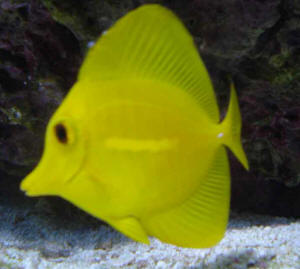
Brown spots, Yellow Tang, stress, more reading and grammar checking
4/30/08 Hello
Crew <Terris> I have spent hours reading your web site great
stuff it should be organized into a hard cover encyclopedia. <Run on
sentence> I am new at this, but we have to start somewhere right.
<A statement?> I have a 110 gallon tank with a small community 4
clown (one is a tomato), 1 Yellow Tang a flame angel fish, coral beauty,
a dog face puffer and a beta, <Not this> all living very happy.
<Happily> With acceptable water conditions tank is fully cycled and
is growing live rock very fast (up till yesterday) I have two sick fish
the puffer and the yellow tang have these brown spots. <... in a
word, from "stress"> I added quick cure 24 hours ago <An
exceedingly poor idea/move... you've poisoned your system... with
formalin> and I do not know now what action should be taken now since
the fish still have the spots on them. I have added a picture of the
tang. The puffer fish fins are starting to look better, but the tang is
still not looking like there is any improvement. Terris Cooper
<Keep reading... Likely the Tomato is harassing the Zebrasoma... could
be nutritional, some aspect of water quality... Bob Fenner> | 
|
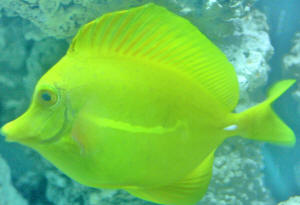
Yellow Tang Ill? Reading 4/27/08
Hi, I have a question about my yellow tang. He has been in my tank
about two weeks. Yesterday he was eating and acting as normal, very
active, and ate 'dinner' with all the others (1 blue and yellow damsel
and 2 clown fish). This morning he was not out as usual after searching
I found him in the back of the tank (30gal) <This volume is too small
for a Zebrasoma (or for that matter any) Tang> behind my live rock
(25 lbs.). He has since been sitting there all day, propped up against a
rock. He will move if I wiggle a rock or coax him with my finger. His
color is bright and breathing is normal. I just noticed a brown
"string"-like line coming out of his side behind his fin. <?!> I
tried to gently pull it off thinking it was hair algae stuck to him, but
it appears to be attached!? I called my LFS and they could not tell over
the phone and they close in 10 minutes. I attempted to take a picture
but it's hard to see it. It looks like fish "poop" for lack of a better
term. Any ideas? Thanks! JB <... Please read here:
http://wetwebmedia.com/YellowTang.htm and the linked files above.
Return this fish... it won't live long under the present circumstances.
Bob Fenner>
Help with Strange Yellow Tang Problem Please 4/9/08 Hey Guys-
<Brian> I have had 2 mini reef tanks for several years and
recently consolidated them into a 90 gallon. There is approximately
90 lbs of live rock which half I've had for 3 years and 60 lbs. of
live sand. For filtration there is a protein skimmer and a wet dry.
I've just ordered a refugium. Water parameters are where they should
be: ammonia= 0, nitrites=0, nitrates=0, PH=8.2, Phosphates=0,
salinity= 1.024. I have recently purchased 3 yellow tangs for my
tank. <Mmm... too likely to actually fight here rather than get
along... Zebrasoma of all species have a mix of territorial
behaviors... the dynamics of their stocking... can be complex>
The LFS where I buy my fish is a good store as their stock is
usually in great shape. The LFS is adding new display tanks in their
store and the tank that the tangs where in was not lit with light
properly due to their construction. When I got them home I noticed
they had the beginning of HLLE. One of the tangs had a weird white
spot on his dorsal fin that looked like a wound. It is not ick. In
the last week these white spots have appeared on the other 2 tangs
and the one with the original spot has a few more. They are in the
same location and do not seem to get any better only spreading
slowly, meaning they never fall off. The spots are also larger than
ick spots and look fleshy. The spots are also raised- similar to
ick. I have caught some fresh water fish fishing that had something
like this on them. I'm sorry but I can not get a picture of it. The
fish are very active and have huge appetites. They are very nervous
and spooky. Unfortunately I did not quarantine them and I'm paying
for it now. They are the only other fish I've added since the
consolidation. <Sounds/reads like either subdermal encrusting
worms or perhaps a type of Sporidean protozoan. Have seen such in
aquariums and the wild on many occasions, having dived hundreds of
times in Hawai'i> For fish I have the 3 juv. 3 1/2" tangs, 2 1"
onyx clowns, 1 2.5" yellow wrasse, 1 2" six line wrasse, and 1
yellow clown goby. None of the other fish have this or any other
problem. <And not likely to "contract" the stated symptoms> I
feed them prime reef frozen and flake, dried seaweed and algae,
formula 2, frozen mysis, and Spirulina brine. I'm going out to buy
Nori and Selcon today as well as a cleaner shrimp. <Ah, good>
I have been researching this site and goggle for a few days with no
results and need your assistance please. Thank you for your help and
the service you provide! Brian <Adding the refugium, the
other food/supplement and cleaner will help a great deal... but do
keep a watchful eye on the Tangs interactions... it may be that
definitely one will be "the odd fish out" and in time only one be
happy-enough in this volume, size setting to suit you and
it/themselves. Cheers, Bob Fenner>
Re: Help with Strange Yellow Tang Problem Please -04/11/08
Thanks you for your help. I have caught them out of my main tank and
setup a hospital tank which is ten gallons. I returned 2 of the
tangs and am going to keep just one. <Ah, good... I had notions
of modifying, adding a further note to our prev. corr. re this... Is
best> After catching them I did a 3 minute freshwater dip- I know
it wasn't long enough as now I've read the correct way to do it.
<This is about as long as any good can/will be done> I was able
to get a few pics of the problem which I have attached to this
email. I have started him on Mardel Coppersafe as per
instructions. What do you think? <I would not... See here:
http://wetwebmedia.com/fishindex3.htm the areas on Tangs,
Disease, Copper... No good to come of exposing this Zebrasoma to
such for what is going on here... Just better care, environment...>
Thank you again! Brian <Welcome. BobF>
Re: saltwater tank infection 5/5/08
Thanks Bob. The yellow tang seems to be improving, he's eating much
better and is out and about more. His color seems to be starting to
come back as well. Hopefully he pulls through, thanks for the help.
-Brian <Ah, thank you for this upbeat update! BobF> | 
|
|
|