|
|
FAQs on Anemone Identification
41
Related Articles: Anemones,
Bubble
Tip Anemones, LTAs, Cnidarians, Coldwater Anemones, Colored/Dyed Anemones,
Related FAQs: Anemone ID 1, Anemone ID 2, Anemone ID 3, Anemone ID
4, Anemone
ID 5, Anemone ID
6, Anemone ID 7, Anemone ID 8,
Anemone ID 9, Anemone ID 10, Anemone ID
11, Anemone ID 12, Anemone ID 13, Anemone ID 14, Anemone ID 15, Anemone ID
16, Anemone ID 17, Anemone ID 18, Anemone ID 19, Anemone ID 20,
Anemone ID 21, Anemone ID 22, Anemone ID 23, Anemone ID 24, Anemone ID 25, Anemone ID 26, Anemone ID 27, Anemone ID 28, Anemone ID 29, Anemone
ID 30, Anemone ID 31,
Anemone ID 32, Anemone ID 33,
Anemone ID 34, Anemone ID 35, Anemone ID 36, Anemone ID 37, Anemone ID 38, Anemone ID 39, Anemone ID 40, &
Cnidarian
Identification,
|

|
|
Mystery Anemone/coral: Telmatactis sp. – 12/14/12
Hi WWM crew,
<Hi Dave, Lynn here this evening.>
Firstly let me just say thank you for the wealth of knowledge which you
have provided me with over the past couple of years since I started this
amazing and sometimes frustrating hobby.
<On behalf of Bob, myself, and the rest of the crew, we thank you very
much!>
This evening when I came home from work I saw this hitchhiker in my tank
and was just wondering whether you could identify it for me - the glass
coloured creature on the sand.
<It appears to be an anemone in the genus Telmatactis (aka the
“Club-Tipped Anemone”).>
The head end (visible) is approximately the size of a 1p piece, and has
a mustard yellow thick body which extends into the rock behind it.
It is really quite pretty
<Yes, it is!>
…and would like to keep it in the tank should it be fairly non-aggressive,
but I am a little concerned as a few days ago I had a mystery death of a
yellow tailed damsel which was showing no sign of disease or ill health
- could this creature be responsible?
<It’s possible, if the damsel was very small and somehow blundered into
the anemone.>
Other tank mates are 2 common clowns, a lemon peel angel, a six-line
wrasse and 2 more yellow tailed damsels, plus a toadstool coral, a
Goniopora coral and some clean-up crew. The tank is 200l and has not had
any life added for the past 12 months as it seemed to be in a very happy
state - so I am not sure where it came from.
<It more than likely moved into this new/more favorable location from
whatever unseen location it was in previously.>
Thank you once again for your ongoing help and dedication to the cause.
<You’re very welcome. For more information regarding these
anemones, please see the FAQ titled “Anemone ID: Telmatactis spp.
8/9/10” at the following link:
http://www.wetwebmedia.com/AnemIDF37.htm?h=
A terrific close-up of Telmatactis Americana can be seen here:
http://reefguide.org/carib/pixhtml/clubtippedanemone2.html >
Dave
<Take care, Lynn Z>
|
 |
|
anemone question or ID please - 11/15/2012Please
help if you can.... have any idea of what these are....I have attached a
crude photo.
I think baby somethings, but my strong points are not anemones. Hope
attachments come through.....if not how do we send pics.
thank you so much in advance,
Grant
<Ahh, this is actually a type/species of Corallimorpharian, Mushroom.
Please read here:
http://www.wetwebmedia.com/MushrIDF7.htm
<Cheers, Bob Fenner>
Grant C. Anderson
Curator of Fishes
The Marine Cove at Sertoma Butterfly House
4320 S. Oxbow Ave.
Sioux Falls, SD 57106
www.SertomaButterflyHouse.org
|
 |
Re: anemone question or ID please
- 11/16/2012
thank you so much, since my accidents I have no reference to what I recall
from my earlier days.
<Yeeikes! I have an ever-diminishing recall capacity... no thanks to none!>
thank you again,
Grant
<Certainly welcome. Bob Fenner> |
|
Carpet Anemone 11/10/12
Hi WWM:
<Jenni>
I recently ordered a giant carpet anemone from Pet Co. and I'm sure they
sent me the wrong species. It was sold as an assorted giant
carpet anemone species
<Mmm, which this is>
and I was hoping to receive a Haddon's. I got this one and it
doesn't seem like any of the 3 giant carpets species I was expecting. It's
hard to tell in the picture, but it is just shy of 7 inches and slightly
asymmetrical. It was lost in shipping and 37 hrs late. The water temp
was 62 degrees and ammonia tested at 2ppm. I rushed acclimation
because of this and yet this thing plopped down in my tank, buried it's foot
(which is light orange with red dots)
<Both good clues to ID>
and has not moved an inch. A true giant carpet would never have
survived this so easy. I had a Haddon's for years and could tell by looking
at it that I needed to do a water change. I thought this might
be a maxi anemone or mini carpet.
<May be>
I can find very little out there on them, the difference between them
(size?) two. Also the pizza anemone...some say big, some say a couple
inches. I need to know what this is and does it need to be relocated when I
get the Haddon's. Will it eat my fish?
<Mmm, yes; given the opportunity>
I have all soft corals, maroon clown pair, coral beauty and a leopard
wrasse. Thanks for your help. Jenni VC
<Do read here:
http://wetwebmedia.com/carpetanemones.htm
This appears to be a S. gigantea. Bob Fenner>
|
 |
|
Unidentified Anemone 11/9/12
I'm very interested in knowing what species of anemone this is. It came in a
shipment from Jakarta that I received about a week ago. It's an aggressive
eater (I'm feeding it Mysis shrimp) but it closes up under strong lighting.
The closest thing to it that I've seen is a waratah anemone (*Actinia
tenebrosa*) but I'm pretty sure that this is a different species. Any
feedback would be much appreciated.
--
*Thank you, Aaron Dragseth*
<Mmm, the tentacle ends/tips aren't "right" for Actinia tenebrosa... My
guess is that this is an aberrant Entacmaea. A beauty.
Bob Fenner>
|
|
Re: Unidentified Anemone
11/9/12
Thank you for your feedback. I agree that it isn't an Actinia tenebrosa but
it also doesn't really look like or have the same behavior as Entacmaea
quadricolor. Are there other species of Entacmaea?
<Not as far as I'm aware... but have seen E. quadricolors look like this
from rough handling, shipping>
I actually received 3 of these anemones. They were all firmly attached to
small pieces of substrate that they have continued to cling to even a week
later. Two of the anemones
had the same foot but a completely separate set of tentacles and each had
their own oral disk. They remind me of the aggregating anemones
(*Anthopleura elegantissima*)
<Yowzah! I did a histological study of this... clone anemone... common off
of San Diego's coast... for a marine invert. class... many years ago>
that are common in my local California tide pools. .
<D'oh! That and the giant green of the same genus. Bob Fenner>
Re: Unidentified Anemone 11/9/12
I know what you mean when you say "but have seen E. quadricolors look like
this from rough handling,", I agree. The big difference on these anemones
are that they seem to be very healthy. The tentacles are very sticky, in
fact I would say that they are stickier than those on even the healthiest of
bubble-tip anemones.
Also, the foot is more like that of the our local Anthopleura species, very
leathery with an extremely strong adhesion to the substrate. An unhealthy
Entacmaea would never have such a strong hold on the substrate and the foot
is much softer. With that said, I currently have it listed for sale as a
Crimson Mystery Anemone (Actinia sp.?)
<A good name>
What do
you think?
<I do wish I were home, w/ my reference works... Am out visiting in Europe.
Maybe a (hard) run through Daphne Fautin's "Hexacorallians of the World"
(.com),
http://hercules.kgs.ku.edu/hexacoral/anemone2/index.cfm
will be productive>
LOL! It's interesting that you worked on those California Tidepool
anemones, I remember my marine biology teacher daring us to stick our
tongues in them and most of us did!
>"Squirt!"<
Would that even be legal today?!!
<Heeeee! BobF>
Help with anemone identification 11/9/12
Hello Bob, I thought that you would find this reply from Karen Sanamyan
interesting. I'm not sure if you are familiar with her or not but she is a
marine biologist at the Kamchatka branch of the Pacific Institute of
Geography, she specializes in the taxonomy of Actinaria and is one of the
authors of Actiniaria.com. It sounds like we have an
<I'll say! Thanks for sending this along Aaron. Wondered re the apparent
empty-of-tentacles space on the face, the open mouth... BobF>
Subject: Re: Help with anemone identification
11/10/12
Hello,
Well, very interesting species.
It has capitate tentacles (small spheres on the tips of the tentacles), such
tentacles usually occur in stone corals and corallimorphs, and in general
are not characteristic for true anemones (Actinaria), (except Telmatactis
and a few other Actinarian genera).
Further, on your photo I see that it has several some tentacles arranged
radially of the disk (arrows on attached photo). This feature excludes all
stone corals. Several true anemones have tentacles arranged in radial rows
(e.g. Stichodactyla), but they all are very different and have no capitate
tentacles. So, this is a Corallimorph species (corallimorphs are all
"mushrooms", e.g. Discosoma, Rhodactis, Corynactis, Ricordea and others -
you know). However, the species on your photo cannot be identified with any
known Corallimorph species, I think this is undescribed (=new) species.
Best wishes
Karen Sanamyan
http://actiniaria.com |
 |
|
question about Anemone, mainly ID
9/24/12
Hi guys
<Cam>
Awesome website which I'm always learning from. Thank you!
<Welcome!>
I have had this anemone for 1.5 years now and it just won't stop
growing!
It has never split in my tank. It was given to me by a friend whose
anemone kept splitting and mine is one if his clones. His one
hasn't done too well in his tank but he does have other anemones in his
tank (I know, I know - I've told him). I did write to you guys
about 6 months ago to try and get an idea as to what type of anemone
this is (among other things). You thought it might be Heteractis
Malu.
<Might be... or perhaps Heteractis magnifica... now that the pedicle
looks so much lighter>
But Now I'm not so sure. It is currently 12" x 16"
<Oh! Not likely H. malu then... too large>
and that is just the top 2/3rds. The tentacles are about 4" long.
During the day it's mouth is open a little. 1" at the most. It's
been doing this for months. I was a little worried at first but it
still is growing and hasn't lost any colour. I've tried feeding it
cut up, uncooked shrimp which it used to devour but since the clowns
have started hosting in it (6 months ago) it doesn't eat from me.
When I feed Mysis shrimp (about 2-3 times a week) I do give a big squirt
to the clown fish so it's maybe getting some food that way. From
what I've read the H. Malu has rather short tentacles which this one
never does. Is it possible I've got a Crispa?
<Possibly; but my guess is on the Ritter's/Magnificent>
I have a RSM 250l tank with a Vortech mp10 e (in wave maker mode) and
using a Deltec skimmer. I've had this set up for 20 months. Temp
sits around 27-28. Touches close to 29 on a hot day. NH4 0;
NO2 0; NO3 3; Mg 1350; Ca 410; Alk 9.5 dKH; phosphate 0.68; SG 1.025;
Tunze ATO. Using standard T5 tubes. I have a much
larger tank (a bit over 1000l) on order - woo hoo!
<Nice!>
Thanks again
Cam.
It's mouth is about where the Royal Gramma is :)
<A keeper. Bob Fenner>
|
 |
|
Help with identity of Anemone
6/15/12
Hi all,
<Hey Paul>
Please see attached an image of a Mystery Anemone I have in my tank. I
bought some Zoas approx 6 months back and when I got them home found a
little hitchhiking anemone on the live rock. It has since grown from
approx 1cm across to 8cm across, and split twice leaving me with three.
I personally like the look of them, but have no idea what they are, how
large they might get, or how common it is for them to split - does 1
become 2, become 4 etc...?
<Quite>
I had assumed some kind of LTA, but recently saw an article stating that
LTA's do not split/clone themselves - I clearly watched this anemone
split yesterday, so I know it hasn't been fragged by a falling rock etc!
Any thoughts?
<Ah yes. This is highly likely an Anemonia sp. Please see here re:
http://www.wetwebmedia.com/AnemoniaF4.htm
Thanks as always,
Paul.
<Welcome in kind. Bob Fenner>
|
 |
|
Anemone? Nope, Corallimorph: Pseudocorynactis spp. –
6/6/12
Hello,
<Hello there, Lynn here this evening.>
Was wondering if you know what these are.
<Yep, although it appears very anemone-like, it’s actually a
Corallimorph (e.g. Ricordeas, mushroom corals, etc.) in the genus
Pseudocorynactis, possibly P. caribbeorum, aka the “Orange Ball
Corallimorph”. We have quite a few references to these in our
FAQ’s but you can start with the one titled “Good or Bad Hitchhiker?
Usually Okay: Pseudocorynactis spp. -- 8/3/10” at the following link and
refer to the links listed within:
http://www.wetwebmedia.com/MushrIDF6.htm?h= >
They come out / open up at night. I only see them for a few minutes
after the light comes on in the morning.
<That’s fairly typical. Interestingly enough, in the wild they’re
nocturnal, but in home aquaria they can sometimes switch to a diurnal
pattern.>
Looks like it has a solid but transparent cone-like base with tentacles
that come off a ring. (Yes, I have a hair algae problem.)
<You have my sympathies. The good news is that you’re at the right
place! We have a lot of information regarding this topic, so if you need
any help, do use our Google search engine for a list of links:
http://www.wetwebmedia.com/Googlesearch.htm >
Thanks for all You do.
<You’re very welcome. Take care, Lynn Z>
|
 |
|
anemone ID and care
4/26/12
Hi again crew hope you are all well.
<Hello Simon>
Can you please ID this anemone for me and give a little information on
care. i.e. flow rates, feeding, lighting etc. Also would it be a good
host anemone for my pair of Clarkii clowns?
<You have a Macrodactyla doreensis aka Long Tentacle Anemone and it is a
natural host for Clarkii Clowns. Read more here--
http://www.wetwebmedia.com/macrodoreensis.htm
http://www.wetwebmedia.com/ltasysfaqs.htm >
Thank you in advance
<Quite welcome>
Simon
<Jordan>
|
 |
|
Lighting and IDs 1/27/12
Hi Crew,
<Hello Rick>
I am after your opinion about my Lighting - currently I have 3 x
120W banks of LEDs as in the picture attached (LED Current).
The tank seems happy enough although it has only been set up for
a few months. All the stock in it are out of several nanos
I've had scattered around the house for about 5 years.
I've very good coralline growth in the new tank and bulk live
Pods and Mysis shrimp due to the 300Lt fishless sump.
<Nice.>
The tank contains a full reef with Live Rock, Fish, SPS and LPS
corals.
The water level from where the lights are mounted to the top of
the aragonite bed is approx 600mm.
I am a bit concerned I've mucked up the ratios of the LED
banks and was after your opinion on light spectrum.
The new banks I'm thinking of building will look like the
picture "LED New"
Can I ask your opinion on the light spectrum and ratios I'm
considering?
<Sure. The 20K LEDs are not much use for growing corals,
at least the corals we commonly keep in our aquaria. I
would not waste the energy on these LEDs but direct it toward the
usable spectrum need by corals (420-700nm). I would not use
any LEDs below 400nm as you are then getting into the UV range
which could/can cause molecular damage to some animals in
your system.>
In addition to the lighting configuration I'm considering , I
am also planning on building 2 x Black Light bars at 18
Watt each to help fluoresce the tank.
<Would not use this as well as they are well into the UV range
and will be hard on the eyes with extended viewing of your
aquarium. Depending on the intensity, the black light may
even damage your eyes if looking directly at them.
At what Wave length will I be exposing the live stock / bacteria
to dangerous levels of U/V radiation?
<Anything below 400nm. UV is in the range of
10-400nm. Below 10nm is the X-Ray spectrum.
Do you think 360nm would be ok, would the 400nm be just as
effective, or could I go lower?
<I personally would not use anything below 420nm.>
Two more questions regarding an ID. See picture
"ID".
This animal has gotten into my sump obviously through live rock,
it doesn't do any damage (except eating the occasional baby
Bristle Worm}. The animal lays flat on the aragonite and very
quickly closes up as food touches or floats over it. It is an
Omnivore as I've seen it eat anything from bits of algae to
shrimp. It's had a few goes at larger Bristle worms but
lets them go after closing around a portion of them, however, it
has no problem chomping up the babies.
<Appears to be a Rock/Flower Anemone, an Actinia of
some type. Bob may input here with a more accurate
ID.>
The next one is a coral that I haven't found conclusively
what it is, It may be some type of brain but the closest pictures
I can find suggest a moon coral. I'm unsure where to place
it, whether on the aragonite bed or on the live rock. The coral
fluoresces beautifully at night under the moon lights and
exceptionally with a jigged up 360nm LED.
<Appears to be a Faviid species, possibly a Moon
Coral. May want to peruse here.
http://www.wetwebmedia.com/faviididfaqs.htm>
As always your advise is appreciated.
<You're welcome. James (Salty Dog)>
Cheers
Rick (who just got his open water license and is about to dive
the GBR J )
<Lucky you!>
|
|


|
|
Anemone ID question (with pic)
1/19/12
Hi there!
I've enjoyed browsing your site, I've always found great
information! I have a question for you regarding a mystery
anemone I acquired yesterday. I was in a local fish store and saw
what I though was a purple Ricordea mushroom,
<Mmm, no>
until looking closely... I asked the man who worked there
and he didn't seem to know what it was (it was in a harlequin
shrimp tank, towards the top attached to the glass in the back)
the man said it must be a small bubble tip anemone,
<I do think he's right... from the shape of the animal,
its tentacles, wrapping about the rock... Entacmaea
quadricolor>
and said if I want it I can have it for $15. I
inspected the foot (intact) and the mouth (closed tightly) the
color is beautiful, brown foot and tentacles, fading into a
bright purple/lavender at the tips. I took it home and after
looking online cannot find anything regarding "purple"
bubble tips.
<Oh! The species occurs in many colour variations>
The anemone is small, maybe 3 inches across.
<Yes; "it has shrunk"... from a lack of food,
inauspicious circumstances likely... Can/will come back w/ good
care>
It seems to be doing well so far, but it is a mystery. I
have no idea exactly what species this is.. Can you help? Thank
you so much!!
Leah
<Please read here:
http://www.wetwebmedia.com/marine/inverts/cnidaria/anthozoa/bubbletipanemones.htm
and the linked files above. Bob Fenner>
|
|

|
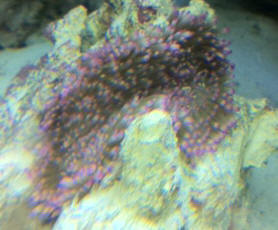
Anemone ID pic 4
1/21/12
Just a few more pictures so you can get a good view...
<Thanks. B>
Leah
|
 |
|
|
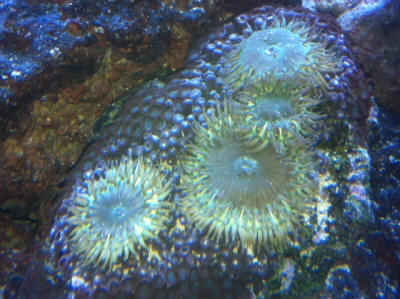
Rock Flower Anemone,
Lighting and Sump Recommendations
1/21/12
Hi Bob,
I sent you a question a few weeks ago about a polyp rock with
five flower anemones attached. I thought you may like a better
photo. You may use it if you like.
<Thank you>
I have two quick questions for you. I recently had to move my 46
gallon Bowfront reef tank to a much sunnier location. My light
fixture is a Nova Extreme t5 with 2 10,000 daylight bulbs
programmed from 9-9, and 2 blue actinics programmed from 8-10.
Includes LED moonlights as well. Since moving the tank, it has
developed slimy red/brown algae on the glass and the live
rock is a much darker green color. Do you think the increase in
natural light may be contributing?
<Seems to be>
Also, I currently have a HOB filter and CPR BAKPAK skimmer
(has worked very well). I want to upgrade to a sump that will
also hold a skimmer. Any recommendations for a unit that will fit
in a smaller cabinet?
<Mmm, yes. Please read here re: http://www.wetwebmedia.com/skimrs4sumpsf.htm
Thanks for all of your help.
Your site has been a major factor in the success of my tank!
Karen
<Ahh! BobF>
|
|
|
Re: Rock Flower
Anemone, Lighting and Sump Recommendations
1/21/12
Thank you for the speedy reply. Any suggestions in reprogramming
the amount of light from my fixture or should I attempt to block
some of the natural light?
<Best to either avoid (to control) or "ride out" the
period of time where the pest algae are growing... will be
supplanted in time. Please read here:
http://www.wetwebmedia.com/marsunusefaqs.htm
BobF>
Karen |
|
Swimming anemone?
12/24/11
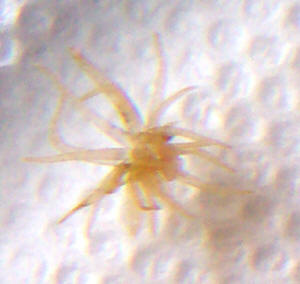
Hi wonderful experts. I hope you are having a great
Christmas!
<Thank you>
I recently bought a detritivore kit for my refugium.
Yesterday I saw a bizarre little creature 'sunning'
itself on top of the clump of Chaeto. It resembled a tiny
light tan octopus, though with many more tentacles.
<I see this... Aiptasiid, Glass Anemone>
When I startled it, it snapped all of its tentacles
together behind it and thereby dove into the heart of the
Chaeto. This morning I found it attached to the side of the
refugium. This made me think it might be an anemone, but I
never heard of an anemone that is a fast and graceful
swimmer.
<There are a few... some clunkier, slower>
It can move FAST, with its many tentacles trailing
behind. The dealer quickly got back to me and suggested
that it might be a swimming anemone, and I should remove it.
<Yes I would>
I did, and got a couple of photos. I Googled
"swimming anemone" and got no useful hits. This
phrase also came up empty on WetWebMedia. I have attached
two photos. The diameter of what you see in these photos is
about 5-6 mm. Can anyone tell me what this is?
<Please see here:
http://www.wetwebmedia.com/marine/inverts/cnidaria/anthozoa/aiptasia/aiptasia.htm
and the linked files above>
I have it in an isolation chamber in my QT right now, in
case it is a good thing and I want to return it to the
refugium.
<Some people employ these as filters... to take up unwanted
nutrient... But they (the anemones) can become problematical in
terms of rapid reproduction, displacement of other life>
I would deeply appreciate any information anyone can
provide. Thanks!
You folks are the best.
Tim
<We try. Cheers! Bob Fenner>
|
|
Re: Swimming
anemone?
12/26/11
Bob - Thanks for the fast and important answer! I hope you
had a great Christmas.
<Is it over? Whoa!>
I got rid of the Aiptasia. But sometimes it is so
frustrating learning that there are so many things I don't
know.
<Mmm, not for me... got used to this long ago. Now I really
look forward to such discovering>
I was positive it was not an Aiptasia. I've read
all about it in books and here, especially because some months
ago when I cured a small batch of live rock for a special project
I had a huge Aiptasia outbreak. A handful of peppermint
shrimp seem to have eliminated them all, though the real test
will be to see if they come back. But the Aiptasia I had
there and that I've read about were very different from this
guy. Those all had a prominent oral disc, while this one
had no oral disk at all (that I could see). Those all had a
prominent pedestal separating the foot from the oral disk.
This guy had no pedestal at all (that I could see).
<Mmm, this is why I stated/speculated that it was an Aiptasiid
(the family), not necessarily of the genus Aiptasia>
It was built like a WW II naval mine, a round central body
with tentacles radiating out from it. So I concluded that
it was not Aiptasia. Now I learn that there is a huge
variety of this beast! Sigh. Well, I'm learning
slowly. Thank again!
Tim
<Take 'er easy Tim. BobF>
Re: Swimming anemone? 12/26/11
Tim, you triggered some memories... perhaps this is a Viatrix
globulifera... BobF
Re: Swimming anemone?
Bob - Thanks for the additional info. You guys are
wonderful to us newbies. I checked this viatrix and it is
not a match. I think you are right about this being an
aiptasiid. It doesn't look like my others in shape, but
it's the exact color (transparent light tan) of an
Aiptasia.
Just another variation. In any case, I removed it and am
keeping close watch for any friends and relatives.
Tim
<Thank you for this follow-up Tim. BobF>
|
Unknown Anemone, and pest spag. worm
Qs 11/18/11
Good Evening!
I have an anemone that I am unsure of its name. It's smaller than
my Zoanthids it came attached to.
<Mmm... maybe just a juvenile>
It has a bright red foot with clear bubble-like tentacles. I checked
out all the articles that looked promising and a Magnificent anemone
seems the most fitting. But I am wondering if it is possible for one to
be so small and survive being transported with the zoos.
<Yes; is possible>
It doesn't attack the zoos
<Unusual that they're not competing chemically. May be the
reason the odd animal is so small... I would excise it (with a single
edged razor blade or such) and move it to another Cnidarian-free
area>
at all but when the current moved it up
<?>
under a stalk xenia the anemone quickly grabbed onto a single tentacle
and sorted of pinched it. The tentacle of the xenia seems to be
recovering. Is this a pest or just one I should treat as any other
anemone?
<Can't tell from what is offered here. Do send along a couple of
well-resolved images, your further observations when you can>
On another note, I have a worm which appears to have a calcareous shell
but no crown. I wouldn't be concerned accept <except> that it
sends out a spider web looking string that has gotten on a colony of
zoos. I pulled it off gently since it couldn't be good covering the
colony.
<Not to worry. Leave the strands alone>
Is this a good or bad worm? I can easily move it somewhere where the
web-like strings will not reach if the worm is beneficial.
<I'd leave this (spaghetti) worm alone. See WWM (the search
tool) re>
Thank You so much for such wonderful information here!!!!
<Welcome! Bob Fenner>
|
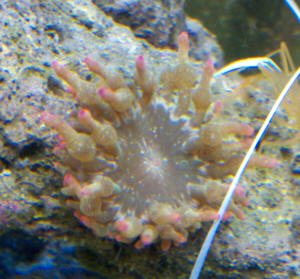
Anemone id
10/30/11
Hello,
<Hi Rob>
I purchased this "anemone" at my lfs. I was told out is
a bubble tip anemone. However I have not been able to find a bta
that looks anything like this. Can you tell me if this is the
case?
<Could be an Entacmaea... Please see here: http://wetwebmedia.com/btaidfaqs.htm
Thanks
Rob
<Welcome. Bob Fenner>
|
|
|
Re: Anemone
id 10/30/11
Thanks bob. You say it could be however I guess my concern was did
I receive what I was told the specimen was? I was worried out could
be a majano our other nuisance anemone.
<Could be Anemonia as you state... but let's let it grow and
see. Cheers, BobF> |
|
Anemone identification 10/25/11
Hi guys,
Got a question for you. My local fish store sold me this anemone
(see pic) they said it is a curlyque anemone but none of the
pictures of curlyques I have seen look like it. Is it really s
curlyque
<Not>
or is it a different type of anemone and if so what type.
It appears to be none aggressive and doesn't scare easily. It
also doesn't move. Any ideas?
<Whatever it is, it's badly bleached and starved. Appears
to be a Condylactis... Bob Fenner>
Thanks,
Timm
|
|
|
|
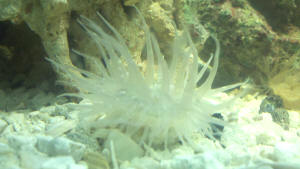
Anemone
ID, reef stocking reading 7/25/11
Hi guys,
<Howsit?>
My name is Tim and I recently got some additional live rock
(cultured Tonga) for my aquarium. The picture attached is a
hitch-hiker I cannot seem to identify. I am confident it is not a
glass anemone. Can you help?
<Appears to be an anemone/Actinarian of some sort... Agreed
that it's not an Aiptasiid... I'd leave, see what it
develops into>
Also I am considering getting a curlyque anemone. What are your
thoughts on these guys? Anything major I need to be aware of?
<Too stinging for most settings... Use the search tool on
every page on WWM re the name, read the cached/colored
parts>
My tank is a 220 gallon. It houses a yellow tang, blue hippo
tang, strawberry Pseudochromis, six line wrasse, two brittle
stars, a percula clown, two engineer gobies, and 3 firefish. It
also has approximately 250-280 pounds of live rock (various types
including Gino, Tonga, and lettuce coral all aqua cultured). I
use reef capable Marineland LED lighting, a Tom Aquarium Products
wet/dry filter with protein skimmer, and a UV sterilizer.
Are there other good anemones or corals you would recommend? Any
other fish or inverts that could be good additions?
<This is all posted/archived on our site...>
Thanks for all the great information you guys provide.
<Please use it>
You are a life saver for me and hobbyists everywhere.
<Cheers, Bob Fenner>
|
|
|
|
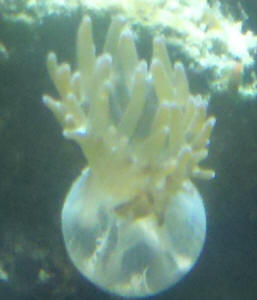
Anemone
positive ID please 6/29/2011
How are you guys doing.
<Ok>
Thanks in advance for all this service you guys provide us
with.
Pictures attached
#1 (I think Magnifica?)
<Mmm, no; likely Heteractis malu>
when touched feels a bit leathery stands very strong even with
strong flow on it seem not to hang loose. Nice green color with
very light purple tips.
<See here:
http://www.wetwebmedia.com/marine/inverts/cnidaria/anthozoa/anemones.htm
Feels extremely sticky on the touch. Has been in the tank for
about 1 month now and has been eating well.
#2 (I think LTA?)
<Mmm, no... almost assuredly this is a badly bleached
Heteractis magnifica... see the comments re the pedicle>
looks very loose and much longer tentacles. Sways hard in the
flow.
Does feel sticky on the touch though not that extreme. Has a
light whitish purple color with a bright purple foot. Very bright
purple tips at the end of its tentacles.(not clear in the
pictures)
Has been in the tank over a month and eating very good although
the 2 hosting clowns tend to grab everything out of it.
#3 (I think Rock Flower Anemone?)
<Good as name as any. I've seen this, or some similar
Actinarian in and about Sulawesi and S. Saba at times. Don't
know the scientific name... some folks state as Epicystis this or
that.>
doesn't feel that sticky at all though has just been placed
in the tank.
Foot did take though within a minute and it started to inflate
instantly.
Has bright dark purple short tentacles with white rings around
its tentacles. Looks like it has 3 separate heads but is one
anemone with one central located mouth.
<Is a beauty for sure>
Has not been fed yet as just placed in the DT
<Thank you for sharing. Bob Fenner>
|
|

|
|
|