|
FAQs on Anemone Identification
6
Related Articles: Anemones,
Bubble
Tip Anemones, LTAs, Cnidarians, Coldwater Anemones, Colored/Dyed Anemones,
Related FAQs: Anemone ID 1, Anemone ID 2, Anemone ID 3, Anemone ID 4, Anemone ID 5, Anemone ID 7,
Anemone ID 8, Anemone ID 9,
Anemone ID 10, Anemone ID 11, Anemone ID 12, Anemone ID 13, Anemone ID 14, Anemone ID 15, Anemone ID 16 Anemone ID 17, Anemone ID 18, Anemone ID 19,
Anemone ID 20, Anemone ID 21, Anemone ID 22, Anemone ID 23,
Anemone ID 24, Anemone ID 25, Anemone ID 26, Anemone ID 27,
Anemone ID 28, Anemone ID 29, Anemone
ID 30, Anemone ID 31, Anemone ID 32,
Anemone ID 33, Anemone ID 34, Anemone ID 35,Anemone ID 36, Anemone ID 37, Anemone ID 38, Anemone ID 39, Anemone ID 40, Anemone ID 41,
Anemone ID 42,
Anemone ID 43, Anemone ID 44,
Anemone ID 45,
& Cnidarian Identification, Anemones 1,
Anemones 2, Anemones 3, Anemones
4, Anemones 5, Invertebrate Identification, Aiptasia
Identification, Aiptasia ID 2,
LTAs, Bubble Tip
Anemones, Caribbean
Anemones, Condylactis, Aiptasia
Anemones, Other Pest
Anemones, Anemones and
Clownfishes, Anemone
Reproduction, Anemone
Lighting, Anemone Feeding,
Anemone Systems,
Anemone
Compatibility, Anemone
Selection, Anemone
Health, Anemone Behavior,
Anemone
Placement,
|

|
 |
New Print and
eBook on Amazon:
Anemone Success
Doing what it takes to keep Anemones healthy long-term
by Robert (Bob) Fenner
|
| Anemone Question (possible H. crispa) 8/22/05 Hello
again Crew, and thank you for your patience. I have a
question regarding an anemone that I would like to add to my tank,
mainly with regards to lighting. This particular
individual is a Heteractis crispa or malu, and is a pale white/gold
with purple tips to his tentacles. Our LFS recently
acquired him, and will hold him for another 2 weeks for
us. <With a decent reference, H. Crispa and H. Malu
should be fairly easy to distinguish. I am guessing this
is probably H. Crispa because it is more common and very prone to
bleaching (which this one sounds like it is). H. Crispa
is fairly hardy (by anemone standards) if a healthy specimen is
acquired and is successfully acclimated. Bleached
specimens often fail to survive. Observe this one for
evidence that it is repopulating zooxanthellae before
buying. Healthy specimens aren't always beautifully
colored, but they should not be white, pale or "washed
out" looking.> I have a 75 gallon tank that is 48L x 24H x
18W, with 62lbs live rock (buying more as I go). I use
an Aqua C Remora Pro with a Mag drive 3, and have a sump with
carbon and Chemi-pure. Am: 0 NO2: 0 N03: <3ppm I do a
10 gal water change every two weeks. Sounds
good. pH, Alkalinity and Calcium should all be
maintained in their normal ranges and salinity should be
1.025-1.026 for anemones.> Lighting is: 2 65 watt PC
10,000K and 2 65 watt PC Actinic. These are suspended
3" above the water, no cover glass. Will this
be enough light if the anemone is placed in the top half or third
of the tank, or should I invest in a MH bulb? I have
seen the clip-on halides, are these effective? I plan to
quarantine the anemone for 4 weeks also, after 2 more weeks at the
LFS. This will be in a 15gal tank, would a clip on MH work here
also? <I would suggest at least 50% more light (double would be
better). You could accomplish this with more PC's or
a MH. I am not sure what you mean by clip-on
MH, but most fixtures offered for the aquarium trade are
suitable.> As to the general health of the anemone, I'm not
sure if it is bleached, or just a pale specimen. I am
going to look more closely in the morning, would it be helpful to
you if I sent a picture to get your opinion? Thank you
for your excellent site, and all of your help. Benjamin
Kratchmer <Pictures are always beneficial, but you
have presented a very classic situation. H. crispa is
commonly imported, more often than not they are bleached, and
occasionally dyed (Bright yellow is not a natural color for H.
Crispa and a sure tip off that the animal has been
dyed!). If after two weeks, this anemone starts
developing a richer cream or green color, is expanding well and
shows no signs of physical injury, it is probably a safe
bed. Be sure to feed it small bits of meaty foods every
few days, especially as it recovers. Best
Regards. AdamC.> |
|
|
|
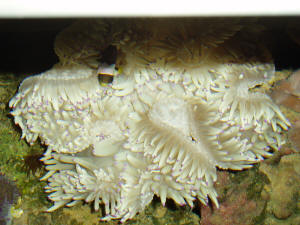
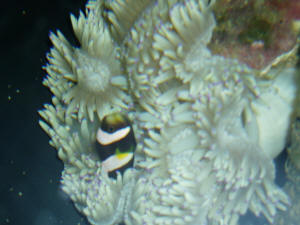
Anemone Question (possible H. Crispa) part2 8/29/05
Sorry, I didn't get the photos on that one....oops. <No
worries. Does look like H. Crispa. It is
definitely bleached, but looks to be in otherwise good
health. Feed small a couple of small pieces (the size
of a marble or so) of food twice a week until it
recovers. Best Regards. AdamC.>
|
| Anemone(?) identification/detachment from glass? i?
Hello there, <Bonjour> First i must say excellent site, i
just started my marine tank and having various trouble and come
across it Googling on various subjects, and your site have been
extremely helpful! <Ah, good> I had an anemone
in my tank (at least i think it is) but i wasn't
sure what type it is, can you help me identify it? <Maybe here:
http://www.wetwebmedia.com/anemoniafaqs.htm>
Originally it was tiny (<1cm), now it is a huge thing (>5cm)
and one morning i saw one of the mandarin i newly put it had gone
head first into it :( I also got a seahorse and another mandarin in
the tank with it, coexisting for the past year or so, are they safe
or should i move them? <Mmm, I would separate these fishes from
the anemone> It is on the glass panel right now, how should i
try to move it (without killing it i guess)? <Slide it off with
the edge of a plastic "credit card"> I read that one
of the replies was that you hold ice against the glass where it is
sitting right now but i can't find more words on it :( thanks
in advanced. Regards, Alan <The personal pronoun "i"
is capitalized... Bob Fenner> |
|

|
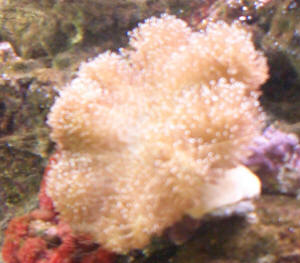
Anemones...One Good...One Not So Good -
06/14/05 Can you identify and advise of care
please. I have been searching for a couple of
days. I was told it was a carpet
coral???? When it is closed it looks like a green
mushroom on a stem. When it opens it has little stems
that are pink with a white tip. Under the light it looks
like it reflects the lights. I would appreciate any
advice. <<Looks like a specie of carpet anemone,
yes. Please start reading here ( http://www.wetwebmedia.com/anemoneidfaqs.htm)
and at the associated links in blue. Much more
info/advice than can be listed here to be found.>> The second
anemone appeared from some rock after about 6 weeks of us having
the rock. It looks clear like glass. It appears for a few hours and
then disappears. I wondered whether it is Aiptasia???? <<Does
appear to be an Aiptasia/glass anemone...several species about, can
vary by conditions as well. Looks like more reading for
you my friend <G>(http://www.wetwebmedia.com/marine/inverts/cnidaria/anthozoa/aiptasia/aiptasia.htm).>>
Again advice much appreciated.
Louise
<<Regards, Eric R.>> |
 |
 |
Anemone ID (Begging, Please no HTML, Folks!) I picked up an
Anemone this weekend. I know they are somewhat difficult but everything
has been going great with my reef tank, so let's kick it up a
notch. The salesperson told me what it was but I forgot. Dumbxxx. It
has an orange stalk/stem/foot. The top bulb? has a pin stripe pattern
and the tentacles are brownish and have stripes running across them. It
is as thick as a tennis ball. It is currently moving around my tank for
a place to rest. Hopefully. <Mark, I'd call the
salesperson up and ask what it is. We can't give an accurate
description without seeing it. If I had to *guess*, I'd say it was
a rock anemone. James (Salty Dog)>
Identifying anemone/feeding, using test kits... Hi Crew,
<Debbie> Any information you can lend will be appreciated. I have
read over and over all the FAQ's I could find and looked at all the
pictures I could find but still can't really tell what my anemone
is. I think I finally found the answer but then it also sounds like
another one too. At the LFS, they called it a Carnation Anemone, when I
asked what family that was from they said, Stichodactyla gigantea,
it's like the Ritteri. So here it goes. It has short yellow
tentacles, under the tentacles is a deep orange color, then this color
is down the column until the end where its yellow. If it balloons up
its more of a yellow column but when it goes back down its orange. I
thought it might be a dyed anemone but read where all the anemone would
be the same color. <Mmm, no... can be multi-colored... and from your
description it sounds like this one is dyed> Is that right? I
don't know if I should put it on the sand which they had it on in
the LFS, and they also said that they have had it for 3 weeks and it
was still beautiful, healthy too, but back to my question. I put it on
the sand, and it laid on its side, so I moved a small piece of rock
under it and it ballooned up till it fell off, so I've left it in
the sand and it hasn't moved an inch in 2 weeks. Does get some
slime under it but is that from it trying to attach itself to the sand?
<...> Also I was wondering if I could blend all the krill,
Pacifica plankton, squid, Cyclop-Eeze together and squirt it near the
anemone. <.....> This anemone also never closes during the day or
through the night and is still open when I turn on the lights, and then
it closes for 1-2 hours and stays open again. Is this normal, or should
I be worried? <........> Another question I have is my tank has
been running for 1 1/2 years now and I'm probably the most brain
dead person but I cannot read the Red Sea calcium test I bought or the
Seachem PH/ALK. When ever I read the results I just can't believe
it because the calcium test I get from my water goes below their chart
and my heart starts pumping, also the Seachem Alka test says 1 drop
equals 0.5 meg/L and I have to use 5 drops before it gets to the right
color and then it says to divide it by 2. Well my number is 1.25. Does
that mean its 12 and its suppose to be 7-8. Are my fish going to die?
Could you please help me. My PH reads 8.1 with the Seachem test kit but
reads 8.3 with the Red sea one. All the other tests are good or I would
be worrying about them too, but those are easy to read. I'm doing
everything to prepare the water properly, water changes weekly. I also
add Aragamilk along with the water changes. I even went home and got a
water sample so they could check my water first before I bought it.
Really care about these animals and a lot of stress to, to make sure
their happy. Thank you for all your time. Debbie <... please return
this anemone, don't buy anymore livestock that you can't
identify... and read on WWM re test kit use, alkalinity... Bob
Fenner>
Guess the Anemone sans Photo! Hello, <Hello,
Debbie> I read your website a lot and you have helped me a great
deal. I bought this anemone and it has a orange column, dark yellow
base under the tentacles, and then the tentacles are pale yellow.
Please can you help me identify it so I can read up on it. They called
it a carnation anemone in the pet store, but when I look at pictures I
can't really see what color their columns are so I don't really
know if it's a dyed anemone or not. I've read that if the
column isn't the same colour as the tentacles then it wasn't
dyed. Any help would be appreciated. <Debbie, a photo would
help very much. By the sound of it, I'm guessing you probably have
a BTA. Send photo if you can. James (Salty Dog)>
Anemone.... Hi Jim, I'm sorry for bothering you again.
Can you tell me the name of this anemone? Can you also tell me if it
could be eating my fish? I still can't find my Sixline wrasse, now
my Firefish goby is missing. I looked on the floor and found nothing. I
have a lot of live rock, is it possible that they are hiding? Probably
not. My Firefish was fine last night swimming around and eating now
it's gone. This anemone has gotten so big within the last 5 months.
What is it and should I remove it? Thanks, Kris >>>Hey Kris,
I'm actually not positive which anemone that is. Please compose
another email regarding this anemone, but don't put my name in the
header. That way another crew member will look into it for you who
might know exactly which critter that is. Glad to be of help
Jim<<<
Aiptasia Hello, I have a type of anemone growing
in my tank I have no idea to what it is it is all over my tank it
spread rapidly it they are about one fourth of an inch a very thin stem
and a very fine looking tentacles. Any ideas on what it can be. Thanks.
<Sure sounds like the pest Aiptasia. Do a Google search
on the Wet Web, keyword "Aiptasia". There are
links there for controlling the critters. Please capitalize
your "i's" in future queries as it saves us time from
editing. Thanks. James (Salty Dog)>
| Anemone Identification: A (Good) Picture is
Worth 1000 Words Hello, <Hey, Mike G with you tonight on my
question-answering spree> I've spent the last few days
looking over your FAQ's and other internet resources in an
attempt to identify the anemone in the picture I've attached. I
haven't seen any images that match, and text descriptions are,
well, insufficient for identification. I found it in my main 150g
reef tank, surrounded by Aiptasia. I moved it into my new 20g Nano
reef, and it moved into the position you see in the picture, under
a cabbage coral. <Well, that picture only shows me the
tentacles, and I really cannot make a very good identification
attempt with the picture provided. could you possibly get another
one, perhaps showing the column and oral disc?> I don't
think it's Aiptasia, mostly because it looks nothing like the
Aiptasia in my main tank. <Agreed.> It has a very short base,
and is very mobile. I've had a friend say it looks a bit like a
baby Condylactis of some kind, but I'd really like to be
sure. <Come to think of it, the tentacles *do* remind me
of a Condy, but, again, I need a better picture.> If it is a
form of Aiptasia, I want to remove it right away, but if it's a
"good" anemone I'd like to do good for it. It was the
size of a U.S. nickel when I found it, and has since (about a week)
expanded out to about 2.5 inches across. The base is still very
short and opaque. <It looks fairly benign to me.>) |
|

|
|

|
| Anemone Identification & Anemone Lighting
Requirements Hello. <Hey, Mike G with you tonight> I warn
you this is a bit long, but I wanted to be as detailed as possible.
<More detailed question = More detailed answer :-) Such lengthy
emails are encouraged, not scorned, by this crew.> I picked up
some live rock about a week ago and found two anemone-like
creatures attached to one piece. So far they do not seem to be
reproducing frantically or causing havoc, in fact, they don't
really move much at all. The anemone in the first 3 pictures is a
little shorter than a cm (about 1/2 inch) with a disc that's
about 5 mm wide (1/5 inch). I have another that looks nearly
identical which has been in my tank more than 6 months and has
never reproduced or moved, but I never worried about it because it
never tried to cause trouble. I've bumped them with my hands
and I never get stung (although the same goes for my Condylactis)
or stick to it. <While viewing the provided photographs,
"Aiptasia" bounces around in my head.> The second
anemone worries me more because it is bigger and seems to be more
like your average anemone (it sticks to others, although I
haven't tested its sting). It only has 10 or so tentacles and
they look like chains of cubes or beads. It is much more mobile
than the first anemone although after its first little trek it went
right back to where it was initially and hasn't moved since (6
days). So should I worry about these guys? I'm keeping a close
eye on them at least... <It still reminds me of an Aiptasia.
There are many forms and varieties of this scourge of the reef
aquarium.> One more question about the health of my
Indo-Pacific Condylactis
anemones. <<Condylactis anemones are native to
Atlantic/Caribbean waters only. >> I've
got two in my 55 gallon and both stay pretty close to the lighting
which I try to keep fairly undiluted. I clean regularly and replace
the bulb every few months. <Good habits to develop.> It is
standard 32W bulb that came with my tank. <By "standard
bulb," I assume you are referring to a Normal Output (NO)
Fluorescent Tube. In that case, you do not have nearly enough
radiation to support your sea anemones. If I were you, I would
seriously considering investing in a better lighting setup. Since
you are keeping anemones, you would need a fairly high output
fixture if you intend to keep them happy. I would suggest taking a
look at Power Compact (PC), Very High Output (VHO), T-5, or Metal
Halide (MH) lighting.> The last 6 months I had no problems with
them and they looked great (big and puffy and brightly colored). In
the last month or so they have begun every night to shrink back
into the bases and the next morning they will come right back out
and look wonderful again. <It is common for sea anemones to
shrivel frequently to perform a water change in their bodies. Some
anemones will also retract during the dark hours.> One tries
moving every two weeks but gives up and returns to where it was
quickly. The other one seems to be growing new tentacles in its
disc but 2 or 3 of them are malformed (tentacle growing out of a
tentacle or really small tentacles on the disc). The original
tentacles on it also look strange like they have been bent or
broken; they aren't as smooth as when I originally purchased
the anemone, and they are thinner like fat spaghetti. I feed them
brine and krill regularly and chemicals in my tank are right on
target. There is a pretty strong current on one (its taken to the
powerhead) and the other is in slow current water. Is there
anything I can give them besides a boost in lighting that will help
their condition? <I think that a boost in lighting is all they
need to do better. :-) > Thanks for any help you guys can give!
<Glad I could assist. Mike G> |
|

|
|
|
| Anemone Identification: Part II (Stumped)
Mike, Sorry about the previous picture, I hope the attached image
gives you a better idea of what I have. <It is exactly
what I was looking for. It completely smashed my previous thoughts
that this was a Condylactis anemone.> I haven't been able to
get a good image of the column yet, but I can describe it. It's
about the same length as the width of the disc, maybe a bit longer.
Same coloration as the disc and it may be semi-transparent (I
can't get a very good look at it, the base of the cabbage coral
is hiding it). <Well, I do have to say that you have an
anemone I have never seen before. It does remind me of a temperate
species of anemone...Urticina (seen here, NOT my picture, just a
Google search: http://cordellbank.noaa.gov/images/environment/urticina_450.jpg
), I think, because of the tentacle arrangement and mouth, but
Urticina anemones also look a bit too different from this one for a
positive ID. The body shape is saying Aiptasia, but nothing else
looks even remotely close. I *do* have a hunch it is a coldwater
species, though. Keep taking pictures, now I have to know what this
guy is! :-) In the mean time, would you mind answering a few
questions? Describe the Stickiness of the Anemone. How does it look
when it eats? When it closes up (if it closes up) what does it look
like? How does it react to being prodded? (fast retraction, trying
to eat you...fast retraction is a characteristic of Aiptasia) Does
it seem to be photosynthetic? That is, does it seem to actively
seek out light, and open/close in response to lighting changes?
> Thanks very much for your time! <Thank you for the
opportunity to see an anemone that I have never seen to this day! I
do hope that I have been of some assistance. Mike G> |
Anemone Identification: Part III (Getting Clearer) I have
never seen it eat, but I haven't actually watched it that closely.
It doesn't seem to react to sudden shadow, and it reacts very
quickly to being prodded, retracting in on itself like an Aiptasia.
<Reinforces the idea of Aiptasia a lot...> I'll try for some
more pictures this evening when I get home from work, and attempt to
target feed it. <I just dug up this photo of an Aiptasia Anemone
from WWM's archives, and it looks to be similar. What do you think?
http://www.wetwebmedia.com/marine/inverts/cnidaria/anthozoa/aiptasia/aiptasia.htm
First pic, upper right hand corner. Do get a few more pics, this
certainly is intriguing. Mike G>
|
|




