|
FAQs on Anemone Identification
21
Related Articles: Anemones,
Bubble
Tip Anemones, LTAs, Cnidarians, Coldwater Anemones, Colored/Dyed Anemones,
Related FAQs: Anemone ID 1, Anemone ID 2, Anemone ID 3, Anemone ID 4, Anemone ID 5, Anemone ID 6, Anemone ID 7,
Anemone ID 8,
Anemone ID 9, Anemone ID 10, Anemone ID 11,
Anemone ID 12,
Anemone ID 13, Anemone ID 14, Anemone ID 15, Anemone ID 16, Anemone ID 17, Anemone ID 18, Anemone ID 19, Anemone ID 20, Anemone ID 22, Anemone ID 23, Anemone ID 24, Anemone ID 25, Anemone ID 26, Anemone ID 27, Anemone ID 28, Anemone ID 29, Anemone
ID 30, Anemone ID 31, Anemone ID 32, Anemone ID 33, Anemone ID 34, Anemone ID 35, Anemone ID 36, Anemone ID 37, Anemone ID 38, Anemone ID 39, Anemone ID 40, Anemone ID 41,
Anemone ID 42,
Anemone ID 43,
Anemone ID 44, Anemone ID 45,
& Cnidarian Identification, Anemones 1,
Anemones 2, Anemones 3, Anemones
4, Anemones 5, Invertebrate Identification, Aiptasia
Identification, Aiptasia ID
2, LTA
Identification, Bubble Tip
Anemones, Caribbean
Anemones, Condylactis, Aiptasia
Anemones, Other Pest
Anemones, Anemones and
Clownfishes, Anemone
Reproduction, Anemone
Lighting, Anemone Feeding,
Anemone Systems,
Anemone
Compatibility, Anemone
Selection, Anemone
Health, Anemone Behavior,
Anemone
Placement,
|
|
 |
New Print and
eBook on Amazon:
Anemone Success
Doing what it takes to keep Anemones healthy long-term
by Robert (Bob) Fenner
|
LPS or Aptasia?? 5/12/08 http://www.drekster.com/myrescues/whatamI.htm
Yesterday I found some Aptasia which made me start digging for anymore
and I found this pinkish stuff in the refugium. There were no live
corals in the refugium, just skeletons, so this is a complete
surprise. I went ahead and put this in the tank, where I can
watch it closely, flushed the aptasia. As I was studying this stuff it
is different, both mouth and base are different than the aptasia. I
seriously hesitate to flush it without knowing what exactly it is.
Kinda looks like some type of LPS to me?? <It looks like some type
of bleached-out hitchhiker anemone (maybe not aptasia, but likely not
anything you want in your tank-- just my opinion). If it doesn't
retract into a skeleton when you poke it, then it's not a stony
coral.> Thank you for any help, hate to leave it in the tank for
long if it's trouble, hate to flush it too. Bridget <Best, Sara
M.>
Re: LPS or Aptasia?? 5/13/08 This stuff
did move which rules out LPS. Later in the day I fed it a piece of
brine shrimp. After it was fed it kinda curled it's tentacles, hard
to describe, it also is starting to develop kinks in the tentacles and
possibly white tips starting to show. I do have a long tentacle anemone
in the tank and I was reading somewhere that they reproduce 2 ways
depending on location gathered. One is spawning, which creates smaller
babies, the other is splitting which leaves behind 2 larger babies.
<Interesting, thanks for sharing. I think more observation will help
with IDing. But do keep it in quarantine just in case it is
Aiptasia.> Bridget <Best, Sara M.>
Unknown Critter in my tank
-05/11/08 I have sent this picture to many people in the
aquarium stores and biology classes and nobody seems to know what
the name of it is. I captured it in the Florida Keys over 7 years
ago and it has outlived everything in the tank, even when I had a
disastrous crash from somebody dripping dish soap in the tank
killing everything, including the bio filter, thing monster lived
through it'¦.lol. I can feed it up to 5 full sized silver
sides and it still would want more. When it is extended, it is
approx 2 inches in diameter and 4-6 inches long. It doesn't
like to be in direct light and prefers to hang upside down from a
cave I made from the live rock. It is currently in a 120 gallon
FOWLR system. When something in the tank disappears I usually look
at it because he has eaten every type of fish that gets too close.
His last meals were two medium Blue Tangs. I would really
appreciate knowing what to call it'¦.it is really
gathering interest around the local shops. Picture is below.
Thanks, Chip <Well, I do believe it's an anemone of some
sort... that's somewhere to start. Please see our pages on
anemone IDs: http://www.wetwebmedia.com/anemoneidfaqs.htm Best,
Sara M.> |
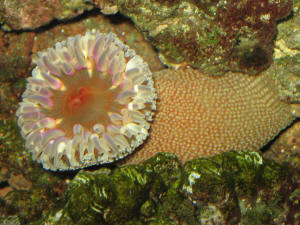 <<Probably a flower or rock anemone -Sara
M.>> <<Probably a flower or rock anemone -Sara
M.>> |
| Malu or crispa? 4/13/08 Evening folks!
<And a good day to you! Mike I here with you> Great site!
(You know this already J) <We do, but we always like to hear
your feedback too!> I'm a long time reader. Thanks to your
site, various books written by WWM authors, and other media outlets
my friends consider me to be the most reputable person to ask about
a saltwater situation. I try to educate as much as I can because
the animals in our systems deserve the best care we can offer.
<Kudos to you for that as well!> Thanks for everything you
all do for us; the enthusiasts <Our pleasure, Steve> On to
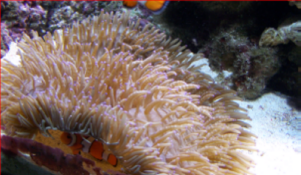
the anemone.. <Yes, indeed> This is my Heteractis malu (99.9%
sure - at least that's what I've called it for the last
several years) that I've had in the 120G reef for 3 years now.
I wanted to share and get a positive/definitive identification from
the experts. Based on the tentacle length and rings on the
tentacles I'd say this is a Heteractis Malu but a few others
have seen it think it's a crispa. What do you think? <I
agree with you> A little about him: I acquired the specimen from
a LFS in the city in early 2005. The clowns that use him as a host
I've had even longer. Back then, his max expansion was maybe 3
inches. He lived with me for a while then I moved residences and
had to break down the 120 and move it across town. Luckily all was
well after the reconstruction of the system. During the day he can
expand to 15 inches in size. I feed him every few days with mysis,
Cyclopeeze and I stir the sand in the tank every few days until
there's a fine cloud of stuff in the water. Many corals in the
tank have seemed to benefit from this stirring of sand. Thanks for
your time and dedication to our hobby and passion. Steve Wright
<As I said above, Steve, I agree with you that is Heteractis
Malu. Tentacle structure, variety of length, markings etc, all lend
to this species. Looks like you're doing a great job keeping
him happy, and long may it last. Good job! Mike I> |
|
|
|
|

