|
FAQs on Anemone Identification
12
Related Articles: Anemones,
Bubble
Tip Anemones, LTAs, Cnidarians, Coldwater Anemones, Colored/Dyed Anemones,
Related FAQs: Anemone ID 1, Anemone ID 2, Anemone ID 3, Anemone ID 4, Anemone ID 5, Anemone ID 6, Anemone ID 7,
Anemone ID 8,
Anemone ID 9, Anemone ID 10, Anemone ID 11,
Anemone ID
13, Anemone
ID 14, Anemone ID 15, Anemone ID 16 Anemone ID 17, Anemone ID 18, Anemone ID 19, Anemone ID 20, Anemone ID 21, Anemone ID 22, Anemone ID 23, Anemone ID 24, Anemone ID 25, Anemone ID 26, Anemone ID 27, Anemone ID 28, Anemone ID 29, Anemone
ID 30, Anemone ID 31, Anemone ID 32, Anemone ID 33, Anemone ID 34, Anemone ID 35, Anemone ID 36, Anemone ID 37, Anemone ID 38, Anemone ID 39, Anemone ID 40, Anemone ID 41,
Anemone ID 42,
Anemone ID 43,
Anemone ID 44, Anemone ID 45,
& Cnidarian Identification, Anemones 1,
Anemones 2, Anemones 3, Anemones
4, Anemones 5, Invertebrate Identification, Aiptasia
Identification, Aiptasia ID
2, LTA
Identification, Bubble Tip
Anemones, Caribbean
Anemones, Condylactis, Aiptasia
Anemones, Other Pest
Anemones, Anemones and
Clownfishes, Anemone
Reproduction, Anemone
Lighting, Anemone Feeding,
Anemone Systems,
Anemone
Compatibility, Anemone
Selection, Anemone
Health, Anemone Behavior,
Anemone
Placement,
|
|
 |
New Print and
eBook on Amazon:
Anemone Success
Doing what it takes to keep Anemones healthy long-term
by Robert (Bob) Fenner
|
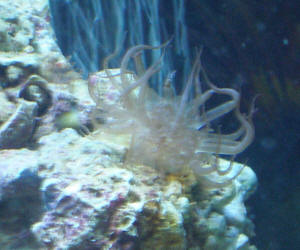
ID... Aiptasia 7/20/07 Hello
guys. <One of the girls here tonight.> I just got some more
live rock for my aquarium today and I saw this hair like creature
of a sort on it. As I watched it longer and longer it looks like an
anemone and it has moved a little bit like one too. Is that what it
is? <You are correct, it is an anemone, but not a good one! Is
Aiptasia. You will want to eliminate from you system as they can
grow to plague proportions. More here and related links in blue:
http://www.wetwebmedia.com/marine/inverts/cnidaria/anthozoa/Aiptasia/aiptasia.htm
http://www.wetwebmedia.com/ca/cav1i3/aiptasia_impressions/aiptaisia_impressions.htm
thank you very much, hope the pictures are good enough. <Welcome
and yes they are.
Cheers,
Mich> |
|
|
Re: Adding more discus/ anemone... Now ID about
the latter 1/20/07 Hi, <Hello> I can resend
them with my writing or if you would like I can send them
again now. Let me know the specific Kbyte limit....
(how are these?) <Fine. Have already downloaded and
placed the previous> This thing is like 12 to 16" across,
and the Heteractis malu's tentacles seem shorter from the
pics I have seen, and it never struck me as such.
<Mmm, as such in terms of size? Agreed... and the verrucae, as
stated, seem to be that of a Magnificent> Not to say you are
wrong, of cause, just an observation. I saw a long
tentacle at a LFS, and it's underbelly looked nothing like
this ones. It had more "stripes" with the
nubs underneath. Plus the Heteractis malu pic I looked
at online, the coloration of the very tip of the tentacle
seems to only be a spot, <Mmm, not so... the "spot"
species is almost always H. sebae> where this ones
is much "longer" where it is lighter at the tip
and slowly fads into the darker part of the tentacle from the
tip. What other pics can I take to help us
identify it. (oral disc) I thought the
"malu" were really hard to care for as well, unless I
am thinking of another one. <About as difficult as H.
magnifica... neither are easy> Another interesting thing this
anemone did in the beginning BEFORE it started to regenerate,
it that the tips of the tentacles would have 2
"heads" as if a Siamese twin! Check out this
web pic of a HM: http://animaldiversity.ummz.umich.edu/site/resources/jeffrey_jeffordsmisc.inverts/Clownanemoneshrimp.jpg/view.html
<Interesting> see the tip of the tentacle under the clowns
mouth? and see the "branching" it does.
That is mine to a tee!!! But like you said, it may not
be a HM: <Am susceptible to this ID as to any. Bob
Fenner>
|
|
.jpg)
|
| Re: Discus/ Heteractis magnifica.... we have a
winner! 1/20/07 Hello Mr. Fenner, <Carrie, just
Bob please> Well, I think we have a winner.... I think! If
nothing else, yes, I am tenacious! <A good
characteristic> Notice the last sentence in red on this web page
I found about anemones...... seems to agree with other things
I read: "Heteractis magnifica (Family
Stichodactylidae) Magnificent Anemone Distribution: The Magnificent
Anemone occurs in tropical and subtropical waters. It has a
broad Indo-Pacific distribution from East Africa to
French Polynesia, and Australia to the Ryukyu Islands, Japan.
(WA, NT, QLD) Features: This is one of the most conspicuous and
frequently photographed species of anemone. It is a symbiotic
host to 12 species of anemone fish of the genus Amphiprion.
Adults are large, commonly growing to 500 mm in diameter, but
specimens up to 1 m have been recorded. The oral disc is flat to
gently undulating, usually green or brown in colour and
densely covered with finger-like tentacles.
Immediately (20--30 mm) around the mouth the oral disk may be
yellow, brown or green, free of tentacles and slightly convex.
Tentacles reach up to 75 mm in length and are unique to this
genus in that the tips are blunt or slightly swollen at the
tip. They are usually the same colour as the oral disk and
interestingly may bifurcate or branch in two."
******Here is the URL: http://www.deh.gov.au/cgi-bin/species-bank/sbank-treatment.pl?id=81286
Here are a few pics I just took: <Thank you. Bob Fenner> |
Nuisance anemone 1/17/06 Dear
WWM crew, <Hi Julia, Mich with you today.> First of all, thank
you all for any previous advice you have given me over the last couple
of years. Thank you for the fabulous web
site. You guys (and gals) are awesome! <Thank you for
your most kind words!> I have a quick ID question for
you. I know you guys need to see pictures to know for sure,
but a picture is not feasible right now. <Would be most
helpful.> I just bought some "used" liverock and it has
these tiny anemones on it. They do not look like Aiptasia to
me. They look more like Majano, except they are perfectly
clear, no tint of color whatsoever. Just the very tips of
the tentacles are whitish (and slightly swollen, from what I can
tell). Can they be bleached Majano, or is this another
species? The outer tentacles are also a little longer than
what I am used to in Majano (almost like they are half way between
Aiptasia and Majano anemone, or they look almost like a clear dwarf sun
coral polyp, just shape-wise that is). Does this ring a
bell? <Really impossible to tell with out a
photo. Many possibilities here, including many desirable
creatures, could even be something like a orange ball Corallimorph
(Pseudocorynactis caribbeorum)...do a google image search on this.>
And should I do anything about these? Until now I have had
NO pest anemones (my liverock was reseeded from scratch, so to speak),
but if these guys are "bad" I would rather not give them the
chance to spread. <Understandable, but if they are
desirable I don't want to tell you to eradicate them... thus the
reason we ask for images.> My tank is not terribly nutrient rich,
but as it is a softie tank I do not want to get it too clean :) <I
hear you.> Thank you all again for your help and have a wonderful
week :) <Welcome and wishing you the same. -Mich>
Sincerely, Julia.
Re: Nuisance Anemone...No, Desirable Hitchhiker...
Pseudocorynactis caribbeorum 1/19/07 Mich, You are
amazing :) <Heehe! And you are funny!> I did an image
search on google, just like you told me, and Pseudocorynactis
caribbeorum indeed does look like my guy :). <Lucky
you! It is not sold in the hobby that I'm aware
of.> Except that mine has white balls, not
orange. <Yep.> I guess I will have to do a bit of
research on these creatures since I have never ever encountered them.
<Hitchhiking nocturnal filter feeders.> I just found a picture of
it on your web site (I am attaching it, I hope you don't mind),
that is almost exactly like mine. <Very good.> Thank you so much
and have a great day! <Welcome and the same to
you! -Mich> Julia General Questions?? 12/22/06 I
have a tank that is 5 months old . My domino damsel is approx. 3
inches and appears to be losing his color, there is a
invasion of red algae. and there are Condylactis anemones popping up
all over the place there are 8 of them so far. <Mmm, don't know
if your telling me something or asking for info. Anyway,
Domino Damsels do fade with age/growth and can get rather large. The
red algae is more than likely Cyanobacteria. Do read
here. http://www.wetwebmedia.com/algaeconMar.htm. As for
the Condylactis Anemones, I'm quite sure you are seeing the dreaded
Aiptasia Anemones which multiply like mice. There are
methods for controlling this species. Do search our site for
this info. James (Salty Dog)>
| Anemone ID Question
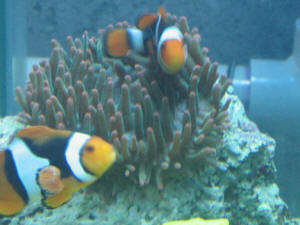
12/14/06 Please excuse the sickly but wonderful
Clownfish in the picture. They were recently treated for
brooks and then fin rot. The anemone in the picture was
sold to me as e.quad or a bubble tip. <Is almost assuredly an
Entacmaea quadricolor> I have had a couple different types of
bubble tips in the past and I see some variation from previous
experience on this one. 1. I haven't actually seen any bulbs on
any of the tips <Some, sometimes you don't, won't...
only "express" themselves under certain conditions> 2.
the area around it's center is vacant of tentacles more than my
previous bubble tips <I see this... not necessarily indicative
of trouble> 3 . also the tentacles seem to stick up straight
instead of out to the sides 4. I have also never seen this color
combination of pink tips with a teal base <I have> Can you
help to identify the anemone I have? Here are some pictures of
previous BTA's I have had... <a href="
http://photobucket.com/"
target="_blank"><img src=" http://i4.photobucket.com/albums/y138/dsmith14/10cc69e7.jpg"
border="0" alt="Photobucket - Video and Image
Hosting"></a> <Please read here: http://www.wetwebmedia.com/marine/inverts/cnidaria/anthozoa/bubbletipanemones.htm
and the linked files at top. Bob Fenner> |
|
|
Anemone ID 12/10/06 Hey crew,
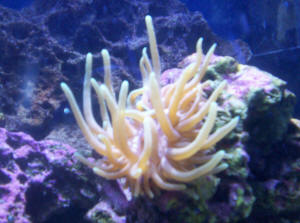
<Hey now, Mich with you tonight.> Wanna take a gander and
throw your hat in the ring as to what I have here? I am leaning
toward a BTA or LTA, but I am not sure. This guy just came out of
some live rock I got in. <My vote is LTA. Where did
the rock originate?> Thanks,
<Your welcome. -Mich>
Cj |
|
|
| Polyp ID 11/7/06 Hi all. Great
website, I have used your site several times as
reference. Can you help me identify this
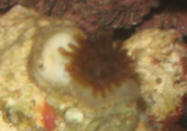
hitchhiker? <Mmm, yep... looks to be an Anemonia
majano> I thought it was a polyp of some type but I now believe
it to be a really small anemone. <Ding ding ding! We have a
winnah!> I have a 55-gallon saltwater aquarium with fish and
approximately 65 LB. Live rock and two small clumps of
corals. SG 1.024, Temp 79, pH 8.2 just after lights
turn on in the morning, No2 = 0, NO3 = 0, CA2= 440. I have a
48" current light with 2 actinic and 2 daylight bulbs (sorry,
not too electrical can't tell you the wattage) and 3 moonlight
bulbs that are all on a timer. I have three green chromis one
tomato clown one lawnmower blenny, various snails, about 7 hermit
crabs one green emerald crab a skunk cleaner shrimp a brittle
starfish that was a hitchhiker in one of my rocks one clump of
green star polyps and one clump of pink
zoanthid. I found this thing growing on my live
rock and thought it to be some type of a button
polyp. It is moving on the rock now. It
started out at the very bottom inside part of a piece of live
rock. It is now on the top of one piece of live
rock. It is about ½ inch across and never
seems to close completely. Is this an anemone?
<Yes> If so I have read everything about anemones on your
site. This one is so small I don't know how to feed
it and if I should even keep it. Let me know what you
think, thanks, Lis. <Do use the search tool...
read a bit about... some folks consider a pest due to prolific
asexual reproduction, possibility of crowding out other livestock.
Bob Fenner> |
|
|
| Anemone Identification - 11/05/06 Dear
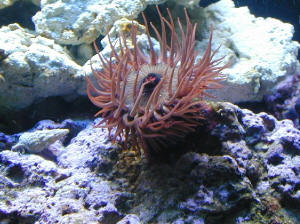
WWM Crew: I'm hoping you can help identify this anemone which I
recently inherited. I've searched all over the WWM site and
elsewhere and not found an answer. I was told that this guy has
been on the same piece of live rock for at least 2-3 years. His
tentacles are not quite as red as they appear in the photo, and
they're just slightly darker than Aiptasia tentacles. The oral
disk is just about 1" diameter, and the stem is dark red,
about the color of dried blood, w/ small red speckles. His foot has
a bright red band at the edge, about 1/8"
wide. Although I don't consider him particularly
beautiful, he is fun to watch, feeds well (esp. zooplankton), and
does not seem inclined to split, reproduce, or cause any problems.
Your help is much appreciated. Thanks, JP <Is Anemonia majano:
http://www.wetwebmedia.com/anemoniafaqs.htm And the linked
file/s above. Bob Fenner> |
|
|
Anemone Identification - 10/19/2006 Good
afternoon! <Hey Al, MacL here with you today. Sorry for the delay.
Lots of emails coming in lately.> I thoroughly enjoy the site,
I've gotten quite a bit of excellent information, not the least of
which is to be patient. <So true!> Now on to the reason I'm
emailing you. I'm getting conflicting information - can
you help me ID this anemone? Some say it's a BTA (E. Quadricolor),
some say it's a Condylactis, I see on your site that they're
both in the same order, and *I* think it looks like a Condylactis (note
the purple-ish spot on the ends of the
tentacles). Here's a pic: http://i9.photobucket.com/albums/a72/getndirty/IMG_0414.jpg
<Its difficult to tell from the picture. One thing though, you said
it was found on a rock and that will sometimes give you a clue until it
grows large enough to determine. Where is the rock from? Atlantic Gulf?
or Pacific? If its Atlantic gulf it more than likely a
Condylactis.> Either way, it was found in my girlfriend's 105g
tank while doing some aquascaping to make room for some new
inhabitants. No telling how long it had been there under a
rock, out of the light. It's now in my QT and I'm
going to attempt to help it along - any tips here would be greatly
appreciated. <The greatest stuff is the hitchhikers isn't
it? I'd watch it for a while and you should be able to
tell as it gets a little bit larger.> Many thanks for the
help! <It is very pale, probably from the light it had.
I think its going to be fun to watch.> <<Unfortunately, the
image has been accidentally deleted from our mail system.
-SCF>>
|
|
| Anemone ID...Queriers Shift Key Not Working -
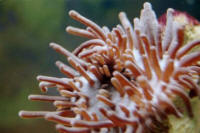
08/26/2006 Hi I was sold this anemone as a Bubble Tip Anemone
from the Red Sea. I have look everywhere on your site and can not
find any anemone resembling the one I have. Can you tell me if you
think this is truly a BTA and if not, what it really is. Also what
spectrum of light is best for this anemone. Thanks for your time.
<Probably doesn't look like a BTA because it appears to be a
BTA in poor health. You offer very little information to
go on (am looking for my crystal ball as I write this); no tank
parameters, present lighting set-up, etc. A Kelvin
temperature between 5500 and 10,000 will work well for anemones
provided sufficient wattage is used for the size/depth of tank
used. Read here and linked files above. http://www.wetwebmedia.com/marine/inverts/cnidaria/anthozoa/bubbletipanemones.htm In
future queries, please capitalize where necessary so we do not have
to do it. Thank you. James (Salty
Dog)> |
| Tubeworm ID help, Aiptasia ID
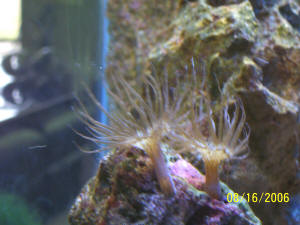
8/21/06 Hello Crew, I humbly ask your assistance in
identifying some tubeworm-like hitchhikers that I have inherited on
some live rock. Pictures attached. <Yep, nice and clear> They
have grown from 3/4 of an inch to almost three inches long in six
months. I thought they were some type of tubeworm and
harmless, but another hobbyist saw them and insisted they were
poisonous, to be avoided at all costs and suggested that I get rid
of them immediately. I like them as they seem to be thriving and
are decorative. My tank has a Yellow Tang, Humahuma Trigger, and a
Coral Beauty Angel, and all have ignored the worms to date with no
ill effects. Thanks for the help and keep up the great work. Rob
<Please read here: http://www.wetwebmedia.com/marine/inverts/cnidaria/anthozoa/aiptasia/aiptasia.htm
"and the linked files above". BobF> |
|
|
|
|