|
FAQs on Anemone Identification
17
Related Articles: Anemones,
Bubble
Tip Anemones, LTAs, Cnidarians, Coldwater Anemones, Colored/Dyed Anemones,
Related FAQs: Anemone ID 1, Anemone ID 2, Anemone ID 3, Anemone ID 4, Anemone ID 5, Anemone ID 6, Anemone ID 7,
Anemone ID 8,
Anemone ID 9, Anemone ID 10, Anemone ID 11,
Anemone ID 12,
Anemone ID 13, Anemone ID 14, Anemone ID 15, Anemone ID 16, Anemone ID 18, Anemone ID 19, Anemone ID 20, Anemone ID 21, Anemone ID 22, Anemone ID 23, Anemone ID 24, Anemone ID 25, Anemone ID 26, Anemone ID 27, Anemone ID 28, Anemone ID 29, Anemone
ID 30, Anemone ID 31, Anemone ID 32, Anemone ID 33, Anemone ID 34, Anemone ID 35, Anemone ID 36, Anemone ID 37, Anemone ID 38, Anemone ID 39, Anemone ID 40, Anemone ID 41,
Anemone ID 42,
Anemone ID 43,
Anemone ID 44, Anemone ID 45,
& Cnidarian Identification, Anemones 1,
Anemones 2, Anemones 3, Anemones
4, Anemones 5, Invertebrate Identification, Aiptasia
Identification, Aiptasia ID
2, LTA
Identification, Bubble Tip
Anemones, Caribbean
Anemones, Condylactis, Aiptasia
Anemones, Other Pest
Anemones, Anemones and
Clownfishes, Anemone
Reproduction, Anemone
Lighting, Anemone Feeding,
Anemone Systems,
Anemone
Compatibility, Anemone
Selection, Anemone
Health, Anemone Behavior,
Anemone
Placement,
|
|
 |
New Print and
eBook on Amazon:
Anemone Success
Doing what it takes to keep Anemones healthy long-term
by Robert (Bob) Fenner
|
|
Anemone ID and Arrow crab predation
query 01/13/2008 Thank you for this
wonderful service and for devoting your time and effort! Tank
parameters: *92 gal community reef (110lbsLR, 90lbs live sand, 4
small gobies, various softies, 2 green emerald crabs, 1 cleaner
shrimp, 1 peppermint shrimp), *29 gal wet-dry sump/refugium with
Caulerpa, mud, and 10lbs of LR (in line), *Lighting: 175MH, 4-
24W T5HO actinic, 12 LED night lights *Water chem: SG-1.024 , pH-
8.3 , nitrite- 0, ammonia- 0, nitrate- undetectable, calcium
410ppm, 78 degrees F I bought an anemone from my LFS yesterday
and I am afraid I've walked into an unfortunate situation. I
had been told by one of the workers that this anemone was a
bulb-tip of some sort. So I put it on hold to research it for a
few days. Upon return yesterday to purchase it, other workers
told me it was a yellow Sebae anemone. I still bought it but now
really wish I had gone back home to research instead. The column
is a orange-red color fading to a yellow around the top with
white/transparent tentacles. Sadly, from reading all the articles
on here at WWM, I realize it's probably dyed and dying.
Although, mine doesn't look like a Sebae to me...maybe
because it's so far gone already?? I'd just like to know
what it is so I can properly care for it / try to save it. <It
looks like a bleached Long Tentacle anemone to me (hopefully Bob
will correct me if I'm wrong).> <Mmmm, maybe... could
be a Magnificent/Ritteri though... RMF> On another note, I
have a question about predation from arrow crabs: I am hoping to
make a proper home for a mandarin goby in the next few months so
I ordered a culture of copepods. I added them to the fuge but
have seen nothing in over a week. I wrote the sender and they
said to give it 3 weeks.... I'm doing that. In the meantime,
I put my arrow crab (juvenile at this point) in the fuge to take
care of a bristleworm population I have (he does have a much
larger suitable tank to go to when he gets grows). <Hmmm, why
do you want to "take care" of your bristle worm
population? The vast majority of these worms are actually
beneficial scavengers/detritivores.> Will the arrow crab, even
if there are plenty of bristleworms to eat, harm the growing
copepod population? <I suppose it's possible, if the crab
is small and fast enough to catch them. But as the crab gets
bigger, it will likely seek out larger prey (as big as small fish
even). To be frank, they're not the best of live stock
choices. Please see here:
http://www.wetwebmedia.com/arrowcrabfaqs.htm> Thanks so
much!!!! Erin
<Best,
Sara M.>
|
|
A dying one. RMF
|
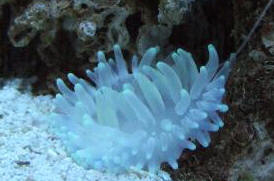
Anemone I.D -01/14/08 Hi, First off I want to
tell you how much your website has helped me out. It's a great
source of information. <cool, thanks> I was given a 7 gallon
nano cube. It has a deep sand bed <Hmm... DSBs are not so
functional in any tank <40g.> and about lbs. of live rock. We
found an anemone in the canister filter. Apparently the person who
owned the tank had lost the anemone a month before. When we got it
out it was completely blanched. I started to target feed it every
two days with chopped frozen seafood. It has been a little over two
months since we found it and now it is starting to regain some
color. It has some blue around the base tentacles and the ones in
the middle seem to be light green and yellow. I would really like
to know what kind of anemone it is. I appreciate any help you can
offer me. <It's almost impossible to even guess without
seeing more of the animal. Could you please try to take other
photos, showing the center of it and base more clearly?> Thank
you
Edith
<Best,
Sara M.> |
|
 Another dying one. RMF Another dying one. RMF
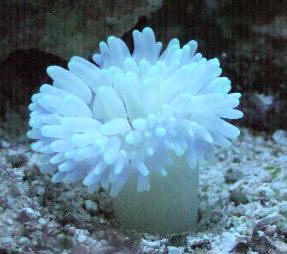
| Re: Anemone I.D 1/16/08 Hi again,
Thanks for your quick response to my email last night. I hope
these extra photos will help you identify my anemone. Thanks
again Edith <Help yourself...
http://www.wetwebmedia.com/marine/inverts/index.htm the tray
on Anemones... this one's dying. BobF> |
|
|
|
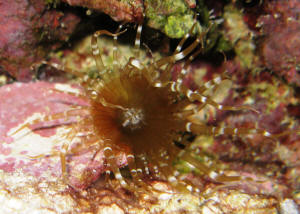
| Anemone ID 1/5/08 Dear Crew: <Brad>
Happy New Year! I hope you are all well in every regard. Wow, thank
you for the stunning SW Pic of the Day. Outstanding! <You're
welcome and thank you.> I have attached an amateur photograph of
a small (3/4" - 1" diameter) anemone. The tank she is in
is in the third year, so she must be shy having just shown up
(grin). After reading through several dozen pages of Anemone I.D.s
and your section on Tropical West Atlantic anemones, I am in need
of your thoughts and advice. Would you say that this is the Turtle
Grass Anemone (Viatrix globulifera), or worse - some type of
Aiptasia? And, if she is the former, is she friend or foe? <It
looks a little closer to Arachnanthus nocturnus, a type of Tube
Anemone, but the center is whitish in color where the specimen in
your photo is not. I believe you have an Aiptasia, and is not a
friend, will multiply rapidly. Read here and related articles
above.
http://www.wetwebmedia.com/marine/inverts/cnidaria/anthozoa/aiptasia/aiptasia.htm>
You all continue to amaze us, your loyal readers, with this world
class website. Thank you as always. <You're welcome.> I
wish you the best for 2008. <And to you my friend. James (Salty
Dog)> Brad in Basalt P.S. I need to send you a photograph of
another possible troublemaker if you would graciously allow me two
questions today to start off the New Year. I will do so under
separate cover to as to avoid overloading your Email system.
<OK> |
|
|
|
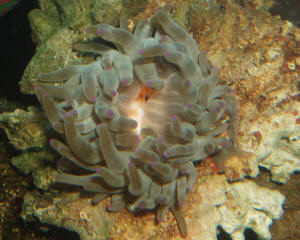
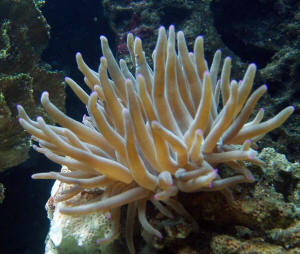
Anemone ID, E. Quadricolor, Bubble Tip Anemone, BTA --
1/02/08 Dear Folks, <Hello Renee, Brenda here> Thank
you, ahead of time for your advice and expertise. <You're
welcome!> I have looked around the entire site, and throughout
all the areas and I don't see my anemone anywhere. I got
these from a pet store I frequent. It has taken me 4 months to
buy them, because they will never let go of the rocks they are
on, and finally, I got a big man to break the rock so I could
afford to get them...and the rock broke, one fell loose and is
now in one of my rocks re-homing himself (unharmed of course,
thank goodness) and the other is on its rock enjoying its new
home. The salesperson, by the time I got them (so many months
later) said he doesn't recall what they are, but they were
false rose something, or anyway...I have no clue. I don't see
any red rose colors anywhere. Does anyone have a clue what kind
of anemone I have here? <They are E. Quadricolor. They are
commonly referred to as Bubble Tip Anemones or BTA.> The
second one is hiding in her rock, but will come out eventually.
The first one to settle I didn't remove from a rock. Instead,
I just bought the whole rock. <Good!> I didn't want to
risk a broken foot. <Torn. There are no bones in anemones to
break.> Had that happen once...ewwwww so sad and traumatic to
see it suffer and then die. <A torn foot is not usually deadly
in many species of anemones. There may have been more variables
involved in the anemones death.> Well, if anyone can identify
these, please let me know. One already ate, as you can see, he
had Krill for dinner. This is 2 days in a row and tonight he had
2 krill. The other is still hanging onto hers and hasn't let
go, and it's sitting just inside her hole. She intends to eat
it later probably, as she already ate last night. <This is way
too much food for anemones. They do not need to eat every day.
Every 2 -- 3 days is more than enough for a healthy anemone. I
don't recommend food bigger than the anemones mouth. Over
feeding will cause the anemone to expel the food later as it is
unable to digest. This will ultimately end up causing the anemone
to get nothing to eat.> Are they both the same type? Or
different and can you tell me what they are? <They are the
same, possible even clones. More information on anemones found
here:
http://www.wetwebmedia.com/marine/inverts/cnidaria/anthozoa/anemones.htm>
I thank all of you in advance. Renee <You're welcome!
Brenda><<... this looks more like Heteractis crispa to
RMF>>
Re: Anemone ID, E. Quadricolor, Bubble Tip Anemone, BTA --
1/02/08 Hello Brenda, <Hello Renee!> I wanted to thank
you. <You are very welcome!> I originally (3 months ago)
thought they were BTAs also, however when they turned so brown, I
thought perhaps they were Condys. <What color were they when
you got them? Any pictures?> My Condys are brownish and my
curlyques turned brown. <I don't recommend keeping
different species of anemones together. What size tank are you
keeping them in? What are your water parameters?> I wanted to
let you know that on the second page of the link you sent me
below Pt. 2, at the end are some links and one is not working. :)
Just a website heads up. <Yes, I see that! Note to Bob: Under
Bibliography/Further Reading, the first two links are not
working. See here: http://www.wetwebmedia.com/anempt2.htm >
Thanks so much for the ID. Renee <You're welcome and thank
you for the heads up! Brenda>
Re: Anemone ID, E. Quadricolor, Bubble Tip
Anemone, BTA -- 1/03/08 Hello Brenda, <Hello Renee!> My
answers are in between your questions in bold. <The bold did
not show up when I received this. I will clean up and delete our
previous discussions so that we don't duplicate
information.> They looked peach colored and had different
shaped tentacles. I originally thought Bubble tips, that were
orangish peach in color and they were not round, and they
weren't pointy like now either. They were flatter on the end
and kind of roundish in some areas and extended in others.
<The E. Quadricolor is known to change the shape of its
tentacles.> My parameters are 8.3 ph, and everything is at
zero, and if it goes up more than 2 notches, I bring it back
down, but to be honest it runs really smooth and I don't get
a lot of spikes, which I attribute to so much live rock/coral
that it filters it before the system gets to it, clear filtration
and skim the heck out of it. <What is your temperature,
salinity, alkalinity, calcium and magnesium?> I am using 2
sets of compact fluorescent lights, 96 watts each, totaling 4
bulbs, 2 actinic 10000k, 2 blue 6500k in a 75 gallon Tru Vu
aquarium with built in overflow, 2 powerheads, <I don't
recommend the use of powerheads with anemones. If you must use,
be sure the intakes are covered to protect the anemone.> a UV
filter/removable and not always in the tank, Aquamedics UV
filter, Prefilter (home-built, to the hilt, very good pre-skim),
and a skimmer, TruFlo wet/dry and I only have a few fish, and
about 100 lbs of rock and 3" of sand (picking up 70 more lbs
of rock tomorrow from a friend). My fish are only 6 damsels, one
wrasse, one snowflake eel, one yellow tang and a Lawnmower
Blenny. I have hermits, snails, etc. I feed krill, silversides,
flaked food, Mysis shrimp, algae cubes and dried algae and I am
also bringing in fresh cultured algae, phytoplankton, zooplankton
as well as trace elements. I put Iodine in monthly. <Are you
testing before you dose? If not, I would stop dosing
immediately.> I change 20 gallons every few months. <I
recommend about 10% weekly.> I add the Trace Elements by Kent.
Anemone in that aquarium consist of (the aquarium is halved by
the overflow chamber) 2 Condy Haitians on one side, and 2
curlicues I have had for a long time live on the top near the top
of the tank (about 2' away from any other anemone up high in
a coral fitted to the side chamber, and the ones I wanted to have
identified are in the rocks to the right side, below). Nobody
touches anyone else, nor are they near each other. However I am
up for your expertise if I have made a mistake housing these
together. <Anemones do not do well long term (sometimes even
short term) when housed with mixed species. To mix anemones long
term you would need a system of a few hundred gallons or more,
even then there is no guarantee.> The curlicues are very small
and they have been pets nearly a year and are way up high in
their own colony...they arrived see through and turned dark brown
also, <It sounds like they had expelled their zooxanthellae,
and have since recovered.> The Condys are brownish, with long
pink tips and about 8" long each. <This sounds
normal.> The new anemone I sent pics in of is about 3"
long each, very small...probably a clone off of one anemone of
the same kind). The anemone I just purchased have been housed in
a pet store environment with a hanging halide light,
approximately 3' above the aquarium, which has shallow water,
great flow and a major skimmer. I am hopeful to keep the same
luck with these as I've had with Condys and the curlicues.
<Unfortunately, I do not see this happening long term. I
suspect you will have issues with the E. Quadricolor first.>
Whew what a long paragraph. I am waiting the response anxiously.
Thanks again! :)
Renee
<You're welcome! Brenda>
|
|
|
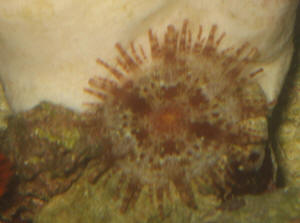
Mystery Anemone? Aiptasia 12/06/2007 Hi Crew!
<Hello Stephan, Mich here.> I discovered this creature at the
base of my leather coral. <I see.> I found it after I split
the coral in two. <OK.> Looks like an anemone no? <Yes,
and a nuisance one at that.> Should I be concern or get rid of
it? <Yes, I would remove.> My tank a 24 gal. reef with
softies. Thanks for your reply
<Welcome! Mich>
Stephan |
|
|
Question re: Identification of corals'¦
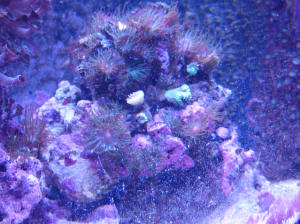
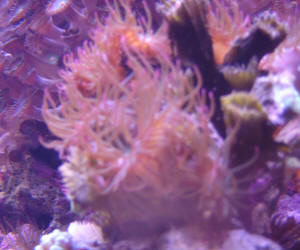
Aiptasia 11/04/2007 Hello guys, <Hi Lynne, Mich here.> I
am attaching a couple of photos (sorry they are not the best) of
some corals that are growing and spreading quickly in my aquarium.
<Heehee! I bet they are!> What type of coral is this? <You
have Aiptasia, a nuisance if there ever was one... will kill most
any other coral it comes in contact with as you have seen with your
Caulastrea. More here about this pest that easily reaches plague
proportions:
http://www.wetwebmedia.com/marine/inverts/cnidaria/anthozoa/Aiptasia/aiptasia.htm
> The store said it was pink tip tulip coral or something like
that. <Oh good grief! Please tell me you didn't actually PAY
for this 'coral'. I've got a bridge and some prime real
estate in the Pocono Mountains for sale'¦ You could build
a casino! Interested in buy either?> Well I also have I was also
wondering what type of behavior can I expect from this coral.
<Did you see the Star Trek episode titled 'The Trouble with
the Tribbles'?> When it came in contact with my Candy Cane
coral it killed those and seems to be taking over. <Yes indeed.
Is what it does.> Any information you could provide me on this
type of coral and its behavior would be much appreciated. <Nuke
it! Some removal options here:
http://www.wetwebmedia.com/ca/cav1i3/aiptasia_impressions/aiptaisia_impressions.htm
Though I would recommend avoiding the flambéing method
someone recently wrote in and suggested'¦> Thank
you!
<Welcome! Mich>
Lynne |
|
|
|
|