|
FAQs on Anemone Identification
23
Related Articles: Anemones,
Bubble
Tip Anemones, LTAs, Cnidarians, Coldwater Anemones, Colored/Dyed Anemones,
Related FAQs: Anemone ID 1, Anemone ID 2, Anemone ID 3, Anemone ID 4, Anemone ID 5, Anemone ID 6, Anemone ID 7,
Anemone ID 8,
Anemone ID 9, Anemone ID 10, Anemone ID 11,
Anemone ID 12,
Anemone ID 13, Anemone ID 14, Anemone ID 15, Anemone ID 16, Anemone ID 17, Anemone ID 18, Anemone ID 19, Anemone ID 20, Anemone ID 21, Anemone ID 22, Anemone ID 24, Anemone ID 25, Anemone ID 26, Anemone ID 27, Anemone ID 28, Anemone ID 29, Anemone
ID 30, Anemone ID 31, Anemone ID 32, Anemone ID 33, Anemone ID 34, Anemone ID 35, Anemone ID 36, Anemone ID 37, Anemone ID 38, Anemone ID 39, Anemone ID 40, Anemone ID 41,
Anemone ID 42,
Anemone ID 43,
Anemone ID 44, Anemone ID 45,
& Cnidarian Identification, Anemones 1,
Anemones 2, Anemones 3, Anemones
4, Anemones 5, Invertebrate Identification, Aiptasia
Identification, Aiptasia ID
2, LTA
Identification, Bubble Tip
Anemones, Caribbean
Anemones, Condylactis, Aiptasia
Anemones, Other Pest
Anemones, Anemones and
Clownfishes, Anemone
Reproduction, Anemone
Lighting, Anemone Feeding,
Anemone Systems,
Anemone
Compatibility, Anemone
Selection, Anemone
Health, Anemone Behavior,
Anemone
Placement,
|
|
 |
New Print and
eBook on Amazon:
Anemone Success
Doing what it takes to keep Anemones healthy long-term
by Robert (Bob) Fenner
|
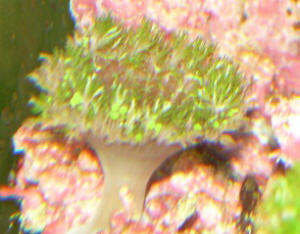
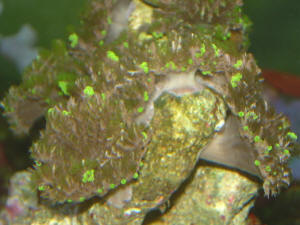
| Anemone (?) ID -- 07/28/08 Hi, <Hello
Thierry.> I got a couple of these things a few months ago from
my LFS. They looked interesting with the bright colored vesicles. I
now realize they are pests. They are 1'' across, reproduce
quite fast, attach strongly to rocks and regrow when cut. They are
all over the tank, including on the branches of corals such as
Caulastrea and Euphyllia, they seem to like well illuminated areas.
They are quite stingy, I brushed against one of them while moving
another coral and got a rash on my arm which lasted for over a
month. So much for the description, here are my questions : - What
are they ? My LFS couldn't tell me and I was unsuccessful
Googling them. <From picture and description I believe they are
a Thalassianthus species.> - How do I best get rid of them ? (I
hate killing anything, but I do have to make some choices).
<Careful (!) injection of boiling water, muriatic acid or sodium
hydroxide solution as described at
http://www.wetwebmedia.com/ca/cav1i3/aiptasia_impressions/aiptaisia_impressions.htm
under 'other chemicals'. Don't kill too many at the
same time and always filter with carbon and also watch the pH when
using pH changing substances. There are possible predators like
butterfly fishes, angels and filefishes, but they can be rather
individualistic and might or might not work, some potentially also
eat other desired sessile invertebrates.> Thank you in advance
for your help. <A small side note: I searched them for quite a
while and have them for half a year in a low light former fish
tank, where they don't multiply often at all and don't show
that much green color. I think they are well suited for such tanks,
but maybe not so for a reef tank with stony corals and strong
illumination. Possibly some fellow marine aquarists with mostly
FOWLR tanks might be happy with some of yours.> Kind regards.
Thierry. <Good luck with getting rid of them. Marco.> |
|
Re: Anemone (?) ID -- 07/29/08 Hello Marco,
<Hi Thierry.> Thanks a lot for replying so quickly. <You
are welcome.> I'll try and find someone interested in
them. That would definitely be better than just killing it.
<Very good.> Maybe I'll save a couple and try and keep
it under control. They are indeed interesting. <Oh yes, they
are, though little is known about them. Kind regards Thierry
<Cheers. Marco.>
|
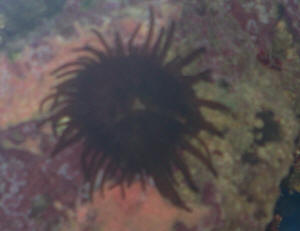
| Unidentified Anemone 7/3/08 Hi How are
you today? <Fine thus far thanks> I bought some beautiful
Live Rock yesterday, got it all set up in my tank. The man told me
there is all kinds of good stuff growing on and in the rock. There
are tons of stars and clams, upon further inspection I find a neat
little thing I am guessing is an Anemone. <Appears to be so>
I am enclosing a picture in hopes that maybe you can tell me. I
scoured the internet for hours trying to find one that resembles
it, I cannot. I hope someone there knows. Thanks a ton. Jessica
<Need a "better" pic... more resolution, lighting...
perhaps a "rock anemone" (Epicystis)... Bob
Fenner> |
|
|
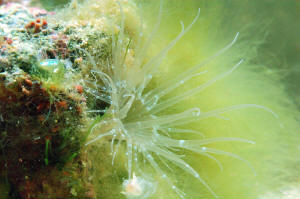
Glass anemone? Aiptasia? 07/02/08 hi - just
wondering if you thought this was aiptasia? <It looks like it to
me.> I know the angle is tough but I could take another photo if
need be... http://spial.org/photos/20080701-3.jpg So far I only
have this "one" anemone in the tank that I can find. I
have a peppermint shrimp in my 29 gallon tank - perhaps that one
little shrimp (I got a small shrimp under the guise it might live
longer than one that is big and halfway through its life) is taking
care of new anemones and they never get off the ground. <The
Aiptasia will thrive, I assure you! ;-)> For a 29 gallon tank
would 1 shrimp suffice? <For killing the Aiptasia, I would not
rely on the shrimp. Do try to kill it yourself (with Kalk paste or
lemon juice or whatever works). Please see:
http://www.wetwebmedia.com/marine/inverts/cnidaria/anthozoa/aiptasia/aiptasia.htm>
I'd rather not have the shrimp eating up my corals.
<unlikely> I have 5 tiny blue legged hermit crabs and 1 red
legged hermit crab. My tank is roughly 2 months old - my refugium
has a very healthy crop of Chaetomorpha (tripled in size in 1
month) - there's some fine hairs of algae clinging to the back
glass of the tank but mostly just single strands about an inch
long. I'm hoping that the Chaetomorpha will starve out the
algae over time. I have no fish and the only thing that goes into
the tank is water. I have considered trying to find some Berghia
but the perils of shipping these things during the hot summer
months <not worth it for just a few Aiptasia> makes me think
twice - but living in Boston the cold winters probably aren't
so great for them either. Do you think I should pursue Berghia or
just let the peppermint shrimp patrol the waters and get Berghia if
I suffer an outbreak of aiptasia? <If you just have this one (or
possible a couple/few) of these things, I would first try simply
killing them yourself before resorting to more drastic
measures.> thanks,
Jason
<De nada,
Sara M.> |
|
 A very nice pic. RMF A very nice pic. RMF
|
| Help Id'ing a Carpet Anemone... using WWM
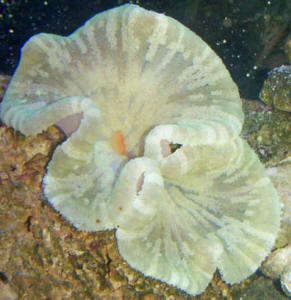
6/16/08 Hey Crew, <LB...> I was hoping you could help
alleviate some concerns for me. I was given a Carpet anemone
recently, but, I am not sure what kind. I am a little concerned it
may be an Atlantic Carpet. My Clownfish haven't paid much
attention to it yet, as it has only been a week, but I have read
that the "Atlantic carpet" will eat them if they get too
close (along with anything else). I have attached a picture. It
isn't the best quality, but, hopefully you can get the idea.
Although you can't tell by the picture, the anemone has a green
"glow" to it. Thank you so much! <Uhh... is a
Haddon's... Read:
http://wetwebmedia.com/marine/inverts/cnidaria/anthozoa/anemones.htm
BobF> |
|
|
|
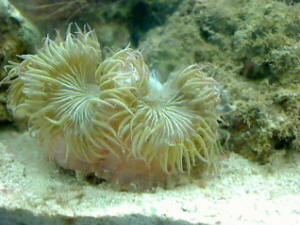
Anemone ID please 06/15/08 Hello!
<Hallo Linda!> I've been coming here as the final say
for a few years now and here's one for ya! Y'all will be
the final say on what type of anemone this is. I say
LTA/corkscrew my friend says rock/flower. Help, Please. This is
turning into an all out war. LOL.. I'm sorry, I couldn't
attach it, I had to insert into the email. <Sorry to say we
aren't equipped to take inserted images. Any way you can
attach it? I'm afraid my answer would be very arbitrary
without an image!> How do I find out if you have answered this
question? <With a personal response in your email inbox!>
Thank you, Thank you, Thank you! <No problem, try and send us
that picture as an attachment!> Linda <Benjamin>
Re: Anemone ID without Image - 6/14/08 6/16/08 Hey
Benjamin! <Linda> Thanks so much, for the VERY quick reply!
<30 minutes, or the pizza is free....wait, wrong job!> I
figured it out and I've attached the picture. I hope you can
see it. <Loud and clear! Looks to me like you have a splendid
specimen there, I would guess a Macrodactyla spp. or perhaps a
Heteractis crispa or aurora- although the absence of tentacles on
the oral disc is a bit flummoxing. Anemones are awfully hard to
identify, and taking them to the species level is best left to
experts. The term 'rock anemone' is a fair colloquialism
used to describe anemones of several families, as well as those
that may come with live rock or corals hidden behind. This
anemone, however, is possessing a large enough column and foot
that I think we can safely put it in one of the specific groups
of anemones above mentioned.> Linda
<Benjamin>
|
|
|
|
|

