|
FAQs on Freshwater Fish Parasite Diseases
2
Related Articles: Freshwater Fish Diseases, Freshwater Diseases, FW Disease Troubleshooting, Ich/White Spot Disease, Choose Your
Weapon: Freshwater Fish Disease Treatment Options
by Neale Monks, Formalin/Formaldehyde,
Malachite Green,
Related FAQs: FW
Fish Parasitic Disease 1, & FAQs on: Diagnosis/Identification of Parasites,
Internal Parasites, FW Parasite Treatments, Freshwater Protozoan Parasite Diseases,
Diagnosing/Identifying FW Protozoan
Diseases, ( Ich/White Spot Disease,
Freshwater Velvet, Sporozoan Parasites, Whirling Disease, Hexamita/Octomita in Freshwater Systems,)
Worm Diseases, Cichlid Disease, African Cichlid Disease, Aquarium
Maintenance, FW Infectious
Disease, Freshwater
Medications, African
Cichlid Disease 1, Cichlid
Disease, Betta Disease
1,
|
|
Parasites 7/18/19
Hello, great site, I am treating dwarf gourami for internal parasite,
<Which one? There are several different types! Each requires specific
treatment. What works for worms won't work with Hexamita, for example.>
lost three fish, using tetra all in one treatment, been treating 8-9 days
now,
<Anything sold as "all-in-one" isn't likely to be entirely reliable, anymore
than a medicine sold at your local drugstore that promised to be a cure-all
probably won't be much use.>
have malachite green but don't want to use in tank, maybe a dip if possible?
<Dips of any/all kinds are for treating external parasites. Of no value at
all if you are genuinely dealing with internal parasites.>
Added salt,
<Again, useful for treating external infections in specific situations
(Whitespot comes to mind) but otherwise either useless or even harmful.>
did a big water change
<Always useful, provided not diluting any medication: would recommend only
changing water (at least) 24 hours after dosing tank, so that each dose of
medicine has time to work.>
two days ago and continued using tetra , help is needed, I get bad info from
Petco specialist.
<I'm sure there's variation, but on the whole, the big pet store chains tend
to have sales clerks rather than actual experts, so unless the clerk you're
speaking to is a genuinely experienced hobbyist -- and some are -- I'd tend
to "trust, but verify" any information shared by most of their staff.>
Thank you so much, I'm Ray, hope to hear from you soon.
<Let's return to the sick fish, the Dwarf Gourami, what was called Colisa
lalia for many years, but is apparently Trichogaster lalius. This originally
lovely fish has been mass produced and inbred over decades, and the
resulting specimens are very poor quality. Viral infections ("DGIV" or Dwarf
Gourami Iridovirus) that cause wasting and lesions are extremely common,
nearly universal in some cases (the ones exported from Singapore are
notorious). There's no treatment. Furthermore, when stressed, these
fish appear to be extremely prone to Mycobacteria infections. Again, there's
no treatment. Symptoms including wasting, lethargy, spinal deformities, loss
of colour, and eventually death. Nothing you dose the
tank with will help. Now, you haven't told me what symptoms your fish has,
nor what you suspect the fish to be suffering from, so I can't really offer
any advice. But as a general observation, Dwarf Gouramis (unless locally
bred) are best avoided in lieu of much hardier, but similar-looking, species
such as the Thick Lipped Gourami and the Banded Gourami. Cheers, Neale.>
Re: Parasites 7/20/19
Hello, thanks so much for your help,
<Welcome.>
I have a powder blue dwarf gourami left, my fire just died, my honey died,
and my neon died...
<These are all varieties of Colisa lalia, or at least hybrids between that
species and Colisa chuna. Either way, not much to choose between them in
terms of healthiness. All best avoided, really.>
I have an opal and another type I forget, but two are not dwarf, and a Cory
catfish.,....
<Opaline Gourami is a different species, Trichopodus trichopterus, that is
usually hardy but sometimes aggressive.>
They had clear poop lines, long, didn't eat..hid... Acted old and crippled.
<See previous emails re: this symptom. Cheers, Neale.>
Can freeze dried worms retain parasite spores?
7/11/19
Dear WWM,
<Dev>
Thank you for being there, the immense knowledge available here is priceless.
<A pleasure, honor, indeed calling to share, help others>
Question: can freeze dried Tubifex worms retain latent spores of the whirling
disease parasite?
<Mmm; I doubt that Myxosoma can/do persist through the process of freeze drying.
My answer: No>
I was wondering as I lost couple of established tetras to disease with symptoms
of lack of balance and rolling over. May be they were due to other causes, but a
rare feeding of freeze dried worms just a day before the onset is prompting me
to cross check, correlated or coincidence?
What about freeze dried bloodworms? Can they retain latent spores of parasites
they are vectors of when alive?
<Again, I think that the freeze drying process eliminates such Myxosporeans et
al. Am not a fan of "sewer fly larvae" bloodworm use other than by a few
processors (San Francisco Bay Brand, Hikari) as have seen suspicious troubles
from their use.>
Thanks in advance.
Warm regards
Devakalpa
<And you, Bob Fenner>
Re: Can freeze dried worms retain parasite spores? /RMF
Dear Bob,
<Devakalpa>
Thank you for a prompt and detailed response. It will help me take an informed
decision going ahead.
<Ah, good>
Keep well.
Regards
Devakalpa
<And you, BobF>
Can freeze dried worms retain parasite spores? /Neale
Dear WWM,
<Hello Devakalpa,>
Thank you for being there, the immense knowledge available here is priceless.
<Thanks for these kind words.>
Question: can freeze dried Tubifex worms retain latent spores of the whirling
disease parasite? I was wondering as I lost couple of established tetras to
disease with symptoms of lack of balance and rolling over. May be they were due
to other causes, but a rare feeding of freeze dried worms just a day before the
onset is prompting me to cross check, correlated or coincidence?
<I would suspect the latter. It seems unlikely that any but the most specialised
organisms could survive the freeze-drying process. Bacteria probably can survive
freeze-drying, at least in some cases. But desiccation is often part of their
natural life cycle. For more complex organisms -- I just don't know. I suspect
not, unless you know the parasite is able to survive dormant on dry riverbeds
for months or years (as, say, brine shrimp eggs can). When it comes to Neon
Tetras, for example, there are so many
other reasons why they get sick -- Pleistophora, generally opportunistic
Mycobacteria infections, even heat stress (they need water around 22-24 C).>
What about freeze dried bloodworms? Can they retain latent spores of parasites
they are vectors of when alive?
<This has been discussed by aquarists at various times, both with regard to
freeze-dried and plain frozen bloodworms. While parasites probably don't survive
either, the often rather grim environments used to rear these bloodworms can
expose them to things like heavy metals, and these will be in the food items
produced from the worms. Bloodworms are to be used cautiously, especially if
you're keeping delicate or disease-prone fish.>
Thanks in advance.
Warm regards
Devakalpa
<Cheers, Neale.>
Re: Can freeze dried worms retain parasite spores?
Dear Neale,
Thank you for the detailed reply, your inputs are valuable.
<Most welcome.>
The fish I lost was not a neon tetra but a Diamond Tetra and though I am aware
that even they (or for that matter non tetras also) are susceptible to NTD, the
symptom onset was overnight, the fish lost balance completely and was dead in a
day. In fact I wrote to you for guidance.
<Diamond Tetras are lovely fish. So good choice there! But they are a little
sensitive to water chemistry. They do best in soft water, and may be
disease-prone in harder water conditions.>
I have added some Bolivian Rams and was thinking if I could add some 'safe'
'once-alive' food to bring some variety to their and their tankmates' diet.
<Understood. But really, not necessary. Modern flake and pellet foods (like the
brands you mention below) are perfectly adequate for small community fish such
as tetras and barbs. No real need to add anything else. If you want to offer
some variety, green foods are the best, such as cooked peas and spinach. Indeed,
it's worth experimenting with vegetables and fruit, in small quantities, to see
if they're eaten. Some fish will also eat cooked rice, which like vegetables, is
perfectly safe. Another good extra is hard boiled egg yolk. Tiny, tiny amounts
at a time because it mostly gets spread out in the water, but the grains are
perfect for small fish like tetras. As well as these, seafood is a good choice.
Few, if any, parasites from seawater fish and invertebrates can infect
freshwater fish. While freshwater fish should be safe if sold for humans,
there's always a risk of parasites that don't affect us being present in the
fish, and these could, if you were unlucky, infect your tropical fish. Still,
I've used defrosted slivers of tilapia many times without problems.>
Their standard spread consists of pellets and flakes from Hikari, NLS, Tetra,
Ocean Nutrition, etc. I have come to suspect live sewer worms for reasons much
elaborated in your website.
<Indeed.>
I guess personally culturing live food is the safest option. It is rather
unfortunate that in a tropical country like India, we hardly get any
commercially vetted frozen foods like daphnia, Whiteworms, blackworms, and like.
<In theory, if you place a bucket of water outdoors, it'll become populated with
mosquito larvae very quickly, and your fish will eat these very readily! But
culturing mosquito larvae in a country where Malaria is present will not be
popular with your neighbours. So while do-able, I wouldn't bother.>
Keep well.
<You too!>
Regards
Devakalpa
<Cheers, Neale.>
Re: Can freeze dried worms retain parasite spores?
Dear Neale,
<Devakalpa,>
Thank you yet again for all the helpful inputs.
<Welcome.>
I just love tetras, the Diamonds, Lemons, Pristellas, Emperors.. among my
favourites!
<Ah, Pristella tetras definitely mine. Robust, adaptable, and impeccably well
behaved. A perfect all-rounder for virtually all community tanks. The Emperor is
another species with much to recommend it; exotic in appearance, but almost
bullet-proof in terms of care.>
I regularly feed my fish parboiled spinach and other veggie tidbits and my
Cories, Bristlenose and Whiptails just love them.
<Good to hear!>
I shall try the seafood, rice and hard boiled egg suggestions, thank you.
<Welcome.>
And indeed, not only neighbors' wrath, I shall attract the municipality health
authorities' ire if I plan to culture mosquito larvae :).
<Precisely so. You could try Brine Shrimp though. Brine Shrimp tolerate a higher
salinity than even mosquito larvae could handle, which would make this a safe
choice. On a small scale you can use old 2-litre soda bottles for this, placing
them on a windowsill to get the water green, and then adding the Artemia eggs.
Outdoors you'd need some sort of salt-tolerant container, probably plastic or
ceramic, since most metal would quickly corrode.>
Take care, and keep up the great work.
<Will try!>
Regards
Devakalpa
<Best wishes, Neale.>
Nerite snails in isolation tank; resisting parasite transfer
1/27/19
is there a way to medicate snails in an isolation tank to make sure they
are disease and parasite free?
Gerald
<Not really. Isolating snails for 4-6 weeks is a good way to ensure
they're not carrying waterborne parasites (such as Whitespot) that might
affect fish rather than the snails themselves. Since those parasites
will complete their life cycle within such a time period, in the absence
of a fish host, such snails should be "free" of the waterborne stages
that might be stuck to their shells. But if you're talking about
parasites that live within the snails, parasitising them, and then
potentially infecting fish, there aren't any available medications to
help here. Those snail-borne parasites of economic concern (such as
Bilharzia) are preventing by exterminating snails rather than treating
them. Hope this helps, Neale.>
Lice - Solve 6/13/18
I used Lice – Solve last night on my happy active fish and this
morning 16 of my fish are dead leaving only 5 left alive. I am
heartbroken that despite using the correct amount and following
instructions to the letter that I have inadvertently killed my beautiful
fish with this product.
Jay
<Hello Jay. Lice-Solve is a product for killing off Argulus,
Anchor Worms, and other (external) crustacean parasites. It's basically
an insecticide, and should have low toxicity to vertebrates such as fish.
Consequently the chemical inside Lice-Solve, Emamectin, has been used on
fish farms where the food produced ends up on our dinner plates. With
that said, insecticides can cause problems for fish if used at the wrong
dosage (so double-check that) and can also cause problems to 'sensitive'
fish species. If we're talking about pond fish, that's going to mean
things like Orfe and Sturgeons, and possibly other species as well.
Goldfish and Koi should be fine though. One problem with using any sort
of poison is that if other things in the pond die as well, such as
insects in the pond, and there's enough 'dying' going on to reduce water
quality, then the fish may suffer as oxygen levels drop. It's often
recommended that aeration be increased when medicating, which in a pond
situation might include using a fountain or air bubbler. In a pond
without filtration or aeration, it's entirely possible that even
irritation to the gill membranes caused by the medication can be
sufficient to stress, or even kill, your fish. I'd certainly reach out
to the manufacturers to see if they can offer some insight, but I agree
with you that this is a very unfortunate outcome. Hope this helps,
Neale.>
|
Undiagnosed disease. 5/17/18
Hello crew, i hope you are doing well, as always.
<Hi Roberto,>
With the coming of winter, and slightly colder temperatures, i started using
heaters in my tanks. (it was getting below 22 C).
<Wise.>
One day i woke up to a Columbian tetra caught between the heater and the glass.
I dislodged him and he went onto normal, except that he had an horrible vertical
searing wound. It looked pretty horrible. I observed the fish for the following
days and he looked to be healing pretty well. When everything looked good, he
developed white, round growths on his wounds. It started slow, and i tried to
net him many times out, but netting him out of a 150 gallon heavily planted tank
is... hard. I decided to just keep on water changes daily and keep clean
filters, etc.
<Understood.>
The growths disappeared, and he seemed to heal completely. a week after the
growths came back more aggressively, but still advancing slowly. Maybe a new
growth every 2 days or so. I finally netted him out and put him on quarantine. I
am concerned between three different ailments which are listed on your website:
Lymphocystis, fungus or Columnaris.
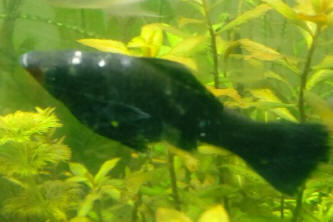
<It doesn't look like Lymphocystis from the photographs of the Mollies and the
Siamese Algae Eater. Conceivably Whitespot, but more likely Fungus, Columnaris,
or perhaps Costia.>
i treated him with tetracycline and Methylene blue (correct me if im wrong, this
has formalin right?).
<Formalin may be an ingredient in commercial medications, but these two
chemicals are specific things, and in themselves, not formalin.>
Not sure if the treatment worked, as it jumped out overnight...
<Oh.>
Fast forwarding a couple days, both fish pictures, a black molly and a SAE,
developed the same growths. They don't have any wounds, they just started
developing the growths. It seemed as first that single scales were popping out,
then in the place of the pooped out scale appeared the growths. Some growths
have disappeared, but they have left red open wounds.
<Not good.>
I have the molly in a 5 gal and treated with tetracycline, Methylene blue.
<Methylene Blue is effective against fungal infections, but will have little/no
impact on Costia or Columnaris (also known as Mouth Fungus). Fungal infections
often set in alongside other types of disease, which can be why Methylene Blue
seems to help a bit, even where the actual problem is a protozoan or bacterium
species.>
It seems to be working, albeit slowly. I am keeping on water changes on both the
main tank and the quarantine, but what do you think is a correct diagnose?
<See above. Costia is typically associated with off-white to grey smears (hence
'Slime Disease') and can develop extremely rapidly. It usually respond best to
anti-Whitespot medications, albeit slowly enough 2-3 rounds of treatment may be
required. Columnaris (or Mouth Fungus) is bacterial in nature, so antibiotics
are ideal, but failing that, some type of antibacterial medication used for
external infections such as Finrot. I'd perhaps be looking at something like
eSHa 2000 in the first instance, as it's fairly broad acting, dealing with a
range of external bacteria and fungal infections. It also works well (and
safely) alongside eSHa EXIT, which is a very good against external Protozoans.
Since both these medications are cheap and widely sold, they're my favoured
combination for use against difficult to identify, though obviously external,
diseases.>
I went out and bought an API medicine that is supposedly for fungus. It is
Victoria green (malachite green?) and Acriflavine. I can get Acriflavine
separately for cheaper. Should i add, this sickness doesn't seem to be stressing
them, they are eating normally, even the Columbian was doing so, even when
heavily infested, it is developing, albeit very slowly.
I will be waiting input, so far no other fish have developed the growths, but it
has shown it doesn't need an open wound to do so.
As always, thanks, WWM.
<Hope this helps. Cheers, Neale.>
|
 .jpeg) |
Stringy white poop, many deaths
1/15/18
Hello!
I've been having a bit of a problem with my Dwarf Neon Rainbows
and I'm at a loss at this point. I'll start the story by stating that
through the whole ordeal ammonia and nitrite were zero, nitrate was less
than 5, water
changes were done weekly at least and whenever else I thought they were
needed. I ordered 9 online nearly 2 months ago; 3 males and 6 females
all came alive but covered in ich. I was expecting ich, so they went
straight
into a 10 gallon quarantine tank equipped with a cycled filter off an
established tank. I raised the temperature to 86-87 and after 2 days all
ich was gone but I left the temperature up for a week or week and a half
just to be safe.
All fish initially ate well. I fed almost exclusively frozen foods
(brine shrimp, Spirulina brine shrimp, bloodworms, daphnia, etc. I had
over 10 varieties) with New Life Spectrum, Hikari Micron, and Sera Onip
fed on mornings when I was running late. After a week the male that got
picked on a bit developed dropsy overnight and died within a couple
days. Now, after having a bad experience at a local fish store with
internal parasites I automatically treat all the fish I get. I treated
with General Cure first (has never proven effective at treating internal
parasites for me but it's proved useful for other things, so I use it
before PraziPro) and during
that treatment, one of the males stopped eating and developed white
stringy poop. He was like this for a few days before he began breathing
very heavily then died. I researched and researched and everything came
up as
internal parasites. I used PraziPro and at some point fed Hex-Shield
(which I had forgotten I had) and the remaining 7 all had nice red poop.
Yay! Or so I thought.
Some number of days later a female got white stringy poop, stopped
eating, began breathing heavily, then died. Down to 1 male and 5
females. More research and forum exploration led to Hexamita or Malawi
bloat. A Hexamita recommendation was to feed food soaked in Epsom salt.
Everyone but one female ate. The recommendation for one that doesn't eat
was to squirt the Epsom salt mixture down her throat. I figured since
she would die as soon as she got to the heaving breathing stage anyway
there was nothing left to lose. I filed the tip off a syringe I got from
the vet, gave her some Epsom salt mixture, and the white poops stopped.
Yay! Other recommendations were to use metro, so I ordered that just in
case. I did it once more and then it was time to pack the fish up for a
move across the state.
All rainbows survived the initial trip but the one female died the next
day. They were kept in the ten gallon QT for a few days but since the
remaining ones all appeared healthy and I really needed the tank off the
floor, they went into a 20 high. One male and four females left. None of
my frozen food made the trip. A relative lent me a cooler she swore was
incredible, yet all my food turned to mush. Everyone got stuck with
Repashy and pellets since finding pet stores here is hard, but at least
that made looking for healthy red poop easy. The remaining 5 fish were
all healthy in the new place for 3 weeks until the other day. One day a
female was suddenly breathing heavily and bloated with white stringy
poop. She didn't stop eating before then and none of the other fish,
minus the initial dropsy case, had bloated before death. Now, I had been
feeding pretty heavily because it kept them from decimating the shrimp
population while the plants grew back (a bit of melt since they got
packed up days before the move), so I fasted them. I was gone the entire
next day and didn't look at my fish at all. Yesterday I counted 3
females and 1 male. The shrimp were picking at a small piece of white
meat, the Hypancistrus was part way out of his cave (very rare).
Clearly, the female was turned into a meal.
I'm at a loss as to what to try next. Your key leads to Malawi Bloat
since there's no fungus or wounds appearing on the fish, but they aren't
cichlids. They've been treated for internal parasites and every time I
think everyone is healthy another comes down ill. What is there left for
me to try? I have one male and 3 females left. They look healthy and the
poop is healthy but I've learned that can change overnight.
Please help!
Sabrina
<Hello Sabrina. Like you, my gut reaction here (if you pardon the pun)
is that we're looking at Hexamita or some similar intestinal parasite.
While you have used Hex-Shield, this is a "good" food rather than a
medicine.
While it contains vitamins and minerals essential to good health, it
doesn't contain Metronidazole, which is the medication you want here. So
that's where I'd be going. Something like Seachem MetroPlex, for
example.
Epsom Salt is often used alongside Metronidazole because it does help to
reduce swelling and constipation, but it isn't a medicine _per se_, so I
wouldn't expect it to treat this problem as it is. Squirting Epsom salt
into a Rainbowfish sound like a non-runner to me, more than likely
causing severe osmotic stress even if the experience doesn't harm the
fish psychologically. Ideally, use Metronidazole alongside a reliable
antibiotic, Nitrofurazone being particularly popular among aquarists. If
you have some other antibiotic kicking about, I dare say it'd be fine
though. At the same time, do ensure a number of other things. Firstly,
lots of oxygen; secondly, appropriate water chemistry; thirdly, a varied
diet with some fresh greenery (gut-loaded brine shrimp are handy); and
fourthly, keep nitrate levels as low as practical. Hope this helps,
Neale.>
Re: Stringy white poop, many deaths 1/17/18
Thank you for your help!
<Most welcome.>
I have a small bag of Metronidazole. The tank is full of snails and
shrimp and I can't set up the quarantine tank right now, so do you
recommend mixing the Metro into some Repashy or bloodworms?
<Getting medicine into fish via their food is usually more effective
than adding to the water. But dosing can be tricky if the fish spit out
some of the food. I'd tend to follow the instructions on the package, or
advice from the vet, rather than simply improvising.>
In terms of feeding greenery, I used to have Spirulina brine shrimp and
emerald entre but they went bad during the move and I can't find any
around here. Tiny town problems.
<Indeed!!!>
Would crushed algae wafers, cucumber, zucchini, lettuce, or broccoli
suffice?
<The algae wafers are a useful staple for any community fish, and should
be part of their regular diet. Spirulina flake food (sold for
livebearers) is also an excellent staple. The other green foods, if
eaten, are all good additions to their diet.>
I also have some Cobalt pellets with Spirulina and probiotics. In terms
of antibiotics, I have Kanaplex, Furan 2, ParaGuard, and Fungus Cure
(says it treats secondary bacterial infections). I've always been
partial to Kanaplex, but which do you recommend?
<Kanaplex would also be my first recommendation here. The others are
more or less antimicrobials rather than true antibiotics.>
The tank does have an air stone. In terms of water chemistry, ammonia
and nitrites are always zero, nitrates less than 5 (usually zero. I dose
a little for the plants), pH around 7.5, 10 dGH, 11dKh.
<All sounds fine.>
Thank you again,
Sabrina H
<Good luck, Neale.>
Re: Stringy white poop, many deaths
1/18/18
The directions that came with my Metro recommend 2 teaspoons per pound
of food.
<That's a lot of fish food!>
I did the math and I need approximately 0.014 tsp per cube of
bloodworms, which is just slightly less than 1/64, which is the smallest
teaspoon measurement I have. I'll just add a little less than 1/64 tsp
and be generous with the Garlic Guard.
<What's the garlic for? I would not be adding random 'cure all'
chemicals alongside specific treatments.>
The math for Kanaplex will have to be done later and hopefully the fish
will eat it. Perhaps they just need to be starved for a day or two as
encouragement.
<Indeed.>
Alternatively, I could mix it with daphnia (only other frozen food I
could find) but I think the hypan is more likely to eat the bloodworms,
since eating the last dead fish more than likely infected him too. Do
you have a preferred brand of Spirulina flakes?
<Not really; they're all good!>
New Life Spectrum is my go-to brand but they don't make them and neither
does my second favorite, Omega One.
<Understood. I've used the Tetra brand, but pretty much any should work
a treat.>
I hope you're having a wonderful day!
- Sabrina
<Off to donate blood now, so wonderful isn't quite the word, but
hopefully useful! Cheers, Neale.>
Re: Stringy white poop, many deaths 1/20/18
I hope donating blood went well! At least as well as it can go anyway.
Personally, I despise needles.
<I think most people do. The burden of being O-neg... constant demands
to be sucked by medical vampires!>
Frankly, I'm too lazy to deal with fresh garlic and without it, I find
the Pleco won't eat anything medicated.
<Really? Fair enough.>
Thus far the remaining 4 rainbows are alive and still eating, though one
female has begun hiding a bit. Should she, or any other infected fish,
stop eating how do you recommend I treat it? All forums and sites online
say if the fish are to the point of refusing food the medication should
basically be squirted down its throat.
<Whilst viable with large fish, with very small fish there's more risk
of either stress, handling, or the pressure from the nozzle doing
serious damage. I'd be extremely cautious before doing this sort of
thing. Many medications can be added to the water. Less effective, but
less
stressful.>
I'll do it if I must, but is there another alternative?
<See above.>
The consensus seems to be that treating the water will do no good.
<It's less effective, but not ineffective. Fish do drink, and in
freshwater, they can't help but absorb things from their environment.
Dosing is important, but also is removing carbon from the filter -- a
common oversight that causes "false negatives" where people use a
medication and find the fish stay sick. High oxygen levels and rapid
turnover will cause medicine to be broken down by the biological filter,
and simply high levels of biological activity, such as algae, let alone
the fish, can have a similar effective. So yes, getting the food into a
fish is better. But many medicines work reasonably well added to the
water. My books recommend 50 mg Metronidazole per 4.5 litres (about 1.2
US gallons) -- so a single 200 mg label would be a bit under 5 US
gallons. Furthermore, it is recommended doing 3 treatments, the first on
day 1, the second on day 3, the third on day 5, with a 25% water change
before the next dose. Make sense?>
Do you personally do any medicating or treatment of new fish? Does it
differ whether the fish are captive bred or wild caught?
<Funnily enough, farmed fish are actually more risky! Wild fish tend to
be in very good shape, though external parasites like flukes are not
uncommon in a few cases (such as Bichirs). Farmed fish tend to be
maintained in high numbers in small ponds or tanks, so cross
contamination is very common.
Drug use is ubiquitous on farms, too. Of course once you mix the fish in
the retailer's tank all bets are off, but no, I don't routinely medicate
new fish, but I may well quarantine if that's a possibility. That said,
I'm pretty ruthless about not buying fish from dodgy shops, and I avoid
delicate species like the plague! Really, fish are actually
astonishingly disease resistant, all things considered -- they're
swimming about in what are effectively bacteria-laden Petri dishes! It's
either bad luck, bad genes, or bad housekeeping that leads to problems.
I haven't bought new fish in six years now, and can't remember the last
time I medicated them.>
Oh and also, you said Hex-Shield is just a good food. What do you
recommend its use be? I spend a fortune on it so I'm definitely using it
one way or another, but is it actually helpful with ill fish or just a
decent addition to their usual food rotation?
<I'd go with the latter. Hexamita -- or at least Hole-in-the-Head --
probably has some relation to diet, the lack of fresh greens being
widely discussed. So, any food laden with greens or supplemented with
vitamins has the potential to "shield" against Hexamita. That said, any
number of ways to achieve the same thing -- good quality flake, slivers
of various fish meats and seafoods, periodic offerings of
Spirulina-loaded brine shrimp, cooked peas now and again -- all these
things, if used together, should provide a good, balanced diet without
the expense. It's much the same as vitamin supplements with humans:
sure, we need what they supply, but if you're eating salads and fruits
and oily fish and all the rest of it, you'll be getting those vitamins
anyways, and it's not like your body can store them, so having extras
doesn't help.>
Thank you for all your help!
- Sabrina
<Most welcome. Neale.>
Re: Stringy white poop, many deaths 1/23/18
The length of time to feed the medicated foods differed greatly between
the Kanaplex and Metro so i went with the shorter duration, but now one
female is bloated and breathing heavily. There's a small chance she is
full of
eggs because there has been some spawning activity in the tank, but im
leaning towards needing to medicate a bit longer.
<Indeed; seems reasonable.>
Your books recommend far higher dosages than my medication or what I've
read online. May I ask what the books are?
<"A-Z of Tropical Fish Diseases and Health Problems" -- an oldie but
goodie.>
Can they be purchased online?
<Oh, I'm quite sure they can.>
Maybe the dosage I mixed with the food is too low.
<Possibly. I double checked, and yes, it's 50 mg per Imperial gallon
(about 42 gram per US gallon, by my reckoning).>
Would it be reasonable to expect the fish were sent to me already with
Hexamita?
<Absolutely. There is some belief that Hexamita is ubiquitous in the
aquarium hobby. It's more about asking "what's happened to these fish
that's made them unable to resist the Hexamita" in which case we look at
things like poor diet, high nitrate, etc.>
They got a wide variety of frozen foods nightly, including Spirulina
brine which was fed usually twice a week.
<A very useful fish food.>
Morning feedings are always New Life Spectrum, Hikari, Sera, or if I had
time crushed Cobalt with Spirulina and probiotics or crushed Omega One
shrimp pellets. I don't have time to crush things often. They also have
always gotten Repashy Community, sometimes Grub Pie if I forgot to make
more Community. If i got out too much fish for the Hypan they got
flounder, clams, shrimp. All my tanks got peas and green beans a couple
times a week,
though the green beans don't seem to be a favorite. I would think this
is enough of a variety even if I wasn't feeding Spirulina flakes
themselves.
<This all sounds fine.>
On another note about food, I recently saw freeze dried peas with a
grinder lid being sold as a fish food supplement. Thoughts? Would it be
any good soaked in water before feeding?
<If the fish weren't getting any greens, then sure; but your fish are
getting such a good diet, this seems like a needless expense. Besides,
fresh greens and Spirulina probably trump dried peas when it comes to
vitamin content.>
Sent from my Galaxy Tab A
<Sent from my computer! Neale.>
Re: Stringy white poop, many deaths
Oh my I forgot to change my signature! I really must get around to
fixing that!
<Indeed!>
I ordered a used copy of the book from Amazon for just under $12. I'm
very excited!
<It's a brilliant yet frustrating book. Lots of info. It's really my
go-to for fish healthcare. Masses of text. Very little filler. But the
layout of the book is insane. Three chapters subdivided alphabetically
using a system I still don't understand. Luckily, it's written by some
very expert aquarists who are very well known in the UK, so it's well
worth the effort.>
I can't find much direction for mixing Metro with food online, other
than stumbling upon one WetWebMedia article saying to use a 1% mixture.
That's too much math for me. Once I finished Calculus my brain checked
out. Now all I get to think about is various sciences. Since one scoop
didn't seem to cut it I'll try two, mixed with the directed amount of
Kanaplex. The one female is looking really bloated. Would it be ok to
mix a bit of Epsom salt
in? I'll be using daphnia instead of bloodworms to help in case it's
constipation also.
<I would not add Epsom salt. Epsom salt will exert an osmotic effect on
the fish that could be dangerous. It'd be similar to having someone eat
a bowl of table salt.>
All the transport would definitely be what made them unable to resist
Hexamita. They were shipped to me covered in ich, which started the
whole ordeal, then I moved and the heat packs failed. All the fish
definitely got
cold but not freezing. The only deaths were the female Rainbowfish that
had white stringy poop already and my last Rummynose tetra from a fish
store who's quality had gone way down. Every fish I bought from that
store died
almost instantly, but the group of wild caught rummies I got from a new
store were, and still are, in excellent shape.
<This is starting to sound like a very plausible explanation. Stress,
bad luck, and the latent Hexamita infection could easily interact in the
way you suggest.>
- Sabrina
<Cheers, Neale.>
Re: Stringy white poop, many deaths 1/30/18
Unfortunately, the female is not improving.
<This is a Rainbowfish, right?>
She's still breathing heavily, still bloated, and has refused to eat for
a few days now. I can't set up a quarantine because my spare heater died
and there's absolutely no money for a new one, but I do have a small
(1/2 gallon I think) container that I can sit in the tank with an air
stone.
<0.5 US gal in l.9 litres, pretty much. 50 mg per 4.5 litres is what's
recommended. To be clear: that's 51 milligrams, i.e., 50 thousandths of
a gram per 4.5 litres. So by my maths that's 21 milligrams per 1.9
litres. So
if you have a single, say, 100 milligram tablet, then you want about
one-fifth of that per 1.9 litre/0.5 US gallon. If the tablet was a 200
mg tablet, you'd want one-tenth. Make sense?>
Based on your book (mine has yet to be delivered. Everything takes
longer in this dang town), I believe I need to use 21 grams of metro for
half a gallon?
<Not 21 grams; 21 milligrams! That's a thousandth of that 21 grams!>
I don't have a scale so admittedly it would be guesstimated. Would you
recommend following that or using the instructions that came on the
package?
<If all else fails, use the manufacturers instructions.>
It calls for using far less.
<I would imagine! See above.>
One tiny scoop (maybe 1/32 tsp?) per 2.5 gallons.
<Without knowing the concentration of Metronidazole in the powder you
have, or the size of the scoop supplied, it's hard to say what 'a scoop'
might represent.>
Thanks a bunch!
Sabrina
<Welcome. Neale.>
Parasites in my tank with other
illnesses...please help! I'm desperate! 9/30/11
Hello! I have been reading through your website for a few days now and
have tried to find answers on my own but its just not working. The help
you give fish lovers is amazing and I know a lot of people appreciate
it! Anyhow'¦here is my problem'¦I have always loved
fish but just got a 10 gal. tank a couple months ago so I'm pretty
new to all of this. I didn't even know about the PH levels and
I'm sure that is an issue in itself so I will go to the store
tonight and get the test strips and other items you have mentioned in
your articles in order to get my levels where they need to be. So my 10
gal tank has an AQUA TECH filter with a blue pad that has black rocks
in it and a smaller white pad (I don't know the right words to
explain it any other way'¦lol) I have a bubble curtain going
across the bottom of the back of the tank. I don't have a heater
but I don't think its necessary since with the lamp in the lid the
tank stays at 80 degrees on its own and I've read that's a good
temp for molly's. In my tank I HAD 4 molly's (1 male and 3
females) one of which has already had babies that all died but she was
in a separate 1 gal tank that I set up for her to have the babies.
Anyway, after she had the babies I put her back in the 10 gal tank
along with the other Molly's, 1 Dalmatian Molly, 2 Gold Gouramis
(that I have recently read shouldn't go in the same tank but they
haven't had any problems), 1 golddust Platy and one of those sucker
fish (I cant remember the name of it but it starts with a P and
it's the black kind). My male Molly and the female Dalmatian Molly
developed what we found out to be anchor worms, we treated with meds
for about 2 weeks and the couple that were on the Dalmatian Molly died
and fell off but the male Molly's stayed and was still there as of
a couple days ago until I read you could pick them off with tweezers
and medicate again. So I put him in a separate tank (since he now had
an open wound and didn't want other bacteria to get in there) and
he seems to be doing fine. I forgot to mention'¦when I first
noticed the worms I also noticed Ick and all the fish except for the
Gouramis were moving in a weird way as if they were shaking their heads
'no' and some of them have swollen bellies...tapeworms
possibly??? So I know they have some kind of disease and I have been
medicating with Ick meds, parasite meds and another medicine that says
its just to promote healing but they are NOT getting any better. Except
for the male Molly that is still in a separate tank and seems to be
doing well. The day I first noticed the illnesses I had just gotten
back from the store with some new balloon Molly's and when I saw
the illnesses I was afraid to put them together and get the balloon
Molly's sick so I took all the fish out of the 10 gal tank, emptied
it completely, cleaned it extremely thoroughly to try to get rid of the
parasites and other illnesses, put in new water, conditioned it and put
in the new balloon Molly's and that's the only fish that are in
the 10 gal tank now. The other sick fish are in a 1 gal tank which I
know is WAY overcrowded but I didn't have another place for them
and I was only supposed to be using it as a 'hospital tank' and
the male Molly is in a separate 1 gal tank alone since he has an open
wound from pulling out the worm. So after giving you all the
information here is my question'¦how do I get rid of the Ick
and the 'head shaking disease' (don't know what it is)
since all the meds don't seem to be working so I can return all the
fish to the 10 gal tank where they can all live happily and make
babies? The 10 gal tank is clean now and doing very well...if I put the
sick fish in it I will more than likely infect the healthy fish and get
the illnesses and parasites into the tank! Also, the anchor worm that I
pulled out of the male Molly, I'm afraid to put him back in any
tank with any other fish cause even though I pulled out the worm how do
I know its completely gone and he is free of parasites? I read the
anchor worm lives in the fish for a month or 2 before it starts to grow
out of him and becomes visible so I don't want to infect the other
fish, especially not the brand new Balloon Molly's in the brand new
tank!! All I want is one 10gal tank with happy, healthy fish! Not 2
small hospital tanks with no end of illness in sight! Thank you sooo
much in advance for any advice you can offer! It is more appreciated
than you will ever know! I'm very concerned for my fishes.
Melissa
<Melissa, the "head shaking" is very likely what aquarists
call the Shimmies, a neurological disease common to Mollies when
they're kept in the wrong environmental conditions. If you'd
read an aquarium book before buying them, you'd realise the
Mollies aren't easy fish to keep, and among other
things, they often (some would say usually) do better kept in slightly
brackish water. A dosage of 5 grammes of marine aquarium salt per litre
(about two-thirds of an ounce per US gallon) makes a huge difference,
maintaining a specific gravity of about SG 1.002. This dramatically
improves their health, but is too much salt for most tropical fish,
which is why Mollies are best kept among their own kind or with other
salt-tolerant fish. Do read:
http://www.wetwebmedia.com/fwsubwebindex/mollies.htm
Cheers, Neale.>
Re: Parasites in my tank with other illnesses...please help! I'm
desperate! 10/2/11
Thanks for writing me back.
<You are most welcome.>
I had no idea fish needed so many things to stay healthy
<Not actually all that much, compared to, say, a cat or dog. But
there are some minimums they require, and people often underestimate
these, assuming that fish are basically happy in glass boxes with
water.>
and I feel bad that I didn't do more research before I got an
aquarium.
<Indeed.>
Most of the fish that I had that were sick have died.
<Oh dear.>
The fish that I have left are all nursed back to health after reading
info on your site and others from morning to night learning what I
should have from the beginning. I am confident that I am doing a good
job now.
<Cool.>
I have all the proper supplies for testing the water for nitrates,
nitrites, ammonia etc...... I got aquarium salt and a few other things.
Now my tank has nothing but balloon Mollies (which I've had since
the beginning, I haven't bought anything new) and 1 male Betta that
has become very good friends with the Mollies :) I have learned to do
frequent water changes and got a gravel vacuum. Me and my babies are a
lot happier now that I've been learning how they like to live.
Thank you for your site and all the info you have to offer to those of
us out there that love fish and want to share their home with them
:)
<Glad to help, and do read up on Mollies. I'd strongly recommend
skipping the Betta tankmate, and concentrating just on the Mollies.
These colourful fish do extremely well kept in slightly brackish water,
and kept thus, can be very hardy and durable. Keeping them alone also
makes it easier to feed them the algae-based flake food that is best
for them, regular tropical flake being okay but not ideal. Cheers,
Neale.>
Sick Swordtail (Gill Disease/ Flukes) 7/9/09
I have a red Swordtail in a 30 gallon tank, which is lightly planted,
that has a white mucus coming from it's gills with quickened
breathing.
<Could be flukes, but perhaps other things too, such as Velvet, that
irritate the gills.>
The Swordtail still eats a little, but with a less ravenous appetite
than usual. He still swims around most the time yet in a more relax and
slower manner than usual, but also spends some time resting at both the
bottom and top of the tank. The tank is cycled and been running for
years with a stable pH of 7.6, zero ammonia/nitrite, and a temperature
of 76 degrees Fahrenheit. The other tank inhabitants include 2 female
Swordtails, 3 Flame tetras, 3 X-ray tetras, 5 Zebra Danios, 1
(temporary) baby Dojo Loach, 1 Amano shrimp, and 2 (1 1/2 in.) clams
which all show no signs of being sick.
<Doubt the clams will live long, to be honest; they take a long time
to die, but unless you're adding plankton for them to eat most days
of the week, then dying they are. Contrary to what pet stores might
say, they ARE NOT SCAVENGERS and there isn't enough stuff in the
water for them to survive. They're animals, they're not getting
anything to eat, therefore they are starving to death.>
Them most recent inhabitants are the clams and shrimp which were
introduced about 5-6 weeks ago and had been at an LFS for at least
several months before purchasing. The swordtail showed symptoms about 3
weeks ago and has been treated with a second round of Maracyn TC
evidently having no effect at eliminating the problem, but has
seemingly kept it from getting much worse than when it started.
<Interesting. What type of "clams" are these? If
they're the small Asian Freshwater Clam (Corbicula fluminea) then
these are relatively harmless, apart from when they die and pollute the
water. But the (usually coldwater) Swan Mussels, primarily species of
Unionidae, produce parasitic larvae that attach themselves to the gills
of fish. This allows the larvae to be carried away from wherever their
parents live. In the wild this seems to cause little harm, but within
the confines of an aquarium, such parasitic infestations may cause
problems, specifically by allowing secondary infections to set in via
damaged gill membranes.>
The swordtail was "adopted" at a Petco about 3-4 months ago
so I have no idea of its past exposure. I believed it to be gill
disease which is why I used the Maracyn TC as I thought parasites would
be unlikely, but I do not know how to tell between whether it is gill
flukes or a bacteria.
<You really can't tell without looking at the gills directly; if
sedating (e.g., with clove oil) and opening the gill covers is an
option, then you may wish to do so. Otherwise rotating through
different medications in a hospital tank could also be used. Don't
use anti-parasite medications in your community tank: these will kill
your snails, shrimps and clams.
Perhaps start with a fluke medication first, and then after a couple of
50% water changes across two days, an anti-velvet/ick
medication.>
The other thing I was unsure of is if it is gill disease is it gram
negative or gram positive because the TC works on gram negative. Any
help would be greatly appreciated and if more information is needed
just ask.
Sincerely, Mack
<Cheers, Neale.>
Disease/s of Fish, FW... 06/03/09
Good Day Crew,
<Bob, Pat... it's... BobF>
I'm hoping someone can help before any more of my fish die.
<Me too>
I have a 55gal. fw aquarium with an Aqua-Clear "70" power
filter and use Bio-Max, Foam & Carbon also Aqua-Clear.
Power Stone & Temp. 76 ( for a year & half.)
Clean, dechlorinate, aquarium salt (1 tbsp-every 5 gals.)
<For?>
& 15% water changes every week faithfully.
Ph-7.2 Dh-75 (soft)
I use API testing chemicals which I prefer over strips.
<Me too>
Dh & KH I have to use
Ammon.-0 Kh-0 (low)
strips because I cannot locate chemicals for this testing.
Nitrites-0
Nitrates-10
(All my fish are quarantined 3 wks)
<Good>
I started with 6 Danios in a fully cycled tank (1 mo. later 1 died
& 1disappeared - found sev. Mos. later in propeller)
1 mo. later added 3 swordtails (1 male & 2 females) & 1 pearl
Gourami
(3mos. later Gourami died)
(only 1 female sword had babies but all were eaten)
1 mo. later added 6 Australian Rainbows (? Sex no babies)
<Need special care... spawning mops, cultured food/s
generally>
3 mos. later added 3 marigold swordtails (1 male & 2 females)
This past April added 6 Mickey mouse platies (2 males & 4
females)
Since the Gourami died I've lost 2 male & 1 female
swordtails.
This past week I noticed my original female sword (1 yr. old) seemed a
little sluggish and staying among the plants. (artificial)
I kept a watch on her and she ate well and would occasionally come out
of plants and swim around but sluggishly. I thought I noticed a whitish
look to the sides of her body and her fins were clamped so I put
her my 10gal. quarantine tank, covered it and increased temp. to 80
degrees.
She was still eating fine. Next day she started swimming with head up
& tail down but still eating ok. I didn't treat her because I
didn't know what she had and the big tank appeared to be fine. (all
parameters were
good & fish eating & frolicking as usual). Yesterday she
appeared lethargic, weak, white stringy feces
<Mmm... sometimes evidence of internal infestation>
& not eating and often hiding in a pvc tube I have in the tank.
Last night I found her sucked against the intake tube of the filter and
of course she had died. I examined her closely and did not see the
whitish look to the sides of her body, I thought I saw before or
anything else that might look like a disease. I am so saddened by
this.
I now have one of my rainbows with a raggedy-looking tail fin and
swimming with a list and sometimes almost rolling over. He/she is still
eating fine.
There is one other rainbow that keeps nudging this rainbow and it
nudges it back. Noted white stringy feces on this other rainbow but not
the one that is listing.
I also have 1 Danio that has a greenish iridescent look to its lower
body & tail fin which just appeared 3 days ago.
What could be going on? I am faithful about cleaning, water &
filter changes. It's obvious something is going on but I don't
know what and with what appears to be different symptoms do I treat my
main tank?
My quarantine tank isn't ready for any fish due to the fact that I
threw out the sponge because tank wasn't treated. I didn't want
to pass anything on to the to the other fish. I always keep a sponge in
my main
tank for times of sickness and new fish. Please help if you can (asap)I
would so appreciate it and thank you in advance.
Ps: Can I use my dishwasher (without soap) to sterilize my q-tank
equipment? I heard this before
Pat
<I would not... for fear of some bit of contamination just the same.
I would likely go ahead here... Using a microscope to autopsy/necropsy
some of the dead if you have such... and treat for both Flukes and
internal
parasites... Likely the best single treatment with be with
Levamisole...
barring this, Metronidazole and Praziquantel... See WWM re (the search
tool). Bob Fenner>
Velvet! No... not reading, yes 3-4-09 Hi,
<Sheri> I can't seem to find anything about fish that are
already sick, really sick, <?!> and so i am hoping you can answer
my question. I have a 25 gallon tank with mostly fake plants except
one. It contains 6 guppies and 6 tetras, 3 diamond and 3 serpae,
<Oooh, these can be hard on the guppies... quite nippy> and one
algae eater. <Mmm, not a Chinese/Gyrinocheilus I hope/trust... see
the Net, WWM re...> They have velvet and/or ich. <?> A couple
tetra have some white specks like salt and a couple guppies have
yellowish dust on them and are acting lethargic. One im particular is
really sick. He is a blue and white phantom but his color is fading,
his fins are frayed and he just sits at the top of the tank with his
back half dangling. He still eats but there is just not much to him
anymore, frankly I'm shocked he's still alive. The PH is 7.2,
temp is turned up to 81-82, <I'd raise this up a bit more...>
nitrites, nitrates, ammonia is 0. I have added some aquarium salt and
also treated the parasite with Coppersafe. <Not my first
choice...> My question is will he get better or should I completely
remove him? <...? I'd leave all in> They are all sick so I am
treating the whole tank but I'm wondering if he should be taken out
or would the stress of moving him make him more stressed? Is there
something I should be doing to treat the fish for the disease or do
they just kind of have to go through the process or does the Coppersafe
work directly on the fish? Thank you for any information you can give
me :) Sheri <Please help yourself... Read here:
http://wetwebmedia.com/FWSubWebIndex/fwmaintindex.htm the tray toward
the bottom... Parasitic Diseases... Bob Fenner>
Re: Velvet! 03/04/09 Thank you for
the link. I'm wondering why my local pet store advised me to use
copper if it's so toxic? <Mmm... is an effective remedy for
quite a few parasitic complaints... but has a "narrow range of
efficacy" unfortunately... One needs to be very careful (with
daily or more frequent test kit use) to not under (which one do any
good) or over-dose (which will kill all livestock) with copper>
I'm new at this and have been working with one of the employees
whom helped me pick out my fish and has been helping with the
disease....or not helping I guess. Yes it is a Chinese algae eater. Is
there anything I can do now to help them or is it too late? Thanks
again <Yikes... I'd be looking to trade in the CAE when all is
better disease-wise. BobF>
Re: Velvet! Now Loricariid ID?
03/04/09 Sorry, I looked up about the Chinese algae eaters and
that's not what I have. He called it that but it looks WAAAYYY
different. It looks like the common sucker fish you see stuck to
everyone's tanks, black, about 2 inches long, wide head. <Maybe
a Plecostomus of some sort/species... again, you'd do well to read,
learn to use the indices, search tool on WWM. B>
Deadly Diseases: Lymphocystis, Glugea, and Henneguya.
02/09/09 Hello All! Just writing this bc I had an important
question and maybe something you don't deal with often ... Before I
start I have a 60 Gallon FW tank that has been running for about a
year. My ammonia/nitrites are always 0 and my nitrates always 40ppm or
less ... Anyways, about 1 month ago or so (maybe a little longer) I
noticed one of my blue rams which I've had almost a year had white
pimple looking bumps on the top of his head ... After researching I
came to the conclusion that he had Lymphocystis so I left him in the
tank. It would spread around his face, reappearing on a different spot
on his head as another healed but never got any worse than when I first
noticed it (he is still alive btw). Now, my question is this ... What
is the chance that this isn't Lymphocystis and is Glugea or
Henneguya? (I never took him out of the tank bc everything I've
read said these diseases are even more rare than Lympho.) The reason
why I ask is bc over the past 3 - 4 days I have lost 4 or 5 fish for
unknown reasons ... And they all exhibit the same signs: Loss of color.
They were all eating and active except for the color and it got to the
point where I could look in the tank in the morning and know which fish
were going to be dead by the time I got home from work based on the
color. Glugea and Henneguya is the only reason I could think of bc I
have not done anything different to my tank in a long time and I
religiously keep my tank clean and maintained. So what is your opinion
bc I truly believe that my whole tank will be dead in a month or less
at this rate. (Which means I convert my tank into a dart frog tank and
forget fish forever lol). Thanks for the insight. -Nick- <Nick, I
think these are unrelated issues. Lympho is by far the most common
viral disease among cichlids; or at least, the most common one
aquarists can recognise. It isn't fatal, and as you've noticed,
it comes and goes. It's a nuisance, but doesn't seem to harm
the fish any, and eventually goes away. If you're losing a bunch of
fish -- of different types -- in a short span of time, it's most
probable there's an issue with water quality or chemistry. Also
consider reviewing diet, temperature, and even the age of the fish. So:
What are the fish? What is the water chemistry? Cheers, Neale.>
|
Question re: anti-parasitic
medicated fish food for Platys 2/24/08 Hello
Crew, I have spent hours reading the FAQ's and your responses
(my favourite being the one with the lady and her boyfriend
having issues with breeding and Don spitting out his coffee) and
have found them entertaining and informative. Now I have a
question, which I hope you will answer. I have a 35 gallon tank,
which has been in operation for about 3 years, so is well-cycled.
I do regular water changes and periodically test the levels of
nitrates, ph, and ammonia. All seem to be consistently within
acceptable ranges. This tank is planted with a large number of
artificial (plastic) plants, as well as live plants. There is 1
to 2" of gravel, 3 ornamental logs for hiding places, an
undergravel filter, an outside 3 stage power filter, and a bubble
bar. 6 weeks ago, my son helped me by bringing over his gravel
vacuum and vacuuming the gravel in this tank. This resulted in a
50% water change. The livestock in this tank includes one elderly
Pleco, whom I inherited with the tank, about 7 inches in length,
2 pearl Danios, 3 blacklight tetras, one of which is very large
(platy sized), 2 Glowlight tetras, and my favourites, 2 adult
male platys, and currently only 1 adult female platy. There have
been no new introductions of fish for the past year, although
there are about 15 juvenile platys of ages varying from 2 to 5
months. I feed twice a day, with premium flake food and
supplement with blanched romaine lettuce which seems to go over
very well with the platys, old and young. This past week, I lost
an adult female Mickey Mouse Platy. She was one of the original
introductions, so I was sorry to lose her. Her history includes
being placed in a nursery net within the main tank, when I was
quite sure she was about to give birth. She had the gravid spot,
and I could see the dark eyes of the babies. She was very unhappy
in the nursery net, so after 4 days with no results, I released
her into the main tank. That was probably a year ago, and while
she never lost the gravid spot, the dark eyes disappeared and
there never were any babies. The one male platy who is always
'on the make' seemed to know she was of no use to him,
and would chase her away. For several weeks before her demise,
she did have what I have seen described on your site as
'whitish stringy poop'. Up until 2 days before she went,
she was still eating, and swimming normally. During those last 2
days, she was hiding, and not coming out to eat. Today I noticed
this 'whitish stringy poop' from the second, less
aggressive adult male Sunset Platy. My question is, should I be
concerned about a parasitic infection, and should I start feeding
the anti-parasitic medicated fish food? Is it safe for the
juvenile platys and the rest of the fish? Should I abstain from
feeding the blanched romaine lettuce while feeding the medicated
food? I do realize my current ratio of 2 adult male platys to 1
adult female is not ideal, but the 2nd male is not particularly
amorous, although by their colouring, I do believe some of the
juveniles are his descendants. I also have a 2nd tank, populated
with a school of Cardinal Tetras, and one small, skittish Pleco.
My intention is to move some of the juvenile platys to this tank
as they mature. Thank you, for having such an informative site,
and for your anticipated response to my long-winded email.
Aprilwine <Anti-parasite food is usually safe for juvenile
fish. In this instance I wouldn't bother unless I saw any
other fish producing abnormal faeces. Do also switch to
high-fibre foods for a while -- algae, daphnia, brine shrimps,
tinned peas, etc. Won't do the other fish any harm. Anyway,
this'll help clear out the insides. But if you do see other
fish with odd faeces and/or signs of emaciation, then by all
means switch to something anti-parasitic. While constipation is
rather more common in livebearers, parasitic infections do
happen, and are worth bearing in mind when fish start looking
off-colour. Camallanus worms are probably the most commonly found
intestinal parasites in livebearing fish. Cheers,
Neale.>
Re: Question re: anti-parasitic
medicated fish food for Platys 03/04/2008 Thanks Neale, I
have been feeding supplementary peas (frozen, slightly cooked,
skinned) and they seem to go over very well. The adult Sunset
Platy seems to be back to normal, and all seem to be doing fine.
I appreciate your advice. <Greetings. It's good to hear
everything is working fine! Platies certainly benefit from a
"green" diet, and I think you'll find that over the
long term you'll have Platies that are more active and have
brighter colours than would be otherwise. Thanks for letting me
know the good news; it's rare we hear that our little
"patients" have got better! Cheers,
Neale.>
Question re: anti-parasitic
medicated fish food for Platys 2/24/08 Hello
Crew, I have spent hours reading the FAQ's and your responses
(my favourite being the one with the lady and her boyfriend
having issues with breeding and Don spitting out his coffee) and
have found them entertaining and informative. Now I have a
question, which I hope you will answer. I have a 35 gallon tank,
which has been in operation for about 3 years, so is well-cycled.
I do regular water changes and periodically test the levels of
nitrates, ph, and ammonia. All seem to be consistently within
acceptable ranges. This tank is planted with a large number of
artificial (plastic) plants, as well as live plants. There is 1
to 2" of gravel, 3 ornamental logs for hiding places, an
undergravel filter, an outside 3 stage power filter, and a bubble
bar. 6 weeks ago, my son helped me by bringing over his gravel
vacuum and vacuuming the gravel in this tank. This resulted in a
50% water change. The livestock in this tank includes one elderly
Pleco, whom I inherited with the tank, about 7 inches in length,
2 pearl Danios, 3 blacklight tetras, one of which is very large
(platy sized), 2 Glowlight tetras, and my favourites, 2 adult
male platys, and currently only 1 adult female platy. There have
been no new introductions of fish for the past year, although
there are about 15 juvenile platys of ages varying from 2 to 5
months. I feed twice a day, with premium flake food and
supplement with blanched romaine lettuce which seems to go over
very well with the platys, old and young. This past week, I lost
an adult female Mickey Mouse Platy. She was one of the original
introductions, so I was sorry to lose her. Her history includes
being placed in a nursery net within the main tank, when I was
quite sure she was about to give birth. She had the gravid spot,
and I could see the dark eyes of the babies. She was very unhappy
in the nursery net, so after 4 days with no results, I released
her into the main tank. That was probably a year ago, and while
she never lost the gravid spot, the dark eyes disappeared and
there never were any babies. The one male platy who is always
'on the make' seemed to know she was of no use to him,
and would chase her away. For several weeks before her demise,
she did have what I have seen described on your site as
'whitish stringy poop'. Up until 2 days before she went,
she was still eating, and swimming normally. During those last 2
days, she was hiding, and not coming out to eat. Today I noticed
this 'whitish stringy poop' from the second, less
aggressive adult male Sunset Platy. My question is, should I be
concerned about a parasitic infection, and should I start feeding
the anti-parasitic medicated fish food? Is it safe for the
juvenile platys and the rest of the fish? Should I abstain from
feeding the blanched romaine lettuce while feeding the medicated
food? I do realize my current ratio of 2 adult male platys to 1
adult female is not ideal, but the 2nd male is not particularly
amorous, although by their colouring, I do believe some of the
juveniles are his descendants. I also have a 2nd tank, populated
with a school of Cardinal Tetras, and one small, skittish Pleco.
My intention is to move some of the juvenile platys to this tank
as they mature. Thank you, for having such an informative site,
and for your anticipated response to my long-winded email.
Aprilwine <Anti-parasite food is usually safe for juvenile
fish. In this instance I wouldn't bother unless I saw any
other fish producing abnormal faeces. Do also switch to
high-fibre foods for a while -- algae, daphnia, brine shrimps,
tinned peas, etc. Won't do the other fish any harm. Anyway,
this'll help clear out the insides. But if you do see other
fish with odd faeces and/or signs of emaciation, then by all
means switch to something anti-parasitic. While constipation is
rather more common in livebearers, parasitic infections do
happen, and are worth bearing in mind when fish start looking
off-colour. Camallanus worms are probably the most commonly found
intestinal parasites in livebearing fish. Cheers,
Neale.>
|
Large Tropical Community with Ich (White
Spot)???? 1/16/08 Please Help. I have a 30g tank with a
biofilter and airstones. Tank established for 6 months. NO2+=:0,
NO3=:0, pH=:6.8, KH=:80, GH=:120. The temperature is at a steady 82%
with the heater. Substrate=: Shallow Fine Gravel. Occupants are: 1
Black Ghost Knife, <Needs more room than this> 2 Platys, 2
Guppies, 2 Angels, 3 mollies, <... brackish water animals...
Incompatible water quality wise here> 6 Tetras, 2 golden Dojo
Loaches, 1 Dwarf Gourami and 1 Cory cat. All were doing well until I
added a 4th molly a week ago. I only quarantined him for two days
because my other 2 male mollies were harassing my female molly, so I
put him in the 30g prematurely!! <Oh oh...> Now most fish, with
the exception of my beautiful Black Ghost and the Tetras have several
tiny white spots all over their body! It must be new. I just noticed
last night. I have many medications, Melafix, Pimafix, <These
"fixes" are worthless... worse than worthless> Rid Ich,
Fungus Cure, aquarium salt, etc'¦ and have never used them,
because I believe if it ain't broke, don't fix it! <We are
in agreement here re this "philosophy"> I pride myself on
pristine tank conditions with 30% H20 change weekly. Please, what
should I do? <... Raise temperature... read... move the mollies
elsewhere... remove carbon, maybe try half dosing the Rid Ich... read
first> I love all my fish, but my Black Ghost and 2 Loaches are my
pride and joy! I will not do anything to hurt them! My quarantine tank
is only 10g and does not have a heater. <Too late for
quarantine...> The temp in that tank is only 76-78%. It is cycled
for over a year and currently empty. The pH is 6.8. Please don't
tell me that I have overstocked my aquarium, as I already know and feel
bad enough. Despite everything I read, I did not resist the temptation
to keep adding beautiful fish and now I, or I should say, the fish are
paying the price. Can u help me? Sincerely Yours: Kristen <Please
read here: http://wetwebmedia.com/FWSubWebIndex/mollies.htm and here:
http://wetwebmedia.com/FWSubWebIndex/fwich.htm and the linked files
above... Bob Fenner>
Parasites..? in pond fish, Gambusia to be precise
-12/14/07 Hello Crew, <Nicole> I am writing this in a bit of
a hurry, so my apologies if this sounds disjointed. I'm at work and
it's just about time to lock up. <Okay... similarly, please make
allowance for my incoherency... am just waking up> I was visiting my
friend today, and he pointed out something very odd in his pond. Three
fish were covered with what looked like tumors at first. The affected
fish were mosquitofish. Upon netting one and observing it more closely,
by putting it in a glass and holding it up to the window, it became
apparent that these fleshy growths were not subcutaneous but loosely
attached to the skin. Some of them fell right off while the fish was
swimming in the glass. I don't know how to describe the growths,
except to say that they are light brown gelatinous blobs, slimy and
mucus like, oval shaped, and they appear to cover the fish from head to
tail, including near the gill area. The affected fish are moving slowly
and seem emaciated, perhaps just from being too slow to get food
amongst all of the competition. <Good descriptions> This pond is
stocked with native FL fish that he's collected from various bodies
of water and populated his pond with over the years. Mosquitofish
primarily, but it seems some minnows and killifish too. More recently,
a few bass and the fry of what appear to be bluegills, have been
discovered in there. <I see... possibility of contamination from
vectors> This is a very basic round pond, maybe 15-20 feet in
diameter, which started as a hole dug in the clay and filled with water
with plants of all sorts added over the years. It's about 10 years
old, in case that matters. Recently he let it "go wild" and
it became overrun with cattails, duck potato, pickerel weed, etc.
Finally this winter, he drained it, moved all of the fish to other
ponds (he has 3-4 other small ponds, which he digs himself with a
backhoe) and removed most of the plants, leaving only a few huge root
balls in the mud which will probably take hold again. I just thought I
would mention this in case this gives any clue as to why these
parasites (I am assuming that's what these are?) would suddenly
appear, after 10 years of having small pond fish without any signs of
such trouble. <Many possibilities... could even have been
"something" brought in via waterfowl...> Incidentally, I
don't have any idea what the water quality is like in the pond,
except the water does seem very tannic (lots of acorns falling in and
such) and is unfiltered, but regularly topped off. Lately the water has
turned green sometimes, but it seems to come and go. The clay soil
around the pond makes the water rather turbid anyhow. I'm sorry, I
wish I could be more scientific, but I know next to nothing about
ponds! I'm just trying to help him find out more about this, as he
is sort of a backwoods guy and not computer literate. <No
worries> I know this is almost impossible to comment upon without a
picture ID, and next time I see him I will bring my digital camera.
However, in the meantime, is there anything you can recommend? <Mmm,
yes... some water changes mostly... perhaps even just water addition;
if the system is "percolating" as many such ponds do in
FLA... adding a slow running hose pipe to dilute the acorn et al.
effects> Any clue as to what this might be? <Likely
"just" environmental in cause... the result of "dead sea
effect"... cumulative metabolic accumulation... Though could be
pathogenic (trematodes, other possibilities), even idiopathic
tumour...> Or perhaps you could point me to a resource, either
online or in print (as I work at a library, and could probably have a
book interlibrary loaned if need be) that could show me pictures of
diseased fish to compare to? <There are several Ed Noga, "Fish
Disease, Diagnosis and Treatment" I especially like...> I have
looked a bit online and have found excellent websites with lots of
written description, but the pictures, if any, are microscopic images.
What I was hoping to find was pictures of diseased fish, or a picture
of the parasites as they are seen by the naked eye. If there is
anything obvious that I am missing here or failing to see? <Mmm, not
likely. There are no good to great works of this kind online as far as
I'm aware> Sorry, this email did get a bid wordy after all. In
any case, if anyone could help, I would be most grateful! Thanks so
much, Nicole <For now, the simple water changes... Is what I would
do. Testing for quality next... Bob Fenner>
Unwelcome Hitchers (External Parasites?), FW
11/9/07 I found what sounds exactly like what seems to be my issue.
However, I do not see a clear answer. The question was named Unwelcome
Hitchers (External Parasites?). I found it here
http://www.wetwebmedia.com/fshwrmdisfaq2.htm FAQs on Parasitic Worm
Diseases 2 Just wondering what it could be. I have noticed these things
for some time. Like the previous person said, it does not seem to
bother the fish. They must fall off in after feeding because when I am
cleaning the tank I find these little thingies. <... a drawing,
photo?> Normally just one or two. The last time I found several. I
just want to get rid of them. I do recall once that it may have been
just attaching itself to the fish and it was like a clear round small
bubble? (best way to describe it right now). I treated it with Quick
cure and it kind of released itself soon after (not sure if it was the
med or the life cycle). <The former... has formaldehyde in it...
just get the open bottle near your eyes... wait, don't!> I saw
it floating through the water and it appeared to have a tiny red dot in
the center. A few days later, I was cleaning the tank and found this
little disc, but hardened. Like a contact lens. Please, help. You may
not have the answer, but seeing how this seems to be common in my tank
for right now, if I find a treatment that gets rid of it (and it stays
away for longer than a few weeks). I will let you know. <Sounds like
Flukes... I'd try a dewormer... Prazi-Pro, Praziquantel... Bob
Fenner>
Sick fish and some sort of parasites 10/25/07
Hello. How is everything? I am once again, in need of your guidance. I
have a 55 gallon tank with 2 great filters. I have 3 adult mollies, (5)
3 month old mollies, 2 dwarf gouramis (male and female), and 7 adult mm
platies and (2) 3 month mm platies. My tank is 6 months old and is well
established. On Saturday 10/20/07 I cleaned the tank out and scrubbed
the walls of it. There was some sort of white almost microscopic worms
all over it. Where could this come from??? I use algae tablets and
clean the walls every Saturday. I noticed last night my molly with a
beautiful tail has fin rot, so I began treatment last night with some
medicine. Maracyn. I removed carbon from filters. This morning the
white skurmmyworm things are BACK....and are everywhere. Any advise.
and 2 of my mm platies are covered in slime...so they going to die
Melissa <Hi Melissa. The worms are either free-living nematodes
(thread worms) or free-living planarians (flatworms). In either case,
they're harmless. But they are an indication that your tank has a
lot of organic material lying about, because that's what they eat.
In a clean tank, these worms are simply not a problem. So, given your
other problems, I'd worry less about the worms and more about the
water quality. Mollies and Platys are both sensitive to water quality,
and Finrot and Fungus, the problems you have, are caused directly by
poor water quality. Have you checked the nitrite and ammonia levels in
your aquarium? These need to be zero. Furthermore, Mollies have very
little tolerance for nitrate, so nitrate needs to be less than 20 mg/l.
Regardless, "cleaning" an aquarium has very little to do with
scrubbing the glass. Indeed, tanks that are covered in algae and look
messy can have superb water quality. Conversely, plenty of
superficially clean aquaria have terrible water quality. So, make sure
you are doing all the basics: Don't clean the filter too often, and
when you do (maybe once every 2-3 months) do no more than rinse the
media in a bucket of aquarium water. Don't waste your filter space
with carbon; instead, fill it with biological media. Sponge, filter
wool and ceramic media all work great. Make sure you do regular water
changes. 25-50% per week is a good amount. You tank isn't heavily
stocked, so you should be fine keeping these fish. One last thing:
Mollies do much better in brackish or salt water than they do in
freshwater. Adding 4-6 grammes of marine salt mix per litre makes all
the difference. If you absolutely must keep your Mollies in freshwater,
it is ESSENTIAL that the water is spotlessly clean (zero ammonia and
nitrite, and minimal nitrate) and that the carbonate hardness is very
high (at least 8-10 degrees KH). Otherwise, keeping Mollies becomes an
uphill struggle against disease. Platies tolerate slightly brackish
water very well, as will most other livebearers. But Dwarf Gouramis not
so much. For now, you need to treat your fish with a combination
Finrot/Fungus medication; Maracyn should do the trick. Do make sure you
remove carbon before using it though. Lots of people forget this
critical step, and wonder why their fish medications never work! Once
you're done, remember: Fish are basically very healthy and
trouble-free animals -- provided you give them the water conditions
they want! Cheers, Neale.>
Re: Sick fish and some sort of parasites 10/25/07
I should have mentioned that everything is reading PERFECT. Zero
ammonia and zero nitrate. The pH is 7.0....I really don't know what
is wrong. I am using Maracyn powder packets with carbon removed. How do
I get rid of these little white worm things. They are really
grossin' me out and are very unattractive. They have multiplied
very fast. Also.....my mollies had a ton of babies......they are doing
well it seems.....and have been in the tank for about 4 days. Thank you
so so much for all your time <Well, for a start, pH 7 is way too low
for livebearers, so that's likely a problem. What this pH says is
that your water likely lacks mineral content. When keeping livebearers,
the general hardness (dH) and carbonate hardness (KH) are the keys to
good health. Test the water and find out. You want at least 5 degrees
KH, 12 degrees dH, and ideally above 10 degrees KH, 20 degrees dH if
you want your Mollies to do well. Nice and hard water should have a pH
around 7.5-8.0. There are two approaches here. Firstly, you can add
Malawi salts to the water each time you do a water change. Malawi salts
are NOT tonic salts. Malawi salts are added to the water like tonic
salts though, and once dissolved into the bucket of water will raise
the hardness very effectively. A 50% dose relative to what you need for
Malawi cichlids should be fine, so if the box says it'll treat 100
litres, it'll do 200 litres in your aquarium. Alternatively, you
add crushed coral to a filter. As the water washes past the crushed
coral it will absorb hardness minerals. Likely every month you'll
need to clean this crushed coral because bacterial slime makes it
ineffective over time. So compared with adding Malawi salts this is
"cheap and cheerful" but a little more work. It goes without
saying that while all livebearers like "rock hard" water, not
all other tropical fish do, so you need to choose tankmates with care.
This is why you have to research fish before buying them. But please
understand this: if your water chemistry is too soft and acidic for
livebearers (which it seems to be) they will never stay healthy. Simple
as that. Do you know anything about gardening? It's like trying to
grow heather in an alkaline soil: the plant wants an acid soil, so
however much you try to help the heather, it'll just die. As for
the worms -- their numbers are directly proportional to the food in the
tank available to eat. Cut back on the food you give your fish, and
remove uneaten food at once, and Mother Nature will take care of their
numbers! They'll die back gradually. Really, these worms aren't
a problem, and in a stable, properly maintained aquarium you hardly
ever see them. Cheers, Neale>
| Help me with my goldfish... Error in placing
"feeders" in a tank... 10/24/07 Hi,
my nephew won these fish at a carnival and I just so happened to
have started a tank about a month prior with only a algae eater in
it <I hope not a CAE... please see the Net, WWM re Gyrinocheilus
aymonieri> and he asked if I could add these two fish to my
tank. So I did, <A mistake... such "feeder, comets"
are notoriously unhealthy... invariably infested with a few types
of parasites, infectious agents... now your system is as well>
and now the one fish has black spots on him and is losing all of
his fins, they are deteriorating. And as of this morning, he is
getting a white egg textured film on top of his head and off the
back of his tail. I am new to the whole goldfish thing, so could
you help me find a cure. thanks so much!! Amber <Much to relate
to you re developing a course of treatment here... As stated, your
whole tank, all the fishes there... are subject to a myriad of
pathogens... Best for you to start reading... Here:
http://www.wetwebmedia.com/FWSubWebIndex/gldfshdisease.htm and the
linked files above... till you understand what you've done,
what you're up against... You will need to sequentially treat
the system, all fishes for bacterial, protozoan, worm et al.
diseases... Bob Fenner> |
|
|
|
Help with internal parasites,
again... Mollies 9/1/07 Hello Crew!
<Greetings.> I've had a few long chats with Tom about
my Mollies with internal parasites. This has proven as hard to
get rid of as ich and killed many fish. <Curious. My first
question when people have problems with mollies is whether they
are keeping them in freshwater or in brackish/marine conditions.
In the former case they seem to me to be irredeemably delicate,
and successful maintenance requires excellent (i.e., zero
nitrate) water quality. In brackish/marine conditions mollies are
basically indestructible. For me, it's a no-brainer: if you
want to keep mollies with the minimum fuss, keep them at 25-100%
seawater salinity (~SG 1.005-1.018). Ich/whitespot cannot survive
under such conditions, Finrot and fungal infections are extremely
rare, and internal parasite "spores" (or whatever)
cannot survive the saltwater conditions so cannot infect healthy
fish.> It all started when we lost one small black balloon
Molly, and then realized that her companion was getting way too
thin and had the red worm-thing sticking out her anus. We tried
Metronidazole and a variety of other medicines, but she died
despite our frantic attempts at a cure. <Why did you use
Metronidazole? That's a drug primarily for internal bacteria
and to a less extent protozoan parasites. As far as I know, it
has no effect on multicellular parasites such as worms. For
those, you need something worm-specific (i.e., an anti-helminth
drug) such as PraziPro or Sterazin.> So, when we got two new
balloon Mollies, we treated them in the quarantine tank with
PraziPro (which is supposed to be effective) before we let them
join the two remaining healthy fish. We added them to our
apparently unaffected two remaining bigger Mollies, who came from
a different dealer (one orange male and one spotted female). We
lost the male two weeks ago (within three days he stopped chasing
the females, then one morning was lying at the bottom of the tank
gasping, then he was dead, no symptoms of anything). My boyfriend
just called to tell me the spotted female died today, and
apparently she has this red worm-thing again. What's worse,
one of the two living Mollies has a distended anus with some
white tube-like stuff protruding. <This is a dumb question
perhaps, but are you sure the problem here is worms? Parasitic
worms generally don't cause quick deaths. What you tend to
see is a gradual loss of condition or a failure to grow or put on
weight. By their nature, most of these intestinal parasites have
evolved not to kill the host outright, since they die when the
host dies. Wild fish commonly carry a parasite load, but
otherwise aren't harmed. Nine times out of ten, mollies die
from nitrate poisoning, Finrot, fungal infections, or acidosis.
This is especially true when the die "quickly".
Gasping, for example, is a good sign of respiratory distress,
which can be caused by poor water quality and a too-low pH. Just
a reminder, mollies in freshwater conditions (if you're
foolish enough to keep them thus) need three specific things:
zero nitrate, pH 7.5-8.2, and hardness not less than 20 degrees
dH. In brackish/marine conditions, the sodium chloride will
detoxify the nitrate so that isn't an issue, and the other
salts in the marine salt mix will raise the pH and hardness
automatically. Please note that "tonic salt" or
"aquarium salt" won't do anything other than
mitigate the nitrate, so are a greatly inferior product when
keeping mollies.> He's moving them to our
quarantine/treatment tank as we speak and will start treating
with PraziPro again. Should I also give them Metronidazole? I
know they can be mixed, but it's not supposed to be super
effective against those kinds of parasites. In any case, I'll
follow your advice. <PraziPro yes, Metronidazole no. As a
rule, unless a qualified animal healthcare professional has said
otherwise, you should NEVER mix medications. The synergies
between two or more drugs are unknown, and potentially lethal.
But more importantly, sit down and review your water conditions
and chemistry. If you're keeping your mollies in freshwater,
please understand that you will always be fighting to keep them
healthy. It's just the way it is with mollies. While they are
certainly freshwater fish in the wild, in aquaria they just
don't do well kept thus. Spend any time reviewing the
livebearer e-mails here, or postings on fish forums, and
you'll see that there are always bucket-loads of messages
about sick mollies.> Now, the only remaining animals in the
tank are a Nerite snail and two Amano shrimp (maybe a few Cherry
shrimp too but we haven't seen them in a while). <Ah, now
the good news here is both Amano shrimps and Nerite snails are
salt-tolerant, so you can raise the salinity of the tank to SG
1.003-1.005 without problems, should you choose to do so.> Do
I need to treat the main tank to ensure that all parasites are
gone? The fish are apparently reinfecting each other, and I want
to ensure that they don't get sick again when I put them in
the main tank. Do I need to leave the aquarium fallow? If so, how
long? Do I hunt the shrimp and move them out, then treat the
whole tank? Help! <Yes, you need to treat the tank. Yes, you
will probably need to remove the shrimps, as they tend to be
sensitive to medications.> Do I need to treat the Betta and
his Eclipse III too? He used to be in the same aquarium as the
Mollies, he might have been exposed... <Probably not, unless
you see some symptoms.> I know many people say that healthy
fish "strike a balance" with their internal parasites
and live in apparent health for years with them. This hasn't
proven true for me, those are nasty little bugs (and tough too,
after a week of PraziPro the worm was still hanging on) and
I'd be extremely glad to be rid of them, once and for all.
<My suspicion is that you're dealing with mollies that are
fundamentally stressed, and the worms are at best an
"excuse" for them to wave a little white flag and give
up.> Those have to be from the LFS, and they must have lived
for months with the things in their digestive systems without
showing any signs, since we haven't given them anything else
but Nori, flakes, sinking pellets and bits of corn for about a
month. They also get frozen bloodworms, and occasionally brine
shrimp, but they're both Hikari brand that's supposed to
be well sterilized. <The foods you list should be fine. Do
bear in mind mollies are primarily herbivores, and the ratio of
green to meaty foods should be of the order 80% to 20%. In fact,
feeding them exclusively on vegetable-based fish foods
(livebearer flake, Spirulina flake, algae pellets) would be
entirely acceptable.> I really don't want to battle
internal parasites AGAIN!!! <If you want healthy mollies, keep
them in brackish/marine conditions. If you want to have to deal
with "disease of the month" with your mollies, keep
them in freshwater. That's Neale's sage advice for the
day.> Thank you so much for your advice... once again! Merci
beaucoup! <You're welcome.> Audrey
<Neale>
Re: Help with internal
parasites, again... -- 09/01/07 Hi again, Neale! <Hello
Audrey,> Thank you for such a detailed answer. It did make me
feel slightly like I was a bad fish owner, but maybe I deserve it
for waiting so long to do what I know I should be doing.... >
<Curious. My first question when people have problems with
mollies is whether they are keeping them in freshwater or in
brackish/marine conditions. *blushing*... I know, I know... All
right... I won't ask any questions again until I do the
switch to brackish... I've been planning on it for ages, but
I was waiting until after we got the new apartment more or less
organized so we could move everyone to a brand new 30 gallons...
Looks like this is the signal to get a move on... Incidentally,
we never detect any nitrates. We have plants and a healthy dose
of algae so I suspect they get used up before our test kit can
detect them. We also had a light fish load, four very small
Mollies (balloon variety, they never grew) in 10 gallons (I know,
too small, we'll wait until we get the 30 gal we're
planning on before we get any more fish, but with the move
we've had to buy essential furniture before we can think of a
new aquarium). The LFS tells us we can put 10 Mollies in a 10
gallons... (!?!?!?!?!?!) Let's just say we have learned very
quickly to take their advice with a big grain of salt :-) pH was
always at least 7.5 and climbed very slightly during the winter,
high enough that I didn't want to risk most of the fish they
sell in the LFS, who need neutral or slightly acidic water. I
guess the big problem is with (hardness? alkalinity?), I need to
learn what scale it is measured in but the water here is a steady
9. You're going to say too low, I know. We used to add
livebearer salt, but after reading your advice (worthless, waste
of money, etc. unless used for a specific problem), we stopped
adding it to the tank a few months ago. We'll drop by the
marine LFS this afternoon and pick up some marine salt. <Ah,
you seem to understand what's going on, so there's not
really much more to add. Mollies just aren't as easy as
everyone thinks, with the result that lots of them (most?) get
sick and die rather quickly. I'd compare them to goldfish in
this regard -- they seem easy, but they're not. For aquarists
who want to stick with freshwater, I always recommend platies or
swordtails instead. On the topic of pH and hardness, it's
almost always safe not to worry about these (within reason). Most
common freshwater fish (as opposed to brackish water ones!) can
adapt to a wide range of values, so Neons, for example, may
*prefer* pH 5.5, near-zero hardness, but they'll *thrive* at
pH 8, 20 degrees dH if acclimated to it carefully and otherwise
looked after properly. What matters isn't so much the values
as the *stability* -- what most fish hate is pH and hardness
levels that bounce around. In other words, get fish that are
already thriving at the retailer, keep them in your local water
conditions, and use good filtration and regular water changes to
optimise water quality while diluting the background water
chemistry changes that happen in freshwater tanks anyway.>
See... sometimes it takes fish dying so that we learn. Another
red flag should have been that they've never bred... we
thought our male was sterile because try as he may, he could
never get one of them pregnant. In retrospect, maybe they were
just in the wrong conditions to breed. <Quite possibly. But
just as likely the fry got eaten or sucked up the filter or
whatever.> > <Why did you use Metronidazole? Ah, well,
because the only symptom we had was one dead emaciated fish and
one very thin, formerly very plump, fish and we didn't know
what she had, and this was recommended by the marine LFS and was
the only thing we could find FAST! The local LFS have never heard
of a cure for internal parasites. They just let them be. We did
our best on short notice. And then we did more research, and
found out about Praziquantel and other medicines, and tried to
get some locally but *nobody* sells it around here, we called
about 6 places, so I tried to mail-order it, but the two Canadian
mail-order stores I know of didn't have it in stock, so we
ordered Jungle Labs medicated food, which they wouldn't eat,
and then we ordered Gel-Tek, which does contain some Prazi, but
that didn't work, and finally the mail-order place got some
PraziPro in stock, but by the time we tried that I think it was
too late and the fish died, with three very visible red tails
sticking out of her anus. But at least we'd finally got to
the right medicine - I think. <I see. Sounds rather bad
luck.> > <This is a dumb question perhaps, but are you
sure the problem here is worms? Parasitic worms generally
don't cause quick deaths. What you tend to see is a gradual
loss of condition or a failure to grow or put on weight. I think
this is exactly what we were seeing, but didn't recognize it
in time. We've had some of those fish for six months and they
haven't grown. It's just so gradual that we don't
notice until the fish are too feeble to function properly. They
seem fine, and then one morning they're not quite right, and
a week later, they're dying. They never get to the not eating
stage. I'm not saying their death can't be due to
something else, and it might be more than one factor, but my test
kit tells me the pH is steady at 7.5 and that there are no
nitrates. What I see is fish that won't grow, and that after
a few months just stop functioning. When the male died he
hadn't chased the females for about a week, maybe more, we
just didn't notice at first... I feel bad for not noticing
those things, but they happen so gradually... and when we did
notice something wasn't quite right we didn't know what
the problem was. <OK. Again, you seem to have a sense of
what's going on already, so all I can add here is a second
opinion. Often, fish deaths come about from multiple small
factors acting in concert. Much as with sickness in humans. So
you need to watch for the small signs and act swiftly. Odd
behaviour is often one of the very best clues, and a lot of
experienced fishkeepers will hardly ever need to use test kits
because they can spot when things aren't right in established
tanks because the fish aren't doing what they should be
doing. I don't recommend that approach for beginners of
course!> > <PraziPro yes, Metronidazole no. As a rule,
unless a qualified animal healthcare professional has said
otherwise, you should NEVER mix medications. Ah, but in
this case, we know they can be mixed safely because most general
anti-parasite medicines contain at least those two, and sometimes
other medicines too. But if you say Metro is worthless in this
case, I won't use it. This is my understanding as well, but
sometimes we bow to people of superior knowledge, so I was asking
just in case, because I have some in my fish medicine cabinet...
<I'm not an expert on antibiotics for fish -- they're
essentially prescription-only in the UK, so when you get them,
the vet will tell you exactly how to use them. I'm happy to
let others give you relevant advice here. But me, I prefer to use
medications sequentially. It's also important to identify the
problem before using the medication; scattergun approaches are
risky because many medications can stress the fish, and if they
aren't fixing one problem, they could end up causing another.
Mollies should be fine, but things like loaches and pufferfish
often react badly to medicines, and stingrays and invertebrates
can be killed outright. So you need to treat medications with
respect. Identify the disease, choose your drug, and look out for
side effects.> > <Ah, now the good news here is both
Amano shrimps and Nerite snails are salt-tolerant, so you can
raise the salinity of the tank to SG 1.003-1.005 without
problems, should you choose to do so.> Yup, that's exactly
what I was planning on when we got the 30 gal. I didn't want
to do it with the Cherries in there, because from what I read
they're not salt-tolerant at all, and I can't put them
with the Betta because he'd rip them apart (he did it before,
so we tried some cheap Ghost shrimp, and only found shrimp
bits...). I was also trying to find a supplier of Bumblebee
Gobies, for the future, and I have lists and lists of
salt-tolerant plants, and know the ones we have now *should* make
the switch (Bacopa, Anubias, Java fern, and Vallisneria in
"quarantine" so we can screen for snails). We're
all ready. We just haven't done it yet. <Very good.
I'm not sure whether Cherry shrimps are good in brackish or
not. I'd personally risk it, at least to SG 1.003. Shrimps
tend to be salt tolerant (many, though not Cherries) have a
marine stage in their life cycle, as is the case with Amano
shrimps. Acclimating slowly is perhaps the key. I keep (and
inevitably breed!) Cherry shrimps and have found them to be
rather robust animals, for their size. All your plants are good
brackish water denizens, and assuming you have enough light and
good substrate for them, will adapt readily. You've also got
a nice mix there. When people rely solely on slow-growers like
Java fern and Java moss, they end up with algae problems.
Throwing in some Bacopa and Vallis should help a great deal.
Indian fern is another good algae-beater that tolerates low-end
brackish.> > <My suspicion is that you're dealing
with mollies that are fundamentally stressed, and the worms are
at best an "excuse" for them to wave a little white
flag and give up.> Then I'll work under this assumption. I
promise not to bother you again with my Mollie troubles until
they're safely in brackish water. Then, if I'm still
having problems, I'll let you have a go at it :-) <Heh!
Brackish water doesn't fix everything, and it certainly
won't cure infected mollies of things like intestinal worms.
But what it does do is make them orders of magnitude more robust,
and the salinity also suppresses many external parasites as well
as the infective stages of certain internal parasites. This is
why brackish water fishes have a reputation for being so
hardy.> > <The foods you list should be fine. Do bear in
mind mollies are primarily herbivores, and the ratio of green to
meaty foods should be of the order 80% to 20%. In fact, feeding
them exclusively on vegetable-based fish foods (livebearer flake,
Spirulina flake, algae pellets) would be entirely acceptable.>
Yes, they've been getting Nori at least a day out of two. I
tried peas but they don't eat it, but they do like corn.
I'll try broccoli next. Can you believe I haven't ever
seen a vegetable-based flake around? Sometimes I feel aquarium
shops around here are 20 years behind the times... Even the
sinking "algae" pellets have fish flour in them,
sometimes even as the first ingredient, so they're not really
vegetarian... I've been looking for something called
"Spirulina flake" but haven't seen it, just regular
flakes with Spirulina among the other ingredients. *sigh*. Maybe
I'm simply not looking in the right places. In the meantime,
we got some Nori for free at the local sushi place, we just ask
for a sheet when we pick up some takeout and with only four small
fish, it lasts a long time... and the Amano love it too.
<Interesting. I picked up Spirulina in a grocery store called
Hy-Vee in Lincoln, Nebraska over Christmas. So I suspect it's
a case of looking out for the stuff while you're on your
travels. It isn't critical though. You might even grow your
own: a plastic goldfish bowl placed outdoors and filled with
water will quickly develop a nice flora and fauna including
insect larvae and thread algae. Yum, yum! I love taking this
approach, because my "live food ponds" become
interesting aquaria in their own right.> Interesting unrelated
tidbit, our Betta eats everything, either floating, sinking or
lying at the bottom of the tank (flake, sinking pellets, Betta
food, live shrimp, dead shrimp, bloodworms and brine shrimp,
peas, corn, everything we ever put in his tank). He even tried
Nori. Well... he tried it the first time we gave it to him, but
stubbornly refused to taste it ever again :-) I guess even the
most wide-ranging tastes have their limit :-) <Indeed! But
that's the right approach to feeding fish. Let them have a
little of everything.> Thank you again, and sorry to be such a
bother :-) Audrey <Not a problem. Good luck,
Neale>
Re: Help with internal parasites,
again... 9/7/07 Hi again, everyone! I hope you're
having a good week! I'm not - my Mollies are sick. <Oh
dear.> I'm leaving the previous correspondence below so
you can refer to it, but here are the latest problems. I treated
the tank with PraziPro as Neal recommended. On the bottle, it
says it may have to be repeated, but not to go over two
treatments (3 to 5 days each). <Yes.> After about 6 days of
treatment, one of the Mollies that previously looked fine started
producing very large poo (more than twice the usual diameter),
and then we noticed her anus is very enlarged, as if she's
missing some tissue down there. And there's the usual red
tail of the Callamanus worm (unconfirmed, but it looks exactly
like every picture of Callamanus I've ever seen, so I'm
pretty sure of the diagnosis). <OK.> The treatment is now
reaching its end. The manufacturers say not to treat more than
twice, but the worms are still there, and it's obvious
she's not feeling right (who would, with such an injury?).
<Indeed. You may want to treat a second time, after doing a
couple of 50% water changes across a space of one week.>
I've also started increasing the salinity of the water,
I'm using real saltwater aquarium salt, not the livebearer
salt. The density is probably around .002 now, and I'll keep
increasing it over the next few days until it's around .005.
<Very good. Monitor the ammonia/nitrite levels if you can,
just to make sure the filter is happy. Normally, going up to SG
1.005 causes no problems. But I always recommend going to SG
1.003, and staying there for a week to two. If everything looks
fine, you can raise the salinity further. For all practical
purposes, most fish happy at SG 1.005 will be happy at SG
1.003.> So, what should I do? Can the fish be saved?
<Perhaps.> She doesn't look like she's suffering,
even if she's not exactly her usual self. She still eats,
she'll be in brackish water soon, I've increased the
water changes and she's undergone two PraziPro treatments
that everybody tells me should work, but she's still
infested. <Brackish water won't do much about internal
parasites, that much should be obvious. But it'll help the
all-round health.> Any ideas? Should I try PraziPro again? It
doesn't seem to be working (and no, there is no carbon in the
tank at the moment). Should I just let her be? <I'd
certainly give her a "breather" for a couple of weeks
before running any more medications. But yes, I'd run the
Prazi Pro another time.> We've lost many fish to these
worms and I'm starting to get really discouraged.
<I've never once had fish with them. Odd. Not sure why
you've had such bad luck.> Thank you, once again, Audrey
<Good luck, Neale>
|
|
Aftermath of parasites, FW
7/5/07 Hello all, <<Hello, Eric. Tom
here.>> First, I'd like to thank you so much for this
wonderful service, and for the wealth of information one can find
here! <<Thank you for the kind words, Eric. Much
appreciated by all, I'm sure.>> I'm writing about a
recently set up 130g aquarium. It came down with a ich
infestation about a month ago when we introduced two young jack
Dempseys without quarantine (a mistake I will *never* make again,
I assure you!). <<Good man! Sorry it was a hard lesson
learned, though.>> It seemed like the problem had been
mated after a week and a half of high temperature and malachite
green treatments, but 2 or 3 days after we stopped medicating,
one of the jacks and a Severum came down with signs of
Chilodonella (constantly staying near the surface in spite of
abundant aeration -- one air pump and ample water-return
disturbance at the surface -- and bluish/white patches just over
the eyes and around the gill area). That's when I decided I
had had it with paying a fortune to medicate the display tank,
bought a quarantine tank, and moved everyone to it (the Severum
and the two jacks. The 4 Corydoras and 2 clown loaches we had
unfortunately all succumbed during treatment). <<So far,
Eric, this response is writing itself. Bob's going to thank
you for helping me keep my mouth shut.>> The QT is a 20g
with basic filtration and heating. I'm medicating with
Seachem Paraguard at 1ml/8L (recommended dosage). I also gave
daily salt baths to all fishes so long as they looked infected.
They have been in the QT for two weeks now. They are all doing
much better now, and unless something pops back up, I will
discontinue medication tomorrow. <<Glad to hear things are
on the upswing for you and your pets!>> The Severum
actually made an impressive recovery: he passed from extremely
laboured to completely normal breathing, and his minor case of
(what I take to have been) stress-induced fin rot has all but
disappeared. Everyone is eating as well.
<<Excellent.>> Now my question is the following: what
do I do with the main tank? It's been running empty for 2
weeks now, and I changed about 60% of the water. I intend on
keeping the fishes in observation in the QT for another week at
least, but in the meantime, should I medicate the display tank in
any way, or is it safe to assume that parasites will have all
died out without hosts? <<Keep the temperature up and add
carbon to your filter, if you haven't already done so, to
remove any remaining med's. Water changes will assist in this
as well. Given a time frame of, at least, three weeks of elevated
temperatures and no host fish, if there's a parasite left
(even at this point) you'll have presented the hobby a whole
new ball game where Ick is concerned. (There are known strains of
Ick that have survived temperatures to 90 degrees F. but there is
no dormancy involved with this pest so you should be
'golden', even now.)>> Also, will it have to
re-cycle, after having been fish-less for this long? <<Very
little question about it, Eric. Supply and demand. Count on
re-cycling before re-introducing your fish. I'd give you my
patented 'BIO-Spira' pep talk but noted above that your
spelling of 'labored' is 'laboured' which leads
me to believe that it probably isn't available where you
live. In fact, I know it isn't. (Been through this with
another "friend" from Montreal.) You know the cycling
'drill' already though and there are other methods of
'jump starting' the process.>> Thanks a lot in
advance! Best, Eric <<Best to you as well, Eric. Sorry for
your losses but I'm relieved to hear that things have gone
well, in a manner of speaking, for your Cichlids. Continued good
luck. Tom>>
Re: Aftermath of parasites,
FW 7/7/07 Thanks Tom for your
reply! <<Sure thing, Eric.>> I just have one other
quick question: > have all died out without hosts?
<<Keep the temperature up and add carbon to your filter, if
you haven't already done so, to remove any remaining
med's. Water changes will assist in this as well. Given a
time frame of, at least, three weeks of elevated temperatures and
no host fish, if there's a parasite left (even at this point)
you'll have presented the hobby a whole new ball game where
Ick is concerned. (There are known strains of Ick that have
survived temperatures to 90 degrees F. but there is no dormancy
involved with this pest so you should be "golden", even
now.)>> Actually, it's the Chilodonella I was the most
worried about. <<Ahhh, and my apologies for skipping over
this.>> I remember reading somewhere that it's
temperature resistant, and that it could survive in dormancy in
filter media, substrate, plants, etc. Is there any truth to that?
<<Yes, there is, on both counts.>> If so, what's
the best way to make sure the aquarium is safe to accommodate the
fishes again? Massive dose of medication, standard medication
over several days, salt? <<Actually, the good news is that
there are a variety of treatments at your disposal. Salt for a
couple of weeks will do well but I don't recommend this
because of the plants. A combination of malachite green and
formalin, copper (Aquarisol, for instance), Acriflavine or
methylene blue are all recommended/suggested. A single treatment
should do it but since you're currently 'fishless'
and will be re-cycling anyway, I wouldn't be reluctant to
provide a couple of treatments with water changes between
each.>> In any case, I'm probably going to re-cycle the
tank fishless with ammonia, so whatever I end up doing will
involve a 70%-ish water change at the end to remove nitrates
anyway. I just want to make sure I'm not under treating the
problem. <<I don't think you'll be under-treating
at all with two treatments of any of the products mentioned
earlier, Eric.>> Thanks so much again! <<You're
quite welcome.>> Best, Eric <<Best to you, Eric.
Tom>>
UV filtration with 2 filters,
and parasitic FW sys. f' 7/26/07 Hello again!
I'm the one who recently asked about treating a 130g tank
that had gone through a nasty outbreak of Chilodonella, before
reintroducing the then cured fishes. I followed the advice I
received, and treated with Malachite green/formalin for a few
days, coupled with massive water changes. I cycled the tank, and
have since successfully transferred all afflicted fishes back
(and some more) and so far, everyone is doing very well. No signs
of ill-health at all. Thanks again for the advice!
<Congrats!> My question this time has to do with the set up
itself, especially filtration. The tank is 72 x 24 x 16 inches
and filtration is provided by an Eheim Pro II 2028. I've come
to realise that I'm probably under filtering: the Eheim is
rated for 277 GPH, which I hear corresponds to the flow-rate
without any media in the box. This means that in actual practice
I'm probably getting my volume turned over at most 1.5x an
hour. <Yes> So I figured I probably should get another
filter, and in any case, it certainly can't hurt.
Wouldn't you agree? <I do> I'm especially leaning
towards the Filstar XP4, since I can get one on sale for rather
cheap. Flow rate seems a bit high to me (450GPH), but I suppose
with a spray bar turned in towards the glass, the fishes
(Severums, Geophagus and jack Dempseys) wouldn't mind the
flow. <Not at all> Now, I also wanted to add a turbo-twist
(Coralife) UV steriliser, but was wondering what the most
efficient way to set it up would be. Does it make a difference
which filter I mount the lamp on? <In this case... not
really... both will/would provide adequate circulation... both
magnetic driven pumps will be about the same
mal-influenced...> I figured the one with the higher flow rate
would be preferable, since the water would get to meet the light
more often. <Mmm... oh, I see you address this below> So, I
figured the best option would be to get the 36W model, for
flow-rates between 400 and a 1000 GPH, and mount it on the
Filstar. <Yes... these would be well-matched> Then again, I
was worried that once loaded with media, the actual performance
of the filter could fall below this. <You are correct> How
damaging would that be in practice? <Mmm, not enough to be
overly concerned> Would I be better off getting the lower
powered lamp (18W) and reducing the flow-rate to below 400GPH?
<Yes... IMO this would be fine> That would put me on the
higher-end of the scale and, I fear, would reduce efficiency due
to decreased exposition time. What would you recommend I do?
<I'd go with the 18 watt unit... and hook it up to the new
filter> I'll set up the filter first, to test the actual
flow rate, but should I find it to be below 400GPH, which of the
two filters should I mount the lamp on? Ideally, I'd have one
on each but, well, one's funds are never unlimited... Thanks
again for this truly wonderful service you are providing. Best,
Eric <Welcome! Bob Fenner>
|
| Parasitized Metynnis - 06/27/07 Hello, Wet
Ones! <In England, "Wet Ones" are moist towel things
used to wipe babies' bottoms when changing their nappies
(diapers). So, not normally something you call someone.> I have
a silver dollar, Metynnis argenteus, that I think is parasitized.
He was in quarantine (30 gal w/ air stones and Whisper III OTB
filter) for 2 months, along with several rainbows, some hatchet
fish, and some neon tetras. All appeared well in quarantine. We
moved these fish to our 150 gal show tank about 4 weeks ago. After
about 3 days we lost one of the hatchet fish to causes unknown.
Four days ago we noticed a whitish spot on the side of the silver
dollar and a similar one on one of the hatchets. The hatchet passed
the next day. The silver dollar is still feeding well and swimming
just fine! The white spot is diminished, but this dark spot just
showed up. I've included three pictures. What is it!!!
<Well, I can't see anything particularly worrying in the
photo. Treating the tank with anti-whitespot would probably be wise
though, just in case. Hatchetfish are uncommonly sensitive fish,
especially when recently imported. Once settled, they become a bit
more robust, but the smaller species (Carnegiella spp.) never
really become "hardy". Do bear in mind hatchets seem to
need a lot of food to stay healthy, while silver dollars require at
least some greens in their diet. Observing these two guidelines
should help in the long term.> Branon <Cheers, Neale>
<Mmm, an anomalous "Sporozoan" incident methinks.
RMF> |
|
|
Re: pH and Bio Wheel filter (parasites are gone)
3/8/07 Hello Bob: Here is Anna, again :--) Before I start another
topic, let me give you a brief update on my fish health condition. On
Feb. 24th I moved my fishy crew (tetras, sword, and butterfly - Pleco)
to a hospital tank. As recommended I let the 10-gallon home tank go
"fallow." With partial daily water changes & bottom
vacuuming + some Maracyn 2 (for 5 days) + excellent food +
vitamins I was able to bring all hospitalized fish to
stability. The hospital tank reads stable parameters -
ammonia = 0, nitrate = 0, pH = 6.8. Visibly fish looks better, eats
well and swims all over the place. None has any white patches, or heavy
breathing, or white spots. <Good> In between, I also bought
Emperor 280 Bio-Wheel filter (as discussed last time) and installed it
on the home tank (along with an "old" filter). For the 1st
week the parameters in the home tank mirrored the ones in the hospital
tank (amm.=0, Nitr.. = 0, pH=6.8). Few days ago I added additional
carbon to the media container in Bio-Wheel filter. The water got
unnaturally crispy, clean, and transparent. <Good carbon
will do this> Yesterday, I checked the water condition in
the display tank and noticed that pH jumped to the 7.6. I assume,
however, that this number could actually increase further (the water as
per API pH kit is very dark blue), because 7.6 is the
highest indicator on the API pH kit test. Today I checked my tap water
- pH read 6.8. Then, I checked my hospital tank, pH read 6.8. I did ca.
30% water change in the display tank and measured pH an hour
later - I got 7.6 and really dark blue color in a test tube. I went
through other people's responses on your fantastic web site - but
could not find anybody who complained about empty display tank pH
problems ;--) Luckily for me, ammonia and parasite problems are gone...
for now ;--) Do you think that Emperor's carbon activity could
distort the pH level in my 10-gallon display tank? <Yes... can... by
removing compounds that hold the pH down... alkalinity/acidity...
buffering works in both directions... "It's" just that
most all are familiar only with "reductive" situations...
with pH dropping...> I was thinking of turning off that filter to
see if that raises an issue. is that a good idea? <Mmm, not
really... I would leave all going... trade out only an ounce or two of
carbon on a regular basis... maybe once a month or so> I plan to
move my fish back to the "home" tank in about a month, but I
am afraid that after months of struggles with ammonia and hard work on
parasites and keeping my precious fish healthy and alive I could lose
all of them due to the pH shock.... <Mmm, not likely... do test the
water in a month or so... use some from the main tank for water changes
in the treatment one...> Would you be able to give me hint(s) on
what and why happened? Should I "feed" the display tank?
<I would maybe "give it a pinch" of food every week or
so...> Should I continue doing partial (weekly) water changes there?
<Yes... with the "new water" for the treatment tank coming
from the old one... once you think communicable problems have
lapsed> Should I take out the carbon? <I would not. I'd leave
it in> I hope I do not ask too many questions :--) <Me too>
Indeed, keeping my fish save become my personal crusade :--) <Ah,
good> Thanks for any insights, Bob. <Welcome> And thanks for
that great web site - thanks to information you posted I learned a lot
and was able to overcome many "first-tank" owner problems...
Anna <Outstanding. Excelsior! (Onward and upward). BobF>
Re: Internal parasites (again), FW 3/11/07 Hello
crew, <John> Surely you are sick of hearing from me by
now. I wrote to you some time ago about a guppy that had an
internal parasite problem. I had treated the aquarium with
an anti-parasitic medication, but things went horribly
wrong. I suspect an ingredient in the tablets had wreaked
havoc on my tank and killed many of my Corydoras and other fish.
<Easily done unfortunately... Some "med." ingredients are
outright toxic, many will forestall or kill off nitrification...
indirectly stressing to killing livestock> The problem eventually
resolved but only after I had transferred the fish from the treated
tank into another untreated tank. I had thought the problem
gone, but yesterday I mysteriously lost a cherry barb from the tank
that had housed all the fish at one time. Today, while
cleaning this tank, I observed that some of the other cherry barbs had
what appeared to be worms extending from their anal area. So
it looks like the problems are just beginning. I do not know
if this is Camallanus or another type of parasite. They look
like red threads (in some cases they are white) extending 3-4 mm
outside the fish. I am not sure how to treat. <I am... I
would administer Praziquantel (relatively safe, and very effective) for
now... and in a week or so, "Fluke-Tabs" (in case this is
actually, or additionally a crustacean parasite, e.g. Anchorworm...
These should do it> I have a UV sterilizing unit, but I
understand this will be ineffective. <Correct> Thus,
the question, is: do I treat with Levamisole HCL or Praziquantel?
<The latter is my choice here as an anthelminthic/vermifuge>
I believe Praziquantel is ineffective against Camallanus,
<Mmm, generally is efficacious> but unfortunately I cannot
identify the parasite so I am not sure what approach to
take. Any suggestions would be welcome. <The use of an
inexpensive (I have a QX-3 on my desk... simple to use... can be
plugged into a USB port...) microscope with one of the fishs should it
perish...> The other problem is that to obtain either
"pure" Levamisole (as last time the tablets were a disaster)
or Prazi, I have to mail order from the US as it is not possible to
find these medications in Switzerland. <Ohh... yes... Perhaps...
yes, am advocating this... a friend can buy and ship this cross-border.
I understand the intent and spirit of such laws... but there is more
harm from internal combustion/gasoline use... For others...just
don't self-administer such compounds.> I am also concerned about
the length of time it will take for me to locate a company willing to
ship to Europe and the shipping time itself. A preliminary
search has revealed that not many companies are willing to ship these
items to Europe. <The Net...> Thanks in advance for any
help. I can't believe I'm writing yet
again. Ug. <Sorry to hear/read of your trials... Can be
fixed... Bob Fenner>
Question on white spots 12/16/06 Hello sir,
I'm brand new to owning fish and have bought a Red Swordtail female
and a Red Platy male. I've had the fish for about 2
weeks, and the night I bought them the Female gave birth to several
fry. Well tonight I was watching the fish swim around as I was feeding
them and I noticed that the Female had 2 White Spots on her. I've
been searching sites looking for diseases and most point to ICH, but
with the pictures I've seen of ICH it doesn't look like it. The
2 spots are approx. the size of the head of a nail. I'd say maybe
1/8th of an inch or so in diameter. Any suggestions would be wonderful.
<Mmm... well, there are other such appearances other than parasites
that this might be... and the presence of the young fish makes any sort
of chemical treatment impractical... And two weeks is a good long time
if indeed this were something pathogenic to evidence itself... If it
were me, mine, I'd hold off at this point, and just keep a close
eye on your livestock... Perhaps making preparation to isolate one,
some, if indeed this does become an infectious issue. Bob
Fenner>
|
Trichodina spreading rapidly in my Gourami
tank 11/25/06 Hi everyone. <<Hello, Sara.
Tom here.>> First I'd like to express gratitude to you
guys for sharing your time and knowledge. Your website is truly
fish lifesaving. Thanks. <<We're happy to help and your
kind words are very much appreciated.>> I have
a 29 gal. tank with 2 adult gold gouramis, 1 adolescent pearl
Gourami, 1 young blue Gourami, 1 young gold Gourami and 11 aeneus
catfish of all ages who are constantly
reproducing. Earlier this evening I noticed Jeb, my
blue Gourami, slightly rocking back and forth. I immediately went
to your website for info on treating Trichodina infestation.
<<A conclusive determination of this would require a
microscopic examination, Sara. Probably as good a 'guess'
as anything else but without visible evidence it's still a
guess. I mention this because, obviously, we first want to be
sure of what we're treating for or, as close to it as a
reasonable person could conclude. Second, there are parasitic
infestations that don't respond at all to certain medications
which could leave us with a three-fold problem, i.e. we've
incorrectly medicated our fish (never good), we've lost
valuable time in a virtually worthless regimen and we've
still got the original problem.>> Merely four hours later
and all of my gouramis are rocking back and forth and flicking
against the filter intake. It's 2:00 am and the only thing I
have on hand is "Tank Buddies - Parasite Clear Fizz
Tabs" by Jungle Labs. Are you familiar with this remedy?
<<The latest generation of this product contains
Praziquantel, Metronidazole and acriflavine. Sort of a
'shotgun-approach' medication. Praziquantel may be toxic
to Corys and, reportedly, isn't advised as a treatment
regimen with young/juvenile fish. Personally, I wouldn't risk
using it.>> If so, should I use it or wait until I can get
something else? The box indicates usage for both external and
internal parasites. The ingredients are based on dimenthyl
phosphonate and Metronidazole. If you have time to respond, it
would be greatly appreciated. <<Since healthy fish normally
deal with Trichodina at tolerable levels with no ill effects, an
'outbreak' has some root cause that must be corrected
before any treatment will be truly successful. I don't
consider over-crowding to be the problem so I'd turn to water
quality as the source of the stress in your fish -- the reason
for the 'population boom' in the parasites. Change out
25%-30% of your tank's water and premix 4-5 tablespoons of
aquarium salt to the new water before adding this back to the
aquarium. While Corys aren't particularly tolerant of salt,
this level shouldn't prove an issue with them and is safer,
in the long run, than many medications would be. Of course,
you'll want to monitor your fish closely for both the
effectiveness of this regimen and for signs of stress in the
Corys, specifically. Again, I don't consider salt at this low
level to be a problem but fish have an amazing talent for
surprising me.>> Thanks again, Sara <<There are more
aggressive measures that could be taken here, Sara, but let's
not go after the 'fly' with a sledgehammer just now. If
the infestation is, in fact, Trichodina, it's probably the
least of the common parasitic problems that our fish may have to
face. Nothing to disregard, certainly, as the added stress can
lead to bigger problems but, in itself, doesn't scream out
for aggressive treatment. With a little luck, your pets should be
back to normal soon. Best regards. Tom>>
Re: Trichodina and "Fizz Tabs"
II 11/26/07 Hi. <<Hi, Sara. Tom
again.>> Sorry to bother you guys again. <<No
bother...>> I just read the article on DTHP which answered
my question. So, I will go ahead with the Fizz Tabs. <<Keep
a close eye on the Corys, Sara. Still need to find/eliminate the
root cause as well.>> Thank you. Sara <<You're
welcome. Tom>>
Re: Trichodina spreading rapidly in my
Gourami tank III 11/26/07 Thanks so much, Tom.
<<Happy to help, Sara. (Guess my response caught up with
you, eh?)>> I won't use the Fizz Tabs but instead
I'll try changing the water and adding the salt. I'll let
you know how it turns out. <<I'd appreciate that, Sara.
The Corys are still likely to be the "weak link" as
they would with just about any treatment but I consider this the
wiser way to go right now. For what it's worth, I use this
concentration of salt in my community tank in conjunction with my
regular water changes and my Emerald Green Corys (Brochis,
actually) are fine with it. Please, do keep me posted.>>
Sara <<Tom>>
|
The Right Medication For the Right Parasite 11/12/06
OK. In a previous email you recommended Clout and Rid-ich
for scratching/flashing fish (no spots). I have Coppersafe
already at home, will this be effective? I don't want to
buy another med when I already have one. Is this one
ok? I have Aquarisol also, which is more effective? Thanks
again < When you ask for a recommendation for a particular problem I
always recommend what has worked best for me for a similar problem.
These other medications may work, it is just that I have not tried
them. I would recommend that you try the Coppersafe at the recommended
dosage. If that does not work then do a 50% water change run carbon in
the filter to remove any medication and then try the Aquarisol.
Medicate as per the directions on the bottle. If that doesn't work
then do a 50% water change, replace the carbon in the filter. The
problem with these copper medications is the dosage needed to kill the
parasite is very toxic to the fish too. These parasites are probably
protozoans and may also respond to high temps around 82+ F. The trouble
is that Lake Malawian cichlids sometimes get stressed out and start to
bloat up at these high temps, especially the wild ones.-Chuck>
Is there any real way to rid a 10 gallon
system of Ich or Velvet? 9/5/06 <Yes>
The more I read the more confused I
become. Everything seams geared towards a very
large system. I am not sure how this started, but
I noticed tiny white spots on my two clown loaches 24 hours
after treating the tank (sans Kuhlis-they got moved into a
temporary 3 gallon quarantine) with Maracyn for a danio with
"cotton mouth". <Mmm, I would have treated all in place...
the system itself is infested> Is there any correlation
between the 2 diseases? <Quite possibly yes> Did the
E-mycin treatment cause the Ich to get out of hand and start
munching my fish? <Mmm, much less likely> So far I
see no other inhabitants with any spots, but I am not sure
how to treat, or what to treat with. <Elevated temperature and...
Posted... Please read: http://www.wetwebmedia.com/FWSubWebIndex/fwich.htm and
the linked files above> I am waiting on a 55 gallon to
cycle, and was hoping to move everyone in there, but not
with an outbreak of Ich. My water parameters have
all been stable and ideal, so I am not sure how this all got
started unless I got an infected fish to begin with,
<Initially, yes> and the 10 gallon being the only system cycled,
there was no where to quarantine. <No need to
quarantine... need to treat...> I also am feeling stupid right now
for placing part of my biofilter from the outside power
filter into the new system to help it cycle, and am fearful
I just infected it with Ich. The biofilter chunk was
the only thing transferred to the new system. I
am hoping this will be OK because the cysts are in the
gravel, and the tomites don't live for more than a few
days at 78 degrees. Should I raise the uninhabited 55 gallon
to 86 degrees? <Yes, I would> Mostly I want to know
how and if I can rid my small system of Ich without killing
the fish, and if I have possibly infected the new
system. I really don't want to start over after
taking this hobby up again after 20 years! Sarah W. <Mmm,
do read... silver salt, other medications (read re dosing with
loaches... likely half concentration) and elevated temperature, careful
monitoring of water quality/changes... should do it. Bob Fenner>
High Mortality Rate, FW, poss. Hexamita/Octomita
7/1/06 My daughter has had her Eclipse 12 aquarium for a little
over a year. We have a high death rate. <Not good> In 13 months
we have had about 18 out of 25 fish die. We test our water
regularly at the local fish store and it always test at normal levels.
<Mmm, you might want to invest in some simple test gear for your
own, at-home use. Many important parameters can/do change in just the
short trip to the store... And these tests, testing can be a useful
element of education, sharing as well> Deaths include about 6-9
platies, 3 dwarf gouramis, 2 albino catfish, 1 skirt tetra and 2
rasboras. <A broad mix of tolerant species...> Our
original skirt tetra is alive after 1 year and 3 of the 5 rasboras we
bought are still alive after 6 months. Many of the fish
wasted away. Also some mainly the gouramis had a hair-like excrement.
<... trouble. This could well be indicative of a persistent
protozoan parasite (Octomita/Hexamita...)> We finally treated for
internal parasites. We bought our first 2 fish from one of
those large chains and believe it might have brought a parasite with
it. <Given what you present here, I concur> We did two treatments
( 2 doses each I think) a week or two apart. <With what
medication?> Two fish died after that. We did not add any
fish for at least 2 month after that. When we did add 3
guppies and 1 dwarf Gourami, the male guppy died after 2
days. The Gourami died after we added 3 more guppies 2 days
later. I realize we added fish to quickly, but we were given
the second batch. I am wondering if these last two deaths
are likely due to stress or are there other things we should try.
<Possibly> The male bloated before dying, the Gourami
just died. I am getting really frustrated and my daughter is
getting very discouraged. Can you give me some suggestions
on how to reduce the death rate. <A few things, yes. For
one, if this problem is Hexamitiasis and unless it was eradicated
through treatment... it's still there (a very common cause of
continuing high losses from and through fish stores). I would treat
your system with Metronidazole/Flagyl to be sure. Please see WWM re
this anti-protozoal, its careful use, and Hexamita... and particularly
here re Gouramis: http://www.wetwebmedia.com/FWSubWebIndex/GouramiDisFAQs.htm
and the next FAQ file linked above. Bob Fenner>
Possible FW Parasite? 5/31/06 I
need some serious help? <Yikes!> I often find myself turning to
your site and have always found it helpful but I have searched your
entire website under parasites internal and external and found a lot of
useful info on treatment but still don't know what exactly I would
treat. Since what I think might be a parasite or lice is too small to
truly tell exactly what it may be to treat. I have a 55 gal FW tank
that I have had now for 9 months. As of a month ago I had a Pleco, 5
neon tetras, 3 zebra danios, 3 diamond tetras, 2 pineapple swordtails,
4 various platys, 2 black mollies and 9 fry in breeder (about 2 months
old/ inside same tank). I have also noticed now a couple of
snails in there shortly after I had added a couple of the female
platys. In the last 1 1/2 weeks I have had 1 platy, 1 molly
and 2 fry die on me. The black molly that died looked like
he had a worm coming from the gills (not moving) but since it took me
about a day to notice he was missing I figured he was just
decomposing. A female platy did not show any signs of stress
before she passed and the fry got bloated bellies and became really
lethargic. My remaining black molly has had a cloudy looking
film on her left eye and mouth that is subsiding on it s own. <Mmm,
well mollies do "like" hard, alkaline water... often people
put salt in their water... but your other fishes don't all like
this...> I tested the water and ammonia, nitrate and nitrite levels
were zero or what appeared as zero since the test kit I own
is not strips but droplets and compare tubes to a color
chart. pH is consistent and staying at 7.4 and did a 30%
water change 2 weeks ago, I added a small container with 2
oz of aquarium salt and gravel on top to slowly disseminate through out
the tank 2 days ago. I sat and examined the fish behavior
(eating and social) when I noticed a lot of what appeared to look like
lint (very thin and poss. white in color) about 1/8 inch long in my
tank but upon a closer look at those on the glass I noticed they were
moving (slowly like worms). From most of the articles I have read on
your postings I still don't know if these are flukes,
internal/external parasites looking to attach, lice or what. <Most
likely either worms of some sort...> Did these come from those
snails? <Not unlikely> I have seen some slimy patches
with white dots on my plants but are gone by the next day and have also
cleaned it off the breeder the fry are in. <Mmm, maybe snail
eggs> Please help! I don't know how to treat if I don't know
what I'm treating before the rest go fatal. There was so
much in regard to so many kinds of remedies for different parasites.
I'm sorry to have given such a lengthy explanation but knew from
reading prior postings too little information is not very
helpful. Especially when explaining something like this in
such a distant forum. Thanks in advance for any help you may
be able to offer!!!! Angie <The only assured way to "tell"
what you might have here is microscopic examination... of the affected
(live or freshly dead) fish... There are some "general"
treatments folks can try... If it were me/mine here I'd start with
Praziquantel (sold under a few names)... and see if this brings relief.
Bob Fenner> Re: Jungle Medicated Goldfish Food
5/28/06 Hello, Tom. <<Greetings, Alfredo.>> I have
given the Jungle Antiparasite food to Mimi and Lucy for three days now
but their feces remain the same (transparent, long segments that seem
to be filled with air). Is it strange that they don't show an
improvement? <<Not really. Note that the directions
call for three days on the medicated food followed by four days of
regular food. This regimen is to be repeated over a four-week period
according to the manufacturer. In my case, my Angelfish both showed an
improvement after about one week. In fact, it wasn't until they
were both on "regular" food that their feces started to
return to normal. It's still early yet, Alfredo. >> Mimi has
been having trouble with swimming into deeper levels of the tank again
today. She is mostly staying near the top and seems to be making an
effort balancing herself. Last time this happened she got better with
Epsom salts, so I have given her a half a table spoon( plus another
tablespoon that has been in the tank for 3 days now). Is this the right
thing to do with her? Should I be giving them the Jungle antibacterial
medicated food instead? <<The Epsom salts will help with
constipation/gas but won't treat the infection. My concern here is
that in cleaning out their systems, as it were, we're also purging
them of the medication. I'd give the medicine some more time to do
its job.>> As always, I appreciate your kindness and look forward
to your reply. Thanks, Alfredo <<Hang in there, my friend.
Tom>>
Fish lice? 4/1/06 Hello. <Hi. Tom with
you> About a week ago a purchased 2 Fantail Goldfish and 1 Platy. I
have all of these fish in a tank together. <Not a good plan,
Savanna. The Goldfish require very different water conditions than the
Platy does which may have led to stressing this particular fish.>
The other day I started to notice on my Platy white bumps all over
it's tail. Then yesterday I noticed 1 huge bump on the back of the
fish. Today I found 4 new bumps on the left side of the fish. These
bumps are white and about 1-3mm wide. I have no clue what is going on,
but I did take the Platy out of my tank and put him in a separate one
by himself. Tell me what's going on; is it fish lice? <Your
Platy almost certainly has Ich. Fish lice are quite a bit larger than
you describe (visible to the naked eye) and are dark (brown or green)
in coloration. Frankly, that's not all bad since Ich is much easier
to treat. You do want to be prompt with the treatment, however. Lots of
information here in WWM on the course of treatment. I'd highly
recommend heat and aquarium salt as your Platy will be very tolerant of
both. Tom> Neon Tetra help needed - 03/28/06 Hi.
<Hello> I have 5 neon tetras, 3 Zebra Danios and now 3
Fancy Guppies (1 female and 2 male) with about 7 fry hiding (mom
died)<Sorry to hear that>. When I bought my Tetras
they were all fine until the next morning. 1 had lost its
color from midway on back and was swimming funny (like it was
drunk). It has now regained its coloring and swims
better. However, it goes in fits of twirling about (fast
circular movement; head down) and other times I can't tell which
one it is in the school. What is wrong with it (maybe got
injured on the way home)? I grew up (25 years) with Tetras
(as well as the other types) and have never seen anything like
this. Do I need to remove it from the tank or is it ok to
leave it in there? Thank you, Karen in Georgia. <First,
remove the Neon to another tank. What you describe, to a large degree,
mimics "Neon Tetra Disease"; loss of coloration, erratic
swimming behavior. I've not come across any information that
describes the return of color to a fish once it's been infected,
though, which makes me wonder, to be honest with you. There is a
"false" version of the disease which is bacterial rather that
sporozoan in its cause but it would be virtually impossible, outside of
a laboratory, for you (or I) to discern the difference. Since NTD is
spread to other fish so quickly and with such fatal results, you should
treat this as a "worst case" to protect your other pets.
Unfortunately, there is no known treatment for NTD although some claims
of success have been offered; none conclusively, I'm afraid.
Maintain your water parameters in the main tank to protect against any
spreading of whatever this may be. Best of luck to you, Karen. Tom>
Myxosporea? Myxosporidians? - 03/14/2005 Hi Bob,
<Actually, Sabrina with you today.> I have read/searched through
WWM and have been unable to find much regarding Myxosporea. <Mm, try
"Myxosporea", "Myxosporidea",
"Myxosporidian".... And try via Google, as
well. And, especially, try here: http://www.fishdisease.net/ .>
I had 3 black phantom tetras, 3 cardinal tetras, a male Betta and a
Pleco in a 10 gallon tank. (probably slightly overcrowded
but frequent (25% 5-6 days) water changes has kept the water quality
very good. <Can't attest to bioload, as I don't know the
tank size.> Anyway last week I had a fish (bp tetra)
start showing all of the swimming signs of Myxosporea but none of the
other symptoms. <Myxosporea are simply a group of
Sporozoans, protozoan parasites of fish.... I wonder if
you're thinking of the Myxosporidean Myxosoma cerebralis, or
"whirling disease"? I'm not certain that
tetras are susceptible to this.... Uh, in any case, what
were the symptoms you saw?> He succumbed to wounds sustained in an
attack by the Betta which I happened to witness (lost an eye, severe
fin damage). I was not quick enough to get my net and
rescue the poor fish. Anyway now that I have carried on for
a while I was wondering how I should deal with this so as not to start
an epidemic and lose all of my fish to this slow but fatal
disease. <Are you seeing any symptoms of any sort in any
of your other fish?> I have a 3 gallon "hospital tank"
plus another 1 gallon jar that could hold the Betta if need
be. I am fairly new at this hobby and do not want to fail
miserably within the first year. Thank you in advance for
the help and keep up the good work on your site. <And
thank you for your kind words. Hopefully a little more
information will shed some necessary light, here.> Scott (Ottawa,
Canada) <Wishing you well, -Sabrina>
Paying for my hasty decision: FW Ich or Velvet -
01/24/06 Dear WWM Crew, I have a 10G QT with one Killi
and some plants. They have been in there for 1 weeks and have 3 more
left. All was fine except for some green water that was solved by
performing 2 X 50% water changes and cutting back on the lighting.
Being the impatient idiot that I am, I somehow convinced
myself I can get a Betta and add it to the QT, since they are held in
individual bowls and are probably free of parasites. Wrong! He has
Velvet now! I've had lots of FW and Marine Ich outbreaks before and
this is definitely different. Rather than a few .5mm spots, it started
out with a very fine dusting on the Betta. After 36 hours, the killie
shows no symptoms and the Betta doesn't seem to be phased by the
dusting, and hence I question my diagnosis, but I'm 100% sure he
has parasites on his skin. <Not an uncommon parasite on both
species/groups> I'm planning to treat the Betta by elevating the
temp to 85F and dosing malachite green. <This is what I would do as
well> I just purchased a second tank for a second QT. I
was planning to put the plants there and just let them go fallow for a
few weeks while I treated the fish alone. Plus I'm not sure if I
should move the killie with the plants and just adopt a wait and see
attitude with him while I treat the Betta. <I would treat both
fishes, not the plants> I don't have enough equipment to give
him a 3rd QT, but I can always move the plants to the display and let
it go fallow for a months while I treat the Betta and just observe the
killie in the 2 QTs... Just wanted to get your opinion. Thank you for
your time and help, Narayan <Sorry to read of your travails. Bob
Fenner>
Velvet 1/21/06 Hey there! It's me again!
The blue crown tail that I previously
asked about has an update! Remember I
said he was listless? well... a few days ago, I noticed he had this
fine golden dust-y looking stuff on him. Now, growing up with fish, I
knew EXACTLY what my Betta (and the Betta next to it, unfortunately)
had. VELVET!!! <Mmmm> so, I put
some Meth Blue in the water... (don't worry, I followed
directions!) and gave them a PROMPT water change.
my questions are this: 1) How
long does/will Velvet last? <Days to a couple weeks... if treated
properly> 2) Is Meth Blue okay to use on my fish? <Yes> 3) My
red Betta that has Velvet is peeling. It looks like he is shedding a
few scales. Is this normal? What is this? <Mucus,
body slime> THANKS A LOT!!! <No
such word as a lot. Bob Fenner>
|
|

