 |
|
| Home | Marine Aquariums |
Freshwater Aquariums |
Planted Aquariums |
Brackish Systems |
Ponds,
lakes & fountains |
Turtles & Amphibians |
Aquatic Business |
Aquatic Science |
Ask the WWM Crew a Question |
| Please visit our Sponsors | ||||
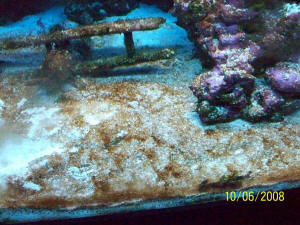
Brown dusty growth in my sand after trying Vitamin C dosing, reading 2/22/09 Hola Crew. <Como que va Juan?> I have a 75 G reef tank with 90 lbs live rock, a 30 gallon sump refugium combo (refugium has 7 gallons with 4-5 inches sugar aragonite and Chaeto), 6 fish, a juvenile 3" Acanthurus leucocheilus (I know, I bought it when I was stupider), three chromis, a PJ cardinal & two Ocellaris and several coral (Acan, mushrooms, two Euphyllia, bubble coral, two Duncans). I dose B-ionic and Kent Tech M after water changes. RO/DI water, two 150 HQI, 1000-1250 gph in circulation, ASM G2 skimmer. SG 1.026 pH 8.2-8.3 Nitrates 30 -> 10 Calcium around 375-400 Alk 3.5-3.7 mEq Mag around 1400 As an effort to reduce Nitrate levels running at 20-30 ppm , I recently tried first a period of vodka dosing (<6ml per 100 gallons) and subsequently Vitamin C dosing (also at comparatively light levels). I have stopped both. <Good> These, I believe, produced what I think are two different bacterial blooms <Could well have... at least the C2H5OH> in my DT sand only (1-2 inches of sugar aragonite). The first was a clump of what I think was Cyano (long stringy clumps of brown tendrils 2 inches in length) on the left side of my tank and the second is a brownish dusty coating on the right side. I have also noticed an increase in "film" on my glass nearer to the bottom. <All likely similarly fueled> I got the Cyano out by aggressive water changes, vacuuming and netting the clumps out and extended darkness periods for 3 days. Incidentally my nitrates subsequently dropped to under 10 ppm either by water changes or bacteria metabolizing the nitrates. However I cannot get rid of the brownish-tan "dust" on my sand. I can get rid of it from lights out for 72 hours, but it returns. <Will go in time... but...> I have to assume the VC and ethanol provided a growth factor for the bloom. I believe my detritus crew is too light which may fix this on repair. Is this "dust" a bacteria or dinoflagellates, and if dinoflagellates do you recommend high pH levels as a potential treatment? Are any scavengers consumers of dinoflagellates? <A few> I would enclose a picture but all you would see is a mixture of lighter and darker sand. <Please read here: http://wetwebmedia.com/algnutrcontrolfaqs.htm and the linked files above. Bob Fenner> Algae problem? What should I do? BGA 2/7/08 I have a 55 gallon tank. I have: one blue hippo, one yellow tang (juvenile but I know either way, eventually, my tank would be too small; I am going to trade in when too big), <For sure.> clown fish and a six line wrasse; my fish range from 1-1.5" so far. Coral: frog spawn, torch coral, candy cane coral, red mushrooms, Duncan coral, button polyps, Kenya, green star polyps and a bubble coral; these coral are basically small frags, up to two inches big. The problem is that I have stringy brown type algae in my tank. I am not sure if my tank is overstocked or if I have done something wrong. <Not overstocked as far as bioload IMO.> This algae type is catching on to everything, including my coral and building up in my overflow. I add additives such as: coral snow, amino acid, trace elements, calcium, and strontium. <Hmmm, some of these all in one types can be fertilizer!> This type of algae almost reminds me of diatom but when the few air bubbles (caught within) that may get through from the skimmer (reef octopus 125). The air bubbles look like they are catching on to the algae. If I take my baster and blow some water across (which makes the rock and such look so much brighter) the algae comes right back (after a few hours). <Yes.> I also have a clean up crew, which consists of Nass. snails (10), hermits (7) and turtle snails(2). I do not know what I did wrong, but I know I did something. <How about your filtration, setup in general? Feeding? Maintenance?> This tank is 1.5 years old. My ammonia, nitrites and nitrates are 0. magn. is also in good shape ( but could be a bit better). Am I going trough something natural? or, Am I just dooming my tank? <With a tank a year and a half old there is something amiss. I would cut out the additives. Unless you are actually testing for everything you are adding, it is best to just supplement Ca and Alk as needed. Then rely on water changes for the rest. Do read through http://www.wetwebmedia.com/bluegralgae.htm and the linked files above...this is your issue. Scott V.> Brown algae or diatoms. SW algal control, avoidance 2/3/09 Hello Crew! <Howdy> I am a long time reader and benefactor of your advice - thank you. <Welcome> Here's my setup: 75 gallon saltwater 4 years old and very 'stable' (until now) I use Coralife salt SG=1.021 <Mmm, too low for "reef" use> 90 lbs live rock one each: Flame Angel Hepatus Tang Yellow Tang Green Chromis 16 Bar Goby "Lawnmower" Blenny Maroon Clown Aqua C Remora skimmer (1400 gph power head) Eheim canister filter 2217 Coralife 48" 260 W CF 50/50 2 Rio Powerheads (1-682 gph & 1-382 gph) 3/4" Aragonite substrate I also had a small colony of Yellow Polyps I have read many of the articles regarding brown algae and/or diatom blooms. It seems nutrient export is the main remedy and possibly limited light. <Mmm, yes... along with competition (macro and micro... DSB, refugium) and predation, nutrient exclusion...> I have had a very stable set up as described above for a couple years. <You are likely a candidate for adding/switching out some substrate/s... See WWM re> Recently I decided to upgrade my light fixture from a Coralife 50/50 130 W to a 260 W CF. At the same time (coincidentally) I was replacing my RO membrane. Because of shipping delays I went 4 weeks without a water change (it was taking almost 10 days to generate 15 gallons of water). Shortly after I changed both the brown growth began and quickly covered all surfaces inside the tank. I have aggressively vacuumed, scraped and performed 25% water changes weekly - 3 changes so far. I empty and clean the skimmer regularly. It is not producing a lot more volume but the color has gone from a dark green to brown. <In a word: succession> I also added carbon to my canister filter. Here are my questions. 1) I feel as if the light change had to have contributed - do you agree? <I do> 2) Do you believe my current response will eventually return my tank to 'normal'? If not what else should I do? <Can, could... over months time... I'd be reading: http://wetwebmedia.com/avoidingalgaeproblesm.htm and the linked files above till you get/have the gist> 3) Will the brown growth harm my coralline algae (all the rock and back glass were a beautiful tapestry of purples, whites and greens - now they're brown) <Can, will> 4) The yellow polyps are not happy either. Will they be harmed and is there something I can do to help them specifically? <Move them short term... improve water quality long term...> Thanks in advance for your help. <Read on! And let's chat up your adding a 'fuge, switching out/adding new substrate/s, raising spg... Bob Fenner> Using ceramic magnets in reef tank 1/31/09 I like the idea of these frag racks, so I decided to build one. The first one I had just has arms, it works, but not very versatile. I want to make one with magnets. I was at Lowes and saw these magnets called ceramic magnets. They were not coated in anything, its just the magnets. I was wondering if these were safe to use in a reef tank, or do I have to use plastic coated ones? <These really should be coated....they do have ferrous material in them. Not only will they rust, but the magnets can actually separate over time. Ceramic sounds nice, but these are the cheapo magnets.> They look like the same magnets that are used inside Maxijet powerheads. <They are indeed, but the magnets in the pumps do have a coating to prevent corrosion. Scott V.> Cyano AND Bryopsis 1/31/09 Hi Crew! <Jennifer.> Ok, I'm at my wits end! I've been battling (and losing) Cyano and Bryopsis for about 3-4 months. I've scoured your site hoping that maybe I've missed something...the only thing I can think of is I need to upgrade the skimmer and/or I'm feeding too much. Stats: 2 yr old 55 gal w/ 30 gal refugium (no Cyano or Bryopsis in refugium) Chaeto in refugium but it seems to be shrinking, tiny powerhead in center section for Chaeto Fish: royal Gramma, coral beauty, damsel, clown, sleeper goby and a starfish. Zoanthids, Ricordea mushroom and starburst polyps. Food: 1 square of frozen mysis shrimp, rinsed and drained (that includes feeding the starfish) 85 lbs of live rock, (2) 50 aqua clear powerheads, 130 watts pc lights and a Coralife 65 gal protein skimmer. Water: R/O (filters changed 3mos ago) and top off is buffered R/O. I do a minimum of 10 gal water changes weekly, scrub the rocks without fail. Change out the micron pad, carbon and the 2 filter pads and clean the skimmer. In a week it accumulates at the most 1/2 cup of deep green/black skim. <That is not much skimmate.> Should I increase the water changes? <You could until the problem is under control, siphoning what you can along the way.> Upgrade the skimmer? <A better skimmer could have a big impact here IMO.> If so could you please recommend something? <AquaC, EuroReef. The new Vertex skimmers are nice too.> Cut back on food? <Just feed a bit at a time, making sure it gets consumed. Don't just drop the whole thing in there at once.> I was thinking of taking some of the rocks and putting them in a dark tank to kill this stuff..would that help? <It would kill it, but not address the root cause.> Your direction would be most appreciate..my fish deserve better! Thanks Jennifer <Welcome, Scott V.> Re: Cyano AND Bryopsis 2/1/09 Thanks Scott! I'll get a new skimmer and increase water changes. I really do appreciate it! Jennifer <Welcome, let us know how it all goes!> Algae Control 1/28/09 Dear Crew member, Pete from England here. <Hi Pete, James from Michigan.> I am desperately looking for an idea to help me with my 7 year old FOLR 100G aquarium. Since I changed my lighting 9 months ago, I have grown into a serious hair algae problem. <Yikes, I can imagine what you look like.> My email is long as I'm telling you everything I've been trying to cure this and I know it's very often down to excess nutrients in the water. My lighting was a 250W halide with two 18 inch actinics. I now have 2 X 36W T5 actinics and 2 X 36W 14K T5 lamps so quite a large drop in intensity. I have only a few soft corals and they still seem happy. <I'd go back to the halide. If water parameters are good, stronger lighting is likely to discourage nuisance algae growth.> My parameters: 24C 34 ppt salinity 3.5 mEq/L alkalinity No measurable Nitrite, Ammonia. Nitrate and Phosphate have always been nearly zero. pH around 8.0 to 8.1. Calcium 380 I've double checked the temperature and re calibrated my equipment for salinity and pH Several months ago I moved all live rock to one side and removed the majority of my thin layer of substrate, then did the other so have a fairly bare bottomed tank and have checked the overflow and sump for any areas of build up of detritus. I have been particularly careful about feeding, I feed twice a day, one fresh one flake. <Sounds to me like your substrate was acting as a DSB and removing it may have led to your algae woes. Looks like the time frame is close for both these events.> I have upped my water changes (RO/DI) to 30% per month and started buffering this water before mixing which I didn't previously do. Water is premixed in a large bin and has a Ph of 8.2 which I guess is right as the buffer is supposed to achieve this figure. <The buffer acts as a bank neutralizing acids to maintain the pH.> The Ph in the tank is still chronically low (around 8.0), I think perhaps due to the large amount of algae which breaks off and rots in the tank and filter. It never used to be this low. <Not dangerously low. I'd employ a mechanical filter, pad, etc. to remove this algae, change/clean weekly.> All my top off water is limewater and I drip dose morning and evening. The Ph can go to as high as 8.15 in the morning after I've dosed but still drop to 8.05 by the time lights go off. I only change Ph by a max of 0.1 each dose. I also clean the system pump pre filter twice a week, it's usually getting clogged already. I have added a mechanical filtration stage to my overflow to try to catch so much algae entering the system pump. <OK, sounds good.> I've removed some water and aerated it overnight but the Ph doesn't rise so I don't think low oxygen is a problem. <Likely you pH test kit isn't reading accurately. Can be difficult discerning different hues compared to a color chart. Is why I prefer electronic pH testers.> I have an appropriate skimmer (Deltec MCE600) in the sump which is fed by the overflow from the tank. It only produces a little each day but then I only have a small load: 1 six line wrasse, 1 percula clown, 2 Chromis and 1 coral beauty dwarf angel. Also 1 blood shrimp, 2 turbo snails, 2 hermit crabs. The hair algae is green, very fine and not feathery. I think it's Derbesia. It's not Bryopsis. I manually remove it with my water changes twice a week. It grows on the glass, rock, pumps, snails, everywhere. I occasionally add carbon for a while and have tried Polyfilters, they just slowly go brown after a month or so and stop any skimmate being produced. Rowaphos also seemed to make no difference. Water movement is by system pump and 2 large Tunze powerheads which pulse. I am sure there is ample water movement and any food floats around for a long time without settling. I can turn the pumps up further but then I don't see my fish. My live rock is a mixture of ages but much is 5 years old or greater. Mostly from Fiji. The tank is maybe one quarter full with live rock and the unlit 3 foot sump is full of live rock. I briefly tried lighting it last year but then the hair grew there which is right by the system pump and I thought it would clog even worse than before. Any comments much appreciated. Particularly interested in whether you think live rock can get too old (some people seem to think this) and whether it could be a lighting problem. I've not tried other bulbs but I could if you think it may help. I do not have many many snails or crabs as I have not needed them in the past and I think there is a more serious problem here. Likewise I don't have a Tang or Blenny and I don't want to introduce more fish at present ideally. <I don't think your live rock is the problem. Removing the sand bed and going to a less intense light in the same time frame is what I believe triggered the outbreak. I'd be putting the halide back on, lower light intensity is more favorable to nuisance algae growth. I'm not implying that this is going to stop the growth, but will help. Your system is out of kilter right now and will take some time to stabilize. Not wanting to introduce any more fish is a good move on your part. You may want to read these links and related articles/FAQ's for more help. http://www.wetwebmedia.com/nutrientcontrol.htm http://www.wetwebmedia.com/algaeconMar.htm Many thanks <You're welcome. James (Salty Dog)> Pete UV Filtration, and algae control f's 1/9/09 Hi all, <Hello> I've got a 60 gallon marine tank - not sure the terminology for my tank design, but basically the 60 gallon tank itself is subdivided into two sections - one for the marine life and the other which is an enclosed ~15 gallon part full of bio balls and a wet-dry filter. <Often referred to as all-in-ones.> The water circulates into this chamber and then is pumped back to the main part of the tank - but it is all enclosed in the 60 gallon acrylic tank. I've got a huge algae and Cyanobacteria problem thanks to a lunare wrasse that has destroyed all of my cleanup crew. <Actually large algae problems are indications of more problems than just a missing clean-up crew. What are you phosphate and nitrate levels? Do you have a skimmer? Is it producing good skimmate? How often do you do water changes and what other livestock do you have.> Despite that, we are trying to avoid parting with our little pain-in-the-wrasse because he is one of the more entertaining fish that we have. <Topping out around 10 inches, the Thalassoma lunare will need a larger tank as it grows.> We are hoping that an UV sterilizer would help us with this - but all the sterilizers I see use an additional pump to force water through a small chamber that contains the UV light. <Yes, is standard setup. However I do not believe a UV will help you much with algae control. It does not do anything for most algaes since they never pass through the filter.> We already have this tank design that effectively cuts down our tank capacity with this back chamber full of bio balls - so is it possible to just set up a bare UV light inside of that chamber? <No, not safe, recommended, or effective.> It is completely enclosed from the rest of the tank with black plastic - so no light should penetrate to the main tank. <I would be more worried about it damaging your own eyes than the tank, these bulbs and do serious and permanent damage to your eyesight. Also the intense UV light would most likely negatively effect the plastic or the filters.> If there is something more to the filter than just the light, I suppose this would not work? <Would not, beyond the safety concerns these filters need specific flow rates to work, which would not be able to be controlled without a dedicated pump.> Apologies if this is somewhere in the FAQ - I could not find it, <No problem.> presumably because I don't know the name of my particular tank setup. In general, is this tank setup reasonable? <Not really, UVs need pretty specific conditions to be safe and effective.> It was a hand-me-down, and perhaps that is why...but despite the fact that we lose a good amount of our tank capacity, it is a pretty simple design and easy for a newbie like me to maintain... Thanks very much for the help! Glenn <Unfortunately tank setups like you have are fairly limited in what they can do, especially within an marine environment. But you can only work with what you have.> <Chris> Re: UV Filtration, 1/9/09 According to the test kit I have, the levels for phosphate and nitrate are within the desired levels. Nitrate tends to be a little high, but still within what at least my test kit calls desirable. <Numbers here are everything, what the test kit considered desirable may not be.,> The tank came with a skimmer of sorts - there is basically an acrylic chamber in the rear part of the tank (where the bioballs are) where the water enters from the bottom and pours out near the top - at the top of the chamber is a plastic piece with a cylindrical tube coming out of the top - air is injected toward the bottom of this chamber and bubbles out the top. But don't think it is good for much other than making bubbles - I don't see any scum collecting at the top of the tube. <All too common with these style tanks.> So would this be something to add? <Absolutely, a quality skimmer will help immensely.> I had heard these were vital for coral, but did not realize they would help with our situation as well. <I would personally not run any tank without a quality skimmer.> I change 10% of the water every week. <Good> And the two problems are green (hairless) algae (coming from the food I feed my tang I think) and Cyanobacteria (goes rampant really fast). <Is prone to do so, nutrient control is key here. If you have not already please see here for more. http://www.wetwebmedia.com/bluegralgae.htm .> I have two small clowns (2-3 inches), one tiny damsel (1-2 inches), one yellow tang (3-4 inches), <Definitely will need a larger tank> and the wrasse (maybe 4-5 inches). I think the latter is still a juvenile based on the black spot on his fin. We also have a serpent star. <Perhaps not for long.> > Despite that, we are trying to avoid parting with our little > pain-in-the-wrasse because he is > one of the more entertaining fish that we have. > <Topping out around 10 inches, the Thalassoma lunare will need a larger tank as it grows.> At what point would he (and presumably the tang) outgrow this tank? <The problem is that by the time you start seeing symptoms of outgrowing the tank the damage is already done. I would consider moving them sooner rather than later.> > We are hoping that an UV sterilizer would help us with this - but all the > sterilizers I see use > an additional pump to force water through a small chamber that contains > the UV light. > <Yes, is standard setup. However I do not believe a UV will help you much > with algae control. It does not do anything for most algaes since they > never pass through the filter.> > We already have this tank design that effectively cuts > down our tank capacity with this back chamber full of bio balls - so is > it possible to just set up a bare UV light inside of that chamber? > <No, not safe, recommended, or effective.> > It is completely enclosed from the rest of the tank with black plastic - so > no light should penetrate to the main tank. > <I would be more worried about it damaging your own eyes than the tank, > these bulbs and do serious and permanent damage to your eyesight. Also the intense UV light would most likely negatively effect the plastic or the filters.> Ouch - thanks very much for the info then. <Welcome> We had the tank for about 5-6 months before getting the wrasse without significant algae problems - we had 6 turbo snails, 10 hermit crabs, and 10 marguerite snails - but he has killed all but 1 turbo snail. I wish I could figure out why he stopped at that one though - it is still doing an effective job on a small part of the tank each night, but obviously cannot proceed alone. It was the smallest of the Turbos that we bought - but I don't see why that would stop him. <Who knows what goes on in the brains of fish, perhaps he has found prepared food easier/tastier for the moment, but I would guess at some point he'll go after the snail, its just what they do.> We tried a serpent star, but it has proven useless (albeit interesting to watch). <They tend to go for meatier fair.> I thought it would help clean the sand (also quickly infested with Cyanobacteria even a day after I rake the sand), but I guess I was misinformed about that too. <Yep, very little eats Cyano.> > If there is something more to the filter than just the light, I suppose > this would not work? > <Would not, beyond the safety concerns these filters need specific flow > rates to work, which would not be able to be controlled without a dedicated > pump.> > Apologies if this is somewhere in the FAQ - I could not find it, > <No problem.> > presumably because I don't know the name of my particular tank setup. > In general, is this tank setup reasonable? > <Not really, UVs need pretty specific conditions to be safe and > effective.> > It was a hand-me-down, and > perhaps that is why...but despite the fact that we lose a good amount of > our tank capacity, it is a pretty simple design and easy for a newbie > like me to maintain... > Thanks very much for the help! > Glenn > <Unfortunately tank setups like you have are fairly limited in what they can do, especially within an marine environment. But you can only work with what you have.> Do you have any other suggestions for what we could do? Aside from our enjoyment of the tank, we have a 5 month old boy and he calms down quite a bit just watching the fish. :) <For the time being set up the water changes, preferably with RO/DI water, and syphon as much of the algae and Cyano you can. With time an a bit of effort you will get it under control. Also try cutting back on feeding, many people do not realize they are overfeeding their fish and in the process adding excessive nutrients to the tank, which the algae and Cyano happily use up.> thanks again! <Welcome> <Chris> Another Algae email... 12/21/08 Hi there friendly people at WWM, I have an algae issue that is causing stress on my marriage :-). <I don't like this... the stress> I have been battling it for sometime now and have decided that I am going to tackle it or go down swinging. Let me give you a brief history of time. <Please do> Parameters of my tank are as follows. 70 Gal reef tank with 90lbs of live rock 36"x18"x24"deep Lighting is 2x96w PC 10,000k (I have purchased but not rec'd yet a 6x39w T5HO) DSB of 3"-5" live sugar fine sand (depending which end of the tank you are looking at). Circulation is an Aqua Clear 70 (400gph) Prism Pro Skimmer (cleaned several times per week and adjusted as needed) hang on. Temp remains at 77-78F Salinity is 1.025 Nitrates are 1.0ppm NO3-N (LaMotte). my source water is also 1.0. don't know if that is hampering me or not at this level? <Mmm, a comment. There is a bit of dynamic that many "western" folks tend to miss here... that measured nutrient values may be "bound up" biologically rather than "free" (in the water). In other words, there may well be quite a bit of nitrate, phosphate, other chemicals in your system, but they are being scrounged by your biota, including pest algae> Phosphates are 0 (D-D Merck) <See above> Alkalinity is at 11.2 dKH (LaMotte) Calcium is 380 (SeaChem) <Magnesium? Needs to be about three times [Ca]> 8.2pH Chemistry seems to remain stable. I supplement 1 drop of Lugol's Solution per week. <Okay> No fish. About 30 Astrea Snails and 10 or so small hermits that I kind of wish were not in there. Only Mushrooms (several varieties), a Frogspawn, star polyps and Zoanthids. I have had the system approx 2 yrs now and have been doing water changes that average 10% per week. Hair algae crept up on me about a year ago (at that time I was running a sump with Grape Caulerpa). I dismantled the sump about 7 months ago. I intend to re-install within a couple of weeks with Chaetomorpha on a reverse daylight schedule with a 150HQI about 14in above the sump. Is this ok or too much? <Should be mighty fine> I did this with Caulerpa and left on 24/7 schedule. As I do the water changes I try to get as much algae off of the live rocks as possible and I vacuum the substrate every other time, as there has usually formed a green mat in places. This algae is not the same as my above reference to "hair algae". <May be a blue-green... do you have a microscope? Does it feel slimy? Can you send along a well-resolved pic?> The Algae continues to grow at a very predictable rate. I have recently begun to blow the live rocks with a small power head to stir up debris before water changes. I guess my question after all of this is what am I missing? <Mmm, not so much this, as what you might be able to easily do to reverse this trend... See below> Is there another nutrient that I am not testing for? <Assuredly yes> What key nutrients are required to feed this BGA besides Nitrate and Phosphate? <A bunch, but unfortunately, they, these are almost identical to what is needed for your other intended life...> My new strategy (prior to this email) is to attempt to out compete it with Chaeto in a sump. <Is a good one> I know the Caulerpa was not a good choice. I will be installing a Precision Marine Venturi Skimmer when the sump goes in. This should be a more effective skimmer. <It will be, yes> I have read hundreds of pages in WWM and will no doubt read hundreds more - very fine site BTY. <Thanks> For source water I use municipal water that has been aerated for 7 days, mixed and kept to temp. Top off is the same (not mixed of course). <Good> Alkalinity is high in the source water and I supplement Calcium Advantage by SeaChem to keep Ca levels. Thanks Mucho in advance, Scott Marshall in Fayetteville, TX. Pop 261 :-). <Neat! Let's see... Scott, in addition to the changes you plan, stated above, I encourage you to add to, or switch out a good deal of your hard substrate here... Either the rock and/or the sand... Please read here re the rationale: http://wetwebmedia.com/substrepl2.htm and the linked files where you lead yourself. Oh, and I would at least measure your Magnesium levels... Please have a few minutes look see here re: http://wetwebmedia.com/mgmarfaqs.htm And happy holidays to you and yours. Bob Fenner> Weird Green Water, SW, reading, study 12/10/08 Hi, I have had a odd problem with a green colored water in my saltwater aquarium and have failed to understand why. The first tank was a 65 gallon aquarium with the appropriate protein skimmer, Fiji live rock, and sand, and VHO lighting. The tank went well for the first few months, and then the water started to turn green. <Mmmm... does sunlight shine on this system? Do you have issues with source water nutrients?> We kept maintaining the water and feeding the fish but soon the water got soo green that we couldn't even see the fish. We thought the VHO's were bad so they got replaced (one white one blue). Out of desperation, we tore the tank down and moved the rock, remaining fish (Jawfish) and coral (colt coral) to a 75 gallon with new sand, and a added sump and bigger protein skimmer than the 65 (which had the BakPak skimmer). LO AND BEHOLD, after about a week of being set up the green water returned and gets worse every day. Soon, it will be as bad as the 65 gallon. I also have a 29g. reef and rock, water has been transferred to this tank and no green algae in the water has occurred. I simply don't understand it. We are thinking about getting a UV sterilizer to help with this problem because we simply don't know what to do. HELLPP! Thanks, Adam <A UV might definitely help... symptom-wise... but am curious, wanting to help you discern root cause/s here... Please read here: http://wetwebmedia.com/avoidingalgaeproblesm.htm and the linked files... where you lead yourself... There are a few "general" inputs here... causes... and possible counters... Better initial water quality, chemical filtrants, competitors, predators... as you will see. Bob Fenner>
Re: A short story made long, Algae control 12/2/08 Chris -- <Hi> The Ammonia and Nitrate are zero <Nitrite?> and the Nitrate is well below 10 ( the lowest scale on the Instant Ocean test guide) results are the same with the AP test kit -- and these numbers have been consistent for the life of the tank (minus the first 3 months of cycling, mistakes and more cycling. We also do a 15% water change weekly. Any other suggestions? Allen <Phosphates are most likely your problem here. I would recommend picking up a phosphate test kit and testing both the tank water and source water. At times the algae will bind up all the phosphate so fast that the tank will not register any, so make sure to test the source water.> <Chris> Nuisance Algae/Alkalinity Problems 11/11/08 Hi, <<Hello>> I hope you can help me with this. <<Me too! [grin]>> I have been reading your site & have asked a question about nitrates a few months ago (they wouldn't come off of 10). After following the recommendations I finally got them to between 2.5 & 5.0. <<Very good>> Didn't have any problems with fish, inverts, algae, or LPS, or other tests (all fine). <<Okay>> In the last month I have been having a problem with the alk. slipping. I use R/O water for the top off, & a PUR filter for water replacement, <<Mmm'¦>> I adjust PH & alk & add after 24 hrs. <<What about some type of water movement/aeration to off-gas CO2?>> I use Superbuffer by Kent Marine & it says it could take up to 24 hrs. for pH to stabilize. <<I am a fan of Seachem's products for this>> I add baking soda to get the alk. right. In the last month I am plagued by brown diatom algae everywhere the light hits & now some green hair algae, which I never had when the nitrates were up. <<Mmm, still'¦ I suspect your water filter here>> I read that a low reading on magnesium can cause alk. to slip, especially if you have mangroves ( which I added 9 about 3 months ago). I got a Red Sea test kit. If I am reading it right it is at 1200. <<Not bad, should be roughly about three times your Calcium level>> My test readings: ammo. 0, nitrites 0, pH 8.2, nitrates between 2.0/5.0, phosphate 0, alk was 2.9 on Sat. & today is now 1.7. salinity 1.025, temp 78. I have a Rena 3 filter, which has only filter pads & sponges, <<Cleaned or replaced at least weekly I hope>> a Magnum 350 w/ filter sleeve & phosphate remover (for 3 days only after water change) right now, afterwards with reef carbon, <<I would omit the filter sleeve and use this exclusively for chemical filtration>> an AquaC protein skimmer, a Hydor Koralia 3 pump. Skimmer cleaned daily, Rena every 2 weeks, <<Would do this at least weekly. Decaying detritus buildup is certainly not helping your nuisance alga issues>> Magnum weekly. In the last 2 weeks I have lost about 1/2 my snails & hermit crabs, 1 clam & 3 fish. <<Yikes!>> The only thing else I use is Prime water conditioner, Oceanic salt, Kent essential elements & food. The only new thing I added was the baking soda, which I read about on your site to keep the alk up. I just don't know what is going wrong. <<Hmm, me neither'¦ Though tis sounds like some kind of system poisoning. How old is your water filter?>> I really hope you can give me some clue as to what I am doing wrong. Oh I also have a 250 w 14K MH light about 8 months old & it is a 95 gallon tank. Do you think the baking soda is doing this? <<No>> I am adding it to the new water before I add the salt & wait 24 hrs & test again to be sure it is right before adding it to the tank. <<This sounds fine, my only other suggestion would be to include some aeration during this period>> I didn't use any directly in the tank & since any change in pH & alk is supposed to be done slowly I only treat the new water. I do weekly water changes. Thanks for any help/ideas you might have. Tina <<Well Tina, nothing really wrong/much to go on with what you've posted here. A couple thoughts though, in addition to those already stated'¦ I would look to exchanging the cartridge in your water filter as it may have a buildup of toxic compounds that are being released/are malaffecting your system, and think about replacing it altogether with an RO/DI unit. I would also consider utilizing a better salt brand, one known for better consistency like that from Tropic Marin or Seachem. Regards, EricR>> Re: Nuisance Algae/Alkalinity Problems 11/12/08 Eric, <<Hi Tina>> Thank you for such a quick reply. <<Quite welcome>> I do use a powerhead in the container for the new water mix along with a heater to get the temperature right. <<Ah, excellent>> You might be right about the water filter, I hadn't really thought about it but about the time I started having problems I had changed to one made by DuPont & it doesn't have an indicator telling me when it is expired like the PUR one did. <<Mmm, yes'¦ This filter is likely no more than a carbon cartridge, and as such may be insufficient for your system depending on the quality/chemistry of your source water>> And maybe the quality isn't there either. <<I doubt it makes much difference re these household drinking-water type filters>> Also since I have you, hopefully!, right now, maybe you can help me with the R/O filter. <<Would be my pleasure>> I have one by Whirlpool. It is oh so painfully slow, <<Indicative of how an RO filter works>> and doesn't make much water before it stops working, <<Mmm, well'¦ This is NOT how it should work>> and the cartridges are expensive, especially the membrane. <<I can help with this/other components (see the link below)>> You unscrew the cartridges & replace the whole thing. <<Ah, I see'¦ Time for a new filter system>> I was looking at some that you can replace just the internal material. <<Yes>> These are a lot less expensive but I don't want to mess up & get something that doesn't do the job. <<Little chance, as most all are very similar>> I will replace my water faucet filter today. <<A good interim strategy'¦ For better water filtration gear as well as excellent prices re have a look here (http://www.thefilterguys.biz/ro_di_systems.htm). These guys will also gladly help with any questions you might have. And you can always give me a shout as well>> This morning I had some dead bristle worms & a limpet (really liked that guy). <<Something is amiss>> Should I do a bigger water change than the usual 20g? <<For lack of a better idea at the moment, yes (and with a better salt mix?). Do also employ some Poly-Filter (http://www.drsfostersmith.com/product/prod_display.cfm?pcatid=4335) in your filtration flow path to try to �soak-up� whatever may be poisoning your system Maybe do several small ones over a week? <<Hard to say for sure, but I think a couple big water changes may be in order here>> Thank you so much Tina <<A pleasure to assist. Eric Russell>> P.S. One last word, just to have one more weird thing to add to this mystery. My anemone (unknown type supposed to be a bubble tip, but isn't, but the clown loves it anyway) has more than doubled in size since this started, and has gone from a pale green to a deeper green. Any thoughts on that? <<Hmm, a conundrum for sure'¦ Perhaps a very specific chemical issue here is affecting your other animals'¦ Or maybe a biological (hitchhiker) factor'¦ But let's keep working on improving the quality of your make-up water; while at the same time keeping an eye out for anything else unusual going on within the tank. EricR>> -Hair Algae Control 11/6/08 Hello again(the gods of fish) <Jessy demi-goddess here> My problem today is HAIR ALGAE and loads of it that just won't go. My tank is a 350ltr(uk) corner tank with about 30kg of live rock 2-3" of live sand 4 wavemakers totaling 15600ltr/h of water movement. Two external filters with floss/ course and fine sponge in 1 which returns to the tank via a tmc 25watt uv sterilizer with the flow rate from filter at have way(max flow 1200ltr/h) and carbon and phosphate remover in the other(max flow rate 600ltr/h). My skimmer is a TMC V21000 with a Rio 2600 pump. My lighting is a 250 watt metal halide mounted 8" off the top of the water with 2, 55watt high output compact actinics. My tank readings are ph 8.2-8.4, ammonia 0, nitrite 0, nitrate 10-20 ppm, phosphate 0, magnesium 1170, calcium 420. The test kits I use are Salifert. My live stock is 2x Anemones(Bubble tip), 6x Hermit crabs, 3x Turbo snails, 1x Sand shifting starfish, 4x Clown fish, 2x Regal Tang, 1x Algae Blenni, 1x Blue Stripe Guppy. I also have 2 sea fans and different types of soft corals. Please help as I've had this problem now for about 5-6 months and my water stats (I thought) seem fine. Oh, my tanks been running for about 18 months and I use Red sea coral pro salt with RO water mixed 1 week before use. <Lee, the next time you write a question to us please take the time to proof read your question and use correct grammar and punctuation, like commas. I took the time to fix most of your query this time, but most wouldn't have bothered. If you have hair algae the best way to make a dent is attacking it physically and starving it nutritionally. Physically remove what you can with your fingers or tweezers in clumps. Yes, its tedious but there is an end in site. I've done it to tanks before and it doesn't take as long as you think it will. Buy a few large turbo snails and place them right on the hair algae every time you walk by the tank and see them not eating it. Lastly, you probably aren't reading any phosphates or nitrates right now because the hair algae is feeding on it. You need to keep your water quality up with water changes and reduce the amount of food that you put in the tank. If you don't put it in, there won't be anything for the algae to grow off of.> Thank you regards Lee. <Jessy> Overflow Algae 11/1/08 Hello Tank Jedi's <Welcome to the dark side.> I was wondering about algae in the overflows. I have a 125g reef tank that has been up and running strong for a year now. It seems that over the last few months, the algae in the dual overflows has REALLY taken off from a small amount of green hair algae, to a few varieties now and seems to really be taking over the pvc and the top area all inside the overflows. Is this normal? <Well, it is just another place for nuisance algae to grow.> I was considering throwing a sea hare in there to feast. <Oh, no, for so many reasons!> Thank you for your time! Alan <Fact is algae is a common reason for overflow failures. If not kept within reasonable check it can restrict or completely plug the drain. I would just manually remove what you can, just make sure the drain is unrestricted. Otherwise, do consider fabricating a shade for the boxes to keep the algae from growing in them. Welcome, Scott V.> Aggressive Peyssonnelia growth in a marine tank 11/1/08 Good morning to the WWM crew. Thank you for providing this resource. <A collaborative effort.> I have a 30g reef tank with an aggressive red encrusting Peyssonnelia growth problem. It started as small (very pretty!) maroon-colored flecks all over the live rock, and I thought it was a dark purple coralline algae until it had gotten a good foothold in the tank. Now, it has begun to crowd out the corals and prevents the sea mats from expanding. <Hmmm.> Tank has been set up for 13 months and is aggressively cleaned using a Tunze filter/skimmer combo. I run a fresh teaspoon of carbon every other week. All water parameters are normal and I have cut back on feedings to once per day and frozen foods to twice per week. After some reading, I added a tuxedo urchin to help control the Peyssonnelia but she went straight for the coralline and has ignored the macroalgae completely. Livestock: pair of black percs, coral beauty angel, flame hawkfish, and about 20 assorted snails (narcissus, Astraea, & nerite) and crabs (blue & red leg hermits, emerald crabs). Any help or advice would be appreciated, thanks kindly! Brooke S <Not much to offer here except for the normal algae control spiel. Have you considered adding a macroalgae refugium to compete with this algae? Otherwise, if this is indeed Peyssonnelia you should be able to manually remove it to control its takeover. What you describe sounds more like a BGA. Also do see http://www.wetwebmedia.com/algaeconMar.htm for other control measures. Welcome, Scott V.> GREEN TANK Help please, SW, reading 10/8/08 hello guys, I'm writing because for about a month now my fish tank has basically died. <!?> I can't explain it only that nitrates rose to 80ppm unexpectedly <Mmm... did something indeed die? Perhaps someone placed too much food?> and after a lot of hard work at water changes and water changes and water changes, it is still green on the sand and on the glass. I've gone through a bottle of Algaefix <Danger!> and have to say what a waste of money that was. Please my levels are great for everything else. I had 5 fish a clam a shrimp and 5 corals. I'm down to one coral one fish and the shrimp. I'm ready to give up. I have lost all hope. Please help me, or give me advice on what to do next. It's a 46 gallon bowfront with metal halide lighting and three powerheads with sump and protein skimmer. Thanks ROY <Mmm, need to know a bit more Roy... re the actual set-up, history, water quality/tests, your source water, foods/feeding practices... These algae situations can be remedied in a few ways as you'll soon know... by reading... here: http://wetwebmedia.com/nutrientcontrol.htm and the linked files above. Bob Fenner>
Problem-please help... SW, alg.? issues, soln.s
9/27/08 Hi gang, My post may be a little bit long but I want
to give as much info as possible to find a solution. So coming to the
problem, first Cyano, now dirty sand, really dirty. <What...
"is" the "dirt?"> My 100gal reef started in
April, 5ft long, about 100lbs of live rock (some LR from my older tank,
also a lot of water from the old tank for easier start, no problems
with older 30g tank). Light is 4x96watt PC (turned on 11-12hrs a day),
main pump rio, 2xkoralia's4, about 1inch sand bed, <Composed of?
I'd see WWM re... possibly adding to, making a NNR here>
euro-reef rs180 skimmer. I started the tank for one month using instant
ocean salt, change after month for reef crystals. Dosing magnesium,
Alk, calcium, twice a week 2 drops of Lugol's solution, and once a
week 2 spoons of strontium. <Mmm, why this last? I'd stop unless
you're measuring a deficiency> Salinity-1.025 Nitrates-5 ph-8.2
calcium-390-400 phosphate-undetectable (but I don't believe that)
Fish-yellow tang (saved with huge HLLE, healed now), <Ah, good...
and a good sign> purple tang, flame angel, yellow blenny, blue sided
wrasse, Firefish Invertebrates-various snails (trochus, Cerith, turbo
and Nassarius), hermit crabs, brittle star fish, 2 shrimps (scarlet
skink and fire). A month ago I purchased 1 fighting conch-didn't
help with my problem. <Mmm... perhaps unpalatable... maybe BGA>
After couple of months I started to see dark spots on my sand bed, I
was trying to clean, steer it etc, nothing helped, it was worse and
worse. Then one day the real Cyano attacked my tank, especially one
side of my tank. Now when I put my hand in sand I see water bubbles
going up. I thought maybe I feed too much, in the morning flakes, in
the afternoon 2x2inches dry seaweed for my 2 tangs, angel&wrasse,
in the evening half, sometimes 3/4 of frozen cube (formula 1&2,
angel formula, mysis shrimp). So I cut feeding a month ago, no morning
flakes, only afternoon dry seaweed and evening frozen cube (rotate,
every day different). My visible red alga disappeared from the sand
bed, but my sand is still very dirty, sometimes after about 6-10 hours
of light I can see it is more dirty then early morning when I turn on
the lights before going to work. <A good clue> So I had like
million ideas so far, too much feeding, too weak circulation <With
four Koralias here I doubt/discount this> (I keep only LPSs, plus 1
soft and one sps coral-Montipora, still growing by the way even under
pc light), pc lighting no good (bulbs around 5 months old, problem
start when bulbs were 3 months old), no Chaeto in sump (only behind
live rock, definitely not enough), <I'd be adding, growing a
purposeful macroalgae here> water after tds 005-008, <What
units?> depends on the day in Chicago. I was asking different
people, nobody can really help, you are my last chance guys. The tank
looks really ugly with these now brown sand. Trying to put bigger
(cleaning crew), pout fighting conch, cut feeding, change water instead
12 gallons a week like before now 24 gallons a week, nothing helps. I
was thinking about some kind of goby, which one would you recommend
that won't be too big, won't fight with my blenny and Firefish
and won't cause too big of sand storms, I have some LPSs on the bed
sand. Or maybe I should try sea cucumber, but I am worried that it will
wipe out my reef one day, especially that in about 15-18 months I will
have to move the tank, hopefully for one and last time. I want a clean
looking sand!!! ps-I might send you a sand picture, even morning &
evening to compare if it help, let me know thanks Daniel <Mmm...
there are a few approaches worth trying here... the added
substrate/NNR, growing the macro as mentioned... perhaps some other
biological algal predators as you state... I would stop with all
supplements period for a month or two... Any chance of your taking a
look under a microscope to determine what Division of algae/Protist or
bacteria this is? Please read here:
http://wetwebmedia.com/nitratennr.htm and the linked files above.
|
|

|
Features: |
|
| Featured Sponsors: |