|
FAQs on Marine Algae and Their Control 17
Related Articles: Avoiding Algae Problems in Marine System,
Algae
Control, Marine Maintenance,
Marine Scavengers, Snails, Hermit
Crabs, Mithrax/Emerald
Green Crabs, Sea Urchins, Blennies, Algae
Filters, Ctenochaetus/Bristle Mouth
Tangs, Zebrasoma/Sailfin Tangs,
Skimmers, Skimmer Selection, Marine Algae, Coralline Algae, Green Algae, Brown
Algae, Blue-Green
"Algae"/(Cyanobacteria), Diatoms, Brown
Algae,
Related FAQs: Marine
Algae Control FAQs 1, Marine Algae
Control 2, Marine Algae Control
3, Marine Algae Control 4,
Marine Algae Control 5, Marine Algae Control 6, Marine Algae Control 7, Marine Algae Control 8, Marine Algae Control 9, Marine Algae Control 10, Marine Algae Control 11, Marine Algae Control 12, Marine Algae Control 13, Marine Algae Control 14, Marine Algae Control 15, SW Algae Control 16, SW Algae Control 18,
SW Algae
Control 19, SW Algae Control 20,
SW Algae Control 21,
& Marine Algicide Use, Nutrient Limitation, Marine Algae Eaters, Culturing Macro-Algae; Controlling: BGA/Cyano, Red/Encrusting Algae, Green Algae, Brown/Diatom Algae, Phosphate,
|
|
 |
New Print and
eBook on Amazon
Marine Aquarium Algae Control
by Robert (Bob) Fenner
|
How to clean diatoms 10/15/09
Hi again WWM Crew,
<Alek>
Our tank finally finished cycling this past week and we tested our
water before adding our snowflake eel; our results were as such:
ammonia=0 nitrites=0 nitrates=some, but very low amount.
Here's what's driving me nuts - the diatoms won't leave us
alone!
<"They come and they go">
They started disappearing a while back and almost entirely went away
but then all of a sudden, out of nowhere (nothing was added, removed or
changed), they took over all the live rock and are now spreading
throughout the substrate (crushed coral). I frequently rinse the filter
bag (since it quickly becomes covered in diatoms), we finally got a
protein skimmer up and running about 2 weeks ago,
<This will have a decided effect over time>
I'm constantly
wiping any brown off the glass, even rinsing off our live rock and
changing our water on schedule but they don't go away! :( The
biggest issue is the substrate which I don't know how to clean.
<Stir or vac it when you do water changes...>
Basically, the
only thing I haven't tried is removing all the substrate entirely
and washing it outside the tank.
<No... don't do this>
For some reason I have the feeling that's
precisely what you're going to suggest I do -.-
I know that a handful of cleaners would definitely aid me in removing
these diatoms, but with the snowflake in there, all they'd do is
become eel breakfast. Would a sea urchin be compatible?
<Your eel might get poked>
If so, do you
recommend a specific one (the hungrier the better)? And are there any
other critters I can stick in there to also help clean.
<There are a bunch of types of sand stirrers. See WWM w/ these
search words>
On a side note, I have another question - how is live rock supposed to
smell?
<Like a fresh ocean ideally>
When I took it out to be rinsed, I curiously smelled it (having smelled
it when I first bought it) and frankly it did not smell
"good" at all. Is it dying?
<Some parts no doubt>
Here's what's on it right now: a few
"stringy" (and short, about half a centimeter) organisms
growing on it and a small, dense patch of white hairs, some faint
purple and dark pink patches, and a good portion of the rock is covered
with this smooth, hard, white, and lumpy "shell" if that
means anything? I'm just a little worried that something that
shouldn't be happening is.
Thanks!
-Ar
<Mmm, maybe at least one reading assignment:
http://wetwebmedia.com/brownalgcontfaqs.htm
and the linked files above. Bob Fenner>
Could lighting be too strong
Algae Problems 10/15/09
Hi!
<Hello>
I am having a problem with red algae; and I was wondering if the
problem could be associated with my lighting. I have a (1) l0000K watt
bulb on both sides of my tank. I also have blue actinic lights but the
red algae is only under the 10000K watt bulbs. Should I be using less
wattage?
<Well you didn't explain the wattage or type of lighting you
have, just the color spectrum of it. Is it Metal Halide or Fluorescent,
and what wattage?
However, the lighting is likely not the problem if the bulbs of are of
a reasonable age.
Are you sure you are experiencing red algae problems, or could it be
Cyano bacteria or Bluegreen algae, which is often red... Please do some
reading, look at some of the pictures on the website and help identify
what you have in your tank, then write back including more of your tank
parameters / test results and we will see what we can do.
http://www.wetwebmedia.com/bluegralgae.htm
http://www.wetwebmedia.com/redalgae.htm >
Thanks in advance
Danielle
<You're welcome,
Josh Solomon>
Another High Nitrate Question/Algae Control
9/5/09
<Hi Bill>
I'm sure the subject line made you cringe but thanks for
reading.
<Nah, get them quite often.>
I have a 55 gallon tank that I got from someone moving out of the
country about 5 months ago. The tank has been running for about 2 years
prior. I have been battling high nitrate levels (started well over
100ppm) since getting the tank.
<Yikes.>
Lost all but one fish (green bird wrasse) from what I think was ich or
marine velvet (and stress from poor water quality). The tank only had a
Marineland canister filter c230 when I got it. I added an Emperor 280
hang on filter and a Koralia 400gph power head after setting up tank in
my apartment. Doing a 15-25 gallon water change every week has brought
the n03 level below 100 but still higher then 50 (hard to be precise
with either of the test kits I have been using). I can't seem to
get below 50ppm. I added an AquaC Remora skimmer 2 days ago (has been
doing well, at least from I what I can tell so far. I have had to empty
the cup the last two mornings). After reading over your site last night
I decided that a dirty pre filter, old media, and bio balls (although
I'm not sure if they belong in a wet filter to begin with) in the
canister aren't helping the situation.
<Correct, the bio-balls can be discarded if live rock is used in
your tank.>
I 'overhauled' the canister filter this morning: cleaned course
filter pads in train tray one. Replaced old carbon media bags with
filter floss in train tray 2 (figured with two carbon media packs in
the hang on, more carbon wasn't necessary). Replaced the bio filter
media in tray 3 with new Fluval Biomax (leaving a few pieces to speed
up new bacteria growth). And put Fluval Clearmax in the last tray to
try and help with no3 removal, not sure if this stuff works but figured
it won't hurt.
<The protein skimmer and weekly water changes will be the best aid
in nitrate reduction.>
The big thing with cleaning the canister was all the 'gunk'
that came out of it, so I was excited and figured I had finally found
the source of the problem.
<Yes, these need to be cleaned weekly.>
Hooked the canister back up, cleaned some algae off the glass and did a
20 gallon water change'¦'¦..waited about 2 hours
tested'¦'¦'¦..+50ppm. I am using two
different test kits because I convinced myself that one was wrong a
couple months ago.
I have tested the tap water I am using and it is 0. I think I am still
on the right track with cleaning the canister and the addition of the
skimmer.
<Yes.>
I also removed the bio wheel from the hang on. I want to stock the tank
again but I need to get this no3 under control first.
<Yes, do hold off adding fish, will just add to the problem at this
stage.
Your Bird Wrasse requires more like a 125 gallon tank, a 55 is much to
small for this fish, and the waste this fish produces in this confined
space is contributing to your problem.>
I think the addition of more live rock will help.
<Not so much for nitrate control.>
I am not sure how much I have or how 'live' it is but it's
about half way up the tank with enough room all the way around to get a
mag float type algae cleaner around. the sand bed varies from 1 to 3
inches, so I think some more to augment the old sand and increase the
depth a little will help.
<No more sand, your present sand bed may not be live and may be
contributing to the problem.
May want to use a gravel/sand vacuum when changing water>
Will the nitrate level hurt or hinder any new live rock/sand
growth?
<No, but it may become covered with nuisance algae making it
unattractive.>
Should I do anything else with the canister besides clean it
weekly?
<Might want to use Chemi-Pure rather than carbon, works much better
in nutrient removal.>
Any help would be greatly appreciated. Great site by the way, a lot of
great info.
<Thank you, and do follow guidelines on algae/nutrient control on
our site and you should overcome this problem. Keep reading/learning my
friend. James (Salty Dog)>
Bill
Nuisance Algae: SW Algae Control - Inadequate skimming
likely culprit. 9/2/2009
<Hi Matt.>
Over the years, WWM has provided me with answers to the many questions
that have arisen as owner of a saltwater aquarium. Many of the
solutions suggested have been of great help and are greatly
appreciated.
<Thank you. We are happy that you have found it helpful and
informative.>
However, at the present moment, I am faced with a nuisance algae
problem that I cannot solve. Since moving my 75 gal reef tank (with 30
gallon refugium) about six months ago, I have been unable to get rid of
the algae problem (somewhere between Cyanobacteria and brown algae in
color) that I am currently faced with. Despite doing weekly cleanings
and water changes, the algae (or whatever it is) will not subside.
<Likely a strain of Cyano.>
I have reduced the amount of food given to the fish and also reduced
the amount of time that the lights are on in both the display and the
refugium (10-12 hrs/day).
<Good.>
I have about 100 lbs of live rock, 2 inches of live sand in display,
4-5 inches of live sand in the refugium, Chaetomorpha in refugium and a
Turboflotor Multi skimmer. The refugium has 2 55 watt PC and the
display
has 4 65 watt PC. Livestock in the tank is as follows: small clownfish,
blue hippo tang, purple tang, polyp colony, snails and a couple
crabs.
<Large number of big fish for a 75 gallon.>
My parameters are as follows: SG - 1.024, PH 8.2, NO3 - 0, NO2 - 0,
Ammonia - 0.
<Looks good.>
Since moving, the Chaetomorpha does not seem to be doing well. It is
covered on top by red slime.
<It happens. Just remove it.>
When I look at the layers underneath, it seems to be in fine shape.
<Very typical.>
All the small critters in the refugium seem to be doing alright. In
looking at the water surface in the display, there is a film on
top.
<A clue. Organics are building up on the surface and are not getting
pulled out by the skimmer. For that matter, it doesn't seem as if
your overflow is pulling enough water from the surface>
Additionally, my protein skimmer is quickly clogged and needs to be
cleaned out completely once every two weeks in order to maintain good
operation.
<Hmm.... Mine never gets clogged up, but I need to clean my cup and
riser tube every 3 - 4 days. How much 'gunk' are you skimming
every day?>
I don't know really where to go from here. Should I look into a new
skimmer?
<That is an option - Turboflotors are pretty good skimmers. Are you
sure you have yours set up correctly?>
Do I need more rock?
<You should have enough with 100 lbs.>
Is the decline in the Chaetomorpha contributing to the algae
problem?
<Likely so. Try to get it closer to the light.>
What would you recommend I do to help combat this problem?
<Do look closer at your skimmer. Water changes, good skimmer
production, and manual removal of the algae will eventually beat it. It
will take some time though.>
I just want to make sure that I am providing my fish and other marine
life forms with a great place to live. Anything you could suggest to
help me out would greatly appreciated.
<Do the things I mention above and have a read here:
http://www.wetwebmedia.com/bluegralgae.htm It will take a while, but
you will win eventually.>
Thanks again for providing us with a great resource in WWM.
<Thank you.>
Thanks,
Matt
<MikeV>
<<Mmm, and my dos centavos in addn.... I'd look into
"means" of raising RedOx, measuring for such... The skimmer
upgrade, fixing et al. Mike mentions here might do it here, or
adding/switching out for some new live rock, adding a high/er K light
(10-20...) or outright: Ozonizer. RMF>>
|
Marine Algae Problem/Algae Control
8/31/09
Hello,
<Hello Justyn>
I have been having problems with one of my marine tanks and the
algae seems to be taking over. If you pull it off manually it
seems to come back even worse. I have attached a few photos so
maybe you all can help me figure it out and solve some of the
problem.
<Sure, read here for help on this problem.
http://www.wetwebmedia.com/algaeconMar.htm
http://www.wetwebmedia.com/avoidingalgaeproblesm.htm
http://www.wetwebmedia.com/nutrientcontrol.htm
<James (Salty Dog)>
|
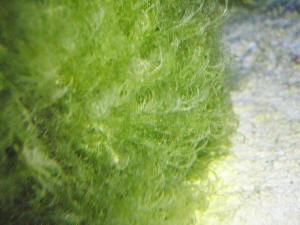 Big B or D. RMF Big B or D. RMF |
|
algae outbreak 8/26/2009
Hi guys,
<And gals Mike. Howsit?>
I have a 54 gallon reef tank, 40lbs LR, sump filtration, with
Deltec MCE 600 skimmer, and run carbon and phosphate remover
(bulk reef supply) in a reactor. Parameters are as follows: S.G
1.026, Ph. 8.3, Ammonia 0, Nitrite 0, Nitrate 0.5, Calcium 410,
dKH 3.54, Magnesium 1200. 250 watt 10 K MH. Inhabitants include
mated false Percs pair, six line wrasse, and a royal gramma.
Corals include Acros, a hammer coral, various zoos and
mushrooms.
I went away on vacation a week ago. The pump on my skimmer was
broken and was sent for repair while I was away. When I returned
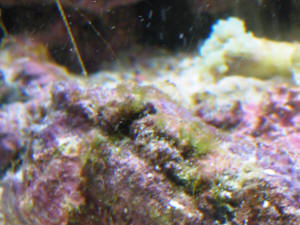
there was a massive algae outbreak (or Cyano, I can't
tell).
<Looks like a mix to me>
No feedings took place while I was gone, so I have to assume that
the lack of the skimmer was the problem.
<Likely so>
I've gone away for a week before and have not had this issue
upon return. All of the corals survived, but the zoos look awful
and have been smothered by the algae. As a result I am doing 5
gallon water changes every other day and thoroughly scrubbing the
rock etc. The skimmer is also up and running. However, I
can't seem to get on top of the problem.
<Takes time... like turning a large ship with a small
rudder...>
I have also added an additional power head to increase flow.
Pictures are included. Any ideas of what else to do?
Thanks,
Mike
<IF you had an ozonizer... other means to improve RedOx, this
would be one window, approach... Perhaps reading re,
gesticulating will keep you occupied while your system is
recentering... Read here:
http://wetwebmedia.com/SystemPIX/RedOx/RedoxPPTpres1.htm
and the linked files above... T'were it me, I'd do little
more than you're presently engaged in. Bob Fenner>
|
 |
Cyano or dinoflagellates? 8/26/2009
Howdy guys,
<Evening, Mike here today>
First the stuff I know you'll need! ...
75 gallon tank
SG 1.025
temp 76
ph 8.2
ammonia 0
nitrites 0
nitrates 10
phosphates 0
inhabitants: pair of false Percs, yellow watchman goby, Kole tang, one
spot Foxface, Zoanthids, star polyps, colt coral, mushrooms, frogspawn,
assorted
crabs and snails.
<ok>
With that out of the way, I'm having a problem with
"something." I thought it was Cyano, but after reading some,
I suspect it may be dinoflagellates.
This stuff grows in long wispy strands and there are a few places on
the live rock where it seems to be bubbly. The substance in question is
rather brown or dull dull red in color and isn't necessarily
growing in sheets.
However, I had read that dinoflagellates will actually grow on the
surface of the water? I certainly haven't seen anything like that
in the tank. I certainly don't think circulation is a problem...the
tank should be turning
over about 30x per hour (I took it seriously when you guys say its hard
to get too much circulation!). My lights (4x54 T5 HO) are on 12 hours
per day. The fish seem to eat everything I put in the tank, and I try
not to get any of the frozen food juice into the tank.
The tank is still fairly young (been cycled for about 4 months). I got
an obligatory diatom bloom a few weeks in, which was replaced by some
hair algae, which has begun to die off. I remove as much of the hair
algae as possible, but it has proven difficult to get all of it off of
the back wall of the tank. Is the dying algae contributing to the
Cyano/dinoflagellates?
I'm doing 2 8% water changes per week, and have been since the hair
algae started showing up.
<Why does seemingly everyone perform such small partial water
changes? Try for 50% bi-weekly instead!>
All water is RO-DI mixed with Kent salt. Is this just something natural
that I should work through, or is there something else I should be
doing other than trying to vacuum up all of this stuff that I see? This
stuff has been around for a few weeks now, and it doesn't seem to
be getting any better. I'm always paranoid about my test kits being
faulty so I also had the LFS test my water and they got the same
param.s. Any guidance you could offer would be greatly appreciated!
<Parameter tests can be misleading in cases such as these - if your
phosphates were truly zero, your algae couldn't survive. Instead,
it's being used as a nutrient source, and sequestered. Your #1
weapon is always going to be nutrient control, which can be
accomplished by large and frequent partial water changes, aggressive
protein skimming, and by the use of chemical medias such as Purigen or
Phosban>
Carter
<Mike Maddox>
Question about algae, Cyanobacteria 7/19/09
Hello WWM Crew!
<Hi>
Thank you for all the thoughtful advice and information!
<Welcome from all.>
Our 28 Gallon Nano Cube has been up and running for about 6 months now.
We recently added a Firefin Goby and two Blue Chromis to the tank after
keeping Polyp coral, two darnassus snails, and a feather duster.
Over the past week the tank floor has bloomed into a carpet of algae!
Most of it is really beautiful, but there is a mat of red/brown algae
that has me worried. It has the texture of a thin nylon and is
spreading by the day.
Air bubbles have started to collect underneath the mat, and at first I
thought it was Dinoflagellates, but the air bubbles are not suspended
on fibers.
<Sounds like Cyanobacteria to me, the bubbles are most likely oxygen
produce by it's photosynthesis. See here for more
http://www.wetwebmedia.com/bluegralgae.htm >
Could it be oxygen released from the worms living in the substrate that
isn't able to be released?
<Worms would release carbon dioxide, but is likely oxygen from the
Cyanobacteria.>
The tank parameters are as follows:
Ammonia = 0.0
Nitrite = 0.00
Nitrate = 0.0
Calcium = 280-300
pH = 8.2
<I would test for phosphates here, often fuel Cyano blooms.>
We do weekly water changes and tests. Is this something that should be
removed from the tank or can we just let it live peacefully?
<I would siphon out as best you can, can be difficult to overcome,
returning rapidly until conditions favor some other life.>
Thank you so much!
Noelle
<Welcome>
<Chris>
Algae explosion 6/24/09
Hi there. I'm sure you probably get this a lot, but I've got
some serious algae problems.
<We do!>
I've tried pretty much everything on the page you guys have on
controlling algae:
http://www.wetwebmedia.com/avoidingalgaeproblesm.htm,
but to no avail.
Every 2 days the glass all around my aquarium is pretty much opaque
from green and brown algae growth. This stuff also covers all my live
rock, choking out the good stuff like coralline. I've done partial
water
changes, cut down on feeding (I use mostly flake foods & only use
enough so that the fish completely clean it up with 1-2 minutes), and
have changed carbon bags out frequently.
What I've got:
20 gallon tank
65 watt light with 1 fluorescent, 1 actinic bulb
Lee's medium air-driven protein skimmer (which seems to work pretty
well based on the stuff I collect every day)
Aqueon 30 power filter
<Be sure to clean this frequently.>
about 20 lbs. of live rock
5 small damsels, 1 small clown fish, 1 hermit crab, 1 brittle star
<Too much for a 20.>
I am hooking up a timer right now; previously lights have been on for
12-14 hrs. per day over the same time period Any suggestions as to what
might help would be greatly appreciated.
<Well, with the info given nothing screams out except the stocking.
I would first start with testing the water you are using for your water
changes. If it is high in nitrate this alone can spur the algal growth.
Also, how about water flow within the tank? Otherwise your stocking
density alone in this tank could also be the culprit.>
Thanks,
Nick Peterson
<Welcome, Scott V.>
Re: Algae explosion 6/24/09
Thanks Scott.
<Welcome.>
As far as overstocking, I guess I'll just have to feed minimally
and be religious about my water changes for now. When I checked the
tank water for nitrates and nitrites previously, I got a reading of 0
(Maybe because the algae is using it all for growth?).
<Possibly.>
I will definitely check the tap water for nitrates and such- that
hadn't occurred to me. If that is the problem, is there any
alternative to having to buy a reverse osmosis rig or deionizer that
costs hundreds?
<Most LFS will sell RODI water, but even with a 20 it may be in your
interest to buy a simple RO unit. Check out Reefgeek.com and
Buckeyefieldsupply.com. Both have great deals on these units.>
I've just finished my first year in college and really don't
have the funds for that right now.
By the way, thanks for the quick response! It still amazes me that you
guys
respond so quickly, and it really is a great help!
<Thank you, we try our best to reply quickly!>
-Nick P.
<Scott V.>
Is my live rock dead? Algae Control/Live Rock System
balancing itself after a crash. 6/22/2009
Dear my personal algae specialists,
<Hi Andy. personal algae specialist.....I'll have to add that to
my resume.>
I have a problem that's been growing and growing (literally) for
the past several months. I have a 90 gallon reef ready that's been
set up since July 2008. Prior to that, everything was in a 110g (since
April 2007) that sprung a leak. The new 90g crashed in September 2008
(some of you helped me with this) when I was away on vacation. My guess
is the power went off during a storm on a Sunday, something tripped the
circuit breaker when the power came back on, and I didn't get back
home until Saturday . . .. I had 5 fish at the time - a Sailfin Tang, a
Kole Tang, a Copper Band Butterfly, a Mandarin, and a Brown Combtooth
Blenny (Atrosalarias fuscus); a large number of SPS, a few LPS, and 5
or so mushrooms; and about 90lbs of Pacific live rock. The tank was
perfect when it crashed! No algae, no Cyano, water param.s were
excellent--it was humming along without missing a beat.
When I got home from my vacation, the tank was a cloudy, disgusting
soup of rotting everything. Everything was dead, except 3 polyps of
Duncan/Whisker Coral (which are doing well to this day). I made up all
new water using RO/DI, and did a 100% water change. I also ran Purigen
and activated carbon for a good while, changing frequently (I still run
carbon 24/7). I added another 10-15 lbs of cured live rock to re-seed
everything in case all was lost. I waited a good 3 months before I
added anything. During this time, my tank went through some crazy algae
outbreaks--from Cyano, to hair algae, to you name it. With a lot of
patience, elbow grease and a decent clean up crew, it all pretty much
subsided. The first fish were/are 5 Bartlett's Anthias. They had
the run of the tank until the Aiptasia that had previously been kept in
check starting sprouting up. So, I added another Copper Band Butterfly,
which made short work of all 100 or so Aiptasia in my tank.
<I'm with you so far.>
So fast forward to today. A good amount of my live rock and pretty much
all of my substrate (just a dusting, maybe 1/4" deep, of
aragonite) is ridiculously covered with hair algae,
<A deeper sandbed could help here, but you are stuck for the moment
until the algae is taken care of.>
Grape Caulerpa and Feather Caulerpa, in spite of manually pruning as
much as I can every week. The substrate is clumped together by the
roots of the hair algae. It is really a mess. Thankfully, I don't
have a bit of Cyanobacteria.
<The algae is taking up all of the nutrient, preventing Cyano. This
is a good thing.>
I added a small Yellow Tang thinking it might put a dent in the hair
algae
and/or the Caulerpa, but so far no dice.
<He should be munching on the hair algae, will not likely touch the
Caulerpa until it gets bigger.>
I run an AquaC EV-180 that I constantly maintain, a 30 gallon refugium
with a 5" deep sand bed, live rock and a huge amount of
Chaetomorpha (which I prune every few weeks), and an
ozonizer/controller (my ORP stays around 340 or so). I have an RO/DI
filter which I maintain, change filters as needed, sterilize, etc. My
tests (Salifert and Seachem) show 0 ammonia, nitrite, nitrate, and
phosphate; pH of 8.2-8.3; calcium about 400; magnesium at 1180-1200;
and specific gravity is 1.025-1.026 (measured with a calibrated
refractometer). I haven't tested for silicates. The TDS of my RO/DI
water is 0-1ppm, and my pre-mixed salt water (Reef Crystals), which I
keep/aerate/heat in a Brute trash can, shows 0 phosphate. My lighting
is 2x250W 14,000K HQI, with 4x65W 03 power compacts. Temperature is
79*-81*.
<You may want to try cutting back on the lighting a bit - reduce
your photo-period.>
I don't have a clue what I'm doing wrong.
<You aren't really doing anything "wrong". Your system
is out of balance due to the die off, and is in the process of
balancing itself.>
I know that Anthias need to eat a lot, so when I first got them
(December 2008) I think I might have been feeding them a little too
generously, but I have since cut way back, feeding my fish only once or
twice per day--I try to mix it up day-to-day with Mysis, New Life
Spectrum 1mm pellets, live black worms, and minced fresh clam. I rinse
all frozen food, and everything but the pellets is usually soaked in
Selcon, and I am very careful about the amount I feed. I change 10-15%
water every week.
<You may want to up your water changes to 20 - 30%>
The only things I dose are ESV B-Ionic two-part buffer/calcium, and
Brightwell Aquatics Magnesium-P (magnesium). Circulation is my Little
Giant return pump (rated 1325 gph, but I'm guessing I've cut it
back to about 600 gph), and 4 Koralia 3s (850 gph each). I have two
Lysmata amboinensis, three Lysmata wurdemanni, three Emerald Crabs,
maybe 8-10 Astraea snails which are reproducing, and a handful of
red-legged and blue-legged hermits. I have lots of SPS, all of which is
doing very well. In fact, everything is doing really well . . .
including my algae, unfortunately.
<This is the telling clue right here - everything IS doing well Your
system isn't broken, and you aren't doing anything
wrong.>
So, here is my theory/concern--when my tank crashed, my live rock sat
in that putrid mix of organic slop and soaked up all kinds of stuff,
which it is now slowly releasing back into the water; this is in turn
fueling algae growth;
<Exactly.>
Any hair algae or Caulerpa that would have grown in my pre-crash tank
was being eaten by my Kole Tang and Sailfin Tang, respectively, neither
of which I have now. Do you think this is what's happening?
<Likely so. You have an excess of nutrient and little, other than
algae, to soak them up, and little to eat the algae.>
Will it eventually stop, or do I need to go drop $650 on all new live
rock?
<It will slow, then stop in time. You can buy new live rock if you
are impatient, but it isn't necessary in my opinion. Caulerpa and
even hair algae, if properly controlled, can be attractive in a display
tank.>
Can you think of anything I can do besides manual removal to
reverse/correct this?
<Short of adding herbivores, manual removal is about the only
option.
Urchins tend to be delicate, but could work in this setting
http://www.wetwebmedia.com/algaeconMar.htm &
http://www.wetwebmedia.com/urchins.htm >
Would adding additional snails, or the same or different type, help
with the hair algae? I would love to add a Kole Tang, as it's one
of my favorite fishes, but I think I am pretty much at my limit on fish
as it is.
What about the Caulerpa?? Is my only hope manual removal?
<Manual removal of Caulerpa is best. You only need to focus on
removing the green parts. The algae will not regenerate from the
"roots".>
Thanks for your help.
<My pleasure.>
Andy
<MikeV>
Re: Is my live rock dead? Algae Control/Live Rock System
balancing itself after a crash. 6/22/2009
Thanks so much, Mike, for the information and reassurance.
<My pleasure.>
I do have a large amount of Chaetomorpha in my 30 gallon refugium, but
I guess my system is producing more than this can process?
<Likely so. It will improve in time. Remember, nothing good happens
in a marine tank quickly.>
Also, you noted adding herbivores. Don't you think my tank it
pretty much at its limit as far as fish go?
If not, could I add a Kole Tang (with my yellow . . . ) or a Foxface?
If not, any other types of fish that would work, look good and will
fit?
<I would say it is at the limit for fish, though you could add an
Urchin and perhaps some Lettuce Sea Slugs - all are good
herbivores.>
Thanks again!
Andy
<MikeV>
Yet Another Person with Algae Issues --
06/20/09
Thanks for taking my call...
<<I'm listening'¦>>
I've got a 125 with a 30 sump. 180 lbs live rock and about 5"
DSB. The rock is stacked along all the back of the wall so I can only
see very little of the wall. I've heard this is not good because of
improper circulation getting behind there.
<<Indeed>>
I have the brown stringy algae with little bubbles all over and all
over my rock.
<<Mmm, a form of Cyanobacteria'¦>>
Drives me nuts.
<<No doubt>>
Had to say it, I know you've heard it a million times.
<<[grin]>>
I am using a Euro-Reef skimmer and removing close to a cup a day.
Chaetomorpha in the sump which seems to be dying,
<<I have seen this before re Cyanobacteria
infestations>>
I'm not sure if it's from the brown algae issue or the fact
that the bulb is about a year old now over it.
<<Likely both'¦but some added water circulation might
help>>
I do my 15 gallon water changes twice a week. I use RO/DI and now after
a year have replaced the whole unit with a new one. Just to replace the
filters costs about the same anyway.
<<Ah yes'¦a little effort searching around can truly
find some bargains re these units, and their consumables>>
I have a Mag18 in the sump forcing the return water through a 3/4 or
1" flex tube in each of the back corners. I have 2 Koralia
4's, 1,200 gph, one on each side wall pointed towards center glass.
And one Rio 2100, (692 GPH) on a side wall just blowing across from
left to right. In my mind I have the "current' just the way I
like it as far as for instance having my colt coral swaying just right
and not being blown strongly from just one side.
<<Okay>>
Fish are doing fine but inverts are sluggish at best.
<<Hmm'¦maybe a clue here>>
Here's my problem with the 'I don't have good enough
circulation' prompt,
<<'¦?>>
All of the rock that is infected with algae and strands of algae and
bubbles, all indicate there is current hitting it. The algae sways for
instance. The only way to make it come off is to wave my hand in front
of it or direct a powerhead a few inches from it.
<<I see>>
I don't think just repositioning the rock and powerheads alone will
cure this do you?
<<The nuisance alga issue? No, I don't'¦
Resolution of this problem will likely be from an 'assortment'
of adjustments>>
In fact, I can watch my powerheads all day long blow algae strings off
my rock and it surfaces to the top. This indicates there is current
hitting those spots.
<<Yes>>
pH is 8.3. Day/8.0-8.1 night.
And I know, I know, it's all about nutrient export.
<<Or stopping/reducing the 'import' of troublesome
ions>>
But this has been going on for a couple months now, not weeks.
<<In my experience these issues rarely ever are resolved quickly.
I do not consider it unusual to take several months or MORE to
'clean up' such matters>>
I do use a sponge block prefilter on my Mag which I rinse every couple
days and you should see the brown coming out of there. Also, one thing
I've never inquired about is my overflow setup. The way the Durso
standpipe is rigged up now, there's about a 2" drop in the
water level from where the water enters the overflow to how far down
the water goes. I don't like to have too far of a drop because it
gets too noisy otherwise.
<<Understandable>>
Not sure if that's ok or if it even makes any sense.
<<If it's working'¦leave it be>>
Would like any input you can muster.
<<Cyanobacteria/nuisance alga issues are often difficult to
diagnose and resolve'¦ I have found that where possible the
discontinuation of supplement dosing (at least for a time),
particularly Iodine and CO2 injection (as from a Calcium
reactor)'¦along with reducing water changes to just the
little needed to 'suck out' the Cyanobacteria/nuisance alga
during weekly manual removal'¦can help to resolve the
infestation, and may well reveal the source of the nutrient input. And
while I am big on feeding one's tank/fishes'¦ Cutting
back here for a while just a bit may also be in order>>
Thank you much,
Jason
<<Happy to share'¦ EricR>>
Algae Problems (Tap Water Filtration) --
06/12/09
Good Afternoon,
<<Hello Jackie>>
I have had a reef tank for over two years, and I am having major issues
with Cyanobacteria and green hair algae.
<<Mmm, yes'¦and seems to be common issues seen by most
hobbyists. I take it you have perused our site re>>
My tap water reads at 46 ppm. Is that considered high?
<<Not at all'¦ I consider my own tap water with a TDS
of about 80ppm to be low'¦and have known some others to be
400+'¦ But do realize that the Total Dissolved Solids in
your tap water is not a full indication as to the toxicity present. It
is best to perform tests for Ammonia, Nitrite, Nitrate, Phosphate, et
al to see what and how much is truly present>>
Would it be that beneficial to invest in an RO/DI machine to help
resolve these issues?
<<With marine systems'¦and especially reef
systems'¦a good water filtration device for filtering your
tap water, like a RO/DI unit, is always a benefit in my opinion. So
more to the point here'¦ Yes, if your tap water is a source
of nutrients for the nuisance alga, a RO/DI unit will help>>
Your opinion is always valued.
Thanks,
Jackie
<<Happy to share'¦ EricR>>
Dreaded Diatoms: SW algae control and Maintenance. RO Water,
High Iron Content. 6/5/2009
"Help me Obi-Wan Kenobi, you're my only hope".
<Live long and prosper.....wait, I think I am mixing science fiction
worlds...>
This phrase keeps replaying in my head as I deal with my ongoing algae
issues.
<OK, nothing is insurmountable. What kind of algae? Are you sure it
is diatoms?>
My 125 reef with the 30 gallon sump is almost a year old. Though I did
have a similar aquarium a couple years prior so I do have a few years
experience with saltwater but am still an amateur at best the way I see
it. I've been patient with this thing trying to get some resolve
but to no avail. I've done plenty of reading this forum for answers
but I have read enough problems and answers to know that I have been
doing all of that already.
So what's left to try.
<So lets hear it.>
Here's the breakdown:
I do weekly water changes of 10%, have increased my DSB recently from
about 3" to now 5".
I have a Euro-Reef skimmer in the sump that is quite capable of
producing a cup full of the dark stuff.
<Wow, that much per day?>
I have about 180 lbs live rock.
I have a mag-drive in the sump, the 1,800 gph variety. I understand
that much of the GPH is lost by being down in there so more powerheads
need to be in the display. Maybe one day I'll graduate to
Calfo's PVC manifold deal and eliminate powerheads all together,
but I'm not there yet.
I have two Koralias both 1200 GPH at opposite ends of the tank blowing
towards the center glass. I notice even these which are almost a year
old don't seem to push water even close to the Rio 660 gph that is
impeller driven rather than propeller.
<They move water differently, the Koralias are more diffused rather
than a linear discharge.>
I cannot seem to keep micro bubbles from forming on rocks which leads
to algae.
<Usually, microbubbles are indicative of algae - that air has to be
coming from somewhere.>
What about my Coralife 2 Pure-Flo RO unit?
<Don't have any direct experience with them, but have not heard
anything bad either.>
It has the membrane and three prefilters.
<Likely carbon, sediment, and another sediment prior to the
membrane.>
Is this an acceptable unit? I notice the first filter gets rusty pretty
fast and I have both rinsed it and replaced it a couple times over the
year.
<Ah ha..... a clue my friend... That is iron. A very good plant, or
in this case, algae food. You wouldn't happen to have well water
would you?>
The second stage I have also replaced once and it shows no rusty
coloration. The third stage I haven't replaced nor the membrane but
I'm due for those next.
<Would be interesting to test your water before it goes through the
RO unit and then after to see how much iron is still in the
water.>
<Also, what are your other readings? Ammonia, nitrite and
particularly nitrate?>
Would this rust color in the first stage be indicative of the rust
color (Diatoms) in my display?
<Possibly, would also be interesting to see what your silicates are
before and after the RO unit.>
One other thing. A few months ago I had an allelopathy (sp?) crash with
my corals feuding it out and lost several inhabitants. One of those was
my 10 Mexican Turbo snails whom all did a great job cleaning up algae.
I never did replace those guys, I got some Nerites and Nassarius
instead.
Thinking maybe I needed those Turbo's back in there I ordered some
and they're acclimating to the water temp as I type. But I think
you will say, "you're treating the symptom not the
problem". I have done plenty of reading as I said. But it's
worth a shot I say.
<Can't hurt, but it is a "band-aid">
I have a Yellow Tang and a Atlantic Blue which by the way I love. I can
double as a Purple at times. It's my only fish that comes close to
being a Chameleon, it's capable of at will changing it's
coloration and overall
appearance. Very cool and for a least a third of the cost of a Purple,
not to mention two Zebra's wouldn't get along anyway.
<Likely not.>
Also Flame Angel, a pair of Perculas, a pair of little Gobies, a
Six-Line, one Chromis, and one bi-color Blenny. I wish I would have
known he wouldn't be a "bi"-color for long, he's now
uni-black.
<Ok, so you are not grossly overstocked., which is a good
thing.>
I'm a Kalk guy because I'd rather play with that than add other
chemicals for calcium and such. I do a 24/7 slow drip into my sump of
close to 12 Ph Kalkwasser. But I had neglected for awhile to make sure
the Kalk was at or around 12 Ph and so my Ph in the main tank dropped
to 7.85 for awhile. I slowly got it up to 8 for the morning and 8.3
evening. I saw from reading today someone said to keep at 8.3 for
morning and 8.6 for evening. Agree?
If so will raise slowly.
<I shoot for around 8.2 - 8.3 with the lights on, 8.0 - 8.1 with the
lights off.>
Oh, and the fuge has a 7" deep sand bed with Chaetomorpha.
<If you run that on a reverse light cycle (lights in fuge while tank
lights are off) it will help stabilize your pH.>
I also employ a block sponge over my powerhead in the sump and clean
every few days. I use a small amount of carbon weekly and occasionally
use a Polyfilter. But again, I don't see using these things as
fixing the problem.
<They can help remove other nutrients, but will not help with
this.>
Any truffles of wisdom to share?
<I suspect you are on well water, that or very bad city water, and
you are introducing both iron and silicate to the tank, feeding the
diatoms. Test your water for both, before and after the RO unit. I do
know that a high iron content can "use up" an RO membrane
fairly quickly.>
Thanks again and again,
<My Pleasure.>
Jason
<MikeV>
Am I suffering the 7 Plagues? New Marine Setup, ChrisP's
go 5/12/09
Here's a long story for you.
<Ok>
I started out with a 55gal FOWLR. I have current USA CFL lights, a
Fluval 305 canister filter, CPR Bak-Pak skimmer, 18w Uv Sterilizer and
Tunze power head for added circulation. I bought live rock and live
sand and started out with my own water using Reef Crystals. Our stock,
slowly added: 1 Yellow Tang, 1 Blue Tang, 2 clowns and one Coral
Beauty. Ten percent weekly water changes.
<Tangs are inappropriate for this sized tank, they will soon need a
larger tank.>
Initially the rock developed a large growth of Grape Caulerpa which I
know some folks don't like, but it was nice and we liked it.
Initially it almost took over the tank until one day the Caulerpa
issued a greenish white fluid into the water and promptly turned white
and died. We were told this was it's sexual reproduction but that
the confines of a small tank would actually prevent any further
growth.
<But releases lots of organic materials that fowl the water and fuel
algae growth.>
The Caulerpa never came back.
<Good.>
The Live rock had loads of little fans and filters and strings and was
very much alive. Then came the green hair algae. On Monday it looked
nice in it's little places, by Tuesday we were at the store looking
for
treatment options and by Wednesday it had covered just about every
surface area of the tank. This taught us, among other things, that
phosphate is not our friend and to buy R/O water from the LFS.
<Better to invest in your own RO/DI unit, the units in LFS are often
poorly maintained and do not produce water as pure as possible.>
Cleaning the tank eventually required the removal and scrubbing of the
live rock which, unfortunately made it into white not-so-live rock.
<You would be surprised at how much survives and will come back with
time.>
Since then it has turned purple, which we're told are
"good" organisms .... but no filters or fans of
"life" as we remember it.
<Coralline algae, most people like it, as for the rest with time it
will come back.>
Then comes the Red Algae covering the sand.
<Cyanobacteria, http://www.wetwebmedia.com/bluegralgae.htm .>
It is suggested that we need more circulation, so two more power heads
are added, adjusted so their flow is just high enough over the sand to
keep from blowing the sand. Red Algae is unfazed by this and possibly
even amused by it.
<Sometimes it helps, other times it does not.>
Now we're told that even though the phosphates in the water are
ZERO, we've likely bound so much phosphate into the sand that it
feeds the Red Algae still.
<Possibly.>
So we buy a BRAND NEW 75 gallon tank and use ALL NEW sand ....
<Because of the Cyano?>
rising the rocks once again, this time in R/O Fresh water
<This probably did kill off most of your live rock.>
...... and within 11 days we have the Red Algae back. I periodically
take my water to my local Fish Store and get an exhaustive set of tests
and the Big 3 are 0/0/0 and phosphate is 0 and all the others, I'm
told, are acceptable.
<Cyano is one of the oldest and most adaptable life forms on the
planet, it is nearly impossible to keep it out of your tank entirely.
Best thing you can do is to try to eliminate food sources for it and
grow competing life
forms. With time as "higher" life forms take hold it often
out competes the Cyano and helps keep it in check. Best to keep
phosphates and nitrates as low as possible and manually remove as much
as you can to limit its growth.
See the link above for more.>
I have come to believe that, somewhere along the line, I have made a
fundamental error that has cascaded into all these individual problems
and I certainly would like to know it that is truly the case.
<Not really, most new tanks go through algae blooms and Cyano
problems, part of the maturing process for the tank, just need to try
to limit these so they don't get to an overload situation.>
But as far as resolution is concerned, with the exception of the
livestock, the "Live Rock" is the only thing that has been
consistent and now, thanks to so activity by our California Fish &
Game Commission, all live rock brought into the state is treated in
some way to be even more white and dead looking than our was at
it's very worst.
<It can come back given time, you will be surprised. Perhaps you can
get a small piece to seed your tank from a fellow aquarist.>
If replacing the sand AND the rocks is required, I'm willing to do
it but, as I said .. so far I feel like I'm fighting various
results of the problem and not reaching the problem itself. Can you
make a guess as
to the underlying cause if it exists? Or else suggest the next
step?
Thank You,
Allen
<Patience here, along with good maintenance will get you going. It
can take upwards of a year for a tank to go through its various blooms
and to really stabilize.>
<Chris>
5/12/2009 Am I being visited by the 7 Plagues?: No, New Tank
setup\Stocking\Algae Control\Nutrient Export\Reading lots and lots of
reading 5/12/09
Here's a long story for you.
<Call me Ishmael, it was the best of times, it was the worst of
times on a dark and stormy night...>
I started out with a 55gal FOWLR. I have current USA CFL lights, a
Fluval 305 canister filter, CPR Bak-pak skimmer, 18w Uv Sterilizer and
Tunze power head for added circulation. I bought live rock and live
sand and started out with my own water using Reef Crystals. Our stock,
slowly added: 1 Yellow Tang, 1 Blue Tang, 2 clowns and one Coral
Beauty. Ten percent weekly water changes.
<Overstocked for a 55 gallon. Read here:
http://www.wetwebmedia.com/stocking1.htm>
Initially the rock developed a large growth of Grape Caulerpa which I
know some folks don't like, but it was nice and we liked it.
<Had some in mine, I like it, as long as it is controlled.>
Initially it almost took over the tank until one day the Caulerpa
issued a greenish white fluid into the water and promptly turned white
and died.
We were told this was it's sexual reproduction but that the
confines of a small tank would actually prevent any further growth. The
Caulerpa never came back.
<Releasing a bunch of nutrients in the water. Read about Caulerpa
here:
http://www.wetwebmedia.com/caulerpaalg.htm>
The Live rock had loads of little fans and filters and strings and was
very much alive. Then came the green hair algae.
<Using all of the nutrient that the Caulerpa used.>
On Monday it looked nice in it's little places, by Tuesday we were
at the store looking for treatment options and by Wednesday it had
covered just about every surface area of the tank.
<Not surprising, though your Tangs must have loved it.>
This taught us, among other things, that phosphate is not our friend
and to buy R/O water from the LFS.
<Phosphate and other nutrients.>
Cleaning the tank eventually required the removal and scrubbing of the
live rock which, unfortunately made it into white not-so-live rock
<Not the best decision - this destroyed the micro and macro life on
the
rock in the process. Read here:
http://www.wetwebmedia.com/algaeconMar.htm
>
Since then it has turned purple, which we're told are
"good" organisms .... but no filters or fans of
"life" as we remember it.
<Typical.>
Then comes the Red Algae covering the sand.
<Cyanobacteria\Blue-Green Algae - again, consuming the nutrients
that the Caulerpa and green hair algae were consuming before they were
killed off.
Read about nutrient control and export here:
http://www.wetwebmedia.com/nutrientcontrol.htm and BGA control
here:
http://www.wetwebmedia.com/bluegralgae.htm >
It is suggested that we need more circulation, so two more power heads
are added, adjusted so their flow is just high enough over the sand to
keep from blowing the sand. Red Algae is unfazed by this and possibly
even amused by it.
<A good analogy.>
Now we're told that even though the phosphates in the water are
ZERO, we've likely bound so much phosphate into the sand that it
feeds the Red Algae still.
<No, your livestock is still producing enough nutrient to feed the
algae.
Readings of zero do not mean there is none in the tank, it means there
is no excess nutrient in the tank - what is being produced is
immediately consumed by the red algae.>
So we buy a BRAND NEW 75 gallon tank and use ALL NEW sand ....? rinsing
the rocks once again, this time in R/O Fresh water ......
<So the live rock is now dead rock., Rinsing it in RO water killed
most if not all of the marine life on the rock. Leaving more nutrient
available for the red algae. Read here:
http://www.wetwebmedia.com/aqbizsubwebindex/lrandls.htm >
and within 11 days we have the? Red Algae back.
<Not at all surprising.>
I periodically take my water to my local Fish Store and get an
exhaustive set of tests and the Big 3 are 0/0/0 and phosphate is 0 and
all the others, I'm told, are acceptable.
<Yes, but see my comments above - there is still nutrients in the
tank,
they are just consumed as quickly as they are produced.>
I have come to believe that, somewhere along the line, I have made a
fundamental error that has cascaded into all these individual problems
and
I certainly would like to know it that is truly the case.
<Yes, you have been killing off the better nutrient exporters - the
Caulerpa, hair algae, and live rock, leaving the tank primed for a red
algae takeover.>
But as far as resolution is concerned, with the exception of the
livestock, the "Live Rock" is the only thing that has been
consistent and now, thanks to so activity by our California Fish &
Game Commission, all live rock brought into the state is treated in
some way to be even more white and dead looking than our was at
it's very worst.
<Read the above linked articles on nutrient export - you need to get
some macroalgae in the tank to compete with the red algae for
nutrients. Daily removal of the red algae also helps.>
If replacing the sand AND the rocks is required, I'm willing to do
it but, as I said .. so far I feel like I'm fighting various
results of the problem and not reaching the problem itself.
<Treating the symptoms and not the problem actually.>
Can you make a guess as to the underlying cause if it exists?? Or else
suggest the next step?
<See above - water changes, nutrient control and export, and most
importantly, time and patience. Nothing good happens in a marine tank
quickly.?
Thank You,
<My pleasure>
Allen
<Mike>
SW Algae control\Tang Selection: 5/5/2009
Hello,
<Hi Curt.>
Wanted to first say thanks for a great site! I've used the site for
several years now and always come away with something new.
<Thank you for the kind words.>
I've got a compound question, first I've got 2 very irritating
macro algaes that I'm trying to control/eradicate, Cladophora
prolifera and Dictyota dichotoma.
Have you found anything that will eat these pests?
<There are several predators of Cladophora Look here:
http://www.google.com/search?sourceid=navclient&ie=UTF-8&q=cladophora+predators
>
<Dictyota is harder - manual removal is best.>
I've read on this site and others that Naso tangs have been
reported to eat the Dictyota.
<Yes>
If so, any particular Naso family member? What about the Cladophora? If
nothing eats this stuff than what would be my best option?
<Your best option is manual removal and reducing your
lighting\controlling nutrients. You can read more here:
http://www.wetwebmedia.com/algaeconMar.htm >
My next question is compatibility of the I plan to have only 3 tangs
(each from a different family) in my 6' tank which currently houses
a Blue Hippo and shortly an Orange Shoulder. Which Naso would you
suggest, if any?
<I would not put neither a Naso nor an Orange Shoulder Tang in a
6' system. I would be leery of trying one in anything less than
8' in length and at least 2 feet deep. These fish get too large
and\or aggressive and are more prone to "mysterious" deaths
in anything less than several hundreds of gallons. Read here:
http://www.wetwebmedia.com/naso.htm
http://www.wetwebmedia.com/badacanthurusaq.htm >
Thanks,
<My pleasure>
Curt
<MikeV>
|
Diatoms? Hair Algae?: Hair Algae. Overfeeding
4/8/2009
Hello,
<Hi Jonathan>
I've been reading the website for several months now, and
figured it was time to ask a question myself.
Knowing how much background info can help (and you might find
something in it of concern) I will lay out the tank setup after
the question.
<Thank you, this is much appreciated.>
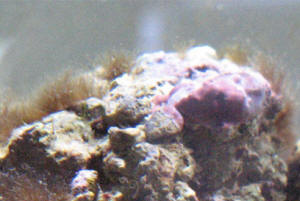
The question is: Can you help me identify the half inch tall
hairy tufts of stuff on my live rock, in the picture
attached.
<Hair Algae>
I have a higher res version, but it was getting past your file
size suggestion for photos. They are "rooted" to the
live rock, seem to be mainly on the top of the live rock (in the
light), and there are about 20 "tufts" of them in the
tank. Each "tuft" seems to be made up of individual
hairs, coming together at the base. Nothing seems to eat them,
not even the Foxface Rabbitfish. They are somewhat difficult to
pull out, coming out in pieces. They feel a little rough,
especially at the base, when pulled out. They don't seem to
be growing quickly, and they started to appear when I added the
halide and actinic fixture (about 3 months ago when I switched
from FOWLR to reef).
<The increase in light was enough to push the algae to
grow.>
Length description of setup follows...
125 gallon drilled tank, 55 gallon sump, largest protein skimmer
they had at the LFS, DLS pad, 20 GPM pump, 4 returns for water,
125 pounds live rock, 3" sand bed, heater in sump.
<Sounds like a nice setup.>
RO unit produces up to 75 gallons per day, but RO holding tank is
only 3 gallons. Thus, my water changes tend to be in 3 gallon
increments.
Usually one per day, but 2/3rds of that is evaporate. I usually
try and do a real "change" of water 3 times a week,
where I take out 3 gallons and replace it with 3 gallons. This is
in addition to the daily top-off changes, with a little bit (1
gallon) of actual take-out.
<Hmm.. Will want to invest in some more storage containers.
Water changes of 10 - 15% per week is recommended.>
Ammonia, Nitrites, Nitrates are all at 0, though nitrates
sometimes get into the 10 to 20 range. Salt levels are a bit high
right now at 1.026.
<Nitrates are a clue. Salinity is fine, particularly for reef
setup, provided it remains stable>
Lighting is 6' in length, 4 x 96 watt actinic, 3 x 150
halide, 4 moon lights.
<OK>
For corals, I have a 6" Montipora shelf coral, a 5"
purple digitata, a 1.25" yellow scroll coral, a pulsating
xenia that has split into 5 separate pieces each about 2 to
5" in height, a colony of green Zoanthids, 4" colony of
green star polyps, and a 3" red chili coral.
All corals are on the left half of the tank, and the first 3 are
in the top 3rd of the tank, the rest in the bottom half. The
chili is tucked away in a cave.
<All sounds good there..>
I also have a 10" wide anemone which is on the other side of
the tank from the corals, and has not walked around since he was
placed 3 months ago.
Fish are, in order added, 4 blue-green chromis, 2 osc. clown, 1
dragon headed goby, 1 diadem, 1 Bristletooth Tomini Tang (added
to control green algae from my initial overfeedings), 1 flame
angel (questionable for reef, but so pretty and so far getting
along with corals), 1 pacific blue tang, 1 Foxface rabbit (added
to take out the brown hairy tufts I'm asking about, though
he's not helping, so he might go back as I don't want to
overcrowd with fish and I'm worried I've done that
already given the fishes adult sizes).
<I tend to agree.>
There are also about 8 marine snails, 1 2" hermit crab, 6
very, very tiny hermit crabs I never see, 3 turbo snails, and a
cleaner shrimp.
I don't have a lot of purple coralline algae on the live rock
yet, but there is some.
I add calcium regularly to keep it around 480, and iodide to keep
it around 0.06. PH is 8.3 and phosphates are near zero.
<Very good.>
I feed Spectrum sinking pellets, 2 - 3 times a day, small pinches
over a 2 minute period at each feeding, making sure there is none
wasted (hardly any hits the sand bed, as the fish gobble it up).
I also use Coral
Accel - a small squirt every two days (probably 2 to 3 tsp
worth).
I am drip feeding Marine Snow - about 3 cap fulls in a gallon jug
which empties in 3 days. This runs dripping for about 6 of every
9 days. I use mysis shrimp, marine cuisine, Cyclops, and brine
shrimp, all frozen - usually 1/2 to 2/3rds of a cube every other
day (less on the Cyclops), thawed in a cup of tank water and fed
a bit at a time over a few minutes.
<Need to cut back on the liquid foods, this, coupled with the
light and the small water changes is what is causing the problem.
Do read here:
http://www.wetwebmedia.com/avoidingalgaeproblesm.htm >
The tank is about 6 months old.
Everyone in the tank is very happy, gets along well
together...
Any help is appreciated - thanks in advance!
<Cut back on the feeding, and read the linked article and the
linked pages at the top.>
Jonathan
<Mike>
|
 |
Too Much Algae
Algae, Algae Everywhere 4/6/09
Hello -
<Hello!>
I have a 6 month old 150 gallon tank with about 10 small fish and
clean-up crew. I still get diatoms on my glass almost daily that I
clean with the magnet cleaner.
<Cyanobacteria..?>
In addition, the top layer of my live rock is all "fuzzy" and
my substrate has grass growing all over it. It
is quite ugly looking so I stir up the sand weekly with my water
changes and try to remove the grass patches but it just returns in a
matter of days.
<Stirring up the sand may not be a good idea. Depending on the depth
of the sand bed could cause more harm than good>
I have employed 15-20% water changes since the inception of the
tank
<Weekly? Monthly? Quarterly?>
and I use RO/DI water which scores "0" on the TDS meter (no
silica).
<Have you tested the fresh ro/di water for phosphates? How old is
the membrane?>
Besides the main Mag 18 return pump, I have two (2) Koralia 4s for
circulation. I do not believe I feed heavily (I strain all the juices),
and I employ an EV-180 protein skimmer which produces nice skimmate.
I
have the lights on a timer: 8 hours for the main ones and 10 hours
total, including the actinics.
<What type of lighting are you running and how old are the bulbs?
Over time bulbs will shift spectrums stimulating algae growth.>
Why do I get so much "hair algae"? I feel like I have tried
everything and I cannot seem to resolve this problem.
<Algae problems are caused when your input of nutrients outweighs
your systems ability to remove or process them. Do you test for
nitrates and phosphates? Do you have anything to help with surface
agitation?>
The livestock do not seem to have a problem at all with it. However, my
5 week RBTA doesn't extend all the way anymore and expels white
stringy stuff. I am not sure my algae problem is the reason for this,
though.
<The algae problem is a sign of poor water quality. Even though
bubble tips are one of the more hardy anemones the still require an
aged tank, strong lighting, and good water quality. Adam
Jenkins>
Thanks,
Andy
Re: Algae, Algae Everywhere 4/7/09
My sand bed is less than an inch so I believe stirring the sand is
OK.
<Instead of manually stirring, I find the best results to come from
incorporating sand stirring inverts into my cleaning crew. Cerith
snails and Nassarius being two very good choices>
My phosphates are 0, as are my ammonium, nitrites, nitrates.
<The most likely cause of the 0 readings is that although present in
your system, it is being used up by the nuisance algae.>
SG is 1.026, Ph is 8.1, Alk is 3 - 4 mEq/L.
<Sounds good>
I have done weekly water changes and even utilized a Phosphate remover
(Phosban), just in case. The RO/DI membrane is only 5 months old, as
are my T5 lights (12 x 39 watts), so I do not believe the bulbs are old
yet.
<Both should still have plenty of life left>
Do you think I need surface agitation? I can take one or two of the
return nozzles and raise it to half in water/half out of water.
<A return and/or powerhead pointed up to ripple the water is enough
to help promote gas exchange>
Would that help? Is my skimmer not skimming enough?
<In my opinion the EV-180 is a bit small for a 150.I live by the 2Xs
rule of thumb, e.g.,a 55 gallon tank would need a skimmer rated at 110
gallons.>
I have it on maximum air intake and I collect nasty green stuff
daily.
<Here is a checklist of sorts to help you through it Test your RO/DI
water for phosphates and nitrates.
Continue with your current water change schedule.
Limit your feedings.
Strain and rinse you thawed foods.
Stop dosing any vitamin/trace elements.
Be sure your skimmer is working to its capacity. Upgrade if
possible.
Redirect water movement to the affected areas.
Redirect water to the surface to help with gas exchange.
Add some sand sifting critters to your clean up crew.(snails, not
starfish)
If possible add some macros to the display or sump to compete for the
nutrients.(Chaeto, Caulerpa)
Manually remove what you can.
Patience. There is no overnight cure for your algae problems. Only
perseverance will win the battle. Good Luck! Adam>
Algae: System\Control 3/18/2009
Hello, my name is Kris.
<Hi Kris>
I am fairly new to saltwater. I set up my tank about a year and a half
ago.
It is a reef tank, with live rock etc.
<Welcome to the hobby.>
Help is not always easy for me to find where I live, it always could be
"many things". I have a 75 gallon tank and have had a problem
with green hair algae for about a year.
<OK>
I use R/O water, have cut the light back to 9 hours a day, and have
a:
Eco Aqualizer, <Snake oil.>
protein skimmer,
and pick off algae once a week when I clean the tank.
<What other kinds of filtration, how often and how much water do you
change?>
I have tried using Algaefix for marine aquariums, which worked for a
while but I can't quite get rid of it.
<I suspect this is related to water quality and\or stocking...
Algaefix will also have attack the desirable forms of
algae.>>
I have taken my water to two separate places to have it tested, and
it's perfect, just like every time I check it.
<What is perfect? Actual readings are helpful when trying to
troubleshoot a problem. pH, ammonia, nitrite, nitrate, specific
gravity, alkalinity, etc.>
My fish are doing good (although my yellow tang doesn't eat much of
this algae) I have blue legged hermit crabs who don't do much with
it. I have two bubble tip anemones which seem to do well, but this
algae is stopping me from really enjoying my tank. My lighting is (2)
65w 12,000 k daylights and (2) True actinic 65w.
<Hmm... What other livestock is in the tank? What and how much are
you feeding?>
Any help or suggestions would be greatly appreciated!
<Please do read here: http://www.wetwebmedia.com/algaeconMar.htm and
send back some of the information I requested.>
<Mike>
Re: Algae: System\Control Stocking and Filtration.
3/20/2009
Hello just responding to some of the questions that you had, thanks for
your help!
<Hi Kris, no problem>
My other form of filtration is a Emperor 400 Bio-Wheel.
<Not enough for this tank.>
I change only about 5 gallons every two weeks, but also top off the
tank with regular R/O water, about 2 gallons a week.
<Hmm,... you will want to do 10 - 15% a week - Figure 10 gallons per
week of salt water.>
My fish are: Coral Beauty Angelfish, Yellow Tang, 3 Green Chromis (very
small), 2 Ocellaris Clowns and a Six Line Wrasse. So 8 fish total. (How
many fish can I safely have in a 75 gallon?)
<You are at the limit, if not over.>
I feed 1 cube of brine shrimp or Spirulina brine shrimp a day or marine
pellets and Spirulina flakes. Most days I'll drop in a few pellets
or flakes
in the evening. So twice a day, but not always.
<Do feed more than brine shrimp - Mysis shrimp is a much better
choice, feeding nothing but brine shrimp is like giving a person
nothing but popcorn to eat.>
I don't have any power heads or fans, which I would like to invest
in.
(Time and Money)
Would that help me? How much water should they move?
<Well Kris, you definitely need more filtration One Emperor 400 is
not sufficient for a highly stocked marine tank. For water movement,
you will want at least 10 x the volume of the tank per hour, so in your
case, you will need at least 750 gallons per hour.>
<Do you have the water testing results?>
Thanks so much for you help!
<My pleasure>
Kris
<Mike>
Re: Algae: System\Control Stocking and Filtration.
3/20/2009
<Hi Kris>
Hi, I have those water tests.
<Excellent>
As off today,
Salinity:30
Specific Gravity:1.022
<A bit low - between 1.024 and 1.026 is best.>
Calcium:400 mg/L
KH: 7 dKH
Phosphate 0.0
Nitrate 10 ppm
<All are within acceptable range.>
These numbers are different than the ones I had been getting. Nitrate
not usually that high.
What kind of filter would you suggest for my tank? Specific brand or
model?
(Don't have a lot of cash right now)
If you cannot do a sump\wet-dry\refugium, I would suggest a canister
filter - either Rena or Eheim.>
It's hard to know what to do with the water changes, everyone tells
me something different.
<Can't go wrong with 10 - 15% per week of pre-mixed
saltwater.>
Would two small fans that equal 800 gallons per hour be better than one
bigger one?
<By fans, I assume you mean power heads - and yes, two smaller ones
pointed in different directions will mix things up a bit
better.>
Thanks again.
<No Problem.>
<Mike>
Re: 125 Gallon Project, alg. control 3/16/09
Hello Scott,
<Hello Matthew.>
My reef has been thriving recently, however, i have been finding areas
of dark reddish/maroon colored algae growth on parts of my live rock
and around the bases of some sps corals. They produce big bubbles and
when i use a tooth brush to get some of it off, it grows back in the
same places after a week. Should i use Red Slime Remover??
<Hmmm, no way. See:
http://www.wetwebmedia.com/maralgcidefaqs.htm>
My phosphates are very low, nitrates 0, refugium plants are doing well,
20% w/c every 2 weeks using 100% pure ro/di water.
Any ideas? ....I've also reduced the quantity of food during
feedings the last week or so. but it still grows back.
<Well this is a phase that many tanks just need to work
through...give it good maintenance and time. You will fight through
this. See http://www.wetwebmedia.com/bluegralgae.htm and the linked
files above on other ways to combat the BGA. Do not use the algicides
though!>
Thanks,
Matthew
<Welcome, Scott V.>
Blackout Periods and Shrimp ?s Nano System Stocking\Algae
3/9/2009
Hello to the Crew at WWM! <Hi Isaac> First off
I'd like to thank Mike for answering my question about clownfish a
week or two ago. Everything is doing fine in the tank at the moment,
and I just have a question or two for whoever is on call at the moment.
<Glad to hear it.> Here are my tank's parameters: AquaMedic
Nano Wave 9 gallon AquaMedic Venturi Skimmer Refugium (I've now
added Chaetomorpha) Sponge and Ceramic Filtration 7 lbs. of LR SG
1.0245 Temperature 79-80F pH 8.3 Ammonia 0 Nitrite 0 Nitrate 0 Weekly 1
gallon water changes Marine DT's Phytoplankton dosed every three
days Livestock: 1 Ocellaris Clownfish (tank-bred) 1 Blue-Leg Hermit
Crab 1 Scarlet Reef Hermit Crab 1 Emerald Crab 2 Tiger Trochus Snails 1
Nerite Snail 1 Nassarius Snail 1 Xenia 1 Star Polyp Colony (about
3" wide) 1 Small Zoanthid Frag (My scarlet reef hermit crab
favored the shell my mushroom frag had inhabited, and scooped it clean
out of its home. I actually witnessed this happening, but it was too
late by the time I realized what was going on. I couldn't save the
mushroom, but at least I got it out in time, I've heard of dead
mushrooms polluting the water). Now, the questions! I've read about
doing blackout periods in a tank, in order to reduce algae, by turning
off the main lights for a period of 2-3 days. Is this a smart idea and
have any of you done this before? I believe I will experiment with
this, but please tell me if it isn't a good idea. <It works well
if you have a bad algae problem and no photosynthetic invertebrates. In
a tank as small as yours though, I would just siphon the algae out if
it were a problem.> I'm considering adding a cleaner shrimp
soon. I've had peppermint shrimp in the past, but I want something
a little more interesting and colorful for this tank. Would you have me
choose a Skunk Cleaner or a Blood Red? I love the Blood Red, but
I've noticed it carries a slightly larger price tag then the Skunk.
I'd hate to pay thirty-or-so dollars and lose a shrimp. Which one
you think is best? <Either would be fine. Do be sure to acclimate
the shrimp well before introducing it to your tank, and expect it to
hide for a few days.> Hope you all have wonderful day! <Thanks
and you too.> Thanks for taking the time, Isaac
<Mike>
|
Sand turning green 3/1/09 Hi Crew, my sand
substrate (pool filter sand) is turning green. The tank is in the
living room, which unfortunately has too much light from the
outside (but the light is diffused through screens). <Hmmm,
lighting is just one factor in this.> I suspect it is algae,
but what type? <Some possibilities, what kind of tank is this,
freshwater, marine?> Short of relocating the tank, how can I
reduce or prevent this from occurring again (after I change some
of the sand)? <More info needed here, type of tank, feeding,
maintenance, filtration, lighting, actual water testing
numbers...> Increase circulation? <Can be beneficial.>
Will a UV sterilizer help? <To a point, with algae in the
water column....not a cure all.> Please see picture attached.
Thanks
Tim
<Welcome, Scott V.>
|
|
Algae Control 2/26/09 <Hello Art> I have a 45
gal peaceful community reef tank. I currently have a problem with green
hair algae. What can you suggest to help to clear up the green algae. I
just tested the water and : CA 300 mg/l, <Not high enough for a reef
tank, 400-425 is the norm.> KH 90 KH <??, do you mean 9.0? What
is the bio-load, overstocking can/will cause algae problems.> Phos
0, nitrate 0, pH 8.2, ammonia 0, nitrite 0. I do a 20% water change
every other week. I have a protein skimmer and a denitrator. I recently
replaced all 4 of my bulbs in my T5 hood. <Reading links below
should lead you in the right direction.
http://www.wetwebmedia.com/algaeconMar.htm
http://www.wetwebmedia.com/nutrientcontrol.htm> Thank you
<You're welcome. James (Salty Dog)> Art
Re: Algae Control 2/28/09 I just switched to a salt
mix for RO water that should help to raise my CA level. I didn't
find specific information on how to reduce or eliminate the green hair
algae. My water temp stays 76 to 78. Any other suggestions? <Is all
in the links I gave in the original email. Will not be specific, there
is no one single cause for nuisance algae growth. Do read again, It
will surface.> Thanks
<You're welcome. James (Salty Dog)>
|
|
New Print and
eBook on Amazon
Marine Aquarium Algae Control
by Robert (Bob) Fenner
|
|
|