|
Related FAQs: Acroporid, Acroporids
2, Acroporid Identification,
Acroporid Behavior, Acroporid Selection, Acroporid Compatibility, Acroporid Feeding, Acroporid Disease, Acroporid Disease 2, Acroporid Disease 3, Acroporid Disease 4, Acroporid Health 5, Acroporid Health 6, Acroporid Health 7, Red/Black "Bugs" Acropora Munching
Copepods, Montipora Munching
Nudibranchs, & Acroporid
Systems, Acroporid
Reproduction, SPS Corals, Stony/True Coral, Coral System Set-Up, Coral System Lighting, Stony Coral Identification, Stony Coral Selection, Coral Placement, Foods/Feeding/Nutrition, Disease/Health, Propagation, Growing Reef Corals, Stony Coral Behavior, SPS Identification, SPS Behavior, SPS
Compatibility, SPS Selection,
SPS Systems, SPS Feeding, SPS
Disease, SPS
Reproduction,
More Pix:
Montiporas
Related Articles: True or
Stony Corals, Order Scleractinia, Dyed Corals,
/The Best Livestock For Your Reef Aquarium:
Quintessential Small Polyped Stony
Corals, the Staghorns, Family Acroporidae, pt. 2
To: Part
1, Part 3
|
|
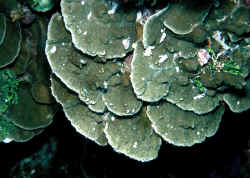
| Acropora lamarcki
(formerly corymbosa), Veron 2000. Colonies as corymbose
plates up to 2 m across. Plates of short, upright branchlets that
are more tapering upward. Axial corallites are exsert, tubular,
with flaring outer lips. Red Sea images. |
|
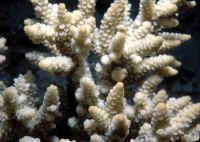
Acropora lokani, Wallace 1994.
https://reefbuilders.com/2019/11/25/acropora-lokani/ /COTW:
Characters: Colonies
are composed of robust horizontal main branches which usually diverge.
Short upright branchlets diverge from main branches. Axial corallites and
incipient axial corallites radiate from branchlets and are tubular in
shape large and dominant. Radial corallites are small and pocket shaped.
Colour: Cream,
brown or blue (which may photograph pink).
Similar Species: Acropora caroliniana has
smaller corallites and forms more plate-like colonies. See also A. granulosa.
Habitat: Shallow
reef environments.
Abundance: Sometimes
common.
Gili Trawangan, Lombok, Indo.
|
 |
Bigger PIX:
The images in this table are linked
to large (desktop size) copies. Click on "framed" images
to go to the larger size. |
|
|
|
Acropora loripes (Brook 1892) /COTW:
Characters: Colonies
have many shapes varying from upright bushes to thick plates. There is a
continuous range of shape and size between axial and radial corallites;
both may be tubular to nearly spherical, with very thick walls. Tubular
axial corallites often have no radial corallites on one side and
pocket-like radial corallites on the other. All corallites are smooth and
rounded.
Colour: Usually
pale blue (which may photograph pink) or brown. Axial corallites are
usually whitish.
Similar Species: Acropora
rosaria and A.
appressa. Acropora
caroliniana and A.
granulosa have more elongate axial corallites. See
also A.
maryae.
Habitat: Upper
reef slopes but occurs in a wide range of environments.
Abundance: Common
in the central Indo-Pacific.
Bali, Indo. 2014
|
%20MD.JPG) |
Acropora maryae possibly Veron 2000, /COTW:
Characters: Colonies
are usually upright compact bushes, but may form thick plates. Branches are
short and sub-branches are frequent. Axial and incipient axial corallites are
large and dome-shaped, with thick walls. They may become long and tubular.
Radial corallites are small and inconspicuous. All corallites are smooth and
rounded. The coenosteum is smooth.Colour: Usually
uniform blue (which may photograph pink) or cream.Similar Species: Acropora
loripes, which has more exsert (pocket-like) radial corallites and is
not uniformly coloured. See also A. rosaria and A. squarrosa.Habitat: Upper
reef slopes.Abundance: Common.
Sinai 2019 |
 |
|
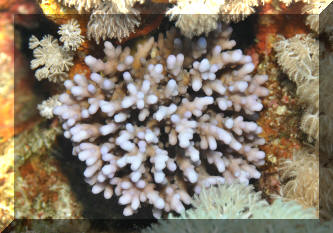
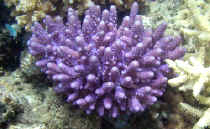
Umm, a purple Acropora monticulosa in Fiji... not air-brushed, I swear! |
 |
Bigger PIX:
The images in this table are linked
to large (desktop size) copies. Click on "framed" images
to go to the larger size. |
|
|
|
|
|
|
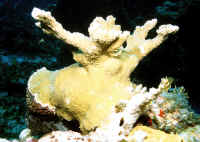
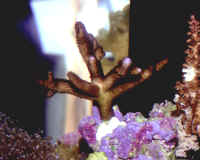
Acropora palmata, Elkhorn Coral.
Found in the tropical West Atlantic. Established stands are 3-12
feet in diameter, with branches of 2-10 inch width. Occasionally
"occurs" on live rock cultured for the trade. Pictured, a
large stand in Belize and a budding colony in an
aquarium. |
|
|
|
|
|
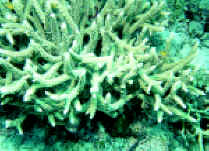
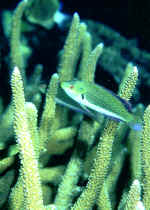
Acropora prolifera, the Fused
Staghorn. Photos of a colony in Cancun, Mexico, and a
"found" cultured specimen in captivity. This is actually a
nomen nudum... a cross twixt A. palmata and A. cervicornis.
The last are the only valid Acropora species occurring in the TWA. |
|
|
|
Acropora robusta forms irregular
colonies with thick, upward pointing branches. Much appreciated by
hiding fishes and invertebrates. |
Acropora squarrosa (Ehrenberg 1834).
/COTW
Characters: Colonies
are usually upright bushes with short compact branches. Axial corallites are
large and dome-shaped, with thick walls. Radial corallites have a wide range of
sizes but are identical to axial corallites in shape and appearance. All
corallites are smooth and rounded and have small openings. The coenosteum is
smooth.Colour: Cream
or pale brown. Corallite centres are a distinct blue or pink, depending on
depth.
Similar Species: Acropora plantaginea,
which has relatively crowded radial corallites. See also A. verweyi,
which has neat pocket-like radial corallites and A. maryae,
which has thinner branches, does not form compact clumps and has less exsert
radial corallites. See also A. rosaria and A. granulosa.
Habitat: Upper
reef slopes.
Abundance: Common.
in the Sinai, Red Sea 2019. |
%20MD.JPG) |
Bigger PIX:
The images in this table are linked
to large (desktop size) copies. Click on "framed" images
to go to the larger size. |
|
%20MD.JPG)
|
|
|
|
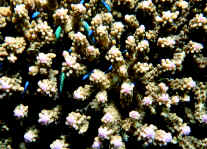
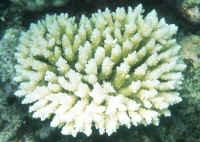
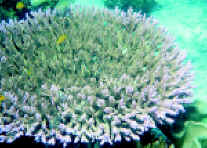
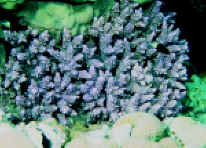
Acropora tenuis
(formerly eurystoma) (Dana 1846). Colonies as
corymbose clumps. Often with their fine branches evenly spaced.
Corallites: Axial ones are long, tubular. Radial ones in neat
rosettes with flaring colored lips. Common on Res Sea Rocky Reef
Slopes. Above, left and below, the last captively propagated
through fragmentation. This is a wide-spread Indo-Pacific species
that generally forms large, even colonies in the wild. |
|
|
|
|
|
|
|
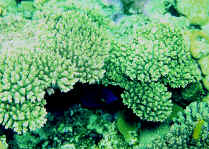
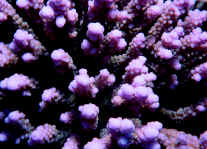
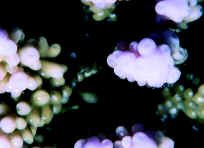
Above, left, and below are Acropora
valida, the most widespread member of the genus, found from the
east coast of Africa and the Red Sea all the way across the Pacific
to the west coast of Central America. An adaptable and useful
aquarium species. The last is a tank-raised fragment. |
|
|
|
|
|
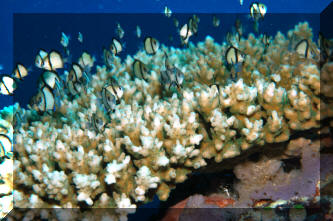
Possibly Acropora willisae Veron & Wallace 1984, /COTW:
Characters: Colonies
are corymbose plates up to approximately one metre across, with short,
uniform, evenly spaced, non-tapered branchlets bearing numerous axial
corallites. There is usually more than one axial corallite per branchlet.
Radial corallites near branchlet tips are tubular and appressed.
Colour: Grey,
cream, blue (which may photograph pink) or brown.
Similar
Species: Acropora
desalwii. Acropora
granulosa has long axial corallites and is not
corymbose. See also A.
parapharaonis.
Habitat: A
wide range of environments from lower reef slopes to lagoons.
Abundance: Common
in Western Australia, rarely common elsewhere. Here in N. Sulawesi.
|
 |
Bigger PIX:
The images in this table are
linked to large (desktop size) copies. Click on "framed"
images to go to the larger size. |
%20MD.jpg)
%20MD.JPG) %20MD.JPG)
%20MD.JPG)
%20MD.JPG)
MD.JPG) MD.JPG)
%20MD.JPG)
%20MD.JPG)
%20MD.JPG)
%20MD.JPG)
%20MD.JPG)
%20MD.JPG)
 |
To: Part
1, Part
3
|
|


.jpg)
MD.JPG)
%20MD.JPG)
%20MD.JPG)
%20MD.JPG)