|
FAQs about the Brooklynellosis
Disease and Clownfishes, Diagnosis/Symptomology
Related FAQs: Brooklynellosis 1, Brooklynellosis 2, Brooklynellosis 3, & & FAQs on
Brooklynellosis: Etiology/Prevention, Cures That Don't Work, Cures That Do Work, Treatment/Products/Manufacturers... &
Clownfish Disease 1, Clownfish Disease FAQs 3, Clownfish Disease 4, Clownfish Disease 5, Clownfish Disease 10, Clownfish Disease 12, Clownfish Disease 13,
Clownfishes in General, Clownfish Identification, Clownfish Selection, Clownfish Compatibility, Clownfish Behavior, Clownfish Systems, Clownfish Feeding, Clownfishes and Anemones,
Breeding
Clowns, Parasitic Marine
Tanks 1, Marine Parasitic
Disease, Parasitic Reef Tanks,
Cryptocaryoniasis, Marine
Ich, Marine Velvet Disease, Biological Cleaners, Treating Parasitic Disease, Using Hyposalinity to Treat Parasitic
Disease,
Related Articles: Surviving
Brooklynellosis by Mike Maddox, Clownfish Disease, Brooklynellosis, Clownfishes, Maroon Clowns, Marine
Parasitic Disease,
|
...Don't eat, is in a tank corner,
breathing rapidly and has some kind of whitish coat extending
from the dorsal fin to the medium and lateral part of the body.
Breathing hard. He has also three or four white spots on the
frontal part. <All indicative> Need microscopic analysis to
be definitive in your ID as other protozoan complaints are
similar in appearance.
|
Possible Brooklynellosis 3/2/20
Hello, several months ago I purchased a yellow tang, after 3 weeks of
uneventful quarantine I moved it to DT. Which hosted 1 Large Bannerfish,
1 Juv Emperor Angel and 2 perc. Clowns, all that I¹ve had for about a
year and doing great. The DT also has corals. Within a day in DT the
Tang had some white mucus that went away in a day.
<Mmm; this could be "nothing"; stress, mucus production...>
Several days later one clown disappeared dead in live rock somewhere.
I didn¹t notice any problems on it.
In a couple days my Bannerfish and Angel started getting white spots,
and slime all over and looked real bad. I moved them both to QT and they
were dead the next day. - they ate just fine the day before.
Since this the yellow tang has been thriving.
I got a new Angel and after 3 weeks QT and doing well moved it to DT.
Within a week it stopped eating, looked bad, I moved it back to QT and
it died the next day.
And just the other day my surviving clown has disappeared.
Based on what I¹ve read and how fast the fish died I suspect Brook in my
DT.
What puzzles me is the Yellow Tang which I suspect was the source is
thriving and shows no problems.
<... sometimes hosts have acquired immunity... like vaccine effect>
My question is can a fish host this disease and not be affected by it.
<A resounding yes; this can occur>
I'm pretty sure I need to remove him and let tank fallow for 6-8 weeks
but I want to be sure before I do this. If I do , do I need to treat him
with formalin in DT?
<IF you are reconciled to that treatment protocol. My usual statements
here re the use of simple, inexpensive microscope and related tools.
Skin slime sampling might easily show the causative organism here. For
what you have invested money, time... likely emotionally here; I'd do a
bit of reading, set on a path of acquiring, using a 'scope (or having a
shop, friend help you), and proceed from a position of knowledge. Bob
Fenner>
Thank you
|
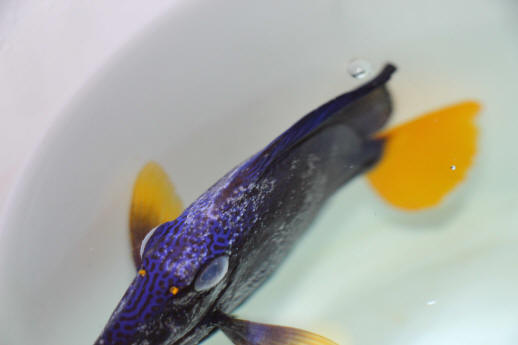
Sick Purple Tang 2/12/14
Hello,
<Jackie>
I have spent multiple days searching the web looking for some image that
would answer my question, however, I have been unable to diagnose my
fish with any degree of certainty.
<Looks like this Xanthurum has Cryptocaryon or Brooklynellosis; you
don't see the SOP on WWM for sampling, looking under a 'scope to
identify such Protozoans?>
I have had this purple tang, Kalinda, for about four months now. She lives
in a 150 gallon FOWLR system and she has been a great fish, very lively,
great eater, and kind to her tank mates. A few weeks ago I decided to
rearrange the rocks in the tank and take out some faux sea grass that
the more timid fish liked, but that I could no longer handle looking at
with all of the growth on it. After doing this, I noticed that my tang
had a few white spots on her. I figured it was Ich, so I let her be and
decided not to stress her out and see if she could fight it off (I will
add that before I added her to this tank, my regal tang whom I had had
for 8 years died in the system. The regal became ill, had white on his
body, refused to eat, pretty much hung out at the bottom of the tank,
and did show some signs of labored breathing.
<All classical symptoms>
Even with fresh water dips and copper,
<... have you searched, read on WWM re the use of Quinine?>
I could not get this poor regal to recover. I figured that this might be
caused by his age, but, after the outbreak I just went through, I am
questioning that). After a few days, the white spots on my purple did
not go away, the coverage on her didn't really look like Ich, and she
stopped eating. At this point, I pulled her from the system, gave her a
fresh water dip, and placed her in a hospital tank with Cupramine. I sat
up with her overnight (may sound weird, but I really like my fish) and
she did not show any signs of improvement and her berating became very
labored. I did not think she was going to make it to morning and as I
sat up all night, I continued researching and considered that she might
have velvet or Brooklynella. However, looking at her and looking at the
images online, I couldn't tell. She did make it through the night, but
spent the night dipping to the bottom and hovering at the top for air
and she seemed to be getting worse. I debated on whether or not to
continue copper (for Ich or velvet) or switch to Quick Cure in case it
was Brooklynella. Because my regal did not recover with copper and
because my purple seemed to be getting worse, I set up a tank with
Quick Cure and Stress Coat and transferred her. By the next day,
she had most of her color back and her breathing was improved but she
refused to eat. By the second day, she was breathing normally
and she went to town on seaweed and her frozen food! It has now been
five days since the crisis and she has all of her color back, her fins
are healing, and she is swimming all over and eating like crazy.
So now my questions: 1) Based on the attached images, what do you think
attacked her? 2) The Quick Cure said to treat the fish for three
days.
<Either this or dips/baths in just the Formalin component>
I did this and I am now running carbon and Purigen through her filter. I
am also doing daily water changes and have lowered the salinity in her
hospital tank. Do you think I should put her through another treatment
of Quick Cure at the two week mark (or four week mark - I am thinking
about the life cycle of the parasite). 3) Should I treat her with any
antibiotics (her tail fin did become frayed on the back edge)?
<Just the handling, copper and formalin exposure... I would not add to
the med.s>
Finally, I am not sure what introduced this problem into the tank. I did
place three small rocks in the refugium before the regal became ill.
These were dry rocks, originally from the ocean, they sat out in the sun
for some time and then I soaked them in fresh water. I also
added an Allardi clown to my tank at some point.
<A ready source of/for the Brook>
I don't remember if the clown came before or after my Regal became ill
but he had been in quarantine for over a month and I didn't see any
signs of illness. In any case, I removed all fish from the 150 and I now
have them in quarantine tanks (there are a lot of tanks in one room
right now). I plan on allowing the tank to go fallow for 2 months - is
this a good plan?
Is 6 weeks enough? I don't want to stress the fish out for any longer
than I have to, but whatever this killer is needs to die.
Thank you in advance for your help!
Jackie Gill
180 Bow Front Reef (SPS, LPS, Softies); 4 AI Hydra LED; 2 Vortech MP40;
Reef Octopus POV DC2 (downright sexy!); 36" Trigger Ruby Sump/Refugium;
Apex Standard Control System. // 150 FOWLR, 2 Kessil Sky Blue LED, 3
Tunze Nanostreams, 36" Trigger Crystal Sump/Refugium; Apex Light Control
System.
<... As the combo. product WITH Formalin seemed to remove the symptoms,
I would read re:
http://www.wetwebmedia.com/brookyescuref.htm
and the linked files above. Bob Fenner>
|
 |
Tank May Have Brooklynella
Hi WWM,
<Gabe>
I have a fair amount of experience with freshwater aquarium and have
decided to give saltwater a try. My saltwater setup is a 17G Nano
reef which I've cycled for four weeks using Ammonium Hydroxide.
The tank has about 5lbs of live sand and 15lbs of Liverock. On the
fifth week, the tank can process a 4ppm dose of ammonia in a little more
than 24H to 0ppm (nitrites 0, nitrates <10). Figured it was time so I
made a 50% water change and retested the parameters the following day,
the test result was no surprise - ammonia 0, nitrite 0, nitrates <5, ph
8.3, SG 1.025, temp 84F (I'm in the tropics).
<Nice... am presently visiting in York, G.B.... Brrrr>
Anyhoo, I got me a Yellowtail Damsel and a Yellow Watchman Goby (this was
first week of October 15). I drip-acclimated the two for an
1.5h then introduced them to the tank, both adopted to the tank quite
well. The goby didn't come out for at least 2 days while the
damsel acted like it owned the entire tank, swimming here and there in
all the nooks and crannies.
<Both to be expected>
On the third day, I went back home from work to a dead damsel.
<They are good at hiding stress...>
Instinctively I tested the parameters - ammonia 0, nitrite 0, nitrate <10.
I'm puzzled that a hardier fish died (the goby was fine, still is today)
when all seems ok, so I dismissed it to be just bad stock that I got.
I played on the side of caution and didn't add another fish, .
However, a friend of mine had a tank emergency and needed to find a
temporary home for his fishes. Having a relatively vacant tank, I
offered help. They were all damsels, 5 of them.
<Yikes... not enough room here>
Took care of them for about a week before my friend had managed to setup
a temporary tank of his own. After that, I figured I'm ready to
add stock again. My local LFS didn't have the fishes that I wanted
so I didn't bought any, but they do have a nice orange sponge that
caught my eye, so I brought it home as well as 5 Nassarius snails.
Days after, the LFS phoned me that they have the stocks that I was
looking for, so off I went. I bought me, all juveniles, blue/green
Chromis, spotted cardinal, and a pair of false Perculas. This is
my full stock list, I know a bit over-crowded but I'm planning to
compensate this with a bit more aggressive husbandry. After acclimation,
all the fishes appeared fine, same with the succeeding days, i.e. all
are swimming alright, eating well, and no aggression whatsoever.
About a week in, my order for a Wavemaker arrived, it's a Resun 2000
(able to turn 2000 liters in an hour), and in it went. I aimed it
pointing towards the surface and at angle with the internal
filter's current flow. The effect was great, to say the least, and
there were no dead spots in the tank. I've also acquired a
neon-green open brain coral during this time by the way. Two days
after, the smaller of the false Percula and the Chromis, died. I was
shocked because these two were doing fine all along. I figured
that they got overwhelmed by the current, but all the people I've asked
with prior to me purchasing the Wavemaker, said that Clownfishes can
handle a myriad of current strength from low to really turbulent ones so
they should be fine with a 2000L Wavemaker. Maybe the Chromis might be
different though.
<Sometimes this genus does fine being moved, placed, other times...
anomalous losses>
So, I kept a close eye on the fishes after this, then just last Sunday,
I noticed something strange on the bigger Percula. It was swimming
with its dorsal and anal fins clipped to its body.
<This is the norm for marine fishes... opposite for freshwater>
I thought, hmmm, clownfish is clowning-up. Later that night, it
was swimming close to the surface which I dismissed since it was doing
this before, it did have a whitish coating on its head which I thought
as just the Nassarius snails' trail that it got tangled with.
<Mmm, not this last>
In the morning, I found it dead. I'm devastated. The water
parameters are the same as before when I tested. The cardinal, the goby,
the snails, the coral, and the sponge are all doing well. After
some research, I think I might have introduced my tank to Brooklynella.
<Not uncommon>
Meantime, I started feeding with garlic as recommended by a friend.
My question now is, do I go ahead and setup a quarantine tank and treat
the cardinal and the goby with Formalin dips/baths and have them stay in
the QT for the 6 weeks while I let my main tank go fishless in that
entire time?
<A tough call/decision... I'd likely just hold off for now... and hope>
Or can I just ride it out with the fishes still in?
<Yes; this is what I'd do>
Setting up a hospital tank is not something I'm crazy doing but I guess
I don't have much of a choice now, do I? Perhaps there are better
alternatives than this. Need your expert advise please.
<There are not better alternatives... your choices are basically the two
you mention>
Thank you in advance and I apologize for a very lengthy message (but you
did say to be thorough with your inquiry :p)
Regards,
Gabriel M
<Do "hang in there" and keep reading for now... let's wait, see if this
situation resolves/solves itself on its own. Do write back w/
developments; should you have further questions, concerns. Bob Fenner>
Re: Tank May Have Brooklynella 10/31/12
Thanks, Bob. Yeah, to wait and see is what I've been inclined to
do, hearing it from someone who's more informed than I is more
reassuring though. :) I mean, I know it would be really stressful
for the fish to be put through a formalin treatment, be "hospitalized"
for 6 weeks, and all that, but if I don't treat them with this regimen,
wouldn't the Brook protozoa make them as hosts?
<Well, it's quite possible this isn't "Brook"... for one, the other Clown
didn't contract it... Very unusual. Could be nothing pathogenic>
Then when I add a new clown, bam! They'll hit again. I read
somewhere of a guy that had the same experience as I and that he waited
6 months without "hospitalizing" his remaining fish (non-clown) then
after 6 months when he added a clown, same thing happened all over
again.
<... I would likely not add another, have two Clowns in this volume...
BobF>
Hawkfish &
Brooklynella 3/20/12
Are Hawkfish known to become affected by Brooklynella? <It is
normally associated with clown fish, but nearly any fish is
susceptible. Please read here, http://wetwebmedia.com/brooklynellosisart.htm
> Amanda M
<Bobby>
How to Break Brooklynella Cycle in a
Tank With Several Healthy Fish
2/11/12
I have combed through your site as well as the internet at large about
how to treat/cure Brooklynella, but I am still at a loss for my
particular issue. I have a 72 gallon reef tank, with perfect water
quality (tested often) and a list of healthy fish including a Coral
Beauty Angel, Green Bird Wrasse, Cleaner Wrasse and a 6 line Wrasse. My
problem is that when I put a properly quarantined fish (4 weeks) into
the tank, no matter how healthy it is, within 3 days the fish is dead
from Brooklynella.
<How are you sure this is the causative agent?>
If treated and put back into the tank, it just happens again, yet
the above listed member remain fine. I have performed large water
changes, have a 25 watt UV sterilizer and keep my water pristine, but
any addition seems to have the same fate, without fail. I am hoping
there is another answer besides removing all of the fish and letting
the tank remain fishless for 8 weeks while the parasite dies off.
I am thinking about adding another UV unit, in hopes to
eradicate the parasite that way,
<Won't>
as my current unit does not seem to be handling it. Any insight
would be greatly appreciated.
Thanks,
Ryan
<See WWM re this Protozoan, the use of quinine compounds. Bob
Fenner>
Re: How to Break Brooklynella Cycle in a Tank With Several Healthy
Fish 2/11/12
From all of the various diagnosis sites I have read, along with the
pictures of affected fish,
<... has to be sampled, viewed under a microscope>
I am 99% sure that this is the issue, as they match exactly. It begins
with heavy breathing, then mucus on the fish, pale color and then spots
on the fins and body. They all also seem to seem hard against the
current, seemingly to get more oxygen. From first sign of body changes,
to death, is usually only 12-20 hours. Before it hits, the fish are
eating and behaving normally.
How can my other fish, in particular a moderately sensitive Angel be
thriving in a tank that is a death sentence for any new comers?
<Two words: "Acquired immunity"... many explanatory
theories>
I will take a look at the site you sent and see if any clues can be
gleaned that way.
<...>
Thanks,
Ryan
<Welcome. B>
Re: How to Break Brooklynella Cycle in a Tank With Several Healthy
Fish
2/15.12
I have read over your site for hours on end since your last email and
have learned a ton, but still have an outstanding question. My tank
obviously has some sort of very fast moving, killer parasite living in
it and my long time fish have as you said, acquired an immunity to said
parasite. So my question is, how can I rectify the tank as a whole?
<A few options... optimize/stabilize the setting... boost immunity
via food supplements... and hope for the best... Removal of livestock
to sufficient treatment setting, and administer medicants (quinine
cpd.s most likely efficacious)... and lesser choices>
Is my only option to catch all of the fish, then dip them to kill
whatever may be living on them, and then put them into a hospital tank
for two months? The concept of running the tank fallow makes sense, but
I fear that I will damage the corals and other inverts trying to get
the fish out. I am hoping there is a better option as it seems I could
be doing significant harm to my current living creatures, in exchange
for the ability to add new life.
Thanks again for the help!
Ryan
<Keep reading: http://www.wetwebmedia.com/reefparasittksfaqs.htm
and the linked files above
BobF>
|
Brooklynella Question
8/12/11
Hello,
<Jer>
2 months ago, I moved an 8 year old 10 gallon reef system (the
only fish, a Royal Gramma died after 8 great years) and a 5
gallon reef bowl that was 1 year old into a new Modified Biocube
29. Some Lace rock was washed and added along with about 18
pounds of Live Rock as well as a mix of live and new washed sand.
After a month, I added 2 Ocellaris Clownfish and 1 yellow Clown
Goby. Everyone was happy and healthy until 2 days later, I awoke
to find that one of the clowns had jumped into the back chamber
of the Biocube and died (I built a Plexi glass divider to keep
this from happening in the future).
<Ah good>
The LFS that I have shopped at for almost a decade was nice
enough to give me a replacement. The replacement fish seemed pale
when I got it home (I figured from stress), but I floated and
dripped it for a while, then released it into the tank. Everyone
seemed to get along well, and the new fish ate some frozen brine
and flake food. The next morning, the new fish was dead and stuck
to the powerhead. He seemed to have a thin white coating on him,
but was eating really well the day before he perished. I removed
the fish and returned him to the LFS for store credit and I
wasn't about to introduce another fish into the system until
I figured out what was going on. I just noticed that my original
clown that had been in the tank is now starting to turn
dark/black in the area around his dorsal fin and it seems like
there is a thin white substance in that area (noticed this 5 days
ago). It doesn't seem to be spreading, and he eats great,
what do you think this could be?
<Can't tell>
Could this be the onset of Brooklynella or does it move faster
than this?
<Almost always yes>
I've tried to snap pictures, but my digital camera can't
seem to take a good photo of him. I'm going to try and create
room for a QT tank to introduce new fish, coral, etc into before
putting them in my display, but in an apartment, it is tough to
find the room. Any advice other than getting a good photo?
<Read: http://wetwebmedia.com/brooklynellosisart.htm
and the linked files above>
My tank parameters are: 1.023 SG, 79-80 degrees, PH 8.2, ammonia
0, Nitrite 0,Nitrate 0 (all of these were confirmed by my tests
as well as the LFS tests. Should I be testing for Alk?
<Possibly... IF you are in the habit of using the same salt
mix brand, regular water changes, not likely a routine you'll
have to repeat consistently>
Thank you!
<Welcome. Bob Fenner>
Jeremiah
Thanks, I'll try to get a photo of the clown so you can see
what I'm seeing
Re: Brooklynella Question
8/12/11
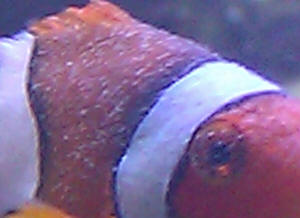
I was able to snap a photo. Please see attached. Thank you!
<Sure looks like Brook to me. Have to look at a skin mucus
smear under a 'scope to be sure... B>
|
|
|
Re: Brooklynella Question
8/12/11
Thanks for your opinion. I should pull the fish out and do a dip
in?
:<Disappointing... READ where you were initially
referred>
If so, a dip in what? I don't have a qt tank, so should I
return the fish to the tank after treatment? Or should I set up a
new 5 gallon bucket with heater and air stone as a makeshift qt
tank? |
Brooklynella... no, not likely
1/5/10
Hello Crew,
<Matt>
I have recently had a major outbreak of Brooklynella in my tank. It
killed 2 Yellow Tail Damsels,
<Mmm, doubtful>
2 Clowns, and a Royal Gramma. What I have left are a Haitian Anemone,
Scooter Blenny, 2 Camel Shrimp and a few snails. What I'm asking is
how long should I wait before I start adding new fish back into my
tank? Thank
you for your time.
<... This is/was much more likely some other Protozoan... Probably
Cryptocaryon... Read here: http://www.wetwebmedia.com/ichartmar.htm
and the linked files above... till you understand your situation. Bob
Fenner>
Re: Brooklynella 1/6/10
Thank you for the quick response. I still do not understand how long I
should wait before adding any fish to my tank.
<... Need to make sure this is/was a parasitic
infestation...>
The reason I thought it was Brooklynella was because all of them became
white, Not spotted but in like a white carpet.
<I see>
And died within a day. I'll continue to read that link you gave me
but any extra information would be very helpful. Thank you.
<I would likely treat all with a quinine compound (will cure both
Crypt and Brooklynella)... In a separate treatment tank... leave the
main/display fallow (sans fish hosts) for at least four weeks... Read
here: http://wetwebmedia.com/quinmedfaqs.htm
and here:
http://wetwebmedia.com/brookyescuref.htm
and where you lead yourself otherwise. Bob Fenner>
Clownfish recovering from Brooklynella without
treatment 11/13/09
First off thanks so much for maintaining such a great resource.
It has been a big help to me! I mostly use the web to research on my
own and don't post much but I need to some help on something I
can't seem to find an answer for.
<Yay!>
I recently lost my male Black & White clown to what I think was
Brooklynella. Now I am not so sure if it was Brook or not. I have had
these clowns since Feb 2009 without a single issue.
<Mmm, if no new Clownfish or fish period had been introduced in
recent time (w/in weeks) this is doubtful. More likely some other
parasite or even "just" environmental effect>
The male had all the symptoms of Brook (white mucus coating the body,
head shakes, darting, not eating, enlarged gills, heavy breathing,
trying to stay in the current). He died within 24 hours of the mucus
showing up (5 days ago). The strange thing is that the Female is still
in the tank today and is the only fish currently in the tank (40
breeder). The day after the male died, she started to develop a partial
white mucus coating but she did eat quite well that same day. I have
also seen her being routinely groomed by my cleaner shrimp which I have
never seen her do prior. She has eaten very well every day this week so
far and last night the mucus was limited to only one area on her lower
body (which the cleaner shrimp was tending to later). She truly looks
really good now but she was still darting a bit last night.
When I fed her tonight she ate more food and more aggressively than I
have ever seen her eat.
<Good signs>
From everything I read (and saw with my male), I don't see how she
could be on the road to recovery without treatment if this was Brook as
it attacks very quickly.
<I agree>
When the male died, I went out and bought a hospital tank for the
female but I have not set it up because she is doing so well and I
don't want to stress her if it isn't necessary.
So here is my question...IF she makes what appears to be a full
recovery without treatment, will I be able to add more fish in the
future without taking her out and treating?
<Should be, yes. You may have a resident parasitic fauna (most
systems do), that could conceivably become (hyper-) infective at some
point, given circumstances that promote it over the fishes'
resistance>
I am in no hurry to add another fish and have already committed to
waiting a couple of months at least to add any fish whether I have to
treat her or not. I have tried to find an answer to this question on my
own but I did not have any luck.
Current parameters: Ammonia 0, Nitrate 0, pH 8.0-8.1, SG 1.025 (no
Nitrite kit). No skimmer or refugium, 30lbs of live rock. I do weekly
10-15% WC's and I have not had any variation to these numbers that
I am aware of.
Also, I would like to add another clown for her to hopefully pair up
with. Is the "purchase a smaller one and he'll remain the
male" accurate or are there no guarantees?
<This general statement does apply. Do buy a smaller individual.
About an inch in length maximum>
Thanks,
Graham
<Welcome! Bob Fenner>
Brooklynella question 9/9/09
Hello there,
<Brett>
I've been reading your question/answer emails about fish disease
and I wanted to get your take on a problem that I'm having. First,
some background info: I have a 55 gallon tank with a 10 gallon
sump/fuge. It is a reef tank and I have several soft corals as well as
some LPS. As for lighting I currently have 4 x 65 watt Coralife PCs,
but I will be upgrading this week to a Nova Extreme 8 x 65 watt T5
fixture. Probably about 70 lbs of live rock and a 2 inch sand-bed. I
have a Remora hang-on skimmer and some Chaeto and mangroves in the
fuge. Fish: 1 baby hippo tang,
<Needs more room than this>
3 blue damsels, and 1 ocellaris clown.
My water parameters: Ammonia: 0ppm, Nitrite 0ppm, Nitrate 0ppm,
Phosphate: 1ppm,
<1.0? Way too high>
Mg: 1250, Ca: 460, Alk: 4.5 mEq/mL. SG: 1.024, temp: 78. I have had the
tank running about 2 months now (I'm sure the nitrates will start
to climb soon). I use RO water and Instant Ocean salt mix.
When I first got the tank I got two young ocellaris clowns. Both died
within a week. I didn't QT them, unfortunately. I didn't notice
any sloughing-off of the skin or any spotting, but they stopped eating,
became much more inactive and gasped a lot near the bottom of the tank.
I added the hippo tang and the damsels between the deaths of the first
clown and the second, also without QTing.
At this point, determined to keep some clowns...I set up a QT with a
heater, airstone, PVC and some ammo-lock on the side just in case.
<Not a good method of handling ammonia here>
I bought two adult ocellaris clowns and put them in the QT. They did
great in there for two weeks and then I put them in the display. After
1 day, one of them looked all powdery. I immediately thought
Brooklynella. The other one looked fine.
<Mmmm, unusual for one to express and not the other>
I gave the spotted one a freshwater bath and then put him back in QT. I
also put the other one in QT as well, figuring that he just wasn't
showing symptoms yet. I treated the QT with Cupramine, just in case it
was ich and because I had not been able to track down any formalin
until today.
<... what about your other fishes?>
That was last night when I returned them to the QT...this morning one
was dead. I couldn't see any "white powder" on either the
dead fish or the remaining one, but I'm assuming that the
white-dusted fish had been the victim. Today my girlfriend is picking
up the formalin and is going to treat according to the directions on
the bottle in the QT.
<Do take care here: Read:
http://wetwebmedia.com/formalinart.htm>
Here's my question: It seems as though the display tank is infected
with Brooklynella,
<Seems? W/o looking at a skin/slime scraping through a 'scope, I
won't agree>
probably from those very first clowns that I put in. I'm not going
to return the clown that I'm treating with formalin to that tank
(if he survives the treatment and QT). I'm also not planning on
taking out the damsels or the tang. The tang has not shown any spots or
sloughing...he is still a brilliant blue color. He has been in there
for over 1.5 months since the first set of clowns died. At one point he
did start scratching on the rocks a lot, but it seems that if I feed
him garlic extreme soaked food that he becomes fine again and
doesn't scratch. Is he acting as a host for the Brooklynella?
<Possibly>
Is it okay to leave him in the display since he has survived for 1.5
months and seems to be doing as well as ever?
<Your call>
I could try to QT him too, but he is very hard to catch.
Also, if I do try to reintroduce the clown after treatment, how long
should I wait?
<A month or more>
I read on one of your answers that unless you completely empty and then
bleach the tank that the Brooklynella could stay in it indefinitely.
That's not an option for me. I was thinking of maybe waiting 6
weeks. If the clown gets symptoms again then, I guess I will just give
up on keeping clowns in this tank, unfortunately. What should I do
about the tang though? Is it possible that he's immune to
whatever's in the water (presumably Brooklynella)?
<Some Surgeonfishes are known to be susceptible... but I don't
think this is/was Brooklynellosis... if it were, all Clowns would have
been afflicted>
Thanks in advance!
<I would return the one adult Clown, wait the six weeks and purchase
a couple of tank bred specimens and place them. Bob Fenner>
Shrimp goby pair quarantine... Actually, Disease,
part. Protozoan ID, trtmt. 8/17/08 Hello to all and
thank you for being able to ask questions, <I as well> it is
greatly appreciated. I am in need of some guidance and direction as to
what is the best way to address my current situation. My tank came down
with what I now believe was Brooklynella. <Mmmm, not likely> In
one day I thought I lost all fish. <Then no> Symptoms were cloudy
eyes, peeling skin and 2 dead fish clown and pseudo. I also had a
yellow watchman goby pistol shrimp pair which I had assumed perished as
well because I had not seen them in a while. I was going to let the
tank go fallow following directions listed on your site. Then one day I
put a very small amount of frozen food in the tank and out comes the
goby and shrimp looking very healthy. So my question is now what do I
do? <Likely nothing> Im thinking of dismantling the tank to catch
the goby and shrimp and place them in a 10G quarantine tank. <...
for what reason/s?> Should I catch both or just the fish? If just
the fish will they still pair off later after reintroduction? Also what
should I use to treat the yellow watchman goby and how often since I
see no signs of disease on him? <I would do none of the above> I
was planning on using a sponge from my tank and also water from the
main tank into the quarantine, but would it be better to not use the
water from the main tank since the disease is in the water from the
main tank? I would really like to keep the goby paired up with the
shrimp but since I will most likely be medicating the fish I am unclear
as to what to do? If you recommend a dip and then placing in quarantine
how would I know if it worked since I don't see any signs of
disease on him and its been 10 days now since I lost the other 2 fish?
Thanks Steve Tank size is 24 gallons water quality ph 8.2 ammonia 0
nitrite 0 nitrate <5 specific gravity 1.025 refugium in the process
of being installed 20% water changes weekly 22 lbs live rock 1/2 in
sand various zoos 1 blue xenia <Mmm... let's start a bit toward
the beginning here... W/o knowing... what the actual cause of loss was
here I would not "jump" to conclusions... was this a
protozoan infestation? Not definitively... NOT Brooklynellosis I assure
you. I would leave all as they are presently... proceed cautiously in
introducing new fish livestock (see WWM re... quarantining, assuring
the initial health of new introductions). Bob Fenner>
|
Brooklynella Parasite Help! Just reading... 07/07/08
Yesterday morning I woke up and found my Tennent Tang was
sideways in the tank "flopping" around. <Yikes!>
I immediately ran to a pet store I trust and they told me that
the fish would die and if I wanted to, I could bring him in and
have a biopsy. When I arrived home, my tang was dead. I drove the
drive back to the store and they found that my fish had died.
<?> They scraped the sides and found a Brooklynella
Parasite and told me that I could not do much, as I have many
invertebrates in my tank. <... Where did this Protozoan come
from?> I was told to gradually lower the salinity to 1.018 and
gradually raise the temperature to 83 degrees (each degree and
amount of salinity in 24-48 hours) - but to closely watch that
everything isn't getting to disturbed in the meantime. Please
help me if you have any experience in what to do with this
parasite when housing invertebrates with fish (other than what I
was told). I am desperate to get everything healthy again and not
to loose anything more! Thank you! <... I am desperate to have
you read here: http://wetwebmedia.com/brooklynellosisart.htm and
the linked files above. Bob Fenner>
Re: Brooklynella Parasite Help! Still... 07/07/08
From message question below - we do not know where it came from.
<... read> I have had this tank for over a year and the
most recent thing I have purchased for the tank was months and
months ago (a decorator crab). The person at the pet store said
he thought it had been infected for a week or so, <...?>
from looking at its biopsy. I just don't know what to do - I
read your link, but it still doesn't help me with what I
should do to cure this seeing as I have Invertebrates in my tank.
I'm just upset because that Tennent Tang was such a good
"buddy" of mine. I just want to be able to save
everyone else. Again, I appreciate your help with this! <...
keep reading. RMF>
|
Possible Brooklynellosis... -- 03/07/08 Hi Crew,
<Pat> Long story short. somehow velvet made it way to my DT and I
QTed all the fish. My tank is now fallow. I FW dipped my two clown fish
for ~10 min, QTed and Rx with copper as directed <Uhh, copper
won't cure Brook...> and I am at day 19 and no more signs of
velvet. BUT I noticed about 5 small white spots with a little
protrusion on the female today and can only think that they now are
showing signs of Brooklynellosis since they have been in copper for so
long. <Mmm, may be just environmental... reaction to the copper
poisoning> None of the other fish in the other QT tanks show signs.
I could not find any information on the cycle of this protozoan. <Is
very similar to Crypt...> Will leaving my DT fallow for 6 weeks rid
my system of it? <Hopefully, yes> What is the best way to deal
with this problem, since a FW dip did not take care of it would a
formalin dip or formalin medicated tank do any better? <Yes... Read
here: http://wetwebmedia.com/brooklynellosisart.htm and the linked
files above> Could the other fish also have it, what should I do
with them, keep in QT and monitor for another 2 weeks? <I would,
yes> Also, I do not have formalin on hand and if I can not get it
locally should I at least do a FW dip to help remove them until I can
get some? <If the fish appear to be suffering, likely worth the wear
and tear...> Thanks, Patrick <I would NOT be so sure this IS a
pathogenic manifestation... Do read where you are referred to. Bob
Fenner>
Brooklynella??? Please help!!!
6/9/06 Hi WWM crew, I have an emergency...unless you can put me at
ease somehow. I have a captive bred clownfish that I have
had for over a year now. He is in a 5 month old 95 gallon
tank with 100lbs of live rock and live sand. Water
parameters are great. Ammonia 0, Nitrites 0, Nitrates
<20, pH 8.3, salinity in between 1.023-1.024, temp steady at
78F. His tankmates are two Pajama clowns that have been
there for 4 months and all have been perfectly healthy. My clown has a
cotton like patch on his left side, just at the lateral line and past
his dorsal fin. It does protrude off of him somewhat, but is
difficult to get pics or more accurate description because he simply
will not stay still. He is eating well. He is
not, nor has not been near the top of the water gasping, neither is he
lethargic at all. He still swims actively around his two
anemones <This may be "it"> and his fins are not
clamped. I don't know what a fish healing from a scrape
looks like, or I could assume that... if it is a scrape, then it's
a nice one. His respiration seems normal, but it's hard
to tell as he swims constantly. The other fish show no signs
of anything thus far. Would the fish still be eating if it were
Brooklynella? <Perhaps, but not with gusto for long>
I read on this site and the section on Brooklynella
thoroughly and couldn't find an answer to that
question. If it were advanced enough to be on his body would
he still be acting fine? <Is not this protozoan unless you have
introduced it somehow recently...> He does twitch and
dart some, but I haven't noticed any flashing. If he
flashes, it isn't often... but he does twitch like something is
biting him nonetheless. I read that it seemingly starts at
the gills. If it is in his gills, would he still be eating
and swimming in the middle of the water column? Please, any
info or advice that you can give would be very welcome and
appreciated!!! Thanks again, H. Owens <I
wouldn't move, treat this specimen. This is highly unlikely to be a
parasitic involvement. Could be a negative interaction twixt the
anemones, but much more likely resultant from a physical trauma as you
speculate. Bob Fenner>
Re: Brooklynella??? Please help!!! 6/10/06 Hi
again and thanks for the super quick reply! If this
is Brooklynella, approximately how long will fish normally
continue to eat after the "bug" shows up on the
fish? <Impossible to say, however, this protozoan is generally very
rapid "on-set", killing its host/s within days of
discovery...> The spot appeared on Tuesday and as of
Thursday night, he was still eating like a pig. <... is almost
assuredly not Brooklynellosis...> I only put two
new pieces of live rock in the tank over a week ago after
holding it for over a week. The tank came from
the LFS that has a live rock only tank with 1 Naso tang in
it. It had been in his tank for some time. Is
it possible that it could have been introduced that
way? I guess, my main concern is, would he still
be eating if it was far enough along to be showing up on his
body? Thanks again for your help! <I wouldn't be
concerned... please read: http://www.wetwebmedia.com/clndisfaqs.htm and the
linked files above. Bob Fenner>
Clownfish Breathing Hard
hello I have a clown fish that is breathing real hard but the weird
thing is that everything in the test kit that I have is all perfect?
what do you think it is and what should I do for it? thanks <Many
possibilities here... could be just simple anoxia (lack of aeration,
circulation)... possibly an osmotic imbalance (too much change in your
water make-up in too short a period of time), perhaps a Brooklynella
infestation... Please read through the Clownfish Health/Disease
sections and related FAQs files posted on the site: www.WetWebMedia.com
for hopefully what will surface as the cause/s, path to take here. Bob
Fenner>
Brooklynella, Microsporidium, or Lymphocystis? Hello, I
recently made the mistake of purchasing a large (3") Amphiprion
Ocellaris (common clownfish) from my local fish store. They had just
received the animal when I purchased it, mistake number two. I added
the clownfish to my newly cycled reef tank (mistake number three,
biggest one). Within 24 hours I noticed a white wart/cauliflower growth
on the animal's right side, in the white band area, just behind the
gills. The clownfish will not eat and appears to be stagnant although
it is moving about somewhat. The animal does not exhibit any other
signs of infection, no small white spots, glazed or popping eyes,
scratching, fin rot, and the like. What has infected my fish? I've
narrowed it down to either Brooklynella, Microsporidium, or
Lymphocystis or ? ? ? What can I do to cure the fish and save my reef
tank. Should I remove the infected fish to prevent the disease from
spreading to the other tank mates (choc chip star, scooter blenny, 2
turbo snails, 6 reef crabs)? Please advise, I want to save my tank and
the clown if possible. thanks, Dan Rose >> Thank you for writing
so well, including with such clarity and humility... Glad to know that
I'm not the only one who makes egregious errors in the hobby... I
would almost bet that what you are seeing is indeed the Clown-attacking
protozoan Brooklynella... And would in any case follow these steps. Do
take the fish out and treat it in a separate "hospital"
system... for it's sake, the use of the treatment
"medicine", and the safety from the same of the rest of your
system. The likelihood that the Brooklynella will affect your other
livestock is minimal (there are no other Clownfishes...)... Copper is
of little use if indeed this is Brooklynella, but formalin dips/baths
are efficacious. Buy a stock solution (my fave retail brand is Kordon,
but any will do)... generally a few drops per quart of pH adjusted
(just with sodium bicarbonate, baking soda is fine) freshwater... and
move the fish from the main tank into this solution for about ten
minutes... either add an airstone, occasionally splash the water around
for aeration), move the Clown to the bare-bottom (but still filtered,
aerated.... with a hang on, sponge, box filter...) hospital/quarantine
system... Dump the treatment water... repeat every day for three
days... and stop there if there is no further visible sign of the
disease... If it re-shows or persists, wait two days and resume the
dip/baths... This will work.... Bob Fenner
| Ich freaking me out what are these spots
still on my fish today, slime kinda <likely a protozoan
infection so common on clownfish... do read more about it and
treatments (which you are already doing) at
http://www.wetwebmedia.com/parasiti.htm Let me encourage you to use
the wealth of information in the WWM archives (articles, FAQs,
photos and more) and use the Google search engine on the WWM to
narrow your search if necessary (I prefer to just browse). Best
regards, Anthony> <Looks like Brooklynellosis to me... Please
see the Google search feature on WWM re "Brooklynellosis"
and/or the FAQs files on Clownfish Disease: starting here:
http://www.wetwebmedia.com/clndisfaqs.htm and beyond. Need to act,
quick. Bob Fenner> |
|
|
Ocellaris Clown (disease) Hello Sirs. Thank you again for all
of the info. I'm writing to get your opinion on diagnosis/treatment
of my false percula. After searching the site, I found a post that
seemed pretty similar to my situation (as far as the symptoms). It
goes: Brooklynella, Microsporidium, or Lymphocystis? Hello,
I recently made the mistake of purchasing a large (3") Amphiprion
Ocellaris (common clownfish) from my local fish store. They had just
received the animal when I purchased it, mistake number two. I added
the clownfish to my newly cycled reef tank (mistake number three,
biggest one). Within 24 hours I noticed a white wart/cauliflower growth
on the animal's right side, in the white band area, just behind the
gills. The clownfish will not eat and appears to be stagnant although
it is moving about somewhat. The animal does not exhibit any other
signs of infection, no small white spots, glazed or popping eyes,
scratching, fin rot, and the like. What has infected my fish? I've
narrowed it down to either Brooklynella, Microsporidium, or
Lymphocystis or ? ? ? What can I do to cure the fish and save my reef
tank. Should I remove the infected fish to prevent the disease from
spreading to the other tank mates (choc chip star, scooter blenny, 2
turbo snails, 6 reef crabs)? Please advise, I want to save my tank and
the clown if possible. thanks, Dan Rose Thank you for writing so well,
including with such clarity and humility... Glad to know that I'm
not the only one who makes egregious errors in the hobby... I would
almost bet that what you are seeing is indeed the Clown-attacking
protozoan Brooklynella... And would in any case follow these steps. Do
take the fish out and treat it in a separate "hospital"
system... for it's sake, the use of the treatment
"medicine", and the safety from the same of the rest of your
system. The likelihood that the Brooklynella will affect your other
livestock is minimal (there are no other Clownfishes...)... Copper is
of little use if indeed this is Brooklynella, but formalin dips/baths
are efficacious. Buy a stock solution (my fave retail brand is Kordon,
but any will do)... generally a few drops per quart of pH adjusted
(just with sodium bicarbonate, baking soda is fine) freshwater... and
move the fish from the main tank into this solution for about ten
minutes... either add an airstone, occasionally splash the water around
for aeration), move the Clown to the bare-bottom (but still filtered,
aerated.... with a hang on, sponge, box filter...) hospital/quarantine
system... Dump the treatment water... repeat every day for three
days... and stop there if there is no further visible sign of the
disease... If it re-shows or persists, wait two days and resume the
dip/baths... This will work.... Bob Fenner Well I thought
that the "wart/white cauliflower" part definitely defined
what has appeared on the very tip of the dorsal fin of my fish.
I've had this fish about a month. 2 weeks in QT and 2 in main
display. About 3 days after introduction into the main tank, I noticed
a white spot about the size/shape of a grain of table sea salt (yum).
Wasn't sure so I've been watching and reading in the meantime.
In the last 10 days the spot has maybe grown by 25-50%, but has not
spread to any other areas. It also has not spread to Pac Blue Tang. He
(or she I'd suppose) was eating normally until yesterday when
he/she started "sampling" then spitting out food (similar CMA
recipe). Seems similar enough to enclosed post to warrant an email.
Would this be a Brooklynella infection that would require the above
recommended treatment? <Mmm, the wart-like growth on the Clown could
be lymph, the spot on both fishes is likely crypt, tangs don't
"get" Brooklynella> Other info: 125 gal, 90# LR (more
coming when the $$ does), 200# LS, 240W NO fluor. lighting @13 hrs/day
(MH with more $$ again), 2x Rio 1100 plus return for circulation, TF
1000 skimmer, sump w/ 55W PC lit 'fuge, airstone and active carbon.
Today's parameters were pH-8.2, Ammonia-0, Nitrate- <5 ppm, Alk-
4.8 mEq/L, Ca-350 ppm, Temp 77, SG-1.025 Other livestock: 1- Pacific
Blue Tang, 1-sand sifting star, 12 bumblebee snails(?), 6-turbos,
12-astrea, 1- hitchhiker clam as of yet un-i.d.'d, misc hitchhiker
polyps/sponges etc, and very soon 1- cleaner shrimp to be determined
<I would hasten the acquisition of the Cleaner Shrimp/s... maybe get
more than one> Hope this is enough/ not too much info. Thank you for
your help and dedication to helping the rest of us become as informed
as we can possibly be. <Perhaps add a Gobiosoma Goby to the Cleaner
list as well... otherwise nothing "stands out" as real
trouble/cause here. Bob Fenner>
Beating Brooklynella! Hello guys! I am new here so I hope you
would help me... and quick if that's not too much to ask? <Scott
F. at your service!> This morning, I noticed that my Flagfin angel
developed some white patches all over his body. Though I didn't
notice any adverse reactions from this, I opted to do a 10 minute
freshwater dip just to be sure. I know this is something serious
because from hindsight, a couple of really healthy bi-color angels I
had in the past developed similar symptoms where their entire body
turns hazy, almost white and then dying a day later. <Not
good...> I know this is not ich because there are no apparent white
spots. I also discount the fact that this might be velvet because the
fish doesn't exhibit rapid breathing, is not flashing and he is
still feeding. <Well, the fact that the fish is eating is a very
encouraging sign...> Same thing in the past with my bicolors. My
best guess is that this might be Brooklynellosis. I read from your site
that this occurs mostly among Clownfishes, but what do you think? How
can I cure it? I'm not considering formalin because I have no
access to it. Will hyposalinity work? <Well, it might provide some
temporary relief from symptoms, but it is not generally considered a
"cure" for Brooklynella. As you point out Formalin-based
medications, and Malachite Green meds are usually considered the proper
cure for this illness. Feeding the fish with antibiotic-laced
medication after they are healed can help prevent the occurrence of
secondary infections in these fishes.> I also put a really nice
Centropyge flavicauda yesterday before I noticed the disease on my
Flagfin. What are the chances that this fish might contract the
disease? <It's really hard to say...This is a highly contagious
illness, and I'd operate on the assumption that any fish which has
been exposed to it is a potential victim...I'd remove all fishes
from this tank (even the apparently healthy ones) and place them in a
separate quarantine tank for observation and/or treatment if symptoms
manifest. Meanwhile, you'd let the display tank run
"fallow", without fishes, for about a month. This will result
in a significant decrease in the population of the Protozoans that
cause this disease. Not a fun procedure, but quite effective> What
can I do to prevent it from attaching to this fish? <As above> I
also have a whitecheek tang, clown tang and 2 Ocellaris clowns in with
these angels, though I don't seem to notice the parasites attaching
to them... ever! Why could this be? <Hard to say...Could be some
form of resistance- could just be random luck...It's up to you if
you want to approach the management of this disease aggressively, or
wait it out and see...> I'm planning to do a 25% water change
tomorrow to help alleviate the situation. <A water change is always
a good thing. Not sure, however, if it will have any impact on this
illness in a display tank while fishes are still present> Pardon me
for the long story, just like to divulge all important details. <You
did a great job! No problem!> I will greatly appreciate your
response! Salamat nang marami, from your friend here in Manila!
Regards, Mitch <Best of luck to you, Mitch! I hope that things work
out okay! Good luck! Regards, Scott F>
| - Tomato Clown Disease? - Hi Jason (or
whomever is kindly helping me here), <It's Jason
again...> Spots have now spread across both sides of body &
fins and seem to be both black and white. Have attached 2 more
photos (which I hope will go through). <Got them...
interesting.> Am not sure of a plan of action here and am simply
trying to rule things out at this point so that I don't start a
treatment plan that ends up being more harmful for the fish than
the problem. <Good tact...> Of the common diseases that
I've read about I can't seem to identify this as being any
one of them because of the following reasons: Amyloodinium -
can't be this because the fish has had problem for a while (3
or so weeks) and has exhibited no signs of breathing difficulty.
Seems like this disease doesn't show any skin symptoms (except
for 2nd hand diseases). <Ok.> Cryptocaryon (Ich) -
thought it might be this, but the spots are hardly 'salt'
like and the other fish in the tank (a scooter blenny) has not
shown any symptoms at all. <Hmmm... not uncommon for one
individual's stress to be high enough to suffer from a
parasitic problem like this before other fish in the tank.>
Brooklynella - Local dealer told me that it was probably this after
I described the symptoms (& sold me some Formalin to use in a
30min dip), but I really doubt it is this as it looks nothing like
the pictures I've seen of it & furthermore, the fish again
doesn't exhibit the 'gasping' & reduced appetite
that I've read about. Finally, it is my understanding that
Brooklynella (like Amyloodinium) would probably kill the fish
rather quickly. As I've mentioned before, the fish seems to be
otherwise doing fine... So, I have CopperSafe ready to go, Formalin
ready to go & am ready to use these medicines either in a
quarantine tank (Copper) or as a dip (Formalin), but as I don't
really know what I'm supposed to be treating, I don't know
what I should do. I looked for Methylene Blue at the store &
wasn't able to find it (is it sold with a specific brand name?)
but will use it in a buffered freshwater dip if you feel it would
help. <The dip is a good way to kick things off. Perhaps
the isolation would also be helpful here.> Anyways - any
identification you could give me? <Still not sure, and really
looks to me like aggression, nipping... or scraping against
something. Will do some more research.> If not, any ideas
on a plan of attack? <I like the idea of a dip along with
isolation in quarantine to await further action.> Hope these
photos are helpful... <Yes.> Thanks again for the help in
advance. Know you guys are busy... Eric Harvey <Cheers, J --
> |
|
URGENT_ sick clownfish: Brooklynella 5/21/04 Hello,
<howdy> When I woke up to turn on the tank light I noticed that
one of my percula clownfish was very badly injured. He has this mucus
white cobweb like stuff all over him and is breathing hard. I don't
know what is wrong. <This sounds like classic "clownfish
disease" (Brooklynella... do a keyword search of this term on our
website. Google search tool on the home page)> The female is fine
and is eating, but I noticed her nipping at her mate. I believe that
the female is pregnant because she is quite large (stomach area), and
this is leading to stress. Nothing appears to be wrong with the other
tank mates. My tank is 75 gallon, live rock, skimmer, UV, filter, liver
rock, 9 months old. pleas help I don't want to lose him. Scott
<the disease generally only afflict new fish or comes in with
livestock recently added to the tank without quarantine. It is critical
to QT all new livestock for 4 weeks without exception (all new fishes,
corals, rock, snails, plants, shrimp, crabs... everything!). Else you
risk random infections perpetually. Treatment of Brooklynella generally
requires Formalin. The Aquarium Products brand "Quick Cure"
may work here with aggressive freshwater dips. Do see our archives for
more details on how to do this. Anthony>
Clownfish nodules related to Brooklynella? Hello there! I
recently moved my pair of 3/4" ORA tank-raised Ocellaris out of
their three-week quarantine and into my tank. They did not appear to be
afflicted with anything, and ate just fine previously. My
question really only pertains to one of the clowns, the one that is
developing larger white nodules. By nodules, I mean what seem to be
larger, semi-translucent fluid-filled sacs, anywhere from 1mm-4mm in
diameter. The nodules seem to stick to her (the larger clown) at
certain areas, but most prominently the gill covers and tail fin. They
are occasionally found elsewhere also. The fish is fine as far as
activity goes, and eats like a pig. Are these nodules in any way
related to Brooklynella? <Don't think so... have battled with
this protozoan, dissected many clowns...> I'm simply afraid that
although they are the only two fish in the system, that I may have
moved them through my quarantine procedure without being cautious
enough. Can you help me? <A bit at least... I strongly suspect this
is NOT a pathogenic reaction... the folks at ORA would not have such in
their systems...> Thanks so much for all the time and effort you put
in to answer the questions that fellow hobbyists such as myself have.
Quentin D. <I wish I could tell you more... is very strange that
only one of the two is affected... I do hope the blistering will fade
of its own accord. Bob Fenner>
Brooklynella 12/28/05 To the WWM Crew
<Flávio> In a small, 20 Lts., quarantine tank I have a
clownfish probably with Brooklynella. He arrived 4 days ago. <Am
sure you're beginning to appreciate the value of captive produced
clowns versus wild-collected...> Don't eat, is in a tank corner,
breathing rapidly and has some kind of whitish coat extending from the
dorsal fin to the medium and lateral part of the body. He has also
three or four white spots on the frontal part. <All indicative>
Today I added Coppersafe, one cupful as the manufacturer indicates. In
the meantime I read your advice about Brooklynella and dips in formalin
( 15 to 30 minutes with 1ml (20 drops) for 4 Ltr of salt water, as you
state). <Yes... if Brooklynellosis, copper will not cure it> My
question is if I can put some formalin in the quarantine tank in order
to treat the possible occurrence of the two diseases. How much formalin
could I put there. 2 drops? Thanks in advance Flávio <I
would not place formalin in your quarantine system if you can treat
otherwise... instead I would run a dip/bath and move the animal to a
newly cleaned/sterilized system to avoid cross-contamination. Please
see WWM re Formalin use, http://www.wetwebmedia.com/formalinart.htm, Brooklynella.
http://www.wetwebmedia.com/brooklynellosisart.htm Bob
Fenner>
|
|

