|
Related FAQs:
Clownfish Diseases
1, Clownfish Diseases
2, Clownfish Diseases
3, Clownfish Disease
4, Clownfish Disease
5, Clownfish Disease
6, Clownfish Disease
7, Clownfish Disease
8, Clownfish Disease
9, Clownfish Disease
10, Clownfish Disease
11, Clownfish Disease
12, Clownfish Disease
13, Clownfish Disease
14, Clownfish Disease
15,
Clownfish Disease 16, Clownfish Disease 17, Clownfish Disease 18, Clownfish Disease 19, Clownfish Disease 20, Clownfish Disease 21, Clownfish Disease 22,
Clownfish Disease 24,
Clownfish Disease 25,
Clownfish Disease 26,
Clownfish Disease 27,
& FAQs on Clownfish Disease By: Environmental
Stress, Nutrition, Social/Behavioral/Territoriality, Trauma/Mechanical Injury, &
Pathogens: Lymphocystis, Infectious Disease (Bacteria,
Fungi...), Protozoans:
Cryptocaryon/Ich,
Amyloodinium/Velvet,
Brooklynella (see article
below), & Mysteries/Anomalous Losses,
& Clownfishes in General, Clownfish
Identification, Clownfish
Selection, Clownfish
Compatibility, Clownfish
Behavior, Clownfish
Systems, Clownfish
Feeding, Clownfishes and
Anemones, Breeding Clowns
Related Articles: Surviving
Brooklynellosis by Mike Maddox, Brooklynellosis,
Damselfish, Anemones, Premnas Pix,
/The Conscientious Marine
Aquarist
Clownfish
Diseases
|
|
|
By Bob Fenner
|
Many problems, causes...
|
Avoiding Clownfish Diseases:
Selection of initially clean,
pathogen-free livestock is of paramount importance.
Wild-caught/captured livestock should be avoided in place of captive
produced (tank-bred and reared) specimens. Wild specimens almost always
have pathogenic issues...
All specimens should be
isolated/quarantined for a minimum of two weeks to assure their health,
as well as screen any pathogen from being vectored into your main
display/s. Do NOT count on your dealer to have performed this crucial
task... Even captive-produced specimens can be easily exposed to
pathogenic disease agents by careless mixing of gear, water in a
commercial setting. If treatment is necessary, this MUST be
accomplished in a separate Treatment Tank/System.
"Medications" may well kill your other livestock directly
and/or indirectly if applied to your main/display system/s.
Quarantine, Quarantine Marine Fishes,
Dips/Baths
Provision of an optimized,
stable environment and good nutrition is of course necessary. Know and
provide a good-sized volume for the species in question. At least forty
gallons for a pair of the smaller species, and double this minimum for
the larger. Ocean Nutrition's frozen Pygmy Angel formula,
Piscine Energetics Mysis, Cyclop-Eeze,
good quality flake (e.g. Omega-C) and pelleted (e.g.
Spectrum) prepared diets are good choices for energy-dense, quality and
palatable foods that can supply all nutritional needs.
|
Chart of Disease/Causative Agents vs. Symptoms and
Suggested Treatment Moda, ex. photo, Microscopic details? (Mmm,
later)
|
| By Symptoms:
(ref./links) |
Causative
Agent/s |
Suggested Treatment
Moda |
Graphic
|
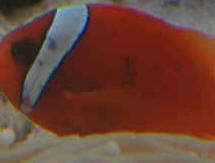
| Discoloration/Mottling, Hiding, Hanging in
Corners: Marine
Environmental Diseases, Toxic Water Conditions, Aggressive
Behavior, |
Most often either environmental or
social/territorial trouble/s. Too much crowding (Clowns are NOT
social animals... like mostly in pairs in the wild, and NOT found
in close association with other Clown species by and large). Some
markings are genetically predisposed and not uncommon in tank-bred
specimens. |
Improved environment and nutrition. Adding
Cleaner Organism/s may help. |
 |
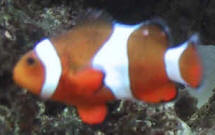
| Raised Pimples: |
Bumps/traumas, run ins with spiny, stinging
tankmates, subsequent reaction/s to netting, shipping, handling,
captive stress. Unless these are numerous, such spots rarely
portend pathogenic disease, though sometimes are indicative of
encysted worms or microsporideans. |
Improved environment and nutrition;
anthelminthic and anti-protozoals if indicated. Adding Cleaner
Organism/s may help. |
 |
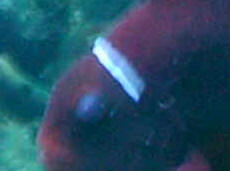
| Cloudy, otherwise damaged eyes:
Pop-eye/Exophthalmia, Cloudy
Eyes & Eye Injuries |
If unilateral (one-sided) most often due to
physical trauma. If bilateral (both sides) or other fish life
similarly afflicted, due to poor environment and/or nutrition.
Rarely due to infectious or parasitic agents. |
Improved environment and nutrition. Adding
Epsom Salt, Cleaner Organism/s may help. |
 |
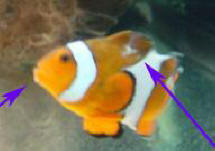
| Clumpy, loose cottony growths on fins, bodies:
<See Protozoan parasites below> |
Most often the result of parasitic
infestation, but can be just excess mucus production from chemical
exposure, poor water quality. |
Further diagnosis, formulation of a treatment
plan and execution. <See Protozoan parasites
below> |
 |
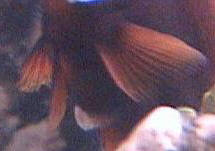
| Long, white, or stringy feces... possibly
"plugged up" likely not feeding...: |
Internal parasites (of the lumen)... usually
protozoan (e.g. Octomita/Hexamita) or worms of various
possibilities. Even just resultant from poor adjustment,
acclimation... Recent moving, introduction to a new
setting. |
Isolation, feeding of medicated foods
(Protozoacide and Anthelminthic), and/or administration of
anti-protozoal and deworming agents to the water possibly. Epsom
Salt. |
 |
| Rapid Breathing, Shallow or Deep: |
Indicative of either pathogenic, environmental
and/or social disease. |
Testing of water quality, water changes,
diagnosis, formulation of a treatment plan and
execution. |
Less than twenty or more than sixty gill
movements per minute. |
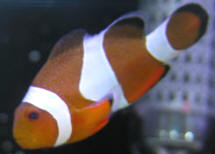
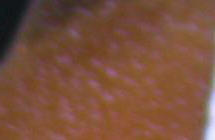
| Fine Dust Appearance, White to Tan in
Color: |
Most often Amyloodinium, though other
Protozoans can appear this way as well. |
Further diagnosis, formulation of a treatment
plan and execution. <See Amyloodinium below and Cryptocaryon pix
for comparison> |
  |
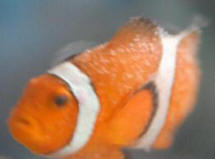
| Discrete Pin-head Sized Spots on the Body and
Possibly Fins: |
Most often indicative of the protozoan
Cryptocaryon irritans. |
Further diagnosis, formulation of a treatment
plan and execution. <See Cryptocaryon below> |
 |
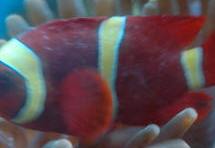
| Slimy Appearing Aggregate White Filmy Material
on the Body: |
Most often Brooklynella, but can be
Amyloodinium, Uronema, other protozoans. |
Further diagnosis, formulation of a treatment
plan and execution. <See these Protozoans below> |
 |
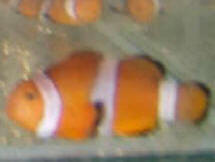
| Clamped Fins, Disoriented
Behavior: |
Often a response to a reflection of the fish
itself. Also general response to low oxygen, poor water quality
period. Possibly infectious or parasitic problem. |
Check water quality, amend. Where, when in
doubt, a good sized (20-25%) water change. Apply dark paper to side
of tank being "paced". |
 |
|
By Causative Agents:
|
| By Cause |
Observable Characteristics |
Suggested Treatment
Moda |
Graphic
|
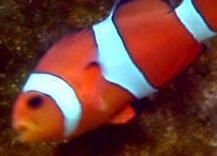
| Genetic Defects: |
Missing pieces of fins, eyes... Bent jaws (as
shown), vacuolations/scalloped portions of the head, back...
Diffuse, weird patterning, less-bright coloration... Dark spots,
areas... |
If the animal appears and behaves functionally
otherwise... |
 |
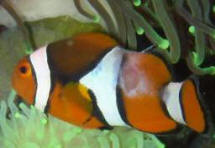
| Trauma; Physical & Social:
Aggressive
Behavior, |
Obvious physical damage, psychological
expression (hiding, not feeding...), from tankmates (here one stung
by a cnidarian host; Euphylliid), decor, rough netting, pump
intakes, jumping up to the hood, lighting... Jaws stuck open
(may be from an obstruction that may be cleared). |
Moving the aggressor or victim/s. Improving
water quality, bolstering immune systems with vitamin/HUFA
supplementation. Cleaner organism presence may help. |
 |
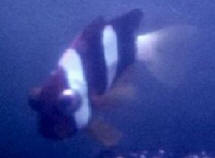
| Poor Environment: Marine Environmental
Diseases, Toxic
Water Conditions, |
Nitrogenous et al. metabolite accumulation
effects. Burning of gills, sores, broken fin membranes, labored
breathing, bilateral exophthalmia... |
Corrective action... water changes, chemical
filtrant use. |
 |
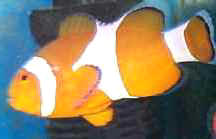
| Poor Nutrition: Nutritional
Diseases |
Shows as wasting, poor activity, poor color, death... |
Offer foods of high palatability, soak same in appetite
stimulants. |
 |
|
By Viral & Infectious Disease:
|
| By Cause |
Observable Characteristics |
Suggested Treatment
Moda |
Graphic
|
| Lymphocystis (Lymph, viral): Lymphocystis, Viral
Disease |
White to gray clumpy, cauliflower-like appearing bunches most
often on unpaired fin membranes. Expresses itself most often in
stressed individuals, poor environments. |
Pulling off large/r masses seems to trigger the host immune
system. Improved water quality, nutrition. Possibly the addition of
a purposeful cleaner organism. |
|
| Bacteria, Fungi: Infectious Marine Disease (Bacteria,
Fungi) |
Almost always secondary to some primary trauma or poor water
quality issue. Appear as open, un-demarcated/non-emarginated sores,
cottony patches. |
Find and rectify the root cause/s. Water changes, improved
water quality and nutrition. Rarely are antibiotics necessary or
useful. |
|
|
By Parasitic Agents:
|
| By Cause |
Observable Characteristics |
Suggested Treatment
Moda |
Graphic
|
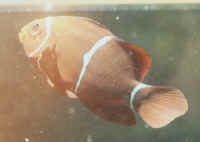
| Octomita/Hexamita, other internal protozoan
and possibly worm parasites |
Not eating, wasting away, disorientation,
occasionally shows as bloat... |
Consecutive or concurrent application of an
anti-protozoal and possibly an anthelminthic |
 |
|
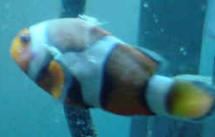
Amyloodinium (Velvet): Velvet
Disease/Amyloodiniumiasis
|
White film to small discrete tan to whitish
fine dotting... lack of appetite, rapid respiration, lots of
mucous. Rapid onset disease... may kill within a day. |
Copper, Formalin can work... with diligence, testing (at least
daily), replenishment... But the anti-malarial Chloroquine
diphosphate at 5-10 mg/L for 10 days is the best route to
go. |
 |
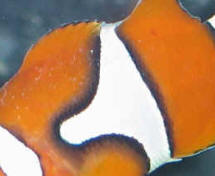
| Cryptocaryon (White Spot Disease, Ich):
Marine
Ich/Cryptocaryoniasis, Marine Ich: Fighting The War On Two
Fronts |
Discrete, "salt" sprinkled spots on
the body and fins. |
Formalin or Copper-based medications. FW
dips/baths are not efficacious by themselves. |
 |
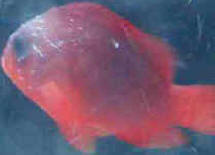
| Brooklynellosis (Clownfish Disease):
Brooklynellosis,
"Clownfish Disease" |
Detached threads/shreds, thick
cloudy mucous on skin. Very common
protozoan parasite in wild-collected specimens, and with others
exposed to systems with these in it... |
Formalin baths are recommended, with
sterilization, movement of affected fishes to new quarters. Not
often treatable with copper. |
 |
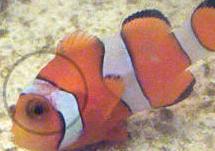
| Uronema: |
Smooth depigmented, pitted, lesions of defined
borders, often pinkish (flesh showing through). Hyperactivity then
listlessness. |
pH-adjusted freshwater baths, formalin dips. Must be caught,
treated early to avoid systemic infestation. |
 |
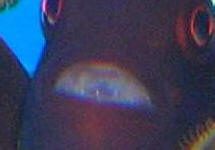
Crustaceans: Copepods, Isopods...
Crustacean Disease of
Clowns, Parasitic Crustacean Diseases,
Isopods, Pill-Bugs that
aren't such a hoot |
Isopods most often in the mouth, though do
occur attached to the body. Segmented, grey, unmistakable. Copepods
often as "sticks" with heads buried under scales or
attached to the skin of the fins. |
Adults are best removed via careful
tweezering. The system needs to be treated (generally with an
organophosphate) to kill the intermediate stages. |
 |
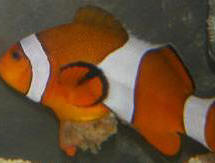
Worms:
Worm Diseases of
Clowns (internal & external), Parasitic Worm Diseases
(Trematodes/Flukes, Nematodes, Turbellarians,
Acanthocephalans... |
Various phyla (mono- and di-genetic trematodes
aka Flukes, Acanthocephalans, Nematodes... External ones may appear
like spots (dark or light colored), worm-like... internal species
can manifest themselves as bloating, prolapsed colons, a lack of
feeding, general malaise, stringy, white feces... |
Application to foods and/or water with a
purposeful anthelminthic. |
 |
| One more time: Other Protozoans, Worms (e.g. Black
Ich/Paravortex): Many |
Various appearing... bloody markings, torn fins, black
spots..., to no symptoms... |
Good livestock selection, quarantine, possible regimens of
pH-adjusted FW dips, with formalin... Use of anti-protozoals... and
anthelminthics... |
 |
About Definitive Diagnosis:
Assuredly, the only real means of
determining the root cause of expressed disease is through scientific
testing... And for causative organism determination, through
microscopic techniques... This last is not difficult, nor need it be
expensive, and much can be discerned with a low-power scope (a couple
hundred magnifications) of simple skin/slime prep.. As I have
long-attested, the investment in a simple microscope like the QX-
series by Intel/Mattel can more than make up its small expense in saved
livestock, medications, thrown away water etc. The single best
reference book actually costs more. Ed Noga's work, Fish Disease,
Diagnosis & Treatment is an excellent (though expensive)
resource.
Notes on Moda Above & Therapeutic Agents of Use
About Quarantine, Treatment and
Main/Display Tanks: All incoming Clowns should be isolated for at
least two weeks, particularly wild-collected specimens. Isolation-only
systems are termed Quarantine... Treatment tanks are where actual
medications are applied. It is extremely rare that fishes should be
treated in their Main/Display tanks... for fear of killing off other
livestock, biological filtration microbes, and the very real likelihood
that the presence of materials there will counteract the efficacy of
treatments. Quarantine, Quarantine Marine Fishes, Dips/Baths, Acclimation
Articles
Improved environment and
nutrition: Stable optimized water quality is key. Total absence of
ammonia and nitrite, minimum (less than 5 ppm) or nitrate are
requisite. Undercrowding, live sump/refugium (with macroalgae, DSB...)
use, careful maintenance, regular upkeep of skimmer, use of chemical
filtrants... Foods that are entirely nutritious (e.g. Spectrum
pellets), soaked in Vitamin and HUFA supplement (e.g. Selcon).
Vitamins in Marine
Systems, Iodine/ate/ide
Use
Copper Compounds: Free cupric
ion or chelated formats (e.g. CopperSafe, Cupramine). MUST be
administered carefully, as there is a narrow range of cure to kill in
exposure... MUST be tested for concentration at least daily with a
matching type Copper Test Kit... Copper Use
Epsom Salt: Epsom Salt,
Magnesium Sulfate and Other Salts & FAQs, Formalin/Formaldehyde: I encourage folks to only use
Formalin, or a formalin-based remedy as a dip/short bath... is very
toxic (a biocide...) to all life, including aquarists- I'd use 1
drop per gallon of a stock (37%) solution. Do aerate the dip/bath
solution and observe the fish VERY carefully during this procedure for
signs of distress and remove if things look bad after a few minutes. If
you can, a 5-10 minute dip is efficacious, moving the fish/es
afterwards to a new/un-infected setting. Formalin, Formaldehyde
Use Quinine Compounds: Quinine Compounds & FAQs,
Organophosphates: Are "economic
poisons", intended for use in killing terrestrial insects mostly.
They can be used to advantage (with care) in treatment for crustacean
parasites in aquatic settings. DTHP/Masoten/Dylox/Trichlorfon...
Dimilin (diflubenzuron)... variously sold in products such as
"Fluke Tabs" (tm), Clout (tm), Med-Aqua (tm)...
Organophosphates (DTHP, Masoten, Dylox, Dimilin...
Anthelminthics (anti-worm agents): Prazi
tm (Praziquantel), Pipzine tm (Piperazine), Hexamit mixed in food or
water, Jungle Anti-parasite Medicated Fish Food
Metronidazole/Flagyl
Protozoacide: Chemicals introduced
into the food and/or water to kill single-celled animals/parasites.
Most notably Metronidazole (Flagyl tm); New
Life Spectrum Thera+a
Antibiotics/Antimicrobials: Materials used
to kill and reduce the virulence of bacteria, fungi... Kanamycin,
Spectrogram, Chloramphenicol, Furan compounds (Nitrofurazone e.g.),
Triple-sulfa (sulfathiazole, Sulfamethazine and
Sulfacetamide). Antibiotics, Antimicrobials and Pet-fishing
& FAQs, Furan
Compounds (Nitrofurazone/Furacyn...) & FAQs, Sulfa Drugs &
FAQs,
Cleaner Organisms: Biological Cleaners, Cleaner
Shrimp, Neon, Cleaner Gobies/Elacatinus,
Gobiosoma,
Phony Non-Cures to be Aware of:
Hyposalinity has been advanced as a "for sure"
cure for various Clown ailments. Unfortunately such lowered specific
gravity trials rarely effect cures in the short or long-term. As you
might assume, these fish species, living in close association with
their invertebrate hosts, are sensitive to the same sorts of
environmental changes and challenges... This being stated, pH-adjusted
freshwater baths, with or w/o additives, can be of use in temporarily
relieving specimens from external troubles and efficacious in removing
external disease agents. Placing host fishes back into
infected/infested systems is of course contra-indicated.
There are a mix of "reef safe"
"cure-all" "remedies" touted/sold on the market for
treating the various maladies listed above... Most all of these are
outright scams... with parasites "cycling off" with their
application or no... to return in force later... What can I say/write
but "let the buyer beware"... Do investigate (thoroughly)
such curatives... If they don't list their ingredients, ignore
them... If their clams are specious, keep shopping... Tea/Leaf
extracts, "Vital" this and that, pepper sauces (sigh, yes)...
are not useful. Garlic... best used on pizzas, pasta dishes, some
soups.
Bibliography/Further Reading:
Mattel/Intel QX Microscopes:
http://www.compuvisor.com/qx5diblmicom.html?gclid=CIG74-zWjowCFQv1YAod5GB46Q
Noga, Ed. 2000. Fish Disease; Diagnosis & Treatment:
http://www.amazon.com/Fish-Disease-Diagnosis-Edward-Noga/dp/081382558X/ref=sr_1_1/103-2945648-4573462?ie=UTF8&s=books&qid=1179180675&sr=8-1
Wilkerson, Joyce. 1997. Clownfishes:
http://www.amazon.com/Clownfishes-Joyce-D-Wilkerson/dp/1890087041/ref=sr_1_1/103-2945648-4573462?ie=UTF8&s=books&qid=1179180712&sr=1-1
|
|