|
FAQs on Marine Ich, White
Spot, Cryptocaryoniasis: Cures
2
Related Articles: Marine Ich: Fighting The War On Two
Fronts, Cryptocaryoniasis, Parasitic
Disease, Quarantine, Quarantine of Marine
Fishes,
Related FAQs: Crypt Cures 1, Best Crypt FAQs, Crypt FAQs 1, Crypt FAQs 2, Crypt
FAQs 3, Crypt FAQs 4, Crypt FAQs 5, Crypt
FAQs 6, Crypt FAQs 7, Crypt FAQs 8, Crypt
FAQs 9, Crypt FAQs 10, Crypt FAQs 11, Crypt FAQs 12, Crypt FAQs 13, Crypt FAQs 14, Crypt FAQs 15, Crypt FAQs 16, Crypt FAQs 17, Crypt FAQs 18, Crypt FAQs 19, Crypt FAQs 20, Crypt FAQs 21, Crypt FAQs 22,
Crypt FAQs 23,
Crypt FAQs 24, & FAQs on Crypt:
Identification, Prevention, "Causes", Phony Cures That Don't Work, Hyposalinity & Ich, &
Marine Parasitic Disease, Parasitic Marine Tanks,
Parasitic Reef Tanks,
Marine Velvet Disease,
Biological Cleaners,
Treating Parasitic Disease,
Using Hyposalinity to Treat
Parasitic Disease, Best Quarantine
FAQs, Quarantine 1,
Quarantine 2,
Quarantine
3, Quarantine 4, Quarantine 5, Quarantine 6, Quarantine 7, Quarantine 8, Quarantine 9, Quarantine 10, Quarantine 11, Quarantine 12, Quarantining
Invertebrates,
|
.JPG)
All invertebrates (and algae, plants) out of the pool!
Steven Pro's excellent Ich
articles that start here: http://reefkeeping.com/issues/2003-08/sp/index.htm
& Terry Bartelme's http://www.advancedaquarist.com/issues/nov2003/mini1.htm
http://www.advancedaquarist.com/issues/dec2003/mini2.htm
http://www.advancedaquarist.com/issues/jan2004/mini3.htm
http://www.advancedaquarist.com/issues/feb2004/mini4.htm
http://www.advancedaquarist.com/issues/mar2004/mini5.htm
|
What looks like the crypt but is not?
10/3/19
Good day everyone,
Love this sight, always have, you all do a splendid job here.
<Ah, thank you for your kind, encouraging words>
My heart was on the floor this morning when I saw my purple tang and
regal tang covered in what appears to be Cryptocaryon irritans at first
glance but is clearly different on a more closer inspection.
<Mmm; well, there are other parasites, even "just congealed body mucus"
that may appear as such. The only definitive means of telling what is
what is to sample, examine with a microscope; as gone over on WWM and
most fish disease tomes>
210 gallon tank FWLR, stocked with angels and tangs.
Ammonia 0 of course
Nitrite 0, nitrate 12, phosphate 0.2
We run carbon, GFO, employ NOPOX and change our socks every other day.
This tank was established from zero-the long hard way of bleached rocks
and new equipment with a 2 month cycle.
We quarantine each fish as we have been rung through twice before.
<Hard to exclude the principal pathogens, but it reads that you've done
your best to>
We did just add 4 new fish in the span of 3 months, all quarantined.
My question is what disease is similar looking to ich? And what can we
do about it?
<I WOULD sample and examine as stated; in the meanwhile (ASAP) likely
drop (slowly, a few hundredths per day) specific gravity... begin
reading re your options (copper, anti-malarials...) on WWM:
http://www.wetwebmedia.com/ichartmar.htm
and the linked files above>
Many thanks,
Evelyn
<Do please keep me/us informed of continuing developments, your actions,
thoughts. Bob Fenner>
Re: What looks like the crypt but is not?
10/4/19
Dear Mr. Fenner,
<Evelyn>
What an honor to receive an email from you having had read SO many of
your posts during research and hard times.
<Ahh!>
I failed to mention that we have been ich free for about 1 1/2 years, I
am quite sure the we nuked the horrendous, dreadful mofo of a
parasite...(throat clear)...
<Ah yes... very hard to eliminate, exclude from captive systems>
A skin smear is near impossible. And the only fish vet in the
surrounding area will not come to the house though I offered extra
payment.
<Easy enough to do by oneself; really>
The last time we went through this I ordered from Fishman Chemicals $350
worth of “pure” CP from America to Canada. It was a disaster. It was not
effective and cost me the lives of my beloved fish. I have used CP
before that a courteous and sympathetic LFS guy gave to me as a favor
and it did wonders. But that is not available any longer, he may have
got in trouble for giving it to me. I called every pharmacy in town, I
couldn’t get it except from Fishman. We all paid a heavy price with
lives and monetarily.
I think I will start with Cupramine, just dose the whole tank.
Thoughts??
<A worthy product... will state for others/browsers; WITH daily
monitoring, testing for free copper presence, cessation of chemical
filtrant use, possibly turning down, off skimming or running on a
punctuated basis (to retain more copper)>
Does the skimmer matter?
<Oh, yes>
Nopox with Cupramine? Does anyone have experience??
<In looking for the MSDS of this Red Sea product, I found this:
https://www.reef2reef.com/threads/carbon-dosing-and-or-macroalgae-right-for-me.426442/
I suspect the totality of the ingredients include water and No3-po4-X,
it has acetic acid, ethanol, and methanol. I would hold off (not use)
this or other treatments during the Cupramine administration.
Bob Fenner>
Marine Ich 7/29/18
I wanted to thank Bob for his article on how to attack marine ich in a reef
aquarium. I had lost a gold rim tang, then a royal Gramma and finally my Kole
tang died. I read the article about dropping the salinity to 1.017. Many
people told me that wasn’t low enough, but after 6 weeks at the lower salinity,,
the ich has disappeared. The remaining fish look much, much better.
Thanks for the help and all you do for our hobby. I didn’t lose any corals or
inverts, but they were stressed. Again, thanks.
<Certainly welcome. Thank you for your upbeat report. Bob Fenner>
Fine Filter Pads for Help Combating Ich/Marine Velvet
3/19/17
Hi Team,
<Brad>
I had an interesting hypothesis that I wanted to get your opinion on.
Would using fine filter socks/pads that are 50/100 micron be able to
help control an outbreak of Marine Velvet and/or Ick?
<Mmm; would likely reduce incidence, but not totally control. DE
(Diatomaceous Earth)... would be better>
I was doing some reading and it seems like the trophonts of each would
be larger than 50 microns, so it would beg the question. Obviously like
UV (which I think this would compliment) it can't eliminate it because
it won't have full access to the entire volume of water at all times-but
I would think that it could help prevent outbreaks when used in a sump
in a tank with high water turnover and good circulation?
<Yes; help. Will/would require very frequent cleaning>
Assume that you could have a decent combination of filters (e.g. 200
micron + 100 micron + 50 micron stacked together and changed often.
Anyone heard of trying this approach?
<Oh yes. Screening like this is commonly employed by facilities using
natural seawater for culture. Bob Fenner>
Thanks,
Brad
Ich! But from where? 8/10/16
Hello WWM Crew,
How are you fine people today?
<A bit sleepy thus far... maybe 17% thus far; you?>
Thanks for keeping this site alive with all this information for us hobbyists. I
will try to keep it short. I started up a 150g tank and after 2 ½ months I added
some crabs, snails and 2 shrimp they all did fine so I added my first fish. He
also did well so I started adding my fish from my 90g slowly one at a time.
Everybody was doing fine in their new home, very active all alert and eating
very well. The tank has been running for about 6 months now so I decided to get
a Heniochus. My LFS had one for about 3 weeks and I would check him out every
week and he was eating, active, alert and no signs of parasites, so I bought
him.
<Mmm; likely H. acuminatus or... the two more popular, commonly offered species.
Really need to be kept in a small school of odd-numbers... three, five... Social
animals that get VERY stressed when kept singly... and sometimes very picky
toward esp. other Chaetodontids>
I put him in my 90g which now is a QT and kept him there for one month he was
doing very well, very alert and active and ate very well. While he was in QT
there were no signs of parasites so after the 1 month QT I put him in the 150g
with a FW dip on the way there.
<Good>
The only fish that harassed him was the Yellow Tang. There was no nipping or
chasing just asserting himself on the Heniochus. After about 5 days you guessed
it, white spots on the Heni. There are not many just a couple on his tail.
<Mmm; well; might not be Crypt... perhaps Trematodes, or even "just"
damage/reaction zones... like a bruise in humans>
I don't have access to CP just yet so I started soaking the food in Seachem
Metroplex, Selcon and Garlic and they are all eating it like pigs but I am still
seeing a couple of white spots on the Heniochus. He makes frequent trips to the
Cleaner Shrimp.
<Again; not necessarily a harbinger of doom>
I will have access to CP in 3 weeks but in the meantime do you think I should
keep using the Metroplex?
<Not for anymore than the label recommends. Metronidazole itself is a "kidney
killer". http://www.seachem.com/metroplex.php>
In your opinion do you think I will have a full blown infestation and have to
remove all and treat in a QT or is this maybe just a case of stress? I
appreciate and value your opinion.
<I wouldn't panic... NOT move the fishes, NOT treat the system further.
Cryptocaryon can/does come in on anything wet at times. VERY likely your system
has a "latent" infestation (I'd easily wager that almost all systems do)... Read
instead of fretting... Start here:
http://www.wetwebmedia.com/ichartmar.htm
and the linked files above.>
Thanks so much in advance
Brian
<Again; don't despair. Bob Fenner>
Re: Ich! But from where? 8/12/16
Hello Mr. Fenner
Thanks for the response. I am more awake than you as I am in Montreal Canada so
my day was half over by the time you sent the response.
<Ahh; about 2 PM or so here PST; about half sentient now>
I have read the link you sent before along with many other articles about Ich. I
just found it strange that I took precautions by QT and FW dipping and ended up
with white spots on him,
<Meh; very common. Isolation won't cure anything by itself... and there are MANY
instances where Crypt is deeply embedded, not susceptible to hyposalinity..
B'sides, the Crypt was highly likely (99.9 percent plus) already established in
the main/display>
by the way he is Acuminatus.
<Ah yes>
I did read a lot about them before buying and I am aware that they do better in
groups but they get so big I think 3 in a 150g is too much.
<Up to you. A singleton usually does just fine in a large enough system>
For the Metronidazole the instructions say to treat for 3 weeks or till symptoms
disappear.
<Mmm; yes; IMO, humble or not, this is too long. If interested, do a bit of look
seeing re nephritic conditions and this compound>
The LFS suggested to use 1/4 of the measuring spoon supplied but the directions
call for 1 measuring spoon to 1 spoon of food. I was using 1/4 spoon and it
wasn't enough so I used a full spoon for 3 days before I wrote to you
and it seems to be working.
<Ah good>
How much can fish take before kidney failure and what are the symptoms
of kidney failure?
<How to put this (twixt you and I not knowing each other well); this is more of
a successive approximation situation... every little bit hurts. Rather than a
threshold response... no problem till you get to such a point. All exposure is
damaging>
I have stopped the treatment since you wrote back to me and will wait it out.
Thanks so much again and nice talking to you.
<And you>
I saw your video with the Fishguys and you remind me of Paul Sorvino. Have a
good day.
<Heeee! Will have to look up this handsome devil. Cheers, Bob Fenner>
Thanks again
Brian
honest questions. Crypt. Reading 4/23/16
Hey Bob,
I write to you, 230 am eastern time here, (NJ, great snorkeling,
unlimited barnacles and syringes)
I have tirelessly compiled data, cut and copy faq's and literature
written by yourself, Steven Pro, and various experienced reefers on reef
central.
I feel I have a good grasp, however I have some wholes that need
filling, and also wish to have your opinion that I have not seen
discussed.
I will keep it short, I know you have many people to help.
Gap 1. Does copper, more specifically Cupramine, kill the
protomont
<Pro...? Read here:
http://www.reefkeeping.com/issues/2003-08/sp/
stage?
Most of everything I read says it only targets and eradicates the stage
where it hatches out looking for a host. My question, deals with the
stages that falls off the fish, crawling around to encyst. I am asking
because I wish to know if a fish is added to copper, would the ich that
falls off looking to harden and encyst, be effected? I've also
encountered the phrase "copper kills free swimming stage", which to me
would imply all stages that don't involve the one embedded on the fish,
and the one that is in cyst form, waiting to hatch out.
Gap 2. I know in many instances in life, (to quote Jurassic Park), life
finds a way. Chloroquine phosphate was created to cure malaria, but in
time it stopped working. I have seen some accounts where reefers
(not scientifically credentialed) said copper was no longer effective
and therefore not the preferred method of choice.
<They're wrong. Still effective; often the best mode of control>
Has the time come, where we need to start looking past copper? (for
reasons of it not working, not for reasons of toxicity to fish or
difficulty maintaining levels)
And lastly, my tank is now 36 days fallow. I plan on running two more.
All of the fish have been in Cupramine, and once the two more weeks have
expired, they would have been in copper for 7 weeks. I see many people
are using tank transfer method. I was going to do this, as an added
measure, insurance policy if you will.
Is this, in your experience, over kill, more stress than needed,
considering the time they would have spent in therapeutic levels of
copper?
<Already gone over and over on WWM>
Part of me says the copper should suffice (if indeed it is still a
viable weapon), the other half says to execute ttm, although, that is
more steps, and ultimately more stress.
That is all I have. Trying to put the pieces together, and in the 50
plus pages I have in m binder. those holes are still vacant.
Thanks in advance, Bob
Signed, bob
Morning bob
Quarantine commitment... Cryptic Crypt f's ongoing
6/8/16
Hello Bob,
Thanks to your site, I think I have given my fish the best chance
against parasites. Before quarantining, I lost a handful of fish life,
and vowed to not make that ugly mistake again happen on my watch.
I let the tank run fallow for at least 30 days, (60 days, not by design,
but had house issues happening at the same time) I also treated the fish
in a separate quarters with copper.
So far only a hippo tang will show some white spot intermittently, as I
believe like you, ich is always present, but less so having run fallow
and weakening the parasite.
As a preventative for new fish, I was wondering what you think of my
plan.
Using tank transfer (moving fish every 72 hours, 4 times total)
which should prevent ich if done correctly.
<Not likely; no... all "it takes" is missing one, some. Best to optimize
environment, nutrition... we've been over this>
Knowing this does nothing for velvet, using Cupramine, on these
transfers.
It. would be simple to make up 30 gallons of water, with .5 Cupramine
level, and use that as the new water for the 72 hour transfers.
My reservation comes with a notable Reef central member stating that
copper may complicate the ich life cycle.
<? Complicate?>
.I've always understood that ich need to fall off the fish within 3-7
days, and in my mind, because copper is there, they couldn't choose to
hold off and wait for copper to go away before falling off an continuing
their cycle.
What do you think
<Your last idea is valid. B>
re: Morning bob
Ongoing chatting re Crypt; life
6/9/16
Hey Bob,
Thanks for the replies. It's amazing, the ttm idea , of moving the fish,
seems like the Bible way of doing it to almost anyone I speak to.
<My usual response here: "Believe what you will till experience changes
your mind">
However , the last idea I proposed to you, which you admitted to maybe
having some validity, is laughed at by the same.
<... all of these ideas, methods have been gone over and over. ALL the
wholesalers in the world, MOST all the collectors, retailers, jobbers
STILL use copper.... READ IT, BELIEVE IT, LIVE IT. Stop wasting y/our
time and
killing livestock heedlessly>
I agree, when you transfer fish, you are transferring the water with
them, some, even if a little. Percentage wise, even if you leave behind
99 percent of them, well you still have too many that made the trip.
It's amazing the long time guys in the more respectable sites push ttm.
However, I don't see it happening that way, and I at least feel better
an expert as yourself leans the same way.
<Not a matter of one "expert", a person's opinions vs. others.... Simply
science and history>
I believe what was meant when someone stated the copper complicating the
cycle, was the ich will adapt and hold on to the fish longer if copper
is present, and wait it out until it can continue.
<What? Nonsense... the copper is a proteinaceous precipitant... causes
the fish host to exude... slough off... Except (here it comes) for
deeply embedded parasites>
That would imply they have free choice, not a designated life cycle.
<Shades of DEVO! "Freedom of choice (or parasites) is what you want...">
If that were the case, even in clean, copper free water, who's to say
the same "feeling" of waiting more time wouldn't apply.
I will do 7- 14 days in proper copper range, hope the studies of 2-7
days are correct, and hope the copper kills and prevents the cycle from
going on.
Thanks again bob
<W>
re: Morning bob 6/9/16
Under and agreed, 100x over.
I would pay to see you converse with the gentleman (sometime not so
gentle) on reef central, but the Lord knows you have way better things
up your sleeve. Sad part is, dozens of not hundreds listen to them on a
daily basis, shame on them, sorrowful for the fish.
<Don't know who or really what you're referring to. I don't "do" the bbs>
I know you actively keep goldfish as a pet from prior conversation.
<Ahh, not for years. Unfortunately those (Eheim) tanks failed>
If you were to do a "saltwater" tank, which direction would you go?
<Our companies installed many such systems decades back... and I was a
keeper as well. Given time, circumstances... I'd like to do culture...
likely dwarf Pomacanthids, hybrids of such... and the food organisms to
rear their young>
Something tells me it wouldn't be the norm mixed reef or fowlr tank.
Thinking more the lines of a non photosynthetic, deep water tank with
Nudibranchs and mantis shrimp.
Bobby
<B>
Ich, to treat or not to treat?
8/31/15
Hello WWM Crew,
Thanks for all the valuable info on this site and helping us keep our tanks
healthy. Here is my situation. I have a 90g reef tank that has been up and
running for 8 years with no problems, thanks to WWM. I have a Yellow Tang that
has been in there for 2 years and no problems with him. He acclimated well, no
Ich or black spot and is getting big and fat. I recently bought some Blue Reef
Chromis(cyanea)and had them in QT until I read it was better to FW dip and place
them in the main display, so I did.
Well my Royal Gramma killed them and I didn't have enough time to get them out.
About a week later my Tang developed some white spots, ragged fins, scratching
and visiting the cleaner shrimp but was still eating like a pig so I thought it
is Ich. There were no changes in my water parameters stable as usual. I removed
him and gave him a 14 minute FW dip and place him in a tank with new saltwater
that has being running and is cycled. About 2 days after the dip he started
eating and acting normal. The white spots that I thought were Ich haven't
returned as of yet. The more I read about Ich I think it might not have been Ich
because the spots were more like white head pimples ready to be popped. I bought
some Cupramine, a copper test kit and some Methylene Blue but I'm not
sure what the best thing to do is.
<Good... to be not sure>
After reading about Tangs and copper I am wondering if it would be better to
just FW dip him again and place him in the main display or treat him with copper
if he might not need it. The only symptom he exhibits now is he swims across the
tank and does the shaky dance, but this might be because he is in a 20g long(too
small). In your expert opinion what would you do?
<Not treat... the system will be worse for wear... read re the use of CP
(Chloroquine), and treat via food>
Also none of my other fish were inflicted with this they are all doing well.
Thanks in advance for your valuable expertise and time. Brian
<Do please keep me/us informed. Bob Fenner>
RE: Ich, to treat or not to treat? 8/31/15
Hi Mr. Fenner,
Thanks for the info. I will look for CP tomorrow.
<Good>
I also purchased NLS Ick Shield which is supposed to contain CP but I was
reading from a post in February 2015 that you didn't have any experience with
it, have you any info on this product since then?
<I have not; but do know (and have high confidence) that this product is real.
Pablo Tepoot (owner, manager) and I are old friends>
Thanks
Brian
<Welcome. Bob Fenner>
Re: Ich, to treat or not to treat? 8/31/15
Hi Bob,
I've been reading more about the NLS Ick Shield pellets and Ian Tepoot says that
it contains ingredients from the Chloroquine group. My tang has been eating
these pellets. There is also NLS Ick Shield powder which contains the same.
Reading about the powder if I can't find CP I think the NLS powder would be the
next best thing. I will keep you informed as I am
going out to find CP. Thanks so much for your interest in my dilemma.
Brian
<Welcome. BobF>
Ich, QT, Treatment 8/16/15
Hello WWM Crew,
First a big thank-you to all crew members for all the help you provide.
I have been reading about Ich, Qt, FW dips and treatment for the last week and I
am confused and not sure if I understand correctly. I read a response to a
reader from 2006 that if a fish has Ich and you FW dip him and place
into a clean QT tank free of pathogens then the fish should be cured of Ich, is
this correct or do you still have to treat with copper?
<I'd still treat with copper. Understand THIS: that Crypt can be so deeply
embedded that freshwater exposure, even FW plus formalin, may not remove all
external parasitic stages>
I also read a response that C. Cyanea should not be QT due to stress and just FW
dipped and placed into DT, is this correct?
<Which "C." is this? The damsel? The answer might be "sometimes" if so>
And finally, if you FW dip a fish and place in QT he should not be treated with
chemicals unless there is reason to do so, and after one month of QT if there
are no signs of problems you can FW dip and place in DT, is this correct?
<You can as in the word "can"; but each case must be examined, considered
independently. Most of the time if fishes are (after isolation, w/ or w/o
dipping/bathing protocols) it is not worthwhile to expose them to anti-protozoal
treatments; but instead, expedite their movement to permanent main/displays>
Thanks in advance again to all.
Brian
<Welcome. Bob Fenner>
Re: Ich, QT, Treatment 8/16/15
Hello Crew,
The "C" I was referring to was the Chromis Cyanea(Blue Chromis).
<Ah yes; these ARE often lost in "simple handling"... best to expedite; not
treat or quarantine at all>
Thanks so much for the quick response and info.
<Certainly welcome. Thank you for sharing. BobF>
Brian
Acclimating and Treating fish, comm.
7/7/15
Hello
<Hola!>
My name is Dani and I have an aquarium shop in Barcelona. I want to ask you a
couple of questions:
First of all is about how to acclimate fishes arriving from a transshipping
order (more than 48 h packed in the bags). I see your Guerrilla method but I'm
not sure if I understand it completely.
<Let's see>
What I have to do is:
1. When the fishes arrives open boxes and float the bags to compensate
temperature. Also check ph and ammonia in the shipping water.
2. Get some saltwater and adjust with the same PH in the shipping water 3. Put
the fishes with shipping water in a container and drip the adjusted ph new
saltwater and check ammonia until it disappear.
4. When the ammonia in the container is 0 I have to drip water from my system to
the container until the ph in the container raises to the same ph in the system.
5. When the container has the same PH in the system we can make a freshwater
(with adjusted ph and Methylene blue) bath and after the bath the fishes will be
ready to go to main system.
<Yes! Well done. IF the fishes appear too weak to do step 5, place them in a
marine system, and come back a day or two later to effect the pH adjusted
freshwater dips/baths>
It is correct? I get new fishes on Friday so I can use this method for the first
time with this shipment.
<Good>
The other question is about treating fish. I have a system of about 2500 liters
connected to a sump with 2x39w UV, ozonizer, a large skimmer and a fluidised
sand bed filter. Actually the water parameters are perfect (in my opinion)
Ammonia and Nitrite undetectable, Nitrate under 5 and salinity at 1020.
The problem is that when I introduce new fishes... some of they get Whitespot
very quickly and dies within days.
<The reason for 1) Selecting the best species, 2) Selecting the best
specimens... from the best locations and dealers... and 3) Expediting their
processing.... and 4 onward; providing the best, most stable, optimized
conditions; good nutrition....>
I don't know what to do.... maybe threat the entire system with Cupramine?
<I would try avoiding keeping copper in the water permanently. Do you have
access to Quinine compounds?>
Put more ozone and raise the RedOx?
<Yes; up to about 400 micro Siemens per cm.>
Maybe the fishes are in bad condition because I make bad acclimation?
<Possibly; or not from a good dealer....>
(I don't use the guerrilla method yet.... I usually acclimate the fishes
just dropping system water to the shipping bags).
<Ah, no... bad. Too easily to burn them this way>
I'm afraid because it's very bad to display a system with fishes with white
spot, but I don't know what to do in this case ^^
<The above acclimation SOP>
Thank you so much for the fantastic site, it's very helpful! And sorry for my
bad English, I hope you can understand me :)
<I understand you perfectly.>
Regards from the sunny Barcelona!
<Nos vemos as we say here in S. California (next to Mexico). Bob Fenner>
Re: Acclimating and Treating fish 7/7/15
Hi Bob
<Hey Mas>
Thank you for your quick reply.
<De nada>
About the SOP, all ok, I will try it with our next shipment.
<Good... I will tell you that amongst all my written efforts, getting
folks in the trade to adapt/adopt this procedure is likely my most important. If
and when we can and will provide better livestock, the business WILL grow.
Alternatively, all these years, losing a huge part of the hobbyists due to
"anomalous" losses has kept all back>
About the white spot, I think that my vet can prepare a solution with quinine...
can you tell me more about that?
<Yes; though it will take too long. Instead I would have you, they read here:
http://wetwebmedia.com/QuinDosingF.htm
and the linked files above, AND elsewhere on the Net... look for Chloroquine
(di)Phosphate>
For the good nutrition on the fishes, I feed 2xday with varied diet (mysis,
Artemia, Krill, ... mixed items from Gamma frozen foods, also mixed Fauna Marin
pellets food and flakes for herbivores, and live copepods for Synchiropus and
other finicky eaters) I hope that this is correct?
<Yes; good products, choices>
I also enrich the food 1xday with ESHa Minaroll (a polivitaminic and minerals
solution)
<Outstanding>
My major worry today is to kill the existent white spot that I have in the
system... If you think that quinine will be better than Cupramine I will try it.
<Well; we should talk regarding this. IF the entrenched infestation is
"very bad"; I/we in the collection side REALLY do at times "nuke" the system
(bleach it most often.... hypochlorite, chlorine bleach) and start again.... IF
not so bad... and fish only (no algae, invert.s, plants, nor sensitive fishes...
like clowns, tube-mouths...) chelated copper at full strength, checked twice
daily for concentration and topped off; is the route I would go... All incoming
dipped/bathed to prevent introduction. Comprende?>
Thanks!
<Welcome. Bob Fenner>
Ich and CP Tx
1/7/15
Hi, Thanks for having such an informative site, and happy new year!
<And you J>
I have been reading the past few weeks on trying to cure ich. My fish have been
free of it for a while and I recently upgraded and foolishly threw in a couple
tangs without QT (never again, trust me: I've had heaters blow and kill fish in
the meantime with transferring, been electrocuted many times, spent more money
than I should with salt, water, etc).
<Dang! Trial by fire!>
Anyway I am currently dosing an approx. ~38.5 gallon total volume
hospital tank with a yellow, purple, sohal, and Naso tang, 3 Anthias, small 6
line, blenny, and two clowns (they normally live in a 6' tank).
<Mmm; I would have tried treating these in place (in the main tank)...
Too much stress from crowding; esp. all these surgeonfishes together in such a
small volume>
Anyway, the sohal and purple tang showed up with spots when I introduced them
into the tank, so I pulled all fish out on Xmas day. They recently began Tx on
Saturday 1/3/15, at an initial dosage of 5/8 tsp. An additional 1/8 tsp was
added on 1/4, but then I noticed some of the fish (namely the sohal and the
purple tang) not eating like before. The sohal would devastate any Nori when in
the tank, and now just grazes by it.
<Yes... the aforementioned stress from crowding>
The yellow and purple tang are definitely showing spots of ich now, and the
sohal and yellow tang scratch their bodies on the PVC piping. Naso tang just
cruises along and eats like normal, male Tierra Anthias seems uninterested in
food at the moment as well.
I have been trying to find an answer to no avail, but I did a 10% water change
to reduce the concentration of the CP to approx 5/8 tsp, when I noticed them
last eating like normal in hopes of getting them back to eating. So I am writing
you to ask if 1) does CP cause a suppression in appetite after a day or two of
Tx,
<Yes it does, can.... along w/ all being jammed together>
and also, can and does ich appear even when Tx the water with CP?
<Well; the "spots" may not be Cryptocaryon if this is what you're asking.
Only can be accurately ascertained via sampling and microscopic examination>
Is CP only effective in the free swimming state of ich?
<Yes; as far as I'm aware>
Thanks for any insight, and I look forward to your response.
Sincerely,
John
Re: Ich and CP Tx
1/7/15
Thanks Bob! I know the HT is a bit small,
<Way too small psychologically... Acanthurids do NOT like... am working on a
title of the family presently>
fortunately for me (?) the tangs are on the smaller side, 2-3" max. The yellow
tang is the most established, 2.5 years old and Max size of 3.5".
There are definitely bumps coming from the sides of its body that weren't there
before.
I chose to pull them out because I was going to do hypo on them, but I realized
it may be difficult to do so. So I bought some CP instead. They have been in the
40 gal breeder for about 1.5 weeks, eating normally and (still) swimming fine.
I must add, I do have coral and inverts on my DT, thus i didn't think of
treating the main tank.
<Life... is a series of compromises...>
I must ask you, do you think if I keep my water good and run the CP for at least
7 more days, they may be okay?
<Maybe>
I really want to run the CP for about 3 weeks IF I could, and from all I've been
reading the CP would be contraindicated in a reef tank.
<Usually; yes... does/will kill off a BUNCH of life, cause complications that
may well not be easily countered>
Again, I appreciate your insight and thoughts and you're far more of an expert
than I!
:)
Thanks again, Bob!!!
<Certainly welcome John. BobF>
<If it were mine, I'd return all these fishes to the large system, GIVEN the
caveats presented on WWM for use, and try the CP there; at 15 mg/l. Bob Fenner>
Re: Ich and CP Tx 1/9/15
Bob,
<Hey John>
I just wanted to give you a quick update: I was able to move five small
fish into a 10 gallon tank (2 clowns, 3 Anthias) and all that remains in
the 40 are the tangs, a small wrasse and a blenny.
<Hope they're all getting along>
The CP is definitely showing signs in the tank where the white film is
all over the inside glass. Fish do have white stringy feces, and some
still aren't eating right.
<Yes; these are effects of the CP>
I had the water tested with an API ammonia kit and it is showing 8.0 ppm
within a few minutes,
<Yeeikes!>
performed some serious water changes and then tested using the Red Sea
ammonia kit and only find 0.8 on their colorimetric chart. Odd, right?
<... not really. API test kits are junk; neither accurate nor precise.
See WWM re getting better assay gear>
Ammonia alert badge is showing alert levels only. Could the API test be
giving me bum results?
<Assuredly; yes. Your fishes would all be dead...>
No signs of heavy breathing, fish don't show signs of ammonia toxicity.
Anyway, the spots on the yellow and purple tang have fallen off, and i
hope they don't show for the duration of the treatment! None of the
tangs seem to want to scratch anymore.
<Good>
This is one costly non-QT mistake that I'll never make again. It's a
little disheartening to know the fish didn't have to go through this if
the other fish were QT'ed, and I hope I don't make them pay the ultimate
price for MY mistake.
<Me too... these sorts of frustrations, losses... the lack of readily
available, useful information (hence WWM) ARE the principal reasons the
hobby "runs through" about 100% of "customer base" every year. Please
don't leave>
John
Thanks for e-listening!!!
<Glad to share. Bob Fenner> FW dips and tank transfer method for crypto
12/29/14
Hi Bob et al,
Need some clarification on some things. I've been thinking, dangerous
sometimes. LOL..
<But oh so worthwhile>
Would you agree that FW dips can reduce the parasitic load on fish that
have crypto?
<Oh yes>
Not cure them of crypto, just reduce parasitic load?
<Can cure IF the infestation/s is/are "not too deep", the dip/bath done
"well"; but likely in most cases does just reduce the load...
sufficiently to aid the fish host/s in warding off decline in overall
health>
What are your thoughts on tank transfer method for fish infected with
crypto.
<Can work... as well>
Have heard some folks swear by this method of getting rid of crypto.
Seems like an awful lot of work and spare tanks laying around.
What is the proper way of performing a tank transfer method treatment to
rid fish of crypto?
<Gone over; archived on WWM... I think by Steven Pro in his articles,
responses to folks>
Thank you.
Best,
Jan
<Cheers, Bob Fenner>
|
Urgent advice on a Crypt (suspected) infestation
11/7/14
I have a several month old large 75 gallon marine setup with a 20 gallon
sump.
I started with a 9" lionfish as my first fish after first establishing
with approx 25KG of live rock and 75KG of coral sand topped with 10KG of
Caribsea live sand.
<Okay!>
Then some snails, a hermit in the refugium and all sorts of bristle
worms and so on appeared from the live rock. I added the Lion Fish who
didn't eat for a few days but then started taking from a wooden skewer
and developed a very healthy appetite. About a month later I added a
large 7"ish porcupine puffer,
<Yikes... puffers and lions aren't usually good tankmates... the former
eating all the food, and getting poked/envenomized by the latter>
who had been in my LFS for over 8 weeks with no issues, no qt procedure
at all though. However he was eating almost immediately and seemed very
healthy and a great fish. Then several weeks after that I added a 3"
plus
Foxface,
<Hard to feed w/ these other fishes present and also venomous>
no QT procedure again,
<Ooooh>
boy have I learnt that lesson!, who immediately set to work on my green
hair algae and was very happy. About a week later I upgraded the tank to
a 125 gallon. All fish were in large plastic heated buckets with
canister filter for about 6 hours.
<All righty; but stressful as you know>
I added more new Coral sand and more Caribsea. After I added them back
the Foxface was never the same, and retired under a cave looking very
under the weather and a little blotchy, my wife thought she saw some
spots but never certain. A couple of mornings later he was dead.
<Ahh>
Then a couple of days later I could see spots on the fins of my puffer,
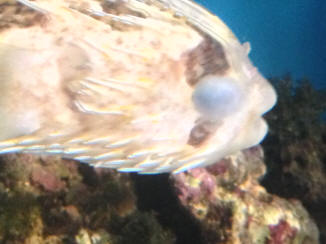
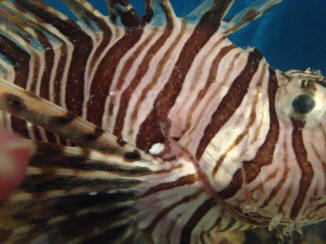
the next day his eyes had started clouding over and by the next morning
he was blind, as you can see in the picture, with lots of white spots
and started
to almost lose colour and go grey, there were also obvious spots on the
fins and body of the Lion and his eyes were a little cloudy. I spent
hours and hours reading but have no hospital tank and after initial
excitement at
things like Rid Ich and soon realized copper was my only hope if I was
correct about Crypt and decided on Cupramine after speaking to SeaChem
who said it gets absorbed but doesn't bind with calcareous material
<Mmm; to degree/s>
and could eventually be removed using cuprasorb, but most importantly
was less toxic on scaleless fish.
<True; compared with elemental copper solutions>
I removed all the inverts I could
<...>
and put in my first dose, but couldn't get a test kit anywhere, so
ordered one for next day delivery. Within hours the remaining inverts
were dead and dropped to the sand bed as expected, but also the puffer
that was already
breathing very hard, retired to a corner and was panting and very short
breaths. Over the next few hours his breathing stayed the same rate,
hardly any movement but got deeper, so I began to hope a little. During
that evening almost all the spots appeared to go on the Lion and his
eyes looked better, although this is hard to see properly as the spots
look at their worst under the blue LEDS, in between with the white
lights on and almost invisible with no lights and normal daylight or
incandescent.
The next morning the puffer was dead and the Lion appeared covered
again.
I went and got my test kit and it showed negligible copper,
<Yes; dropped out of solution; and absorbed by various sources>
less than .1, so I added another full dose and got it to .25, then
monitored during the day, having to redose, as expected to keep it
stable, the lion again seemed to clear itself during the evening and
shed its epidermis again and started swimming a little, (it was always a
lazy fish during the day anyway) then the next morning it was down to
about .15 so I gradually redosed up to about .4 to .45 as directed by
SeaChem and tested over and over during the day, having to redose about
8pm, but only 5ml to get back to the right dose. I guess that the
absorption is slowing down, again as SeaChem said it would. I also,
after reading more and more, decided on a freshwater dip with double
dosed Methylene blue, 5 minutes, which he hated and immediately hid in a
cave he barely fitted in for several hours, however, by the time we went
to bed he was swimming very strongly as he used to at night in the
various currents and on his 5th day of not eating still refusing food.
However all his dots appeared to be
gone just leaving behind little scars, presumably where cysts had
dropped from.
Now this morning the tank was down to about .35, so I've added enough to
get back to just over .4 ( I am pretty awful at these colour tests
though)
<Everyone I know is; myself included>
but he again appears covered in little white specs, and still refusing
to eat, but only trying once a day, he is sitting on the sand near a
cave, however that isn't unusual for the time of day. But with the dose
never dropping below .3+ for over 48 hours, I don't see how he can be
infested again.
<Happens....>
In the water column, especially under the blue lights, there are
hundreds of similar sized specs washing about, I assume small coral
sand, or dead copepods, is it possible that as the Cupramine increases
the slime coat
that these are just sticking to him when he stops swimming about?
<Yes>
and I am thinking he is being reinfected but he isn't?
<Could be>
I plan on continuing this for at least 14 days, however SeaChem have
suggested extending to 21 as I am not treating at .5, although this will
possibly mean he won't have eaten for 23-24 days by then. Should I
increase
the strength, ( I am making a reference .5 sample up side by side with
every test to ensure I get the dose right) or extend the treatment,
repeat the freshwater bath or........
<No value in increasing the dosage beyond what is physiologically
useful>
Any advice gratefully received,
<You can/will find my articles and thousands of responses to
Cryptocaryon organized and archived on WWM; in articles and books I have
penned...>
I loved both of these fish and would hate to lose my Lion too, I have
loads of freshwater tropicals, Discus and Koi and nothing has bothered
me as much as these two getting sick, and my knowledge to look after
them is
apparently woeful. I have included SeaChem support in this email as
their team have been incredibly helpful
<Ah yes; a VERY good company, staff; REAL products>
and responsive, so any help from anybody to try and save him would be
gratefully received.
Water parameters are;
PH 8.2
Ammonia was zero but showing a trace (But SeaChem say Cupramine causes
this as a misread)
Nitrite 0
Nitrate 5 (I have left my skimmer running)
Carbonate Hardness 11-12
I have also spoken to a very helpful exotic pet, but he just reiterated
I was doing the right thing and that Crypt was always present in marine
tanks and then I found he gets advice from my local LFS when he's stuck,
who has also been very helpful so decided not to pursue that route.
Regards
Trevor
<Mmm; well; we need to move back, proverbially to square one. Your
"case" (circumstances, events) are very common. NEED to assemble
compatible (more) livestock, NEED (as you state) to do your bit re
preventing pathogenic disease introduction (dips/baths, acclimation,
quarantine/isolation...), NEED to have a ready plan to counter probable
issues like Crypt... not w/ what you've done above. SEE WWM re the use
of quinine compounds. Lastly, as tough as it is to do (or say), don't be
disheartened: These mistakes, losses are mostly preventable. When I was
young/er, folks had a very hard task at just keeping Symphysodon (almost
all wild-caught or F1s) alive...
Bob Fenner>
Re: Urgent
advice on a Crypt (suspected) infestation
11/7/14
Sorry, I forgot the pictures.
Trevor
<Ah yes; BobF>
|
  |
|
Re: Urgent advice on a Crypt (suspected) infestation
11/7/14
Hi Bob,
<Trev>
Thanks for the response. And the Facebook accept:)
<Ah, welcome>
As I'm now keeping the dose reasonably stable in the tank and the damage is
done to the rock and sand, is there any point in added stress by moving to a
4' tank I have free up for another freshwater fish but could use as a
temp hospital tank?
<Yes; easier to control sans the decor, substrate... IF not too much work>
I was considering moving him to this and trying to treat him, then running
the old tank on RO freshwater for a week to kill everything!
<I'd bleach/nuke it...>
then moving it back to marine and not moving him back until that had
matured. Or is the best thing to do, as it feels like, to carry on as I am?
Would the freshwater idea even work!
<Not as assuredly; no>
And I will be doing a lot more reading before restocking, on either qt, tank
transfer or at least freshwater Methylene blue dips for any new fish.
<Good>
lol also read up on the Quinine treatments but expect that to be very hard
to come by in the uk.
<Can be done however... ask around re a friendly veterinarian, or medical
doctor>
Incidentally, I chose the lion and the puffer after reading a lot of
anecdotal stories about them cohabiting well, and intended to feed them both
by hand, having a maximum of 4 fish in the tank, with them being pets rather
than a display?
<Not in my opinion/experience... which is lengthy>
Trevor
<BobF>
Re: Urgent advice on a Crypt (suspected) infestation
11/7/14
After a lot more reading I can't believe I didn't try the quinine route
first, but I guess too late to switch meds now, would you agree?
<Yes>
There appear to be two compounds you favour for a display tank, is it
quinine sulphate you would recommend. Whatever way this goes I'll get some
in in preparation.
<CP is better>
I couldn't get my head exactly round the dosing and there isn't a way to
measure it so I would have to get that spot on I guess.
<Close; and easily done. See WWM re>
Also as a bit of an update, and not wanting to jinx things, he's looking a
lot better this evening, the extra specs seem to have washed off while he is
swimming and just covered in little discoloured scars and his eyes are
slowly clearing too. I'm sure I'll be all despondent again in the morning
but heading towards hopeful!
Trevor
<Keep moving forward. B>
Re: Urgent advice on a Crypt (suspected) infestation. Puffer f'
too 11/14/14
Hi Bob,
<Hey Trev>
Just an update and some more advice please?
<Ok!>
The copper levels are reasonable stable and slightly fluctuating between .45
and .5 but very little having to be added to the display tank now so I've
left him in it.
He looks completely clear and his eyes are also crystal clear and he is as
active as he's ever been.
<Ah good>
However it is now 2 weeks since he's eaten, he shows no interest in his
food,
<Not to be worried, nor either surprised: These (puffers) can/do go w/o
feeding for weeks at times; and the copper exposure, having Crypt have
contributed to the non-feeding>
I have tried him with skewered lance fish, mussels, etc, exactly as he used
to eat, but he isn't at all interested, almost actively disinterested, I am
trying once a day, except for 1 day when I left it in his tank for the
whole day while at work. Should I just carry on trying once a day, every
other day, or just stop worrying about it.
<More the latter...>
He is swimming at the front of the glass looking out, for a good hour plus a
day, looking hungry, but just not eating. He doesn't appear to have lost any
weight and generally looks well proportioned still.
<Ah, good>
I was planning to do the treatment for 21 days as I was initially running at
a lower dose than the recommended .5, but now I am running at the full .5
dose of Cuprinol would you recommend running for the 2 weeks at that
dose suggested by SeaChem or the 21-28 days I planned?
<As long as you deem prudent... not much to be gained by going beyond the 21
days under "normal/usual circumstances">
Thanks
Trevor
<Welcome. Bob Fenner>
Re: Urgent advice on a Crypt (suspected) infestation
11/14/14
That's great! Thank you.
And really hope they do a great job of the Foundation series:)
<Oh, welcome and I as well! So wish I was young (and handsome) enough to
play Hari Seldon... or better R. Daneel Olivaw! BobF>
Re: Urgent advice on a Crypt (suspected) infestation
11/14/14
That would be a hell of a role!
I always dreamed of being a Lensman:)
<Another great series. B>
|
Re: Dormant Cryptocaryon? 10/26/14
Crazy thought-
Have you ever heard of anyone using colloidal silver to treat marine Protozoans?
<Oh yes... Ag used in various commercial and DIY remedies for many years.
Aquarisol used to be silver ion based (now Cu). BobF>
-Matt Parsons
FW: Paraguard Personal View.
10/17/14
Hi,
<Adam>
I would like to say the fish are all 100% well which is excellent news as the
medication, SeaChem Focus and Metronidazole only arrived today some 5 weeks
after ordering it. I am therefore of the belief that if you catch
Whitespot early, just a few visible spots and can create water current in all
areas of the tank via several pumps etc the number of pumps depending on the
size of the tank a working UV whose input area is in the central
water flow area will cure it.
<Mmm; yes; given that the fish/hosts are not "too" debilitated>
My UV is only a budget model a SunSun JUP-01 (I do not have any connection to
SunSun just own the UV) but all I can say is the Whitespot is gone.
Having lost to Whitespot many times over the last 30 years and then won with
copper but the said effects of copper killing many algae and it toxicity to
inverts make this method a much better way. Remember the UV
turns over the tank theoretically every 10 mins which I think is also a factor.
<You can read my similar comments on WWM under the FAQs files on Infested Reef
and Fish Tanks>
Thanks,
Adam.
<Welcome. BobF>
|
Formalin>Malachite Treatment for Wrasses exposed to Ick?
9/19/14
Aloha! Are wrasses really that sensitive to Hypo?
<Some smaller genera, species more than others; but about "medium" sensitive
overall>
I have a 100g. here in Hawaii that I have enjoyed, Ich free, for years thanks to
you and the hypo treatment protocol I learned here.
I have lots of live rock, with minimal gadgets, based on streamlining power
consumption running off solar power and a sump filled with lava rock. I have
gotten lazy and have not been QT new specimens as they come from a LFS on Kona
side of the Big Island here and they pretreat with copper. I know, not smart,
but I haven't had probs and based on power conservation for my solar setup, I
have chose to not run the QT tank. Obviously this is not a luxury and really a
MUST HAVE!
<Agreed>
I got that slap of reality when I brought a Green Hawaiian Lionfish and 3
Moorish Idols back from an ocean collection last full moon... along with a
jeweled anemone crab and some Hawaiian Green Shrimp. I didn't QT them and found
bad Ich all over the MI's the next morning! Doh!!!
<Idols are very susceptible>
I took them immediately back to the ocean and set up my Hospital tank. At the
LFS here on Hilo side I was getting salt and was told that my wrasses will not
make it through the hypo treatment, and that, I believe the Lionfish won't
handle the copper, or maybe it was the wrasses as well. The point is he
convinced me Formalin Malachite was my only option. Really?
<Good; tried and true approach, though nowayears am a bigger fan of Quinine
compounds>
So I bought the Ich plus poison and brought it home with my bucket of salt and
got to work. Finally everything is now in my 20 gal hospital
tank:
1 Juvenile Coris
1 Juvenile Green Hawaiian Lionfish
1 Small Elegant Wrasse
1 Sailfin Tang (Rescued from Petco bad icy, about to die and made it through
hypo treatment and has been fine for 2 years)
1 Clown
1 Anthias
1 Blue Chromis
1 Hawaiian 2 Spot Butterfly- I think goes by a different name but very hearty.
1 Flame Angel.
<Too many disparate fishes for a 20>
Maybe too much for my 20 gal but seemed like overkill to setup my 55 gal
<Fire this 55 over>
and do all those water changes.
I have read and searched all over WWM for the last 3 days and still don't have a
clear answer on what to do.
<READ re Quinine.... CP... use the search tool>
I have 2 tsp the commercial formalin/malachite formula in the 20 gal, backpack
filter, bubble, bare bottom, plastic hiding shelf thing, no heater keeping
steady at around 80. I'd like to add a few coral pieces but was worries about it
absorbing the medicine. Only the Tang, Butterfly , Lionfish and Angel were
showing any white spots, but I believe I need to treat them all, even the
Wrasses that are not showing any symptoms, right?
Should I run the course of 1 week, then just flush it out with water changes...
probably put carbon in my hang on filter?
I put some of the live rock from the sump in there (cinders) but the formalin
will probably kill the biological, right?
<Oh yes; and quickly... have to change the water frequently>
After the week I'd like to go hypo so that the Ich is for sure gone while I
allow my tank to fallow for 6 weeks. Can I do this with the list above and not
kill the wrasses, lionfish etc?
<If done carefully>
Should I avoid hypo for these guys and just keep them on life support in the
Hospital tank until 6 weeks?
<Need to keep a CAREFUL eye on all>
Mahalo,
Sky Kubby
<A hu'i hou! Bob Fenner>
Re: Formalin>Malachite Treatment for Wrasses exposed to Ick?
9/20/14
Thanks, Bob. I had read so many responses that Rid Ich was a joke so I was
really concerned. I'm glad to hear it is a viable option.
<...? You can/could just read my/our input re Malachite Green archived on WWM>
I guess I was doubtful it would completely get rid them of Ich, because its
repeated time and time again that Hypo and copper are the only 2 ways to be
sure.
<Mmm; hypo- not so much/often>
So I must ask again, should I do a hypo treatment after a week of this
Formalin/Malachite treatment?
<Up to you. Am not a fan>
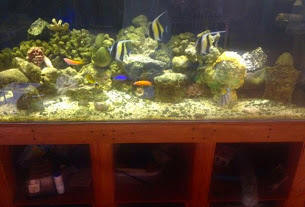
Here's a pic of the culprits before I got them out.
<I see>
When you say too many disparate species for a 20, do you mean because they are
all different?
<Yes; too numerous and incompatible behavior-crowding wise>
Here's a pic so you can get a visual of the sizes. They are really getting along
well and not nipping, etc, if that's what you meant. I'd really like to not have
to stress them by switch tanks again. Will this work?
Many mahalos and a hui hou!
<.... again; I'd use the 55. The Kona wind/Kilauea must be getting to you.
BobF>
|
|
|
ICH.
7/18/14
Hi Guys,
Are there any new chemical based cures for Ich apart from
CopperSafe for an fish/invert tank?
<Oh yes; quinine compounds... See WWM re. Bob Fenner>
Kind regards,
Adam.
Marine Velvet / Ich and Chloroquine/Hypo Treatment
Dear WMM Crew,
<Brad>
I wanted to share an experience and get your guidance, in hopes that
this might help out others as well as myself.
<Please do>
For the last 9 months or so I've been trying to get my 370
angel/butterfly tank off the ground, but I've been battling some issues
with what appears to be Ich and Marine Velvet (I purchased a microscope,
and though it is a bit difficult to tell for certain, it appears to
resemble the slides I've seen on your site and in books.) I had followed
proper QT procedures both for the initial introduction, and also for
subsequent fallow periods (I have about 250 gallons of QT in 5 separate
tanks, 2 times I've removed all fish from DT and put them in QT with
Copper for 8-10 weeks, and once with Chloroquine for the same period),
but despite this I've still run into issues a week or two upon
reintroducing some of the fish into the DT.
<Happens... you may well have entrenched protozoan issues in your
main/display... that are "surfacing" in/on new introductions>
So I got my hands on some Quinine and also Chloroquine from National
Fish Pharmacy and Fishman Chemical respectively, as I seemed to
have a strain of Ich/MV that was copper resistant
<This is also been conjectured for a few years; make that decades>
(I tried both Cupramine and CopperSafe separately, used multiple test
kits to ensure proper dosage &c.) The copper seemed to hide the
symptoms, but once I would remove it after say 30 days, the symptoms
would return-and since I have angel's and butterflies, I didn't want to
continue using copper.
I've established that I CAN rid the Ich/MV from my QT by using
Chloroquine, as the fish don't show any signs of symptoms after the
treatment in the QT (I have several QT's, and when I would remove the
medicine with Polyfilter or Carbon, I wouldn't see new symptoms even
after 3 weeks of no meds, something that I always saw with Copper within
about 5 days). But even after letting my DT go fallow for up to 10
weeks, I don't think that the parasites were completely eliminated as
symptoms would return to the fish about a week or two after
re-introduction (I would only put a few back in, not all of the fish),
and would quickly spread to epidemic proportions even with 120W of UV
which has new bulbs, and appropriate flow per Emperor Aquatics.
<Yes>
So now onto the question(s).
I've removed all inverts / corals from my DT, which is primarily a FOWLR
tank. Even when dosing Chloroquine in the DT, it seems that I still have
not eliminated the pests entirely. The difference is perhaps that I do
have Live Rock and Sand in there. I've been reading on some various
forums, and also in Ed Noga's book, and he recommends using
Chloroquine + Hypo (at about 12-13 ppt) for 30 days to really pack a 1-2
punch on any issues with Ich/Velvet. I've personally never done
Hypo before, and I wanted to get your opinion on if you would recommend
this approach-or something else? I am fully confident that I can carry
out the protocol properly, and have a refractometer, and also water test
kits to ensure the I do have a few red sea/generally sensitive fish, but
they haven't minded the treatments so far and their adults so they seem
to be pretty hardy. Just wasn't sure if doing Hypo would be
dangerous with them?
<Not as much as the parasitic infestation... in other words: no>
While I can certainly catch all of the fish out and move them to QT's,
I'm worried that at this point that might be more traumatic then
treating them in the DT, especially since they have so much more room
within that tank than in the QT's, and also the DT is well established
with a biofilter, so there is 0 ammonia / nitrite, and I keep nitrates <
10 with water changes, which is harder to keep on top of with 5 QT's
that will be more heavily stocked if I remove all the fish from the DT.
My preference at this point would be to treat the fish in the DT
(basically as a large scale QT), and wait to reintroduce any inverts for
at least 6 months or so. But if you feel that this is the wrong
approach, I can certainly pull all the fish out again, I've just not
been able to rid it in the past, but perhaps I wasn't waiting long
enough.
As a side note to your readers, I used both Quinine and Chloroquine. I
noticed that the Quinine appeared to be much harsher on the fish than
Chloroquine.
<Yes; generally so>
When I would dose Quinine, the fish would turn dark, some would breath
heavily, and most would lose appetite for a few days, even had a couple
of fatalities with smaller fish. I never noticed any such symptoms with
Chloroquine, and they seem to be equally effective in my QT's. Also
note, snails seem to handle this treatment (even long term) just fine
(when I've treated in my DT). I have several different kinds, and
haven't noticed any fatalities. I did test with shrimp starfish
and snails, and they do not handle this treatment and will quickly
perish. Same goes with Coral, for the treatment, my suggestion is to
remove all coral and non-crab inverts and put them in an unmedicated
tank if treating your DT.
<Yes; for sure>
No urgency for the response on this holiday weekend, just trying to plan
my next steps. I have Chloroquine in the DT right now, and it seems to
be keeping the parasites at bay, but not 100% eliminating them. I spoke
to Fishman, and they recommended rather than just doing a single dose
every 7-10 days, to do daily doses at ¼ strength after the initial dose
to ensure that the medication does not fall below the efficacious
threshold.
<I concur>
I'm 3 days into that approach, and was thinking if this doesn't work
then I need to try another approach.
Best Regards and Thanks much as always!
Brad
<Again; thank you for sharing. Bob Fenner>
Re: Marine Velvet / Ich and Chloroquine/Hypo Treatment
Thanks so much Bob for the lightning fast response!
I just wanted to make one edit to my previous post. I accidentally said
that snails tolerated the Quinine/Chloroquine treatments, but this was
exactly what I meant not to say. The previous post said ". Also note,
snails seem to handle this treatment (even long term) just fine (when
I've treated in my DT)". However this should have read: ". Also note,
<<Crabs>> seem to handle this treatment (even long term) just fine (when
I've treated in my DT). " Just want to make sure that anyone reading
this understands that Crabs and Not snails tolerate the treatment.
Snails, Bristleworms, Starfish, Shrimp, and Corals will perish.
<Yes>
I will keep you and everyone posted with my progress (or lack thereof)
with the treatment/outcome.
<Thank you for this clarification>
Best Regards,
Brad
<And you, BobF>
Re: Marine Velvet / Ich and Chloroquine/Hypo Treatment
6/5/14
Hi Bob and Team,
<Hey there Brad>
Just a follow up. It's been 1.5 weeks since my last email when I
initiated hyposalinity treatment + Chloroquine. To date I
haven't seen much of any improvement (no fatalities but no improvement),
and I'm wondering if perhaps at this stage I've eliminated the
Ich/marine velvet and perhaps have flukes (since I've
been treating with Chloroquine for about 2 months now, and don't
see the trademark Ick spots, nor the velvety coating/rapid breathing,
just some scattered white spots, some fin fraying, and a few spots in
the eyes.
<It is indeed possible. Trematodes are almost always present on marine
fishes in the wild...>
interesting that it isn't on all fish, just a few. Some fish show no
signs at all. I'm beginning to think maybe I still have some form of
flukes/monogeans. It definitely doesn't appear to be anything bacterial
or fungal.
<... do you have access to a simple microscope? Sampling and looking is
simple...>
From what I can see researching online, I'm not sure that either
hyposalinity or Chloroquine would treat flukes (just some anecdotal
evidence on forums, but nothing concrete.)
<Mmm; they will not. Straight pH adjusted freshwater WITH formalin will
eliminate external (body and gill) flukes... Otherwise, the use of
Anthelminthics like Prazi/pro is advised>
I don't want to rush into anything but wanted to seek your guidance on
treatment. Should I continue to treat with Hyposalinity/Chloroquine?
<I would not. You've already gone long enough with this M.O.>
Maybe I should pull the Chloroquine with water changes/poly filters, but
hold the hyposalinity? The other option I was thinking was to pull the
Chloroquine and treat with Praziquantel at hyposalinity levels.
<I'd be reading... THEN doing dips while moving the fish livestock, THEN
treating them with Prazi>
I've used Prazi prophylactically in the past for my reef tank fish with
Copper. Not sure if it would be ok to treat with it + hyposalinity.
Seems like an easier treatment on the fish. I could also punt and
continue the current path, but usually in my experience you notice a
change in symptoms when you are affecting a cure within a few days, and
the multiple weeks of treatment is to ensure you eradicate everything +
give your DT time to kill off the parasites.
Any guidance would be greatly appreciated!
Best Regards,
Brad
<... wish we could do "the Vulcan mind-meld... am about as olde as
Spock!)... reading re Trematodes, 'scope use, the compounds mentioned...
Bob Fenner>
Re: Marine Velvet / Ich and Chloroquine/Hypo
Treatment 6/5/14
Thanks Bob!
<Welcome Brad>
I do have a microscope, and just got oil for 40x+ resolution, and also a
USB adapter so I can take pictures and share. I agree with not doing
trial by elimination treatments, and not opposed to pulling all of the
fish again for treatment. Just wanted to avoid that if possible as to
not stress the fish out more if there was a simpler coarse.
<Course; and better to sample, know what is on your fishes>
Will ponder this a bit more and dig around WMM some more along with
pulling out Ed Noga's book for more research after I catch a candidate
fish and collect the samples. Just wanted to follow up in case if there
was something else obvious that I was missing.
All the best,
Brad
<Not that I know of. Cheers, B>
Re: Stocking list , opinions please? Crypt concession
5/8/13
Hi Crew,
Just as a follow up for the collective experience value: with all the
combined measures taken (UV, Quinine, Sulfates, substrate rotation,
hyposalinity, Metronidazole, Formalin/Meth Blue/FW dips etc.)
this tang "appeared" to be cured after 4 -5 months of yo-yo treatment in
quarantine, only to die in the display about two weeks later of Ich.
This brings my total number of fish saved over the last ten years from
Ich and Velvet, to an impressive zero. I think the next fish I get with
Ich will be quietly put down to save it and me the pain... I officially
give up on Ich treatment.
Thanks for all the help regardless.
Cheers,
Rama
<Yeeikes... Might be time to "go back to zero": Bleach the tank, all its
contents and water-touching gear; start w/ fishes from a known,
starting-healthy state... run through quarantine, dips/baths, do your
best to maintain an optimized, stable environment. Bob Fenner>
Marine Ich help, awful timing
11/19/12
Looking for some advice here. You all have been a great resource for me
and I always point people to your site. There is a wealth of information
here.
<Ah yes>
I have an Ich outbreak, my first in many years. It is
because of a recent addition of 2 clowns and a Sailfin tang. I did QT
them for about 2 weeks, obviously not enough. I was hasty in the move
because it's a decent sized tang and my QT tank is only a 20gL... Big
mistake....My tang now has Ich after looking good in QT. I have a
swallow tail angel that now has some spots on her fins, a royal gramma
that has it and a six line wrasse that is flashing a bit, but no spots.
Every fish is eating very well. I feed sheets of Nori daily, frozen
Mysis, a marine flake and reef chili. They are all fat as heck and
healthy, even the new arrivals. I guess the stress from the move was
enough to trigger the outbreak. I know what to do, I am setting up a 55
gallon that I had in my basement to start a copper treatment.
<Mmm, I think I'd wait/see for right now... perhaps try methods of
boosting "immune response" of your fishes (supplementing foods
mostly)... and Not move the fishes. Please read here:
http://www.wetwebmedia.com/parasittkfaq2.htm>
But the problem is the timing of this! It is currently the 18th of
November.
My wife and I are traveling to her fathers for Thanksgiving the 22nd and
have planned and already paid for lodging in Williamsburg VA Thurs night
through Sunday. I will not be here to monitor copper levels or make
water change after water change that will be needed in a tank without
biological filtration and significantly over crowded as it is.
<All the more reason why I would not move the fishes. IF you had
sufficient concern that this infestation might "go nuclear" (hyper-) I'd
precipitously drop the specific gravity... IF not, I'd forestall any
further action and just hope>
My params. in my display are spot on, no ammonia or nitrites, nitrate
less than .05 and ph goes from 7.9 to 8.15 during the day (per reef
keeper readings, and working to raise ph and lessen the swing dosing two
part via two 1.1 ML per minute pumps reading the graphs one the
controller I am getting closer to keeping this much more steady). Alk is
about 8.2 and calcium is 410 to 420. It is a 180 gallon with a 35 gallon
refugium and a 33 long sump. Filtration is just a skimmer, carbon in a
bag and a phosphate reactor. Also about 130 pounds of live rock and a
deep sand bed (newly added from dry sand). What do you suggest?
<As above>
Do I just feed the heck out of them and do a big water change before I
leave and start treatment and the fallow state for the display
once I return?
<Better this than treatment, moving>
Or start treatment now and hope that everything will be okay in the
hospital tank while I am gone. I have a friend that is coming by to feed
the fish, but I don't expect them to do water changes for me. I know
there is risk with both, but looking for the lesser of two evils I
suppose.
Thanks in advance.
Rob
<Enjoy your trip, vacation. Bob Fenner>
Re: Marine Ich help, awful timing – 11/19/12
Thank you very much for your response. Your suggestion is the most
logical.
I do have coral in the tank, a clam, shrimp, snails and crabs. Would it
be best to possibly move all the coral to the 55 gallon for the
time being and drop the salinity in the display?
<A call I can't make w/ much confidence... t'were it me though, given
what's been stated, I'd just leave all in for now>
Some coral is completely attached to the Liverock so I would have to
rearrange the tank, probably quite stressful and maybe not a good idea
at this time.
<Yes; agreed>
Thanks again,
Rob
<Welcome. BobF>
Re: Marine Ich help, awful timing – 12/02/12
Just an update. Thanks for the advice. No issues at all, not even a spot
of Ich and it has been several weeks. No treatment, no tank torn apart,
just good water quality and feeding a varied diet. I will just wait for
some time before adding any other fish.
<Ahh, very good>
Thanks again!
Rob
<Welcome. BobF>
Re: Ich treatment, need advice
11/25/12
Hi Bob,
<Adam>
So first, I have some sad news. Not long after I wrote you last I had to
move the QT tank from the garage to the laundry room as the weather in
Calgary turned nasty a full month earlier than it normally does. Our
garage door is powdered glass, and the QT tank was creating so much
humidity that as soon as the weather got cold, the condensation of the
door was getting out of control. The garage was also hovering around 16
degrees at night, so the heater was essentially running 24/7. However,
the Cupramine treatment went beautifully, and all my fish actually
seemed to improve in general demeanor and acclimation.
<Ah good (for the last)>
2 weeks ago, 10 days before the fish were to go back in the tank, we had
a large party. At some point in the evening, one of my guests closed the
door to the laundry room and I didn't catch it. There is a large server
stack in that room that houses the home automation equipment, and with
the door closed the room rapidly heats up. I didn't realize the door had
been closed until I went downstairs to feed them at 11 the next morning
and opened it to find every fish had perished. The room and water were
both in the mid 30s. I've tried to find the right words to describe what
that felt like, both for the loss and because I blame myself, but so far
I haven't been able to.
<Aye ya. Of what use is blame?>
To be honest, if the display tank wasn't built right in to my house, I
would have quit the hobby that day.
I saved the filter by running it in a 5 gallon bucket for a day while I
cleaned out the QT tank and decided what to do. All together, I'm more
than the price of a nice car in to this tank, removing it will require a
significant renovation to both the electrical, plumbing, flooring, and
walls of my house, and leaving it as a giant box of corals seems
ridiculous, so I have decided to start re-stocking. However, I want to
pick your brain over something.
<Ok>
I'm in grad school, so I have access to scientific journals and I've
been reading up on crypt the last couple of weeks. From what I've been
reading, I don't see how a 14 day course of Cupramine could possibly be
sufficient to eliminate the parasite:
<Mmm, depends on a few circumstances... IN a bare treatment tank, NOT
returning the fish hosts to the previous (infested system)...>
First, I routinely visit all the stores that carry salt water fish in my
city, and I can say with absolute certainty that every single one of
them has Ich in their systems.
<Not uncommon... I tried, 30-40 years ago to encourage the trade
(collectors, distributors, wholesalers) to adopt a protocol involving
dips/baths... to greatly decrease the prevalence of external protozoan
issues... w/ some, but little success on my part. The principal "cause"
of folks dropping out of the hobby; is, not surprisingly such
"mysterious/anomalous losses">
I've seen it on the fish, and I have made a point of learning how their
tanks are plumbed together so I know there's not a single holding tank
in this city that's not been exposed. Basically, I don't believe you can
buy an "Ich free" fish in this city. One store seems better than the
others (I've seen the least Ich infected fish there), but it's specialty
isn't salt water, so it's supply is also the most limited. Whether you
can see signs of the infection or not, every fish available here has
been in water with the parasite, so according to the same logic that
backs the advice of removing and treating all fish from an infected
system, any fish from a store where Ich is present (in this case, all of
them) must be treated as though it has it, whether or not it's showing
visible symptoms. To not prophylactically treat all fish from the local
stores, in my mind, would be no different than telling someone they
could expect to enact a system cure by leaving the 'uninfected' fish in
their display and only removing and treating the ones with visible
spots. The absence of evidence is not evidence of absence, and I know
each and every one of them was exposed.
<I do concur>
Second, hypothetically speaking, let's say you have a fish enter a
quarantine tank from the store on day 1 and it has Ich - whether you can
see it or not - and you want to treat it with a copper compound. I only
know the protocol specifically for Cupramine, so I'll focus on its
directions, but I assume that the other brands have a similar protocol
to avoid toxicity. You can't drop a fish right in to water with 0.5ppm
of Cupramine without risking it's demise, so you need to put it in
copper free water and slowly raise the concentration over the course of
3 days. I also can't see it being wise to add a fish to a quarantine
tank and then immediately add your first dose of Cupramine. The safest
thing to do for the fish is let it get settled and make sure it's eating
before you start.
At least a day or two, longer if the fish won't eat and is not showing
signs of a visible or severe infection. If on the first night, trophonts
leave the fish and encyst (both possible and likely), you now have
encysted Tomonts somewhere in your QT system by the time you add your
first dose of copper. Even if you did add Cupramine the first day, you
shouldn't be at therapeutic levels by the time the first trophonts leave
the fish that night, at least not if you're following the directions as
stated by SeaChem. In any case, I have yet to see anyone state with
anything other than a guess that the detached Trophont/pro-tomont is as
susceptible to copper as Theronts.
<They're assuredly resistant... beyond the exposure concentration that
fish hosts can tolerate>
Now, the literature is quite clear that Tomonts have a high degree of
resistance to just about anything we can throw at them, including copper
and low salinity. Also, while it's an extreme case, the literature has
examples of Tomonts successfully producing infective Theronts 72 days
after they encyst, but in less extreme cases they seem to have little
trouble remaining in the resistant tomont stage for up to 6 weeks.
<Even longer...>
So, given that Tomonts are both resistant to copper, and can easily
outlive the recommended duration of Cupramine treatment, and there will
almost always be an opportunity for trophonts to leave a fish and encyst
before the fish is bathed in therapeutic levels of copper, how is it
that a 14 day course of Cupramine is regarded as sufficient to eradicate
the parasite?
<Generally the parasite is weakened sufficiently, and the host fish
not... that a balance is struck in favor of the fish>
I understand that anything longer than that is a risk to the fish,
<Yes>
but a protomont could just as easily encyst within the biological media
of a quarantine tank filter as it could on the glass. Given the lack of
desired substrate for crypt in a properly set up QT, it seems even more
likely that they would find their way to the filter intake, and no
amount of vacuuming will get to those. Furthermore, If you're doing it
right, you will leave the fish in quarantine for at least two more weeks
following the end of copper treatment, which exposes it to the very real
possibility that by the time it does go in to the display, it's gills
are once again harbouring invisible trophonts, ready to start the cycle
all over again.
Is there something about Cupramine that I'm missing?
<Mmm, well, copper ion exposure does act as a proteinaceous precipitant,
causing fishes to produce and slough off more body mucus... and the more
superficial parasite fauna embedded therein>
Is it more effective against Tomonts than your standard free or chelated
copper medications?
<It is not... ligated copper compounds are preferable for staying in
solution longer than Cu++ in acidic solutions>
The advice that is given over and over on the web is that to fight this
parasite you have to understand it and its life cycle, and yet
everything I now know about that life cycle seems to indicate that the
manufacturer's recommended use of Cupramine is not sufficient to
eliminate it.
<I encourage you, others to incorporate a pH adjusted freshwater dip
routine, possibly w/ formalin (see WWM re) going from system to system,
including isolation/treatment/quarantine>
Even the University of Florida recommends a minimum 3-6 week course of
copper in infected systems to try and account for the parasite's
extended life cycle, but I'm sure that would be horrendous for the fish.
14 days only seems long enough for the fish to become free of trophonts,
and prevent infection of any new Theronts within the window of active
treatment, but unless it were to act on all external stages of the
parasite equally, it's not long enough to break the life-cycle. It's
starting to seem to me that the only way to truly and definitively break
the cycle is the tank transfer method, as it's the only one that
destroys this disease's wild card, the Tomonts. I generally really
believe in SeaChem as a company,
<I as well... know the previous owner and his son who currently manages,
quite a few of their employees, and much of their product lines>
so I'm not suggesting they're up to anything nefarious, but I'm wondering
if the published 14 day recommended course is what they state because
it's safest for the fish, as opposed to most effective against the
parasite.
<Yes>
I understand how large companies need to 'cover their behinds' in
situations like this, but my goal is the eradication of the parasite.
<Understood>
Am I out to lunch?
<Mmm, no; or we both are. Hope this isn't an expensive restaurant>
I'm looking at an unplanned and unwanted 14 week fallow period (minimum)
<Two months... t'were it me, mine... there is such a thing as
"hyper-infectivity"... and lowering specific gravity and raising
temperature w/in reason are means for "speeding up" the effectiveness of
"going fallow">
for my display at this point, and I would hate to blow it now. I've
already got new fish undergoing Cupramine treatment in QT, and I'm
wondering if I should either maintain the copper levels at 0.5ppm for
the full 4 weeks I had intended to quarantine them, and remove them to
the display without ever reducing the copper level in the QT tank, or if
I should still only do 14 days of Cupramine,
<The fishes, your observations...>
but remove them to buckets on the 14th day, bleach bomb the tank and
filter, and completely reset it so they can finish quarantine both
tomont and copper free. It will suck to lose a cycled filter, but
ammonia is so much easier to deal with when you're not worrying about
binding agents increasing copper toxicity. Going forward, I think I'm
going to subscribe to the tank transfer method.
<Is a helpful adjunct/addition to control>
Thanks,
Adam
<Welcome. Bob Fenner>
Ich treatment, need advice 8/19/12
Hello WWM crew!
<Adam>
Well, if there was every a time where I realized how unforgiving this
hobby can be, it's right now. I'm dealing with what has turned out to be
a really severe infestation with Cryptocaryon, and I'd like your input
on how I'm choosing to deal with it, and what I might be able to do to
ensure this is a complete and total system cure.
<Mmm, well, this is all posted, archived, gone over and over on WWM>
First, the fish list, as I know some species respond differently to
different treatments, but I'm not sure if I've got anything I need to be
especially careful with:
1 powder blue tang
1 purple tang
3 Banggai cardinals
1 labouti wrasse
1 leopard wrasse
1 Australian harlequin Tuskfish
2 red Firefish
4 square spot Anthias
1 copper band butterfly
1 cleaner wrasse
<... See WWM re... searchable by species, family>
1 long-tail tripod fish (Tripodichthys blochii) - this last one was
something of an impulse purchase. I'd never seen anything like it, and,
not surprisingly there's next to no information on them online. Based on
it's behaviour I'd assume it never comes up to where the sun is very
bright as it hides in the shade until my LEDs go in to twilight mode, at
which point it cruises around picking pods off the rocks. If I knew
someone who ran a dedicated deepwater tank I'd give it to them as I
think it would be happier, but it eats everything I feed it, and seems
generally very healthy other than not loving the lights in my tank. Very
cool fish.
The tank is a 275 gallon reef, with a 100 gallon sump. I know
that once your system has Ich, you can either try to manage it, or you
can take drastic measures to eliminate it.
<This is so>
I would have opted for the management through general fish health approach
if I didn't have such an Ich magnet of a powder blue. I was hoping his
immune system would cope on its own, but he went from having only a few
spots to being nearly overwhelmed in less than 24 hours. The purple tang
is affected as well, but doesn't seem as bothered by it. The only other
fish with obvious spots is the tripod fish, though the rest of them have
started flashing.
My sump design is pretty unique, in that it allows me to isolate 3 out
of 4 chambers from the display system above so that I can do water
changes using the largest, 50 gallon chamber. My QT tank is only a 40
gallon long, which I don't think is big or cycled enough to handle all
17 fish at once, so what I've done is isolated the 20 gallon skimmer
chamber, 17 gallon frag chamber (which currently houses 50 pounds of
cycled Marco rock and 3 inches of sand for remote pod breeding),
<... the calcareous parts of your substrates will interfere, absorb most
all med.s>
and 50 gallon water change chamber from the main display tank, and then
used the pump that I would normally use to drain the water change
chamber to pump water back in to the skimmer chamber. Basically this
created a new, isolated 3 chambered system. I then spent a night
catching all my fish (heck, I needed to re-aquascape anyway), and have
distributed them across the three isolated sump chambers.
I then dropped the salinity in the sump QT system to 1.010, used baking
soda to keep the pH at 8.1, and turned the temp up to 81 degrees.
<So far so good in my estimation>
I thought I was doing the right thing until I sat down and red the WWM
FAQ on hyposalinity and Ich. I didn't realize you guys were so
unimpressed with this as a treatment method, and now I'm worried that
after all that work I'm not going to enact a full cure.
<Highly unlikely, yes>
The salinity has only been down to 1.010 for 24 hours now and the powder
blue seems markedly improved, and is eating vitamin enhanced brine
again.
However, the purple tang actually seems to have more spots than before.
So far none of the fish seem stressed, and the water quality hasn't
changed.
My skimmer isn't doing much anymore at this salinity, but I'm leaving it
running to keep the oxygen high. My plan is to leave the salinity at
this level for 30 days, then start slowly bringing it back up to the
display level of 1.025, and watch my fish for any signs of illness for
the rest of the 9 weeks the display will need to be fallow. Do you think
this will be enough to eradicate Ich?
<Doubtful... no>
I don't want to use any sort of a copper or formalin treatment here
because this system will eventually be returned to use as a my system
sump.
If you guys don't think that will be enough, I think I have a back-up
plan for how to medicate everyone separately (though not all at the same
time), but I'm really hoping it won't have to come to that. If I haven't
eradicated the Ich with the 30 day hypo treatment, there will be another
30 days where the fish are in the sump QT system, should I see evidence
of it's resurgence in that time if it hasn't worked?
<Not necessarily; but likely, in time, yes>
Also, do you anticipate that the hypo treatment will kill off the
bacteria in the rock in the QT system?
<Definitely will>
I'm hoping it can continue to act as filtration while they're down
there.
<Mmm, no. I encourage you to study and use a chelated copper product...
on the low side of effective dosage (0.15-0.20 free copper)... See Lance
Ichinotsubo and Bob Goemans work/s re. Bob Fenner>
Re: Ich treatment, need advice 8/19/20
Thanks for the fast response Bob,
<Welcome Adam>
It looks like I'm going to have to figure out the logistics of doing a
copper treatment on all my fish. That will probably require a second
quarantine tank.
It's going to take me a couple of days to get that organized and bring
the salinity back up to 1.025 (from reading on WWM I don't think I want
to combine hypo and copper),
<Mmm, actually, Lance does this in his service company tanks on a
continuous basis (they're fish only)>
but as of this morning my powder blue has taken a turn for the worse. He's
literally overwhelmed with spots at this point. It's my understanding
that hypo doesn't treat parasites that were already inside the tissue of
the fish, so I'm assuming that what I'm seeing today (48 hours after
beginning hypo) is the expression of what he was already infested with.
<Likely so>
I've only ever seen something this bad once before, and it was the day
before the fish who had it perished. Do you think there would be any
value in doing a freshwater dip of the tang right now?
<Yes... pH adjusted, with aeration if extended in time>
I know it's sometimes recommended to do the fresh water dip before you
start hypo, but I'm not sure if doing a dip after hypo has begun is
useful/safe.
Thanks for your time,
Adam
<Welcome. BobF>
Re: Ich treatment, need advice 8/21/12
Thanks again Bob,
<Welcome Adam>
I did the freshwater dip on both tangs last night. The powder blue
didn't seem bothered by it at all and stayed in for a full 5 minutes,
but the purple started exhibiting signs of severe distress after 3
minutes so I halted the treatment for him. Both tangs ate normally after
the fresh water dip. I also called around the local stores to try and
get a formalin solution for dipping, but it looks like no one here sells
the concentrated stuff anymore for legal reasons or something.
<Yes; this biocide is banned in many places, States>
I checked on them again around midnight after the lights went out <Mmm,
best to not disturb fishes during darkness periods>
and the powder blue was upright, but bumping in to things.
<Not unnatural if/when disturbed after "going to sleep">
This morning, both fish are spot free, but I fear it was too much for
the powder blue. He's still breathing, but not swimming at all, either
upside down or on his side getting blown around in the current.
<Yikes>
Honestly I'm surprised he's still alive at all. I'm guessing that his
gills were also overwhelmed by the parasite and with so much trauma from
them bursting he's not able to get enough oxygen.
<Mmm, could also be loss of body slime integrity, hemolyzation...>
The QT system showed a bit of ammonia this morning, so I did a 20% water
change with salinity, temp and pH matched water in the hopes that the
powder blue can recover, but I've never seen a fish come back from
something like this. I'm going to give him a couple of extra hours and
if he's still doing this (I can't imagine this is comfortable at all)
I'm going to consider the most humane way to euthanize him.
<See WWM Re>
I'm pretty gutted. I'm considering donating the remainder of my fish to
someone with an existing and functional copper treated QT tank. Daily
20% water changes aren't going to be possible for me in a week as I have
to return to heavy field work out of the city. I think in a few weeks
I'll try bringing my QT tank up to therapeutic levels of copper and then
letting it re-cycle fishless (I use ammonium chloride for fishless
cycling), then starting over with the fish. I know not everyone
advocates prophylactic treatment for parasites
<Most all stores do, all wholesale operations, all institutions...>
(I certainly never used to), but I'm pretty sure that's how my tank was
infected. I'm not sure which of them brought Ich in, but they certainly
weren't exhibiting any signs of it when I put them in my display, even
after quarantine. I know some fish can have sub-clinical infestations
that don't present obvious, outward symptoms, but whoever it was able to
release enough of the parasite in to the water to completely overwhelm
the powder blue, who was my most recent addition. I fear that if I put
the purple back in the main tank, I won't be able to add a second tang
like I had always planned because it will have 'claimed' the space by
the time a replacement for the powder blue is finished being QT'd.
<Could happen>
In another, slightly related question, I'm using a conditioning agent
from AquaVitro in the QT tank. It smells just like Prime and claims to
do the same things so I'm pretty sure it's the same compound.
<Both are fine products of SeaChem>
It claims to 'remove ammonia and detoxify nitrite and nitrate', but I'm
not sure of the chemical reaction involved.
<Can be "looked up" if you're interested>
Obviously it doesn't 'remove' ammonia, it would either react with it and
convert the molecules in to some other product, or simply bind to it in
a way that makes the ammonia less toxic to animal life. Would a
standard ammonia test still register any ammonia in the water if the
binding agent was being applied in the appropriate quantities?
<Most test/reagent kits, no... there are some (total vs. free ammonia)
kits that can>
Again, thanks for all your help.
Adam
<Welcome. BobF>
Re: Ich treatment, need advice 8/21/12
Again thank you so much. I'll just finish this off by letting you know
that the powder blue did not make it. However, I've beefed up the
filtration capacity of my QT system and added bacterial supplements for
both fresh and marine systems (I'm between the two so hopefully
something will take!). I also did a ton of reading on the Cryptocaryon
irritans life cycle today and I think my impulse to get rid of all my
fish was premature.
<Am glad for this>
On the face of it, I've only lost a single fish. I have another making
clear and marked improvement, and the rest seem as healthy and hungry as
ever. I'll work out with my fiancé how to keep the water quality up to
snuff while I'm out of town, and wait out the 9 week period my main
system needs to be fallow. If I do add another tang, it will not be from
the group of 'Ich magnet' Acanthurus', and it will receive a full
prophylactic treatment and quarantine.
<Ah, good>
If I time it right, I will be able to purchase, quarantine and introduce
it to the main display at the same time I re-introduce the purple tang.
Again, thank you for all your help.
Adam
<Cheers, BobF>
Re: Ich treatment, need advice
9/8/12
Hello Bob!
<Adam>
Just wanted to update you on the progress. In the past 4 weeks I've
really gotten the hang of how to run my modified sump as a QT system, so
I've decided to stay the course with it. It's also extremely convenient
to work with, as it can be drained and refilled almost at the touch of a
switch.
<Ah yes>
The sump QT system went through a cycle that I battled with AquaVitro and
massive water changes with heavy dosing of bacterial supplements. I also
added the canister filter that powers my much smaller remote QT tank. I
did lose some of my smaller fish at this stage: the Firefish both
jumped,
<Very common>
and the cleaner wrasse simply vanished (which is odd considering there's
not many places to hide), but the 'big guys' got through it seemingly
unfazed. I would say that the CBB became even more bold and adjusted
than before, as he now eats directly out of my fingers.
<Ah good>
As this is part of my sump, I have decided against a copper based
treatment of any kind. Instead I'm hoping that an aggressive synergistic
hypo-salinity plus Seachem Paraguard approach will fully eradicate the
parasite from my fish. I got in touch with Seachem directly and they
claim that the active ingredients in Paraguard will disassociate in 24
hours, so I don't have to worry about any toxins absorbing out from the
rocks and sand in one of the sump chambers after the sump is brought
back online with the main display. They didn't recommend combining
Paraguard with a specific gravity of 1.010 because of the increased
strain on the fish, but I did some digging online and found some people
who have combined Formalin/Methylene blue/Malachite Green treatments
with a slightly less intense hypo treatment (SG 1.015) with success. So,
my plan so far has been 30 days at SG between 1.009 and 1.010 (buffered
to pH 8.1 and temperature maintained at 27 degrees Celsius), then a
'flex' window where I will raise the SG to 1.015 and administer
Paraguard for a period of time, then a third period where I will return
the SG to 1.025 and continue administering the recommended daily dose of
Paraguard. My hope is that any encysted parasites that have somehow
survived the 1.009 SG alone will be taken care of by the follow up
treatment with Paraguard. The longest recommended course of Paraguard
I've seen is 3 weeks in a QT system, so I was planning on doing two
weeks with 1.015 SG plus Paraguard, and one week of normal SG with
Paraguard alone.
I lowered the salinity on August 17th which means I'm only a week away
from raising the salinity and administering Paraguard, so unless you
think there's something inherently wrong with this plan I'll stay the
course.
<Worth trying given your circumstances>
I haven't seen an Ich spot in weeks at this point, so I'm hoping this
will enact a full cure. They'll get a few weeks of observation for
recurrent spots before they go back in the main display.
I'll let you know if this is successful.
<Thank you. BobF>
Thanks,
Adam
Re: Ich treatment, need advice 9/25/12
Hello Bob,
<Adam>
So I'm afraid that my QT protocol has failed. I have to chalk this up to
experience as the sump, while technically possible to use in the manner
that I was using it, was definitely an experiment from the get go. There
are two points in the system as I had it running where water could
potentially get from the DT to the QT, but under normal operating
conditions shouldn't have happened. However, I've been having a heck of
a time with my Herbie style overflows recently, and last weekend they
basically over-filled my tank (assisted by the ATO system which kept
adding more as the level in the return chamber fell) to the point where
the emergency stand-pipe was triggered. That stand-pipe drains straight
down to main chamber of the QT system. *sigh*. I wasn't home when it
started, but by the time I got home, enough water had entered the QT
system to raise the SG to 1.012. Lo and behold, 4 days later my purple
tang had 2 spots of Ich, after 5 weeks of hypo and a week and a half of
Paraguard. I was hoping I would get away with it, as the DT had been
fishless at this point for 5 weeks, but Murphy wasn't having any of it
and I'm back to square one.
Regardless, I've done what I should have done in the first place. On
Friday I re-set up my separate QT tank in the garage and transferred all
my fish, giving them each a fresh water dip before the transfer. It's
much smaller than I would normally feel comfortable keeping that many
fish in, but after the losses I had at the start of the outbreak it's
not as cramped as I initially feared it would be. This QT tank also had
a canister filter which I was running in the sump QT system, but I'm
still dealing with another cycle as I'm sure the rock in my sump QT
system was still picking up a huge amount of the waste processing. With
the smaller total volume of the system however, I'm able to do much
larger water changes by percentage, so those plus my trusty bottle of
AquaVitro Alpha and I'm so far not seeing any overt signs of
ammonia related stress. I picked up some Seachem Cupramine, and the
Seachem copper multi-test (which I have been led to believe tests for
both chelated and ionic copper) and am going to try the copper route.
Now I'm just waiting for the cycle to be complete, as I don't want to
add the additional stress of a Cupramine treatment plus ammonia and
nitrite. In the meantime, I'm using a gravel vacuum to vacuum the bottom
of the QT tank with each water change.
<Good>
I do have a few questions for you:
1. The canister filter has 4 trays, 2 with foam pre-filter pads, 1 with
plastic bio-balls, and 1 with ceramic rings that are supposed to
distribute the water it moves through the canister. Should I remove the
ceramic rings for the Cupramine treatment?
<I'd leave all present... the "bio-gunk" present may take up some
copper, but no big deal>
2. Is there any benefit to leaving the salinity low while I'm dosing
Cupramine?
<Some folks (e.g. friend Lance Ichinotsubo) say yes>
The only reason I can think to leave it lower would be to reduce the
concentrations of other ions that Cupramine could react with, like
calcium and carbonate, but I'll be testing daily and adjusting the
concentration as necessary, so I'm not sure if it would be better for
the fish overall to receive treatment at their native SG.
3. The protocol I keep seeing online and on WWM calls for a two week
treatment course of Cupramine. I understand that the Cupramine only
treats the free swimming stage, not the encysted tomont stage. While I'm
vacuuming the bottom of the tank with each water change, it seems to me
that tomonts could just as easily lodge in the filter material, which I
have no way of safely cleaning without re-setting the cycle. Is two
weeks really long enough?
<In almost all cases, yes>
Is there something more I could do at the end of the two week treatment to
be sure my QT system is truly free of Ich?
<Elevate the temperature... a few degrees F.>
Do you see any value in extending the Cupramine treatment by an extra
week?
<Not really. A trade off w/ being too stressful, debilitating>
Again, thanks for all you help.
Adam
&<Steady on. BobF>
Re: Ich treatment, need advice 9/27/12
Hi Bob,
<Adam>
Once again thanks for everything. I hope this will be my final question
on the topic:
<Lo dudo>
Do you think I would be better off waiting until the cycle that I'm
battling in the new QT system is complete before I initiate Cupramine
treatments, or would it be best to start now?
<I'd start now... you'll have to count/rely on water changes anyway>
I'm dealing with the cycle with AquaVitro Alpha and changing 65% of the
water when my API test kit goes darker than 0.25ppm of ammonia, which
has been once every other day since Saturday. The only fish that
developed new spots in the last QT arrangement was the purple tang, and
all fish received a 3-5 minute FW dip between the last QT system and the
current QT system (I gave the purple a 6 minute dip to be sure). Since
then, no new spots have appeared on any of the fish, though with the
filter having been transferred with them from the last system, I'm
anticipating seeing more spots in the coming days. However, I'm not
presently faced with an emergency situation with the Ich specifically,
so I'm not sure if waiting to initiate Cupramine treatment until the
water parameters stabilize is a better course, or if I should take the
'hit 'em hard, hit 'em fast' approach.
Thanks,
Adam
<Welcome. B>
Re: Ich treatment, need advice - 10/18/2012
Hi Bob,
<Adam>
Just wanted to update you and let you know that I followed your advice
and started the Cupramine treatment the day you sent your last e-mail,
taking 3 days to get to therapeutic levels. It was a little dicey there
for the first week as I was battling both nitrite, ammonia, and dosing
copper, so I added a second HOB filter (bringing the total number of
filters on that
tank to 3) and the cycle eventually sorted itself out making things much
easier. I had to go out of town unexpectedly near the end of the
treatment so they got a few extra days with the Cupramine than I had
intended, but I've done daily water changes this week to bring the
levels down. So far the only complaint any of my fish could lodge would
be a small patch of what looks like white fuzz on one of my Banggai
cardinal's lower lip. I don't doubt the process was hard on their immune
systems, so if it doesn't clear up within the next 48 hours I'll give
him a round of anti-biotics in my 5 gallon pico. Everyone else came
through with flying colours.
<Ah good>
Now I wait and cross my fingers no tomonts survived the treatment
trapped in the filter material. I wish I had just done it right the
first time. My calendar pinged to remind me that tomorrow was supposed
to be the day the fish would have gone back in the display had the sump
hypo QT system worked the way I had hoped, but since there was still Ich
in the sump QT and I had to put the sump and display above it back
inline with each other, the 9 week clock reset the day I moved the fish
in to the garage. I'm also still dealing with the fallout of my display
tank effectively having no nutrient export for the 5.5 weeks the fish
were using all the filtering machinery in the sump (basically a recipe
for Demesia), but I'm finally getting it back under control. Lesson
learned, this hobby doesn't forgive cut corners.
Thanks again for everything, I have really, really appreciated it.
Adam
<Thank you for this report. BobF>
ick, my latest experience and my own
conclusions. SW, parasitized systems, cures that work
12/16/11
Hi Crew,
<Hey Sam>
I have a 24 gallon AquaPod with LPS, LED lighting and the following
fish.
Royal gramma (1 year), Green Clown Goby(2 years), Pajama Cardinal (8
years), baby Pajama Cardinal (2 months), Tailspot Blenny (8 months) and
a Rusty Goby (3 years and hardly ever see him). Tank temp is usually
around 80, salinity 1.025.
On November 30 I picked up a Blue eyed Cardinal (from a hobbyist,
mistake because it is too big for my tank) and 3 days later he looked
like he was full of ick. On December 4 after lights were out I took him
out and put him in Greenex(malachite green-mixed as directed) that I
happened to have.
After a half hour I put him back in the tank. I have not used Greenex
for years and the last time I battled ick it was with copper.
<Greenex: Malachite Green & Quinine HCL (Aquatronics)>
The next day he looked fine, eats well was clean.
On December 11 I noticed my Gramma was missing at feeding time. Finally
found him hiding but could not see anything on him. On December 12 he
did come out to eat and I could not see any spots on him. But he was
not his usual self. Then I saw the Green Clown Goby and he was full of
spots. After lights went out I dipped him in Greenex for 30 minutes.
Decided I would use garlic flakes and Selcon for the next few
feedings.
<Mmm, what about the rest of the fishes/hosts? The system itself is
infested>
December 13 and the Green Clown Goby has a couple spots and is eating.
But the baby Pajama Cardinal has cloudy fins. Did not see any spots and
he is eating. Will continue to monitor at this point rather than take
them out for copper treatment.
Today is December 16 and all is well so I am assuming this attack is
over.
My situation was resolved so quickly that some may say that it was not
ick.
But I am sure it was. I was able to inspect my clown goby up close.
My conclusions. Not real facts but my own speculations.
<Well put>
1. The fish fought it off on their own. What little intervention I did
probably had no bearing on the outcome. But dipping those most sick
gave them a little more breathing room to survive and also reduced the
ick population so that a second round never came.
<Agreed>
2. Had I used some product I would be telling everyone how good it is.
And that is why people claim some product worked for them when in fact
they could have done nothing.
<You are correct. And not "just some people"... A bunch of
folks involved in making, selling "scam products" that they
portend are efficacious>
3. Most products don't do the job because if they did then everyone
would use it and ick would not be a real problem. Using copper, other
meds or low salinity have been the only consistently successful ways to
beat it.
<Thus far... quinine compounds show promise in future>
4. My situation is probably the kind where regardless of what you do or
don't do the results are success. I think the reason is that either
the fish have immunity to that particular strain of ick or it is just a
week strain that the fish can handle.
5. Why did ick flair up in my tank. My guess is as follows. The fish I
got from a fellow hobbyist was probably ok in his tank. My tank did
have ick a couple years ago and probably my fish are able to handle it.
My new fish was stressed from the move from his nice big old tank to my
little one with a new set of neighbors. And he was not immune to the
ick in my tank so, bingo, he comes down with it. Now the population of
ick in my tank rises since they had a host to help them reproduce. The
new volume of the parasite now enabled it to attack my other fish that
until then were able to handle the small population, but were now
overwhelmed by a much larger population, so they got sick. But being a
weak strain eventually they all fought it off and now all is well.
This explanation may also explain why at times people QT new fish and
they still come down with ick.
<Yes>
I know, there is nothing scientific about my conclusions but it sounds
logical to me.
Thanks,
Sam
<Thank you for sharing. Bob Fenner>
Re: Stocking list , opinions please?...
Actually Crypt treatments, trials 10/25/11
Hi Crew,
Ok , won't bore you with the domestic consequences and logistics,
but suffice to say I managed to get a third tank (about 20g) setup as a
hospital tank for the crypt infested Blue tang in the garage with a
chiller to stave off the heat.
The treatment so far has been:
- Tri-sulfur in the Display
<... Sulfa drugs? Won't work>
for 3 days with crushed Garlic food supplementation - no discernable
effect (as pretty much expected - good ol' LFS....can always count
on their advice/anecdotes......)
- Previously described Formalin/MB dip - no discernable effect
<Should kill, remove any/all external parasites... IF specimen
placed in new, parasite-free setting... should do it>
- Relocated to Hospital tank with Display water (sacrificed some
Theront introduction to QT for stress reduction benefit) and ran with
30mg per litre of Quinine Sulfate (human anti malarial tabs on script-
unfortunately looks like we can't get Chloroquine based meds in
Australia anymore , takes a special justification script and O/S order)
and fabricated two Plastic insert bases that fold up the sides of the
QT inside and form a replaceable
floor. I carefully swap these and PVC hidey-pipes out every two days
and leave them to dry to help kill any Tomonts adhering to the
"substrate" or walls.
I compiled a list of dosage/treatment regimes for Quinine Sulfate
products from every possible source I could find (WetWeb, other forums,
specialist Fish Vets, my own Vet, National fish Pharm etc.) these were
almost unanimous in their disagreement on the dosage and duration.
Dosage rates varied from 5mg to 35mg per litre, with durations from 3
to 10 days. I went with 1/4 tsp/10g approach 5 day treatment with a 25%
water change as one of the treatments recommended for the Crypto-pro
product and cited on WWM several times, on the hope that the two
compounds would be of similar strength.
Ran with this for 5 days with a 40% water change on day 6, - There was
no change for the first 3 days then day 4 the visible crypt vanished
suddenly from the tang completely, and hasn't returned again
(yet?).
<Yay!>
- The display is being treated with a 6 week fallow cycle helped along
with a new 36W UV steriliser.
So... questions I was hoping you could help with are:
1.) Do you think I should hit the QT with a second 5 day round at 30mg
/litre, or a second round at a reduced dosage and/or duration, or just
leave it be and avoid stressing the fish any further unless the Ich
returns?
<I'd leave as is>
2.) Day two of a 12 hour on /12 hour off cycle of UV in the now
fishless reef display, seems to have yielded a sudden yellowing of the
water (I have had my skimmer turned off and Phosguard etc. removed to
avoid interference with meds). I surmise this is due to
"die-off" and have turned the skimmer back on and re-applied
Phos-Guard bag. Does this all make sense, or is something amiss with my
cheap JEBO UV unit?
<Does make sense. I'd add a bit of carbon... fresh>
3.) The tang hasn't eaten much if anything during it's time in
the QT , despite eating voraciously in the display , even heavily
infected (infested?) <the latter for Protozoans on up>. I've
even constructed pretend plants out of Nori and dried Seaweed which I
soaked in Seachem Reef Fuel (and sometimes not) in the tank which she
"bothers" occasionally but I haven't seen her eating. She
is very shy and I've set up a wireless IP camera to monitor and
feed her with so as not to disturb her.
In my physical absence she seems quite happy to cruise the tank , but
doesn't seem to eat the same food she previously liked when I put
in the tank (almost , but not quite). Do you have any advice on getting
food into her?
<Patience... just time going by, return to the main system>
She ate pretty well before the QT, but she has another 4 weeks to go in
there, I'm concerned about keeping her immunity up.
4.) I came across the Jungle brand " Internal Parasite Guard"
with the active ingredients of "Sodium Chloride, Praziquantel, and
Metronidazole" in unlisted concentrations. The NaCl would imply a
freshwater treatment, but I got it anyway since the other two are hard
to find. The directions say add to the water, but I thought
Metronidazole was really only effective if ingested yeh?
<Yes>
Do you think I should attempt adding this to the food or just leave it
be? or even add it to the saltwater?
<Marines do drink their environment a bit, but I'd add to
foods>
5.) I might be able to get Quinine Hydrochloride instead, is your
opinion better , worse or same?
<Same>
6.) Early on I made a mix of some silversides/brine shrimp/garlic/Nori
with dilute reef fuel into frozen food cubes. but I used the display
tank water as a dilutant. I haven't read anything to support that
freezing Theronts/tomites or stray tomonts will actually kill them
(might just go dormant?), so now I'm reluctant to feed either of my
fish with it. What do you think?
<I think likely freezing kills>
Thanks for your help,
Rama
<And you for your shared intelligence, observations, speculations.
Bob Fenner>
Crypt eradication
questions 2/1/11
Hello WWM crew!
<Adam>
I am curious about CopperSafe vs. Cupramine (or something else) on
different fish. I am in the process of moving my 72 to a 150g. I have
had crypt for well over a year and it effects every tang that I add
regardless of Q. Once they were added to the DT they got it and either
made it or not.
I treat the DT with lots of different "reef safe" products
like ruby, no sick fish and Herbtana and I don't think any of them
have had any real effect.
<Very likely not>
Currently I have a newly added hippo that is battling. Since I am
moving tanks I figure this is a great time to rid the system of crypt.
So I am moving all of my live rock, coral and other inverts to the 150
this week.
Leave the whole thing for 6 weeks min. But I am wondering about my
fish.
List below. Any of these safe to move or should not be left in the 72
with one of the above?
<I'd leave all fishes in the present (72 gal.) system>
I am converting the 72 to a fish only so not concerned about what the
copper will do to that system. Also keep in mind that the only fish
currently with signs of crypt is the hippo. The black spot was added 4
weeks ago and battled through it and everything else has been in the
system for over a year.
Thanks!
Purple tang
Black spot tang
Hippo tang
Flame Angel
Cleaner wrasse (this dude eats EVERYTHING including algae sheets with
the tangs)
2 scissor tail gobies
Mandarin goby (not sure what he would eat if left behind)
Diamond Goby
Eyelash blenny
Adam
<Have you tried Quinine cpd.s, esp. CP on the fishes... in the
foods? I would while they are by themselves. Please read here:
http://wetwebmedia.com/QuinSciUseF.htm
and the linked files above. Bob Fenner>
Re: Crypt eradication questions
2/2/11
I have not. So it appears you would recommend dosing with Chloroquine
phosphate or Quinine Sulfate instead of copper.
<The former, yes>
Do you have a preference as I see both offered. Perhaps based on what
was easier for each person to get?
<If... only>
Since only one fish is showing active symptoms this seems to be a good
solution.
<Yes>
As near as I can tell dosage is treat the tank for 10 days with 40mg
per gallon of Chloroquine Phosphate. This is a one time dose not a
daily dose.
Keep skimmer and lights off. Check daily for any adverse water
conditions.
At the end of 10 days add back in the carbon to remove the CP. Continue
with the fish in the 72 Qtank for at least 3 weeks. (would keep them
for 6-7 while the DT is fallow). The initial does of CP will kill all
the stages of the crypto?
<Mmm, yes, and make the salinity 12-13 ppt... add the carbon if no
relapse is apparent in 21 days>
Sorry if this is redundant, I went through a ton of posts but I never
did find one that specifically said "use this med at this amount
for this period and it should do this".
Adam
<BobF>
Whitespot cured? Def.
1/21/11
Hi Crew
<Morning Jim>
Just an update about my hippo tang. I have recently installed a TMC Uv
which has got the Whitespot in my display tank under control.
<Mmm, "under control", but not eradicated from this
system>
My tang has been parasite free
<Not>
for nearly two weeks now. My question is about quarantine. I have got a
Premnas clownfish and two neon gobies in quarantine ready for addition
in two weeks time.
Would you suggest I give the steriliser another four weeks and add the
fish then? Or would it be safe to add the clown and the gobies into the
main tank?
<The longer the better in waiting for the new fishes, as long as
this does NOT debilitate them more than give the Crypt time to lose
pathogenicity. To reinforce what I'm trying to communicate: your
system IS infested, all new fishes ARE more likely to contract
Crypt>
I must say the steriliser is a lot more effective than ozone dosing so
it seems.
<Mmm... very likely the UV WAS most effective as an ozone generator
here...>
Your thoughts please
Regards
<Are posted, search-able on WWM, as usual. Cheers, Bob
Fenner>
Re: Whitespot cured? 1/21/11
à agree bob my system is infested. I am however from the camp that
believes Ich is present in all systems as proved from my previous
experience with quarantine with the tang.
<Okay>
The tang went from an Ich free quarantine tank to a fallow system (Left
for 5 weeks only to break out with Ich anyway from stress of the move).
This is the gold standard for treating Ich I am told.
<Mmm, some folks gold perhaps>
Ozone and UV (both of which have been used here) in my opinion bring
this parasite back to a tolerable background level (by killing the mass
majority of free swimming tomonts).
<And importantly by improving water quality overall>
With my previous tank I used the sterilizer until I had all the stock I
wanted then pulled it in the summer months as it pushed my temperature
too high.
<I am only a fan of "sleeved" units... for among other
reasons, their less-imparting of such waste heat>
Barring territorial scraps the reef tanks inhabitants never contracted
Ich again. That's not to say it wasn't present in a background
capacity, but then its always going to be present (in my opinion).
<Cheers, BobF>
Clownfish, Ich, Quarantine, and not
eating... 12/16/10
Hi Crew! I have a few questions concerning the recent quarantine of a
clownfish with a mild case of Ich. Yesterday, I decided to move him to
a 10 gallon quarantine tank
<For what reason/s? Are there other fishes in the infested
tank?>
with a bio-wheel filter, powerhead for circulation, couple of pieces of
live rock, and water from my display tank. Parameters are nitrate
approx. 10, no nitrites, no ammonia, pH is a little low at 7.8.
<Actually, this is a base ten log... 7.8 is dangerously low>
Temperature is steady at 80 F. Before transferring him yesterday he ate
3 small food pellets soaked in Selcon. I transferred him to the QT and
kept lights off until offering him a small amount of food which I knew
he wouldn't accept, but I thought, what the heck. I then turned the
lights off for the night to let him calm down.
Upon checking on him today, he is acting fine other than swimming along
the bottom of the tank frequently (which I painted a dark color) as if
he were looking at something, and mildly pacing the tank. Not what I
would consider swimming erratically, but it may be to more experienced
people such as yourselves. His respiration is somewhat fast, but he is
swimming a good bit (not "darting" however). He acts relaxed
part of the time, and "checking things out" the rest. He has
been in QT for 26 hours as of writing this, and it has been just as
long since he ate anything. An important detail that I forgot is that I
am treating with Seachem Paraguard.
<With the live rock present?>
Upon trying to feed him after 24 hours of no food, he takes the frozen
brine in and then spits it out. This was his favorite food of in the
display. Any insight on when I should start worrying about his feeding,
and what I should do if that time comes?
<The move, disease... stress>
Another important tidbit is that I separated him from an anemone that
he has hosted for about 5 years. Could this play part in his anxiety
and hunger strike?
<Definitely so. In the wild, there are NO Clownfishes found w/o
anemone hosts>
Any help you all can provide is greatly appreciated.
Thanks so much, and Merry Christmas!
Heath
<And you, Bob Fenner>
Re: Clownfish, Ich, Quarantine, and not eating... -
12/16/10
Hi Bob,
<Heath>
Thanks for the speedy reply. To answer your questions, The fish is
being treated for a mild case of Ich. Also, Seachem told me that the
live rock would be ok in the QT
<Mmm, I disagree>
and any absorbtion would be small and not enough to effect the
treatment.
<They (SeaChem) have evidently removed the MSDS for this product but
an excerpt:
"ParaGuard[NFPA 1,0,1]: Principal ingredient is glutaraldehyde
with ameliorating ingredients, pH 7.
ParaGuard also contains malachite green. Malachite green is a possible
carcinogen. Ingestion may cause severe gastric disturbance. May cause
moderate irritation of mouth. If ingested, drink large quantities of
milk or water. Universal antidote (charcoal) is useful. If enough is
swallowed to cause distress, seek medical attention. Eye contact will
cause severe irritation. Flush eyes copiously with water. Seek medical
attention."
... I would NOT put Gluteraldehyde nor Malachite Green in with
"reef life"... It will assuredly mal-affect the live
rock>
I have a few more questions now, how long do I have before it is
dangerous for the fish to not eat?
<Days, perhaps a couple weeks>
Should I transfer him back to the display to get him to eat if he
doesn't eat after the time you suggest?
<Up to you... this is posted on/in WWM>
What is a safe way to get my pH up in a QT?
<Also...>
Is it safe to use a small amount of Seachem reef buffer?
<... can...pre-mixed...>
I was scheduled to do a water change in the QT this weekend for
husbandry reasons. Would a silk plant possibly serve as a surrogate for
the anemone since he has hosted other things in the past?
<Not really>
Sorry for all of the questions, I am just trying to be a good steward
of the pet that I have.
<Understood/stand>
Thanks again,
Heath
<It might do you good to read here: http://wetwebmedia.com/clndiscrypt.htm
and peruse the linked files above. BobF>
Cannot rid tank of ich - yes we can! (where
have I heard that before??) 3/13/10
Hi Crew:
<Hiya Royce - Darrel here>
I'm a frustrated aquarist.
<Welcome to the club '¦ we have T-shirts and coffee
mugs!>
I have the Conscientious Marine Aquarist and look forward to getting
the 2nd edition.
<It's great, isn't it? They put a lot of work into
it>
I wish I knew then what I know now.
<Nature is a stern teacher, Royce. She gives us the test FIRST and
only after we learn the if we passed or failed do we get the
lesson>
LOL!
<Another way to look at it is that we learn from our mistakes ... so
when one of us turns out to be one of the most learned people on the
aquatic subject I've ever met .. makes me wonder what a screw-up he
must be. Wait '¦ that didn't come out right '¦
what I meant was '¦>
<[Editor's note: I MEVER NAKE mistakes!]>
I've had a 135g tank with live rock and live sand for about 5 years
now, with an Aqua C skimmer on the back. I've made a lot of
mistakes unfortunately, specifically with not quarantining my fish
before putting them in my main tank. I've battled ich ever
since,
<our old nemesis Cryptocaryon irritans '¦ evil, malevolent
and misunderstood - just like my ex-wife>
specifically with any tangs I have tried to add. They would get ich and
of course none of the other fish would.
<well, that may not be quite accurate -- two schools of thought
here: One is that you get "rid" of Ick and the other is that
your stock and your system are in balance and the small amount of
Cryptocaryon irritans that exists in your system and even on your fish
doesn't have the opportunity to get out of hand. Like catching a
cold -- the rhinovirus is always around us and 99% of the time
you're exposed to it your immune system destroys it, but when
you're wet, tired (and or ironically enough COLD) your immune
system lets a few by and the virus gets a foothold. Same thing
here.>
I understand tangs are susceptible to getting this.
<yes, for several reasons.>
So, I started all over, by leaving the tank empty for about 4 months.
Since then I initially added a pair of clowns, blenny, cleaner goby,
and a few cleaner shrimp. Quarantining all of them for a period of 2
weeks.
<Here it comes>
They have been in there about 6 months now with no problems. I just
recently bought a red sea banner fish from live aquaria's divers
den (wysiwyg) who also claim to
quarantine their fish for a period of time before selling. When I
received the banner fish, I quarantined it for about 2 weeks and no
sign of problems.
<Queue the ominous music '¦..>
Well he is in my main tank now and it's been about a month and
I'm seeing what I believe to be many ich spots on his back fin.
<yep>
Here I go again.
<yep - again>
<I FEEL YOUR PAIN -- in fact, I've lived it>
<Ever heard the old adage that one sure sign of insanity is to
repeat our same behaviors while continuing to expect different results?
What you have here is just one tiny misunderstanding: Once we correct
that, we can open a window into a bigger world:>
<You merely need to understand your enemy>
<The Ick parasite can be attached to your banner fish for as little
as one or long as seven days. After it drops off it crawls around for a
day or two and then makes itself into a cyst (like a cocoon) where it
divides into daughter parasites and this process can take as little as
three and as long as twenty eight days. When the cyst finally bursts
and the new parasites swim out looking for a new host, they can swim
for at least one more day before dying.>
<The life cycle of your enemy is quite variable '¦ and 14
days isn't long enough -- in fact, it's right in the middle of
what is likely to be it's productive cycle.>
I understand I can take him out and treat him, but my question is after
even leaving my tank fallow for 4 months and quarantining my fish why
am I still unable to keep healthy fish. I was hoping to add a pacific
blue tang next, but I know now that would be difficult, since my banner
fish has contracted ich.
<>
<With all due respect and apologies to the body of work here on WWM,
the most readable article I've ever read on Marine Ick is a two
part article written by Steven Pro. Since he didn't publish it
here, I'm going to be snooty and not give you the link '¦
but if you put the four words Marine Ick Steven Pro into Google I'd
be surprised if it's not the first one that comes up>
<>
<Now let's talk treatment. What you're going to hear next
are my opinions. Technically they are known as the
"Right"¢" or "Correct"¢"
opinions, but my editor is smarter and more experienced than me and he
may add a correction .. so here goes:>
<I treat severe outbreaks of Ick with Copper. Copper is the ultimate
weapon. It's the nuclear option. Unquestionably the most effective
treatment there is. But just like any nuclear operation '¦
it's dangerous, messy and has the potential to do far more harm
than good. HAS to be done in a sterile quarantine tank'¦ You
have to test 2-3 times a day and almost every test will indicate more
copper (add & re-test .. repeat test again, etc.) or too much
copper (water change, test, now too little copper, add more, test
again, now too much, water change '¦. ) meanwhile the copper
that is saving the lives of your fish by killing the Cryptocaryon is
also toxic to those same fish! If that's not enough '¦
irony being as ironic as it is '¦ Regal Blue Tangs are one of
many species to which the copper is especially toxic.>
<Resist with all your might the desire to buy Kick-Ick or any other
remedy because they don't work>
<Small outbreaks can be treated with re-quarantines, frequent water
changes and fresh water or formalin dips -- and this is what you should
do: Remove your banner fish to a sterile tank that has been drained,
scrubbed and filled with new water (not drained from your tank). Ick,
it turns out, doesn't cyst-up as well on bare surfaces (turns out
that it can't adhere at all to fiberglass) so without a substrate
you change the odds in your favor. Do a 2% water change daily
'¦ but do so by siphoning and vacuuming the bottom. This sucks
out some of the cystic-stage beasts, again tilting the odds. Then a
formalin dip every other day for two weeks -- and then continue to
quarantine him for the remainder of SIX WEEKS!!!!!!!>
<Now this is what I learned as a novice, Royce. Things that
absolutely do NOT work and in fact seem incur the wrath of the thing
from the wherever:>
<Looks healthy>
<If he was going to get Ick he'd have gotten it by now>
<What's the deal with 6 weeks? It's been 5 weeks and 5
days>
<Honest honey, I was only on that web site to do research for an
article I'm writing>
<>
<Which brings us to policy: Many more experienced here will have
differing and even more valid opinions than mine '¦ the
problem is many of them come with "Well, you could do this or you
could do that and other people do the other thing." This process
certainly will help you find your own path, but other times (at least
speaking for myself) I just want someone to tell me THEIR path so that
I can copy it and get on with my life - and that's what I'm
doing here:>
<Quarantine in a sterile tank for 6 weeks. That's 1008 hours and
not a minute less.>
<If you add a new fish to the QT tank '¦ even a tiny one
'¦ even one from your existing tank, the clock starts again at
zero.>
<Every fish gets a fresh water dip prior to introduction to
quarantine>
<10% water change every other day. Yeah. That one bites.>
<.>
<I feed my marine fish several small feedings a day and the first is
Selcon pellets that have been soaked in Kent Garlic Extreme. As weird
as it sounds, garlic does seem to have a tiny bit of prophylactic
effect on Cryptocaryon>
I do 20% water changes every 2 weeks
<Not so good an idea. Think about this from the fish point of view:
their natural environment is constant and now you give them a slow 14
day slide of water content (much more than ammonia, nitrates, nitrites,
etc.) and then a sudden 20% change. Imagine your room temperature
sliding from 74 to 58 over 2 weeks and then suddenly changing back to
74 over a period of 15 minutes -- that's exactly the case for
abusing your immune system that allows the common cold to get to you.
In a perfect world (from a fish perspective) 2% per day would be best.
Or 5% twice a week. The industry has found and pretty much
"settled on" 10% a week as being the balance between need and
convenience. 20% every other week is too much change too
seldom.>
<.>
Water quality is perfect by the way. Nitrates, ammonia levels, nitrite
etc all at 0.
<To go off on a wild tangent (only because this is Saturday morning
and I'm desperately looking for excuses to put off a water change)
those are really good numbers, but please don't lose sight of the
fact that they aren't even close to the ONLY things that matter in
a marine aquarium. The most fundamental challenge for keeping marine
aquaria is that the natural marine environment is constant, rarely
changes, changes are gradual and always temporary '¦ while
almost the exact opposite is true in the aquarium. In fact, it
wasn't until we embraced the fact that we could never provide a
natural environment were we able to actually move forward.>
I've read many articles and postings that claim leaving the tank
fallow for 60 days will minimize ich greatly, since there is no host. I
did twice that time and still cannot rid it entirely.
<Or what you've done is re-introduced it unwittingly>
Should I just tear down and start all over?
<No -- you just needed a 6 week Quarantine>
I've done everything, I believe by the book, and still having
trouble.
<the problem is that we're all still writing that book and every
once in a while we have too many variables and not enough
constants>
Would a UV sterilizer be recommended?
<I never leave home without one. I have them in my tanks, my ponds,
even my bare quarantine tank.>
At this point I just don't know what to do.
<You're doing good things and the right things. I think maybe
all you needed was to better understand your enemy.>
Please help.
<I hope I did>
Thank you.
Royce
|
Treatment Resistant Cryptocaryon
irritans... & Formalin use admonition
2/10/10
Greetings to Bob and Crew at WWM!
I hope that all is well with each and every one at WWM.
I recently shared my experience with you regarding a nasty bout
of C. irritans and Quinine Sulfate and received much helpful
advice - thank you!
Sadly though, my battle continues due to my own stupidity. Now
looking back at things, I could only shake my head and ask myself
"what in the world were you thinking?"
<Oh?>
In order to recap a little and to remind Bob which sorry soul I
am, I will quickly give a synopsis of events.
I have a 225 gallon reef tank with Powder blue tang, Kole tang,
Atlantic blue tang, Flame angel, three wrasses (Clown Fairy,
Exquisite, and Cleaner).
Everyone got ich (all the fishes were 'new' with
established live rocks and sand), after several days of
"treatment" with garlic, Kick-ich, No-ich and many a
witch's brew, I finally took the advice given by Mr. Fenner,
caught
all my fish and started quinine sulfate treatment in a 55 gallon
hospital tank. I was without C. irritans for two weeks after the
10 day treatment and decided that this would be a wonderful
opportunity to try to introduce an Achilles tang which was at the
LFS for five weeks and looking absolutely stunning. I introduced
him to my fishes while they were all in
"quarantine"
<A huge error>
as I was waiting for my reef tank to go fallow for a total of six
weeks.
Well, several days later, I noticed ich on the Achilles. I
thought - No problem - I still have plenty of quinine sulfate on
hand, so I started dosing again just as I had before. This time,
it did not work. After seven days of treatment, my Achilles
continued to be covered with bumps and white spots and so
luckily, I was able to take him back to the LFS for a full refund
of store credit. I'm glad to say that was a good move because
the Achilles is still alive and well at the LFS today. I
continued treatment of my hospital tank and its inhabitants with
quinine sulphate for a total of
10 days before introducing them back to the DT which was fallow
for FIVE weeks.
I did it one week early because all fishes were starting to show
signs of stress from being in a less than adequate environment.
Four days later, I noticed bumps on the Powder blue tang. I
called my LFS and spoke with my buddy and owner of the LFS who
recommended me to do something slightly on the drastic side and
this is where I like to share my experience and ask some
questions.
I was guessing that the strain of C. irritans I have now is
resistant to quinine sulfate as I wrote to National Fish Pharmacy
and Dr. Brian Aukes suggested it be so. I was leaving to the
Maldives in SIX days when all this was occurring and my pet
sitter is limited in her ability to handle copper treatment. So
my buddy, John, offered his experience of being in the fish trade
and help - Formaldehyde.
I took all my corals, macro algae, most of my snails and hermits
out and distributed them in the multitude of tanks I have at the
house. He took my corals to the LFS for safe keeping. Now, I
have, essentially a FOWLR tank.
We figured with the sump and refugium, there are 250 gallons of
water. So we dosed 25 ml of 37% Formaldehyde solution directly
into the DT. I thought my heart was going to stop but it
didn't. I dosed another 25 ml on day three.
The fishes were actually doing better, showing more color and
feeding better. I did a third dose of 30 ml Formalin solution 36
hours before I left and a 40 gallon water change 24 hours after
it. At that time, there were still spots of ich on the all the
tangs. Three days later, a fourth dose of 25 ml was given, which
was followed by TWO 30 ml treatments four days apart.
During that time, according to John, my parameters stayed
"acceptable".
When I came home two and a half weeks later, some of the
Zoanthids and leather corals were still alive and open! But here
is the frightening thing - everyone was still alive and well, and
so is the ich on the tangs! I spoke with John some more, and we
thought we needed to increase the formalin, so I treated with a
40 ml dose three days ago on Saturday (2/6). The next morning one
can see that I've probably killed off a majority of my good
bacteria with the water a yellowish tint and the sand littered
with dead bristle worms. I've since done 40 gallon water
changes each day times two, and am planning another one today
before my next 40 ml of formalin treatment tomorrow as the PBT
got into some sparring with the KT and got a scratch near the
base of his tail (I want to make sure that it heals a bit better
before the next treatment). I know from my readings on WWM that
this
- Formalin in DT - is something that is not done nor recommended,
but at this time, it appears as the only thing I can do to keep
the ich in check.
Some interesting points and questions are:
1. At 40 ml to 250 gallons, the concentration greatly exceeds the
1 drop per gallon or 1 ml per 25 gallon recommended by WWM for
continuous bath.
I know I'm probably doing damage to my fishes' internal
organs like their liver... What can I do to reverse that damage
or things I should be watching out for?
<Outright mortality>
2. What type of ich is so resistant to treatment?
<I suspect the Formalin is being rapidly converted... lost
here>
These guys have been through so much - fresh water dips of 7
minutes, hypo saline conditions, quinine sulfate, and now
continuous formalin! How much formalin can ich stand?
<Not much>
3. I've learned from WWM about the life cycle of C. irritans.
Ich on fish is protected against treatment, they drop off of fish
in 3-7 days during which they are resistant also?
<Yes; more so in the resting stage>
They divide while attached to my substrate and only when they
hatch is when they are susceptible to treatment. I feel like I
should be dosing formalin DAILY for 28 days but KNOW THAT I
CANNOT DO THIS, so I'm thinking I should be able to catch
into the cycle with 5 treatments every third or fourth day? I
also know to dose at night as the C. irritans hatch at night and
hunt while the fishes are sleeping.
4. I am surprised to see all my fishes alive and active. I just
don't know how long they can withstand this.
I'm sure you have many thoughts going through your mind as
you read this.
Please share!
<You need to either treat the fishes in the absence of CaCO3
material, or dip them and move them to a clean setting/system
enroute>
As always, I really appreciate the help and advise that is
given!
Thank you!
Jamie Barclay
<Welcome Jamie. BobF>
Re: Treatment Resistant Cryptocaryon
irritans, formalin use -- 02/12/10
Dear Bob,
Thank you so much for your reply!
It took me two days to ponder what you wrote while staring at my
fishes to "comprehend" what you recommend! You are
recommending that I move my fishes out of my infected system
because as long as one tomont exists and encysts in my tank,
I've got 200+ theronts looking for my tangs to attach.
<Yes... much easier to control these infestations, treat and
vacuum out intermediaries in bare-bottomed settings>
My system is established by C. irritans that I most likely have
fresh theronts everyday, so even treating with formalin every
three days will not kill them fast enough.
<Correct>
I see now that this is why formalin works so well in a retail
setting where there are minimal things for the tomonts to attach
and not work well for the home aquarium where the tank is set up
with rocks and sand.
<Ahh!>
This really has been a learning experience!
Thank you, thank you, thank you,
Best wishes!
Jamie Barclay
<And you Jamie. Keep on "fighting the good fight"...
You will ultimately prevail. BobF>
Re: Treatment Resistant Cryptocaryon
irritans -- 2/23/10
Greetings to Bob and Crew at WWM,
<Jamie... 17 plus megs of pix?!>
I have been battling with ich since November and reading almost
daily regarding ich and it's treatments.
I've learned a lot from everyone, especially WWM and Mr.
Fenner, and I'm continuing to find new and interesting
information daily.
To catch up since the last e-mail.
I did not take the fishes out and put them in quarantine. I
decided not to do so for two reasons. One reason is that my
quarantine is 55 gallons and is truly small for all my fish who
are in a 225 gallon tank for the 6 week they would be for
treatment and letting the DT go fallow. Secondly, I really wanted
to treat my whole tank too.
After reading Bob's e-mail and about different formalin
dosing schedules, I thought I would give a slight increased dose
and increased dosing schedule a try for a few days and see what
happens as I've pretty much already destroyed my bio-filter
in my system.
<Easily done w/ Formalin>
Out of my 11 fishes in the tank, only the three tangs showed
signs of C. irritans then and now, I really can't see
it on the Atlantic Blue. I started dosing 37 mL of formalin every
48 hours.
My sixth treatment was last pm. I do 40 gallons of water change
prior to every other dosing, so around every four days. So far,
all my fishes are alive and eating well and it appears that the
ich is subsiding. Not gone by any means but I notice fewer and
fewer, smaller and smaller bumps on the tangs. The few surprises
are that I spotted the peppermint shrimp in my tank who I've
written off as dead for several weeks, my Zoanthids are actually
opening, I've seen a few feather duster worms still hanging
on, and found one hermit crab that I missed when I removed
everyone else.
<Indicative of the formalin being absorbed... taken out of
solution. Else these would definitely be dead/killed>
So here are my questions:
1. Is this ich? Why am I asking this question? Well, in my search
for information today, I saw a picture of a fish with
"severe ich". It looked like a fish that has been
salted all over. I've enclosed a few pictures of my tangs and
well...it looks like ich (at least what I thought) but much
smaller than what I saw in the picture.
<Looks like some sort of Protozoan parasite...>
2. If this round of formalin does work and rid the ich, how long
would you continue to treat the DT? Would you really treat it for
28 days AFTER the last bump on the fish to make sure that all
theronts are killed?
<... please take your time... re-read the short FAQs file/s on
Formalin again... The Crypt or whatever this is IS NOT gone...
the Formalin cannot be used safely in this setting. I am sorry if
I've not communicated this
clearly, loudly enough>
3. What is the evaporation rate of formalin in salt water at 80
degrees?
<Good question; I don't know... can fathom how to start a
search for such a question, but it's irrelevant. The CFO is
not evaporating... but "changing" into other molecules
with exposure to other materials>
Why I'm asking this question? Well, I figured out the exact
treatment dose for my tank of 250 gallons of water is roughly 25
mL every three days (as recommended schedule) but this did not
work and that was why I've increased
it by 50% to 37 ML, dosed at every 48 hours appears to have an
effect on the frequency of "new" bumps seen on the
tangs. I was thinking of increasing the frequency to a lesser
dose daily like 25 mL so to kill all the theronts excysted in one
24 hour period but was afraid that I may be dosing too frequently
as to have a build up of formalin in my tank. Example day one 25
mL, two 37.5 mL, three 46.5 ML (going along the theories of half
lives).
<Dear... you will almost assuredly kill all/everything, yes,
including your fishes... continuing with this methodology.
What's more, formalin is too toxic for almost all hobbyists
use... It is a biocide... kills all life.
PLEASE stop using it here. Look to quinine/s as I've
repeatedly suggested>
Thank you so much for your patience with me. I've been trying
to figure this out by researching on WWM and on line and have not
found much written regarding the half life of formalin.
Thank you and looking forward to your reply,
Jamie Barclay
<Bob Fenner>
|
  |
Re: Treatment Resistant Cryptocaryon irritans --
2/24/10
Hello Bob,
Thank you for your quick and thoughtful reply.
Sorry about the large files for the pics...I had to use the Canon
to make sure the "bumps" show.
<Hon... please learn to/crop the images to show what you'd
like to highlight. I did this and deleted the files... we have
limited server space>
I would love to try something else as on many nights I would wake
gasping for air thinking I'm the one being embalmed in
formalin!
<In a manner of speaking, they are>
I've tried so many different treatments: hyposalinity, fresh
water baths lasting 5-8 minutes, and quinine sulfate. The quinine
sulfate from National Fish Pharmacy worked for my original ich
but not this protozoan parasite as my tang caught this from an
Achilles Tang that was being quarantined. This is definitely much
smaller and "tighter" than regular ich. What do you
think it is?
<Have to look through a scope, but this is likely just
Cryptocaryon... that is deeply embedded, not being treated
currently. Go with the Chloroquine Phosphate...>
Have you seen anything like it? I know that short of a wet mount
under the microscope it will be near impossible to really know
what it is, but if you had to guess...
With all your new information, especially now you know what my
parasite looks like and is not your normal C. irritans, here are
some thoughts of possible treatments: Which one would you do, any
or none of them? What other possible treatments am I missing?
1. Metronidazole?
2. Hyposalinity? (my poor peppermint will sure go bye bye)
<No>
3. Huge water change, put the carbon, poly floss, Purigen back in
it.
Wait a day to make sure that all formalin is "gone"
where ever it goes. Get maybe 3 cleaner shrimps and see if they
will eat the parasites off the fishes?
4. Increase the dose of quinine sulfate by 50% of
recommended?
I will also start looking for any protozoan treatments available,
not only for C. irritans.
Thank you!!!
Jamie
<The CP. BobF>
Re: Treatment Resistant Cryptocaryon
irritans
Hi Bob,
Sorry, but I had forgotten to add Chloroquine Phosphate to the
list of possibilities. I remember reading it on WWM just now a
long time ago.
Thanks!
Jamie
<Yes. B>
Re: Treatment Resistant Cryptocaryon
irritans 2/28/10
Greetings Bob and crew at WWM.
After reading your e-mail and contacting Dr. Aukes from National
Fish Pharmacy. I re-thought my past treatment with quinine
sulfate and more recently with formalin and realized that I am
the reason neither medications worked. This led me to acknowledge
the need to share my experience so that others may learn from my
mistakes.
<Ah good>
Going back several months ago, after the quinine sulfate did not
APPEAR to work in treating the C. irritans infection brought by
the Achilles tang.
There were actually three issues at the time that somehow, I
lumped into one which was the thought that quinine did not work.
In reality there were three very separate issues which led to my
failure and poor decision making, not
to mention illogical thinking were:
1) The Achilles was not eating in the quarantine and the only
fish showing ich. No good nutrition intake leading to the poor
immunity of the fish to begin with.
2) By the 8th week for all my fishes to be in a 55 gallon not
previously cycled hospital tank, they were starting to show a lot
of stress: flame angel exhibited darkening of facial markings
like a red mustache, my wrasses hovering near the surface and
loosing their appetite and looking like a film was covering their
usually brilliant colors. Stress due to daily fluctuation of
ammonia, nitrate, nitrite, and not to mention the daily 20+
gallon water changes. Stress leading to poor immunity.
3) I was pressured for time as I was going on holiday for two and
a half weeks. My stress, causing me behave more erratically and
making bad decisions. Loosing patience and losing sight of what
exactly what I was supposed to be doing.
Now, more recently with all my 37 mL every 48 hours dosing of
formalin - this one is easy. Mr. Fenner made several comments
that my formalin is somehow being absorbed or being taken out of
solution. You must have a
magic ball Mr. Fenner! I stupidly left my protein skimmer ON! I
was cleaning it every other day and still not recognizing I
should have turned it off.
That was why I was not killing ANYTHING!
So on Wednesday night (three nights ago) I performed a 40 gallon
water change and dosed my display tank with six and a half
teaspoon of quinine sulfate which is 1/4 tsp per 10 gallon.
I've read on WWM some conflicting
information on whether quinine will be absorbed or bound by
substrate. Dr. Aukes from NFP said NO.
<To some degree he is wrong, materials associated w/
substrate... do so...>
I've turned off my UV sterilizer and my protein skimmer and I
will do as told by Dr. Aukes - Treat once and leave in for 7
days. No parameter testing, water condition will be told by fish
behavior.
I did note to Dr. Aukes that all my fishes' appetite have
decreased since starting treatment and that they are seem more
shy and even a little grumpy.
He advised that this is often observed and will continue as they
are in treatment.
<We are in agreement here>
I also asked if I need to re dose every seven days for a total of
28 days for the life cycle of C. irritans and he said no - just
one treatment.
<And here>
Three days into quinine sulfate treatment - my Powder blue and
Kole tang are finally showing a dramatic decrease in bumps and
spots. This is the first time in MONTHS that they are actually
looking improved. I know I'm not out
of the woods yet, but I will keep my fingers crossed and keep
following the advise of those wiser and more experienced.
Thank you Bob, for putting up with my endless e-mails and also to
have the patience to point things out to me, even if I miss the
"point" several times in a row.
<Clarity is pleasurable. I am satisfied that you have worked
out your situation>
I hope to share good news with you in a few weeks...before I go
to the Great Barrier Reef.
Thank YOU!
Jamie
<And you. BobF>
|
Crypto-pro, Quinine 2/18/10
I was reading your FAQs today and saw that you recommended Crypto-Pro
for ich infestation. I checked online for any precautions but could not
find any. My question is if this product is reef and invertebrate safe.
Thanks in advance for your response.
Shannon
<It is Quinine Sulfate, with all the benefits and drawbacks that
come with that particular medication.>
<Chris> <<Referral? RMF>>
Metronidazole for Tx of Crypt
2/17/10
Hey there WWM Crew!
<Howdy Mr. Duncan!>
Hope you are doing well and had a nice valentine's day weekend, if
that was important to you.
<Now you're covering all bases... sort of!>
Anyway, let me get to the point. Recently I purchased a royal gramma
for addition to my 30gal FO Marine tank with only a pair of
Percula's in it. He was quarantined in a 10gal with some base rock
for 2 ½ weeks, never showed sign one of disease (Not one
spot, scratch, anything).
While in QT I had not exposed him to any chemicals and took the chance
to introduce him to the foods I feed the clowns, Mainly formula one
pellets and Prime reef flakes, with Mysis about twice a week. He took
to all types of
food very well, and developed great personality staying out in the open
during daylight hours, which I know is strange for a Gramma (to get out
under bright lighting that is). Anyway, after the 2 ½ weeks
I moved him to the
clown tank after doing a rock rearrangement in that tank to break up
territories. He did fine, no aggression for about a week, but then low
and behold, crypt. So, I setup the 10 Gallon again (I was stupid and
drained it)
and moved him over, and treated him with some Metronidazole at 200mg in
tank water every 2 days (Seachem instructions). It's been eight
days now and he no longer has any signs, I.E. he has gone from
reclusiveness, spots, scratching, to zero spots, very hungry, out in
the open again. I think maybe he just wants his own solitary space.
Anyway I digress. I was browsing your site and could not find a length
of Tx with metro for Crypt,
<One shot is best>
and I know it has a renal toxic effect so I am afraid of overdosing.
When do you think I can replace chemical filtration and stop
treatment?
<Yes>
Seachem states "when symptoms are no longer present", but I
would think it would be at least 3 days after that.
In case you are wondering I know the clowns are probably also sick (or
carriers), but since they have been completely asymptomatic, I
haven't put them through the stress of treatment. I will not expose
anymore fish to the
30 gallon tank and I plan to keep the 10gal solely for the Gramma.
Thank you in Advance
-Cory
<Welcome! Bob Fenner>
Re: Setting up and cycling a proper QT
1/27/10
Hello again (Chris?),
<Hi>
This is a follow-up to my original line of questioning about a month
ago. I had the damsel and the gramma with crypt in quarantine with
copper.
Firstly, thank you for your quick advice - now, four weeks after taking
the copper out of the tank, the fish are alive and have no ich. The
tank went into a weak cycle soon after I took the copper out, and now
ammonia, nitrite and nitrate are at zero or barely detectable.
<Good>
So, my question today is simple. Should I put them into the display
tank now, or should I wait another two weeks? I've heard varying
recommendations from as little as two weeks after finishing treatment
to as much as 6 weeks. What do you think?
<I generally go with at least 4 weeks symptom free after treatment,
this gives plenty of time for ich to reappear if it somehow survived
the treatment,>
Also, I was thinking about fresh water dipping them with Methylene blue
before proceeding to acclimate them to the display tank water. Do you
think this is a good idea to be entirely sure ich is gone, or do you
think it would be unnecessarily stressful to the fish?
<It is only marginally useful here, but very little downside if done
correctly.>
What should the order of operations be if I do this? (for example,
should I dip before or after acclimation, how should I buffer the pH of
the water, etc).
<Match the pH and temp to the display tank, use either baking soda
or commercially available buffer to raise the fresh waters pH. See here
for more http://www.wetwebmedia.com/dips_baths.htm .>
Thanks!
Chris
<Welcome>
<Chris>
Re: Recommendation for fish illness, Crypt,
Quinine trtmt. follow-up 1/20/10
Mr. Fenner,
<Daniel>
I would like thank you for your support and give you an update on my
fish treatment using Quinine Sulfate (QS).
<Thank you>
First, I quarantined my lawnmower blenny and mandarin in an 8 gallon
system and my Tomini tang to a 24 gallon system. Both tanks were
treated with 1/4 tsp of QS for every 10 gallons of water. I performed a
water change twice a day to control ammonia as I didn't have/allow
the biological filter to establish ahead of time. The water changes
were treated with QS and bio-Spira at the time of each change (I did
this after speaking with National Fish Pharmaceuticals about the
half-life of QS and was told it does lose strength during treatment but
the added 'fresh' mix during a water change would not harm the
fish).
<Yes... and thank you for this reminder>
After the first treatment (7 days) all the Ich spots on the tang were
gone but another problem showed itself, Hexamita.
I started the second treatment of QS on the two systems and also added
Metronidazole to the tang's treatment (both are safely mixed and
did not stress the fish or effect the biological filter).
<Good>
Yesterday was the end of all treatments. I performed a 25% water change
on both systems and added activated carbon to remove the remaining
medication. All fish are doing great and will remain in quarantine for
3-4 more weeks for observation and to allow the display to stay fallow
a total of 5-6 weeks.
<Outstanding. You have good discipline and a clear, sharp mind...
Capacity for relating>
Thanks again for your support! I hope this information will be valuable
to others
Daniel
<Indeed it will; rest assured. Bob Fenner>
Saltwater Ich Eradication, 12/31/09
Happy Holidays Crew!
<And to you.>
I have read a ton of your material here, and want to say thanks for all
of your hard work and dedication. My question is related to treatment
of saltwater ich. I have read the forums, probably 3-4 times over, but
yet
have not found the specific question brought into light. Here we go...
I have a 60 gallon tank, with wet/dry underneath, Aqua-C Remora Skimmer
(too small?),
<Remora Pro might be better but probably adequate.>
tons of flow, a 50/50 Coralife 4ft tube, and a Coralife 24"
actinic/white light combo. 80 lbs live rock, 1/4 inch of fine crushed
coral substrate, overflow, 0 ammonia, 0 nitrite, 5 nitrate (all ppm).
tank up and running for 9 months. Right now I have an African Banded
Shrimp goby, a Purple Firefish, and a Fuzzy Dwarf Lion. I can't
keep anything else alive in this tank. Upon introduction into my tank,
anything added will apparently succumb to stress and take on an intense
manifestation of the ich (salt sized grains everywhere, itching on the
rocks, loss of viability), only to die within a few days. This includes
a sunburst Anthias, dwarf lion, blue tangs, yellow Longnose butterfly,
bi-color angel, flame angel, bi-color blenny, etc. etc. Whether I
acclimate or not, turn lights off, try different types of fish, they
always get stressed and show signs of ich. However, the three
inhabitants that are in there now show 0 signs of ich.
Ever. And I realize this is due to their having survived somehow
themselves, and their stress levels never got too high.
<Probably have developed some degree of immunity that limits the
parasites ability to overwhelm the fish.>
So, figuring I have a large population of ich in my tank I want to go
fallow. My question is will the ich die after a month in this
environment, seeing as how the fish currently in the tank don't get
sign or symptoms of the ich?
<Without a fish host the parasite cannot survive, but I would aim
closer to 6-8 weeks to feel like I have knocked down the parasite
population. And all fish, including the ones you currently have will
have to be treated for Ich, as they are undoubtedly infected with a
sub-symptomatic amount of ich.
Otherwise when you return the fish to the main tank you have just
reintroduced the parasite.>
If not eradicate, would they possibly reduce in number?
<Yes, possibly eradicate, definitely reduce.>
I understand that reducing stress levels are the ultimately answer, but
I believe it is the combination of the stress and the presence of ich
together that create the deaths.
<I don't really subscribe to the "stress" school of
thought on ich, simply if the parasite is present the fish will be
infected, to what degree depends on many more factors than just
"stress". A stressed fish in a tank without ich cannot get
it, plain and simple.>
What do you think? Should I wait a month with the fish in the tank, or
just go quarantine?
<QT the existing fish and treat for ich, and allow the tank to go
fallow is what I would do.>
<Chris>
Bithionol sulfoxide against Cryptocaryon irritans
12/15/09
Hi Bob,
<Thomas>
I've some time ago found a German study on the effects of Bithionol
sulfoxide (=2,2'²-Sulfinyl-bis(4,6-dichlorophenol)) against
Cryptocaryon irritans and had forgotten it as I never had any problems
with this parasite. The compound apparently keeps the parasites'
mitochondria from working and seems to be very effective.
Dr. Dohle, the author, did experiments with Amphiprion species and
found a 24h bath in a concentration of 25mg/l of Bithionol sulfoxide to
be 100% effective in killing and completely dissolving the parasite
(she always checked the containers for fallen off/free swimming
parasites as well), even at a concentration of 10mg/l the substance
removed all parasites after 48 hours without harming the fish.
I just wanted to let you know as this fast approach might be
interesting for the industry and I have been wondering for quite some
time why these findings never led to the use of Bithionol. Maybe
it's because the study is written in German. You can find the whole
text, which by the way includes tons of electron microscopic images of
C. irritans, at the German National Library.
http://deposit.d-nb.de/cgi-bin/dokserv?idn=966434285&dok_var=d1&dok_ext=pdf&filename=966434285.pdf
- I hope the link works, it's a 5 MB Pdf-file.
Maybe letting people know about the study helps establish a protocol
aimed at stopping the parasite before it reaches the local fish
stores.
Cheers, Alex
<Am going to send on to MarcoL and ask him to transliterate. Thank
you for sending this along. Bob Fenner>
Re: Bithionol sulfoxide against Cryptocaryon irritans
12/17/09
Hello Bob,
I know the study Alex has summarized nicely. The substance is indeed
very promising, I tried to apply it to fish imports a few years ago in
cooperation with a few vets, but we had severe difficulties obtaining
it and changed plans. I hope this has improved, I'm not importing
fishes nowadays. I do believe with proper investments the industry
could make a working product out of it, which would likely be intended
for aquaculture, ornamental fish traders and stores. It seems less well
applicable for the home aquarium at this point: the concentration toxic
to Amphiprion is about 50 ppm, fatal overdoses can be expected. In
addition, it is not known how invertebrates, beneficial bacteria react
(reef safe?),
<Efficacy, ranges of toxicity, after- co-effects are of course
always a concern>
neither are toxic doses to more sensitive fishes known.
Also, it would be interesting to know how the concentration in a
hospital tank might decrease under the influence of light, biological
and chemical filtration methods.
<Yes>
So, there still is some work to do. It could become THE weapon against
Cryptocaryon in captive systems. Please
let me know if I can be of more assistance. Cheers, Marco.
PS: You should change my email address to XXXX.de . The university
address will be shut down.
<Thank you... I had both; will delete the former. Wiedersen,
BobF>
Re: Bithionol sulfoxide against Cryptocaryon irritans
12/17/09
Hi!
Since Bithionol sulfoxide has been used as an anthelminthic and longer
exposure to the substance in higher concentrations might harm aquatic
life I agree that it should be considered as not "reef safe"
and is definitely better suited to be used in a
quarantine/wholesaler/distributor/LFS setting. I got 25g of it from
Sigma Aldrich for the equivalent of about 30 USD but never had the
opportunity to try it for lack of infected fish.
Alex
<An enviable position. Be chatting, BobF>
Ich and the Aquatics Biz -- 12/14/09
Hello Folks,
<John>
I've looked through the Ich FAQ's as well as the Business
FAQ's for an answer to some of these questions. I'm hoping for
a more concise/updated answer.
I own a store that sells freshwater and saltwater fish. The problem
here tends to be more with the saltwater side. I acclimate the fish
using your "Guerilla Acclimation" method. Some fish are put
in individual tanks while others are put into a larger connected
(centralized) system.
<Mmm, with a good-sized UV I hope/trust... and a good protocol in
place for disinfecting nets, specimen cups twixt uses>
At one point or another some of the tangs, puffers and triggers develop
Ich. That is not all tank mates get sick, just those mentioned. I'm
not a fan of hypo salinity.
<Me neither>
Lifeguard by Instant ocean seems to work well on individuals but too
costly for the whole store. My feeling is, once it's in the system
it's in there until I remove all fish, autoclave the gravel and dip
the tanks in an
active volcano.
<Heeee! Can be persistent>
Seriously though, I was wondering about maintaining a level of copper
or Paracide of your suggestion in these tanks. What happens when I sell
the fish?
<Hopefully they become less toxified, don't have their lives
inopportuned too badly. Many stores, wholesalers, collecting station
holding facilities keep a titer of free copper (though most use
chelates) in their fish-only systems. Our own stores used to do this
years back>
Is the purchaser introducing too much copper into their system that
they might kill inverts?
<Mmm, doubtful. The amount of introduced copper is likely to be very
small.
A note, there is some (even added) copper in foods et al., and this
metal is a micro-nutrient...>
I've read conflicting accounts of copper obliterating live rock
bacteria.
<Has to be very large amounts of Cu++... most all gets readily
absorbed by carbonate... Needs to be measured at least once daily for
free cupric ion and replenished>
I like to keep live rock with my fish to help de-stress them.
<Mmm, then you are going to be going through a good deal of copper
compound. I suggest 1 gallon bottles... e.g. of Cupramine>
My supplier is well a well known company. I can't fault them. They
do ship many of the fish at 1018 SG and use Meth. Blue in the bag. So,
what can I use as a preventative/cure?
<IF you can make economic sense of Quinine... Chloroquine phosphate
pulsed in weekly or with shipments of new incoming fish stock is my
number one current pick. Do you routinely use any other "fish
med.s"? Levamisol is another fave...>
Thanks,
Mike
<Glad to assist your efforts. Bob Fenner>
Quinine Sulphate Treatment for Ich
12/3/09
Greetings to my FAVORITE people at WWM!
I cannot tell you how much I appreciate Bob and the whole crew.
<I sense your earnest friendship and thank you>
Well, I should have taken Bob's advice on November 10th and removed
all my fishes from my 225 gallon reef and treated them with
hyposalinity and ordered Quinine Sulphate. Not listening to wisdom
caused me the lives of my favorite Kole Tang, two little Neon Gobies,
and I think my Filament Wrasse
(his MIA since Thanksgiving night when I DID FINALLY TOOK ALL THE
FISHES OUT).
The reason for me to write is not only to pay respect for the knowledge
at WWM but also to share some information that I've learned about
Quinine Sulphate and some "other" treatments.
<Ahh, please do>
I wasted time by attempting to treat with "REEF SAFE"
products: Ich Attack, Herbtana, Kick Ich. They were all indeed REEF
SAFE, my hermits, shrimps, urchin, worms were all alive and well after
two weeks of using those products concurrently. I can't say they
killed ich because my fish still had them, but I cannot say that they
might not help them some as they did not decline in health until after
two weeks. But this delay caused the lives that I will feel guilty
about for much time to come.
So, on Thanksgiving night I enjoyed moving 260 pounds of live rock and
corals out of my tank to catch the fishes. PBTang, Atlantic Blue Tang,
Flame Angel, Cleaner Wrasse (I know not to ever get these again from
what I've learned here at WWM), Lubbock's Wrasse, Clown Fairy
Wrasse are currently doing much better in a 55 gallon hospital tank.
PBT and ABT were treated with a pH and temperature matched fresh water
dip prior to entering the hospital tank since they were showing the
worst infection.
I then treated with hyposalinity that was dropped over 3 days to 1.009
and then raised over 3 days to 1.020. (Yeah - they did not stay at
1.009 for more than 36 hours as I decided to treat with the Quinine and
I needed to bring salinity back up.)
Tonight is day 1 of Quinine Phosphate treatment.
I dosed at 1/4 teaspoon per 10 gallons. I recommend that people mix
this medication in some tank water prior to putting it in the tank - it
sort of clumped up when put directly in the tank but it is slowly
dissolving.
I contacted National Fish Pharmacy due to conflicting information
regarding dosing schedule. Dr. Aukes there recommended to do ONE
treatment and let the medication sit in there without a water change
for seven days.
<I concur>
Then a 50 percent water change at the end of seven days. Make sure that
UV, protein skimmer are turned OFF. Remove all carbon, Purigen,
etc.
<Yes, all chemical and physical filtration needs to be off,
removed>
Since giving medications, all fishes are looking fine without any signs
of additional stress. Interestingly they are showing areas where
they've been scratching on their skin.
<Yes... pits>
They are actively eating (by the way - Nat'l Fish Pharm recommends
that you DO NOT FEED during treatment to keep water parameters in
acceptable range.)
<Mmm, I'd be feeding sparingly>
I will be feeding some because I think it is good that they eat but
will be monitoring parameters closely and will use water that I'm
made up especially with the purpose of changing water if needed. (20
gallon tank with SG 1.023 and 1/2 teaspoon of Quinine pre-made on the
same date - this way, I believe that the medications will have the same
effectiveness with it's half life.)
I had read at WWM.com that light should be turned off. Dr. Aukes
explained that only UV light would affect the medication. Lights can
stay on with Quinine treatment.
<I agree with this as well>
Well, I do apologize for this long winded recap of the events but just
in case if Chris is not the receiver of this e-mail.
<I will send it on to him>
Again, I cannot thank all of you enough to educate me about the lives
that we take from the ocean. I will always listen to the advice of the
wise, and Bob - you are very wise!
<Heeee! Perhaps a wise-n-heimer at times>
Thank YOU!
Jamie Barclay
<And you for sharing your experience, learning here Jamie. You have
thus saved MANY folks trouble and MANY fish livestock their health.
Cheers, Bob Fenner>
Treatment for marine ich and marine velvet infestation
combination 11/28/09
Hi bob and crew ! First of all i thank you for this great site and for
painstakingly answering us hobbyists tiresome questions. I am a medical
student from hot and humid Bangalore, south India. I own a 30 gallon
reef tank with a few corals, live rock, crushed coral substrate, a
venturi skimmer, an external canister filter and metal halide lighting.
The piscine inhabitants are a 2 inch regal blue tang, a 3 inch yellow
tang,
<Both these will need more room, particularly the
Paracanthurus>
a blue streak cleaner wrasse that feeds on brine shrimp and even flakes
and occasionally cleans the fish,
<And this Labroides dimidiatus won't live long or well in this
setting either>
a yellow watchman goby and a bicolour blenny. Water parameters are :
nitrates 05 ppm, ammonia and nitrites 0 ppm, ph 8.2, ca 400 ppm, trace
elements are dosed regularly, sp.gr of 1.024 is constantly maintained
and temp is under control. I know this is over crowded but i am
shifting them all to a 210 gallon tank in Singapore where i reside.
<Ahh! Let us hope all will be well in time then>
Due to constant harassment from the yellow tang, the hippo or regal
tang has been under a bit of stress lately and consequently has been
infected by Cryptocaryon and Amyloodinium ! I've detected a bit of
the infestations on the other fish as well. The hippo tang keeps
scraping itself on the rocks and aside from that it feeds well and
swims actively. I ve currently shifted all of them to a qt. I know that
a combination of hyposalinity, freshwater dips, copper medication and
increase in temperature will cure the Amyloodinium.
<Not likely here, no>
But i do not know if this treatment will cure the Cryptocaryon as well.
Do i have to separately treat them for the Cryptocaryon?
<Mmm, no... copper compounds can cure both, however the system
itself is not conducive to success here... Absorbing the medication,
being stressful>
Pls do advice on this regard. Also I've heard that gobies and
blennies are notoriously sensitive to such treatments. How do i treat
them?
<Actually... better to treat all with CP... a Quinine compound.
Please read here: http://wetwebmedia.com/quinmedfaqs.htm>
I do not want any causalities due to my over indulgence in treating
them.
Your advice and guidance is highly appreciated as i know you are very
busy people. Thank you. Blesson
<Do look about there at school to see if you can secure Chloroquine
Phosphate... and soon... and the use of a gram scale. Bob
Fenner>
Hyposalinity, ORP and Raffles B/F... Crypt
philosophically -- 11/03/09
I continue to really enjoy your site's articles and FAQs. I have
some questions that I couldn't find answered in your FAQs or other
sources.
<Okay>
As background, here's my setup: 220g FOWLR, T5 lighting, 35g
refugium (reverse light cycle, growing Chaeto), 40g sump, 64g
Rubbermaid overflow sump, Aqua-C EV240 skimmer with Mag 18 pump, 300lbs
LR, RO/DI, auto-water top-off (aerated and heated to tank temp), ORP
controller, Ozotech 300mg ozonizer and DI dryer. The display is
completely covered by a glass top and wood canopy. The refugium, sumps,
skimmer, etc. are in the basement under the display tank and are
uncovered (with dehumidifier running). Circulation in the display is
about 6000gph, including the overflow returns and four Koralia
4's.
As you may recall, I wrote to you before about my ich problem. I tried
hyposalinity in the display, which worked for a short while, but the
ich eventually returned a few months later, so I've removed all of
the fish for treatment and the display is running fallow. I had an old
120g tank that I was able to set up with wet/dry filtration for
treatment. I gave each fish a 5 minute freshwater bath with Methylene
Blue before putting them into the treatment tank. The treatment tank is
running at 1.008spg (tested with refractometer). The treatment tank and
the display are both running at 82F. After 6 weeks, my plan is to give
each fish another 5 minute freshwater bath with Methylene Blue before
putting them back into the display. Is this sufficient treatment to rid
the fish of ich while the display runs fallow?
<Mmmm, maybe. Cryptocaryon that is "very entrenched" can
be below susceptibility of dips/baths and hyposalinity (embedded in the
fishes' skins)>
Or should I be treating with copper for those fish that will tolerate
it?
<I'd use a Quinine cpd.:
http://wetwebmedia.com/quinmedfaqs.htm>
It's been 4 weeks and no signs of anything resembling ich in the
treatment tank, except... Just recently, I noticed a small white dot or
miniature lump on the top edge of each side fin of my white faced tang
(otherwise, the fins and body are clear, at least for now). Given the
long term hyposalinity, is it possible that this is Lymphocystis and
not ich?
<Sure>
Or is it possible that the ich is actually returning even in the
hyposalinity environment?
<Possibly>
If it is Lymphocystis, would it be best to just leave the tang alone
for now and then return him to the display with the others?
<I'd move all... maybe add a/some biological cleaner/s>
I worry that moving him to a separate QT might cause more stress
(though his behavior seems fine and he competes well for food).
When returning the fish to the display (given that the treatment tank
is running at 1.008 and the display is running at 1.025), should I
acclimate the fish to the display water before the freshwater bath, or
is that not necessary, since they're getting a big shock either
way?
<I'd acclimate them... a thousandth or two per day>
Given the above treatment plan for the display tank and the fish (as
modified by any recommendations you make), how likely is it that the
ich will return?
<In all actuality/honesty, yes. Many, if not most hobbyist systems
have resident Crypt populations... esp. ones that have evidence of
previous outbreaks. Please don't let this "get you
down"... Life is, after all, "a series of
compromises"... There really are few instances of extreme
"all okay" circumstances. Shoot for a balance and be
vigilant, satisfied with your efforts>
More specifically, would you recommend that I get rid of my dwarf zebra
lion and instead get some cleaner shrimp when I am ready to return my
fish to the display?
<I'd risk other Cleaners... Gobiosoma/Elacatinus spp.
perhaps>
I love my lion, but I really don't want to go through any more
battles with ich.
When I had previously tried hyposalinity in the display, it seems that
all of my pods perished. Is it possible that other critters in the
rocks and sand would have died with hyposalinity as well?
<Yes>
Do I need to add new live rock in the display and/or fuge?
<Just a bit... a few pounds>
(As a side note, I added various snails to the display after the
hyposalinity was over. Looks like the Nassarius snails have had babies
-- and the fallow tank is giving them time to grow.)
<Ah, good>
Also, my ozonizer works great -- it pumps up the ORP to the high
300's (and occasionally just over 400) -- but when the ozonizer is
offline, the ORP quickly drops to the low 200's. Would the rapidly
falling ORP indicate that there is a problem that I should be trying to
find, or could it just be due to the fact that my display is fully
covered and doesn't get much oxygen exchange?
<Just high metabolite addition, metabolic activity...>
Because the ORP drops so fast, the ozonizer doesn't shut off for
long before the controller senses the need to fire it up again. As a
result, the skimmer doesn't get much of a chance to remove as much
waste.
<There is that much less to remove with the addition of O3>
Would you recommend any adjustments in my setup?
<Mmm, maybe removing the glass top, using a screen or louver cover
instead>
Lastly, I currently have three B/Fs -- a raffles, a double saddled and
a Spotband. My favorite is the raffles. Do they do well in pairs or
groups?
<Pairs>
If so, do they need to be added at the same time, or could I add more
even though I already have one?
<Another can be added here>
Sean Patrick Whelan
<Bob Fenner>
Ich Treatment/Quarantine Cleaning 11/17/08 Hi
folks, <Elsie.> Well, it's been two weeks since I tried to do
a 100% water change on the QT tank and I guess it didn't work
because I think I see spots on the blue tang and the sailfin tang. So
frustrating! <Tis frustrating.> Should I try the copper again for
two weeks, or should I try hyposalinity? Quick Cure? <Do a Google
search re Chloroquine phosphate on WWM and the web. Just safer, less
toxic, this is the stuff to use here. It can be hard to find, the
"in the know" LFS now carry it, otherwise do call a vet or
check the web. One source:
http://www.spectrumchemical.com/retail/product.asp?catalog%5Fname=Chemicals&product%5Fid=6647185.
Most chemical supplies will have this too. Dose at 10mg/L.> Thanks
in advance Elise <Welcome, Scott V.>
Re: Ich Treatment/Quarantine Cleaning 11/17/08
Scott, Thanks so much for your reply. <Welcome.> I have never
heard of the stuff before. <Many...most have not.> I've been
glued to my computer digesting all the FAQ's on the subject. A
couple of things I'm wondering if you could clear up for me: Why
Chloroquine Phosphate as opposed to quinine sulfate? <They are
completely different compounds.> The quinine sulfate seems readily
available from that phispharm place. The link to spectrum you provided
asked me to submit a form, wanted to know the name of my organization,
etc. <A pain, just one source.> I will try calling some local
vets. <Some will know, others will not. Keep chemical supply houses
in mind too. A quick explanation of what you are doing may be
necessary.> Will the stuff have any effect on biological filtration?
<Supposedly not, I do have my doubts, though have not quantified
them.> I read that person's post about dosing 20ppm then waiting
a week, doing 50% percent change, dosing 10ppm, repeating three more
weeks. I am still combating ammonia, doing daily water changes. I guess
I'd have to redose with each water change? <Yes, prorated of
course.> Could get pricey, no? <Comparative to other treatment
and depending on the source it could, but it works!> Thanks for your
assistance, Scott, I'm very anxious to try this chemical, as I do
feel that my tangs suffer in the copper. <They do.> Elise
<Scott V.>
Chloroquine Phosphate Source 10/28/08 Hi Crew,
<Matt.> Thanks for all you do for the hobby! I have noticed
recently on the 'dailies' that Bob is very excited about the
prospects of Chloroquine phosphate as a treatment for Ich and the like.
I was interested in finding out where this medication may be available
for future reference, so I did a bit of googling (not sure that's a
word lol) and found that it is the active ingredient in a medication
named Avlocor (in the UK at least). Avlocor is an anti-malarial drug in
250mg tablet form and is obtainable without a prescription at the
following link -
http://www.chemistdirect.co.uk/avloclor-250mg-chloroquine-phosphate-tablets_1_3474.html
-for a very reasonable price. Would this be a form of Chloroquine
Phosphate that would be able to be utilised in the aquarium, and if so
how much would an effective dose be? <It should work out fine. 10
mg/l would be the dose. I don't know what it cost you, but this can
be had through many chemical supply companies, with many "in the
know" LFS keeping some on hand.> Thanks for your hard work and
commitment, Matt. <Welcome and thank you, Scott V.> <BTW,
thank you very much for sharing your finds. Scott V.>
Re: Chloroquine phosphate Source 10/29/08 Hi Scott,
<Hey there Matt.> Thanks for the response. The cost of these
tablets is £1.89 (~$3.10) for a pack of 20, 250mg tablets.
<Geez, pharmaceuticals cost sooo much here in the U.S.> If my
math is correct this works out at 3.7 pence (~6 cents) per 100 mg. I
don't know if this is expensive or cheap as I am having a hard time
finding a chemical supplier who stocks it. <Tis cheap, for my
area!> Maybe it's easier in the US (I'm in the UK). <Is
prescription as a drug from my knowledge.> At 10mg/l recommended
dosage, I presume the easiest way to dose it would be to dissolve a
250mg tablet in 25l of saltwater and use this for start-up water in a
hospital tank and subsequent water changes. What do you think? <This
could work, yes.> I also asked about its use, in case there were any
other ingredients in this 'designed for human's' tablet
that would mal-affect fish and/or inverts. Do you think there are?
<Doubtful, more like fillers and binders.> How effective would
you consider this as a treatment for Ich, in relation to copper or
hypo? <Very effective in my experience, can be used along with hypo.
Do realize this drug is photo sensitive, it will degrade with strong
lighting.> Thanks for your time, Matt. <Welcome, Scott V.>
|
Ich Treatment, SW, Tangs, Toby...
10/7/08 Crew, I recently purchased a 125 gallon tank
from someone who was getting out of the hobby complete with fish
live rock and a few inverts. <I see your pic... very nice>
I currently also run a 180 gallon reef tank which has completely
separate nets and equipment. The 125 had been up and running for
about 3 weeks when 2 fish started showing signs of ich. Here is
the stock list of the tank as it came. 150 lbs of live rock DSB-
new when I set the tank back up, with slight seeding from the old
Skunk Cleaner Shrimp Coral Banded Shrimp Misc Large Hermits and
Huge Turbo Snails Misc Soft Corals (xenia, zoos) 2" Picasso
Trigger <Mmm, will likely eat the Hermits, Snails, perhaps
more in time> 2" Maroon Clown 2" Saddle Puffer
3" Hippo Tang 3" Yellow Tang 2.5" Powder Brown
Tang After reading over the WWM archives, I have decided on the
following plan of attack. (Please correct me on medications:-) 1.
Setup quarantine tank with salinity, temp and ph that matches the
display. 2. Catch all fish except for puffer and move to the
quarantine tank (55 gallons). 4. Move puffer into 5 gallon tank
heavily bubbled and dose with formalin for 30 minutes, <Mmm,
may well be too long... Likely ten minutes will do all the good
that can... I would definitely be in constant attendance, ready
to move this fish...> transfer to separate 10 gallon for 6
week stay. <Hard to keep such small volumes stable....> 3.
Dose OrganiCure to the 55 gallon tank, no carbon just filter
floss filtration for 6 weeks, with frequent water changes and
copper testing. <Mmmm, I'd rather go the
quinine/Chloroquine treatment route with this mix of fish
species...> 4. Return all inhabitants to the main display tank
(- the yellow tang, maroon clown and hippo tang that I may sell
off to make the quarantine period go smoother). My 180 has been a
great success from all of the information that I have read and
used off of your site. I included a picture to show it off.
Thanks for your help, Tim <I do think I will finally stop
putting off my minor "expose" re the use of Chloroquine
phosphate... 10 mg/l... Please do read re this, and quickly
order, start using... Much better... safer, less toxic than
copper, formalin. Bob Fenner>
|
 |
A bit of a problem.... Marine Ich 8/17/08 Hey
crew, I have been a fan of your site for a while now. Diving into the
saltwater scene when I was 13. Since then I have had my hills to climb
but learned more than anyone can imagine in this hobby. <Great>
Now 18, I'm running a healthy 60 gallon reef and loving every bit
of it. Anyhow, recently I added a beautiful toadstool to my tank. It
was from a mixed tank in my LFS display. A week after adding this coral
I noticed my Royal Gramma has come down with ICH. Since the toadstool
was my latest addition in over 4 months I assume it had the parasitic
hitchhiker on the rock he came with. <Possible, and why QTing
everything wet is important.> As you know it is near impossible to
remove a basslet out of a reef without massive deconstruction. The
Gramma is still eating but looking rough and I am worried the parasite
will spread. <Probably already has.> Any suggestions as to what I
should do? <You basically have 2 choices, remove all fish from the
tank, treat in a hospital tank, and allow the tank to run fallow for 6
to 8 weeks, or maintain the water quality very high in the main tank,
feed well, and hope the fish are strong enough to resist the parasites.
Be aware that any new additions will probably be infected too and may
not be strong enough to survive.> I appreciate your time, Aaron
<Welcome> <Chris>
Marine ich treatment, Chloroquine
Phosphate 7/22/08 To the Crew at WWM: <Gene> For
many years you've helped fellow hobbyists through their troubles
including myself. This time I do not have a question but I would like
to share my experience with the fight I've been having for YEARS
against ich. <Please do> Before I begin I would like to remind
everyone that proper quarantine is essential. It is NOT an option. A QT
system can be set up in an out of the way place (mine's in the
laundry room). My QT system is a 50 gal. AGA with a 15w UV, large
Aquaclear power filter, CPR BakPak skimmer, heater and a variety of
plants and PVC sections. This is what's worked for me, especially
since I usually have a couple of fish in QT so I needed the extra room.
My usual protocol would be to let the new fish settle in for about a
week <A very good practice> and then begin hyposalinity therapy
as a prophylactic measure for 3 weeks then slowly bring the SG back up.
Many people, myself included, can't wait to get their new fish into
their main system and don't have the patience to wait the month or
so. Try to think of how healthy the fish will be and the long term
enjoyment that will come from having that healthy fish in your system.
In the meanwhile you'll be able to observe your new fish while in
QT. <Good spiel> As stated earlier I have been battling ich for
YEARS with what I believe now to be a very resistant strain. I
don't like to use chemicals so I've tried hyposalinity many
times only for the parasite to reappear. I always QT my fish with an
average QT period of 4 - 6 weeks. Awhile back, I read an article in
FAMA about a product called Chloroquine phosphate ( CP ). The author,
Bob Goemans, also has a book out that I obtained which explained the
new chemical treatment. My system is a 210 gal. AGA FOWLR with a sump
capacity of 75 gal. and a 55 gal. refugium.. After I turned off my UV,
Ozonizer, Skimmer and refugium I began the treatment. At first I
didn't lower the salinity so the effectiveness was in question. A
week later I began hyposalinity (SG 1.009) with a CP treatment. One
week later the fish were looking amazingly well. However, when I
finished my first treatment and began increasing the salinity, the ich
returned. It was then I began believing the parasite needs to go
through its life cycle in order for many treatments to be successful. I
took a deep breath, regrouped and went a different route. The following
is what I did next. On 5/19 I began treatment with CP. The first dose
was a double dose of 20/ppm. and I did not use hyposalinity. My SG was
1.018 which was been slowly raised to 1.022.. On 5/26 I did a 50% water
change and added the second dose. This time at 10/ppm. On 6/3 I did
another 50% water change and added the third dose, again at 10/ppm. On
6/10 I performed the final 50% water change and add the final dose at
10/ppm. I turned on my skimmer on 6/28 and turned on the UV and
reconnected my refugium on 7/5. On July 8th. all fish were doing well
with no signs of parasites. I even introduced a Cortez angelfish and 6
chalk basses on July 1st that were appropriately quarantined for 6
weeks and they too are looking good. It's now July 22nd and the
fish in my tank have never looked better!! At this point I have to
believe the CP was definitely effective in eliminating Cryptocaryon
that is a thorn in the side of many hobbyists. It appears the correct
protocol is as described above; do not use hyposalinity with the CP
treatment, use a double dose of 20ppm with first dose, 10ppm for the
next three doses with all doses precluded with a 50% water change. (Of
course not to be used in the presence of photosynthetic organisms). The
Crew has helped many hobbyists over the years that I hope my experience
will also help other hobbyists out there an alternative procedure in
the battle against ich. It is not safe with photosynthetic organisms
but it appears to not have any negative effect on shrimp nor crabs.
Gene <Thank you for sharing your information and passion Gene. Much
appreciated. Bob Fenner> Kordon Ich Attack 3/25/08 Hi team,
<Hello John.> Just thought I would give you my experience with
the Kordon Ich Attack herbal remedy as there is very little on your web
site. <Little tidbits here and there, not much.> This is no
criticism as all that I know about marine fish keeping I have learned
from your site plus a couple of books so many thanks for all the
invaluable information contained on the web site. <Welcome, thank
you for the kind words.> I have a 100 gallon (UK) tank with a
refugium system using Chaetomorpha and miracle mud. I also use a
protein skimmer (Deltec MCE600). There is loads of live rock and a
fairly small bio load comprising of 3 Blue Chromis, 2 Ocellaris Clowns,
1 Black Cap Basslet, 1 Flame Angel fish, 1 Kole Tang, 1 Long Nose
Hawkfish, 1 Algae Blenny (salarias fasciatus), 2 Purple Firefish and 1
cleaner wrasse (who eats like a pig, and who I have had for over a
year. I did feel guilty about buying one after reading your web site
but he is a real character and services the other fish and is very
healthy). <Great, sounds like a very nice setup.> I had my first
ever outbreak of marine itch after purchasing a butterfly fish which
unfortunately died within a couple of weeks and who I think was the
carrier (only my second death!). <Too bad, sorry to hear this.> I
then noticed the dreaded white spots on the Kole Tang, the Black Cap
Basslet and one of the Clowns. All other fish appeared unaffected. I
could not set up a quarantine tank and keep an eye on water quality due
to work commitments and being away from home several nights a week.
Plus it would almost be impossible to catch the offending fish with all
the live rock I have in the tank. I know this is not the way to go but
I didn't have much choice. <Ideally we would all have and use
quarantine tanks, it does not always work that way.> I spoke to my
LFS who recommended a UV sterilizer which they said would help but
wouldn't cure which concurs with the information on your web site.
<Yes.> I then did some more research and came across the
Kordon's herbal remedy. I sent away for around 3 weeks worth of
remedy and started treatment in conjunction with the sterilizer.
Initially the spots disappeared only to return after a few days,
obviously following the typical cycle of these critters. However it
only seemed to affect the Kole Tang and the Black cap basslet the
second time around, all other fish remained unaffected and their
behavior was as normal, I don't know why. <These fish may have
been weaker than the others from the first round, or the Ich never
really subsided.> All fish were still eating well during this
period. The spots also seemed to be less and less as the treatment
continued. All fish have now been spot free for around 12 days so I can
only assume that the combination of UV sterilizer and the herbal remedy
has done the trick. <That is good to hear.> It may be that I
haven't had an epidemic of marine Ich and the above has nipped it
in the bud and I may have been lucky but this stuff does seem to work.
It's worth a try but I think you do need to continue treatment for
quite a while. All my corals have been unaffected by the last 3 weeks
treatment. I did stop skimming during this time. Thought this may be
useful information to other enthusiasts in the same position. Kind
regards John Dickinson <This is a product that one hears many
differing opinions on from time to time and made by a great company.
Thank you for sharing your success story with everybody! Scott
V.>
Crypt the dragon 10/6/05 Bob, <Yes?> I have sent
many e-mails over the last couple of weeks concerning my battle with
Crypt. With your help, Crypt the dragon met his demise and a
biological disaster in the hospital tank has been avoided. The HT
finally cycled after multiple water changes using an established 29 gal
tank even while consistently replacing the Coppersafe removed by the
water changes. It surprised me that I was able to get the HT tank to
cycle while treating with Coppersafe. <Happens... not always> The
only thing I can attribute this to is the use of water from my
established tank to do the water changes. <Yes, the best source>
Even with this, I expected to battle the ammonia and nitrite throughout
the entire quarantine process due to the copper treatment. Believe me
I'm not complaining. I was doing water changes in my
sleep. The copper treatments end today in the HT and I will begin the
process of water changes to remove the remaining copper. The
fish will be back in the main tank in about 10 days. Again, I cannot
tell you enough how I appreciate your help and WWM. Mark
<Congratulations on your success. Bob Fenner>
To Mark and Kathy/ ich in a 55 qt - Kim's Very Hard-won
Advice Hi crew, I just read the inquiries from Mark and Kathy about
their struggles with ich. Boy did this sound familiar! I wanted to
write in hopes that they would read this. I wanted to tell them not to
get frustrated, this next month will be HELL! <Yikes! Is this George
B. Jr.? Watch out for terrorists! They're terrifying!> After I
lost half of my fish the first week and a half with the Quick Cure and
doing 10 to 20 % water changes I changed to CopperSafe... <Yay!>
...and changed 50% of the water [also had a 55 gallon qt] everyday for
a month. I also had to pull one of the fish into another tank
temporarily to treat for a secondary bacterial infection. Well I am
done, I will hopefully be putting my fish back in the main tank this
weekend. My Raccoon's skin has healed beautifully and I am happy to
have saved the 3 fish I have left, they are doing good. It was worth
the early morning water changes and the 200 gallons of salt I went
through every week to save them!! So I guess I wanted to tell them to
hang in there, don't give up and read this website!!! I would have
lost ALL my fish had it not been for the wonderful help and info on
this site!! Have a great day! Kim <Thank you for your input. Bob
Fenner>
Fish with Ich in a Hospital Tank.....Hypo, Formalin, or Copper?
(6-13-05) Hi all, I have been speed reading through much of this
site since last evening, trying to make a decision on how to treat my
pygmy angel and clown fish for ich. <Hi there, Leslie
here representing all this morning. Sorry to hear about your fish.>
I noticed 2-4 spots on each fish last night that were not
visible to me as early as that same morning. I am
aware that all treatments have their own pros and cons, but am mainly
concerned with the angel, knowing she would not tolerate
full doses of copper, and many opinions on this site lean towards hypo
not being a good cure. I have a stack of reference books, and a bugged
out brain from info overload. Please advise this new
aquarist on the best way to proceed. <Sure, I am a fan of freshwater
dips followed by hyposalinity. I have had very good luck with these
methods. The fish can go directly from the FW dip into the
hyposalinity. The FW dip water must be dechlorinated, and adjusted to
the pH and temp of the water the fish are currently in. Recommended
treatment for FW dips are usually 7 to 15 min and Scott Michael
recommends up to 30 min. Keep in mind here you must remain with the
fish for the duration of the dip and any signs of distress'¦..
gasping or jumping at the surface, they should be returned to the main
or quarantine tank and slowly acclimated over several hours to the
hyposalinity. Some increased gilling is normal. Occasionally
a fish will lay over on it's side. Should this happen try gently
stimulating it, most often they will respond to gentle stimulation, by
returning to a normal orientation in the water and the dip can be
continued. If they do not come around the dip needs to be terminated
and they need to be returned to their tank. Formalin is harsh as well
as toxic to the environment and a known carcinogen. I never use it as a
first line treatment. The other thing that is nice about hyposalinity
is that it can be used in conjunction with meds should you need to.>
I have a -10 gallon hospital tank (fish are in) <Perfect>
-running whisper filter with poly instead of carbon (good choice??)
<Yes, fine, but will need to be removed if you decide to go with
meds vs. hyposalinity.> -attached skimmer for water turnover, might
this help keep parameters in check or am I dreaming?
<Nope'¦'¦it should help. If you opt for the FW dip
and hyposalinity then a few pieces of live rock will do wonders for the
water quality. Anything that increases turnover and oxygenation is
beneficial. The skimmer will of course help with removal of organic
waste which should in turn help the water quality.> Should I add
Selcon or Garlic Extreme etc. to the food/water to
increase immunity? <I would be careful with any additives
that could diminish water quality. I would opt for Beta Glucan. There
is quite a bit of evidence out now about it's the immune
stimulating effects. It can be obtained from any health food
store. Here is some information on Beta Glucan'¦. http://www.marineaquariumadvice.com/beta_glucan_biological_defense_modulator.html
. They recommend administration by gut loading live brine shrimp. You
could also dissolve some of it in RO or DI water, soak some flakes or
Nori, and then feed that. Another method, if you have access to a
needle and syringe, would be to again dissolve it in some water and
inject it into Mysis. A bit tedious and requires a steady hand and good
eyesight but does work well especially for my captive bred seahorses
who prefer Mysis to live brine believe it or notº.> I should
also mention all LFS stores in my area are closed on Monday so I most
likely will be ordering meds on line and next day shipping them. <If
you opt for the FW dip followed by hyposalinity you can start
immediately and do not have to wait for meds to be shipped.> Thanks
a bunch in advance. I do not want to lose any fish here.....forever
grateful for all you do! <Your most welcome! Best of luck with your
fish, Leslie>
Re: Fish in Hospital Tank with Ich.....Hypo, formalin or copper?
Continued (6-13-05) Hi Leslie, thank-you so much for your reply.
<Your very welcome Kelly.> I am feeling less panicked already!!
<Glad I could help dispel some of the panic. I can certainly relate
and I have never found it to be very helpful ;).> Well there are now
3 fish in QT, probably soon to be 5 as other my other tank is also
contaminated. <Oh bummer, I am so sorry to hear that.> As this
point I am thinking of using one tank to house most of my rock and all
inverts while using the smaller 16 gallon to treat all 5 fish with hypo
and dips. <That sounds like a plan. The bigger tank would be a
better option since there are 3 additional fish. Be sure to do the dips
in a separate container and do not add any of the dip water back into
the tank that will be housing the fish. Since you are not adding meds
daily water changes would be a good idea. In addition to keeping up the
water quality it will help to dilute the parasite load.> Thanks for
the excellent advice on administering garlic to shrimp. I
don't think you have to go to the trouble of gut loading the shrimp
with the garlic. I would vote for making life simpler and just soaking
their food in the Garlic Extreme. I really do think the Beta Glucan is
a better immune stimulant and would advise you go with that instead of
the garlic.> I did go ahead and order some Garlic Extreme and Selcon
to supplement feedings. Also I ordered Methylene Blue and
Formalin 3. I was thinking of using the Methylene with FW
dips and the Formalin to sanitize equipment since I have more than one
tank. <The Meth Blue is not necessary and perhaps
overkill. It is typically used for nitrite and ammonia toxicity. The FW
dip and hyposalinity should be just fine. More is not necessarily
better when it comes to meds and treatments. As for the formalin, as I
mentioned in my previous response it is toxic, a carcinogen, and
disposal of it would not be considered environmentally friendly. It
would be better not to use it at all if you can avoid
it. You can sterilize you equipment easily by soaking or
even running it with a diluted mixture of bleach and water for a few
days. Rinse it well when done and then soak or run the equipment in
freshwater with some dechlorinator for a few days. Rinse again and set
it outside to dry in the sun for another couple of days.> Again,
thank you for any thoughts or advice on my plan. Hoping hypo
works!! ~Kelly <You're most welcome! It should work well if done
correctly. Be sure to use a refractometer when measuring the specific
gravity for your hyposaline solution. Any other method is not reliable
enough for this extreme drop in specific gravity. It is very important
to have an accurate measurement. If the specific gravity is to low the
fish will not tolerate it for the duration of the treatment and if
it's to high the treatment will not be effective. You want to be
sure your water is 1.008 to 1.010 and the treatment is usually
continued for at least 4 weeks. Best of luck with your fishes,
Leslie.>
Have 2 fish in hospital tank.....hypo/formalin/copper? Hi
all, I have been speed reading through much of this site since
last evening, trying to make a decision on how to treat my pygmy
angel and clownfish for ich. I noticed 2-4 spots on
each fish last night that were not visible to me as early as
that same morning. I am aware that all treatments
have their own pros and cons, but am mainly concerned with
the angel, knowing she would not tolerate full doses of
copper, and many opinions on this site lean towards hypo not being
a good cure. <Are you sure this is ich/crypt? Have you
tried the biological cleaner route?> I have a stack of reference
books, and a bugged out brain from info overload. Please
advise this new aquarist on the best way to proceed. -10
gallon hospital tank (fish are in) -running whisper filter with poly
instead of carbon (good choice??) <Yes... unless you're adding
chemical treatments> -attached skimmer for water turnover, might
this help keep parameters in check or am I dreaming? <Will, but will
remove...> -should I add Selcon or Garlic Extreme etc. to the
food/water to increase immunity? <You can> I should also mention
all LFS stores in my area are closed on Monday so I most likely
will be ordering meds on line and next day shipping them. Thanks a
bunch in advance, I do not want to lose any fish here..... forever
grateful for all you do! <I'd return the fishes to the main
tank, read over the use of cleaners for now. Bob Fenner> Taking
The War To Ich! Hi Bob, <Scott F. in today!> This is Gulnar
(the wife) reading ich FAQs on your website and trying to come up with
a plan for tomorrow. Yes, we sure had some magic dynamic going for 14
years. Sorry we pushed it over the edge, and ironically on the eve of
getting a 120 gal. Needless to say, we returned the LN Butterfly the
next morning (over a week ago) but the damage was done. I noticed
the spots on the Sailfin Tang this morning, and most of the fish did
not eat today, so assume all the fish have ich. This is our first
encounter with ich, and I would love to give it my best shot to save
our fish which we've had for years and are obviously very attached
to. (committed to QT from now on) <A battle that you can definitely
win with some quick and decisive action! Glad that you are committed to
quarantine for the future! You won't regret embracing this
process!> Michael has started raising the temperature of the tank
today. I will do a water change and start reducing the sg gently
tomorrow. I am getting ready to set up 1 (maybe 2, to spread the load)
10 gal. hospital tank/s with main tank water to get fish out (no small
task, as we have 100-150 lbs of live rock - there is no other bio
filter media for the last 7 years or so). <You could put sponge
filter in the display tank for several days in the hope of
"colonizing" the sponge with beneficial bacteria for
filtration in your treatment tank. However, there is a very good
possibility that some medications can wipe out significant populations
of the bacteria. Frequent water changes are a very safe bet in the
"hospital" tank; just make sure that medications are
replenished to maintain a proper therapeutic dose.> I am not very
savvy about all this, as I have pretty much sat on the side lines until
recently. <Sounds like you've got a pretty good handle on
things, however!> But I do not want to give up on the fish, so any
help is most appreciated. <That's why we're here!> I see
that the advise is to get all the fish out of the tank and let it go
fallow for over a month. <I am a huge proponent of this technique.
It has a very high success rate at eradicating ich from the display
tank> Am I right in assuming copper cannot be administered to the
main tank because it would kill the live rock/bio-filter/beneficial
bacteria?. <It will definitely kill many inverts, some microfauna,
and may actually be "absorbed" by the rock and sand, becoming
bound up and effectively reducing the therapeutic benefits of the
medication. It is always recommended to treat in a dedicated
"hospital" tank with a bare bottom and inert decor, such as
PVC sections, etc.> IF THAT IS SO, some specific questions: 1. Is 10
gal hospital/QT tank big enough for 6 fish for 1 month? <Really
depends on the size and types of the fishes. Frankly, a Sailfin Tang
would not do well in such a small tank. I'd either spread out the
population over several tanks or other containers (plastic trash cans
and the like), or try to find a (used) tank of a larger size, like
40-50 gallons. Even in a treatment tank, a larger tank affords greater
environmental stability.> 2. Since not established, would 2 gal ( or
more?) water change everyday keep ammonia, nitrite, nitrate at
acceptable levels? (Apologize for ignorance, will commit to
self-education after crisis) <Please, no apologies! You're doing
great! Yes, water changes done regularly will be a definite aid in
keeping the water quality up. Just be sure to regularly test for copper
concentration (if you elect to use Copper Sulphate as a treatment) to
make sure that you are maintaining a proper therapeutic dose.> 3.
Please advise if copper is the way to go in the QT tank? If so, which
brand/type and a source for overnight delivery, if LFS does not carry.
<Copper is good stuff if you follow the manufacturer's
directions carefully and test regularly. I like Mardel CopperSafe or
Cupramine by Sea Chem. Both of which can be ordered from places like
Drs. Foster & Smith, etc. However, there are some fishes
(particularly Centropyge angels, Puffers and many Tangs) which do not
do well with copper over the long term. I have never encountered
difficulties with copper, but that doesn't mean that it's
foolproof, of course! If you are concerned about Copper, perhaps a
Formalin-based product would be a better choice for you.> (Hope
directions are idiot-proof). <They are pretty good! Just remember to
get a copper test kit if you go the Copper sulphate route> 4. Is
FasTest for copper a good one? Is this for chelated or "free"
or both? <I believe that this test is only for "free"
copper. Do check the Aquarium Systems (manufacturer) web site.> Your
preference? <I like the SeaChem Copper test kit, but Fastest are
excellent, and I use them, too> 5. Are "Dip test Strips"
any good to keep an eye on the QT? 5-in-1 Quick Dip strips? Ammonia
Alert? <As long as you don't need a real high degree of
accuracy, I suppose that these tests would work. I'd rather have
the Fastest or SeaTest kits, though> 6. Additionally, would fresh
water dips also help? How often? <They can be of some help; however,
freshwater dips alone are not a cure, IMO. They can help supplement
other treatment techniques. Remember, they do cause some stress for the
fish, which could be potentially problematic to a sick fish. If you are
not confident with FW dips, I'd consider the potential "down
side" before attempting. All in all, I find them to be useful if
done correctly.> Sorry for the long message. <No need to
apologize!> Thanks for your help. Look forward to your response.
Please reply to both of us. Thanks again. Gulnar <Hang in there,
guys! You can do it! Regards, Scott F.>
Taking The War To Ich- The Battle Is
Joined! Hi Scott, <Hello again!> Thanks for your
response. I'm so very grateful for your point-by-point response to
my long email. Thanks for all your efforts and all this good
information. <Glad to be of service...that's what WWM is all
about!> I have been at your website FAQs every minute I get and into
the night, essentially taking a crash course, and am in info-overload,
and experiencing some confusion, (To stay with Kick-Ich or go QT).
<it is a bit overwhelming...Sometimes it is okay to just stop and
take a deep breath before proceeding...> As I have not yet taken
decisive action, in the 3 days that have gone by, we started first dose
of Kick-Ich Thurs. AM (says it's reef safe), though I know you
don't agree. <I guess my biggest concern about so-called
"reef-safe medications" is that I am curious how something
can target just the Cryptocaryon parasite without doing any collateral
damage to physiologically analogous creatures in the tank. That's
what worries me about the stuff...I just don't believe in using any
"medications" in the display. Nonetheless, I respect and
understand your decision to take action...I cannot fault you at
all!> We needed to do something, as it was day 3, thought to give
the fish some relief, and the QT is not set up yet, as we have to
prepare to tear the LR down to remove the fish to the QT, filter still
to arrive, etc. <Yep...Ya gotta lay the
groundwork...> Now we're Preparing to set up a QT this
Saturday, but we have no bio-filter. There are 6 fish to be treated,
(all eating at the moment). The 5-6" Sailfin Tang, which is
covered the worst; the 4" Regal Angel, seems covered not as bad
but eyes are cloudy; 4" Square-Backed Anthias, Flame Angel and
Blue Devil damsel don't look as bad; and can't tell if the
Sailfin (I think) Algae Blenny has ich spots or not. <Best to
assume that all fishes in a "hot" tank are ill. You may not
need to treat them, but they should be observed carefully in isolation
nonetheless.> All have to be accommodated in 55 gal QT, as I will
already be stretched keeping up with one QT. I am very anxious about my
ability to pull this off without a biofilter. The only filter we have
in the ich-ridden 55 gal display tank is the LR, which is no good for
treatment tank. <Correct. Your best allies will be (IMO) water
changes and a good sponge filter.> QT/Hospital tank elements- your
thought?: - 55 gal tank (following your advice, and coming to my
senses) - Bio-Wheel 330 with mechanical filtration, (I don't
see a sponge filter in Drs F&S catalog) <Well, the BioWheel will
colonize some bacteria as it matures. Dr. Foster and Smith do have
sponge filters...Do check their website, too.> - Visi-Therm
Submersible 300W heater - will set to maintain at 82 F day and night.
Is that OK? <Elevated temperatures are helpful to speed up the life
cycle of the causative protozoa, but do make sure that the tank is well
aerated/filtered, as the warmer water holds less dissolved oxygen.>
- PVC fittings - various sizes <Good. Inert "decor" is a
great idea and won't interfere with medication.> - 35-40 gals of
water from display tank (nitrates may be 20-40, typically are)- 15-20
gals new water, temp and sg matched to display tank <Sounds
great!> - tubing to siphon bottom of QT for daily water change
<I'm glad that you are doing that. Frequent water changes will
help as the biofilter matures in the QT.> - Ammonia stick-on alert
Am I forgetting anything? <Nope...Sounds good> Medication at the
ready - your thought?: -Formalin, (Aquarium Products) - 16 oz. (I
don't think copper is an option, having a flame angel and SFin
tang. Do you agree? <Although I am a big fan of copper, and have
used it for tangs and dwarf angels, I would not recommend it because of
the potential "collateral damage" it can cause for these
fishes. I agree with your decision to use a formalin-based product.>
-Kent Detox (Is this OK to use in case of an ammonia spike?) <I have
not used this product, but I'm wondering how it will interact with
your medication. Formalin will have a negative effect on the biofilter.
Personally, I'd arm myself with a "bacteria in a bottle"
product (like Cycle, etc.) and dose it regularly in the hopes of
keeping up with the tank's needs.> -Methylene Blue (getting it,
but probably won't use, considering down-side risk you mention)
<Actually, not too much down side, IMO. However, it is of no real
effect with Cryptocaryon...> -Coppersafe or Cupramine - get later as
back up <Hopefully, you won't need a "second round" of
meds, but both are excellent products if used as directed and copper
concentration is regularly measured.> Am I forgetting anything?
<Nope. You seem to have it wired!> Test kits FasTest Multi kit
+refills - Ammonia, Nitrite, Nitrate, pH FasTest Copper - get, if
needed Am I forgetting anything? <Again- sounds good!>
Questions - Sorry for the number of Qs: 1. We saved 20 gal from the
water change yesterday (Thurs. morning), and is currently being brought
up to 80 F, no filter yet. Will that still be good for this weekend to
start the 55 gal treatment tank? The display tank is also a 55 gal.
(FOWLR). <I think it will be fine for this purpose.> 2. Will it
be OK to do another water change within 2 days (Sat) to get another 15
-20 gals to start the treatment tank? <I'd wait a little longer-
like 3-4 days, and keep up that interval during treatment, or as
warranted.> 3. I'm afraid of the FW dip, and you mentioned the
stress may be too much for the 2 that are the most sick. Also, I'm
ignorant about PH and how to raise or lower it in the QT and FW dip,
and may not have time to learn that. Any ready answer will help
greatly. <The dip process is really not that scary, but if you are
not comfortable with the process, I don't really see a downside to
skipping it. Better to use this technique prior to quarantining
newly-received fishes.> 4. What is the down side of NOT doing the
FW/M.Blue dip? <Really not much, IMO. In theory, it can help remove
or kill some of the Cryptocaryon protozoa that are on the fishes'
bodies. However, its effectiveness as a primary theory is questionable.
I've seen some research which indicates that the necessary duration
to effect significant eradication of the protozoa would cause the fish
to expire in the process...Not a good trade off, if you ask me!> 5.
When should I start using Formalin immediately, as have read reluctance
to use meds, but SF Tang is fully covered in fine white spots, and the
regal angel's eyes are cloudy (repeating myself, sorry) <I'd
start right away, as the sooner you start, the sooner you can
discontinue the dosing. Follow manufacturer's directions to the
letter regarding dosage and duration.> 6. Is Formalin as effective
as copper? <It is, if used properly> Downside of Formalin? <It
can disrupt filtration, and like all medications, can be deadly if
dosed improperly.> How can I verify that I am maintaining the
Formalin levels prescribed? i.e. no test kit <Follow
manufacturer's directions without deviation!> 7. You mention
that you have not encountered any difficulties with copper. Are you
referring to its use with Flame Angel or Sailfin Tang? <With both.
The real problem with tangs and copper is that the copper is thought to
be harmful to the digestive fauna that these fishes harbor in their
intestinal tract. If these fauna are killed, the fish may not be able
to properly digest it's food, leading to further problems. Granted,
this is usually caused by long-term exposure to copper (several
weeks...Usually longer than you need to effect a cure, BTW), but it
warrants consideration. As far as Centropyge Angels- they are
categorically sensitive to copper, with a few exceptions. I have used
copper many times on both fishes without incident, but that does not
mean that I recommend it to everyone. The risk is there.> 8. How
long/days has Formalin to be used? Haven't got it yet, so don't
know the directions. Do you know of its success rate? <Depends on
the manufacturer's recommendations and concentration. As far as
success- it can be very successful, if used as directed.> 9. Assume
I should add Formalin (1 ml to 18 gals) to new water on alternate days
as prescribed, to maintain dosage. <Good idea. Do know exactly
how much water is in the tank, so you can accurately gauge
requirements> 10. Will I need to do a 5%, 10% (6 gal) or 20% (12
gal) water change every day? <I'd go for every three or four
days, as outlined above.> 11. With daily water changes, will there
be need for make-up water, as bound to be evaporation. So have to
medicate make-up water with Formalin as well? <I would. You need to
maintain a proper therapeutic dose> 12. With the QT daily tests,
will I need a high degree of accuracy? Meaning, will tests strips be
accurate enough? <I think that the inexpensive strips will do the
job.> 13. Are Ammonia, Nitrite, Nitrate Tests to be done once or
twice a day? <Once a day is plenty. eventually, every other day will
do.> 14. Any other daily tests to be done for the QT? <Well,
I'd mainly be concerned about the parameters outlined above>
Speaking of tests, I have not done any tests this week, since noticing
the ich. Nitrates typically are 20-40. Will this have adverse effect on
the success of the treatment? <Not to my knowledge.> 15. Just
curious, if we had a sponge in display sump ready for QT, once you
start adding copper or Formalin, would the bio-filter die totally? If
so, is there a benefit in having a "dirty" ready sponge with
this type of medication? <There would be some potential "die
off" of beneficial bacteria with formalin, but an established
sponge gives you a "jump start". Do consider replenishing
with a product like Cycle, as outlined above.> 16. Lastly, yesterday
was day 3 after we noticed the ich, but the spots have not disappeared
or diminished. I read that after 8-24 hours of the feeding stage, then
they drop to bottom, but that is not my experience. Your thoughts?
<Hard to be sure, but I suspect that they will soon.> Anxiously
waiting for your quick response. Thanks very much for your time and
attention. Gratefully, Gulnar <A pleasure, Gulnar. Take it slow and
steady- be confident, and you'll win this war! Regards, Scott
F.>
Don't Dip for Ich Hi, My 30 gallon reef
tank is having an outbreak of ick. I'm pretty sure that my yellow
tang brought it home. I've read some info on how to get rid of ick.
I know how to do the freshwater dip. I have a 10 gallon tank set up as
a quarantine tank. I'm worried that if I move all of my fish to the
10 gallon tank that it won't be big enough. I have 2 scooter
blennies, 2 Percula clowns, 1 algae blenny, 1 yellow tang, 1 engineer
goby, all of which are pretty small. Do you think that it's big
enough to hold so many fish? I've read that you have to keep the
tank empty for about 4 weeks to get rid of the ick that's in the
tank? Is that true? Is there anything I can do to speed this process
up? Any help would be really appreciated. >>>Hello Heather,
It's too late to quarantine. The time to quarantine is BEFORE you
introduce the parasite into your system. Now, you have C. irritans
running amuck in your system, and your job is unfortunately much
harder. Forget about freshwater dips. C. irritans is an obligate
protozoan with a life cycle (theront, Protomont, tomont and Trophont
stages) that prevents you from treating it by a simple dip of any kind.
At this point, you MUST remove all fish from you system and let it
stand for at least 4 to 5 weeks in this state. No fish. Your fish must
be treated with either hyposalinity (1.009) for 3 weeks in a hospital
tank, or a commercial medication can be used such as
"Cupramine", again in a hospital tank. Yes, the 10 gallon is
too small for this purpose. I would invest in at least one more for
treating your fish. Please read the following
article, all five parts in their entirety. http://www.advancedaquarist.com/issues/nov2003/mini1.htm
http://www.advancedaquarist.com/issues/dec2003/mini2.htm
http://www.advancedaquarist.com/issues/jan2004/mini3.htm
http://www.advancedaquarist.com/issues/feb2004/mini4.htm
http://www.advancedaquarist.com/issues/mar2004/mini5.htm
This will give you a good handle on this pathogen, and hopefully you
will avoid this problem in the future by quarantining your fish before
introducing them into your display. If you have any further questions
after reading the article, please feel free to drop me another line. By
the way, a 30 gallon tank is MUCH too small to keep a yellow tang (or
any tang) for very long. These fish grow fast, get rather large, and
are VERY active. 75 gallons is the minimum tank size for a yellow tang
- long term. Jim<<< Spots That Won't Go Away! Hi,
<How goes it, Michael here> My level of copper in my tank is .50
ppm. Is that enough to treat marine ich? <Too high, I'm
afraid. I would lower it with water changes or carbon to .25
ppm> The test kit I have only goes up to >or = to 1 ppm. Please
respond quickly and thanks for the info!! <No problem, good
luck. Make sure to monitor your water quality while
dosing. M. Maddox> My level has been that high for weeks
and the 2 spots on the tang and the 4 on the blue damsel are not going
away. Why is that? Maybe the spots on the damsel are scales? They kind
of stick up Thanks thanks <Scott F. following up. Mike was right on
the mark. Maintain proper copper levels for the manufacturer's
recommended duration. As far as the spots are concerned, you might be
dealing with something that copper is not effective at treating. Rather
than continuous exposure to copper, I'd probably discontinue using
it for a while. Observe the fish carefully for a few days
"post-copper"...See if they are improving, declining, or
maintaining their current status. Could very well be some sort of scale
distortion or other non-infectious condition on the fish. Be
alert...Regards, Scott F.>
Formalin with Sensitive Fishes Hello WetWeb crew person who
takes this question : ) <Hello! Ryan with
your question today> I've made it
a habit to peruse this most awesome website almost everyday as new
challenges arise in my marine animal keeping odyssey. <Phenomenal
thing to say!> Thank you all for your much needed knowledge, time
and caring for our piscine critters and their sometimes bewildered
owners. <Sometimes? Just joshing>
I am seeking advise on treating a pretty
sensitive flasher wrasse (not sure if P. carpenteri or p. filamentosus)
for a rather persistent case of crypt.. He is in a 15 gallon
bare bottomed, PVC pipe quarantine tank along with 5 Stonogobiops
gobies. PH has remained at 8.0.
I tried a fresh-water dip on the wrasse with
adjusted ph to 8.0 and temp around 78f, and the wrasse went
stiff and flared, lost color and dropped to the bottom and lay there
within 5 seconds. He didn't move when I scooped him out and put him
back in the quarantine where he spent twenty four hours breathing heavy
and lying in a corner before he recovered. <Doesn't sound too
promising> In fact, I believe I was more out stressed by
how he reacted. Am not inclined to do that again. <And
likely not necessary, if the proper medications are added to the
quarantine setup.> Decided to treat
with Kordon Formalin-3 because it seemed this was the better choice for
a sensitive fish. <Yes, I was about to suggest it> The biological
filter crashed after first treatment. <Predictably> Have been
dosing according to directions on bottle for 7 days at the
10ppm. Temp. is at 80f. Because of the filter
crash I have been doing 30-50% water changes a day while siphoning
bottom, and dosing new change water only. <In QT, 30% daily water
changes are almost mandatory! In a perfect world, you
shouldn't rely on the bacterial filter in this scenario> Also am
adding Seachem Prime to help protect the fishes from the unfortunately
present ammonia and high nitrites. <OK> Throughout this, so far,
7day ordeal, the wrasse and gobies having been eating (feeding
sparingly) with a ravenous appetite. On 7th day
(AAAAAAARGH!, my back is killing me), about 3 new Ich spots appeared on
the wrasse's dorsal fin. <It's time for copper>
My questions come from total lack of
experience in treating marine fish....would you recommend I stay with
the Formalin-3 at double the recent dose to 20ppm (which is what
I've begun to do as I wait for a response)? and observe if it was
simply that the dose was simply not strong enough? Or do you recommend
using the heavier duty formalin (staying with the same type of
chemical) for ponds from a company like Aquarium Products instead (I
have to order off the internet)? Or go on to
Coppersafe which I worry will maybe pound the wrasse and gobies more
than the formalin. Is switching medications way
too detrimental to the fishes health? <Run carbon, and in two days
with water changes, start copper treatment. Buy a copper
test, you'll need it to get the treatment levels correct.>
I am trying to be as conscientious a
caretaker as possible and absolutely appreciate the time taken by you
to consider and answer my questions. <Yes, and overcoming ICH is the
nastiest business in the hobby! Be patient, you're on
your way to curing this ailment! Feel free to write back if
the copper doesn't do the trick. Cheers, Ryan> Thank
you so much, once again, Esmeralda
Treating Sick Fish In The Display Tank Is A Better Way? Hey
guys, <Scott F here today> Bob and Tony have some great books and
you have a great website and I agree 100% that a QT tank is essential
to having a successful reef tank, but the advice you give about needing
a QT tank for a fish-only-tank (FOT) is ridiculous. <Really? Ask the
next aquarist that you meet from The Shedd Aquarium, Waikiki Aquarium,
The National Aquarium, etc. if they feel that it's
"ridiculous" to quarantine fishes in their fish only
systems...I think that they will tell you otherwise. Quarantine is a
standard procedure at all public aquariums, and should be part of every
hobbyist's set of procedures. In my humble opinion, it's just
something that you do, like changing water, etc. All part of the
"price" of this hobby.> If you have a FOT and it suffers
an ick outbreak YOU TREAT THE WHOLE SYSTEM! Why, because all the fish
have ick and the tank has ick. I read on your website a guy
with a 90 gallon tank with 6 fish and you told him to pull all the fish
which were probably big in QT tanks and let the entire 90-gallon system
go fallow. <That was probably me. I still believe in that technique.
Is it hard- yes! Is it disruptive? Sure! But it works. The
"easy" way is NOT always the best way!> This advice
borders on criminally insane! <Frankly, your point of
view on this matter borders on criminally ignorant.> I can see this
poor guy who probably works a 40+ hour week, has a wife and kids and
now spending precious time and money running around setting up multiple
QT tanks all over his house (he would probably need at least 2-20
gallon tanks) and siphoning them daily, etc.. for the next month for no
logical reason. <Gee...I'm no different than anyone else: I work
a 40 plus hour week, have a "significant other", two dogs, a
mortgage payment, assist on WWM, and I still treat my sick fishes in
this manner. Being "busy" is no excuse for not giving our
animals the best possible care, as I am sure you are aware. The fish
didn't choose us...We chose them. This is where I am coming from.
Of course, I believe in quarantine of all new arrivals prior to placing
them in my tanks, which I suppose is also a waste of time by your
standards. I mean, it might entail buying an extra heater, extra tank,
and another couple of minutes a day. Yep- just throw your new fish
right in the tank, it's quicker, right? And don't bother
feeding them, because there must be enough natural food in the tank to
sustain them, and if you feed, you might have to change water once in a
while...C'mon. Think about it for a bit.> By using your advice,
he stands a much higher chance of losing the fish! All he needed to do
was treat his FOT with Copper and after 30 days start doing heavier
water changes to remove the Copper. <Hmm... what if you are treating
fishes such as Centropyge angels, some tangs, and other species
sensitive to copper? Do you just net them out and leave everyone else
in the display while you "nuke" it with copper or Formalin?
Oh, wait, that takes too much time, right? Another major concern I have
with this "treat in the display" philosophy is that it
encourages hobbyists to look to so-called "reef safe
remedies" and other approaches of questionable value.> You
argue that the copper ruins the gravel, dead rock, live rock (for a
FOT) and decorations by absorbing the Copper. <Yes, it can...But by
the same token, it is much more difficult to maintain a proper
therapeutic copper level in a tank filled with rock and sand. And, as
you know, it is very important to maintain a proper level of copper to
assure an effective treatment.> I agree, ahhhhh, SO
WHAT! Just don't ever use any of it in a reef tank
anytime in the near future or better yet ever. <And no one EVER
switches over to reef tanks, right? Why develop these habits when you
won't be able to use them in a reef or invert system...?> My
mother says keep it simple stupid and in this case you are making this
"hobby" very difficult for a lot of people with advice like
this. < I agree with keeping things simple. And, you are certainly
entitled to your opinion on this, but I respectfully disagree. Steps
such as "fallowing" a tank and quarantine ARE easier. And,
quite frankly- no one ever said that the husbandry of animals captured
from the most stable environment on earth and subjected to a variety of
hardships from the reef to your store is easy. The hobby requires
effort, observation, and research. When we render advice on WWM, it is
from our experience; what works for us. You often see us state things
like "..This is what I would do" or "...In my
opinion.." All advice should be taken with a grain of
salt. What we are trying to do at WWM is provide hobbyists with
objective (well, usually!) advice that helps them to develop
conscientious husbandry techniques. That's our mission, and I will
continue to render the best advice that I can based on my experience-
what I know will work for the largest number of people. To give our
readers anything less would be an insult, and a profound disservice to
the hobby and animals that we all love. Sorry, I really do love your
website, but this was just horrible advice. I feel bad for
this poor guy. Nathan <Nathan, I don't like to get into sparring
matches with our readers, and I apologize in advance if I am being
disrespectful! However, you need to be a bit more open-minded here.
I'm sure that you are a talented and compassionate hobbyist, and
it's a good thing that you state your views here. I simply think
that you are not looking at the big picture here, and need to look at
things from a different perspective. I wish you continued success in
your hobby endeavors. Regards, Scott F.>
Ich Woes (8/4/04) Six months ago I upgraded my Marine tank to
85 gal. I had 2 clowns and a Majestic Angel. Everyone was
doing great until I purchased a powder blue tang. <Ich city. Did you
not quarantine for 4 weeks first?> Within weeks the entire tank was
infected with ich. I tried fresh water dips to no avail. Although the
fish appeared a little better after the dip, by the next day they were
covered with parasites again. (Why dip when the tank is infested with
ich?) <Which is why I favor removal to QT to treat
there.> I even tried freshwater dip on my angel and put
him in my old (26Gal) tank knowing that tank was parasite free but the
dip DID NOT kill the parasites and guess what... the 26 gal tank now is
infested with the disease. This tanks only other resident, my little
cowfish, died a week later) My question, how do I rid my tanks of this
problem? <6-8 weeks of no fish. All of the answers you seek are in
the ich articles and FAQs. Take the time to read them and you will be
well-rewarded. You may also want to read Steven Pro's excellent ich
articles that start here: http://reefkeeping.com/issues/2003-08/sp/index.htm>
There are no fish left. I raised the temp to 84 and lowered the
salinity to l.012. Will I destroy my biological filter leaving it this
way? <No, but inverts may be at risk.> How long should
I wait before reintroducing fish to my tank? <Minimum six weeks,
eight even better. For 4 of those weeks, your first new fish can be in
quarantine.> Any advice is greatly appreciated! <BTW, powder
blues and majestics are both rather difficult to keep and grow too big
for your tank. Consider more appropriate fish.> Thanks, Carol
<Hope this helps, Steve Allen> Staying The Course...(Ich
Treatment) Hello Crew! <Hi there! Scott F. with you today!>
If you don't mind, I would like to update and ask a
question. I have positively ID'd my tang as having
Cryptocaryon. That was a few weeks ago. I tried
hyposalinity at 1.009 for approx. 2weeks, but found it to be
ineffective. Rather than continuing (FOWLR) I decided to
bite the bullet and separated my fish into a QT tank. I have
been treating with Copper Sulfate at .25ppm. After 1-2 days,
all signs of ich disappeared. It has been 11 days since I
started the copper treatment. I had been running the FOWLR
tank at low salinity during this time (11 days at approx 85-86F) and
slowly raising salinity back to normal (no fish in it). I
would like to ask your suggestion for returning my fish to the main
tank-when is it safe-(I have read life cycle of Cryptocaryon is 10
days, but others say possible 30 days-is this possible) and whether it
is safe to discontinue copper treatment in 2-3 days (as directions on
package state). Thank you very very much for all your
help. Jeff <Well, Jeff, you don't need to keep the
copper concentration in the treatment tank any longer than the
manufacturer recommends (usually around 14-21 days). I'd keep all
of the fishes out of the main tank for a full month, or longer, as
dormant Cryptocaryon parasites can strike when the fishes return...No
sense rushing things here...Just follow through on the treatment, and
keep the newly-cured fishes in the copper-free hospital tank for a
couple of more weeks, and you'll be fine! Good luck! Regards, Scott
F>
Another Ich Battle... I have a 54 gallon
saltwater corner tank that I lost 3 fish to Ich in about 6 weeks ago. I
dosed my tank with copper before I lost them ......but I waited too
long to treat ( I am a novice). <All part of the learning
curve...Don't be too hard on yourself> My question to you
is...........the tank sat empty of fish for about 5 weeks and I tested
the copper level it is below efficacy level at about .1 .....I just
bought a Lemonpeel angel 2 days ago and it looks like one fin is
getting white spots on it. He's still eating aggressively but
occasionally scratches on a rock. So tonight I dose my 54 gallon with
about 50 drops of copper and turned my skimmer off. I don't have a
copper test kit. <You must check for copper whenever you use it, or
you will not be able to maintain a therapeutic dose, or you may even
overdose> I will get one tomorrow........but I know you have to
catch Ich really quick and I don't want to overdose or underdose my
fish before I can get a kit. <Exactly!> With a little copper in
the tank, and the copper I put in tonight should I wait till I test
tomorrow........to put more in, also is it safe to keep my skimmer off
for 3 weeks to keep copper level up. <I would not add any more
copper until you can test for it. Also, you really don't want to
treat in the display tank. With all of the substrate, etc., it becomes
very difficult to maintain a proper level in the tank. s far as the
skimmer is concerned, I'd keep it on...But, as I said before- I
would not treat in the display!> I don't want nitrate levels too
high and have to do a water change before the copper kills the ich. I
have live rock by the way and it is a marine tank only. I know the rock
is pretty much sacrificed by the copper. <Yep> I just want to do
right by this fish and don't want to get discouraged. Thanks and I
appreciate any help I can get. <Well, I'd back-pedal a bit and
do all that I can to eliminate copper from the display tank (Poly
Filter or CupriSorb excel at removing copper). Then, Id let this tank
sit without fishes (or copper) for another 6 weeks, performing regular
water changes and other maintenance as usual. The fish should be
treated in a separate tank or Rubbermaid container with copper or
formalin, per the manufacturer's recommendations. Read all about
this "two front" approach to ich treatment on the WWM site.
You can beat it! Good luck! Regards, Scott F> Alternative
Therapies For Ich (1/27/04) Greetings WWM Crew!
<To You as Well. Steve Allen here.> I seem to
have gotten into an Ich mess despite my best attempts at
quarantine. Here is my current situation - I have a 150 fish
only system housing 5 fish - a damsel, a striped puffer and a longhorn
cowfish from another tank in my house, a yellow tang and a juvenile
queen angel, both recent purchases. The tang entered near
the end of cycling, the angel shortly there after, followed last week
by the three others. Nitrites and Ammonia are zero, Nitrate
just barely registers. I've never seen Ich in my
old tank, and I guess I wrongly assumed that I was okay... and of
course failed to quarantine the last 3 fish. <Live and learn.>
Yesterday I noticed a couple white spots on the fins of the puffer and
cowfish, and they sure look like Ich. <You are almost certainly
right.> I'm now in the situation of having 5 large-ish fish to
house and treat. with only a 15 gallon hospital / QT tank (my secondary
QT is also my water mixing trash can). I definitely can't house 5
separately, and I think the stability of the big tank is best for the
fish. <Big Rubbermaid tubs with biofiltration, circulation &
heat work well.> I travel quite a bit for work,
and don't have anyone I trust to do daily water changes, etc - my
girlfriend has learned to feed correctly, but that's about it.
<Understood.> I know you're against
treating in the main tank, but I guess I'm looking for some
alternatives. I like the idea of hyposalinity, but I've
found a lot of conflicting information on the
subject. <Many opinions out there.> I've already
started to lower the salinity <Do you have inverts?--could be
dangerous to them>, and I'm now running the UV sterilizer 24
hours a day. <May kill the free-swimming organisms if flow rate
correct. The theory then is that if few are able to get to your fish,
most eventually die for lack of a host.> I'm also tempted to try
copper. <Resist this with all your strength. This will be
nothing but trouble and disaster. Will kill your biofilter and inverts.
May kill your cowfish and thus wipe out your tank. Will ruin your sand
and rock, causing them to leach toxic copper forever. Should only be
used in QT.> What exactly are the detrimental effects of doing these
in my main system? <As above.> Am I just wasting time, or is
there viable "if-you-have-to-do-it" alternative? <The
QT/fallow method is the only proven way.> I'd love to run fallow
for weeks, but I just don't think my fish would make it. <I
understand your predicament. I can tell you that I had a few spots of
ich on two fish in my tank last July. I was very careful about water
quality and ran UV for several weeks. I have not seen a spot of ich on
any fish since. A word of warning: ich will "disappear" after
a few days and then may come back a hundred fold a couple of weeks
later when the next, bigger generation is ready to leave the substrate
and infest fish. It may then be too late to save your fish. That's
the risk you take if you do not immediately treat aggressively. You
have to weigh the factors and decide what's best for your
situation. There was a good article by Scott Michael in Aquarium USA
2004. You should be able to find this at Petco or PetSmart. Advanced
Aquarist Online is running a good series of articles right now too.
Unfortunately, this month's is only number 3 of 5. Check here:
http://www.advancedaquarist.com/issues/jan2004/toc.htm>
Many Thanks, Dave <Hope this helps.>
A Noble Experiment (Ich Treatment) About how big," in
microns preferably", is the free swimming stage or tomont stage of
these protozoa? <Anywhere from 60-370 microns in size> Can they
be filtered out effectively? <In the free-swimming stages, it is
theoretically possible, but probably rather difficult, because the
density of the protozoans in the water column is rather sparse. Usually
easier to siphon out the tomonts after 12-18 hours, when they create a
cyst and attach to substrates. Using daily 100% water changes,
siphoning from the bottom in a bare tank may allow a successful cure
without using medications, as you are probably aware> I have a 20
gallon QT tank with a piece of PVC pipe and two smooth round
rocks about eight inches in diameter without any bottom substrate I.E.
gravel that I am experimenting with. <Good> I'm
trying to eliminate these critters by using a 1/12 hp Little Giant pump
linked to a filter canister. I am also implementing a 30
watt double helix UV sterilizer with a flow rate of about 1
1/2 gallons per minute. <Interesting...>
Hyposalinity has been established at a reading of 1.008 and
I am also using light manipulation. I have set the temp to
82 degrees," I realize only the one type of protozoa will be
affected". I plan on getting a protein skimmer before I start. The
tank has been established for about 2 months now with a whisper 30-60
bio-filter that was established by live rock. I was
basically wondering what size filter I should try and use in the
canister or if I'm just wasting my time and use it for extra
filtration? <Not a waste of time, but you'd want to go with a
micron sleeve of some sort> I plan to go to the LFS and buy one of
the most infested damsels and try to cure then return it if it gets
better or he might just become the local in my QT tank? Just a
thought. If this doesn't work I will just let the tank
go fallow for a month or so, I've got nothing but time.
<Interesting and noble idea...ell worth the experiment>
That's my new saying after I failed so miserably on my first
attempt at saltwater. Just wanted to let you guy's know, if it
wasn't for your site I would have already given up on keeping
saltwater fish.. Thanks again. <I like your expression...Do take
your time and carefully record your results. I wish you luck on your
experiment. Regards, Scott F.>
Ick on my shark - How to treat First, thank you
for taking the time to help us hobbyist. The wealth of
information you guys share is amazing. My situation: I have a 110 gal
FOWLR (and fine grain sand) DAS tank/filter/skimmer housing a 4"
dogface puffer, 5" antennata lionfish, and a 7" banded cat
shark (I know this tank is too small to keep the shark for long, <Do
monitor nitrogenous waste content as well (ammonia...) as the Dutch
Aquarium Systems filters are puny, inconstant> plans for the near
future include a custom 12' 350-400 gallon tank built into my
living room wall). My last addition to the tank was a 4" Porkfish.
My problem: Everything went fine for about 2 months then all of the
sudden Ick broke out (the day before I left town for a week I noticed
it). When I returned the Porkfish was very sick and died a couple days
later. My puffer is also ill now. He has taken to swimming directly in
front of a powerhead - I guess it is kind of like being rubbed without
being scratched by the rock - really a neat behavior but I would rather
have never witnessed it. My shark is showing a handful of Ick spots.
The lion is fine. I have lowered the SG to just under 1.018 which has
helped but not cured the problem. <It won't> It seems like
they are not getting worse but they are not getting
better. I assume a lot of the parasites are dying due to the
SG but the stronger ones are living to attach to a host.
<A good way to put this> Instead of a massive infection killing
my puffer I am afraid of the cumulative impact they are having on his
gills. If I don't get this treated I am going to have a
puffer with emphysema. All parameters (pH, nitrite, nitrate,
ammonia....) are good. Whether I move the fish to a treatment
"tank" or treat in the main tank - what medication can I use?
I am afraid CopperSafe will kill my shark. I have Paragon II but I do
not know enough about it to use it just yet. What can I
do? Should I go lower on the SG, around 1.015? Thanks
<You might have success with a combination of elevated temperature
(to the mid 80's F.) and the administration of Quinine
Hydrochloride solution... sold still... and used as an anti-protozoal
with some fishes. http://www.google.com/search?hl=en&rls=GGLD,GGLD:2004-27,GGLD:en&q=quinine+hydrochloride+fish+disease&spell=1
This is a treatment I have used with success with juvenile sharks...
many years ago... as a consultant to public aquariums. Bob
Fenner>
A rainbow of colors to treat ich... blue, green or copper
Hello Bob! Thank you for your very informative articles. I'm new to
marine tanks. I have two saltwater tanks; one 55 gallon and a 10 gallon
quarantine tank (I'm at work but will send the other stats later).
The fish in the small tank just came down with ich. Should I remove
live rock and hermit crabs before performing a copper treatment on the
fish? <... you will have to> If so, I don't want to chance
contaminating the big tank by transferring the hermit crabs and live
rock to that tank, but am not sure how to store them while quarantine
tank is being treated. <You... need another tank> Also, I went to
the fish store and they gave me a copper treatment kit, copper test
kit, and "ich Attack" from Kordon (it's positioned as
being '100% organic and safe for reef and live rock
aquariums'). Do you know if the latter works very well? <I do
not. But, the owner of the company, Bob Rofen is not a fakir... I am
very curious to know how the product singles out the one type of
protozoan though.> I also have some hermit crabs in the larger tank
and am now worried that they might spread ich to the clownfish. Should
I treat the hermit crabs for a fresh water dip or take all of the
hermit crabs back to the store because they are suspects for carrying
ich? <Do not freshwater dip the Hermits... or any invertebrate
marine animal...> I just finished reading "Fighting the war on
two fronts" and wanted to pick up some Methylene blue to treat all
of the hermit crabs in the big tank (and then maybe put some of them
back or take them back to the store). <Mmm, better by far to take
the tact of isolating possible vectors... in the absence of fish hosts,
the Cryptocaryon will die out or lose much of its virulence> At
lunch (and also before reading your article is when I bought the Ich
attack. I also have Rid Ich at home and noticed that it contains
formaldehyde and chloride salt of malachite green (but strangely enough
the water turns BLUE). <Yes... this is the Malachite> Also,
I've read that poor water quality, stressed fish or a sudden change
in water temperature could trigger an ich outbreak. <Yes... though
marine white spot is far more often "imported" with new
livestock than triggered in place> Do you have an opinion about
which one may have been the biggest culprit? I'd like to narrow my
focus to see what I need to look for in the future to prevent something
like this from happening again. <No way to tell given the
information you have provided. Bob Fenner>
Re: a rainbow of colors to treat ich... blue, green
or copper Hello Dr. Bob, <Just Bob> Thanks for being so kind
and sharing your wealth of knowledge to help people that you don't
even know. I saw your name on another site as a reference and thought
it was cool because you just personally responded to a message that I
sent you just yesterday. <Mmm, wouldn't you?> So, here is
what's gone on since my last message: Quarantine tank: 10 gallons
Emperor filter fit for a 50 gallon tank Underwater heater Live rock and
gravel Temp 79 degrees (raising it from 75.9) Salinity is about 1.021
(I think but will have to get back to you because I forgot to write it
down) Two damsels with ich (discovered yesterday morning). We treated
the fish to a freshwater bath last night, but it didn't last for
very long. The small fish immediately fell to the bottom of the
container and rolled onto its side when we put him into the freshwater
dip. We took him out right away because he was so stressed. The larger
fish we left in for almost a minute before he started thrashing around
and hitting his head. <Happens... you did pH adjust the
water... it was about the same temp.?> Initially, we prepared a
Methylene Blue dip, but decided against it when we read conflicting
information between the manufacturer's directions and your
treatment instructions. Your instructions said to turn the water dark
blue and leave the fish in for about two minutes, but the container
recommended a larger dosage and said in bold letters that the fish was
to remain in the Methylene dip for no more than ten seconds. <Mmm,
either one... Methylene Blue is VERY safe... in fact it's
administered intravenously into "blue babies" in some cases,
places... where folks don't go for blood mixing> I also was
hesitant because I didn't want to risk squishing the black fish
because I wasn't able to really see them in the dark blue water and
that's why we pulled the plug on the Methylene dip. Should we try
to dip the fish again? If the answer is yes, should we follow your
instructions for the Methylene dip or the manufacturer's?
<Either way... > We did NOT treat the Quarantine tank with
copper, but instead used Rid-Ich because I treated them with a dose
before I left for work in the morning and the bottle recommended
against using multiple treatments at the same time. I also removed all
of the hermit crabs and took them back to the store. <Mmm, you need
to do a bit of re-studying... the rock and substrate in the
treatment/quarantine tank? No good... the copper kills the life there,
and the material absorbs the copper.> A bigger problem surfaced this
morning when we noticed that one of the clown fish had two white spots
on its body. He is located in the main tank, 55 gallons, 78 degrees
with two clowns, five hermit crabs, two damsels and some live
rock. A friend of ours recommended that we purchase a UV
sterilizer so, I hopped online and bought two Turbo Twist 3X UV
Sterilizers from Drs. Foster and Smith. I read that you CANNOT treat
the fish with copper and a UV sterilizer at the same time because the
UV sterilizer rips some of the copper molecules apart and makes the
copper dosage deadly; it also read that you aren't supposed to use
it with other treatments. With regards to 'other treatments'
I'm assuming that they are referring to the Rid-Ich medicine. Do
you know if the UV sterilizer can be used with Rid-Ich? <Can
be> So, we're not sure what to do now. Are we supposed to pull
out all of the fish from the large tank and surely condemn them to
death by moving them into a smaller quarantine tank with the damsels
that are covered by ich? <If this is the only treatment system
available... yes... you might throw in some chemically inert decor...
like PVC parts, pipe... for habitat... need to remove the LR,
sand...> If so, would you recommend that we strip out the rock and
gravel from the quarantine tank and turn it into a copper treatment
tank or simply continue with the Rid-Ich? Or should we move forward
with a third tank and make it a bare bottomed copper treatment tank?
Also, what would happen if we left the four fish in the larger tank
(including the clown fish with one or two white spots on it), hooked up
the UV sterilizer to it and did NOT treat it with any
medications? <... this "going back and forth" with
questions won't work... too much lag time... Again, if you're
interested in saving your livestock, please read on WWM, elsewhere,
talk with others... and make up your own mind re a treatment
protocol... Now, as this parasite can proceed quickly...> Thanks in
advance for all of your help. It just gets difficult because there are
so many differing opinions when you start investigating diseases and
treatments online or asking friends & pet store employees for their
opinions. Regards, Tiffany <Tiffany... don't become confused...
ask point blank why the people who are telling you believe (the
science, fact) what they are telling you...> FYI: I returned the
100% organic product because another fish store person said that,
'it didn't work'. I guess he tried it before and didn't
have success with the product. No offence to your friend. <None
taken... I have known Dr. Rofen in the trade for more than thirty
years... Kordon/Novalek/Oasis... the ARCS... are venerable companies...
but even the best have some clunkers now and then. Bob Fenner>
Help me Save my Coral Beauty Hi guys... <Ceri> Well I
just bought a Coral Beauty Angel, he looked OK in the LFS but the next
day after bringing him home he developed white patches on the fins and
I am starting to see small white specs on him. <Man, this is the
year for parasitic troubles!> Not many just a few. So, I read, read,
and read some more on your site. This is what I have done. Good news, I
put him directly in a QT tank. I have raised temperature to 80 and
lower salinity for hyposalinity conditions. I have also ordered some
Methylene Blue and CopperSafe. <Good moves> So, here are the
questions. How many times do I perform the fresh water dip with
Methylene Blue? Only once? <Once (on the way into QT) is best>
Once a day? Leave him there for 3-5 minutes? <About right...> How
do I know if this stresses the fish? <Observation... that the fish
isn't laying over "too much", breathing "too
hard"...> Also, won't putting him back into the affected
water re-start the ich? <Bingo, yes... the reason the dip/bath is
best performed en route...> Should I start the copper treatment as
soon as he is returned to tank? <ASAP> If he looks better I
understand I need to stop the copper treatment through water changes.
<Actually, no... you need to keep a physiological dose of
free/cupric ion present for the two week treatment period... you may
well not see the "ich itself"...> I then want to bring
water to the same conditions as my main tank. I am worried that
lowering the temperature will bring Ich back, is that possible? <Not
if it is not present...> Please advise, I want to save this guy. So
far, he still looks good, but not eating as well today. Poor thing has
no algae to eat in the QT, hope this is OK. I have never done a fresh
water dip before, I am probably more stressed than the fish!
Thanks...Ceri. <Likely... these baths are not of themselves that
much strain on the fish... the netting is far worse... Bob
Fenner><<Wish I would have emphasized that once the
Cryptocaryon was off the hosts, it would not "magically"
reappear like freshwater (Ichthyophthiriasis) ich. RMF>>
Re: Help me Save my Coral Beauty Thanks Bob, really
appreciate your help. Since catching this guy will be stressful...and I
would have to put him back into the same QT, should I skip the dip and
go for the copper only? <Yes, I would. Thanks for the
clarification> (yes lessoned learned, will dip all new first FIRST)
Copper hasn't arrived yet, I will start as soon as it does. Do I
keep the water at hyposalinity during the copper, or can I bring it
back to normal? Thanks...Ceri <Can leave low if the fishes being
treated are not "too" stressed already... a balance my
friend. Bob Fenner>
Re: Help me Save my Coral Beauty, ich Great, thanks Bob. I
will slowly bring water conditions back up to normal. I don't want
to fight monitoring copper and hyposalinity tank at the same time. My
QT has live rock and substrate it in (thanks to LFS who suckered me
into it). I will remove before starting copper treatment as I
understand it makes an accurate reading difficult <Actually will
quickly absorb the copper> (from the FAQs on your site !!) and will
ease in removal of these nasty bugs !! Thanks for the support. Ceri.
<You're welcome my friend. Steady on. Bob Fenner>
Coral Beauty/Copper - Follow-up Hi guys...well I am sad to
say my Coral Beauty has taken a turn for the worse. I started copper
and now he looks TERRIBLE. Appears as if there are no white specs on
him, but there is a large white fuzzy patch, that is growing, right
next to his, well, butt. Nitrite and Ammonia levels have spiked through
the roof. I did a 20% water change Fri, 50% water change yesterday, and
50% water change today and levels are still high. I have decided to
stop the copper and just focus on getting the water to normal. I added
PolyFilter... <Good> ... and added a new filter
cartridge in the Emperor 280. Question is, what happened to this poor
fish? Does copper kill the bacterial function of the filter? <Yes,
especially at the .25 level I see below> I am desperate and
just don't know what is wrong with him, or how to help. Please
advise. The directions on the bottle are not clear, and the copper test
kit always read over .25 of copper in the tank, even after water
changes. <Copper is an effective method of killing diseases if
used properly and with care. For angels, the copper level shouldn't
exceed .15, .25 is dangerous. Are you using an ionic copper or
chelated, or which brand/type are you using?> Was the treatment done
in quarantine in a rock/substrate free tank? Also, since I was
reading your site last night, I have a question for my main 65 gal
tank. I have 75 lbs live rock, Fluval 404 with carbon and bio-material,
Emperor 400 bio-wheel, and a Prism skimmer. Should remove the
bio-filter material from the Fluval 404? Is this adding nitrates? <I
don't believe you have enough live rock to remove the bio material.
Yes the rings can increase nitrate slightly.> Also the Fluval
is adding tons of tiny bubbles in the tank, I was thinking of replacing
it with a Eheim Wet/Dry canister filter. Is this a good choice?
<There are better ways for less $. Even though the Prizm is rated
for a tank your size, it is not that efficient to handle it. I use one
myself on my 29 mini reef. Just great for that.> If it is, I
should not use the bio- material for that as well since I have live
rock - right? < If it were me, I would seriously think about adding
a hang-on refugium with a live sand base and add some Caulerpa. This
will help control the nitrates and nuisance algae. You will need to buy
a small PC fixture to place over the refugium. CPR is coming out with
their hang-on that includes a built-in skimmer. This would add to the
skimming efficiency of your system.> Question 3 - sorry - full of
uncertainty today. I will do a freshwater dip with Meth. Blue for each
new fish from now on BUT - the directions say to leave the fish only in
the dip 10 seconds. I have read that the fish should be there 3 to 5
MINUTES. Which one is correct? And to be safe, it is good to dip when
moving from the QT to the main tank just as an extra precaution? What
is the correct concentration of blue to use? <I'd follow
info on the bottle. Here is a link on disease prevention that has
info on FW dipping. http://www.wetwebmedia.com/ichart2mar.htm.
James (Salty Dog)>
Coral Beauty/Copper Follow-up, Doesn't Look Good.. Thanks
for quick reply. Sorry to say, Coral Beauty basically dead. On it's
side breathing very hard, I added water, and some of the bio-material
from my main tank to QT tank, but afraid it is too late. Yes the
QT is rock and substrate free (well there is a teeny bit on the bottom
since I removed existing substrate before treatment.) I used 7ml of
CopperSafe for 10 gal tank, per directions. I feel terrible, I just
killed this innocent fish. I really want to be sure this does not
happen again. Directions said to leave in the copper filter, was that a
good idea? <Ceri, usually when a fish gets that bad, copper
will just finish it off. It' very important to treat right at the
onset of the disease. If the directions say to leave the carbon in
place, then that's what I'd do. Sorry. James (Salty
Dog)>
Treating Ick On A Touchy Fish Hi Bob and Crew, <Scott F.
checking in tonight> I am writing to you because I have a Mandarin
dragonette that seems to have fallen victim to a case of Ick that has
already claimed the life of a Kole tang in my 72 Gallon Reef tank. I
fear that the Ick is preventing "Manny" from foraging for
food and he is starting to really feel the effects of this parasitic
disease. I am not sure if I should treat him as I would another fish of
take exception to the fact that he is extremely delicate and only feeds
on a diet of copepods and amphipods. What steps would you take in order
to rid him of the Ick parasite? Any help or advice you could give me
would be greatly appreciated in this matter. I am thinking of treating
him with Methyl-Blue in a small quarantine tank. Is this the best
course of action or would this do more harm than good? <Well,
Methylene Blue is really better as an anti-bacterial, and would
probably have little effect on a parasitic disease such as ick.
However, if you're leery (and rightfully so!) about subjecting an
otherwise touchy fish to aggressive medications, then you might want to
utilize hyposalinity in the treatment tank. I am not a big fan of this
technique, but I have utilized it with delicate fishes with some degree
of success. Do read up on this technique on the WWM site> I got him
as a rescue out of a barren 10 gallon tank from a friend at my LFS. I
would do anything I can to save him, as he is a really beautiful fish.
Any help is appreciated - thanks. Jason <Well, Jason- I think that
you can save him, but it will take pretty quick action on your
part...Get that hospital tank up and running, and start treatment
ASAP...Good luck! Regards, Scott F>
A New Trick Against An Old Parasite? (Another Possible Ich
Cure) Hi, I was reading through the FAQ's on ich and came
across a reply to someone's question by Anthony that stated the
following.... "No guarantee in a tank with sand or rock (more freq
copper and tests are need daily to keep levels therapeutic because sand
and rock keep absorbing it further...Eeek! In a bare bottomed aquarium,
common Ich can be cured simply by siphoning the tomites/larvae off of
the bottom for eight consecutive days. Ich cure that simple"
<It is!> If all I have to do is put my fish in bare bottom
aquarium (which they are in already) and siphon the bottom for 8
consecutive days why should I mess with copper? If I'm reading this
right, I guess the theory here is that eventually all parasites become
"breeder" cysts and fall to the bottom of the aquarium so if
you keep siphoning them out the will eventually be gone?? <Yep>
Sounds to good to be true. Any thoughts on this? <No- it isn't
too good to be true, actually... It's not too well known to most
hobbyists, however. I've discussed this technique/principle with
Anthony before, and there is very legitimate science behind this
technique...It will work...Now, it's hard to guarantee 100%
effectiveness with any disease, but the thought behind this (as you
more-or-less correctly surmised) is that you will get the cysts in
their "dormant" stage if you siphon daily...Sort of analogous
to the "fallow tank" technique, but instead of depriving the
parasites their hosts, you're physically removing them from the
fishes' immediate environment (i.e.; the treatment tank) as they
drop off of the fishes...But you need to be very thorough, and
absolutely diligent...Copper is commonly used to treat Cryptocaryon,
because the parasite simply cannot survive exposure to it...Of course,
there is the issue of "collateral damage" caused by
copper...It must be administered in an exacting manner. However, for
most hobbyists, the copper technique is a more predictable technique.
Remember, however, that even using this technique- you need to let the
display tank run fallow for at least a month, to address the parasite
population there.> Thanks, Angelo <Well, Angelo, sounds like we
may need to discuss this technique a bit further in a future
article...Right, Anthony? Good luck with your efforts! Regards, Scott
F>
Porcupine puffer with ich (08/28/03) <Hi! Ananda here
tonight...> I have been reading your puffer FAQs.. but yet to find
any help for my problem. I have an 80 gallon tank w/a porcupine puffer
fish, a lionfish, a trigger fish and a yellow tang (the latter have
been moved to a non-infected tank). my puffer has had ich for
about two weeks now...other than the obvious visible symptoms, and
heavy breathing and sometimes twitch- like movements he is eating and
functioning fine. <So you have just the puffer in the 80 gallon
tank? I would put him in his own hospital tank and let the display go
fallow for at least a month.> After calling my local fish store as
advised I turned up the heat to around 82 degrees, kept the lights off
and have done a few water changes. The levels test
fine. My boyfriend has gone several dips that while clearing the
fish up a bit...still has not gotten rid of the problem. We were
advised not to do anymore for fear of stressing them out even more.
<Dips alone will not get rid of ich if you're putting the fish
back into an infested system.> We treated the tank with Marisol (I
believe that was the name) for a week daily, and it seemed to have no
helpful effect. The lionfish has gotten worse w/one clouded
eye now, and the puffer's white patches are getting more dense in
some areas (make sense)??? <Cloudy eyes are usually a symptom of
poor water quality. You might want to check your test kits.> We are
trying to stabilize a hospital tank to put them in...but it probably
won't be ready for a month. <Good grief, don't bother trying
to cycle a hospital tank right now. Get the infected fish in there
ASAP. Then you'll do daily water changes to keep the
ammonia/nitrites/nitrates under control and bring the specific gravity
down to 1.010. And keep the tank temp up.> I really don't want
my fish to die...please please please email me back with any
suggestions...I will appreciate it indefinitely!!! Thanks
again, Bonnie <Do check out the ich articles and FAQs on the
WetWebMedia site, starting here: http://www.wetwebmedia.com/ichartmar.htm.
--Ananda>
White Spot treatment in marine aquarium, using Methylene blue ...
Uh, no... 6/12/06 Dear team, I find myself in an
emergency situation. My 1.5 yr old marine tank cracked! <Yikes!>
I pulled water, corals and my two fish (a full grown Volitans and
juvenile Emperor) out into plastic storage tubs, with heaters and air
stones. I BOLTED out to the nearest LFS and brought home a
new 4ft Aqua One tank, sand etc. I set it up overnight, <Fixing
whatever the source of initial breakage I hope/trust> filled it the
following day, but lost my Volitans to stress before she could ever go
into it. 48hrs later, with the sand still not settled, my Emperor (Empy
for short) was decidedly not happy, so rather than lose him without a
chance, into the new tank he and the corals went. Alone, with
"everything different" and a tank not yet cycled up, he was
frantic to find Nibs (the Volitans). I closely monitored the water,
bought more living rock, and found a baby Volitans (4inch body length).
Empy calmed a little and teamed up with "Dude" (baby
Volitans) immediately, BUT, he has White spot. Before reading about
Methylene blue on your site, I used Sulfate tablets as told by the LFS.
<Neither one effective against Cryptocaryon...> It slowed the
cycling up and didn't help Empy, indeed, it probably set him back,
and required me to do more frequent water changes to get rid of
Ammonia, Nitrite and Nitrate that were not there before the tablets
went in! <Would very likely have occurred irrespective...> I now
wish to ask; Can Methylene blue be used in a tank containing corals?
<Not advised... not efficacious> I am afraid that if I pull Empy
out into a dip, he will stress to death, but I just have to try to help
him! He is just going through his colour change, and overall, is
looking a little better today than in the past week (I think the UV
sterilizer is helping). It has been a month of Hell, but I
think we will make it as long as I stay away from the tablets I was
told to use! Will the Methylene blue kill my corals? Please help...your
site already has, I just need more! I have seven aquariums, 2x6ft
tropicals. the 4ft marine, and some "little ones", and I can
normally "hold my own", but this time I really got
"caught short". Thank you, in anticipation, and thank you for
having a web site which is SO brilliant! Janie. <Ten big breaths and
read: http://www.wetwebmedia.com/ichartmar.htm and the
linked files above. The affected fishes all must be removed, treated
elsewhere... not with Sulfa drugs or Methylene Blue... Bob
Fenner>
Epsom Salt + Hyposalinity + Kordon's Ich Attack --
OK? 3/2/06 Hi Bob & Crew,
<Cam> Thanks for such prompt
response on my earlier query on Epsom salt in Main Display Tank, to
treat my red bar Anthias' pop eye. Your response endorsed it.
Appreciated! Well, thing get rough here. Is it
Murphy's Law (bad things happen together...??)?. <Events do seem
clustered... perceptually> My emperor angel has developed Ich, I
suspect. It is certainly not air bubbles but white dirt/dots on head
and fins. I think some get onto one eye (looks dusty). Its breathing is
OK still. Still happy and eats like pig. I did a 7 min fresh water bath
on it today, hoping to relieve it from the parasites attached. I see
some dropped off but some still remained. I have been
doing speed reading on your site & hoped to adopt the following
procedure to treat the tank and emperor to tilt the balance of
health/disease in our favor. <Good way of putting this> I intend
to effect hyposalinity (1.018) + Higher temp (mid 80s) + Kordon's
Ich attack (hope it works as it claims --) for the tank, which is the
main display tank. Side note: I have treated emperor
angel with copper in the past. It developed HLLE after the treatment
and I really hope I don't have to do it to this emperor angel which
is still HLLE free. Besides, I have an infection in main display tank.
I have to control it in main display tank.
<Yes> Before I take the plunge, I
would appreciate further clarification from your vast experience:-
1. If I have to put Epsom salt to treat my red bar in a
hyposalinity tank. Is it alright? <Should be, yes> 2.
What's your view on Ich Attack. <The Novalek product?: http://www.novalek.com/korgd20.htm Only out of blind respect
for owner/mgr. Bob Rofen do I give this some chance of actually
working... I don't believe he would be part of selling "a pig
in a poke".> You mentioned that its is worth trying in your
previous response to one hobbyist who asked similar question. Does the
response still hold today? <Mmm, I would not use this product
myself... nor endorse its use in your circumstances> 3.
I have 2 cleaner shrimps in my main display tank. do you think 1,018 SG
salinity is OK with them? <No... will likely cause their demise>
4. How long a period for a hyposalinity treatment is deemed
optimal? 2 weeks or 4 weeks? Trying to seek a balance that most
parasites are controlled/weakened and fish/shrimps do not have to
suffer for long. <... am not, NOT a fan of
hyposalinity for actual, advanced (discernible) parasite treatments...
As you will find by reading WWM, print works by myself>
Thanks in advance for your help. I am really grateful that
you set up such useful site. I also own your books. Great work!
Best regards. <I do wish you well...
to cut to the proverbial chase, I would remove all fishes, treat with a
chelated copper solution... Bob Fenner>
|
|

