|
FAQs about the Diseases of Clownfishes: Cryptocaryon,
Saltwater Ich
Related FAQs: Marine Ich/Cryptocaryoniasis by Bob Fenner,
Marine Ich: Fighting The War On Two
Fronts by Scott Fellman & Best Crypt FAQs, FAQs, Crypt FAQs 2, Crypt
FAQs 3, Crypt FAQs 4, Crypt FAQs 5,
Crypt FAQs 6, Crypt FAQs 7,
Crypt FAQs 8, Crypt FAQs 9, FAQs
10, FAQs 11,
FAQs 12, FAQs 13, FAQs
14, Crypt FAQs 15,
Crypt FAQs 16, Crypt FAQs 17, Crypt FAQs 18, Crypt FAQs 19, FAQs 20, FAQs
21, Crypt FAQs 22, Crypt FAQs 23, Crypt FAQs 24, & FAQs on Crypt:
Identification, Prevention, "Causes", Phony Cures That Don't Work, Cures That Do Work, Products That Work By
Type: Free Copper/Cupric Ion Compounds
(e.g. SeaCure), Chelated
Coppers (e.g. Copper Power, ), Formalin Containing: (e.g. Quick Cure),
About: Hyposalinity & Ich,
Treating for Crypt & Sensitive
Fishes: & Clownfish Disease
1, Diseases of Clownfishes
2, Diseases of Clownfishes 3,
Clownfish Disease 4, Clownfish Disease 5, Clownfish Disease 6, Clownfish Disease 7, Clownfish Disease 8, Clownfish Disease 9, Clownfish Disease 10, Clownfish Disease 11, Clownfish Disease 12, Clownfish Disease 13, Clownfish Disease 14, Clownfish Disease 15,
Clownfish Disease 16, Clownfish Disease 17, Clownfish Disease 18, Clownfish Disease 19, Clownfish Disease 20, Clownfish Disease 21, Clownfish Disease 22,
Clownfish Disease 24,
Clownfish Disease 25,
Clownfish Disease 26,
Clownfish Disease 27,
& FAQs on
Clownfish Disease By: Environmental
Stress, Nutrition, Social/Behavioral/Territoriality, Trauma/Mechanical Injury, & Pathogens:
Lymphocystis, Infectious Disease (Bacteria, Fungi...),
Protozoans: Amyloodinium/Velvet,
Brooklynella (see article below),
& Mysteries/Anomalous Losses,
Cure, Success Stories, &
Clownfishes in
General, Clownfish Identification, Clownfish Selection, Clownfish Compatibility, Clownfish Behavior, Clownfish Systems, Clownfish Feeding, Clownfishes and Anemones,
Breeding
Clowns
Related Articles: Clownfish Disease, Brooklynellosis, Clownfishes, Maroon
Clowns, Marine Disease,
|
A lone
white mark or three may well not portend parasitic infestation...
When/where in doubt, wait, shy on the side of
conservativeness
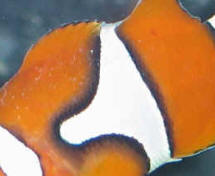 This IS very likely
Ich/Cryptocaryon
This IS very likely
Ich/Cryptocaryon
|
|
Brook or velvet
10/20/14
Hi, crew
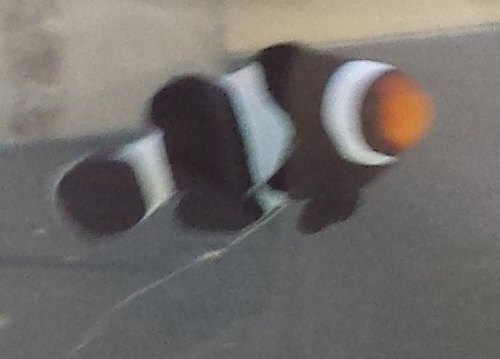
Could you tell me if my clowns have Brooklynella or marine velvet?
Pictures attached. Thank you.
<My guess is on Brook and/or Cryptocaryoniasis... def. not Velvet. I
would treat w/ quinine per WWM.
Bob Fenner>
|

 |
|
A couple questions! Clownfish
disease concerns bordering on.... Crypt, lumenal parasites?
8/5/14
Hi crew,
Long time fan, I really appreciate all that you guys do around here.
Please excuse me if these questions have already been answered, but I
have tried to use the search function to no avail. I believe my
questions are a tad too specific.
<Let's see>
I currently have 2 clownfish in my QT, and I've just finished the 4th
transfer using the tank transfer method to prophylactically treat them
for Ich.
My QT is a 20 gallon tank, currently sg is hovering around 1.025,
temperature is at 80-82 degrees. All parameters are in check, as the
fish have only been in the water for 3 days so ammonia is at 0,
nitrate/nitrite 0, pH. around 8.0-8.2. I have also been dosing with
AmQuel plus, to make sure to detoxify any possible ammonia.
I just have a couple questions regarding the health of my fish before I
throw them into my display:
1) One of my clowns has ONE "dot" which is white, on one of his pelvic
fins. Now this "dot" has been there for about 4 days, and hasn't
expanded/multiplied or changed in any way.
Is it possible for ich to show up as only ONE dot?
<Yes; but unlikely. This spot is probably "consolidated body mucus" from
general stress>
and remain that way for up to 4 days? I have a feeling this isn't ich,
but rather something else, possibly an injury?
I THINK it might just be a "hole" because when I look at the pelvic fin
from the other side as well, there seems to be a white dot on the same
spot, but it's weird to think that he found a way to make a "hole" in
his
fin, rather than a tear. If it were just a single Ich spot on his fin, I
wouldn't see the same white dot from BOTH sides of the fin, would I?
<Could; yes>
Would ich behave in this manner at all?
<... again; not likely>
I'm thinking if it was ich, it would have multiplied by now, or fallen
off, or changed in any way, or the fish would show signs of the disease,
breathing heavier, flashing, appetite loss, anything. The fish has not
changed his behavior in any way. Still eating like a pig. Currently I am
only feeding them the Thera-A new life spectrum pellets. I'll add more
variety to their diet once they're in the display.
The other clownfish has shown 0 signs of ich, no dots, nothing.
Any ideas? am I just being paranoid?
<The latter>
My second, unrelated question:
2) The other clownfish has weird stool patterns. Sometimes he has really
long, stringy white poop, similar to that of an internal parasite.
Please find attached a picture of the poop that I saw a few days ago.
<Again; most likely "just" stress... You could look at a specimen under
a microscope...>
Now this poop looks very similar to what an internal parasite looks
like, but both of my fish have gone through a PraziPro treatment, twice.
The clownfish will show this poop one day, and then the next day he'll
have somewhat "normal" poop, which would not be long white and stringy
like pictured. He has continued to have normal poop for the past 2-3
days, which is the strange part for me.
Is it normal for a fish to show this type of stool one day, and then
seemingly normal stool the next day? It seems like he'll go a week
without showing stringy poop, and then one random day he'll show it for
a day or two and then go back to normal poop. I was under the impression
that if it were internal parasites, then the fish would continue to show
stringy poop until the parasites have been cleared. Not show stringy
poop one day, and then normal poop the next. Am I mistaken here?
Do fish get different poop from stress?
<Yes; same as humans>
He showed the stringy poop right after the 4th tank transfer, and then 1
day later, he had normal poop again, so I'm thinking is it possible for
his stool patterns to change simply due to stress? or diarrhea? haha.
Any ideas?
I want to throw my fish in the display in a couple days, as they seem
healthy and happy, but I'm just worried about these two issues right
now, which makes me doubt if they are 100% ready.
Any input is much appreciated.
Thank you very much, and enjoy your day.
Cheers,
Fahd.
<Welcome. Bob Fenner>
|
 |
|
Clownfish with ICH, just using WWM
3/20/14
Hi!
<Meli... the little sweet one>
I just started my salt water tank a little over a month ago this past
Sunday ( 3/16/14) I added two clownfish, 5 snails and 10 little hermit
crabs.
<A note: I would not add all these at once>
The day after I added everything to the tank my clownfish developed
white spots and it's looking like ICH.
<Does indeed>
One fish has it worse than the other I attached a picture of one of the
fish. I bought the PH test and alkalinity test and my ph looked fine but
my alkalinity was low (2.5). I bought the garlic guard food
<... of no use>
but my fish still won't eat. Is there anything I can do to help heal him
or prevent any other fish I add to the tank from having this?
<? Read here:
http://wetwebmedia.com/clndiscrypt.htm
and the linked files above till you understand, decide on a given path>
Thank you in advance for your help
Melissa
<What we do. Bob Fenner>
|
.jpg)
Re: Clownfish with ICH 3/20/14
Thank you for your help! The place I bought them from keeps throwing new
things I need to buy at me instead of helping me with the problem
<Ahh, the merchant-mind affliction>
so its nice to get some good feedback! What would you recommend I do ?
<Read; and quick. This fish is near its end>
I purchased ParaGuard ( SeaChem brand) they told me to do two treatments a
day until I see improvements
<This product might work; IN a separate treatment system. BobF>
RE: Clownfish with ICH 3/20/14
I've been reading and I'm just so lost with all of it, Im fairly new to all
this so its all confusing
<Ahh; easy to become overwhelmed here... Take your time... B>
RE: Clownfish with ICH 3/20/14
What would you recommend? Will Ich ruin my tank and will all future fish I
put in get it?
<Hon... there's just too much to key, re-key re... >
RE: Clownfish with ICH Dismal 3/21/14
Hi! My Clown Died last night and now my other seems a little down not really
moving much or eating....Should I wait a few days or weeks before I add
another one?
<Another... fish? You're joking I take it. None. B>
|
|
Black marks on clownfish in QT
1/25/14
Good afternoon!
<Jen>
After searching the internet for days and asking on forums with no
discernible answer, I decided it was time to ask the experts!
<Ok!>
My clownfish has been in a hospital tank, undergoing copper treatment
for white spot, for 3 weeks now. I originally had two in there but I
unfortunately lost the other smaller (male) black and white clown after
a few days in the HT. Mona, the larger of the two, is now cured of
Whitespot and doing well apart from these marks on her. She had a few
black marks that I assumed were caused by my Zoas when I first
transferred her. But these new marks look as if the original few spots
have dispersed and spread all over her.
<I see these/this>
After looking at pictures of clownfish changing colour as they mature,
I'm not convinced this is what's going on.... Those changes seem to be
from under the scales and look to be a more even spread of colour. This
looks more like the edges of her scaled are trimmed with black.
She is still eating well (tetra marine flakes twice a day, sometimes
three times. Once a day I add garlic Xtreme. I feed Mysis every couple
of days too). There's no ammonia in the HT, I do a 25% water change
every 4/5 days and have an ammonia badge in there too.
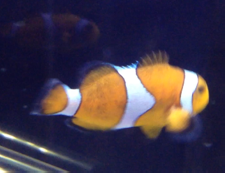
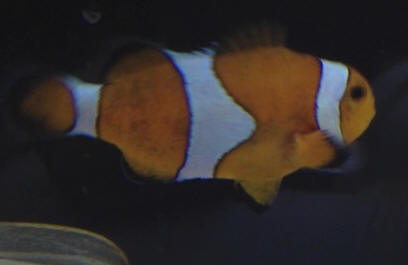
I've attached the best pics I could get with a rubbish camera and a fast
moving fish! The black shows up most between her middle and back white
line but is also on her fins.... Everywhere except her head!
Do you think I need to worry about her/do anything?
Thanks in advance for your help!
Jenny
<These markings look to be smudges; chromatophore, melanophore: color
cells on/in this fish... From? Copper exposure, gen. stress? I would NOT
treat for anything pathogenic here. Return this fish to optimized,
stable conditions and it should be fine. Bob Fenner>
|
 |
|
Re: Black marks on clownfish in QT
1/26/14
Bob, thanks so much for your response.
<Welcome Jen>
Yesterday was the last day of copper treatment at the recommended level
so I have now put carbon sponge and PolyFilter in the filter to remove
the copper, hopefully Mona will look less grubby soon! I was wondering
if lighting may also have had something to do with this and if I should
leave the tank light off for a few days? Do you think this may be a
factor?
<Not likely... the copper exposure by itself... most all. BobF>
Jen
|
|
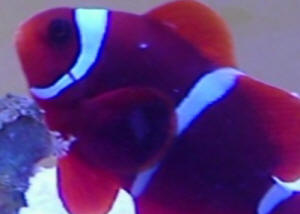
Parasite id help 3/21/13
Hi I'm looking for a little help with an ID. Some background on the fish...
Began as a 72g with un-quarantined fish. Majestic angel,
<... needs more room than this>
flame angel, 2 maroon clowns, exquisite wrasse, cleaner wrasse,
<... inappropriate species here>
Fiji blue damsel. After 2 days, Exquisite wrasse got some white fungus
cottony looking patch and died within a week despite eating well. All was
fine after that so I don't think that was related. I did add a hectors goby
some time after and I began seeing some spots on my clowns, but none that
looked like Ich. These were more cottony/fungus looking. Some other fish
(majestic and cleaner wrasse mostly) began scraping on rocks. Majestic got
some large white patches I almost thought could be velvet and died within
days. At that time I broke down the tank, thinking I had Ich and not really
sure if/what else.
<?>
I used tank transfer method
<What is this? Leaving the intermediate states of parasites behind?
Dipping/bathing fish/hosts enroute?>
to treat the remaining fish, and I had a newly set up 125g with only 2
fish (dogface puffer and a juvi red Coris). The dogface puffer I was also
sure had Ich, and so I caught these two and treated them with the rest from
the 72g. I set up a 20g which I already had cycled, and used that for the
wrasses. treated with Cupramine (3 wks) and then PraziPro (1 wk).
<Why the Prazi?>
The rest (Puffer, flame angel, 2 clowns, Fiji damsel) as I said I used tank
transfer (I did about 6 or 7 transfers 3 days apart using 32g trash cans
bleaching and drying in between).
<... won't work>
No signs after that and from there they went to a 90g qt that I cycled
specifically for these fish. I did not see any signs on them from here, but
I did treat with Cupramine for 3 weeks to be on the safe side, and then one
week of Prazi.
I left my 72g and 125g fallow during this time, but I did add snails and
some coral frags in the mean time. I went about 8 weeks with no fish but I
did add some snails to both tanks only about 2 weeks before reintroducing
fish. The flame angel and cleaner wrasse went back to the 72g and seem fine.
The 2 maroon clowns, puffer, Fiji damsel, and red Coris went back to the
125g. That was about 3 weeks ago. Last week I noticed a small white spot on
the larger maroon clown near the dorsal fin. That is in the first picture. I
kept an eye on it but there was no other signs of anything on the fish or
any other fish.
All of a sudden this morning the larger maroon clown is now covered with
similar spots as the first. I really don't think this is Ich, as usually
when I see it I can id it very easily with certainty.
<Can't w/o sampling, microscopic examination>
These spots are irregularly shaped, and all over. Some on their lips, very
edge of some fins, and on the body. There is one spot that is larger than
the rest near the clowns dorsal fin which almost seems cone shaped but fuzzy
looking. All the other spots are fuzzy looking and around some the skin
seems somewhat darker in the immediate surrounding area.
<See WWM re marine parasite ID>
I took a lot of pics to try to show this but you can only see so much in a
picture. The best pics I can find online seem like brook but I can't tell
because it seems so different in all the pics I see. Also I would think if
it were brook they would all be dead by now. I tried to send image links for
the pics if it doesn't show in the email then you should be able to paste
the links in your browser. Also Parameters are 1.025, 0 ammonia, 0 nitrite,
5-10 nitrate, 1200 Mg, 400 Ca, 8 to 8.5 dKH in both my tanks.
Thanks for any help. Dave
[IMG]http://i78.photobucket.com/albums/j102/badaszx9r/Mobile%20Uploads/aquariums/0314131510_zps04b6e099.jpg[/IMG]
<Does look like Crypt... on the Premnas... in a badly bleached anemone...
but what to do? Read:
http://www.wetwebmedia.com/reefparfaq2.htm
and the linked files above. Bob Fenner>
|
 |
Clownfish and Copepods co exist or parasite?
-
3/10/12
Hey there!
I've been reading through your site for days now and still can not
find an answer for my question. Very possible that I have not looked
long enough.
Anyways, I have a 90 gallon Refugium tank with live sand substrate,
live rocks mixed with...not live rocks, frogspawn, sunflower zoos, one
small leather coral, a Candy Cane coral, and a small cluster of brown
mushrooms with green tops, I also have one yellow watchmen goby, one
small coral beauty, one Ocellaris(unsure on spelling sorry) Clown Fish,
one Sexy Dancer Shrimp and one peppermint shrimp, lastly one tiny
emerald Crab. We also have snails, 8 sand sifters
<Whoa! Why so many? Will denude your live portion of live
sand>
and I believe 10 other snails that I am unsure what they are called,
they have triangular shells and stay mainly on the rocks only. My water
is as follows: Ammonia: 0ppms Nitrites: 0ppms,
Nitrates: 5ppms Salinity: 1.024 Magnesium: 1500 Calcium: 480mg KH:
125.3ppms and the Phosphate is .25ppms. About two an a half weeks ago,
I noticed these near microscopic white specks crawling around on my
tanks glass. They were on the front, back and two sides of my aquarium.
My coral beauty, once she noticed them, started picking them off of the
glass which lead me to think they were indeed some sort of organism.
After searching your amazing site for information I came to assume they
are copepods.
Well, yesterday my father was using the magnetic glass cleaner and
cleaned the glass including the copepods. They were immediately all
over the tank! So yesterday evening I am sitting starring at my fish
when I noticed a white spot on my clown fish just above his gill on the
left side. At first I thought well, it's probably just sand or one
of those copepods, but the white speck is still there so now I am
wondering of the fella contracted Ich!!!
<Mmm, if one spot... I wouldn't be concerned... not likely
Ich>
Is it possible, that this spot is indeed a copepod that when swashed
away from the glass, latched onto the Clown Fish, or is that not
remotely possible?
<Not really, no>
I do have a 10 gallon sick tank and am now considering moving him just
to be safe. Thanks so much for the continued help that you all
give!!
<I wouldn't move this fish>
Kindest Regards,
Stephanie L.
<Welcome. Bob Fenner>
|
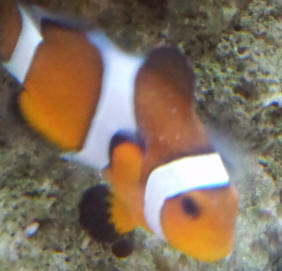
Tiny white spots on clown 12/26/11
Dear wwm crew,
I have attached a picture of my clown with some tiny white spots.
Are these the symptoms of ick?
<Does look like it>
please let me know.
Best regards,
Kelly
<Could be evidence of another Protozoan, or..... Read
here:
http://www.wetwebmedia.com/clnfshdisart.htm
Bob Fenner>
|
|
|
Clownfish behaviour and Ick problems
11/10/11
Dear Bob,
<Heather>
We are in need of some advice regarding our mated pair of True Percula
Clownfish - Sanjay Photon - to be more precise. After many hours of
research on Wet Web Media (which has taught us a lot) we are unable to
find the answers relevant to our situation so hopefully your expertise
can help. It is a rather long story, apologies in advance, so please
bear with me. Our problem concerns Ick and also Clownfish behaviour
issues.
<Ok>
Our tank is a 55 gallon with a 20 gallon refugium; the 'mated
pair' of Clownfish (which is how they were sold) were the first
addition to the tank (along with a clean-up crew). Unfortunately on the
first night in the tank the female was darting around all over the
place and the next morning we woke up to find them fighting with their
jaws locked - not what an already mated pair should be doing,
surely?
<Mmm, well, can/does happen when moved at times>
On the second morning they had stopped fighting and we saw the male
showing the usual signs of submission, but ... we noticed a few
tell-tale white spots on the female. We quickly set up a 10 gallon
quarantine tank (this was all we had available) and transferred the
female.
<Mmm, I wouldn't have done this... would instead have either
elected not to treat at all (and hope for sufficient immune response),
or treated all in place (likely w/ Quinine)>
On a side note, we are aware we should have quarantined first but, like
many hobbyists we took a risk. The following day the male also had a
couple of spots so he joined the female in the quarantine/hospital
tank. The only Ick medication available at the store the next day was
Malachite Green,
<Not good for this situation...>
which we bought. We followed the instructions and so treated over the
course of 4 days, however, online research told us that this would not
be enough to get rid of Ick and so we decided to continue treating for
another 4 days making sure to do regular water changes. All the while
our main tank was fallow.
<Will have to stay thus for weeks...>
We were not successful in getting rid of the Ick and after waiting a
few days, using carbon to clear all medicine, the situation was no
better and we decided to try another method. After more research we
decided that copper seemed to have a high rate of success with many
people and gave this a go.
<Again... a poor choice w/ Clownfishes. Read here: http://wetwebmedia.com/clndiscrypt.htm
NOW>
We used Cupramine with the Seachem copper test kit to make sure the
dosage was correct. All through the course of the treatment both
Clownfish continued to show signs of Ick (spots, scratching, darting,
loss of appetite)
<Oh! This could be Brooklynellosis instead... Read here: http://wetwebmedia.com/brooklynellosisart.htm
and the linked files above. Copper won't cure this>
and at one point we were sure the female would die. Incredibly she
pulled through and both fish seemed to be doing better - but the spots
never went away.
After 3 weeks of copper treatment we were at a loss of what to do, to
make matters worse both fish had developed fin rot and we realized the
water quality was a problem. We worked hard on keeping the water
quality good - got a better skimmer and filter going, regular water
changes with siphoning and scrubbing, fresh carbon and also used
Melafix
<...>
to heal their fins. By this stage the fish were eating really well and
the symptoms of Ick were barely noticeable except for a few spots which
kept coming and going.
Their fins also healed with the Melafix. We decided that perhaps they
could fight the Ick themselves after all and really didn't want to
use any more chemicals. With the main tank lying fallow now for 5 - 6
weeks we were desperate to get them better and back in there. However,
the Clownfish began fighting - not locking jaws but what can only be
described as bickering. They drove us mad just watching them going
round each other in circles, constantly annoying each other. Clearly
stressed they developed Lymphocystis and we decided to separate them to
calm them down. After a few days with a divide in the hospital tank the
Lymphocystis was improving.
The Ick also appeared to have gone and things were looking up. We
removed the divide and they seemed happy to see each other .... but
after a few minutes began their strange bickering again! We believed
they were just fed up with the tiny hospital tank and in need of space
so we took a gamble and put them back into the display tank.
<... what about...>
Amazingly they seemed great! No fighting, peaceful swimming together,
but after a short while to our complete horror we noticed a couple of
white spots on the male!
<Yes... this system is still infested. HAD you read on WWM re
you'd have known this>
By now the tank had been Ick free for weeks, we had just added three
Resplendent Anthias
<?! Not to this infested system, no!>
and certainly would not be able to cope with Ick taking over the main
tank now. But we decided to take a chance and see if good water
husbandry and plentiful feeding would work - it was only two or three
spots and both Clownfish were eating NLS pellets and frozen foods
soaked in Vita-chem. We also have a Skunk Cleaner Shrimp to help keep
the Anthias clean.
<Good>
To begin with, the Clownfish seemed a thousand times better and were
behaving like a pair again, swimming together, calm, no fighting, the
male occasionally twitching and showing signs of submission again. Both
were eating very well too and the Lymphocystis was practically
gone.
Unfortunately after about a week the male - still with a few white
spots - began harassing the female again and they appeared to exhibit
this strange bickering behaviour once more, sometimes he would nip at
the female's side.
We believed he was perhaps irritated by the spots (Ick, I suppose)
because he seemed agitated and frantic in his swimming, after a couple
of days he did calm down a little but the pair were not as harmonious
as they had been. A few days ago both of them had frayed fins again and
the Lympho was back on the female - we think it is because they are
stressing each other, and the male began nipping at the female again.
We decided to move him and for now he is in the refugium on his own.
The female looks great again and her fins are healed, the Lymphocystis
seems to be gone -- better yet she has no signs of Ick at all. The
Anthias currently do not show signs of Ick either. Our male Clownfish
still has a couple of spots on him, and now he seems to be off his
food, although he will eat a couple of pieces (mysis, NLS pellets,
Cyclopeeze..) but he is not his usual self - normally he goes crazy for
food and will come up to the surface when we approach the tank,
gobbling up anything in sight. Worse still, he seems to have inflamed,
red gills on one side.
Do you have any words of wisdom for us?
<As above. Read>
Is this still Ick that the male has and if so why have none of the
treatments worked?
<Need to look at a scraping under a 'scope... to determine
whether this is Crypt or Brook or...?>
What can we do to keep him healthy?
<Read>
All water parameters are excellent, temp is around 79.3 degrees, PH is
8.2. Our corals are in excellent health (SPS and LPS) so we don't
believe water quality/stability is an issue. Why do you think our
supposed 'mated pair' keep fighting this way?
<Mmm, well... "pairs" are transient at times... changing
circumstances upset the dynamic of their pairing... different size
systems, more/less habitat/symbiont/s...>
I should mention that these are young Clownfish and are similar in
size,
<... then not really likely a "mated pair">
however the female is definitely a little larger - they were sold to us
as a 'mated pair' from the Diver's Den.
<Usually reliable source>
I apologise for all the questions and the lengthy story - these fish
have been through quite an ordeal - we just want them to be healthy
again! Any help you can give would be much appreciated, we are
beginning to feel rather exhausted but don't want to give up. Thank
you in advance.
Heather
<Again... I wouldn't have moved these fish, treated w/ Malachite
nor Copper... Bob Fenner>
Re: Clownfish behaviour and Ick problems 11/10/11
Bob,
Thank you for your quick response and for sharing your opinions.
We didn't think the Clownfish had brook because they never
developed a mucous coating, however we will do some more reading on
this.
<I've been "fooled" more than a few times re
differentiating these two Ciliate Protozoans... there's not always
such a mucus coating on afflicted fishes w/ Brooklynella>
Having done much reading about Ick since the fish initially got sick we
have read that in mild cases it is sometimes better to let the
fishes' own immune system fight it,
<Yes>
and yes we realize this is probably what we should have done to start
with. Unfortunately we had already acted and this cannot be undone. We
have obviously learnt from this experience, I do wish we had known
before.
<Ah yes... one of many of my occasioned "would of, could of,
should have" situations>
As for what we do now - of course we are ensuring that we feed a
variety of nutrient rich foods to everyone and that the water quality
is excellent in the hopes that the fishes' immune systems remain
strong.
<Good>
We realize that the main tank is infested again, but if we had never
moved the Clownfish in the first place this would still have been the
case, wouldn't it?
<Mmm, not w/ treatment there, no>
Finally thank you for your thoughts regarding the pairing issues with
our Clownfish. We had our suspicions about their similarities in size,
would it be best to find a new home for one of them?
<Actually... no; IF they can be together, get along well enough, one
will grow much more, be/come the female>
Or is there a chance they could work things out in time?
<There is>
Your website is a great source for information and your advice is the
best we know so thank you again!
<Certainly welcome. Cheers, BobF>
Clownfish, Ich, Quarantine, and not
eating... 12/16/10
Hi Crew! I have a few questions concerning the recent quarantine of a
clownfish with a mild case of Ich. Yesterday, I decided to move him to
a 10 gallon quarantine tank
<For what reason/s? Are there other fishes in the infested
tank?>
with a bio-wheel filter, powerhead for circulation, couple of pieces of
live rock, and water from my display tank. Parameters are nitrate
approx. 10, no nitrites, no ammonia, pH is a little low at 7.8.
<Actually, this is a base ten log... 7.8 is dangerously low>
Temperature is steady at 80 F. Before transferring him yesterday he ate
3 small food pellets soaked in Selcon. I transferred him to the QT and
kept lights off until offering him a small amount of food which I knew
he wouldn't accept, but I thought, what the heck. I then turned the
lights off for the night to let him calm down.
Upon checking on him today, he is acting fine other than swimming along
the bottom of the tank frequently (which I painted a dark color) as if
he were looking at something, and mildly pacing the tank. Not what I
would consider swimming erratically, but it may be to more experienced
people such as yourselves. His respiration is somewhat fast, but he is
swimming a good bit (not "darting" however). He acts relaxed
part of the time, and "checking things out" the rest. He has
been in QT for 26 hours as of writing this, and it has been just as
long since he ate anything. An important detail that I forgot is that I
am treating with Seachem Paraguard.
<With the live rock present?>
Upon trying to feed him after 24 hours of no food, he takes the frozen
brine in and then spits it out. This was his favorite food of in the
display. Any insight on when I should start worrying about his feeding,
and what I should do if that time comes?
<The move, disease... stress>
Another important tidbit is that I separated him from an anemone that
he has hosted for about 5 years. Could this play part in his anxiety
and hunger strike?
<Definitely so. In the wild, there are NO Clownfishes found w/o
anemone hosts>
Any help you all can provide is greatly appreciated.
Thanks so much, and Merry Christmas!
Heath
<And you, Bob Fenner>
Re: Clownfish, Ich, Quarantine, and not eating... -
12/16/10
Hi Bob,
<Heath>
Thanks for the speedy reply. To answer your questions, The fish is
being treated for a mild case of Ich. Also, Seachem told me that the
live rock would be ok in the QT
<Mmm, I disagree>
and any absorbtion would be small and not enough to effect the
treatment.
<They (SeaChem) have evidently removed the MSDS for this product but
an excerpt:
"ParaGuard[NFPA 1,0,1]: Principal ingredient is glutaraldehyde
with ameliorating ingredients, pH 7.
ParaGuard also contains malachite green. Malachite green is a possible
carcinogen. Ingestion may cause severe gastric disturbance. May cause
moderate irritation of mouth. If ingested, drink large quantities of
milk or water. Universal antidote (charcoal) is useful. If enough is
swallowed to cause distress, seek medical attention. Eye contact will
cause severe irritation. Flush eyes copiously with water. Seek medical
attention."
... I would NOT put Gluteraldehyde nor Malachite Green in with
"reef life"... It will assuredly mal-affect the live
rock>
I have a few more questions now, how long do I have before it is
dangerous for the fish to not eat?
<Days, perhaps a couple weeks>
Should I transfer him back to the display to get him to eat if he
doesn't eat after the time you suggest?
<Up to you... this is posted on/in WWM>
What is a safe way to get my pH up in a QT?
<Also...>
Is it safe to use a small amount of Seachem reef buffer?
<... can...pre-mixed...>
I was scheduled to do a water change in the QT this weekend for
husbandry reasons. Would a silk plant possibly serve as a surrogate for
the anemone since he has hosted other things in the past?
<Not really>
Sorry for all of the questions, I am just trying to be a good steward
of the pet that I have.
<Understood/stand>
Thanks again,
Heath
<It might do you good to read here: http://wetwebmedia.com/clndiscrypt.htm
and peruse the linked files above. BobF>
Red sea clown disease? 10/13/10
Hi all
<Hello>
I have just had an outbreak of Ich in my system and
all fish appear (tenuous I know) to have no Ich spots on them at-all
now.
<Doesn't really mean much.>
This has been the case for about 3-4 days now. I understand about life
cycles of this parasite, but the fish are completely clear of it
currently and have been so for the 3-4 days.
<Very well may come back.>
However the larger of my red sea pair continues to occasionally flick
against the glass/silicon seals. Could this just be the remnants of the
disease? Or gill flukes maybe?
<Could still be from the parasite, or just normal behavior for
clowns.>
The gills appear normal and not flared though.
<Ich usually first infects the gills, and in nonsymptomatic until it
suffocates the fish.>
They all eat fine and between these intermittent bouts of flicking
against the glass the fish appear healthy. My LFS said it is likely a
remnant if the Whitespot and is indicative of irritation and should
clear by itself.
Would you recommend a FW bath maybe?
Thoughts please.
<I would remove all fish and treat for Ich while the main tank runs
fallow.>
< http://www.wetwebmedia.com/ichartmar.htm
>
<Chris>
Parasite protocols - 8/1/10
Gentlemen-
<And some of the tender gender>
I'm not off to good start....I have a 70g display up and running
for about 3 months.
My first stocking was a pair of true Percs that went through a
formalin/malachite dip and freshwater/methylene rinse, followed by 4
weeks in quarantine with no complications.
I introduced them to the 70g and about 2 weeks later one showed some
ich. I put the pair through another formalin dip and back into the 70g.
It has been 2 weeks with no further/new indications.
I am now wondering if I should put them back into QT, treat them more
aggressively (quinine or copper) and let the 70g go fallow for 6 weeks
before more stocking.
<I would not. More likely to live being left in the main display...
And it may be the source of the infestation anyway>
I guess this is the age old quandary of whether one can ever keep a
tank totally free of parasites without aggressively treating all fish
before introduction.
<Yes... there are specific pathogen free systems, even whole
commercial aquaculture facilities... but mixing any "wild
collected" wet material (live rock, sand, all invertebrates,
fishes...) can be a source of such problems>
I could very easily introduce a parasite in the future without doing
so, and find myself in this same situation only with a tank full of
fish to pull and treat.
Your thoughts...thank you.
Regards,
Ron
<I would leave all as is currently Ron... prophylactically treat any
new biological input, at least with separation for a few weeks. Bob
Fenner>
Re: Parasite protocols 8/1/10
Mr. Fenner...Bob if I may-
<Sure, is my name>
Now I am conflicted..I spoke with my LFS guy after emailing you, and as
could be expected, his advise <advice> was much different.
He recommended I pull the clowns and return them to QT with my other
fish and treat with copper.
<Mmm, no... I wouldn't... Copper is too harsh for Amphiprionines
period... please read WWM before writing...>
He is a staunch advocate of copper (he stated his experience with
quinine has not been positive) and allow the tank to go fallow.
He also is not convinced the fallowing technique is a sure thing
either, but tearing down and sterilizing is stepping way back.
I believe his thinking is that while I am in the early stages of
stocking, I have an opportunity to do something prophylactic that
becomes increasingly more difficult as stocking progresses.
On that point I agree, from a common sense approach...however stepping
back to a point I was at 6 weeks ago and looking forward to another 6
weeks of quarantine is not a pleasant thought either.
<I wouldn't quarantine... as stated ayer. Read here:
http://wetwebmedia.com/parasittkfaq2.htm
I might add, this is a fish only setup with no live rock or substrate,
so in all likelihood any infestations will be a result of fish
introduction.
<Maybe... B>
Regards,
Ron
Sick clownfish, Crypt 4/1/1-
Hi there, I just wanted to say what a fantastic site this is, it has
helped me so much as I'm new to the saltwater hobby.
<Thanks>
My tank has been up and running for about a month now, it is 60 litres
and contains two true percula clownfish, two cleaner shrimp, one blood
red shrimp, three snails and three hermit crabs, live rock and no
corals.
<Small tanks like this can be very difficult.>
Recently I've noticed tiny white spots on my male clownfish which I
know to be whitespot.
<Cryptocaryon irritans>
I've talked to the guy at the pet shop (B&S in Bolton) who has
been very helpful and he said if the clownfish gets covered in the
white spots then it can be quite critical, however I was wondering what
covered means?
<I would consider any infestation cause for concern.>
At the moment my clownfish has about 10 white spots around his gills
and head, and one or two on his fins, is this quite severe or should he
be literally covered in white spots for it to be critical?
<Severe enough for my tastes.>
My water parameters are what they should be except for the ammonia
level which is 0.25 ppm, I'm going to do a water change to bring
this to zero to reduce the stress that caused the whitespot.
<Ammonia at any detectable level is a big problem, it is very toxic.
Also this is not the cause of the ich/crypt, the protozoan Cryptocaryon
irritans is. While stress can lower a fish's immune system enough
to allow a symptomatic level of infection, if there is no parasite in
the tank the fish cannot get this disease.>
The clownfish is still eating and has not been gasping for air or
rubbing himself on substrate which I know are other symptoms so I was
wondering if I should just keep a very close eye on him or whether his
condition is serious enough to need medication? Thank you in advance
for any help given.
<Now you have a choice, either remove the fish from the tank and
treat with formalin, one of the Quinine drugs, or one of the other
methods (note that clownfish are very sensitive to copper and would
only use it as a last resort) while the tank runs fallow for at least 8
weeks to kill of the remaining ich, or leave them in the tank, feed
well, correct the water quality issues and hope their immune system can
recover enough to limit the parasite's infection. See here for more
http://www.wetwebmedia.com/ichartmar.htm
, http://www.wetwebmedia.com/ichart2mar.htm
.>
<Chris>
Re: Sick clownfish, Crypt 4/14/10
Thank you ever so much for the information, sorry for the late reply,
my internet has been down :(.
<No problem.>
I corrected the water issues and all is fine, the whitespot has cleared
up and my clownfish are doing really good.
<Great, but do be aware that if it was Ich it is still in the
tank.>
<Chris>
Re: Help with sick clownfish 4/11/10
Bob, thanks for your advice and insight. I really appreciate your
willingness to help. Just to provide an update: the clownfish is eating
better and more active. I've kept both filters (the Aquaclear 110
and the Renstar XP1) running since we've talked. The Aquaclear
breaks up the surface of the water and the amount of flow it creates I
think really helps with the oxygen exchange.
<Good>
However, the fish isn't fully back to eating like a "pig"
yet and I've noticed that it's breathing heavily (its mouth
opens and closes rapidly more than before and more than the other
clownfish). The red spot that was there before has begun to disappear,
so that's a good sign, but I'm wondering if it's infected
with a parasite. I just recently noticed a very small white cottony
growth on its chin. That along with the heavy breathing worries me.
Again I should mention that this fish is the same one that has
fluorescent spots that aren't raised appear and disappear on its
face within hours. Its always had those spots and seemed healthy. I
should also add that the other fish in the tank seem completely
fine.
<I would not "jump" to conclusions, act on the poss. of
parasites here>
From what I've read on your site, this symptoms point towards a
water condition problem. I've had those two filters running with
extra activated carbon so I'm wondering if there could be another
problem. Do you think
trying to treat with Binox would be a smart decision at this point?
<I do not>
I've held off up until now because I thought I could just cure the
situation with water quality and I didn't want to use anything that
might hurt the Featherdusters and snails in my tank, but I'm more
concerned about the clownfish at this point.
Thanks,
Scott
<I urge patience, further. BobF>
Could it be recurring whitespot
Crypt Treatment Copper and Clownfish. 6/25/2009
Hello Crew Member
<Hi Kev.>
I have searched Wet Web Media and cannot fine an answer to my problem,
although Wet Web Media has been extremely useful in the past.
<We shall see what we can do.>
Eight weeks ago I had an outbreak of whitespot, I have set up a
hospital tank and transferred all the fish, which consist of 1 Long
nose butterfly, 2 common clowns, 1 purple Firefish, 1 bicolor blenny, 4
green chromis. The hospital tank contains a cup, rock and PVC pipe.
<OK so far.>
I am using Cupramine, keeping the dosage at the correct levels 0.3 to
0.5ppm, although I keep it nearer 0.5.ppm.
<Clowns do not tolerate copper very well. Do read here:
http://www.wetwebmedia.com/clnfishdisfaq6.htm >
I am nearly eight weeks into incubation all fish look healthy, and are
feeding well. During the eight weeks of treatment I have noticed that
the 2 clowns are scratching up against the cup when I turn the lights
on., this can happen just 2 or three times then not happen again for 2
or 3 days although they show no signs of whitespot on there skin, and
look in good health.
<It may not necessarily be whitespot. They may just be rubbing
against the cup. I have a Clown that has 'bonded' with a rock
and frequently rubs against it.>
Have the clowns still got whitespot, I understand that that whitespot
attack's the gills, without exposing itself on the skin, they are
not gulping for air and don't look in distress, non of the other
fish are showing any symptom's of the disease what so ever.
<Which leads me to believe that this isn't crypt.>
I am desperate to get the fish back in the main display tank, but dare
not risk it just in case the clowns have still got the disease, Is
there still a problem?, clowns do develop strange habits.
<They do.>
Can you advise me on the best course of action from here please.
<I would suggest a balanced approach. I would return your other fish
to the main display tank, and leave the clowns in QT for another week
with no further medication or treatment. If at the end of the week you
still see no signs of Crypt, return them to the display tank.>
Thanks in anticipation.
<My pleasure.>
Kev
<MikeV>
Marine Ich and possible Hypo treatment: Clownfish
Disease\Crypt 4/20/2009
Hi Crew,
<Hi Kelly>
Firstly I am sorry for having to ask a question or two, well possibly
more! I am a bit unsure as to how to proceed.
<No apologies necessary, that is what we are here for.>
My boyfriend and I have been without a marine tank for a number of
years but have recently returned to the fold. We had a larger 150
gallon system but have returned with a more modest 24 gallon tank due
to lack
of space (new house) and funds! Although stability issues are more of a
worry the maintenance routine is much easier.
<OK>
I picked the tank up second hand, with livestock, and bucketed all the
water and contents. I set the tank up within hours of receiving it.
Only a single clownfish is present and a number of inverts and soft
corals.
Unfortunately the clownfish, I presume wild due to colouration, has
marine ich. I have never encountered disease before this time so I am
not 100% sure, but prob 90% at least. There are a number of small
salt
like specks to fins and also to the body when caught in the correct
light, usually fish between my eyes and the lights. I have improved
receiving conditions and now with the additional of reverse lit Chaeto
(in place of skimmer, now using Polyfilters) and multiple daily water
changes I am down to around 5ppm nitrates and holding. This has caused
the hair algae to disappear slowly to now nothing. Other than that tank
is now looking good and within wanted parameters, just the Ich to
contend with.
Obviously I have researched the matter and spent hours reading through
your articles and FAQ's. I will be picking up a 12 gallon tank in a
few days in which to remove the clownfish to. I will allow the main
tank to
run fallow for 2 months. I would like to use this tank to quarantine
future purchases, of which there will be little, possibly only adding a
Firefish, another small fish and a coral or two.
The clownfish is eating, will meet you when you approach, but
doesn't eat much in a sitting. He is respiring probably a little
quicker than he should but not desperate. There is no sign of flashing
and eyes are clear. If he didn't have white specks I would have no
reason to be alarmed.
Now I know that most of the crew are against the hypo salinity choice
and I have no knowledge to debate that.
<I cannot speak for the others, but I see it as useless without
additional medication.>
But I wanted to try this technique along with the "two front"
fallow tank.
Mainly as the copper and formalin routes scare me of cross
contamination and the fact I won't then be able to use
tank/equipment for future invert quarantine.
<Not necessarily the case,>
I am a little worried by the freshwater dips but they are re iterated
so many times throughout the site they must be for the best.
<Freshwater dips with formalin are marginally effective. Using
copper with clowns is touchy at best, as they are very sensitive to
it.>
I was reading the guide by Pete Giwojna. He seems to initially advise
the lowering of SG to the desired .008 over a number of hours. Most
FAQ's the crew have replied to advise a thousandth a day and
ultimately
no less than .010! The article then goes on to say this, I quote
"Just set up your hospital tank at a salinity of 11 ppt (1.008 SG)
and adjust the water to the same temp and pH as the main tank. Then
administer a freshwater dip to the affected fish and transfer them
directly into the hyposalinity treatment tank afterwards without any
acclimation whatsoever. "
I can imagine the shock would more effectively kill off the desired but
would it the fish too? As a freshwater dip is more of a shock one would
presume. As the fish seems fairly healthy I was hoping this
technique
coupled with other questionable techniques like garlic and daily base
siphoning would give him the fighting edge.
Would you go straight in with copper or Formalin?
<Something else completely - quinine see below.>
It would render the tank just a hospital and I would have to consider
another for quarantine. I'd probably have more volume in
treatment/quarantine than in display!
Thanks for spending the time to read this longer than intended
mail!
<Another option, and once certainly friendlier is quinine sulfate.
You can purchase it from:
http://www.fishyfarmacy.com/products4.html You can read more about
treating with quinine here:
http://www.wetwebmedia.com/quinmedfaqs.htm >
Kind regards
<My pleasure>
Kelly
<Mike>
Re: Marine Ich and possible Hypo treatment: Clownfish
Disease\Crypt 4/20/2009
Thank you Mike,
<No problem.>
I had read the FAQ's on that but not seen an article.
<Just a FAQ at this point>
It seems to be one of the more recommended treatments by the crew. I
will order some today; thanks to the email from someone else in the UK
in the FAQs I have sourced it very cheap! I am receiving the tank
tomorrow but will have to wait on whatever delivery times from this
company.
Should I use hypo as well or is this not necessary/welcome?
<Should not be necessary.>
And can I safely dose the tank before the fish enters, to the tune of
10mg/l?
<I would dose after the fish is in the tank.>
Or should I gradually raise it once the fish has entered by water
changes?
It would of course be near impossible to monitor the level in this
manner! Perhaps I have answered my own question!
Thanks once again, no more emails I promise!
<My Pleasure.>
Kel
<Mike>
Marine Ich 03/27/2008 Hey WWM Crew, <<Hello,
Andrew today>> I seem to have an outbreak of Ich, as of now the
ich is in the beginning stages and there are small white spots all over
my pink skunk Clownfish's fins and there are several on his body.
There are a few on my false percula clown and I cannot see any on my
royal Gramma or my snowflake eel (Though it may just be because they
have bright colors and the spots are hard to see). It is a reef tank
with some small Zoanthids, a leather coral, and a branching hammer
coral. I also have an egg-bearing scarlet skunk cleaner shrimp and a
small horseshoe crab along with 8 Astrea snails. The 30 gallon tank has
been running for 6 weeks with no problems. <<All the above in a
30 gallon tank? A bigger home is needed my friend. The best way to
treat your Ich is to get the fish into a quarantine tank and treat with
hypo salinity and allow the tank to go fallow of fish for 6 - 8 weeks.
More information can be found in the following link and by reading the
linked articles and FAQ's http://www.wetwebmedia.com/ichart2mar.htm
>> My water parameters are fine and my sand bed is about an inch
deep. My LFS recommended another cleaner shrimp to help with the
infestation but I am not sure it would clear up the problem.
<<No, the best way to go>> I really don't want to have
to get a new tank for my fish so I turn to you to help me clear this
problem up before any major damage has occurred. Are there any
medications for a marine tank that contain no copper? Thank you for
everything! <<Do read on the above link, understand the ich
parasite itself, the treatment. Hope this helps. A Nixon>>
Clownfish 911!! Ich 10/2/07 I recently bought a pair of
percula clownfish, one was so stressed before even reaching my tank
that it soon died of starvation from not eating after a week. (I tried
everything to make him eat - changing his foods, providing tasty
options...but no luck). <Chances are he was more than just stresses,
was most likely carrying a disease.> The day he died, the other
clown just hung around the bottom and didn't zip around the tank
like she used to. The next day she seemed back to her old self only, to
my dismay, to begin a slew of medical problems. Shortly after her
partners death she developed a mean case of Ich (so I began treatment
immediately seeing as it was in my tank with Ruby-Reef). <Worthless
against ich, but probably decimated your biofilter.> Just two days
ago, I saw she had developed pop-eye over night. <What are your
water parameters?> She was still eating very well so I decided to
wait a day and see if it got worse or if any thing else would pop up to
help me diagnose the cause of her pop-eye. Well, this morning I woke up
only to see it had gotten worse (more so her right eye than left). In
addition, her right gill has swollen and there seems to be another bump
on her right side in between her gill and eye. Lastly, her gills seem
to have developed a frill edge to them. I am so confused on what is
happening and I am worried that by tomorrow she will be gone. I am only
half way through my ich treatment so I need a medication that will be
safe to use in conjunction with the Ruby-Reef. <Need to get a
hospital tank going, there are no effective treatments that are reef
safe.> She is still eating but hangs around the top portion of the
tank. Advice would be greatly appreciated ASAP before I loose her :(.
My water readings were pretty normal...just a bit above 0 for nitrates
but nothing that should stress her - everything else reads normal.
<What is normal? Numbers please.> The temp is at 82 (it's
normally around 78 but I was advised to raise it to quicken the Ich
cycle to kill them all off) She only has one other tank mate (a royal
gamma) and a feather duster with plenty of live rock in a 30 gallon.
This is not a new tank and has been cycling for almost a year now so I
am a bit confused. Thank for your help in advance, Sommer Ps: also, on
a side note, do you think that all these illness were brought on by the
loss of her partner? <No, I am guessing both fish were sick to begin
with, just took this one a little longer to start showing symptoms.
This is why QTing any new additions is so important. What the Gramma
closely too, it may now have contracted whatever the clowns were
carrying.> <Chris>
Percula Clown question... ick? Using WWM... reading? 9/25/07
Hey, I set up a saltwater tank.. 20 gallons. It has been cycled, I have
2 false percula clowns in it, 1 coral beauty <Needs much more room
than this> some live rock and a cleaner shrimp. 2 days ago i noticed
a white dot on 1 of the clowns, he was kinda hanging near the top of
the tank and then all of a sudden seemed to be fine. This morning I
wake up, and 1 of the clowns has the white dots all on its body, the
other has a few and the coral beauty had a few dots on his fins.
<... not good> This morning i raised the tank temp to 82 degrees
and added extra salt to the tank. <?> I went to work, picked up
some copper safe and garlic for the food. I heard garlic is good to mix
with the food if a fish has ick.. true? <... not a cure> Anyway,
I returned home 8 hours later, and now all the white spots are gone
from all 3 fish. <... cycled off... will be back> I haven't
used the copper safe, I would prefer not to unless necessary... do you
think my fish had ick? If it was, i am sure the cleaner shrimp helped
rid some of it, but will the extra salt and raising the temp do away
with it also? <... no> Should I take any other course of action
right now if the spots are not there? Thanks in advance -- .Matt
Slattery. <You need to read... and soon. Start here:
http://www.wetwebmedia.com/ichartmar.htm and the linked files above...
till you understand what you're up against... Move the Centropyge,
stat., and get/use a chelated copper test
kit...http://www.wetwebmedia.com/cryptchelcucures.htm Bob Fenner>
Also... with my ick question.. 9/25/07 there dots were here this
morning, gone this afternoon.. but the fish have not been scratching or
darting around... could it be stress.... not ick? <...> -- .Matt
Slattery. <Read. RMF>
Ich... reading 7/22/07 How can I treat ich on my
clown fish if I don't have a quarantine tank? <Please read here:
http://wetwebmedia.com/mardisindex.htm RMF>
Reintroduction from HT, post Crypt 6/22/07 Dear
Bob, <Hello, but not Bob, Chris here this morning.> Thanks again
for helping me through my Ich crisis--one of my own making. I have a
question about reintroducing my sole survivor to the display--a small
gold stripe maroon clown. As you know, I treated him for 13 days with
ionized copper. He never showed any signs of Ich but my other fish did.
<Was probably still infected.> I pulled all out of the display
(now finishing week 3 of fallow period) and placed them in HT for the
copper treatment. <Good, keep the fallow going for at least 1 more
week, preferably another 3 weeks.> It's been 10 days since I
stopped copper treatment and the clown seems very health. <Good,
they are pretty resilient little guys.> No signs of Ich, eating
well, acting well, etc., and hopefully he will remain that way until I
place him back in the display. Which leads me to my question: At the
time I move him from the HT to the display, I was considering
administering a RidIch+ (formalin/malachite green) freshwater dip, but
I'm really nervous about doing so because I know how toxic formalin
can be. <To you as well as your fish.> Because (i) this clown
never showed signs of ich, (ii) is doing well and (iii) the HT water
was nuked with copper so I'm pretty sure nothing survived, would
you recommend that I skip a formalin dip and instead go for a simple pH
adjusted FW dip before introducing him into the display? <Yes,
Methylene Blue added to the bath would not hurt either.> The latter
is my preference/gut, but I wanted to know what you think. <We are
in agreement here.> If you agree, about how long should the dip last
assuming he's happy throughout? I've read everywhere that the
dip should last anywhere from 2 minutes to 47 years, but was hoping for
a refinement for this particular situation. <I would shoot for 7 to
10 minutes as long as doesn't appear too stress, which will not
likely be a problem with clowns.> Thanks. Andy <Welcome>
<Chris>
- What are these Spots - I've read much
of your material covering the disease but remain unsure of a
diagnosis. I hope you can help! I had 2 true perculas who had
successfully sorted out the male/female arrangement over the last 6
months. The female had grown dramatically over the last couple
months. Last weekend, I lost the male who miraculously jumped out
of a tiny whole in my aquarium. Despite knowing better, I purchased
another (small) clown and introduced him directly to the tank (I
know I know). I did a 20% water change at the time as well after a
lengthy acclimation. Now, 4 days later, I noticed today that the
female (not the new fish) has lost her appetite, spends most of her
time swimming slowly on the bottom or behind a rock (I had assumed
this was her "nest"). She also had small white strings or
flakes anterior to her dorsal fin (picture attached). I suspect
Brooklynella from what I've read here. <Uhh... to my eye,
that is Cryptocaryon - ich.> Could the new clown have been an
immune carrier? <Likely not immune but a carrier.> I should
also note that 8 hours later, these spots/flakes/strings seem to
have gone away. <Please read here: http://www.wetwebmedia.com/ichartmar.htm
> Her behavior remains the same. I'm concerned that I wont
be able to treat her until Friday when the stores all reopen after
Thanksgiving. What do you think? <I'd try to catch her and
perform a pH-adjusted, freshwater dip... and then tomorrow head out
and get the supplies for a quarantine tank. You're going to
need them.> Many thanks,
Jeff
<Cheers, J -- > |
|
|
Blind Clownfish Hi Guys, <Cheers> I was hoping you
could provide some advice. I have an ocellaris clownfish that came down
with what I think was a parasitic infection. (I had placed an infected
flame angel in the main tank not knowing - it came down with ich or
such and I lost it - had skin, eye symptoms). Yes, I will always
quarantine a new fish from now on - learned my lesson (I'm new to
marine fish/reef keeping). <no worries... it sounds like you have
learned this important lesson a lot faster than most folks. I'm
grateful to hear it> Shortly after I removed the angel, the clown
became ill. It did not show surface signs like the angel (skin, eyes,
etc), but had white stringy feces and was behaving odd. Can't say
for certain infections were related. <agreed... white stringy feces
indicates an intestinal parasite/protozoan. Use Metronidazole (Flagyl)
for this> It would spasm and twitch at bottom of tank, not eating. I
treated it with Coppersafe for 21 days in a hospital tank. <hmmm...
copper is most only effective against Cryptocaryon white spot... not
much else and certainly nothing internal> After even just 5 to 6
days, it was looking good and eating fine so after the 21 days of
treatment I placed it back into the main tank. <could have been
natural immunity just the same> After about one week the symptoms
came back worse than before. <are we talking about only stringy
feces or was there a body symptom as well?> I placed it back in the
hospital tank and re-treated with Coppersafe. My local fish supply
store said that no therapeutic monitoring is necessary with Coppersafe.
<wow... that was a stinky pile of misinformation. Copper is indeed
effective against common Ich, but only within a narrow range... a
little bit too little is ineffective and a little bit too much is fatal
to fish. Test kits must always be used with copper> I followed the
dosing directions exactly, very carefully. (I didn't dose the
evaporation replacement water - believing that the copper was staying
in the tank when the water evaporated. But of course I did re-treat any
water change water.) <the mfg recommended dose is irrelevant because
each tank has various amounts of calcareous media (rock sand gravel)
that absorb copper...hence to need for bare bottomed tanks and testing
with copper> Also, do you know if Coppersafe is chelated or ionic?
<chelated> It appears to be chelated, I would say copper sulfate
by the color. Anyway, after another 12 days of treatment with
Coppersafe (21 days original, off a week while in main tank and back on
12 days) my clownfish is now blind. Maybe not completely blind, I
believe it may be able to sense light, but can't see anything -
running into tank walls, can't eat, etc. <yes... the copper was
misguided and perhaps excessive. Hard to say without having tested.>
Swimming fast, being scared and confused. <I am very sorry to hear
it> Have you ever heard of Coppersafe doing this. <many overdosed
meds can... blindness may be temporary and return slowly within
months> All other tank parameters were fine during the time frame.
Could this have been caused by extended copper treatment? <more
likely the level of copper and not the duration. 21 day treatments are
the norm. I personally can't stand using copper because of its
narrow range of efficacy (in application and in scope of pathogen
kills)> Or do you think may another problem. Well regardless of the
cause, the advice I was looking for was how to feed the clown. <if
it comes to the surface sensing food have a hanging specimen cup or
large net handy and scoop the little bugger up and feed him in there...
don't forget about him though! Return him after 15 minutes or
so> I thought about euthanizing it, but my local fish supply guy
thought it could survive ok. <yes... perhaps, and the sight may
return anyway> It appears to be learning how to adjust a bit, but it
hasn't eaten for 5 days (still fair in color and swimming well - no
signs of original infection yet) By the way, I did an emergency 75%
water change to dilute the copper the day I realized it was vision
impaired. <very wise> It obviously can't see the food. I
trapped it in a net along the glass (easy to do, as to fact it
can't see) and placed some fresh frozen food on a plastic wire and
tried to get him to take it. I couldn't get him interested - very
scared, even though he can't see - obviously knows it's
trapped. Do you think eventually the hunger will over ride the
nervousness and it will eat? <I do believe so...> If you were in
my position, what would you do? <I would work hard at trying to
nurse it for weeks to a couple of months with hope for improved vision
and self-support. If not by that time, euthanasia may be an option>
Any advice at all will be greatly appreciated. You guys do a great job
on your website and email questions. Thanks so much! Bill Prevo
<best regards, Anthony>
True Percula Clowns Good Morning WWM Crew, I purchased 2 true
percula clownfish (tank raised) on Saturday, and I currently have them
in my 10 gallon quarantine tank before I put them in my 75 gallon tank
with 100lbs live rock. I noticed a few white spots on one of them
yesterday morning, so last night I started copper treatment with
Cupramine. I lost 2 clownfish a few months ago to Cryptocaryon, so I
want to get this treated quickly. I'm also in the process of
lowering the spg to 1.018 and the temp is at 82. Is there anything else
I should do? <Many other things you could do depending on your
perception of the severity of the infection; freshwater dips, formalin
baths, daily water changes, medicated foods, etc.> Should I be doing
freshwater dips as well? <They are helpful.> I gave them a 5
minute FW dip with Methylene blue before they went in the Q tank. They
seem to be eating fine so far (tetra flake and formula II flake soaked
in Selcon). Also, I just noticed my copper test kit reads in mg/l, is
there a way to convert this to ppm? <Due to the simple beauty of the
metric system, ppm and mg/l are the same thing.> Thanks for your
help! Dave Indianapolis, IN <You are welcome. -Steven Pro>
Ich As promised, I have more questions. This time concerning
ich. In my main system (the 40 gallon) I had a clownfish that developed
white spots. The other fish in the system (two small damsels) do not
seem affected and all fish are still eating and swimming fine. I have
two cleaner shrimp in the main tank. I noticed the spots last night and
move the fish to my quarantine tank (a 20 gallon) with a specific
gravity of about 1.021. I have a few questions about this disease and
treating it. Is this ich or some other disease? <Maybe
Brooklynellosis, as only the Clowns seem affected. Please read:
http://www.wetwebmedia.com/clndisfaqs.htm> My plan was to raise the
temperature slightly in both tanks and to dip the clownfish in a
freshwater dip with copper sulfate for a period of time (several dips
of about 5 minutes that are spread out in about an hour time). Is this
a good method of treatment? <No> I have live rock in both systems
so would I be able to lower the SG any more (my main system also has
other inverts)? Should I do anything else to remove this disease? How
helpful would a UV system be in preventing this for later? Thank you,
Kevin <Please read through the WWM site re these questions, issues.
The answers are there as are many co-factors you don't mention. Bob
Fenner>
Clownfish, disease Hello Mr. Bob I've been looking around
WWM for a few days now, I still have a couple of questions. I had a
fish (Amphiprion clarkii) that, within one week, lost about one third
it body weight, lost coloration to cloudiness, stopped eating, looked
like its skin was peeling away, and was taking about 35-40 breathes
every twenty second (that's higher than I'd ever heard of so I
kept checking again and again but got the same numbers). Finally it
died. I had given it a fresh water dip at the first signs of a problem.
Through the whole ordeal I didn't notice any white specks until
after it died. I took the fish to school and under a microscope could
see very tiny white specks here and there on the fishes body. They were
too small to be seen with the naked eye, but they were easy to spot
with the microscope. I assume the disease/parasite is not Ick but
rather Amyloodinium? The fish was the only fish in the tank. It had
been in there about two weeks when all that happened. The tank had been
running for a good while now. It is a 75 gal. I've had snails,
crabs, a bulb tip anemone, mushrooms, and some star polyps. All the
inverts are fine. I would like to get the inverts out of the tank and
into another tank before I take any steps to rid the system of the
parasite. Also, the tank has about 80 lbs of live rock. Is it possible
to infect a another tank by moving inverts into it? I can live without
the crabs and snails, but I would like to keep the anemone, mushrooms,
and star polyps. I think I read that the infestation of another tank
through the introduction of inverts would be from the parasites being
attached to the "non-living hard surfaces" on/with the
invert. If that is the case, then I guess it wouldn't be possible
to keep the snails, crabs, star polyps (attached to rock), or the
mushrooms (attached to rock), right? On the other hand, would it be
safe to pull the anemone off its rock and put it in a different tank?
Is it okay to freshwater dip an anemone or any of those inverts? I have
two tanks. My other tank is a little reef tank. The live rock for it
had been previously taken from my now infected tank. So it may be
infected too there aren't any fish in there right now). To find
out, I was thinking of putting some kind of cheap "tester"
fish like a damsel or maybe even a molly in the reef tank to see how it
does. So can all fish get affected by the same diseases and parasites?
Back to the big tank. I do want to completely rid the 75 gal tank of
the parasite. I don't want to put copper in the tank. I want to use
the tank as a spawning tank for clownfish and I've read that copper
can cause sterility in clownfish. If Amyloodinium is the culprit, then
is there any way of getting rid of it aside from completely drying out
the system? I was getting ready to put some kind of small "flame
or pygmy angel" type fish in the reef tank. Do you know of any
examples of reef safe fishes that wouldn't be affected? If
you're still awake, then thanks for your patience. Any help would
be greatly appreciated. I really enjoy the web site and your columns in
FAMA. Thanks, Matthew Boehm <OK Matthew, lets keep this simple.
Please do not move anything nor freshwater dip your inverts. That is a
good way to kill them. Some corals will tolerate very short dips, but
snails, crabs, shrimp, etc. would be killed. Leave the tank empty of
fish for one month and the parasites will die out. They require a host
and without one will soon die. -Steven Pro>
SICK CLOWN Dear Bob, Recently, my true percula
clown has gotten ick. Currently, he is in a 10 gallon quarantine tank,
dosed with Cupramine copper. Its got a whisper filter of adequate size,
heater, a rock, one powerhead, and a 15 watt NO bulb. I have not
measured the copper level, but my guess, from what I have dosed, is
around .7 or .8 PPM. He is getting better, at least it looks that way.
But when I got home today, he was upside down, in the upper back corner
of the tank!!! He is still very much alive, but he is still upside
down. He does still eat, but not if it is more than 2 or 3 inches below
the surface. I checked nitrate and nitrite, all fine, and I put ammonia
neutralizer in daily, since I do not have a test for ammonia, and I
cannot use carbon in my filter because of the copper. He will turn
over, but not for very long, maybe a few seconds, then goes back to
being upside down. Question 1- Does this setup for a quarantine tank
sound good? Question 2- Could he be upside down because of the high
copper levels? If not, then what? Question 3- I have heard clowns are
sensitive to copper treatments. Should I change to a different
treatment, such as Clout or Rid-ick, both of which are readily at hand?
Thanks for any help you can give, Ryan >> Yikes Ryan... things
don't look/sound good. Do agree that Clownfishes (and other fishes
that live in close association with invertebrates) are sensitive to
copper... and I do hope that what you really are seeing is ich... a few
other common clownfish parasite problems (e.g. Brooklynella) look
similar symptomatically, but are not susceptible to copper treatment.
1) The quarantine set-up sounds okay. 2) The copper could indeed be
mal-affecting the clown, but the overall stress and disease itself
could account for the behavior as well. 3) Here's where I have to
clobber you. Even with semi-sequestered formats of copper like
Cupramine, you need to have/use a copper test kit. Re-read the products
label and use instructions. It calls for a first day input of 1 ml. per
ten gallons that will render a free copper reading of 0.25 ppm and a
follow-up treatment at the same rate to give a reading of 0.50ppm. It
has been my experience that this product will not effect a therapeutic
effect unless it is at least at a 0.20 concentration or a treatment
effect unless it is at a 0.30 ppm dose. Yours is way too low... in
other words, the present concentration is not doing anything to treat
the fish. The only way to tell how much copper (Cu++) you have in
solution is a test kit. I would NOT switch to another medication. The
Cupramine can/will do "the job" if it is ich, and the other
"Med.s" would likely push the fish over the edge. If the fish
is still alive, do lower the specific gravity over the next two days to
1.017, raise the Cupramine concentration to at least 0.20 and keep it
there (by testing, re-addition of Cupramine). Do keep your eye on
ammonia levels, changing water if you don't have, or want to invest
in an ammonia test kit... You might benefit from reading the archived
articles on copper use, marine fish diseases, Clownfishes on my
wetwebmedia.com website. It's free. Bob Fenner
Disease question HI Bob, Happy Thanksgiving! I am a new
aquarist and need some advice on my pink skunk clown fish. I have had
my 10 gallon hospital tank set up for over a month now with 8.5 lbs
live rock with one pink skunk clown fish and a purple Dottyback. Each
fish is well adjusted and has their territories all mapped out. Each
fish has been eating voraciously since I put them in the tank on 11/4.
<Sounds good... and am glad to hear the Dottyback's not being
too mean to your Clown> My water conditions have stayed consistent
since I set up the tank. I have an AquaClear 200 powerfilter and a
Hagen powerhead running. My PH has stayed stable at @8.4, temp a
consistent 78 degrees, no ammonia or nitrites or nitrates. Salinity has
stayed consistent at @1.024. <So far, so good> I have fed the
fish Spirulina and frozen brine shrimp only once a day. <okay>
For over a week I noticed that the clownfish has a tiny white spec on
the edge of his caudal fin and one on the edge of his dorsal fin.
I'm concerned that it may be ich but the fish is eating
voraciously, swimming normally and there is nothing on his body. His
pectoral fins are clear and his eyes are clear. He's breathing
normally and behaving normally. <I wouldn't become overly
concerned... spots could be nothing... would not try to
"treat" this chemically or with environmental manipulation at
this point... But would avail myself of a cleaner... like a Lysmata
Shrimp sp. if it will fit into your stocking plan> At what point do
I get concerned about ich. The Dottyback is completely fine. I am
resistant to use copper as my water parameters are perfect and I do not
want to use chemicals unless absolutely necessary. I have been testing
the water every week to keep it in good shape so I'm not sure what
to make of these two specs. <I agree with your sentiment... and
would try the cleaner, and a dip/bath procedure on moving the specimens
to the main system... detailed on the www.wetwebmedia.com site> Any
guidance you could provide would be much appreciated. <Be chatting,
Bob Fenner>
Clown fish Mr. Fenner, I have two clowns. A male and a female
and they get along great. For about a week now I have been observing my
female very closely. Near her belly and on the two lower fins closer to
her gills I have noticed that she has white matter on her . She is very
active moving sand and picking up larger pieces of coral to clear them
from her anemone. The white matter (maybe ich ) seems to have come and
gone this last week. I believe it maybe spreading but I have not seen
it spread to a larger area or different area as of yet. I was wondering
if I should keep monitoring the fish or try a fish water dip to control
the problem if indeed their is one. Also, what procedures do I follow
when doing a fresh water dip if needed. Thank You, Jason Cohen <If
it were my tank, livestock I would not dip, nor "treat" this
condition with chemicals, but definitely keep an eye on the
situation... and likely add a cleaner organism (like a Lysmata Shrimp
sp. if it will go in this system)... Please read over the
"Cleaners" section and FAQs and Clownfish health FAQs on the
www.WetWebMedia.com site where you'll also find notes on protocols
for dips/baths for marines. Bob Fenner>
Re: clown fish Thank you Mr. Fenner for the advice. I will
definitely watch for any change in the clowns condition. I would like
to add the cleaner shrimp as you requested but I am not sure if it will
be accepted in my reef system. I have the 2 clowns and one anemone,
arrow head crab, watchman goby, 3 green Chromis, sally light foot,
coral banded shrimp, and 18 hermits and snails. If the creatures I have
in my tank will not interfere with the cleaner shrimp than I will add
one tomorrow from my local pet store with your acceptance. Thank You,
Jason Cohen <Hmm, I share your concern... with the presence of all
those other crustaceans... there might well be some negative
interaction with the CBS, and do keep your eye on that Arrow Crab... it
alone can/will get big enough to threaten your fishes (yes, they do eat
fishes)... Perhaps a Cleaner Goby (genus Gobiosoma) would be a better
choice. Images and more on the WWM site re. Bob Fenner>
Ich on clowns Hi Bob, I'm very new at this. . . I've
been reading everything I can find on saltwater tanks since I set up my
first 20 gallon and I have several questions. <Good> First, my
system: I have a Penguin BioWheel 170 filter and two lights - one
regular fluorescent and one Actinic Blue - I want to have corals later.
The tanks been cycling for just over two weeks with two tank raised
percula clowns (I asked, and the LFS said two clowns could survive the
cycle). <Hmm... stressful though...> So far, they've done
fine (sort of - I'm getting there). During the middle of my cycle I
introduced a Berlin airlift protein skimmer (which I've since read
is not the time to introduce a protein skimmer ? ). <Yes, generally
better to wait till the system is completely cycled> The first
problem I encountered was off-the-chart high nitrites. At the
suggestion of LPS, I used Bacter Plus to bring the nitrites down and
today they're at .25 ppm. Side note - as nitrites are going down,
I'm seeing more and more brown algae in tank. <Yes...
opportunistic... with tank changes... will cycle out...> I also
thought some air bubbles might help oxygenate the water, so I added a
bubble tube to the back (my own hypothesis - and actually, when
it's on, they didn't gasp at the top at all). <Many things
possibly going on... and good to have the added aeration> Yesterday,
I noticed a fish scratching against the substrate and saw a few spots,
which LFS said were probably ich. So I bought Quick Cure for 2 reasons:
1. I want inverts later and read that copper was toxic to inverts and
hard to get out of tank once introduced (but then my filter, which the
LFS recommended has a copper bag in it). . . and 2. The LPS highly
recommended it. I removed the copper bag b/c <Hmm, likely you mean
activated carbon which removes copper... and LFS, "Livestock Fish
Store"> quick cure bottle recommended it but now the only
filtration/water movement I have is the BioWheel, protein skimmer, and
bubbles - is that dangerous? Today was the second treatment with Quick
Cure, I still see ich and fish are still scratching but it's only
been 1 ½ days - I read on an earlier post today that you
said Quick Cure could be toxic to fish, but I couldn't find the
original post. . . <This product is indeed quite toxic... and also
may well have been unnecessary... Your Clowns might not have
"ich" or any other parasitic agent...> Please explain if
you think I'm doing anything wrong or could do anything better.
I've gotten pretty attached to my clowns. Many thanks, Laura
<Thank you for writing, and be assured I will help you. Please take
the time to read through the "Clownfish" sections and
associated FAQs files posted on our site: www.WetWebMedia.com and
consider what you find there that applies to your current situation...
as well as the "Marine Parasitic Disease", "Ich",
"Copper Use"... other sections that interest you. At this
point, I would cease the Quick Cure treatments and let your system come
to a full cycle... else you are likely to overall cause your livestock
more harm than good (Please also see "The Three Sets of Factors
that Determine Livestock Health" section as well...). Bob
Fenner>
Re: Ich on Clowns, forgot to mention I wrote earlier about
the new 20 gal. tank with .25 nitrites and ich (I'm using
QuickCure). . . Forgot to mention that the temperature is 80 degrees
F., the salinity 1.023, and the fish are still eating normally
(voraciously, which is normal for them). Don't know if that will
help you diagnose my tank, but maybe. . . Any suggestions on how to
rectify this amateur's problems would be most appreciated. Many
thanks, Laura <When this system "settles down" cycle-wise,
it may well be prudent to raise the temp., lower the spg to rid the
fish of their apparent spots... not now. Bob Fenner>
Re: ich on clowns Thank you Bob for your speedy reply.
I'll definitely take your advice. Since I last wrote, my clowns are
acting worse. I'll definitely stop the QuickCure treatments,
<Best to... the active ingredient is... formalin... imagine having
that in your eyes... on your skin...> but can I put the carbon
filter back in the tank? <Yes... I would> I'm wondering if
QuickCure says not to mix w/ Carbon or Charcoal because it will hurt
the water quality or b/c it will neutralize the "medicine"?
<Yes... it absorbs the Quick Cure...> I'm guessing it's
the latter, but I want to be safe. Thanks, Laura <Be chatting my new
friend. Bob Fenner>
Re: Sick clowns Hi Bob, I wrote yesterday about the sick
clowns. I've read just about all the posts you mentioned, put the
carbon filter back in my tank, and have tried to just get things back
to normal. But my fish are acting worse today. One is just hanging out
at the top, then occasionally swimming lazily around. The other is
hiding out by a shell. I still see white spots on both fish - though
maybe not as many as yesterday - I hope that doesn't mean the ich
(if that's what it is) has dropped off to reproduce. <Yes...
> I'm wondering if I can do anything to help them. I know I
shouldn't use QuickCure, but what about CopperSafe or some other
product? My nitrites are steadily going down. Today they're between
.25 and 0 ppm. Does this mean my tank is at the end of its cycle?
<Unfortunately... and this is why you should have been
instructed/advised to wait on fish livestock... the copper, other
materials, environmental manipulation will/would likely kill the Clowns
at this point... and forestall or worsen the nitrogen lack-of-cycling
situation...> The only thing I could think of that I haven't
tested is the alkalinity, which I don't know much about - Today I
tested it and it's between 1.1 and 1.7. My pH is 8.2. <This is
low... and can be slightly elevated by the addition of some baking
soda... sodium bicarbonate... Please just mix a heaping teaspoon in
some system water in a glass and add daily... safe and a help here...
after the system is cycled (no, zero, zip nitrites), I would start to
slowly lower spg and elevate temp... a thousandth and a degree F.
respectively per day... hopefully this will be soon enough to save your
clowns... in the meanwhile do increase aeration if you can, and extend
the "light period" of this system to about fourteen hours per
day... this will help to speed along nitrification establishment and
help your Clowns> If you have any suggestions for how I can help my
fish, I would be sooo appreciative. Do you think they're on in
really bad shape? as in near-death, or just stressed? <Likely very
stressed... yes.> Thanks, Laura <Bob Fenner>
Re: Ich, Quarantine Tanks/sick clown Bob, Unfortunately the
one damsel that I have in my quarantine tank died last night. He had
spent the last 2 days at the surface breathing rapidly and not eating,
and of course was peppered with small white dots. I'm assuming his
infection was beyond the scope of being cured in time with the
Coppersafe that I'm using. Should I have dipped him 4 days ago
before putting him in the hospital tank? <Hard to say, assess, but
it is not likely this would have helped...> This morning, the
smaller of the two clowns was covered with small white spots, and the
larger had about 2 dozen on each side. Both ate ok and seemed fine. The
smaller clown that was more infected to begin with also had a small
(1/8" diameter) black spot on it's side towards the back of
the body. Over the last 2 days the spot has seemed to grow, and now
looks like a scab that is about to fall off. It actually projects
beyond the body at least a millimeter! What could this be, and should I
be treating with something other than Coppersafe? I am guessing this is
some type of secondary infection. <Its own body reaction as
well...> I am feeding the fish in quarantine a small amount of flake
food once a day, and planned on every other feeding soaking the food in
Selcon. I am keeping the copper at 1ppm because of the clowns, but must
admit I was surprised to see them both with white spots this morning
when they didn't have any yesterday. Should I dip them, or maybe
ever so slightly raise the copper to nearer 1.5ppm? <No to the dip
unless you are moving them elsewhere... and do get/use a test kit that
will render you a measure of free cupric ion... this is all that is
important... or do the calculation provided by the manufacturer to come
to this value from their chelated product> Is it normal for there to
be a cycle or two of parasites that survive the first few days of
treatment? <Yes... very astute of you... especially in "late
caught" situations where multiple generations of parasites have
had time to reproduce asynchronously> I tried to get a picture with
a digital camera of the smaller clown's black spot, but didn't
have any luck! By the way, the two damsels are fine so far. Once again,
any help on what to do for these sick fish is greatly appreciated! Kris
<I know how hard all of this is/can be... stay the course. Bob
Fenner>
|
|


