|
FAQs about the Powder Brown and White Cheek
Tangs Identification
Related Articles: Powder
Brown Surgeonfishes, Genus
Acanthurus, Naso,
Related FAQs: Powder Brown Tangs 1, Powder Brown Tangs 2, & FAQs on:
Powder Brown Tangs Behavior,
Powder Brown Tangs Compatibility,
Powder Brown Tangs Selection,
Powder Brown Tangs Systems,
Powder Brown Tangs Feeding,
Powder Brown Tangs Disease,
Powder Brown Tangs Reproduction,
& Acanthurus, Acanthurus Tangs 2, Acanthurus Tangs
3, Acanthurus ID, Acanthurus Behavior, Acanthurus Compatibility, Acanthurus Selection, Acanthurus Systems, Acanthurus Feeding, Acanthurus Disease, Acanthurus Reproduction, Surgeons In General, Tang
ID, Tang
Behavior, Compatibility, Systems, Feeding, Disease,
|
What's in a (Common) Name?:
Confusion
Japan or Whitecheek or Powder
Brown: Acanthurus japonicus:
http://fishbase.org/Summary/speciesSummary.php?ID=23375&genusname=Acanthurus&speciesname=japonicus
Whitecheek or Powder Brown:
Acanthurus nigricans (nee glaucopareius)
http://fishbase.org/Summary/speciesSummary.php?ID=6011&genusname=Acanthurus&speciesname=nigricans
Yes... both species are called Powder Brown AND
Whitecheek... in the pet-fish interest (not in science)
|
Surgeonfishes: Tangs for Marine
Aquariums
Diversity, Selection & Care
New eBook on Amazon: Available here
New Print Book on Create Space: Available
here
by Robert (Bob) Fenner |
 |
|
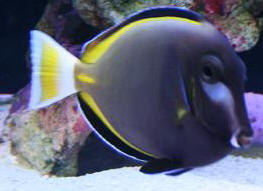
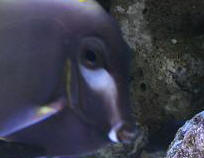
Powder Brown Tang ID 1/21/11
Hi, I been referring to this website for many years now, would
appreciate your assistance on identification. Thanks
My tang does seem to look like nigricans but it has a rather long
white tone on its mask
Acanthurus nigricans (glaucopareius), or A. japonicus?
<The latter. Bob Fenner>
http://i380.photobucket.com/albums/oo250/slcw1/IMG_5344.jpg
http://i380.photobucket.com/albums/oo250/slcw1/IMG_5351.jpg
|
|
|
|
Re: Powder Brown Tang ID
1/21/11
Thanks for speedy reply
Steven
<Welcome Steven. BobF>
|
The Conscientious Marine Aquarist - 2nd Edition - mistake?
Which Acanthurus looks like it has a white cheek? A gold rim? You tell
me. 9/17/09
Hi,
<Hello David!>
I recently purchased the book "The Conscientious Marine
Aquarist" (2nd edition) by Robert M. Fenner. On page 330 of the
book, he gives the Acanthurus nigricans the common name Powder Brown
Tang and the
Acanthurus japonicus the common name White-faced Tang. He then goes to
describe the extreme differences in hardiness of the two (one being
hardy, and the other often not lasting even 3 weeks in a home
aquarium).
My question is: did he mix up the two fishes by any chance? Online and
in other books, the fish are respectfully paired with the opposite
common names (Acanthurus nigricans is commonly named White-faced or
Gold-rim Tang, and Acanthurus japonicus is commonly named Powder Brown
Tang) AND opposite descriptions (elsewhere, the Acanthurus nigricans is
said to be hardier than the Acanthurus japonicus). Since I am
interested in getting one of the two variety, it is important to me to
read correctly the hardiness and differences between these two
fish.
<There is a never ending disc. re common names period; a minor one
with these species. Please read here:
http://wetwebmedia.com/GoldRimSs.htm>
Looking purely at the scientific names, does Fenner believe the
Acanthurus nigricans is hardier (more robust in the home aquarium
environment) than the Acanthurus japonicus, or is the opposite
true?
<A. japonicus is far more aquarium suitable, hardy>
Thank you. I truly enjoy reading this book! :)
David L.
<Thank you for your input! Bob Fenner>
Re: The Conscientious Marine Aquarist - 2nd Edition -
mistake? 9/17/09
Dear Mr. Fenner,
I am honored that you unexpectedly replied to me directly. Thank you so
much for sharing your experiences!
David L.
<Thank you in turn David... A bit more re "common
names"... And these fishes in particular... Which to you looks
like it has a white cheek? A gold rim? Me too. BobF>
|
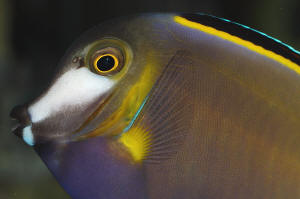
Another photo for Bob 4/19/09
Hey Bob, Grant here. I just got another good picture of a fish,
thought I'd pass it on to you. If you feel like using it,
feel free, it's a nice crisp shot of a powder brown. If you
happen to want a LARGE image of it, that is a 4700x3200 pixel
shot that I just resized but no cropping, so it would be really
easy to resend a very large but still very clear shot.
<Ah, very nice>
I send in a picture once every month or two, but I realize that
isn't what the website is for, so if you don't want them,
tell me and I'll quit sending them :) No hurt feelings on my
end, I just figure you might see one you like and be able to
replace a blurry or "poor" photo that you've had to
use.
Grant
<Will gladly post with credit to you. Thanks for sending this
along. BobF>
|
 |
Tangs ok, I'm not trying to compare your book to Scott
Michael's Marine Fishes (or your knowledge to his) but, you always
say that A. japonicus is hardier than A. nigricans and he switches the
two, is this some mistake or is it just a difference of opinion ( of
course this assumes that you have spoken to each other and that you
know about his views on these two fish, which are probably not the
case... ) Curiously yours, Yaron Aronowicz <<Geez, don't
know... I would ask Scotter... as well. His works are very careful...
and there are MANY differences of opinion in our huge fields
here... But on this specific, I do consider (okay my confidence
limits are high enough), know the White Cheek, Acanthurus japonicus to
outlive (historically... not one hobbyist with limited experience, but
thousands of specimens...) the Powder Brown, A. nigricans (formerly
glaucopareius)... by a HUGE margin... Bob Fenner>>
- Tang Switcheroo - Hey guys, I recently bought a A.
japonicus from Marine Depot. Well it turns out they sent me A.
nigricans because mine has only the little white mark under
the eye and no orange on the tail. My question is since the one they
sent me is much harder to keep what can I do to ensure its health?
<Well... I'd go as far as either shipping it back or refusing
payment... this type of livestock switch while possibly just human
error, is not in your best interest.> It has been eating a lot of
algae from my live rock but I am having trouble getting it to eat
anything else. I have tried Mysis shrimp, brine, and chopped krill. It
has ignored the first two and just kept spitting out the krill. What
else can I try?? <I'd stick with the algae for now... you can
get it in sheets - Nori, for rolling Sushi, etc. - is an excellent
choice.> One weird thing I noticed is when I go near the tank it
will come up, look at me and swim near the glass, but when I put food
in the tank it turns almost white with black stripes and races from one
side of the tank to the other!! What does this mean?? <The color
change is just a fright pattern - most fish take a couple of weeks to
get used to their new surrounds. No worries.> Thanks for all your
help! Derrick <Cheers, J -- >
Re: Acanthurus Nigricans vs. Japonicus Dear Bob, as said in
one of previous emails, I have bought your book and it is always a very
good advice when I have to look for something. Your site and your book
has been for me the reason that I stayed and did not leave the hobby of
seawater aquarium. I really thank you for this, you and the crew, who
have been really helpful. Now, back to action: In your book you state
very clearly that we want the Acanthurus Japonicus (White Faced Tang)
and not the A. nigricans (Powder Brown Tang) and you give all the
reasons why this is so. Lately I read the book "Marine
fishes" written by Scott W. Michael. In his book he names the
Japonicus as "Powder Brown Surgeonfish" and the A. nigricans
as the "Whitecheek Surgeonfish", which is the opposite
denomination. He also writes that the A. nigricans is "similar but
more durable than its close relative A. japonicus". Do you think
this a typing mistake or there are really controversial opinions about
these two fishes? <The common name issue is one mainly of
Scott's (we're friends) predilection for using scientific
common names (the names folks in the sciences typically use) versus my
use of common common names (ones generally agreed upon by aquarium
hobbyists). The survivability issue is likely one of mistaken identity,
but perhaps Scott's experiences vastly differ from mine> I am
really interested in this because I really like a lot A. japonicus and
I am considering it to be my next purchase. By the way, it is possible
that he fights with my Blue Tang, who lives already 1 year in my tank?
<To some extent yes. Should be okay if the newcomer is smaller by an
inch or more and the tank is more than one hundred gallons. Bob Fenner,
just back from Hawai'i> Thanks, Thanassis from Greece
Discrepancy between WWM and Michael's Marine Fishes book
Dear Bob, <Timon> On http://www.wetwebmedia.com/acanthurTngs.htm you
have a picture of Acanthurus japonicus and A. glaucopareius
(nigricans). You state that japonicus is the "white face
tang" and hardy and that nigricans is the "powder brown
tang" and not hardy at all. <Yes> In the book "Marine
Fishes, 500+ essential to know aquarium species", Scott Michael
calls the japonicus the "powder brown" and the nigricans the
"white cheek" and states that the japonicus has a poor
survival record and that the nigricans is the hardier choice. Clearly
one of you has them confused, and both of you have me confused :) <I
have addressed this query before. The fish in Scott's work I
believe is switched. The "Cat" Tang, aka Powder Brown,
Acanthurus nigricans (formerly glaucopareius) does indeed have a dismal
survival history in aquarium use, and is indeed called the Whitecheek
Tang by science... and A. japonicus the Japanese Tang, but the
Whitecheek to the petfish interest... sigh> Having recently acquired
the japonicus I would really like to find out if it's the japonicus
or nigricans that has a good survival record. Kind regards Timon
Haringa <The two species are distinct... easily
discerned. Bob Fenner, who encourages you to look at these species on
fishbase.org>
Re: Discrepancy between WWM and Marine Fishes book Hi Bob,
<Timon> In that case I am glad I made the right purchasing
decision. <Me too> I purchased only one out of fear for
aggression but would really like to have more of this stunning species.
Is there any chance of two or three living peacefully in a 400 gallon
reef tank or would that just be plain stupid? <In this size system
more than one should be fine.> Thanks Timon
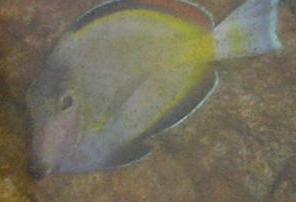
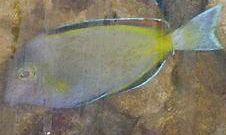
| Tang ID. Picture attached of Tang in
question. Was sold to me as a Lipstick tang "Naso
lituratus", I'm thinking that I may be fortunate that it
is more to the name of a A. japonicus, but it doesn't have the
white "cheek" marking as described, The rest of the
coloring doesn't look like it would be the a. nigricans either.
Attached is a couple pics of it, since its color does vary a bit in
the body. Mainly, seems when it gets startled, also, aprox.
3.5-4". <You are correct... this is not a Naso sp.
tang. IT IS either A. japonicus or A. nigricans. Both of these fish
are commonly referred to as "powder brown" or "gold
rim" tangs. See here: http://www.wetwebmedia.com/GoldRimSs.htm
A. Japonicus is the far better aquarium fish, and I suspect that is
what you have. To verify, look also for the characteristic yellow
tail bar of A. nigricans. Hybrids are thought to occur between
these fish and A. Leucosternon (powder blue), and it is possible
that this is one of those or just an unusual morph. These fish
often display unnatural looking colors under stress, so a positive
ID may only be possible if the fish reaches peak health.> Please
disregard the algae spots, that at least seems to be going away, as
last week it was pretty much sheet, instead of spots. Midnight
sleeper goby and Red Sailfin Blenny seem to have been working
overtime. Additional tankmates: firefish goby, pair of cleaner
shrimp, yellow tail damsel, and false percula clown. Temp 76,
Salinity 1.023, ph 8.3, alk 325, ammonia 0,nitrite 0, nitrate 20
and falling, was 40 a week ago. Would be appreciated if you could
id this tang for me. Hoping it is more suited for the 48"L
tank, it is eating anything from Frozen Brine, Zooplankton, Marine
flakes, and devours seaweed salad. <Your tank mates sound
fine, and this tang should help clear up any algae problems. Any
48" tank will be too small for this fish. It may do OK for a
few months, but it will soon out grow it. These fish appreciate
strong water movement (at least 15x tank volume) for both high
oxygen saturation and the swimming stimulation. I am not sure about
the ppm scale for alkalinity, so please consult your kit
instructions and maintain it in the high end of the normal range.
Also, I would avoid significant amounts of brine in any fishes
diet. Ocean nutrition frozen "pygmy angel formula" is one
of my favorite tang foods for it's high marine algae content.
Lastly... I hope that this fish was quarantined. All tangs are high
Ick risks and often take tankmates with them when they cause an
outbreak. Best Regards. AdamC.><<Is japonicus.
RMF>> |
|
|
Surgeonfishes: Tangs for Marine
Aquariums
Diversity, Selection & Care
New eBook on Amazon: Available here
New Print Book on Create Space: Available
here
by Robert (Bob) Fenner |
|
|
|

