|
|
| Home | Marine Aquariums |
Freshwater Aquariums |
Planted Aquariums |
Brackish Systems |
Ponds,
lakes & fountains |
Turtles & Amphibians |
Aquatic Business |
Aquatic Science |
Ask the WWM Crew a Question |
| Please visit our Sponsors | ||||
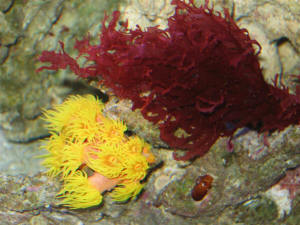
Is Gracilaria curtissae safe in my refugium? Yes! - 6/21/08 Hey Crew, <Hi there, Lynn here this morning.> I've recently added a sump with a refugium to my 65 gallon reef setup. <Excellent> The sump has a SWC protein skimmer and I'm also running 2 Phosban reactors, one with carbon and the other with Phos-lock. In the refugium section, I've added a DSB and some live rock along with some Chaetomorpha and Gracilaria curtissae, <One will likely out-compete the other and take over.> ..keeping it lit at night (24" power compact) while the display's lights are off. After much reading about the risk of certain algae releasing toxins if the "go sexual", I was not sure if the Gracilaria curtissae was at risk of doing this. <Nope, no worries regarding noxious events with this macroalgae.> Also, do you have any recommendations of what you would add that would be beneficial? <I wouldn't add any additional macroalgae. If you mean fauna, this is one of those 'If you build it, they will come' situations. Once the Chaeto/Gracilaria gets going, various pods, feather dusters, sponges (likely Syconoid), etc, will start appearing and populating the fuge. If you're adding the refugium/sump to an already fairly mature tank, then this process shouldn't take very long at all. If you want to give it a kick-start however, or have a fairly new system, there are various refugium packages that you can purchase online. Two such companies that supply these are IPSF (Indo-Pacific Sea Farms) and Arizona Aquaculture Solutions. I've ordered from both of these companies with good results. These packages contain a variety of fauna, including various mini-Brittlestars, amphipods, grazing snails, beneficial worms, etc. Just make sure that you don't add any predatory hermits, crabs, and shrimps to the fuge. For more information on refugiums, please see WWM starting here: http://www.wetwebmedia.com/refugium1.htm. Another excellent source is Bob and Anthony Calfo's Reef Invertebrates book. Please let me know if you have any additional questions. Take care, -Lynn>
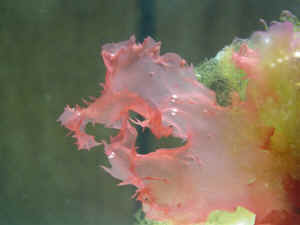
Marine operation/maintenance and red algae I'm a newbie learning the ropes and finding your site was priceless. (maybe you should do MasterCard commercial....) You guys are awesome for all you do! Thank You! Thank You! Thank You! (should I suck up some more?) <Please no more! We all do this because we love the hobby. It is sincerely our pleasure!> We are building a reef. Going very slow! A little over three weeks into it and tank has cycled and Coralline is coming on STRONG! Only thing we've added is 6 Turbo Snails. Refraining from adding creatures is HARD, but know (thanks to you guys!) that patience will insure success. We want to continue research and have a complete livestock list and a clear plan of attack rather than randomly adding things... It is a 55g w/ 88lbs live rock and a 10gal overhead refugium. I'll spare you the rest of the peripherals and get right to my ???'s. <That sounds like a lot of rock! Is there any room left for animals<g>? It sounds like things are coming along nicely, and Kudos for your patience!> In the refugium I have an 8lb live rock which has lots of barnacles. When we first bought the rock it was covered with waving cirri. I have since seen many dead cirri floating around. Inevitably they are dying from a lack of phytoplankton? <Phytoplankton or other suitable food. These animals typically are not long term aquarium survivors.> They are, however, reproducing as we've seen many cyprid larvae running around. "What the hell is your ?" (You asked that at just the right time!) Is it worth trying to feed these and save them or not? I found a post, regarding DT brand liquid phytoplankton, suggesting that this brand had appropriate size particles. I could shut down the 'fuge flow for a short time and feed them, so as not pollute the display. I feel responsible to try and support them since I bought them (in a round about way). <DT's will provide food for many larval organisms, and if you wish to use it you will likely see some benefits. No matter what you do, it is unlikely that you will grow anything but amphipods, copepods and mysids to maturity. Because of long pelagic larval stages, most other critters will be killed or eaten before they can "grow up". DT's will simply make them more nutritious food items for your corals and fish!> Second ?.... I attached a photo of a plant also growing on this rock.... I'm guessing that it is in the Rhodophyta family, but haven't been able to find a photo exactly matching it.... Is this a good plant to leaving growing for nutrient export? Lastly, I would like to add some additional snails to help keep microalgae in check (still researching what we want for macroalgae). Can we add these without quarantine since there's nothing else in the tank? Thanks again! Brad <Your algae is too small to be sure, but it is most likely Gracilaria. It has the advantage of being great food for herbivorous fish, but is relatively slow growing compared to Chaetomorpha or Caulerpa. You can add the snails without quarantine, but if you wish to follow a strict protocol in the future, you must wait several weeks before making any other additions. Best Regards. Adam> Gracilaria in the sump Greetings Gents! << Blundell today. >> I have a miracle mud system that has been running for about 1.5 years. Things are doing well, and the sump is filled with Caulerpa. I am trying to grow SPS and think it is time for a change. I am going to attempt to replace the Caulerpa with Gracilaria, (Tang Heaven) which I purchased a ½ pound from IPSF.com. Do you think this is a wise choice? << Pricey stuff, but good stuff. >> Are there any precautions or procedures that I should take when replacing the Caulerpa? I am thinking that I need to have the Gracilaria grow for a few weeks and slowly remove the Caulerpa in small daily bunches. << Sounds great. Gracilaria is not nearly as easy to grow, so it may be tough getting it established. >> Any advice would be kindly appreciated. << Blundell >> Tap water Rinse for Aiptasia? Another Infestation of Aiptasia after Buying Gracilaria - QT! Dear Crew, <Paul> After receiving in the mail, a half-pound of beautiful Gracilaria parvispora infested with Aiptasia, I am at a loss as to what to do with it. Currently, it is isolated in a bucket of saltwater with lighting and aeration but the vendor does not seem to want it back. Is it possible to completely kill the Aiptasia and its larvae by soaking the Gracilaria for several minutes with chlorinated tap water? <Mmm, no> I don't want to contaminate my aquariums but I hate to simply throw out the Gracilaria. Thanks, Paul <I would go the route of using a purposeful Glass Anemone predator with this red algae, while still keeping it separate from your other systems. These Aiptasia-eaters are listed on WWM. Bob Fenner> Nitrification/Denitrification and Chaetomorpha linum 8/1/05 Thank you so much for such a prompt reply. <<Glad to help>> I have had a really good look around your site, and I'm still struggling to find a few more answers, so I really hope you don't mind me asking just a few more questions. With the cycling process in a aquarium without a wet/dry filter, where does the ammonia and nitrite conversion take place exactly. The reason I ask, is because I have always previously understood, that the bacteria required to perform this conversion only survives in aerobic conditions. With no wet/dry, there are no true areas where oxygen is constantly present, so where does the ammonia/nitrite/nitrate conversion take place. (or have I totally missed something?) I'm "guessing" that it all happens with bacteria present in the live rock/sand, but all I have read about DSB's and live rock is its ability to convert nitrates back to nitrogen because of the "good" bacteria living in the anaerobic conditions. <<Good guess. There are two processes to consider. The nitrification process is an aerobic process where the waste is oxidized. The denitrification process is an anaerobic process where the waste is reduced. The aerobic process occurs on the surface of the rock as well as the sand bed. The anaerobic process occurs deep in the sand bed as well as in deep pores in the rock.>> I'd really appreciate it if you could clarify this for me. <<Hope this clears things up for you.>> (I really do apologize if this question/query has been asked before, but I've had a good look around and still cant find the answer - thank you! :)..) Just going on from the Chaetomorpha question, the main reason I asked if it existed on all coral reefs, is because I was wondering if it could potentially be harvested here off the coast of Australia. There is a store in Western Australia who would be prepared to look for it, IF they knew it existed (as they at the moment they only harvest Caulerpa for refugium applications)<< I found an internet site that indicates that C. linum is found in the Indian Ocean and in particular mentions Australia as part of the distribution. Please see http://ucjeps.berkeley.edu/cgi-bin/getent?2833 >> Thank you once again. Paul << You're welcome. Cheers - Ted >> Thank you once again Ted, that clarifies a lot - and thanks for the link re: Chaetomorpha. <<You're welcome. Glad things are bit clearer.>> I'll try and refrain from anymore questions for the time being - but no doubt once I finally have my tank up and running, I'll have a multitude! Paul <<No worries. Good luck and don't hesitate to ask questions. Cheers - Ted>> Tangs eating Fauchea 8/29/05 Hi, I have been trying to grow Gracilaria with very limited success for our Tangs. They are very picky (spoiled) and only really like the Red Gracilaria or Green/Red pressed seaweed selects. Unless they are hungry, they won't touch Ulva or some of the Gracilaria. I was given a little piece of Fauchea for the sump, and it has grown like mad (or as you say... like a plague). Before I offered it to other reefers, I put a rock of it in the main tank just to see what the Tangs would do. They are going crazy over it (the Yellow has already devoured 1/2 of it). How can I find out the nutritional value - will it give them they vitamins they need and can they eat all they want without harm? Given it's growth history, if it provides for their nutritional needs (other than the meaty foods), it will be wonderful!!! Thanks for your help! Doug <A gorgeous genus of Reds... Does have nutritional value... some references to this on Google Scholar... otherwise it's off to the large college library you go. Bob Fenner> Can I Get Some Ogo To Go? 09/25/05 Hello, I was at this site called Indo-Pacific Sea Farms and was reading about "Tang Heaven Red". They call it a natural red sea weed that our tangs will love. Have you great people at W.W.M. ever heard of this stuff. If you have is it easy to grow in an aquarium like they say it is? <<Some Tangs love Gracilaria parvispora, also known as 'Ogo'. It is possible to grow Ogo though I would not say it is easy. Please see this link http://www.wetwebmedia.com/redalgfaqs.htm). You could also search WWM for "Gracilaria".>> Thanks for taking the time to answer. Jim Jesko <<You're welcome. Cheers - Ted>> Fauchea sp algae Sel., and Garibaldi Info Hi Mr. Fenner, <Howdy> I basically have two questions. The first is do u know of any suppliers who ever have the Fauchea sp red algae? <In stock? No... but with a few key-stroke inquiries of the folks who handle live macro-algae you can find out if any of them carry this genus> I was lucky enough to have this come in on a piece of live rock in a previous tank, it is so kelp-like, it is soft and slimy and flows in the currents, one of a kind, and it grows and grows, had to trim it each week, I never thought I'd fall in love with algae like I did that stuff. I want some more but can't ever find it. LFS usually have green Ulva, Caulerpa and red grape algae, don't see anything else. Also, I have two juvenile garibaldi damsels in there own tank, they sure fetch a hefty price for a damsel, $50 each, do u know why, (if any other reason than the fact they are the protected CA state fish). <This, the costs of collecting them out of the other half of their range (Hypsypops also come out of Baja California, thankfully. The folks there are not as backward as the Alta Cal.)> I want to keep them and let them grow out to their big Oscar like size. Ever heard of spawning Garibaldi's in the aquarium other than in public aquariums? <Mmm, no... and did work up a bibliography on the species years back (have same in print, not computer, if you'd like me to send along a copy). Our site: http://wetwebmedia.com/garibald.htm> (I'm hoping I have a female and male, but I read there is no outward way to tell.) I'm assuming they were caught in a more southern tropical area down the California coast, but I'm keeping their temp at 75F. Anyway, lots of Fauchea reds would make their tank more like a kelp forest. Any recommendations for any other kelp like macro algae? <Most any that will live in the temperature, other conditions you're making will do> How about a piece of the real giant kelp off of CA? :) (I'm assuming it wouldn't do well in the aquarium, hehe) <Very hard to grow in aquariums... need colder water, nutrients...> but, two feet of growth a day sounds like a really efficient protein skimmer to me! hee hee. I have a feeling I'm gonna have to get fake kelp :(. Okay, I'm done, thanks for any info, Dennis <Ah> PS personal question, what is the highest number of aquariums you have ever had in your home at any one time? :) <As a mere youth, a couple of dozen (in the sixties), but nothing real big... like an eighty gallon marine. But our old businesses had several hundred in one building for holding, breeding, shipping... and we did fabricate, install marine systems of thousands of gallons, and have worked on ones of hundreds of thousands, consulted, installed mechanicals and controllers on ones of millions of gallons...> I have 3, one with big marine fish/live rock, I love my Miniatus grouper, he's so beautiful, and is growing so fast. <A gorgeous species> The other with smaller saltwater, royal Gramma, jewel damsel, tomato clown, etc/live rock and of course my new garibaldi tank. <A worthy project. Have combed their nests, raised the young, had some trials with their nematode parasite fauna off of San Diego... Be chatting, Bob Fenner> Red algae... Did I write this? Heeeeeeeee! Hi, I noticed that the coral reef of the red sea has red algae everywhere. Is it possible to attain this type of algae in an aquarium? If so, then how? And is it a good source of food for my hepatus tang? <Please read through our principal site: www.WetWebMedia.com Bob Fenner><<Can, is posted on WWM and yes. RMF>> Re: High ammonia levels. Dear Bob, Was talking to my stockist about using "Nori", and they asked me if I was sure that it didn't contain oil. Bought it from a super-market in a sealed pack, made by a company called Sanchi, and it simply reads: ingredients: Nori (Porphyra tenera). Green light? <Yes... nothing else added here> You suggested I used this stuff whilst I was waiting for my ammonia level to go down, now at about 0.6 (much better!). And is this the same type of low pollutant stuff as purple seaweed (Porphyra umbilicalis), which I was already using? <Bingo> Also, the patches of brown/red algae have really started coming up on pretty much everything, which the blenny loves (bicolor, & my other fish is a little lipstick tang), and while I recognize this as a sign of "life establishment", <Yes, well put> & bearing in mind that you advised me not to clean anything till the ammonia was 0, can you give me any tips about controlling it?<Yes sir. Please read here: http://www.wetwebmedia.com/algaeasfriend.htm> Should it turn green? My system is now nearly 11 wks old. Your advice as always will be much appreciated. Hamish, UK. <You're on a/the right track. Bob Fenner> Hawaiian Ogo... Lolo for Ogo! Aloha WWM Crew, <Eh Howzit Jeff, Scott F. with you (one haole with one Big Island girl)> Your web site is DA KINE (the best). I can't thank you guys enough for the great service you provide. I live on the island of Oahu and have a 55 FO tank. I have a question about Hawaiian Ogo (seaweed). I noticed that the local markets have fresh Ogo bagged for consumption. I was wondering if you could place that Ogo in your sump or main display. <If you got the Ogo already refrigerated, chances are it will not grow in your sump or aquarium. If it's fresh, meaning you "jus' wen pick em from da ocean water," then, the Ogo will probably survive and grow. I have had success growing fresh Ogo in a 10 gallon aquarium with an airstone. Please note that Ogo (Gracilaria parvispora) needs a lot of light and should be kept in suspension in order to grow at its best> Moreover, would it be okay to place shoreline rocks from the North Shore into my tank without worrying about pollution and other negative consequences. Thanks for all your help. <Jeff, are you referring to coral rubble or lava rock? If it's coral rubble, it may be okay after curing. If it's lava rock, it may not work in a closed system, because of the possibility that it could release lots of compounds that will induce microalgae growth. Also, you might want to check with local authorities to see if it's legal to collect rock.> Jeff <Malama Pono and A hui hou! Scott F.> Re: red algae Dear Mr. Fenner, Thank you for responding to my question about red algae. I will give your suggestion a try. It never even dawned on me to try something like some floating plants to cut down on food and light source. <Yes... often there is a form of chemical competition as well (allelopathy)> I will let you know how it goes. <Please do> I guess sometimes you just need someone to look at the problem and help with a solution. As far as my aquatic background, well life just wouldn't be complete if I didn't have at least a half dozen tanks going at once. I have about 20-25 more tanks that I will be setting up here in the near future, so I can get my hatchery going again. I am going to start with angels again and try to work on the color strains I was working on before. And I'm raising up some clown loaches to give them a shot also...any input there would be greatly appreciated. <Most are still wild-collected in Indonesia, but have been spawned... with and w/o hormonal manipulation... by trying "environmental cues" (i.e. lowering water level, temperature), mimicking conditions in the wild> I will also be setting up at least one saltwater tank when I get my customers tank back together. I will also start collecting lots of hard to find and keep species, which I did before. I like a challenge when it comes to my finny friends. I'm hoping that this will turn into a retail shop and consulting and maint. business in the future. Again thanks for your help, I'll let you know how it goes. Patty Ashley <A lifetime of adventure unfolds. Bob Fenner> "Ogo-Mania!" Hello. I have a 4" yellow tang (Tango) and would like to start feeding it some fresh macro algae like you suggest. Any idea where I can buy Gracilaria (on the internet) so I can start propagating it at home? All of the LFS's in my area only seem to carry grape Caulerpa, and even that is only on a limited basis. Thanks! Sherri Wilson, Buffalo, New York. <Ahh- you can get my favorite stuff (Gracilaria parvispora aka "Ogo") from my favorite e-tailer, Indo Pacific Sea Farms in Kailua-Kona (www.ipsf.com)! They call it "Tang Heaven", but whatever you call it- your tang will call it "delicious!" This stuff rocks! Enjoy! Regards, Scott F.> Fauchea Red Algae 11/3/03 Sorry, I do have one other question. Have you heard of and know anything about Fauchea Red Algae? Thanks, Paul <it is an interesting algae that can be a plague in tanks without proper nutrient control. Have you referenced this species on the website I sent you in the last e-mail? www.algaebase.org see their links for this genus here - http://www.algaebase.org/action.lasso Anthony> Macroalgae II 11/3/03 Thanks for the info. I will research algae on your web site better. I just have one more question about it. From what you said below, I take it that I should pick one type of algae that I want to use, and use only that one, correct? <correct> For example, if I think Chaetomorpha is the one to go with, buy and use nothing but it. <exactly... else one species will dominate the others and worsen water quality in the process (during the fight). Anthony> |
|

|
Features: |
|
| Featured Sponsors: |