|
|
| Home | Marine Aquariums |
Freshwater Aquariums |
Planted Aquariums |
Brackish Systems |
Ponds,
lakes & fountains |
Turtles & Amphibians |
Aquatic Business |
Aquatic Science |
Ask the WWM Crew a Question |
| Please visit our Sponsors | ||||
|
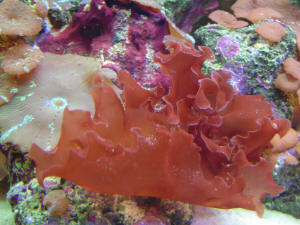
Information concerning red algae pigment... 10/9/08 Hi there WWM crew! First of all, I'd like to say that your site is great! The information you give are really detailed, and they helped me a great deal with a project I am doing. Now about my question. I need to know which specie of red or brown algae (I am particularly interested in red) contains the biggest amount of phycoerythrin pigment? <Mmm, some of the Reds... read here: http://www.patentstorm.us/patents/5643585/description.html> Also some extra information about the pigment will be welcomed. <And the words you will find in the citation above re> I would also like to ask you to send me your response as soon as possible because variety of things depend on your answer. Thank you a lot. I am very grateful for your answer. Yours sincerely, Anastasija Siljanoska from Macedonia <Bob Fenner> Request for images of encrusting Rhodophytes 2/12/07 Dear Mr. Fenner, While searching the web I came across your page http://www.wetwebmedia.com/redalgae.htm. I am presenting a talk at the AAAS meeting in San Francisco this Friday -- title: The Future of Coral Reefs and Tropical Coasts, as part of a session on the effects of ocean acidification. I plan on stressing the importance of encrusting calcareous algae as sediment stabilizers, and point out some of the issues relating to their apparent high sensitivity to decreasing carbonate saturation states. <Ah, yes> Although I have plenty of coral images, I lack good illustrations of encrusting algae. I wonder if I might have permission to use 4 or 5 of the images on your page in my PowerPoint presentation. I will be most happy to credit you or the website in whatever form you would like, and there would be no hard copy publication resulting from the talk. <You certainly are welcome to the free use of my content, including image work for non-commercial purposes> I'll be grateful to hear your response on this. Thank you Bob Buddemeier <Am responding on Hotmail as it is easier to send you some thumbnails... Please ID which of these or other taxa you're looking for. Cheers, Bob Fenner> Growing Red Macro Algae 2/7/07 Dear Bob and Crew, <Good afternoon Lisa> We're at a loss. We purchased a beautiful rock with an anemone (who promptly left the rock and abandoned his clown) and a heavy, lush cover of deep red macro algae. By the second day, the algae was starting to change it's color from deep red to a lighter red, then over the next couple of days it turned greenish yellow. We were told that our lighting was insufficient for macro algae, we needed at least 5 watts per gallon and our current system only provided about 2.3 watts. We purchased a new light which took another 6 days. The new light provides 5.7 watts per gallon both fluorescent and actinic. The temperature is a constant 78, Ph is 8.5, SG 1.024, Calcium is 440 and we turned off the phosphate reactor two days after we brought the algae home so I assume the pH is up again. <Assume? No pH test kit?> The macro-algae is now white with pink tips and it's disintegrating :( We'd like to get more and try to cultivate it, but we need to know where we went wrong. Is it possible it was already stressed by being taken from it's tank to the LFS and then resold? The lighting in the LFS was pretty low. Was it our delay in upgrading our lighting? Was it the hermit crabs munching on it? <I'm thinking it is in the shipping/holding process, but, even under ideal conditions, the red macros can and mysteriously do what you are describing. In my opinion, can be one of the more difficult to culture. Here are two links, do read the linked files above also. http://www.reefkeeping.com/issues/2007-01/sl/index.php http://www.wetwebmedia.com/maralgae.htm Any help you can provide is much appreciated. Thank you, <You're welcome. James (Salty Dog)> Lisa Hupman
|
|

|
Features: |
|
| Featured Sponsors: |