|
|
| Home | Marine Aquariums |
Freshwater Aquariums |
Planted Aquariums |
Brackish Systems |
Ponds,
lakes & fountains |
Turtles & Amphibians |
Aquatic Business |
Aquatic Science |
Ask the WWM Crew a Question |
| Please visit our Sponsors | ||||
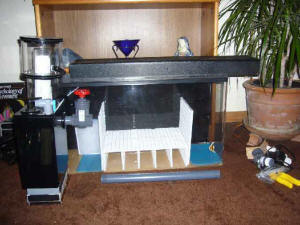
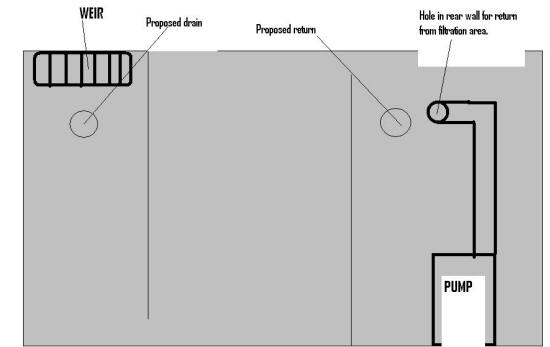
Re: Sump design question 12/07/2007 Hi Bob and thanks so much for your response. <Welcome> It's an honour to get advice from such an eminent expert. <Hah! Expert... Previously married and flow under pressure?> A quick update to a couple of the points raised in my first mail. I found the Tank for £1000 from a UK supplier "Shirley Aquatics" not sure if I can give the name out? <Oh yes... a venerable institution in my estimation. Do you have a copy of Colin D. Roe's work from there? Excellent> The side filters were removed (simple in tank affairs) also all the other (little) extras were not included. <The "towers" can be re-made, fitted, installed... other walls/overflow weirs made, put in> I took delivery today and it looks spectacular (though I feel it will still be some weeks before my existing stock can move home). I have followed your advice and yet again gone back and read and read some more, I also purchased your book "The consentience Marine Aquarist" in order to recap on setup techniques. <A handy guide> Lastly I have read much more about the Copperband and will not be purchasing one of these. I have no interest or intent in keeping animals that do not have a very high chance of survival. Finally to my questions (I promise much shorter intro's next time :) ) As previously stated space under the tank is at a premium with a max head height of 50cm. Although I am not completely settled on the sump design (I will start with an empty sump and check the transit volume requirements before adding any baffles) my biggest issue is the choice of protein skimmer. I have read about many advised makes and models but fundamentally come back to height issue every time. <Yes... important... you might well want to incorporate some loops of flexible... even valves and disconnects... to enable/allow you to pull this tool out at times> My feeling is that I will need to run two smaller skimmers as a single unit for around 200 UK gal (inc sump volume) just isn't possible. <Mmm, actually... there are some units that should fit here... Do see EuroReef's site...> Also the outlet from the main tank runs at 1.5? dia. What size return pump would you advise? <The diameter of the discharge on your pump/s volute/s... Just match this> Thanks again for your assistance. Regards Steve <Certainly welcome. Bob Fenner> Re: Sump design question, skimmers in the UK 12/07/2007 Bob, Thanks for your swift response. I have searched the EuroReef's site but am unable to identify any under 50cm. I further got in touch with them who again responded very quickly only to inform me that they do not ship abroad and have no pumps that run on UK voltage 240V. I would welcome any advice on a quality skimmer meeting height restrictions of 50cm and tank volume of 200 UK gal either from yourself or any readers who have experience. Thanks again and regards Steve <Mmm, the V2 line through TMC? http://www.tmc-ltd.co.uk/aquarium/v2skim-skimmers.asp BobF> Flow through sump, des. -- 10/28/07 Crew, Thank you in advance. <Scott V, glad to be here with you.> I came across something that I had not considered before today and want to run it by you. I'm setting up my 240g with 100g sump. I've done some testing with my return pump and it's giving me about 2400 gph with my current manifold configuration. I have four 1.5" drains along the back wall. <Nice big tank with big sump. Good safety margin on overflow size vs. flow.> Seeing how I do not want powerheads or a CL, this 10X turnover is about right for my planned inhabitants. My only concern is that 100% of this will be through my sump. I am not concerned with the noise aspect of this set up as everything, sans display, will be a through wall set up in the garage. Today I read something about in sump skimmer inefficiency with too much flow through the sump. (I have Euro-Reef RS250) Have you heard of this? Should I be concerned? What exactly are they talking about? Have I overlooked any other drawbacks to this volume through the sump? Any advice is appreciated! Thanks, Ben <The ideal setup would have just enough water coming through the overflow as the skimmer can process, the overflow would skim a thin layer of surface water and it would flow directly into the skimmer. This will give you the highest concentration of the organics you want your skimmer to remove and theoretically give you the highest efficiency per pass (these same compounds your skimmer removes are the most concentrated on surface). The issue you are reading about is the fact that too much flow will dilute that surface water, thus your skimmer sees less of these organics per gallon, technically being less efficient per pass. The flow through the sump and its effect on the skimmer performance is a matter of optimizing, not necessity. Fact of the matter is you have a lot of carrying capacity with your tank, you add to that a large sump and you picked out a awesome skimmer that will still perform great. Have fun, sounds like a nice setup, Scott V.> System upgrade, Connecting SW Systems -- 09/08/07 To the WWM Crew: <Flávio> I have a 125 G. marine and a 125 fresh. The distance between the tanks is about 50 cm. The marine system is a established one ( 6 years ) and is a growing soft corals, porous rock, and fish good mix. I intend to connect the two tanks, in order to double the water volume and to have the possibility to add more fish and propagate/divide some more grown corals, using the future new salt space. I think I have two options: Option 1: to connect the tanks using a water line between the bottom of the corner division (overflow) of the tank 1 and the bottom of the tank 2 ( the two tanks have 3 holes (with ball valves) in the bottom glasses); and also to establish a water line between the overflow of the tank 2 and the sump. The pump is the sump and feeds tank 1. Option 2 : just to add another pump in a bigger sump ( 60 G.) that feeds tank 2 and connect this one to a shared sump. <Mmm, I would go with Option 2. Gives you more flexibility... and less potential for disaster> Another issue is the new 125 G. of new salt water to fill the added tank. I use natural salt water. Do you think it is better to gradually mix the new with the "old", connecting the two tanks during, let me say, 10 minutes each day, or just connect totally since the beginning ? <I would do the latter... if the waters are about the same temperature... All should be fine> The added tank will have new water, new sand, new rocks. I am thinking to mix some tank 1 sand and rocks to the news in the tank 2. <I agree with you here> Please use this email to contact me: <Done> Thanks for your advice and for your so helpful site. Flávio <A pleasure to share with you. Bob Fenner>
Sump Flooding 8/14/07 Hello, and thank you so much in advance. <You're welcome.> I have everyone's fear happening to me at the moment. My tank, a 90 gal reef, has been running for 18 months without incident. My sump is an AllGlass Megaflow model and my tank is pre-drilled. I run a Sedra 900 pump for my returns. Today in my usual manner I turned off all power to begin my weekly tank cleaning. I usually let my lights cool (I have to remove the canopy to get in tank) for 10 minutes or so. When I came back, luckily after only a few moments, my sump was overflowing. I have traced the problem to the Sedra siphoning the water back from both return pipes in tank. Last week I did tighten the connectors on the return pipe to try to get rid of some bubbles, this is the problem I'm guessing but I don't know why or how to fix. Please give any advice you've got I've been living by it for 18 months already. <Jill, there are two ways to handle this problem, one is relatively cheap. What I do is drill a hole the same diameter as rigid air line tube, then trim a piece of the air line tube and stick it in the hole so that there is only about 1/4" between the top of the tube and the water surface. When you shut your pump off, water will siphon to that point, then air will enter the return line breaking the siphon. You will need to do this on all returns. The other method is to by an in-line check valve and plumb it into the pump outlet. I use both devices, not relying on the check valve itself, although it hasn't leaked back yet. It you decide on a check valve, it is a good idea to put a shut off above it. This will allow you to unscrew the cap and clean the valve of debris.> Thanks, <You're welcome. James (Salty Dog)> Jill Re: Sump Flooding 8/15/07 Thank you so much for your quick response, I did the quick fix for now and will go forward with the check valve. You're a lifesaver (and floor saver), thanks again. <You're welcome, Jill. Do make sure what you have done works properly. James (Salty Dog)> Jill Sump Baffle Height...Is 'All The Same' Okay? -- 08/09/07 Hi team, <<Hello Dave>> I'm just about to commission a purpose built sump/refugium but have a question on the height of the baffles. <<Okay>> The design has 1 set of 3 baffles allowing the water to pass over the first, then under the second and then over the third out from the overflow chamber into the refugium; and then another set performing the same flow out of the refugium into the sump before being returned to the display tank. In my design the height of both sets of baffles are identical, but I've seen other designs where the 2nd set is lower than the first. Q1. Is my design OK? Q2. Is there any benefit to having a lower 2nd set? <<Having the baffle-sets made at differing heights is only necessary if the height set for the overflow chamber (this is usually governed by the requirements of the skimmer or other ancillary equipment, if placed here) is such that the resulting water volume in the sump overall will not allow all the transient water to collect without overflowing the vessel when the return pump is off. If there is enough 'empty' volume left in your sump when the system is running, having your baffles all at the same height will not be a problem>> Cheers, Dave <<Regards, EricR>> Refugium Issues... gen. des., maint. f's 7/12/07 Crew, <Scott F. With you today!> I'm almost done asking you all the questions I have about marine aquariums (yeah right!). I finally got my refugium up and running and am very excited (which does not accurately describe my wife's feeling). <Hey, what's a little more smelly, water in the house, right?> It's a DIY model--30 gallon covered clear thick plastic tub with a 1/2" bulkhead for inflow and a 1" bulkhead for outflow. Substrate is 40lbs of 1mm aragonite, along with 3+ lbs (5 or so pieces) of Fiji live rock and a nice big ball of Chaetomorpha. Lighting is by two $9.99 17W NO fluorescent "Grow Lamps" made by Lights of America that claim to put out 75W worth of incandescent light--lighting is on a reverse cycle with my display. I have e-mailed the manufacturer because I'm curious about the temperature of these bulbs. My LFS uses these lights all the time for refugiums and swears by them . . . we'll see. <I've used 'em before...they work fine for growing macroalgae, in my experience> Water is moved at a relatively low rate by a MaxiJet 1200 (295gph) that sits in my sump. Because of the head (about 2.5ft) , I'd be surprised if I am getting 100 gph. It certainly isn't enough to toss the Chaetomorpha about, but it is a steady flow. <That's fine, in my opinion. You don't want too much flow in there. Since one of the refugium's important jobs is to foster nutrient export via growth of macroalgae and purposeful fauna, you don't need the water flowing through there at a blistering pace.> I'm not really sure what, exactly, I hope the fuge to accomplish. Certainly nutrient export via the Chaetomorpha is one goal. I assume that I will also get some denitrification from the sand bed, which has a really interesting contour because I ran a power head in the vessel for a few days to circulate the water before I hooked it up to my display, but depth ranges from a small section of 0" (at which I placed my live rock) to 3-5+" throughout. <You'll also benefit from the production of natural plankton and other food sources, which can flourish in the protected environment that a refugium provides.> Before jumping into this, I read (about 5 times) the chapters of Reef Invertebrates regarding refugiums and live sand/DSBs. <Some of the best material ever written on the topic, IMO!> I also did a lot of reading on WWM (I also spent a lot of money). From this, I have gathered a few things that I hope you can confirm/deny/guide me: 1. Don't mix macroalgae types. True? If so, does this rule apply only to macroalgae, or all vegetation? In other words, should Chaetomorpha be my only vegetation? If not, do you have any suggestions for others? <I wouldn't, for the simple fact that you're creating competition in an area designated for unimpeded growth.> 2. Don't suffocate the sand by placing a bunch of live rock on top of it. True? Right now, I have 5 relatively small pieces of rock that I added to (hopefully) speed up pod/creature intro into the refugium and to give these "creatures" some hiding/breeding spots, etc. I placed a few pieces where there is no (or very little) sand depth and then loosely stacked the other pieces on or around that base. Should I add more live rock scattered around the fuge, or leave as is? <I wouldn't worry about the rock causing problems. I can see myself getting on to the soap box and preaching about the unwarranted fear of "detritus" that we have, and why some folks fear putting rock on top of sand...nah- not gonna start!> 3. Don't go out of your way to add sand sifters, especially hermits and others that will eat pods. True? <I doubt that they'll eat copepods to any extent, but they may definitely decimate populations of other beneficial infauna and possibly disturb some processes going on in the sand bed.> I did throw in 2 Nassarius Snails. I also noticed that there are some tiny brittle stars. <No problem, IMO.> 4. Is my flow enough? Should I add a small power head to the fuge to circulate more water internally? <Again, you don't want to over do it...Sure, you could try another powerhead, but see how it goes.> 5. Speaking of pod culture, and this may tie into the above answers. Obviously at this point my fuge is mostly water and sand. As time goes, hopefully my Chaetomorpha will take up more room and I'll have to start pruning it. In the mean time, should I add anything like pieces of filter pad, prefilter sponge pieces or egg crate to give the pods/mysids more areas to hide/grow? <I'd just let them multiply in the natural materials that you've provided them...> Thanks for all of your help. This is really fun. Andy <And that's what it's all about! Keep having fun! Regards, Scott F.> I had inquired about setting up a sump/refugium in a basement directly below a main tank on the main floor of my house. 7/2/07 My question relates to a response from one of your crew members to an email that I had sent previously. I was hoping to get another's opinion. <Please let me try to clarify my previous response. If that doesn't help, I'm sure someone else here would be happy to give you another perspective.> I had inquired about setting up a sump/refugium in a basement directly below a main tank on the main floor of my house. Since I am in the research stage, and do not have any experience with a sump, I am unsure of how a water change regimen would work with this setup. <There's really no one way to do it. In my last response, I explained why many people with sumps prefer to do water changes from the sump. As for the size and frequency of the water changes, that's going to depend on your tank's needs (depending on bioload, filtration methods used, etc.). However, most would recommend something like at least 30% water changes once a month (or better yet, at least 15% twice a month). To a point, more is usually better.> I don't know if it is performed from the sump, or the main, or both. <Like I tried to explain in my last email, there are pros and cons to doing the change from the sump or the display. Doing the water change from the sump is less likely to cause an inadvertent overflow or dry-out (please see my previous response for an explanation of why this is). Doing water changes from the display has the advantage of being able to "vacuum" the tank as you change the water. So it really just depends on what you personally prefer to do.> Ideally I would like to make all the water and keep all the "stuff" in the basement (ie - out of sight). The response from one of your crew members seemed to say that when performing water changes I would be running up and down the stairs to avoid either an overflow, or pumping the sump dry. <Ok, I apologize for not being more clear. When I was talking about running up and down stairs to avoid overflow/dry-out problems, I was trying to explain why people do water changes from the sump. I didn't necessarily intend this as a reason why you shouldn't put your sump in the basement.> The overall impression from the response was to avoid the basement setup and go with a sump in the stand. Do you agree with that? <I'm sorry, I didn't mean this at all. There are pros and cons of both set-ups. As I mentioned, many people very much enjoy having their sumps in their basements. Theoretically, you should be able to do all the same work with a sump in the basement as with a sump under the tank.> Would I be doing as much work on the main as I would in the sump? I am fortunate to have a house with a basement, a spouse who loves the end results of this hobby and who is willing to let me use whatever space I need in the basement. It seems to me that many of the people posting on WWM would be jealous of this situation! <If you want to put your sump in your basement, then that's what you should do.> Would you please provide your thoughts on basement sumps? Pros/cons in your opinion? <In terms of being able to care for your tank, it really doesn't make much a difference. The pro of having the sump upstairs is the convenience of having everything in one spot. Also, if your "sump" is going to be more like a refugium, sometimes people become quite proud of their refugiums and actually prefer to have them upstairs (almost as an additional display). The pro of having the sump in the basement is, as you've pointed out, having it out of sight and with more room. You also have less noise upstairs if most your equipment is in the basement. Another thing to consider is the temperature of your basement. Most people have basements much colder than the rest of the house. If you tend to have problems keeping your tank cool, this might be another pro for having the sump in the basement. However, if you have trouble keeping your tank warm, then it would be a con for having the sump in the basement. As you're going to find with many things in reef keeping, no one can honestly tell you with certainty which way is always better. The hobby is filled with choices that have equally weighted pros and cons and depend a lot on personal preferences. The choice of putting the sump upstairs or downstairs is one of these choices.> Does Anthony Calfo's Book of Coral Propagation get into setup/plumbing such as this? <I don't know if it specifically talks about the pros/cons of sumps under the tank or in the basement, but it's probably a good book to have anyway. :-) > Thank you for thoughts. For some perspective, I will be upgrading my main tank from a 55 gallon to a 75 gallon, and using the 55 gallon to create the sump/refugium. <Congrats. :-)> Kind regards, Kim <Best, Sara M.> Sump issues closed loop... Transit volume/gear issues 7/2/07Hello! <Hi there> I have a rio 2100 that was in my miracle wet dry <Proper nouns are capitalized> that I replaced with a mag 7. I went to put the rio back in the wet dry/sump, (no bio balls) and the water overflowed in my tank. Ok I shut it off went out bought an intake hose and box cause it I figured there wasn't enough water to the sump. <Something like this> So I set up the extra intake for the sump and now the sump over flows. <Yes... too much transit volume for the size/space in this sump and tank...> All I want is to get rid of the dumb power head in the tank and use my rio 2100 to pump from a closed loop to circulate. Please help. It's a 54 corner so I have limited room underneath but I even tried to use a bucket for the loop with pump to no avail. Thanks <Mmmm, let's see... how to explain (again) here... there is too much water "in play" for the pump and drainage you have... you can throttle the pump back, and/or decrease the volume overall... Fill the main tank up with the sump/pump turned off... fill the sump to within a few inches of the top... Turn the sump pump on... see how low the water level becomes in the sump? Mark this with a permanent marker, piece of tape... for your system, the current gear... this is how "high" the water level can be. Bob Fenner> |
|

|
Features: |
|
| Featured Sponsors: |