|
|
| Home | Marine Aquariums |
Freshwater Aquariums |
Planted Aquariums |
Brackish Systems |
Ponds,
lakes & fountains |
Turtles & Amphibians |
Aquatic Business |
Aquatic Science |
Ask the WWM Crew a Question |
| Please visit our Sponsors | ||||
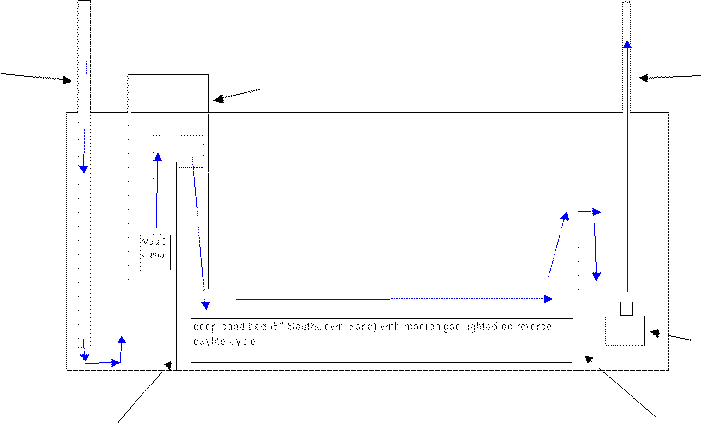
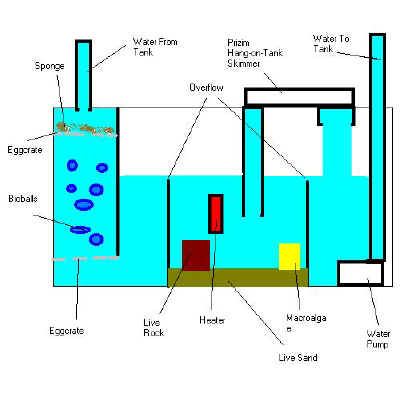
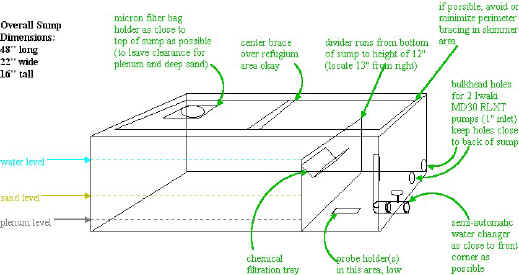
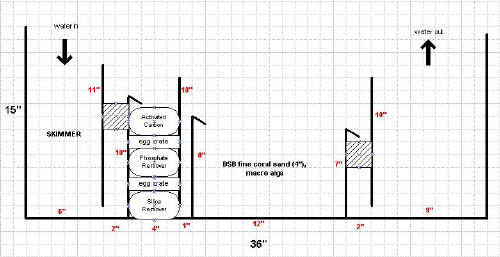
-Going up a few gallons!- Top-o-the morning to ya, <And to you too laddy> I have had a 55 gallon FOWLR for about 8 years now and I feel I have gained enough experience (through some unfortunate mistakes and knowledgeable books and literature) to expand my hobby (or obsession if you will). The main reason is that my tank is getting old and the caulk is starting to break away from the corners. <Ooo, not so fun> I know I could drain and recaulk but its the perfect time to try something new. <You got that right!> Here is what I am thinking. I don't want to get rid of my 55 gallon tank. I think I can make a lot of use for it. I was thinking about getting a 100gal(60 inches long) so I could fit the 55 under the stand and use it as a sump. At 1st I wanted to just try my luck at a 75 but Its the same size length as a 55. What do you think about this idea? <Wouldn't you want to go more than 20g larger?> Is a 55gal overkill for a 100 gal tank? <No such thing as overkill; shame on you> I've went through your Faq's about DIY's but couldn't find anything about a 55 gal sump. Also, I hear a lot about refugium(s?). I have never ventured into this dark realm of fish keeping. Could I partition off some of the 55 to use solely as ref? <Absolutely> Would I need to? <No, but you'd probably want to> How should I divide the tank? <I'd use a pair of 10" baffles to section the largest possible space off that does not crowd or interfere with the other stuff you'll have in your sump> I know for the sump part of it, I would separate into 2 or 3 chambers. Unsure if I need sand in it though. <Would be a great place for a deep live sand bed!> Thanks for any light you can shed on my situation. <Uh oh, here comes another shameless plug for Bob and Anthony's Reef Invertebrates book. It has an incredible chapter on refugiums, and would serve you well. Good luck! -Kevin> Jason -55g sump setup- thanks for the reply. I have created 2 ideas I have in paint. Which one would be better? <I like the one with the whale, the boat, and the beautiful sun!> or am I totally off on what I need. Keep in mind this is a 55 gallon standard. 48 long. Am I missing something? or do I need to go back to the drawing board? <I'd suggest going with the "classic" sump style. Have the incoming water enter the left side of the sump. Affix a baffle 6 or so inches away from that end, starting the 'fuge. This first baffle will serve to section off the 'fuge and reduce bubbles from the drain. Affix the other baffle where you would like the 'fuge to end, then after that baffle drop in your skimmer, heaters, and return pump on the far right side. Easy? If you want I can draw you a fabulous picture in paint :) -Kevin> Thanks, Jason Adding a sump Hello, Currently have a 5` x 2` x 2` reef setup, 80" soft corals, 20" hard, 60kg live rock, DSB and Turboflotor skimmer (hanging) With an Eheim external filter filled with only floss polishing the water and a UV. The system as you will see has no sump connected due to the person I bought it off having back problems. My question is the sump is there to connect the pipes are in but it is waste pipe he used and a waste pipe connector, < this part is very confusing to me I'm not sure what you are asking> I've had different ideas told to me about this, one guy said it would be ok just replace the pipe every 12-18 months, The other said put a new connector on using PVC but how can I do this when my tank is full and about an inch off the back wall. Even if I don't have to move it could I still silicone it? The reason I would like the sump connected is to add a calcium reactor and use it as a refugium.< without better explanation, the best thing I could suggest is Hook the sump up using new schedule 40 pvc. Sorry for the lack of direct answer but I'm just not clear. Eric> Thanks in advance! Carl Sump design spec.s, heater, sand Hi, Am building a 125 gal. reef with 55 gal sump below, will divide sump into 3 chambers, first area for water to drain into and skim, 2nd area for my live sand bed, 3rd for return pump and heater. What height should my baffles be, 1/2 of tank height ?<As tall as you can make them, and still leaving enough room in the sump to hold all of the H2O if the power fails, Should they be different heights? Remember some skimmers (Euro Reefs) require a certain set height on the baffle to maintain a perfect running height in the skimmer> I'm assuming the distance apart should be #1- wide enough to accommodate skimmer and pipe coming in, #2 As wide as possible for sand area, # 3 wide enough for the heater and the return pump.<Correct> What wattage heater can you recommend?<depends on how cold your ambient winter temp will be in the house and how fast your water is moving, 200 watt should be more than enough> Should my thermometer be in heater <Separate is better> (#3) chamber<In the last chamber> or in display tank?<no> The main tank will have a 1/2 live/1/2 regular sand bed with live rock, can I do the 1/2 and 1/2 sand for sump or does it need to be all live sand?<1/2 & 1/2 will be fine for both. Eric> Thanks, Louie -Converting Wet/dry to sump- I have a 55 gallon tank running with 45 lbs of Foster and Smith Fiji live rock (been running two months). Currently the system has a small (Amiracle SL-50) wet/dry running. Over the weekend I spent hours finding a way to cram my remora pro skimmer under the stand hanging on the sump side of the wet/dry, it fit by a hair! Your site, and a local pet store recommended slowly removing the bio-balls from the filter. <Forget slowly, yank it all at once.> I am wary about this, since most of the people in your FAQs on converting wet/dries seem to have a ton of live rock per gallon. Is 45 pounds enough? <That it is. It's been known for quite some time that you can ditch the entire bio-chamber in one shot if you have a reasonable amount of live rock and/or live sand in the tank (Sprung and Delbeek proposed this in The Reef Aquarium which came out in '94).> I also have about 15 pounds of lace rock in there left over from my cichlid tank. The substrate is 60 pounds of Carib-Sea aragonite (I now realize that more than 1 inch less than 4 is bad, but I bought it before I knew that). I don't plan to have a heavy bio-load in there. I want to do mostly fish and inverts with some easy corals. I would prefer to take the media out of the wet/dry, but I want to be sure I have enough bio filtration, and I don't have the money for more live rock right now. <You're all set, ditch away! You shouldn't notice any ill effects, but you should always plan for the worst and test your water frequently for ammonia and nitrite. Good luck! -Kevin> Thanks for the great advice! -Ken Sump setup for Eclipse System 3 Hey Guys, <Hey! Ryan with you today> I have a Eclipse system 3 hood (29g. tank) that has been retrofitted with pc lighting, and while I sort of wish I'd taken a different approach to setting up my reef tank (i.e. not eclipse and larger) the money has been spent and I can't financially justify a complete revamp at this point. <Well, then we have a lot in common. I too have this setup, and it was my only for a long time.> That being said, everything seems happy and healthy. Regardless, I feel like I'm flirting with disaster by not having a protein skimmer. <Yes, certainly helps> I know there are mod.s to add one without sacrificing the current filtration, but when I start cutting things, I'm more apt to destroy than improve. <Actually, it's not that difficult. I asked a few questions on Reefcentral, got out the Dremel and started cutting. I use a CPR Bak Pak on that tank, and there is adequate room.> Knowing that, I decided that skimming in a sump was worth exploring. <An overflow will be much harder to get in that hood> Now, I can't seem to find a small enough overflow box to mount in the eclipse, <thought so> and it's a little late in the game to start drilling (besides, if I can't cut plastic, I certainly can't handle glass). So...here's what I'm thinking. I take a power head and mount it to draw water from about 1-2" below the water surface of my tank and use it to pump water through tubing to the sump. <hmm....> In the sump I mount another powerhead at a level that would preclude it from flooding the tank should the other powerhead fail. Obviously, it would be a practical impossibility to match water flow in and out of the tank, so the relative water volumes would be in flux, but beyond that is there any reason why this wouldn't work? <Bad ideas.... A powerhead's flow is not adjustable. Asking for problems> If I have a more powerful unit up top, then it would only be active when the sump powerhead supplied enough water. Water would drop in the main tank, the sump unit would replenish it, the water would then drop below the tank powerhead as it would remove water more quickly than it was supplied, and so on... <Powerheads are designed to work constantly...this is why many fail so quickly with "wavemakers." I would just use a hang-on skimmer, like a remora or CPR. Both great choices, minimal cutting. I see many headaches in your future with the powerhead scheme.> I could even put the pumps on a timed switch once I had a good notion of the cycles. Does this make sense, or am I missing something vital? Also, any other suggestions on ways to add a sump to an eclipse would be welcomed ( like where can I find the world's narrowest overflow box). <Drilling is the only way> If this is a viable solution in you're estimation, product recommendations and relative gph specs for the two powerheads would be appreciated. <If it's helpful, I will post a pic of my Eclipse with CPR installed. Easy cuts, the skimmer goes on the back-right corner. The output for the skimmer occupies the area previously for cords, and the intake requires a 1/2 inch cut. Good luck, Ryan> Thank You, G. Andrew Stricklin Filtration Options For A Predator Tank Hi Scott, one thing I don't understand, the primary "filtration" has to take place in the sump, you say. <Not really. Perhaps a confusing choice of words on my part. The "filtration" occurs throughout the system, wherever rock and substrate are available for bacteria to attach. The "primary filtration" that I am referring to is the live rock or sand. The sump is mainly a vehicle for processing water from the display tank. However, the protein skimmer (and I hope that you get an efficient one) should be located in or near the sump.> Ok but how, which supports nitrifying bacteria? I have to fill the sump with live rocks? <You certainly can fill the sump with live rock "rubble", as previously mentioned.> Or what else? The refugium with DSB and macros work for Phosphates/Nitrate reduction but which element perform nitrifying action? <Well, your deep sand bed and live rock, wherever they are located in the system, can perform this function. I like the remote DSB that you are thinking of. It can remain undisturbed and do a great job processing nitrate if properly composed> I've forgotten to say I've just got a great skimmer fortunately (Aquamedic 5000 twin the greatest AquaMedic skimmer for 1320 gallons tank). <Excellent!> Thanks for your quick reply! Lorenzo <My pleasure, Lorenzo. Sorry for the confusion. Basically, if you look at a sump as your "water processing center", it will make it easier to visualize what functions it performs. Sumps provide a tremendous amount of flexibility for all kinds of captive systems, and allow the intrepid aquarist/DIYer a lot of freedom to create a system to meet the exact needs of his/her tank! Have fun! Regards, Scott F> - Sump Question - Hello Bob, <Actually, JasonC today...> You helped me a couple of years ago and I have used your book as well as WWM since then to continue to learn as I go. Thank you for that! I am starting a new setup on a 90 to move some of my fish over from my 50 until renovations are done for a 180. This will give me some time to learn the ups and downs of bigger skimmers and sump use. A lot of my new equipment was inherited from a friend who got out of the hobby a while ago so I am not too attached to it financially... I intend to have fish and inverts, small amount of live rock, (40-50lbs) sand bed 1-2" deep some corals with average light requirements. So far I have as follows: 24Hx48Wx18D tank All Glass PC lighting x1 drilled overflow tube drilled spray bar Plexiglas sump particulate media over Bio Balls overflow baffles Red Sea Berlin Classic driven by a Mag 700 in sump Mag 500 return to tank pump 40 lbs. Aragalive Sand 30 pounds Aragamax finer sand Tank is slow to cycle without any traces of ammonia or nitrites after three weeks. My question is for down the road when time passes and my accumulations of Nitrates increase (presently a nagging issue with overstocked 50) I have read on WWM in several locations you are not fond of bio balls. I can see why and agree. My problem is I am not sure how to place live rock or macro algae in the same space occupied by the balls as it is above water level. My sump is arranged very close to your photo on page 111 of CMA only larger). <Answered a similar question just a little while ago. Unfortunately, these types of sumps don't easily lend themselves to other uses.> Am I to increase the water level or does this rock or algae sit above water? <Would be the only way.> I don't really have room on the other side of the baffles as it is occupied by the skimmer, pump and heater. <Consider a new sump designed for this purpose.> Your help is again appreciated. Keep up the great work!! We need ya! Later Rob <Cheers, J -- > Putting A Sump To Work! Hi Guys Hi there! Scott F. with you today!> I am currently converting my 72gallon fish tank from fresh water to salt water. <Ahh- welcome to a whole new world!> I need to know what would be the best filter material to put in my sump. <Well, the purpose of the sump is to serve as a "processing center" for your system's water. As such, the sump can contain bags of activated carbon, Polyfilter, or other chemical media. You could also use a micron filter sock underneath the standpipe supplying water to your system, so that you can remove some particulate matter before it gets to the sump...A lot of what goes on in the sump is biological, which can be achieved by placing chunks of live rock "rubble" in the sump, and/or macroalgae, which assist in nutrient export. If using macroalgae in the sump, be sure to light the section containing the macroalgae. Finally, a lot of what occurs in the sump is "settling" of particulate matter and detritus, which can concentrate in the sump, facilitating easy removal.> I also have a canister its a small Fluval 103, it is just lying around so I thought I might as well just use it for the extra filtration. <Not a bad idea..> What filter material do you suggest I put in there. <I like the idea of using activated carbon...> A guy from my LFS told me to fill it up with activated carbon and replace the carbon every 6 weeks? <Good advise, but I'd replace the carbon more frequently-more like every 4 weeks. By the way- if you are going to use mechanical media, such as prefilter material, be sure to clean/replace it often.> Thanks in advance for your time and advice Regards, Ziad Limbada Total South Africa <Glad to be of service, Ziad! Good luck! Regards, Scott F> Sump Stuff Hi, John here. <Hey John, Scott F. with you today!> Been reading a ton of the questions on WWM site before venturing into setting up a new 72g bow front FOWLR setup. You guys do a great job! <Thanks for the kind words! We're happy to be here for you> My question concerns designing a sump (which I would like to construct myself). I'm considering a 20 gallon (30" x 12" x12") glass aquarium as a sump to be positioned in a cabinet below my tank (can't go bigger due to space constraints). From what I've read, I plan on putting a protein skimmer into the first compartment where the raw tank water drains (probably a Euro Reef CS6-1). <Nice choice!> Next would be a baffle about 8" high from the bottom up to maintain a constant water level for the skimmer. This would be followed by two more alternating baffles about 1" apart to eliminate bubbles. The next compartment would be a refugium with live rock and the last compartment would house the return pump and heater. The footprint needed for the CS6-1 is about 9" wide and the baffles take up another 2" in length. This leaves about 19" in length for the refugium and pump chambers. From what I've read the preference seems to be to maximize the refugium area and minimize the pump chamber. Doesn't this leave a small amount of water for the pump to operate thereby running the risk of running dry because of evaporation? <Potentially, yes, but keeping a moderate flow inside the sump should keep the water level higher> Is there another simple method to keeping a decent volume of water for the pump chamber without too much sacrifice to the live rock chamber? I'm thinking I would like to keep a volume of about 5 gallons in the pump chamber to minimize monitoring the water level for evaporation replacement. Any help would be appreciated. Thanks. <Actually, you hit it on the head. A moderate flow rate within the sump is a good way to keep the water level up. I think that your sump design will work okay, and you may need to do a little tweaking with the sump to get things right. All part of the fun. Good luck! Regards, Scott F> SUMP SIZE Greetings: I have a 55gal FOWLR. The only sump I can fit under my stand is 10 gal. This means approximately 5 gallons of water, right? Is this size a waste of time and energy? Is any size sump an advantage over none? Thanks. <Mmm, still worthwhile, but... have you considered possibilities of locating the sump/refugium next to the tank, above it? Please read here: http://www.wetwebmedia.com/refugium.htm and the linked files (at top, in blue) for much more input on what you're about here. Bob Fenner> Re: SUMP SIZE FOLLOW-UP A Sump next to the tank or above it is grounds for divorce! <Yikes! Sleeping with tanks is no substitute for a spouse> A couple of follow-up questions, If I may: 1) Can you "daisy-chain" sumps? <Yes... can be tied together via gravity, fittings, pipe> 2) Would that be considered one sump? <Or two partials?> 3) Could I maybe fit a couple of plastic containers and put pipes to connect them (water overflows from tank, to container #1, which overflows to #2)? <Absolutely. Bob Fenner> Thanks a million, Rich. Re: SUMP SIZE FOLLOW-UP II Okay, so I couldn't find a long and narrow enough single plastic container for under my stand. Instead, I will daisy-chain 2 or 3 plastic containers for my 55 gallon FOWLR. <Neat> So, I'm thinking, skimmer in the first one, the heater and return pump in the last one, and maybe, if I am feeling really brave (or insane), a DSB/Refugium in the middle one. I may go with an external pump, but you get the idea. These are 5 gallon containers, and are 14" high. 1) Would/could this work? <Yes> 2) If so, I drill holes, connect bulkheads and pipe them together? <Okay> 3) With two 1" bulkheads for overflow, what size bulkhead(s) for the chains? <1 1/2 or 2" are ideal... look for the less expensive thru-hull or bulk-head fittings used for spas> 4) At which height should the chains be? <Between sumps 1 and 2 about 3-4 inches down... and down about another inch for between sumps 2 and 3> Any information or point of reference you can give will be immensely appreciated. Keep up the fabulous work!!! Rich. <Mmm, maybe take a look through Ozreef.org> Ps to Bob: I finally can put a face to the name; saw your picture in a current aquarium magazine article! <Yikes! Wish those folks would just stick in a puffer pic... maybe they did!~? Bob Fenner> - Re: Sump Conversion - Dear Jason: Thanks for you quick reply. <My pleasure.> I think I am going to purchase a wet/dry filter rather attempt to make one. I have the Maxi-Reef 300 in mind made by Amiracle and use a Rio 2500 pump, however I have also seen but never heard of is the Aqua Clear Aquatics brand. The model I was looking at was rated for a 200 gal tank and used a CAP2200 pump. I have not heard of this brand pump either. <I have.> Since either one is not a cheap investment (though it seems not many things are in this hobby:) ), I want to make the right decision the first time. I think, but am not sure, the overflow tubing on the Maxi-Reef is 1 1/4" and the Aqua Clear Aquatics is 1". From reading the numerous FAQ on WWM it seems the 1/4" is a considerable difference and the larger tube is better. Looking forward to your comments. <I don't recall the size of your tank, but the 0.25" difference will not affect things too much. I think you'll be fine with this setup.> Thank you again for your time and knowledge. Gene <Cheers, J -- > What Lies Beneath? Sump Configuration Hey Guys, <Scott F your guy here!> Hope your having a good day I have reviewed several drawings of tanks on DIY, and have yet to see what I was considering doing. <Ain't it always that way? :) > I have a 3 year old 90 gallon all glass reef ready system. I am in the process of taking out the rest of the bio balls in about 2 weeks so far all water parameters are good I have 200 lbs of keys live rock and 200 lbs of keys live sand about a 5" bed. My wet dry has three sections the first holds the skimmer the second is my bio ball chamber their is a trickle tray with a second level of egg crate, then bio balls then a third layer of egg crate which then flows through a sponge into the sump area where a Rio 2500 returns the water through the UV back into the tank. <If you're gonna use the sponge (I wouldn't, myself), clean that bugger a few times a week, as it will become an amazing nutrient/detritus trap that can degrade water quality over time> What I am proposing is to take the egg crate out put the trickle tray on the bottom where the third stage of eggcrate used to be add crushed coral for a buffer 2 jars of M2 Mudd and a layer of ruble on top. My concern is that I don't know if this is viable or if it will become a water clogger? <Potentially, yes. I'd just go for the rubble, and make it easy on yourself!> Your thoughts please. Frank <Well, Frank- you've got the general idea here! I'd keep it as simple as possible...Rubble is a good choice. It will help you propagate amphipods and copepods, and maybe even some cryptic sponges, when kept in the sump. An amazing natural filter. Throw in a bag or two of activated carbon, a Poly Filter pad, and you've got yourself a great, simple little sump set up that will do the trick! If you want, you could consider sectioning off part of the sump and lighting it, and throwing in some "purposeful macroalgae", such as Chaetomorpha, Gracilaria, or Halimeda, and harvest the stuff regularly as a means of further nutrient export. Easy. Good luck! Regards, Scott F.> Best way to add a sump? Thanks Bob for the URL's I have read through them , but what would you recommend is the best ( tried and tested way ) to add a Sump that wasn't designed to have one ? Werner Schoeman <"Best" would depend at least on what one is starting with, your plans (it's intended function/s), and probably budget. If it's not too hard to drill the tank for overflow/s I would do this, barring hang-on overflow boxes... Place the largest sump/s possible under, to the side, above the main/display tank... have them pump, overflow back to the main. Bob Fenner> Fact, Fiction, And Nutrient Export... I am in the process of setting up a new tank. A 135 gallon Floribbean biotype. <That should be cool! I'm envisioning the "eye candy" in this reef already! Scott F. with you here today!> Not necessarily a full blown reef in the true sense but their will be a fair amount of gorgonians as well as whatever life comes on the gulf rock. Is 90 lbs. enough rock for bio filtration or do I need more? <I think that this is enough rock, for the most part. If you maintain a deep sand bed, this will provide significant biological filtration/denitrification, as well> Now to my main questions. Their seems to be a lot of contrasting opinions and conflicts as I reed through your FAQ's. <Well, much like in the hobby at large- everyone at WWM has their own interpretation of many aspects of reef husbandry...You have to take any and all advice with "a grain of salt", and draw your own conclusion in the end...> 1) Sand bed: Bob Smith said he prefers a 1/2" shallow sand bed. Yet others swear by 4-5 inch bed with a plenum. I would rather save the time and expense and use a 1" bed. But would this provide significant denitrification as well as enough depth for some of the Caribbean wrasses I intend to keep? <Actually, there really is little disagreement and a lot of fact on this topic. The rule of thumb with sand is 1/2" or less, or 3" or more. One half-inch of sand is not enough to provide denitrification; neither is anything less than three inches. Sand beds between 1/2 inch and less than three inches are more or less a biological "no man's land", not deep enough to reduce nitrate, but too deep to be aerobic. This will result in the formation of the dreaded "nutrient sink", which has the potential to create long-term nutrient accumulation and the resulting nuisance algae blooms that accompany it. My advice- Go with a 4-6 inch bed> 2)Sump: Do your prefer an "in line" Ecosystem type setup, or leaving a standard sump in place and using the refugium in a separate closed loop? <Actually, in my opinion, a refugium should be supplied with raw water from the aquarium or sump, so you certainly could have a dedicated pump just for the refugium...many ways to accomplish the same thing...> 3) Size: Bob Fenner has made reference to the largest sump possible. Yet when I look around many configs. Most only have a mud area the equivalent of 10-15 gallons. What gives? <There are so many variables here... I'm not going to try to interpret what Bob meant (well- yeah, I am!), but he correctly points out that a larger sump gives you many benefits, among them the ability to create larger "mud" chambers (if you're into the "mud" thing), provide room for protein skimmers, mechanical/chemical media, and simply add to the overall system volume...Think about it: A 100 gallon tank with a 30 gallon sump is essentially a 130 gallon system (well- almost, because you wouldn't run a sump "filled to the brim" at all times..), so you get the picture here...As Anthony likes to say- "Dilution is the solution to pollution...More water is a good thing!> 4) Plants: I recently read a published article stating that mangrove filtration is not as effective as first thought. <Mangroves really grow to slow to be considered an effective, rapid means of nutrient export in closed systems. they offer other advantages, such as their leaves contributing to beneficial microorganism growth and their roots offering shelter and spawning areas for a variety of different animals. A cool addition to a display, but I would not view them as a viable nutrient export system> On the other hand their is now information that Caulerpa produces chemicals that can be harmful to corals. <Very true...Caulerpa does produce a number of substances which can create problems for corals in closed systems, has a propensity to "go sexual" (releasing it's reproductive products into the water column, degrading water quality), and is just plain "aggressive", often overtaking and smothering more desirable animals with it's rapid growth. That's why my personal favorites are more "purposeful" macroalgae, such as Chaetomorpha and Gracilaria. They are more "stable", grow rapidly, are not overly invasive, and are easy to harvest. All in all, they are much better macro algae for nutrient export purposes> As you can see about the only thing I can find clarity on is a flow rate of 3 - 5x mud sump area. <Well, like I said before- everyone has an opinion...What works for me may seem absurd for you...But you need to be able to sort through "facts" and "opinions"...never an easy process, but all part of the fun of this awesome hobby of ours!> I am hoping you guys can help make sense of this as you always seem to do. Forever grateful, Ken <Hey Ken- I'm glad that you turned to us...Feel free to contact us again any time! Can't wait to see how your system turns out! Regards, Scott F> Sump Design I am concerned about the evaporation reserve that my sump will provide. I am setting up a 75 gal RR. 60 gallons of water after a 5"DSB. I plan on using a drilled 20 gal tank as a sump (30x12x12). External return pump. Turboflotor 1000 and 2 Ebo-Jager heaters. I plan to install 3 baffles to create a skimmer box and bubble rising obstacle course. The baffle height will be 12.5 cm, the recommended skimmer constant water depth. The skimmer w/pump footprint will make it 14" long; the heaters will "lay" on the bottom parallel to the pump/skimmer, and be about the same length; the skimmer will have a second feeder pump shoehorned in, and an air pump (which I understand will work best if it is not actually in the water). The overflow will go directly to the skimmer box (without passing go). The skimmer will discharge into its own box to contain the bubbles. The skimmer box will have the deepest water depth, 5", gravity being what it is. So, 30" of tank minus 14" of skimmer box minus 2'' of baffles. The return pump will pull water from a 14" by 12" area with a max depth of 5". This is four gallons of water reserve! Less if you figure that the top of the 3/4" bulkhead is an 1" from the bottom. So, is my math wrong? Will less then 4 gallons really protect my pump from running dry? Is there a way of keeping the skimmer in 5" of water while I stack more water by the pump inlet? ;-) Can I put a 60" long sump in a 48" long stand? Plumbing the Iwaki external pump in-line with a true union ball valve instead of at 90 degrees makes the footprint even longer . <Not to worry my friend! Build the skimmer box to sit the skimmer off the bottom of the sump. The overflow from the skimmer box (that controls the skimmer box water level for the skimmer) should be the highest desired water level the sump can hold w/o overflowing (like about 1" below the top of the sump). Now you will hold some water under the skimmer box and raise the sump water level as high as possible (while pumps are off). As you know, the baffles are simply pieces of plastic or glass that make the water flow down and then up over to release any possible bubbles. You likely will not need them with a 30" long sump 12" wide. The water will be moving slow enough and over a large enough area to not need them When you fill your sump you can then fill it to 1" below the top (not running), and have a larger reserve. You won't evaporate too much! Craig> INVERTS ONLY tank & Anthony's BOCP1 Anthony: Thanks for the reply. <always welcome my friend> Sorry, but I was really referring to everything except corals in your "Non-Vertebrate Life" website section. <ahhh.. very good. No worries though, not much different. There are plenty of non-coral inverts that are planktivores to keep microcrustaceans in check (as if it was a problem <G>... they will be limited by the food source at any rate)> So, are you implying that without corals there would be an imbalance? <hard to predict without knowing what your invert selection is and what they eat... still, unlikely you will have any problem> As far as your book, BOCP Vol.1; I read on this web page: http://www.wetwebmedia.com/sumpusefaq3.htm someone wrote "Where else can I find more DIY Sump Information" and Bob replied : Do you have Anthony's Coral Propagation book? Many good ideas there". While I obviously did not buy your book for DIY Sump ideas, I happen to be considering that notion at the moment, and since my book arrived today (YEAH!), I figured the timing was perfect. To the question: where is this information in your book? <a sump is simply a reservoir, of course, and is defined by what you do with it. There is no "variations of a sump" chapter, alas... but what Bob is referring to, I suspect, are the permutations of the concept in the second chapter "Concept Aquarium Dynamics" like the downstream lagoon (p18) or the automated system (p 59) and other variations in between> I don't see it indexed or in the contents. Thanks, keep up the outstanding job you guys do!!! Rich. <thanks kindly, my friend. Best regards! Anthony> - Sump Question - Hello Crew, <Good morning, JasonC here...> I have a sump question for you all. Its a 29 gallon sump, 30 x 12 x 18. It will contain my Aqua C EV-120, heaters and some carbon. My question is in the construction of this sump. I wanted to make 3 chambers, the first chamber being about 6 inches wide. This is where 3 1.5 drains will empty into from the main display. The skimmer pump will be located in here. I was going to make a baffle about 8 inches tall. Then the second chamber would have the skimmer and would be about 12 inches wide. Then there would be a baffle, again 8 inches tall, then going forward about 1 inch with another baffle coming down from the top to the bottom leaving about 1 or 2 inches of clearance from the bottom, then going forward again about an 1 with another 8 inch tall baffle which would leave the last chamber about 4 inches wide that has the bulkhead to the return pump. Does this seem like a workable design. <I think so... the design sounds similar to many available commercially.> Should the baffles be taller? <I would experiment with these, perhaps with acrylic panels in a glass tank... just to get an idea of how all the pieces work together.> I still have 10 inches of height till the top of the sump, so it might not be a good use of space. <Well... you need to be able to hold the water that is in transit to/from your tank - if the power shuts off, most of that water will go back to the sump, so you do need some amount of reserve space.> The main tank has 3 1.5 " drains that have elbows curving upward leaving about 1 inch from the top of the tank, so if the power shuts off, it will stop draining into the sump pretty quick. Maybe the baffles should be higher to use more sump space. What are your opinions. <I would experiment... get a working model going so you can test some cause/effect relationships.> many thanks Paul <Cheers, J -- > Sump question Hello Crew, I have a sump question for you all. Its a 29 gallon sump, 30 x 12 x 18. It will contain my Aqua C EV-120, heaters and some carbon. My question is in the construction of this sump. I wanted to make 3 chambers, the first chamber being about 6 inches wide. This is where 3 1.5 drains will empty into from the main display. The skimmer pump will be located in here. I was going to make a baffle about 8 inches tall. Then the second chamber would have the skimmer and would be about 12 inches wide. Then there would be a baffle, again 8 inches tall, then going forward about 1 inch with another baffle coming down from the top to the bottom leaving about 1 or 2 inches of clearance from the bottom, then going forward again about an 1 with another 8 inch tall baffle which would leave the last chamber about 4 inches wide that has the bulkhead to the return pump. Does this seem like a workable design. Should the baffles be taller? I still have 10 inches of height till the top of the sump, so it might not be a good use of space. The main tank has 3 1.5 " drains that have elbows curving upward leaving about 1 inch from the top of the tank, so if the power shuts off, it will stop draining into the sump pretty quick. Maybe the baffles should be higher to use more sump space. What are your opinions. Many thanks, Paul <Hi Paul, My own choice would be to use as much of the sump volume as I could, as long as it would accommodate all water during an outage. The baffles can be as tall as you wish (for those that flow under the baffle) and held off the bottom as needed to accommodate flow for those that flow over. You might consider using the first compartment as a skimmer box that maintains a specific water height (overflows into second chamber at specific height) so skimmer has proper depth water according to manufacturer. This helps skimmer efficiency/consistency, and puts the skimmer first in-line for waste ladened surface skimmed water. Don't forget siphon "breaks" in your return lines, they will siphon just as your drains will. Have fun! Craig>
Sump design Hi.....sorry for disturb your time.... I am not speak English very well but I can see a lot of post about sump design and implementation. My question: I have a 55 Gal reef tank and I want to make a good design sump...I understand that the sump have many chambers (skimmers, and other implements, etc), but my question is how many chambers I need for use correctly. 2 or 3 ...and how can I connect all chambers....I really appreciate your help on this matter or if you can give where I can find this, I appreciate too......thanks a lot. Your friend. Daniel Castillo <Hi Daniel, search on "sump" at WetWebMedia.com and go to Anthony's article on sumps and reef set-ups. There are several examples under "marine set-ups" at WetWebMedia.com They will help as would Anthony or Bob's book. Craig> Re: Marine Set-up: Sump Design It is me again asking those silly questions. Thanks for the last reply it will help much. I have another question. Do I need to partition the live rock, skimmer, heater and activated carbon in a special way? <Not necessarily...see marine set-ups and sumps at WetWebMedia.com, much more there.> I know the skimmer needs to receive the first of raw water. <Yes, this is better, see skimmer boxes at WetWebMedia.com for additional info. Also DIY sumps as well. Too many options and plans to present here! Craig> Anthony to LA for Pitch and sushi Anthony, Thanks for all your input! We can talk more on this over the weekend I am sure, but my reasoning is as follows... I like the idea of an outside sump for several reasons. More space, less noise inside, and free lighting primarily. My main concern is heating/cooling and I am curious if a large outside sump, perhaps with a strong fan blasting over the water surface, will be enough to eliminate the need for a chiller. I definitely plan on dividing the sump up into sections and I should have 100 gallons or so for a large refugium/mangrove/seagrass area. I've got a 75 gallon mangrove/Caulerpa refugium on my current system and I like it a lot. I'll probably avoid Caulerpa this time around and try something new. Your thoughts on lighting are interesting - over the last several years I have been slowly upgrading to higher and higher wattage lamps/more lighting overall with excellent results where SPS corals are concerned. I've noticed that that their colors seem to be more intense. I've run systems, in the past, with 175 or 250 watt halides and although the SPS did very well and I had good growth rates, never the really brilliant colors. Has it been your experience that the difference between 250 and 400 watters has little if any appreciable effect on coloration? I might very well try running the lower output lamps, at least for several months... I like the look that the VHO's add to the tank, but your point is well taken on those and I can probably get away with fewer or lower rated bulbs and still achieve what I am after. Thanks for the input Anthony! Jason Kim Refugium Design Anthony, If possible I'd like to give you the chance to promote your book, "The Book of Coral Propagation". <that's easy... thanks <G>> I went through about 3 inches of information downloaded from WWM over the weekend from calcium, Kalkwasser, general maintenance, refugiums, ph, alk, testing, live rock... etc?. I noticed in a few of your reply's you mentioned that general husbandry, calcium (I understand now that a calcium reactor is the preferred method) and alike are also covered in your book, along with coral propagation. Flashback?. <heehee...> Last week you replied to me about the proper way to care for feather duster worms. In short you recommended a larger tank and refugium. Before purchasing a larger tank I've started the process of researching on how to go about constructing and setting up a refugium. <a great start> (my lack of knowledge has probable led me to shy away from it) <happens to us all at times> And was curious if this was covered in your book. <the fundamentals and differences between types of refugia are covered there. More details coming in the next book with Fenner/Pro> Some have referenced "Natural Reef Aquarium" by Tullock, and I'm assuming this would be covered in chapter three " the living filter". Is there one book over the other, which covers this particular filtration better than the other? <actually... refugiums have not been covered in detail in any modern reference as they are currently best applied. My coverage in BOCP1 on this topic is generalized and other works are now dated (Dynamic Aquaria by Adey for example... great book)> Or possible another book? <yes... actually our upcoming Reef Invertebrates book covers the topic in great detail. See here: http://wetwebfotos.com/store/nma-ri.html > (I read and reread the "the conscientious marine aquarist" (great book!! and as usually find more information each time I read it) but the I'm looking for a bit more information on refugium's, how to set one up? Pumps? Lighting? preferred substrate? Tank? Drilling holes? Etc?. I understand that I can benefit from both books, but wondering which one to buy first. The crew's "Reef Invertebrate" is also on my list of reading and hope to order it shortly. I'm slowing converting over from a fish only/live rock system, and want to do it properly. Thanks again, Dave <best regards, my friend... Anthony> Converting an Oceanic 75 Trickle Filter to a reef-type sump Mr. Fenner, Can you please advise me on any method to convert my existing Trickle filter to a Mini-reef safe sump. <I'll try> I understand a trickle filter, while good for a fish-only set-up, might produce excessive nitrates for a reef tank. <There are countervailing strategies for preventing, reducing this accumulation... your present filter could be converted easily... by the removal of the wet-dry media, replacement with live rock, possibly macro-algae, and/or vascular plants, perhaps a DSB or other media for encouraging anaerobe denitrification...> I am having a tough time trying to reduce my nitrate problem (above 80ppm!). I know my trickle filter is not the only problem, but an article I'd seen somewhere on-line had a DIY project, converting an Oceanic 75 Trickle filter (just like mine) to a reef-type sump. After reading your responses and articles on WWM, I know your the best person to ask. Thank you for your time. Lou Agostino <Likely you will need to do both... figure how to not add more NO3 and encourage its removal... this will probably involve adding another sump/refugium, in addition to the above mentioned conversion of your WD filter... the latter may well not have enough space... Please re-read through the Nitrate, Wet-Dry, and Algal Filtration sections on WWM... I would start with the Indices or use the Google Search feature on them or the Homepage. Bob Fenner> Reef Tank Questions/Baffled/Sump Design 1) Please explain how to make the baffle and where to locate. I don't understand. The first chamber, where the water enters, has bioballs from the manufacturer. The second chamber is the mud, the third chamber is more bioballs and the fourth chamber is an empty sump where the water exits the filter. <A baffle can be nothing more than a piece of acrylic, cut to the height of the top of the chamber, that can arrest some potential bubbles on their way through the sump> The manufacture suggested adding PVC piping down into chamber 1 followed by two 90's and running a PVC pipe up to the top of the water level. This appears to have helped, but there is still some fine bubbles in the tank. Could this still be a plumbing problem? How can I locate the problem? <Yes- could be some air getting in somewhere, as you originally thought. Do check all seals for leaks, make sure all connections are airtight> 4) The star fish was dead this morning. Also 3 fish have ick. Is this from the bubbles? Should I try to treat the fish in a separate tank? <Really impossible to say. Could be the bubbles, but more likely some environmental condition, toxin, or disease. In the absence of obvious symptoms, it's really anyone's guess. Do observe all remaining animals for any disease signs, and be prepared for action, if needed.> Thanks again, Steve <You're quite welcome, Steve. Sorry I couldn't be more precise in pinpointing the problem. Just keep observing! BTW- note our new address-crew@wetwebmedia.com Regards, Scott F.>
Sumps, refugiums, mud filtration, oh my! Hello again, Thanks for all the wonderful info that you provide. It helps to bring order to what sometimes seems a very difficult hobby. Here goes...... I have a 215 gallon mixed fish and invert and I am in the process of setting up refugium. I currently am using the Berlin method (350 lbs of live rock with lots of skimming). What is an ideal size refugium for me? <Generally, the bigger the better. Anything under 20 gallons is not worth doing.> Should the water in the refugium go all the way to the top? <Like a standard aquarium, overflow and plumbing considerations need to be factored in of course.> How large of a space should the plenum be? <I am going to refer you to the published works of Dr. Jean Jaubert.> It is my understanding that the plenum is simply an empty space underneath the substrate. <Correct> What are the physiological effects of the plenum/why is it necessary? Should the substrate be layered with different grain sizes (why) and separated by additional eggcrate? How should the layering be done? <Again, with the above questions, go to the source of this methodology. Almost all problems with plenum systems have to do with improper installation.> Is a mud type substrate recommended or a larger grain or some combination? <A mud substrate is a completely different methodology by Leng Sy of Ecosystem Aquariums.> What should the grain size be? Where can I find step by step plans/blueprints for the construction? <You should be able to find out all your questions using a simple search engine on the internet.> Should it be lit 24/7 or alternated with the main display tank lighting? <This depends on which methodology you employ.> Does the refugium need to be compartmentalized? <This helps with controlling flow and surface skimming.> Will the pump kill all the critters before they get to the main tank since the refugium will empty into my sump first? <No, not all.> What is a good seeding package to start with? <Livesand and detritivore kits from several sources to increase diversity.> What are the essential macro-algae plants that should be in the refugium? <Again, this depends on your intentions, nutrient export, larger plankton production, nanoplankton, etc.> My space will allow for a refugium that is 48" x 9" x 20". <About 35 gallons.> Will this size be enough to do the job? <You should be some added benefits.> Also, I have heard all the pros and cons of UV's and have decided to use one. It has been running now for 6 months. My display tank has four drains and I plan on using one of the drains for the refugium. The other three returns will drain into the sump where I have a Euro-Reef skimmer and my mechanical filtration. The pump return is Teed off and 1 return flows to chiller and the other though the UV. Both returns go directly into display tank after that. If I have the refugium return directly into the display tank, can I continue to run my UV? <You can but it will negatively effect plankton production.> Any input would be much appreciated. <Please search both our site and the internet at large for refugium ideas.> Thanks, Steve <You are welcome. -Steven Pro> Sump Design Good day Bob, <Steven Pro in this morning.> This is Frank here. The attached file is my sump that I designed and plan to implement. Do you think the water flow in each chamber is in the proper way. Let me know as I need your advise. <This drawing/design looks excellent. I am sure it will help others from our posting and filing in the appropriate FAQ files.> The water will surely have phosphate as I'm not using R/O or distilled water. So I place a phosphate remover and silicate remover (Corallife) to remove it. <I understand, but please consider the money you spend on resins will very quickly overshadow any saving on not purchasing a RO or DI unit. They are the most cost effective alternative.> Note: each "square block" represent 1". Thank you for any upcoming advise. Frank <This looks good. Proceed at your leisure. -Steven Pro> Sump Configuration Question... making skimmers work better Hey guys, Was reading your Daily FAQs (as always :-)) and had a question. In regards to a statement that was made by Anthony, "noisy and/or have mechanical prefilters that all but ruin protein skimmer performance (never pre-filter water before a skimmer)" (Overflow designs for sumps), can you tell me if I have my sump configured in the manner that you recommend? <Okey Dokey...> The current water flow "path" is as follows: overflow > filter media >(standard blue media) > BioWheel > sump. The protein skimmer sits in the >sump, pulling water from the sump (after the BioWheel) and returning it to >the sump. <you essentially couldn't have the skimmer in a worse position. Guess what... you don't get a full cup of daily dark skimmate either (not a question <G>). This is a very common problem my friend. The goal of your skimmer is to process organic matter BEFORE it degrades into nitrogenous by-products. The rule is... "Always feed raw unfiltered water to a skimmer". It IS your prefilter. Else, you are just fueling pollution in the tank by letting any prefilter or filter proper handle waste first (stays in the system rather than exported to the skimmer cup)> I have included a simple diagram of the configuration. In the diagram, the filter media is in the overflow so it doesn't muck up the BioWheel with debris. <understood... but still a common design flaw. If the tank is running fine... no nitrates, no nuisance algae... and weekly water changes to delay the accumulation of dissolved organics. I say no worries... enjoy as is. Else, make a skimmer box (small just big enough to hold skimmer) to catch raw overflowing water (remove overflow prefilter here) before flowing on to the bio-wheel and sump> There is a 2nd plumbing (closed system) that services the tank with the Ocean Clear canister filter and chiller. <wow... you have a lot of mechanical filtration. Its nice... but is it necessary? Do you have a heavy load or very large fishes? Else... less man-made filters and more live rock/skimming and you will enjoy a healthier aquarium in the long run> I hope this all makes sense. Sincerely, Craig <clearly my friend. Anthony> Re: Sump Configuration and Skimmer basin Anthony, Thank you for the response. You are correct, I get maybe 1/2 cup of semi-clear liquid in the skimmer a week. I've always thought that was low. <indeed my friend... some other reasons here too: fluctuating sump level (even 1/2 daily is too much... a skimmer box inline will stabilize this)... and perhaps skimmer design> By changing to the configuration you mentioned, would the system be healthier / more stable? <tremendous long term benefits... many aesthetic ones too (very little maintenance of nuisance algae, water clarity)> Don't have any LR to use (too expensive right now), but the tank is well established (over 2 years). I do have a loaded tank w/messy fishes (2 triggers, panther, eel, large clown, hamlet, hawk, wrasse). Thanks, Craig <understood and agreed... do keep the heavy mechanical filtration as well. Just tweak the skimmer and be amazed by its performance. Assuming its an efficient model (much written in the archives here about feedback on brand performances). Lets start with installation issues first (we'll worry later if you have a Red Sea or Kent skimmer <G>). The simplest modification here is to take a small aquarium or acrylic box (say 5-10 gallons) and place it under the stand set just slightly higher than the sump with a drilled overflow to catch the water from above and let it carry on down to the sump. Take heed that the hole(s) for this skimmer basin are drilled to allow a height consistent with the skimmer manufacturers recommendations for optimum running level of sump water. This basin will catch raw water and overflow it at a dead level consistency... this alone will improve skimmer performance. Best regards! Anthony> Overflow designs for sumps Dear WWM crew, I have an existing 300 gal (96x30x24) reef. The tank is a room divider and visible from three sides. The overflow box is located in the center with a 2"drain leading to two 50 gallon sumps. I have read a number of recent FAQ's where there has been a recommendation to install new tanks without standing overflows, but sidewall drains instead. <hmmm... actually, bud. There is no inherent problem with standing overflows. The common problem covered here and at large that you may be referring to is some popular manufacturers (like Oceanic and All Glass) that market "reef ready" tanks with what some people believe are poorly designed standing overflows. Undersized (cannot even handle the flow from a small return pump let alone a properly sized pump for a full reef display), noisy and/or have mechanical prefilters that all but ruin protein skimmer performance (never pre-filter water before a skimmer). If your overflow does not fit these categories... no worries at all> Can an overflow be safely removed in an existing glass tank? <depends on how it was installed. Some are sealed in place at the time the walls are formed and as such the box is tied into the founding seams (cannot disturb). Others are added after the tank is built and cured (can usually be removed)> Removing the existing "box" around the drain would free up a great deal of swimming room in my tank. <agreed. I never liked these overflows but cannot fault a functioning one otherwise> Can you make any recommendations in this regard? <yep... lets get a 500 gallon tank with side drilled overflow holes! What the heck> I could replace the overflow with a 2" stand-pipe and screen, or run 2" pipe under my DSB to the far end of the tank so as to be opposite of my returns from the circulation pump. <we'd have to compare the flow rate of the pump with the needs of the system and the ability of that diameter pipe. A single 2" overflow can be noisy> The drain pipes could be hidden by existing live rock. I have included a diagram to hopefully clarify my situation. <ahhh, very good. Yes... it looks like your overflow dam can be removed, but the extension under the DSB is too long of a run to safely drain well and quietly. More importantly, you will be skimming thicker water from the top of the tank (surface area of a 2" pipe instead of the many inches along the lip of the overflow box. This will cripple the quality of water making it to your skimmer. This is avoided (while space is still saved) with side drilled holes and a horizontal overflow box (thin skimmed water across the width of the tank)> Thanks as always for the wealth of information and advice you provide. Bob McCook <our great pleasure! Anthony> Sump and Refugium Above Tank Hi Guys, My questions concern both sumps and refugiums. Am I correct in saying that a sump is merely a way of stowing one's filtration, etc. out of sight and also increasing water volume overall? <Yes> A more convenient way to dose? <I guess that would be correct, also.> My thoughts on combining an upstream sump/refugium have met with "good to go" and "they should be separate". It seems to me that dividing a sufficiently large tank into an area that acts as a sump in so far as it contains the equipment and allocates the rest of the space to normal refugium functions there shouldn't be a problem. <Correct, that is how most sump/refugium combinations are laid out.> Maybe the problem lies in that most people think of a sump as being below the tank (rightfully so) and I think in terms of its function. I plan to put a 30 gallon tank upstream of my 75 gallon reef tank. The 30 gallon will be divided so that the first part (pumped directly from display) will be for heater, skimmer, carbon, etc. It will overflow into the remainder of the dedicated to macroalgae and pod production. Then to be overflowed into the display. Do you see problems with this arrangement? <The only "problem" (and it is not that big of a deal) is that your display tank will act like your sump. One of the other things that occurs in a sump is that the water level fluctuates due to evaporation and that the operating water level is left a little low to compensate for power outages when the display back siphons down. In your case, the water level will fluctuate in your display as water evaporates. You can take care of this with daily top offs, but you will still need to keep the tank's water a little low. Even with a great plumbing job, if the power goes off, your pumps will go off, but water will continue to overflow out of the refugium and back into the tank. There is also all the water in the plumbing that will drain back down in the display.> Best regards, Mike <Good luck with your plans! -Steven Pro> |
|

|
Features: |
|
| Featured Sponsors: |