Become a Sponsor

 
Home
Information Pages:
Marine Aquarium
Articles/ FAQs
(enter words you'd like highlighted in this page)
Freshwater Aquarium
Articles/ FAQs
Planted Aquarium
Articles/ FAQs
Brackish Systems
Articles/ FAQs
Popular Pages:
Features:
Daily FAQs
FW Daily FAQs
SW Pix of the Day
FW Pix of the Day
Conscientious Aquarist Magazine
New On WWM
Helpful Links
Hobbyist Forum bb.WetWebMedia
Ask the WWM Crew a Question
Calendars
Search Feature
Admin Index
Cover Images


FAQs about Giant Clam Disease, Pests & Predators 5

Related Articles: Example Chapter from NMA Reef Invertebrates book, on Giant Clams, Tridacnids, A Brief Guide to the Selection and Placement of Tridacnid Clams by Barry Neigut, Bivalves, Mollusks, Lighting Marine Invertebrates

Related FAQs: Tridacnid Disease 1, Tridacnid Disease 2, Tridacnid Disease 3, Tridacnid Health 4, T& Pest Snails (Pyramidellids...), Tridacnid Identification, Tridacnid Selection, Tridacnid Compatibility, Tridacnid Systems, Tridacnid Lighting, Tridacnid Placement, Tridacnid Feeding, Tridacnid Reproduction, Tridacnids 1, Tridacnids 2, Tridacnids 3, Tridacnids 4, Tridacnid Clam BusinessBivalves, Bivalves 2, Lighting Marine Invertebrates,

Unhappy Clam?/Tridacna Health 9/9/09
Hey gang!
<Hello Carla>
Quick question, my t. crocea clam just detached itself from the rock it's been happily (or so it seemed) anchored to for over two years now. I had noticed the clam "rocking" itself on occasion, usually when stressed such as when the lights first come on in the afternoon (I'm on a reverse light cycle to help control temp. swings- the tank gets no natural light).
Otherwise seemed ok, good mantle extension, etc. Obviously it's unhappy about something though, or wouldn't have jumped ship like that! Didn't notice any byssal threads in the tank, attached to the clam, or the rock. I moved the clam back up to his perch on the rockwork, and redirected the powerhead that had been blowing behind that rockwork in case that was irritating him- his spot is also below the intake of the skimmer, but there are no discernable strong currents that I noticed when my hand was in the tank. Any other tips? Just keep an eye on 'em? It is just beginning to extend its mantle a bit- obviously clamped shut for a few minutes after moving it. I wonder if it is outgrowing the shelf/nook in the rockwork and was trying to find more room to grow? I have read that it's a good idea to leave the clam on the sand if they detach with a piece of rock below them in the sandbed to attach to, but this is a 29 gal. tank with PC lighting (60 watt 50/50, 60 watt 10000k?) so it needs a high placement in the tank.
<For sure.>
The bulbs are in need of replacement (a little over a year old, I believe)-
could the wavelength shift with aging bulbs be part of the problem?
<Possibly, as your lighting is close to borderline to start with. Anyway, wondering if you had
any feedback and I'll keep you posted on any new developments!
<I would replace the lamps and further observe. A link to a very informative clam article by James Fatheree, a regarded clam expert, will be good reading/learning for you. http://www.reefkeeping.com/issues/2007-10/jf/index.php
Thanks!
<You're welcome. James (Salty Dog)>
*Carla

Re Unhappy Clam?/Tridacna Health 9/18/09
James and Crew,
<Carla>
Thanks for your advice!
<You're welcome.>
I moved the clam back to his original position in the rockwork, only to have him "jump ship" again by the next morning, so I perched him in a smaller piece of live rock that is a thickly encrusted shell of some kind, and has a nice hollow cup for him to sit in, where he seems quite happy and has attached, and is now at least 2" closer to the lights.
<Good, now leave it alone.>
When I turned this rock over to repurpose it for a clam perch, I discovered a tiny light-starved mushroom polyp growing on the underside (now the top)- this is growing next to the clam- will it irritate or injure the clam? If so, suggestions to relocate the polyp? Careful razor blade surgery? It's a quite smooth surface, so might work, and I'd obviously rather sacrifice the polyp than risk damage to the clam... but thought I'd leave the two for a bit to see if they can work things out, unless anyone has advice to the contrary... :-)
<Leave alone, not to worry until you need to.>
Several people have commented- "A piece of your clam fell off!", which of course led to minor panic on my part until I realized the were talking about the mushroom anemone, which has similar coloration to the clam, and is attached to the rock near the base of the clam. Funny...
<Yes.>
I also discovered the root cause of clam distress- stupid stupid stupid me neglected to plug in the canister filter after cleaning it (don't do vital maintenance tasks when distracted by company next time, I suppose). Ack!
Opened it up, and man was that stinky- sent my fiancé and his friend practically running out of the room. Discarded the media (except for the Chemi-pure, which I rinsed/soaked very very well- should this be discarded as well?
<Not if it is still functional. Water clarity will determine that. A good test to determine this is to put several stripes on a white paper with a yellow highlighter, then tape the paper on the side glass.
While looking at it from the opposite side glass, you should be able to see the yellow highlighting. If not, time to change the Chemi-Pure. I prefer to change the Chemi-Pure before this stage, say every three months with
an average stocked tank.>
Obviously has lost a lot of effectiveness, but it won't leach contaminants back into the water, correct?),
<Shouldn't.>
added carbon and floss to temporarily polish the tank (usually I just run Chemipure or sometimes Polyfilters as well, and mainly use the canister for increased water volume and circulation), and filled with new salt water, and within 24 hours everybody in the tank looked much happier- I'd wondered why the skimmer was suddenly producing double the usual amount of goop. Sigh... live and  learn, I suppose... bad tank owner!
<No, just the learning curve being experienced.>
Question about a new addition- bought a serpent star on Tuesday (and a 4 # hunk of gorgeous cured live rock with a pretty polyp on it... no one believes me when I tell them the rock was more expensive by several times than the starfish.. heh), and he's still hiding out in the live rock cave he retreated into when I released him.
<Far more active at night.>
There was quite a difference in salinity from the store tanks (1.028 in the bag) and mine, which is around 1.023... working to bring that up slowly with water changes and topping up with light salt mix instead of fresh water. I drip-acclimated him for just over 6 hours (even though the LFS guy said that I didn't need to drip-acclimate- sounded crazy to me and contrary to everything I'd read... did it anyway)
<LFS is wrong here.>
to help even out the dramatic shift in salinity etc, but know that these animals are quite sensitive.
<Sensitive to sudden pH/salinity changes, correct.>
It's definitely alive, and looks healthy, but sluggish. Patience?
<Yes.>
He was the most active guy in the store tank, climbing the walls with the lights on. I have my tank on a reverse-light cycle, and was hoping to watch his "nocturnal" scavenging activities... hopefully he just needs time to settle in and recover from the stress of acclimating to new tank conditions? Anything I can do to help him out?
<You are doing fine.>
Thanks for all the reassurance and advice that I've gotten from you guys over the years- what a great resource!
<You're welcome. James (Salty Dog)>
Cheers,
*Carla

Clam with hitchhikers – 09/08/09
Hi
I hope everyone is well at the WetWeb!
<I am for sure!>
I recently purchased a 2.5 inch Maxima clam, with 2 large, and 3 smaller clove polyps on its shell. One of the large ones is at the very top, and the mantle of the clam expands around it to open, the others are further
down the shell, (and obviously reproducing).
The Clam seems ok - it opens fully, but I don't know if I should be removing these polyps or if that would be a worse stress on the clam than leaving it alone. If so, how would you recommend (Exacto-knife was my best guess...)
Thanks as always,
Karen
<A sharp blade, yes... not likely chemically toxic or physically harmful however. Bob Fenner>

Tridacna derasa quarantine: 7/13/2009
Hi Guys!
<Howdy!>
Please forgive me if the answer to my question lies in your immense FAQs, but I was unable to find it so I thought I would just ask.
<Sure thing.>
I have just purchased a *Tridacna derasa*. I'm very excited as you might imagine. But, I'm confused with the quarantine. The clam is approximately 3-1/2 inches. I know that it is always recommended to quarantine for 2 weeks at minimum.
<Yes>
But, I'm a little afraid that it might attach itself to the bare tank bottom and I won't be able to move it.
<A valid concern, but easily corrected by giving the clam something portable to attach to, such as a old shell or a small piece of rock. >
I'm also wondering if placement in the display tank would offer better water flow, nutrients, and lighting.
<It would>
Would you still recommend a 2 week quarantine?
<If it is your only clam and you are certain that it is not carrying any parasitic snails that will devour it, yes, you can go ahead and put it in your display. Do watch it closely, particularly after lights out for signs of snails. If you had existing clams, I would quarantine it for the two weeks.>
As always you guys are the best!
Thanks for responding.
<My pleasure.>
<MikeV>

Tridacnid HH    6/29/09
Dear Crew at WWM,
Thank you so much for all of the information you have here & the references, my husband & I have truly enjoyed learning about our beautiful tank inhabitants. Our original tank was last up 15 years ago so things have changed a lot since we started back in the hobby 6 months ago. We currently have a 125g tank, with spot on water parameters and all critters doing very well. My question is about a baby T. squamosa that I just purchased last week. Roughly 2" (5cm) long,
<Mmm, very small clams have a historically high incidental mortality>
beautiful caramel, honey, golden brown with turquoise spots--quite beautiful. Acclimated the baby, put it in quarantine, & introduced it to the tank--seems fine, mantle all the way over, reacts well to light, etc...as my hubby was feeding our plate corals & anemones, out of the inhalant siphon came a white worm looking 'thing'
<Might be a worm...>
about 1cm long 1/4cm wide. By the time I grabbed the camera to take a photo, it had disappeared. I have since spent hours trying to see this 'thing' since yesterday evening...can anyone help me with this description? I am horrified if there is a beastie in my baby or if it can reproduce and attach itself to any of our tank critters.
Many thanks in advance for your response, I truly do appreciate it.
Tracey
<There are organisms that live as space "parasites", commensals for the most part... So send along an image if/when you can. Bob Fenner>

Re: My baby squamosa clam, not HH  – 07/01/09
Dear Kind Crew,
<Tracey>
I wrote to you a couple of days ago with the query of a beastie being seen in my new baby squamosa. After spending hours watching the babe-camera in hand, I did move him up to the rock...Please find attached a photo & I would so appreciate if you could let me know if & what this moving 'appendage' is...
<The whitish object to the lower right? The excurrent siphon>
I await your comments--and thank you so much for the absolute invaluable advice you post--you're my favourite reference site!
Best regards,
Tracey
<Do keep an "eye" on that urchin... can be problematical in poking clam mantles. Bob Fenner>

Coral and Clam Competing for Turf 5/5/09
WWM Crew:
<Josh Here>
I've been lucky enough to have the livestock in my reef tank flourish, but now I fear that I'm running into an issue where I have too many creatures competing for limited reef space. I've been able to somewhat successfully deal with this problem in the past, but now I'm in a bit of a pickle. I've attached a photo of my problem area. Obviously everything is attached to the rock, so I can't easily move anything. I'm most concerned about the clam getting stung, and I don't really care about the mushrooms or Zoanthids if they need to be removed.
<The clam may be getting close there... but they don’t seem quite as close as you make it sound. Anyway, it couldn’t hurt to separate them. While it certainly isn’t ideal for the clam to be in contact with the coral, do Google search some for some photographs of giant clams in the wild, (often surrounded by corals).>
Will the clam survive if I allow it to be smothered by the Zoas and Shrooms, and if not, what is the best way to remove the Zoas and Shrooms. I'm afraid that scraping them away with razor blade will release toxins into the water. Thanks in advance for your help.
<Should be fine to scrape, if this rock is like most live rock, it may be just as easy to scrape away a layer of live rock with the corals attached as to scrape the corals themselves.>
Sincerely,
Jesse
<Good luck with the coral relocation...
Josh Solomon>

Tridacnid Maxima Disease 02/09/09
*Sorry, forgot to attach images in previous email*
Hello WWM,
I have searched all of the five pages on Tridacnid disease and have not found an answer to my question, so I hope that someone will be able to help me.
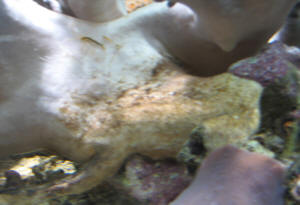
My Maxima clam has been fine for months since I have had him (purchased tank Sept 08, Maxima came with it, in tank at least 6 months before that). In the past few weeks a brown colored film seems to be growing on the shell.
<I see this>
I have tracked its progress, and it is spreading. The clams behavior seems fine, mantle looks ok, it fully extends during lighted hours, but this recent development worries me.
Please take a look at the two attached pictures and tell me if you can identify it. Thanks in advance.
Landon
<Need much more resolution here to tell... Could be a simple algal growth... of not much consequence... Perhaps a Hydroid colony... a Bryozoan... IF concerned, IF this growth appears to be deleteriously affecting the Tridacnid, I would take the clam out, and scrub the area (underwater) in a bucket of water outside the system. Bob Fenner>


Clam Question... I'm not seeing the problem 11/17/2008
Hi.
<Hi Eric, Mich here.>
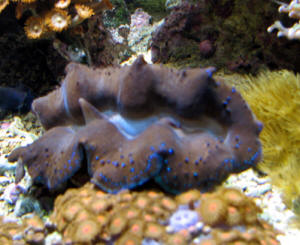
I seem to be having some sort of problem with my clam. I thought it was the fact that that an angel was nipping at it, but that having been solved by removing the fish, I still see these grayish, whitish spots on the mantle.
<Mmm, I'm not exactly sure what you're referring to here. I'm not seeing anything that looks out of the ordinary consistently in your pictures.>
It started in one place about six months ago and progressed across the mantle.
<The picture ending in 126 appears to be your clearest photo and the one I am relying on most here, but I'm not seeing anything that looks abnormal to me. Working from the outside of the mantle inwards, I see bright blue spots on dark purple, then a lighter brownish-purple, and then more bright blue spots. My guess is perhaps you are concerned about this lighter brownish-purple section, but this looks like normal color variation to me.
When clams are moved into new environments/lights the colors often appear different.>
I've looked for worms at night and have not seem them or anything else for that matter.
<Mmm, I guess I'm not surprised?>
I'd would appreciate it if you could lend your expert eyes to the attached pictures and hopefully offer a diagnosis.
<I do not see anything that appears concerning to me, If I've overlooked something please let me know.>
Thanks, Eric
<Welcome, Mich>

Re: Clam Question
Clam Question... I'm not seeing the problem 11/20/2008

Thanks for the response.
<Sorry, I'm not more help here.>
I guess the pics don't provide enough color differentiation.
<I'm just not seeing much, I'm sorry.>
The spots are grayish white and it doesn't look natural.
<Could be bleaching, which is the loss of the symbiotic algae known as zooxanthellae, is sometimes related to changes in lighting among other things. More here:
http://www.wetwebmedia.com/ca/volume_1/cav1i3/Clam_care/Clam_care.htm>
However, since I removed the angel, the clam has started using calcium again, so maybe he'll be ok.
<Let's hope.>
Thanks again, Eric
<Welcome, Mich>

Re: tridacnid byssal gland trauma 11/16/08
Sara-Have another question for you, just FYI, the clam I have previously inquired about is doing very well, so apparently I was just overreacting.
<Ah, cool>
My next question however, is one I can't find an answer to anywhere. What are the general guidelines for stocking levels of Tridacnids? I would like to have several in my tank (30 gal w/ 15 gal refugium) but don't want to have them over compete for nitrates, etc. Is there a rule? I kind of wanted to add a crocea and derasa in addition to the maxima I currently have. Let me know!
<Well, I honestly don't know of any real "rules" about it... but these animals are primarily photosynthetic. So they don't add to your "bioload" the same way fish do. Also, they grow at different rates (depending on the individual-- it's apparently a genetic thing). I imagine that how many you can keep in a tank depends on how fast they grow (since this will likely be the primary determining factor for how many nutrients they consume). If you can find some of the "slower growers" I think you could probably put as many in a tank as will comfortably fit. The problem is that you can't just look at a clam and know if it's a slow or fast grower. If I were you, I'd go to a LFS that's had some clams for awhile and ask them if they've noticed how fast or slow each of them has been growing. Explain that you're not necessarily looking for the fastest growing clam or else they'll like over-state the growth rates because they assume you want a fast growing one. In any case, I do think you could have 3 smaller (<6in fully extended) clams in the 30g tank. Even if they turn out to be super-fast growers, I'm sure you'd have no trouble placing (or even selling) it to someone else. The fast growers are more "in demand" as they say. Also note, if you're worried that your clams aren't getting enough nutrients, you can always just decrease the time you have the skimmer on. Also, please do pick up James Fatheree's book on ornamental clams... it's very good, and you seem to have the interest for it.>
Thanks,
Chad S
<De nada... hope this helps,
Sara M.>

Re: Squamosa death and Maxima Issues. 11/15/08
I went to the LFS today to verify everything. My salinity was a little higher due to the difference between my rinky dink plastic hydrometer and their refractometer but here are the parameters as of today...
The tank is a 120 gallon with a 29 gallon fuge and ~30-40 gallons in the sump plus what is contained in the skimmer.
KH=110ppm
Ca=400
Nitrate=undetectable
Nitrite=undetectable
Phosphate=undetectable
Salinity=1.027 ( I normally try to keep it around 1.025 or 1.026, I will be purchasing a refractometer soon)
The only thing that I can figure is that the new Squamosa did not like the new flow pattern. The LFS guy said that trimming back the Montipora and the small movement of the powerhead changed the flow dynamics of the water.
This could have caused the clam to exert what energy it had into moving
<?>
into a lower flow area and that led to it's demise?
<Possibly>
This sounds like it could be true but I wanted another opinion. He and I do not always see eye to eye when it comes to our views on husbandry practices. I have also down sized the picture of the maxima.
<The Byssus doesn't look good>
Another quick question, does Cyano bacteria grow in small patches... sort of like coralline.
<Some species can, definitely>
I thought I had some dark maroon coralline algae but pulled a rock out to trim some Acro and scratched at the maroon growth. It was not entirely soft but I could scratch some of it off. There is a small bit of Cyano started in the corner of the fuge, but it is the typical long stringiness.
<Mmm, "comes" in a wide variety of shapes, colors...>
I'm guessing this could be attributed to the skimmer issue I had ( will discuss in a second) and the maxima dying. I have done two ~15 gallon water changes in the past week and a half and plan to continue if this is a Cyano problem. I also swapped out my EV120 for my ASM G4. The EV120 injector was continually being infested by snail larva and not working correctly, so I ditched it but I fear that the multiple skimmer failures may have caught up with me. The growth in question is also in high flow areas of the tank, which I didn't think was characteristic of Cyano?
<Again... Please read here: http://wetwebmedia.com/bluegralgae.htm
and the linked files above... You'd do well to investigate RedOx potential as well.>
Thanks again guys,
Adam
<Welcome. Bob Fenner>

Giant clam malady? Mg toxicity – 09/04/08
Hi Bob (and crew),
<Hi Chris, Mich here.>
Thanks for the many hours that you have collectively invested in the hobby and in this website. It is a great resource.
<Thank you for your kind words here.>
I am having a problem with the mollusks in my tank that I haven¹t been able to resolve after looking at the
snail disease faq, the giant clam disease faq. or Fatherree¹s clam book.
<OK, hopefully I can help.>
My tank¹ is a sps dominated mixed reef. Salinity is 1.024, pH is 7.8-8.1 (lower than I would like it to be)
<Yes.>
temp 78.5, ammonia, nitrate and nitrite are all not detectable, PO4 is around .25-.5 ppm (more than I would like), because of my high coral load and the presence of a large clam I am having trouble keeping my calcium and Alk where I would like them to be. My dKH hovers around six and my calcium is around 325. I know that these levels are too low and I am currently investing in a calcium reactor and Kalk reactor, which will be employed under the vigilance of an aqua controller to address this problem. My Mg is around 1300ish.
<I think this maybe part of your problem.>
I currently dose what seem to be excessive amounts of DT¹s 3-part calcium mg and Alk buffer to compensate for bio depletion and to raise pH.
<OK.>
Lighting is a 10,000K 250W metal halide. Tank turnover is about 50X. I have a 1 inch sand bed which I gravel vac as part of my weekly maintenance. I typically do at least 10% water change every week. (more often 25%).
<Husbandry seems good.>
I have great coral and clam growth and no algae problems.
<Wonderful!>
As for fish I¹m a fan of a relatively conservative fish load. I have a small flasher wrasse, a Banggai cardinal, a mandarin and a yellow assessor. (no coral eaters or clam nippers)
<Great!>
On to the problem: About a week and a half ago, my T. crocea (~5.5 inches) decided he was no longer happy as a clam. During the daytime, he remains mostly closed with his mantle mostly retracted. It does open ~75% in the mornings when natural sunlight hits his corner of the tank. It also seems to be expanded to a greater degree when the lights are off (~25%). The clam is still light responsive and appears to have no signs of pinched mantle, white spot, obvious necrosis or parasitic snails. It is located on a small rock on the bottom of my tank about 13² under water (mantle is at a 10² depth). It¹s byssal attachment is still quite strong.
<OK.>
I¹m concerned that he hasn¹t been opening.
<Rightly so.>
Since the situation arose, I have employed activated carbon in the tank in hopes of removing any DOC
toxins that might be present and have done three 25% water changes in the past week and a half.
<Well your carbon usage has likely cleared your water significantly, which may make your clam more sensitive to light.>
I would be content to call this an issue related to the clams exposure to light in the tank BUT, I have noticed my Astrea snails have been remarkably lethargic lastly as well.
<I think this is likely related to your high Magnesium levels and low Calcium levels.>
One snail laid on his side half open for ~12 hours others have not moved for several days on end. I have not noticed any snail deaths.
<Here is my theory: You are likely seeing paralysis from the high Mag levels/ low Calcium. Magnesium Sulfate (MgSO4) in the human acts as a central nervous system depressant. It blocks neuromuscular transmission by decreasing the amount of Acetylcholine released by motor nerve impulses. A secondary effect is the relaxation of smooth muscle tissue. MgSO4 is also the most commonly used tocolytic agent, it decreases the frequency and intensity of uterine contractions associated with preterm labor. It is also used to prevent seizures and convulsions..Mag toxicity is a huge concern in something the size of a human, let alone a tiny snails. When MgSO4 is given in a hospital setting the antagonist, calcium, typically calcium gluconate, is kept at the bedside. Patella Tendon reflexes are continuously monitored for signs of diminished or absent reflexes related to the risk of overdose. This is why I suspect your problems may be related to the Calcium level and Magnesium levels in your tank.>
Any thoughts?? (sorry for the long email)
<I do think this is a water chemistry issue. I think you should try raising your dKH, pH, and Calcium levels and lower your Magnesium levels.>
Thanks,
<Welcome,>
Chris
<Michelle Lemech MS RN>

Re: Giant clam malady? 10/8/08
Hello Mich,
<Hi Chris,>
Thank you for you well thought out response!
<Welcome!>
I think you are on to something.
<Well, makes sense in theory I think.>
In retrospect, I *think* I noticed more mantle extension on mornings after large doses of 2 part calcium buffer (without the Mg dose) and on mornings after CaOH was dosed. Depletion of calcium by mid morning could result in recurrence of the symptoms.
<OK.>
I had considered the idea of calcium depletion toxicity before, but discounted the theory because the clam was sill photo-reactive. I figured that adductor contractility would have also diminished if calcium was so low that it was interfering with either action potential propagation, cell signaling or smooth muscle contraction.
<I suppose internal levels could be higher.>
I have no idea about the histology of the adductor muscle. Is it smooth or striated? ( I guess this doesn't
really matter.)
In the past week my snails seem to have been doing much better. This is concurrent with your theory that this this is a chemical problem rather than a biological one. If I had some sort of pathogen in the tank the snails should have been the first to kick the bucket rather than get better.
<Does support a chemical issue.>
I am not sure, but I think I may now have a secondary protozoan infection.
When the mantle of the clam is withdrawn (aka not midmorning when the sun hits the tank after a good shot of calcium) there is now a slight curl to a small portion of the mantle. When the clam is extended, here is no sign of pinched mantle what so ever. Do you think I should try and do a freshwater dip?
<Mmm, think I would wait here.>
Having decided that calcium depletion is a possible cause (and an issue that needs attention in my reef regardless, I am unsure how exactly to proceed.
Specifically, I am wondering about adverse effects of GREATLY overdosing my system with 2 part buffer to increase the Ca levels. Do you know of any trace elements present in 2-part that will reach toxic levels if I am dosing WAY beyond the recommended dosage (as I would have to get levels where they ought to be) ?
<I'm sorry but I do not have experience with this.>
What do you think?
<I think it is worth trying and just keeping a close eye on things.>
Thanks again for your ideas and input!
<Welcome.>
Chris
<Mich>

Re: Giant clam malady? 10/8/08
Hi Mich,
<Hi Chris.>
I wanted to give you a quick follow up Re my T. crocea.
<Thank you. It is always nice to get follow-up!>
You were 100% right. Last night I dosed more calcium than anyone ought to over the course of 8 hours and brought up my calcium 250 pts (now final concentration of 450ppm).
<Yikes! Glad you did it over 8 hours!>
The clam was fully opened this morning and has remained open all day. (for the first time in almost 3 weeks!)
<YAY! Hope all stays happy and adjusted!>
To you I tip my hat!
<Glad to help.>
Thanks so much for your insightful answer. Without your input the clam would have been chowder.
<Yikes! No T. crocea chowder please!>
Best,
Chris
<Cheers, Mich>

Giant Maxima Clam- What is this growing on it's side?  9/25/08
Hello,
I have been researching something that I noticed on my blue Maxima Clam to no avail and am looking for some insight as to what is "growing" on my clam. I think it looks like a pale fleshy substance that slightly resembles the Exhalant Aperture of the Clam. This "growth" is round at the bottom and has an open spout at the top; it has not moved since we noticed it, and it is located on the ridge of the clam's shell and mantle. When the mantle is fully open it almost covers the object completely. When the mantle is drawn shut the object protrudes above the shell. I want to be sure it is not harmful, and if so if there is something I can do to help the clam. I have attached two pictures of the clam and the "growth" it doesn't not appear to have a snail infestation as we have not noticed anything else in or on the clam (although I have never seen such an infestation, and have very limited experience).
Thank you for your help.
Sincerely,
Ashlee
<Your photos are too small, unresolved to make this out. I suspect from your general description, shape of the object that this may well be a solitary Ascidian, a sea squirt. Please see here: http://wetwebmedia.com/ascidpt2.htm
and Part 2... I would leave this as is... not likely harmful. Bob Fenner>

Derasa Clam, hlth., comp.  9/24/08
Hello, this is my first question but I read your recommendations since a long time ago. Sorry my English is not perfect.
<I understand you>
My reef setup is running since a year and a half ago. Among many corals and invertebrates I have these two clams since a year ago. A derasa and I thing a Crocea, but im not sure about that. The two clams where very good till now. The crocea is still very good but I see the derasa not extending the mantle as before like 10 days ago. I try to move the clam when I notice that the two shells were like disassembled and feels like the top shell was going to fell.
<Yikes, no bueno>
I leave the clam and not touched anymore. I was very careful and Im sure that I didn't do the damage. She opens a little and the color is good and sometimes close and open a little but Im not sure if she can recover by herself. Is not getting worse at least. I include a photo where you can see the two clams and you can see that the top shell is like a couple millimeters off the natural position.
The water parameters are
Ammonia 0
Nitrites 0
Nitrate 10
Phosphate 0
Carbonate hardness 8
Calcium 400
Temperature 80
I don't have a chiller and its a 30 gallon tank
196 watts PC and the calms are very high and in the center of the tank
Thanks!!!!
Fernando
<I think this animal is being poisoned by either the Zoanthid below or the Polyp above. I would move either the clam or these stinging-celled colonies. Bob Fenner>


Coral identification & gigas clam shell formation question 9/23/08
WetWeb Staff,
First I just wanted to say thank you for providing such a wonderful service.
<Welcome>
I just have two quick questions. First, regarding dendrophyllia, I purchased a few heads from two different online vendors and can only positively identify one colony as dendrophyllia. I suspect that the second colony might be Tubastrea, but I am really not sure. I was hoping that you wouldn't mind taking a look at the picture attached and offer your best guess as to what the second colony is. I know that the only true way to determine the species is to examine the skeleton, but your best guess would be greatly appreciated.
<The photo sent appear to be of the genus Dendrophyllia>
My second question is concerning the growth of my gigas clam. Once again, this was an animal acquired from an online vendor. I have had it for just about 3 months now and it is doing fine. I have noticed about a half inch
of new growth, but what concerns me is the unusual shape of the shell. I'm guessing that since the clam is doing so well, I really don't need to worry about it, but I am curious to know if the growth pattern has a chance of
harming the clam as it grows larger. Pictures are attached for your review.
<Not to worry... growth will slow, the shell change a bit going forward>
Thanks in advance for your response, and thanks once again for providing invaluable service.
Marc
<Again, welcome. Bob Fenner>

Did my new lighting kill my 4 year old Tridacna maxima – 09/12/08
Hello, I had a Tridacna maxima for about four years. Purchased it about 3" in size and it grew to 6" over the last 4 years. The clam had always been healthy.
My tank is a 55gallon reef w/25 gallon sump, Only additives is Kalk Drip ½ tsp per gallon of top of water and trace elements through bi-weekly 15 gallon water changes. Also use Phosbuster.
<... this is the most likely "causative agent" thus far... Clams, all live need phosphate...>
Calcium runs from 325-380 (maybe a bit low).
<Yes>
PH 8.1 -8.2, Salinity 1.022,
<Too low...>
no Nitrates, Nitrites or Ammonia.
About two weeks ago I removed two of my four 96w Power Compacts 10k/Actinic Smart Bulbs and added two 250w 20k Metal Halide. A grand total of 692 watts. Transition- I ran the two power compacts 2 hours then shut off and turned on the MH for 1 hour and then Power Compacts on 2 hours. I increased the MH duration 1/2 hour each day until they were on a total of 4 hours per day with the Power Compacts on for 4 hours per day. I noticed that the clam was barley opening on the second day of transition. Figured it was adjusting to the light.
<Mmm... maybe not>
After two weeks I noticed that a whole bunch of my blue legged hermit crabs were eating it from the mantle down.
<Oops, yum!>
I removed it from the tank yesterday because it appeared close to death and did not want to poison tank. I was wondering if I killed it with to
<too>
much light?
<Maybe this along with other stress sources, yes>
The clam was always at the bottom of the tank so it got less light then the rest of the corals
<... Clams are not corals>
in the tank which all seem to be fine with the exception of my Rose Bud anemone. It seems stressed, eating fine but is shrinking and expanding and is also wanting to move to somewhere else in the tank because it is releasing it foot to try and move. Something is obviously amiss.
<Yes... again, the light, HPO4, spg... of what you mention>
Aside from the lighting the only thing I have changed in the tank was adding a medium size frag of sun corals and small Acropora frags. Oh almost forgot I have been able to maintain tank temperature of 75F-79F with the halides by use of a fan. Tank is 75 when lights turn on and 79F when lights go off 8 hours later.
The Metal Halides are CoralVue Mogul Base style, retrofit so they don't come with a UV shield. Do they need some special UV glass between them and the tank?
<Uhh, I'd be contacting the manufacturer re... More and more such lamps come with a coating on their glass, but I strongly encourage all to provide another layer/barrier between the water and the lamps... for safety's sake... to prevent damage (even explosion) from splash, spray>
My plan is to do a large water change this week, 55 gallons of the total 80 gallons of water volume, just in case something is wrong. Could the clam had a predator that I could not see that was introduced from the sun polyps or Acropora's or did I introduce the new lighting to fast or likely something else in water?
<Doubtful re the predator, but the three items mentioned above... for sure>
Any insight into what may have killed my clam would be appreciated. It was one of the oldest things in my reef and really disappointed that is now gone especially when they can live so much longer than that.
Brian
<I'd ditch the chemical filtrant, raise the spg, use a more gradual photo-acclimation process. Bob Fenner>

Aiptasia inside Tridacna Crocea clam shell (cannot scrape it!) 6/13/08
Hello crew,
<Betsy>
I just purchased a ~5 inch crocea clam from another person who was breaking down a tank. During acclimation I noticed an aiptasia, but it is not 'on' the shell of the clam, it is between the layers of the shell right under the mantle, I declare it to be unscrape-able. I tried to use one point of a tweezers (which barely fit into the hole) to "squish" the aiptasia (which withdrew completely into the crack, you can see in the bottom center of the photo). I was a little timid though, very afraid of hurting the clam. From what I have read about Aiptasia, I imagine that I did not successfully kill it. I read on your site FAQs that Aiptasia can annoy the mantle of the clam (and boy, is it ever close to the mantle!). I also read that injecting anything that close to the clam might not be such a great idea.
<Actually, I'd either ignore this pest... or look into a really neat new product by Red Sea... I saw this in action a few weeks ago at the Interzoo industry show in Germany... an injectable that appears to be "tasty" and non-toxic... that one can squirt into such pests... they eat it... and dissolve>
So, any ideas on how to rid myself of this pest without injuring the clam?
Also since I'm writing, I plan to let the clam attach to a piece of ceramic tile so I can place it on the sand bed. (I understand that crocea's prefer to be on a hard substrate). Is a tile a good idea?
<Mmm, yes>
The clam was living on the sand in the other person's tank, from what I understand. My lighting is very good ( 6 overdriven T5 bulbs on Icecap 660 ballasts - producing a PAR of about 350 on my sand bed). I would like to keep it on the sand bed rather than in my rocks so that I get the best viewing angle on it's mantle.
<A very good point>
Thanks very much,
Betsy
<Welcome. Bob Fenner>

Injured Tridacna derasa…A Case Of Home Invasion – 04/05/08
Hello all,
<<Greetings>>
I have a bit of a problem here and could use some advice.
<<Okay…let’s see what I can do>>
To start with, I have a 20g reef tank, maintain general good water quality - weekly water changes, Ca-Alk supplement in morning before lights on, pH 8.3-8.5, 9-12dKH, Ca 380-420,
<<Having both Alkalinity and Calcium at the high end of the scale can lead to trouble…as Anthony explains here: http://www.wetwebmedia.com/calcalkmar.htm >>
Nitrate 3-5 (peaked at 5 when I lapsed for month without getting more salt), 18g sump with 8g DSB, and SeaClone 100 skimmer. Now for my problem....I have a 3" T. Derasa that I have had for about 2 months that has gotten "hurt"... One of my small C. tricolor hermits got trapped by the clam somehow (I have seen them picking at the algae growing on the shell and causing the mantle to retract as they hang on the edge of the shell) with its 3/4" Cerith shell directly in the clams intake siphon.
<<Mmm…>>
I was running late for class and couldn't get the clam to release before I left, and when I came home tonight the crab was out but the clam is pretty torn up. The excurrent side looks fine and was still expanded, but the intake is heavily lacerated and very withdrawn.
<<Not good>>
Can the clam recover from this?
<<Possibly…if its internal organs have not been damaged as well>>
Or would I be better off euthanizing this specimen to save the rest of the tank from a dying clam?
<<I wouldn’t…yet. But do keep a close watch on the clam and remove it at the first signs of further decline or decay>>
If it can recover, is there anything I can do besides maintaining good water quality, or just hope.
<<This is pretty much all you can do…although moving the clam to a hospital/recovery tank would alleviate your fears of polluting the display should the animal die>>
Is this a common accident to happen with Tridacnids and hermits/snails, or just a freak occurrence?
<<I seem to recall a similar incident with a snail that entered a clam through its byssal opening a few weeks back…but all in all, I think such incidents are rare>>
I know that crabs in general should not be trusted with clams, but I never thought that a small, grazing hermit could be so destructive in this way.
<<Are very opportunistic…but the species you mention are not generally known to “attack” healthy clams if kept well fed. The hermit likely just “fell in” during the activities you described earlier. And the bulk of the damage to the clam was also likely self-inflicted while trying to eject the “foreign object”>>
Thank you for your time and advice.
BBB
<<Happy to assist...I do hope the animal recovers. EricR>>

Turbo snail inside clam -03/28/08
First off, just want to let u know that you have helped me immensely over the last two years, so thank you.
<Thank you, sorry for the delay.>
I have a strange problem. Last night I realized that my clam (picture clam 1) about 6 inches long was unable to close its shell, however it was Retracting and responding healthy. Upon turning it over, I found that there was a turbo snail about the size of a marble trapped in the joint.
<How odd.>
I tried to dislodge the snail but it was in to deep and went through the hole in the bottom of the Clam were the muscles that attach to rock are. These muscles then closed the opening back shut. The snail is now inside the clam. The clam can still not close but is responding well, however it is not opening the top vents, when I got home today this is what I found (picture Clam 2). The shell still does not close so I assume that the snail is still inside but it appears that the filtration part of the clam is on the outside through the whole in the bottom.
<Hmm, the picture is a bit blurry. I can't be too sure exactly what part(s) of the clam that is (that are hanging out). But it does look uncomfortably like gill. Though, I'm not entirely sure it's not just the byssus muscle.>
It is still attached. Is there a way to get the snail out or will it take care of itself? Is the clam doomed? Is there anything I can or should do?
<This is really odd, but it doesn't look good. I've never heard of this happening before with a turbo snail. I suppose, maybe if the snail is still alive it might find its own way out. But unfortunately, I don't know if too much damage has already been done to the clam or not, for it to survive. If you can't reach the snail, I can't think of anything else you could do.>
I have one more question. I have something growing on my finger leather (picture finger leather). It looks the same as what was on my Fuji leather last year that died from the base up. Do you have any ideas on what it is and how to treat it?
<What happened to your Fiji leather last year? The photo is a bit difficult to make out what's happening. Is it detaching from the base?>
Bryan Stone
<Best,
Sara M.>

Re: Turbo snail inside clam 3/30/08
The mass that is outside of the clam has a large sac with a bunch of tiny filaments attached to it. The whole thing is still attached. I will try to get a better picture but it is white. Should I try to go in and get the snail?
<If you can see it and delicately get it out, it might be worth a try. But to be frank, it just doesn't look good... the clam might be past the point of possible recovery.>
My Fiji leather had this same discoloration at the bottom and is slowly spreading upward as this is doing? The tissue seams to get hard.
<It might be trying to move/reposition itself.>
Yes the Fiji eventually detached and appeared to kind of dissolve or rot from the bottom up. This discoloration seems to have small black lines moving vertically. As if it is growing. I have a good picture but by the time I reduce the size down it loses definition. I can sent it again if it helps. Again thank you for your help! I had them both in this tank but the finger was still rather small when the Fiji died a year ago.
<Leather corals can sometimes detach themselves from their bases when they're "unhappy" with where they are for some reason (though they do this very slowly). It sounds to me like this is what might have happened to your previous leather (which was apparently unable to reattach itself somewhere more favorable). Otherwise, I don't know what else could be happening here, sorry.>
Bryan Stone
<De nada (but please start using spell check),
Sara M.>

Yikes

clam problem, English, no useful info., using WWM   3/26/08
last night before shutting down my light system on my 140 reef all of the animals and coral were fine open and happy .this morning I awoke to a horrible sight my baby crocea was dead .it is kind of hard to explain what it looked lide when I took it out of the tank there was this mass that had the concisty of gel. I will be including a picture . I believe that to be whats left of him.
<Bizarre that this should happen so quickly... Your pix are very hard to make out>
I was wondering if it could of been a snail .I have heard that there's a snail that attacks clams .
<... your English... and no searching...>
The clame was in the sand also I don't know if that a facto .also ph 8.2 ammonia 0 nitrate0,nitrite 0. in the picture with the clam the watery looking stuff is like a jelly fish feeling to it .
tecture
<Read here: http://wetwebmedia.com/tridacdisfaqs.htm
and the linked files above. B>

Re: clam problem, English, no useful info, using WWM - 3/28/08
I don't know if this is useful information for you or not (and like you said the pictures are not the clearest). The second picture (the one of the snail) looks suspiciously like a LR hitchhiker I removed from my main tank after I caught him feeding on (what I think is) a tube worm or non mobile snail) of some kind. I tried to do some research on the predator at the time and found that it indeed was known to feed on other inverts (especially the non-mobile types).
<<I see>>
I can't remember where I found it now and tried looking for it, but mine looks kind of like a gray tulip snail.
<<Mmm…best to “evict” then>>
Since this is the first time I've written I'd also like to say thank you for teaching me that everything (at least most everything) I learned from my mother about keeping a marine tank is incorrect.
<<…?>>
After reading through your pages for the last 6 months or so I'm amazed that her overstocked 29g long does as well. I also wish I had found you before I had setup my tank (a 40g tall) I'd have made very different decision if I had.
<<Ah…>>
Keep up the good work,
Jason
<<We are trying. EricR>>

Clam troubles... no data of use, not reading...   2/21/08
Hi!
<Howzit?>
I have a newly setup 330g main tank and 70g sump setup in December. As a part of the new tank I migrated from a well established 46 gallon reef
tank. I had a maxima clam and a Crocea clam I have kept for over 2 years in my 46g tank. However, last week I lost my Crocea clam and my
maxima is fading quickly (clam not opening very wide, sinking mantle, bleaching of mantle). The new tank water quality is kept very clean,
stable pH, temp, water parameters are great, salinity 1.025, calcium is a bit low but climbing 350-380.
<Alkalinity, Magnesium?>
I am dosing every other day w/ DT phyto.
<... of not much use in this setting>
After the Crocea perished I dosed the maxima in a separate container with tank water and heavy dose of DT phyto, despite this the maxima is still declining quickly. The tank is kept under 1600 watts of (4 x 400w HQI halides). The clam is kept on a flat rock laying in the sand substrate.
<... may well need to be elevated...>
Given the new tank would you suspect:
The maxima clam size is about 4".
1.) The tank is to new and does not contain enough natural phyto and other items in water column needed for health of this clam.
<...>
2.) A water quality or chemistry problem.
<Possibly>
3.) A light problem
<Likely>
Thanks for all of your help as always!
Bryan
<Please read here: http://wetwebmedia.com/tridcacdisf5.htm
and the linked files above... You need to know a bunch more... and provide more data... For now, read. Bob Fenner>

Re: clam troubles... lack of nutrient...  2/21/08
Thanks, I did some reading on that URL.
<Okay>
The maxima perished. Alk is 11 dKH, calc is about 390. ammonia: 0 nitrites: 0: nitrates: barely detectable. I had always thought under halides keeping a clam on the substrate was doable,
<Mmmm>
I have seen several healthy looking clams in other tanks like this. The tank is 30" tall and the halides are about 7" off the top of the aquarium. I obviously want to figure out what went wrong before buying anything else.
<This depth... the light would have to be directly above...>
Given the slow decline I didn't speculate it was a pest.
<Agreed>
The only thing recently I have changed in the tank was the addition of PhosBan media per your teams recommendation.
<...! Clams (actually all life... e.g. ADP, ATP...) absolutely require "some" soluble phosphate... This sudden removal may well have been a factor>
Within 2 weeks, both clams are gone. Coincidence?
<Not likely>
I have not tested phosphate prior to this, and I had no reason to believe I had a phosphate problem, I simply added it as a precaution for long term health.
<... I would not have done this... there are other, easier means of phosphate limitation, control... Posted on WWM>
Is your bet still on light?
<Partly... but am hedging/spreading my bets more and more. How about you?>
Best
Bryan
<Bob Fenner>

Questions about crocea clam and an open brain coral -02/06/08
Good afternoon,
I hope this email reaches you all well. I can't tell you much I (we) appreciate what you do for us! Anyway, I have two questions I have searched for on WWM archives (there's A LOT) and can find no clear answer for. In fact, I'm a little confused. First, I have a question about a red open brain I got last week. Picture attached. In the week I have had it, I have seen no movement, no tentacles, no feeders, no nothing! It has also lost a little color since I got him home. Last night, I saw slime tentacles with little bubbles on the "slime" which were extended about 4 inches above him. Is this normal for a while as it gets used to the tank?
<Usually, yes, it can take some time for feeders/sweepers/etc. to come out.>
The only other invert near him right now is a small rose bubble tip 8 inches away and up in a rock crevice. Also, on many WWM archives, these should be placed directly onto the sand bed , which mine is. But, I saw some other WWM archives that said to place it into a rock structure, since it gets irritated if sand is blown in it http://www.wetwebmedia.com/trachyidfaqs.htm
Which is it? Sand or rock?
<On the sand is preferable. However, if it keeps getting covered in sand, you might want to prop it up on a rock.>
Second question, I also have a Tridacna crocea clam I bought at the same time. When I placed him into the tank, I also placed him into the sand with a piece of tile 1/4 inch under him in the sand (did my research!) so he could put his foot onto something, and although he looks very healthy and opens / closes as he should, he keeps "knocking" himself over onto his side. I don't want to keep adjusting him and causing more stress than he probably already has. I know he should eventually be moved onto a rock, I just wanted to keep him where he is so I don't "light shock" him before I move him up. Any suggestions?
<The tile might be too flat or not the right size/shape for it to "balance" itself on. Try a rock or some other hard surface that it can sit balanced on.>
Is he OK on his side?
<Not in the long term.>
The sand grains you see in the picture get blown out when he "exhales" (which is what is knocking him over). I hope these don't seem like silly questions.)
Tank specs:
55 gal (w/10 gal partitioned sump holding Chaeto algae)
4 inches of Aragonite live sand
40 - 50 lbs live rock
3 Ocellaris Clowns (introduced together last year)
1 Clarki Clown (plays nice with the O's) in a Sebae Anemone
1 Bubble tip Anemone
6 nice stalks of Xenia (doing very well I might add)
1 Sailfin Tang
1 Six Line Wrasse
various Zoos (small colonies)
Nassarius Snails and various small hermits, lots of amphipods, copepods, and a few bristle worms the wrasse has yet to find.
PH = 8.4 (evening)
Ammo, Nitrates, Nitrites, Phosphates = 0 (hard to believe on the last two, but that's what my test kit says)
Calcium 460 - 480
Alkalinity = 11 - 12
Magnesium 1300 - 1400
Thank you,
Shayne McKean
<De nada,
Sara M.>

Can Cyano kill clams? Oh yes   10/2/07
I have a 55 gal saltwater aquarium. I'm having a bit of a problem with Cyano. I've repositioned my powerheads so that there is water circulation in all directions.
<Helps>
It seems to have gotten much better except on the substrate around my Crocea clams. I purchased a few queen conch,
<Get too big...>
some snails and a sand sifting cucumber
<What species? Some of these aren't "reef safe">
to keep my substrate stirred up. I even stir it up myself and try to siphon out the Cyano.
<I would do this VERY carefully>
My question is this. I came home from work to find the mantle of my clams rather withered and retracted. Upon closer inspection I noticed I could see right through them to the substrate. Could the Cyano bacteria on the sand have caused this or is it more likely my cleaner shrimp or emerald crab (even though I've never caught them in the same area as the clams)
<Could be the Mithraculus for sure... but also the BGA is a negative influence. Have you read on WWM re various means of countering Cyano profusion? I would. Bob Fenner>

Clams making a fashion statement? Bleached Tridacnids   9/23/07
Hey Gang :)
<Lisa>
Here I am again with a question. (big surprise huh?)
<Oh yes!>
I have 3 crocea clams in my tank. They've been there for about a year. They all had pretty good color until about a month or so ago. Now two of them are completely faded, the biggest has gone from purple to brown. They otherwise seem very healthy. The light has not changed since we upgraded in January to a 520 watt system which provides about 5.7watts per gallon to our 90 gallon Oceanic bowfront.
I had the water tested Wednesday at the LFS just to double check my own results, and the quality is excellent (Ph 8.3, nitrates 0 nitrites 0, ammonia 0, phosphate 0). They  didn't test calcium, alkalinity was 13. SG is 1.026.
<This all looks okay... except that the clams do actually need some nitrate, phosphate... and some folks speculate even ammonia>
So knowing lighting hasn't changed, water quality is excellent (everything else is thriving), what can I do to help my clams regain their color?
<More nutrient I believe... What do you feed these tridacnids?>
Thanks again so much, I'm lost without y'all.
Lisa
<You have read here: http://www.wetwebmedia.com/tridacfdgfaqs.htm
and the linked files above? Bob Fenner>

Bad


Featured Sponsors:
Google
 
Web www.WetWebMedia.com