|
FAQs on Cichlid Disease 4
Related Articles: Cichlid Fishes, Freshwater Fish Diseases, Freshwater Diseases, Ich/White Spot Disease, Freshwater Medications,
FAQs on Cichlid Disease:
Cichlid Disease 1, Cichlid Disease 2, Cichlid Disease 3,
FAQs on Cichlid Disease by Category:
Diagnosis,
Environmental,
Nutritional,
Social, Pathogenic,
Parasitic,
Trauma,
Treatments
Related FAQs:
African Cichlid Disease, Oscar Disease/Health,
Aquarium
Maintenance, Freshwater
Medications, Freshwater
Infectious Disease, Freshwater Fish Parasites,
Ich/White Spot Disease, Cichlids in General, Cichlid Systems, Cichlid Identification, Cichlid Behavior, Cichlid Compatibility, Cichlid Selection, Cichlid Feeding, Cichlid Reproduction,
Dwarf South American Cichlids, African Cichlids, Angelfishes, Discus, Chromides, Neotropical Cichlids, Oscars, Flowerhorns,
|
|
|
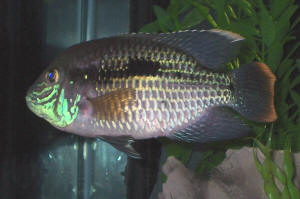
Sunken belly 1/9/20
Hi Crew
My electric blue Acara, Finn (so named because of a
piece missing from his dorsal fin), whom I've had for 8 months has been
off his food for past 3 to 4 days. His color is good, no clamped fins,
not hiding but he is ignoring his usual favorites (cichlid flakes. Brine
shrimp cubes and frozen Blood worms) and his belly seems a bit sunken
in. I've not seen any white feces. Tank set up is 55 gallon heavily
planted with driftwood and rocks, Fluval canister 206 and sponge filter
(rated for 80 gallons) and Aquaclear 70. Lots of filtration. Water
parameters: pH 6.6-6.8, temp 77-78°F, gH 8°, ammonia and nitrites are 0
ppm and nitrates are around 20 ppm with weekly water changes. Tank mates
are Columbian tetras and small school of Corydoras. I recently upped the
temp from 75-76° to 77-78° as he seemed sluggish. He seemed more active
in warmer temps.
My first thought was parasites. I don't think its stress related as he's
pretty mellow. I have API General Cure on hand and since he is not
eating I was wondering if best course of action would be to treat the
whole tank? I have two Angel fish currently in my quarantine/hospital
tank (one of whom I was planning on adding to his tank). I do have a 20
gallon tote I could put him in with a cycled sponge filter but I would
need to buy a heater first. Any thoughts?
<Electric Blue anything tends to be a risky purchase, with few of these
fish being as healthy as their regularly coloured ancestors. In this
case, since your tank sounds broadly about right, I'm guessing the
environment is basically fine. I'd be tempted to treat as per "mystery
ill cichlid" scenario; i.e., metronidazole alongside a nitrofuran
antibiotic. This tends to catch the usual problems cichlids waste away
(i.e., Hexamita-type infections) but doesn't unduly stress the fish or
filter.
Cheers, Neale.><<Totally agree. RMF>>
|
 |
|
Re: Sunken belly (RMF?)<<Wish I had one; oh! Again, in total
agreement>> 1/10/20
Thanks Neale for getting back to me so quickly!
<Welcome.>
He was treated when I first got him as a juvie with Metroplex in food
(once a day for recommended treatment period). He was very skinny and
spitting out his food. He seemed to bounce back and he's grown and
filled out (over 5 inches). He has continued to be a picky eater,
however.
<Does happen with cichlids; to some extent, you need to experiment, but
good quality cichlid pellets should be taken.>
I have Furan-2 by API on hand along with SeaChem Metroplex. So, do you
recommend dosing the volume of water with each med as per directions on
each box?
<Medicated food is, by far, the best approach if viable. Dosing the
water is less reliable, so should be Plan B.>
With this combo can I treat him in my planted tank thus avoiding the
stress of moving him or should I set up a hospital tank for him? I know
Metroplex won't crash my bio-filter but I wasn't sure about Furan 2 as
I've never used it.
<Metronidazole shouldn't cause any problems for plants or filters.
However, Furan-2 does seem to have a mixed reputation, and the
manufacturer states that it WILL harm filter bacteria. So the ideal is
to use Furan-2 (alongside the Metro) in a hospital tank with a
zeolite-filled box filter.
If you must medicate the main tank because it's the only one you have,
remove some of the filter media and keep damp, while also removing any
irreplaceable plants, just in case (or at least some cuttings, so you
can regrow them if needs be).>
It's one of those meds I bought to keep on hand. Also, is this combo
safe for corydoras and nerite snails?
<Should be fine for catfish, but snails likely not. Remove them. They'll
be fine in a large plastic container kept somewhere warm. Change the
water every couple days, but otherwise just make sure the lid is on
safely to keep them from escaping.>
I'm reading online that a lot of owners of EBAs are having similar
issues.
Too bad.
<Indeed. As stated before, the Electric Blue varieties of pretty much
everything are unreliable, at best. The relevant genetic selections that
have produced these strains seem to be connected with the genes that
provide disease-resistance. While the varieties may improve over time,
there are some selected strains of fish that never really recover.>
He has a great personality. I hope I can pull him through this. Thank
you again for your help and expertise.
Susan
<Most welcome. Cheers, Neale.>
Re: EBA with Sunken belly 1/11/20
Hi Neale
<Hello again, Susan,>
Well, I decided to dose General Cure until my heater arrived and I could
set up his hospital tank. He appears to be responding somewhat to this
treatment as he is coming out of hiding to greet me and he ate a small
amount of blood worms mixed with Metroplex last night. I'm finishing the
second dose of General Cure today.
<Sounds promising.>
SeaChem says they usually recommend not to do both (treat water column
and do medicated food, they said General Cure is comparable to Metroplex
with some Prazi added).
<Would seem logical; doing both would be an overdose, with perhaps
unhelpful results to either fish or filter.>
Do you think it would be wise to continue with medicated food (straight
Metroplex) after I've finished with the General Cure if I don't see 100%
improvement?
<Yes, but I tend to favour waiting a day or two between the end of one
course and the start of another. Certainly, doing a decent water change
at this point gives the filter bacteria a breathing space.>
I want to knock out whatever bug he has but I don't want to over
medicate.
SeaChem says to feed for 3 weeks which tells me the dose in the food,
while effective, is on the low side.
<Possibly, but remember: when fed as food, you're getting all the
medicine into the fish; when added to water, only a tiny fraction is
absorbed through the skin because its so massively diluted by the
aquarium water or metabolised by other organisms in the tank. So feeding
the fish generally ensures a closer-to-optimum concentration of the
medicine inside the fish.>
Thank you for tip on using Zeolite in the hospital tank filter to
control ammonia. I usually use Prime but I know it can reduce O2 levels
especially when medicating. Zeolite is a better alternative.
<Indeed it is. A simply box filter will do.>
Thank you again! I can't count how many times your site and advice has
saved my fish and made me a better fish keeper.
<And thank you for these kind words. Cheers, Neale.>
|
Freshwater tropical parrotfish; HITH
9/10/17
Hi
Could you tell me of something called Hith my fish has a tiny white spot
on top of its head and someone on another website says it looks like
hith but I've never heard of it
<HITH is an abbreviation standing for "Hole in the Head" disease. The
"holes" go into the head of the fish, as opposed to the white pimples
characteristic of Whitespot (Ick) so it is generally easy enough to tell
the two diseases apart. HITH is a difficult disease to treat unless you
use Metronidazole, which is the best medication available for the
disease. HITH may be related to a parasitic organism called Hexamita,
which infects and
destroys the sensory pores in the skin, but the trigger is invariably
environmental stress. In the case of cichlids -- which are more prone to
HITH than any other freshwater fish -- low oxygen, high nitrate, and a
poor diet (no fresh greens) seem to be the "holy trinity" of causal
factors.
Prevention is better than cure, but in its early stages, HITH can be
treated with Metronidazole, as mentioned earlier. Follow the
instructions carefully, including removing carbon from the filter during
medication.
Cheers, Neale.>
Rescued cichlids... Please help; hlth., comp.
issues/questions
4/15/17
Hello Crew,
I rescued a bunch of fish from somebody who was letting them die in
29
gallon long tank, severely over stocked tank because he no longer wanted
to care for them.
<Ugh!>
I'm dealing with fin rot, fungus, Ich, and pop eye,
<Environmental>
Most of the fish had clamped fins, All of the fish were crashed on
bottom of tank, none of them tried to swim away when I netted and bagged
them... I brought home four yellow labs, jewel cichlid, two green
Severums, 9 angels, 3 large blood parrots, female kenyi, rainbow shark,
iridescent shark and a monster Pleco. All crammed into 29 gallon with
filter and heater not working. There was several dead fish in the tank.
When I got home I tested water and was horrified to see 8.0 ammonia, 5.0
nitrite and 160 nitrate.
How on earth did they survive with water that bad? I'm surprised
anything would be alive.
I juggled my fish around to get 2 quarantine/hospital tanks 40g and 29g.
Now my other tanks are over stocked but I had to have room for rescued
fish to have tanks! sigh. I put angels and iridescent shark (he is
small, 3 inches) in 29 g tall and rest of fish in my 40g. Sadly a lot of
the fish passed, some within hours of being placed into clean water. The
fish I'm still determined to save and are fighting to live is...The
jewel cichlid he is in worst shape, he has horrible pop eye, his eyes
are so cloudy. He had Ich and I'm still treating for fungus. Poor guy.
Three angels with sever fin rot, 1 quarter size Koi has no tail fin,
only tiny dorsal and anal fin, About 80% of her fins are gone. another
angel her ventral fins are pointed upward on sides of her body. (The
ventral fins touch her dorsal fin) What caused the ventral fins to do
this?
<"Poor water quality' mostly>
Will they ever be normal?
<IF the fins aren't burnt too far to the body; they may regenerate>
3rd angel is not so bad. She is missing an eye and about 30% of fins are
gone. The angel without an eye will be able to be moved into my 180
angelfish tank without other angels picking on her?
<Yes>
All 3 angels will go into my big 180 gallon. Angels are improving! The
angel with no tail is starting to get her tail fin. Yay! I read that
angels should not be kept with more aggressive cichlids. Maybe the angel
lost her eye to one of the other cichlids?
<Likely so>
Not sure how any survived with the jewel, labs, or kenyi cichlid...
Green Severum had big time fungus, seems to be gone. Two yellow labs
survived Ich and fungus, The Pleco has grey looking faded areas no him,
not
sure what's going on, maybe fungus?
<Deterioration period>
I lost two yellow labs, one green Severum, six angels, three blood
parrots, kenyi, rainbow shark and iridescent shark. I tried so hard to
save them.
My question is, the jewel cichlid showed improvement few days ago but
the I caught him rubbing his eyes against the sand, since then his eyes
are terrible like pop eyes and grey fog on them, his Ich is gone but
still has fungus near the eyes and I'm treating the fungus and pop eye.
I'm using API fungus cure, it also treats eye cloud. What else can I do?
<Just be patient at this point; provide good care>
I have salt in the tank, temp on 83 to kill the Ich, Afraid to turn temp
down, Don't want Ich to come back. I have had him almost a week and if I
cant figure out what else to do, He might be blind?
<Possibly>
He swims around now and is defiantly the BOSS, He can still see because
he chases the labs and Severum when they get within 18 inches from his
cave...lol He is a feisty one! I tested water in both hospital tanks,
ammonia 0, nitrite 0, nitrate 0.
How long would you suggest I keep the rescued fish in
quarantine/hospital tanks after all signs of illness is gone?
<After... no time further>
I don't want to infect any of my tanks and god forbid I get my 180g tank
sick. That would be a nightmare!
Last question, I never had cichlids other than angels and rams. The guy
gave me the 29g long that all the fish lived in. I cleaned it and it is
cycling. Once it is cycled will the jewel cichlid, 2 yellow labs and
green Severum be able to live together in it or will I need to upgrade
them at some point?
<Will need to upgrade. Severums need much more space. See WWM Re>
Are they compatible?
<Not really; no. The Labidochromis should be apart entirely>
The jewel is 5", labs 3" and 4" and Severum 4". So far the fish have
gotten along. The jewel swims around and bothers nobody, He will dart
out of his cave if the others get to close , Once he chases them away he
returns to
the cave.
Can the Severum live with angels in my 180g?
<Possibly for long term... yes>
I have 2 blood parrots, 2 Bala sharks, Pleco, 4 angels, 4 Bolivarian
rams , black ghost knife and the 3 rescued angels will be going in
there. I read some Severums work out with angelfish.
Any advice would be appreciated and helpful.
Thank you!
Julie
<Welcome. Bob Fenner>
Re: Rescued cichlids... Please help
4/17/17
Hi Bob, Thanks for the reply! I have noticed since the labs feel better they
pester the jewel and Severum badly. They chase, they lunge, they nip. To the
point that the jewel now chases them frantically. He kind of chases the Severum
occasionally, maybe out of frustration? I have 10 g hospital tank, a male Betta
lives in it when not in use. I was wondering if I moved the Betta to daughter's
tank with platies, Neons, and cories, (this is where he lives when a small fish
needs the hospital tank)
<Should work to place the Betta; unless the Neons are very small>
Could place the two labs in there till I can get a pet store to take them?
<No... the Labidochromis are not compatible here>
Or is 10 g to small for just a few days? I don't want to stress them out! I hate
to do that but they are kind of bullies. The 29 gallon long would be ok for the
jewel?
<... yes>
If so, Do u think I could get him a buddy or should I leave him by myself?
<... alone for now>
If I can get him a friend, Can you suggest one? I'm going to try the green
Severum in my 180g tank with my angels. I just seen the jewels eyes look a lot
better, his eyes are pretty much clear but the one eye has a white spot near his
pupil, Could that be because the day after I got him he was going nuts
scratching his eyes in the sand? The skin around eyes and his black spot still
are somewhat a grayish color, Is it fungus? He is turquoise jewel (I think) and
his color is very drab. He looks olive green and his turquoise spots are dull
looking. I just tested water, ammonia 0, nitrite
0, nitrate 0
The tail less angel who's tail rotted away all the way to her body, Is regrowing
her tail fin. Her tail will never regrow fully?
<Already answered>
Is there anything I can do other than keeping her tank water clean to help her
tail grow out a little quicker? I put some salt in the water. She has very
little dorsal and anal fins as well.
<See Neale's piece on WWM re freshwater salt uses>
She looks pitiful but seems happy and swims all over and gets excited when
somebody approaches the tank. I can add the three rescued angels to 180 gallon
tank now? Or should I wait till fins start to grow out a little more?
<I'd likely move them. B>
The fin rot is gone. Thanks for your help Bob!
Julie
Cichlid problem. Need info. of use
2/10/17
TI have two large cichlids that were given to me over
six years ago. One hides most of the time and yesterday I noticed that
the other one has a black spot under his chin. Today the other one
emerged and the black is under the skin and spreading to the gills.
We're changing the water right now but have no idea what's wrong. Please
help.
<Need data... how large is this system? Can you send a well-resolved
photo of the fish, system per our requirements? I'd be separating the
two... What re water quality, tests? What are you feeding? Bob Fenner>
Re: Cichlid problem 2/10/17
It's a 29 gallon tank
<For how large.... Cichlids?>
and we recently changed food to Tetra Cichlid by Tetra.
(Floating cichlid pellets) They don't seem to like it as it's all over
the bottom of the tank and sticking like concrete to the gravel, etc.
<Pollution ville. What's the ammonia?>
We had been feeding Wardley Goldfish flake food and they did really well
for years. I'm sorry I can't send pictures.
<Can you give these fish to someone who can/will take care of them? Like
the local fish shop? Bob Fenner>
Cichlid - growth coming out of nares
4/19/15
My 4 year old cichlid seems to have something coming out of its nares. This has
been going on for nearly a month. About a week ago, it was only on one side of
the face and I noticed it disappeared after I cleaned the tank. But
it came back and on both sides of the face and instead of being grayish in color
like the first time, this time it is pink. This fish is always reclusive, but he
seems more so now and I don't ever see him eat. The only other fish in the tank
is a plecostomus and it seems fine.
I can't seem to find anyone else with this problem. Please, any advice would be
great. I have attached a photo.
Thank you,
Leslie
<It's a prolapse of some kind. Not uncommon among cichlids and catfish, and
typically associated with prolonged exposure to less-than-perfect water
conditions, such as infrequent water changes coupled with high nitrate levels.
Metronidazole plus Nitrofuranace (ideally, used alongside Epsom Salt, 1-3
teaspoons per 5 gallons/20 litres) should help reduce the swelling and eliminate
the bacterial infection responsible for the swelling, but you'll also need to
fix the environment and/or diet: review water chemistry, increase regularity of
water changes, and add more green
foods to the diet of your fish (few cichlids are purely carnivorous, and lack of
fresh greens is a major cause of ill health). Cheers, Neale.>
|
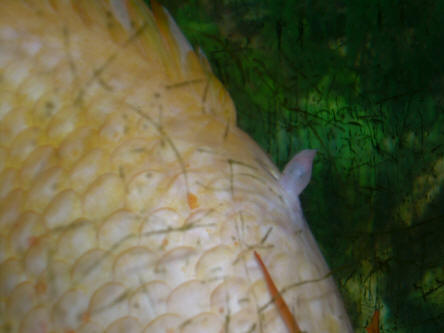
Cichlid Troubles
7/13/14
My sherbet orange knot head cichlid is very old and has been swimming
upside down for a while now. I'm guessing that the problems is his swim
bladder. I took a photo of it or I think I did. Notice there seems to be
a mass inside it at the tip. The green lines are scratches in the glass.
What is the problem and how do I fix it?
Thank you in advance
Angie
<Hi Angie. It's hard to see what this thing is from the angle of the
photo and because of the way it's been cropped. But it looks like an
anal prolapse. Quite common in cichlids. Essentially the back part of
the colon gets infected, expands out of the anus, and what you see is a
funny looking "growth" attached to the cichlid. It's treatable for sure,
using Metronidazole. Do have a read of the relevant FAQs on the pages
linked below; use your browser's search facility to look for the word
"prolapse" and you'll go right to them, plus some photos:
http://www.wetwebmedia.com/fwsubwebindex/OscarDisF8.htm
http://www.wetwebmedia.com/fwsubwebindex/neotropcichdisfaqs.htm
http://www.wetwebmedia.com/fwsubwebindex/parrotcicfdgf.htm
Environment and diet are the two causative factors, so review and act
accordingly alongside any treatment. Good
luck, Neale.>
|
 |
cichlid dorsal fin closed 12/18/13
I have four baby orange cichlids in a holding tank. Recently, two
of the fish have a dorsal fin that is closed so I took out the fish and
I cleaned out the tank but only put back the two healthy fish.
Meanwhile, the two fish with the closed dorsal fin are in a bucket.
please tell me why the fins are closed and whether I can do anything
about it.
<... Need information on water quality, history of maintenance... I
would NOT leave fish in an unfiltered, unheated bucket for any length of
time.
Bob Fenner>
Re: cichlid dorsal fin closed 12/18/13
The water was .1% ammonia before the tank was cleaned.
<Toxic. Must be 0.0. Read... on WWM re. BobF>
There is a separate part of the tank parceled off by a piece of glass.
The 4 baby orchids were kept in this separate holding area within the
tank. Two of the fish kept in this separate holding area within
the tank got collapsed dorsal fins.
I cleaned the tank right after I saw this. I cleaned the regular
tank, but never cleaned the holding tank before, but I cleaned the
holding tank after.
Is there any way to cure these two fish?
<Fix the environment, time going by>
Re: cichlid dorsal fin closed 12/19/13
Thanks.
<Welcome>
|
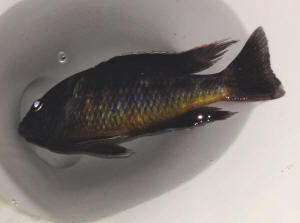
Over Night Cichlid Death 3/5/13
I'm not quite sure what type of fish I had, my girlfriend bought it for me
about a year and a half ago, but I fed my 7 cichlids two herbivore
blocks last night. The fish in question, see attached photo, usually
eats most of one block, and he did. I also added some Stress Coat last
night before I went to bed. At about 5 this morning I woke up to what
sounded like a pool party in my tank, but I didn't think anything of it.
When I turned on the tank lights an hour later he was floating at the
bottom. He didn't seem to have any visible damage marks on him which
leads me to believe that he either had too much to eat and choked or a
chemical imbalance. I'm asking this to try to prevent my other fish from
dying. Thank you!
P.S. Sorry for the ..somewhat informal.. picture, I found out that
it was the only picture I had of him! He looked more gray than the
picture
About chemical makeup currently:
pH: 7.7
Ammonia (NH3 / NH4+): 0.22 ppm
Hardness (GH): 300 ppm
Total chlorine: 0.2 ppm
Total alkalinity (KH): 320ppm
Temperature: 22 degrees Celsius
< You cichlid probably choked on something in the middle of the night.
When he panicked he probably thrashed about and knocked himself out and
drowned.
If the fish is still around try and peek down his throat and look for an
obstruction to confirm.-Chuck>
|
 |
Mystery Texas Cichlid Death
11/11/11
I just had my Texas cichlid die. He was very healthy one day and I
found him dead this morning. No noticeable illness in my tank. I have a
few cat fish and convicts and they look a little depressed but no
visible disease. What causes premature death in healthy looking fishes?
Can you help me understand this? Thank you for your time. Kelly
< Look for trauma around the head. He may have jumped and hit his
head. A second cause may be he choked on something like a plastic plant
leaf.-Chuck>
|
serious disease in my cichlids they are dying in
numbers
Cichlid Tank Die Off 9/30/11
Hi WWM, Please!! Please!! Help. My fish are dying & looking
worse. I am hoping that you can help me. I have a 125 gal
aquarium that was housing about 17 small cichlids about 1-2
inches. They were all healthy, getting along & eating well.
The fish man that changes my water & cleans my tank every
month, wanted to get rid of his larger cichlids. So I allowed him
to add his healthy bigger 4-5 inch, 15 varied cichlid fish. My
tank has 2 large 360 Marineland filters, 3 power heads for the
underground filter and 3 large air strips. The problem I started
having late last week is that 4 of the bigger fish came down with
one cloudy white eye, in varying degrees. I have seen this before
with another tank I had, so I did another water change &
started treating with Melafix as directed on the back. Also I
tested the water before I did the water change and the pH was
7.5-8.0. nitrites were 0, and the nitrates were 10, GH was 180
& KH was 180-240 which is where the water has been for the
last 6 months. However, day by day the cloudiness has been
getting worse, progressing to white patches on other fishes
mouths & faces and open ulcers on the sides & bellies of
other fish.2 days ago when I seen the first white patch I was
suspecting a fungal component, so I added Pimafix along with the
Melafix. Unfortunately today was day 7 of treatment & they
look worse. In fact I lost 3 fish, so I am even more worried.
Could the Pimafix & Melafix been harmful?
< I think you had am ammonia spike when you added the new
fish. The waste generated by the new fish exceeded the
bacteria's ability to convert the excess ammonia into nitrite
and nitrate. This would account for the cloudy water. As the fish
die their decaying bodies add additional ammonia into the water.
When you added the Melafix it probably killed or at least
impaired the bacteria to convert ammonia..>
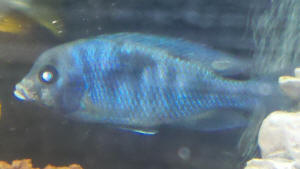
As I have read in your many blogs I am suspecting that is was
really a bacterial infection I will attach pictures.
I am hoping that you can recommend a medicine that can cure this
problem.
I don't have a qt tank & believe that the symptoms are
arising on fish that didn't look sick the day before I should
treat the whole tank. Thanks in advance, Pam
< Check the ammonia with a test kit that gives numbers in PPM.
Kits that say "fine" are worthless. Any ammonia reading
is harmful to fish. This stresses the fish and makes them
vulnerable to infection. I would recommend a 50% water change,
clean the filters. Add Dr. Tim's One and Only. It is a
bacterial additive that works very well. The ammonia should be
under control very shortly. Feed only enough food so that all of
it is gone in a couple of minutes. Remove any uneaten food. Once
the ammonia gets under control you can add some rock salt to the
water to increase the slime coating on the fish. Cichlids are
pretty tough. Once the water gets cleaned up they recover pretty
quickly. The other approach is a little more drastic. Clean the
tank and the filters and do a 50 % water change while vacuuming
the gravel. Treat the tank with a antibiotic like Erythromycin or
Nitrofuranace for the bacterial infection. This will probably
wipe out your biological filtration. so you will need to water
changes to keep the ammonia under control. Once the fish have
recovered you should add some quality carbon to remove the
medication, do a 50% water change and then add the Dr. Tim's
One and Only. This should get the tank back ob track in a few
days.-Chuck>
|
|
|
My sick fish... Cichlids... need
data 6/8/11
Hello. Thank you for taking the time to listen to my concerns. I have
two cichlids, one yellow (Oscar) one blue (Diggs) I noticed about 2
weeks ago that Diggs' tail fin was looking ragged, but assumed that
it was Oscar biting him since I've seen him chase him around.
However for about a week now Diggs has stayed in one spot in the tank
and not eating. Today Diggs did come to the top and ate some food, but
when he did I saw that he had a white bump on the side of his mouth.
Oscar hasn't been acting weird and is eating just fine. I've
had the water tested and everything was in normal range.
<We need the actual numbers for what was tested>
I have two questions; 1) is there anything a broke recently graduated
college student still looking for a job do to help my sick fish (cheap
medications, general advice)
<Need data re the size, mechanical make up, foods/feeding, decor,
the species involved here...>
and 2) will Diggs' illness spread to Oscar?
<Likely this is simply a psycho-social issue... the one fish
mechanically damaged from trying to avoid the other... More decor may
dissipate the antagonism>
I was thinking about moving Diggs away from Oscar and into a little
tank I have but was worried he wouldn't tolerate the move because
he was sick.
<Better to isolate in some way...>
Thank you again for taking the time to listen to me, I am very grateful
and appreciative.
Jasmine Teats
<Jas, you may benefit from reading re Cichlids en toto on our site.
Start here:
http://wetwebmedia.com/FWSubWebIndex/fwlvstkind2.htm
scroll down... Bob Fenner>
My sick fish cont. 6/8/11
Hello, sorry about the second email. After reviewing more FAQs I
noticed I forgot some important information. My fish are in a
ten gallon tank,
<Too small for African Cichlids and most Neotropicals... THIS is
your root problem>
and I've had them for a little over 8 months. The only supplements
or additives I use are Top Fin ammonia remover, bacterial supplement,
and tap water dechlorinator. Their food is Omega One cichlid flakes.
These are my first fish and I'm really hoping to keep them for as
long as possible.
Thank you again for all your time, please feel free to email me at this
address.
Jasmine Teats
<Welcome. BobF>
Still Learning...Help my Cichlids
please...........
Cichlid Shimmy 5/17/11
Hi there, I have a 60 gallon tank with the following Cichlid's. The
issue is I know now after investigating so many things, that either 1
my water is not where it should be and or the fish have a internal or
external disease. Maybe both at this point? I have tested the water and
here are the results:
Nitrate 160 - 300 - DANGER, I assume? I know I need to do a water
change but to lower the Nitrite, what should I get to boost biological
filtration? Or do I need to buy anything? (Nitrifying bacteria?)
< Do a 50% water change, clean the filters and vacuum the gravel.
Check the tap water too. In areas where there is lots of agricultural
activity the nitrates can be high in the tap water.>
Nitrite - safe per test
< Safe means nothing. Get a kit that gives you actual readings in
ppm. Reading should be zero.>
Hardness - 300/good?
< Ok for the fish you have.>
Alkali 180-300 not sure hard to tell on test stick, Isn't this high
though? What do I need to do to bring this down?
< Fine for the fish you are keeping.>
pH 7.5 to 8.0 - normal/good?
< Fine for the fish you are keeping.>
Ammonia - normal per test kit as well.
< Get a kit that reads actual numbers in ppm. Zero is what you are
looking for.>
We have treated the water with Maracide for starters. I see a cotton
like fungus on the Oscars pectoral fins and on body. That is the ONLY
visual I see on any fish. I also think these fish may be suffering from
bloat. We were told all of them were carnivores and now know that is
not true. They are omnivorous as well.
What can I buy to treat that - that these pet stores/shops will
actually have on hand?
< By reducing the nitrates you should see a reduction in the body
fungus and overall improved health of all your fish. Medications may
not be needed.>
Two of the fish are not eating and one of them is sooo bloated looks
like it is going to pop! - this is the one I now cannot find today.
< Bloat may be caused by stress or by diet. In Lake
Malawi cichlids it is probably caused by a diet with too much
animal protein.>
Fish Listing: Most of the fish are scratching themselves on the bottom,
acting weird, shaking, etc.
Last water change: 2 weeks ago. Need to change again today 50% but need
to know what else I should treat with? No hospital tank available.
>> 1 Tiger Oscar - has cotton stuff on pectoral fins and one
white spot on body.
>> 1 Mbuna - (blue fish) - now starting to go to the top of the
water where the filter is, just like the one that died did prior.
à 1 Melanochromis Chipokee - this one died recently - nothing on
scales or body to identify death. Bloated though..
à 1 Turquoise one that's like the Genus Henucgrinus died or
hiding still? Not sure
< Not aware of any fish in this genus.>
2 Electric Yellows
2 Metraclima Estherae (Red Zebra) - orange fish
1 Convict Cichlid - stays to itself
1 Genus Henucgrinus
1 Tin Foil Barb (Orange fin)
1 Metraclima Callainos?? Or Petrotilapia, or Pseudotropheus/Metriadima?
- the purple dolphin looking one & a caramel one
1 Bumblebee
1 Albino Pink -don't know real name light pink with red eyes and
gold around it. Looks like the Red Zebra but Albino pink
1 Algae Eater
1 Jewel fish
Food Questions: I know what they eat but what is the best form of
feeding to use for the spinach, vegetable matter, seaweed, etc?
< Spirulina flakes or pellets are fine for the Lake Malawi fish. The
others can handle it as well.>
Do they sell any of this in a pellet form?
< Sold as wafers for Plecos.>
What do you think is the main cause of the fishing shaking, rubbing
themselves on the rocks, etc.?
< High nitrates. Reduce the nitrates add a teaspoon of rock salt per
5 gallons of water to increase the slime coat and reduce the skin
irritations.-Chuck>
Thank you, Kathleen Zavala
Re: Cichlid Shimmy
Cichlid Shimmy II 5/17/11
Hi Chuck, Thank YOU so much for getting back to me. I really appreciate
it. Did a 50% water change last night, removed filters (for now) due to
the med's in the tank (Maracide) and cleaned gravel etc. Added the
Nitrifying bacteria solution per instructions, and added what I had
left of the Maracide not enough for the 60 gallon tank but will have to
do till I can get more today.
How long should I treat the fish for with the Maracide for parasites,
etc?
< As per my first response, I would recommend not treating the tank
until the nitrate levels are under 20 ppm. The Maracide probably wiped
out the biological bacteria that were in the tank and the ones you just
added.>
Should I add more Nitrifying bacteria to the tank today?
< I would recommend replacing the filters with carbon to remove any
medication still in the water. After the medications are gone I would
check the water quality for ammonia and nitrites. If you get any
readings then the biological activity has been disrupted and I would
add Dr. Tim's One and Only to quickly replace the biological
filtration.>
After the water change I tested the water again. The nitrate was then
between 40 and 80.
< Much better than before.>
I then added the Nitrifying bacteria. Do I need to now take another
reading?
< Since you medicated the tank I would test the water for ammonia
and nitrites. Continue to do water changes to get the nitrates under 20
ppm.>
As of last night, I now see other fish with white spots but bigger than
just a dot. (not looking like the normal Ick or velvet dust) Or, what
would be your recommendation, please?
< Get the nitrates under 20 ppm, add the salt like I recommended.
Feed only enough food so that all of it is gone in 5 minutes. Remove
any uneaten food. Give the fish a few days to recover.>
They seemed to appear happier but still shaking. I mean, this was
really freaking me out. They were shaking like they are about to have a
nervous breakdown. (no kidding!!) scary! Then, they swim and "act
normal" I've never seen a fish act this away. And, I found the
other fish that I couldn't find. It was dead. Removed from
tank.
< Check the water temp. with a thermometer and add the salt. The
shimmy should go away as conditions improve.>
I value your input and advice. Thank you, Chuck! Kathleen
< The crew here at WWM is always happy to assist aquarists in
keeping their organisms alive.-Chuck>
Re: Cichlids slowly dying
5/10/11
Dear team,
I just wanted to thank you so much for your help. Since keeping up the
water changes, my fish have been great and grown about a centimeter
each.
Thanks again and great work- I love your site!
-Kiara
<Congratulations Kiara, on saving your animal's lives/health.
Bob Fenner>
Suspected Septicemia
Cichlids With Red Mouth Possible Septicemia
6/29/10
Hi WWM Crew, I'm seeing redness at the mouth area, at the joint
between body & pectoral fin and some parts of the body on my
cichlids. I've been using API Furan-2 (following these steps):
Day1: 3 packets of Furan-2 powder + Pimafix + Melafix
Day2: 3 packets of Furan-2 powder + Pimafix + Melafix
Day3: nothing
Day4: 25% water change + 3 packets of Furan-2 powder + Pimafix +
Melafix
Day5: 3 packets of Furan-2 powder + Pimafix + Melafix
Day6: nothing
Day7: 25% water change
I've been doing this cycle for 7 days now, not much of improvement.
So I've just started tonight to mix 1 pack of API T.C Tetracycline
powder with a small amount of water, to soak some pellets into this
mixture for about 15
minutes, then feed my cichlids. They are still eating fine.
- I would like to know if this mixing of Furan-2 (externally) and T.C
Tetracycline (mixed with pellets) is advisable.
< If the Furan is not working then discontinue it. The Tetracycline
is worth a try but I have found it not to be a big help in my own
situations.>
- How long does it take to cure septicemia?
< You should see some improvement in a few days if it is
working.>
- Should I keep this up or is there something else you can advise me to
do?
< See below>
Thanks in advance. Hope to hear from you soon.
Regards, Roger
< Check the water chemistry to make sure that it is compatible with
the fish you have. Rift lake cichlids like hard alkaline water. Soft
acidic water may stress them and leave them vulnerable to disease. I
like to use the Furanace based antibiotics but sometimes they are over
used and some bacteria become resistant to them. I would try
Erythromycin and forget the "fix's".-Chuck>
weird acting fish
Clamped Orange Cichlid 2/16/10
My orange cichlid is not swimming all over. The fish seems to stay in
one spot and move his head back and forth and shake. Its dorsal fin is
mostly held close to its body. I can't see signs of Ick. The
eyes are bright. No white dots any where. What do you think?
Gary
< This is a case of the shimmies. It is usually seen on mollies.
Check the water quality. The ammonia and nitrites should be zero. The
nitrates should be under 20 ppm. The term "Orange Cichlid",
is not a great descriptive term. If you have a yellow Labidochromis
from Lake Malawi, then the fish requires hard alkaline water. If you
have an orange Chromide then you have a cichlid that comes from
brackish water and requires some salt. Check out these fish names on
the internet and see if you can match up a photo with your fish. Once
you identify the fish and match the water conditions the disease can
then be treated. My guess is that you have an orange Chromide in a salt
free tank. The other fish in the tank may not like the salty
conditions. Most fish can handle some salt, exceptions are some soft
water catfish.. I would recommend adding a tablespoon of sea salt per
10 gallons of water and see how the fish responds. The water temp
should also be around 78 F.-Chuck>
Water changes, cichlid sys., hlth.
2/1/2010
I made the mistake of changing all the water in our 37 gallon tank now
the cichlid hasn't eaten much of anything it's been 5 days.
will he come around he seems to keep his mouth open now more than
before .mark
<These two things are likely unrelated. While changing too much
water can cause problems if the new water has a very different
chemistry or temperature, in general this big water changes aren't
a problem. Provided the biological filter remains operative, and the
variation in temperature and chemistry was slight, you can change as
much water as you want. Now, cichlids fight using their jaws, and
dislocated jaws are common when aquarists make the mistake of keeping
fish together that shouldn't be kept together. Firemouth cichlids
for example are famous for suffering
dislocated jaws when kept with more aggressive Central American
cichlids.
This is because Firemouth cichlids have special jaws evolved to sift
sand (which is why you keep Firemouths in tanks with a sandy
substrate). To avoid fighting, Firemouth cichlids bluff and puff out
their red throats, but Convicts don't play along with this game,
and can do some serious damage when fighting with Firemouths. Anyway,
your stocking is much more likely to be the problem here; if there are
other cichlids in the tank, then this one with the broken jaws may well
have been on the losing end of a fight. You can try to re-set the jaws
by very, VERY carefully pulling the jaws forwards and then hoping that
when you release them, the jaws click into place. You may need to do
this a couple of times. A vet could do this for you if you prefer. But
otherwise, the fish will not be able to eat, and will eventually
starve. That being the case , if attempts to re-set the jaws don't
work, then the cichlid will need to be painlessly destroyed. It will
not get better by itself.
http://www.wetwebmedia.com/euthanasia.htm
In future, think carefully about what you keep in a community of
cichlids, and don't keep species likely to fight, or very different
in fighting ability.
Cheers, Neale.>
re: cichlid
Thank you for your quick response, we have only one fish in the tank
,he was flapping around a lot when I tried to catch him to get him in
the pail do you think he good have dislocated his jaw at that time?
<Possibly, but doesn't sound very likely. Most dislocated jaws
are caused by fighting; to become dislocated, the jaw needs to be
firmly pulled, and it's hard to imagine what other circumstances
might cause this. Cheers, Neale.>
Cichlids With Cloudy Eyes -- 1/27/10
I have 2 cichlids in a 29 gal tank. We've had them 5 or so years.
(They ate all the other fish that were in there within a week and
anything else we would try.) One of them developed a cloudy film over
its eye. I thought it looked as though his eye had rotted out. Pretty
gross! My husband is the primary care taker of the tank. I let him know
and he put some salt in the tank. I just kept watching the fish. Then I
realized the eye was still there. It was just a film over the eye. The
film had come loose on one side and it looked like it was getting
better until it spread to the other eye.
The first infected eye now has a cotton ball looking stuff on it. The
fish is pitiful. It stays in one spot usually, doesn't act
interested when fed (or doesn't know there is food) and today it
just runs into the walls/plastic plants like its blind (which I'm
sure it is). Now the other fish has the film over its eyes. I don't'
know what to do or where to start.
I have read everything I can get my hands on, but nothing I've read
fits exactly. Is it fungus, pop-eye, TB, bacteria, or what? What do I
do about it? .... and I hate to ask this, but when is it too late to do
anything?
And if it's too late, just exactly what do I do? These poor fish
are just getting worse and I can't wait for someone else (who is
supposed to be taking care of the tank) to do something about it.
Please help me to help them. Thanks!
Anita
< First thing is check the water quality. The ammonia and nitrites
should be zero and the nitrates should be under 20 ppm. It is probably
bad so do a fifty percent water change and clean the filters. Next week
do a twenty -five percent water change and vacuum the gravel.. If no
improvement is seen then treat with Nitrofurazone. It treats both
bacteria and fungus. When the cloudy eyes clear up you will be able to
determine if your fish is blind or not.-Chuck>
Cichlid Sick or Non-compatible
12/28/09
Hello, My husband and I just got two cichlids from a pet store that got
them from a guy, so we are not sure what kind they are. I went to the
pet store owner on 12-6 of this year with my camera, cause our females
belly is
a little bigger then normal, and she said that one is a male and one is
female. And the one that is female has the bigger belly. She has been
hiding in the corner, and when the light is off the male doesn't
seem to attack her as much. We are worried as it has been close to a
month and her belly has not gone down. Please help us. Thank You
Tiffany
<If they are a pair then the female is not ready to breed and the
male will chase her until she becomes ready to breed. You did not
mention the species so it is difficult to make recommendations on how
to get her ready. If she
has an intestinal infection then the belly will become larger as the
parasites in the gut multiply and expand the gut. This can be treated
with a combination of Metronidazole and
Nitrofuranace.-Chuck>
Re: Cichlids?
Cichlid Spawning? 12/31/09
Chuck, Thank you for responding. I do not know the species of these
cichlids. He is making nests and she just hangs out in the corner most
of the time. I tried to send you a video of this, did you receive it?
He also does not like people to close to the tank, kind of like he is
protecting her. I am unsure what to do, cause it has been close to a
month of her acting like this and having a swollen belly. But when she
does swim, she seems to be swimming good. Am I missing something
though? Thanks Tiffany
< Videos take up a lot of space so a simple photo would work just
fine.
Cichlids usually have two spawning strategies. One is called substrate
spawning. The pair usually look similar except the male may be larger
and have more pointed fins. The pair usually have some spawning ritual
with flared fins and some jaw locking. Once a pair bond has been
established they settle down and prepare a spawning site, usually on
something solid like a rock, log or even the side of the aquarium. The
female lays the eggs in a row and then the male follows close behind to
fertilize them.
After a few days the eggs hatch and then a few days later the fry
absorb their egg sack and become free swimming. Both parents defend the
eggs and fry. The second method is mouthbrooding. Mouthbrooding
cichlids usually are very sexually dimorphic. Males are larger and very
colorful while females are drab and smaller. The male builds a spawning
site by usually digging a pit. He then dances around trying to attract
a fertile female to the site willing to spawn. She will lay an egg in
the pit and then pick it up in her mouth. She will then pick on the
males anal fin. When he does this he fertilizes the eggs in her mouth.
When they are finished the male chases the female away and then looks
to attract a new female. Either way it doesn't sound like you have
a spawning pair.-Chuck>
New Tank Cichlid Problems 12/11/09
Hello, I need help to figure out what is wrong with my African cichlid.
I just bought my tank 2 weeks ago and I got two African cichlids, two
Oscars some sucker fish. One of the cichlids was acting funny then it
started to turn silver from the belly to its back. When the fish is
usually blue it started swimming up side down and having trouble
breathing. I took him out when he died than I noticed a little white
kinda translucent bubble on one of my Oscars. I have looked at many
different internet sites to try and figure out what the problem is with
no good out come. Please help me if you can and thank you for your
time
<Check the water quality. When tanks are new they have no biological
filtration so ammonia and nitrites can be a major problem. If they
don't kill the fish outright then they weaken the fish to a point
that they get very sick from all kinds of diseases. Control the
nitrogenous wastes with water changes or add Dr. Tim's One and Only
to get the bacteria established. In about 30 days or so ammonia may
start to be broken down by some bacteria but then the nitrites will
become a problem. If you treat now then you will kill all; the bacteria
and your tank will not get cycled and you will have problems all over
again.-Chuck>
Cichlid help please
Cichlid With Eye Trouble 12/3/09
Hi, Today when I got home I noticed that one of my cichlids had a
bubble in his eye (under the lens). It is perfectly clear and the eye
itself is not bulging. Do you have any idea what is causing this or,
more importantly, how to fix it? Thank you so much for your time.
Sabrina L.
<Almost every circumstance that involves a gas bubble usually is a
symptom of some bacterial activity. The bacteria's metabolism can
be treated with antibiotics, even under the lens. I would recommend
using a Nitrofurazone type antibiotic in a hospital tank. Once the
bacteria have been treated the gas bubble may be reabsorbed by the
fish's system.-Chuck
|
Geophagus brasiliensis
Cichlid With Infection 11/11/09
Hi guys, hoping you can help! About 3 months ago I purchased a
pair of large Geophagus brasiliensis. They took a bit of a knock
in the shop the careless guy allowed the bag to drop to the floor
but I still had them as they were such beautiful fish. Within a
couple of days of having them, one started to develop a lump on
the side of its head. I put this down to the bump they received
and thought I would wait and see if this 'bruise' went
down. The lump never disappeared or got any better or worse and
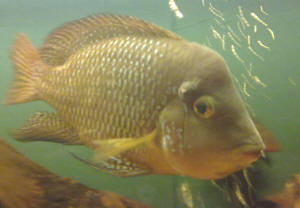
as the fish seemed perfectly happy otherwise, eating, healthy and
constantly flirting with its mate. It didn't really concern
me too much. In the last week or so the lump has developed a sort
of red pimple in the middle, a bit like a white head on a normal
spot. I've enclosed the best picture I could take. I'm
hoping you can cast some clarity on this as I cant seem to find
anything online and im really hoping this isn't HITH. My fish
are in a 850 litre tank with a few other new world cichlids,
there is no aggression between any of the fish and all my water
parameters are normal Many thanks
Dan
< Thanks for the photo. The bacterial infection is coming to a
head. When it pops like a pimple, There will be some redness. At
that time I would do a 50% water change and watch the site
closely. It doesn't heal right away or look like it is
getting better then treat with an antibiotic like Furanace. I
don't think it is HITH.-Chuck>
|
 |
Cichlid problem, hlth. 8/17/08
Hello again, My T-bar cichlid has got hole in the head, all my fish are
scratching, twitching and have all there fins down. <Likely caused
by Hexamita, and almost always trigger by environmental or dietary
deficiencies, i.e., overcrowding, high nitrates, lack of fresh greens.
Treatment is only possible via Metronidazole, couple with correction of
water quality/diet. http://www.wetwebmedia.com/metranidazole.htm >
They are all eating normally except my T-bar with hole in the head and
they have been doing this for 3 days now and they have no signs of any
spots so it cant be white spot. <Hexamita is most common when
cichlids are overcrowded. Quite possibly latent in all cichlids, when
their immune system becomes weakened the Protozoans spread from the
digestive tract into the body and out to the lateral line. It's the
ones in the lateral line that cause the distinctive pits and
lesions.> What could be wrong with them all? Thanks <Review
environment, diet, and act accordingly. Cheers, Neale.>
Re: cichlid problem 08/18/2008 Hello,
When you said "review environment" what did you mean? My tank
has lots of bogwood and a few plants with fine gravel. Thanks.
<Simple. Take a look at all the requirements for the fish you have.
Look in an aquarium book (or search this web site) to find out more
about each species. Note things like water chemistry (pH, hardness),
diet, space requirements, compatibility with other fish, etc. Write all
these things down. Then compare them to the environment in your
aquarium. Any differences between what your fish need and what you are
providing will be likely sources of potential problems. Also check
nitrite and nitrate; nitrite should be zero at all times, and with
cichlids nitrate should be as low as practical, ideally less than 20
mg/l. Cheers, Neale.>
|
Crayfish, cichlids; health ... English... "Buttons are
not toys" 7/31/08 ok so I have had
my electric blue crayfish for about 5 months now. he's appx.
5 inches long. <Cool. Now, make sure you don't keep him
with any fish.> doing well until I accidentally introduced a
seemingly well cichlid into the tank. <Oh dear.> he blew up
and died about a week ago. I think the Cray may have eaten it!
<Well, fish don't "blow up and die" for no
reason. Crayfish can catch living fish and eat them, and they
certainly will consume fish that are sick/dead for other
reasons.> he's pretty lethargic now and he sits cocked up
to one side and his legs on top just sway back and forth. he
really wont eat and I know he's dying. is there anything I
can do?? <No information here to work from. How big is this
tank? What filter are you using? What is the water chemistry (at
minimum: the pH)? What is the water quality (at minimum: the
nitrite concentration)? Almost certainly water quality is an
issue, if not THE issue.> pet smart gave me 'gel Tek'
'ultra cure PX' <Pointless, unless you know what's
wrong and how you cure it. Since you have no idea what the
problem is, how can you treat the animal?> they said it would
be ok for him to eat too, but he really wont. and now my other
cichlids are getting blown up looking too. <Ah, definitely
water quality.> I noticed when the other cichlid died her
scales were like coming up. don't know if any of that helps,
but what can I do to save my Cray and my cichlids!??? I know by
the way everyone looks I don't have long! thank you!
<I'm assuming this is an overstocked, under-filtered tank,
quite possibly with the wrong water chemistry for the species
being kept. Without names for these cichlids, it's impossible
to say what conditions they require. Some (e.g., Mbuna) need
hard, alkaline water. Others (e.g., Severums) need soft, acidic
water. All cichlids need spotlessly clean water with zero
ammonia, zero nitrite, and ideally as little nitrate as possible,
certainly less than 50 mg/l. In any event YOU CAN'T MIX
CRAYFISH WITH FISH. Cheers, Neale.>
Re: crayfish, cichlids; health 8/2/08 well the cichlids
are African Kribensis, and I've had them since birth. still have
the parents in a diff tank. the water is fine, for all, checked
it over and over. <If you say so!> the cichlid I introduced
was already sick, I know that, now) and when he died, the kribs
ate it and I think so did the crab. <Letting fish eat dead
fish is asking for trouble. Many diseases are spread that way.
Remove fish as soon as they die, and ideally isolate them when
they're sick.> they were all fine till about 3 days after
the Wal-Mart fish died. he seems to be fine with my fish, I've
never seen him raise a claw to them. not that it wont or cant
happen! <Indeed. Many cichlids become territorial only once
sexually mature, which may take 6-12 months, depending on the
species.> I am well aware of that. so total in the tank I have
2 cichlids, and 5 small tetras, and the Cray. the cichlids are
still juvenile, only about an inch and a half. all were fine
until I put the seemingly fine Wal-Mart fish (which I didn't
buy, a friend did.) in. <If you can't quarantine new fish,
then you should be very carefully about selecting additional
livestock -- so accepting fish from friends really isn't a
good idea.> I have a 50 gal tetra filter, with two filters,
and a 20 long, which will soon be a 30 long. I know I need at
least a 50, but funds are low right now. there's plenty of
room for them, the Cray doesn't seem to mind, he's
usually busy and healthy, molted about 4 times successfully.
<Seems as if you're aware of the potential problems but
depending on luck. While we've all done that one time or
another, it's hardly the best strategy.> its definitely a
sickness from the Wal-Mart fish. <Why do you say that? Post
hoc ergo propter hoc? Unfortunately, there's no guarantees
that just because you've _added_ a new fish, the aquarium has
_developed_ problems because those new fish were sick. While it
can happen, it can also happen that the additional fish overwhelm
the filter, or break up the social structures, or a variety of
other possibilities.> I think by eating the dead sick fish
they got sick. <OK, if you say so. Can't say I'm
convinced.> the tetras I don't think ate any because they
are fine and Im sure the cichlids didn't let em get to eat
any of the dead fish. <Hmm...> I noticed though that the
cichlids scales look funny too. this just started. they seem to
be itching on the rocks. no Ich though. can you think of
anything??? <Many things. If they're itching themselves,
then Ick/Velvet are both possibilities, and both can make a fish
sick *without* obvious external symptoms, because both diseases
attack the gills before the skin. If the fish are breathing
heavily, for example, as well as itching, that's a good clue
that Velvet is in the tank. Saying the "scales looks
funny" doesn't help much. Are we talking excessive
mucous, making the body look cloudy? That's usually a water
quality/water chemistry issue. Are the scales sticking outwards,
like the scales on a pine cone? That's Dropsy (oedema) a
symptom of a variety of things from internal bacterial infections
through to inappropriate use of "tonic salt". Cheers,
Neale.>
Re: crayfish, cichlids; health 8/2/08 ok so Im not god,
I don't know for absolute sure that the Wal-Mart fish did it
but here's my evidence... got 2 cichlids (don't know what
there were, just they were yellow.) <Likely Yellow Labs,
Labidochromis caeruleus. A smallish, fairly well behaved
Mbuna.> kept em quarantined for month and a half. one got fat,
and died. <Right. If this happens *in the quarantine tank*
then you obviously don't put the survivor into your display
tank. You run through all the possible diseases, or ideally, and
what I would have done, you take them back to the store. This of
course assumes the water conditions in the quarantine tank were
appropriate to the species in question. For a Mbuna, that would
mean hard, alkaline water with zero ammonia/nitrite, and low
levels of nitrate (less than 20 mg/l if possible). There is
*absolutely* no point quarantining in a tank that isn't
cycled or doesn't have an appropriate chemical filter to
remove ammonia directly. You can't just stick in a new filter
and hope for the best. If new fish are exposed to a cycling tank,
OF COURSE they're going to get sick and die. You may known
this, but I'm just putting this out here fair and square so
other people reading this can understand things.> thought it
was because of the water, they were in with goldfish, I know, but
it was the only thing I could do at midnight (drunk friends do
dumb but thoughtful things). I wasn't going to risk putting
em in my good tank. not fair for the goldies I know, but what
else could I have done??? <Hmm... no idea.> so when one
yellow fish died, after being fine for a month I figured it was
indeed the water. <Why "the water"? Think about this
logically for a moment. Fish live in water. They like water. So
why would water kill them? There are really only two ways that
water *conditions* can kill them -- either the wrong chemistry or
poor water quality. Pick and choose. If 50% of your new livestock
die, then your plan of action is firstly to see if the
environment was right. At minimum, you check nitrite and pH. In
the case of Mbuna, you'd need zero nitrite and a pH around
8.0. If this tested fine, you would then look for possible
symptoms of disease. But you would absolutely NOT move the
remaining "healthy" 50% into the show tank until
you'd at least checked off all the possible diseases and
perhaps treated proactively.> so I moved the last yellow
cichlid to my good tank in hopes it wouldn't die too. after
about a week he did die, at night. <I'm concerned that
these "mystery yellow fish" are Mbuna, and you're
exposing them to completely inappropriate water chemistry and
quality. Just to reiterate, Mbuna need water with a high level of
carbonate hardness and a high pH. Adding "tonic salt"
will not work. Kribs will tolerate -- but don't appreciate --
such conditions, and South American cichlids will be positively
stressed by them.> nothing I could do. by the time I woke up
he was already being consumed...Im not depending on luck, but Im
trying to do the best I can with what I have. <We've all
been here. Which is why I'm stressing research and water
chemistry/quality so strongly. You have very little scope for
error and seemingly no Plan B, so you have to get things right
first time. This demands a slow, methodical approach rather than
hoping for the best. In other words, carefully identify all your
livestock. Write down what conditions they require. Determine
whether you can provide those conditions. We can help with all of
these things. But so too will a good book. Libraries are full of
them.> I did not ask for these fish nor did I want them. like
I said drunken present at midnight. not something I would have
ever done. didn't need any more fish. now, the velvet thing
sounds like what I have. a lot. would this cause my Cray to be
sick too?? <Crayfish won't get sick from the disease, but
they certainly can carry the infectious stages of the parasite
life cycle on their bodies. In any event, any Velvet medication
can, likely will, kill the crayfish because they contain formalin
and/or copper, both highly poisonous to invertebrates.> and
what do you recommend to fix it? <Remove the Crayfish to a
quarantine tank. Treat the tank with a Whitespot/Velvet combo
medication. Nothing tea-tree oil based! Remember to remove carbon
from the filter (if you use the stuff).
http://www.wetwebmedia.com/FWsubwebindex/fwfishmeds.htm Once
I'd finished that course of medications, I'd perhaps run
something for systemic bacterial infections, for example
Maracyn.> thanks for being prompt, I don't think I have
much time! <Cheers, Neale.>
|
Cichlids Breathing Heavy And At The Top Of The Tank
07/07/08 Hi there , I am relatively inexperienced when it comes to
cichlids , although my water quality is checked regularly I am worried
about the behaviour of some of my fish. My tank is 6 foot in size and I
have many cichlids of varying size and colour. I recently added 4 new
cichlids to the tank, and after doing so almost my entire population
are constantly swimming near the surface of the water ? Why are they
doing this is this common or not ? And what can I do to prevent them
from doing this as they all seem to bunch up , so you cant really see
them , kind of defeats the object of having them ! Any advice given
would be greatly appreciated Many Thanks. < The fish are at the top
of the tank because they are not getting enough oxygen. Start by
increasing the aeration. If you use a power filter then make sure the
return breaks the top of the water to increase the oxygen exchange at
the surface. Check the water temperature. The higher the water
temperature the water has less oxygen carrying capacity. Lower the
temperature to the lower part of their acceptable range. Check the
ammonia and nitrites. They should be zero. If these are present then
they can "burn" the cichlids gills and impede their ability
to absorb oxygen from the water. Treat for gill flukes with Fluke-Tabs.
These parasites attack the blood rich tissues of the gills and block
the water from coming over the gills and interfere with
respiration.-Chuck>
| My Frontosa, HLLE tissue damage -
7/1/08 Hi, I wrote you before about my Front, Georgie and his
hole-in-the-head problem, and that I treated him with Medizole and
Furnace, I then noticed it looked like fungus so I treated him
again with just the Furnace, It looked like it went away but his
holes didn't look any better, so I then treated him with some
medication called Hole-in-the-Head by JUNGLE, and he still looks
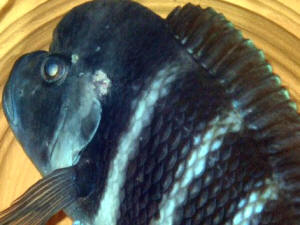
like this, is there any hope? <To heal the wounds from the
neuromast destruction? Mmm, yes... with time, good nutrition, water
quality...> ( I sent you a couple pics) I have had him for a
long time( we think he is around thirteen years) and he has always
been healthy but know I am at a loss, usually when I treat my fish
I have good luck if I catch it right away, I am sending you a few
pics and see if you can see what you think, Thank you for your
time, John Cline <Have seen worse cases remit. Do try feeding
Spectrum pellets exclusively, being religious re weekly water
changes... Read here: http://wetwebmedia.com/hllefaqs3.htm and the
linked FAQs files in this series above. Bob Fenner> |
|
|
sick cichlid, poor English, reading 6/27/08
hi there <Micaela... the beginnings of sentences, proper nouns like
your name, the pronoun "I"... are capitalized...> i have a
55 gallon tank with three parrot fish, a ghost fish, <What is
this?> and a electric blue Johanni, <Not a good idea to mix Mbuna
with neotropical cichlids> which i got about 3 months ago. usually
the electric blue runs the tank and is very active. yesterday he began
to be very listless and didn't eat when i fed them frozen
bloodworms, which is very unusual. he continues to defend his area of
the tank, but does not swim around much any more and even let a parrot
fish get close enough to nudge him. also, not normal. I did a water
change about 4 days ago and added ammonium remover, <... water
should be pre-mixed, stored. Read here:
http://wetwebmedia.com/FWSubWebIndex/fwmaintindex.htm the second tray
on "treating tapwater"> as I always do. I did not add
anything else after the water change. This is obviously not the first
time I've done a water change since I got him. Do you have any
ideas as to why he might be acting this way? there is no physical
evidence on his body. thank you Micaela <Read. Bob
Fenner>
re: sick cichlid 6/27/08 thank you for the advice. p.s.
as an english teacher who just received a master's degree, i
won't take offense to the grammar advice. <... !? Set an ejemplo
amiga! RMF>
I possibly have sick cichlids 5/30/08 Hi,
my name is Emily. <Hello Emily,> I have a 65 gallon fish tank
with two AquaClear 110 filters. Ammonia, nitrate, nitrite, pH are at
the correct readings, and the temp is always around 80 degrees.
<Slightly on the warm side; aim for 25C/77F unless you expressly
keep fish that need other conditions. Do also remember that pH is
largely immaterial; fish care about a stable pH but the number itself
isn't important (within reason). What matters is hardness,
particularly carbonate hardness where cichlids are concerned. Lots of
aquarists make this mistake and test pH but have no idea what the
hardness of their water supply is.> I have had this tank for over a
year, the fish I started with were tiger barbs, a blue African cichlid,
a Firemouth, a jewel, and Chinese suckers. <Not really a compatible
selection of fish. The Jewel needs soft/acidic conditions; the
Firemouth moderately hard, neutral to slightly basic; and "African
Cichlid" covers a lot of ground but I'm assuming
Pseudotropheus zebra, a species that needs a high level of carbonate
hardness and a pH around 8. Chinese Suckers (Gyrinocheilus aymonieri)
don't belong in this system because of their aggressiveness and
tendency to suck the mucous from large fish; and really neither do the
Tiger Barbs because of their predilection to nip fins.> Basically
since I put these fish in they have been flashing (they had no signs of
Ich, parasites, velvet, or any disease at all). <When fish
"flash" for no obvious reason, assume an issue with water
chemistry and/or water quality. The water irritates their gill
membranes, and this is what makes them "flash", i.e., dart
about, scratching their bodies against the sand or rocks.> About 3
months ago, my Firemouths eye turned bright red, almost magenta.
<A secondary infection; possibly caused by water quality, but likely
a direct result of fighting. Firemouths are *not* fighters: they use
bluff almost entirely when settling territorial disputes among their
own kind. Their jaws are relatively weak, being adapted for sifting
sand (which is why you keep them in tanks with sand, never gravel,
substrates). When they get into fights with other, more aggressive
cichlids, they invariably lose out. Firemouths are best kept on their
own or with cichlids that are smaller and/or less aggressive than they
are. Jewels we beat the heck out of them, as will virtually any
Mbuna.> He, nor any other fish, showed any signs of discomfort or
loss of appetite, however the flashing still continued. I then removed
the tiger barbs into a different tank because of my high interest in
cichlids. <A wise move; it's now time to decide how to
streamline this collection by adding compatible species while removing
incompatible ones.> About a month into the Firemouths eye
issue, the red turned into a silver color (must be blind in that eye).
<Indeed.> All of my fish eat Hikari cichlid pellets, frozen blood
worms, wafers, and feeder fish. <Stop with the feeder fish! Unless
you're deliberately trying to make them sick, feeder fish serve no
purpose. None of these cichlids is a fish-eating species in the wild.
All of them feed on algae and small invertebrates, particularly insect
larvae and small crustaceans. Goldfish and Minnows are loaded with
Thiaminase and fats that make predatory fish sick in the long term, and
unless you are breeding something like killifish or livebearers at
home, the cheap feeders aquarists tend to use are "parasite time
bombs". Think about it: if fish are sold for a few pennies a
piece, just how much effort do you think the producer is putting into
keeping them healthy? Once you start feeding even standard tropicals
like Neons and Guppies week after week, these are likely to bring in
Whitespot, bacterial infections, Camallanus worms and so on. In short,
one of the most foolish things any aquarist can do is use feeder
fish.> Their colors are still vibrant, they still have a great
appetite, and still show no signs of disease, however they are still
flashing once in awhile. A few weeks ago, I put a barracuda in the
tank... <Do you mean a "freshwater barracuda", Ctenolucius
hujeta? This is a *schooling* and extremely gentle fish that must not
be kept with aggressive fish. Best kept in trios (at least) in tanks
with lots of floating plants because they don't like bright light
and are prone to jumping. This species does not need live fish as food,
and there are lots of advantages to not using them. They "go"
for movement, especially things in the water current. So use live
shrimps and earthworms initially, and then wean them on to safe
marine-based food items such as prawns and lancefish. Bloodworms and
other insects are also popular, especially with juveniles. When kept
singly they often pine away, especially if bullied by things like
cichlids. Goes without saying that since they're Amazonian fish,
their water chemistry requirements are completely different to your
Central American and Mbuna cichlids.> ...and two high finned Plecos
who are very healthy and don't flash. <The two Plecs will likely
fight eventually, the dominant one skinning the weaker one alive. Do
understand most Loricariids are territorial, and unless you know a
species is sociable, they must be kept singly.> A few days ago I
introduced a Julidochromis "gombi" into the tank and is doing
great. <You're mixing Mbuna with Tanganyikans? Whoa... someone
needs to sit down with a cichlid book. This is in the top ten list of
no-no items. Mbuna can, will destroy Tanganyikan cichlids; the
difference in temperament is just too extreme. Maybe not right now, but
once the fish become sexually mature you're inviting trouble,
especially if the Mbuna is a male.> I want to know if I should be
aware of this flashing that the other fish have experienced and why I
haven't seen any sign of disease. <Review water
chemistry/quality. There's no way you have ideal water chemistry
for all four species since they all have different requirements. So
someone isn't getting what he needs. Check your carbonate hardness
in particular, and get back to me if you need to discuss this
further.> Like I stated before, all my fish are presumably healthy
and eat great. <So far...> I know that the fish that are flashing
aren't just itchy, even though they don't constantly do it, and
if no signs of unhealthy behaviors are seen then how can this be
treated? Should I bother treating it? Will it spread to the other fish?
The barracuda, gombi, and high finned Plecos have not been flashing.
<Yet... though to be honest the Barracuda will simply die in this
tank at some point, and the Plecs really don't have the speed to
flash! I'm trying to visualize my Panaque swimming fast enough to
scratch... difficult. When she builds up any speed at all, she tends to
just knock stuff over.> And the biggest question is what happened to
the Firemouths eye and why???? <No mystery at all there. Likely
fighting and/or water quality.> I have been looking for answers for
hours now and have received no input what so ever. Please write back!!
Thanks so much!!! -Emily <Well, I've done my best. Not sure
you'll like the answers, but at least they are honest and detailed.
Do consider buying a book on cichlids so that you can understand their
needs. Cichlids have a woeful track record when just thrown into
aquaria... they are demanding fish for expert fishkeepers. For less
experiences aquarists, Central American cichlids probably represent the
best balance of hardiness, adaptability, bright colours and aggression.
The milder species, like Firemouths, can work well in decent sized
groups together with robust dither fish like Swordtails or the larger
Tetras (such as Astyanax spp.); they also work well with Plecs. Mbuna
are simply far too aggressive for anything other than a Mbuna tank, and
then you have the problem of dominant males exterminating everything
they don't like anyway. Mbuna are also very prone to hybridising,
so you have to choose species extremely carefully. Mbuna are herbivores
largely, and need a very mixed diet to do well. Tanganyikans are
probably the single most difficult group of cichlids because they are
extremely sensitive to poor water quality. You really need a
marine-grade filtration system and extremely stable water chemistry to
keep them happy. Aggression can be a problem with them as well, though
to a lesser degree than Mbuna. Jewels are lovely cichlids, but
incredibly aggressive when they start breeding, and are notorious for
killing everything in the tank once that happens. Best kept as matched
pairs in their own tank, or perhaps in very thickly planted tank with
surface-swimming dither fish of some kind. Hope this helps, Neale.>
Parrot Cichlid help 05/23/08 Possible Gill
Flukes On Parrot Cichlids Hello, I need help. I have 4 Parrot
Cichlids in a 75 gallon tank, looks like the youngest one has red like
worms hanging out of his gills on both side. Everything I read stated
that it was Flukes. When I checked the water, yes my Ammonia was a
little high, so I pulled the carbon filters out and treated with a
medication that states that it treats all types of worms. I did
everything I was supposed to but nothing changed. The fish seems
to be "normal" , he's eating, breathing as normal as the
other ones , but I do not know what else to do to get rid of
them. I treated the entire tank because I figured that if one had
it , then the others were susceptible to getting it also. Please help!
Thanks! < You could have anchor worm. It is a parasite that attaches
to the fish via a hook into the flesh. Thus the name anchor worm. The
medication may have killed it but it may take awhile for the dead worm
to slough off. Another approach would be to net the fish out and remove
the parasite with a pair of tweezers.-Chuck>
Sick and Dying Cichlids, Not Much Info
To Go On 05/19/08
Hi WetWebMedia, I am having a bit of trouble with my fishes, and I was
wondering if you could help me out. I have a 40 gallon tank with
cichlids and many fishes have been dying. This is an established tank
and has been there for almost a year now. I do consistent water changes
and use tap water conditioner. No aggression has occurred so I believe
it is because of my water quality. I test my water every week, and
ammonia, nitrite, and nitrate are all at 0 ppm. My pH is in the acidic
zone, but I heard that I should leave it alone as my cichlids will
adapt. I think the main problem is the hardness of the water. It is in
the soft zone and my cichlids thrive in moderately hard water. I tried
adding crushed coral in a net bag and I put it in my filter, but it
didn't really work. Another problem I get is green water. This
never happened before. I do not overfeed and I make sure they finish
all their food. I do not place the tank in a sunny area and because of
the green water, I have to do water changes almost every other day,
which is very tiring. I vary their diets with shrimp pellets, flake
food, brine shrimp, blood worms, veggie cubes, shrimp, crickets, and
beef heart. Please help me out as I do not want my fishes to suffer. Do
you think it is the hardness of the water that is causing all this? I
used to have plants in there but they all died and floated up. I also
used to have a piece of driftwood in there but I removed it because I
read that they lower hardness and pH. Please give me any advice you
have. Thanks so much, Chris < There are thousands of species of
cichlids found in South and Central America as well as Madagascar and
India. They come from the very soft acid waters of the Rio Negro in
Brazil to very and hard alkaline waters of the rift lakes in Africa.
You did not mention the types of cichlids you have, other than they
thrive in moderately hard water. This covers a great many species. Your
fish are dying yet you describe no symptoms. Are they bloated? Loss of
appetite? Color changes? Frayed fins? Open sores? Heavy breathing?
Anything? If you are concerned about the water hardness I would
recommend that you get a reading for your tap water with a hardness
test kit. Modify the hardness you desire in a separate container with
commercial buffer and salt additives. Do a water change while vacuuming
the gravel and cleaning the filter. Add the new buffered water to the
aquarium. You want to make these changes very gradually. Eventually you
will get the water in the aquarium to the hardness you desire. Green
water comes from excess light and nutrients in the water. I would
recommend that you feed you fish once a day and make sure that all the
food in gone in a couple of minutes. The floating green algae suspended
in the water may be absorbing all the waste in the water thus your zero
readings for nitrogenous wastes.-Chuck>
|
Re: cichlid question Disease
Treatment Recommendations -- 03/07/08 Thanks for the info but
before I got the reply, I got desperate and called the local
petstore (which might I add that here in the mountains where I
live good pet stores are few and far between) and she told me to
use Jungle brand Ick Guard to treat for Ick. I told her that it
didn't look like Ick and she said that it was the advanced
stages of Ick, and insisted that I use the Jungle brand Fungus
treatment along with the Ick Guard. < Ich is a common parasite
but usually shows lots of white spots. The Formalin I recommended
also does a great job on Ich.> So Tuesday, I did a 50% water
change... Wednesday I tested my water 10ppm nitrates, 0 ammonia,
0 nitrites and the pH was 7.6 I know this needs to come up but I
was afraid of putting too many chemicals in the tank. I treated
with the Jungle brand products and the fish still look bad, but
eating well today on Thursday morning but after reading your
reply today, I am afraid that I am wasting time. I have not had
any deaths yet, still have 6 fish... but one of the Jewel
cichlids has become anti-social and hangs out at the top of the
tank about 2 inches below water line. I have no idea if its a
male or female but I like to call "IT" a her because
she seems so petite and girly to me.. :) but anyway, she hangs
out at top just below water line and still eats but not with the
enthusiasm as her tank mates. She is the one looks the worst. She
is covered in black patches and is very dull in color now. After
treating with the Jungle products I plan to do another water
change tomorrow or this evening. So would it be ok to treat my
fish again with the products you suggested even after all the
chemicals I have already used? < When I make a recommendation
it is based on the info supplied by the writer and what has
worked for me the best in the past. Jungle products usually have
lots of salt in them. Salt increases the slime on the surface of
the fish and this could be some of the improvement you are
seeing. If you don't feel that the current treatment is doing
any good then do a 50% water change and treat as per my
suggestion.> I am sorry to sound like such a "noob"
but I really want to prove my husband wrong, he said that I need
to flush my fish and raise guppies. Not only is this a mission to
save my beautiful fish, it has become a mission to prove I CAN
survive fish other than goldfish and guppies. As for the rock
salt you suggested isn't just regular non-iodized salt? Like
table salt? Sodium chloride? < You can use rock salt or
aquarium salt.-Chuck>
Re: cichlid question Cichlids
With Ich Treatment 3/9/08 OK, so far so good! Fish are
still alive! They are looking much better with just the salt that
you recommended. I am having a hard time finding the Formalin,
pet store didn't have it. So, I treated with the Jungle
product for Ich. I have used the Jungle medication until is all
gone. I was wondering how often I should treat with the salt and
should I replace my carbon in filters when doing so. Color is
beginning to come back it appears on my Jewels, and their black
patches have faded almost completely away. Unfortunately for me,
the more petite Jewel has something going on with her eyes. They
don't appear to be bulging out really but more like growing
light fuzz or fur? She doesn't seem to be blind, both Jewels
still occasionally "scratch" the head/gill area of
their bodies as well. The only new symptom is the eye thing at
this point. < The white fuzz is a fungal infection.> My
tank tests are pH 8.4 , ammonia 0, nitrates are 10 ppm, nitrites
0. water temp is 78/79ish. I don't have any carbon in the
filters at the moment and have been relying on 50% water changes
about every 2-4 days during this sick time. Also, I have a
spotted cichlid, reminds me of a leopards spots, that has done
amazing through all of this. He has never lost any color or shown
signs of any sickness. I was wondering if I should purchase a
smaller tank just for him and stop medicating him if he
doesn't look or act sick. I know you all are so busy and I
hate to bother you with my fish problems since I am sure you get
tired of answering the same questions time and time again. I have
really tired to search the web for answers as well as your site.
It is just hard to read so much information and think well that
fits, oh no wait that one fits and so on. I am so unsure of what
I am doing at this point, I just find it more comforting to
actually discuss it with someone if possible. Thank you again for
your time. < Look for Rid-Ich at the local store. If you
cannot find it then look at DrsFosterSmith.com for either
Formalin or Rid-Ich from Kordon. The disease may have caused a
secondary bacterial infection. This can be treated with
Nitrofurazone. This medication is also somewhat successful
against fungal infections.-Chuck>
|
Cichlid Blister/Pimple
2/15/08 Hello. I have a cichlid tank and one of my cichlids seem to
have gotten a "pimple" or blister on their fin. Do you know
what disease this may be? The "pimple" is a pinkish reddish
color. Also, it is only on one of the fins, the other one is completely
fine. Do you have any idea what this may be? Thanks so much. <Likely
a localized expression from a physical injury... getting poked by a
fish spine of another fish for instance. No real treatment advised
other than good care, nutrition and water quality. Bob
Fenner>
Cichlid cut/wound???
2-05-08 Please help me. I have a Firemouth cichlid who has what
looks like cuts, or wounds near his dorsal fins. It is right below his
dorsal fins and not exactly on his dorsal fins. The "cuts"
are a pink/whitish color. He still is very active and eats fine and has
no discolorations. What is this "cut". I am not sure if it is
fin/tail rot. His fins and tail do not seem ripped and seems perfectly
fine. Is it normal for him to have "cuts" below his dorsal
fins? Thanks for your help. <Yes, this sounds exactly like Finrot.
Treat at once with a medication such as a Maracyn or eSHa 2000. Finrot
doesn't cause fish to lose their appetite until it infects the body
cavity, at which point the fish will likely die regardless of
treatment. So treat now! Do also try an establish the cause: Finrot
almost never comes out of nowhere, but is usually associated with poor
water quality and/or physical damage. Firemouths are gentle (by cichlid
standards, anyway) and easily damaged by more aggressive species like
Convicts and Red Devils, so mixing these species isn't a good idea
and often ends with the poor Firemouth getting hammered. As for water
quality, at the very least do a nitrite test just to see what the
situation is on that front, even if everything looks fine. Cheers,
Neale.>
My Jewelfish... beh., hlth. 2/1/08
Hello, My female Jewel seems stuck to the bottom. She feeds normally
and immediately sinks back to the bottom. She swims around as if
magnetized to the bottom. No other symptoms. Any advice? Thanx Jay
<Greetings. One of the most common reasons fish become sluggish or
unable to swim is constipation. Hemichromis bimaculatus feeds on a
variety of foods, but insects are a major part of their diet, and the
skeletons of insects act as a sort of dietary fibre. In the aquarium,
things like live Daphnia and brine shrimp make a very good alternative.
What doesn't help is dried food and flakes, which contain little
fibre. Many cichlids will eat plant material, particularly tinned peas,
as these have an excellent laxative effect. Adding Epsom salt to the
water can help: http://www.wetwebmedia.com/epsomfaqs.htm Otherwise, if
these remedial actions don't help, you have to consider a systemic
bacterial infection or a genetic problem. Bacterial infections often
come under the banner of "swim bladder disease" but can be a
variety of things. They are usually caused by water quality issues, and
with cichlids, nitrate is something to watch, not just ammonia and
nitrite. Bacterial infections are difficult to treat once established;
antibiotics probably work best, so you'll need something like
Maracyn-Two. As for genetics, that's something that is essentially
not fixable. Inbreeding of cichlids is incredibly common, and swim
bladder deformities are typical of this. Often this becomes worse as
they fish matures. In any case, there's nothing to be done.
Provided the fish is otherwise happy, it isn't something to be
concerned about, but obviously a deformed fish shouldn't be used
for breeding purposes. Cheers, Neale.>
Cichlids playing dead????
01/08/2008 Hola, I have a quick question for you. Do cichlids play
dead? <No. Very few fish "play" at all (the sole
exceptions recognised in the scientific literature are among the
Mormyridae Elephantnoses) and usually when fish look like they're
dead, they are dead, or at least in a state of shock. A few fish roll
onto their sides as part of their natural behaviour. Clown Loaches do
this when resting, for reasons as yet unknown. A few fish
'pretend' to be dead, so they can eat any small scavenging fish
that swim too close.> The other day, my convict played dead and I
was so scared. Why did they do that? <Might be a physical problem.
When cichlids are quickly shocked or stressed, for example by adding to
much cold water to their tank, they go distinctly loopy and will lose
balance. They will roll over and drift about for a while. Once they
warm up, they get back to normal. So consider things that could have
'knocked them out' for a while -- a badly handled water change,
someone banging on the tank, loud noises, etc.> They were laying
down, looking as if he was dead, and a second later, he swam across the
tank perfectly. What happened? Is this normal? <Not normal, no. But
if your fish has recovered now, I wouldn't worry too much. If it
becomes a habit though, then you might want to reflect a little more on
what's going on. Cheers, Neale.>
|
My Flowerhorn has a prolapsed anus, please
help! 1/7/08 Hi WWW Crew,
<Hello,> Your web site is so great and informative. Now, I
really need your help to save my FH. He has a prolapsed anus (see
the attachment) hanging there about 3 weeks and there some dead
white tissues come out sometime. He doesn't eat much and not
happy as he was. I tried to clean it with Epsom salt solution,
but not improved. Please tell me what to do with it. What
medicine should I use to help him to pull his prolapsed anus back
inside his body as normal. Is it ok if I cut it off from him??? I
am looking forward for your help. Please answer me ASAP. Attached
is his pix. Your time is my appreciation. Thank you very much,
Tony <Hmm... the problem with this condition is that it
isn't caused by any one thing, and it isn't easy to cure.
The most important thing to do is identify the possible causes
and reverse them. For a start, what are you feeding your
Flowerhorn? Like virtually all other cichlids, these fish are
omnivores and need a balanced diet that includes at least some
plant material and algae. Tinned peas, cooked spinach, and Sushi
Nori, as well as algae wafers, all work well. Just as with
humans, a lack of green food can create constipation, and over
long periods this makes the gut of the fish more sensitive to
bacterial or protozoal infections. Ultimately, it's the
"bloom" of micro-organisms in the bowel that causes the
anus to become exposed in this way. Anything that increases the
chances of bacterial or protozoal infections -- such as poor
water quality or the use of "feeder fish" -- can
trigger the problem. So, the three things to check are as
follows: [1] How much green food does your fish get? Regardless
of what it wants to eat, only feed green foods from now on until
the fish gets better. The fibre will help the muscles of the
bowel get back to normal. Soft foods (like shelled prawns) and
dried foods (like pellets) must be avoided at all costs. Never,
ever use feeder fish or unclean live foods like Tubifex. Brine
shrimp and Daphnia are also "high in fibre" and can be
used, though I suspect your fish is too big to eat them. Oh, and
if your Flowerhorn ignores the tinned peas and spinach, don't
worry! Starving this fish for a couple of weeks will get him
hungry again, and will do NO HARM at all! [2] What's the
water quality like? Cichlids are notoriously sensitive to
dissolved metabolites, including nitrate. 50% water changes each
week, minimum, are important. A big Flowerhorn needs a big tank,
and you're going to have a hard job keeping it healthy in
anything less than 200 l/50 gallons. [3] Keep using the Epsom
salt treatment, adding it to each new batch of water during water
changes. Understand that this may take weeks, even months, to get
better, and during that time you must keep water quality 100%
perfect and the diet as rich in fibre as possible. Hope this
helps, Neale.>
Re: My Flowerhorn has a prolapsed anus, please
help! 1/7/08 Hi Neale, Thank
you very much for your quick reply. <You're welcome.>
Actually, this fish got an internal infection with stringy white
feces which caused his anus prolapsed I think. <Quite possibly
a protozoan infection, as I said; something like Hexamita, which
will require a very specific treatment. In the UK, we'd use
something like eSHa Hexamita.> I treated him with mediated
food and his feces is normal color now. <Good.> However,
his prolapsed anus is still there. <Does take a while to go
back; fibrous foods will help.> I keep very good water quality
and all parameters are fine by changing 1/4 water in the tank
twice a week. <Good.> He doesn't eat tinned green peas
at all, but bloodworms. <Bloodworms are very soft and not good
for this. Try Daphnia or Brine shrimp, but honestly peas are the
best. If a cichlid is starved for a while, it will usually devour
peas!> As you advice, I am going stop feeding him for couple
days. I just worry that he'll be ok with his prolapsed anus
that's hanging there for a long time. <Can be a site of
secondary infection, so is something "not good".>
Will it get back inside his body soon? <Not soon, no. Takes
time to heal.> <Cheers, Neale.>
|
|
|
Convict Cichlid has bulge in
stomach 12/12/07 Hey, <What?> I have had two convict
cichlids for 5+ years, and just recently one of them got a sort of
bulge in the stomach. It actually seems to have appeared randomly. A
while ago I had a feeder fish that I am assuming was eaten (not quite
sure) <... a very poor idea. Read here:
http://www.wetwebmedia.com/goldfshfd.htm and the linked files above>
and I thought that it might have been the fish with the bulge that ate
it, but it seems odd for it to still be there (and the bulge is rather
large). So for the past couple of days, I have been watching them eat
and it looks like the fatter one is eating the majority of the food. It
still acts normally, but the bulge looks very odd and I'm afraid
something could happen to it. I have considered separating the fish in
the tank to feed them separately and make sure they both get the same
amount (they are always together, so I don't want to completely
separate the two). The fatter one seems to always rush to the food and
beat the other one to it. Why do you think the bulge is present? It
seems like even though it is eating the food, it should be able to
digest it and not have the bulge. Do you have any other suggestions?
Thanks so much! -Chantal <... no useful data re water chemistry,
foods/feeding... I suspect there is something amiss here
environmentally... But it could be a disease, parasite introduced
inadvertently with the "feeder". Keep reading. Bob
Fenner>
Re: Convict Cichlid has bulge in
stomach - 12/13/07 Sorry that was of no help. Here is some extra
info, and basically all the info I have left. I moved about an hour
away from home in August and took my fish with me. They are also in a
new (bigger) tank now, but their environment is the exact same. They
have a better/new filter, and I used a lot of their old water for the
new tank. The bulge appeared around early November. My fish don't
typically eat feeder fish, and the one that was in my tank was not
meant to be eaten either. I had goldfish and feeder fish living in the
new tank before I moved my fish in there so that it wouldn't be
squeaky clean and brand new once they got in. The one feeder fish
disappeared, so I am only assuming it got eaten, but that happened
probably around September/early October, so it was a pretty long time
ago. That is really all I have on my fish. I am definitely going to
start feeding the fatter one less once I find a way to separate them
during feedings. It just still seems odd that a bulge would appear. I
have been feeding them the same amount of food for the longest time.
Thanks again! <... could also be a tumour/tumorous growth of some
sort... Only way to be sure is to sacrifice, necropsy the specimen...
Otherwise your proposed changes, good maintenance are about all that
can be done. Bob Fenner>
Re: I really need your help.
Cichlid dis. 11/23/07 Hi! I emailed you about a week ago about my
cichlid, he has a prolapsed anus. I've been treating him with Epsom
salts consistently, and he's been eating the recommended food
(Brine shrimp is all I could find around here.) But the bulge only
seems to be growing, I haven't seen him poop yet! I don't know
whether it's not working or I should try another food? He seems
alright physically (swimming around, eating normally, etc.) but I'm
worried about the bulge. Is there anything else I can do? Is he going
to die? -Amanda <Hi Amanda. Difficult to make a clear recommendation
here. The first thing I'd do if this was my fish is stop feeding
it. If tinned peas and brine shrimp aren't helping, there's no
point ramming more stuff down it's throat! Leave things be for a
while, sticking with the Epsom salt dose though. See if that helps. If
things don't improve in a few days, we might be beyond a simple
cure. Antibiotics may be required to bring down the infection and the
swelling. Cheers, Neale.>
Constipated angelfish (severe),
FW - 11/20/07 HI Bob, Your site is awesome! I've taken
the advise of using Epsom salts @1tablespoon per 10 gal. in order to
free up the blueberry sized intestine of my 8 yr. old, 5
black angelfish. It's a 20 gal. tank shared with
2 very small catfish and one large plant. I've had the angel and
the plant for 2 ½ years, there have been no sudden changes
to the tank. The water condition is fine. I use TetraMin pro, but
noticed the worm and shrimp diet recommended on the site. However,
today I'm going to stop putting any food at all in the tank until
this fish relieves itself. The problem looks severe, the anal is so
swollen that it's becoming slightly red. All the fish behave
normally except that yesterday I saw the angelfish twitching its 2
lowest fins and making small jerking motions with it's body.
I've tried different things with a skinless smashed green pea, but
the fish won't eat. It still rushes to the top of the tank always
anxious to eat whenever I approach the tank though. Today I'm going
to begin slowly upping the dose of salt. Any other suggestions? Thank
you! <Greetings. Constipation in cichlids is very common, much more
common than people might think. Pellet and flake food is especially bad
at causing this, as will freeze-dried foods. The best foods for
clearing up constipation are peas, algae, live Daphnia, and live brine
shrimp. It does sound as if your fish has developed a prolapsed anus.
This will heal by itself once the infection caused by the constipation
subsides. Not feeding the fish at all for a couple of weeks will do no
harm whatsoever, and if you starve the fish a bit, it might eat the
tinned peas more readily. Alternatively you may want to provide live
Daphnia or brine shrimps every day or two, as few angelfish turn their
snouts up at these. Raising the Epsom salt concentration will also
help. Cheers, Neale.>
Neglected Cichlids With
Hole-In-The-Head 7/21/07 I have been bad. Over the summer I
neglected my 150 gallon cichlid community. I was busy expanding my
perennial garden. I only recall doing three 50% water changes in the
past four months. The glass was covered with crusty hard algae which
took forever to scrape off. Now my Geophagus has HITH syndrome. I have
been doing partial water changes every three days. Is 25% too much of a
water change? Should I do less more frequently? I had been testing my
water once a week and all parameters were normal except the nitrates
were about 40 ppm all summer. My test kit says this is high end in the
safe zone. I do have hard water and my pH is approx. 8. <Most
Geophagines require warm soft acidic water that is very clean and low
in nitrogenous wastes. Keep the nitrates under 20 ppm with water
changes.> My major question relates to a large 8" gold Severum.
He is about 1.5 years old. He looks great except for one thing. For the
past 6-7 months I have noticed that he has a "divot" behind
one of his eyes. Like a very small thumb print indentation (about the
size of a pea).. I never really thought much about it. It wouldn't
be the first time I have seen a cichlid with a deformity. For the
longest time I watched it and there has not been any changes in it till
now. Now the impression actually looks like a hole. It is much deeper.
It is not white or fuzzy or pussy like the Geophagus' holes. I
could try and send you a picture of it if that would help. He is still
eating and swims normal with not other signs of distress other than
that divot/hole. < A photo would be helpful.> Also, I feed my
fish a variety of foods, including flakes, pellets, frozen blood worms
and brine shrimp. Also shrimp pellets and algae wafers. Will the
improved water quality reverse the HITHS alone, or will I need to treat
with Metronidazole? < If you see no improvement then I would add the
Metronidazole.> Should I add vitamins? < Won't hurt.> One
last question, would it even help to use a hospital tank or should I
keep everyone in the community? <Medications may affect the
biological filtration. It is always best to treat sick fish in a
hospital tank unless all the fish in the tank are effected.-Chuck>
The rest of the residents include two rainbow cichlids, two Laetacara
curviceps, four large unknown tetras, three clown loaches, five
sajicas, Cory catfish three tiger barbs, one Danio, and a large
chocolate cichlid. Thanks for your help, Linda
Cichlid Blood blister
7/26/07 I have a breeding pair of Jaguar Cichlids (eggs hatching
tomorrow) and the male (10") has a blood blister/clot in the
middle of his pectoral fin. It appeared a few weeks ago and has grown
to about 3mm in size, with a blood streak running the length of the fin
to the clot. Is there anything I can do? Your help will be greatly
appreciated, I struggled for almost a year to find a suitable male.
Great site! Heinrich <Hello Heinrich. Fabulous fishes you have
there. Kept them while at university, and easily among my top three
cichlids. Good looks, nice personality, and a high degree of
intelligence. And their fangs are rather impressive, too! Anyway,
there's nothing much you can do directly to fix this problem. There
are three causes I can think of. The first is Nodular Cyst disease.
This is a catch-all term for any parasitic infection where the
parasites form cysts under the skin. When the cysts burst, they release
the next generation of parasites that can infect other fish or the
other host in their life cycle (such as some sort of invertebrate).
There's nothing reliable on the market for these, though isolating
the fish and treating for external parasites might help. Nodular Cysts
are off-white and opaque. Because the parasites tend to have complex
life cycles involving more than one host species, this isn't a
common problem in ornamental fish. The second disease is Lymphocystis,
a viral disease that seems most common among cichlids (and indeed
advanced fish generally) rather than things like barbs and tetras.
Although viral, the trigger seems to be water quality, both in aquaria
and in the wild. It doesn't kill fish unless some organ system is
blocked or damaged, but it takes a long time (years) to go away.
Lymphocystis tumours have a characteristic rough texture and
cafe-au-lait colour that makes them easy to spot. Being viral,
there's no treatment; optimise aquarium conditions and let the
fish's immune system do the work. Finally, your fish could be
suffering from Gas Bubble Disease. This is where over-saturation of the
water with oxygen causes bubbles to develop in the blood vessels, and
these damage them, leading to swellings. While it eventually goes away
by itself, it is important to fix the underlying problem because damage
to blood vessels in the gills or brain will obviously be very serious
indeed. Of course, your fish may simply have mechanical damage from
rough handling or fighting, in which case adding anti-Finrot/fungal
medication on a prophylactic basis could make good sense. Sorry I
can't be more specific with the diagnosis. Perhaps a photograph
would help? Cheers, Neale>
Re: Cichlid Blood blister --
07/26/07 Thanks for your prompt response, Neale! I'll try to
take a picture. In the meantime please note that the clot is bright
red, but with a matt finish (that's why I refer to it as a clot,
rather than a blister). Heinrich <Hello Heinrich! Yes, I did see
your description of the blister, which was why I described the diseases
I knew about that resembled it in detail, so you could see for yourself
that nothing was precisely the same. As it is, it sounds like there was
some sort of fin damage and then a clot set in afterwards, but without
a photo, it's difficult to know 100%. Fin damage of all types
usually heals very well, assuming everything else is good. Cheers,
Neale.>
Chocolate Cichlid With
Hole-In-The-Head Disease 3/27/07 Hello; I thank for the
great website. My experiences as an aquarium keeper have been greatly
enhanced by what I have learned on your site. I purchased a 4 inch
black ghost knife, and a 3 inch chocolate cichlid two days ago. They
are both in quarantine in a 30 gallon tank; 79F, 0 ammonia
& nitrites, nitrates 10-15. The tank has been running with a Pleco
and Synodontis (and a few other temporary 'guests') for about a
year an half. The BGK and chocolate cichlid are to eventually move into
a 100 gallon Amazon tank. The problem and question: After
looking at the chocolate cichlid closely, he appears to have HLLE small
lesions behind the eyes on both sides of his head. Three or four holes
on each side. If I do a treatment with Metronidazole on this tank will
I be endangering the black ghost knife? < The BGK should be
unaffected by the treatment.> I've read about their sensitivity
to medications. < They are mainly sensitive to dyes.> I plan to
treat the tank every two days, after 30% water changes, as the package
instructions state, for ten days. Then, follow up with a good diet and
added vitamins. Any other suggestions or information greatly
appreciated. Thank you very much in advance, Anna < Should like a
solid game plan.-Chuck>
| Sick Cichlid, or just old? Hi, love the site.
Michael <Thank you Michael... trouble with your letter here...
Spaces twixt your sentences, commas... but I will make allowance
for your email as I see the suffix .fm on your addr.... Where are
you writing from?> I think my convict cichlid is sick, I bought
him from a "Big" LFS who I won't name, he looked
pretty unhealthy when I got him, flushed color, white spots. Anyway
I nursed him back to health and he was doing fine until about a
week ago when he started developing a big reddish brown patch on
his tail fin (see pic) <I see this> IDK what it is, I thought
it was just his age not sure how old, bought him fully grown) until
I noticed the fry, and my Texas Cichlid (mother) constantly picking
at it. <These fish may not be compatible> He's also
acting a bit strange ,laying on the bottom of the tank, shallow
breathing and he seems to be lacking energy I've been doing
partial water changes every other day I've treated him for
parasites and ick Is he sick, or just old thanks for any
insight you can give me sorry about the poor pic, the spot is a lot
darker -- Michael McLaughlin <I would separate these
cichlids, treat the Convict with a Furan compound... See WWM re
Cichlid Disease... Bob Fenner> |
| Re: Sick Cichlid, or just old? thanks for the
reply! 2/1/07 Hi guys <Michael> Thanks for the
timely reply I will remove him from the tank and treat him ASAP
Thanks for the help <Real good and welcome. BobF> |
|
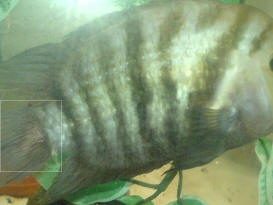
|
Jewel Cichlid Acting Strange 1/2/07 Hi- I
have a 55 gallon tank with 1 Kenyi cichlid, 1 Bumblebee cichlid, 1
hybrid cichlid, 1 orange cichlid (?), 1 red tip shark, 1 Pleco and a
jewel cichlid. The jewel cichlid (which is a pearl color
with blue dots) has been acting strange lately. She does not
swim around only stays at the top of the tank. Her fins are
all down and she curves her tailfin. She eats a little but
not like she use to. She does not swim around although she has always
kept to herself but now she is not acting normal. I have
isolated her in a tank but I am at a loss as to what to do for
her. Any advice would be appreciated. Thanks! Leslie <
Clamped fins are a sign of a disease. Treat with Rid-Ich and salt for
now. Crank the temp up to 82 F. If not better in three days then do a
50% water change and treat with Nitrofuranace and salt.-Chuck>
"Bumps on FW Fish" - 1/22/07 A quick note for
today's post "Bumps on FW Fish" in which Chuck suggested
treating the fish with Nitrofurazone. The querior had
mentioned already having treated the fish with Jungle Fungus Clear Tank
Buddies tablets--just wanted to mention that these contain
Nitrofurazone as their primary active ingredient. (The other
active ingredients are Furazolidone and potassium dichromate.) Thought
it worth a mention! I have these myself, that's why I
know. Rachel <Thank you for this... will post next to the related
corr., share with Chuck. BobF>
Re: Bumps On Keyhole Cichlids 1/23/07
Mr. Rambo, thanks for your quick reply! I remember you
answered a question for me before. I just want to double
check with you. These don't look anything like the
pictures I've seen of fish lice. The pictures I've
seen look like bugs crawling on the fish - these look more like nits
(eggs) you'd pick out of a kid's hair (sorry lol), not like
bugs at all. There are no visible body parts, legs, eyes or
anything. They aren't moving on the fish, but seem to be
stuck fast to them, like tiny (1mm) sesame seeds you could scrape off
with your fingernail. Does this sound typical? I
wish I could send you a picture, but my camera just can't handle
anything that tiny. It's so frustrating trying to compare these to
pictures on the internet, which seem to always be the most extreme
cases. Thanks again for your time - I'll add the Clout
as soon as I get the go ahead. The fish still seem to be doing okay,
there are possibly a few more bumps today but they are still eating
well and swimming around. Jessica <Wild South American cichlids
sometimes carry a parasite that has a very complex life cycle. The
"bumps" are actually little parasites that stay on the fish
in a suspended animation state. When the fish is eaten by a bird the
parasites come to life and are excreted in the bird droppings. The
parasites then go to an aquatic snail and then to a fish again. They
don't really hurt the fish but are very unsightly. The Clout may
not kill them while they are in this state but usually aren't
contagious. Go Ahead with the Clout. If the medication is effective
then these little spots will die and may fungus or become infected. Try
the Clout first. If the spots start to rupture they may become infected
and need to be treated with Nitrofurazone. I like your last
name.-Chuck>
Red Devil Cichlid With Internal Infection
1/2/07 Hello I have a Red devil cichlid that I got that has swim
bladder for the purpose of trying to save him. The pet store gave him
to me free because someone brought him in. He is a nice looking fish
and is about 6inches and I have put him in a hospital tank and then
added Epson salt raised the temp to 84F and treating the water with
poly guard as well as trying to feed the fish with Metronidazole and
garlic guard mixed in with some food as well as some green peas and
doing daily 20% water changes and carefully replacing the
salt and poly guard. But the problem is that the fish stays on the
bottom of the tank and cannot swim but only scoot's around on the
bottom of the tank on his belly. He sometimes will go over to the food
that I place in the tank but can't get the food in his mouth
because he can't seem to raise up to pick the food up from the
bottom of the tank. He often lays on his side until he see's me in
the room then he sits back up on his belly. I noticed as well that
yesterday and today that there was some blood in his stool. I have been
treating him for about three day's now. Do you know anything else
that I can do to get this fish better and how long do you think it will
take before he gets better? Thank you for any help. <Remove any sand
or gravel that can be abrasive to the skin of the fish. The infection
has affected the swim bladder. Even if you cure the disease the swim
bladder may not recover and become functional again. I would add
Nitrofuranace to the mix and continue to treat for another week. These
medications are not cheap. You probably could have purchased a healthy
red devil for the money you will spend trying to save this
one.-Chuck>
Cichlid May be Getting Hole-In-The-Head 10/10/06
Thanks for taking this question, I have a tank of various Cichlids and
I noticed a round hole on the surface of the gill on my Brown/Black
Cichlid. He seems to act fine and is eating well. Any idea what it
might be? The hole looks pretty deep and I worry it may spread to other
fish. Thanks for the help. Shaun < Many cichlids come down with
hole-in-the-head disease. It starts as little clear openings around the
gills and head. Sometimes the entire head erodes away it not treated.
The cause is not clearly defined. Some say water quality while others
think it could be nutrition. Cover your bases by doing a 50% water
change, vacuum the gravel and clean the filter. Change the diet and try
to include more nutritious foods. Try to add more vegetable matter to
the diet in the form of veggie flakes or pellets. It starts to get
really bad then treat with Metronidazole.-Chuck>
Unknown Cichlid With Unknown Disease
9/30/06 Hi There. I hope you can help. I will start off
by admitting that I am not the most conscientious aquarium keeper, but
my fish seem to have adapted to me and my habits. I have cichlids but
do not know what they are. There is this one that is one of
my favourites because he seems to be smiling all the time (a more
rounded head than the others) and he was a beautiful blue/gray
stripe. He is about 2 years old but the other week seemed to
stop eating and then went a very dull grayish colour. He is
now swimming in a vertical position, tail down - head
up. Every day for the last week I expected to find him dead
but he is such a fighter that I am now wanting to do everything I can
to help him. I did a 30% water change, filter change and
gravel vacuum 4 days ago and will do the same this weekend, however I
don't know if I should be treating him with
something. Do you have any
suggestions? Lynda < After waiting a week to decide
to do something did not help. Your fish is showing many symptoms. If
possible isolate him in a hospital tank. Treat with a combination of
Metronidazole and Nitrofuranace. Add some salt to the water too. This
will take care of many internal and external infections. If these are
not available then you could try Clout instead.-Chuck>
Cichlids
slowly dieing/dying 8/8/06 For the past 8, 9 months my
cichlids are dieing. Every month one fish dies, I have to get my water
tested and then I'll get back to you. But until then what else
could be wrong? < Start with water quality tests. Keep nitrates to
under 25 ppm with water changes. Ammonia and nitrites should be
zero.> I have one cichlid that I have had from my first set of
cichlids and I really want to keep him. Will a Lake Malawi cichlid be
good with a fire mouth cichlid? < No. Lake Malawi cichlids come with
a very good set of teeth to scrape algae off of rocks. These same teeth
do a a lot of damage on other fish.> Also (this has to do with my
Pleco) he and the other Plecos I have had seem to be lazy. This one
just stays, oh no, he just moved! But now he's back, but usually
he's where he is now, upside down on a rock that I bought for my
cichlids. Why do they do this? < They are nocturnal and are usually
only active at night.> When I was looking at pics of convicts I saw
clay pots in some of the pics, if I were to get a pot how big should it
be (my tank is 10 gallons) and should I maybe break a piece off of the
pot? < The flower pot should be twice as big as the fish regardless
of tank size. So a two inch convict gets a four inch flower pot. Turn
the flower pot on its side or notch out a hole in the side.> The
ones in the pic were on their side but some that I saw on eBay for
cichlids had holes in them and they were supposed to be upside down. My
last question. It's very, very random, what is the plural for
discus? < A school, shoal, pair or couple of discus.
There is no discuses.-Chuck>
Flowerhorn With Stubborn Popeye
7/25/06 Hi.. a pleasant day once again to you. Its me again, I
consulted you before about the problem of my Flowerhorn. If you still
remember, my fish has an internal infection and pop left eye. Well, I
followed your advice. I apply the proper medication for my fish. But it
seems he's not feeling better. He even got worse because his right
eye got infected too and now his eyes both popping out and both are
turning white. I am really worried because he's also not eating for
days already. I think I've done everything to help him but I still
want to know and try if there is anything else I can do to save him.
Aside from giving him Nitrofuranace and Metronidazole and water
changes, is there any other ways to help him get well or make him eat
again. I am afraid to ask this but .. will my fish die? <This
disease can be fatal.> What do you think is the percent for his
survival? < The key to a complete recovery is early detection and
early treatment. Something has stressed your fish to the point that he
is susceptible to this disease. It could be food, sanitation,
temperature and even tankmates. You need to find out what had changed
before he got sick. You could try to add some rock salt to the tank
too. About a teaspoon per 5 gallons would be worth a try.> I hope
he'll gets better,.. because he is my beloved pet.. hope you help
me again. Thanks in advance and for your time going through my letter.
good day. RHEA from Philippines. < These medications are usually
pretty effective if the disease is caught early. Keep the tank clean by
vacuuming the gravel and cleaning the filter often.-Chuck>
Lionhead Cichlid With Bloat 6/21/06 Why is my lionhead
floating on his back? Every time he goes to the bottom he
floats back to the top. Other than that he likes fine. He
just started this today(06-17-06). Will he
die or will this effect my other fish which is common
gold. Please help. Thank You Nancy <Gas pockets within
the fish are probably infections within the digestive tract. I would
recommend a 50% water change, vacuum the gravel and clean the filter.
If possible I would recommend that you treat him in a hospital tank
with a double dose of Nitrofurazone and a single dose of Metronidazole.
Add about a teaspoon of rock salt per 5 gallons. The key to a complete
recovery is early treatment. This can be lethal.-Chuck>
Big Cichlids Getting Cloudy Eyes
4/30/06 I have a 12" Gibbiceps and 2 female Jaguar
cichlids, 1x6" (S) and 1x8" (L) in a 280 liter tank. PH=7.5,
Nitrite=0, Temp=26°C. "S" laid eggs on Wednesday.
At about the same time she developed a single small white spot on each
eye. One eye has now grown slightly cloudy also. "L" has now
developed it also, although very small. The rest of their bodies and
fins are clean with no signs of any problems, and their behaviour seems
normal. "S" is not eating much (I think it's normal when
she's with eggs), "L" is still eating well. I'd
appreciate your help before their conditions get worse. Regards,
Heinrich < Usually these body /eye fungal problems are because of
excessive nitrates. Do a 50% water change, clean the filter and vacuum
the gravel. Give it a couple of days and see if things get better. Add
some salt if it looks like there is no improvement. If it continues to
get worse then treat with erythromycin but watch for ammonia spike
because the medication may affect your biological
filtration.-Chuck>
Cichlid Caught In A Decoration I have a Cichlid
that was stuck in one of my aquarium decorations for about 2
days, I finally had to break the boat to get him out, he has
scrapes on top his head and some red areas on his
body. I put him back and he just sank to the
bottom, I swished him around in the water and it revived him but
he doesn't look good. Can anyone recommend anything
that I can do? I don't have a hospital tank
set up and the aquarium store is closed for me to get a
divider to keep him away from the other fish. Can you give
me an idea about how I can keep him separate from the other
fish for now? Thanks, Bobbi < Place him in a large dip net and place
the net so it gets some water flow from the filters or airstones. Add a
tablespoon of rock salt per 5 gallons of water and add some MelaFix to
prevent bacterial and fungal infections.-Chuck>
Damaged Parrot Cichlid - 04/19/2006 I have
3 medium sized parrots and 5 silver dollars in a 26
gallon tank. My smallest parrot managed to wedge
himself into a hole in a rock, and it took some effort to
work him back out - his face and side are fairly scraped up, and
he had to be handled a bit more than I'm comfortable
with. Now he can't seem to get upright, and is
stuck upside down. The other two parrots keep pushing
him toward the top of the tank, but he ends up back at the
bottom, upside down. He is working his gills, fins and
tail, but that doesn't seem to be doing
much. I'm in the middle of treating the tank for slime -
using Furazone-light - but I don't think that would affect
much. I did a 30% water change 2 days
ago. The tank is a bit acidic at 6.0, nitrites are 0,
nitrates are less than 20 ppm, and ammonia is less than
0.25 ppm, and I keep the temp at 82 degrees. I'm afraid
I may have damaged his swim bladder while rescuing
him. I'm not sure what I should do at this
point - any ideas? Deb Jones <Your fish could have been damaged
during the initial trauma or has suffered a secondary bacterial
infection. Not much we can do with the initial trauma. Surface wounds
can be treated quickly with MelaFix. If any secondary bacterial
infections or fungus appear then you have already treated with
Nitrofurazone. Internal bacterial infection can be treated with
Metronidazole. Do a 50% water change, clean the filter and vacuum the
gravel. Treat as directed on the package.-Chuck>
Re: more on Cichlid tank and Flagyl
4/16/06 The current sizes of the present cichlids are as follows,
Oscar 8 inches, Dempsey 5 inches, Pleco and
angelic catfishes are both around 3 inches. Can I
add another cichlid to the 75 gallon tank. Thanks
again Jim Second, the tank these
fish came from was a 30 gallon, my Oscar got hole in the
head and lateral line disease before the switch. I have been
mixing Metronidazole with his food. <... a very poor idea to
"keep" mixing this protozoacide/administering it more than
once, twice. Is toxic, will kill your fishes renal/kidney systems>
His behavior and appetite is fine, the only problem is the
holes and scars on his head and body. My water conditions
are fine. will the extra space in the 75 gallon solve this
problem with my Oscar? <Perhaps... see WWM re nutrition
and HLLE... this is the root cure, along with improved water quality en
toto> Finally, I live close to the ocean and fish very
often, can I feed my fish live bait fish from the sea such
as Killies and spearing? <Yes> Thank you
in advance for your patience and help. Jim <Keep
reading... the materials archived on WWM re Oscars, other cichlids...
http://wetwebmedia.com/FWSubWebIndex/fwlvstkind2.htm Bob
Fenner>
Flowerhorn with holes in bottom jaw Dear
WWM crew, <Just a small part of it, Rod... Tom> About a month ago
I noticed my Flowerhorn had ONE hole (or what appears to be a hole,
could be circle sinks) under his jaw. I didn't think anything of it
because I have never seen this kind of disease before, but now he has
about 5 of them. I wanted to know what disease is this, and how can I
treat him? Also he has a white spot on his left gill cover, it seems to
be under the scales. <Your description seems consistent with HITH
(Hole-in-the-Head) disease/HLLE (Head and Lateral Line Erosion)
disease.> I had treated him with PimaFix but I don't think that
helped. <It won't. HITH/HLLE is multi-faceted in that there are
several factors known to, or suspected of, causing it, i.e. water
conditions, stress, vitamin deficiency, internal parasitic infection
(Hexamita), carbon contamination. [The last two are "shaky"
but haven't been totally discounted.] Please, research the WWM
FAQ's/articles for more information on these diseases. You might
look at this article, as well: http://www.worldcichlids.com/diseases/Adamhith.html>
I am sorry, but my digital camera broke. <Sorry about this, too.>
But, if needed let me know and I will try my best to get a picture of
it. <No worries, Rod. Clear photos certainly help us but concise,
well-written and well-documented information is often worth just as
much.> Thank you very much, Rod <Hope I've been of some help.
Tom
Cichlid With Hole-In-The-Head
4/8/06 I have a 9' red flame cichlid that has developed raw
spots on its head (above the eyes and below the dorsal fin, and between
his eyes) they developed after his tank mate died about 3 weeks
ago. The spots seemed to have blood circulating to them
because I see red within the areas. I do 25 -30 % water changes about
every 10 days (55 gal whisper 3 filter) I have also been adding
aquarium salt (1 tablespoon a day for three days now). I have had the
water tested and is within the norm. He is the only fish in
the tank and has stopped eating for at least 4 days, spends a lot of
time on the bottom. When I turn on the light he comes
to the top to eat, if he even bothers to take any Hikari cichlid gold
pellets, he just seems to swim backwards any spits them out. These
spots are not deep; they seem to be just on the surface. The
one above his eyes is approx ½' across and slowly
getting bigger. He has had these spots before but this big
and not for this long. Any help you can provide would be much
appreciated Thank you Dave < Do a 50% water change, vacuum the
gravel and clean the filter. Treat with Metronidazole and
Nitrofuranace. When he starts to eat , offer some live food live washed
earthworms, and watch for ammonia spikes because the medication will
affect the biological filtration.-Chuck>
Cichlids Really Breeding
Or Just Sick - 04/05/2006
Hi! I have a 40 gal tank with a Convict pair, Jack Dempsey
pair, and a Green Terror pair. They are all about 1.5 to 2
inches each. The Green Terror female and my Convict female
both seem to be expecting. I have never seen behavior like
this. They lay on the rocks and on top of the caves almost
hovering. They are also very plump. Although I
have seen not one egg from either, their respective males are right
with them. How long does it take to lay the
eggs? The convict has been this way for about a week, but
the Dempsey I just notices today. Thanks Chelle < A 2
inch green terror is probably too small to breed. If conditions are
right, clean water, good food and good nutrition, then they should
breed in a couple of weeks. Even with eggs the females should be up and
about eating and defending a territory from the other fish. If they are
not eating or acting normal then I would start to think that they are
sick with an internal bacterial infection and need treating with
Metronidazole.-Chuck>
Sick Gold Severum 3/19/06 I treated
this Severum 5 weeks ago with furan 2 because he was hiding and not
eating much and had red streaks on his tail fin, after 8 days he quit
eating and I changed medication to Minocycline for 9 days. Some where
in this time frame he developed a bump mid body a little on the left
side the size of a quarter he had some trouble with balance but is
still eating some every day. Yesterday his left fin was torn, he was
holding it to his body most to the time. I put a little aquarium salt
in and increased aeration. He still has the red streaks on
the tail fin, and his breathing is labored. There is only a clown loach
and a little 2 inch Pleco in the tank. Possibly the loach was a little
rough with his pectoral fin. The bump is the concern? < Your fish is
being attack both externally and internally by bacteria. Do a 50% water
change, vacuum the gravel and clean the filter. You probably have high
nitrates too and that contributed to the problem. Cleaning the tank
will help. Treat with Metronidazole for the internal infection and
Kanamycin for the external infections. This will affect the biological
filtration so watch for ammonia spike after treatment.-Chuck>
Severum With Lump 3/20/06 My Severum has a
quarter size bump on his left side, he developed it some time in the
last 5 weeks. He was being treated for red streaks in his
tail fin with Maracyn 2 for 7 days , he stopped eating so I switched
him to furan 2 for 10 days. He has a little bit of buoyancy problems as
the bump is out about a half inch. he is still eating , but his gills
seem labored so I added a little salt and have been doing a lot of
water changes. Should I medicate him again, and if so with what? <
Sounds like an internal bacterial infection. Keep up with the water
changes and treat with Metronidazole.-Chuck
| Bloated Flowerhorn 3/19/06 Hello WWM Crew,
My Flowerhorn is around 6 months old. At first I thought the tube
sticking out was his breeding organ but, I wasn't sure. After
observing his behavior he looked unhappy , wasn't playing, and
eating . So I did a water change . After reading on your site I
think he has a digestion infection ? I took a few pictures so,
maybe you could help me. What should I do ? Please help and Thank
you. Aloha, Donald The message is ready to be sent with the
following file or link attachments: Flowerhorn 001 Flowerhorn 002
Flowerhorn 003 Flowerhorn 004 < Sorry, Photos did not show up.
But I can still tell from you description that your fish does
indeed have an internal bacterial infection. Do a 50% water change,
vacuum the gravel and clean the filter. Treat with Metronidazole
and Nitrofuranace. This is best done in a hospital tank. These
medications will affect the good nitrifying bacteria in the main
tank.-Chuck> |
|
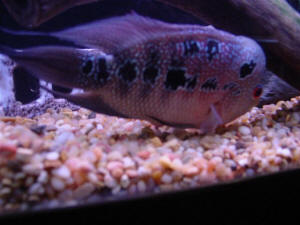
|
|
Bloated Flowerhorn 3/19/06 Thank
you Chuck, I'm trying to send you the pictures again because,
I wanted to know if he still has a chance ? It's been about
three days since I notice that hanging out. I won't be able
to treat until 24 hours from now. Thank you for the quick
response and I appreciate all the help. Aloha, Donald The message
is ready to be sent with the following file or link attachments:
Flowerhorn 001 Flowerhorn 002 Flowerhorn 003 Flowerhorn 004
Flowerhorn 005 Flowerhorn 006 < Sorry , no photos again. I
still think you have the same problem. Keep the water clean with
water changes until you are able to get the medications. He has
no chance unless you treat him.-Chuck>
|
Parrot Cichlids With Hole-In-The-Head - 2/28/2006 HELP.
About two months ago My 2 parrots who are around 2.5 years old - we
had them from babies, started to develop fungus type
'sores' on their head (no where else, and none of my other
Cichlids have this problem) then it disappeared only to return
again and now I need help. I treated them for Velvet, Fungus, Hole
in the head etc., to no avail. Although my water qualities etc.,
were fine, water temp was tried at between 24-28 (this was double
checked by Maidenhead Aquatics) I changed to the fish shops own
water in the hope it would make a difference - it didn't. I
have not added any new fish, gravel, plants etc., Food is still the
same dried in morning and frozen in evening (Krill, bloodworms,
Mysis, Green food, Artemia etc). I do a water change every week,
(sucking up all pop from gravel in process) I have tried to do it
daily, every other day, weekly and even longer - no difference. The
last month 'his' sore has got bigger and does not seem to
be responding to anything. He is eating well and his stools are
normal. For the last month, 'he' has started to hang round
the top of the tank as if trying to get more oxygen, rapid gill
movement (compared to the other parrot) and generally looking off
colour doesn't really want to move, and when he dose it looks
like he hasn't got full balance, although he eats well, and
moves fast and straight into the caves when startled. The other
parrot I am sure knows something isn't right as she is hanging
below him instead of her usual haunt the caves. I have a 5'
tank and an external Fluval 404 pump. I am an experienced Cichlid
keeper but was given these fish from my son, they are magnificent
and very clever and cunning. I have no trouble between my fish
what's so ever, if anything the parrots rule the tank, or at
least did. I have photos of his head if it will help anyone to help
me. My local fish shop said that as they are a hybrid fish, they
are not as healthy and tolerant to changes as the normal cichlid
and that they don't know much about them as they don't and
never will stock these fish. < Do a 50% water change, vacuum the
gravel and clean the filter. The drug of choice is Metronidazole,
but you need to get it inside the fish. Take some live Calif black
worms or Tubifex and wash them very well. Place them in a
disposable plastic cup or bowl. Drain off most of the water. Add
Metronidazole to the worms. It should kill the worms. Immediately
feed them to your affected fish. You know it is working when the
pits turn black. This disease is thought to be caused by stress.
Things like dirty water or a lack of minerals/ vitamins have also
been thought of as a cause. If the fish are not eating then treat
the water . It may help but will not be as effective as getting the
medication inside the fish.-Chuck>
|
| Hole-In-The-Head Cichlid Photos - 3/1/2006 Thanks
for this advise, did you see the second email I sent to you from
home last night with photos on this fishes head - showing this
complaint? It may help, also do you think it is Hole in
the Head or Fungus etc???? Many thanks Sheena
Jolliffe < We got the photos and the reply is still the same.
They are posted on the site.-Chuck> |
|
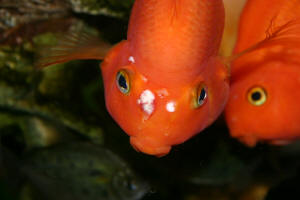
|
Flowerhorn Cichlids Don't Have Color
2/10/06 Hi! I'm Joan from the Philippines. My
husband and I are newbies in FH care. We have 2 Flowerhorns
that are almost 1 year old. The thing is, both their colors
are not as vibrant as other Flowerhorns that I see in the
website. They are mostly black with red along the gills but
that's it. I did some research but nothing that can
possibly answer specifically to my problem. 1.What can I
do/feed my FH to make their colors change? (the aquariums have coral
backgrounds. No gravels or sand. No decorations either.)
< A Flowerhorn is a hybrid of three different cichlid species. Their
colors can range from grey to bright red. This is determined by the
genetics of the parents. If your fish do not contain the correct genes
then they will never look like the web site photos.> 2. Can it still
be remedied? They are almost 1 year already. 3. One of the
FH's aquarium water becomes greenish in color after a few
days. What causes these things? (note: the aquarium is not
in direct sunlight). < You can enhance what color they do have with
good nutrition, but you cannot create color on a fish. The green water
may be from the food or high nitrates in the water.-Chuck>
Cichlids Melting 2/6/06 I am writing to you because
I have found nothing on a disease called cichlid melt. < First I
have heard of it and I have been keeping cichlids for 38 years.> My
young Oscar died. I brought the body to the pet store to see
if they could make sense of the Oscar's skin
condition. Both sides looked eaten away. They
told me it's cichlid melt and compared it to
leprosy. They said it's highly contagious and there is
no cure. They told me to take down my entire tank and wash
everything with bleach. I have a 72 gallon tank, so I'm
hoping I don't have to get that aggressive. I presently
have 3 parrot fish who seem to be OK, as well as one pearl
cichlid. I have lost about 5 other fish within the past
couple of weeks. None of them seemed to have what the Oscar
did, however, two of the cichlid's had puffy and deteriorating
scales protruding out of its head. I've had fish for
years and never experienced such a thing. Any ideas or
suggestions? Have you heard of Cichlid melt? Thank you
Shannon < You have a bacterial infection that is eating the skin of
your fish. Do a 50% water change, vacuum the gravel and clean the
filter. Check the nitrate levels. They should always be under 25 ppm.
Treat with Nitrofuranace as per the directions on the
package. After treatment, you will need to add a high
quality carbon to remove the medication. When the water is clear add
Bio-Spira to replace the good bacteria needed for biological
filtration. Then feed your fish once each day and only enough food so
that all of it is gone in two minutes.-Chuck>
Cichlids With
Bacterial Infection - 2/4/2006 My son brought home a blue
cichlid, an Oscar, and one of those fungus eaters. (looks like a little
shark, but I don't know what is called). I have a 39 gal. tank
filled with fresh water, which I change weekly, two filters and
an air pump. I never heard anything about water chemicals
until now. I feed them floating pellets two or three times a day. I
don't know much about fish, but I have noticed the blue cichlid is
growing orange wart like growths on the sides at the root of the
fins. It started showing about two or three months
ago. I didn't pay much attention in the beginning
because I thought the fish was simply growing in size and that was part
of it. they have grown a lot since we got them. the Oscar is
about 12 in, the cichlid is about 7 in and the other one is about 10
in), but the last few weeks, I noticed that one side is bulging out
while the other seems to be "falling off in tiny
chunks". That's the best way I can describe it.
What can I do? < Do a 50% water change, vacuum the gravel and clean
the filter. Treat with Nitrofuranace as per the directions on the
package. Fed once a day and only enough food so that all of
it is gone in two minutes. High nitrates contribute to bacterial
infections such as these.-Chuck>
Oscars With Bacterial
Diseases - 2/4/2006 Hello, Can you please help me? We bought
2 Red Tiger Oscars about 5 months ago and have already lost 1 to this
disease already. It started with these small indentations in their skin
which have now got larger on the remaining one. Also the remaining
Oscar also has a whole in his top fin which is slowly getting bigger
and I think this will soon divide his fin into 2. We do a water change
every 2-3 weeks. We were given a treatment called 'Melafix'
which were told would get rid of it and if that didn't nothing
would. We followed the instructions, took the carbon filter out, but
nothing worked and this is how we lost our first through the treatment.
Our local fish shop said to take a water sample in (which we
haven't done yet) to see if there was a high level of acid in the
water, but only the Oscars had this disease. We have different types of
Parrot Cichlids but these are all fine If you could reply to my email
that would be great, Thanks Rebecca < This is a bacterial infection
brought on with water high in nitrates. Do a 50% water change, vacuum
the gravel and clean the filter. Treat with Nitrofuranace as per the
directions on the package. Feed once a day and only enough food so that
all of it is gone in two minutes. Check the nitrates weekly. They
should not exceed 25 ppm. Reduce them with water changes.-Chuck>
Babysitting a 100 Gallon Aquarium 2/3/06 My son has
me caring for his tanks until the spring when he will take them
back. The tank is either 95 or 100 gallons. Currently it is
inhabited by the following:2 Jack Dempsey, I Albino Oscar, 1 Pleco, 2
parrot fish and a catfish. Also when he fed the fish live
food 2 of the goldfish survived and are about 5 in long. I
have BioPure filter and a Fluval 404 running, aeration
etc. I had trouble with ammonia and was treating it with
Amquel, which I am not sure worked. I invested in the python
siphon so I cleaning the tank more often. Here are my problems; 1 the
goldfish developed this black stuff as well a white fluffy around the
mouth I also noticed some gray matter on the Oscar as well as on the
parrot fish. I treated with Maracyn 2 and Copper Safe All was well 2.
Suddenly the goldfish was a mess and subsequently died. Soon I found
the other Pleco on its back dead and later in the day one of the
catfish was swimming upside down and looked terrible 3.I cleaned the
tank and treated it for body fungus because I saw white spots on a few
of the fish. Now I see that the goldfish has white over his
eye, one of the Dempseys has a sore under his chin and one on his side
and the Oscar looks as if he has a tumor. To add to my dilemma the 2
Dempseys are fighting one keeps chasing the other and I think that is
where the sores originated and also the more aggressive Dempsey and the
Oscar open their mouths wide and to at each other and then separate. I
know that we need to separate the fish, but the only other tank has 18
convict cichlids we raised from fry. 1.What should I do to keep the
fish from fighting-I cannot believe I am refereeing fish? < Lower
the water temp to 75 to 77 F. Move all the rocks and plants around to
make them establish new territories.> 2.What should I do with the
Oscar who still has some grayish spots( perhaps its normal) to fix the
large swelling? < Probably body fungus.> I feed them Hikari
Cichlid Gold, but after reading your forums stopped giving them that
and gave some spinach and brine shrimp. I know this is lengthy but I am
at wits end and I don't think I should keep dumping chemicals.
Peggy Geist Blass < Do a 50% water change, vacuum the gravel with
the python and clean the filter. Feed once a day and only enough food
so that all of it is gone in two minutes. In a couple of days if things
are not better then you may need to medicate with an antibiotic like
Nitrofuranace.-Chuck>
| Green Terror, sick 1/31/06 Dear staff, I have a
green terror with a swollen stomach. I have recently
learned that I have been mis- feeding him. he was fed one cube of
frozen beef heart and like 8 small cichlid pellets everyday. I
tried a few peas and a couple pellets soaked in castor oil thinking
he was constipated. he did poop but that didn't reduce the size
of his stomach. I have looked up fish diseases and ailments but
haven't found one that fits. LFS told me could just be an
enlarged stomach due to his food.... I don't know, please help,
I love this fish. Jeff >> This fish is fat, likely its'
liver is swollen and distended. Like a person would be on that sort
of diet. Try switching him to a food that has a much lower
concentration of animal protein! Feed this fish with some green
Spirulina pellets every second day. I would even not feed him for a
week to start. Oliver. |
|
|
| oh here is picture of my green terror with swollen stomach,
forget to attach it. Jeff |
Cichlids With Mouth Problems - 1/30/2006
Hello. I tried to search your site, unfortunately, not everything
loaded up for me. I'm having slight computer issues. Please bear
with me if this question has already been answered. It was my 23rd
birthday a week ago, and my father, knowing how much I love fish, got
me a small 10 gallon to go on the dresser of mine and my boyfriends
dresser. It was complete with heater, air stone, and filtration. I set
up the aquarium. Washed everything before I put it in there and let it
run for 2 days before I introduced anything to it, Just to make sure
there wasn't any dust or anything in there from the stones. Upon
feeling my tank was ready for fish, we went to the fish
store that I have gotten fish from since my very first tank when I was
two. [ I do not trust PET stores, as most of the time, their fish have
Ich, and they do not realize this, and with a community filter, I fear
all their fish are tainted - fish stores give more attention to their
tanks then say , PetCo, ever would. ] So, I bought 5 fish. Two
Pearlscale Orandas for our 50g tank in the living room [ which already
housed two gigantic Plecos and 4 other Orandas. ] and 2 blue ram
cichlids and a Kribensis cichlid. I am writing on behalf of
my cichlids. They are very small, so a 10g is more then enough room for
them to dart around and be happy. I keep the temp. anywhere between 74
and 76 degrees. < Too cold. They prefer at least 80 F.> All three
were quite active after they got used to the new tank [about a day ]
Within a day or two, I noticed the Kribensis' mouth looking quite
swollen. The lips were quite puffy, almost like someone who had too
much collagen injected into their lips. It also started to
develop a small white spot on the bottom lip almost directly in the
middle. That almost resembled a tooth, though I know it was not one. I
took out my other fish and dosed both tanks with Ich
treatment. Within a day, the Kribensis was very weak, it
couldn't stay upright and would fall to its side. Over night, it
died. Since it was albino, I noticed that the whole underside of the
fish was bright red, as if it had bled out under its skin. I was very
upset about this, as I had gotten the fish no more then 4 days ago. I
cleaned the tank out and let it run for another day, with a clean
filter, before I put my blue rams back in. Upon putting them back in, I
also bought a Pleco and a snail. It's been about a week
and I was watching my fish and noticed that one blue ram likes to hang
out at the very top of the water. < It is warmer there.> He also
now has a white growth on the middle of his bottom lip. Though, he is
not as weak or lethargic as the Kribensis was. It still darts around
chasing and getting chased by the other blue ram. The eating habits
have not be affected, nor do any of the other fish have any white spots
on them. The white spot is not spreading, as I thought Ich normally
does. It also doesn't look ' fuzzy ' as I have seen it look
on the bodies of fish. It, again, resembles a little tooth on its lip.
But, I'm worried. I can not find any information about this on any
other fish site, and I was hoping maybe you could help me, even in the
slightest. I'm not sure what to do, or why this is attacking my
fish one at a time. Thank you in advance, KL. < Cichlids make a
living by sifting through the sand looking for something to eat. It
sounds like your sand is too coarse or abrasive. As they try to feed
the sand is cutting and damaging their lips/mouths. They are becoming
infected and killing the fish. Run your hand through the sand to see it
this could be the problem. The infection can be treated with
antibiotics like Nitrofuranace. But unless the sand is changed the fish
will continue to have the same problems over and over again.-Chuck>
Gold Severum With Mouth Problem. - 1/30/2006 I have two
gold 8" Severum fish in a 75 gallon aquarium. I have had them for
a little over two years. One of them has developed a growth of some
sort in its mouth. It protrudes from its top lip and looks like its
gums or teeth or something. The growth is fleshy looking. I first
noticed it about a week ago. I have seen this fish trying to spit it
out by blowing air out its mouth. So far it has been able to eat around
the growth, but today when I fed it, it could not get the food in its
mouth. Now I am worried that it will starve to death. I don't know
the sex of either one of them but they get along fine. I bought them
both together from the same pet shop. Can you please tell me what this
is and what I can do about it. I really love these fish. Thank you,
Shirley Brand <Sometimes these big fish try to eat things that are
not edible. Plastic plants, rocks pieces of wood etc.. I think it may
have something stuck in its mouth that is causing an infection. Get a
baking plan large enough to hold your fish. Get a large towel and fold
it up so that it will lay in the pan. Bail out some aquarium
water and get the towel in the pan very wet. Catch the Severum with the
problem and lay him on the towel. Wrap the fish up in the towel with
just his head exposed. Now get a flashlight and look down the mouth to
see it there are any obstructions. Use long tweezers to remove anything
you see. Put him back in the tank. If you didn't see
anything then we can assume that he injured his mouth in a fight or
trying to eat something. The injury might be infected so treat the fish
with Nitrofuranace. Follow the instructions and watch for ammonia
spikes in the tank because this medication will affect the bacteria
needed for biological filtration.-Chuck>
Red Devil Swimming On
His Side 1/30/06 Have my son's red devil still here
and has been doing well. The last few days he has been swimming on his
side and has lost a bit of condition. Seems to flop on his side when he
is not moving rapidly. There are no marks on him and he is still eating
well (both live and cichlid pellets). He is now about 10 inches long
and son has had he since really small. Please help as I really
don't want to lose him. Thanks Sue < When I hear of problems
like these I think of internal bacterial infections. Sometimes food
gets stuck in the intestines and the bacteria continue to reproduce
causing gas and bloating. This sets off the equilibrium and causes fish
to swim on their side, upside down etc... Do a 30 % water change,
vacuum the gravel and clean the filter. Treat with Metronidazole as per
the directions on the package. It may stop the infection but the fish
may not completely recover and be back to his old self.-Chuck>
Flowerhorn Trouble 1/25/06 Hi, I have a very
big headache and is trying my best to save my Flowerhorn. My Flowerhorn
hit very hard on the side of my fish tank while my mother is playing
with it and stays on its side ever since at the bottom of the tank. It
has been 3 weeks now and he is still alive. I tried very hard to push
him upright vertical) but he seems to slip down horizontally to one of
its side every time. All he can do now is move his eyes, slightly move
his tail and flap one of its fin. For the other fin, he can only move
it slightly and is seems to be infected and looks a bit small with
white spots. He looks a bit inflated though. He is able to push himself
by sliding on the bottom of the tank. About food, he is still able to
eat slightly but he will to spit some of the food out sometimes. Before
the incident we used to give him some guppies (found in the drain) to
eat. I am really worried that he might have eaten some infected ones.
Regards Josephine Lai < The trauma to the fish probably caused some
permanent nerve damage. As he swims on his side the substrate is
scrapping him up and it may now be coming infected from the guppies in
the drain. Remove the substrate, do a 50% water change, clean the
filter and keep mom away from the tank. Treat with Nitrofuranace as per
the directions on the package. This will clean up the infections but I
am afraid your fish may not fully recover from the trauma.-Chuck>
Sick Old Red Devil 1/21/06 Hi-My 12 yr old red devil
lives in a 120 gallon tank with some gravel, a few rocks and his baked
ceramic plant pot. He gets fed jumbo min and some brine shrimp. For the
past 2 weeks he has been very sick -laying down in his plant pot like a
dog to rest and then getting up to patrol his tank when I come near. He
won't eat. He swims sideways sometimes. I have siphoned the gravel
and changed 25% of the tank water on 4 separate occasions (giving him a
few days between each time). The ammonia level and the nitrite level
test normal. The nitrate level tests high. I keep the pH at 7 although
it keeps tending bluer - higher, which is the opposite of what it
usually does. I keep the temp at 80 degrees. I have put
kosher salt in the water. He is typically somewhat orange, but when he
got sick he got quite pale. Now his color is more orange again. I read
in your column about using Furanace or Metronidazole... is either one
appropriate? Do you have any advice or suggestions? Thank you for your
help-Julie < At 12 years old your red devil may be
getting near the end and no longer can fight off infections. I would do
a 50% water change, vacuum the gravel and clean the filter. If he is
not eating then don't feed him. Sounds like an internal bacterial
infection. Treating him in a big tank will be very expensive,
especially if multiple treatments are needed. If you can, move him to a
smaller hospital tank. Treat him with Metronidazole and Nitrofuranace.
High nitrate levels over a long period may have stressed him to the
point of becoming ill.-Chuck>
Lots Of Cichlids In a Little Tank
1/19/06 I have a 30 gallon freshwater tank with 7 med- lrg cichlids
in it. < Too many fish already.> I have one highly
aggressive little lady convict (I think) that spends most of
her time picking on the others, even though some are bigger than
her. I have battled fin rot sporadically in the
past one fist at a time in a sick tank when
necessary, however, last week it seemed as though it all went
awry. I have 5 fish all starting to suffer from
bad fin rot. I immediately did a 25% water change
pulled out the carbon in the filter and started to treat
with Melafix. I decided at that point it was
better to treat the entire tank with so many fish
sick. I quarantined the aggressive convict in
a breeding net, to take some of the stress off the
others. Seems to be going well with the treatment
however, now a few of the electric yellows seem to
be getting darker tiny black speckles, is this a side affect
to the meds? < Never used MelaFix to cure fin rot. I don't think
it is the reason.> I also ended up having to pull one of
my Jack Dempsey's out because he seemed to be suffering
severely. I put him in the sick tank with salt (all the
fish water is always treated with it) and
meds. He was listless for a few days, staying
under the filter and then he started to get more
active. Once he came out where we could se him
better I was shocked, his gills seemed to be falling off, I
am not sure if that is the best way to put it, but it was like
he was going bald. I continued to treat the tank
and the he developed a mucusy film and within a day of the
slime he passed away. I am now finding this cycle
repeating itself with another of my fish, he is quarantined and is
in new water with salt and MelaFix. It seems as though
the large tank is doing just fine outside of the color
change to the fish, but I wonder if I am doing all that I
can. I am worried for my fish and want to do what is
best for them, please help with any info or advice you can
give. The sick tank is 5 gal and it only has the
one fish in it. ~Tricia < Check the nitrates. They should be under
25 ppm. Big cichlids generate a lot of waste in a little tank, add in
the stress of the aggression from all the other fish and you are
looking for trouble. Do a 50% water change, vacuum the gravel and clean
the filter. Treat the fin rot with Nitrofurazone. After the treatment
then add good quality carbon to remove any leftover medication. then
add Bio-Spira from Marineland to get the good bacteria up and going
again. Check the nitrates and control the levels with water
changes.-Chuck>
| Parrot Cichlid With Throat/Mouth Problem -
01/12/2006 I am Desperate to save my 9" Parrot Fish. Few
chat forums have had any idea of diagnoses. I'm left unanswered
by others because of my "hybrid." Please help me save my
best friend. I'll describe then detail. The visible problem is
his mouth. The first week it just appeared 'swollen.' No
sign of fungus or columnaris. Just what looked like a tumor growing
inside his lower lip, swelling the outer lip, and making it hard to
eat. He (even now) is Always hungry. A forum suggested a med so I
treated the first 4 days with Maracyn (along with water changes)
and it only got worse. By worse I mean, at the end of the first
week he only had a pinhole left in his mouth that food could get
through. Smaller lumps formed on top of the larger one. I
couldn't see any fuzziness. As you can see in the pics, there
is also a small red dot on the outside of his lip. They were a
little pink/reddish in color. (he is dark orange) His fins are
lightly frayed by his gills. The dorsal and tail are healthy. I had
posted his pictures on numerous forums and no one had a clue. My
local LFS gave me Furan-2 meds and SUCCESS! Along with half dosage
of Mela-fix and decreased temp to 75F he got better. For a full 5
days the lump went down, and he was able to eat efficiently but the
lump had not completely gone away. So last night (now two weeks
with mouth problem) I increased the temp back up to 78F but still
issued Furan-2 and Melafix as usual. I figured he was getting
better and didn't want to subject his tankmates to anymore cool
waters. He was fine this morning. I come home from work, and its
Worse Than Ever. Not only is his lumpy lump almost full size again,
but he has a red pimple in the middle of his lower lip that looks
like it could pop any second. He also has stringy hairs on the
outside and inside of his mouth. Coloration and rest of body look
fine. My water conditions as of today are; Nitrites 0, Nitrates
20ppm, ammonia 0, pH 6.8, water - a little hard, temp 78F (was
75F), The tank is 55 gal. - other tankmates 1:pictus cat, 1:pleco,
1:butterfly ram, 1:gourami, 1:babyparrotfish All the fish get fed a
variety of pellets, dried krill, vegetable flakes, and tropical
crisps. The photos are from before he grew the pimple and fuzzy
hairs. I have yet to photograph his new 'state'. Please let
me know if I'm leaving any info out and PLEASE... if you have
any idea... help me save my fish =(-Jessica < Sometimes fish try
to eat things that they are not good for them. I suspect that your
parrot cichlid has an obstruction in his throat. As he tries to
expel it , the movement of the obstruction has damaged the tissue
in the area and it got infected and swollen. You treated the
infection and the swelling went down. Now the fish tried to expel
it again and has started things all over again and is swollen,
maybe reinfected. remove the fish from the water with a wet towel
and try and look down the throat to see if there is an obstruction.
Usually it is a piece of plastic plant, a filter part or an odd
shaped piece of gravel. If you do not see anything then it could be
a broken pharyngeal bone. This is a second set of jaws that
cichlids use to chew their food. Sometimes this gets broken from
pellets that are too hard to chew. I would recommend that you
presoak the fish food to soften it up.-Chuck> |
|
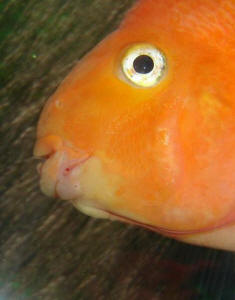 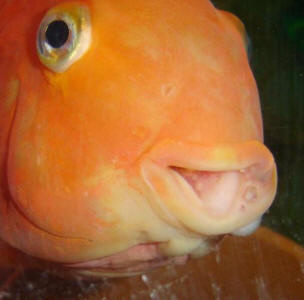
|
Parrot Cichlid Problem II 1/13/06 That you so
much for the quick response. I just wanted to add a quick update. The
night I wrote that entry, I stopped administering meds and decreased
the temp back down to 75F without my usual 2-day 15% water change. I
figured, the only thing I did different before he got worse was
increase the temp. And I'm tired of medicated my other healthy
fish. The very next day... Swelling went down and the red pimple is
gone! He still has a swollen lump and outer lip, but only about 40% of
the previous days size. I was shocked! Not that he's totally
better, but it gave me much more hope. Do you think the temp decrease
had anything to do with the infection (fuzziness/red pimple) he had?
< I think the temperature reduction has lowered the fishes activity
level and it hasn't worsened the condition by trying to eat.> I
also want to check his throat out but this is the largest fish I've
ever owned and I don't want to damage his slime coat, fins or
scales by mis-handling. I hear of many people handling cichlids when
things get stuck in their mouths. I just want to know the proper and
safest way to do it. You mentioned a wet towel. Any more tips to make
sure I handle him with care? < Take a shallow pan and fill it about
half full with aquarium water. Place a towel inside the pan to absorb
the aquarium water. Take the fish out of the aquarium and place him on
the wet towel. Wrap the fish in the wet towel with just his head
exposed. Now that the fish is in control you can gently pry the mouth
open to see if there is any problems.> One more thing. If it is
something like a broken pharyngeal bone, does this ever heal? Or will I
have to deal (which I would cuz I love him) with his lump and random
infections forever? Thanks a million. You guys/gals must save a lot of
fish. YOU'RE HEROS! < The bone may heal over time with a long
term feeding program of soft mush foods.-Chuck>
|
|

