|
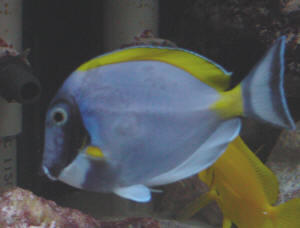
FAQs on the Powder Blue Tang Disease/Health
2
FAQs on Powder Blue Tang Disease:
PBT Disease 1, PBT Disease 2,
FAQs on Powder Blue Tang Disease by Category:
Diagnosis, Environmental,
Nutritional,
Social, Trauma,
Pathogen
(plus see
Tangs/Rabbitfishes &
Crypt),
Genetic, Treatments
Related Articles: Powder
Blue Tangs, Acanthurus
Tangs,
Related FAQs: Powder Blue Tangs 1, Powder Blue Tangs 2, Powder Blue Tang Identification, PBT Behavior, PBT
Compatibility, PBT Selection,
PBT Systems, PBT Feeding, PBT
Reproduction, Acanthurus Tangs
1, Acanthurus Tangs 2,
Acanthurus Tangs 3, Acanthurus ID, Acanthurus Behavior, Acanthurus Compatibility, Acanthurus Selection, Acanthurus Systems, Acanthurus Feeding, Acanthurus Disease, Acanthurus Reproduction,
|
|
Surgeonfishes: Tangs for Marine
Aquariums
Diversity, Selection & Care
New eBook on Amazon: Available
here
New Print Book on Create Space: Available
here
by Robert (Bob) Fenner |
 |
|
Help Bob Fenner
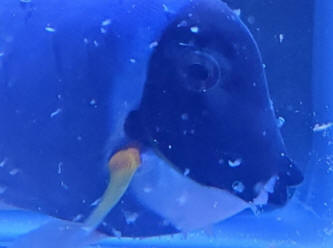
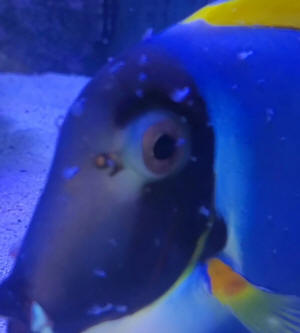
So I have a PBT that came down with the "unknown parasite".
4/15/20
<Mmm>
There is little info here or anywhere else I've looked for the past month.
It started as Ich. Then after a week progressed into the long fleshy looking
skin tags. As I read this is mucous build up....I'm not sure exactly what it
is and how to treat.
<Does look like the latter; mucus... from irritation. Likely treatment,
water quality at its source>
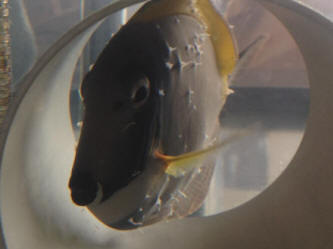
Right now she is in qt and treating with Maracyn..day 5. The last pic is
what I found on your site...and is the only pic I could find that resembles
what's on her. What is this?
<As we've both stated, highly likely (simply) body mucus... all fish are
slimy; serves several functions>
And what should I do. She's been like this for a month. Super stressed out
but will still eat Nori.
<IF it were me, mine, I'd summarily pass this fish through a pH
adjusted freshwater bath (gone over on WWM), and place this fish in the
main/display system. It's past the time/balance where staying in quarantine
will help, and its health is being reduced. Bob Fenner>
|
 |
|
Re: Help Bob Fenner; PBT, a failure in communication
4/16/20
Bob. I gave her a fresh water dip for 5 min. She did pretty good. I
put her back in my qt after the dip.
<Why? I specifically stated I'd move the fish from there. Whatever the
source of irritation is... it's IN the quarantine system!>
..i didn't want to just throw her in my display. She seemed to be doing OK
but noticed her sides are discolored with white splotches. It looks like the
lesions are coming loose a bit but I'm concerned about the discoloration.
She seems to be laboring a bit. Does the dip shock them?
<... shock... I was hoping the dip/bath in this case would remove a good
deal of the slime and discount any further concern re external parasite and
pathogen transmission AHEAD of the fish being moved FROM quarantine. You've
just further stressed the PBT>
Will it take a while for her to calm down? She's acting very lethargic...is
she just in shock? Here's a video. This poor fish.
https://youtu.be/4fc8TeIHQRk
<.... Do you understand what I'm writing? DO NOT keep this fish in the
present circumstances. It will die.
Bob Fenner>
Re: Help Bob Fenner; PBT 4/17/20
Dear Bob. I did understand what you were saying.
<Ah, good. Choices in action are entirely other peoples choices; I wondered
if you didn't get my input>
And I really really appreciate your time in responding. I own your book by
the way and I love it. Anyway what happened was I failed to raise the temp
of my qt.(80)To match my display temp (78). I made a quick decision to place
her back in my qt.
<Mmm; well, for future reference, this temperature difference isn't a big
deal; especially going from cooler to warmer>
I fed her some Nori this morning and she gobbled it up.
<A very good sign>
I slowly dropped my temp to 78 and she is now back in my display. She seems
ok...and seems to be very very slowly losing her lesions. I have added a UV
sterilizer since this has started.
<Both good>
I'm pretty sure that my recent addition of fish pushed my limit of my tank
size (180). I did however take a humongous leather out and put about 50lbs
of my rock in my sump to open up some swimming room.
<Good moves. The leather/alcyoniid may well have been a/the source of
(chemical) stress here>
Hopefully she makes a full recovery and I never see this again. I wanted to
say thank you and I will give you an update in a week or two.
<Thank you; appreciated>
I value your opinion and I appreciate your help.
Paul
<Thank you for your follow-up. Bob Fenner>
Re: Help Bob Fenner, PBT
4/18/20
Hey Bob, I forgot to ask this before. These lesions that did not come off in
a dip are still very much attached to her. She’s not looking much better
than when I first took her out. Obviously this thing is not life threatening
right now. I’m continuing to soak her foods and monitor. In your experience
with this, will she heal from this? And how long can I expect her to be like
this?
<Likely will heal in time, weeks to a few months. BobF>
|
Re: Help Bob Fenner; PBT
4/19/20
Hi Bob, sorry to bother you again. This has gotten me nuts. She looks
twice as worse since putting her back in my main tank. Although the
water that was in my qt came from my display....its not the water
irritating her..I’m assuming. I give up. She’s now %85 covered in those
lesions.
<Do send along another pic. Do you have, use purposeful cleaner/s?
Cleaning organisms...?>
Hiding and swimming erratically. I’m having a hard time just watching
her get slowly worse. Should I remove some fish?
<Maybe... do you have another established system to place this fish? IF
NOT, DO change all the water out of the quarantine and refill it, do
daily water changes (20-25%) with the main/display system water>
I’m pretty sure the three Anthias I last added are the contributing
cause for her stress. I’m at a loss.
<Cheers, BobF>
Re: Help Bob Fenner; PBT
4/19/20
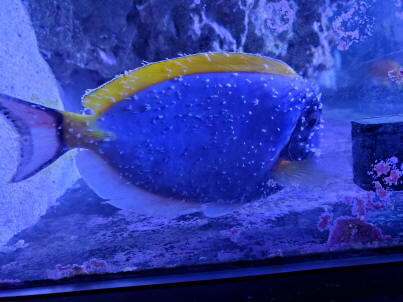
Here's a great pic. Are you saying put my PBT back into qt?
<Yes>
Using my main tank water? And doing daily waterchanges?.
<Yes and yes>
If I'm using my display water for qt water changes...isn't the water in
qt staying the same? I was going to pull the 3 Anthias and take them
back to my LFS. Something in my main display is Stressing her out.
<Can you tell what it is... the fancy bass?>
She was fine before adding the three Anthias. I do have a decent
CUC...if that's what your referring to. She looked so much better in Qt.
<BobF>
|
 |
|
Re: Help Bob Fenner 4/19/20
<Please change the title of your emails... they're all going to our "Junk"
folder... Just Re: PBT will do>
3 Anthias square backs. One male and two females. Should I treat with
anything once she’s back in? Or just water changes?
<Just the water changes, though I'd drop the spg a few hundredths... will
make it easier for the fish to breath, shed mucus>
I went through a 5 day treatment of Maracyn already...and was going to do
that again, until you told me to put her back in.
<I'd skip any antibiotic administration. BobF>
|
|
Leucosternon Mouth issue
3/31/18
Hi Bob,
As mentioned on Facebook, our Acanthurus Leucosternon has some issue
with its mouth.
Hopefully videos sent via FB chat were enough for you to see what the
issue is, or at least point me towards possible problem.
<Mmm; not obvious (to me) in the video what is going on with this fish's
mouth. Is it eating?>
Leucosternon went through our quarantine facility and ended up in our
display tank at the store, it has been with us since September last
year, very active fish, was eating everything we offered, even picked
the food right out of our fingers.
<Ah, a very good indication of health>
I have noticed something under his upper lip, at first I thought it's
the beak/teeth they have, but now, since it stopped swallowing food, I'm
worried. It still aggressively chases food, takes it in and then spits
it out. I've tried different types of food it normally eats and same
thing is happening with any of it.
Im suspecting its parasitic isopod, however it could be possible its
mouth got damaged while it was nibbling at fake corals.
<Yes>
To hard to see without capturing it and taking it out, and im trying to
not put unnecessary stress on the little fellow :)
<This may be necessary though>
Are there any isopods that would stay under fish lips?
<None that I'm aware. There are many that live on bodies, fins, and
holding on to pharyngeal bones in the buccal cavity/mouth>
If there is such isopod, what course of action would you recommend. As
you know we do import fish and have access to fish medication and fairly
good quarantine facility.
<I would maybe skip trying anesthesia, as the amount of time, extra
handling... will likely be more detrimental than simply catching the
fish out (two nets, maybe two people) holding the fish out of water in a
wet cloth towel, and using tweezers to probe the area>
Looking forward to hearing from you.
Kind regards,
Branko
<And you, Bob Fenner>
|
Trying to save my fish; CP f' 9/10/17
Hi
<Mike>
I had a group of 5 fish (juvenile Queen, an adult Imperator, a Powder Blue and
Achilles tangs and a smaller Blue Jaw Trigger) in my 160 gal QT system, made up
of 3 - 55gal tanks plus sump. They have been there since Aug.
12th. They seemed to be doing good at first. They were in lower salinity water
for over two weeks ~ 17ppt, temp 78F, pH around 8. I started to slowly bring the
parameters up to match my display when I saw Ick break out on the Tangs.
<Very common; as you likely know these two Tang species are VERY susceptible>
I lowered the salinity back down to 17ppt and did 2 treatments of Chloroquine
Phosphate (from National Fish Pharmaceuticals) . After a week the trigger died.
The Ick seems to have morphed into Amyloodinium
ocellatum - cloudy eyes, shedding slime, patchy white on the Achilles...I'm not
sure if the darkening pelvic fin is on the Powder Blue is a symptom of something
else.
<Could be sampled, looked at under a 'scope. Perhaps just chemical/physical
burn>
The tangs have stopped eating.
<VERY bad>
The two angels are still in better shape - I only see white spots on the eyes
and they are still eating well. I gave both tangs a fresh water dip yesterday
but didn't see any improvement. I pushed the salinity lower to 14ppt. I am about
to do a 25% water change and give another treatment of Chloroquine. Am I missing
something?
<The CP may be hurting more than helping here. >
Is there something else I should be doing? Here are some pictures.
<IF these were my fishes, I'd NOT use the quinine, but just drop the spg.
down to 1.010, and hope. They may be too impugned to come back at this point>
I would appreciate any suggestions you might have Thanks,
Mike Spizzirri
<I would have you read re others experiences w/ CP (on WWM) as well. Can be
tricky in use:
http://www.wetwebmedia.com/QuinTrbFixF.htm
and the other Quinine FAQs files linked above. Bob Fenner>
|
.jpg)
.jpg) |
|
Hairs on PBT 2/13/17
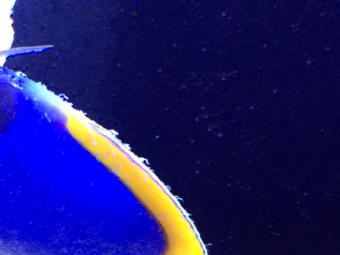
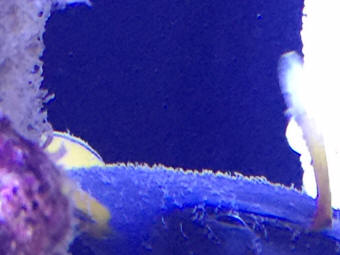
Hi any ideas what these are.. looks like small hairs on my pbt. He has been in
tank for about a year. I have been dosing Prazi for the last week. Any help
would be great. Thanks
<Would REALLY like to sample and look at these under a microscope... Could be
"just" body mucus from... something chem./physically irritating in the water,
accumulated gunk in the system attaching... Perhaps some sort of worm/s. Again;
I'd sample and look first, check and improve your water quality, add mechanical
filtration... and possibly treat with an Anthelminthic... the last via foods. Do
please send along further input as this progresses. Bob Fenner>
|
 |
|
Re: Hairs on PBT 2/13/17
Thanks bob.. that being said I have a dose of Prazi going now.. I could do a
large water change..one other fish may have a couple spots.. not sure.. not
sure what to do.. what is your best idea? Environmental or parasite??
<Can't tell w/o data Eric. BobF>
Eric Willoughby
Re: Hairs on PBT 2/13/17
Thanks bob.. another thing he is flashing and rubbing on rocks.. would he do
that if it was environmental??
<Oh yes. BobF>
Re: Hairs on PBT 2/13/17
Thanks again.. did a huge wc and loaded a bunch of carbon.. see what happens
<Ah yes. B>
|
|
PBT... Hlth., env. 1/13/17
Hi I have a PBT that has been in my DRT for about a year….he started getting
little hair like filaments coming off his body….looks like a man who has not
shaved for a day… like stubble…. He also has some larger white masses on his
fins that have come and gone….. He is eating…and it does not look like ich…
you can see the little strings/stubble on his skin….any ideas…thanks
Eric
<Mmm; could you send along a well-resolved pic of this? Have you read re
Paracanthurus disease on WWM? This reads like an environmental response
issue rather than something pathogenic (a biological disease). What other
life here? (always a good clue), foods, feeding... Water quality test
results? Maintenance, set-up? Bob Fenner>
Re: PBT
Thanks I will wait for my lights to come on.. 1.026.. n 1ppm . P says nd
<? Phosphorus is not detectable?>
but know I have some.. mag/ca/ are at Red Sea pro salt levels.. alk
too.. ph is low 7.7-7.8..
<Yeeikes! This is critically dangerously too low. The pH scale is a base ten
log... this IS the likely cause of your/Tang trouble>
run a ca reactor..
<? What is the effluent pH? NOT lower than 6.6-7 I hope/trust. You may need
different, better media to melt down>
have a rsm 650.. do about 10 percent weekly changes.. but have been doing
large changes past two weeks since this showed up.. did dose tank with
prazzi..
<... I'd be sampling... first; not using an Anthelminthic>
I'll get you a pic when I can.. mates... clowns, tiny purple tang, hawk
fish, Anthias, 2 cardinals
<.... Please read your emails, messages before sending them. BobF>
Pbt 1/13/17
Here are some picks about 1.5 weeks ago.. these seemed to resolve but more
have shown up.. thanks
<.... Eric... the fish would be dead by now if this were pathogenic. READ on
WWM re the husbandry of Acanthurids. FIX your water quality here; THIS is
what's wrong with this fish... The mucus coming off of it is from poor
environment. Bob Fenner>
|
.JPG) |
|
Re: Pbt
1/14/17
Hi did you get to look at these
<Already responded re. See WWM Dailies if you didn't receive directly. B>
Pbt
1/14/17
Any ideas?? Is it ich? Thanks
<What? Read>
Re: Pbt 1/15/17
You indicated to read but nothing was attached
<Where you've been referred to on WWM. Search just Acanthurus leucosternon...
read all. B>
Eric
Re: Pbt 1/15/17
Thanks when I search Acanthurus leucosternon on your site it comes up with stuff
just on pbt.. sorry a little confused on what you are telling me to look at..
sorry just confused.. do you know what this is.. thx
<Mate; I've responded re this, and told you where to find the resp. twice on
WWM. Either go there and read or go elsewhere. B>
Re: Pbt 1/15/17
http://www.wetwebmedia.com/WWMAdminSubWebIndex/question_page.htm
Ok again not trying to be hard..but told me twice to look up info on Acanthurus
leucosternon.. correct.. that is the name for pbt.. correct.. I was just trying
to id what was on the pics I sent.. I'm not sure if we were talking about the
same thing.. sorry for the confusion
Eric
|
|
powder blue tang that is bloated 2/27/16
Hi.
<Hello>
Could you shed some light on the problem I am having with my powder blue tang.
<Will try>
It has looked fine up until this morning where I noticed it was just hovering in
one spot, on closer inspection I noticed it was swollen around the abdomen.
<I see this in your excellent pix>
It was a bit sluggish earlier today but this evening it seems to be waddling
through the water and the swelling has increased.
<All in one day.... Something ingested... too much, gasifying?>
the pbt has been on a diet of frozen Mysis and brine, Nori, and just recently
grazing block.
admittedly the diet has been mostly protein and not a lot of fibre or “green”
foods.
<Mmm; should be the other way around>
I have attached a picture to illustrate.
thanks in advance.
Dray
<Am hoping "this too shall pass"; however, if it were me, mine, I would go ahead
and administer Epsom Salt here; as a laxative... at 1 tsp. per five actual
gallons of system water. This is a very safe material; its use gone over and
over on WWM if you'd like to search/read. Bob Fenner>
|
|
Re: powder blue tang that is bloated 2/28/16
Thanks for the reply.
<Welcome>
I have now dosed the tank with Epsom salts and have tried to feed cooked pea’s
(skinless) but I have also to hand some “fluke solve” which I am holding off on
using until I know whether it will kill of the flatworm infestation I’m having
at the moment as well.
<Mmm; are they (the flatworms) "that" bad? I'd leave for now>
I don't suppose you know anything about this?
<A bit; archived on WWM. Do you need help using the search tool, indices?>
adding to this, is it possible to overdose the Epsom salts? what's the effects?
<Not easily done... MgSO4 has a wide margin of safety... again... on WWM.
Welcome. BobF>
thanks again
dray
|
 |
|
Re: powder blue tang that is bloated 2/28/16
yeah I'm not that concerned about them just now, apart from whether they will
die due to the meds. I'm going to siphon a few off tomorrow and do a container
test to see their reaction.
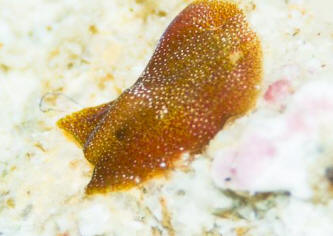
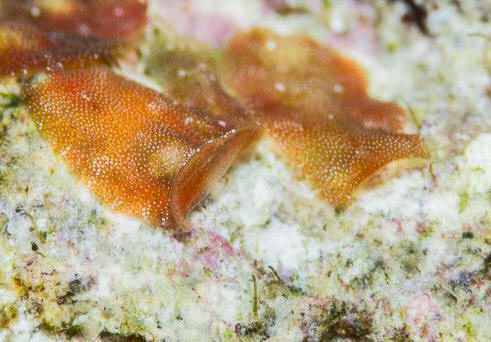
these are the flatworms…..I think they are just red Planaria.
<Oh; nice pix. BobF>
|
|
Powder Blue tang 8/19/15
Hi Gang. Hope all is well. Love the sight and all of the usual information.
I've got a small, I believe anyway, issue with a powder blue tang I've had for a
few years now. Visually the fish is very healthy and happy. It is active all day
picking at algae as you would expect, it's color is very sharp and vivid and its
body is nice and thick. I feed a regular variety of quality marine food, both
frozen and flake, as well as Nori to supplement.
My setup is a 150 gallon tank with liverock and your standard sump wet
dry/protein skimmer combination. My "issue" is that for the last 12 months or so
it will swim alongside something and scratch itself.
<Natural... behavior... do in the wild.... not necessarily indicative of ext.
parasite, water quality, other issue/s>
Having been in the hobby for about 20 years now I'm well aware of the diseases
associated with this type of behavior and keep a close eye watching for evidence
of such. Having said that after very close examination on multiple occasions I
can not spot anything from a parasitic standpoint. No bumps, lesions, spots or
otherwise. It's coloration is very uniform and bright and, again, it is very
active all day and eats constantly. Since this has been going on for some time
I'm almost at the
point of it likes to scratch itself, but the 20 years of experience tells me
something must be causing this. I have 4 or 5 other fish in the tank as well and
none of them exhibit any issues health wise either, difference being that they
don't scratch themselves. My water parameters are exactly where you'd like to
see them and I have tested them many times for accuracy. Basically I'm stumped.
Any thoughts on what the issue might be?
<A non-issue... given their propensity for being "first to break out",
Acanthurus leucosternon, the aquatic canary in a cave.... yours otherwise
looking good.... >
Could it be something internal and, if so, any recommendation
treatment/medication wise? Thanks!
Jamie
<Nothing to treat; would NOT medicate. Bob Fenner>
Powder blue tang; hlth, using WWM 6/24/15
I am facing a concerning issue with one of my favourite fish. I have recently
put my pet in QT and commenced hypo with him after some concerns he may
have been infected by ich.
<Very common w/ this Acanthurus and a few others... READ on WWM re>
He has been in hypo
<Rarely effects a lasting cure. READ re this as well>
for two weeks and eating up to three days ago. He has great colour, is thick and
his fins are perfect. The problem is he is struggling to swim. He is constantly
at 45 degrees or worse and swimming almost in circles with his head up.
<Could be simply the low salinity>
The salinity is at 1.009 and the other fish is in QT with are doing great. I am
considering treating for bacterial infection with something like Kanaplex
<Mmm; I wouldn't... for reasons again gone over and over on WWM>
but wanted to ask what you thought I should try.
<Reading... likely the use of a Quinine compound... these fish are still
Cryptocaryon (et al. likely) hosts; just being weakened further through the
hyposalinity treatment... Seen this many times; avoided buying the tee shirt, no
news at eleven>
Thank you for you time and any guidance you can provide.
<Simply the looking, reading, understanding ahead of real action through the use
of WWM's archives. Bob Fenner>
Thanks
Marc
|
Thin Powder Blue Tang 5/3/13
Hello again crew. Seems like I've been writing you guys a lot lately.
<... w/ too-large image files>
This will hopefully be my last question for a while! I ordered a Powder
Blue Tang online.
<This fish is starving>
When he arrived he was very thin but he was eating right away. He was even
searching for food in the acclimation bucket! He has not come down with
crypt and eats voraciously on Nori and Rod's Food soaked in Selcon.
<Ah, good>
But as stated he is very thin. I am just wondering if there is anything
more that I should be doing for him?
<Yes... NLS Spectrum pellets.... Read here:
http://www.wetwebmedia.com/pbtfdgfaqs.htm
Other than supplying him with an endless amount of Nori.
<Very little food value in Porphyra sheets, other algae... Bob Fenner>
I have attached a few pictures for reference.
Thanks,
Shea
|
 |
Re: Thin Powder Blue Tang
5/3/13
Thanks Bob. Sorry about the image sizes. I can resend with smaller sizes if
you would like.
<Ah, no; too late>
I have various sizes of NL Spectrum Pellets that I can offer.
<Oh, good>
Should I be soaking them in the Selcon solution?
<Maybe for a short while (a minute or two)>
I am appalled in the condition that this fish showed up in.
<Very common for all wild-caught fishes to not be fed after capture...
through packing, shipping... often even while at wholesale facilities...
And Tangs as you note, eat/forage continuously by day>
This is the second tang that showed up like this. First one was a Naso
that died 4 days after arriving. I could not get that one to eat. Needless
to say I will not be ordering from that company in the future.
<Ah yes; good point... Dr.s Foster and Smith (through Quality Marine) is a
valid source>
Thanks,
Shea
<Welcome, and thank you. BobF> |
Powder blue tang 4/8/13
Hello all. My powder blue tang has what looks like small white
threads on one of its eyes.
<Ahh, likely Trematodes... Flukes>
Tried to get a pic but to no avail. Tank info - 125 gal, 100 lb live
rock, ammonia, nitrite, nitrate all 0 - ph 8.3, temp 77 degrees. Fish in
tank - yellow tang, clown, flasher wrasse, royal gramma, lawnmower
Benny, red Hawkfish, long-nosed Hawkfish (all get along fine). Any
thoughts?
Diann Trapp
<Search WWM re. Bob Fenner>
Re: Powder blue tang 4/8/13
Thanks, any suggestions as to what to do? He's eating like crazy and
acting normal. Should I be concerned about other fish?
<... please read where you've been referred. BobF>
|
PBT with growth/injury 2/22/13
Dear Bob all other crew members,
<Alex>
I have a problem with a Powder Blue Tang (A. leucosternon). When the
fish arrived it had what appeared to be a scratch along part of its
lateral line (see image #1). I did not pay it much thought since such
minor injuries heal pretty quick in most fish. That was on the 8th.
A few days after that the wound got larger and looked "fleshy" with
whitish protrusions. I thought that this might have been due to an
overeager cleaning shrimp and that it would heal.
But the injury/growth/parasite infection keeps getting worse with the
current state shown in images #2 and #3. I hope you can see that it has
spread enormously along the lateral line, even up to the posterior end
of the scalpel. My phone's camera isn't that good and the fish kept
swimming away… But in person the look of the growth is fleshy and
pinkish (not "fuzzy" as it might seem on the pictures) with small
longish white protrusions among it. Could this be a simple
reaction/inflammation due to the sensitivity of the lateral line organ
or is this something parasitic? No other fish shows any symptoms (yet).
The PBT does not show any discomfort at all, I strangely haven't seen it
flashing even once, and it is very active and curious (i.e. normal
Acanthurid behavior). It is housed in a 400g reef tank with zero
measurable phosphates/nitrogen compounds, 34-35ppt salinity, 78°F
temperature, Ca, Mg, alkalinity, pH all in the optimal range, so I think
environmental conditions are not the main culprit.
<Mmm, no. A physical injury is>
Do you have an idea what this might be and what can be done/if it will
heal itself?
<Am hopeful re the last... only time going by will reveal>
Thanks in advance!
Cheers, Alex
<And you, Bob Fenner>
|
 |
Re: PBT with growth/injury
2/22/13
Thank you for your reply, Bob!
Then I'll wait and see. (Definitely preferable to trying to catch the tang…)
Alex
<Ah yes... best not to try and do anything here. BobF> |
Powder Blue Tang question 1/29/13
Hello WWM,
<Danny>
I've had a large (4.5 inches)
<Mmm, no; medium. Gets about twice this length>
Powder Blue Tang for the past 8 weeks in my 180 gallon FOWLR. The tang
eats well, on a diet of Spirulina brine shrimp, mussel meat, formula 1, and
daily Nori sheets. His stomach is not pinched in (indeed he has a little
belly on him) and he is not thin behind the eyes (per your article) but I can
see his spinal column quite easily, especially on the anterior half of the fish.
<Then is thin... not atypical; and can be fattened up >
The tang is quite active and behaves normally, but should I be worried about
this?
<Mmm, no. I'd use Spectrum pelleted as a basic/staple... a few times daily.
Will be plump in a few weeks to months>
I know tangs have laterally compressed bodies, but I wondered if this was
normal.
Thanks,
Danny
<Easily starved in transit from the wild, through the chain of custody...
Bob Fenner>
Suicidal powder blue! High NO3, stung by a H. magnifica...
in too small a sys. 9/1/12
Hi crew, firstly what a fantastic site! I have learned soooo much!!
Although I have now hit a problem with a tang that has behavioural
issues!
Tank specs are as follows:
100 (UK) gal reef
Sg 1.0255
Temp 26.2
3 x Wavemaker
1800 Gph return
3x150w m/h 14000k
Aggressive wet skim vodka dosing @ 3ml/day due to high nitrate prob
Socked carbon in sump
Ammonia 0
Nitrate 40 ppm
<High by twice as much as I'd allow>
Nitrite 0
Tank mates are:
Sailfin tang
<Will need more room in time>
Flame angel
Pink spotted goby
Engineer goby/convict goby
Emperor cardinal
2 clowns hosting a "rescued" Ritteri
<Mmm, very stinging>
Mix sps/lps
After water change (5-6hours) the powder blue tang started swimming at
the surface, breaking water, swimming awfully close to the nem, he
seemed very friendly swimming around my hand to the point I moved him
away from nem with my hand but he headed straight back in to flow of
Wavemaker pushing him back towards nem, he got stung and grabbed
by nem, I pulled him out and into my sump until I set up my
hospital tank again, please help he is now breathing rapidly in the sump
not moving much but buoyant at the top of the water
Many thanks in advance
Jim
I did a 30 gal change 2 days ago and another today to try bring down the
nitrates
<Ah good. I suspect this A. leucosternon did actually encounter the
Anemone strongly enough to suffer real damage... and/or that or there's
a shortage of dissolved oxygen here (this species needs room, good DO),
and/or there's something "internal" going on w/ this specimen... Other
than moving it to other quarters, there's not much to be done. Bob
Fenner>
Re: Suicidal powder blue! 9/1/12
Hi bob, thank you for your swift reply, as you suspected this fish has
already succumbed to the sting unfortunately,
<Ahh>
I still fighting the nitrate battle and doing another 30 gal change in 2
days and another every 2 days, until the nitrates are down,
<There are other means... see WWM re>
I'm not seeing any improvement using vodka dosing, do you see this as a
beneficial way of reducing the nitrates
<Not long term, no... better to utilize DSB, RDP sump and macro-algal
culture... and, and...>
or do you think this may have caused a reduction in DO in conjunction with
the 30 gal change today?
<Unlikely; no. BobF>
Thanks again
Jim
Powder Blue Tang Ick, no
rdg. 4/13/12
Hello Crew
<Dev>
I purchased a rather small Powder Blue Tang, only about
3".
<Mmm, smaller than I'd start w/>
I know that this size is generally not recommended, but he
appeared alert, healthy and was eating. I paid for him and had the
store hold him for three days prior to picking him up. Once home, he
went in my 45 gallon quarantine tank. On day two he developed what
appeared to be ick on his fins.
<Very common>
I removed the carbon pads from my filter, and started
treating with CopperSafe.
<Acanthurids-oids don't "like" copper
exposure. Other treatment means are preferable, gone over on
WWM>
He is still acting normally, nibbling at seaweed strips and small
amounts of Mysis shrimp. Treatment started 48 hours ago. Water temp is
78, PH 8.2, salinity 32, spec grav 1.024, nitrates 10ppm.. I removed
the carbon pads from my filter, and started treating with CopperSafe.
He is still acting normally, nibbling at seaweed strips and small
amounts of Mysis shrimp.
Treatment started 48 hours ago. Water temp is 78, PH 8.2, salinity 32,
spec grav 1.024, nitrates 10ppm.
<Mmm, keyed twice, or copied...>
Is copper the wrong medicine to treat with? If so what do you
recommend?
<Read here: http://www.wetwebmedia.com/PBTDisFAQ2.htm
and... the linked files above>
How often and how much water should I change to control water
quality?
<Also covered>
Will the two pieces of live rock in the tank have to be discarded
after the treatment? How long does this usually take to run its
course?
<... not necessarily, and perhaps a couple weeks to forever>
Assuming I am lucky and actually save this fish, should I
keep him in the quarantine tank for approximately 3 to 6 months
<Will surely perish t/here>
until my 180 setup is ready for him, or move him to my existing
55 gallon FOWLR with a percula clown and 3" Heni butterfly fish?
The 55 has been up and running for a few years with hermits, snails,
coral banded shrimp and green Mithrax crab. Thank you for your
help.
<Better to look before you leap... Look to quinine compounds...
moving this animal through a dip/bath procedure. Bob
Fenner>
Help! Powder blue tang stopped eating
12/24/10
Hi,
<Happy Xmas eve>
I have a powder blue tang in a 180 gallon tank that stopped eating and
swims at the bottom of the tank like he cannot see.
<Perhaps s/he cannot>
He is bumping into the glass tank and the rocks. He is not very active
at all. Water and tank quality is the same and no changes. I am not
sure what to do. He does not have any signs of disease on the
outside.
<Most often such cases/symptoms point to long/er term
avitaminoses... deficiencies in diet... To some extent correctable at
times...>
I checked the body and eyes and they appear clear. I do not know what
to do. We have had the Tang for about 9 years now and do not want to
lose him. Please help.
Thanks,
Pancy
<Put the two words "Tang blindness" in the search tool
here:
http://wetwebmedia.com/Googlesearch.htm
and read the cached views. Perhaps addition of supplements to the
water, foods will rectify the situation. Bob Fenner>
Re: Help! Powder blue tang stopped eating 12/24/10
Thanks Bob. I will search the site as suggested but I am very concern
that he is not eating.
How do I get him to eat?
<Please read where you were referred to. All I know re this issue is
archived there. BobF>
Help with a new powder blue tang,
hlth. mostly 7/28/10
Dear Wet Web Media staff,
<Hello>
First off, let me just say that your web site has been such a help with
both the setting up of my freshwater tank and now my new reef tank.
<Great>
Yesterday, I went to my LFS and bought a Powder blue tang semi-
impulsively.( I knew a lot about tangs and knew my 120 gallon fish tank
could support it, but I got home and read that they need an older
aquarium.) I tried to return it to the fish store but they would not
take it back because it would be too stressful for the fish
understandably.
<Bogus, would not be any more stressful than being added to any
other tank.>
My tank was cycled with 50lbs of live rock for 2 to 3 weeks. My
question is what is and what are the signs of the white stress bar and
does he have a chance that he will live.
<Certainly he has a chance of living if properly cared for, not sure
what you are asking about the signs of the white stress bar. These
tangs do display a white bar in response to some stress, but in and of
itself it is not harmful.>
I feed him algae, brine shrimp and New life spectrum optimum salt H20
with garlic in them.
<Lose the brine and garlic, feed occasionally with Mysid but mostly
algae is what this fish needs. Selcon or similar additive may be
beneficial.>
He looked very healthy in the store.( he is the right colored blue,
clear eyes, responsive, active, and eating already.) The only thing I
saw wrong was one dark splotch on him but it is already half gone.
<Good>
I put him directly in my main tank because it was empty and am
currently putting stress zyme in that replaces his mucous coat and
treating him precautionarily with reef safe kick Ick.
<I would not be using either of these products at this point,
unnecessary and if Ich becomes apparent I would go with a more
effective treatment method.>
I also gave him a 17 minute freshwater bath and didn't see anything
come off of him. Thank you for your time
Michael
<Enjoy the new fish.>
<Chris>
Quarantine 5/3/10
<Hello Jay.>
I am expecting a powder blue tang to arrive for my reef tank from
saltwater fish.com folks
<Uh oh.>
Do you recommend isolation tank/ fresh water bath or what??
<A quarantine tank is highly recommended. The Powder Blue Tang is a
very difficult fish to acclimate and
they are known as ich magnets. You do not want to risk infecting your
other fish should a disease become present, and due to the stress of
shipping/handling (especially so with this particular fish), the stage
for this to happen is usually set.>
The owner of the LFS recommended against isolation tank because of the
increased stress.
<As above, and please read here.
http://www.wetwebmedia.com/quaranti.htm
And here. http://www.wetwebmedia.com/powdbluetg.htm
James (Salty Dog)>
jay
|
eye-clean PBT with fast breathing and no appetite -
10/24/09
Hey guys,
<And gals... don't forget them... or next generation...
there won't be one>
Thank you all so much for what you do!
Now a little background: 110 gallon display with 120 #s live rock
and 1" live sand, 20 gallon sump with EuroReef skimmer, 20
gallon fuge with ~6" live sand. Total flow is around 1000
gallons/hour. 6 40watt NO tubes on the display, 1 60watt CF on
fuge with a 12/12 lighting period. I have a half-dozen hermits,
about 50 assorted snails, two tank-raised percula clowns, long
nose butterfly, flame angel, powder blue tang and a Moorish
idol
<These last two are not easily kept in captivity>
in the display. In the fuge is Caulerpa
<I'd ditch this... too toxic>
and another handful of red macro that I grabbed from the LFS
without identifying. Temp: 81, SG:1.025, PH:8.2, Ammonia, Trites,
Trates: 0. I do 10% weekly water changes. I have all the fish and
there have been no changes to the tank, feeding or livestock for
over a year.
And my problem: The tang is breathing at roughly a 2x rate of
what it should be and has not eaten for a week. Normally, this
guy is a bottomless pooping machine. I have studied him closely
(especially his gills) to look
for something (anything!) that I could treat or at least
identify.
Nothing. It is a strange feeling to hope and wish that you
identify something bad, but the lack of a desire to eat is a big
deal for me (especially with this tang). I have never lost a fish
in the 4 years I have had this tank going. All the of the other
fish are fine. I was going to quarantine but I don't know
what to treat for.
<Need to assess the root issue/s... or at least guess at what
may be most likely... Environmental... water quality,
social...>
Question: How would you debug this?
<Water testing... change-outs, chemical filtrants... A cursory
reading on WWM re environmental disease... cogitation>
What should my action be? What kind of time-frame do I have? I
know that his immune system has probably already taken a hit due
to the lack of food for a week, but he still looks quite
plump?
Thank you very much!
Al
<Start here: http://wetwebmedia.com/marenvdi.htm
and the linked files above. Bob Fenner>
Re: eye-clean PBT with fast breathing and no appetite
- 10/25/09
Bob,
<Albert>
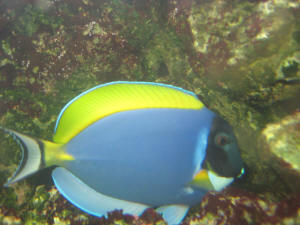
Thanks for the quick response. I re-tested all the levels to rule
out water quality.
<Umm, no... your pic shows a nice plump A. leucosternon... but
with a good deal of (toxic) Cyano/BGA on the rock...>
Everything is at the proper level as listed in my previous
mail.
I can't think of anything that has changed environmentally in
the past year. I am going to continue to try and guess at what is
troubling this guy, but I am feeling rather hopeless.
<See WWM re Cyano control...>
In the past day, the fish has developed a white discoloration. I
am thinking that this is due to stress that would come as a
result of countless possible conditions, but I thought I would
send it to you in case it sets
off some alarm.
Thanks again,
Al
<Read: http://wetwebmedia.com/bluegralgae.htm
and the linked files above. Bob Fenner>
|
 |
|
Re: eye-clean PBT with fast breathing and no appetite
10/25/09
Bob,
<Big Al>
Awesome. I am glad I sent a picture, I had no idea this algae was
toxic.
I'll start daily 10% water changes (This is the fastest I can
make water), siphon out as much algae as I can and add
carbon.
<Good moves>
Think the Tang will make it?
<Yes... looks otherwise to be a mighty fine specimen>
Thanks again, you're a lifesaver! (hopefully)
Al
<We'll see... BF>
|
Hippo tang not eating! Deli time, high
NO3 - 10/24/09
Hi all,
<Reuben... one of my fave sandwiches BTW. Extra 'kraut
please>
Firstly just like to say that your web site is a great resource and has
helped me loads in the past!
<Welcome... and sharp mustard galore>
The problem I'm having I couldn't quite find this time though
so am asking myself this time.
I've had a 65 gallon tank now for just over a year and a half with
1 hippo tang about 4 inches long now, a yellow about 3 inches, a
Sixline wrasse and two ocellaris clowns.
The tank has remained with the same inhabitants and live rock
arrangement with a couple of soft corals for the best part of a year
with no real problems though I have lost a couple of snails and my
cleaner shrimp did go missing about 6 months ago never to be seen
again!
<Happens>
My problem is about 5 nights ago I returned form work to find that my
Hippo tang was no where to be seen at feeding time (he normally will
always come out and actually will play 'tug o war'
with a piece of dried seaweed if you hold it on the surface of the
water)
after a look around I found him hiding in his little rock space or
'home' at first I thought maybe he's just a bit spooked
from a 10% water change I did the night before but he didn't come
out all night, I managed to get a good look at him using a combination
of peeking through the gaps in the rock and hanging a mirror down the
back of the tank and he looked fine, no skin damage ich or anything
similar, his eyes looked ok and he was flapping his fins about like
normal, so I was a little bit puzzled.
Anyway 3 days later and he still hadn't really moved so I headed to
my LFS to get some advice and after explaining the situation they
suggested that the power balance may of swung in the Yellow's
favour (as with the Hippos absence he was looking a bit more dominant)
and that the Hippo has been stressed and/or scared so they suggested
getting him out of the gap to try to feed him, unfortunately I
don't have a QT tank and don't have the money to buy another
setup at the moment
<Solution: Catch the Yellow Tang and place it for a few days in a
floating plastic colander in the tank>
so for now I have put him in a home made large 'breeder box'
within the tank, since then he has pretty much (apart from when I first
put him in he was swimming around a bit)
stayed in the corner of the box
<Move this Paracanthurus out of here>
just flapping his fins sometimes calmly other times fast like he's
trying swim away and hide, I've put in a bit of flake food (which
is used to eat all the time almost 'stealing' from the clowns),
a few live brine shrimp which he definitely normally eats and hung a
piece of dried seaweed in and he has completely ignored all of it, in
actual fact the only reaction I did get is if I move the box about he
loses colour and turns white (it returns shortly afterward).
I'm getting worried about him now the last time I saw him eat
anything was about 5 days ago and he's starting to look a bit
skinny and his stomach has now got a small 'pinches' on either
side.
Anyway tank parameters are,
Ammonia 0
Nitrites 0
Nitrates around 80-100ish
<... likely the root of the issue here. See WWM re NO3...
act>
(this I know is too high and have had trouble with them in the past
getting them down to 20ish) had a suspicion they may have crept back up
recently as
my tank has had a bit of an algae bloom so will try and reduce
these.
Don't know why it hasn't affected the corals and other inverts
on LR though they all seem fine.
Ph around 8.2
Temp around 78ish
SG is 1.025
Equipment is a canister filter, protein skimmer and two powerheads to
increase flow inside tank.
Please any advice will greatly appreciated he's my fave fish and
has so much personality, I hope I don't lose him.
Many Thanks,
Reuben
<Get going Reuben. Bob Fenner>
Powder blue problems
2/16/08 Hi Bob, <Sam> Sorry to bother you but my powder
blue tang appears to have gone temporarily blind I have had him for
around 2-3 years. I have always fed him ocean nutrition flakes and
occasionally mysis, plankton and frozen marine mixes. He ate some mysis
and plankton a few days ago. But over the last week he has stopped
eating and on further inspection appears blind. He seems to be swimming
in circles. Normally he sits in his hole and comes out at feeding time.
Apart from that he is quite a fat specimen. His eyes appear vaguely
cloudy and his eye balls are moving a lot somewhat like a toy doll. He
can see, but only things that are close to him. I have placed him in my
hospital tank with aquabee 200/1 skimmer, eheim wet and dry filter. i
have lowered the SG to around 1.018 and added ParaGuard. Do you think
he will regain his vision? Regards Sam <I do hope so. As marine
fishes "drink" their environment, I encourage you to
supplement the system water with a vitamin and HUFA prep... Like
Selcon, Microvit... This addition may well serve to reverse some sort
of deficiency syndrome in effect here. Bob Fenner>
|
Fish Disease... A. leucosternon 12/14/08 Dear
Crew, After researching carefully, I am unable to identify the
presenting condition of this Powder Blue Tang. The symptom onset
was eight weeks ago and very sudden. The fish has been in an
aquarium for three years. The fish is quarantined and remains
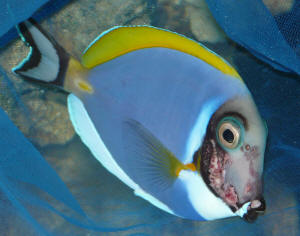
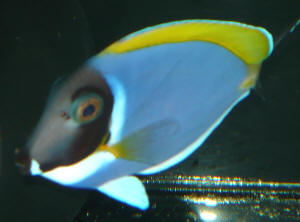
bright, alert, active and feeding. <Good> I've attached
some hi-res photos to offer you a closer look. <I see
these> If you have an interest or experience to share in this
matter, I'd be grateful. Regards, Greg Danos Owner / Operator
Urban Aquarium, Inc. Anaheim, CA 92806 www.urbanaquarium.com
<Mmm, well... considering that the fish presents as damaged
only on the one side, the length of time in captivity, its
apparent good health otherwise... I would guess (with some
confidence) that this is an issue that started with some sort of
physical injury... that has developed as a secondary, likely
bacterial issue... How to proceed? On a few fronts. I would move
this fish back to a main display that has rock et al. to pick on
at its leisure, and try bolstering what it does eat with vitamins
and HUFA supplementation (e.g. Selcon), and use a cleaner (my
choice, a Lysmata species shrimp) to keep the wound clean, AND
avail yourself of the benefits of "mud" filtration in
the system, have palatable macro-algae present (perhaps a
Gracilaria sp.)... and if available, lace the foods with the
antibiotic Chloramphenicol (Chloromycetin) should your
veterinarian be willing to prescribe this to you for this use. I
have seen similar wounds "heal" with time (months)
going by. Bob Fenner>
|
  |
|
Re: Fish Disease... A. leucosternon
12/14/08 Bob, <Hook 'em Danos!> Thank you
kindly. I will implement your recommendations pronto. Your Fan
and "Student" for 10 years, Sincerely, Greg Danos
<Ahh! Glad to assist your efforts. BobF>
|
Re: Acanthurus leucosternon
mistake... compounding... need to read... Hyaku! 11/30/08 Hi
again, I'm afraid that I improperly quarantined my tang, and he
might have marine ich. <This, and a few other species, are indeed
very hard to rid of this protozoan> cannot tell for sure if he has
it or not, but there are small white dots on his fins and maybe on his
body but they are really really small. To somebody looking at him they
would probably think it was a sort of acne; but you would have to be
closely looking at him, not just a glance. To be safe I put all the
fish in the QT tank and turned the heat gradually up to 81 days over
the course of the day. <Mmm... not high enough to be of use...> I
bought some rid-ich at the store (only ich remover they had) and read
the directions. <... and this; formalin and Malachite Green,
treatment is not generally effective... and quite toxic> It says
that it is safe to use on "scaleless" fish and some inverts (
I do not have inverts, jus thought it would be worth mentioning). The
puffer seems to be a little sick also. His right eye is a little
cloudy- greenish cloudy. And his left eye is cloudy white in one spot.
<... could be a pathogen or just exposure to the Kordon
product...> I feel like I am in way over my head with this saltwater
stuff. Do I wait 4-6 weeks from the start of treatment or the start of
seeing no cysts? <My friend... you need to read... and
quickly...> It says when treating for ich to treat for three days
after no visible signs of cysts occur- but then want? Do I wait and see
if it comes back and start over? I do not want to start treatment
before I know all of this because I don't want to injure/ kill my
fish. I hope in this hobby the beginning is the toughest place to
start, then it gets more enjoyable. I almost forgot to thank you guys
for all the info and quick responses!! Thanks, Will <Have just
skipped down. Start here:
http://wetwebmedia.com/mardisindex.htm scroll down to "Parasitic Disease",
particularly parasitic tanks... then onto Cryptocaryon... and then to Quinine
use... and quickly. Bob Fenner>
Re: Acanthurus leucosternon
mistake 11/30/08 Thanks bob. I have not used the rid-ich
because I was afraid it could be toxic to some of the fish. <Ahh,
you are wise here> Would freshwater baths work for the ich and help
the puffers eyes. <Mmm, no> Do you know where I can get Methylene
blue? <On the Net assuredly... a few brands are sold by most all the
major etailers... B> Thanks, Will
Re: Acanthurus leucosternon
mistake 11/30/08 That was literally a super quick reply. What
do you recommend for the ich then? <... that you read where you were
initially referred to... I would go the Quinine cpd. route... time is
slipping... make that sliding way fast... into the future.> I'm
afraid to use any medications. It seems that I'm just sitting
around doing nothing. <I concur. You apparently are> To help with
the ich would I raise the temperature and lower the specific gravity in
the display and QT tank or just the display. <Too late, too
little...> The only fish that seems "sick" is the puffer.
The powder blue tang has the white spots, but other than that his
behavior is normal. The lionfish doesn't seem to care that he has
moved, he still swims around and tries to intimidate his reflection.
The eels seem fine. They both had their heads out of their rock. Do you
know what I can do for the puffer and the tang? <Yes> I'm
thinking of using the rid-ich in a dip/bath as mentioned in one of your
FAQ's and putting the lionfish and eels back in the display since
the ich might not have been transferred from the tang to the ground if
he was only in there for a matter of hours, but I don't know if
this is true. Will Methylene blue help relax the fish and make them
calmer? <Yes also> I just want them to get healthy again. <I
understand... read. B> Thanks for all your help/advice,
Will
Re: Acanthurus leucosternon
mistake 11/30/08 I am getting freaked out because i found
parasitic diseases, then "in marine tanks" but that's
just a FAQ section and i cannot find anything on Quinine use"
<Ahh, let me help you... here:
http://wetwebmedia.com/quinmedfaqs.htm You should learn to/use the
search tool, found on all pages.> I am going to perform a dip for
about seven minutes on all the fish (separately) with Methylene blue
and water to calm them down and to hopefully buy them some time.
<Mmm, likely more stressful than useful...> thanks for all your
info, will <Will, a good path to take all a step at a time here...
Do consider the Chloroquine Phosphate... B>
Re: Acanthurus leucosternon
mistake 11/30/08 I also and a question about dips/baths. When
using Methylene blue and fresh water, is that the complete make up of
the bath? Or is it added to saltwater and then the fish go in? thanks,
Will <Just the dechloraminated freshwater and Methylene Blue my
young friend. B>
Re: Acanthurus leucosternon
mistake 12/1/08 I looked it up on fishchemical.com and it is
$125 for a kg. <...! You' don't need a kilogram> I'm
only 16 and don't have that kind of money right now and neither do
my parents. I went to my local fish store and they had some products I
would like to get your opinion on. First is Copper Cure II by Aquatrol,
Inc. I know copper can be toxic to tangs and some other marine fish.
Second is Quick Cure by Aquarium Products. <... See WWM re... the
ingredients... all covered> Third is Nox-Ich the people at the LFS
said this is what they use, but I trust you guys more than them- it
says use half dose on scaleless fish, so that's kinda a bad sign.
There's also the rid-ich+ i could use half dose, but i don't
want to take any chances. Only now do i realize the importance of a
good QT tank. <Ah yes> I feel like a smoker who is surprised that
he got lung cancer, with all the warnings out there and all. I did do a
Methylene blue bath, but if it's just going to stress them out more
then that's out. The puffer does seem better after the bath though,
he is swimming around the QT tank now. <Good... baths can be
efficacious, IF you can move the afflicted livestock on to
new/non-infested settings afterwards> Thanks bob/WWM crew, will
<... Please... don't write with these sorts of questions until
you've read what is posted on WWM... this is all gone over and
over. I fear by the time we "chat" via the Net... your
livestock will be gone. Bob Fenner>
Re: Acanthurus leucosternon
mistake... compounding... refuses to read 12/01/08 I treated
with half strength rid-ich+ and there practically gone. <...> So
dips are ineffective if They go back into the QT tank they were being
held in for treatment? If that's the case would I be able to add
Methylene blue directly to the QT tank to calm the fish down if I need
to? Will it be safe while using rid-ich+? Thanks, Will <Don't
write... READ. There is just too much (again!) that needs to be made
known here... and not sufficient time/means of teaching you through
this process of asking next, next... B>
Powder Blue Tang and
parasites, parasitized sys. 10/22/08 Hi, <Marcia> I have
yet another question for you about powder blue tangs and parasites. I
bought my PB tang about three months ago. He is housed in a 55 gallon
tank. <... too small> (Yeah, I know. The arrangement is
temporary. I'm setting up a 130 for him.) <Likely should have
waited> Tankmates include a pair of gold head sleeper gobies, a
small damsel, a small algae blenny, a few small hermit crabs, and a sea
urchin. Tank is well established, has a 4+ inch sand bed and a moderate
amount of live rock. Ammonia, nitrites, and nitrates are negligible, pH
8.2, temperature 81, salinity 1.022, <Too low...> lots of water
movement. I did lots of reading before buying the tang, so I pretty
much knew what I was getting into with this fish. He was the last fish
added to the tank, and I do not intend to add any others. I am feeding
mysis shrimp and two kinds of Nori. Food is soaked in garlic. The tang
was in good condition at time of purchase. He eats well, is
full-bodied, and still has lots of "sparkle." <Good> Of
course, I knew it would likely happen sooner or later. One morning I
looked, and the PB tang had several spots of ich. A few days later, he
began to have tiny bumps all over his skin. Today I noticed a few gray
spots (~2 mm. diameter) on the anal fin and the body in that region. It
seems to me that the bumps and the white spots are different stages of
the same thing, but the gray spots are not something I have not seen
before. Possibly a secondary disease? <Define
"disease"...> So here's my question. Assuming the
whole problem is parasitic, <Is not... a large part/element of
"the whole problem" is environmental> is it possibly to
control disease like this in the main tank effectively, without using
medication? <Mmm, yes> Shortly after the fish began to show
symptoms, I added a UV filter to the system, hoping that that would
help. <A bit... to improve water quality> The parasites continued
to multiply. Since then, I have added a diatom filter with an 800 gph
pump. <Shouldn't be run continuously> It is my understanding
that the diatom filter does help with ich, but do you think it could
arrest the outbreak once it is in full force? <It cannot> The UV
filter continues to run as well. I do not have a hospital tank set up
at this time, and I do not really have the financial resources to buy
much new equipment right now. Can you make any additional
recommendations? Marcia <Yes... read here:
http://wetwebmedia.com/parasittksfaqs.htm and the linked files above.
Bob Fenner>
Powder blue quarantine
9/20/08 Hi Crew <Wayne> Couldn't find an answer to
my question on the site. Hope you can help me out. <Me too> I
just bought a 4" PBTang...been at the LFS for 2 weeks and looks
healthy. Have him in a 40 gal QT. My question is about feeding. I plan
to feed dried Nori, red algae, and Gracilaria (all soaked in
Selcon)..as well as occasional Form 1 & 2 pellets, and New life
Spectrum pellets. I also have this "Jungle" anti-bacteria
pellet fish food. I've read about the beneficial bacteria that
reside in the guts of PBTs. Based on this....should I not feed this
anti-bacterial food? <Mmm, don't think this will be an issue.
The infauna of use are actually Protozoans mostly> What if the fish
displays a bacterial infection...would you still not feed this food?
<Such "infections" are actually exceedingly rare... How to
put this a bit differently than usual... By the time such microbes
"show up" it is almost always too late... they're mainly
decomposers, not pathogens per se> Thanks a ton. You guys/gals are
great! <Mmm, myself, fair to middling. Cheers, BobF>
Powder Blue "pimples"
7/3/08 Hi and happy 4th of July to everyone at WWB. <?>
I'm writing in regards to a problem I have with Peanut, my Powder
Blue Tang. I bought him a little over a month ago and immediately put
him in a 40gal QT. I observed him for a period of 3 weeks and I
didn't notice any problems, no parasites, no signs of disease,
eating frozen food and the dry algae sheets. The fish is about 4 to 5
inches in length. Then I thought everything was great and put Peanut in
my 150gal FOWLR. He acclimated very well and none of my other fish
bothered him. If anything he bothered my Foxface at first, but then
they became friends. A week later however, I noticed something very
odd. He had what looked like pin sized pimples all over his body. They
were not white like ich and it looked like they were under the skin. He
didn't seem bothered, still very active and eating like a pig. I
waited hoping these "pimples" would go away but they
didn't so now Peanut is back in the QT, except I have no idea what
is wrong or how to medicate for this problem. If these pin sized
pimples were white, I'd say ich, although none of my other fish
have it and the tank has been ich free for 6 months. Still, anything is
possible. Any idea what these are? They're only on the body,
nothing showing up on any of the fins. My tank parameters: Ammonia and
Nitrites: 0 Nitrates: 20 pH: 8.3 Density: 1.025 Other tank mates:
5" Foxface, 4" Picasso Trigger, 4" Niger Trigger,
4" Yellow Canary Wrasse, 2" Juvi Queen Angel. Again, there
was no aggression at all. The Niger is the most aggressive in the tank
but it never bothered the tang. Thanks, Peter <Mmm, likely
sporozoans... not easily treated... Could be encysted worms... these
might be treated with a vermifuge. Bob Fenner>
Powder Blue
Tang/Health 3/3/08 I just recently purchased a Powder Blue Tang
about a week ago. He is very hardy, started eating the first day, I
have him in my hospital tank cause of previous problems with the Powder
Blue getting parasites, sure enough he has them, <Not
surprising.> not bad and is being treated with med's an 2
Cleaner Wrasses. The Powder Blue is one of my top fish but have never
had no luck with them. <You and many, many more aquarists.> I
just recently got rid of my Gold Rim Tang , which I had for about 3
years so I can successfully accomplish acquainting a healthy Power
Blue. I've read that the Powder Blue is from South Africa an also
Indo. Is there any way to tell them apart? <Do not believe so. Most
are collected from the Indo Pacific.> I also read that the Powder
Blues from South Africa are a lot more hardy, is there any truth in
that? <No. Do read here and linked files above, will give you a some
knowledge of what it takes to successfully keep one. In future queries,
please do a spelling and grammar check before sending. Just do not have
the time to correct/edit queries before posting. http://www.wetwebmedia.com/powdbluetg.htm James (Salty Dog)>
| Powder Blue Tang Disease Id 2/24/08 Hello.
Was hoping someone could help me identify what is wrong with the
Powder Blue Tang I recently acquired. I got him, put him in
quarantine (37 gal. tank, wanted it big enough for when I get big
fish), and thought it was just some scrapes on his side but a
friend that was over said it was body rot. <...?> He is
eating well (algae and omnivore flakes, seaweed sheets, mix of
frozen enriched brine/Mysis soaked with extra vitamins) and is not
trying to scrape on anything (there is some pieces of live rock in
the tank from my 2 yr established tank that has a couple strands of
live feather algae for him on it). He is picking at the algae and
the rock like normal. Please take a look at the pic attached and
let me know what it is and what is the best way to treat if
anything needs to be done. It was suggested I try garlic, would
that be good to add as well? Any help is appreciated! Thanks!
Nicole <These markings are due to injury (handling... fingers
really) during capture, transport et al. stress... Please read
here: http://wetwebmedia.com/powdbluetg.htm and the linked files
above. Bob Fenner> |
|
|
Powder Blue
Tang/Disease...Another Sad Tail 7/19/07 Thanks Guys, <And
gals> Kick butt website by the way! Just a short scenario for you,
and I would LOVE to save my fish here! I'm on day #3 with this
Powder Blue, and it came down with ich. <Not surprising. A difficult
fish to keep.> I didn't quarantine, (I know, stupid move ). I
added a Scopas Tang at the same time, <Another bad move.> once
again no quarantine, <And again.> and it got ich as well. Both
are eating like crazy, but I got them in a qt anyways, 10 gallon only,
<Too small for these guys, big time stress coming up. At least get
another 10 gallon tank and separate them.> temp is 80, conditions
are good. <Good? Not with two tangs in a ten gallon tank.> In my
regular tank, levels are good, temp is more 77-78. (reef tank by the
way) What should I do at this point? <I would pray.> I was told
to lower salinity, raise my water temp, frequent water changes (how
much?) and haven't done these yet. Garlic in the foods is all I
have done so far... <All this is gone over in the linked files
posted below.> I'm also adding small doses of Rid Ich in my QT.
<Much better off using Copper Safe than this.> All other fish in
my display tank are ok. They have had ich in the past, and I QT'ed
them for awhile, put them back, and they are fine. Must have immunity?
Am I on the right track here? <Aaron, you do not have much time,
especially for writing back/forth. Do read here and related linked
files above, and act. http://www.wetwebmedia.com/parasiti.htm> Your
help is appreciated, just trying to save some fish over here! Thanks in
advance, <Good luck, and you're welcome. James (Salty Dog)>
Aaron Wise
Re: Was: Rapid Breathing Emperor... Now PBT dis., Crypt -
03/12/07 Bob, It has been about two months since my last e-mail. I
had observed my powder blue tang flash on several occasions <Mmm, a
natural behavior to extents... not necessarily portentous...> and
decided to wait it out having not seen any spots present. following my
last e-mail I have not observed it flashing and believed I was in the
clear. I have had it for approximately 5 months now and have been
feeling pretty good about my chances with him. It has put on weight and
is a very aggressive feeder on over a dozen different foods all soaked
in Selcon and Zoe. <Good> Having read all the reasons that they
are not suited for captivity, I chalked up my apparent success to luck
and believed that I may have happened upon a good specimen that was
going to adapt to life in a glass box. About a month ago I began to
acclimate my reef to metal halide lighting and this is where I believe
things took a turn for the worst. Immediately he began aggressively
attacking his reflection in the glass. <Yes... this A. leucosternon
can be a very social OR extremely territorial animal with its own
kind> His face would get dark black and his eyes would turn bright
gold. It sounds funny but he would get a crazy look in his eyes. In
retrospect, this indicated that the fish had not in fact adapted to
life in a glass box, and now leads me to believe that it probably never
will as so many PBT's before him. As I'm sure you've
guessed he has now broken out in a full blown case of crypt. My emperor
angel had a few spots and the two clown fish haven't shown any
signs. The crypt is cycling right now so no spots are present.
<"Are elsewhere"> I am going to tear down my reef
tomorrow to move these fish to a hospital tank. I have three cycled
BioWheels ready and will be purchasing a tank in the morning. <Good
planning> All fish were quarantined in a hex aquarium for a minimum
of 2 months back to back with the powder blue being the final edition.
the shape of this tank is not suited to treat these four fish at once.
I have a 20gal. Would that be too small? <Mmm...> The tang and
angel are both about 3.5'' and the clowns are 2'' and
1''. <Will have to do. Add some PVC parts for habitat...>
I hate to use copper on these fish because I believe that it kills the
intestinal fauna which leads to nutritional problems like HLLE later in
life. What is your feeling on this? <Is so, though these intestinal
fauna can be easily re-constituted... and the use of vitamins,
"muds" can forestall...> Unfortunately, copper seems to be
the most effective cure in my experience. Do you have any experience
with the transfer method combined with hypo salinity? <Yes> Is
this a viable option in your estimation? <Not dependably> I am
also planning on a 2 month fallow period which I have read will not
result in total eradication, <This is correct> but I read one
study that indicated that line degradation occurs after multiple cycles
of crypt and without any new additions to a system over the course of
15-20 cycles crypt loses its ability to reproduce and will result in an
"ich free" system. <Also so> In your opinion is there
any merit to this claim, or will ich always be present in my system.
<Can be eliminated entirely, but in actual cases, most always
retained as a subclinical infestation...> I guess my concern is that
once returned to the display my PBT will stress out under the metal
halides and over time become reinfested. <Too likely so> The fact
that he still attacks his reflection leads me to believe he always will
and since releasing him to the wilds of Minnesota is not an option the
stress of it might be the death of him. Although I suppose this is a
little premature. He still has to live through the copper treatment!
Any words of wisdom from the wise are always appreciated! <I would
definitely try... covering all sides but the one viewing panel with
paper or such... this may well solve the "reflection"
issue> Thanks for reading and responding to my ramblings, Jim
<Steady on my friend. The road may seem long ahead of you... but it
is your path. BobF>
| Tang parasite?... Not reading re researching WWM
first, sending too large files... 1/29/07 I bought a very nice
looking powder blue tang 11 days ago that has been in my 10g Qtank
since I brought him home. I started him on a half dose preventative
treatment on Coppersafe. <Mistake> I didn't notice a
single thing on him until about the 5th or 6th day. I noticed a
suspect area on his left side under his pectoral fin (I think where
his stomach is). After looking at it a while, it seemed like it was
something hanging off of him and he would scratch at it from time
to time too. I upped the dose to about 90%(scared to over do it),
and the very next day the area had gotten noticeable worse to about
what the picture shows. <... likely due to copper
poisoning...> The lighting looks funny because I was using a
shop light to show it better. <Good note> The tang has always
eaten very well (mostly mysis shrimp and some formula 2-loves the
mysis) and still is. Water quality and temp have been good and
consistent and he shows no other symptoms other than scratching and
a little less color from time to time. Oh, and there is a little
area small black spots on the forward part of his anal fin (you can
barely see it in the pic and the spots aft of the most fwd part of
the fin were on the glass). The pic shows the main suspect area
pretty well. Any idea what it is? <... your file is an order of
magnitude larger than we request... And your answers and many more
that you are not yet aware of are posted... on WWM. See the
indices, search tool... re Acanthurus leucosternon, Tangs and
Copper... Bob Fenner, disgusted> |
|
|
| Re: tang parasite? 1/29/07 Bob, I apologize
for sending the large file, I forgot about it cause it's been a
while. <And sorry for my apparent over-reaction... we only have
ten megs of storage... and we went past it... all else is bumped
till the buffer is cleared...> I have been researching WWM using
different key words, but I hadn't thought copper was a problem
(based on a friend having tangs for years and the LFS), <Is with
Acanthuroids... particularly soft-bodied species like the PBT and
Achilles> and I couldn't find anything else like I was
seeing, but I don't even know if I was using the right words.
I'm not sure if you got the image so here it is in a smaller
size. <Thank you, did down-load and look at> I am looking
again using your info, but any other help would greatly be
appreciated. Thanks <I would not expose this specimen further to
copper compounds... Perhaps a one-time formalin dip and move... And
the administration of a general purpose anthelminthic... My choice?
Praziquantel. Bob Fenner> Re: tang parasite? FW dip Q.
2/4/07 after more consideration and a little improvement, I decided
on a FW dip. took my time balancing temp and ph. I only let him go 3
minutes. WWM is VERY right about the dip being so stressful on the
owner, but I wanted to ask: Is it normal for the fish to stop swimming
and just lay down? <Yes, very common> he did that quite a few
times and I would just prod him along with my hand, he would swim a
little and then stop all tensed up and fall over on his side. by the
time 3 minute came around he wouldn't respond to stimulation from
my hand and he was turning colors so I had to stop.
<BobF>
|
Powder Blue Tang, Ich
11/8/06 I have a 155 reef with 13 fish, and assorted corals and
inverts, all levels great, but while out of town for 3 days (fish
watched by LFS owner) my powder blue has a light (for the time being)
case of ich. I have not added anything for over a year, so my QT is
gone. My other fish seem unaffected, the tang has had it for 4 days, I
have been adding garlic to the food, but he isn't getting better or
worse. Will kick ich help the tang, or will it prevent only further
spread. < I cannot advise adding this to a tank with corals. While
it may help the tang it may harm you inverts. Please research WWM for
opinions on these "reef safe" products. > And do I do
freshwater dips, or would it be useless without a QT. < If you can
catch the tang without inducing a lot of stress then it can help. >
He is still acting normal and eating great, but I want to do whatever I
can. < This is one of those watch and see situations. I would
suggest getting that QT up and running ASAP. If you can maintain
optimal water conditions you may keep your fish healthy enough to fight
off a minor outbreak, but prepare for trouble. Moving all fish to QT at
the first sign of ich spreading may be your best bet. > Thanks, <
You're welcome, and hope everything works out for you - Emerson
> Denise
Powder blue with ich... re-sent,
same bat channel.. 11/14/06 I have a 155 reef with 13 fish, and
assorted corals and inverts, all levels great, but while out of town
for 3 days (fish watched by LFS owner) my powder blue has a light (for
the time being) case of ich. <A common occurrence> I have not
added anything for over a year, so my QT is gone. My other fish seem
unaffected, the tang has had it for 4 days, I have been adding garlic
to the food, but he isn't getting better or worse. Will kick ich
help the tang, <Not in the least. This product is an outright
scam> or will it prevent only further spread. <Neither, none of
the above, nunc...> And do I do freshwater dips, or would it be
useless without a QT. He is still acting normal and eating great, but I
want to do whatever I can. Thanks, Denise <Mmm... a bunch to state,
speculate... on the one proverbial hand, you could do the
least/nothing... watch the Acanthurus for signs of further increasing
infestation... to the other end of the scale... removing, treating all
fishes... hoping that by allowing the main/display system to go fallow
(sans fish hosts), the protozoan will die off or become so subsequently
weakened as "not likely" to re-infest your fish livestock...
All these and intermediate possibilities are posted, gone over on WWM
BTW. Bob Fenner>
| Wound or disease or both? 9-19-06 This
Powder blue I have had for about 4 months. It was at the LFS for
about 3 months before I purchased it. It has never had any health
problems to my knowledge. Can you determine from these pictures the
ailment, if any? <Mmm, nope> I noticed this dark spot on its
side 2 days ago. It seems to have occurred overnight. Did it have a
run in with some rock? Or the anemone? <Maybe> Or is this
some sort of disease? <If so... likely environmental... not
nutritional, infectious, parasitic/pathogenic...> The last
"change" I made was a 5 gallon water change last week. 90
gal reef tank <Too small> 1.021 <Too low> temp: 80-82
deg Nitrate/phosphate/nitrite/ammonia all equal zero. Lighting: MH
and Actinic and moonlights 1 royal Gramma 1 black clown 1 blue
damsel 1 sebae anemone (6 inches in diameter when fully expanded) 2
pieces of frogspawn 1 small blue mushroom colony 1 green star polyp
1 leather coral 70-80 lbs live rock Thanks so much for your help,
Blake <Could be some sort of allelopathogenic effect... result
of negative interaction twixt your H. crispa and the other
cnidarians... my best guess... Cures? Improve water quality... use
of chemical filtrants, add a refugium... Please read here: http://www.wetwebmedia.com/powdbluetg.htm and the linked
files above. Bob Fenner> |
|
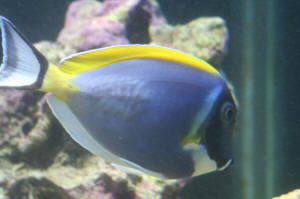 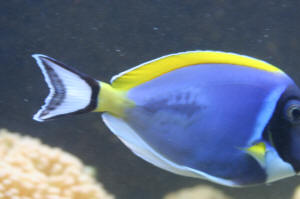
|
Microsporidean Infection - Will
it go away? 3/21/06 Hi Bob, <Steve> You have been such a
great help! I recently got a small Powder blue tang that has been
showing pimple-like bumps on its body - not salt grains (ich) and not
dust-like (velvet). After researching your site, I'm pretty sure
it's a microsporidean infection. My question is, while it is said
that there is no cure for this, will it just go away or is the fish
just doomed? <Mmm, have seen such infestations live "with their
host" for many years> In your responses to the other related
posts, you only mentioned that it's not infectious to other species
nor is contagious. Secondly, how long does it usually take for these
bumps to develop? <...?> I'd like to figure out if it picked
it up in my tank or already had it when I bought it from the store.
<This latter, assuredly> I bought the PBT with a yellow tang at
the same time so that they won't get too territorial. For the first
few days they were buddies, then the PBT would get annoyed and
they'd flash their tails now and then. Could these bumps be coming
from stress maybe? <To some extent> Also, from your experience,
how long does it take to go away? <Sometimes months, other times,
never.> thanks again for your help. You've truly impacted the
aquarist community for the better. Steve <There are some groups of
fishes, my favorite example the serrasalmine fishes called Silver
Dollars, that very often have these... and they often prove persistent.
I would enjoy this fish, ignore the bumps. Bob Fenner>
Re:
Microsporidean Infection - Will it go away? PBT dis. - 03/22/06
Update on my PBT - Last night the white bumps turned into more or less
white specks and white specks started showing up on its pectoral fins.
<Is likely the protozoan Cryptocaryon...> Then this morning they
looked black on the body but still white on the fins. As this is my
first time dealing with this, I find myself second guessing my initial
diagnosis. Could it be ich, <Most likely> or black ich that
I'm seeing instead of a microinfection or is this just part of the
lifecycle for the microsporidean? The fish is less active today and
swimming a little more wobbly but still eating Nori and picking at
algae on the LR. His original darker full blue has faded into a much
lighter powder blue and he's not picking on the other fish anymore,
sometimes just hiding in the corner away from the other fish. Sorry for
bombarding you guys with these trivial questions - I feel like a
nervous parent who's never seen their kid have a cold before. So a
little reassurance or at least understanding of what's going on
would be most helpful. Just in case, since I only have a 10 gallon QT,
I decided to move all my corals (I don't have that many, just some
zoos, xenia, anemone, and candy cane) to the QT and leave the fish in
the main tank with a some live rock in case I need to medicate. Did I
misdiagnose or is this just part of the microsporidean lifecycle and I
just have to wait it out? Steve <... is not likely a Microsporidean.
Please read here: http://wetwebmedia.com/powdbluetg.htm
and the linked files above. Bob Fenner>
| Parasite on powder blue tang? Health... - 03/12/2006
Dear Crew, My 2 ½' powder blue tang has recently
been infected by what I assumed was marine ich. It started as small
white sand grains all over his body two days after I introduced it
to my tank. <Sans quarantine...> It is a new addition to my
established 60 gallon tank (non-reef). <Too small...> My
water is RO and the levels are stable and near perfect. I had it
with a small (2' long') yellow tang and I they didn't
get along very well for a couple of days. I thought that this is
why the powder blue was stressed and was infected with ich. I
turned up the temp to 82 degrees (as told to do so by my LFS) and
rearranged the live rock and they began to get along and even
followed each other around. The ich started to get worse and I
noticed small bumps under the skin of the powder blue. All along it
has eaten very well (red macroalgae, frozen mysis cubes, and
grazing the liverock) and been very active, just looked bad due to
the bumps and specs. I took the powder blue out after a week,
<The system is infested...> freshwater dipped for 20 minutes
in formalin / malachite green. It did very well (no signs of
stress). Then I moved it to a quarantine tank, which I have treated
with the same formalin / malachite green (after reading through
your FAQs, I now know that I should have done this in the first
place, <Ding ding ding! Yes!> before putting him in the
display tank). The instructions on the bottle say to treat the tang
for up to 3 days. It has been in the quarantine for a little over
12 hours and most of the white specs are gone. Now the specs are
gone, the raised bumps under it's skin are more prominent. The
bumps seem to be all over it's body, but especially large just
under and rear of it's pectoral fins. <Poisoned...> The
powder blue is still very active and eating very well, but I am
concerned about the bumps. Is this just another symptom of the ich
or another parasite all together? <Symptomatic of formalin,
malachite toxicity> Am I treating the tang correctly? <...
no> It is a beautiful fish and would love to get it healthy
again. The yellow tang has shown no signs of infection at all and
the powder blue acts like nothing is wrong. This gives me hope. Any
suggestions you might have would be greatly appreciated.
<Posted... on WWM> I have attached two pics of the fish in
QT. I am sorry the pics aren't sharp, but it is the best I can
do. The first shows the dark marks left after the white specs were
gone. The second shows some of the bumps I am concerned about
(circled in yellow). The bumps are not discolored, just raised and
actually look like they are clear inside, like large water bubbles.
Thank you for your help, Casey <Do read... and soon... re
leucosternon tangs, crypt, the compounds you have used. Bob
Fenner> |
|
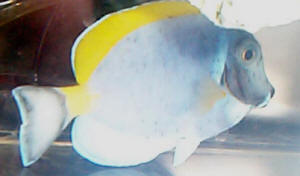 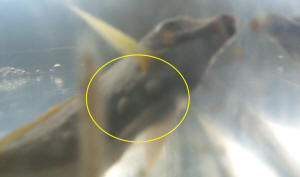
|
| Re: parasite on powder blue tang ? - 03/12/2006
Crew,
Thank you for your quick response. I do understand the error of my
ways as far as not quarantining my fish before introducing them
into my display tank. I was just listening to the instructions of
my LFS. They were bad instructions. <Learn, think for
yourself> I have removed both tangs and have them in QT. I
don't think the bumps are coming from the meds though. The
bumps were present on the Powder Blue before I move it to the
quarantine tank. They are just more visible now the white specs are
gone. There was no formalin / malachite green in the display tank.
The display tank is now empty except for a small (10")
snowflake eel. I am planning on leaving it that way for 4 or five
weeks to let the parasite life cycle expire. <... won't with
the eel present...> I have been reading more on your site and it
sounds like I have two choices, copper or hyposalinity. I am more
apt to go for hyposalinity as I don't want to poison my fish
anymore, if I have already done so. <... please read on WWM re
hyposalinity treatments> Thank you for your help and all the
wisdom on the website, Casey <Welcome. Bob Fenner> |
| Disease Identification
Hi WWM, <Jen> I need some
help identifying some "stringy white tissue" hanging from
the fins of a Powder Blue Tang. I have never seen this on a fish
before, and have no idea what it is, what caused it, or how to
treat it. This fish was quarantined for 3 weeks in hyposalinity and
no symptoms of parasite or any other problem was noticed during
that time. The specific gravity was then raised over the course of
2-3 days to 1.020, <This species is best always kept in near
natural seawater concentration, 1.025> and the fish remained in
quarantine for 4 months to help insure he was in excellent
condition before being added to the display tank. There were never
any indications of parasite or any other problem. He was added to
the display tank about 10 days ago. On day 9, we noticed some
slight scratching on the rocks and a few of the "stringy white
tissue" hanging from the tail fin. On day 10, (picture
attached of fish on day 10) he had considerable more of the
"tissue" hanging from both pectoral fins, the tail fin
and the back part of the dorsal fin. He is still breathing and
eating normally. We have noticed that he will occasionally dart,
and then resume swimming normally. The other fish in the tank seem
unaffected. I am hoping you can help me identify this problem and
advise me on the best treatment method. Thank You for your time.
Jen Marshall <I am of the opinion that these extensions are part
of the fish itself, and will diminish with time, good care. I would
not "treat" the water or fish per se. Bob Fenner> |
|

|
Tang With Ich or Velvet or other?
12/15/05 Hello my wonderful WWM Team, you all are a true blessing!
I pour over your information like a wolverine ALL THE TIME to research
new tank inhabitants, care, disease, reef care, etc... I true database
of information! Here we go. Tank: 29 gallon Bio & Carbon filters,
Eclipse hood w/upgraded lighting and add-on circulation unit. About 20
lbs of Live Rock & additional live sand. Tank Inhabitants
(currently alive and well): 2 percula clown fish 1 firefish goby 1
clown goby 1 juvenile Powder Blue Tang <... in a too small world...
Really needs hundreds of gallons.> 1 Rose BTA <If something goes
wrong in such small confines...> 1 SPS Hammer 1 Blood Red Cleaner
Shrimp 7 Hermit Crabs 8 Astrea Snails 5 Sand-Sifting Snails
(Nass's) I had recently purchased two juvenile clown gobies and a
neon goby from my LFS. <Not to go in this same system I
hope/trust> This was exactly 18 days ago. Sad to say I have not
gathered enough SW care equipment to have a quarantine tank (I know, I
know!) - so I acclimated my new tank inhabitants in the only tank I
currently own. <You're learning... by fire> The clown gobies
fought with each other the first couple days, one becoming very shy and
elusive. She used to hide a lot while the other fed (and/or he chased
her and they locked jaws a lot, I figured they were sorting things out)
but I did in fact observed her eating - have not seen her at all for
about 7 days now, was hoping she was still hiding in the LR eating the
live food that naturally resided there, but I fear she's gone (crab
meal). <Only one should be kept here... remove the other if it's
still about.> The neon was very active and aggressively wanted to
clean my powder blue tang. (The tang rarely sat still enough for the
shrimp to clean him unless he was with it in the rockwork). So he was a
great eater, very active, did very "goby things" as I would
call it. Then one day (about three days ago) I did not see him during
feeding time front and center eating like a maniac. I looked around, he
was tucked in the LR and eating here and there, but not like his true
self. I did not see him the next day. Today during feeding he must have
just died because the crabs were cleaning the fresh carcass (I could
see the blue stripes still on him very vividly). I am not sure what he
died of at all. He acclimated and got along with everything so very
well. Well upon my daughter looking at the remains of the goby. She
said, "What's wrong with the tang?" My heart sank - I ran
over to the tank. He has what looks like and I can only describe as
"chicken pox" - it does not look like ich or marine velvet
(to me) but can be either or. How did he get it? <Environmental to a
large degree... perhaps a parasite, pathogenic input from the
non-acclimated/new livestock...> Could it have come over on the
gobies? <Yes> The tang was "flashing" - rubbing up
against the rockwork two days ago quite a bit (looking silly I thought
- he is quite the character, but I did not notice any spots on him then
as I know this can be a sign of a problem). He didn't really have
any "white dots" so I looked up black spot - nope not that
either. And I am not sure if it is even velvet. They are grayish bumps
all over his body. On the dark areas of his face, the spots look like
white faded scars, on the light areas they look like a soft gray spot.
His white fin on the bottom has what looks like gray spots on it. He is
acting very normally, eating, swimming patterns, etc. not getting
aggressive towards anyone. I checked my water params and everything
seemed normal on my end - but I am taking a sample to the LFS in case I
had some sort of error (double checking myself) and salinity is
perfect, temp is between 79-81 degrees (usual for my tank). He is not
presenting himself that I can see to the blood red shrimp - and did not
allow the neon goby to clean more than a few seconds (as he is so
active). I heard both of these animals help with ich - is it just my
tang is too active to allow for a good cleaning? <Mmm, no> The
tang has been in my tank for about 8 months without ever showing signs
of sickness except for when I did a large water change once (breathing
very quickly - I literally held him in front of the minimal eclipse
hood flow I had so he didn't have to work so hard to get flow over
his gills. <Good observation> I held him for a few moments in the
flow (he actually allowed me to), he was calm and seemed to catch his
breath so to speak and I released him from my one-handed cupping and he
was fine after that with no draw backs - don't know what that was
about but he never exhibited any spotting/discoloration that might have
gone along with a disease or infection. Other than that, he has been a
happy, healthy and extremely friendly fish to all of his tank mates.
<Eight months is a good long time for this species in captivity in
general... remarkable in this small setting> He is very bumpy -
almost pimply looking. Like I said, appears to be a lot like chicken
pox all over his body. They are dull-colored splotches, like I said
they discolor whatever color it was on. It made the dark areas appear
to be light (like an old scar would be on a person), and light areas
have a gray tint. It did not "coat the fish" as the velvet
pics show - but had defined spots/bumps. I read and read and read
through the tang disease and other diseases and have not found
something that fits this description (I did try to do my research!). I
thought perhaps with the history of my introduced inhabitants and their
behavior/deaths might help you to help me. <... you need a much
larger system...> I love my tang (aka: "Fat Head") and
would do what's necessary to help him. I have pre-mixed salt at
home already with pH buffer missed as well that is about 4 days old.
Any suggestions on what I can do now (yes, I am buying a quarantine
tank TODAY!) I read you all don't favor copper treatments. Any
other suggestions on how to treat the reef tank - and should I remove
all the other fish even tho they are showing no signs of the
ich/velvet? <Not a treatment per se... but barring moving this fish
to a large, stable system with a good deal of cured live rock, possibly
"mud filtration", there is not much that can/will
"cure" it> I am so afraid I don't know what I am
diagnosing and I don't want to treat them, stress them, <You are
wise here> then realize I have to treat them all over again for
using the wrong medications. HELP! Damage control! (PS: I tried to take
some pictures of him, but he is never still and ends up being blurred
and you can't see anything. sorry I could not send them along with
this request.) Thanks in advance for any help in figuring out what this
is and helping me and my fishies - you all are THE BEST and I really
appreciate all of the hard work put into having WWM and your selfless
contributions to fish-keeping society. Warm Regards and many hugs -
Christine <Thank you... am sure you've read my piece on
Acanthurus leucosternon posted on WWM, and the accompanying FAQs
files... I would review these again. Copper, formalin, other treatment
are not efficacious here... this fish needs to be moved to better
quarters... soon, to survive. Bob Fenner>
| Mystery Malady? Hey Crew! Need your help
again! Thanks for your advice! <Glad to be here for you! Scott
F. with you today!> I have had this beautiful Powder Blue for 2
weeks now, he has been eating like a monster, and doing well with
the other roommates. Parameters: Temp 82 75 gal. w/20 gal.
sump/fuge growing Caulerpa; EV-240 skimmer; 140# LR, 4-5" fine
substrate pH 8.2 Yellow tang, Picasso Trigger, Volitans Lion,
Powder Blue tang NH3 0 NO2 0 NO3 20 <Water conditions sound
good...At some point, a larger tank is in order for this crowd!>
The last two days the Powder Blue has exhibited the discoloration
shown in the photo, he has lost the black to his face. These look
like abrasions with some inflammation, but are difficult to
visualize due to his speed. <I see...> They are on both
sides, and various body parts including his face, which makes me
think more along the lines of a fungal infection or such. I'm
setting up a Hospital tank now and will QT him until further ID of
problem. Thanks again for your help! Ed Carter, RN, BSN, CCRN
<Unfortunately, I didn't get the pic, so I'm compelled
to take a guess here. Discolorations like you describe could be
anything from a non-lethal malady like Head and Lateral Line
Erosion (HLLE), which generally is diet or environmentally-induced,
to a more serious fungal infection, as you theorize. Usually, HLLE
has a gradual onset of symptoms, so you may indeed be looking at
some sort of fungal disorder. Are there any other symptoms? Lack of
appetite? Heavy breathing? Obvious distress or discomfort shown by
the fish? If you could try again with the picture, we might be
better able to diagnose this malady. Until then, your quarantine
procedure is correct. Keep the water quality high, feed carefully,
and take note of further symptoms. I'd avoid any medications
until you get a handle on just what this affliction may be. In some
cases, these types of non-lethal disorders clear themselves up with
the passage of time and a good clean environment. Hang in there!
Regards, Scott F.> |
|
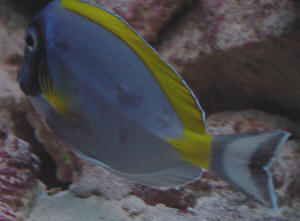 |
Surgeonfishes: Tangs for Marine
Aquariums
Diversity, Selection & Care
New eBook on Amazon: Available
here
New Print Book on Create Space: Available
here
by Robert (Bob) Fenner |
|
|
|