|
Bristle/Fireworms Identification
FAQs 7
Related FAQs: Polychaete ID 1, Polychaete ID 2, Polychaete ID 3, Polychaete ID 4, Bristleworm ID 5, Bristleworm ID 6, Bristleworm ID 8,
Bristleworm ID 9,
Bristleworm ID 10,
Bristleworm ID 11,
FAQs: Worm Diversity
FAQs, FAQs
2, FAQs 3, & Worm IDs
1, Worm IDs
2, Worm IDs 3, Worm IDs 4, Worm
IDs 5, Worm IDs 6, Worm IDs 7, Worm
IDs 8, & Worm ID FAQs by Group/Phylum: Flatworm Identification ID, Nemertean, Proboscis, Ribbon Worm ID,
Nematode, Roundworm ID,
Nematomorpha,
Horsehair Worm ID, Acanthocephalans,
Thorny-headed Worm ID, Tubeworm ID, Hirudineans, Leech ID, Sipunculids, Peanut Worm ID, Echiuran Worm ID, & Bristle/Fireworms 1, Bristle/Fireworms 2, Bristle/Fireworms 3, Bristle/Fireworms 4, Worm
Identification, Polychaete Behavior, Polychaete Compatibility, Polychaete System, Polychaete Selection, Polychaete Feeding, Polychaete Disease, Polychaete
Reproduction,
Related Articles: Worms,
Polychaetes, Flatworms/Planaria,
|
|
|
Xenia (pest?) and worm (ID, comp.)
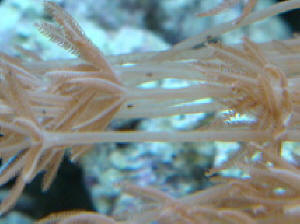
2/20/09 Hi. I'd like to thank you for all your help.
Today I noticed that one xenia colony has brown/black specks
crawling all over it. <Mmmm> Just a few days ago a crab
reproduced, so I wonder if it could be crabs eating away at the
xenias. I say eating because some of the branches look like tiny
parts are missing. If it is not tiny crabs, what else could they
be? <Small crustaceans... or Nudibranchs... or... Need a much
higher resolved image or two to tell. There are treatments for
all... see here:
http://wetwebmedia.com/LR,LS/HH%20PPT%20Pitch%20Cells/HHProsConsart.htm>
Is there anything I need to worry about? We have two xenia
colonies and only one shows the spots. I have attached a few
pictures. <If it is convenient, easy to do, I would move the
one showing these moving zots to another system... carefully lift
it and place it in a container underwater... so that if this is a
pest, predator it doesn't fall off...> When I was checking
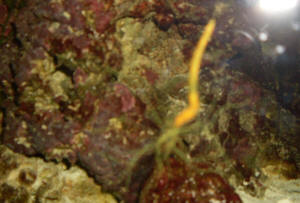
on the xenias, this yellow worm was stuck to the glass. I did
some research and it looks like it could be a spaghetti or medusa
worm. Can you confirm which one it is. Is it harmless in my tank?
<Should be... it is almost assuredly a species of Errantiate
Polychaete, see the Net re... Perhaps a member of the family
Cirratulidae> I have removed it from the tank temporarily
until I learn more about it. Thanks for all your wonderful help.
Cindy salinity 1.025 nitrite 0 ammonia < .25 nitrate 2.5
ph 8.4
Alk 1.7 - 2.8
<Bob Fenner>
|
 |
|
Saltwater Polychaete ID Question: Syllid Stolonization
-- 1/19/09 Hello <Hi there, Andrew.> I've been
reading over this site basically constantly since I set up my
saltwater tank a little over two weeks ago and found many good
IDs for all sorts of things that have popped up in my tank
including a Collonista sp. snail who has now happily been
returned to my tank. <Excellent, they're terrific little
grazers.> A few days ago I moved a rock covered with Zoanthids
and Palythoas because I didn't like its placement. I changed
things around a little bit more and had more polyps open again
but there was one section on one part of the rock where I still
wasn't having any luck. From this rock I've already
removed a Pycnogonid and a Nudibranch that was also eating some
of my Palythoas <Yikes> so my next thought was that I
either had another of either of those two I'd missed or that
I had something completely new. Earlier today I saw a worm that
looked like it was leaving the closed head of a Palythoa polyp
<Uh-oh> but wasn't able to get a good look or picture.
Later on though I saw it again and was able to suck it out using
a turkey baster. I've attached a picture for some help with
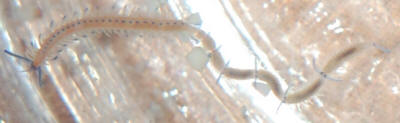
the identification. The worm is about 2 cm long. It also looks to
me like there are a number of segments near the tail of the worm
that could break off to form new worms - it looks like they have
eyes and tentacles like the larger worm, especially on the back
three segments. <Terrific observations. That is one bizarre
but neat looking little creature, isn't it! What you have is
a Polychaete worm (Family: Syllidae) that looks a lot like a
species of Myrianida. Its more than unusual appearance is because
it's in a reproductive phase. The parent reproduces asexually
by means of budding a succession of attached offspring called
stolons (process = stolonization). As you noted, the individuals
near the tail appear more mature than those near the main body of
the worm. When the juvenile on the end matures sufficiently, it
breaks off and takes off! This process continues with the rest of
worms on the chain. The really fascinating thing about these
worms is that the generations alternate between reproducing
sexually and asexually. Although the parent in your case is only
capable of reproducing asexually, the offspring (apparently born
all male or female) will reproduce sexually. For more information
and photo comparison, please see this link:
http://www.hawaiianatolls.org/research/CoML/features/polycheates.php
> I figured it was either being a good bristle worm and
cleaning up a polyp that had been killed by something else or it
was the one eating the polyp. <Mmmmm, this is unfortunately
one place I'm not going to be of too much help. I did some
research and found Palythoa and Syllids/Myrianida mentioned
together, but was unable to determine whether the worms actually
preyed on the polyps or not. I can only recommend that you
continue watching the colony for any evidence of further
predation/pests -- and keep that turkey baster handy!> Any
help will be appreciated greatly. Andrew <Your query was great
appreciated! It's always a pleasure to see what neat little
creatures appear in people's aquariums. Take care --
Lynn>
|
 |
|
Worms 12/28/08 <Hello Chip. Minh at your
service.> Found these in my tank appear to stay in sand and
only have long tentacles protruding from the sand. What are
they?? Are they helpful or harmful? <Based on the pictures
provided, the worms appear to be Terebellid Polychaete or
commonly known as "Spaghetti Worms." There is also a
similar worm in the family Cirratulidae that is often times
mistaken for the "Spaghetti Worm." Both the Terebellid
Polychaete and Cirratulidae perform useful functions in aquaria
by facilitating the consumption and recycling of fine organic
debris such as minute particles of detritus. More information can
be found in this excellent article:
http://www.reefkeeping.com/issues/2002-06/rs/index.php.>
Thanks. <You're welcome. Cheers, Minh Huynh.>
|
 |
|
Re: Worms, Cirratulids
12/28/08 Thanks a lot, was not sure what to do with
them. have 20 or more in sand and in/on rocks. <Have no fear.
Rest assured that the presence of Terebellid Polychaete and
Cirratulidae is a positive sign of a maturing aquarium. Cheers,
Minh Huynh.>
|
Bristleworm or Fireworm?
Errant polychaetes - 8/1/08 Hello again. Love your site.
<Hello! Thanks!> I found the 2 photos on the internet. The one on
the left looks like the 2 worms in my tank. I probably have more than
2, but that is all that I have seen. Please identify.... the 2 worms
that I have found in my tank look exactly like these photos. Roughly
2" inch length, maybe longer (can't see the entire worm).
<Simple errant polychaetes...omnivores/detritivores. Do read re on
wetwebmedia.com> Thanks <Welcome> Cynthia Rice
<Benjamin
|
What's in the tank? Hair or Spaghetti worm -- 7/16/08
Hello all! <Hi Kathy!> Once again I am in need of a
question answered... I have a 55 gallon saltwater tank. In
January I purchased 65lbs of live rock. For the last 7 months I
have been totally fascinated with the little creatures that are
emerging. <It's the gift that keeps on giving, isn't
it!> Yesterday I noticed what looked to me like long pieces of
hair on the bottom, across the crushed coral substrate. I have
long black hair so I thought some of it had gotten in the
tank...but when I looked closer it was thread-like, dark and
light alternating along the "thread" and it was
moving!! Then I notice 3 or 4 more! All seemed to be stretching
out from under a piece of the LR...and this morning when I fed
the fish, these "threads" seemed to attach to the blood
worms and mysis shrimp I had put in. They stretch out
approximately 6 to 8 inches... in different directions. I've
spent most of the morning reading and trying to identify, but I
can't wait. My eyes are blurry and I have to know,
"What's in my tank?" Can you give me a clue as to
what this is so that I can begin, in a logical place, to look on
the website, to research this little creature? <It sounds a
lot like a harmless/beneficial Hair worm/Cirratulid (Family
Cirratulidae), or possibly a Spaghetti worm/Terebellid (Family
Terebellidae). Both are deposit/detritus feeders, as well as
scavengers that make nice additions to a system. For more
information and photos, please see the following links:
http://forum.marinedepot.com/Topic34114-11-3.aspx (last post on
the page) See the Query 'Red worms with black Rings?
7/8/07' at this WWM link:
http://www.wetwebmedia.com/wormidfaq10.htm
http://www.reefkeeping.com/issues/2002-06/rs/index.php > OBTW
I love, love, love, your website! <Thank you, thank you, thank
you!> So much so that some days it's hard to do my
work...mind and body keep drifting back to the PC :) <Heheee!
I know the feeling!> Thanks so much, tootles, ~Kathy
<You're very welcome, Kathy. Take care, -Lynn>
Re: What's in the tank? Hair or Spaghetti worm --
7/17/08 <Hi Kathy> Well...creepy looking things.. but,
I will keep them around, the more I watch them the more
fascinating they are! <Indeed they are!> (I found a couple
more :) ) thanks again! Tootles, ~Kathy <It was a pleasure!
Take care, -Lynn>
|
Wondering what this is - some sort of worm?
07/07/08 hi - Just wondering if you could tell me what this
thing is? When its tentacles are extended fully it is approximately
1 inch wide. Its body is between 1/4" and 3/8" long. The
body is barely wider than the width of the metal of a paperclip. It
moves rather quickly - it can navigate its way halfway across my
30" tank in about a minute if need be. <Ah, looks like a
"medusa" worm: http://www.wetwebmedia.com/polychaetes.htm
(scroll down, see after feather and bristle worms)> The colors
are fairly true in the photo - the bluish tint to its legs are due
to the actinic lights in the tank, however with the actinics off
the legs appear to be clear (white/translucent). I found it earlier
this evening after the lights had been off for 2-3 hours. Although
I turned the lights on to take photos of it, it didn't
instantly seek shelter from the lights... Any idea what this is,
and if I find it again should I remove it promptly? <Oh no, they
are good guys. And you likely have many more than just this
one.> thanks again,
Jason
Sara M.> |
|
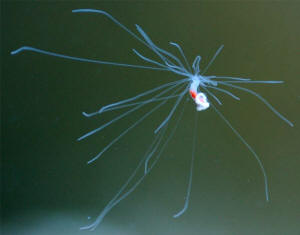 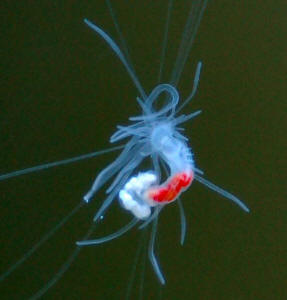
Gorgeous pix. RMF
|
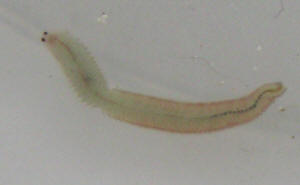
Swimming Worm ID: Epitoke - 6/2/08 Hi Crew! <Hi
Jen!> Thanks for all of your help. <It's our
pleasure.> My nano reef seems to be coming along pretty well
thanks to you guys! <Yay!> Just an ID question for you today.
I was relaxing, having breakfast, staring at my tank calmly
enjoying my morning and admiring the new Xenia I brought home
yesterday... when all of a sudden this white THING comes shooting
up out of the rock and starts zipping around all over the tank.
<Heheeee! I had a run in with one of these a few years back.
It's a real eye opener, isn't it!> I mean clearly free
swimming and really fast. <Yep. It's a rapid and distinctive
shimmying/corkscrew motion that's interrupted with brief
periods of inactivity.> It's about an inch and a half long.
I got lucky and managed to catch it and take some pictures.
<Appreciate it!> On closer inspection it's clearly some
type of worm, <Yes, it's an errant Polychaete of some sort -
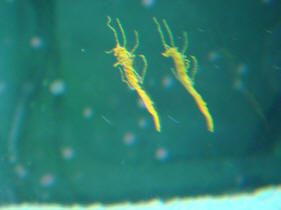
in a reproductive phase.> ..segmented and with two very
prominent eyes. It has two distinct sections, a sort of head/body
section and a sort of tail section. It swims with an eel like
motion, with the hair-like things rippling along the side of the
tail section. <Good observations! What you're seeing is a
harmless reproductive unit called an 'epitoke' or a
'swarmer'. Polychaetes reproduce in a number of ways, but
worms such as yours take it to a whole other level. They change
form, from what's originally a bottom dwelling/crawling animal
to a free-swimming version. One of these changes involves the
development of paddle-like structures, the 'hair-like
things' you mentioned on the posterior end of the Epitoke.
These enable the worm to swim up into the water column and spawn.
In some species, the gamete filled posterior segment detaches and
swims away on its own to spawn while the anterior/head section
returns to the reef and eventually regenerates. At any rate, these
epitokes rise up and gather in great numbers, perhaps in response
to a lunar or tide cycle, and on cue release their gametes (eggs
and sperm) into the currents.> I've attached photos for your
enjoyment (you can sort of see the swimming motion in the second
picture). Is this something to worry about? <Nope, not at all.
For more information, please Google the term 'epitoke' or
'epitoky' and see the FAQ's/photos at this link re:
http://www.wetwebmedia.com/wormidf11.htm Also, here are a couple of
photos of an Epitoke I had in my tank for comparison. It had a very
similar looking segmented posterior section and is in the Family
Nereididae. Size-wise, it was a little over 4.5' long.
http://wetwebfotos.com/usermedia/high/0/2470_44.jpg
http://wetwebfotos.com/usermedia/high/0/2470_46.jpg > Should I
put it back in the tank? <I wouldn't, not because it's
harmful, but because you have a nano and the Epitoke is already
out. The release of gametes and possible decay of the worm/section
of the worm would just add to the bioload.> I can't lie, it
scared the heck out of me and I definitely got the heebie jeebies!
<Well, if it makes you feel any better, I had my face all the
way up to the glass when I saw the one in my tank. I jumped back
and screamed like a little girl! :-D> Thanks again!! Jen
<You're very welcome! Take care, -Lynn> |
|
|
|
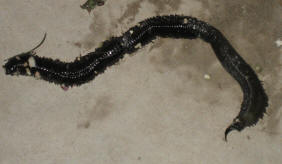
Some type of bristleworm? 03/31/2008 Crew,
<<G'Morning, Andrew today>> I was reaquascaping
my tank today and a I ran across a nifty critter as I was
breaking down some of my rock. I have no idea what it is , he was
just big and ugly. The "worm" was about 14-16"
maybe a little longer hard to say he split in two on me. I have
included some pics I hope they work I did the best I could.
<<Ahh yes, a segmented Polychaete variety. Please review
the following linked files and Articles for more info.
http://www.wetwebmedia.com/wormidfaqs.htm and
http://www.wetwebmedia.com/polychaetes.htm>> Thank You,
Shawn <<Thanks for the questions, A Nixon>>
Re: Some type of bristle worm? 04/01/2008
Crew, <<Shawn>> Is it possible that this guy was
killing some of my fish in the past? <<I would suggest
not>> For a period of time I was losing fish left and
right. Also are these guys poisonous and will they use it. One
last question what are the chance I have more of these bigger
worms. <<Its always possible in and around the rock and
crevices, yes>> Thanks, <<Thanks for the follow-up. A
Nixon>>
|
|
|
Fireworm/Bristleworm, ID/comp.
- 3/18/08 Hello! <Hi Melissa!> I know you get lots and lots
of these questions, but I haven't been able to find a picture of
this exact worm to make sure it's not the one bad kind of fireworm.
<Okay> Sadly we also haven't been able to take a picture of
it yet. We've got an 8 gallon BioCube with a peppermint shrimp,
yellow watchman goby and 3 corals (mushroom, Ricordea, xenia).
We've got lots of assorted worms that aren't the bad ones (the
long tubey ones that suck in and some substrate ones), but we just got
back from vacation today <Welcome back!> ..and sitting on top of
a clam shell (no idea how we got this tiny clam in there, but he's
pretty cool!) was a mean looking worm. <Arrghhh, welcome home,
matey!> It was still partially in the rock, but I'd guess about
an inch long and 1/8th inch or so around. <Good, it's pretty
small.> It was a very deep maroon or bright red color all one color,
with separated white bristles. <Hmmm, does sound like a fireworm,
Hermodice carunculata but it could be something else.> The bristles
were also really bright white and looked like bunches of cactus spines.
<Yep> I've found pictures of bad reddish Fireworms that also
fit the bristle descriptions, but the color was not all one color. Is
ours the same type? <It could be. There are many, many species of
what's commonly called a 'fireworm'. There are also some
relatively harmless/beneficial bristleworms (Eurythoe spp.) that are
bright orange. Unfortunately, I'd really need a photo in order to
have any hope at confirming what you have.> Should it be removed?
<I wouldn't, until/unless it's proven to be a significant
risk. The majority of these hitchhiking worms are harmless, especially
when small.> If so how...I know if it is a real fireworm that it
will sting so obviously no touching! <You've got that right!
That goes for any worm, really. Even the common bristleworms (such as
Eurythoe spp.) can still envenomate you and deliver a nasty sting.
Beyond that, there's the possibility of infection from some rather
nasty bacteria that can live in our systems. As far as removal, there
are several different methods. One of which is to bait a clean
jar/small plastic bottle (previously containing water), with bits of
shrimp, etc., and tip it up towards the area of rock where the worm
appears to live. I'd place it there at night, just before lights
out and check it in the morning.> We were especially concerned since
it was sitting on top of our little clam. <Heeheee! The good thing
about clams is that they can 'clam up' and protect themselves!
A fireworm/Hermodice spp, could however pose a threat to other small
invertebrates, corals, etc. The larger it grows, the more potential
there is for significant predation. Until we know for sure what this
little guy is, though, I'd consider him 'innocent'. In the
meantime, I'll give you some links with photos for comparison:
http://www.wetwebmedia.com/polychaetes.htm
http://home2.pacific.net.ph/~sweetyummy42/hitchworms.html Also, you
might want to try Google Image Search. Just enter the terms
'Hermodice' and 'Eurythoe'.
http://images.google.com/imghp?hl=en&tab=wi > Thanks if you can
help us out and we'll keep trying to get a picture of it. <Yes,
please. If those links don't pan out, then do the best you can with
a photo and send it along. :-)> Melissa <Take care,
-Lynn>
|
|