|
| |
|
Bristle/Fireworms Identification FAQs 5
Related FAQs: Polychaete ID
1, Polychaete ID 2,
Polychaete ID 3,
Polychaete ID 4, FAQs: Worm Diversity FAQs,
FAQs 2, FAQs
3, &
Worm IDs 1,
Worm IDs 2, Worm
IDs 3, Worm IDs 4,
Worm IDs 5, Worm
IDs 6, Worm IDs 7,
Worm IDs 8, & Worm ID FAQs by
Group/Phylum:
Flatworm Identification ID,
Nemertean, Proboscis, Ribbon Worm ID,
Nematode, Roundworm ID,
Nematomorpha, Horsehair
Worm ID,
Acanthocephalans, Thorny-headed Worm ID,
Tubeworm
ID, Hirudineans, Leech ID,
Sipunculids, Peanut Worm ID,
Echiuran Worm ID, &
Bristle/Fireworms
1, Bristle/Fireworms 2, Bristle/Fireworms
3, Bristle/Fireworms 4,
Worm
Identification, Polychaete Behavior,
Polychaete Compatibility, Polychaete
System, Polychaete Selection, Polychaete
Feeding, Polychaete Disease, Polychaete
Reproduction,
Related Articles: Worms, Polychaetes,
Flatworms/Planaria,
|
|
Swimming Worm ID: Epitoke -
6/2/08
Hi Crew!
<Hi Jen!>
Thanks for all of your help.
<It’s our pleasure.>
My nano reef seems to be coming along pretty well thanks to you guys!
<Yay!>
Just an ID question for you today. I was relaxing, having breakfast,
staring at my tank calmly enjoying my morning and admiring the new Xenia
I brought home yesterday... when all of a sudden this white THING comes
shooting up out of the rock and starts zipping around all over the tank.
<Heheeee! I had a run in with one of these a few years back. It’s a real
eye opener, isn’t it!>
I mean clearly free swimming and really fast.
<Yep. It’s a rapid and distinctive shimmying/corkscrew motion that’s
interrupted with brief periods of inactivity.>
It's about an inch and a half long. I got lucky and managed to catch it
and take some pictures.
<Appreciate it!>
On closer inspection it's clearly some type of worm,
<Yes, it’s an errant Polychaete of some sort - in a reproductive phase.>
..segmented and with two very prominent eyes. It has two distinct
sections, a sort of head/body section and a sort of tail section. It
swims with an eel like motion, with the hair-like things rippling along
the side of the tail section.
<Good observations! What you’re seeing is a harmless reproductive unit
called an “epitoke” or a “swarmer”. Polychaetes reproduce in a number of
ways, but worms such as yours take it to a whole other level. They
change form, from what's originally a bottom dwelling/crawling animal to
a free-swimming version. One of these changes involves the development
of paddle-like structures, the “hair-like things” you mentioned on the
posterior end of the Epitoke. These enable the worm to swim up into the
water column and spawn. In some species, the gamete filled posterior
segment detaches and swims away on its own to spawn while the
anterior/head section returns to the reef and eventually regenerates. At
any rate, these epitokes rise up and gather in great numbers, perhaps in
response to a lunar or tide cycle, and on cue release their gametes
(eggs and sperm) into the currents.>
I've attached photos for your enjoyment (you can sort of see the
swimming motion in the second picture). Is this something to worry
about?
<Nope, not at all. For more information, please Google the term
“epitoke” or “epitoky” and see the FAQ’s/photos at this link re:
http://www.wetwebmedia.com/wormidf11.htm
Also, here are a couple of photos of an Epitoke I had in my tank for
comparison. It had a very similar looking segmented posterior section
and is in the Family Nereididae. Size-wise, it was a little over 4.5”
long. http://wetwebfotos.com/usermedia/high/0/2470_44.jpg
http://wetwebfotos.com/usermedia/high/0/2470_46.jpg >
Should I put it back in the tank?
<I wouldn’t, not because it’s harmful, but because you have a nano and
the Epitoke is already out. The release of gametes and possible decay of
the worm/section of the worm would just add to the bioload.>
I can't lie, it scared the heck out of me and I definitely got the
heebie jeebies!
<Well, if it makes you feel any better, I had my face all the way up to
the glass when I saw the one in my tank. I jumped back and screamed like
a little girl! :-D>
Thanks again!!
Jen
<You’re very welcome! Take care, -Lynn> |
|
 |
|
Some type of
bristleworm? 03/31/2008
Crew,
<<G'Morning, Andrew today>>
I was reaquascaping my tank today and a I ran across a nifty critter as
I was breaking down some of my rock. I have no idea what it is , he was
just big and ugly. The "worm" was about 14-16" maybe a little longer
hard to say he split in two on me. I have included some pics I hope they
work I did the best I could.
<<Ahh yes, a segmented Polychaete variety. Please review the following
linked files and Articles for more info.
http://www.wetwebmedia.com/wormidfaqs.htm and
http://www.wetwebmedia.com/polychaetes.htm>>
Thank You, Shawn
<<Thanks for the questions, A Nixon>>
Re: Some type of bristle
worm? 04/01/2008
Crew,
<<Shawn>>
Is it possible that this guy was killing some of my fish in the past?
<<I would suggest not>>
For a period of time I was losing fish left and right. Also are these guys
poisonous and will they use it. One last question what are the chance I have more
of these bigger worms.
<<Its always possible in and around the rock and crevices, yes>>
Thanks, Shawn
<<Thanks for the follow-up. A Nixon>>
|
|
 |
Fireworm/Bristleworm,
ID/comp. - 3/18/08
Hello!
<Hi Melissa!>
I know you get lots and lots of these questions, but I haven't been able to find
a picture of this exact worm to make sure it's not the one bad kind of fireworm.
<Okay>
Sadly we also haven't been able to take a picture of it yet. We've got an 8
gallon BioCube with a peppermint shrimp, yellow watchman goby and 3 corals
(mushroom, Ricordea, xenia). We've got lots of assorted worms that aren't the
bad ones (the long tubey ones that suck in and some substrate ones), but we just
got back from vacation today
<Welcome back!>
..and sitting on top of a clam shell (no idea how we got this tiny clam in
there, but he's pretty cool!) was a mean looking worm.
<Arrghhh, welcome home, matey!>
It was still partially in the rock, but I'd guess about an inch long and 1/8th
inch or so around.
<Good, it's pretty small.>
It was a very deep maroon or bright red color all one color, with separated
white bristles.
<Hmmm, does sound like a fireworm, Hermodice carunculata but it could be
something else.>
The bristles were also really bright white and looked like bunches of cactus
spines.
<Yep>
I've found pictures of bad reddish Fireworms that also fit the bristle
descriptions, but the color was not all one color. Is ours the same type?
<It could be. There are many, many species of what’s commonly called a
“fireworm”. There are also some relatively harmless/beneficial bristleworms
(Eurythoe spp.) that are bright orange. Unfortunately, I’d really need a photo
in order to have any hope at confirming what you have.>
Should it be removed?
<I wouldn’t, until/unless it’s proven to be a significant risk. The majority of
these hitchhiking worms are harmless, especially when small.>
If so how...I know if it is a real fireworm that it will sting so obviously no
touching!
<You’ve got that right! That goes for any worm, really. Even the common
bristleworms (such as Eurythoe spp.) can still envenomate you and deliver a
nasty sting. Beyond that, there’s the possibility of infection from some rather
nasty bacteria that can live in our systems. As far as removal, there are
several different methods. One of which is to bait a clean jar/small plastic
bottle (previously containing water), with bits of shrimp, etc., and tip it up
towards the area of rock where the worm appears to live. I’d place it there at
night, just before lights out and check it in the morning.>
We were especially concerned since it was sitting on top of our little clam.
<Heeheee! The good thing about clams is that they can “clam up” and protect
themselves! A fireworm/Hermodice spp, could however pose a threat to other small
invertebrates, corals, etc. The larger it grows, the more potential there is for
significant predation. Until we know for sure what this little guy is, though,
I’d consider him “innocent”. In the meantime, I’ll give you some links with
photos for comparison:
http://www.wetwebmedia.com/polychaetes.htm
http://home2.pacific.net.ph/~sweetyummy42/hitchworms.html
Also, you might want to try Google Image Search. Just enter the terms
“Hermodice” and “Eurythoe”.
http://images.google.com/imghp?hl=en&tab=wi >
Thanks if you can help us out and we'll keep trying to get a picture of it.
<Yes, please. If those links don't pan out, then do the best you can with a
photo and send it along. :-)>
Melissa
<Take care, -Lynn>
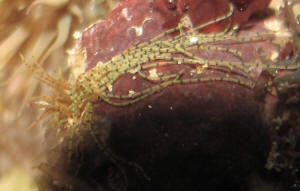
ID Please... Hair Worm
(Cirratulid species) 3/14/08
Hey there all,
<Hi Tim, Mich here!>
I was wondering if you might be able to ID this for me. I spotted it on
some of my Live Rock.
<Looks like a hair worm (Cirratulid species) to me, a harmless filter
feeder. Often crabs, including hermit, cleaner shrimp and nipping fish
prey upon these beneficial worms.>
Thanks Much, Tim
<Welcome much, Mich> |
|
 |
|
Hitchhiker ID: Likely
Amphinomid - 3/10/08
Hello,
<Hi there, Sheye!>
First I would like to thank you all for doing an incredible job on the
site. Your site has provided me with answers to several of my question
and given me hours of reading enjoyment.
<Excellent!>
Now my question. I recently purchased a total of 30lbs of Fiji live rock
from my LFS. I was amazed to find so many hitchhikers (spiny brittle
stars, common and blue-legged
hermits, and several sponges).
<Neat>
But one of them I was unable to identify (pic attached). It looks like
some sort of worm or Nudibranch but may also be a larvae of some sort. I
doubt it is harmful
<Likely not, especially at this size.>
as most hitchhikers aren't and this one seems to munch on the algae. I
would just like to know what it is.
<Hmmm, I'd need to see more detail to be sure, but it looks like an
Amphinomid/bristleworm, possibly in the genus Chloeia. Please see the
photos at these links for comparison:
http://www.wetwebmedia.com/polychaetes.htm
http://calphotos.berkeley.edu/cgi/img_query?query_src=photos_browseimgs_invertebrate_sci&seq_num=226453&one=T>
Thanks for your time
Sheye
<You’re most welcome! Take care, -Lynn>
Re: Hitchhiker ID: Likely
Amphinomid - 3/11/08
Hello again,
<Hi Sheye>
After looking at the links you provided. I have found it. In this link
(www.wetwebmedia.com/polychaetes.htm) under Hermodice canunculata the last
picture on the right. That is exactly what it looks like.
<Yay! Mystery solved!>
Thanks again!!!
Sheye
<You’re very welcome! Take care, -Lynn> |
|
 |
|
Critter ID: Eunice
spp. Worm – 2/15/08
Hi crew - and thanks again for the great resource!
<Always a pleasure to share information with fellow hobbyists!>
I'm attaching two photos of a critter I found in my live rock.
<Yes, I see it. What you have is a polychaete worm in the genus Eunice,
aka a "Bobbit worm" (after Lorena Bobbit - not going there!). Nice
photos by the way, considering how quickly these worms can move!>
The hole it's in is about 3cm wide, <3cm or 3mm?> and the critter pretty
much fills the hole.
<Thankfully, it looks like it’s the length of the worm that’s filling it
up (at this point), not the width! I’m basing that on what appears to be
a nearby Collonista spp. snail. Those supposedly top out at around 1/4"
although most I've seen are around 3mm.>
The front end looks like some kind of orange worm with antennae - the
longest single antenna comes out of the middle of its head,
<Characteristic in these worms.>
..then there are two sets on either side, with the lower set being
shortest.
<Yep. Terrific observations, by the way!>
The lower part of the face appears to have flaps that remind me of
walrus cheeks!
<Coo-coo-ca-choo! Behind those “cheeks” are some wickedly impressive
jaws.>
The back end appears to be shrimp-like.
<I see what you mean. It does look a bit like the tail end of a mantis
shrimp, but this little guy is all polychaete annelid worm.>
I haven't determined how long it is, as I've never seen it completely
out of the hole, but it did stretch its head out of the hole one time
about 9-10cm and I didn't see the tail at all then,
<Heeheee! Just wait until you find out what length some of these worms
can reach! As if it’s not a bad enough sign already that they’re named
after a woman who...well, never mind. To give you an idea, Bob has one
in a jar that’s eight feet long. Another fellow in Oregon has photos of
a seven footer that was in his tank. The good news is that this is not
the norm. I've had several of these in my tanks over the years and none
have gotten very large or caused any problems. However, if I ever find a
seven foot Eunice worm in my tank, the resultant scream is going to
rival the infamous 1883 eruption of Krakatoa/Krakatau, aka the “loudest
sound ever heard by man”!>
..and didn't see any additional white bands either.
<That’s typical of the hitchhiking Eunicids I’ve seen as well. They
usually have one light/whitish collar (or band), on/near the “head” and
that’s it.>
I seriously thought it was a worm until the photo showed the shrimp-like
tail (it moves so fast I could never see it without the still shot).
<Indeed. I read somewhere that these worms have been clocked retracting
into their holes at speeds in excess of 20 feet per second. Now that’s
fast.>
I haven't seen any pinchers or claws,
<The jaws are tucked away until needed.>
and I haven't heard any clicking noises either.
<Nope, there wouldn’t be any coming from these polychaetes.>
It is very shy and spooks easily - darts very quickly back inside the
hole, <Oh yes!> but also seems curious (or hungry) enough to peek out
quite often.
<This behavior should come in handy if/when you need to trap it.>
I have searched every descriptive word for it that I can think of
<LOL Let’s see..worm with shrimp tail, shrimp with worm head...Shwormp!
Sorry, couldn’t resist ;-)>
..& looked through tons of shrimp and worm photos on various sites, but
can't find anything quite like it.
<Although I’ve made these worms sound like something out of a horror
movie, they’re not all bad. Some are scavengers that do a good job of
keeping a tank clean. This is especially true of those species that stay
small. Others, however, are decidedly predatory. They eat sessile
organisms, small crustaceans, and are quite capable of catching/killing
fish. Those jaws, combined with impressive speed, make for a very
efficient ambush predator. Personally, I wouldn’t trust any large Eunice
worm in my tank. For that matter, I wouldn’t trust even a smaller one in
a tank with tiny gobies in it. Keeping the worm well fed would likely
help to deter predation, but it would be a gamble.
I have a Eunice worm in one of my tanks right now that looks very
similar to yours. It's been in residence for about a year and a half.
The diameter is about 2.5mm and the length is around 7cm. I've tried to
bait/trap it, but have never succeeded. Thankfully, it hasn't caused any
problems and I’m hoping it stays that way. As long as he behaves himself
he can stay. The minute he approaches 1/4" in diameter, though, he’s out
of there!
If I have somehow misjudged the size of the worm in your tank, and it is
indeed 3cm (or close) in diameter, I’d recommend trapping and removing.
There are many traps available on the market, as well as homemade
versions covered at WWM and on the internet. If the worm is fairly
small, you can either keep an eye on it and trap later if necessary, or
try to get it out of there now. It just depends on what type of
livestock you want to keep, or already have, in your tank. Heeheee, that
and whether you’re feeling lucky!
For more information on Eunice spp. worms, please use WWM’s search
engine:
http://www.wetwebmedia.com/WWMAdminSubWebIndex/question_page.htm
See the following WWM link as well, about halfway down, for a photo of a
similar worm:
http://www.wetwebmedia.com/polychaeidfaqs.htm
http://www.reefkeeping.com/issues/2003-04/rs/index.php >
Thanks for your time.
<You’re very welcome!>
You provide a wonderful service with a great sense of humor.
<“Laughter is the shortest distance between two people”. Truly, it’s a
measure of how much we enjoy what we do here, and life in general. Take
care, -Lynn>
Re: Critter ID:
Eunice spp. Worm – 2/15/08
<Hi Lillian!>
Okay, so I'm from the US & screwed up the measurement
<Heheeee! I thought something wasn't adding up! Not to worry - I’ve done
it a time or two myself!>
- the hole opening is about 3mm, not 3cm. And I forgot to sign the
previous email. Sorry. Lillian B. :)
<No worries, Lillian. Thanks for confirming those measurement for me.
Take care. –Lynn> |
|
Nice pix! RMF. |
Worm ID:
Spionid/Chaetopterid? - 12/25/07
Hi there.
<Hi Jamie.>
I have a strange worm in my tank that I am struggling to identify. The worm is
around 50mm
<5cm/~2”>
in length and is white and brown on the body.
<Are you actually seeing the body of the worm, or a tube? Where is it
situated/living – in the substrate, on a rock, in a rock, elsewhere? This is
where a photo could really come in handy.>
It has two tentacles (which are translucent and about 300mm long)
<Yikes, 300mm/30cm/almost a foot in length? Are the tentacles mobile/active?>
and comes out during the day (which makes me think it isn't a spaghetti worm).
Through some searching the closest I can find is a Mud Whip Worm.
<Polydora spp. – shell borers in the family Spionidae.>
However I can find very little information on mud whip worms and so can't be
sure that this is exactly what I have. Do you have any clues as to what the worm
might be?
<Sounds very much like something in the family Spionidae, or Chaetopteridae. The
two hair-like translucent tentacles/“palps”, are characteristic of worms in
these two families. These detritivores/particulate feeders live in hardened
mucus tubes, or “U” shaped burrows. Some tubes look very much like parchment,
others have bits of substrate, shell, sand grains, or even silt cemented to the
outside. This is most likely what’s in your tank, but without a photo/more
info..? Please see these links, as well as Google Spionidae and Chaetopteridae,
for more information/confirmation:
Spionidae: http://www.reefs.org/library/aquarium_net/1197/1197_1.html
Chaetopteridae: http://www.reefs.org/library/aquarium_net/0897/0897_5.html>
Thanks very much! Jamie
<You're very welcome! -Lynn>
Re: Worm ID:
Spionid/Chaetopterid? - 12/25/07
<Hi Jamie!>
Thank you very much!
<You're very welcome!>
I am wrong with 300 mm, should be 30mm!!! Big difference, I know.
<Heeee! I had a feeling it was probably 30mm/3cm!>
But the links you have sent me are great! I love seeing new and interesting
creatures in my tank, and so am pleased you have pointed me in the right
direction.
<My pleasure. It really is great fun, isn’t it? I think of live rock as the gift
that keeps on giving!>
Thanks again! Jamie
<You're most welcome! Take care –Lynn>
Worms and
Nocturnal Critters... Cirratulids, Eurythoes, and Gammaridean Shrimp Oh
My! 11/30/07
Hello Crew,
<Hi Sammy, Mich here.>
Your site has been a tremendous help for me. I like to add to the many
praises your guys are getting.
<Thank you for your kind words.>
I have a 175 gal reef tank that has been running for 6 months. I am now
finding a lot of worms and nocturnal critters that seems to be quickly
growing in numbers. I just like to know if this is something I need to
get concerned about.
<Generally, no. Usually this is all good.>
First, the number of string worms has increased greatly. There is a
bunch every inch or so on the sand. Some have moved onto the rocks as
well. Here is a photo of it. These guys send out long tentacles to pull
larger sand pebbled towards the group to form a little mount on the
sand. The fish don't bother it at all.
<This is a hairworm, a Cirratulid species. They are beneficial
scavengers and a wonderful addition to your tank.>
Next to it is a worm that comes out only after the lights are off. These
are also increasing in number. Both of these are really creeping my wife
out.
<Well they are creepy-crawlies, so I do understand your wife's reaction,
but beneficial and commonly found in systems with live rock.>
Here is a closer shot of the nocturnal worm. Some are 4 inches long. I
find them at the base of every rock in my tank.
<This is a fireworm (Eurythoe sp.) and named so with good reason. You’re
not going to want to touch these guys. The chaetae/bristles contain
venom and can pack a rather painful sting. That being said, these
touch-me-nots are beneficial scavengers and another fine additions to
your system.>
It is hard to get a good photo of these guys. As soon as I shine a
flashlight on them to focus my camera, they scurry away into hiding.
<Yes, but your photos are decent.>
A third critter that only shows up at night is something that looks like
a shrimp, but it crawls all over the rocks like wobbly bugs. Here is a
photo.
<This is a Gammaridean amphipod, commonly called a Scud, or your fish
might call them yummy! Again their presences in your setup is an asset.>
I really appreciate your help in identifying them. Should I get rid of
them?
<Nope! Keep'em!>
And if so, how?
I have one more question. I have this black pearl that is growing on one
of my coral. What is it?
<It is Valonia, a nuisance alga. Try to gently remove it, wiggle it
carefully with your fingers and hopefully it will come lose. Try not to
break the bubble which contains reproductive material that you do not
want to spread around your tank!>
Is it normal to have it on this kind of coral?
<Is not uncommon but you don't really want it there!>
That feather duster seems to be an invader of this coral also, right?
<Yes.>
Should I leave it alone?
<Yes.>
Regards,
<Cheers, Mich>
Sammy |
 |
 |
Worm ID and
Reproduction 11/11/07
Hey Crew,
<Scott>
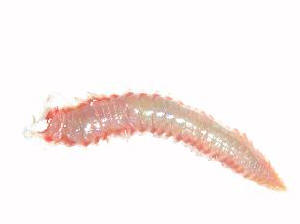
I have a 520L (130g) Reef tank with approx 80kgs of Live Rock. I have
been observing these white worms coming out in the evenings, between the
time the Metal Halides go off and the T5s. They seem to swim like a
knife-fish (the fresh water variety) and the same time each day come
out. Naturally I got curious as to what these are, and knowing that
quite a few different species of fish will come out in the evening to
spawn I was curious about the worms.
<Sure>
So tonight I caught some and threw them under a USB microscope to take
some pictures for an ID.
<Good pix>
They look like a bristle-worm but I am unsure as all of the photos I can
find for reference are of bigger ones. These photos are of 25-100x
magnification. Each worm is <1cm long.
<Mmm, yes... are Errantiate Polychaetes>
I have attached some photos for ID, please note that in the first one it
appears that I managed to catch some Eggs with the worm too! Perhaps the
worm was releasing them into the water column as part of the
reproduction?
<Yes... and eating some>
Are these a common bristle worm? And is it possible I have caught them
in their nightly spawning ritual?
Thanks,
Scott.
<Mmm, there are many, likely hundreds of species of "common"
bristleworms... Please read here:
http://wetwebmedia.com/polychaeidfaqs.htm
and the linked files above to grant you some insight... or any
college-level marine invertebrate zoology text... This is not a
dangerous species... much more beneficial than deleterious. Bob Fenner>
|
|
 |
Long Clear Thin Worms on
Rock... On top of Spaghetti (Worms) All Covered With Cheese... 11/9/07
Hey guys!
<Hi Jane, Mich here.>
I have recently added a new piece of very live rock into my tank about 2 weeks
ago. While the moon light was on last night, I noticed there were 4-5 long(4
inches, and can stretch) very thin, clear worms of some sort coming out of a
hole in my new piece of rock. They resemble fishing line and can stretch to long
lengths. They are a solid clear color with no obvious head I can see. Are these
harmful to my tank?
<Nope!>
Should I try to eradicate them,
<Nope!>
they are on the bottom of the rock, in a hard to reach area.
<Leave it be. Sounds like a Spaghetti worm (Terebellidae sp.) to me. They are
harmless scavengers feeding on particulate organic material and detritus. More
here: http://www.reefkeeping.com/issues/2002-06/rs/index.php >
Thanks for your help!
<Welcome! Mich>
Jane
What Kind of
Worm???? Using WWM... 11/4/07
Would you please help me identify this worm? We found it while
cleaning a huge amount of green hair algae off of our live rock.
<Is a Polychaete... an Errantiate of some sort...>
They are about the thickness of a pencil and 3" to 4" long, there are
several of them.
And could u
<...>
please tell me if it is ok to have them or should I try to get rid of
them.
Thanks in Advance for any help,
Kandra
<Please read here: http://wetwebmedia.com/polychaeidfaqs.htm
and the linked files above. Bob Fenner> |
|
 |
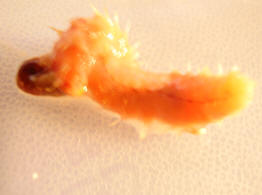
Large Bristleworm 10/26/07
So my tank is in about its 4th week, and I've just found a rather large (5
inch or thereabout) worm of some kind. He is blue/green in color, and the
closest I can come to describing him is that he looks like a centipede of some
kind.
<Sounds like a Bristleworm.>
He looks, far as I can tell in my brief glances, something like this guy...but
again, I haven't gotten a super close up look at him.
<Would not be unexpected in your tank.>
The questions are these...should I be getting this guy outta there?
<Normally I would say no, they are quite beneficial scavengers, but this guy is
starting to get pretty big, I worry he might turn predatory of he can not find
enough food.>
There's nothing dead in the tank: 5 live snails, 6 live hermits, and a bunch of
algae on live rock...that's it...is he going to starve if I DON'T pull him?
<Might>
I'm VERY new to this reef keeping hobby, and nearly fell over when I spotted a
large worm crawling through a rock...when I knew I hadn't put him in there!!!
Mitch
<Its can be surprising what shows up on LR. At this point if you can remove him
I would, but I would not go to drastic measures to do it.>
<Chris>
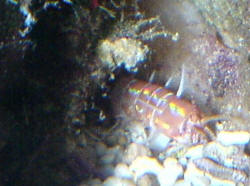
Bobbit Worm? (Eunice Spp)
9/26/07
Even crew -
<Hello Hendy, Mich here this early morn.>
you are all well I trust?
<I can only speak for myself and I am quite well thank you!>
One of my favourite pastimes is to feed the tank with a prawn or lance
fish after lights out and watch the "unseen tank" perform it's clean up.
<Even better with a red light!>
It's normally a free-for-all between the hermits, Saron shrimps, coral
banded shrimps and the usual mass of polychaete worms.
<Cool!>
It has been like this for two tears nearly. Nothing has changed and
definitely no new rock.
<OK.>
Imagine my surprise when this beastie showed up to claim the sand eel
tonight.
<Heehee! Is a beastie for sure!>
I am certain it is a "Bobbit worm" Eunice sp.
<I am in agreement with your identification.>
but it seems to lack the massive chelicerae of the pictures in my books.
It has a huge mouth which rather reminds me of those aircraft where the
nose & cabin opens up to allow freight in and out as this worm
definitely seems to have a "flip-top head"
<Heehee! A la a Muppet or perhaps Julia Roberts?>
and a good appetite to match.
<Goes with the "flip-top head">
I was worried at first but having done a tiny bit of research, I am
tempted to leave them (yes there are at least two - the one in the
photo, diameter of about 4mm and another tiny one about the width of a
pencil lead)
<If there are two there could easily be more...>
as I has witnessed they are definitely good clean-up and increase the
bio-diversity.
<True.>
I don't seem to have a problem with fish disappearing
<Yet.>
so either they are a non-predatory species (a minority are I understand)
<OK. You are making an informed decision.>
or they are getting enough to eat
<I'm leaning towards this.>
- I often feed after dark to keep my sand snails happy.
<And many other creatures as well!>
Just after some advice from you
<Well you seem to have made a decision and an informed one at that.
These are typically predatory as you know.>
- sorry the picture isn't great,
<No apologies! Actually, the pic is quite good! These guys are hard to
catch on "film".>
but it took me ages to coax it out with the fish
<I can imagine.>
- and they are timid of the light and lightning fast
<Super fast!>
- had loads of failed shots.
<I bet!>
All the best
<And to you Hendy! Mich>
Hendy |
|
 |
ID Needed
Please… Egg Mass… Perhaps of a Polychaete Worm
8/30/07
Hello,
<Hi Brad, Mich here.>
I cannot thank you all enough for what you guys do for us!
<Just trying to help. Thank you for your kind words.>
That being said, I'm stumped on this one. Can you possibly ID this for
me?
<I'll give it a try!>
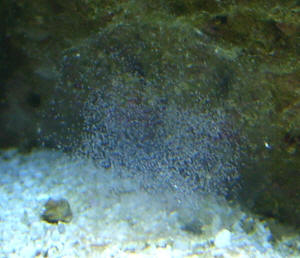
I have two of them growing out of my sand bed, they are a bubble of some
sort with specks inside. Good/bad?
<Excellent picture by the way. Is the reproductive matter of something,
an egg mass, likely an invert, and from what I have read, but have been
unable to find pictures to really compare is it may be that of
polychaete annelid worms. Nothing to worry about and when they hatch,
likely in a day or so, it will make a tasty treat for your fish and
corals.>
Thank you for your time in this matter!
<Welcome! The pleasure is mine. Mich>
Brad |
|
 |
Id help:
Epitoke - 8/14/07
Hey everyone,
<Hey Noah>
I'll start with the required (but well deserved of course) Wow your site
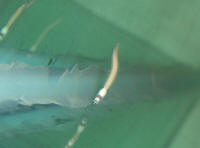
is awesome, I love it. <Thanks!> Anyway, just recently I found this odd
little thing in my tank (pictures included). The white part is the head,
and it does seem to have visible eyes, mouth, etc. It behaves very
oddly. It will swim like an eel to the top of my tank, sit there trying
to get its head out of the water (at least that's what it looks like),
then suddenly stop moving and sink to the bottom of the tank. It does
this entire cycle maybe once every 5 minutes. Any help would be greatly
appreciated.
<Well Noah, what you’ve got there is an epitoke, sometimes called a
“swarmer”. It’s a reproductive form of an errant polychaete worm (sorry
- can’t quite see enough to give a better Id). There are several
different ways these worms reproduce. In this case, the back half
develops into a segment filled with gametes (eggs or sperm). When the
time is right (usually a phase of the lunar cycle), the worm emerges and
the posterior section breaks away. That section then swims up into the
water column, and releases its gametes in a mass spawning event. The
head/anterior section returns to the bottom and regenerates. By the way,
with only one of these present in your tank, you don’t have to worry
about an imminent plague of polychaetes! For more information, please
Google the terms “epitoke” or “epitoky”. Also, here are a couple of
photos of one I had in my tank for comparison. It had a very similar
looking segmented posterior section and is in the Family Nereididae.
Size-wise, it was a little over 4.5” long. http://wetwebfotos.com/usermedia/high/0/2470_44.jpg
http://wetwebfotos.com/usermedia/high/0/2470_46.jpg >
Thank you very much,
Noah
<You're very welcome! -Lynn>
Re: Id help: Epitoke - 8/14/07
Thanks again!
<Anytime, Noah! It’s pretty strange to see something like that swimming
around in your tank, isn’t it (but pretty neat too!). <lol> I hate to
admit it, but that one I photographed initially scared the living
daylights out of me. I’d just woken up, the lights were still off in the
tank, and I went in for a close look to check things out. Evidently, the
worm had been floating/resting up at the surface, and suddenly decided
to zoom by, right in front of me. I jumped back about a foot and let out
the most embarrassingly girly shriek ever. I laugh about it now, but at
the time…yikes! The lesson I learned was to avoid going in for those
close-ups first thing in the morning! I figure it spares me, as well as
the creatures living in my tank! <g> Anyway, it was a pleasure helping
you, and please let us know if there’s anything else we can do for you.
–Lynn> Re: Worm
Identification, Follow-up - 8/17/07
Thanks again crew!
<You're very welcome!>
Sadly, the little guy was sucked into a powerhead last night.:(
<Aw, I’m sorry to hear that. Thank you for sharing the photos and
experience with us, though. By the way, here are several good links for
future reference re: polychaete Id:
http://www.reefkeeping.com/issues/2003-03/rs/index.php, and:
http://home2.pacific.net.ph/~sweetyummy42/hitchworms.html. Good luck,
and thanks for keeping in touch. – Lynn> |
|
.JPG) |
|
Re: Identification?
Worm 8/15/07
Ill try to find it and get it out of tank, should be able to get a
close-up of it then!
<Real good>
Re: Identification?
8/16/07
Ok, so i got it and looked at it under a microscope.
It has 8 legs (or whatever the proper term is) on each side of the
forward half of the body.
It has two dark lines going from head to tail, and a visible blood
vessel (or something of the sort) that has a visible pulse.
It is about 3 mm wide at the front half, and 4-5 on the back.
It is about 14 mm long.
Some more pictures are included, hopefully they will be better.
Noah
<Ahh, thank you for these. I do agree with Lynn that this is very likely
an epitoke... a "reproductive unit" of a polychaete... Very common in
the world's oceans... and not a worry. Bob Fenner> |
|
.JPG) |
Marine critter ID
– 07/18/07
Hi Crew,
I've written in several times before with freshwater aquarium questions,
but this time it's a matter of curiosity rather than fish care. We're
vacationing at Bald Head Island, North Carolina. We were out in the
sound at low tide and noticed these guys on a sandbar, sticking up out
of the sand with about an inch exposed. As best we can tell, they're
hollow, flexible tubes made of cemented sand--or made of something else,
and very well coated with sand. They're three or four inches at the
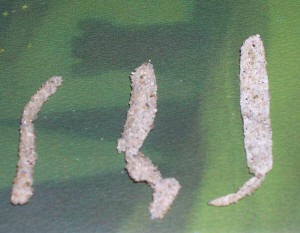
longest, and never more than three millimeters wide. They look like worm
casings, but we've carefully dug around them, rather than just pulling
them up, and we've never found anything in or under them. My brother's
best guess is horseshoe worms, but the casings aren't U-shaped. In fact,
we found one tube with three tubes branching off of it.
<I think you've found the tubes of some kind of Maldanidae worm, maybe a
"bamboo worm" or something similar. At first I also thought they were
parchment/horseshoe worms (Chaetopterus variopedatus). But as you
pointed out, they aren't u-shaped and they don't seem quite as tough or
big as Chaetopterus variopedatus worm tubes usually are. There are
Maldanidae worms which have narrower and more brittle tubes made of sand
and mucus. This seems to fit your description and picture. However, I
couldn't tell you which species might be common in North Carolina. I
suppose it's also possible that these are just old, empty Chaetopterus
worm tubes that have just been broken up.>
Attached is a picture. Obviously it's not an urgent matter, but we'd
appreciate a guess as to what they are!
<Btw, this is a cool site for beach findings in North Carolina:
www.okeefes.org/Marine_Life/marinelife.htm>
Thanks,
Rachel
<No problem.
Best,
Sara> |
|
 |
|
Bristleworm Regeneration 7/14/07
Dear Crew,
<Hi Eric, Mich here.>
I have found conflicting information on this on the web, and nothing specific
here on WWM, so I thought I'd ask. If, when trying to remove a bristleworm with
tweezers, said worm breaks in half, will the posterior portion of the worm
remaining in the tank regrow a head and survive?
<Theoretically, yes, it is possible, and has been done in a laboratory setting.
See the article below. However, I suspect it is uncommon in an aquarium setting,
particularly given the number of segments you removed.
http://www.springerlink.com/content/uqhnrcw04vp7v9wa/ >
The worms I am specifically dealing with are large (8-10 inches)
<YIKES!!!!>
and I believe are members of the Amphinomidae family. (Please see attached
photo.)
<Yes, looks to be an Eurythoe spp.>
Thanks in advance,
<Welcome! Mich>
Eric |
|
 |
Red worms with black Rings?
7/8/07
Hey Crew!
I have searched the website, but found no definite answer. In my tank, these
hair thin worms come out at night in clusters. They come up from the sand in the
same spot every night. They are very thin colored pinkish red with small black
rings. I am worried that they are some type of parasite that will either harm my
fish or coral. If they are harmful, what would be the best way to get rid of
them. Thank you very much guys.
<No worries. They're most likely some kind of Terebellid polychaete or
"spaghetti worm" (highly desirable and fascinating little critters). Each
cluster is one worm. Those thin hair-like things are the worm's feeding
tentacles. Please give no more thought to getting rid of them and do enjoy them.
:) >
- R Delaney
<Best,
Sara M.>
Re: beautiful spaghetti worm
7/9/07
My bad... it's a hair worm, not a spaghetti worm.
Sara
<Yes. RMF>
Re: Red worms with black Rings?
7/10/07
OK Great! Thank you so much.
<No problem. I forgot to say it could also be a "hair worm" (Cirratulid
polychaete). It doesn't really matter though. Both kinds of worms are very good
to have. :-)
Best,
Sara M.> |
|
 |
| |
|