|
Bristle/Fireworms (Errantiate Polychaete) Identification FAQs 8
Related FAQs:
Polychaete ID 1, Polychaete ID 2, Polychaete ID 3, Polychaete ID 4, Bristleworm ID 5, Bristleworm ID 6, Bristleworm ID 7,
Bristleworm ID 8,
Bristleworm ID 9,
Bristleworm ID 10,
Bristleworm ID 11, &
FAQs: Worm Diversity
FAQs,
FAQs
2, FAQs 3, &
Worm IDs
1,
Worm IDs
2, Worm IDs 3, Worm IDs 4, Worm
IDs 5, Worm IDs 6, Worm IDs 7, Worm IDs 8, & Worm ID FAQs by Group/Phylum: Flatworm Identification ID, Nemertean, Proboscis, Ribbon Worm ID,
Nematode, Roundworm ID,
Nematomorpha,
Horsehair Worm ID, Acanthocephalans,
Thorny-headed Worm ID, Tubeworm ID, Hirudineans, Leech ID, Sipunculids, Peanut Worm ID, Echiuran Worm ID, & Bristle/Fireworms 1, Bristle/Fireworms 2, Bristle/Fireworms 3, Bristle/Fireworms 4, Worm
Identification, Polychaete Behavior, Polychaete Compatibility, Polychaete System, Polychaete Selection, Polychaete Feeding, Polychaete Disease, Polychaete Reproduction,
Related Articles: Worms,
Polychaetes, Flatworms/Planaria,
|
|
|
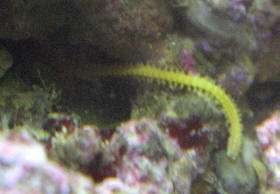
What is this? 12/16/18
Hi Crew!
<Blue...>
You guys are my “go to” peeps whenever I’m stumped and you always come through!
I happen to notice this little guy climbing my glass and don’t know how he got
in there, since I really haven’t added anything to the tank in weeks.
<Mmm; likely came in on live rock... or something solid that you added... like a
coral; possibly from live food/s>
But, there he is. (see attached photo). Anyway, if you can’t completely identify
it, can you guess if it might be friend or foe?
Thank you for your help!
<Appears to be a young Errantiate Polychaete of some sort/species. Some are
widely labeled as bristleworms... I wouldn't panic, nor remove it. Likely will
add interest, keep the substrate stirred, aerated.
Bob Fenner>
|
 |
|
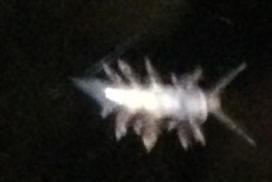
Unknown worm. 7/10/16
After a couple of years of happy reefing and not bothering you guys. I added
a new rock to my tank. And a couple of days later I noticed a worm in my
tank. Looked all over your site and haven't found one that matches.
About 2 foot long and about 1/4 inc in circumference. It has legs like a
centipede but they seem to point up and down. About every third one or so is
sticking up. The head end looks like a worm with a square shovel for a head.
I tried taking a picture but it sucked. I found one online accept that I
didn't see eyes on mine, but the shovel shaped extension is similar. Mine
might have been a bit more squared and thicker. I have seen it a couple of
weeks but I haven/t realized how big it was until it has migrated earlier
this week and it seemed to go on forever. But judging on where the head was
and the tail was its about 2 feet maybe more. It wasn't a concern until I
saw it bug my turbo snail earlier today. It didn't seen to have taken a bite
just poked it with the head end an than gave up after several attempts. I
attached a couple of pictures and a video. Hopefully it will all fit in your
inbox. Please let me know what you think it is and if I should try and get
it out. And if I do, should I wear some sort of protection. Thank you.
Artur.
<Hi Artur
Jordan with you tonight. Unfortunately you have an Oenone fulgida. A
particularly nasty predator that I'm all too familiar with. They
prey primarily on gastropods but I've seen them go after other inverts. They
are primarily nocturnal and it is odd that you saw one during the day. I
would take that as a sign that there are likely many more. I've had success
removing them with a PVC trap. Use an 8 or 9 inch piece of PVC capped with
removable ends. Drill a small hole in the pipe for the worms to enter. Bait
the trap using PE Mysid inside a mesh bag that is tied shut so they cannot
get to the bait. Place in the tank at lights out and pull in the morning.
Wear gloves as the worms produce a toxic mucus. Conus regius can be used to
keep numbers in check but it will prey on beneficial Polychaetes as well.>
|
.jpg)
.jpg) |
|
Bristle Worms? 7/21/14
<Kate; am wondering... do you not see our file-size requirements?>
Hey y'all. I have a 55 gallon salt water tank that I am setting up.
Trying to be very patient.
<A very, if not THE very most important quality for success>
As of right now, all I have in the tank is Fiji pink live sand and some
live rock. It turns out that the live rock I purchased unknowingly came
with a large number of fuzzy pink worms (picture included) that I am
assuming are bristle worms. But it turns out that there are a ton of
tiny star fish hiding in the rock as well. So I guess my questions are,
will these worms harm the star fish? And what can I do to keep them
under
control? Thanks so much for your advice. Kate.
<... Errantiate Polychaetes can/will eat most anything if very
hungry... And their control is archived on WWM... An addn.l
question Kate: Do you not see how to use WWM where you found how to
write us? Bob Fenner>
|
.jpg) |
|
Sorry to bother y'all again.
7/21/14
Hey guys. Kate here again. I just sent an email about some bristle worms and
when I walked back over to my tank and saw this weird guy poking out of the
live rock. Any idea what it is and what I should do about it?
<... another Bristleworm. Use the indices or search tool; on every page.
BobF>
|
.jpg) |
|
Re: Bristle Worms? 7/21/14
I'm very sorry if i didn't follow procedure. All I saw was a link that said
"click here to ask us a question"
<Ahh; I see. Please read here:
http://wetwebmedia.com/polychaewmcompfaq2.htm
and as much of the linked files above as you deem prudent. BobF>
|
Worm ID? 2/23/14
Heya folks.
<Scott>
I have a little USB microscope pointed at the sand/water interface in my
refugium, and I caught something on camera that I haven't seen before.
https://www.youtube.com/watch?v=PBR-pQoTmzg
<Ok>
The worm that crawls across the bottom- it has long*, flexible setae
(you may have to view the video full screen to see that). * Long
in relation to the body (about 6x the body diameter) and as compared to
run-of-the mill bristleworms.
<Yes>
Over the years, I've seen some interesting worms- tons of small
flatworms, loads of bristleworms, dorvellids with their scissor-like
proboscis, and even an Oenone fulgida (per Dr. Shimek). But this
is a new one to me.
Here's another shot of the same kind of worm- this one I made into an
animated gif-
http://rowelab.com/misc/microscopy/worm.gif You can see the
long setae better in this gif.
I know it's a long shot without having it under a scope by itself to get
more characteristics (head details, etc) but I thought I'd reach out and
see
if this rings a bell for anyone.
Thanks,
Scott
Fort Worth, TX
<... what are you looking for? Bob Fenner>
RE: Worm ID? 2/23/14
Heya Bob, I was wondering if you might have an ID for this little guy. I
love staring at the scope, finding things that I haven't seen before,
and trying to research them. I browsed the NZ Polychaete site, but it's
kind of like trying to look up a word in the dictionary when you don't
know how to spell it. :)
<Need a much better resolved pic, pix; of the head and mouth area
mostly.
BobF>
Ostracods, copepods, and Polychaetes, Oh my!
Thanks,
-Scott
Fort Worth, TX
|
Live rock hitchhiker - fish? 5/23/12
Hello Crew,
Can someone help me ID a live rock hitchhiker?
<We'll see>
I have had this piece of Caribbean rock for just over 3 months, in
questionable water conditions up until now. There is a lot of life on it -
bivalves aplenty, some polyps, micro/macroalgae, tiny brittle stars, feather
dusters, possibly some Aiptasia (which I hope to manage with peppermint
shrimp), sponges, etc...
I provided all new, fresh RO water just 2 days ago to ideal specifications
(as confirmed by the life on the rock - feather dusters wide open, etc).
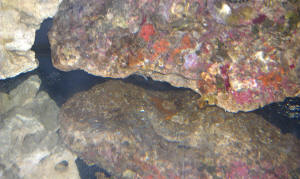
Today I noticed a little fellow emerged and is swimming throughout the 30
gallon tank. He swims like a tadpole with a very long tail, and looks like
one (head region, almost all else looks like a tail, I can't notice any
fins). He is about 1/2-3/4" long, 1/8" circumference, slightly pink head
with tiny dark eyes, body of whitish color with what looks like a darker
eyespot mark in the middle of his body (on both sides). He swims so
erratically that I cannot get a good picture (with my poor camera), and
can't distinguish any head features. He swims throughout the entire tank,
almost with distress.
I don't know if an egg hatched...or a creature near death is doing his final
erratic swim...seems most likely to be a fry and I can't figure out what it
is. Can someone please help me make an ID?
<If I could find what you're referring to in your image... I can't>
I have 2 maroon clowns, 3 engineer gobies, and 2 peppermint shrimp on the
way via airship on Friday, so want to rule out any issues (and possibly
remove/dispose of him if there is any concern). This is a temporary tank for
a much larger build in process (i.e., will use as a quarantine and remove
the rock if need be).
The attached picture shows him in front of the piece of live rock on the
bare bottom tank. (sorry for poor quality, I took about 10 trying to catch
the booger). You will see half of his body in front of the black background
and half in front a dark orange sponge just left of the rock's middle.
Thanks! Dave
<Sorry; I just can't make it out... that it's "eyed" and motile... points to
this likely being a fish of some sort... Please send along a better resolved
image, cropped... Bob Fenner>
|
 crop
crop |
5/23/12
Bob, this is like trying to catch a shooting star with my poor quality
camera. I took another 15 pictures, and none were any better. I tried a
video, which only captures the behavior and no further detail. I may need to
borrow a friend's camera this weekend and follow up with a better device's
picture. Sorry/thank you for reviewing. Let me know if the attached helps
with the ID.
<Ahh! The swimming mode is definitive... this is a Polychaete worm of some
sort... Yes, there are free-swimming types/species. Not harmful, but the
segments may bear sharp spines... hence the fish leaving it alone. Bob
Fenner>
| WWM
Video/VIDEO0006.mp4 Video Linked File |
Re: Live rock hitchhiker - fish?
5/23/12
Bob, incredible! Amazed that the ID was successful based on a nonscientific
description and lousy pictures/video. Thank you!
<Welcome Dave>
And, glad to know what this animal is. It sounds like there may not be risk
with the animal harming the fish or peppermint shrimp?
<Not harmful... a major source of protein in the oceans...>
Upon a quick Google search, I don't see many Polychaetes that are on the
attractive side. That said, I do intend to add a porcupine puffer and either
a Coris wrasse or harlequin tusk to the final build - so down the road,
perhaps the worm will serve as a nice large snack for
one of these specimens?
<Oh yes. Assuredly. BobF> |
|
Strange creature in my tank 4/17/12
Hello WWM Crew! Tonight while was working my tank, I came across a rather
strange creature. I have attached a photo. It is about 1/4" to 3/8" in
length, and was moving quite slowly with what would best be described as a
crawling motion. Originally I thought it was a Bristleworm segment that had
perhaps been pinched off while I was moving Liverock about, but after
watching it for a bit, I am not so sure. I did search for an identification
before emailing you, but had no luck. I am hopeful that you can help
identify it, so that I can find out if it is a nuisance animal. It's
currently being held captive in a breeder net in my sump. Thank you in
advance for any and all help.
Sherita
<My guess is the same as yours. Do be careful (don't handle w/ your bare
hands/fingers)... as the "podial spines" are very sharp. Bob Fenner>
|
 |
|
Hair Worm , saltwater .
4/9/12
I just wanted to confirm this worm species, it's a hair worm
correct?
<Yes. A Cirratulid or possibly a Terebellid. A macro photo of
the worm would lead to definitive ID.>
And you guys can use this photo for anything you want, like, the
worm id section . ;)
<Jordan>
|
 |
|
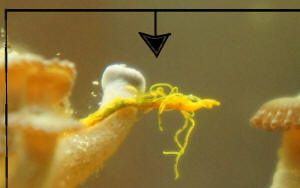
Worms? 1/23/11
Got one for you guy's see if you can identify the worm in the
attached movie and photo. We are located in Port Fourchon, La.
and these worms have been appearing in our slip areas for the
past week. Let me know what you come up with.....James
--
James Guidry
C-Port
General Manager
<Is an Errantiate Polychaete (Bristleworm) of some
sort/species... Need a close up of the head to get to the family
level of ID. Not problematical for boats, plumbing... painful to
get "podia" spines in hands if handled.
Bob Fenner>
|
|
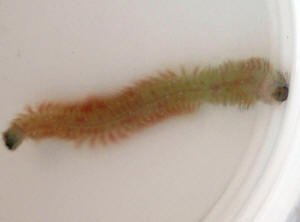
|
Re: Worms? 1/23/11
Thanks for info. One more questions what time frame will they last
in this area and why did they appear all of a sudden? (tough
question)
--
James Guidry
<Likely will only be around in good numbers for a week or two...
As they're likely out and about reproducing... And the numbers
increase... probably due to the vagaries of seasonal/predator-prey
abundance. Cheers, BobF> |
Polychaete worm and snail comp Name
& Advice 10/3/11
Tonight, I witnessed mucous around one of my brand new (and looked to
be very healthy) Ceriths...upon closer inspection, I saw a worm that
certainly didn't look like my average-Joe bristle. It was thick,
more like a Fireworm, and seemed to have a very large mouth that sucked
like a snail snout. It was pale in coloration and stout...
I went to the site to research and saw this response to one of the
questions in the section:
"Dead ones, yes. Live ones, no. There is a type of worm that is
bright red, long and thin that prey on snails by smothering them in
mucous before eating them."
My worm was not bright red, nor long and thin--but there was definitely
an undeniable ball of mucous surrounding the shell's opening.
I've never been able to keep snails in my tank, I always thought it
was because I didn't acclimate them properly...what should I
do?
<Bait out and remove the worm/s in question>
What is this worm called?
<Harvey? Can't tell from the description>
What are the chances that the mucous was from the snail, not the
worm?
<Better than middling>
Is that the defensive mechanism of a snail?
<One, yes>
Thank you for the help and taking the time to read.
- Ruth
<Welcome. Bob Fenner>
|
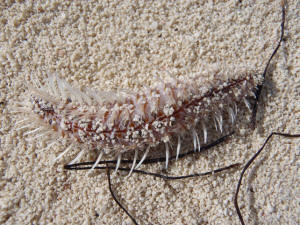
Polychaete identification
9/14/11
Hello,
<Kath>
I would like any help possible in identifying this worm. I assume
it's some kind of Fireworm/Bristleworm, but I haven't
found a more specific identification yet. It was found washed up
on the beach (though still
alive) on San Salvador Island, The Bahamas. Any ideas as to its
specific identity?
<Not species,,, much more detail needed... of head parts,
podia..., but this looks to me to be a member of the Spionidae.
See the Net, WWM re this family. Bob Fenner>
|
 |
|
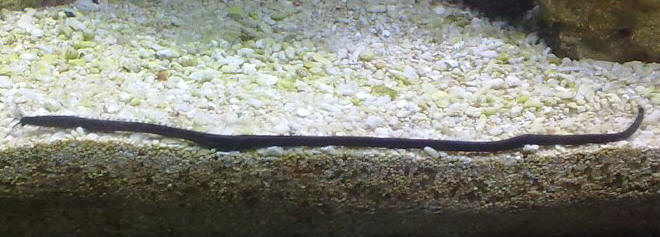
Info on Worm-Like Species: Likely Phyllodocid or
Nereid - 8/23/11
Dear Crew,
<Hello Manie, Lynn here today.>
Have noticed this worm-like creature in one of my clients
aquariums and would like to know whether you can shed some light
on what it is
<My best guess is that it's either a Phyllodocid (family
Phyllodocidae) or a Nereid (family Nereidae). Note: depending on
where you look, you might find this latter group listed as
'Nereidids' in the family 'Nereididae'. For more
information on Phyllodocids, please see the FAQ titled
'Hitchhiker worm 10/16/05' at the following link:
http://www.wetwebmedia.com/wormidfaqs6.htm
For more information/photos regarding both Phyllodocids and
Nereids, please see the following link: http://www.chucksaddiction.com/hitchworms.html
>
...and whether it is a problem to any other aquarium
inhabitants.
<While many of these worms are predators, thankfully, they
mostly target other small worms, pods, and the like. Species can
also feed on detritus, algae, and/or scavenge remains. Corals,
fishes, snails, etc., should all be fine. If I saw such a worm in
my system I'd leave it unless it was very large worm and/or
the system was very small ( = it would have more impact on the
lower level of fauna/biodiversity within). It's up to you
though. In the FAQ I listed above, Anthony Calfo recommended
getting rid of the Phyllodocid in question.>
Thanks
<You're very welcome.>
Best Regards,
<To you as well.>
Manie van der Merwe
<Take care, Lynn Z>
|
|
|
|
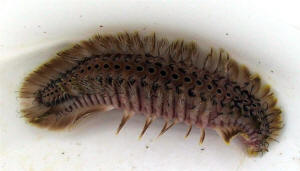
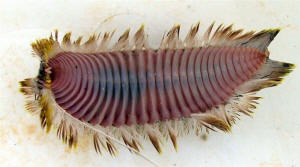
Help to identify a strange sea creature
8/21/11
Hi,
<Stu>
I have tried searching the web to identify this sea slug? that I
caught today, and a link to your site turned up. I hope you can
help satisfy my curiosity.
It swallowed a hook baited with a piece of Whiting fillet on a
set line.
<Strange... but these worms are voracious feeders>
I am anchored at the bottom end of Hervey Bay in Queensland,
Australia (25 10S, 153 03E), in about 6m of water over a sandy
bottom. Water temp is 20 deg C.
The hairy protrusions look a bit like feathers due to the
colouring.
<Are painful spinous processes...>
Underside is segmented. No obvious eyes, but the fishing line
goes into a mouth which must be larger than it looks in the photo
because the hook is about 30mm x 12 mm and there was a piece of
fish bait on it.
Thanks in anticipation,
Stuart
<This is an Errantiate Polychaete worm... looks like images
lifted from a text of an Aphroditid sp....
Bob Fenner>
|
|
|
Re: Help to identify a strange sea creature
8/21/11
Hi Bob,
<Ah, Lynn!>
Heheee! Looks like we went for the same query and you beat me!
I'm pretty sure that what Stu caught was an Amphinomid called
Chloeia flava, sometimes referred to as the Golden, Yellow, or
Peacock Fire/ Bristle worm.
Apparently, they're pretty common, distinguished by a line of
spots down the middle, and are sometimes caught on fishing lines.
Here are some links:
http://www.poppe-images.com/?t=17&photoid=951321
http://www.ntnews.com.au/article/2009/01/31/30501_ntnews.html
http://www.wildsingapore.com/wildfacts/worm/polychaeta/chloeia.htm
There is also a plethora of photos available through Google's
image search engine.
Sorry for horning in, but I recognized that little fellow! Take
care,
Lynn Z
<Do please send your ID to this young fellow. Cheers! BobF>
Re: Help to identify a strange sea
creature 8/22/11
I'll send it now - thanks!
<Thank you Lynn. B>
Help to identify a strange sea creature: Amphinomid -
8/21/11
Hi,
<Hi Stuart, Lynn here this evening.>
I have tried searching the web to identify this sea slug?
<Interestingly enough, although this species is sometimes
mistaken for a Nudibranch or sea slug, it's actually a
variety of Polychaete worm.>
...that I caught today, and a link to your site turned up. I hope
you can help satisfy my curiousity.
<I believe I can help. What you have is a
Fireworm/Bristleworm, in the family Amphinomidae. The species is
Chloeia flava, sometimes referred to as the Golden, Yellow, or
Peacock Fire/Bristle worm. Apparently, they're pretty common,
distinguished by a line of spots down the middle, and are
sometimes caught on fishing lines. For photos and more
information, please see the following links:
http://www.poppe-images.com/?t=17&photoid=951321
http://www.ntnews.com.au/article/2009/01/31/30501_ntnews.html
http://www.wildsingapore.com/wildfacts/worm/polychaeta/chloeia.htm
>
It swallowed a hook baited with a piece of Whiting fillet on a
set line.
<Yikes>
I am anchored at the bottom end of Hervey Bay in Queensland,
Australia (25 10S, 153 03E), in about 6m of water over a sandy
bottom. Water temp is 20 deg C. The hairy protrusions look a bit
like feathers due to the colouring.
<They do indeed, but watch out. The bristles you see on either
side of this worm can sting the living daylights out of you
(hence the term "bristle" or "fire"
worm)!>
Underside is segmented. No obvious eyes, but the fishing line
goes into a mouth which must be larger than it looks in the photo
because the hook is about 30mm x 12 mm and there was a piece of
fish bait on it.
<That was one hungry worm!>
Thanks in anticipation,
<You're very welcome.>
Stuart
<Take care, Lynn Z>
Re: Help to identify a strange sea
creature 8/22/11
Hi Bob,
Thanks for your reply, and Lyn's later reply with more
details.
I take your comments about the photo as a compliment.
<Like olde-timey serigraphs w/ painted in details>
For your interest, they were taken with the worm in the bottom of
a plastic bucket with a Fuji Finepix camera in macro mode. Then
cropped and tweaked with Picasa's 'I'm feeling
lucky' button.
<Neato! Thanks for this input. BobF>
Cheers,
Stuart
Re: Help to identify a strange sea creature: Amphinomid --
8/22/11
Hi Lynn,
<Hello there, Stuart.>
Thanks for your informative reply.
<You're very welcome.>
Great service you offer to the world at large.
<Thank you and thanks for writing us. It's wonderful to
have the opportunity to see what neat little critters people find
in the wild, or within their tanks. It never gets boring,
that's for sure.>
It looks like most of your enquirers are aquarium owners, but we
boaties appreciate your knowledge and advice.
<It was a real pleasure, Stuart. I have to admit that I'm
envious of your position as a boatie. I can only imagine all the
neat things you must run across on a daily basis!>
Cheers,
Stuart
<Take care, Lynn Z>
|
|
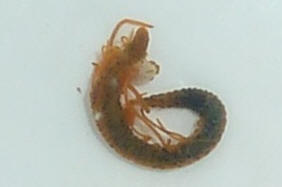
Some type of worm?????
7/11/11
Hey Guys,
<Howsit Jorge, Como que va?>
These are the best photos I could get of this guy that I found
slowly (very, very sloooowly) slithering along my sump glass.
He has some pretty cool colors (red/brown and green) and some
thin tentacles on one end. Whatever it is, it is not very
coordinated and it has a very hard time moving.
Any ideas?
<Mmm, yes... looks to be a specimen of the family
Terebellidae... an Errantiate Polychaete... See the Net, WWM
re>
If by any chance I discovered a new species let me know so I can
name it "WetWeb" ;)
<Oooh, or Bobsbierasomething>
Thanks,
Jorge
<Welcome, por nada, Bob Fenner>
PS - He is out of the tank so no hurry at all in getting
back....other than to kill my curiosity.
|
|
|
Re: Some type of worm?????
7/12/11
Wow...that was fast!
Thanks Bob!
PS - reef safe?
<Welcome and yes. BobF> |
|
Net fishing animal...
7/8/11
Hello,
<Simon>
I Googled the web, scan your site and could not find an answer to
my interrogation.
<Ok>
I recently bought a fragment of sps coral and glued it to my live
rock.
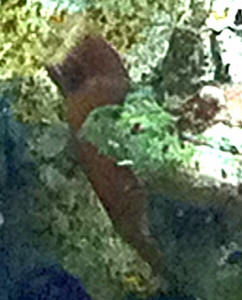
Yesterday I noticed a brown animal that grew at the base of it.
It seems to be some kind of worm and I can't identify it. It
has a very special way of feeding. For a few days, I noticed tiny
filaments, like some kind of spider web in that area. I finally
realized it is generated by that animal. It kind of throws a net
of very fine threads that stick to the surrounding live rock. It
takes a few minutes to complete the work. Then it stands still.
Tiny bits of particles suspended in the water column stick to the
net. After a few minutes wait, the animal pulls back it's
net, apparently swallowing it with it's catches. And then the
cycle goes on again and again.
I took a picture of it. It is the brown shape in the middle of
the picture.
It is partially hidden by a part of the coral base. It is also it
it's shadow, which didn't help the picture... The thing
is about a centimeter long, and doesn't move or contract.
What is it? Any danger with it? I hope not, because it is
fascinating to watch!
<Is likely a species of "spaghetti worm"... A member
of the Polychaeta, perhaps the family Terebellidae. Not
harmful>
Thanks for your help!
Simon
<Welcome. Bob Fenner>
|
|
|
|
Re: Net fishing animal... poss.
Terebellid ID 7/9/11
Hair it produces are so thin that I would rename it spaghettini
worm, or even vermicelli worm!
<Shades of semolina!>
Thanks a lot for your great work!
Simon
<Welcome. BobF>
Re: Net fishing animal
lol!
|
white errant Polychaetes?
5/10/11
Good afternoon! I am writing in regards to this particular article
about the white worms (notably, the one adjacent to the Nassarius
snail).
>>http://www.wetwebmedia.com/WormIDF14.htm
<Okay>
I work at a lfs and the other day a customer showed me a video of
several of these white worms swimming around his tank. When
they hit the glass they would stick.
<Unusual...>
I spent a few hours reading over this particular link and others hoping
to find out what exactly they are.
Is it possible that these white worms are in fact the same
epitoke bristle worms described in the white worm
response?
<Yes>
I just wanted to check with you guys before I gave the customer an
answer.
Also, he says he sees them at night-- like, 2 or
3am.
<Another good clue>
Any help would be appreciated!!
-Ina Marshall
Fins of Franklin
Franklin, Tennessee
<Bob Fenner>
Eunice worm question, ID,
bioluminescent beh. 4/12/11
Hey Crew!
Quick question regarding a Eunice worm I found in my Nano tank. I'm
looking for a specific (as possible) ID so I can accurately match up a
threat level that this creature poses.
<... Ok>
I am not able to snap a photo but there are a couple characteristics
that may narrow it down.
<Mmm>
The color on the worm's plated back is primarily dark brown/black
with a hint of metallic red that really shines with a flash light. That
in it's self is neat, but the cool part is that when you harass the
little bugger, his head flashes blue. The flash holds for a full second
then fades away.
I tapped him with a spoon two nights ago and he "flashed me"
in a quick retreat. I then tapped the hole that he was burrowed into
and the entire hole glowed for the same amount of time. The blue is
very similar to a blue actinic 453nm LED. It's pretty awesome.
I'll NEVER be able to catch a still shot of that, but I will
definitely try to video the blue flash..
<... there are about 200 species of Eunicids. Do search on WWM
(we've ID'd a few) and the Net in general... and/or college
level invertebrate zoology texts>
The tank is a 14g Biocube with ~15 pound of live rock (origin is The
Coral Sea if that further narrows down the possibilities).
<Nope>
I am on the fence. Anyone that has read up on Eunice Worms know the
potential terror that they can cause. This tank will host primarily
corals. I have about 4 or 5 prominent colonies of Zoos, some GSP, 6
colonies of Acan, and some other random mushrooms that I am basically
growing to trade. None of these have been touched in the 4 months that
the tank has been running. There's one clown and the average
cleanup crew.
I've lost one snail, but again, that's not necessarily
uncommon. I barely feed the tank so I imagine the thing would be
getting hungry and attack the corals if desperate by now.........
<Some Eunicids do eat coral...>
Any thoughts on an ID or potential risk?
<I'd remove it/them if they're of size, such concern to
you>
Thanks everyone!
-Jon
<Welcome. Bob Fenner>
re: Eunice worm question 4/12/11
Thanks Bob! I appreciate the response!
<Welcome Robert>
I have searched high and low for information and I'm not finding a
lot of reputable info on bioluminescent Eunicid..... is that flash of
blue a common defensive feature across the line of Eunice worms or is
this a unique characteristic?
<Mmm, not especially... Could well be bioluminescent bacteria in the
water or on the worm's exterior>
Also, do you know of any specific university studies that are the
"end all" on Eunicid? I'd love to look it up and maybe
pick their brain on the subject.
Thanks!
<Heeee! I "spent" a few years as a college student
"sorting and identifying Errantiate Polychaetes" for
bioassays... but that was decades ago. Am sure that a cursory search
(BIOSIS, the Zoological Abstracts) perhaps w/ the help of a reference
librarian... at a college with a bio./zoo. dept., will show if there is
such a tome/study. B>
re: Eunice worm question 4/13/11
Thanks for the direction..... I'm in NC a little ways east of
Raleigh.
<Ahh, have visited there>
I know of at least one marine biology offshoot in Morehead City
(it's either Duke or UNC, I don't remember). Maybe I'll
look them up and see if anyone can spot me a lead.
<Real good>
Question regarding the bioluminescence. The blue flash was very
isolated on one particular region of the worm's head and it only
flashed in response to my physical threats via long handled spoon. If
it were bacteria in the water or externally on the worm, is the worm
acting in a certain manner or doing something to trigger the flash
response (assuming the flash could be bacteria)?
<Can/could be triggered... most folks think by movement alone. Am
not so sure>
Perhaps some sort of symbiotic trade? Has a relationship like this ever
been noted or is it more on the lines of theory?
<Either not so theoretical or yet another instance of my faulty
recall>
I don't know why I am fascinated / dragging on this conversation
about a worm.... but nonetheless, I appreciate your insight/website/and
thoughts on the subject!
I'll bet this won't be the end ;)
<I do hope not>
Till next time
-Jon
<BobF>
Re: : Eunice worm question. LynnZ chimes in
4/13/11
Hi Bob,
<Hey Lynn>
Sorry, I saw this query earlier but was not able to answer it the way I
wanted.
I was on the way to yet another doctor appointment! Anyway, I don't
know about Eunice worms and blue emanations, but I have read of
bioluminescence in Chaetopterus spp./family Chaetopteridae worms, Scale
worms/family Polynoidae, and some Syllids/family Syllidae.
Chaetopterids in particular have been reported to release a luminescent
mucus, when threatened, that results in a bluish light. Unfortunately,
I don't have any links to list right offhand, but an internet
search should prove fruitful for Jon. Hope that helps!
Take care,
-Lynn
<Thank you Lynn. Have cc'd JonH here. BobF>
|
|


