 |
|
| Home | Marine Aquariums |
Freshwater Aquariums |
Planted Aquariums |
Brackish Systems |
Ponds,
lakes & fountains |
Turtles & Amphibians |
Aquatic Business |
Aquatic Science |
Ask the WWM Crew a Question |
| Please visit our Sponsors | ||||
Koi fry, dying 9/19/15
Help with Koi with Dropsy... and use of antibiotics in ponds
f' 10/22/13 VERY sick Butterfly Koi
12/5/12 Goldfish, pond... shocking/shocked beh.?
11/30/11 4 questions 6-10-11
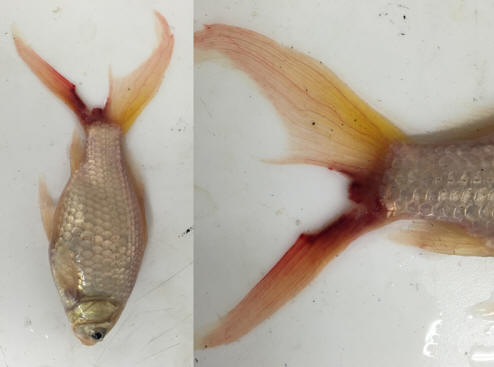
ORF BENT 3/28/10 Re: ORF BENT -- 3/31/10 I could use some help with a koi with pink/red fins
and a bloodshot tail 4-16-09 Re: butterfly koi lockjaw disease -07/18/08 Hey Bob... I did catch the fish with a net and put it in a separate tank, we did look for a stone or any kind of obstruction while it was in the net, but seen nothing of the sort, just tissue you would see of the inside of it's mouth. <The jaw is likely dislocated or broken. Sometimes happens with Koi and Goldfish, supposedly because they inhale some gravel or similar solid object. No idea if that's true or not, but in any even if the jaw moves freely but the fish can't keep its mouth closed, that's the problem. Some vets may be able to help relocate dislocated jaws (telephone around for your nearest Koi specialist) but otherwise this is very difficult to treat. The problem is that fish jaws bones are incredibly delicate, far more so than our very primitive solid jaws. As such, it is very difficult for the non-specialist to "man handle" the bones back into position, and on anything smaller than an adult Koi practically impossible even for a vet. If the fish can't feed, it will obviously starve to death, so this *is* a life-threatening injury. It is also possible that the jaws are surrounded by swollen tissue, and this is forcing the jaws open. This is a luckier scenario, because prompt treatment with a broad spectrum, systemic antibiotic such as Erythromycin can help (e.g., Maracyn) by reducing the swelling and allowing the jaws to get back into alignment. But this is quite an uncommon reason for the symptoms you are describing, and would normally be present along with other signs of bacterial infection, such as Finrot or white, stringy faeces.> The next day after being in a separate tank it's lips are turning a blackish color, and it's basically just sitting at the bottom of the tank being mellow, I have tried putting a few pieces of small food, but it isn't interested, I have it in a tank with Mela Fix fish all purpose medicine. <Melafix is completely useless in this situation, and arguably useless is most others as well, so hardly an "all purpose medicine" any more than a stiff shot of whisky is for humans.> I don't know what else to do... Thanks for Your Help Lenn <Call a vet. Your options for home therapy are limited. Cheers, Neale.> Dead pond goldfish 1-22-08 Hi - you were so helpful with a previous issue with my son's goldfish - thanks to you they are still alive and kicking!!! I wonder if you can help me with my problem. <Will try.> I have an outside pond - no filters etc. just a pond with water lilies. I had five goldfish for the past six years. About six months ago one became very bloated and died. It did not look like dropsy and my local fish shop said it could have been because the fish was pregnant and could not get the eggs out?? <Unlikely.> Not sure about that one, but the scales etc were not as indicated for dropsy. The only thing was the mouth look white and gummy. About four weeks ago I noticed that another fish was staying at the bottom of the pond with its mouth to the wall most of the time. The fish does swim about, is not bloated but its mouth looks odd. By that I mean that it looks as though it is slightly deformed, almost caved in. The other three fish are fine, but I am not sure if I should remove this fish. I keep the pond in good order removing dead leaves, cutting back on the water lilies, and at the moment in winter the water is quite clear and I was about to clean out the dead leaves with my pond Hoover. <Water clarity does not equal water quality. So first thing to do is check the water quality. You can use your regular tropical fish test kits for this. At minimum, check the pH and nitrite. Both of these give you a quick "handle" on water conditions in the pond. Goldfish like (need) quite hard water, so if the pH is acidic (i.e., below 7) you have one problem right there. Goldfish (like any other fish) want water that has zero ammonia and nitrite. Just because they're in a pond doesn't make them different. While a big pond with small fish can have excellent water quality, if for some reason the ambient bacteria and plant growth aren't sufficient to keep the water sweet, then the fish will get stressed. More often than not, when a bunch of fish all die at the same time, the fundamental issue is water chemistry or quality. So check these, and then get back to use.> Any advice please would be gratefully accepted. Many thanks Jackie <Hope this helps, Neale.> Re: Pond Goldfish (dis., env.) and FW testing f' 1/25/08 Hi <Hello,> I went out and bought a test for ponds so that I would get it right. The results were: PH - low, Total Alkalinity - low, Total Hardness - soft, Nitrate - safe. <Please let me have the NUMBERS, not what you think they mean. I can make more from the numbers than the "words". But this said, low pH, low alkalinity, and low hardness are all bad for Goldfish. Goldfish need a pH of at least 7.0 and ideally 7.5-8, and a hardness of 10 degrees dH upwards. In other words, they like the same sort of conditions as livebearers and Mbuna. You've also not mentioned either ammonia or nitrite -- the two uber-killers in ponds and aquaria. Nitrate is largely irrelevant, as Goldfish have very high tolerant of nitrate.> I also bought Pond Goldfish Treatment which is a broad spectrum treatment for pond goldfish. It says use to treat undiagnosed diseases, bacterial disease, fungus disease and parasite infections. I did not think that this would hurt. <Likely not hurt, may help. The flip side is that jack-of-all-trades medications tend not to be terribly effective against established infections, where you need more tightly focused, microbe-specific medications.> It is a five day course so today is day three - but nothing noticeable with fish. It is sitting almost at the bottom of the pond with his mouth on the wall. <Not so good. I'd be tempted to bring the fish indoors and put it into a hospital tank for a while. That way you can provide warmer water, where the fish's own immune system can kick into gear and help sort things out. At least here in the UK, there's a definite distinction between how regular Goldfish and fancy Goldfish survive over winter -- i.e., regular Goldfish are normally fine, but fancy Goldfish suffer from bacterial infections because their longer fins are more prone to what is essentially frostbite. This is why one never leaves fancy Goldfish outdoors over winter in England.> Many thanks for all your help Best wishes Jackie <Cheers, Neale.> Re: Pond Goldfish (dis., env.) and FW testing f' 1/25/08 Thanks - haven't got a hospital tank so will get one. If I retest water will medication affect it? <No, should be fine.> If not I will do that and let you know figures. <Cool.> Many thanks <You're welcome, Neale.> Very Sick Koi 1/27/08 We have a 7 year old Koi who last week we thought we had lost her. She was laying on the bottom of our outside pond and when I went to retrieve her I realized she still had some life in her. <That's a start, anyway.> Unfortunately, she just continues to lay on the bottom and she has a curvature in her spine. <Not good... usually indicates severe trauma, typically oxygen starvation, poisoning, sudden (and severe) changes in water chemistry/temperature, etc. Simple lack of buoyancy can be caused by dietary issues or systemic bacterial infections, but when the muscles become locked in a bent-spine modus, that usually implies something rather worse.> She keeps mouthing the bottom trying to feed and twists around every so often like she's trying to get up, but can't. We've had to deal with curved fins before, but caught it so we could make water adjustments. This came on so suddenly and she doesn't have much quality of life at this time. Is there anything we can do for our Koi? <Difficult to say without a diagnosis. The first thing is to tell us about the water chemistry and quality. At the least, check the pH and the nitrite level. Next up is to consider any possible stress factors. Anyone done any spraying in the garden with pesticides or herbicides? Even things like paint and cleaning agents can be deadly poisonous to fish.> Any medication or shots we should be giving her? <Likely not, at least, not without some idea of the immediate problem.> Our water quality is good and the temperature has been between 20-40 the last 4 weeks. So I believe that is keeping her in a hibernated state and she might have gone quickly had it not been for the temperatures. <Are we talking 20-40 Fahrenheit here? Or Celsius? I assume the former, which translates as the air temperature bouncing slightly above and below freezing. How big is your pond? Here in England at least it is generally recommended that fish NOT be wintered in ponds less than 90 cm/3' deep, the reason being that smaller bodies of water are too at risk from freezing and from unstable temperatures in winter as they thaw/freeze too rapidly for the fish to adapt safely. The wild ancestors of Koi naturally live in quite deep canals and lakes where depth gives them some protection against cold weather. If your fish has been stressed by the cold, that might explain some of its symptoms. A photo would help!> Any recommendations you could give us would be much appreciated. Our thanks in advance. Terri <Cheers, Neale.> Koi health, no info. 7/19/06 I am in need of help so I am hoping you can. I am very new to the whole pond and Koi thing so i hope you can help me out. I have searched the web over and I am almost out of options other than hunting down a fish vet, which I have no clue where to find! I have 2 Koi approximately three and six months old. A few months ago I had 5 Koi and 1 comet and I introduced a new fish in that had a parasite and it killed all but one which we managed to save with salt, Quick Cure, and a qt tank. He is one of the Koi I have now. We bought the other a few weeks after he was all good and went through the whole qt process just in case. <Good practice> Her name is Princess and the lone survivor is Salty. Salty has never really acted the same. If I had to guess I would say he acts a little brain damaged. <The formalin in the Quick Cure will do this> Well to get to my problem...For about a week I haven't seen him which in a way is normal. Princess has never changed her attitude. She is waiting on her food when it is feeding time. Salty is rarely seen. Well today was time for a water change. We have a few large rocks on bottom for them to swim under. We took a few out and Salty swam out as usual. We went to transfer him to the holding tank and noticed he was bent in half. His tail end right past his abdomen is completely bent. He still moves his tail but he is bent in half. He is having trouble swimming if you hadn't guessed. Is this ok and is it going to fix itself? <Mmm, the bending can/could be due to a number of dissimilar causes/influences... from nutritional deficiency, bad/poor water quality/conditions, genetic anomaly, electrical leakage, infectious disease.... You don't provide enough information to guess which of these might be at play here. Not likely to get better, no> There are no scraped or tears. I thought maybe a rock fell on him, other than that I am at a loss. Can we help Salty or is he going to be this way from now on? KANDY ANGEL <Please read here: http://www.wetwebmedia.com/PondSubWebIndex/pdfshdisart.htm and the linked files above. Bob Fenner> Our poor fish... Pond fish dying... no useful data 10/7/06 My uncle bought some new (big) Koi to put in his new pond a few weeks ago. what I don't understand is that a few days ago, one fish died. It had parts where the scales had fallen off and brown gooey bits oozing out. <Very bad signs> another one died yesterday. A few are showing the same symptoms that the other fish showed before they died. (not moving much, rarely eating and staying under the filter) What is wrong?! Please help, a worried niece. <... Where's the beef? Need much more information... Please read here: http://www.wetwebmedia.com/PondSubWebIndex/pdfshdisart.htm and the linked files above... The root cause/s here? Environmental most likely... but w/o data as to water quality, set-up, history, other livestock... only can guess. Bob Fenner>
Koi Problems 12/11/06 Hello, <Greetings> We seem to be having many problems with our Koi this year after the water turned cold. <Many problems manifest themselves at the years two main season changes> We have an outdoor pond which is about 1500 gallons. It contains 7 large Koi (9 years old), 6 young Koi (1 year old) that were introduced about 2 months ago, <Mmm... a note to browsers... This is not a "very" large system... I would just stick with the nine established Koi... and there are often difficulties (pathogenic disease, social dynamic readjustment) with introduction of new fishes to an "older" grouping> 6 goldfish, and 2 turtles <These are incompatible...> which we have recently removed to separate them from the fish. We have not had a sick fish in about 7 years, so we are not very prepared to handle sick fish. <Understood> Most of our fish are slowing down due to the cold water temperature and have settled down at the bottom of the pond. In general the fish looked stressed out. In the lighter-colored Koi, you can see the red blood vessels in their body showing through their scales. Also, we have found a few scales lying at the bottom of the pond but can not see which Koi they are coming from. <Missing scales are a very bad sign... perhaps a predator... some types of zoological parasites> We noticed last week however that one fish was laying down sideways instead of upright and its mouth was stuck open. <Very bad...> We read from other sources online that the mouth could be stuck open due to something behind lodged in the mouth. We did a visual inspection of the fish and could not see anything in its mouth and nothing wrong with the body of the fish either. So we did a salt treatment by giving it a salt bath <Good move> and the mouth problem seemed to go away, it can now open and close it's mouth. However, it still turns sideways when it stops swimming and it seems like it's gasping for air from time to time. We have quarantined this fish <Also good> for fear that whatever it has could spread to another fish. We are not sure what is wrong with the fish. Yesterday, I noticed one of the fish had Ich and one was beginning to develop Ich, so we went out and bought some anti-fungal medication (Malachite Green) and treated the water. I was told to treat the entire pond since the fungus <Mmm, Ich is a protozoan... not a fungus... but Malachite Green is efficacious here.> was present and all the fish were vulnerable and that it would be fine to use at colder water temperatures (about 50F) <Mmm... cold...> but now I see conflicting reports online saying that this medication is not effective at lower temperatures and might not work. <Along with salt, it should do for the cold weather period. Very likely you will need to address this parasitic problem in the Spring as well> So we have a concern as to what we should do in this situation. Should we continue on with the treatment or stop? <I would continue> The bottle says to re-treat the water after 48 hours if the fish are not getting better. <Yes> Also, today our fear came true. I woke up to another fish with the same symptoms as the first fish. The fish was lying sideways in the water. When I came outside and started talking though, it heard me and turned itself over and started swimming again. At this point, we don't know what is causing the fish to turn sideways and what to do about it. Any help would be greatly appreciated. Thank you in advance! Tracy <The side-turning behavior leads me to be concerned with general environmental issues... like dissolved oxygen, some chemical contamination... You do have water quality test kits? What do they read? You have "put to bed" your biological filtration for the Winter? And/or thoroughly cleaned this before the end of Fall... You've ceased feeding I trust... You have read on WWM re Koi/Pondfish disease? Bob Fenner> Koi with a Bump in the Night 7/18/05 Hello, You have helped us tremendously in the past and we thank you. So here goes. 5 fish in a 200 gallon indoor tank. One Rena X3 bio filter (largest) one Fluval 404 bio filter (largest). Water tests zero for Ammonia and Nitrites, Nitrates appear high and PH is about 8+. 1/3 water vacuumed off to remove all debris on bottom of tank once every 7 days (water added back in at EXACT temperature of tank and is country, well water that tests normal) and filters gently flushed every 14 days at same time water is vacuumed off. The product Cycle added with each water change. New carbon every 3rd cleaning or 6 weeks. Approx. 1/3 aquarium salt of recommended dosage. All winter and spring, tank temperature was approx. 68 degrees F. Now this Hot Summer, temperature is pretty stable at 76 degrees F. Two small Comet Goldfish (about 3 inches), 0ne 6+ month old Koi (about 6 inches) one 16 month old Koi (about -12 inches) and one 17 month old Koi (measured at 13 inches by floating plastic ruler on water and getting him to line up with it as he is a pet and easy to handle). Koi are growing at an incredible rate, appear very healthy, very good color, very tame, not stressed, eat well and always hungry, etc. Two weeks ago, I noticed on the biggest one and our favorite Koi: On the left side, approx. mid of his body (both from top to bottom and from head to tail) a raised scale. Thinking he must have brushed to hard against one of the 4 large rocks positioned down the center of the tank. Then 5 days ago, he had a very thick, snow white ribbon sticking straight out of the damaged scale. In 3 days time it was more 1/3+ of an inch long and very thick. NOTE: size description is pretty accurate. By thick, think larger than a pencil lead by 2+ times. I searched numerous pictures on the web and it looked to thick to be an "Anchor" worm and "Did Not" match the various pictures? It also "Does Not" match a "Fluke" picture, especially of attachment to fishes body? On advice from local Fish Store, bought "Melafix" and added according to label directions last night. While doing so, saw the snow white, thick spike was gone. Went to add it again today as says to do so for 7 days and noticed a tiny bump of white showing again on damaged scale. Is this a worm that does not match what I can find on Internet or could it possibly be some kind of "Purulent Discharge" (called Pus on us humans and animals)??? < Possible.> Last Koi was added 3.5 months ago after being kept in a separate tank for 14 days. Was supposed to be parasite free when I bought him??? < Seriously doubt there is such a thing.> Once again, pure white and thick coming straight out from tip of slightly lifted and/or damaged scale on the fishes side. Fell off but appears some is notable today AGAIN!!! That scale appears to be very reddened in color (he is a "Kin Matsuba" so kind of yellow/orange with the Pine Cone black edged scales on the top and coming part way down the sides) so the reddened scale/pure white thing is very easy to see as below the Pine Cone effect if that maybe helps you in location? We do not have a Quarantine Hospital tank for a fish his size. Plus he/she is the dominant fish and we doubt even if we got a larger hospital tank and got it (water) properly conditioned that he/she would be happy alone??? Sorry, so entire tank of 5 fish are being treated. Please help as this is our Pet and means a lot to us. I can pet his head and he will come up and kiss me on the nose when I bend far enough over the tank so my nose is only about an inch from the water. He knows his name too. He actually does not come until you sweet talk him using his name. Don't use his name and he does not come up to respond. Crazy but true!!! Thank you again for now and all your help in the past. Trixie < The summer temps have elevated the water temp in your tank and have stressed you cool loving Koi. If you have a worm type parasite then treat the tank with fluke-tabs. It sounds like an external bacterial infection that may have started with a bump or scrape. Treat with Nitrofurazone, increase the aeration and watch for ammonia spikes because antibiotics may affect the good bacteria that break down fish waste.-Chuck> Dropsical Koi I've got an 18'' Israeli Bekko whose got Dropsy, she's had this since the summer, but due to my pond being heated I believe this is what has kept her alive, and happy, sadly it look's a lot worse, the scales are not only lifted but red too. She's still feeding, and seems happy, all other Koi are fine. Can I just leave her in peace? I don't want to upset her by messing as she's never liked being messed with. Yours Jaime Chrisfield <I would move this fish to another "large-enough" container to ease treatment, and add a level teaspoon per ten gallons of Epsom Salt (Magnesium Sulfate)... monitor water quality daily, dilute ammonia by water changes... This might just "do the trick" by itself. Are the scales at right angles to the body? Perhaps this is something other than bacterial in origin... egg-blockage... Bob Fenner>
Albino Catfish in pond, winter health question 04/17/2006 We have an Albino Catfish in an outside pond, approx 500 gal pond, he has been out there all winter with our Koi fish, <Mmm, likely a channel: http://wetwebmedia.com/FWSubWebIndex/ictalurids.htm> after doing our spring cleaning of the pond, cleaning leaves and such out, we noticed the catfish has this reddish color rash on the top of his body and somewhat on the sides. He is normally all white, didn't know if our water quality is still needing some fixing. <Mmm, careful here> The red rash looks like it is under his skin all the way back to his tail fins. He swims around really well, so don't know what to do for him or her. Can you advise? Should I be feeding him something different then what we feed the Koi?? <No> Thanks for anything advice you can give us. Connie McCunn <I would not "do" anything here other than allow the water to warm up, keep treating this fish as you have been. Likely the reddish coloring is due to environmental stress... the cold, perhaps a degraded water quality over the winter. Adding medicine, salt will do this fish no good. It will "cure" of its own accord. Bob Fenner> Koi w/ scrape hi, About a week ago I bought a new Koi. Now I see what seems to be a scrape. That's fine enough but I don't know if it is infected. It seems to have a tannish appearance around the scrape. Also has a little thing hanging off, possibly skin? <Does the "thing" look like two little strings arranged at an angle hanging off the fish?> It doesn't look like a fungus. My water quality is: Ammonia 0, Nitrite 0, pH 7.6, Nitrate 5, salt .23 With .23 salt in the water I tend to believe that an infection is unlikely, but the tan appearance seems odd, I think. My question is do you think that it is infected and also should I raise the salt level to .3 to treat for a bacteria or something that could be in there. Thanks for your help now and in the past. this site has been a great help. ed <I would definitely raise the salt content... and keep a very sharp eye on the affected specimen. Do please read over the piece on Furunculosis: http://wetwebmedia.com/holedispnd.htm I do hope this sore is just the result of a physical trauma... perhaps evidence of an Fish Louse (Lernaea sp., a copepod parasite of fishes)... and not signs of an acute or chronic Ana aki problem... I would inspect the other fish in the pond, and if only the one is marked, place it in a separate system. Bob Fenner> MY GOLDFISH ARE DYING Hi. <Hi Todd, Sabrina with you today> My name is Todd and I have put 24 common goldfish in my outside pond about 2 weeks ago. <That's an awful lot of fish to add all at once....> The pond is about 7 feet deep and 10x10. Rain water fills it and I run cold well water to keep it full. They have been dying off 1 or more a day and have tried to feed them bread, peas, goldfish crumb food but they don't seem to eat anything. <Don't try bread. It's an inappropriate food for them really. But I'm surprised they didn't take peas?! Every goldfish I've ever had is insane for peas. They may just be scared of you still, being in a new environment and all.> The well water temperature is around 50 degrees f. They swim off scared with I come to the edge of the pond. <That's normal, until they start associating you with food. Then you won't be able to keep them AWAY from you!! :) > I also tried to feed them live cut up worms but they didn't want any. Is the pond temperature to cold for them to eat??? <Possibly. You said the well water is 50F, right? What's the temp in the pond itself?> Any response as to why they are dying would be appreciated. <Well, there are definitely a few important things I'd like to bring up. Do you test for ammonia, pH, nitrite, and nitrate? If not, please invest in test kits (liquid reagent type) so you can know what's going on in your water, and see if there's something wrong that might be causing your goldfish to get sick. I wouldn't worry too terribly about them fasting, as there are plenty of organisms for them to feed off in an outdoor pond - especially a large one like yours. There should be plenty of stuff naturally available for them to munch on. I would imagine they're not starving to death, but rather, dying from some unseen factor in the water (ammonia, nitrite, perhaps). If you can't get test kits now, take a sample of your water in to a local fish store, and they should be willing to test it for you. Do please find out and keep us updated.> Thanks, Todd from Canada Goldfish are STILL dying Hi. The letter sent back to me didn't finish. It ended with the word INFE. <I will resend very shortly. Hope everything comes through, this time. Also, please do look for this at http://www.wetwebmedia.com/PondSubWebIndex/pdh2ochemfaqs.htm . The day you receive the email, or perhaps the day after, you may see your answer on the Daily FAQs page: http://www.wetwebmedia.com/daily_faqs.htm .> I think you were going to say inferior quality fish. Right??? <Sorta.... as I said, I will resend it. Hopefully will clear up a lot of confusion.> These are from a different pet store than the 24 common goldfish I bought for my pond in which 23 have died. These 12 new common goldfish were bought from a different pet store hoping for a better quality of fish if that is the major problem in the first place. The 12 new goldfish I put in my garage fish tank which is in my garage and made from a old chest type freezer with a plastic liner (house vapor barrier poly) on the inside. A 5 gallon pail filled with medium rocks and filter on top to collect debris and a pump filling the filter constantly and it drains back to tank. 300- gallons approx. <I'm pretty confidant that it's a water quality issue - again, not with the water from your tap, but from adding such a bunch of fish all at once. It is very important to get test kits for ammonia, nitrite, nitrate, and pH so you can have an understanding of what the problems are. Until water quality issues are ruled out, there's really no diagnosis to be made.> The rocks are said to remove ammonia and toxins and the material on top to remove bigger stuff. Only 6 out of the new 12 goldfish are still alive in the garage tank after 1 week in there. I've kept minnows in the tank before and they seemed to do ok. But since then I've had to put in the poly plastic liner because of leaks. I wonder if the poly plastic could be a problem? <Doubtful, but possible. Wild guesses are all I can give you without knowing water quality and symptoms (white spots on fish, lumps, discoloration, wounds, any abnormalities whatsoever?) The pond outside has the same plastic liner to where the other 23 out of 24 died. I will take a water sample into the store where I bought the last 12 goldfish and ask them to check the water quality. <Ahh, wonderful. Be sure to ask them for pH, ammonia, nitrite, and nitrate. Please do consider purchasing your own test kits - it's really an invaluable thing to be able to test your own water, whenever necessary, right when you need to know the values.> I have also added a charcoal filter to the top of the garage tank filter system. I plan to keep all the pond goldfish in the garage tank during the winter IF I EVER FIGURE OUT WHAT IS KILLING THE GOLDFISH!!!! LOL LOL This is starting to drive me a bit insane figuring it out but with your help and going back to talk to the pet store guy, I will find out what I am doing wrong or if the fish are inferior and I have to spend more money for better quality fish since these are only $4.99 a dozen. <Ultimately, if your 'feeder' comets are coming from a good source, they *should* be okay. Operative word here is *should*. It's entirely possible that they're all sick, but water quality is always the first suspect.> The next step up in price is 2 for $5.00, which are not the common goldfish but another breed of goldfish. <"Fancy" goldfish? Shubunkins? Something else entirely? You should be able to get 'pond' comets (as opposed to 'feeder' comets - they're healthier and sold at larger sizes) for an inexpensive amount.> Your help is greatly appreciated in my GOLDFISH DILEMMA...... THANKS FROM TODD <Any time.... Hope this one gets through okay. -Sabrina> RED SPOTS on pondfish Hello, <Hi there> I have searched the internet, researched books, and consulted my local aquarium shop without success. I have a 250 gallon outdoor pond with a 750 gph pump and compatible Bioforce uv filter. ( which I split into two separate returns ) My pond is home to 7 six inch fancy goldfish, 2 seven inch Pleco, 2 three inch baby turtles, and 6 mystery snails. Last week I noticed a very small red dot (1/8 inch) on the cheek of one of my pearlscale's. Today I noticed a similar but larger red spot (1/3 inch) on the chin of one of my Orandas. I would describe these spots as blood vessels or some sort of hemorrhage under their skin but not under their scales. The spots are not close to the gills and they do not appear to protrude. Could this become serious? <Could be... but I suspect not... much more likely a "seasonal" change to cooler/warmer weather, even perhaps "nuptial tubercles" (raised and reddened areas on fishes with the physiology and behavior of reproduction... Your fish may have the hots. Seriously, I would not be overly concerned... Keep checking on water quality, routine maintenance and try not to worry> Can treatment be confined to a quarantine tank rather than the entire pond? <Yes, could be... with most of water coming from the pond itself... I would only do this if other symptoms (off-feeding, stringy-feces, a lack of swimming activity...) occur> Any advice you may have concerning this matter would be greatly appreciated. Thank you. <Welcome. Bob Fenner> Pond aliens I have noticed a proliferation of 2-4mm shrimp-like creatures (copepods, as I have learned) in my pond in the filter net and such areas. I have not examined my fish. They don't look like fish lice and don't have a Y shape. They swim around inverted frequently. <Could very well be a copepod of some sort, like Cyclops, or perhaps water fleas (Daphnia), or one of many, many other tiny critters that show up in ponds.> Are they bad news? <Unlikely.> I am worried that they are parasitic. <Although there are parasitic copepods, and other parasitic tiny forms of life that will appear in ponds, chances are good that what you're seeing isn't parasitic. Of course, it would definitely be a good idea to net out a couple of fish just to check on them, make sure nothing's amiss. Also, while trying to identify pond organisms, I ran across this page/site that may be of use to you to identify what you've got: http://www.microscopy-uk.org.uk/index.html?http://www.microscopy-uk.org.uk/pond/insects.html . Play around with the links and other pages in the site, and you'll probably be running out to your pond for a cup of goo to stick under a microscope. Lots of fun.> Thanks for any comments, Roger <No problem, Roger. Have fun with your tiny pond life, -Sabrina> Sick Koi & Comets <Hi! Ananda here today while the usual Koi crew are out and about...> I guess I have been lucky until now, I have a large pond (1600) gallons, this past week the fish all started acting strange, they seem to gulp for air, (not all the time) stay at the waterfall, some have a film <I'm not quite sure what you mean by "a film"...> and I have lost 5, the salt level was low, I have brought it up to .2%, the ph, is a little high but not in the alarming range, <Any change of more than 0.2 per day can be stressful to fish.><<RMF says 0.1>> the nitrates, ammonia are both ok, the water is on the hard side, well water. We recently put in a new filter system could this have stressed the fish? <Perhaps, if you also removed the old filter system at the same time, leaving the fish with no biological filtration, or something similar...?> I also wonder if maybe the pond now is overcrowded as I have several large Koi and then smaller fish. I am at the end of the rope trying to figure things out. There are several pond owners in town that have problems and have lost fish this past week. <In that case, a couple of things come to mind. Have you had a heat wave? A sudden increase in water temperature might lead to significantly lower oxygen levels. A sudden change could be especially problematic. Did several of these people do a water change shortly after the city added something different to the water, perhaps?> We have had a lot or rain. <What is the pH of the rain, compared to the pH of the pond? Is the difference enough to cause a pH swing in the pond?> If you have any suggestions I would appreciate them. Sarah <Got a pond club or Koi club? If so, I'd get everyone who's lost fish, and several people who have not, to check their water parameters -- preferably with the same test kit (pond tour time) or at least using the same brand of kit. I'd compare those results with each other. I'd also look at any trends the various owners may have noticed in their water parameters. And I'd compare pond maintenance practices. I'd look for patterns in just about anything... it's detective work, but perhaps you'll find something. Wish I could be of more help. --Ananda> Pond goldfish pregnant or diseased? hello, <Hi there> just wondering if you could advise me. we have a pond with around 50 goldfish most of which are very young. Recently (well within the last 2 months) we have noticed that one of the older fish has become bloated. At first we thought it might be "pregnant" with eggs because we keep seeing new little goldfish all the time! However it doesn't seem to have given birth so we're wondering if it's diseased? It has a good appetite and seems quite happy and joins in the feeding frenzy. Any ideas would be very welcome and appreciated. Thanks Dan and Diana <Mmm, if it's only one fish affected... seems that some sort of pathogenic complaint can be ruled out... or even trouble with food/feeding... It may be the one fish has what is called "dropsy" or a dropsical condition, but I suspect you are correct in your estimation that it is a female full of roe. If you are concerned that this might be a problem that could spread you might administer Epsom salt (magnesium sulfate) at the rate of about a teaspoon per two gallons of water (hope this is not a very large system), or move the one fish to a smaller system and treat it hence... or just wait and see "if this too passes". Likely so. Bob Fenner> Carp Pox? 7/20/04 I'm at a total loss at to why goldfish are dying in my 900 gallon pond established 2 years. Water quality checks out on tests fine, and I have a solid UV filtration system which leaves the water quite clear. I action regular husbandry of the pond, using a pond vac at least every 3 weeks. In the past 4 weeks about 7 goldfish out of the 16 I had have died, but none of the 6 Koi I have shown any symptoms yet. The symptoms are 1. White spots on tail fins, but fish continues to swim well and eat well 2. After about a week to 10 days an ulcer like lesion appears on the fishes side just in front of the tail fin. The fish still continues to eat well 3. Within a week though it usually then dies. I have tried full course of white spot treatment, ulcer treatment and general pond tonics with no success. I have tried isolating in a quarantine tank fish showing any symptoms, and then using one of the above treatments. <it does sound perhaps viral in nature. Tough to say for us without seeing the fish and observing them> I also found a small 4 inch frog dead in the pond 4 days ago. All of the goldfish are about 3 years old, and were bred in my last houses pond, the Koi have been introduced over the past two years and are between 3 and 5 inches in length as an average Thanks, Andrew <its very tough for us to say, my friend... your husbandry and treatments have been sensible and wise. You may need to enlist the help of a local expert for a trained set of eyes. Are you near Shirley's Aquatics by chance? Some great staff there for consult in the UK. Anthony> Sick pond goldfish Hi, I have a small outdoor pond, 90 gal. in NJ. <Hi Lora, Don here in Philly. You're right, that is a small pond. Do you have plans to bring her in for the winter?> My pride and joy goldfish who is about 2 yrs old is suddenly sick. She seems a bit bent at the tail, is hanging out on the bottom of the pond. When she is still she starts to flip slightly to the side. Can you help with any suggestions? Watched her be born and she is beautiful. Don't want to do the wrong thing by misdiagnosing her with all the different info online. Many thanks, Lora <Lora, do you test the water? If not, take a sample to your Local Fish Store. Get the actual numbers for ammonia, nitrite, nitrate and pH. Do not accept "Everything's fine". Better yet, pick up a test kit. How many fish are in the pond? How often do you change water? If you do have a tank inside to winter her, I'd bring her in now. Make sure you match pH and temp. Goldfish are so hardy that fresh water is usually all they need. If you see any fin decay, you can add some salt. If she does not improve it will be much easier to treat her inside. But before we can recommend any medication we need to know her water conditions. Strange Koi behaviour For the last couple of days I have noticed a large Koi curled around a clump of pond weed in my mud bottom pond. It is right at the surface of the water and part of its body is even above the surface. It twitches once in a while but is otherwise motionless. Any idea what is going on? <This IS strange behaviour indeed... if this is the only fish exhibiting such, am given to suggest it may have "eaten a bad bug"... an insect or such that got into the water... I do hope/trust it will be okay... If you have other quarters, I might move the fish, treat it with the addition of some Epsom Salt (about a teaspoon per five gallons... in the hope of dislodging whatever this might be.> Love your Koi info pages... thanks for the providing such good material. <Ahh, glad it is of service. Cheers, Bob Fenner> Pale Koi Hello: <Hi there> I have had a Koi in my pond for about 3 years now and today I noticed it's a pale on the fins. it is not very active and seems to be coming up for air and stays there for a while. it doesn't seem to be its normal self. Usually its very active. Thanks Shobna <Good observation re the fin color... I don't know what this might actually portend... The breathing worries me though. I would test for what aspects of water quality you have gear for... and effect a large water change (25%) and possibly move this fish to all new (conditioned) water if this water change doesn't remedy the respiration behavior. Bob Fenner> Loner Goldfish in Pond Obsessed with Wall Hit the Wall We have a clear, UV-filtered, chemically well-balanced 1000 gallon pond in our backyard with 3 Koi, 50-100 minnows, probably 150-200 snails, and 6 goldfish, one of which recently died. Question about the strange behavior leading up to the passing of the recently deceased goldfish: <Okay> We added the 6 goldfish about 1 year ago when they were tinier that the minnows, and they grew rapidly. The now deceased one grew bigger than the others for a while, and socialized with them normally, swimming with the others in a group as they fed, grazed on algae, etc. However, about 5 months ago the now deceased one stopped hanging out with the others and became "obsessed" with one wall of the pond kind of near the weak waterfall, but not really near enough to be near the bubbles. (We have 2 waterfalls in the pond, one weaker than the other). It always just stayed staring at that wall at a normal depth (midway between the bottom and the top of the pond) and once in a great while grazed on the algae growing there. It would do this 24-7 except when it was dark (as far as I know). It would maybe twice a day meander over to the other fish, look at them for a second or two, then go back to the wall and stare at it again. It never seemed to be doing anything but stare at this wall - it didn't look like it was exploring, hardly ever grazing, etc. Meanwhile, the other fish, both Koi and goldfish, would swim in a group and graze on algae all around the pond and eat the Koi pellets we threw in it. The now deceased fish ended up getting scrawnier that its brothers and sisters, when it was once the biggest when it was socializing normally. <Strange> Sadly, we found the fish dead this weekend. My dad thinks it starved itself, as it rarely seemed to eat. He also thinks that maybe it became brain damaged in some way, <I agree with his guesses> which led to its starving itself and becoming obsessed with the wall. Also, I never saw the other fish ever bullying this fish; it seems that one day he just decided to be a loner. Also, when he did venture over to their group for a brief second here and there, they didn't seem to mind. Regarding food, all the fish seem to get in a good amount - there never seems to be bullying in that respect, although the goldfish hang back when we first throw food in and let the Koi eat a few huge bites before they start eating. <Good descriptions> I am just curious as to what could have been wrong with this fish. None of the other fish have any social problems whatsoever - they act perfectly normal as far as I can tell. They all swim together and seem to have fun. Oh, and I read in your FAQ that lionhead fish tend to be lonely, but this wasn't a lionhead, but a regular looking deep-orange goldfish (I don't know much about breeds). <Likely "Comets"... an American development> I'm pretty sure that it's the sibling of the other goldfish.... however, all of our goldfish, while having the same features, are different colors (one all white, one pale orange and white, one bright orange, another white and really fat), and some are fatter than others. All of them are pretty big though, except our poor little deceased loner fish. Thanks for your help. <Thank you for writing. This does sound like some sort of "developmental disorder"... as your father speculated, perhaps best described as a type of "brain or neuronal dysfunction"... As your other livestock appear fine and your system reads as solid, I would not be alarmed, treat the water in any way. I wish you well. Bob Fenner> Re: Koi Illness?? Dear Sir I emailed you yesterday as we thought that one of my KOI Carps could be egg bearing. Just to re-cap the fish had put on a lot of weight put seems to be resting at the bottom of the pond for a short period of time with the pectoral fins flat on the floor. After referring to our KOI KICHI book by peter Waddington we have examined the fish the abdomen is soft and spongy to touch, however we have now noticed that she has blood loss coming from her gills (like short spurts) not constant. Her skin, eyes and fins all seem fine however because she is a HARIWAKE it is difficult to tell if her colour looks paler than usual. Your advice would be much appreciated <The softness of body is trouble, the excretion of blood very dangerous. I would isolate this fish for closer observation, perhaps to slow progression
|
|

|
Features: |
|
| Featured Sponsors: |