|
FAQs on Pondfish Disease Treatments
Related Articles:
Koi/Pond Fish Disease,
Livestock Treatment System,
Gas Bubble Disease/Emphysematosis,
Pond Parasite Control with DTHP,
Hole in the Side
Disease/Furunculosis, Goldfish
Disease,
Related FAQs: Pondfish Disease 1, Pondfish Disease 2, Pondfish Disease 3, Pondfish Disease 4, Pondfish Disease 5, Pondfish Disease 6, & FAQs on Pondfish
Disease: Prevention, Diagnosis, Environmental, Nutrition, Genetics, Social, Pathogenic, Mysteries, Goldfish
Disease,
|
Tea "fixes", Mela-, Pima-...
terrible
Know for sure what you're treating for
before... Most medication treatments cause much more damage than
doing nothing other than changing water.
|
 |
Aquatic Gardens
Ponds, Streams, Waterfalls & Fountains:
Volume 1. Design & Construction
Volume 2. Maintenance, Stocking, Examples
V. 1
Print and
eBook on Amazon
V. 2
Print and
eBook on Amazon
by Robert (Bob) Fenner |
 |
Argulus medication in Fresh Water Ponds of Catla Catla & Labeo Rohita
11/15/16
Dear Robert and Wet Web Media,
<Krishna; hey; one of our dive guides shares your name here in Mauritius>
I am a Chemical Engineer and working in Aquaculture Industry in India. Our Fish
farmers raise Major Carps (Catla catla, Labeo rohita etc.,) .
<Ah yes; many important food Cyprinids>
The is too much of Argulus (sea lice) here. We found existing medications cease
to work due to raised resistance of Argulus.
<Mmm; I take it you mean organophosphates... acetyl cholinesterase inhibitors>
Would you enlighten us with some new formulas which we can try out?
<What have you tried/used thus far? Common/generic and IUPAC names please>
Thank you, I look forward
<Cheers, and we'll be chatting... Am out dive-adventuring to mo.s end; so no
access to chem. abstracts, what have you. Bob Fenner>
Re: Argulus medication in Fresh Water Ponds of Catla Catla & Labeo Rohita
11/16/16
Emamectin Benzoate used to solve the problem some extent. But it became obsolete
now in our Aquaculture industry. There are few unknown costly medications used
by some dealers, (some say 'Biospot') whose formula is unknown. They stop the
outbreak a bit, but again they lice come severe.
<Mmm; have you tried Lufenuron along w/ the Emamectin (1:4)? Is there a
possibility of formalin flushing, or bathing stock while sterilizing holding
facilities? Bob Fenner>
Re: Argulus medication in Fresh Water Ponds of Catla Catla & Labeo Rohita
11/16/16
Lufenuron, I did not try it myself. I am not sure whether people would have tried
Lufenuron here. My best guess is someone would have already tried it here since
we have around 1 lakh acres of inland Fish culture here, (dealing with Argulus
is pretty aggressive here ) and few of the fancy new compounds (unknown
chemical) worked for a while like 1 month, however they cease to work as the
Argulus increases its drug resistance. Its a closed secret when a new medicine
comes out here. However none of them hold more than 2 months. But I am not
really aware of the 1:4 combo Lufenuron with Emamectin.
<There's some recent literature in the sciences re. Do you know Ed Noga down in
Florida? He's retired from teaching, but still does consulting re fish
disease... and another friend I'd contact is Myron Roth; in Canada>
In my research in the literature, I found these compounds Cyromazine,
Trichlorofon and Praziquantel, which might not have been tried at our side.
<Mmm; Trichlorfon and its many brand/generic names I'm quite familiar with.
You can search re on WWM. Prazi has issues w/ water solubility and is expensive
in actual large scale aquaculture>
I wish to make new combinations with these and try out, with your suggestions.
Regarding the sterilization of facilities, these are very large ponds (ranging
from 10acres-100acres, with avg water depth ~5ft). We use formalin just as
nominal water sanitizer, but it is not effective with Argulus.
<Needs to be border high dip/bath concentrations. NOT added to ponds>
My idea here is ......considering a pond of 1 Acre with 5 ft depth (~160,000
gal, with 2500 pc.s Labeo Rohita), I want try out new compounds and combinations
to checkout which works the best. I'd be more than grateful if you offer some
insights in formulating. Thank you.
<It's been many years since I had first hand experience w/ Argulus, these
pesticides... Hence my suggestion to contact people in the field presently.
Bob Fenner>
Sick pond fish
1/23/15
Hi Bob Fenner,
You have been recommended, by Neale Monks'
<Oh, yes, a fine fellow>
I live in St Helens Merseyside England. I have an outdoor fishpond and keep
quite large goldfish and Koi, it is winter i have not fed my fish since end of
summer,
<Below about 55 F consistently, I think this is the route to go>
I have 2 sick goldfish, symptoms are they look bloated having trouble keeping
their balance, i have been putting Myxazin P, in pond past three days, with no
effect.
<Aye ya... not likely to be effective during cold months>
Although weather is 3 degrees during the day, is there anything you can suggest
that I can try doing
<Yes; the simplest, least expensive, most likely to work and not cause trouble
is adding Epsom Salt (MgSO4); about a cup per 100 gal.s (UK or US)>
The fish did belong to my Dad who passed away a few years ago. I am trying my
best the pond holds about 280gallons, with a green gene filter. All the other
fish seem to be fine, they are about 10-15yrs old. Neale, mentioned Epson salt,
i have never used this, he also told me you are an expert on pond fish.
<Ahh; Epsom, not Epson (the printer co./brand)>
I hope you don't mind me asking for your help and opinion of which I would be so
grateful.
Kind regards Nerina x
<Do try the Epsom... you should be able to procure it at most any grocery
store... Used often as a "muscle relaxant" by humans. Bob Fenner>
Sick pond fish
1/23/15
Hi Bob Fenner,
Thank you for getting in touch, would I be better taking the sick goldfish out
the pond,
<No; much worse for pondfishes to be moved, manipulated during the cold/er
months. Unless there is something very wrong w/ the system itself, leave all in
place>
i have a container that I can fill with water and put in my garage were it is
a bit warmer, just put a couple of tablespoons in, in your opinion would this
method work any better?
Kindest regards Nerina x
<And you, BobF>
Sick pond fish
1/23/15
Hi Bob, thank you so very much for the information, I will try the Epsom salts
in the pond, as long as it won't cause harm to the rest of the fish. It is going
to be 7 degrees tomorrow.
Thanks for your help! :-)
Nerina Everall x
<W. B> Help with Koi with Dropsy... and use of antibiotics in ponds
f' 10/22/13
As you can see... from my original message, in such a state... typed
wrong e-mail address. Thank you.
Hi, finny expert:
Not trying to be funny, actually I'm almost in a panic state. We've
never had a problem with our Koi in 15 years! I have a Butterfly Koi
that's approx. 14 years old that we've had in our pond almost since its
inception. Last Wednesday/Thursday/Friday I thought she was full
of eggs, thought it odd, but with Koi I read on one of the fish websites
that it's possible even here in Ohio.
<Mmm; not likely this time of year... too cold>
No aquatic vets..._am in touch
with one in a close by city, but he hasn't gotten back to me. Not
my regular vet... is that why there is no sense of urgency. He was
formerly vet for one of the better known zoos in Ohio and has retired to
private practice. He's my only chance for "doctor advice"... other
than you kind folks! _
Microbe-Lift pond expert has been very helpful. An answer
from a "not free" online service suggested Maracyn II which I am
currently using.
<... Erythromycin... for what? Dropsy? From what presumed cause/s? I'd
simply use Epsom Salt>
Dropsy was diagnosed by them and Microbe-Lift expert. The latter
said that since Sunny's scales were in the pinecone stages, only on her
bloated belly and not on her back, that it was bacterial Dropsy
and treatment should proceed.
<... Might be bacteria involvement... But... the Mardel product... not a
good, first choice... Was any sort of culture work done?>
She is in only 21 gallons
<... a poor idea. Exceedingly. I would return this fish to larger
quarters, as it will assuredly perish here>
of water in a tub in our basement right now, since Sunday afternoon.
I'm using the Maracyn II as directed. I've an air pump in there,
testing... ammonia reading is 4.0,
<... deadly toxic. See above. MOVE this fish NOW>
after having done a 50% water change. I added "Ammonia
out" for aquariums and have not yet tested again.
<... won't, WILL NOT remove the ongoing excreted and secreted
ammonia>
We're equipped for a pond, not aquarium setting. We want to build
her a larger area, with cement blocks and pond liner, but then need
larger amounts of Maracyn 2... which is very expensive, even on Amazon,
which I just checked. Usage is 2 packets per every 10
gallons of water. If we put her in a 60 - 100 gallon holding pond
that would mean 12 - 20 packets per day for five days then repeat
treatment for another five days. I paid $25 at PetSmart for
a 24 packet box... it's $11.50 for same at Amazon. But that would be a
minimum of $12/day. If there is nothing else, we will do it.
But if something better, we'll keep her in the 20 gal for five days and
they transfer her.
<.... this fish won't live that long in this setting>
to what I refer to below. (I KEEP INSERTING THOUGHTS THROUGHOUT THIS
E-MAIL AND NOW I'M GETTING OUT OF SEQUENCE, SORRY... I'M USUALLY
ABLE TO KEEP MY WITS ABOUT ME... BUT THIS HAS TAKEN IT'S TOLL ON ME --
NOT KNOWING REALLY WHAT TO DO FOR HER.)
<I do know... See/Read on WWM re Pondfish health, dropsical conditions.
You can/could administer an antibiotic to foods, inject...
putting it in the water is of very small use/efficacy>
It states on Maracyn 2
<STOP. Don't treat w/ this further>
package to finish treatment and not use any other antibiotics while using
it. Is there something I can purchase over the counter or obtain a
veterinary script for?
Incidentally, if my dear Sunny is alive after being treated for 10 days
with Maracyn 2... what then... another series of antibiotics?
<... not if it were my fish. I would NOT put antibiotics, antimicrobials
directly in the water... OF ALMOST NO USE>
My dear friend is also my vet but she knows absolutely nothing about
fish. She would write me any script I needed and there is a local
Pharm that fills pet scripts... but we would need to know what... and if
there is an alternative that I could substitute for the Maracyn 2 after
we transfer her (we haven't built... the larger pool yet) --
without killing her.
My vet advised that I call OSU, their Vet Med or Zoology Dept but they
offered nothing. Since Sunday afternoon I've made 26 phone
inquiries... all dead ended. I want to move my girl to larger
quarters but can't afford to keep buying the packets of Maracyn 2
I would need to maintain a volume of say 60 - 100 gallons, which would
be anywhere from 12 packets to 20 packets per day. Sunny is two
feet long and can't really move where she is. I've put bacteria in
but I know that has to seed. I will try anything to try to save
her. Can you please help?
This morning her scales don't seem to be protruding as much... or am I
seeing that I hope to see? She is eating thawed frozen peas and
her water temp is 70 degrees, whereas our pond is now 50 degrees
outside.
_Do I start feeding her? _ I'm going to petstore as soon as they
open to get a piece of tubing to get out the waste. At least she
is pooping. Is that a good sign? Our pond is pristine and
all tests are perfect. I'm just scared to death that this same
bacteria will infect my other finny guys. I've been praying a lot.
Please help... I'd really appreciate it. Thank you
ps Am in this for the long haul... and am prepared to winter her
in the basement so as not to stress her any more by putting her back in
her home.
<Read on WWM... re MgSO4... return this fish to the main pond,
treat the water there w/ this salt... IF your friend/vet wants to inject
the fish, have her contact me directly (here). I do NOT want to
encourage private individuals in such matters... Or have her read Ed
Noga's work/tome re the same... Bob Fenner>
Re: Fwd: Help with Koi with Dropsy
10/30/13
Hi, Bob.
First, let me apologize for causing you to roar! Wasn't aware of
your credentials, and I don't and didn't last week have time to read
your bio. I'm sure by now you've become aware that I, too, say
what's on my mind at any given moment. BTW, I, too, have
"credentials", which, in this instance, are totally useless. Yours are
not.
Despite our valiant efforts, Sunny died Sunday morning.
<Ahh!>
Vet came out and took fluids from her ab which were pinkish. When
lifted out of her hastily built hospital pond (150 gal) she had bloody
red sores on sides. These were not seen when she was under water.
The culture he sent out returned yesterday which indicated "Infectious
Periotonitis",
<Aeromonad?>
I asked him whether bacterial or virtual and he said he suspected cause
of condition was due to either kidney/renal failure, cancer, tumor,
etc., and that this weakened condition caused Aeromonas as and his
cousin pseudoymonas (please excuse spelling of both of them... am
hurrying to get ready for work) ever present in our ponds to take over.
He didn't say this exactly 'cuz he never mentioned the a/p cousins...
those are my words. He just indicated parasites or bad bacteria
took over. Then came even more advice. I spoke to a
gentlemen who is a well known fish breeder in the area and who was
recently published in National Geographic and he said to either open up
the pond again and heat if and treat it with Oxalic acid and feed
MediKoi OR just watch the other fish in the pond. There is NO WAY
IN HELL I can heat this pond.
Is my daddy Donald Trump???????????? Just frustrated and angry
that there are SOOOOOOOOOO many opinions and suggestions out there...
obviously fish husbandry is more complicated than human medicine,altho
working parts are the same and equal the same sum.
<I would just observe... there are two "types" of these sorts of
infections; acute and not... Read here:
http://www.wetwebmedia.com/PondSubWebIndex/holedispd.htm>
I'm taking the advice of the Microbe-Lift expert and dosing the outside
pond with Sabbactisun and Parazoryne, each for 10 days,to possibly keep
the a/p cousins OFF my other fish. Even though the directions say
best used in temps @ least 70 degrees, she said to go ahead and use
it... which I will, as soon as it gets here on Monday. Like I
said... I live in "podunk" and nothing is readily available... maybe for
acquariums, but not ponds. The few pond shops that are available
don't stock anything but standard pond supplies but then can order them.
Yea... so can I... taking the same length of time to get here.
So, now, after burying our girl, Sunny... I'm about out of gas mentally.
I just want to try to save my other fish and am prepared to bring them
in if necessary. But, 150 gallons can't accomodate everyone out
there! I'm just saying prayers to our Lord and St. Francis to
intercede and protect them.
Then... there is the question of: to salt or not to salt.
For 14 years we've kept a .01% salt solution in the pond. That's
what we were told at its inception. I questioned usage
of salt for freshwater fish as I know there is salt naturally in water
and was told... "who's the expert here?" I let him live! On
a lighter note... since I did let you beat me up a bit... you must be a
Scorpio or a Leo,right?
<Yes>
I know it's not fashionable to talk about signs of the zodiac now... but
some things are just inescapable! It kinda takes one to know one, I
think... cuz I'm a Scorpio with rising sun in Leo. If you're not
close to the same... then my guess is a Gemini or Cancer. How
close am I? You don't have to answer personal questions... but I
usually don't take prisoners... and I don't think you do either.
Can you just please tell me I'm doing the right thing with 50 degree
water temp out there and an aerator running for oxygen (air fork at
surface) and a stock heater just for a hole for oxygen should the air
fork fail for some reason. I'm going ahead with the Sab and Para
because something within me is saying that it's better than nothing and
all herbal and won't hurt my fish.
<I would do nothing further this season... Stop feeding
period... Do read the above article cited, the Related FAQs that are
linked at top>
Thanks, Bob...and lighten up!
<? B>
Re: Fwd: Help with Koi with Dropsy... the end of dealing w/ nonsense
10/30/13
Gee, Bob... how could I possibly know, i.e., Stinger or Lion? I
guess
our supreme arrogance and fiesty demenor just can't be hidden under that
proverbial bushel!!!!
<... please go elsewhere>
Anyway, in my haste to write, I probably wasn't clear. Our pond is
shut
down for the season and I'm not now, nor will I be feeding! The
MediKoi
feed was in the event we had another incident and had to bring one of
our guys into the hospital pond. He said to raise temp, feed MediKoi and
also get Oxalic acid and to treat hospital pond. After looking up
that
little gem, there is no way on this earth I would attempt to use it
unless instructed by a professional, each and every step and with each
and every once. I suppose I could have it on hand to use on an old
antique ice chest I inherited!
So, I also was told to do another water change and not to do another
water change. What do you think? I didn't take water temp
today but a
week ago Sunday, when i first wrote, it was 50 degrees. Our
outside
temp is supposed to hit 65 here... just today and then gradually go down
to 47 high (weather temp)... so that outside water spigot is probably
running at about 50. So, should I do a maybe 650 gal water change
or
not? I'm working now and I won't get home til tomorrow morning and
my
husband refuses to do anything at the pond unless I'm there!
Duh!!!!
Water change or not... or literally... do nothing.
Also... I thought fish floated when they expired. Sunny was at the
very
bottom of her hospital pond. I have only had goldfish and bettas
prior
to my koi and when they died they were floating.
Thanks, Barbi
Treating goldfish for ick and juvenile green frog, pond dis. 3/25/12
Hello WWM Crew,
<Ronna>
You have a wonderful website and I have used the search box and read
the FAQ pages to find out general information about ick, medications,
frogs and goldfish. However, I am still not sure what course of
action to take to treat my fish.
I have an outdoor pond. It is one of those preformed
rigid kidney shaped liners that holds 35 gallons. It is
16" deep in the deep section and 8" deep on a small shelf
where I put pond plants in the "pond
season".
<I see>
I have four goldfish (yes, I know the pond should not have that many,
but read about the origin of the fish below in "background
information").
Before doing the first water changes of the Spring this year, I scooped
out some of the fallen leaves that had sunk to the bottom over the
winter. I did stir up muck on the bottom while doing this.
<Hopefully the water temp. is staying (even at night) over 55
F.>
We had some unusually warm weather in the past two weeks (in the high
70's) so I've done 3 water changes in two weeks. Each
water change is about 8-10 gallons and I treat it and let it come to
ambient temperature before adding it to the pond. I performed the
water changes a bit more frequently than normal since the pond had not
had a water change since fall and the weather was warm enough.
<Do please read here:
http://www.wetwebmedia.com/PondSubWebIndex/pdspgmaint.htm
and the linked files above>
Two days ago, I noticed some flashing behavior and a few scales missing
on two of the fish. I looked closely at them while feeding them
and thought I saw ick crystals at the base of the dorsal fin on
one.
<... at the base? Unusual>
I think I should treat them for ick, but I currently have a resident
juvenile green frog and I'm not sure if the treatment will harm
him.
<It could; yes>
I've read enough on your site to know you don't think
much of the Jungle Products Ick Clear, but I did use that last year
when ick occurred for the very first time in my pond and I nearly lost
my fish. At the time, there were no frogs present. I searched
your site and could not find information on "Victoria green"
one of the ingredients in the ick medication that I have.
<This material is rather mild... not too toxic>
The other ingredient, Acriflavine,
<Nor this>
seems to not be a problem for African Dwarf Frogs, but I
don't know if that would be true of Rana clamitans.
<Though I don't think either will be of help here>
The current conditions of the pond are the following:
pH = 6
<Too low... do see WWM re raising pH for freshwater use... Simple
sodium bicarbonate will be of service here... to raise to about
7>
NH3/NH4+ = 0
Nitrate = 0
Nitrite = 0
Temperature = 58 F.
No filter is running right now, just two air stones 6" from the
surface which is the normal winter set up.
<I'd rig, run the filter>
The water was tested indoors and had come to room temperature.
I do not have a quarantine tank or anything large enough (except a
trash barrel) that would hold sufficient water.
<Mmm, then I wouldn't be treating... too likely to do more harm
than good w/ the water being this cold, the fish's immune systems
at this stage>
Thank you for any advice you can provide,
Ronna
Background Information:
One year, I put some "water lettuce" plants into the
pond. When I went to clean the pond in the early fall and was
bailing out water and had already removed about 2/3 of the water, I saw
a flash of movement. There were fish in the pond!
:-O Not believing in Spontaneous Generation, I
surmised that four fish eggs had been stuck to the pond plants from the
garden center and had hatched in my pond. They were only an
inch long when I discovered them. Now, eight years or so
later, the fish have grown, with rotund Goldie, the largest, at 6"
or so long. So I have become an inadvertent aquaculturist.
<Good term>
I read up on how to overwinter fish. I knew that my pond
was too shallow and would freeze to the bottom without some action on
my part, so to keep the radiative cooling down, I cover 2/3 of the pond
with Rmax, a builder's insulating foam. I put two air stones
in the pond 6" down. Then temperature remains at 40 degrees
on the bottom for the entire winter. When the temperature goes down to
17F or less, I have a birdbath heater that I put in the shallow end of
the pond. This keeps the water open in the exposed section. I do
not have a filter, but use one of those sponge filters on the pump for
the pond's fountain, which only runs during pond season. When
the sponge gets clogged with debris, I hose it off. I squeeze out
the excess water (which was untreated) and let it suck up pond
water. Enough of the "good" micro organisms seem to
survive this treatment and my pond water has been balanced.
<Good>
I've avoided bailing out the entire pond and cleaning it for
probably 4 years now; I did that one year and stressed the fish
terribly. :-( I promised them I wouldn't do it
again.
<Also>
During the late Spring, Summer and early Fall, I have a small fountain
running and this attracts dispersing juvenile green frogs. The
frogs winter over with the fish and after growing an entire season pond
side, they graduate and move on. I have had as many as four frogs
in the pond during the Winter. There is currently one resident
frog.
<Ahh! Bob Fenner... who would just wait, hope at this
point>
Are medicines to treat
Koi harmful to aquatic turtles? 2/5/11
Hello,
<Hiya- Darrel here!>
I was writing to inquire about whether or not medicines to treat Koi
diseases would be harmful to my Peninsula Cooter turtle. We have a
couple Koi and a 2 year old Peninsula Cooter in a 75 Gallon tank. We
went away for vacation and when we returned we noticed the Koi were
showing signs of septicemia. We immediately did a water change and have
been treating them with the proper meds.
<What meds?>
I noticed after the third dose of the 5 day treatment that our turtle
seems to be bottom-dwelling a lot more than usual and at times seems
like she has a hard time using her left back leg. She is usually
constantly swimming or basking but seems to be more sluggish and
staying at the bottom of the tank and in her shell more than usual.
<At the very best case, it's stressful for her. The medications
in the water are at the least a very likely a skin irritant>
Are medicines for fish harmful to turtles, and if so are there only
specific ones that are or is it best to remove the turtle during any
treatment? We just want to make sure we're taking the best care of
her that
we can.
<I would remove her during the treatment. An otherwise healthy
turtle can go weeks and even months with only enough water to drink.
You can move her to any type of escape proof container for a few days.
Make sure she's warm enough - then give her a bath every evening
for 15 minutes so she can drink, poop and maybe eat.>
Thank you!
Toni Bellone
<Yer welcome!>
|
sick Koi - 5/22/10
Hello. I love your site. First, I wanted to say "Thank
You!" for offering to help people who are having trouble
with their beloved fish!
<A pleasure to share>
I live in New York. My fiancé© built me a
pond about a year ago so I am a new pond owner. It is roughly
4,500 gallons (10 feet wide by 16 feet long by 4 to 5 feet deep).
We have a massive water filtration system. We use an
upgraded vortex chamber (275 gallons) a 150 gallon cone brush
chamber, and a 150 gallon biofilter chamber. I don't remember
who makes the system, but a picture of a similar smaller system
can be seen here:
http://www.bing.com/images/search?q=vortex+cone+filtration&FORM=BIFD#focal=7
520c054d3f0d128c082662468dac46d&furl=http%3A%2F%2Fwww.azponds.com%2Fmark_arc
hive%2FCyc2sys.JPG We have a waterfall, but have not turned it on
yet. We also have a air stone in the pond. We have had a handful
of rainy days in the past few weeks. Temperatures have been
fluctuating. Nights from 35f-
65f days from 50f - 80f.
<I hope/trust temperatures do not drop to freezing
there>
I have about 29 Koi that range in size from 1 inch to 24 inches.
I have approximately 14 babies (under 2 inches), approximately 10
fish that are 6 inches or so, 1 Koi that is approximately 12
inches, 3 that are around 18
inches, and one that is about 24 inches.
About a month ago, a friend of mine gave me three Koi (1 12 inch
Shusui, a 18 inch white butterfly Koi with a black stripe down
her back, and a 24 inch butterfly Koi that is mostly black and
orange with a little white).
<Mmmm, I'll comment that you'd do well to quarantine
any new additions... there are a few "stock"
transmittable diseases of Koi about>
I was not aware of how big they were at the time I agreed to
accept them.
The Koi were in big Tupperware containers and were driven about
20 min.s or so to my house in a small amount of water. Due to the
stress the fish underwent, lack of supplies (i.e. quarantine tank
large enough to hold one let alone all of the Koi that size), and
lack of oxygen, the fish were directly placed into the pond. (I
was not happy to do this since everything I have read has told me
not to-but I was outnumbered and felt I had no other choice). The
fish actually seemed okay. As soon as they entered the pond they
started schooling with the original fish. We tested the water
difference between the two ponds. We had a higher pH (7.5) to her
7.0. We had less
phosphate than she did. Our Ammonia, Nitrite and Nitrate levels
were the same (0).
<Okay>
Only my 3 new fish appear to be sick.
The white Koi's fins had started to have a pink tinge to
them. We added Pond Care's Stress Coat.
<Mmm, I wouldn't do this>
Her fins actually turned more red. Now, they are still streaked
red and one of them has what appears to be a small ulcer/tear? Up
until this week, she was swimming with the others. Now, she is
still eating, but stays mostly by herself by the side of the wall
near to the water return except for when it is feeding time.
The Shusui Koi has some small amount of red streaking on its
fins, but only a little bit.
The biggest Koi (orange, black, and white butterfly 24 inches) is
not doing well at all. When we originally got the Koi, it was
missing a few scales but it looked okay. The fish has seemed
healthy and happy, swimming energetically until recently. On
Thursday, we realized something was very wrong. We actually
thought it was dead last week when we found it resting on the
bottom of the pond. It didn't move until we went to scoop it
out of the pond with a net. Then it sped off and started swimming
around like it was fine. This week, we have noticed its skin has
developed a white/grey tinge and its fins look like they are
deteriorating. There is white film hanging off of the fins and it
has some algae growing. The fish is often found resting now. It
is still eating and swims ( a little funny) around
when we come up to the pond to feed the fish.
We called a few Koi vets, but they are way out of our price range
(i.e.: $420 to just look at the fish and test the water)
So we have been trying to research what we could do to help these
fish. We read that adding the stress coat can actually hurt the
fish
<Yes>
(buildup on gills making it harder for them to breathe) so we
have not added any more of this to the pond. We also read that
salt was good to add so we are slowly adding pond salt to the
pond. We use Morton's Pond Salt.
directions say to add 1 cup per 100 gallons so we added only 5
cups. We weren't sure if we should add the rest of the salt
all at once or if it would hurt the fish so that is why we have
been adding some of it slowly.
<Good>
We also weren't sure of the water changing requirements after
creating such salty water. I read somewhere that you could keep 3
% salt for 21 days and then do a 50 % water change a few
times.... But I am afraid all of this
could drastically affect my other fish that are currently
fine.
I really don't want the fish to die! I have added pictures of
the Koi. I really hope you could help us and our beloved
fish!
Alissa
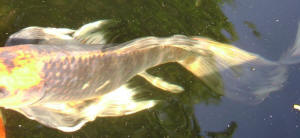
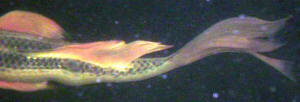
<At this point/juncture, there is scarcely any further harm
that can/will be done by leaving these Blue Ridge Fisheries
butterfly Koi in place... the markings you describe are/were most
likely resultant from stress and your
treatment thus far. I would not add more salt or any other
treatment... instead just stay observant, remove any fish that
perish. Bob Fenner>
|
  |
|
Re: sick Koi update
5/23/10
Thanks for your help. I was able to find a professional pond man
who would look at my fish for $50. He sedated the fish and was
able to show me the damage under the fish's body. He
explained that the fish has a severe
internal bacterial infection and took scrapings and a sampling of
her stool.
When he studied them under the microscope he found (and showed
me) skin flukes, Ich (he said it wasn't the type that was
white, it was the type that lives inside the body?) and a few
Chilodonella (spelling?).
<Mmm... a host of troubles, which could/would have been dealt
with through quarantine/isolation and treatment ahead of
introducing these fish... as you and I know... But I see below a
plan of action to deal with>
He has me treating my pond with 50 g Praziquantel, 50 g
KMN04,
<Do be VERY careful with this amount of Potassium
Permanganate, KMnO3 likely... this compound is a powerful
oxidizer... and can easily burn, and kill fishes, invertebrates,
even plants>
100# salt and 1 qt Hydrogen Peroxide for this week, 50 g KMN04,
and 75# salt and 1 qt Hydrogen Peroxide next week and then
Medicated Koi food. We are to do a 50 % water change on 21 day
and another 50 % water change a week from that. He also
recommended that I buy medicated food. I bought 3#.
I got home and tried to look up some of the medicated food online
so I can replace it when I run
out, but I wasn't sure which one to get.
<Mmm, medicated for what? The Prazi is for the flukes
(Trematodes) and the Protozoan is likely being treated with the
Permanganate... Are you looking to add Metronidazole here? If so,
it can be purchased as a powder and mixed
in... Please read here for details re making your own medicated
food/s for Pondfish: http://wetwebmedia.com/PondSubWebIndex/holedispd.htm
His are unlabeled. They sink to the bottom. Do you have any idea
of what type of medicated food I can give them when they run out?
He didn't tell me what brand it is and it was $50 for a 3 #
bag. Also, is this treatment going to hurt my biofiltration
system?
<It could well do so... depending on admin., what is in the
med. food>
Is there something I can/should use like microbe-lift to increase
the beneficial bacteria since the KMN04 is an oxidizer? (I was
told conflicting report of whether oxidizers kill beneficial
bacteria)
<They can kill everything... You may want to read re RedOx
measure, implications>
Thank you again for your help!
Alissa
<Welcome. BobF>
|
|
Koi stress/losing scales
8/1/09
Hi,
I have read all of your posts about the causes and prevention of
koi losing their scales. None of the posts say anything about how
long to continue treatment and approximately when you will start
to see the scales grow back.
Or do they?
<They can, will if the fish regain their health>
I donÃ'¹t know whether or not I should
continue to put salt and stress coat in the water.
Thanks.
Cherie
<Mmm, what do you consider the root cause of trouble here?
Salt alone is not often efficacious. Bob Fenner>
Re: Koi stress/losing scales
8/3/09
Thank you for your quick reply.
<Welcome>
I believe it is a water change.
<Mmm, no. The animals might die from such, but not lose
scales>
I had a mishap and about 2/3 of the water drained out. When I
replaced, I forgot to add stress coat because I was so stressed
about it draining out!
I check the levels (pH, ammonia, nitrate and nitrite) regularly.
They are not overfed and there are 10 relatively young fish in a
1000 gallon pond.
The water is crystal clear. I am not sure what else could be a
factor?
<The clarity of the water? Mmm, no>
They do not seem to be behaving differently -swimming happily and
normally.
Just missing scales. I have done the salt once and stress coat
twice in the last week.
Thank you.
Cherie
<I'd be looking about for a possible predator... or sharp
objects that your fish might be running into that is causing the
scale loss. Bob Fenner>
Re: Koi stress/losing scales...
reading 8/3/09
Thanks again for additional info. This is going contrary to what
I have read on the web - the water change being a factor, I
mean.
<... please read:
http://wetwebmedia.com/PondSubWebIndex/pdfshdisart.htm
and the linked files above >
It would be next to impossible for the scale change to be due to
share objects since the lost scales are in a specific pattern and
all next to each other. One of the fish used to have a large
orange spot on his head and
that is exactly what is missing.
<A pic please>
What kind of predator could remove scales in a pattern?
<Possibly the wound area might appear thus>
Our pond has plenty of plants for cover and we've also built
a cover out of coated metal fencing. It hasn't been disturbed
and neither have the plants (which had been sheared off when we
had a raccoon problem, but the cover has eliminated that).
Can you address the question of whether or not the scales grow
back and if I should continue to use stress coat?
Thank you.
<Will regenerate in time. StressCoat really only useful for
massive water changes... B>
Re: Koi stress/losing scales 8/5/09
Hi,
I had already read all the articles about illness on the site and
was following instruction there for treating the pond for stress.
My problem was that articles say how the illness starts and how
to treat it, but none
address what happens after? How long does it take for the fish to
recover?
How much of whatever treatment should you do?
<... just good care, time going by (high, consistent water
quality, feeding...). Months>
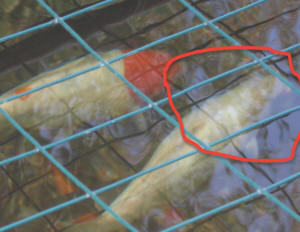
Hopefully you can see this - it's as close as I can get
without scaring them into hiding. There is a ridge at the edge of
the color/scale loss that is an indentation (like layers of flesh
are missing - where color and scales are gone). You can also see
that his head is kind of transparent now because there isn't
as much protecting it.
Thanks again for the replies.
Cherie
<Welcome. B>
|
 |
Re: Koi hlth., bloated ghost wider than ever
06/26/07 Dear Bob Fenner, <Jules> My large ghost that has
been bloated for some time is larger than ever (full of fluid) In our
last contact you suggested giving a 'shot' to it.
<Yes...> I got in touch with the vets (in UK) and it would seem
impossible to get hold of anti-biotics. <Not impossible, but not
easy either> They passed me to a specialist vet who gave me
telephone advice. The cost of getting a vet to administer anti biotics
is ridiculous. Anyway, she seemed sure that it could not be bacterial
as given the time scale (10 months) a fish could not live with that
problem, and would in any case show other bacterial problems such as
ulcers or reddening. She advised that nothing could be done for such a
problem. Do you agree? <Mmm, no> The fish seems fine, however if
handled at all, even just netted and held still in water, it keels over
in the pond, gasping and generally stressed for about a day, after
which it's fine again. (hence, I don't do it!). Will it die? Or
shall I now finally stop worrying? Julian (wet, depressing, generally
miserable England) <I would still "try" the antibiotic...
the best would be Chloramphenicol (Chloromycetin succinate)... Do call
around some of the more near by "Koi", "pond",
aquatic garden clubs and ask some of their members who they deal
with... Bob Fenner>
Emaciated Doitsu Sanke Koi 6/2/06 Hi WWM crew,
I've been trying to find information on treating a condition where
juvenile Koi I have purchased seem to be slowly starving to death (Yes,
I have actually tried feeding them, including soaking rich foods like
brine shrimp in garlic to whet their appetite). There are no external
lesions or lumps on the body but these young fish have a hunched over
look as their abdomens shrink. They look emaciated and eventually grow
listless and die. I haven't been able to find much information on
treating them or even what is causing this. I found one pond disease
FAQ that mentioned something similar in a much larger fish but gave no
reason for the condition occurring in the first place. I began treating
my quarantine tank with Maracyn and Maracyn-Two as the other FAQ
mentioned similar treatment anti-bacterial treatment as well as
introducing some medicated pellets containing 1.0% Metronidazole (made
by Jungle) although I doubt these will be consumed. Since this Koi had
also contracted a few spots of ick I added some kosher salt and
increased the temperature to 32C. The tank was filtered by a Fluval 104
but I have shut it down overnight to let the medications permeate the
fish (will turn it on tomorrow for a few hours to cycle the water
through it before the next medication dose) and am just circulating
with an AquaClear 150 with no carbon and some BioMax. I am trying to
save this Sanke as it is a very attractive fish but I do not expect a
good outcome. I have had to return a series of dead fish to the store
for the exact same reasons. This fish is a replacement from another
store location for a fish that died of the same ailment. I know the
water quality of the display pond where the fish are kept is abysmal
but I thought being introduced to a well maintained environment would
counter any previous poor treatment. Any information would be very much
appreciated. Regards, Patrick. <Mmm... we might discuss the
practical use of injectable Chloramphenicol (Chloromycetin
succinate)... If this fish is very valuable... through a
veterinarian's care... intramuscular. Please have your vet. contact
me at WWM or at fennerrobert@hotmail.com Bob Fenner> Water temp,
Pond Fish with Ick/Ich, UV lights 7/26/06 Hi, I have a 2 year old
pond about 1200 gallons with plants, waterfall and pressurized UV and
bio pond filter. <Okay> I test the water daily and it is balanced
and the water quality good. I have three large gold fish (6" to
8") and two small Koi. 2". Recently the smallest of my large
goldfish developed Ich. I have a couple of questions: I am concerned
that frequent partial water changes and pond top-offs (every few days
because I lose a lot of water through evaporation and waterfall
"splash") are creating fluctuations in water temperature that
stress the fish and make them susceptible to disease. <Possible>
Is there anything I should do about this? <Yes... replace this water
changed out and top offs very slowly... as in drip... WITH placing a
timer, other reminder on the door let's say, to help you recall
that the hose pipe is running, needs to be shut off> And I'm
afraid that treating the fish for Ich and continuing this practice
might be counter-productive. <?> Is the Ich life cycle longer
because I unavoidably keep lowering the water temperature w/these
top-offs? <Slightly more so> I'm in a rural area and my water
is very cold because it comes from a (very clean) underground well.
What should I do? <Perhaps drip the new water over the falls...>
Also, I have used AP Pond Cure Ick. Just one app. so far. No additional
Ich spots, but the ones that were there still are. Must I take the UV
bulb from the filter for this treatment to be effective? <A good
idea if this cure is copper based... the UV will plate out the
copper> Is vacuuming the pond advisable? <If there is much
"muck", this is a good idea> Though the pond water tests
really well, I have a lot of silt-like stuff on bottom and that clings
to the sides and gets stirred up when it rains. Is this a breeding
environment for the Ich parasite? Thank you for your time and help.
--Judy <Is possibly forestalling the cure here. Bob Fenner>
Koi very heavy 8/27/05 I have a Koi that looks like a
pregnant horse. Scales do not stick out like in dropsy. Swims with the
other fish, is active and eats. I'm wondering if it can't spawn
- is that possible? Any suggestions on what to do. <May be
dropsical... or egg-bound... You can try adding Epsom Salt to a
small-enough container at the dose of about a level teaspoon per ten
gallons, and/or drop some liver oil into the fish's mouth... Bob
Fenner>
Re: Koi very heavy 8/30/05 Thanks for the quick reply.
I have a total of 6 Koi & 1 comet in a 750 gallon outdoor pond in
the Willamette Valley in Oregon. Is it okay to leave the
"fat" Koi in the pond and add the Epsom salt to the pond or
should I put the "fat" Koi in a smaller kiddie pool and add
the salt to that? <Can be treated in either place... better in a
smaller, separate tank... Do keep it covered, aerated... monitor
ammonia... Bob Fenner>
Koi with puffy white spots - 2/4/2006 Hello, <Hi there>
I am trying to treat a Koi in my pond. It has puffy white spots on its
tail fin. I treated the pond with antifungal remedy for a week. It
contained Pimenta Racemosa 2.5%. <... another "tea"
mix...> The fish is eating and behaving normally for the winter
period. The air temperatures are in the high 50's during the day
and into the 30's at night. The water temperature is cold. <And
hopefully not fluctuating much in the system> The fish are not as
active as the summer, which is normal for past seasons. <Yes> Can
you recommend a treatment? Thanks, JT from Santa Rosa, California
<Mmm, not w/o knowing what this is, the root cause. Best not to
"fool" with ponds, their occupants during cold seasons (when
water is consistently below 55 F.)... I would maybe... carefully add
salt here... as proscribed on WWM... otherwise I'd wait, hope for a
cure in the coming warmer weather. Bob Fenner>
Re: Koi with puffy white spots 02/12/06 The salt worked
wonders. Everything is back to being healthy. We forgot that when you
remove water to add back the salt. Thank you so much. Joanne Thomas
<Ah, good to read of your success. Bob Fenner> Red Cap Oranda
w/ SBD Dr. Mr. Fenner- I have a red cap Oranda in my outdoor pond
and for the last two weeks he's been floating at the surface.
Through my internet investigations, I suspect swim bladder disease.
I've tried feeding him frozen peas as I had seen suggested on
several websites, but unfortunately he spits them back out almost
immediately. <...> I am contemplating brining him indoors into a
controlled environment to try to help him. <A good idea... if the
temperature of the respective waters is not too different (like five
degrees F.> Will this stress him unduly? What should I do about the
abrupt temperature change? (Water temp outdoors
55Ã'º) What types of medicated foods will best help
him with this problem? And finally, since he rests at the surface
completely upside down, is his quality of life good? Would euthanasia
be a better alternative? <Look to the medicated foods for bacteria
made by Tetra... and I Sera here... if you can find them... otherwise,
please look over the piece on "Hole in the Side Disease"
posted on the www.WetWebMedia.com site re how to make your own... and
the possibility of injecting this specimen if need be.> Thank you-
Angie <Bob Fenner>
Possible anchor worms and CopperSafe First,
I'd like to tell you that your site is fantastic, the best fish
site I've come across, and I've looked at a few. I think
I'm having a problem with anchor worm. <Sometimes difficult to
eradicate once established.> I have three tanks-one 20 gallon with
four (used to be six) very large ex-feeder goldfish which is always
cloudy, yet the ammonia and nitrites/ates are nil and the pH is 6.5 or
so. One tank is 55gallons with two big Koi, three channel cats (two
big), and seven goldfish of varying size (two of which came from the 20
g tank). The other tank is 15 gallons with three very small fancy
goldfish (the ones with the big bellies and the forked tail fin) and a
Pleco which also came from the 20 g tank. Two days ago, I noticed a
goldfish in the 55g had a bump on his skin with a white wormy thing
sticking out. <Does sound like a Lernaeid...> Then I saw that a
goldfish in the 20g tank had two red raised spots with white stuff on
him (the scales were missing from the spots) and one with a veiltail
has red near the ends of his tail fin. The Pleco in the 15g has had his
fins clamped and won't eat very much, and I think I saw some white
stuff on his mouth. He doesn't come out much, it's hard to see
what's going on. These tanks are all well established and have the
same water chem, i.e. no ammonia, no nitrates, and 6.5 or so pH. The
water in the 55g is crystal clear, and a little bit cloudy in the 15g.
They're well established, I do water changes every week, and I
don't understand why they should all of a sudden all get sick. The
transferred fish have been in their new tanks for at least 2 1/2 weeks.
I started using CopperSafe, and it made all these little red worms come
out in the 20g tank, and white worms in the other 2. <The copper
won't "get" the intermediate stages... you'll poison
the fish stock before the treatment can be completed...> No noticed
improvement in the fishes' conditions. How long does this stuff
take to work? What can I expect? Do I have to treat for secondary
bacterial infection? <Good questions. Please read here:
http://www.wetwebmedia.com/PondSubWebIndex/contrpdparasit.htm You need
to seek out a source of this pesticide, follow the directions that come
with it, or the ones posted here> I apologize for the length, but I
really don't want my fish to die and you really seem to know what
you're doing. Thanks in advance. Pati <No worries. Do contact me
if this is unclear, incomplete. This is an easy problem to fix, given
the active ingredient... and cautious use. Bob Fenner>
|
Goldfish/Comets .. white spot ? hi
<Hello> we have a very large pond (12,000l) with mixed pop
of comets fantails, swords, catfish and mollies <Any recently
added?> we recently lost one of our best and largest comets ..
there were no visible signs and then we noticed two other comets
who have a white spot on body .. when I did Google search I found
that white spot is indicated by lethargy, and by rubbing, and by
swimming in 'front' of pond inlet ... which is exactly
what the one who died did ... but these only have one spot on
body the one we could catch it was a velvety type of fungal
growth .. but they don't have spots all over like white spot
should also spots are somewhat larger than the 'salt
like' appearance mentioned for white spot and there is only
the one <Do you have any testing results recorded that you can
share?> so I was doing to treat pond with Condys crystals as
indicated when doing Google search
(www.koivet.com/html/articles/...) the little comet is almost
dead and I am worried about other affected large one .. although
he is not showing any other signs (and he won't let us catch
him either! so before I treat pond I wondered if there was
another disease or parasite that this could be instead of white
spot ... and if so would treatment be the same <Yes... there
are other Protozoans (with about the same treatment regimen), and
some "environmental" diseases that can express
themselves as "pimples", hence the questions about when
livestock was added, the history of your water quality.> ps if
I do treat pond, I was going to disconnect bio filter and just
have the return for that pump running into pond <What is this
"Condy's" product? I would not discontinue the
biofilter unless absolutely necessary... the beneficial microbes
will die there if circulation is stopped> giving oxidizing
affect of Condy's, is there anything else I should do if I
need to do this treatment <Ask the folks selling, promoting
this product... is this potassium permanganate and some sort of
salt mix?> can you let me know if you have any useful advise
/info? <Yes. Please see the Pond SubWeb on WetWebMedia.com
under "Disease"> PS water tests perfectly for
ammonia, nitrates, and Ph <Mmm, need the actual values,
history> cheers don card <Bob Fenner>
Goldfish/Comets .. white spot ? take II
thanks for reply ... please see additional info etc below hi
<Hello> we have a very large pond (12,000l) with mixed pop
of comets fantails, swords, catfish and mollies .. and various
rainbows <Any recently added?> >>> yes some (more)
mollies and rainbows about two weeks ago ... all seem fine as
fair as we can tell/see <<Ahh, these were likely the source
of your parasitic problem>> we recently lost one of our
best and largest comets .. there were no visible signs and then
we noticed two other comets who have a white spot on body .. when
i did Google search i found that white spot is indicated by
lethargy, and by rubbing, and by swimming in 'front' of
pond inlet ... which is exactly what the one who died did ... but
these only have one spot on body the one we could catch it was a
velvety type of fungal growth .. but they don't have spots
all over like white spot should also spots are somewhat larger
than the 'salt like' appearance mentioned for white spot
and there is only the one <Do you have any testing results
recorded that you can share?> >>> no
<<Rats!>> so i was doing to treat pond with Condys
crystals as indicated when doing Google search
(www.koivet.com/html/articles/...) the little comet is almost
dead and i am worried about other affected large one .. although
he is not showing any other signs (and he won't let us catch
him either! so before i treat pond i wondered if there was
another disease or parasite that this could be instead of white
spot ... and if so would treatment be the same <Yes... there
are other Protozoans (with about the same treatment regimen), and
some "environmental" diseases that can express
themselves as "pimples", hence the questions about when
livestock was added, the history of your water quality.> ps if
i do treat pond, i was going to disconnect bio filter and just
have the return for that pump running into pond <What is this
"Condy's" product? >>> pot. perman.
(generically known here as Condys crystals) <<KMnO3...
effective, but potentially dangerous... use with care>> I
would not discontinue the biofilter unless absolutely
necessary... the beneficial microbes will die there if
circulation is stopped> giving oxidizing affect of
Condy's, is there anything else i should do if i need to do
this treatment <Ask the folks selling, promoting this
product... is this potassium permanganate and some sort of salt
mix?> >> as above <<I reiterate: I would not turn
off the flow of water to your biological filtration>> can
you let me know if you have any useful advise /info? <Yes.
Please see the Pond SubWeb on WetWebMedia.com under
"Disease"> PS water tests perfectly for ammonia,
nitrates, and Ph <Mmm, need the actual values, history>
>>> nitrate ~ 0 ammonia ~ 0 recently lowered Ph from
around 7.6 to 7.2ish <<Looks good>> >>>
apart from Ph at around 7.6, these values have been constant for
a long time ... there have been no major water changes for a
month (although we got two inches of rain last night :-))
<<As stated, you likely "inherited" a
hyperinfection with the new (unquarantined) fishes>>
>>> have worked out if we use salt instead of Pot.
Perman. would need about 55 k to bring up to 3% (which i guess we
can get) >> but it seems it might be a safer treatment than
Pot Perman. ?? <<Maybe not... for your size system,
multitude of ills this treats... just has to be carefully
(dosage) administered... as the amount added is a function of
dissolved, suspended organics... so the active ingredient
will/can be "used up" w/o doing much good... or
alternatively, if too much placed, can "burn" your
livestock to death/disease>> >>> what else could
spot(s) be ? ... it was very 'interesting' that one who
died (who showed no spots but i gather that is possible with
white as it might show only ion gills) exhibited the
'swimming in inlet' behavior ... which is/was unusual for
our comets >>> (can't find little one at moment so
can't whether he's alive or dead .. and haven't seen
other large comet with the one spot .. after previous attempts to
catch he is not visible/approachable) <<Might be
better/best to "take a look and see" approach here...
the parasite might be "transient" in your set of
circumstances, and be gone or latent (for now). Bob
Fenner>> cheers don card <Bob Fenner>
|
Wardley ick away Hi, I have a sick fish in my
outdoor pond. He has ick and very sick. I went to Wal-Mart and bought
Wardley Watercare Ick Away and put it in my outdoor pond. Is it harmful
to kids and domestic pets. Thank you Janet <Mmm, time to send you to
their website for their technical help. These formulations vary and
most are relatively "safe" around pets, children (let's
say, compared to many household cleaners). Check the product or
packaging for their website or 800 number. Bob Fenner> Swim
bladder problems in golden Orfe Hello to you all,
<Salutations> I am in England and have just discovered you on the
web whilst searching for an answer to the problem of what can only be a
swim bladder problem in a golden Orfe. I have a pond of approximately
2000 gals. in which I have Koi, grass carp, ghost carp, comet goldfish
and, of course, golden Orfe. The total number of fish is 20 so the are
definitely not overcrowded. Yesterday, Sat. 13th. April, I noticed one
of the golden Orfe, a fish about 10 inches long, was on the surface
with its dorsal fin out of the water and it was having the greatest
difficulty submerging. Twenty four hours later it shows no sign of
improvement. I can only presume from its condition that it is a swim
bladder problem. As at this time of year in England the pond water
temperature is still rather low the fish are not really feeding so I am
unable to supply any oral treatment, if indeed there is any, at this
time. The pond has been treated with Acriflavine and a commercial tonic
pond salt with a Ph buffer. I would be grateful for any suggestions you
may have and thank you in anticipation. Kindest regards, Ken. Drewitt.
<I suggest the application of Epsom salt here (Magnesium Sulfate),
at the rate of one pound per thousand gallons... I would not be
concerned re the lack of feeding during this cooler weather. The root
cause/s of this condition may not be nutritionally related, but I would
look into a low protein (less than twenty percent by dry weight)
prepared food source during cooler months. Bob Fenner>
Sick Koi & Comets <Hi! Ananda here today
while the usual Koi crew are out and about...> I guess I have been
lucky until now, I have a large pond (1600) gallons, this past week the
fish all started acting strange, they seem to gulp for air, (not all
the time) stay at the waterfall, some have a film <I'm not quite
sure what you mean by "a film"...> and I have lost 5, the
salt level was low, I have brought it up to .2%, the ph, is a little
high but not in the alarming range, <Any change of more than 0.2 per
day can be stressful to fish.><<RMF says 0.1>> the
nitrates, ammonia are both ok, the water is on the hard side, well
water. We recently put in a new filter system could this have stressed
the fish? <Perhaps, if you also removed the old filter system at the
same time, leaving the fish with no biological filtration, or something
similar...?> I also wonder if maybe the pond now is overcrowded as I
have several large Koi and then smaller fish. I am at the end of the
rope trying to figure things out. There are several pond owners in town
that have problems and have lost fish this past week. <In that case,
a couple of things come to mind. Have you had a heat wave? A sudden
increase in water temperature might lead to significantly lower oxygen
levels. A sudden change could be especially problematic. Did several of
these people do a water change shortly after the city added something
different to the water, perhaps?> We have had a lot or rain.
<What is the pH of the rain, compared to the pH of the pond? Is the
difference enough to cause a pH swing in the pond?> If you have any
suggestions I would appreciate them. Sarah <Got a pond club or Koi
club? If so, I'd get everyone who's lost fish, and several
people who have not, to check their water parameters -- preferably with
the same test kit (pond tour time) or at least using the same brand of
kit. I'd compare those results with each other. I'd also look
at any trends the various owners may have noticed in their water
parameters. And I'd compare pond maintenance practices. I'd
look for patterns in just about anything... it's detective work,
but perhaps you'll find something. Wish I could be of more help.
--Ananda>
All my pond fish have open sores Hello, I have a
95 gallon in-ground pond that has been running for the second year. All
of my fish, seven 4" comets and one 7" calico goldfish have
developed a severe case of open sores. <This is very bad...>
Reading some disease facts on your site, I believe they have
Furunculosis. <Me too... or some extreme environmental insult>
These are the same fish I had last year with no problems. I have been
told by my LFS to use Pond Melafix to treat the pond. <Ehhh...
what?> After 4 days of usage I have not seen any improvement in the
sores. I am at a loss of what to do next. My questions are if I should
do any of the following: Should I continue this treatment, try some
other med, do a large water change, add salt? <Please review the
article on Furunculosis... if all fishes are affected I would encourage
you to commence a regimen of antibiotic laced food/s> I would
appreciate any help you could give me as the situation looks severe.
Background Early this year, I added a bio filter to the existing
bubbler pump to help filtration and a trickling flagstone rock
waterfall. The water has been clear, which I contribute to the
filtering abilities of the thriving water hyacinth, lettuce, and a
water Lily. I have not been in the practice, however, of testing the
water as I did not for the first year which was very successful. The
same has held true for this year except for the open sores in the fish.
I perform a 15 gallon water change about every month. Feeding is once a
day without overfeeding where the fish are always eager and active to
eat. Circulation and oxygenation is very adequate. I have used the
Micro Lift product two times, once in the early spring, and once about
1 month later. Temperatures, as of first noticing the disease, have
been low in the upper 50's to high in the mid 70s. Thanks, Glenn
Koenig <Do you have a sophisticated store where you might take some
of your fish for their inspection? Are the sores emarginated? That is,
do they have an obvious reddish zone about the openings? Bob
Fenner>
Koi with fungus I have a Koi fish who recently got
a fungus infection (red spots) and I gave him a fizz tab called fungus
clear, and it almost completely cleared up, but not quite, so I changed
25% of the water and put in another one in 4 days. It cleared up, but 4
days after I put it in, it came back, is it safe to give him a third
dose? <It is probably safe to give him the third dose but what
concerns me is why he keeps getting the fungus? Is he rubbing on
something? Is something stressing him? What's the water quality
like? You might want to try addressing these questions while doing his
treatment and lets figure out what's going on to keep the fungus
issues happening. Good luck, MacL> Thank you so much Question
about inside/outside pondfish disease Hello and thank you in
advance for answering my question. <Hello, Gayle...Jorie here
tonight - I'll try my best to help you!> (1) I had 10 fish in an
outside tank until September 18th when I brought them in for the
winter. I used 50% of their water from outside tank and 50% new water.
Tank has 150 gallons in it. It has aquarium salt added. The water
temperature was exactly the same when moved from outside tank to inside
tank. <What type of fish are we talking about? Just goldies or
something else as well? How long have they been in their present tank
set-up? It's great that you used 50% "old" (and I am
assuming it was old enough to have been a fully cycled tank) water, but
I would still suggest you closely monitor ammonia, nitrite and nitrates
for a while. Have you have taken any measurements? If so, could you let
me know what they were reading? And, definitely good that you matched
the temperature...did you check to see if the pH was the same as well?
Something else to consider...> (2) The 2 very large Comets became so
stressed they were attacking the other fish. They were removed. 2 Koi
appeared to have serious Gill Disease and were removed. Leaving 4 (6
inch) Koi and 2 (3 inch) Comets. <Did you put these guys in a
hospital tank somewhere? If so, how are they doing?> (3) They all
had started flashing against the bottom of the tank after being in the
house for a couple of days. <Again, I would suggest you start with
checking all the fundamental water parameters, such as the ones listed
above. Also, I should have asked you earlier what the
"matched" temperature you refer to is at. Perhaps the fish
were reacting to some sort of environmental stressor. Or, perhaps they
aren't used to their new surroundings...is the inside tank in a
high-traffic area? Is there a big difference in decor between the
outdoor and the indoor set-ups?> (4) I treated with Jungle
"Anti-Bacterial" fish food for 6 days. They did not stop
flashing but did for the first time ever start carrying their top,
dorsal fins fully erect and seemed happier and not stressed any longer.
<OK...that sounds like you're heading in the right direction.
I'm curious if you ever saw any external parasites on the bodies,
or in the gills of these guys. Or, what about any white spots (Ich)?
Anything besides the flashing behavior you've described?> (5)
Then I was told to treat with the Mardel "Copper Safe" for
parasites and "Maracyn Two" for secondary bacterial
infections. Since the carbon filter was in use over 6 days, the
instructions said it could be left in place. I miscalculated and did
not purchase enough of these two products so the recommended full dose
was not used in the water. approx. 3/4 doses used. And since at least
one fish had pale, stringy feces, I was told to feed Jungle "PEPSO
FOOD" for internal parasites as well. <Yikes...this is a lot of
medication to introduced all at once. It is generally not a good idea
to mix and match medications - I would bet that your fish aren't
happy to have had all of these meds thrown into their tank at once.
Also, it becomes quite difficult to pinpoint what works and what
doesn't work. I would suggest you do several large water changes
(again, make sure to match water parameters to rid their home of all
the toxins that have likely built up. It sounds to me as though the
cause of the problems may have been environmental and could have been
rectified by several large water changes - never underestimate the
power of pristine water conditions! And you should be aware that
you've likely wiped out your bacterial population with all these
meds, so your tank is going to have to re-cycle. That calls for even
more water changes, my friend!> (6) They ate the food Friday night
and Saturday morning. Then completely stopped eating and went into
hiding. They won't eat even their favorite foods and if they come
out of hiding, they race madly once around the tank and go back into
hiding. They have not ate for 2 and 1/2 days. <Check your water
parameters.> (7) I did a partial water change and vacuumed the tank
bottom really well. I am worried they are going to die on me. Please
advise ASAP. Thank you, Gayle <When you say "partial water
change", how many gallons are you talking about? In such a large
system (150 gal.), you are going to need to replace a lot of water
(over the course of several changes, not all at once of course) and
I'm just trying to get a handle on how much you've already
replaced. In any event, I'd suggest doing at least a 40-50% water
change ASAP. Do take those readings before and after, though. Give them
a few days to settle down and re-assess. If the flashing behavior
continues after the environmental conditions have been rectified, then
chances are you are dealing with some sort of gill parasites, but I
wouldn't go there quite yet. It sounds like you take very good care
of these fish, Gayle, and I hope they pull through. Keep me posted on
how a big ol' water changes affects things, and we'll go from
there. Best of luck, Jorie.> Fish in a Barrel I have a 20
gallon whiskey barrel water garden with about six mosquito fish of
various sizes, at least 2 mature females and 1 mature male. I added 2
small comet goldfish (less than 2 inches long), thinking that they
would be compatible. I took the goldfish out of the barrel and placed
in a glass jar today to check health and overall appearance. To my
surprise, ones tailfin is almost gone, and the other (longer flowing
tail) is torn and gone in places. First I thought it was fin rot, but
on closer inspection there is no white edge or fungus growing on the
fins. Are mosquito fish capable of this damage, or could it be the
cooler water temperature of 63 degrees stressing the fish and causing
fin rot? I live in San Diego, but the barrel is deeper than it is wide,
and the water doesn't get a lot of direct sunlight to warm it. Help
I don't want to torture these goldfish. <Hi, Don here. The temp
is a little low, but goldfish can handle even cooler without problems.
They do produce large amounts of waste. If you are not already doing so
I would suggest trying a few large water changes. About 30 to 50%,
siphoned from the bottom. Daily for a few days, weekly after that. A
test kit for ammonia, nitrite and nitrate would confirm this as the
problem. do not forget to match temp and dechlorinate. A little salt
would help the fins heal without getting fungus> Koi in tank, in
trouble Hello, It all started when my friend Sara came over. She
began to torment my Koi and he hasn't been the same since. Next
thing you know he isn't eating for days. So I began to get worried
and looked around online for what could be wrong with him. It stated
that stress or poor water conditions could have caused him to not eat
and get red spots...which he has a few of now. So I changed the water
and a few days later I thought to change the filter because I thought
it may have become contaminated by the bad water. I figured the water
might have gone bad due to the food sitting at the bottom for too long.
So he is still not eating and I'm worried because I cant bear the
thought of losing him. So if he hasn't eaten by Tuesday I was
thinking about putting him in a bigger tank with fresh water once
again. I just wanted to know what you thought could be causing him to
eat and if what I planned on doing was a good idea. Please help me
because I'm stressed every day he is. thank you and I would
appreciate it if you could write me back at XXXX@comcast.net. -
Christine <Hello Christine, First off I would change 50% of the
water in the tank. Your filters need to be maintained on a weekly
basis. Always remember, even though the waste is in the filter, it is
still in the system and needs to be removed. James (Salty Dog)>
Red Patch on Shubunkin Dear Crew, I have a small outside pond
(approximately 60 gallons). My two comets and Shubunkin have been doing
well for the last four years until about one month ago when a heater I
put in the pond broke sending an electric current through the pond. The
two comets recovered fully, but the Shubunkin seems to have a damaged
swim bladder. He is unable to hold himself upright when still. However,
he can right himself and swim, but once stopped he slides to his side.
<<Ok.>> He has shone such a desire to live that I have been
hand feeding him. <<Goldfishes/Koi learn this trick well,
too.>> Lately, he has shone a lot of strength and seems to be
adjusting to his disability. Within the last few days though, I noticed
an angry-looking red patch on the side which he lays on. His tail fin
is ragged-looking and somewhat reddish. I'm afraid I caused the fin
damage when I started handling him in the pond. <<Yes, and
there's also a good chance of Furunculosis this time of year. Do
Google, the web and our site, on diseases of goldfish,
Furunculosis.>> I am now very careful to not hold or guide him by
his fins. <<Good.>> Two days ago, I have started treating
the pond with Melafix, but in reviewing the WWM site, the benefits of
Melafix are both praised and discredited, depending on the WWM crew
member responding. <<Yes, and you'll find me, Marina,
agreeing with Bob on the general assessment of this alleged panacea.
I'd rather go with salt (literally) than rely on this derivative of
the Melaleuca tree for anything, including relieving dandruff.>>
Also, he seems to have trouble eating as he often spits out the flakes
I feed him. <<I've seen lots of goldfish do this, but if
it's not normal for him, I'd go with feeding a slow-sinking
pellet, some live, and more vegetable matter. Follow those links via
the goldfish web.>> Can you advise me? Thank you, Kelly
<<Please do look up as suggested via our Google bar and the web.
We have posted a good deal on these subjects. http://www.wetwebmedia.com/FWSubWebIndex/gldfshdisease.htm
http://www.wetwebmedia.com/FWSubWebIndex/gldfshfdgfaqs.htm
Good luck with keeping this pet going, sounds like overall he's
doing pretty well. I think due your diligent care s/he could live to
its fullest span. Marina >>
Red Patch on Shubunkin - Doing Better! Dear
Marina, Thank you for your reply. <<You're very welcome
Kelly.>> My Shubunkin, "Blue," seems to be doing better - the redness in
his fins and the patch on his body seems to be fading. <<Ah, excellent! I was
worried it might be the onset of Furunculosis.>> Again, thanks. Kelly <<Do keep
an eye on him, just to be safe (I'm sure you already do), you may want to have
some medications and salt already on hand. A "Fishy First Aid" kit is good to
have in any event. Marina>
|
|
Aquatic Gardens
Ponds, Streams, Waterfalls & Fountains:
Volume 1. Design & Construction
Volume 2. Maintenance, Stocking, Examples
V. 1
Print and
eBook on Amazon
V. 2
Print and
eBook on Amazon
by Robert (Bob) Fenner |
|
|
|

