|
FAQs on Pondfish Genetic
Disease
Related Articles: Koi/Pond Fish Disease,
Livestock
Treatment System, Gas Bubble
Disease/Emphysematosis, Pond
Parasite Control with DTHP, Hole in the Side Disease/Furunculosis,
Goldfish Disease,
Related FAQs: Pondfish
Disease 1, Pondfish Disease 2,
Pondfish Disease 3, Pondfish Disease 4, Pondfish Disease 5, Pondfish Disease 6, & FAQs on Pondfish
Disease: Prevention, Diagnosis, Environmental, Nutrition, Social, Pathogenic, Mysteries, Medications/Treatments,
Goldfish
Disease,
|
|
 |
Aquatic Gardens
Ponds,
Streams, Waterfalls & Fountains:
Volume 1. Design & Construction
Volume 2. Maintenance, Stocking, Examples
V. 1
Print and
eBook on Amazon
V. 2
Print and
eBook on Amazon
by Robert (Bob) Fenner |
 |
|
Golden Orfe
8/1/14
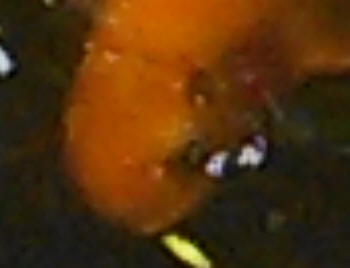
Hi I have a 200mm golden Orfe that has a bright red gill on the left side and a
distorted mouth it looks like there in no skin over the gill see pic any ideas
cheers Dave Beckett
<Either a genetic anomaly or resultant from a physical trauma. Both covered on
WWM.
Bob Fenner>
|
 |
|
Butterfly koi
lockjaw disease 7/17/2008I have had this butterfly koi
(golden). for over a year. I have a 4000 + gallon pond and added
some more butterfly koi about 3 months ago. The golden one was
kind of scrawny and never ate much until we bought other
butterfly koi and then it became quite the eater and aggressive
fish when it came to eating. <Mmm, Koi/carp (both Cyprinus
carpio) are social animals> today I came home and it has some
kind of lockjaw thing going on. <? A deformity... likely
genetic, ontogenetic> ugh. what do I need to do. I was going
to leave him in the pond over night and if he doesn't get any
better, <?> I was going to pull him out and look in his
mouth. I don't know if it ate too much food or sucked up a
rock or just what the heck happened. Help. Goldenboy is a
favorite. Thanks. Lenn R. Neal <Mmm, I would carefully net
this fish, see if a stone or such might be stuck in its mouth...
otherwise I'd do nothing... Is not "catching". Bob
Fenner>
Re: butterfly koi lockjaw disease -07/18/08 Hey
Bob... I did catch the fish with a net and put it in a separate
tank, we did look for a stone or any kind of obstruction while it
was in the net, but seen nothing of the sort, just tissue you
would see of the inside of it's mouth. <The jaw is likely
dislocated or broken. Sometimes happens with Koi and Goldfish,
supposedly because they inhale some gravel or similar solid
object. No idea if that's true or not, but in any even if the
jaw moves freely but the fish can't keep its mouth closed,
that's the problem. Some vets may be able to help relocate
dislocated jaws (telephone around for your nearest Koi
specialist) but otherwise this is very difficult to treat. The
problem is that fish jaws bones are incredibly delicate, far more
so than our very primitive solid jaws. As such, it is very
difficult for the non-specialist to "man handle" the
bones back into position, and on anything smaller than an adult
Koi practically impossible even for a vet. If the fish can't
feed, it will obviously starve to death, so this *is* a
life-threatening injury. It is also possible that the jaws are
surrounded by swollen tissue, and this is forcing the jaws open.
This is a luckier scenario, because prompt treatment with a broad
spectrum, systemic antibiotic such as Erythromycin can help
(e.g., Maracyn) by reducing the swelling and allowing the jaws to
get back into alignment. But this is quite an uncommon reason for
the symptoms you are describing, and would normally be present
along with other signs of bacterial infection, such as Finrot or
white, stringy faeces.> The next day after being in a separate
tank it's lips are turning a blackish color, and it's
basically just sitting at the bottom of the tank being mellow, I
have tried putting a few pieces of small food, but it isn't
interested, I have it in a tank with Mela Fix fish all purpose
medicine. <Melafix is completely useless in this situation,
and arguably useless is most others as well, so hardly an
"all purpose medicine" any more than a stiff shot of
whisky is for humans.> I don't know what else to do...
Thanks for Your Help Lenn <Call a vet. Your options for home
therapy are limited. Cheers, Neale.>
|
| Missing
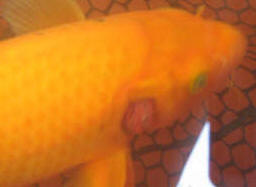
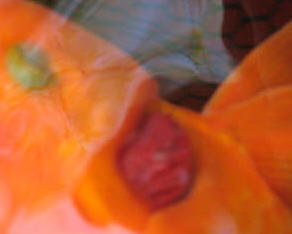
gill cover on Koi 7/6/08 We recently purchased a home (about 2
month ago) with a large pond 1600 gal that has both Koi and
goldfish. one of the smaller Koi 10" or so has a missing gill
cover. I don't know for sure when this happened I noticed the
red mark a couple a weeks ago. My question is what do we do, and
will the cover grow back or is the fish doomed? Currently he is
eating well, not being picked on by the other fish and doesn't
seem to be acting different from the other fish. To help you see
what I am talking about regarding the missing gill cover I am
attaching a few photo's. Also the water level are normal expect
the ph is 8 (I know high, but even with treatment we can't get
it to come down) and am afraid to change to fast since the other
fish seem fine. Per a suggestion at the pond store we have given
the fish a salt bath for 4 consecutive days. This did not seem to
impact him at all good or bad. Do you need any other information?
Thanks for you help Crystal <Hello Crystal. Sometimes fish are
born without opercula (gill covers). It is quite a common birth
defect among very inbred (and consequently genetically weak)
ornamental fish varieties, particularly things like Angelfish.
Opercula can also be lost following secondary infections or (more
likely with outdoor fish than aquarium fish) damage caused by
predators such as cats. In any case, opercula don't grow back
(so far as I know). On a healthy fish the operculum serves a number
of functions, and while not having opercula won't kill a fish,
it will be weakened to some extent. The delicate gill filaments are
more sensitive to mechanical damage, for example when you are
netting the fish. The opercula are also involved with ventilation,
so this fish will find breathing a bit more difficult than
otherwise. The main problem is really to ensure that any damaged
tissue heals completely before secondary infections can set in.
These sorts of wounds, if wound it is, can become septic or
fungused very quickly. Salt baths can help deal with keeping wounds
clean to some extent, but if the wound does become infected (i.e.,
you see necrotic (dead, white) tissue and threads of fungus) then
you will have to step up the treatment to something suitable for
such infections. Hope this helps, Neale.> <<This one looks
like it was excised... perhaps a jump against a very sharp edge?
RMF>> |
|
|
|
Onset of
crooked spine, pond, Koi 6/20/07 Dear Crew...
Helpppppppppp! <Helloooooooo....> I've tried the entire
day, phoning area vets to find answers as medical deformity in
seven year old pond Koi. We've had him since he was about
4" long... he is still the runt of the pond at approximately
16 - 18" long... the others are at least 2 feet long. He is
the size of our 5 year old Butterfly Koi. <Well, yes, sounds
like bad genes.> Yesterday, I thought "Shrimp"
looked a little curvy. I've been observing him since sundown
yesterday... he ate as usual... as well and as aggressive as the
other eight pond dwellers. I observed him at least two hours
today... he has a decided "kink" where his tail begins.
His swimming appears to be fine... appetite fine... but he
wasn't shaped like this three days ago. I've been on line
for the past 2-1/2 hours and getting nowhere. We had a storm
several nights ago with thunder and lightening... could he have
been struck? <Struck, yes. Still alive afterwards, no.>
What precautions should I take with medication, etc. I'm so
frustrated at NOT being able to get an answer. One website
suggested Vitamin B or C deficiency... another a mycobacterium...
please help. I have a friend who is a vet but knows nothing about
fish... nor does the nursery who sold them to us seven years ago.
Apparently no one in the area knows anything about Koi... only
how to sell them to you and provide food for them. We purchase
all our food and pond supplies through Drs. Foster and Smith out
of Wisconsin... and feed several kinds of food... three different
ones actually. <Yes, diet can cause deformities in fish. Just
as in humans. To be fair though such a problem with Koi carp
isn't common, because they are omnivorous fish and their are
so many brands of good quality Koi feed on the market.
Identifying particular vitamins is a bit of a waste of time; you
need to get them all correct. Standard Koi diet, mixed with some
greens from the kitchen should give a nice balance. The green
foods are often overlooked, but are critically important because
fresh foods contain vitamins that dried foods tend to lose
gradually after manufacture. A ratio of 50:50 pellets and greens
would seem about right to me. At the very least, keeping the pond
well stocked with edible aquatic plants, such as pondweed, is a
good thing to do, and by skipping some of their meals, you will
encourage them to eat these plants plus some algae.> Please
help me determine what to do for my little guy. <Likely bad
genes. Koi are intensively bred, and quality control is variable.
There's a reason Koi aficionados pay $1000s for top-quality
fish while your local pet store sells them for $10 a pop --
quality. With Koi (as with everything else) you get what you pay
for. This isn't to say "Shrimp" can't be a fun,
friendly pet, I'm sure he can. But you have to accept that
when you chose that fish, you pulled the short straw, so to
speak. He probably always had a kink in the tail, but it's
only now become obvious to you for whatever reason. Provided he
is otherwise healthy, and the water quality is good, and
you're giving the fish a nice balanced diet, then don't
worry about it.> I hope he isn't suffering. It is raining
now and they are all frolicking in the rain drops. That is what
they do when it rains. It seems the rain is their own private
little sprinkler system. Thank you, thank you, thank you.
<Sounds as if your fish are happy. Please, just enjoy your
fish, don't worry about the deformed one, and just love him
that little bit more because he's special.> Barbi <Good
luck, Neale>
Re:
onset of crooked spine 6/20/07 Neale... thank you for
your prompt reply regarding Shrimp. <No problems.> Usually
when at the pond, and am feeding, I observe that all are
eating... getting their share, make sure there are no bulging or
protruding eyes, nothing on gills that shouldn't be...
swimming... aggressive... etc. I can't believe that Shrimp
could have been crooked and I didn't notice it.
<Interesting.> Perhaps because it looks as if he is
experiencing a growth spurt... now it is more obvious.
<Certainly a viable hypothesis. Spine deformities are quite
common in fish (I have one peppered catfish with an alarmingly
twisted spine and had a baby halfbeak in a recent batch of fry
much the same. Doesn't cause any particular problems, but the
main thing is not to breed from them, so the faulty gene dies
out.> I think perhaps I was lax in more closely observing and
became complacent because we've never had a problem of any
kind. It also appears that the sides of his body are a little
darker. Or can it be my imagination... like humans who think they
have maladies that don't exist. <Without seeing the fish,
difficult to know. Fish do change colour for a variety of
reasons, some normal, others worrying. But provided the fish is
otherwise healthy, I'd tend to focus on
"observation" rather than "treatment".> Is
it possible to be just looking for any little thing that may have
changed? I'm becoming paranoid about him despite your
reassurances. <Hah! Nothing wrong in being careful, where
animals' lives are concerned.> Would you possibly e-mail
back if there is anything to the fact that he appears to be
darker on his sides than before. <The most common reason in
stress. Many fish can change colour to signal to other members of
the group they are, for example, not a threat, so please leave me
alone. But Koi don't do this (as far as I know) because
they're bred to have certain (artificial) colours. Now, they
can lose/gain colour over time. This is (again) where breeding
comes in -- people pay for show-quality Koi because the parents
and grandparents of that fish were known to have consistent,
quality colours throughout life. Generic Koi aren't backed up
by this sort of breeding. It's basically like buying a
pedigree cat versus a moggy. A pedigree cat will exhibit
behaviour and colour within very specific boundaries. A moggy is
a bit of a pot-luck because you don't know its ancestors --
sometimes you get something as beautiful as any show cat, other
times something a bit more ordinary (but still loveable, of
course).> I so appreciate your expertise and kindness in
replying. Your words have eased my mind somewhat... but still am
wondering. <It's good to worry. Look out for accessory
signs of infection: Finrot, mouth fungus, pox, lice, etc. that
Koi sometimes get. Koi Herpes Virus is another thing to be aware
of, and while it's a viral infection the signs are similar to
those of Finrot or some other bacterial infection -- blisters,
open sores, dead skin patches, and so on. But if your fish is
otherwise completely normal and happily swimming about doing his
thing, then there doesn't sound (to me) to be anything
alarmingly bad here. I hasten to add that this isn't to say
something isn't wrong, since I can't see this fish, and
if you're really worried, a trip to the vet may be in order.
Koi are large enough that treatment by vets is viable, and given
the cost of good Koi and how long they live, economically
worthwhile. There are also some excellent Koi books on the
market, any one of which could be a sound investment. I remember
petting a 20-year old giant Koi in a pond at a family
friend's house. Really nice animals, and definitely among the
very few fish that really seem to enjoy human company.> Shrimp
and his pond mates ate as usual last night... in the rain...
swimming back and forth in the reeds looking for remnants of
food. I will definitely begin the greens today... I always have
tons and tons of various types of green in the fridge for my two
guinea pigs. <This all sounds great. Greens help a lot,
including fish colours, because many of the chemicals used to
produce colours come from plant sources (such as carotenes).
Shellfish, especially prawns, are also very good for this. But
the flip side to prawns is their high Thiaminase content, a
chemical that breaks down vitamin B1, so great as a treat, not so
good as a staple.> Again, Neale, thank you so very much. Barbi
<No problems. And good luck. Neale>
Re:
onset of crooked spine, Koi hlth. 6/24/07
Neale... thanks again. Sorry it took several days to get back to
you but I was working. 48hours on 48 hours off... etc., etc. Bad
night last evening... a storage barn in a rural area supposedly
empty but there was a family of goats making their home there and
all made it except one baby. Two of us tried CPR... but his lungs
were just too small. Anyway... not allowed to do personal
e-mailing at work but can surf the web if there is time. I'm
still looking... you know... a mom's work is never done... no
matter what species her kidders may be. Do you think there is a
remote possibility that Shrimp may have TB? Again... I'm
obsessing!!!! And... if there is a chance of that, could it only
be him that is infected? Could I arbitrarily just treat the
entire pond with some kind of antibiotic? I have that time of
doctoring... but it seems that I apparently "can't do
nothing"? By the by, are you a Brit? I think the word moggy
gave you away. If so, I'll tell you about my fantastic
adventure and stay there, meeting the Queen Mom... Her
Majesty's Irish Guards, their Irish Wolfhound mascot, then
named Conor... etc. Again, Neale, thank you so very much for
coming to my rescue. Sorry to have gotten personal about your
ancestry... I'm just nosey... that's all. And... probably
the British are one of the few that don't hate Yanks... not
too, too much, that is!!!! Barbi <Hello Barbi! Sorry about the
goat. Anyway, I doubt shrimp can have TB. Fish TB is exceedingly
rare in freshwater fish -- it is only at all common in marine,
Perciform ("advanced") fish and hardly ever seen in
non-Perciform, freshwater fishes (carps, tetras, etc.) So the
chance of a your Koi getting TB is very small. There is a bigger
chance of things like Koi Pox and KHV (Koi Herpes Virus). But
neither of these matches the symptoms you are experiencing. Koi
Pox is rather distinctive, the external "warts" being
likened to melted wax. There's a picture here:
http://www.wetwebmedia.com/FWSubWebIndex/gldfshdisfaqs.htm . Now,
KHV is something again. It produces pretty generic symptoms,
unfortunately. You can only 100% identify the thing with a
biopsy, which a vet will do. There's a nice page at the
University of Florida that goes into KHV at some length, here:
http://edis.ifas.ufl.edu/VM113 . Treatment is unknown, and being
viral antibiotics won't do any good at all, but there is a
vaccine that your vet may be able to obtain. Realistically, it
isn't going to appear in a pond unless you introduce new
fish, so it tends to be more of an issue for people with mobile
livestock (e.g., retailers) than people who have mature,
established ponds. Both Pox and KHV are contagious. Yes, I'm
British, though my mother was American and I have lived in the US
for a while, which I enjoyed very much. And, as a rule, Brits
don't hate the Americans (though my mother used always to say
"no-one likes a rich uncle"). We aren't wild about
that stuff you call beer, and I personally think Hershey's
chocolate smells of vomit, but beyond that, I think the Brits
feel closer to the Americans than any other country. Cheers,
Neale.>
|
Goldfish
problems - Crooked Tail 11/5/07 Hey guys, <Hello Paul,> Sweet
website by the way, helped heaps. Problem is I have a goldfish that has
a crooked tail that only developed very recently. It is still eating
but it is lethargic and not swimming much at all. <Hmm... first do a
water quality test, just to make sure that's not a factor. Nine
times out of ten, when fish go off their food or show a lack of
activity, it's water quality at the root of the problem.> Rather
it prefers to spend most of its time just sitting round. At the moment
there are three fish that live in the outdoor pond, two are healthy and
young and are a cross-breed of a comet and a fantail but the sick one
is a pure comet. <OK.> There is a filter that runs into the pond
and we feed them fish flakes, the normal type you get from big W.
<Is this an abbreviation for a particular chain store or
something?> The main problem is, is that one of our former goldfish
also died the same way! <Ah, I see.> (The other 4 died from this
stupid black cat) <Obviously the cat wasn't at all stupid if it
managed to out-wit you and eat four of your pet fish. There are ways to
dissuade cats from fishing in your pond, as well as ways to make it
easier for the fish to avoid being eaten. Research them. Right now, of
the 7 fish I know about, the cat has eaten 4... not a very inspiring
track record!> It got a crooked tail became extremely lethargic and
eventually we had to let it go. <Goldfish tend to only go into
terminal decline if exposed to poor water quality month after month.
They're essentially tougher and more durable that any other fish in
the hobby. But they do need good water quality to thrive, and
appropriate water chemistry too. So check the nitrite at the very
least, and also make sure the pH is at or above 7.5.> The two fish
aren't related, so that discounts genetics. <Genetics tends not
to be an issue wild Goldfish anyway. The average fancy goldfish is a
complete train-wreck as far as "Good Genes" goes, and yet
they survive perfectly well.> All the fish received the same food,
so I thought that would discount vitamin deficiency. <Not
necessarily. Do review the articles on feeding Goldfish we have here.
Around 50% should be plant food, not flake. Algae, Elodea, spinach,
tinned peas, Sushi Nori, Spirulina flake food... whatever. Just not
plain vanilla flake. They're herbivores, and expecting them to
thrive on pre-packaged flake food is kind of like expecting a sheep to
do well on steak and eggs.> Also, the other two fish are fine, so
I'm guessing that rules out electric shock from the filter. <I
guess.> If you guys have any idea what it could be that would be
great. <Without more information on water quality and chemistry, the
size of the pond, what sort of filter you use it is difficult to say.
But from experience I'd be looking at water quality, water
chemistry, and diet as the three prime factors.> thanks, Paul
<Hope this helps, Neale>
Butterfly Koi characteristics Hi Mr. Fenner - <Judith>
I have a neighbor who has Koi in an outdoor pond. She is very
conscientious with all her critters. One of her butterfly Koi (named
"Ghost" as he is a whitish-gray and has some black markings
on him) has what look like little wavy fins in front of each eye. As
she had never noticed this before and noticing that he had a scrape on
his "forehead," she retrieved him from the pond and has him
in a tank in the garage (filtered, water changed, fed, with a door over
one end of this large holding tank so he has "privacy") and
she is treating the water with whatever the little cylindrical tablets
are. <Mmm, okay> Anyway, she wants to know if the little wavy
fins, eyelashes, whatever, are normal. If so, she will release him back
into his 40,000 gal pond with his buddies. She was concerned that maybe
he had a nostril infection or something. Seems the best fish expert in
our area is in the hospital! <If they are symmetrical (over both
eyes) I suspect they are "congenital" and not indication of a
parasitic condition. I would return this fish to the main pond. Bob
Fenner> Thanks for your help. I do bunny rescue so this is not at
all in my area! Judith
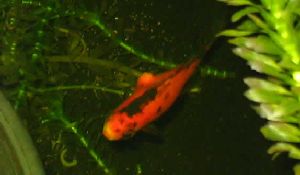
| Pondfish with Bulge on Side About 1-1/2
years ago I bought 4 small fish for my pond but because they were
too small to survive with the 18" - 24" Koi, I put them
in a lined whiskey barrel to grow for a while. <Okay> Last
fall after I moved some Anacharis from the pond to the barrel, one
of the fish developed a bulge on its side. I presume this is some
type of parasite but the link I tried to follow from the one of
your descriptions that matched best was broken. <I see>
I've attached a photo of the fish to help. For reference,
although the water is not changed regularly, the test results are
as follows: pH: Between 7.5 and 8.0 Nitrates: About 10 mg/l
Nitrites: Less than 0.1 mg/l Ammonia: 0 mg/l Salt: ~0 (I thought I
had added salt but apparently not) <All look good> I'd
like to cure the problem with this fish but the bigger problem is
my 3000 gal pond where I took the Anacharis from. Although I
don't see any fish with the same symptoms now, I had other
problems last year with some of the goldfish and one of the Koi.
That Koi had a round open sore about 3/4" across (like a ulcer
in the mouth) with a raised edge. Some of the goldfish had open
sores (irregular, not round) or white fluffy stuff like cotton over
red areas. <Very bad> I tried a number of medications (Ich
Out with Formalin, sulfa, and something else I can't find now)
but what helped the most was medicated food (with an antibiotic).
Thanks for any suggestions you can make. Larry Heine <The one
fish may actually just have a developmental or genetic disorder...
Not a parasite... If it were me, mine, I would Not treat the system
per se... If you have an aquarium, it might work to put the one
fish in, treat it with salt, keep it under observation. I take it
there is not a question of good nutrition. Bob
Fenner> |
|
|
|
|
Aquatic Gardens
Ponds,
Streams, Waterfalls & Fountains:
Volume 1. Design & Construction
Volume 2. Maintenance, Stocking, Examples
V. 1
Print and
eBook on Amazon
V. 2
Print and
eBook on Amazon
by Robert (Bob) Fenner |
|
|
|