|
FAQs on Pondfish Disease
Mysteries...
Related Articles: Koi/Pond Fish Disease,
Livestock
Treatment System, Gas Bubble
Disease/Emphysematosis, Pond
Parasite Control with DTHP, Hole in the Side Disease/Furunculosis,
Goldfish Disease,
Related FAQs: Pondfish
Disease 1, Pondfish Disease 2,
Pondfish Disease 3, Pondfish Disease 4, Pondfish Disease 5, Pondfish Disease 6, & FAQs on Pondfish
Disease: Prevention, Diagnosis, Environmental, Nutrition, Genetics, Social, Pathogenic, Medications/Treatments,
Goldfish
Disease,
|
Where, when in doubt... water
changes
|
 |
Aquatic Gardens
Ponds, Streams, Waterfalls & Fountains:
Volume 1. Design & Construction
Volume 2. Maintenance, Stocking, Examples
V. 1
Print and
eBook on Amazon
V. 2
Print and
eBook on Amazon
by Robert (Bob) Fenner |
 |
Pregnant pond comet? Using WWM
8/17/13
My comet seems to have been swollen since last summer. She wobbles when
she swims. Not sure if she is pregnant or something wrong with her. How
can I tell
<... could be full of eggs, egg-bound, a tumour, fatty degeneration due
to poor food/feeding... Search WWM w/ your string above and read. Bob
Fenner>
Pond... mortalities, reading
06/26/10
Hi
I have had a pond now for about 10 years and this year is the first
year I have ever had any problems (other than blue heron problems) with
it. I can't keep any fish alive. We live next to a lake and each
year I fill my pond with lake water and I seem to have really good luck
with it.
<Luck...>
This year my fish just keep dying. I usually just get feeder goldfish
because of the blue herons and I bring them inside for the winter,
keeping them for years. The only thing different from previous years is
I set a canna lily pot and an elephant ear pot in the water.
<What were these "potted" with?>
I have since removed them but the fish are still dropping off. Last
year I made a bog with a pitcher plant and it did very well and
didn't seem to affect the pond any. I'm now wondering if maybe
this is a problem also.
<Not the plant/s, but the soil perhaps>
The fish seem to get a whitish coating near the back fin before they
die.
I would like to know if I'm doing something wrong or have I just
been getting bad fish.
<Highly likely something is amiss with the system, not the
livestock>
I only get the cheap feeder fish
<These almost always have a plethora of health/parasite
issues>
as it gets to expensive buying better fish to feed the herons.
<You should read on WWM re guarding against such predators:
http://wetwebmedia.com/PondSubWebIndex/pdpestspreds.htm
and the linked FAQs file above>
The water in my pond also seems to be staying very clear which is
unusual. Every year it gets some green algae but not this year. The
weather is very unusual this year and I have been putting the clear
water down to the weather. I really enjoy watching the fish in my pond
and will be very disappointed if I can't keep any alive to
watch.
Any suggestions on what I might be doing wrong?
Thanks
Lillie
<Yes... read here: http://wetwebmedia.com/PondSubWebIndex/pdenvdisfaqs.htm
and all the linked files above. Bob Fenner>
Re: Pond... mortalities, reading
6/26/10
> Hi Bob,
<N>
> I did see the pond question earlier today, but left if you to
answer since the problem wasn't obvious to me.
<Nor I>
> However, one thing that did catch my eye was the bit about pitcher
plants. Growing carnivorous plants is a hobby of mine, and one thing
true about them is they're bad choices for ponds. They invariably
need acidic, mineral-free water to grow; lime causes damage to their
roots, and eventually death. So if the pitcher plants are thriving in
the same water basin as the pond, then alarm bells should be ringing --
anything soft and acidic enough for Sarracenia spp. North American
pitchers would be lethal to Eurasian pond fish. Conversely, if the pond
was alkaline enough for the fish, any pitcher plants used as marginals
would be dead by now.
<Will accrue your input>
> So at the very least, employment of a pH test kit would be very
useful.
> Cheers, Neale
<Thank you, B>
Police report filed after several fish die at
local Koi competition -- 01/13/2010
http://sg.news.yahoo.com/cna/20100113/tap-434-koi-police-report-filed-die-loca-231650b.html
Geez, I hope this wasn't foul play. BobF
Re: Police report filed after several fish
die at local Koi competition 01/17/10
Yes, most likely foul play. Contestants of past contests have
complained about fins and tails of their prized Koi sipped off. The
pressure to win is intense.
Perry
<Yeeikes! And ridiculous. BobF>
|
White warts over Koi 12/18/08
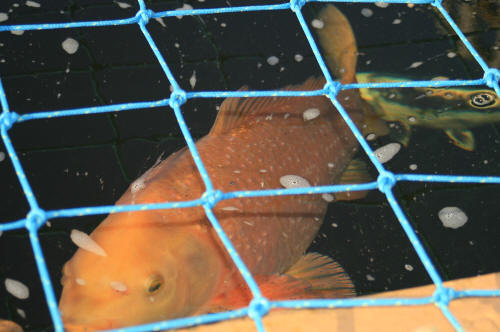
Greetings, <Salutations> I enclose a picture of a chagoi
that has not been great all year. I was finding odd feces
floating in the pond- white mucoid, very large and jelly like,
sometimes slimy. I had numerous scrapes of fish taken,
microscopic examination of feces done- nothing discovered.
<Mmm; too small for light microscopy...> As winter
approached, the fish developed white spots, large and cyst like
all over the body (not the fins). The fish has acted strangely at
times by holding its head out of the water in the inlet (this is
a 20 inch fish). No other fish appear to have these symptoms or
spots. The fish has not flashed, sulked or looked otherwise
irritated. The water is currently at 4-5 degrees, holding very
steady. I have many contacts here in the UK, none of which can
explain these growths. The white spots are very raised-
resembling zits, and are around 2mm big. The water quality is,
and always has been immaculate. Testing regularly. I have kept
Koi for many years- this is new to me. Many thanks for any help..
(I have kept the photo at full size, so that you can zoom in and
see the detail of the spots) Julian. <I do wonder that this
might be a case of Spring Viremia... Do please insert this term
in your search tool... much written re its pathology, due to
occurrence amongst economically important food cyprinid species.
Bob Fenner>
|
 |
one-sided bloat... Pond goldfish... need
data 7/8/08 Clear Day Hello, <Overcast here
howdy> I am writing about a pond goldfish. I searched the site first
and read about fish bladder problems, but in this case the goldfish is
bloated on one side, <Not from the gas bladder... perhaps a tumour,
maybe ovarian activity...> does not have signs of dropsy, has no
overt injuries, missing scales, ulcers, etc. It is able to swim but
lists to the 'flat' side. Appetite is good. I first thought it
was carrying eggs, but does not seem to be the case. <There goes one
part of my guess> This happened last summer to another goldfish,
that survived for many months in this condition before succumbing. The
PH, nitrates, nitrites etc, are within normal range. <Values
please> It is a very healthy pond, and the other fish are
unaffected. Thank you for your quick response, as I would like to help
this fish survive. Laurie Kross <Need to know the make-up of the
pond, water quality tests, maintenance procedures, foods/feeding...
Please read here:
http://wetwebmedia.com/PondSubWebIndex/Pond%20Sub%20Web.htm the section
on Pondfish Disease. Bob Fenner>
|
Koi are dying left and right - please help! Hello -
<Hi! Sabrina with you today> I have had my 500
gallon pond for 2 years and have never had a
problem. All of a sudden, last week my Koi have been
dying one by one. I found another 3 dead this morning
-- two 12" butterfly and a 10" regular domestic
Koi. This makes 5 dead Koi since last
week. <How many fish are there/were there
altogether?> I have examined the fish and have found nothing
wrong. For a few days they appear lethargic,
anti-social, and do not eat --- then the third day they
die. I have not introduced any new Koi in to my pond
lately. I do regular water changes -- about 20% once a
month. <Depending on your fish load, this may not
be enough (or it may be just right). Have you tested
your water lately? Check your pH, ammonia and nitrite
right away, see if any of those values are outta whack, it sounds
like this might be water-related> They only thing I could
think of is all the rain we have been getting in NE Ohio
recently. <Possible. That might affect
pH, and too huge a pH change might cause the fish harm - but
that's a real stab in the dark. Has anything else
changed? Feeding regime/type of food, water
conditioner, anything?> I'm lost. I'm
sad. I'm frustrated. I'm
confused. Did I say sad? <I'm
sorry :( > My local pet shops don't have a
clue. Please give me any help you can. One
more thing -- my Shubunkins, Sarasas, and goldfish are doing fine
-- why is this? <IME, Koi are a little more
sensitive than goldfish. Whatever's affecting the
Koi probably is affecting the goldfish too, but to a lesser
degree. Check your water parameters, and fix if
necessary. Best of luck to you!> Thanks -
<You're welcome> John
Koi are dying left and right - please
help! (Part 2) Hello again - <Hello again,
John!> Thanks for the fast response. I just went
out to my pond to check on my fish and I lost two more
Koi. <Sorry to hear that.... :( > However, all
the other Koi that have died showed no physical signs of
illness. But the one of the two Koi that just died had
a white fungus on it. It was quite
severe. Why would this fish have a fungus and the
others show no signs of fungus? <Could be that
there's something else at play as well, that's not as
easily seen, and this fish, weakened but still alive, ended up
contracting the fungus where the others just hadn't yet?>
And why would this fish die after the others if it's in worse
physical condition? <He may have just been a stronger fish
overall, and the fungus finally did him in> To answer your
questions . . . I had five 10-12" Koi three 4" Koi four
4" Shubunkins maybe 20 goldfish (all small) and two Sarasa
(about 4") <This really seems a bit much to me, for a
500g pond. Illnesses can spread like wildfire in high
stocking densities, and fish waste can build up rather quickly,
worsening environmental conditions> (again, all my fish that
are not Koi are still alive. I down to two Koi)
I've now lost 6 Koi within 24 hours. <I suggest you catch
a few, one at a time, and take a close look at them in a clear
container. Look for the fungus that you saw, and
anything else amiss; look especially for white stringy feces, as
perhaps you're dealing with something internal, which may
explain why the fish have looked more or less undamaged
externally. Check the color of their gills, their rate
of breathing. It might be a good idea to try treating
with MelaFix, as it does have antibiotic properties; I'm
really not convinced as to its effectiveness, but I've used
it in conjunction with other things and gotten
results. might be worth a shot, if we can't figure
out what's ailing them (aside from the fungus).> Ammonia
and Ph levels are testing out fine. However,
my water hardness is on the high side. <I assume
you mean ammonia is zero? I don't think I'd be
terribly concerned about the hardness, unless it's WAY off
from the norm, or has been changing dramatically. Do
check your nitrites/nitrates, though, and see where they're
sitting. Also, the next time you get a chance, you
might think about collecting/testing the rainwater and see what
that is as compared to the water in the pond and from your tap,
or whatever source you use for water changes. Another
long shot, how often do you check your filtration
system? Perhaps that's gotten out of whack
somehow, or gotten really gunky? Have you used any
gardening chemicals/weed killers/anything else like that that may
have gotten into the pond with all the rain you've been
getting? Any next-door neighbors uphill from the pond
that might have done so?>
Re: Koi are dying left and right
- please help! Thanks again for your prompt
help. I had no deaths so far today (but then again I
don't have many fish left). We did look at the
gills of some of the dead Koi last night and they looked nice and
pink. No parasites. Also, to answer your
question, the nitrates are checking out fine. I also
pulled out some of the fish as you requested with a net and
examined them and found no noticeable defects or parasites. My
filtration system is clean as I'm religious about my weekly
cleanings. No gardening or insect chemicals have been
sprayed around or near the pond that I know
of. I have purchased some MelaFix and added it
this morning. Is there any other recommendations for
medications that you may have? Also, if I'm
unlucky enough to have another death and end up dissecting it
what should I be looking for? Thanks again.
<Reading over this correspondence brings back bad memories of
years past when we had service accounts that suffered similar
sudden "anomalous" losses of pond fish. I want to add
an emphasis on having some of the dead fish checked for pesticide
residue... a spray truck (usually for wood termites... in the
ground or structures) can account for this sort of wipe out...
and be a few blocks away. Bob Fenner>
Koi are dying left and right - please help! (continued)
A pond shop in Akron might know what the problem
is. As you suggested, it's more than likely a
parasitic problem. I didn't mention in
my previous e-mails that my pond is located in the shade
surrounded by several trees and a bird feeder. The
pond shop thinks that parasites may have entered the pond via
bird droppings. <Yes, this is possible, especially
if you have birds coming that visit local ponds, streams, rivers,
etc. - glad the store could help you, and I hope you've
located the problem at last!> I have since relocated by bird
bath and feeders to the opposite side of the yard.
<Great. This may help prevent
recurrences of the same problem (if, in fact, the birds did bring
something with them), but do understand that it's impossible
to eliminate the threat altogether; birds come to ponds, and the
most we can do is be vigilant and keep an eye open for anything
wrong, as you have been doing. Although I've no
direct experience with birds bringing in parasites (thank
goodness!!), I have heard of similar cases.> I have purchased
parasitic treatment and I hope my pond is on it's way to
recovery. <Excellent - but please do
not discount the possibility of pest control
poisons. Keep your eyes open, and see how the fish
respond to the treatment. With all due luck,
you've found the problem.> I have two more sick Koi that
appear lethargic. I hope they make it.
<Our fingers are crossed!> Thanks for all your help --
seriously. I can't believe that there
are people out there that care for the Koi of
strangers. It's nice to know that people like you
exist out there. Thanks! <And thank you for the kind
words! -Sabrina> John Trafan
|
Mysterious Death Hello, <Hi.> Im
thoroughly confused. <Me too, a great deal of the
time. This condition can often be easily combated with books
and other resources concerning the topic(s) which confuse
you. Oh. Wait. There's more to
this, isn't there? Something fishy, perhaps?> I have
just found a dead goldfish floating in my pond. <Sorry
to hear that.> The pond is about 12ftx20ftx3ft deep (at its deepest
point) and has been established for about 5 years (2 comets, 4
goldfish, 5 Rudd <I had to look "Rudd" up; I've never
heard this common name, nor seen pictures of this Eurasian
cyprinid. Cool looking fish.> and numerous sticklebacks).
<Sounds good, so far.> The fish is about 4 years old and is
approx 6 inches long and appears in perfect health all the fins are
intact and the colour is fine <Sounds excellent, minus the bit about
being dead.> I thought it was just resting but it was on a slightly
strange angle (maybe dead for an hour or so at most I think) and the
fish is a good weight and size and has no outward signs of disease or
parasites or damage etc. The temperature is probably btwn 2-6 degrees
Celsius and there has been no ice on the pond for a few weeks now
(I'm in the UK) It is the first fish I have lost from the pond
(apart from the odd stickleback every few months at worst) <First
thing to check is water parameters - find out where you're sitting
for pH, ammonia, nitrite, and nitrate. It would also be a
good idea to check your oxygen level. Another point to
consider, are you feeding the fish? At these cold temperatures, the
fish cannot benefit from the food, and it really only contributes to
waste buildup, which can cause ammonia, nitrite, and nitrate to rise to
perhaps toxic levels.> I am a relatively experienced fishkeeper (6
years tropical/coldwater) and I just dont get it? Do you
have any idea what could have caused this? <In all honesty, this may
be a completely unsolvable mystery. It is entirely possible
that the animal died of something unexpected and sudden, just as other
animals and people sometimes do. Dissection may shed some
light on what did him in, but other than that.... Test your
parameters, rectify if necessary, and don't lose too much sleep
over it, at least. Everything sounds good otherwise,
really.> Many thanks, Paul Newman <Any relation to....
no. No, I am *not* going to ask that. I get
enough "teenage witch" comments, I can understand where
you'd go nuts if I asked you that, so I'll
refrain. Wishing you and your pond
well, -Sabrina, neither teenage, nor a witch>
It's Not Easy, Bein'
Green.... 06/20/2004 Hi, <Hello.> I have a large
outdoor pond (1400 gal). Two of my goldfish developed a
green fungus on the skin on both sides of their bodies. <Wow, now
*that's* something wholly unfamiliar to me.> One died, the other
just developed the same symptom. Do you have any idea what
it is? <'Fraid not.... I'll be
hitting the books, though, and see if I can find
anything. Meanwhile, if you could please respond with
ammonia, nitrite, nitrate, and pH readings, that may be of
help. Also, any other symptoms the fish may exhibit -
lethargy, clamping of fins, any marks or discoloration (besides the
green), perhaps also describe the green fungus in a bit more detail
(fluffy, stringy, grainy, bright green, dark green....)> How to cure
it? <Sorry I'm not of the greatest help, at the
moment. Please do respond, though, and know that I'm
trying to find any info on the situation as you describe.> Thanks
for the help. <Hoping to be of better
service, -Sabrina> <<Likely env. at base...
RMF>>
Koi with sudden Curvature Of The
Spine? Hello, thank you for running this awesome
site. One of my Koi, 11 months old, about 7 inches long
(approx 1 inch less than others his age) and while they appear to be
maybe overweight, is in good shape but not as heavy. He/she
is an orange and white Kohaku and I have often thought in the last
month or more that it had developed a slight kink where the body meets
the tail itself. <Not good... thank you for the useful info.
above... such twisting/kinking is likely genetic here... though can be
infectious (e.g. Myxosoma), nutritional in origin> All Koi are
growing like crazy, eating out of my hand, surfacing to allow me to pet
their heads, except this one? Now today I noticed that it is bending
its back third of its body most of the time making it swim crooked and
unbalanced. In fact with its body straight while motionless,
it lists to one side and stops the listing by suddenly kinking the last
third of its body (approx. from the rectum back?) It seems quite
bad? So my questions are: If it was normal at
birth, why is it now developing a Curvature of the Spine or whatever is
happening? I switched to a higher protein food in the last
month or two. They are fed some Wardley's Pellets and
Wardley's Tubifex Worms, some Nutrafin Spirulina Algae Flake Food
and some Hikari Gold Pellets. Averaging out the protein
comes to 40%. <Mmm... I would offer "regular" Koi food
prep. (pelleted) foods... better nutrition and MUCH less expensive.>
Water temperature is consistent at 68.5 degrees
Fahrenheit. I vacuum off 20% of the water daily, removing
all traces of debris on bottom of tank. <This much protein is
"okay" at this temperature, but it would be better for your
Koi to eat less protein percentage... like twenty percent maximum, and
grow more slowly... will live longer, healthier lives...> My well
water straight from the well has a pH of 7.0 High range pH
of 7.4 Nitrate 10 and Ammonia between 0 and -.25 as so hard
to decide on the color graph with my Master Test Kit on that
Ammonia? Well water is tested safe for Human Consumption
every year. <Then it is fine, I assure you> Tank is consistent at
pH 7.6 High Range pH at approx 8 Nitrite is
always 0 Nitrate around 80+ And that Ammonia
comes in around -.25??? Just don't know, MAYBE it is 0 but the
color test strip makes me suspect from yellow (0) and kind of a
yellow/lime colored (.25)??? <A good idea to store, aerate new water
ahead of use... like in a covered plastic trash can, for a week> Bio
filter is cleaned every 14 days. Foams, pads and carbon is
cleaned, bio stars and rings are not flushed with tank water more than
every 2nd or third cleaning? <Ah, you've been studying!> Tank
is a 200 gallon galvanized aluminum stock tank. <Mmm, hope it's
"old"... the galvanization, aluminum can be toxic> Also
Aquarium salt is kept at less than 1/2 recommended amount
for freshwater aquariums. 4 growing Koi and 2 tiny Comet
Goldfish. Water is added back each day after vacuuming as close to 68.5
degrees as possible, rarely out more than .5 degrees. Any chance you
can explain to me what is happening with this Kohaku? I am
thinking it might just be Genetic but certainly don't want it to
start happening with my other 3 babies who are more excellent
quality. Thank you kindly, Gayle <Ahh, we concur re the
cause here. I would just enjoy this specimen... it may survive for
years... Not a contagion at play here. Bob Fenner>
Help!! Koi problem! Hi, <Hello> We are
having a problem with our Koi and I can't find a similar
problem/answer anywhere. Hope you have and idea. <Let's see>
(first a bit of background) My daughter was lucky (?) enough to win a
"goldfish" at her school carnival about a year and a half
ago. <Like giving away "the first pack of Pall Malls..."
this is how many of us "got started" in this wonderful
interest/hobby> (Figured he/she was a feeder fish a wasn't
really thinking he'd last too long) Started him/her out in in small
tank ( 2 Gal). Fishy got bigger. We moved him to a bit larger tank (5
Gal). Fishy got bigger. Ok... notice a pattern? We have since moved
Fishy to a 10 Gal. tank and he's still getting bigger (about 9-10
inches). So, we have made plans to excavate in the backyard and install
a pond. (as you may a have surmised, Fishy the goldfish is actually
fishy the Koi! ) <I see... unusual... usually are comet goldfish
that are given away> The problem is this, Fishy has always had a
nasty habit of snacking on the gravel in the tank. To curb this, we
changed to a larger sized gravel (more like stones). This took care of
the problem for a bit. Now, as Fishy has grown, so has the size of his
mouth. The bigger rocks are no problem now. Usually, in the past, he
has managed to either "pass" or regurgitate the
gravel/rocks. Currently, he doesn't seem to be able to do
either AND his tummy area is looking quite large. He doesn't seem
interested in food....very odd for him and seems to hover (head
down/tail up) in the tank much of the time. Is there anything that can
be done? I've taken all the gravel/rocks put of the tank but,
I'm worried that this time he's eaten way more than he can take
care of on his own. <I strongly suspect your fish is either
"just fat" or "full of eggs", but in case it has
swallowed rocks, I would add the equivalent (you may want to move the
fish into smaller quarters) of a level teaspoon of Epsom Salt per ten
gallons of water...> Any help you can provide would be appreciated.
Kathy <The Epsom is safe, and should help dislodge whatever the
cause is here... Please do read here: http://www.wetwebmedia.com/PondSubWebIndex/pdfishfeeding.htm
re pond foods, feeding... in case the cause is actually nutritional.
Bob Fenner>
Egg-bound pond goldfish Hi: We have a white
goldfish that we've had for more than 10 years - in a small outdoor
pond. She is very large (with eggs, we think), but has been this way
for more than one week. There are only three other fish in this pond -
two are from her and the other was purchased with her (also 10 years.)
Anything we can do to assist her to release the eggs. She is moving
very slowly and we are worried about her. <You might try adding
Epsom Salt to the system water... the equivalent of a level teaspoon
per about ten gallons of system water> In the past, the other white
fish would "chase" her, but, this does not seem to be
happening this year. S. Robison <Bob Fenner>
Pond injuries, disease We have a 700 gallon
backyard pond with waterfalls, plants and 15 fish. The pond is well
established, about 6 yrs old and we've added salt and test the
water etc. Seems fine. I have 2 questions. 1) Fish periodically get
sucked into the skimmer basket... <Do fashion a screen over the
front of this> ...and are usually fine when taken out and put back
in the pond. We have one fish that was hiding for about 2 days and I
finally found it and it seems to be swimming like a rolling barrel and
then resting on the bottom. Should we euthanize this fish? <I would
wait, see if it "straightens out"> 2) Another fish is
acting normal and swimming around with the others but I see what looks
like a couple of algae (green) threads drifting up off of 2 tiny spots
on the back near the top fin. I can't find anything about this. Is
this something to worry about? It's a new one on me. The rest of
the fish look fine and healthy. <Net the fish out and examine this
area carefully... this may be a crustacean disease... remove with
tweezers, and daub with Mercurochrome, Merthiolate or
|
|
Aquatic Gardens
Ponds, Streams, Waterfalls & Fountains:
Volume 1. Design & Construction
Volume 2. Maintenance, Stocking, Examples
V. 1
Print and
eBook on Amazon
V. 2
Print and
eBook on Amazon
by Robert (Bob) Fenner |
|
|
|