|
FAQs on Pondfish Nutritional
Disease
Related Articles: Koi/Pond Fish Disease, Livestock Treatment System,
Gas Bubble Disease/Emphysematosis,
Pond Parasite Control with DTHP,
Hole in the Side
Disease/Furunculosis, Goldfish
Disease,
Related FAQs: Pondfish Disease 1, Pondfish Disease
2, Pondfish Disease 3, Pondfish Disease 4, Pondfish Disease 5, Pondfish Disease 6, & FAQs on Pondfish
Disease: Prevention, Diagnosis, Environmental, Genetics, Social, Pathogenic, Mysteries, Medications/Treatments,
Goldfish
Disease,
|
Pay attention to the types (particularly protein
concentration) and amounts of foods fed per
season/temperature.
|
 |
Aquatic Gardens
Ponds,
Streams, Waterfalls & Fountains:
Volume 1. Design & Construction
Volume 2. Maintenance, Stocking, Examples
V. 1
Print and
eBook on Amazon
V. 2
Print and
eBook on Amazon
by Robert (Bob) Fenner |
 |
Multiple Bloated Goldfish 4/5/11
Hi there Bob/Sabrina/WWM Crew in general!
I am helping a neighbor of mine with an issue of multiple goldfish who
are bloated.
They are in an outdoor pond, approximately 300 gallons.
I am unsure as to how large the pump is, but I am sure that it could
have a better filtration system. It is a submersed box filter with
sponges that is run to a fountain. There are 5 Veiltails, 2 Comets, and
1 Koi. The Koi is unaffected so far, as he was a gift from a friend who
had to move. The veils and comets are the only fish who seem to be
affected. I have read through your site extensively and it seems to be
constipation, but from what I can find on your site this issue is in
the case of one fish. I am dealing with
multiple fish with the same issue. The reason I believe it is
constipation is the HIGH (47%) protein food
<Yikes>
he has been using for who knows how long. But would this affect all of
his fish? Or is it some other type of infection?
<It's almost assuredly the food>
I am considering an Epsom salt/water change treatment regimen along
with a change to a diet that is lower in protein and higher in fiber.
(I keep aquariums, and I have generally found that less is more.) How
often should I change a portion of the water, and how much should I
change each time?
<I'd change a good quarter a week>
I was thinking every 3 to 4 days, about 50 percent changed each
time.
<Mmm, IF you can trust the source water, this should be fine>
I was going to do this for 3 to 4 weeks to see if there was any
improvement. If this does not work, I have also read that Kanamycin in
their food might be the next best route,
<I'd leave off with antibiotics here>
which, from what I have read and what my local fish store recommended,
seems to be the best follow-up in the case the salt treatment is
ineffective. Please let me know if you need any more information to
help
get these guys back into shape, or whatever else you think the
problem(s) might be.
Thank you for your time and help! We really appreciate it!
Mitchell
<The better, more appropriate food (perhaps some Anacharis/Egeria
added to the system for a few reasons), and water changes, time going
by will "do it" here. Bob Fenner>
Floaty goldfish (RMF, other thoughts on this?)
11/16/09
Hello crew, I have three large red cap Orandas. They live in a 200
gallon outdoor pond which is heated in the winter,
<<? How, and thermostatically? To what temperature?
RMF>>
and always has a supply of duck weed, hyacinths, and water lettuce. I
also feed cooked peas and shrimp.
The largest and oldest, about 7 years, is now floating upside down. All
I have read the prognosis doesn't sound. Did a partial water
change, and if I cup her in my hands and she will gobble up her peas,
but, if I don't hold her, she can't eat. Can't be any fun
living "upside down." but I don't have the heart to end
it for her. I do have a neighbor who says she will put her in the
freezer. Any other advice is greatly appreciated.
Every day I am amazed that she is still alive, and that she can still
struggle to swim down, but she pops right back up. thank you in advance
for your attention. P. O'Donovan
<I assume you've read this article, and performed the Epsom
salt/cooked peas treatment?
http://www.wetwebmedia.com/FWsubwebindex/gldfshmalnut.htm
If not, that's the first step. Yes, it's true that Fancy
Goldfish by their very nature are prone to swim bladder problems, or
more specifically, because of their skeletal deformities, slight
problems can cause them to lose balance. But if the fish is happily
feeding, the problem is unlikely to be a serious problem in the sense
of a bacterial infection, though treating in a hospital tank with an
antibiotic would be well worthwhile, just in case. One last thing:
putting a fish in a freezer is not humane. In fact it's cruel. The
idea the fish "goes to sleep" slowly is a myth.
Instead ice crystals form inside its fins, bursting the cells,
presumably causing whatever the fish equivalent of pain and stress
might be. There are humane ways to destroy fish, and the easiest is
probably to use an overdose of Clove Oil. I find about 50 drops/litre
does the trick. Do read here:
http://www.wetwebmedia.com/euthanasia.htm
Cheers, Neale.>
<<I suspect this floating issue is the result of foods/feeding
and the genetic predisposition to such problems as Neale mentions. I
would move this fish indoors, and feed very little of very low protein
food for a few months. BobF>>
Re: More re: Floaty goldfish (RMF, other thoughts on
this?) -- 11/16/2009
a few more questions please. If I move her indoors, at what temp should
I keep the tank ?
<Low 70's, and with a heater set to that point. Do monitor for
ammonia, nitrite, nitrate>
I did do one Epsom salt treatment, for the life of me I could not find
the ratio of ES to water, used a tsp to a gallon.
<About right>
I read that this was very stressful to the fish,
<Mmm, not so>
so when I did not work the first time, I did not do it again...it's
beginning to get cold in No. Cal. and her belly is always exposed to
the cold, is it better for her to be cooler or warmer.
<... fancy goldfish (all other breeds than comets and Shubunkins) do
best at/near "room temperatures">
The outdoor pond is heated with regular aquarium submersible heaters to
about 60 degrees.
<Too low>
Her two tank mates are quite happy but, this problem did start when I
started feeding more protein, ie: shrimp every few days,
<Very common... did you read where you were referred?>
when I usually did not feed them much at all. Their main diet was
primarily plant roots. Thank you for the quick response.
<Welcome. Bob Fenner>
Swim Bladder Disease in Koi
Hi,
<Hello Don,>
I have a rather large Koi...approximately 18 inches long, and around 4
pounds in weight.
<Good size.>
He appears to have swim bladder disease and can use some help. I have
read several articles about this over the past 4-5 days and still
remain confused about what I can do to try and bring him out of
this.
<Hmm... do understand that most swim bladder disorders (I don't
like the word "disease" in this context) are more to do with
other issues, particularly constipation. See here:
http://www.wetwebmedia.com/FWsubwebindex/gldfshmalnut.htm
>
He began irregular swimming about 5-6 days ago. I live in an area where
the outside temperature has been fluctuating ranging from moderately
cool nights 40's and 50's to warmer daytime temps in the
50's to low 70's.
<Take care not feed these fish while it's cold; here in England
at least, Koi aren't fed between late October and the beginning of
March.
Temperatures below 10 C (about 50 F) prevent their digestive systems
from working properly, and any food in the gut rots and promotes the
growth of bacteria.>
My pond has been established for 8 years, and I have never lost a
fish.
<Great!>
The other 5 fish in the pond are smaller, no larger than 9-10 inches in
length and no more than 1 pound in weight. None of the smaller fish are
experiencing any problems.
<May be a clue... bigger fish eat more, have longer digestive
tracts, are perhaps more sensitive to water temperature/digestion
issues?>
On the warmer days, I have lightly fed the fish (a high quality Koi
staple food), but not on a daily basis.
<Good.>
Over the past few days, the evening temps have fallen into the high
30's, but still warming during the daytime into the 60's on
occasion.
<Much too cold for feeding.>
With the exception of an elevated Ph level, all water conditions are
excellent. I have slowly reduced the Ph level to normal about 6.4.
<That's actually pretty low for carp. A neutral to basic pH is
optimal; aim for 7.5.>
I have also been treating the pond with Tetra Pond Treatment which
contains Quinine Hydrochloride.
<Do be careful not to use a "scattergun" approach:
medications are poisons, and if used without reason, can end up causing
even more problems. Always identify the problem first, and then
medicate. Medicating first, and hoping that cures something tends not
to be a viable approach.>
I am not sure that my Koi is not simply constipated or really does have
swim bladder disease, and I realize from reading it isn't always
easy to distinguish one from the other.
<Quite so; but if the fish is defecating (easiest seen in a holding
tank) then constipation is unlikely.>
My fish has a swollen abdomen, and there are some slight areas of blood
streaks on the swollen area, and also on one dorsal fin.
<Ah, I see. Again, cold can cause problems, especially if you have
any water features running (these cool the water further). Frost damage
in the fins leads to inflammation and eventually Finrot-type
infections.>
He remains mostly laying on his side and does not move much at all.
<Yikes!>
He has not been feed for the last 5 days, and I have to tried to get
him to eat any peas, which I understand could relieve the constipation,
if that is the problem.
<Do also add Epsom salt to the water, as indicated in the above
article and associated FAQ. Epsom salt relaxes the muscles, allowing
blockages to pass out more easily. Possibly easier to do if the fish
can be moved to an aquarium or holding tank.>
Is there a water treatment I can try that may kill a bacteria
infection, if that is what is causing the problem.
<Generally, adding antibiotics to ponds isn't practical or
especially effective. There's just too much "ecology"
going on there for such drugs to work. Antibiotic foods can be better,
since they're going into the fish, but for things as big (and as
valuable!) as Koi you need a vet to comment on this. He/she will either
calculate the appropriate food dosage, or else inject the fish
directly. If there is one fish on the planet that veterinarian science
has a good handle on, it's the Koi, so finding a vet able to do
this shouldn't be too hard.>
Something that I can use in the pond along with the other fish?? I do
not have a hospital tank (but could set up something if it may help).
Also, with a hospital tank, how much trouble will this cause give the
change in water temp.
<Don't expose the fish to massive temperature changes, but by
all means fill the tank with water from the pond, and let it warm up
slowly as needs be.>
The pond water temp has to be around the mid to high 40's or low
50's at this point, and I don't want to traumatize the fish
with a large temp change to warmer water.
<Indeed.>
Any assistance you can give me with this would be greatly appreciated,
as I do not want to lose my prize Koi.
<I bet. These are lovely fish, and worth going the extra mile
for.>
Thanks
Don
<Cheers, Neale.>
Re: Swim Bladder Disease in Koi (RMF?)<<You're
spot on>> - 11/07/09
Neale,
<Don,>
Thanks so much for the reply.
<My pleasure.>
I agree that "disorder" is a better term when talking about
swim bladder issues. Your comments have caused me to think more about
my Koi's problem.
<Very good.>
I realize there are a number is things that can cause the swim bladder
to malfunction, such as constipation, a tumor, a bacterial infection,
injury, genetic defect, just to name the most obvious.
<Indeed. A vet can narrow these down some more, but from my vantage
point on the other side of the Atlantic from you, the best I can do is
mention some of the possibilities.>
I have to some degree examined my Koi's abdomen and it feels
pliable, no hard spots that may indicate some sort of injury or
tumor.
<That's good to know.>
I believe I am ruling out a bacterial infection, since the other fish
in the pond show no signs of any issues.
<Hmm... would be careful about this. Genetic variation in fish, as
in humans, does affect predisposition to disease.>
Unless the large one's immune system was somehow depleted, I would
think if it is bacterial, viral, or some other organism causing the
problem, the other fish would also be effected.
<Perhaps. Broadly, yes, it's true that if water quality was bad,
several fish would show signs of a suppressed immune system (e.g.,
Finrot). But this doesn't have to be the case.>
I have also looked at some different pictures of examples of
Dropsy....and my Koi doesn't look like any that I have seen. There
is no overall swelling of the body, and only a very few scales that are
slightly protruding on his abdomen where the swelling is located, but
not to any degree it gives the appearance of Dropsy.
<This is also good news. Dropsy tends to be difficult to treat,
since by the time it appears (it's a symptom rather than a disease)
whatever disease is at work has progressed a very long way. Again, vets
can help, particularly where Koi are concerned since they're big
enough to treat. But even with Koi, the prognosis is mixed, at
best.>
This brings me back to the constipation, and since I had given then
food during more colder weather than I normally do (on those warm days)
when they were swimming around giving me that look like, don't just
stand there give us a bite to eat!!
<Resist! Or at least, provide high-fibre foods that'll get
shifted through the gut quickly. Plant material is the obvious thing,
and a clump of Elodea thrown into the pond would make a find snack for
them.>
If I create a hospital tank using the colder pond water...would it be
ok to bring in side and allow to warm to room temp?
<Yes, this is fine. Do put the tank somewhere cold though, like a
garage, shed or basement. Or even an unheated spare bedroom (which is
where, funnily enough, I overwinter my carnivorous plants that, like
Koi, need a cool winter).>
Or should I be more gradual than that?
<The more gradual the better, but don't get paranoid about this.
Provided filtration and if necessary aeration are adequate to the size
of the fish and the aquarium being used, Koi handle this sort of thing
just fine.>
I will have to figure something out as far as filtration and
circulation....and I think I have enough resources to get the proper
amount of Epsom salt in the water.
<You certainly can add Epsom salt to ponds, but you'd need an
awful lot, and getting it out again afterwards would mean changing all
the water, and that really isn't practical with most ponds.
That's why it's better to do this using by moving the fish to a
hospital tank. Good luck, Neale.>
Re: Swim Bladder Disease in Koi 11/10/09
Neale;
<Don,>
Thanks again for all of your help.
<Happy to help.>
Unfortunately I lost my big guy last night.
<That's too bad.>
I did get him in a hospital tank over the weekend, set up with aeration
and filtration and a heater...but I guess I was too late, or it was
something that just wasn't going to be cured with the resources I
had and my level of knowledge. I am just glad I gave it my best
shot!
<Indeed, sounds like you did.>
Thanks again, and I truly appreciate all of your assistance!!
Don
<Good luck with your remaining fish! Cheers, Neale.>
|
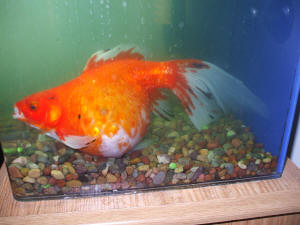
Please help me to diagnose my Goldfish's malady
1/31/09 In reading others' problems on your site, I
am wondering if my fish has more than one issue simultaneously.
Meatball has been in a 450 gallon pond in our backyard for 5
years. She was originally one of a half dozen feeders we
purchased from our LFS to establish the pond. She has 17 other
pond mates, not including mosquito fish, which consist of: the
rest of the original 6 feeders, 4 shubunkin and the remainders
are koi. The pond has a bio-filter for up to 750 gallon ponds, a
waterfall, a fountain and a UV light spitter frog. We live in
Southern California (5 miles from Disneyland) so I feed the pond
pets year-round, but in the Fall/Winter they are fed a lower
protein food. Tuesday we moved her into a Marineland 25 gallon
tall with an Eclipse II filtration and bio filter system that is
in our office and have been treating her w/ Melafix for three
days. She is the size of a softball. <I see this... a goldfish
with a dropsical condition... From what cause/s?> She was
constipated, but after reading about feeding her peas last night
we did so and she expelled the poop next to her right fin in the
photo this morning. On the test strip this morning, the Nitrates
were both in a "safe" position, the hardness was
"hard", the alkalinity was "ideal" and the pH
level was "acceptable". <Good> Without turning
the tank's heater on, the water temperature during the day is
79F and at night drops to 77F. <High, but acceptable> She
has adapted her maneuvers as her size has increased and has no
problem obtaining food, although it takes her longer than her
companions. She is quite active and very friendly. Her scales
have been smooth although strained because of her size. Just this
morning I thought that the scales near her tail were starting to
stick our like a pine cone or that could just be me looking for
symptoms of dropsy. <Yes> I'm guessing she has bloat,
swim bladder issues and was constipated. I have Tetracycline
tablets but should I put her on Metronidazole as explained under
the Goldfish Bloat heading or try the Tetracycline? <None of
these> I have aquarium salt for my puffer fish, should I be
treating her w/ this as explained in other articles? <I might
try Epsom Salt here> What prompted us moving her was that two
weeks ago one of the shubunkin, Lisa One-Eyed Lopez, had a red
spot on her side where she lost a scale so we put her in the 20
gallon patio tank and treated her for two weeks time. When we put
her back in the pond we noticed that she had slowly gone down in
size after her fortnight in the tank. <Good> She and
Meatball were the only two who looked "pregnant". I
thought this might work for Meatball as well. We put her in the
25 gallon tall because she seems to need more room to move
vertically rather than horizontally even though I know a larger
surface area is better. What do you think she has? <Gut or
gonadal blockage...> Should I continue to feed peas and for
how long? <Yes and as long as "it takes"> Should
I also feed her something else? <I'd have some
Egeria/Anacharis present at all times for munching> I tried to
also feed krill as I read in another article but they don't
tempt her. Which antibiotics should I use? <None> I
understand I should do a 25% water change daily w/ the antibiotic
dose or should the percentage be higher? Would the aquarium salt
treatment be beneficial for her? Please help if you can, we love
her very much... <Do search on WWM re Epsom use... This and
time going by, regular water quality tests, change-outs of
water... will see this fish improve. Bob Fenner>
|
 |
Koi Illness?? I have a 1500 gallon pond, the water checks are
okay, For the past 5 days one of my Koi carp of 20 inches has put on a
lot of weight and has episodes of sitting at the bottom of the pond for
about 5 minutes with its fins spread out, not gasping for air, is
feeding, however this fish has never behaved this way before, getting a
little worried as it does not move when I approach the pond. Any advice
would be gratefully appreciated <Mmmm, may be just
"egg-bound" temporarily, but could be sign of gut blockage...
Do read on WWM re Koi foods/feeding/nutrition... and I'd remove the
one fish to a large-enough separate system (like a kiddie wading pool
of size) and add the equivalent of about one level teaspoon per ten
gallons of Epsom Salt to the water... monitor ammonia, make daily water
changes and see if this "moves" whatever is causing your fish
to expand. Bob Fenner>
|
|
Aquatic Gardens
Ponds,
Streams, Waterfalls & Fountains:
Volume 1. Design & Construction
Volume 2. Maintenance, Stocking, Examples
V. 1
Print and
eBook on Amazon
V. 2
Print and
eBook on Amazon
by Robert (Bob) Fenner |
|

