|
Related FAQs: Acanthurus, Acanthurus Tangs 2, Acanthurus Tangs
3, Acanthurus ID, Acanthurus Behavior, Acanthurus Compatibility, Acanthurus Selection, Acanthurus Systems, Acanthurus Feeding, Acanthurus Disease, Acanthurus Reproduction, Mimic Tangs, & Surgeons In General,
Tang ID, Selection, Tang Behavior, Compatibility, Systems, Feeding, Disease,
This Article Continued as part 2:
Bad Acanthurus
Species, The "Unknowns" and Disqualified Due To
Size
Related Articles Tangs, Surgeons,
Doctorfishes, family Acanthuridae, species of Acanthurus:
A. leucosternon (Powder Blue),
A. sohal, A.
nigricans & A. japonicus, other tang genera: Ctenochaetus, Naso,
Paracanthurus, Prionurus, Zebrasoma, The Surgeon Family, Acanthuridae
The Conscientious Marine Aquarist
The Tangs, Surgeons, Doctorfishes, of
the Genus Acanthurus, Part 2 of 2
To: Part 1, Bad Acanthurus Species,
|
|
|
By Bob Fenner
|
|
Surgeonfishes: Tangs for Marine Aquariums
Diversity, Selection & Care
New eBook on Amazon: Available here
New Print Book on Create Space: Available
here
by Robert (Bob) Fenner |
 |
|
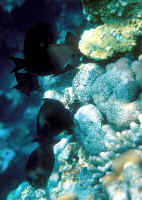
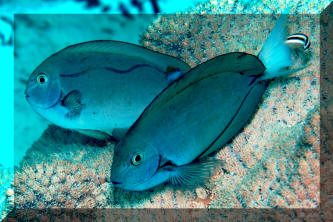
Acanthurus nigrofuscus (Forsskal 1775), the
blackish Brown or Spot-Cheeked Surgeonfish. Manageable size (to
eight inches), and moderate behavior toward other fishes qualify
the Brown Tang as a desirable aquarium species especially as an
algae controller. Unfortunately it is a rather plain fish. Red
Sea images of individual and group feeding together to overwhelm
more aggressive, territorial fishes.
|
|
Bigger PIX:
The images in this table are linked
to large (desktop size) copies. Click on "framed" images
to go to the larger size. |
|
%20MD.jpg)
|
Acanthurus pyroferus
see below under: Mimic Tangs. Aquarium and Australian and N.
Sulawesi images of "wild type" individuals as adults.
There are quite a few mimic and mixed looking variants in this
species.
See below under "Mimic Tangs". |
|
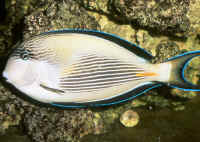
Acanthurus sohal
(Forsskal 1775), the Red Sea Clown or Sohal Tang. My vote for
best surgeonfish of the genus Acanthurus, though some individuals
get quite aggressive with age and size. As long as they're
"kingfish", problems are few.
|
|
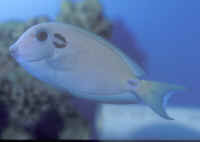
| Acanthurus tennentii Gunther 1861, the
Doubleband Surgeonfish. Western Indian Ocean; South Africa to Sri
Lanka. To about a foot in length in the wild. Aquarium
photo. |
|
Bigger PIX:
The images in this table are linked to large (desktop size) copies.
Click on "framed" images to go to the larger size. |
|
%20MD.jpg)
%20MD.JPG)
|
|
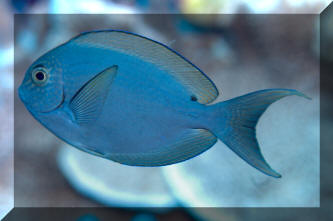
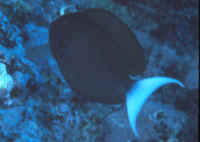
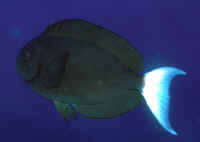
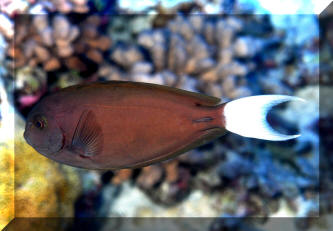
Acanthurus thompsoni (Fowler 1923), the
White-Tailed Surgeonfish, a good name for this species except for
its populations in Hawaii which bear no white on their tail areas
(at right). Another name for this planktivore is Thompson's
Surgeonfish. Though not a striking beauty, this Whitetail tang is
a good feeder and stays moderate small (to ten inches). Rarely
imported into the trade. A Hawaiian specimen, one from the Cooks
and Australia's northern coast pictured.
|
 |
|
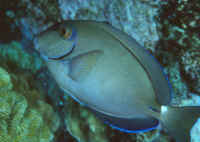
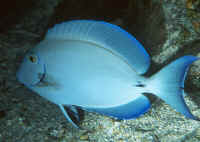
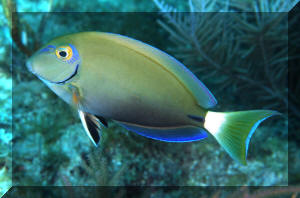
Acanthurus tractus Poey 1860, Ocean Surgeonfish.
N.W. Atlantic; Bermuda to Trinidad, Tobago, Gulf of Mexico and Caribbean
Islands. It's a shame this hardy fish isn't more
often sold in the trade; it has a quiet, yet strong beauty.
Although not super-gorgeous it is one of the least aggressive
Acanthurus, and readiest feeder on aquarium fare. Two views in the
Bahamas. (see below)
|
|
|
Bernal, M.A. and L.A. Rocha, 2011. Acanthurus
tractus Poey, 1860, a valid western Atlantic species of
surgeonfish (Teleostei, Acanthuridae), distinct from Acanthurus
bahianus Castelnau, 1855. Zootaxa 2905:63-68.
|
The ocean surgeonfish, Acanthurus bahianus, has been
historically recorded from Bermuda and Massachusetts to southern
Brazil and the islands of the central Atlantic. We have found
that individuals in the southwestern and central Atlantic
consistently have a posterior bright yellow margin on the caudal
fin and an orange/red margin on the dorsal fin. This coloration
is different from the characteristic white/blue fin margins on
individuals from the northwestern Atlantic. In addition, there
is a clear genetic distinction (d= 2.4% mtDNA, CytB) between
these two lineages. With the corroborating coloration and
genetic differences, we suggest that these two lineages
represent distinct species. The South
Atlantic species retains the name of A. bahianus and we propose
to resurrect A. tractus (Poey 1860) as the valid name for the
northwestern Atlantic species.
|
Bigger PIX:
The images in this table are linked to large (desktop size) copies.
Click on "framed" images to go to the larger size. |
|
%20MD.JPG)
|
|
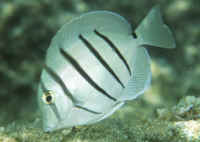
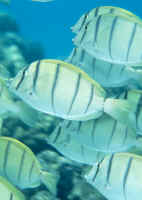
Acanthurus triostegus (Linnaeus 1758),
(manini) Convict Tang or Manini (Hawaiian). One of the best
Acanthurus for use in reef tanks for its size, easy going
temperament and habit of consuming fine, filamentous algae.
Reserved for native Hawaiian use in Hawai'i, but available
from elsewhere. Juvenile in Hawai'i and a marauding school on
the prowl in the Cooks.
|
|
Bigger PIX:
The images in this table are linked
to large (desktop size) copies. Click on "framed" images
to go to the larger size. |
|
%20MD.jpg)
%20MD.JPG)
|
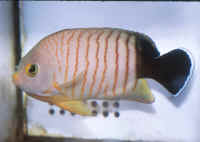
Mimic Tangs: These
fish species "pretend" in color, markings and behavior to be
other species, in this case dwarf angelfishes of the genus Centropyge.
The specific advantage accrued is reduced predation; Centropyge angels
are spiny and feisty.
I consider the Acanthurus mimic tangs, "good"
aquarium species when small for their slow growth rates (can be kept as
'juveniles' for years), peaceful nature (to the point of
over-shyness), and readiness to eat prepared foods. Mimic tangs make
excellent reef tank inhabitants.
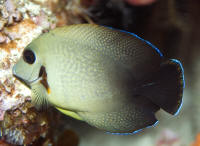
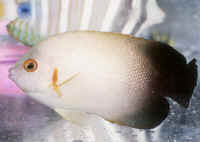
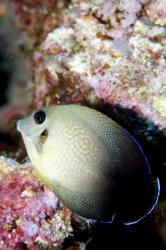
| Acanthurus chronixis
Randall 1960, a/the Mimic or Chronixis Surgeonfish. Very similar to
C. vrolikii, anterior two-thirds silver-gray to deep black
posteriorly, and identical blue highlights on the unpaired
fins. One in Sulawesi, the Angel in captivity. Pix by
RMF. |
|
|
|
The tang mimic
|
Centropyge vrolikii
|
Bigger PIX:
The images in this table are linked to large (desktop size) copies.
Click on "framed" images to go to the larger size. |
 |
|
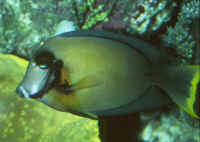
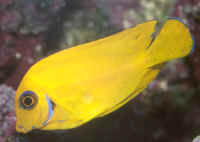
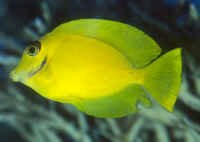
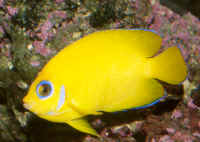
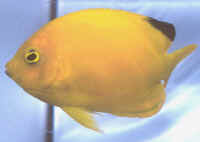
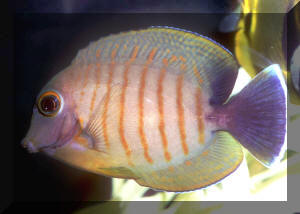
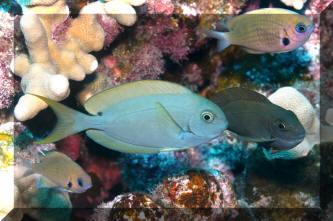
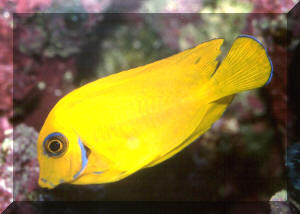
Acanthurus pyroferus Kittliz 1834, the
Chocolate Surgeonfish. Indo-Pacific; Seychelles to the French
Polynesia, down to the GBR. To ten inches in length. A successful
mimic of three (four if you count C. vrolikii in Palau where C.
flavissimus is absent and it mimics the other!) Centropyge
Angels. Shown here as a wild type on the right, mimics in
captivity below and below them, the Dwarf Angels that Acanthurus
pyroferus most typically mimics; the true Lemonpeel, and
Herald's. Aquarium images. Lastly, a comparison with A.
pyroferus (in N. Sulawesi) and C. vrolikii.
|
|
 |
 |
| Tang above, Centropyge
flavissimus below |
Tang above, Centropyge
heraldi below |
 |
 |
Bigger PIX:
The images in this table are linked to large (desktop size) copies.
Click on "framed" images to go to the larger size. |
|
|
Natural Range
Most species of Acanthurus are found in the broad area
called the Indo-Pacific. One is found in the eastern Atlantic along
Africa, five in the Caribbean/western Atlantic.
They are mostly shallow water (1-100 meter depths), rocky
and coral reef dwellers.
Size:
Smaller species "only" get six to eight inches,
the largest ones to a couple of feet. Under ideal conditions the big
ones get that way quickly; growing a handful of inches a year.
Selection: General to Specific
There are four major criteria to consider when judging
the acquisition of members of this group; body conformation, color,
behavior, and time in captivity.
|
1) Body Conformation:
Though appearance of a pinched stomach is not of itself an
accurate indication, healthy, freshly collected specimens of
tangs are well-fleshed. The upper body, above and behind the eyes
should not be "shrunk in", or show loss of
color.
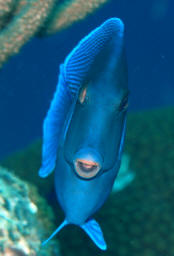
Seen head-on as this adult specimen in the Turks,
the fish should appear "full", convex in profile.
|
 |
To: Part 1, Bad Acanthurus Species,
Surgeonfishes: Tangs for Marine Aquariums
Diversity, Selection & Care
New eBook on Amazon: Available here
New Print Book on Create Space: Available
here
by Robert (Bob) Fenner |
|
|
|



.JPG)
.JPG)
MD.JPG)
MD.JPG)
%20MD.JPG)