|
FAQs about Mussid Coral Health/Disease, Pests
2
FAQs on Mussid
Disease:
Mussid Disease 1,
Mussid Disease 3, Mussid Disease 4,
Mussid Disease 5,
FAQs on Mussid Disease by Category:
Diagnosing,
Environmental (Pollution/Poisoning, Lighting...),
Nutritional,
Social (Allelopathy),
Trauma,
Pathogenic (Infectious, Parasitic, Viral)
Predatory/Pest,
Treatments
Related Articles: Coral Pests and Disease; pests, predators,
diseases and conditions by Sara Mavinkurve, Mussid Corals,
FAQs on Stony Coral Disease: Stony Coral Disease 1, Stony Coral Disease 2, Stony Coral Disease 3, Stony Coral Disease 4, Stony Coral Disease 5, Stony Coral Disease 6, Stony Coral Disease 7, Stony Coral Disease 8, Stony Coral Disease 9, Stony Coral Disease 10, Stony Coral Disease 11, Stony Coral Disease
12, Stony Coral Disease 13,
Stony Coral Disease 14,
Stony Coral Disease 15, Stony Coral
Disease ,
FAQs on Stony Coral Disease by Category: Diagnosing:
Environmental (Pollution/Poisoning, Lighting...),
Nutritional, Social (Allelopathy),
Trauma,
Pathogenic (Infectious, Parasitic, Viral)
Predatory/Pest,
Treatments
FAQs on Stony Coral Disease by Family: Acroporid Disease, Acroporid Disease 2, Acroporid Disease 3, Acroporid Disease 4..., Caryophyllid Disease, Caryophyllid Disease 2..., Elegance Coral Disease/Pests, Dendrophylliid Disease, Faviid Disease, Faviid Disease 2, Fungiid Disease, Mussid Disease,
Poritid Health, Trachyphylliid Disease, Trachyphyllia Disease 2,
FAQs on Stony Coral Disease by Type: Brown Jelly Disease, RTN,
|
|
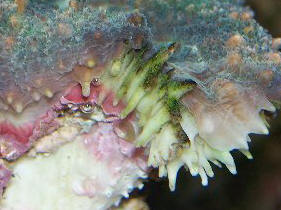
Cynarina lacrymalis question -02/07/08 Greetings!
I was hoping that you could help me with what is, I believe, a donut
coral, as I have not been successful in locating much information on
the Internet. I acquired this fellow, a relatively large donut about
4-5" across and green in colour, from a fellow hobbyist about
three weeks ago. He told me that he did not feed the coral,
<<Needs to be fed. RMF>> but that it had once eaten a
(dead) fish. It seemed to be doing well in his tank, also. It looked
great in my tank for many days - reacting to proffered foods (Mysis,
brine shrimp, as well as Cyclop-Eeze and various other foods), swelling
at certain times of the day, etc. Today, however, he sort of shriveled
up, and his mouth is gaping, and I am not sure what the problem is. I
have an established 28 gallon tank, over 30lbs live rock. 4 x 24W T5HO
lighting, good flow, but no direct flow to his area. I do not have a
skimmer, but have ordered a Prizm Pro. I have a modified AquaClear HOB
filter/refugium. The tank has many Zoas, candy canes, clove polyps,
Palys, brown star polyp, and a leather coral or two. I have a watchman
goby, a Randall's goby, and a pair of false percula clowns. I feed
roughly every other day, and do a 15% water change every 5 to 7 days. I
had a temperature drop from 80F to 75F over the course of the day today
(from about 1 am to 6 pm), which is the only thing I can think of, that
could be the cause of his ill health. <I wouldn't worry about it
unless the condition persists. It might just be expelling waste.>
Any guidance would be much appreciated. Thank you very much, Zoe
Stevens <De nada, Sara M.>
|
Blastomussa merleti health 10/25/07
Cheers Crew. <good morning> Someone was breaking down a
tank and gave me a small (5 or so polyps) Blastomussa Merleti
frag. The polyps were very full when I got it. Since adding it to
my tank after quarantine, however, it is not faring so well, as
the polyps are not nearly as full and portions of the
skeleton/cup are visible. <What kind of system was it in
before you got it? i.e. what lighting was it previously
under?> I have a 110g display with a 30g fuge (4-5" DSB,
Chaeto and LR) and 85lbs of LR. Lighting is six 54W T5 HO (4
10000Ks and 2 460nm actinics). Mechanical filtration is a wet-dry
trickle filter and a Coral Life Super Skimmer. I run carbon in
the sump that I change out every 4 weeks. Flow is via a Little
Giant 1345 gph return pump, 2 MaxiJet 1200s, 1 MaxiJet 900 and
one cheapo low-flow powerhead that I threw in for good measure.
<This is still probably not quite enough water flow for a 110g
reef tank. Please see here:
http://www.wetwebmedia.com/circmarart.htm and if you have the
time/interest...
http://www.advancedaquarist.com/2007/1/aafeature > Livestock is
a Sailfin Tang (I know . . .), Gold Stripe Maroon Clown and BTA,
Royal Gramma, Brown Comb Tooth Blenny, Yellow Canary Wrasse,
Filament Flasher Wrasse, a Citron Goby, 2 Cleaner Shrimps, a
Sally Lightfoot, 2 unknown tree corals, a Lemnalia tree coral,
two small groups of Pulsing Xenia, 6 Green Hairy Mushrooms, 5 red
Shrooms, 2 Ricordea Shrooms, and 4 unknown Shrooms. I use RO/DI
for top-off and water changes (10% per week). I dose with B-Ionic
2-part calcium/buffer as needed with testing and Kent iodine one
per week with water changes. <No more iodine. Or, please at
least test the iodine levels in your tank first. For some further
reading on iodine:
http://advancedaquarist.com/issues/mar2003/chem.htm> Water
parameters are: ammonia, nitrite, and nitrate (SeaChem) all 0ppm,
phosphate (Salifert) 0ppm, calcium (Red Sea) 400, pH (SeaChem)
8.3, SPG is 1.024-1.025, Alk (SeaChem) is 3.5-4 mEq/L, and temp
is 78-80. Based on these readings and a ton of Coralline Algae on
my LR and glass, I believe that my water quality is excellent.
<::sigh:: Well, I will agree that the results of your test
kits do not raise any alarms.> I've read that Blasto
Merleti like low flow and low to moderate lighting, so I figured
that my T5 setup would be acceptable. Initially, I placed the
coral in the lower portion of my tank but have since moved it to
the upper third to see if the increased lighting might help. I
have seen nominal improvement. I have also read that supplemental
feeding is not required, as this coral is primarily a
photosynthetic feeder, but I've also read that target feeding
with Mysis is not discouraged either. <Hmmm, where did you
read that they are "primarily a photosynthetic feeder"?
I would have to disagree with that. Yes, these corals can be
slowly acclimated to tolerate intense light. However, usually
coming from mid-level waters, they prefer less light (or indirect
light). They extend extensive feeding tentacles at night and have
strong prey capture ability. As a side note, the phrase
"photosynthetic feeder" makes no sense. Animals do not
feed photosynthetically. If they are photosynthetic, they convert
light energy into chemical energy and store it in the form of
ATP. Feeding is when an animal metabolizes organic matter from
another organism. An animal can't "feed" on
sunlight.> I've tried to target feed the coral, but it
doesn't seem to eat the food. I target feed whole Cyclop-eeze
to my tree corals, so I would think that some of the free
floating particles are available for the Blasto Merleti for what
that's worth. <When did you attempt to target feed the
coral? If you tried to feed it during the day, this might explain
why you didn't have much luck. You should try feeding the
coral a few hours after lights out. It might not start feeding
right away, but if you're consistent, it should start to
respond in a few days or weeks. Please see here for some coral
feeding tips: http://www.wetwebmedia.com/fdreefinverts.htm>
Any ideas on what might be going on or what I can do to improve
this coral's health? <My guess is that the coral is
stressed and/or starving. I would move it slowly back down from
the light and start trying to target feed it at night.> The
only thing I can think of other than that maybe my lighting is
not sufficient is that it is positioned near my Green Hairy
Mushrooms, but not right on top of them or anything. When it was
in the bottom of my tank, it was not near any Shrooms. <It is
a good idea to keep it away from the mushroom corals. Though they
might not kill the B. merleti, they'll compete with it for
space as they grow.> As always, I appreciate your help. Andy
<My pleasure, Sara M.>
Re: Blasto Merleti... fdg. 10/25/07
Dear Sara, Sorry--"I've read that they feed primarily
through photosynthesis." I hope that makes more sense to the
scientists among you--It is clear from your response that you
understood what this fledgling was attempting to say. <Yes, I
do understand what you're trying to say. If you'd like to
say what you want to say correctly, saying "I've read
that they obtain most their energy needs through
photosynthesis" would be more accurate. :-) > I did take
biology in 9th grade, but it's been 20 years so I am
sometimes not as accurate as I should be. I'm just going to
warn you now in the event you have to respond to any of my future
questions that I never took Latin nor did I take any classes in
college of the type that would have exposed me to the manner in
which Kingdom, Phylum, Class, Order, Family, Genus, and Species
should be referenced ;-p. <No worries. I apologize if you
found my clarifications of the science here to be pedantic.>
Now, turning to your questions/comments. In all seriousness,
thanks for the help that is embedded in your other comments. I
see now that I was not feeding this coral at the right time and I
will try to feed after lights-out (if I can stay up that late).
<No need to stay up too late if you adjust your lighting
schedule so that the lights go off towards the end of the
afternoon (maybe 6 or 7 pm).> First, prior to my acquisition,
the coral was living on the outer edges of MH lighting (probably
250W, but I must confess that I have no clue). I'm sure some
of its issues are that it needs to adjust to my environment.
<Probably> Second, I read that Blasto. Merleti primarily
feed through photosynthesis on: 1. Liveaquaria.com: <Ugh,
unfortunately, this is not exactly an authoritative source of
information.> "Its body contains the symbiotic algae
Zooxanthellae from which it receives the majority of its
nutritional requirements through photosynthesis. <Wow, this is
just wrong. Corals do not obtain their "nutritional
requirements" from photosynthesis.> It does not require
additional food to maintain its health in the reef
aquarium, <This could be true if the tank as a whole is
well feed. In well-fed tanks, healthy colonies of these corals
can get all they need without target feeding. For some good
general information on how to feed a reef tank, please see here:
http://www.wetwebmedia.com/ca/cav1i3/Progressive_Recipe/Progressive_Recipe.htm>
but it will feed on micro-plankton or foods designed for filter
feeding invertebrates." 2. Reefcorner.com: "Feeding:
Blastomussa is photosynthetic and does not take any known
foods." <Again, just flat out wrong.> 3. On WWM
(http://www.wetwebmedia.com/mussidae.htm): "Though all are
hermatypic, photosynthetic, most are voracious feeders of meaty
foods." <Yes, this is accurate.> And the same on many
other sites. After searching again today, I found a post from
Anthony Calfo: "The real key to success with these (and
most) corals is feeding. 3-5 times weekly ideally (or more). Use
meats of marine origin/zooplankton substitutes. Cyclop-eeze is a
great choice. Flying fish eggs (for sushi) are great too. For
smaller polyped corals, DT's natural diet (oyster eggs). Best
regards, Anthony" <Yep, I agree with Anthony here.> As
you can see from the above, there is a lot of conflicting advice
with respect to this coral, which is one of the reasons I posed
my question to WWM in the first place. <I can understand your
frustration. There is a lot of misinformation (and out-dated
information) out there. Though it's getting a bit dated, E.
Borneman's "Aquarium Corals" is still a good source
for information on captive coral care. As for internet sources,
obviously, I think WWM is your best bet. :-)> Third, by my
calculations, at least on paper, I have 2195gph of total
circulation, which is 20x total tank volume. Let's be
realistic, however, and assume that I get 2/3 of that, which
leaves me with 13.3 x turnover. The info you linked suggests a 10
to 20 x volume turnover, so it would appear that I'm in the
lower end of that range and could stand to add another power
head. <Yep. Knowing how to arrange your live rock helps too
(make sure it stays away from the sides of the tank and avoid
building big walls of rock). Since you're using power heads,
you might find this helpful:
http://www.wetwebmedia.com/ca/cav1i4/power_heads/Power_Heads.htm>
Fourth, why the "::sigh::" in response to my listing of
parameters and statement that I believed they evidence that my
water quality is good? Is there something else that the typical
hobbyist should be looking for on a regular basis or something
that I am not doing enough of/doing wrong, or was my comment just
plain foolish (and if so, please explain so I can learn from
this)? Please understand that I was simply doing my best to give
you as much information about my tank, measured water quality and
other factors as I could to assist you in understanding my
problem--I was under the impression that you guys appreciated
that. <I'm sorry if you were offended. The ::sigh:: was
because I'm playing a drinking game with Bob involving any
time someone says their water quality is "perfect" or
"excellent" based on nutrient test kit results. No, no,
just kidding! <<Gulp! I already drank mine. Dang! B>>
Seriously now though, yes, it is very good to be testing
these things. And you have my genuine respect for being such a
prudent and responsible aquarist. However, I would advice you not
to let these test kits give you too much of a false sense of
security. These test kits don't always tell you as much as
you'd really like to know. For example, the phosphate test
kits don't test for organic phosphates. More generally,
we're actually quite limited in what we can test for (while
some things are taken up before they can be detected).
Additionally, it's difficult to define what
"perfect" or "excellent" water quality even
is because it's relative to what kinds of coral you are
keeping.> Andy <Best, Sara M.>
Re: Blasto merleti 10/25/07 Dear Sara,
Thanks for your genuine response and helpful thoughts. <my
pleasure> Notwithstanding the limited amount of time that I
have in my life for this hobby, I try really hard to understand
the hobby and to keep a good tank and clean water for my pets.
<Indeed, I can tell you care very much for them.> Of course
I have made, and will make, mistakes in livestock selection/care
despite good intentions and research. <It happens to us
all.> As you might have guessed, I am no biologist or fish
scientist (but do have a B.S. in mechanical engineering, which I
haven't used in 12 years), but I do "get"
scientific concepts. <Yes, I think any kind of science
background helps. But you'll be surprised by how much
biological science you'll naturally pick up as you read and
learn more about the hobby.> I just think you guys sometimes
forget that most of us have nowhere near the incredible
background and knowledge that you have. <Thank you. As I said,
I do apologize if I seemed pedantic or persnickety (<--great
word, isn't it?).> Although there are a few lazy people
out there, I suspect most posters are like me--they try to
research issues before asking/doing and have genuinely good
intentions when asking questions. <We do appreciate your
questions.> I look forward to being a pain in your butt in the
near future. <I do too. :-)> Andy <Best, Sara M.>
|
| What's wrong with this Scolymia? Likely
nothing... but... 4/5/07 I've had this Scolymia for
about 9 months now, and have seen somewhat of a steady decline. The
first symptom I think I noticed was a gaping of the mouth,
accompanied by mesenterial filaments inside the mouth, starting
about 6 months ago. There's also some deterioration of the
tissue surrounding the mouth. About 2 months ago or so, I saw what
I thought was a small rock lodged inside the mouth. <!?> I
got some tweezers and tried to pull the rock out, but before I
applied much pressure at all, the "rock" broke open
revealing what appeared to be sand and other debris inside.
<Likely waste> I kind of waved the loose material around, but
didn't go digging around in there to get it all out (remember,
I thought I was pulling out a pebble, not performing exploratory
surgery ). So, for the past 2 weeks or so, I started
seeing what kind of looked like a black pebble in the mouth. A
couple of days ago, I got out the trusty tweezers again and poked
at the "rock". <... no> It was actually more like a
sack of tissue, enclosing who knows what, so I stopped before
piercing the sack. Today the sack had ruptured, exposing what again
looks to be a pile of sand and debris. <Please... just leave
this be> This first picture is with the black sack intact
(apologies for the dirty glass and actinic lighting )
And this one after the sack had burst... Any ideas what the problem
is, or what I can do about it? <Am pretty sure this is
waste...> Thanks for all the help. <Mmm, not so fast... Would
like to help... but need data... Water quality tests? Your set-up,
maintenance... feeding, lighting? You have read here: http://wetwebmedia.com/mussiddisfaqs.htm and the linked
files above? You should review if so, and do, if not. Bob
Fenner> |
|
|
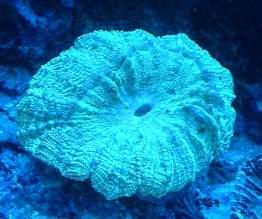
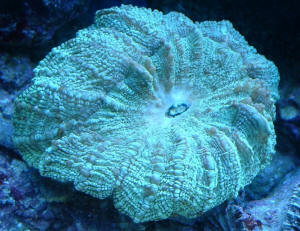
Blastomussa Coral/Health 11/13/06 WWM Crew,
<Hello Chris> I would like to report that I often search your
site, and can point to it as the main reason I got serious about my
salt water hobby and treating my tank inhabitants with respect (I even
try to drop Microcrustaceans back into my tank when they come out with
algae or during overflow filter removal!) <Nice.> Now I go to my
LFS armed with a book or two in an effort to understand what I'm
buying and what its needs will be. I have never, in about 15
years of keeping fish, had so much success and it's been very
rewarding. I've had a very stable system with respect to
my chemistry, fish, and corals. <Good to hear.> Since I've
been reading your site, I've slowly gotten into keeping some basic
corals, have added a DSB refugium, and track all my test kit readings,
additions, etc. in a little spreadsheet to trend my tank chemistry.
<Ah, excellent.> Anyway, thanks again and on to my question: I
have a 65 gallon display tank. In this tank, I have a little
fragment colony of Blastomussa merleti (5 little tubes with green
polyps. I have it toward the bottom of my tank, (4x96W orbit
PC for lighting). <At least you have the easier of the two Blastos
to keep, the other being the wellsi. They do well under PC
lighting and like a medium water flow along with an occasional feeding
of a plankton type coral food. Steady calcium and carbonate
levels will also aid in the health of this coral.> I've had this
Blastomussa colony for about 6 months, and it has always seemed to do
very well. I've watched the polyps extend further and
further out until they touch and look like one colored
mat. In fact two more small polyps had started to bud off
the side of the colony. Recently it does not want to come
out. It's not dead, because I can see the retracted
polyps, but I can't figure out what's going on. No
major changes, readings have been fairly steady as far as I have
measured for the past two months (Nitrate 0ppm, Phosphate 0 ppm, pH
8.2, alkalinity 3.5 mEq/L, salinity 1.024, Calcium 450 ppm (up from
about 375 over the last couple months), temp 78 degrees F. <All
sounds well here.> There are only two things I can think of: 1) The
only thing that is nearby is a large feather duster (one I've had
for quite some time, but one that has slowly grown bigger (It's
probably 3" in diameter when open). It's possible
some of the "feathers" could touch the Blastomussa, but
they've been close to each other (about 4" apart) ever since I
got the Blastomussa. Can Featherdusters attack corals in the
same way corals attack each other? <No, the duster is basically a
filter feeding worm.> 2) I flooded my sump when topping
it off (I have a nearby fill line, so I left the valve open, got
distracted, and overfilled it - absent minded, maybe I should force
myself to do it with a transfer container so I am forced to pay
attention :-). Instead of doing anything drastic, I checked
the salinity of the system and it had dropped to about
1.022. I let the system recover via evaporation (just let
the sump run high a couple of days) until the salinity was back to my
normal level. Nothing in my system seemed to suffer at the
time. But maybe the effect could lag the incident? <Quite
possible here, Chris. Are your PC bulbs
aging? Good idea to replace them yearly to ensure the proper
Kelvin temperature is there.> Oh well, that's all I can think
of. It's probably been about 2 weeks that the polyps
have been retracted. <You may want to use a good iodine
supplement. You didn't mention frequency of water
changes, but generally, a good reef salt will replace the iodine and
other needed trace elements that are lost, providing a weekly water
changes are done.> Thanks, <You're welcome. James
(Salty Dog)> Chris
Mussidae Family/Feeding
5/23/06 Hello guys, <Hello Paul> I have a gorgeous
meat that doesn't look like it is doing very well (bones showing ?)
I haven't fed him anything in a few months. What can I feed him ?
Thank you for the help. <Read here and linked files above
it. http://www.wetwebmedia.com/mussidfdgfaqs.htm
Paul
| Re: Brains in a Nano cont.
3/28/06 Dear Mr. Fenner,
In my last
email I sent to the WWM email. I told you about how I
never received a reply when I had sent pictures with the
email. You directed me to send it to your
personal email. <Yes, thank you for this>
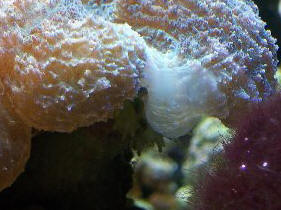
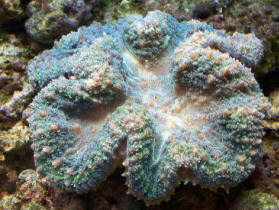
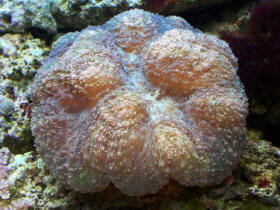
In a previous email I told you about
my Lobophyllia and some odd behavior. As I said before
it I am not sure if this is just natural or a problem.
Other than the odd behavior and some recession it
is doing well. <I see this here> As I mentioned
before with the recession it was there either when
I bought it 4 months ago or shortly afterwards. The
recession does not appear to have gotten much worse, but
not better. Below are pictures of the
lobo in it's 3 forms (not really the right word).
When it is in it's extra expanded state, it's
"normal" state (meaning what it looks like
most of the time.) and when it will pull in most of
it's tissue. The behavior has no pattern and varies from day to
day. On most days it will look normal all day, on other
days it will go into the pulling in it's tissue
form. It does usually do it in the afternoon and
will stay like that for a few hours. It is rarely in
it's extra expanded state, usually once or twice a
week. ( it only stays like that for a few hours
then will usually go into the normal state) The
fluctuations seems entirely unrelated to feeding or
water changes or anything else. Bye the way how often should
I feed it? <A few times a week with meaty foods...
Please see here: http://wetwebmedia.com/mussidfdgfaqs.htm>
I was thinking 3 times a week. (Or is that too often.) Order of
picture is as follows: 1. Extra Expanded 2. Recession Extra
Expanded (have moved the rock with red algae on it since picture)
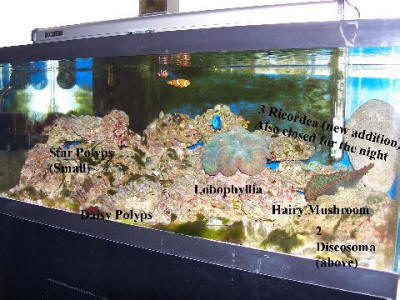
3. Recession Normal 4. Normal 5. Recession Closed Up 6. Closed Up
7. Full View of Tank. (Daisy Polyps are closed up because I took
the picture in after 8 P.M. just when they like to close up
for the night, not a great picture of the tank either.
The flash washed everything out, but it gives an accurate
representation of the tank.) Thank you for your help and time,
(sorry if the pictures took a long time to load) MDM
<Likely this tank is doing about as well as it can under your
good care. The keeping of multiple species, families, orders of
cnidarians in small volumes is problematical. Put another way, your
"margin of error" increases with increasing system size
all else being equal. Bob Fenner> |
   |
 |
|
|

