|
FAQs on Carpet Anemone Identification
Related Articles:
Carpet Anemones, Stichodactyla spp., Use in Marine Aquariums by Bob Fenner,
Carpet Anemones, big, beautiful and deadly by Mike Maddox,
Bubble Tip Anemones,
Tropical Atlantic Anemones,
Anemones,
Colored/Dyed Anemones,
Cnidarians,
Marine Light, &
Lighting,
Related FAQs:
Anemone ID 1,
Anemone ID 2,
Anemone ID 3,
Anemone ID 4,
Anemone ID 5,
Anemone ID 6,
Anemone ID 7,
Anemone ID 8,
Anemone ID 9,
Anemone ID 10,
Anemone ID 11,
Anemone ID 12,
Anemone ID 13, Anemone ID 14, Anemone ID 15,
Anemone ID 16,
Anemone ID 17,
Anemone ID 18,
Anemone ID 19,
Anemone ID 20,
Anemone ID 21, Anemone ID 22, Anemone ID 23, Anemone ID 24, Anemone ID 25, Anemone ID 26, Anemone ID 27, Anemone ID 28, Anemone ID 29,
Anemone ID 30,
Anemone ID 31,
Anemone ID 32,
Anemone ID 33,
Anemone ID 34,
Anemone ID 35,
Anemone ID 36,
Anemone ID 37,
Anemone ID 38, Anemone ID 39, Anemone ID 40,
Anemone ID 42,
Anemone ID 43,
Anemone ID 44,
Anemone ID 45, &
Cnidarian Identification,
Related FAQs: Carpet Anemones 1, Carpet Anemones 2, Carpet Anemone Behavior,
Carpet Anemone Compatibility,
Carpet Anemone Selection,
Carpet Anemone Systems, Carpet Anemone Feeding, Carpet Anemone Disease, Carpet Anemone Reproduction,
Anemones
in General, Caribbean
Anemones, Condylactis,
Aiptasia
Anemones, Anemones and
Clownfishes, Anemone
Reproduction, Anemone
Lighting,
Anemone Identification, Anemone
Selection, Anemone Behavior,
Anemone Health,
Anemone
Placement, Anemone Feeding,
Heteractis malu,
|
|
 |
New
Print and
eBook on Amazon:
Anemone Success
Doing what it takes to keep Anemones healthy long-term
by Robert (Bob) Fenner
|
|
Carpet anemones ID 8/11/16
Hi,
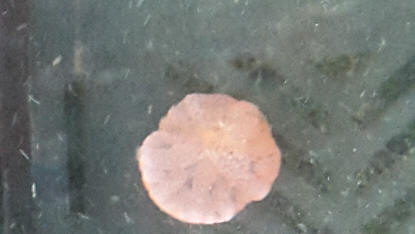
Is it possible to please ID the anemone.
It came as a mini red anemone at a local pet shop but looks more pink.
shipment came from the US to South Africa.
There was no scientific name.
It's quite sticky like a carpet.
<...? Need a better pic... cropped, resolved. Have you searched, read on WWM
Re Actinarian ID? Do so.
Bob Fenner>
Thanks Mohamed
|
 .... cropped
 |
Re: Carpet anemones ID
8/12/16
Hi,
I have searched but could not find anything close to it.
It's only about 1/2 inch.
The first thing that comes to mind is a Ric but it's very sticky.
It's the closest I could get based on the size.
Thanks for the help.
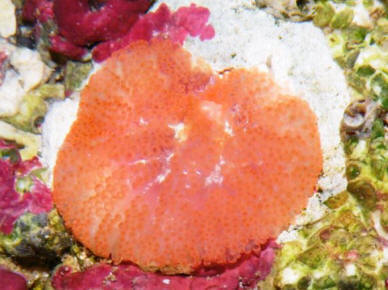
<Well; these are better pix... and it does look to be a Stichodactyla species...
I'd LEAVE it at the shop till it expands a bunch... they should be treating it
w/ Iodide/ate, perhaps some glucose solution and a thousandth reduced spg... and
feeding it sparingly. Do you see elements of the pedicle? Any striations
on the surface tentacle arrangement?
DO please have a look here:
http://www.wetwebmedia.com/cptanemidfaqs.htm
and the linked files above. BobF>
|
 |
|
re: Carpet anemones ID
8/12/16
Hi,
Can't see any sign of pedicle.
It does seem to have striations.
<Then my guess is on S. haddoni. B>
Thanks Mohamed
re: Carpet anemones ID
Hi,
Is it possible to tell the species of Stichodactyla?
<?! Yes... Don't write: READ>
Thanks Mohammed
|
|
Hi All.... myst. "coral" bonus!
9/8/15
Hi
<Tab; twelve megs of pix? Groan>
I was searching for information on a mystery coral and came across your
foram.
<Foraminiferan?>
I just set up a tank to start cycling and bought a live rock that
was taken from an old tank at the store. After getting it home we noticed
what looked to be a whitish slime on it going to rinse it off i noticed
it
opening thinking we had a stray coral i just put it in my tank. It has
recently opened more and i wanted to get it identified to make sure it
wont
harm any other coral or fish i will eventually place in the tank. it has
only been in the tank for about a week.
These picture were taken within 20 min of each other
<Interesante.... in cropping, spiffing up.... this looks like a Haddon's
carpet anemone..... striated; uniform tentacles as small bumps uniform over
capitulum.... What say you? Bob Fenner>
|
.jpg)
.jpg) crop crop |
|
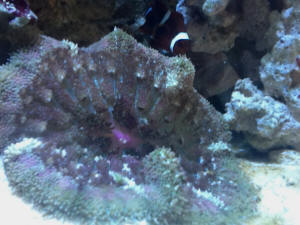
Carpet Anemone 11/10/12
Hi WWM:
<Jenni>
I recently ordered a giant carpet anemone from Pet Co. and I'm sure they
sent me the wrong species. It was sold as an assorted giant
carpet anemone species
<Mmm, which this is... but small/er>
and I was hoping to receive a Haddon's. I got this one and it
doesn't seem like any of the 3 giant carpets species I was expecting. It's
hard to tell in the picture, but it is just shy of 7 inches and slightly
asymmetrical. It was lost in shipping and 37 hrs late. The water temp
was 62 degrees and ammonia tested at 2ppm. I rushed acclimation
because of this and yet this thing plopped down in my tank, buried it's foot
(which is light orange with red dots)
<Both good clues to ID>
and has not moved an inch. A true giant carpet would never have
survived this so easy. I had a Haddon's for years and could tell by looking
at it that I needed to do a water change. I thought this might
be a maxi anemone or mini carpet.
<May be>
I can find very little out there on them, the difference between them
(size?) two. Also the pizza anemone...some say big, some say a couple
inches. I need to know what this is and does it need to be relocated when I
get the Haddon's. Will it eat my fish?
<Mmm, yes; given the opportunity>
I have all soft corals, maroon clown pair, coral beauty and a leopard
wrasse. Thanks for your help. Jenni VC
<Do read here:
http://wetwebmedia.com/carpetanemones.htm
This appears to be a S. gigantea. Bob Fenner>
|
 |
|
identifying an anemone 5/29/12
Hello all,
<Pedro>
I have problems in identifying an anemone and I come to ask you for
help, if possible.
In this gallery are several pictures of her:
http://s625.photobucket.com/albums/tt337/pedrogoncalvesx/carpet_anemone/
<I see>
A friend of mine bought this anemone with 20cm in diameter, as a
Stichodactyla mertensii, and four years later she was 30cm.
<Not surprising... but might be a He tried to fix it on the rocks, but
she moved to the substrate (coral sand) always.
<Mmm, strike two... I think this might be a S. gigantea... on the basis
of the mouth, the sand...>
When we played with our fingers, they get stuck and we have to do some
strength to let go of the tentacles of the anemone.
My question is between identifying it as a Stichodactyla mertensii or
Stichodactyla haddoni.
<Please read here re:
http://s625.photobucket.com/albums/tt337/pedrogoncalvesx/carpet_anemone/
<<Oops!:
http://www.wetwebmedia.com/carpetanemones.htm >>
Can you help me identify?
Thanks in advance and
Best Regards,
Pedro
<Welcome. Bob Fenner>
|
 |
Re: identifying an anemone
5/30/12
Thank you for your prompt reply!
<Welcome Pedro>
For some technical reason, some parts of the answer must be incomplete ..
<? What do you mean? I see the totality of the corr. below. Are you able to
open the link, review the distinctive characteristic (differences) twixt the
principal Stichodactyla species?>
Anyway the tentacles of gigantea are much longer, are not?
<Are not... the placement (sand), mouth (not flat, but open, obvious),
stickiness of tentacles, colour of the verrucae... all point to S. gigantea.
BobF>
Regards,
Pedro
Re: identifying an anemone
5/30/12
<Please read here re:
http://s625.photobucket.com/albums/tt337/pedrogoncalvesx/carpet_anemone/
<<Oops!:
http://www.wetwebmedia.com/carpetanemones.htm >> |
|
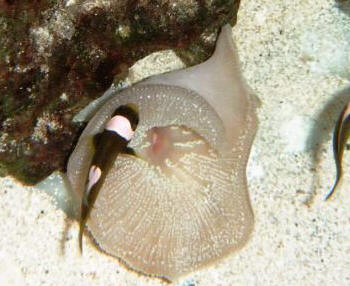
Could You ID My Nem Please?/Carpet Anemone ID
5/26/2011
Hi all at WWM!
<Hello Ruth>
I have trawled your site many times and found many a varied
answers, but the one that still bugs me, is, not knowing for
certain what my anemone is.
<OK>
I got the whole system second hand so need a little help. Despite
looking at hundreds of pictures, I just don't feel confident
enough to give him a name!
<How about sticky?>
I think he looks like a carpet anemone, possibly S. haddoni, but
like I said, I'm just not confident enough. He is about
6" across when fully open (although that is rare since he
mostly does what he's doing in the picture, which is
"hiding" under rocks!). I haven't been brave enough
to touch him yet! He's not changed since I got him in
October.
<Coloration as well?>
Any comments on his health and well-being are welcome since
I'm new to the hobby and advice is always appreciated.
<Well Ruth I'm not so sure it is a haddoni. The fold shape
leads me to believe it may be
Stichodactyla gigantea. I will ask Bob for his professional input
as well. <<Is haddoni>>
You may want to read here and learn more about the needs of this
animal.
http://www.wetwebmedia.com/carpetanemones.htm
http://www.wetwebmedia.com/ca/volume_6/volume_6_3/capranem.html>
I'm also hoping your tank is large and has intense lighting
in the form of metal halide which is necessary to even have a
chance on keeping this animal long term. At present, it appears
to be just surviving.
Many thanks
<You're welcome. James (Salty Dog)>
Kind Regards
Ruth Carsberg
|
|
|
|
Re Could You ID My Nem Please?/Carpet Anemone ID
5/26/2011- 5/27/2011
Thanks James
<You're welcome, Ruth>
OK you did make me giggle with the "sticky" suggestion,
I could probably have phrased that sentence a little better.
So from your coloration response, I am guessing that my gut
feeling is correct, and he is indeed bleached. His coloration has
not changed since October.
No, the tank is not large, but this is something I am currently
looking to improve. It is an Aqua One 620T (approx 140 litres)
with the standard 2x 18watt PL bulbs.
<Tank is too small and lighting is no where near enough for
this animal. I am surprised it is still alive. Is the anemone
taking food?>
I've asked various aquarists whether this lighting is enough,
and they have said that it is.
<What are their credentials?>
But I'm still dubious. Would you say metal halides are the
only option here?
<Metal halide would be my first choice, and T5 HO my second.
If you can provide me with your tank dimensions I will make a
suggestion.>
We feed him directly once a week with chopped silver sides /
muscle /other chopped seafood.
<Oh good, and consider soaking the food in a vitamin complex
such as Selcon or Vita-Chem.>
Water parameters are:
Sg 1.026
Temp: 27*C / 80.5*F
<I'd lower the temp to 78.>
Ammonia: 0
Nitrite: 0
Nitrate: sorry, I'm at work and my memory is failing me, but
I do know that it was considered within the "safe" area
using the JBL test kits.
<Yes, but safe for what.>
Phosphate: 0.25 (working on solutions for this - using RowaPhos
and removed carbon for now)
<A good protein skimmer would be a very useful tool to improve
water quality and help control nitrates/phosphates.>
As far as I know, from the information I was given, the tank has
been running for around 4 years, but I don't know how old the
anemone is.
My tank has mum and dad A. polymnus along with 7 of their
offspring (hoping to move them on soon)
<Congrats to you Ruth!>
some turbo snails, a hermit crab, a star fish and a cleaner
shrimp. There are a few mushrooms and polyps that seem to be
healthy, but nothing spectacular.
<Won't be with your lighting.>
The rest is live rock.
Sand bed is approx. 4".
Apart from improving the lighting and tank volume, is there
anything else I can do to help him?
<For you to continue to read/learn and ensure this animal is
fed at least once weekly, it's obviously his lifeline right
now.>
I am most grateful for your swift response.
<You're very welcome. James (Salty Dog)>
Kind Regards
Ruth
|
|
Anemone Identification 12/3/10
Hello Crew! Thank you for providing this service for those of us
that have hit dead end with every other method of research.
<Welcome~!>
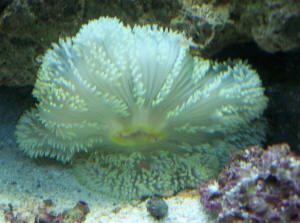
I recently ordered a sebae anemone from a very reputable shop.
What I received was a beautiful specimen, but not something I
have ever seen or would have identified as a sebae.
<Me neither>
I checked with the shop and they verified it as a sebae,
<Not Heteractis crispa assuredly>
and treated me as if I am stupid, which I know I am not. I went
on with my week and have been alarmed a number of times by
it's behaviors. It is often full and beautiful in the
morning, but in the afternoon will shrivel as if it's dying.
It fills back out in the evening and is shriveled again by 9:00
or 10:00pm. I also have yet to see it eat, and it has been 6 days
now. I've tried feeding it a variety of meaty foods, and the
food sticks to the short tentacle but I see no locomotion moving
it toward the mouth.
Even checking 15 and 30 minutes later pieces of krill, shrimp, or
squid will remain in the tentacles. At this point my efforts to
identify are not in knowing what it is, but in knowing how to
care for it, what it needs,
and what to expect in behaviors. It's a truly beautiful
creature, and I would like to enjoy it rather than worry about
it. Thanks for your help!
Derek
<Well... this specimen is aberrant, but my best guess is that
it's a Stichodactyla... likely a S. haddoni. Please do see
here:
http://wetwebmedia.com/carpetanemones.htm
I do hope this specimen rallies for you. Bob Fenner>
|
|
|
|
Anemone ID 11/17/10
Hello Crew,
<Howsit Kris?>
I was wondering if you can help me identify my anemone. I
purchased it form a reputable online retailer as a Stichodactyla
haddoni.
<Mmm, don't think so. See here: http://wetwebmedia.com/carpetanemones.htm
When I opened the bag it was small and brown and a good sight at
first that it wasn't white or transparent. While I was drip
acclimating it I was reading a post on a well known forum about
if there was any trace of
ammonia in the bag to expedite it and place in the tank. I
checked the water in the bag and it was at 3.0 mg/l. Checked mine
and it was 0.0. So while I was trying to unattach it from the bag
ever so carefully I noticed that there was very noticeable
verrucae and snapped a quick pic before I placed him in the tank.
I posted all of this on that forum to try and get a positive ID
but have come up with conflicting responses. We have come up with
the following: a Atlantic carpet, a gigantea or a mertensii.
<The latter is my guess>
The little guy is maybe 4 inches in diameter purplish oral disk
with green tentacles. The picture that
shows the verrucae was taken in my kitchen with the anemone in a
small Tupperware hence why it all looks tanish. The oral disk
looked the same color tan while it was in the kitchen and now its
more purple in the tank.
Lighting is 2-250w phoenix 14k bulbs and the anemone is being
shaded by three layers of window screen to acclimate it to the
lighting. Is there any way you help paint a clearer picture.
Thanks,
Kris
<Enjoy! Bob Fenner>
|
|
.jpg) .jpg)
|
|
Carpet Anemone Identification 10/12/09
Hello wonderful people (and places and things, etc) at Wet Web
Media!
<Hello Sally>
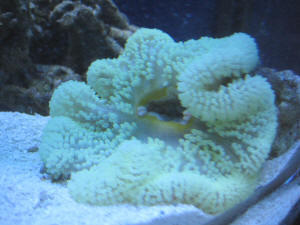
I came across a small (4-5" in diameter) Stichodactyla sp.
carpet anemone but I'm not sure which one type it is.
I've been reading the descriptions here:
http://www.wetwebmedia.com/carpetanemones.htm and Carpet Anemone
Identification links, books (The Conscientious Marine Aquarist,
2nd ed.), etc, but cannot find a consistent description.
Habitat: it has its body over sand, like the gigantea or
haddoni
Oral Disc: it looks bare, like the gigantea or haddoni
Column: attached to rock like the gigantea or mertensii Verrucae:
not sure what this is. a growth?
Disc Tentacle field: short, two-toned like haddoni I'm
attaching 2 pictures that might be helpful!
If you're able to identify which type this is, can you
describe what gave it away?
<Based on your info and the pics, I'd vote for it being a
badly bleached gigantea.
I am basing that on the large oral cavity and no two toned
banding of tentacles, and likely not a mertensii, their tentacles
are not very sticky (re your last email).
I'm asking Bob for his input here
also.><<Worthless>>
Thank you! Hugs & kisses :* :*
<Oh no, I'm getting loved up again:) James (Salty
Dog)>
Truly yours,
Sally
Re Carpet Anemone Identification 10/12/09
Oh yeah, one other thing! :)
It was very sticky to touch, but I didn't feel stung by
it.
<Gotcha.>
Thank you!!! ;)
<You're welcome. James (Salty Dog)>
|
 soon to be dead. soon to be dead. |
Re Carpet Anemone Identification 10/13/09
Ty ty ty ty! The picture doesn't show the brighter yellow
coloring of slightly 2 toned tentacles. Would that still call for
it being a badly bleached gigantea?
In order to care for it best, should I shield it from my 2
ocellaris clowns that love it so much?
<At this point, it really doesn't matter what type of
anemone this is, as it will soon die. Badly bleached means on
it's way out. I would suggest you remove it from the system
before you have a total wipe out.>
Thank you! ;)
<You're welcome. James (Salty Dog)>
Re Carpet Anemone Identification 10/12/09
Hello Bob,
Hoping you had a nice trip to the East Coast.
Am wondering what you meant by
"<<worthless>>".
<My input>
If it was directed toward the ID, I based this on information in
your article on Carpet Anemones as well as information from other
noted authors.
James
Re Carpet Anemone Identification 10/18/09
Hello again!
<Hi Sally>
Quite frustrated with my bleached purchase, I took it back and
complained a lot until I was offered a replacement. Can you
believe that I was even told by one employee that it wasn't
bleached, but naturally lighter in color??? I had to quote you
friendly fish lovers at WWM to gain any sort of credibility!
Thank you!!!
<You're welcome.>
The story goes on... and I have a new carpet anemone. It's a
bit larger, and much darker than the one I parted with. I drip
acclimated it for 3-4 hours and it seems to be happy after a
night (the tentacles are moving happily and it ate a piece of a
silver side fish for me!).
Can you help me identify the type of my new carpet anemone?
It's sticky like the last one, and I believe it's
gripping to a piece of live rock and hovering over the sand like
the last. I can take more pictures if needed.
<Is enough.>
Thank you all so much. James (Salty Dog) especially. I'm glad
I was able to trade it in... but was told I wouldn't be able
to trade it a second time (but I could donate it back, so please
let me know if you see any obvious things that I wouldn't
notice).
<Before I go any further, I see in looking at your last few
emails, you give no description of your system as to size of tank
and lighting along with tankmates. I'd like to be sure you
can even meet the requirements for keeping a carpet anemone alive
for any length of time. Your attempts may be futile. James (Salty
Dog)>
Ty ty ty!!! ;)
Sally
|
Re Carpet Anemone Identification
10/19/09
Hi again James! :)
<Hello Sally>
My system is a Clear For Life Acrylic 100 gallon Bow Front
Aquarium (60" x 18" x 24"), with a 30 gallon
sump underneath, protein skimmer and another 20 gallon
refugium.
<Tank is actually a little on the small side for keeping
carpet anemones with any degree of success, but the sump
and refugium are a plus.>
My lighting system is made of T5 HO with 6 bulbs in a row
along the entire length.
<This may be borderline lighting with a 24" deep
tank. Best chances for success with tanks 24" or
deeper are with metal halide lighting in the 5500-10000
Kelvin temperature range.
Excessive use of the blue spectrum is useless from a
photosynthetic perspective and energetically wasteful.
S. haddoni and S. mertensii are more adaptable to
variations in light intensity than is S. gigantea.
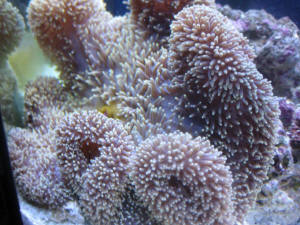
Based on your photos, it appears your anemone is a
Haddon's or haddoni Carpet Anemone, the most readily
available species. The Merten's or mertensii are rarely
seen in the trade with the S. gigantea not lagging too far
behind.>
I keep the tank at 77 degrees with heating and
chilling,
<Temperature and parameters must be kept rock stable for
these animals.
Your means of temperature control is another plus. Use of
an ozonizer is another great benefit in keeping water
quality high, which these animals also demand.>
and in it are a variety of shrimp (2 skunk cleaner, 2
peppermint, 2 fire red),
<Very likely to become food soon.>
50+ snails variety, a few crabs, 1 Chocolate Chip
Starfish,
<Would remove the starfish also.>
2 Ocellaris clownfish, this carpet, and the only other
thing on my list is a algae blenny.
<Other fish can/will fall prey to carpet
anemones.>
Thank you! I appreciate you looking out for me. Please
advise! ;)
<Based on your system details, the odds of successfully
keeping this anemone long term would be low. Larger tanks
increase the chances of success to a higher level.
More research on your part, and from more than one source,
should have been done before purchasing this anemone.
I'm thinking you do not realize the difficulty in
caring/providing for carpet anemones. James (Salty
Dog)>
Sally
|
 |
Re Carpet Anemone Identification 10/19/09
<Hellooooooo Sally>
Thank you for your sincere reply James! Sad news for me...
<Shouldn't be sad news, just reality.>
I've been reading up on these a lot.
<After reading, did you still feel you had the system to give
yourself an honest shot at it?>
I'd like to try, but if my odds are low at keeping this
long-term (lower than average which is 10% already),
<The odds are low for anyone, not just yourself.>
would you suggest that I try to give it back to my fish store?
:-( I do have another 46 gallon tank for the other items (shrimp,
starfish) that could potentially get eaten.
<Well Sally, being that you mentioned the LFS will not take it
back, you may want to attempt this, the choice is yours to make.
You may be one of the lucky few to succeed.
One of the problems that lead to the difficulty in keeping
carpets, is that they do not ship well. From the time they are
collected and find their way to the LFS, the anemone has gone for
quite a few days without
proper lighting, food, and likely in water conditions not to
it's liking with the end results being a stressed
animal by the time it gets to the dealer's tank. It isn't
that these anemones are touchy or sensitive, most live
longer lives than us. It's the fact that most of these
anemones are in the very early stages of death before we receive
them, and, it takes a very good system with excellent water
quality to attempt reversing this process and return the anemone
to a healthy state.>
Also, in case it helps-- the tank has about 3-5" of sand,
and the carpet is attached to a piece of rock, so it's raised
up higher than the 24" depth. Does that help?
<Keep in mind that T5 HO lamps can provide enough light in
some cases, it's just that metal halides are preferred.
If you decide to attempt this, you can help yourself and the
anemone by switching to 10K lamps. More of the proper light will
be present for photosynthesis. I'd like you to read this
article on carpet anemones if you haven't already. Is a good,
informative article on the subject.
http://blog.captive-aquatics.com/captive_aquatics/2009/05/carpet-anemones-captive-aquatics-blog-saltwater-aquarium.html
James (Salty Dog)>
Sally
|
|
Stichodactyla ID 3/19/09
Hello Everyone,
<Hello Steve>
Thanks for your site....I have covered your facts page(s) well
before many purchases and it has made a world of difference.
<Good to hear.>
I have what I believe is a Stichodactyla Haddoni. Pet store
picked it up at a popular reef where house
<I don't know where the house is.>
in L.A. but wont specifically I.D. the anemone. Based on your
sites pictures, I am guessing.
Could you please I.D. him? In the picture he just woke up to MH,
so he
might have "bed head". I'll insert the picture.
<Sure looks like a haddoni to me, how about you, Bob?>
<<Mmm, no, I'm a human... this is the Actinarian you
state. RMF>>
Thanks everyone.
<You're welcome. James (Salty Dog)>
Steve C
|
 |
Responsible Anemone/Scallop Keeping 8/12/04 Hi there!
It's been awhile since I've had a question come up, so here I
am. ;] <we've been waiting with bells on> I recently got a
deep blue carpet anemone. I'm in love. ;] <this is an illegal
relationship in most civilized countries> It is very sticky, the
foot is in perfect condition, and it ate a chunk of food on the first
day! I have it in a tank with lots of light and very good flow. <all
good> My main question is how can you tell the difference between S.
haddoni and S. gigantea? <listen for the accent in their speech
betraying the locale of their origin/speciation.> Do S. haddoni come
in blue as well? <yep... RIT brand dyed fresh from some charming
Indo exporters> I have two rock/flower anemones that are near the
carpet (3 inches away) but not touching. Will this be a problem? <I
expect the carpet will stress or kill these in time> Everybody seems
happy at the moment. Do pink skunk clowns take to carpet anemones?
<the answer to this question, as with the details of speciation
between anemones (like the tentacle-free distinction around the mouth
of S. haddoni) and so much more is waiting for you in our archives. We
work hard to build this database... please do make the effort to use it
and help yourself. There's a clownfish/anemone compatibility chart
ta boot: http://www.wetwebmedia.com/marine/inverts/cnidaria/anthozoa/anemones.htm
be sure to follow the many other links atop these pages> I feed all
of my anemones (3 flowers, RBTA, green BTA) a mixture of live plankton
and Prime Reef/Frozen Brine shrimp by Formula foods. They all seem very
happy and are growing. Is this an acceptable diet for the carpet
anemone as well? <seem weak to me... the phyto is of dubious value
for the carnivorous anemones (they feed on zooplankton principally)...
and brine shrimp is a truly hollow food (barely useful even if gut
loaded). Please do add better variety here with 4-6 other meats of
marine origin. Shredded cocktail shrimp, Mysid shrimp, Pacifica
plankton... minced krill... and fish eggs (grouper roe from the LFS or
flying fish eggs from an Asian groceria... excellent food for such
filter feeders)> Thanks for everything! Morgan Mok ps: Just as an
update for the naysayers and the "blind squirrel people", my
red flame scallop is over 1 1/2 years old in my system. ;p
<Morgan... you do understand that we are here to serve the greater
good in the hobby? I hope you are too. Encouraging the majority of
aquarists to keep inappropriate animals like flame scallops just
because less than 1% survive over one year is... well... irresponsible.
Unless you can clearly explain and document how yours lived to 18
months (still not much of an accomplishment when many simply take
longer to slowly starve via a small daily deficit in nutrition as from
brine shrimp feedings over time... and all have a natural lifespan on a
scale of magnitude much longer!), let me ask... rather, beg (!) that
you do not casually promote the keeping of flame scallops or the like
as if its a lottery, and telling people the equiv. of "you might
win too!". The truth is that most lose... and these are living
creatures lives lost... not lottery tickets. Your fave naysayer,
perhaps... Anthony :) >
| Yellow vs. Green carpet anemone Hello Bob, <Steve>
I am curious, why does every authority state that this anemone
should be green. It has been yellow for Two years! Thanks Steve
<Well, you and I will state otherwise. Have seen this carpet in
quite a few colors, including yours here... in the wild and
captivity. Can even change color due to lighting, feeding, water
quality, perhaps other factors. Bob Fenner> |
|
|
Carpet Anemone ID Hey Wet Web People...
<Discriminating against extraterrestrials, are we? The shame!> I
bought a carpet anemone...sadly I for once didn't look up your
website and wonder if I will regret it now. They are cheap here in
Bangkok and I got suckered in (US$8) as it looked healthy and well
coloured. <Starting off with a healthy specimen is half the battle,
but PLEASE do your research before impulse buying! Life should not be
measured by the cost of acquiring it> I am not sure what species of
carpet it is. <Most likely Stichodactyla haddoni or Stichodactyla
gigantea...can you get a picture of it, especially a pic of it's
mouth?> The colouration is a soft pinky burgundy base and the
tentacles are light green. Its about 7 inch wide. Also very sticky. Is
it gigantea? <See above. Stickiness is a good sign though, make sure
you feed it often> Are all carpets fish eaters? I have seen tanks
with them with fish in the past...it's one hell of an ordeal to get
LFS to take stock back here so I am hoping not to. The tank occupants
are two pipe fish - Doryrhamphus sp.. (black snout/orange front to the
body/blue back section with a black tail with a white central patch and
rim?), a clarkii clown, and sifting goby of some variety. Other than
the clown, I am guessing they aren't the best tank mates with one
of these. <Yes they are, and expect to lose all of your fish
eventually except for the clarkii, especially the pipe fish. Do you
have adequate lighting, space, and water flow for your new anemone?
They like bright light, you will need halides or natural sunlight to
keep one long term. Make sure you keep it well fed also, with
shredded\small pieces (1\4") of fresh seafoods> Thanks for the
advice <Anytime> Brett Moloney <M. Maddox> Bangkok <Aym
ah Texan>
Anemones (Carpets) Hello, Will a green and blue carpet
do well together in a 180 gal? Or will they poison each other? I was
thinking about adding a red carpet. <probably no anyway you slice
it. Green carpets are a legitimate and natural color/species. Blue, Red
and Yellow carpets are most often dyed and most are not destined to
live long for the stress of it all. If they are otherwise naturally
occurring distinct species, then you are still beat from the extra
specific aggression. Bottom line... two different anemones are not
recommended together. Besides... carpets get enormous and you would
need a huge tank for two three foot diameter carpets <wink>. Do
read though the archives for information on dyed anemones> also what
else can you feed them besides Thawed krill, shrimp silver sides?
<the above foods are good if finely shredded. Feeding large whole
prey otherwise can be harmful to an anemone in the long run. Most meaty
foods of ocean origins are fine (Pacifica plankton, Mysid shrimp, fish
roe, etc). Thanks, Scott <best regards, Anthony>
Anemone Husbandry... Hey Guys, <Scott F. your guy
today..> I just bought a new carpet anemone (don't really know
what kind, it has bright green, stubby tips) <Might be Stichodactyla
mertensii...can be a tough one to keep, since it requires a lot of
light and food... Also, you could be looking at S. haddoni, which has
shorter, blunt tentacles. It gets quite large, but is otherwise about
average in care requirements as carpet anemones go...Meaning- it is
touchy...> and went to get new lights for it. I bought Aqualight
20" quad strip with 96 watts (do you think that is enough) and I
was wondering if I should feed him live food or just let him
photosynthesize? <Well, in regards to the light- I think that you
might need to move the animal high up on your rockwork to get adequate
light. You may want to keep a close eye on the animal's behavior to
see if the lighting is enough (on the surface, it sounds like it's
not...You'll have to feed often, almost daily, in order to keep the
animal in good shape)...And, again- light...lots of light- and
current!> If I should feed him, what should I feed him? <Various
forms of plankton tend to be natural foods.> Also, one more
question, do you think black percula clowns will be more prone to live
in the carpet than orange perculas. <Hard to say...Many perculas are
tank raised, and have never seen an anemone...It is often disappointing
for hobbyists to find that their clowns don't go into the
anemone...Here's to hoping!> Thanks a lot guys. <My
pleasure...really learn all that you can about the species that you
have an it's husbandry...Anemones are simply not easy animals to
keep, and require a high level of care...Good luck! Regards, Scott
F>
Stichodactyla tapetum - mini-carpet anemones 7/20/03
Thanks for the quick response. Something I had forgotten about, (due in
part because I never see that part of the rock) is that on a zoo rock I
bought back in May, is one of the . smallest species of carpet anemones
- Stichodactyla tapetum. I have been in contact with the fellow I
bought the rock from, and he confirms that the un-identified critters I
wrote you about are indeed the small anemones. thanks for your help,
and any advice you might have on keeping these happy would be
appreciated. Neil <the mini-carpet anemones you have do not present
any unusual challenges in husbandry. Treat as you would other anemones
and corallimorphs... feeding fine foods several times weekly. A
fishless refugium to produce plankton for them and others in the tank
will be even better. They lean towards the hardy end of the spectrum
relative to other cnidarians at large. Best regards,
Anthony>
|
Carpet anemone questions 10/18/03 After
reviewing your site can you confirm the following: 1) The
specimen in the attached photo is a S. mertensii. <<Looks
like a S. haddoni to RMF>> <cannot say with certainty
from most any photo. But on gross characteristics, I'm
inclined to wonder if this isn't S. gigantea which has dense
short tentacles of equal size whereas S. mertensii has colored
verrucae (peach/pink) and longer tentacles approaching the
mouth> 2) Your usual recommended feeding regimen of a wash of
Mysis shrimp or other 1/4" food applies to this anemone as
well. Not too frequently. <yes... a must with all anemones to
be safe. There are few if any large chunks of meat/fish falling
through the water column untouched on a reef <G>. Many eyes
watching and waiting to consume such matter. Anemones instead
feed on fine zooplankton (like most carnivorous cnidarians) at
night> 3) I bought this carpet unaware of the numerous posts
of it eating tangs and other fish. <yes... does occur because
of the unnatural and crowded confines of aquaria. Far less so in
the wild> I am willing to assume some risk and leave it as is
in my 200 g tank with 5 fish, but I might change my mind if
it's a virtual certainty that at some point it will eat my
purple tang. Can you roughly ballpark the percentages?
<nope> Is it 50/50 that my fish will survive or are the
odds against me 95/5? <hard to say... truly pot luck. I never
recommend anemones for mixed community tanks. I believe they
should always be kept in a species or biotope display, else
somebody's life (anemone and/or fishes') will be
shortened.> As always, thanks for your help. <my strong
advice is to house the anemone in a proper species tank. Perhaps
a nice 60-90 gallon drilled and plumbed inline with your 200
gallon to spare you the expense of another filtration system. If
your anemone is mertensii... it is a rock dweller... and if it is
S. gigantea, then it is a sand/lagoon denizen (soft substrates).
Best of luck. Anthony>
|
|
|
|
|

