Featured
Sponsor


FAQs on Sponge Identification 7

Related Articles: Sponges in Marine Aquariums

Related FAQs: Sponge ID 1, Sponge ID 2, Sponge ID 3, Sponge ID 4, Sponge ID 5, Sponge ID 6, & Sponges 1Sponges 2Sponges 3, Sponge Selection, Sponge Compatibility, Sponge Systems, Sponge Feeding, Sponge Disease, Sponge Reproduction

Unknown critter ID, Porifera   8/9/08
Hi,
<Hello, Mich with you tonight.>
I've been reading this site for months.. it's great.
<Thanks! Glad you like it!>
Now I need some help.
<Alrighty!>
My tank is two weeks old.
<VERY new!>
Ammonia has been trending downward for 6 days and is now at less than .25ppm. The tank has 192W of PC lighting (96W 10k, and 96W dual actinic) running 7 hours per day. The tank is doing great, I've got new growth in macroalgae, feather worms, breeding snails, etc. The live rock is from Tampa Bay Saltwater, so call it Caribbean rock.
<Ok.>
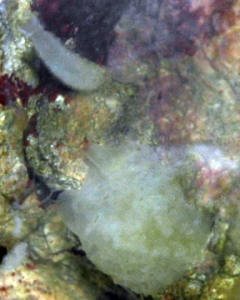
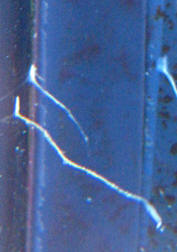
I've got these things growing on it. (see pic) They are thin, translucent, white stalks. They have gone from nonexistent to 1 to 2 inches tall in about a week. It appears to have small polyps on them, but that's not really verified. Is this a juvenile gorgonian colony?
<Nope. Is a sponge, likely growing rapidly due to high nutrient content in the water. Is a harmless filter feeder. Just enjoy it. More here:
http://www.wetwebmedia.com/sponges.htm and related links in blue.>
Thanks
<Welcome,
Mich>

Can I rescue my sponge? And what kind is it?  7/29/08
Hi Bob and crew!
<Kerstin>
Well, as usual, I have been searching your great website and the web, and wouldn't you know it - I haven't been able to identify my sponge.
I did find a great website (www.poppe-images.com) with an amazing number of pictures of different sponges; it complimented your articles on them. I have learned lots in the process (as usual), and so I am wondering if you could assist me with the following:
<Will try>
1. Do you have any idea which type of sponge this is?
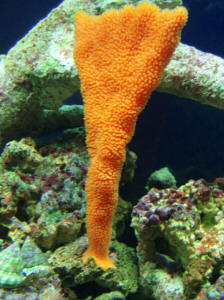
<Mmm, looks most like a Monanchora unguifera to me... is it from the TWA, the tropical West Atlantic?>
I have only seen orange pictures that have this kind of structure, and didn't know if that would translate; my LFS had no record of what kind it is. I did try to do research on the sponge before I purchased it, and I observed it in the tank at my LFS for over a month - where it seemed to have no problems.
<Mmm... the color... feeding type...>
2. Do you have any suggestions of things I can do that will help it stay alive?
<A very large refugium... culture of food there and elsewhere... careful addition of small foods>
I have included a picture of where it is in my 92-gallon corner tank; the tank has an Outer Orbit 250W HQI/T5 light hanging ~8 inches above the tank frame, and the sponge is on the right side of the light.
<I see... also another sponge toward the off right on the bottom>
I added the sponge to my tank six weeks ago, and until recently, it looked fine; only within the last week has it started to develop some areas at the top where it is going pale white/green.
<Ahh, die-back>
I am wondering if it needs either more or less light, current, food,
<Likely this, and time to settle in, but... again, this is a non-photosynthetic species... some concern with alkaloid release...>
or any combination of those? Or should I just re-setup my quarantine tank and watch what it does there? I don't know if it would be toxic to my tank if it dies, hence that question.
<Is...>
The red sponge did come attached to a small piece of rock, which was in fact encrusted with an orange sponge and a small feather duster (which has since disappeared). The encrusting orange seems to have attached it to the rock - but I am sure I can move it if I need to.
<I would leave this as is>
I had rearranged my powerheads slightly lower about 2 weeks ago (when it was still doing well); I have returned them to their previous position (higher along glass, but blowing in the same direction) again as of yesterday; could the change in current be what caused the sponge to start deteriorating?
<Mmm, much more likely just from collection, being moved issues>
Other information about my tank:
- My fish are a Zebrasoma Xanthurum (Purple tang), Pseudocheilinus Hexataenia (Sixline Wrasse), Ecsenius Bicolor (Bicolor Blenny), Gramma Loreto (Royal Gramma/Fairy Basslet), Siganus doliatus (Barred Spinefoot - Rabbitfish);
- Invertebrates are 2 Blood-red shrimp, 4 skunk-cleaner shrimp, 2 peppermint shrimp, and a serpent star, as well as an unidentified crab (have seen his molted shell once, is about 3/4-inch wide).
- Corals include several different types of brains, a Lobophyllia, 2 Acropora, a Stylophora, a Pavona, an Acanthastrea, a small green Zoanthid rock, a Micromussa, a Turbinaria, two Fungias, and 2 mushrooms (I tried, but these are on the base of a 25-lb. rock, and until they become a nuisance, I am not willing to dismantle my tank just to scrape them off the rock...). Could any of these be proving a problem for the sponge?
<Mmm, more like the opposite... again, for emphasis, instead of hinting around, I would watch your Anthozoans... move the sponge out, change a bunch of water, utilize carbon... should they show rapid negative behavior>
- I also have several other sponges - a yellow encrusting who is happy no matter where he is located, and an orange encrusting sponge that has recently sprung up.
<A good sign re the overall fitness of your system that these sponges are proliferating>
- Most of my parameters are in the general norms, with pH running at 8-8.2 (depends on time of day for the measurement), temp. running 80 +/- .6 °F (MH tends to heat up the tank, the fan keeps the temp from swinging too badly). I have been battling low alkalinity, which I seem to finally (in the last 2 months), have under control around 8.5 dKH (I seem to have an alkalinity sink in my tank,
<Yes... the metabolism/growth of the biomineralizing life t/here>
with it dropping sometimes below 7 (not since I have had the sponge)
<Mmm, it may be supplying, and/or depressing the uptake therein>
while the Calcium would spike above 550 (also finally stabilizing)).
- I do weekly water changes of 5-10 gallons, and have gotten rid of my Bryopsis algae (finally!) after weeks of raising the alkalinity and just generally picking it off/sucking it up with water changes. I had a small case of red slime about 3 weeks ago - it seems to be primarily gone, and even the small HOT refugium (I used Steven's instructions to convert a AquaClear 110 with Chaeto and Fiji Mud) is rid of the red slime.
<Good>
- My Tunze skimmer produces about 100ml of skimmate every 4-5 days, and the tank has been set up since I upgraded it from a 29-gallon back in November last year. My powerheads for circulation are a Hydor Koralia 2, Hydor Koralia 3, and a MaxiJet 1200 with the Hydor Flo Deflector on it.
<Sounds/reads good as well>
I greatly appreciate any inputs you can provide... I learn lots every time I research on your site, and feel my tank wouldn't be doing as well without the excellent information and opinions you provide. I am working on a sump/refugium,
<Ahh! Do go forward with this full steam>
but at this point want to see what is at
MACNA before I build/purchase one; if that would help my sponge, I may need to see what can be done to keep it alive until then.
<Do hope to meet you in Atlanta>
Thanks tremendously in advance for any information, Kerstin DeRolf:-)
<Cheers, Bob Fenner>

Can't identify encrusting creature on my live rock; looks like old chewing gum, but with mouths in it, living in a crevice. ( I know that's weird)   6/23/08
Hello,
<Hi Alisa, Mich here.>
and thank you all for providing such a comprehensive resource for aquarists.
<On behalf of Bob and crew, you're welcome!>
I have researched for days trying to identify this strange thing, and frankly my research may be inhibited by my inability to really describe what I'm looking at, as I've never seen anything like it before.
My closest approximation is that it is some sort of flat tunicate or encrusting sponge, but I haven't found a picture of anything very close.
<Mmm, doesn't look like a tunicate to me. Looks like a sponge.>
Specs:
I have a 45 gallon long reef tank with a 14 gallon sump. I have a wet/dry filter,
<I'd remove the biomaterial, it increases nitrates.>
protein skimmer, an internal overflow and two powerheads, and a 24 hour power compact fluorescent lighting system with 2 AquaClear 502 powerheads. I have about 40 lbs of live rock, all live sand and about 2.5 inches of substrate, 16 hermit crabs (scarlet, red leg, blue leg, and left handed),
<Not a fan... Too opportunistic in my opinion.>
15 American star snails,
<Mmm, I'm not familiar with this common name.>
two true percula, a Midas Blenny, and a Coral Beauty, 1 four inch tall brown pulsing xenia, and 9 polyps of blue spotted mushrooms.
Levels:
As of today my Nitrate is 0, Ammonia is 0, Nitrite is 0, Ph is 8.1, Phosphate is 0, Alkalinity 11 DKH, Calcium 340, Salinity 1.024
<OK.>
Question:
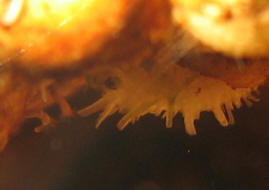
There is a strange encrusting creature on a piece of my live rock which appears to be growing out of a crevice. It is light beige, and about 2 inches long and ranges from 3/4 to 1/4 inch wide, and has six 'mouths' of varying size from 3/4 inch wide to 1/8 inch wide, that look just like clam mouths, and they open during the day and close at night. It is not moving, or if it is moving, it is doing so super slowly. I have included a photo, and an wondering a) what is this thing? and b) is it safe, or should it be removed?
<Looks like a sponge to me. As long as it is not impinging on anything I would leave in place.>
Thanks for any help you can offer!
<Welcome,
Mich>
--
Alisa Berman

White growth on live rock: Syconoid sponges and likely Ascidian - 4/21/08
Hello crew.
<Hi Bubba>
I have been looking for answers for a while now.
<Heheee! Haven't we all!>
I have this white growth on my live rock. I have felt it and it feels almost like a gel of some sort?
<That's a helpful clue, thanks!>
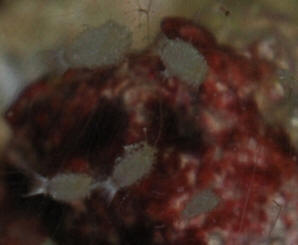
I have tried to blow it off with a power head and have tried to suction it off with no luck. I had this stuff once in the past, same exact spot, and finally got it off with a tooth brush. 2-3 months later and it is back. I have included a picture for you to see. At the bottom of the pic there is some of the stuff that comes out of the rock in little q-tip heads.
<Guess what one of their common names is? Yep, a Q-tip sponge, also known as a harmless Syconoid sponge. See the FAQ’s/photos at the following link regarding these neat little sponges: http://www.wetwebmedia.com/spgidf7.htm >
There are numerous pieces of that type.
<Yes, these can be quite numerous at times, especially in new systems or when there’s a high nutrient load.>
The middle of the pic is the same stuff, but it just seems to be one big growth. The pic is good so hopefully you can tell what I have. Do you think it is some type of sponge?
<Mmmm, no. If it feels like a gel, that is - smooth or slimy, it’s more than likely a harmless Ascidian (tunicate/sea squirt) of some sort. For more information on these, please see this link: http://www.wetwebmedia.com/ascidians.>
I have looked for sponge pics but it seems they are mostly red or orange.
<Oh, you've been missing out on some real beauties! Sponges come in a wide variety of beautiful colors and interesting shapes, as can be seen at the following link: http://www.wetwebmedia.com/sponges.htm . Enjoy!>
Please help!!
Bubba D.
<Not to worry, Bubba. Sponges and tunicates are all part of the diversity that makes for a healthy system. Take care, -Lynn>

Help to Identify – Sponge 4/19/08
Hi,
<Hi Crystal>
This was on a live rock that I bought from a local store. I have been told it is a sponge and also told it was and encrusting Bryozoan. Please help me, I have searched the web and not found anything that looks like it.
<It’s a neat little sponge! Please see the following links for more information and photos (also note the associated links at the top of each page):
http://www.wetwebmedia.com/sponges.htm
http://www.wetwebmedia.com/spongeidfaqs.htm >
Thank you,
Crystal Coffman
<You're very welcome. Take care, -Lynn>

Are these sponges? I hope? Yes! Syconoid Sponges - 3/31/08
Hello crew!
<Hi Ben!>
I have been lurking since I started this hobby and have sent one email that was answered by James 'Salty Dog' and really helped me with my algae problems.
<Excellent!>
I appreciate the database of information you guys have built up. It certainly helps us relative newbies out.
<Hehee! It even helps this oldie out as well!>
(sorry for the re-mail, I forgot to attach the pic the first time around!)
<No worries. :-)>
The reason I write today is that I have a mysterious growth on my Neon Hammer and would love a little help with an ID!
<No problem! It’s a harmless filtering Syconoid sponge, commonly called a Q-tip or Pineapple sponge. Please see this link for other examples/photos and more information: http://www.wetwebmedia.com/spgidf7.htm >
I admit, I looked around on the site, but time hasn't permitted me to do an exhaustive
search, so I apologize for that.
<Alright, well I’ll let you off the hook just this once!>
This is the only place it exists in the tank, on the stems of this hammer. I have attached a picture. There are quite a number of them. They are best described as what look like tiny soft white pineapples.
<Yep, hence the common name.>
Could they be sponges? <Yep> Or egg cases? <Nope> I did notice a while ago that one of my brittle sea stars was hanging out in there, but I haven't seen any snails in there. Is this something that could be harmful?
<Not likely.>
The Hammer is starting to sprout a couple tiny new polyps so I hope it isn't.
<Should be fine.>
Also they popped up relatively quickly. One week they weren't there, the next they were!
<That’s fairly typical. These neat little sponges usually appear in boom and bust cycles, showing up in great numbers, then dropping off to a few or none.>
Animals in tank: 2 Ocellaris, 1 algae blenny, 2 brittle sea stars, 2 skunk cleaner shrimp, 4 peppermint shrimp, 2 emerald crabs, and a bunch or Cerith, turbo and Nassarius snails. Pulsing Xenia, Neon Hammer, and clove polyp. Oh yeah, and some Chaeto.
Tank readings: Ammonia, Nitrites, Nitrates- 0, pH 8.2, Calcium 380, KH 8 (on the ap test- that's how they measure it) phosphates 0 and salinity 1.025. It's a 40 gallon breeder.
Any help on an ID would be appreciated!
Ben
<You’re welcome, Ben, enjoy those little sponges while they last! Take care, -Lynn>

plant id... actually a Poriferan – 03/20/08
hello, I have an unusual plant in my reef tank. It looks like coralline algae in color. It grows slowly and has broad leafs/tissue.
Its pretty robust-- not brittle, quite slippery. I have been searching for any similar plant/macroalgae morphology, but have not found anything close. I would appreciate any input to help figure this out. Thanks, rob
<Very nice pic and organism... This is actually a Sponge. See the Net, or here: http://wetwebmedia.com/sponges.htm
and the linked ID files above. Bob Fenner>

Re: plant id, Poriferan  3/20/08
Thanks a lot for the input. I did actually frag it and find it to be one of the cooler parts of my reef system.
<Is a beauty! And testament to your good maintenance. Cheers! BobF>

Isn't that pretty?

Re: Purple coral alga... overcome with... sponges!   3/17/08
Thanks for the quick reply. I'm attaching some pictures of the alga I was
asking about. You say more info will help. Tank is a 24 gal nanocube w/3
peppermint shrimp, 6 hermit crabs, 1 clown fish.
<Looks very nice... I do think you have sponges here... Read on WWM re... Bob Fenner, who wonders what might be a connection twixt your family name and that of the Avocado, Persica americana...>

Sponge IDs...   03/15/2008
Good day! Can you help me identify these sponges? i found them on intertidal zone, in a seagrass community. Thank you.
<Mmm, nope! I suggest you try finding, looking through a reference work or two that deals with Poriferans in the geographical area these were extracted. Bob Fenner>

Polyps of some sort in my sump? (sponge ID)  3/14/08
Crew -
At some point I hope to have a refugium in my sump. For now there is no light, just a rock beside a bag of activated charcoal where my refugium may be one day. However, I have a new development in the past couple of weeks, and while I like to see new life, I have no idea what's going on here. Suddenly these little critters are all over my sump. Would you please identify and tell me if they are a positive or negative life form to have in the sump?
<They are harmless Syconoid sponges.
http://www.wetwebmedia.com/spgidf6.htm>
I don't know if I should clean them out or rejoice that they exist.
<It's your call. There's no need to clean them out if they're not bothering you.>
Pics are attached. Thanks for any help, as always.
Regards
<De nada,
Sara M.>

Re: Polyps of some sort in my sump?
Wonderful! Thanks for the ID. Looks like my nutrient levels have risen to support these. I'll check to see if my skimmer pump filter is clogged since I have noticed reduced skimmate the past week - just before these little guys arrived.
<Well, in many ways, they are little filters themselves. ;-) They usually come in boom and bust cycles. People seem to get them in droves all of a sudden, but then they don't last.>
Joel
<Best,
Sara M.>

ID and removal of yellow cave-dwelling balls 02/19/2008
Hello,
<<G'morning. Andrew today>>
We bought an existing marine reef aquarium, 45 gallon long, without knowing what we were getting into. Fortunately, with great help from the wet web media forum [and Bob's seminal book], it has been a thrilling roller-coaster ride of discovery and success. Maybe too much so.
<<Sounds like a wonderful journey your embarking on>>
Starting out with pretty much all the wrong equipment [and a nitrate reading of 100 ppm], it is nice to say that at the end of two months everything and everybody seems extremely healthy [purple mushroom corals are at 5" diameter, one Domino damsel is possibly over 4" in length, chemistry great, lots of exciting stories, etc].
<<Great news>>
Everything is healthy . and growing. So much so that we now may have a problem with an unidentified yellow ball something [sponge?] that likes to grow in caves or reduced light areas [and propagate]. Original there were3 attached under one rock in a cave like setting. That cave now has six and there are at least 4 other locations with these yellow fellows.
<<Yes, these are sponges, harmless filter feeders and will come and go, depending on nutrient levels. More info can be found here http://www.wetwebmedia.com/sponges.htm >>
The problem is one of the original yellow balls has gotten so big that it is threatening to dislodge some rock from a crack it 'grew into'. The question is safe removal.
If you know what these are, can you provide advice on the proper way to harvest them. If the one can be saved, great. If not, can it be removed without harm to the other occupants of the habitat?
<<Removing it is not a problem and it will not effect the others near by. Safely remove with a scalpel blade or other sharp bladed instrument and attach to a rock with some fishing line>>
Knowing the great level of support all of you provide it is easy to imagine how busy you must be. I apologize for adding to the work load with this question. Hope it is not an 'easy' simple thing that could have [should have] been figured out. Please be assured that what you do does make a difference. Dana C. Andrews, B.S.
<<Your questions are most welcome, so, no apology is needed. Thanks. A Nixon>>

Zee spongee!

Bluish gray fuzzy ,cotton candy, web looking, is it fungus, bacteria or sponge?   2/8/08
Hello crew member's of WWM
<Bridget>
I am kind of new to having a reef tank less than a year and really need your expertise!
Could you please help me?
<Yes, and will>
My husband's buddy has this stuff in "groups" on his live rock all over his tank. originally they thought it was copepod eggs or something, so he gave my husband a couple rocks with it on it as we are planning on getting a scooter blenny or a mandarin goby in the next few months and thought the extra copepods would be good for them since our tank that is less then a year old . Well as soon as he brought it home, I thought it looked suspicious and starting searching the inter-web for it. I couldn't find it anywhere which leads me to wonder what did he just stick in our tank?
<A sponge>
The suspicious "stuff" is kind of bluish gray, looks kind of like a cotton candy or a web of some sort, may even be slimy, has little white dots which look to be eggs, almost like it is a cocoon. and if you look close it has translucent "slimy looking" holes that almost look like volcanoes where something emerged from it,
<These are "osculae"... "little mouths"... excurrent pores/openings...>
This "stuff" is kind of weird and worries me that it is in our tank I want him to take it out but he wont until I prove to him it might harm our other corals.
<I would leave in>
I put a pic on a different web site asking what this was
The people that responded said a blue sponge
<This is so>
But I still am not to sure of this. I know there are over 9000 different species of sponges and I have looked at hundreds and hundreds of pictures off the web
and none are similar enough to say yeah that is it.
<Are adaptive, polymorphous species... taking various forms depending on "current conditions"... of light, current, foods...>
So I was wondering do you think it might be a sponge as well? If so what kind it might be? is it good or bad?
<Please read here: http://wetwebmedia.com/sponges.htm>
I have read that sponges die as soon as they hit the air
<Mmm, not all>
and we have exposed them to air as we thought they might be copepod cocoons (are there even copepod cocoons or do they just lay their eggs in the substrate?)
<Are not Copepods, cocoons... don't lay eggs thus...>
and they are still alive and doing well.
I have attached a few pictures
Thank you in advanced for your time and input
It is much appreciated
Sincerely
Bridget
<Bob Fenner, who urges you to focus your curious mind, keep investigating, sharing...>

Re: Bluish gray fuzzy ,cotton candy, web looking, is it fungus, bacteria or sponge? 2/9/08
ahhhhh Thank you Bob
Now I can sleep at night not having night mares that something is going to take over our tank.. lol
Your time and wisdom is much appreciated
Sincerely
Bridget
<Heeeee! Wish I had more of the first and any of the last. Cheers! BobF>

Nice photo, specimen, sys. RMF

Strange Growths On Live Rock, sponge ID -01/30/08
Hello Again Crew!
I'll jump right to my question. I've been attempting to gain some insight into what it is that's taken up residence in my live rock.
<sponge>
I have likely have three (that I can see anyway) of these strange growths in the impressions in the live rock. I have sent along a picture as well for you to have a look at. The best way to describe these are as follows: 1) They look like cocoons for lack of a better way to describe it. I'd say like a dust ball as a different way to describe it also. 2) While it's somewhat grey, it does distinctly have a pale greenish hue to the structure. 3) It has three or more holes in it that looks as though something has burrowed in, or burrowed out of it. 4) All are approximately the size of a pinky finger tip and smaller.
<Sponge, maybe syconoid sponges.>
I have never seen anything coming or going from these structures, nor have I ever witnessed any tentacles coming from it either day or night. The rock didn't come with these on them (at least not in the locations where they are at present). So they have developed in
the time I have had the rock. Could it be the birthplace of some form of worm? Or of some other critter? My searching for answers has met with little result to this point so I'm hoping all that knowledge over there may have encountered this at some point along the way!
<Indeed, many, many times... these little sponges are almost ubiquitous among diverse, well maintained reef tanks-- and even among many that are not.
http://www.wetwebmedia.com/spongefaq3.htm>
Many thanks in advance. You're all doing wonderful work.
<Gracias>
Kevin
<Best,
Sara M.>

Oh yeah. RMF.

ID Please: Cirrhilabrus exquisitus and Syconoid Sponges – 1/28/08
<Hi there!>
Can someone please tell me what these are in the attached photos from my reef tank? They look like some sort of egg sacs, and if they are sacs of some creature that I don't want in my tank, then I would just as soon remove them now. If they are something I would like, then obviously I would keep them.
<No worries with these, you can keep them. They’re harmless, filter feeding sponges in the genus Sycon, also called Syconoid sponges. For more information/photos, please see the FAQ's at this link (and related links above):
http://www.wetwebmedia.com/spgidf7.htm >
For your info, I have:
1 Naso Tang
1 Foxface Tang
4 clownfish
2 black clowns
1 Snowflake eel
1 Fu Manchu lion
1 yellow angel
1 electric flame scallop <Very difficult to keep.>
numerous snails
two tiny hermits that stowed away with the snails
some chromis that disappeared (lion food?)
2 Wrasse (type unknown, will attach pic also).
<Looks like the Fairy Wrasse Cirrhilabrus exquisitus, commonly called the Exquisite Wrasse. Considering all those colors, I'd say that it’s a very apt name! By the way, color can vary depending on place of origin, whether it’s male or female, etc. Here’s a photo of one for comparison (and lookee there, it’s Bob’s photo!). http://wetwebfotos.com/media/medium/1/600_Cirrhilabrus_exquisitusAQ.tif.jpg
More information on this genus:
http://www.wetwebmedia.com/marine/fishes/wrasses/cirrhilabrus/index.htm >
Thank you.
<You’re very welcome! Take care. – Lynn>

Sponges? Syconoid 01/02/08
Happy New Year to all of the Crew:
<Thank you! And to you and yours! Mich here.>
I hope all of you are warm.
<Yes, thanks to Mr. Holmes my portable space heater... I'm feeling hot hot hot…>
We have an inch of snow here in Surrey BC Canada
<I can raise that and then some! Big fluffy flakes currently falling on top of the several inches of their friends that are currently covering things here in the Pocono Mountains of Pennsylvania. The weather outside is frightful…>
I have these "critters" in my 2 year old 50 gal.
<Critter can be good! All got a place in the choir…>
They might be sponges,
<Yes, they are.>
but I could not find any pics of these on your site.
<They're here, they're there, they're everywhere:
http://www.wetwebmedia.com/spongeidfaq3.htm
http://www.wetwebmedia.com/spgidf5.htm >
Hopefully you could identify these and tell me if they are friend or foe.
<You've got a friend… harmless filter feeders, Syconoid sponges.>
At first I had one and found it interesting. Just before he died,
<Oops.>
There were about 75 little ones on the glass and a few scattered around the LR.
<Can be a sign of excess nutrients in the water, you may want to watch your feedings.>
They are now in my 10 gal where I just have live rock and Caulerpa growing.
<Careful with the Caulerpa. Don't let it get on any of your LR. You won't be able to get it off easily.>
I fill this aquarium with the 2 week old 50 gal water. So they transferred in with the water.
<Or came with the LR.>
must be 100 of them there. They seem very prolific!!
<They’re multiplying…>
I am worried that they will take over.
<And I’m losing control? No, they usually they reach a balance on their own, with populations waxing and waning. They are usually self-limiting unless your nutrients are totally out of control.>
A siphon hose easily pulls them off however.
<Yes, but they are doing a service for you. I would let them grow where is convenient.
I have attached 3 pictures. #2 is about half an inch long. Below that is a mass that might be a sponge with 2 siphons. It is about half an inch in diameter and half an inch high. This is along the back wall and I have not seen it before. #3 ,the downward angled one is about 3/4 in. long. #4 is a cluster of the smaller ones, 1/4 inch long, growing on the glass.
Should I keep them in check, or let them be?
<Speaking words of wisdom… Let it be…>
Thank you very much.
<Welcome very much.>
Worried
Dietmar
<No worries Dietmar… be happy… Mich>


Yet Another ID... Yet Another Sponge... 11/17/2007
Good morning crew.
<Good morning Chris.>
Chris here with another ID question.
<Mich here with another ID answer.>
I've spent the past two days looking for this critter on your site with no luck.
<It's there.>
I'm not a computer wiz but I was thinking. What if you had pages with nothing but submitted pictures that you could click on to be taken to the appropriate page. I don't know if that is in the realm of possibilities but it's just an idea.
<And a good idea at that! Will discuss with RMF.><<A good idea... but... the real problem... It's just me who places all... seven days a week... and I am currently just able to keep up with what I do... RMF. IF we were more commercial, we COULD hire folks (we do this for free) to greatly improve the sites>>
Now on to my question. This guy is some kind of hitchhiker.
<Yup.>
It lives in my LR.
<Yup.>
Is not mobile but does have what seems to be a feeding tube that stick out a little farther than it's tentacles <???> and pulls it in when hit with light.
<The tentacles that pull in are unrelated... Perhaps something else nearby, like the tiny feather dusters off to the left in the pic.>
I've attached a picture to help.
<Is a sponge... a Poriferan, identification to the species level usually requires microscopic examination. Is nothing to worry about. This is a harmless filter feeder, though an excessive amount could indicate a nutrient problem. Some similar pictures here:
http://www.wetwebmedia.com/spgidf6.htm
Enjoy!
Mich>

Help With Identification of Something Growing on Rock... A Sponge 11/9/07
Hi,
<Hi Carlos, Mich here.>
Thanks for the great web site...
<On behalf of Bob and the crew, you're welcome!>
it has been a great source over the last year with my reef thank.
<Glad to hear!>
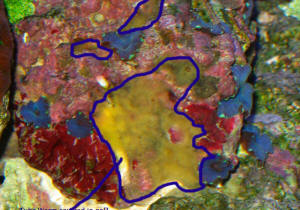
My tank is doing quite well and appears healthy, but I have had this rock with mushrooms on it for about 9 months. I have noticed over the last few months a yellowish green substance filling some of the crevices. It is semi-transparent almost gel like in appearance. I tried to scrape it off a couple of weeks ago while cleaning the tank but it is actually quite hard to the touch. I have enclosed a photo and outlined it in blue. As you can see there is a tubeworm that is being covered by this substance. Any ideas on what it might be?
<Yes, is a sponge. Impossible to identify much beyond this without microscopic analysis.>
My tank is about a year old.
36-gallon corner tank.
65 pounds of live rock
30 pounds of live sand refugium with Chaeto and two small rocks with zillions of Mysis shrimp and pods. <Yay!>
2 Montipora
1 Acropora
1 small hammer coral
1 frogspawn
pearl bubble coral
xenia sp
open brain
plate coral
3 Ricordea mushrooms
tube worm...going on a year
2 small percula clowns
1 Royal Gramma
1 Randall goby with pistol shrimp
<Lots of potential for allelopathy in such a small system! Hope you're doing frequent water changes!>
pH 8.1-8.2, temp 79-80, ammonia, nitrite at 0, nitrate fluctuates
0-15, Calcium at 390-420, Alk at 4.0, sp grav approx 1.027 <A bit high>
Thanks for your help.
<Welcome! Mich>
Carlos

Worm ID... maybe a poriferan  10/29/07
Great site! Have found answers to almost all of my questions.
The one question that I have today deals with a worm ID. I found something similar at http://www.wetwebmedia.com/wormidfaq3.htm but you said that the picture was not clear enough. I have taken a few of my own and hope that you can help me figure out what these little creatures are. Thanks,
Staff Sergeant Chris Shannon
<I see where you allude to... the second reply from the bottom... I think these are sponges however... Do they stay attached permanently? I.e., are non-moving? I would just leave them be... are useful filter feeders... Bob Fenner>

Re: Worm ID... poriferans – 10/30/2007
They are non-moving. Unless my psychotic Kole Tang bites one off and spits it out somewhere else. Thanks for the help.
<Ahh! Do look on the Net with the term Syconoid sponges. Cheers, Bob Fenner>

Mystery Coral... No, Is a Sponge   10/21/07
Hello All,
<Hi Jonboy! Mich here, not on Walton's Mountain, but in the Pocono Mountains.>
I've used your website for the last couple of years and have found a wealth of knowledge on it.
<I'm very glad you have found it helpful!>
This is my first email since I usually can find answers to my questions from your archives.
<This is wonderful to read.>
My problem is that I can't identify the coral in the picture attached to this email.
<Heehee! That's because it's not a coral!>
The LFS told me it was an 'orange sea fan.'
<Nope, is not a Gorgonian either!>
Though it is orange it doesn't resemble any sea fan that I've been able to locate.
<Is not a seaman. Is a Poriferan, Looks like an orange tree/paddle sponge, a Clathria spp. to me. You have been sold an inappropriate creature for captivity as most Poriferans are. This is not a good genus to keep in an aquarium. This sponge can be toxic and may harm other animals... particularly if it dies, which is a good likelihood as these animals are difficult to keep in a home aquarium setting.>
It stands about 5 inches and has incrusted on the rock. It also has a very bumpy exterior that I believe is a way for it to catch organic matter.
<Yes, is a filter feeder.>
I've never seen this coral before and the LFS told me that it would do great under my PC's.
<No, it won't. It prefers dimly lit conditions and may actually be harmed by brighter lighting.>
I hope the picture turns out well enough for you to identify this for me.
<The picture is fine.>
Thanks in advance, Jonboy
<Welcome! Goodnight Jonboy! Mich>

Sponge ID, Anemone getting healthier – 10/12/07
Crew,
<Hello Andy, Brenda here! I have received both of your e-mails, and will answer both here.>
Hope all is well. I have two questions and have attached three pictures related thereto.
<Okay.>
First: I purchased a piece of Tonga Branch with 4 greenish mushrooms on it. At the bottom of the LR is what appears to be some type of hairy sponge. When I tried to reposition this piece of LR, I noticed that it has become attached to the piece of LR on which it rests. On closer inspection, it appears that this sponge (or whatever it is) has grown and bonded to the underlying LR. Any thoughts on what this is?
<It is hard to tell with a picture and there are so many different sponges.>
Second: I have had a BTA for 5 or so months. When I got it, it was tan. Since then, it has gotten progressively darker and is now a purple/brown color.
<Congratulations! Your anemone is getting healthier.>
I feed it 1 frozen cube of Mysis (thawed and soaked in Selcon) 2 times per week, and it is a very eager eater.
<A full cube may be a bit much. I would also mix up the diet a bit with some Silversides, Lance fish, raw shrimp, etc. Portions should never be bigger than the anemones mouth.>
My Gold Stripe Maroon Clown is in love with it.
<Yes, I bet! It is a wonderful relationship to witness.>
In any event, as you'll see from the attached photos, its tentacles have lost their bubble tips (which it only had for a month or so), which I know is typical/normal/not indicative of problems.
<No, it is not a problem, and also not completely understood yet why some have bubbled tips and some don’t.>
What has me curious is why the tentacles sometimes look like curly-cues and whether it is normal for the anemone to go concave on me (first picture). Its mouth is very tight. It has not moved from that spot since I added it to the display.
<Is it expelling waste when it looks like this?>
As background, I have a 110 gallon display (48" x 18" x 30") with about 80 lbs of live rock, a 30 gallon LR/Chaeto/DSB refugium, a wet-dry filter, and a Coral Life Super Skimmer. Lighting is six 54W T5 HO (four 10,000k and two 460nm actinics).
<Do you have individual reflectors?>
The BTA is positioned almost on the bottom of my tank. Parameters are: ammonia, nitrite, nitrate, phosphate all 0; pH is 8.2; Salinity is 1.024-1.025.
<I recommend increasing salinity to 1.026 for anemones.>
Temperature is 78 -80 degrees. I do 10% weekly water changes with aged RO/DI water (Instant Ocean). Other tank inhabitants are Sailfin Tang (I know . . .), Gold Stripe Maroon, Brown Combtooth Blenny, Royal Gramma, Filament Flasher Wrasse, Yellow Wrasse, Clown Goby, about 15 mushrooms (various types), 2 unidentified tree corals, 1 Lemnalia, hermits, snails, and two Sally Light Foot crabs. I appreciate your time/thoughts.
Andy
Crew,
Sorry to cause confusion and delay, but in re-reading my e-mail below I realized that I asked about my BTA's oral disc being "concave" from time to time, when I meant to say convex. Sometimes, it turns outward/upward to fully expose its oral disc.
<It may be trying to reach for light. From the pictures it looks healthy.>
Just so I'm clear, it never turns itself "inside out"--just appears to reach for the stars.
<It is reaching for light.>
Because it has never moved and has great color, I can only assume that it's not in need of more light, but I am just a reader of law and no specialist of inverts.
<It may be that the anemone has positioned itself in such away that it is partially shaded, and needs to extend in order to reach the light. It does not mean that you need to add more lighting. The anemone appears healthy. If you have individual reflectors on your T-5s, I would leave things alone.>
Thanks!
<You’re welcome! Brenda>

Re: Sponge ID, Anemone getting healthier – 10/12/07
Brenda,
<Hello Andy>
Thanks for the response.
<You’re Welcome!>
I don't think I have individual reflectors. I know that some T5 bulbs actually have internal reflectors, but I don't think my bulbs (SlimPaq T-5 HO) have this characteristic.
<Without the individual reflectors, T-5 bulbs are comparable to PC lighting.>
What I do know is that my fixtures are Current Nova Extremes (I have one 4 bulb fixture and one 2 bulb fixture). The product information states that the fixture has "A German parabolic reflector increases light output up to 99%".
<With the use of individual reflectors, lighting can be increased up to 300%. I am really surprised that the anemone remains so low in your tank, yet appears healthy after 5 months. I suspect that your clownfish constantly feeding it, and the use of Selcon, is making up for the lack of lighting. The “reaching” out that you see, is the anemone trying to get as much light as possible. Keep a close eye on the anemone. Keep all intakes protected in case the anemone decides to take a walk looking for more lighting. If its health decreases, it may be time to upgrade lighting, or find the anemone a new home. At this point, I am not seeing any immediate concerns. Brenda>


Featured Sponsors:
Google
 
Web www.WetWebMedia.com

Amazon Honor System Click Here to Pay Learn More