|
FAQs on Sponge Identification
3
Related Articles: Sponges in Marine
Aquariums
Related FAQs: Sponge ID 1, Sponge ID 2, Sponge ID 4, Sponges
1, Sponges 2,
Sponges 3, Sponge ID
4, Sponge ID
5, Sponge ID 6, Sponge ID 7, Sponge ID
8, Sponge ID 9, Sponge ID 10, Sponge ID 11, Sponge ID 12, Sponge ID 13, Sponge ID 14, Sponge ID 15, Sponge ID 16, Sponge ID 17, Sponge ID
18, Sponge ID 19,
Sponge ID 20, Sponge ID 21,
& Sponge Selection, Sponge Compatibility, Sponge Systems, Sponge Feeding, Sponge Disease, Sponge Reproduction,
|
.JPG)
|
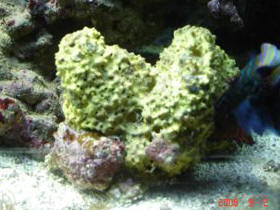
Yellow Sponge Question? - 5/4/07 Hello, <Hi
there! Mich here.> How are ya? <I'm mighty fine,
yourself?> I discovered a bright canary yellow sponge growing across
2 large pieces of liverock in my 125 gallon reef. I was wondering if I
should add anything to my reef to keep it happy and healthy? <Sounds
like it already is happy and healthy, don't think I'd change a
thing.> I also noticed a purple sponge that looks like vines and are
almost translucent. I noticed it growing under a large piece of
liverock and it is attaching itself to the skeleton of my Torch coral.
Should I be concerned about this? <Mmm, no, not overly, though if it
is easily done, you may want to shift the Torch away from the
sponge.> Can you tell me what these might be? <Mmm, what species
of sponge? Mmm, no, sorry, there are over 5000 species of
sponges. Microscopy work is often needed to identify
sponges.> As always thank you in advance...
<Welcome! Mich>
Mystery Growth - Haliclona sponge? -
04/04/2007 Hello crew. <Hi, Tom! Sabrina with you
today.> I'd like to start by saying thanks for the great web
site. I would have left this hobby after a month if I had not found
it. <Wow.... Excellent (and important!)
testament.... Thank you for sharing this. It
is very encouraging to realize that our efforts do reach the
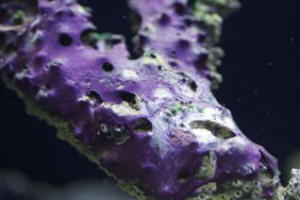
intended goals!> With that I would like to know if this purple
growth can be identified? <I hope so.> It is a deep purple
and in spots has a dark green. I thought it was coralline algae but
have read that it maybe Cyano bacteria. I have looked at a lot of
pictures and can not find any that resemble what I am seeing.
<It actually looks VERY much like an encrusting sponge, maybe
even Haliclona vetulina, though it doesn't seem to have the
"star" pattern that H. vetulina exhibits. It
doesn't look like Cyanobacteria or algae to me, from the images
provided.> The tank is ten months old and is fish only. I have
some dead corals and the growth is attracted to them mostly.
<Any live rock? Any previously live corals, or things
that came from reef tanks, anything like that? If so,
I'm still comfortable saying I think it's an encrusting
sponge.> The water parameters are AM=0, NI=0, NA=10. I do
regular water changes at five gallons per weekend and ten on the
fourth change. I also age the water for three days before I use it.
<Very good.> The tank is a Sea Clear System 2 forty gallon.
There are two inches of mixed sand and crushed coral. I also have
the Sea Clear venture skimmer installed. I would love to get a
better skimmer but could not find one the would work with the
design of the tank. We are waiting on a new custom one hundred and
eighty gallon tank to be built and I have not decided if this tank
will remain or if I will take it down. <If it IS sponge, and you
choose to keep it, be certain NOT to expose it to air, if
avoidable.... keep it submerged, even when moving it
from tank to tank.> So if this is Cyano will I be able to wait
it out a few months? <Probably. If it is Cyano (I
don't really feel that it is), you can try manually removing it
'till the move.> The biological load is as follows. One
Dottyback, one Yellow Stripe Maroon Clown, one Algae Blenny and a
Blue Hippo Tang. The new tank is for the Tang. <He'll
appreciate it, to be sure!> I have included two pictures to
help. Thanks you for your time and effort. <Glad to be of
service, Tom, and again, thank you for your kind and encouraging
words!> Tom
<All the best to you, -Sabrina> |
|
|
Tunicate Invasion 3/5/07 Hello:
<Hi.> You have been very kind in the past in answering my
questions and I hope you can help me with this one. Not long after
I transferred my very healthy Dwarf Zebra Lionfish from to my 55
gallon display tank, I began to notice white specks on the glass
and ornaments. They were accompanied by the things in the photos
attached to this email. They look like some kind of parasite but
they are not affecting the fish at all. They are though making my
tank look terrible as you can see. I keep the water and gravel very
clean and I also scrape the glass but these things return. The tank
has been up for five years and I never saw these things UNTIL I put
the Lion in there. What are they and how do I get rid of them? As
always, any help is very much appreciated. Thank you for your time.
<These are tunicates, are not directly harmful/parasitic at all.
Please see WWM re: for more detail about them. an
overabundance may indicate an underlying nutrient issue though.>
Robert Sabbia
<Adam J.> |
|
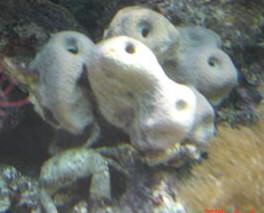
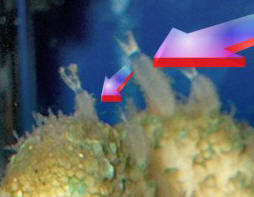 Mmmm, no. Are Syconoid sponges. RMF Mmmm, no. Are Syconoid sponges. RMF
|
Blue Sponge 1/14/07 Hello, <Hello Ellen> I am so
thankful that you guys are here and answering millions of questions.
You all are great! <Thank you.> I do have a question about a blue
sponge that I purchased several months ago. I placed it on some live
rock about the middle of my tank. It was doing well until recently. It
is starting to reduce in size and it is starting to spread out onto the
live rock. Is this normal or is this sponge dying? Really difficult to
say without a pic. If this sponge is a Haliclona species, I
can tell you that they like strong water movement and a good
amount of light as it thrives in direct sunlight in shallow
water. Haliclona are filter feeders taking in dissolved
organic matter along with being photosynthetic.> Thanks so much.
<You're welcome. James (Salty Dog)> Ellen
Re: Please I need Help with sponge ID 9/3/06 >
<Mmm, yes... match them up here: http://www.wetwebmedia.com/sponges.htm > Or, as you're
so fortunate to live where you are, being able to collect your > own
organisms, I'd invest in a set of Humann & DeLoach Guides. Bob
Fenner> > Thanks for your help, I am still a little bit confused
about conditions, I placed them in the bottom of my 33 inches deep tank
with some slight shadow and medium current. <Mmm, well... a good
many sponges aren't easily kept in most aquarium conditions...>
I will try to locate the books you suggested, <The Paul Humann, Ned
DeLoach works are mainly identification, diver oriented... I would
(quickly) look for the Modern Coral Reef Aquarium series by Alf Nilsen
and Sven Fossa as the most reliable source of practical aquarium
husbandry information. Vol.s 1 and 3 in English editions. Cheers, Bob
Fenner> Thanks again
Claudio
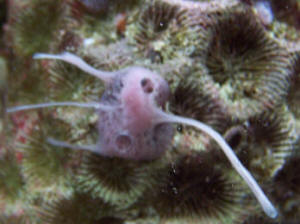
| Species ID Hello WWM crew, <Don and Nan> I am new
to the hobby and I am having difficulty identifying something
growing in my aquarium. Please see attached
photo. I have these small pinkish blobs growing in a lot
of places on the live rock. Some are growing clear
tentacles as shown in the photo. What are
these? Are they problematic (i.e..
pest)? They are not growing particularly fast, but they
are certainly multiplying. If it is a problem, how do I
deal with it or get rid of it? Thanks for the help... Don Ouimette
<Some type of sponge/Poriferan... See WWM re... not harmful...
Bob Fenner> |
|
|
| Red Algae or Sponge ID Well Bob, nothing I
do with these photos seems to work! Here is my last attempt to send
these to you for ID. I am stumped about what they are and really
wanted to know. Below is the original message and your invitation
to email directly to your address. Jeanne Hey there Bob and
Anthony, et al First, I hope to see you at IMAC again this year. I
really enjoyed our pizza lunch with Dick Hilgers! Bob, how did your
wife do in the marathon last June? <Mighty fine... her first and
she came in and wasn't really tired! Di's trying to enter
the New York...> Ah well, on to the question... I've
searched WWM and the algae site, but without an actual name it is
hard to find things. What is this stuff and is it evil? Thanks,
Jeanne <Isn't evil, not an algae... see the "little
mouths?" Methinks this is a sponge. No worries. Bob
Fenner> |
|
|
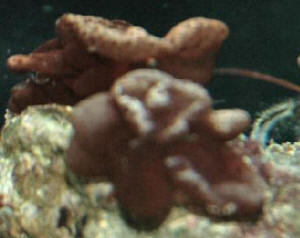
| Please help me with sponge ID I have this
beige colored branching sponge no more than 1/4 inch long all over
the place in my reef tank. It was under control for years but now
is quite a pain. Dr. Ron Shimek diagnosed it as a when he tested it
and the spicules showed. But he didn't tell me anything else.
Can you give me an ID Name of sponge family and how I may rid my
tank. Thanks so very much, Jef <Mmm, impossible to tell from a
picture... even to the phylum... but if Ron said he looked, this is
a sponge... Maybe a Clathria species from gross anatomy (Order,
Poecilosclerida Topsent, 1928. Family, Microcionidae Carter,1875.
Genus, Clathria), but would need to examine spicules from different
parts of the colony... not easy to do... perhaps a good guess could
be gotten from examining reference works from the area where this
originated... How to control? Nutrient limitation, introduction of
probable predators, physical removal... Bob Fenner> |
|
Lost in Space
|
Black sponge three months ago we established our reef
tank. attached to one of the pieces of live rock was a black
sponge - species we have not been able to identify. <Not easily
done> it was doing quite well until a couple of weeks back when it
was located to a different area of the tank. it was a smooth
surfaced black sponge that within the past couple of days have begun to
look like a pool of black fish eggs (although some of the edges of the
sponge are still smooth). what is your assessment of
the state of affairs for the sponge? <Likely nothing to be concerned
about, and very likely little practically that you can/could do... are
you wanting to modify your water chemistry, attempt nutrifying this
colony... and doing all this with the other livestock present?> if
it is in ill health any suggestions to cure it. Thanks in advance for
your thoughts. <I would do "nothing" other than maintain
good water quality... consider my options... you could add an area
of/for cryptic fauna, an extensive live sump/refugium... these would be
of benefit to all... Bob Fenner>
Orange Frilly Sponge Hello again Crew, haven't had to ask
a question in quite a while. My LFS has a sponge for
sale. He didn't know the name of it which lead me to the
internet. I believe I have found the same sponge on
saltwaterfish.com. They call it an "Orange Frilly
Sponge". They do not provide a scientific name, just
that it eats plankton. Here is a link to the page:
Saltwaterfish.com --
Orange Frilly Sponge. I don't know if it is photosynthetic or
not. Basically, I don't want to spend money on it and
find out later that it's toxic to everything in my tank or to
me. Any info you can give would be appreciated. >>I
can't give much info on it, but I can tell you that they almost
always don't do well in aquariums. I would avoid it and spend the
money on something else! Rich>.
Re: Creature ID - sponge? Dear Crew, <Dawn> After
sending the mail below, I think I have located something very similar
in the sponge section... http://www.wetwebmedia.com/spongeidfaq2.htm Not
certain how I missed it, it's right there! <Happens to me all
the time> The only difference seems to be the color. The
one in my tank (pic attached to original email), is the color of a
raspberry. Any idea what kind of sponge it is? <Not
without actually taking a small piece and "melting" away the
tissue, examining sclerites... Not easily discerned to species>
Thanks again, Dawn Branam <Thank you for writing, sharing. Bob
Fenner>
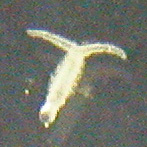
| ID... tough to say 7/13/04 Hello, Very hard to search
for these things online. Wondering what this thing is. Suddenly my
tank has many of these attached to various things, mostly the
glass. They don't move at all. They're very small. Thanks.
<its tough to say from the image my friend... just too
blurry/low-res. I do realize its quite difficult to photograph
items this small though. Taking a shot, let me suggest you do a
keyword search with the Google search tool on our home page for our
website: plus in "Sycon" or "Syconoid sponge".
These are small pillowy Poriferans that commonly flourish in
aquaria and look like a little critter or polyp popping up in the
recesses of the tank. Anthony> |
 |
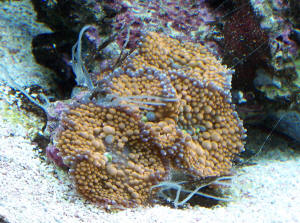
| "Goo" on my Ricordea... spreading sponge
7/6/04 Here's my best shot at a scientific statement
regarding a problem with a small piece of live rock / Ricordea...I
have "goo"....this stuff started growing underneath my
Ricordea, then it slowly began moving to other sections of the
small piece of live rock that the Ricordea was purchased with (nine
months ago as one mushroom...now about seven), and now it has grown
long fingers / branches that attach to anything it
touches. Is this "goo" something I should try
to get rid of? If so, what do you recommend? (Please see
attached picture) Thanks, Scott. <it is a healthy, calcareous
sponge that can grow to nuisance measures but only so in the
presence of adequate nutrients. If it flourishes... its a sign that
you may have nutrient export control issues (too much feeding, poor
protein skimmer performance, weak water change schedule, etc). It
is not photosynthetic and as such is wholly dependant on filter
feeding in the system. Control the nutrient and you will control
its growth. Anthony> |
 |
|
|