|
FAQs on Sponge Identification
4
Related Articles: Sponges in Marine
Aquariums
Related FAQs: Sponge ID
1, Sponge ID 2, Sponge ID 3, Sponge
ID 5, Sponge ID 6, Sponge ID 7, Sponge ID
8, Sponge ID 9, Sponge ID 10, Sponge ID 11, Sponge ID 12, Sponge ID 13, Sponge ID 14, Sponge ID 15, Sponge ID 16, Sponge ID 17, Sponge ID 18,
Sponge ID 19, Sponge
ID 20, Sponge ID 21, & Sponges 1, Sponges
2, Sponges 3, Sponge Selection, Sponge Compatibility, Sponge Systems, Sponge Feeding, Sponge Disease, Sponge Reproduction,
|
|
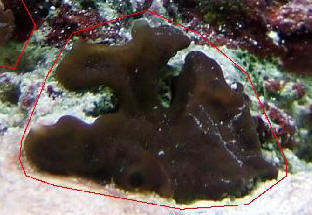
Sponge ID 9/22/06 Could you
possibly identify what this is? I noticed it one day behind one of
my power heads. I enclosed a pic. It looks like a miniature clear
or white colored tree branch all scrunched up. Sometimes I notice
small "bugs" that resemble fleas inside the branches. Its
very small and unusual to me. Any help would be appreciated.
<Appears to be a sponge, quite possibly. a type of Clathrina.
The critters are more than likely copepods/amphipods, good snacks
for the fish.> Thanks.
<You're welcome. James (Salty Dog)> |
|
|
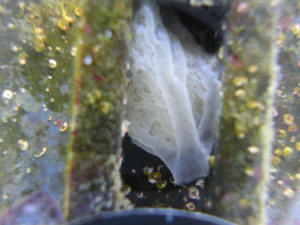
| Help with Sponge ID 8/31/06 Can you
help me id this sponge so I can research it more? <Yes... this
is a Syconoid> I have already searched the net but could not
find a positive match. Maybe Sycon or Syconoid sponge, but I
haven't seen them with the extended tubes? <Quite common in
aquariums... and in the wild if one looks about> The
tubes have grown longer now and have entwined each other like
spaghetti and look like they have attached to each other in one
large mass. There are about 50 small ones in my skimmer and more
every week in my tank. I do not want a tank of sponges
and I have heard that sponges can also become toxic and crash a
system, so should I remove them and give/trade them
away? <Mmm, this group is rarely problematical...
can likely trade some about> If they are beneficial and do not
require light, I would like to move some to my new sump too.
<Good idea... if they'll "take" there> Thanks
for your time, Pat <And you for sharing yours. Bob Fenner>
P.S. You may use the picture Patrick |
|
|
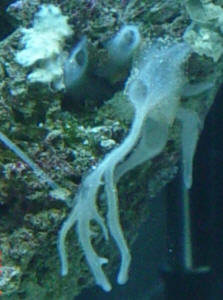
| Sponge ID - 01/01/06 Hi, <<Hello>> Like
everyone else I keep coming back to your page when looking for
answers about my aquarium you have been a great resource.
<<Happy to help>> I have attached a photo of what looks
like two different sponges that grew on the live rock my coral is
attached to. Could you identify them for me? <<The
white one is a Syconoid sponge, the yellow is a type of encrusting
sponge. Both are harmless if not beneficial.>> Not
sure what I am doing right but they seem to like where they are and
I like them. Hope they are nothing to be avoided.
<<Not at all, do enjoy them.>> Anne <<Regards,
EricR>> |
|
|
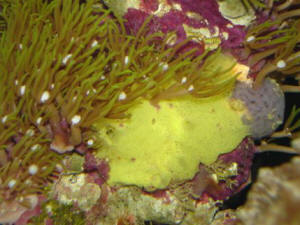
| Beautiful color, what is it? 11/21/05
Greetings crew. Great site; immensely helpful. I'm new to the
marine aquarium thing, but have been considering and researching
for a number of years. A recent trip to Cancun, including
snorkeling a few spectacular reefs, sealed my fate. <Good!
Wonderfully complementary hobbies, interests, vocations> I have
a 38g glass tank with Coralife Super Skimmer which, FWIW, seems to
perform very well, 192w CF (96w actinic 96w 10K) with 2 3/4w
moonlight LEDs, Fluval 403 with media (ceramic, carbon, sponge) and
2 maxijet900 powerheads (230gph each), outboard 200w heater. I
execute bi-weekly water changes of about 6g and my parameters are
fairly consistently 0 ammonia, 0 nitrites, 0 nitrates, 0
phosphates. I have to keep a close eye on ph, but maintain it at
about 8.2. SG is 1.022, temperature pretty consistent at 81deg.
Livestock consists of: 2 blue devil damsels 1 Coral beauty 1 Rusty
Angel <Both in such a small volume... troubles ahead> 1
Maroon clown <Ditto> 1 Blood shrimp, who molts pretty
consistently every two weeks Half dozen margarita snails 1 Olive
snail, sand sifter (is he a carnivore? He comes running when
he smells Mysis in the water) <Yes> Hairy mushrooms on one
rock Red mushrooms on a second rock Maroon-ish mushrooms on a third
of the glow in the dark variety Mystery yellow 'stuff'
(I'm assuming sponge and the subject of one of my questions)
<Is...> About 30# live Fiji rock About 10# of Tufa About 1in
aragonite I have two questions, one re calcium content, the other
about a new acquisition: My calcium level is consistently above
520, <Too high> the highest my test kit will measure, and
this without my supplementing it. Is this due to the Tufa leaching
calcium, and is there any danger in this? <Possibly and yes...
best to "knock down" with the addition of carbonate,
bicarbonate...> I like the Tufa because the two rocks have great
caves that the fish like at night. I also expect that eventually
they will become live rock with great porosity. I'm also
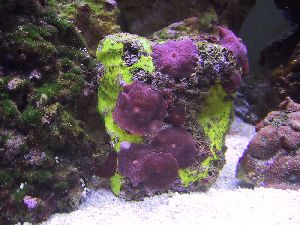
attaching a picture of a small rock I bought because of the
beautiful yellow 'stuff' on it. At the LFS, they said it
was probably a sponge, but could be algae of some sort. <Much
more likely the former> What is it and what can I do to ensure
that it thrives? <What you're doing... there is obviously
the "right" or favorable circumstances present from your
set-up, maintenance... endogenous foods, water movement, a dearth
of predators...> It's why I bought the rock. It also has a
nice population of mushrooms and various small feather dusters,
etc, but I really like the color it adds to my tank. Thanks
for your help, and the eagerness of you all to help the community
at large. Regards Phil <Welcome. Bob Fenner> |
|
|
| Sponges & Polyps 10/12/05 Hi, I apologize for
probably asking you the same question you've been asked a
hundred times, but I couldn't find exactly what I was looking
for. I have a 29 gal. fish/reef tank with live rock. We have been
very lucky with our tank, it has been up and running for about a
year. Within the last month (we have added no new live rock) we
have noticed several new growths, and I am not sure what they are.
We seem to have 5 different kinds of sponges growing and some
polyps. There is a fuzzy ball-looking sponge (no pic since it's
behind some rock), and a patch of white-ish sponge (again no pic).
<You can likely see what you have... on WWM... on the Sponge ID
FAQs files> What I have included is one picture of a black
sponge... I apologize for the fuzzy pic, but it is definitely a
sponge with holes for passing water through. <I agree with your
identification> The other sponge pic has two on it, on the left
is a patch of orange that I am unable to identify, and to the right
is a purple sponge which I am assuming is a tubular sponge. <Too
small, blurry for me to make out> We have several of the purple
ones growing in different areas of the tank. Since they are
multiplying I am guessing that whatever we're doing is good for
sponge growth. What I am wondering is do we need to do anything
special/different? <Mmm, nope> Can you help me identify the
black and orange sponges? <Not from these, or pix... if
you'll read a bit you'll find that such species, genera,
sometimes family ID's require microscopic examination of
sclerites...> We are enjoying watching them grow and would like
to keep them alive if possible. <Can be... their presence is
indicative of healthy state... are of use> None of our fish
bother them, but as far as lighting we only have one blue actinic
and one full spectrum daylight. <These are likely
non-photosynthetic> We also have moonlights for nighttime. This
lighting has worked fine thus far since we do not have corals. I
have heard that sponges prefer shaded areas, and indeed the ones
that are more shaded are growing faster. My other question is for
the third picture...(again, sorry for the fuzziness). The appear to
be bright green polyps, and also a colony of peach colored polyps,
but are definitely not star polyps...they are more flower-like and
look more feathery and delicate. I have been trying to look up
green polyps but haven't found any answers. Any ideas on
exactly what these are and what is the best care? <Look to be
Clavulariids... can be searched by this name> I know our
lighting is probably too low for these to survive, but they are
multiplying actually quite rapidly. Sorry for the length of my
questions, and thank you in advance. ~Jennifer <Read on my
friend. Re-direct your curiosity to delving into what you're
interested in. Bob Fenner> |
|
|
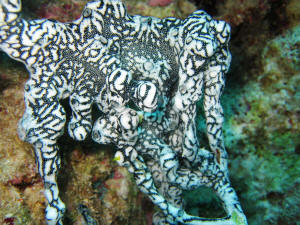
| Sponge/Asc. identification 9/29/05 Is there any
chance you could identify this splendid sponge for
me? At least I think it is a sponge--it appears to have
siphonophores. The photo was taken in the Red Sea <A nice pic...
of an Ascidian, sea squirt... Please see here: http://wetwebmedia.com/ascidians.htm Bob Fenner> |
|
|
Have you heard of an orange sea sponge called codmium?
9/10/05 My daughter has a science paper to write, and we are not
sure if this is the correct spelling or not. We have been unable to
find information on the Internet. Thanks, Michele Reader <Mmm, a
search on the Net turns up nothing for this spelling... there is a
genus of algae called "Codium"... otherwise, you might have
success perusing our postings of sponges: http://www.wetwebmedia.com/sponges.htm Bob Fenner>
Syconoid Sponges...Probably - 08/18/05 Dear Crew,
<<Hiya!>> I have a problem that I hope you can solve.
<<I'll give it a try.>> I have a 12 gallon reef tank
with almost 40 lbs of live rock <<Yowza!...how do you have room
for anything else?>>, 3 inches of live sand, a 10 gallon
refugium, 65 watt power compact 50/50 light, 1 blue damsel, a green
Chromis, and a hi-fin shrimp goby, a cleaner shrimp, 6 red hermits, 7
snails, and various corals. On one rock that houses 6 red mushroom
corals, I see about 20 small, white, cotton ball looking
objects. <<A sponge of sorts most likely.>> The fish seem
to stay away from it, as well as the hermits and shrimp.
<<Hmm...likely not related to the sponge.>> The cotton
balls also have feather looking objects coming from the
top. Some are about half an inch tall, the others are about
1/8th inch. Do you have any idea what these are, or if they are
dangerous. <<Sounds like Syconoid sponges...harmless if not
beneficial.>> I did have one leather finger coral die and almost
dissolve before I figured it was dead (it didn't lose any
color. Could this be spawn of it. <<Not likely in my
opinion...would look to other sources/problems.>> Also what
confuses me the most is they are on the back of the rock, out of the
light, towards the back of the tank. <<Yes...many sponges prosper
in these type conditions...helps prevent being overgrown by
algae.>> Thank you so much Josh <<Always welcome my friend,
EricR>>
Syconoid Sponges...Probably (II) - 08/19/05 Dear Eric,
<<Joshua>> Thank you so much for the info. It
really eased my mind. Joshua. <<Is my pleasure to assist and
assure. EricR>>
| ID Troublesome Encrusting Algae, Sponge Hi
guys, I've searched & scanned the archive and couldn't
figure out what this is... Photos are attached. It's a
reddish-brown, spongy algae (or sponge?) <The latter> that
encrusts rock, GSP fairly quickly. I originally was scrubbing it
off with a toothbrush, but now I'm seeing little bits of it
replicating/seeding in more & more places. Can you tell me (a)
what it is, and (b) how to either exterminate it, or at least keep
it under control? Thanks!! John <Likely nutrient limitation is
your best approach here... along with physical removal, perhaps a
search for a purposeful predator. Bob Fenner> |
|
|
Sponge IDs? 7/19/05 Dear Sir bob, <Not knighted...
yet!> Good day! <And to you> First and foremost, I visited
your website and read some letters of your fans and sponge enthusiasts.
Well, I'm very satisfied of your scientific information and
explanation regarding sponge or related to sponge. In this connection,
I would like to ask a favor from you or need your help to check the
sponge images in their scientific names of our new launched POPPE
IMAGES for some of the images cannot be identified or we are confused
which is based on the picture only. Even if we have some books for
reference but still it is not enough to relay the right or correct
information to the possible client. <Uhhh...> It's really a
great honor and a great privilege for us that you will correct our
works. For further information, please visit our website.
www.poppe-images.com Looking forward to hear from you soon. Sincerely
yours, LEONOR O. ABAD Marketing Correspondent Conchology, Inc. Cebu
Light Industrial Park, Basak, Lapu-Lapu City, Cebu, Philippines
Web : www. conchology.be <Few Sponges can be accurately
identified to species from photographs... I would contact folks who
specialize in Poriferan systematics (mostly at colleges), with
specimens or parts of colonies... and ask for their help. Bob
Fenner>
Re: Sponge IDs 7/20/05 Dear Mr. Bob, Good day! <And to
you> Sorry for the "sir" thing for we have the standard to
call the person that way as a sign of respect. <I see> Thank you
for the reply. I really appreciated even in your busiest day still you
manage to answer me. <We answer all> And I would like to thank
you also as what you said in your replied letter that you are going to
contact some of your friends or colleagues who specify in Poriferan to
ask them for help. <Ah, good... the University at Banos (where
fishbase.org is produced) I believe should have some folks that
can/will help> Looking forward to hear the good news from you. More
power!
<Be chatting, Bob Fenner>
|
|

