|
FAQs on Marine Ich,
Cryptocaryoniasis & Velvet: & Treating Sensitive
Fishes: Puffers & Kin
Related Articles: Marine Ich: Fighting The War On Two Fronts
Cryptocaryoniasis, Parasitic Disease,
Quarantine, Quarantine of Marine
Fishes,
Related FAQs: Marine Puffer Disease,
Marine Puffer Disease 2, Marine Puffer Disease 3, Marine Puffer Disease 4,
Marine P
uffer Disease
5, Marine Puffer Disease
6, Marine P
uffer Disease 7,
Best Crypt
FAQs, Crypt FAQs 1, Crypt FAQs 2, Crypt
FAQs 3, Crypt FAQs 4, Crypt FAQs 5, Crypt FAQs 6, Crypt FAQs
7, Crypt
FAQs 8, Crypt FAQs 9, Crypt FAQs 10, Crypt FAQs 11, Crypt FAQs 12, Crypt FAQs
13, Crypt FAQs 14, Crypt FAQs 15, Crypt FAQs 16, Crypt FAQs 17,
Crypt FAQs 18, Crypt FAQs 19, Crypt FAQs 20, Crypt FAQs 21, Crypt FAQs 22, Crypt FAQs 23, Crypt FAQs 24, & FAQs on Crypt: Identification, Prevention, "Causes", Phony Cures That Don't Work, Cures That Do Work, Products That
Work By Name: Free Copper/Cupric Ion
Compounds (e.g. SeaCure), Chelated Coppers (e.g. Copper Power,
), Formalin Containing: (e.g.
Quick Cure), About: Hyposalinity & Ich, Treating for Crypt & Sensitive
Fishes: By Group: Sharks/Rays, Morays and other Eels, Mandarins/Blennies/Gobies, Wrasses, Angels and
Butterflyfishes, Tangs/Rabbitfishes, &
Parasitic Marine Tanks, Parasitic Reef Tanks,
Marine Velvet
Disease, Biological Cleaners, Treating Parasitic Disease, Using Hyposalinity to Treat Parasitic
Disease, Infectious
Disease,
|
Chemically Treating
Puffers...
Copper can be used (in RMF's opinion) but at
the lower effective, physiological dosage... and only with
careful testing... twice or more frequently daily.
Many others prefer to use Formalin (dips) or
Quinine cpd.s
|
|
Long horned cowfish question 3/16/16
I've had my salt water tank for over two years now and my cow fish about the
same time. He's done great until I added a very small amount of
coral to the tank (about 5 weeks ago).
<Mmm; might be the source, of the pathogen, or enough added stress to
elicit... Crypt>
Now he has these white specks but that's it, behavior, eating and everything
else is fine I'm just concerned with how he looks and my other fish
are perfectly fine.
<Won't be for long>
All my levels are "perfect" according to the liquid drop testing (I've
noticed the stick strips say my levels are crazy
<These strips are neither accurate nor precise. Try reading on WWM re>
but I've also read a lot about those being inaccurate a lot due to the
maintenance required to keep them "good"). He has a very well rounded diet
of seaweed, algae tabs, Mysis shrimp, brine shrimp, blood worms, dry
plankton, and flake food with garlic (not all are at every meal they are
separated Morning and night) my tank has a 3 stage filter ( mechanical
filtration, chemical with an ammonia reducer, and a bio filter all changed
regularly but not on the same days) I also have a protein skimmer 150
gallon. This is my first saltwater tank, however it's my dad's second so
he's the more experienced one and claims he's okay but I'd rather have a
professional reassure me. We did our routine water change about 3 weeks ago
and still no change.
<Trouble.... deaths coming unless you act quickly>
His name is Otis
<My man!>
(after the cow from back at the barnyard) and I'm worried. I do have
copper safe
<... See... as in READ on WWM re puffers and copper exposure... NOT a good
idea. NEED to READ and act... lowered spg in the short term to buy you
time.... CP; other quinine... NOW>
on hand if it is Ick but I don't want to give him any chemicals without
knowing due to his sensitive skin.
<Good>
I also notice a few other posts on your page say to lower the salt but I'm
concerned about how that will effect the other fish.
<Better by far than the alternative>
Another person said it was "dead" skin
<... no. Dismal>
and to remove it with a cotton swab but he will eat plastic when acclimating
other fish, corals, etc. (all of my fish are bought local from the same shop
every time and have NEVER had a problem) this is new sense in
the two years I've had the tank nothing has ever happened *knock on wood*
the only time a fish has died is when two have jumped out of the tank, but
we now have a glass lid to prevent that.
He's very social and still comes to the tank to great me and other people.
His behavior hasn't changed just his skin. I'm also worried cause when I put
the coral in he accidentally bite me and there was some blood, but like I
said he has a thing for plastic and I had my hand in the bag trying to
get the coral out (which the coral is doing great as well)
My live rock is kind of low but the local shop here doesn't sell much and I
don't like buying online during the cold weather and living in upstate New
York our weather has been crazy!! Lately
Thank you so much and I really hope my dad is right and I'm just overly
worried ( I do the same with my boys too).
Sincerely,
Jillian
<The reading; ASAPractical; formulating a work-able plan and
then....
ACTION. Write back (after reading) if your path is not clear. Bob
Fenner>
|
.jpeg)
.jpeg)
Re: Long horned cowfish question
3/17/16
I did lower the salt level as suggested. I only lowered it to .0022
<1.022 likely>
(I'm hoping I remembered that number correctly) which is only a few levels
lower than my tanks "normal" and will lower more tomorrow.
What level do you recommend?
<... please search, read on WWM ahead of writing us>
I also bought vitamin drops to add to the food and will be adding krill to
his diet and live snails.
<Good>
All other fish and coral are looking/doing fine.
<Not too much lower if you have corals; other invert.s... Perhaps 1.021>
Any other ideas for him?
<YES! The reading re Cryptocaryon and puffers:
http://www.wetwebmedia.com/cryptpuffs.htm
Didn't I stress the need for READING then ACTION? Your fishes may soon be
all dead>
I wasn't sure on some of your abbreviations so I hope I acted correctly.
Also did you get the photos I attached to the last email? There was no
comment on if it looked like Ick or anything.
<.... ?~! Re-read below... SW Ich IS Cryptocaryon.... Bob Fenner>
|
Puffer and Cupramine
5/27/15
Hey Bob, I have a dog face puffer in a bare bottom QT for treating Ich. His eyes
are a little bit cloudy but that's it for symptoms so far. My question is
will 0.3 of Cupramine be enough to rid him of the parasite?
<Maybe... Tetraodontids, puffers in general don't "like" copper exposure....
often kills them w/ exposure... and Crypt can often "hide" buried deep enough in
their copious mucus. Better to use Quinine compounds for Protozoan issues w/
these an many other fish groups... This is gone over on WWM>
He's doing fine now on that dosage and I'm nervous to bring it up to full
concentration. (0.5) Also should I keep him exposed for the full 14 days or
less?
<Mmm; well... insufficient strength in equivalent of Cu++ concentration
will not effect a cure period; only marginally poison fish hosts>
My other fish are in a separate QT with levels of about 0.4 and doing fine.
I just hope that's enough to kill the Ich.
<Should be>
Thanks as always,
-Jay
<Need to test for [Cu] at least daily (twice if it were me/mine) and adjust (add
more). Bob Fenner>
Re: Puffer and Cupramine
5/27/15
Ok, I will begin filtering out the copper with poly filters. Can I still dose CP
after the filters stop turning blue?
<Yes>
I have a container of "Fish Quine" which is CP, but it expired in 2013...
I'll have to order a new batch. I just don't like the fact that the hobbyist
cannot test for it like copper; plus there are so many different conflicting
views on how to properly dose it. I followed the directions during my last
outbreak and killed a pearl scale butterfly. How would you dose it if you had
to.?
<As posted on.... WWM>
Thanks!
-Jay
|
Ich/Puffers and Hypo
2/21/15
Hey crew, thanks for doing what you do!
<A pleasure, honor and life-fulfilling to share>
Question, I see that you don't recommend hypo treatment for Cryptocaryon
(SW "Ich"). In the case of Holocanthus puffers, copper treatment is suggested to
be potentially very harmful.
<Yes>
I'm just doing the freshwater dip now and heading to the quarantine tank.
Was set to hypo, but if you don't recommend hypo, what would you
recommend for Holocanthus that you would consider a safe, effective treatment?
<Chloroquine phosphate is best currently. Use the search tool on any page on
WWM...>
I did do a search using some terms but didn't come up with something (probably
just didn't do it right!)
Thanks very much,
Scott Goorland
<Welcome. Bob Fenner>
Re: re: Ich/Puffers and Hypo 2/21/15
Bob as a ps- I know in my last note I went from the no hypo/copper to
some level, but just trying to find something prophylactic till I get my
hands on the right stuff.... Thanks so much again
<Figured, but thank you for this clarification. BobF>
Re: Ich/Puffers and Hypo 2/21/15
Bob, thanks so so much for your super fast reply! I've read your
articles and books for what seems to be a very long time! (I was a U of
Miami grad in the 90s from the Marine Science school, went a different
direction but never left the love of it!) I've read up before on
Chloroquine, hear super things about it. Your support of it is even
referenced in a Pufferforum
post. I even was able to get some Dr G's which i soaked shrimp in and
feed the puffer with it while I got the QT set. Of course, Dr. G's only
provides an internal medication, and does not treat the external
parasite in the tank. That would require dosing.
<?... the quinine does treat for external Protozoans>
The problem I've had is that I can't seem to find anyone that carries
it.
<... See here:
http://wetwebmedia.com/QuinSourceF.htm
Most of the LFS's have never even heard of it. And the one that sold me
the Dr G's, who swears that Chloroquine does wonders, doesn't carry it
because he's just start up and dealing with start up costs. I can't
quite understand why if it's as effective as I've read, it isn't fully
commercialized.
<Meh... newer tech; the regulations... expense of start ups; lack of
momentum...>
I'm going to see if I can find it somewhere, I haven't had much success
on the web either. Any thoughts on where to find a product?
The LFS guy is trying to order some for me from a place in Gainesville,
FL (we're in West Palm Beach) if he can. But he says it will be until
Thursday before he could get any in. (he did say the market for this
should open up, in his opinion it's been limited to commercial
operations).
In the meantime I was going to try one of two options to get things
going for the puffer. I dipped him in fresh water last night on the way
to the QT for 10 min.s. 'Most' of the Crypto came off. He's swimming
happily in the QT and begging for food. (note, all the other scaled fish
will be placed in a separate QT and copper dosed, and the DT left fallow
for 6 weeks). I am considering starting either a hypo treatment combined
with a daily formalin dip and daily 50% bottom vacuumed water changes;
or a half dose Cupramine regime, which I've read can be effective
against crypto and if slowly dosed up correctly is safe for puffers (of
course, keeping a close eye on levels and behavior to make sure). Any
thoughts on these as
prophylactic while waiting for a Chloroquine supply?
Thanks again,
Scott Goorland
Re: Ich/Puffers and Hypo 2/21/15
Got it! Fish Pharm CP. Not cheap but worth it! Will keep extra on hand
(and thus also support the market growth!) Do you have dosing
instructions on WWM?
<Yes>
If so I can do a search, or I can contact fishPharm. Will also look at
that NLS Ich Shield Powder, seems to contain chloroquinine as a dip. Re
your question of why I mentioned Dr G's for internal, what I meant to
say (I probably could have said better) is as I understand it, the
product works on the fish itself (internally and externally), but not on
the tank water in the QT where the crypto will still remain unless I
somehow treat that as well?
<Don't understand this statement... but quinines are not effective on
free-swimming and off-host intermediates as far as I'm aware. B>
Thanks again for all you do Bob
Re: Ich/Puffers and Hypo
Hoping to help spread the word, here's another supplier I found, no word
on quality:
50-63-5 | Chloroquine diphosphate salt, 98% |
N4-(7-Chloro-4-quinolinyl)-N1,N1-dimethyl-1,4-pentanediamine diphosphate
salt | J64459 | Alfa Aesar| Alfa Aesar
| 50-63-5 | Chloroquine diphosphate salt, 98% | N4-(7-Chlo...Hazard
Statements ...
| View on www.alfa.com
<Thanks. B>
Re: Ich/Puffers and Hypo 2/21/15
As I understand it, I can treat the fish with CP foods, but even with
treatment if the off host intermediates are still in the water, unless I
eradicate the off host forms as well, they'll just keep attacking the
host.
If quinines don't treat off host intermediates, won't the problem just
continue as a cycle until I find some way to treat those as well? Scott
<A few approaches can work here: Moving hosts to non-infested systems
serially... in actual practice, IF one is dealing w/ a single (not
multiple, over-lapping) generations of Protozoans, eradicating those on
the host fishes generally effects a system cure. Reducing the numbers
and viability of parasites off-host can be done in numerous ways... B>
Re: Ich/Puffers and Hypo 2/21/15
Now that is great! Looking forward to the employment of the method!
Thanks
again for all. Scott G.
<Ah, welcome. BobF>
Re: Ich/Puffers and Hypo
3/1/15
Hi Bob, the tank transfer method with a FW dip in between seems to be
working well for the porcupine puffer
<Ah, good>
, no new spots showing up, about to move to the third transfer (trying
to keep it every three days for four switches, with daily water changes
in the tanks). Two completely matching systems that each get washed down
and left dry for a day before resetting. Cutting the dip as it's been
heavy on the stress (for him and me watching him!). Slowly lowering SG
down to 1.016
for his comfort. Got NLS Ick Shield Powder on hand in case after the
fourth switch I need to try to move to Chloro-Q treatment. (Got word
that major shipments of CP have been moved to Asia due to a new Malaria
outbreak).
<Yikes; this ancient human nemesis still kills more than a million
people /year>
He's eating well. That said, he has a cloudy eye and lethargy. I'll try
to boost his immune system with a food soak in Selcon or something
similar, but I also am considering dosing an antibiotic. A search on WWM
indicates Kanamycin is the favorite, but it's not carried locally. I'm
going to express order some, but is there another antibiotic you
recommend that may
be more available?(assuming you recommend one at all?)
<I don't; really... though Furan compounds are a fave for extended
baths>
I read on WWM that Erythro isn't preferable for salt bacteria
infections.
Can't seem to find anyone locally that has anything as a broad spectrum.
Scott G.
<Do look for a cheapy e-download of Ed Noga's "Fish Disease; Diagnosis
and Treatment"... You'll enjoy, benefit.
Bob Fenner> Re: Ich/Puffers and Hypo
3/3/15
Thanks for the book tip, I'll make sure to pick that up asap! (haven't
found a cheap version yet, looking, but I'm not too concerned even if I
can't, seems worth the investment!).
<.... ?! Just took a look....
http://www.amazon.com/Edward-J.-Noga/e/B001K8PPX8/ref=sr_ntt_srch_lnk_3?qid=1425322044&sr=8-3-fkmr1
I thought somehow the Kindle vers. was ten dollars... it's 84.49 US!!!
Even the first edition is too much money used>
Unfortunately the porcupine puffer again has gone a bit downhill. He was
really energetic and perking up until the tank switch with the dip in
between. He didn't react well to the new tank at first, jumping around
seemingly trying to get out. Once he calmed down, and ever since, he's
been very listless.
<Patience here>
Pale. I don't see any more crypto spots on his skin, but his eyes have
cloudy spots in both now. He's also every so often swimming and turning
on his side, and trying to push his side around his gill area into
whatever object is beneath him, or the tank bottom. Then he'll remain in
a back corner facing away for lengths of time. I halted the tank
changes, did a water change last night, raised the temp up 2 degrees
from 76 to 78. At this point I'm concerned he needs some form of meds
asap.
<No...>
(also thinking there may be shock symptoms from the salinity switch from
fresh to salt again? The dip was at matching pH and temps). He did eat
today (vitamin enhanced). To be on the cautious side I dosed a slightly
below recommended dose of KanaPlex, concerned that I needed to do
something asap. But I'm thinking perhaps the crypto is there but I'm not
seeing
anything more than his eyes? And perhaps I should do a water change and
start dosing the NLS Ick Shield Powder, which indicates a quinine
component. I'd do both since I don't know if it's either, but I don't
know that I can mix those meds.
<Time going by. B>
Re: Ich/Puffers and Hypo
3/3/15
Yep those are the prices I found as well. but honestly, if you think
that's the best out there to help, it's worth to me.
<Mmm; did see one (I think first ed., for $47.50) on Jim Foshey's site
last night: Not searchable; so just call him:
http://www.seahorses.com/
Doing my best to stay patient... Keeping up with daily water changes.
Only dropped SG slightly to 1.020.
<A thousandth per day raising back up.... can be dropped precipitously>
Temp at 77. Antibiotic seemed to help at first but now not much more. Of
course its only been a day.... He's still looking a bit rough, eating,
but still has white spots on eyes and listless and when he does he keeps
turning on his side and pushing down into the tank bottom. Now I may be
seeing why. Instead of white spots, now he's developing brown spots. You
can see in the attached photos of yesterday vs. today, across the front
of his face between the eyes the brown spots developed between yesterday
and today. I now notice it at least seems to be more present elsewhere,
and there's one above and behind his right eye that is a small bump of
the same color that may be a sore, but hard to tell yet. Any idea on
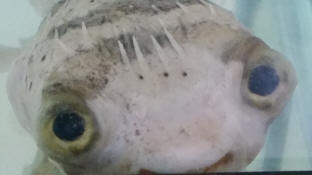
what could be going on?
<Quinine burned. BTW, do NOT send us 11 meg pix files... a few hundred
Kbyte is our limit. Bob Fenner>
Thanks much Bob. Scott G.
|
 |
|
Re: Ich/Puffers and Hypo
3/4/15
My sincerest apologies about the photo sizes. I feel awful about the chemical
burn. Just awful. He looks miserable but still eating.
<A very good sign>
Would the burn be a reason for spotty/cloudy eyes and for his consistently
trying to rub his left side on the bottom of the tank?
<Yes>
He's also now pulling his left eye into his body on occasion. Anything I can do
for him at all but wait?
<Stable, optimized conditions, good nutrition...>
Thanks so much.
<Welcome. B>
Re: Ich/Puffers and Hypo 3/5/15
Skin starting to look better but the crypto looks like it's back, fiercely.
Didn't see it until under flashlight this mornin, small white dots
everywhere.
<... can't tell what this is... w/o sampling, 'scope.... Could be coalesced
mucus... >
Plus small dots on tank bottom. White rather than gold and no sheen so really
hoping not velvet, but all over, small, and only visible under flashlight.
Considering chemical free (with ph/temp adjustment) fresh dip into the duplicate
QT today, then continue to optimize conditions. He did eat today.
Re: Ich/Puffers and Hypo 3/15/15
Bob, I just wanted to send a note of thanks. The puffer, Fugu, is doing great.
<Ah, good>
It took a lot of work, daily water changes, having two QT's set up and changing
every three days, freshwater dips, plus having to catch the other fish in the
display tank and set up a QT for them, but with patience, hard work, and a lot
of effort and a little loss of sleeping time, the payoff has been in seeing Fugu
slowly come back to the happy guy he was before all
this started. No more spots, skin color normal, swimming around looking for
food, eating all too well. I really did benefit from your
recommendations on more natural routes, patience, and decreased use of meds.
<I appreciate your saying so.... MANY people seem to express that they "just
want ""the"" answer"; as if I have some sort of truth to impart (I do not)... I
much prefer offering what little I have confidence in, the background rationale,
and helping folks to decide (as in nothing's decided till it's done) on their
course of action>
Just the tank transfers, water changes, fresh dips, and slight hypo to 1.016 to
ease his osmoregulation. He's in a 40 QT now, moving him to a 75 holding tank
while i wait for the display tank to cycle through for remaining crypto. Slowly
bringing up the SG a point per day. Will move the other fish into the 75 with
him (only a few small Chromis and a goby) in a few weeks when they're done with
their treatment. By the way, catching Chromis and a goby from a 180 reef tank
isn't easy!
<Oh no>
But I built a trap 12x14x7 out of acrylic with a sliding trap door that
i now call the "How to build a better Fish Trap"!
<I STRONGLY encourage you to at least post this design... here/WWM, on hobby
bb's... if not write up your experiences and this for pulp 'zine publication. I
will gladly help you make the submission>
just a few pieces of food, it's big enough the fish swam in, done. One Chromis
was a hold out, until i threw two back in, they schooled, went right in. Still
lots of work to keep the family happy, but with the cloud lifted, we're really
excited. Fugu is getting up there, he's about 11, but we're hoping to have him
around for some time going forward!
Thanks again for your help, WWM, and everything it does for us all.
Scott G.
<Certainly welcome. Thank you for the follow up, and DO consider what I've
suggested above. Bob Fenner> |
|
Urgent advice on a Crypt (suspected) infestation
11/7/14
I have a several month old large 75 gallon marine setup with a 20 gallon
sump.
I started with a 9" lionfish as my first fish after first establishing
with approx 25KG of live rock and 75KG of coral sand topped with 10KG of
CaribSea live sand.
<Okay!>
Then some snails, a hermit in the refugium and all sorts of bristle
worms and so on appeared from the live rock. I added the Lion Fish who
didn't eat for a few days but then started taking from a wooden skewer
and developed a very healthy appetite. About a month later I added a
large 7"ish porcupine puffer,
<Yikes... puffers and lions aren't usually good tankmates... the former
eating all the food, and getting poked/envenomized by the latter>
who had been in my LFS for over 8 weeks with no issues, no qt procedure
at all though. However he was eating almost immediately and seemed very
healthy and a great fish. Then several weeks after that I added a 3"
plus
Foxface,
<Hard to feed w/ these other fishes present and also venomous>
no QT procedure again,
<Ooooh>
boy have I learnt that lesson!, who immediately set to work on my green
hair algae and was very happy. About a week later I upgraded the tank to
a 125 gallon. All fish were in large plastic heated buckets with
canister filter for about 6 hours.
<All righty; but stressful as you know>
I added more new Coral sand and more CaribSea. After I added them back
the Foxface was never the same, and retired under a cave looking very
under the weather and a little blotchy, my wife thought she saw some
spots but never certain. A couple of mornings later he was dead.
<Ahh>
Then a couple of days later I could see spots on the fins of my puffer,
the next day his eyes had started clouding over and by the next morning
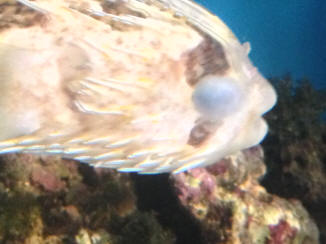
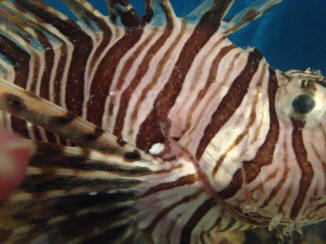
he was blind, as you can see in the picture, with lots of white spots
and started
to almost lose colour and go grey, there were also obvious spots on the
fins and body of the Lion and his eyes were a little cloudy. I spent
hours and hours reading but have no hospital tank and after initial
excitement at
things like Rid Ich and soon realized copper was my only hope if I was
correct about Crypt and decided on Cupramine after speaking to SeaChem
who said it gets absorbed but doesn't bind with calcareous material
<Mmm; to degree/s>
and could eventually be removed using CupriSorb, but most importantly
was less toxic on scaleless fish.
<True; compared with elemental copper solutions>
I removed all the inverts I could
<...>
and put in my first dose, but couldn't get a test kit anywhere, so
ordered one for next day delivery. Within hours the remaining inverts
were dead and dropped to the sand bed as expected, but also the puffer
that was already
breathing very hard, retired to a corner and was panting and very short
breaths. Over the next few hours his breathing stayed the same rate,
hardly any movement but got deeper, so I began to hope a little. During
that evening almost all the spots appeared to go on the Lion and his
eyes looked better, although this is hard to see properly as the spots
look at their worst under the blue LEDS, in between with the white
lights on and almost invisible with no lights and normal daylight or
incandescent.
The next morning the puffer was dead and the Lion appeared covered
again.
I went and got my test kit and it showed negligible copper,
<Yes; dropped out of solution; and absorbed by various sources>
less than .1, so I added another full dose and got it to .25, then
monitored during the day, having to redose, as expected to keep it
stable, the lion again seemed to clear itself during the evening and
shed its epidermis again and started swimming a little, (it was always a
lazy fish during the day anyway) then the next morning it was down to
about .15 so I gradually redosed up to about .4 to .45 as directed by
SeaChem and tested over and over during the day, having to redose about
8pm, but only 5ml to get back to the right dose. I guess that the
absorption is slowing down, again as SeaChem said it would. I also,
after reading more and more, decided on a freshwater dip with double
dosed Methylene blue, 5 minutes, which he hated and immediately hid in a
cave he barely fitted in for several hours, however, by the time we went
to bed he was swimming very strongly as he used to at night in the
various currents and on his 5th day of not eating still refusing food.
However all his dots appeared to be
gone just leaving behind little scars, presumably where cysts had
dropped from.
Now this morning the tank was down to about .35, so I've added enough to
get back to just over .4 ( I am pretty awful at these colour tests
though)
<Everyone I know is; myself included>
but he again appears covered in little white specs, and still refusing
to eat, but only trying once a day, he is sitting on the sand near a
cave, however that isn't unusual for the time of day. But with the dose
never dropping below .3+ for over 48 hours, I don't see how he can be
infested again.
<Happens....>
In the water column, especially under the blue lights, there are
hundreds of similar sized specs washing about, I assume small coral
sand, or dead copepods, is it possible that as the Cupramine increases
the slime coat
that these are just sticking to him when he stops swimming about?
<Yes>
and I am thinking he is being reinfected but he isn't?
<Could be>
I plan on continuing this for at least 14 days, however SeaChem have
suggested extending to 21 as I am not treating at .5, although this will
possibly mean he won't have eaten for 23-24 days by then. Should I
increase
the strength, ( I am making a reference .5 sample up side by side with
every test to ensure I get the dose right) or extend the treatment,
repeat the freshwater bath or........
<No value in increasing the dosage beyond what is physiologically
useful>
Any advice gratefully received,
<You can/will find my articles and thousands of responses to
Cryptocaryon organized and archived on WWM; in articles and books I have
penned...>
I loved both of these fish and would hate to lose my Lion too, I have
loads of freshwater tropicals, Discus and Koi and nothing has bothered
me as much as these two getting sick, and my knowledge to look after
them is
apparently woeful. I have included SeaChem support in this email as
their team have been incredibly helpful
<Ah yes; a VERY good company, staff; REAL products>
and responsive, so any help from anybody to try and save him would be
gratefully received.
Water parameters are;
PH 8.2
Ammonia was zero but showing a trace (But SeaChem say Cupramine causes
this as a misread)
Nitrite 0
Nitrate 5 (I have left my skimmer running)
Carbonate Hardness 11-12
I have also spoken to a very helpful exotic pet, but he just reiterated
I was doing the right thing and that Crypt was always present in marine
tanks and then I found he gets advice from my local LFS when he's stuck,
who has also been very helpful so decided not to pursue that route.
Regards
Trevor
<Mmm; well; we need to move back, proverbially to square one. Your
"case" (circumstances, events) are very common. NEED to assemble
compatible (more) livestock, NEED (as you state) to do your bit re
preventing pathogenic disease introduction (dips/baths, acclimation,
quarantine/isolation...), NEED to have a ready plan to counter probable
issues like Crypt... not w/ what you've done above. SEE WWM re the use
of quinine compounds. Lastly, as tough as it is to do (or say), don't be
disheartened: These mistakes, losses are mostly preventable. When I was
young/er, folks had a very hard task at just keeping Symphysodon (almost
all wild-caught or F1s) alive...
Bob Fenner>
Re: Urgent
advice on a Crypt (suspected) infestation
11/7/14
Sorry, I forgot the pictures.
Trevor
<Ah yes; BobF>
|
  |
|
Re: Urgent advice on a Crypt (suspected) infestation
11/7/14
Hi Bob,
<Trev>
Thanks for the response. And the Facebook accept:)
<Ah, welcome>
As I'm now keeping the dose reasonably stable in the tank and the damage is
done to the rock and sand, is there any point in added stress by moving to a
4' tank I have free up for another freshwater fish but could use as a
temp hospital tank?
<Yes; easier to control sans the decor, substrate... IF not too much work>
I was considering moving him to this and trying to treat him, then running
the old tank on RO freshwater for a week to kill everything!
<I'd bleach/nuke it...>
then moving it back to marine and not moving him back until that had
matured. Or is the best thing to do, as it feels like, to carry on as I am?
Would the freshwater idea even work!
<Not as assuredly; no>
And I will be doing a lot more reading before restocking, on either qt, tank
transfer or at least freshwater Methylene blue dips for any new fish.
<Good>
lol also read up on the Quinine treatments but expect that to be very hard
to come by in the uk.
<Can be done however... ask around re a friendly veterinarian, or medical
doctor>
Incidentally, I chose the lion and the puffer after reading a lot of
anecdotal stories about them cohabiting well, and intended to feed them both
by hand, having a maximum of 4 fish in the tank, with them being pets rather
than a display?
<Not in my opinion/experience... which is lengthy>
Trevor
<BobF>
Re: Urgent advice on a Crypt (suspected) infestation
11/7/14
After a lot more reading I can't believe I didn't try the quinine route
first, but I guess too late to switch meds now, would you agree?
<Yes>
There appear to be two compounds you favour for a display tank, is it
quinine sulphate you would recommend. Whatever way this goes I'll get some
in in preparation.
<CP is better>
I couldn't get my head exactly round the dosing and there isn't a way to
measure it so I would have to get that spot on I guess.
<Close; and easily done. See WWM re>
Also as a bit of an update, and not wanting to jinx things, he's looking a
lot better this evening, the extra specs seem to have washed off while he is
swimming and just covered in little discoloured scars and his eyes are
slowly clearing too. I'm sure I'll be all despondent again in the morning
but heading towards hopeful!
Trevor
<Keep moving forward. B>
Re: Urgent advice on a Crypt (suspected) infestation. Puffer f'
too 11/14/14
Hi Bob,
<Hey Trev>
Just an update and some more advice please?
<Ok!>
The copper levels are reasonable stable and slightly fluctuating between .45
and .5 but very little having to be added to the display tank now so I've
left him in it.
He looks completely clear and his eyes are also crystal clear and he is as
active as he's ever been.
<Ah good>
However it is now 2 weeks since he's eaten, he shows no interest in his
food,
<Not to be worried, nor either surprised: These (puffers) can/do go w/o
feeding for weeks at times; and the copper exposure, having Crypt have
contributed to the non-feeding>
I have tried him with skewered lance fish, mussels, etc, exactly as he used
to eat, but he isn't at all interested, almost actively disinterested, I am
trying once a day, except for 1 day when I left it in his tank for the
whole day while at work. Should I just carry on trying once a day, every
other day, or just stop worrying about it.
<More the latter...>
He is swimming at the front of the glass looking out, for a good hour plus a
day, looking hungry, but just not eating. He doesn't appear to have lost any
weight and generally looks well proportioned still.
<Ah, good>
I was planning to do the treatment for 21 days as I was initially running at
a lower dose than the recommended .5, but now I am running at the full .5
dose of Cuprinol would you recommend running for the 2 weeks at that
dose suggested by SeaChem or the 21-28 days I planned?
<As long as you deem prudent... not much to be gained by going beyond the 21
days under "normal/usual circumstances">
Thanks
Trevor
<Welcome. Bob Fenner>
Re: Urgent advice on a Crypt (suspected) infestation
11/14/14
That's great! Thank you.
And really hope they do a great job of the Foundation series:)
<Oh, welcome and I as well! So wish I was young (and handsome) enough to
play Hari Seldon... or better R. Daneel Olivaw! BobF>
Re: Urgent advice on a Crypt (suspected) infestation
11/14/14
That would be a hell of a role!
I always dreamed of being a Lensman:)
<Another great series. B>
|
Ick, UV and QT, 7/6/10
Hi Team,
<Hello>
We have a Valentini puffer in a quarantine tank at present, who is
showing signs of Ick. She is currently sharing the qt with two Chromis
(no signs at present).
<But probably still infected.>
I've read a lot of discussion on Ick which says "a bare bottom
tank for qt is only half the solution", and others which say
"UV in a display tank is only half the solution".
Could they work well together as a whole solution - i.e.. a bare
bottomed tank with good circulation, which passes its water through a
UV to kill the cysts when they drop?
<A UV will not effect a cure, and a bare bottom tank alone does
nothing but provide a suitable tank for chemotherapy.>
What are your thoughts? Do you think the UV will kill the cysts, as
opposed to just the free-swimming parasites?
<Will not kill either reliably.>
(pH, ammonia, nitrite, nitrate all good in qt. Salinity is normal; I am
hesitant to drop the salinity as I have read conflicting information on
how this does/doesn't stress the fish over extended periods.)
<I would investigate one of the Quinine drugs for use with a
puffer.
http://www.wetwebmedia.com/quinmedfaqs.htm
.>
Best regards,
Matt
<Chris>
Dogface Puffer Whitespot 6/15/10
Hi WWM,
<Hello Nigel>
firstly may I say a huge thank you to you for providing such a
brilliant website.
<Marvelous!>
I have a problem with my Dogface Puffer fish which seems to have a
small degree of White spot or Ich and today I noticed his eyes have a
slight cloudiness to them. He's quite a big fish at about 9 inches
in length.
<Ok>
His White Spot problem is showing a few small white spots on his fins
and a few spots around the edges of both eyes as well. The White Spot
isn't causing him to 'scratching' against rocks at all.
His behaviour is unchanged from a highly inquisitive fish and likes to
be gently 'stroked' under his chin - he seeks the attention and
will sulk if he's ignored.
He hasn't lost his appetite either <all good so far> so it
seems his condition isn't bothering him too much, yet. He eats
Lance Fish which I always defrost before feeding him but seems not to
want to eat Cockles anymore or at least Lance Fish is his preferred
choice at the moment.
<Needs a more varied diet than this.. can you get some New Life
Spectrum pellets into him somehow? Perhaps by stuffing them into the
Lance fish, or by soaking them a little and squashing into a large
ball>
I am keeping a very close eye on his teeth, I know they need to break
open shells to help keep their teeth from
over growing.
<You might need to trim these manually
http://www.wetwebmedia.com/ca/volume_2/cav2i1/puffer_dentistry/puffer2.htm>
I have been treating him with a medium dose of 'Paraguard'
which I'm told is a natural and copper free treatment which should
have helped to clear up the White Spot, but it doesn't appear to be
having any positive affect --
<It's not terribly useful at all>
I'm not really for medication treatments especially for Puffer
fish.
<Mmm, sometimes this is the only method>
I have increased the water temperature by a few degrees to around 28C
in an effort to try to speed up the White Spot cycle and then eliminate
the problem with Paraguard.
<This won't work. The medication would have to be in the water
at the required strength for the full lifecycle.. 6 weeks
plus..>
I have also lowered the salinity level slowly over a few days via small
(10%) water changes using just RO water, from 1.023ppm to 1,018ppm, in
an attempt to try to stop the White Spot from carrying on its
lifecycle.
<This also won't work.. needs to be 1.009 for hyposalinity
therapy, even then this is not a guaranteed method for success>
The tank is an open topped 5ft x 2ft x 2ft with a 4ft Metal Halide
light over. A Fluval canister filter, TMC Ultra Violet (new bulb fitted
2 weeks ago) a Vectron V2 skimmer and a SEIO 8200 power head which is
providing a
huge amount of water movement across the 5ft length of tank. I have
around 40kg of ocean rock with a few good hiding places big enough for
the Puffer to swim into, the rock is pilled almost to the water surface
in one section,
creating a 'cliff face' affect for my Lion Fish to hang on to,
which he does. The Lion Fish is the only other tank mate and is around
8 inches from fin tip to fin tip.
<Ok>
Water parameters are:
Salt now at 1,018, Temp 28C, PH 8.4, Nitrate 5, Nitrite 0, Phosphate
0.1, Ammonia 0
I would really appreciate any help you can give me to get this
incredible animal back to health.
<Well, my thoughts are that trying to manipulate the conditions in
the tank to combat the Crypt, such as temp and salinity, have altered
the water quality, possibly by affecting the nitrifying bacteria or
causing a die off in/ on your system so that your puffer is showing
these cloudy eyes. Or, this change in conditions has affected the
already suffering fish more directly. In short, it is better to
optimise conditions in your system rather than the opposite so that the
fishes immune system is better able to combat these low level
infestations itself. If you decide to treat the fishes look to quinine
(Sulphate or Chloroquine phosphate) preferably in a QT tank with the
main system left fallow http://www.wetwebmedia.com/quinmedfaqs.htm
http://www.wetwebmedia.com/ichartmar.htm >
Kind Regards
<No prob.s!>
Nige
<Simon>
Re: Dogface Puffer Whitespot
6/16/10
Hi Simon,
<Hello Nige>
Thank you for your advice,
<Pleasure>
I will try quinine as you mentioned
<Mmm, I would not -- unless in a QT setting -- this could make
things worse if used in the display. It sounds like you might have some
success with 'striking a balance' here and I would try this
first by optimising water quality and diet before going down drastic
lines>
and New Life Spectrum pellets for a better and more varied diet.
<Yes -- my Lionfish eats these.. try the 'Thera A' - rolled
up into large balls>
I'll also reduce the water temp and raise the salt level back to
normal over the next few days and monitor all water param.s
carefully.
<I should yes>
Today I noticed hardly any white spots on his fins which I also know
doesn't mean it's gone <correct> and his eyes were much
clearer too, more like they're supposed to be.
<Yes. I would not treat here until you have explored other avenues
as posted>
Kind regards
<No problem>
Nige
<Simon>
Porcupine Puffer... hlth 9/7/09
Hello. I have a 75 Gallon aquarium that currently only houses a small
porcupine puffer and live rock. My readings are 0 for everything except
nitrates which are 20ppm. And so here are my questions. My aquarium has
been fallow
<...? You just stated it has a fish in it>
for 4 weeks because I thought I might have a possible ich problem. I
have been housing all of my fish, the puffer, a yellow tang, percula
clown, and a blue damsel in a 20 gallon quarantine tank with daily
water changes. I placed them all in quarantine because I thought the
puffer possibly had ich (which is one of my questions). While in
quarantine, the few white dots that were on the puffer, went away,
never returning. None of the other fish developed these spots. I did
not medicate. In the meantime, my 75 gallon was running fallow and i
still did my regular water changes. I purchased a new powerhead for the
75 to use along with my other two. The nitrates in my 75 shot up from 0
to 20 in a matter of two days after i placed the new powerhead.
<Perhaps the improved oxygenation spurred on nitrification
here>
I have not been able to lower them regardless of constant water changes
and filter cleaning ( Fluval 305 ).
<... there are other means. Read here:
http://wetwebmedia.com/nitratesmar.htm
and the linked files above>
Anyway, I returned the puffer back to the 75 to see if the white spots
would return. ( i did this once before and they did ). The white spots
are back!
<Mmm, yes... not unusual actually... many systems are as yours...
Infested>
Well I wanted to retrieve the fish to put him back in quarantine and as
soon as my fingers touched the surface of the water, I was SHOCKED. The
culprit was the new powerhead. Can stray voltage cause high
nitrates?
<Interesting to speculate. I don't know>
What about the white spots on my puffer?
<More stress could definitely be a factor>
Is this ich or something else entirely?
<Can't tell from here>
If it's ich, why are my other fish not contracting it, especially
the tang?
<... more resistant? Acquired immunity?>
I have been trying to research other causes of these white spots but
I'm coming up empty handed.
<... Read here: http://wetwebmedia.com/parasiti.htm
and the linked files above... need a 'scope...>
Please help. I'd really like to return my fish back to the display
tank.
To describe these white spots, they are salt-like white specs. My
puffer has only had a few at a time the three times he's had them.
Also, he's never had trouble breathing or eating. Thanks in advance
for your help.
<Might well be "something else" Protozoan, helminth
wise... Bob Fenner>
Porcupine Puffer with possible ich
8/26/2009
Hello. I have a 75 Gallon open-top tank with a Fluval Canister Filter,
protein skimmer, a hang-on filter for extra filtration, and 3
powerheads.
My readings are as follows, nitrates:0 nitrites:0 ammonia:0 ph:8.2. In
my display tank I have a 3" porcupine puffer, 1 small percula
clown, and about 60 lbs. of live rock. I just recently added the puffer
to my display tank ( he had been in a 20 gallon quarantine tank alone
for several weeks with no problems after I purchased him ). A few days
ago I noticed a few very tiny translucent white spots on his fins and
body.
<Mmm... not likely Crypt>
I put him back into quarantine immediately where I am also housing a
newly purchased small yellow tang. A few days have passed and the white
spots have not multiplied nor either of my other fish ( in main display
or
quarantine ) have showed any signs of these white spots. Could this be
something other than ich?
<Yes>
The puffer seems fine. He's very active, he eats like a pig, and
his breathing is very normal.
<Good signs>
I'd rather not go to any extremes as far as medications or
hyposalinity until I know for sure. Any thoughts? Thanks in advance for
your help.
<I would place this fish and not worry. Bob Fenner>
Cuprazin and puffer, 8/5/09
Hi please can you help as I can't seem to find the answer I am
looking for.
<Sure, but next time please use spell and grammar check before
sending queries, otherwise we have to correct these before
posting.>
Can I treat my (Scooby) dog faced puffer ( 9inch long) with Cuprazin
for Whitespot.
<I cannot tell what its active ingredients are, do not seem to be
listed anywhere, so that alone would keep me from using the product.
Judging by the name I'm guessing it is some sort of copper formula
which puffers are very sensitive to, so no I would not recommend using
it.>
I have treated my rectangular trigger with Cuprazin with success but
from reading many different reports I'm not sure if my puffer will
tolerate it.
<I would guess you may run into trouble here.>
I'm not sure about the FW dip incase I stress him and he blows
up.
<Is of limited use for white spot, may help temporarily.
http://www.wetwebmedia.com/dips_baths.htm >
Could you please advise me on the best method to treat my puffer, as I
get different responses from my LFS (garlic, lower salinity, increase
temp etc).
Thanks for your time please please help as I think this works up me and
my husband more than the fish.
Sue
<I would recommend either Quinine Sulfate or Chloroquine Phosphate,
which should be used in a separate hospital tank. Failing these then
formalin or as a last resort Chelated Copper, but look around the FAQs,
I believe there are links to places in the UK where QS and CP can be
found, which I think will be much better options here.>
<Chris>
Sick long horn cowfish, Crypt treatment... NOT reading WWM
before writing, using sham "trtmt.s"
6/17/09
I purchased about 2 months ago and he's about 5-6" long in a
36 gallon tank
- 2 clowns, 2 shrimp right now.
<Much too small of a tank for this fish, needs a larger tank now.
See here and related FAQs for more
http://www.wetwebmedia.com/boxfishes.htm .>
He got what appeared to be ich about 4-5weeks ago. Treated with Kick
Ich
<5- nitroimidazoles, not an effective treatment.>
without any filters, seemed to get better so put the filters back in,
he got it again, so treated for 3 days with
Rally, which seemed to make him really lethargic.
<Are you treating in the main tank? This is rarely a good idea,
impossible to maintain therapeutic levels and can wreak havoc on your
biofilter.
Rally is Acriflavine, Aminoacridine and formalin, which are antiseptics
and formaldehyde, not something I would add to my main tank, and with
the exception of the formalin of questionable use here.>
He was head down floating in the bubbles for almost 24 hours and then
just laying on the bubbles after
that. I immediately changed out 25% of the water, put filters back in
and he seemed to get back to normal as far as moving around within 24
hours.
All during this time he had no problems with his appetite or
breathing.
Now the ich (or whatever) is back all over him, including his eyes,
which also look a little cloudy.
<Not surprising, what are your current water parameter. Test and
make you are not seeing a ammonia/nitrite spike which is compounding
your issues.>
My fish expert that I buy from is on a cruise and cannot get in touch
with her. I don't want to lose this fish. She suggested stopping
all treatment until this weekend to see how he does.
<Is better that over treating.>
I give him immo?? Vitamins, and medication and algae in his food.
<Ok>
Do you have any suggestions as to why these treatments have not
worked?
Thank you,
Dawn
<To be blunt you are not using effective treatments in my opinion.
For a scaleless fish like this I would be treating with either
formalin, which is very toxic to both humans and fish but better than
copper in this
particular case, or ideally with a Quinine based drug, which while
expensive is effective. In either case I would be treating outside the
main tank in a dedicated hospital tank. However long term this fish
cannot
stay in this sized tank, its just too small. See here for more, and
check out the links at the bottom for more excellent articles
http://www.wetwebmedia.com/ichartmar.htm .>
<Chris>
Dogface Puffer with Crypt 3-25-09
Crew,
<Mike here today, replacing Pufferpunk as the resident puffer
"expert">
It goes without saying your site is filled with useful information that
I am proud to say I consult on a regular basis.
<So do I>
About 3-4 weeks ago I noticed the first signs of Ich on my Dogface
(Yellow belly varietal) Puffer. At that time I slowly raised the temp
to 84 and added fresh garlic to his diet. (This may or may not be
beneficial but he seemed to enjoy it.)
<This is not a cure, but will assist medications by hastening the
life cycle>
The ich continued to spread and after consulting with a few LFS as well
as a tank maintenance co. I decided to treat with kick-Ich due to the
fish being scaleless as well as having some invertebrate tank mates. As
per instructions I discontinued use of protein skimmer and carbon. The
ich did not get better or worse.
<I have used kick-ich before, and I agree, the medication does
nothing>
I ended the treatment 4 days ago and decided to try a PH adjusted fresh
water bath per your site.
<This isn't a cure either, and should only be used if the fish
is covered in parasites...for a light infestation I don't recommend
a dip>
This seemed to stress the fish out more than it potentially helped.
Today at about 9 am I found the puffer completely inflated and stuck to
the bottom of a power head. I turned to power head off and freed the
fish but he is still inflated (almost 6 hrs now). I tried to
"burp" the puffer earlier thinking he may have swallowed air
but to mo avail. It is unclear if his fins or pupils are moving. With
the obvious exception of today the fish as held a great appetite. Any
suggestions...is the fish dead? I have
read that his toxins may release into the tank potentially harming
other fish. Is this true?
<Without observation, I cannot tell you if the fish is alive or
dead. Watch the gill openings for signs of movement. Puffers have
toxic flesh, but will not release this toxin into the aquarium upon
death; just do not allow the fish to decompose in the aquarium if it is
dead. In the future, move the puffer to a QT tank and leave the main
tank fallow for 6 weeks, while you treat the QT with quinine sulfate.
Quinine sulfate is a 'wonder drug' for curing crypt IMO,
especially with puffers, sharks, and rays. You can purchase it at
www.nationalfishpharm.com.>
Thanks,
<Anytime, and good luck>
Adam
<M. Maddox>
Re: Dogface Puffer 3-26-09
Mike,
Thanks for the fast reply. Sadly the puffer had bean pronounced
dead.
<I'm sorry>
I have a 155 bowfront with a lunare wrasse, maroon clown, and a hippo
(blue) tang as well as a Tiger Cowry Snail and various cleanup crew.
The hippo has a few spots and the wrasse had one spot which has gone
and never reappeared. Would you recommend doing a water change then
treating the tank with Quinine Sulfate?
<I recommend moving the fish to a separate quarantine tank and
treating there, because quinine sulfate will eradicate all molluscs and
possibly other inverts> Should I restart the protein skimmer and
carbon filtration?
<For now>
The temp is at 82.5 should I slowly bring this back down to 78.5? Any
other suggestions?
<Leave the temp elevated while treating the fish in a QT
tank>
Thanks for your help,
<Anytime>
Adam
<M. Maddox>
Dogface puffer worries, Ich treatment 2/10/09 Hi
<Hello> I have a 5 month old 55 gallon tank with live sand and
live rock. and a Skilter (filter and skimmer combo) and keep salinity
around 1.25. I have a juvenile emperor, a coral beauty, a couple
damsels, a yellow tang, a green spotted puffer and of course, a dog
face. <Too much for this tank.> About a month ago I had a case of
ich and I lost my juvenile emperor. <You probably still have the
parasite in your tank.> Around that time i noticed spots on my
dogface's fins and I dosed the tank with meds, extra frequent water
changes, temp raised to 82, but symptoms persisted. <I would never
recommend treating a tank with LR and live sand, impossible to maintain
therapeutic levels of medication due to the reactiveness of the rock,
most effective medications will decimate the life on your rock, and
make maintaining water quality almost impossible.> Then my tang
broke out all of a sudden with thick spots and even on her eyes.
<Water quality? What medication did you treat with.> My LFS
suggested a product called Copperpower. <Copper should not be used
in the main tank, and tangs and puffers are very sensitive to it.>
So after I put that in everyone got better. Today my dogface has spots
on his sides (obviously not air bubbles) and he is swollen. he might be
a little puffed, but there appears to be bulges (and even after a big
meal he never got like that) I think that fresh dips are in order, the
only thing is that he is a very sensitive fish. he gets really stressed
from anything and everything (except food:) ) <I do not think that
will help in this case, something environmental is wrong. Check your
water parameters and do some water changes. This could also be a
reaction to the copper.> He won't eat or even move for a couple
days. how long do u think he should be dipped for? <Dips are for
external parasites, I see no reason to go down this path at this
point.> I don't have a quarantined tank yet <You need one
badly.> - if i went out and got one tomorrow do u think a 5 gallon
tank would be big enough for a 3 1/2 inch long puffer, and would a
heater be enough or should i get a filter too (seeing as this is going
to be for just fresh dips)? <You need a filter and heater for a QT,
but 5 gallons is not large enough for the fish you have.> And since
I've learned that copper is bad for scaleless fish, should i do
some massive water changes? <Yes> I just did a 10 gallon change
today and was going to do another 10 tomorrow. what percentage do you
suggest? <I would test for copper, if you detect any keep doing
changes. Carbon and poly-filters would be helpful here. Also time to do
some reading on ich, your current methods of attack have little chance
of success.> I'm so worried about my little buddy! Thank You for
your help!!! <In future correspondence please spell and grammar
check before submitting, otherwise we have to do this before posting.
At this point you need to stop and take a breath. Good places to start
are http://www.wetwebmedia.com/ichartmar.htm and
http://www.wetwebmedia.com/ichart2mar.htm .> <Chris>
Porcupine Puffer possibly has ich (UNCLASSIFIED)
12/20/08 Classification: UNCLASSIFIED Caveats: NONE <... is
this email being spied on? Is this one of my/our civil servants using
the public's dime/time? One out of too many...> Hello, <Mmm,
yes> I recently set up a 125g FOWLR tank. It has a canister filter,
protein skimmer, and two powerheads. I have 130 pounds of live rock and
10 pounds of live sand and 60 pounds of sand. The tank has been up for
three months. (The first month no fish were in the system) I have a
Porcupine Puffer and yesterday (12/19/08) I noticed a few white spots
on his two side fins. They look like little bits of sand. <Might
be> I thought that that was what it was little pieces of sand since
Puffer likes to go to the bottom of the tank after a meal and rest, but
after a few hours of observation I am concerned that it may be ich.
<Could be, but doubtful> Puffer is not really active during the
day, but at night he come to the top of the tank and begs for food. He
rests a majority of the day, but he has never been that active. He
seems healthy by all accounts. He eats well and besides being a little
timid around the other fish (Harlequin Tusk, Naso Tang, Pearlscale Red
Butterfly, Blue Jaw Trigger, and 5 Green Chromis)he doesn't seem to
have any issues. I have read your forums on Porcupine Puffers with ich
but I feel the information given is to scattered and there are
conflicting opinions. <Same as it ever was> I would like to know
if a freshwater dip is worth even trying. <Mmm, no; not IMO/E> I
know one of your forums say certain stages of ich easily resist
freshwater dips. I just don't want to put puffer through the stress
of being removed from his tank and then the huge stress of being in
freshwater. <I am in agreement with your point of view> How
resilient are puffers against ich? <Mmm, more than middling> He
only has a few white spots on his fins and nowhere else. Each meal is
soaked in garlic which I hear helps guard against ich, <Nah> but
does it do anything to combat the illness once a fish has the illness.
<Zip> I have read that the ich parasite doesn't like the odor
of garlic <Methinks you've got these Tetraodontiforms mixed up
with vampire lore> and the smell will keep them from attaching to
the fish. I have no idea if this is true, but if it is will the
parasite detach because of the garlic. It is really hard to get good
information so I appreciate the assistance. If you need anymore
information please ask. Classification: UNCLASSIFIED Caveats: NONE
<I too have not caveats (to mention)... But would take a wait and
see approach here... Most likely these two "spots" are
nothing. Bob, citizen, person who generates GDP, Fenner>
|
Ich Treatment, SW, Tangs, Toby...
10/7/08 Crew, I recently purchased a 125 gallon tank
from someone who was getting out of the hobby complete with fish
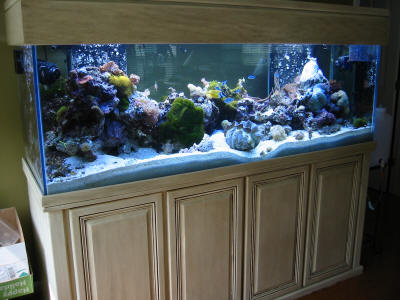
live rock and a few inverts. <I see your pic... very nice>
I currently also run a 180 gallon reef tank which has completely
separate nets and equipment. The 125 had been up and running for
about 3 weeks when 2 fish started showing signs of ich. Here is
the stock list of the tank as it came. 150 lbs of live rock DSB-
new when I set the tank back up, with slight seeding from the old
Skunk Cleaner Shrimp Coral Banded Shrimp Misc Large Hermits and
Huge Turbo Snails Misc Soft Corals (xenia, zoos) 2" Picasso
Trigger <Mmm, will likely eat the Hermits, Snails, perhaps
more in time> 2" Maroon Clown 2" Saddle Puffer
3" Hippo Tang 3" Yellow Tang 2.5" Powder Brown
Tang After reading over the WWM archives, I have decided on the
following plan of attack. (Please correct me on medications:-) 1.
Setup quarantine tank with salinity, temp and ph that matches the
display. 2. Catch all fish except for puffer and move to the
quarantine tank (55 gallons). 4. Move puffer into 5 gallon tank
heavily bubbled and dose with formalin for 30 minutes, <Mmm,
may well be too long... Likely ten minutes will do all the good
that can... I would definitely be in constant attendance, ready
to move this fish...> transfer to separate 10 gallon for 6
week stay. <Hard to keep such small volumes stable....> 3.
Dose OrganiCure to the 55 gallon tank, no carbon just filter
floss filtration for 6 weeks, with frequent water changes and
copper testing. <Mmmm, I'd rather go the
quinine/Chloroquine treatment route with this mix of fish
species...> 4. Return all inhabitants to the main display tank
(- the yellow tang, maroon clown and hippo tang that I may sell
off to make the quarantine period go smoother). My 180 has been a
great success from all of the information that I have read and
used off of your site. I included a picture to show it off.
Thanks for your help, Tim <I do think I will finally stop
putting off my minor "expose" re the use of Chloroquine
phosphate... 10 mg/l... Please do read re this, and quickly
order, start using... Much better... safer, less toxic than
copper, formalin. Bob Fenner>
|
 |
Box/cow fish parasites. Parasitized systems, alternatives...
reading 8/24/08 I've had a Blue male, Black female
box fish and a Cow fish for several years now. One thing I've
noticed is they always have Cryptocaryon, I just have to try and
control it. I've tried hospital tanks and the only successful/safe
medicine was malachite green. However after using low salt and meds for
2 months and returning them to the 180 gal. tank, they would get
"it" <Uhh... the system itself has "it"...>
again after a few months. Is it true that they always have/carry ick or
Cry.? <Nope> I've found the best long term solution to
housing Box and Cow fish is to have only them as tank mates, and to use
a low salinity of 1.016-1.018. This has kept them symptom free. My main
question is, I will keep the low salt for 2-3 months, then raise to
1.022-1.023 for 1-2 months then back down when the first spot shows up.
Is this potentially harmful? <Yep... shortens their lives... due to
"stress", kidney damage mostly> How long can I keep 1.016
for? <Months to years> This method seems to be the least
stressful to the fish and I don't have to keep a hospital tank as
well. What kind of salinity's do you recommend? <Near
seawater...> Am I too low and then not going back high enough? I
want to give the fish the best long term care as possible, but need to
keep the salt low to avoid problems. Thanks. <... There are other
means of treating/excluding protozoan complaints with the puffer
families... Read on WWM re Quinine cpd., dip/bath (with formalin)
procedures... Peruse here: http://wetwebmedia.com/mardisindex.htm Bob
Fenner>
Inverted puffer gill -- 04/21/08 Hello, <Hi.> My dog
face puffer is having issues, her gill keeps getting inverted back into
her breathing hole, in front of her side fins. <You usually cannot
see the gills at all, puffers only have these small slits (gill
openings) in front of the pectoral fins, the gills are inside. I'm
suspecting a physical injury (pump, other fishes) here based on what
you describe, but I fail to visualize it, even with a puffer in front
of me.> Like when a dogs ear flips backwards, it's like that.
<Something wrong with the gill opening (is its skin being sucked
inside?) or something coming out of it? A picture would help with
diagnosis!> When it happens, she can't breathe that well, as it
doesn't open. I keep finding it like this over and over again. If I
show her the can of food she gets all excited and will snap it back out
but next time I look, its back inverted. This seems to be happening all
the time. She has stopped eating entirely now. She doesn't swim
around either. <Both no good signs'¦> Any suggestions?
<Amyloodinium and Cryptocaryon parasites on the gills can result in
problems with breathing like breathing with one gill, do you see a
velvet like white layer on the skin or small white spots? Flukes can
result in similar problems
(http://www.wetwebmedia.com/fshwrmdisfaqs.htm and search this link for
gills). If something is coming out of the gill slits or if the slits
themselves are hurt, there is not much you will be able to do yourself,
except for providing a good water quality and varied diet (I hope it
will eat again), and hope for the best. Maybe a veterinarian could
solve the problem by fixing whatever tissue was hurt or torn apart,
depends on the size of the puffer and skill of the vet. Good luck, I
hope your puffer's conditions improves again. Marco.>
Dogface puffer with Ich... poor env. period -
4-11-08 Hello! <How goes it? Mike here tonight> I have looked
around on your site and haven't seen anyone with quite this
situation; then again there is a lot on here so I'm sorry if
I've missed something. <Here to help, no worries> I've
had my dogface puffer in a 40 gal tank with a clownfish and a mandarin
goby for about a month or two now and my tank has had very steady
levels other than a slight mishap the other week where the salinity was
spiked for about 1 day. <Hopefully your dogface is still small - FYI
he'll attain a 12" + in length. Also, please read our archives
regarding your mandarin> And only a little - I wish I could be more
specific but I was away and it was my dad who noticed and put some of
the freshwater (treated for the tank - just no salt added) in to bring
it back to normal (I have a hydrometer in the tank with a
"green" area where the salinity is ok.. he said it was still
in the green - just more salt then there usually is. <No problems
here> My puffer - Bubbles- has been great until a couple of days ago
- he started to develop ich. <Puffers are prone, unfortunately.
However, they don't develop diseases for no reason - he's
probably being stressed in some way. What are your water
parameters?> I went into my LFS and they said they were getting
cleaner wrasse brought in so I should try one of those (they're
coming into the store tonight). This seemed like a "holistic"
alternative to a fresh water dip - and wouldn't hurt. <Not a
good idea - don't buy the wrasse. Not only is the wrasse likely to
develop marine ich (Cryptocaryon), but even if it doesn't, it will
likely starve to death due to its specific dietary requirements>
Yesterday afternoon I noticed that he was bloated, hiding (which is not
his normal behavior - he acts like a puppy always begging for attention
and putting on a show), and appeared to be coughing?? <He's been
stressed, as well possibly some GI issues> I had some gobies to try
to entice him to eat as well as possibly help him to
"de-bloat" (another recommendation from my LFS - they thought
he may be constipated and it was due time for him to have a treat and
something to gnaw on). His usual diet is gobies as a treat, brine
shrimp and bloodworms - which he has been quite happy on for me.
<Try to vary the diet a little, adding meaty seafoods. Remember,
adult brine shrimp have very little nutritional value> I'm
concerned about the coughing as I haven't seen a fish act and look
like he has a cold before. As additional information he's been
looking pale longer - as though it's taking him longer to wake up
in the morning, he didn't even act like he saw the gobies when they
were put into the tank for him. <Definitely stressed. And do you
literally mean gobies as food?> Last night at one point I had to
"rescue" him - he had wedged himself between a plastic barrel
decoration that I have and the glass; I'm assuming he was trying to
scratch after this he seemed to be more nervous than usual (and has
been since, although still hangs around the barrel) and has ignored
food completely. <Puffers commonly wedge themselves on purpose while
digesting or sleeping, don't worry too much about this, and they
also will ignore food if stressed or in poor health> Also - his eyes
look sad...I know this isn't the best description but the look in
them is heartbreaking...and he normally could cheer you up from the
worst mood. <I know what you mean - my favorite fish is my A.
hispidus (stars-n-stripes puffer)! The eyes of a puffer are actually
very good indicators of health> Thank you in advance! I hope this is
enough to have some ideas. <Make sure you have adequate filtration
for this messy fish in your smallish tank (and that you have plans to
upgrade relatively soon), and that all of the parameters (pH, ammonia,
nitrite, nitrate, salinity, temp) are within norm. A large water change
would also be beneficial - make sure the replacement water is the same
salinity, temp, and pH, and let it mix for an hour or more. Also, read
our archives regarding curing marine ich, and good luck> Charis
<M. Maddox>
|
Black Dogface Puffer Illness, Crypt, poisoning,
reading 3/15/08 About 3 weeks ago we noticed ich
on our black dogface puffer. We set up a hospital tank and
administered non-copper ich treatment. <Of what variety?>
The ich was gone within a couple of days. <Uh, no... just
cycled off the trophonts...> After a week of being healthy, we
started noticing cloudy eyes and a white film all over body (that
comes and goes). When he has the film, he is very lethargic and
doesn't eat.. just sits at bottom of tank. Do you have any
ideas as to what this might be? We have also done water changes
and administered MelaFix. <Worse than worthless. See WWM re...
you're poisoning...> Any help would be greatly
appreciated. Thank you, Concerned Puffer Owner <And one that
needs to read: See WWM re Tetraodont health, Cryptocaryon... Bob
Fenner>
Re: Black Dogface Puffer Illness 3/15/08 I
appreciate your help although I think we waited too late to ask
for any. As I was emailing you last night, my husband was doing a
water change. After that the puffer swam to top and stuck his
head out of water, let my husband wipe most the film coat off,
but then went back down to bottom and died. :-( This is our first
experience with puffers and we really enjoyed him and are sad
that it wasn't a better experience. Thanks again for your
advice. we will definitely read up on puffers before we get
another. <I am so sorry for this/your loss... And so angry
with API and whoever instructed you to pour a worse than
worthless leaf extract into your main display to
"treat" a parasitic condition.... IF only I, our Crew
had the opportunity to properly instruct fellow aquarists on
adequate husbandry... many, MANY organisms would not have to
suffer or die prematurely... I do hope you sense my (palpable)
frustration here... And again, I am compassionate (from the Latin
meaning "to bear pain with") your situation. Life to
you my friend. Bob Fenner>
|
| Dogface puffer with raised white spots only on
body; not on fins. I've looked everywhere, I can't find an
answer! 2/15/08 Hello! My name is Marisa. First and
foremost, thank you so much for any and all help. I have been
reading WWM for several weeks and have found so many answers. I
can't seem to find any information on my current question,
though. I have attached three pictures of my dogface puffer
(Arothron nigropunctatus, I believe?) <Yes> in his current
state, and later on in this e-mail I will address the other
pictures. As you can see, he has accumulated these odd bright white
spots on the lower part of his body. There seems to be a line of
these bumps going from his mouth to his tail along his sides.
Before I spend several hours describing what has been going on in
my tank for the past few weeks, let me ask this: Just by looking at
these pictures, can you tell me what this is? <Mmm, no... look
like discrete marks... What might be in the system that would make
these?> The pictures I am specifically referring to are titled
"pufferspots_1, _2, and _3." I am going to assume not, so
here is some background info as to what could be causing the
problem: I have a 55 gallon fish-only tank; the dogface is the only
thing in there. No live rock, coral, or invertebrates. My tank has
been running for several months with no apparent problems, until
about... 5-6 weeks ago, when I bought a live rock from (as I later
found out) the worst, least respected pet store in town. After
researching the "care" online for days before purchasing
my live rock, I finally went out to buy one. I was told it was
already cycled and so I went ahead and placed it in my tank. It was
fine for 2-3 weeks until all of a sudden I noticed my tank was
extremely cloudy. There was a grayish type "mold" all
around the live rock and on nearby aquarium decorations. I
immediately took the rock and the nearby decorations out. My puffer
seemed fine. He was eating fine, acting normal, etc. I went ahead
and tested my water and my pH, ammonia, nitrites, and nitrates were
off the charts. I did a 15% water change (while siphoning a lot of
the gray stuff off the sand) and the water cleared up within hours.
The picture titled graystuff_1 is what was left over after the
water change. I spoke to several people at my LFS (different one
from where I bought the live rock), who told me to do another water
change that night and treat the water with Stress Coat, Prime, and
Cycle. I did a 20% water change later that night and tested my
water again the next day. My pH was a little low (7.8 - 8.0),
<Mmm, the pH scale is a base ten expression (sort of like the
Richter Scale)... this is quite low/different than what you
want> but my nitrites and ammonia were back to 0. My nitrates
were still very high (100-140), <Yikes... this could be
"it"> but I was told it's better to have high
nitrates than high ammonia or nitrites. <Yes, but better to have
none of all...> Slightly relieved, I went ahead and left my tank
alone. I was told to do a 10% water change every week until my
levels were back to normal... or a 5% water change every day if the
cloudiness came back. No one knew what it was, but I assumed it was
some sort of bacteria bloom. <Likely so> Two days after the
20% water change I checked my water again and my pH, ammonia, and
nitrites were all good, despite my nitrates still being around 80 -
120. <Way too high. Needs to be addressed> I wanted to figure
out what happened, though, so I asked around and discovered a
specialty saltwater fish store down the street from me. An
employee, who also couldn't figure out what all of this was,
called his boss, who said what most likely happened was that the
live rock cycled itself in my tank (even though I was told it was
already cycled, ugh). He said the gray stuff was probably silt that
eventually came out of the rock. That would explain why my levels
shot up. <All likely so> I was satisfied with that answer
because it made the most sense, and the store seemed very clean and
legit. All the fish looked happy and healthy so I figured they were
reputable. So, that is the first thing that happened. Here is what
happened next: I got home that day to check on my puffer and
studied him for about 10 minutes, just to make sure he was okay. I
noticed an influx of white, sand-like spots on his fins. I had seen
white-ish spots on before, over the past few weeks, but assumed it
was just sand sticking to him because he liked to sift through the
sand and sit in it sometimes. He often had sand sticking to his
belly and face, which were the two areas that came in contact with
the sand. Before I got this puffer, I did extensive research on
potential diseases and sicknesses, so ich/ick was in the back of my
mind. <The images do show what is likely Crypt> I tried to
look up some pictures of ich online, but just to make sure I
decided I should go back up to the specialty saltwater store and
show them the pictures I took of my puffer--to see what they
thought. The pictures titled pufferich_1 and _2 are the ones I
showed to the people. The person I had spoken to the other day was
not there, so I re-explained the weird rock cycling event and
showed them the pictures and they declared it as ich, although they
admitted ich didn't show up in pictures very well. They said
the stress from the rock cycling could have triggered the outbreak,
or at least intensified it. Like I said, I noticed he always had a
few tiny spots of white on his fins, but they seemed to disappear
on a day to day basis, which led me to believe it was sand.
<Mmm, yes... you have a resident infestation...> There were
about 3 people helping me at the store at this point, and they all
agreed that copper was the best solution. I had read that copper
and puffers do not normally mix well, and mentioned this, but they
assured me that with carefully monitored dosage and the fact that
it's a fish only tank, I have nothing to worry about. I asked
if any of them had experience with treating ich on puffers with
copper, and one of them said yes, and that his puffer is now happy,
healthy, and ich-free (he had a porcupine puffer). I must have
spoken to these guys for at least 40 minutes, and they were happy
to help. I asked them about "freshwater dips" and
hyposalinity, but they said if I've been noticing these white
spots for a few weeks, I should probably start (copper) treatment
immediately. They gave me a bottle of SeaCure (liquid copper
treatment) <Yes... a free cupric ion solution (copper
sulfate)... as opposed to chelated (which I would have used
instead). A product made by Aquarium Systems...> and a copper
test kit made by Instant Ocean. <Actually, also A.S.> I was
told to keep my copper level between .15 and .20 mg for 3 weeks.
<No lower than 0.15 free Cu++> I was also told to add the
first dose over a day or so, as to not overload the puffer. So when
I got home I made sure to study my puffer for about a half hour to
see if he was flashing, scratching, or generally acting weird. I
noticed that his eyes seemed cloudy and there was some sort of
trail of wispy "stuff" hanging off of him on certain
spots of his body. His eyes had been slightly cloudy (but not this
bad) for the past few days, but this was the first I had seen the
wispy stuff. Continuing on: I went home and took my carbon filters
out. To make this easier to read and document, I'm going to
list my dosage and treatment day by day. Day 1: Thursday, Feb. 7th:
-added 20 drops of copper (they suggested 1 drop per gallon),
waited several hours before I added another 20. -checked my copper
level several hours later and it read .05 - .10. I went ahead and
added another 20 drops. Day 2: Friday, Feb. 8th: -checked the
copper level and it read .10 - .15. <Below 0.15 ppm is not a
curative...> -I went ahead and added another 10 drops just to
top it off, since it was just barely .15. Day 3: Saturday, Feb.
9th: -checked copper level and it read .15, but was still barely
.15. -I added 15 drops just in case the level dropped over the next
day. *Today I noticed the white spots had increased significantly,
as well as the wispiness. My puffer seemed extremely lethargic and
would not accept food (freeze-dried krill, frozen shrimp, and
frozen squid is what I normally offer him). He hadn't eaten
since Friday morning. He looked like he was bogged down by this
stuff. Since it looked like everything was getting worse, I took
some pictures of him and went to the specialty saltwater store. The
picture titled pufferichcopper_1 is the picture I showed the people
at the store. The guy I had spoken to last time was there, and
basically told me, "You're only on Day 3 of treatment;
there's a lot that can happen to him physically as far as
getting the parasite out of him." I showed him the picture and
he suggested that he is probably going through 'the worst of
it'. He explained that when we (as humans) get sick,
there's a period where we are overcome with all types of
symptoms and problems for a number of days... i.e. with a cold, you
may start with a moderate sore throat, but by day 3--even with
medication--you can feel, and look, a hundred times worse. That
sore throat can develop into sneezing, coughing, vomiting, and
overall unhappiness, etc. He said my puffer was just getting over
the hardest part of the ich, and that every fish reacts differently
to parasites. <An apt description> He said to give it 2 weeks
before I freak out over anything, because a lot will probably
change in my puffer's attitude. I mentioned him not eating, and
he said most fish won't eat when medication is first
introduced. He said he will be fine, and not to worry if he
doesn't eat for a while. So, I felt a little relieved that all
of this behavior was "normal." Day 4: Sunday, Feb. 10th:
-checked the copper level and it read .15. -I added 10 drops to
maintain the level. Day 5: Monday, Feb. 11th: -the copper read
somewhere in between .15 - .20 so I did not add any copper this
day. *I forgot to mention that I have been checking my water levels
every day, just in case. The people at the saltwater store said if
my ammonia/nitrites begin to go up, do a water change. Today my
ammonia was at .50 so I did a 10% water change. I made sure to
check the copper level before and after the water change and added
drops accordingly. Day 6: Tuesday, Feb. 12th: -checked the level
and it was barely at .15. -I added 10 drops. *Despite my puffer
still refusing to eat, the ich seemed to have cleared up completely
today. I did not see any white spots on him whatsoever. He also
seemed more alert and interactive. *My ammonia is back to 0. Day 7:
Wednesday, Feb. 13th: -checked the level and it read .15 - .20, so
I did not add any drops this day. *Still looking good; he is
becoming more active, but still not eating. Day 8: Thursday, Feb
14th (today): -checked the level and it read barely .15. -I added
10 drops. *To my surprise, he ate today! I gave him a piece of
squid and after a minute or so, he ate all of it. This happened in
the morning. He was even more interactive--really getting back to
his normal self. So, I am 8 days into my copper regime and all
seems well... except what I noticed a few hours ago. I figured
since he ate this morning, everything can only go up from here. My
boyfriend and I went out today in the late morning/afternoon and
returned in the evening. I checked on my puffer as soon as we got
home and there were these very strange, bright white bumps on him.
As I explained at the beginning of this e-mail, they are raised and
only on his body--not on his fins or eyes. At first glance I
assumed it was the ich reappearing (maybe trying to bury back into
him?) but the spots look completely different in size, shape,
texture, and placement. I am still continuing my copper treatment
like usual. My puffer seemed pretty normal... he was swimming
around and seemed alert. He did not seem to be flashing very
much... I've seen him do it maybe once or twice in the past few
hours. The pictures pufferspots_1, _2, and _3 are of these new
white spots. As you can see, they look completely different from
the ich. No matter how hard I search, I can't find
anything--neither pictures nor similar descriptions--about this.
The only thing I can guess is that the parasites are attempting to
burrow back into the puffer? <Mmm, no> The bumps actually
appear to either be burrowing into the skin, or are trying to push
themselves out. Looking at them closely, it makes me want to scrub
them off of him--do you know what I mean? <I think so> It
seems like they are raised enough and could be rubbed off. I'm
not suggesting that I would do this, but the roundness of the bumps
evokes that sort of feeling/description. Whereas the ich did not
appear raised or round (i.e. not being able to be scrubbed), these
seem like they could be picked off. They are the brightest (as you
can see) near his underside, and darkening/becoming more flesh
colored toward the top. They also appear smaller and shorter on
top. Also, please note that this morning he looked 100% clear and
normal, and when I returned home a few hours later he had all of
these bumps. How did something like this flare up so quickly?
<Autoimmune reaction...> It has been about 5 hours since I
got home and noticed the bumps, and I just checked on him a minute
ago and his color is extremely dark (normally this means he is very
stressed, from what I have observed. he is usually a milky/creamy
tan color). He has some splotchiness, which also seems to be a sign
of stress. The bumps seem to have, more or less, dug deeper into
his skin. It does not appear that they have "fallen off"
or anything; if anything, they are less raised and seem to be
lodging themselves further in. He is not very responsive and is not
swimming around as much. He's kind of resting on the bottom of
the tank. He seems bothered by these things, and his breathing is
slower than normal. I apologize for the extremely lengthy e-mail! I
just wanted to include as much information as possible. If you have
any questions about anything I have mentioned, please ask me. I
just want to do everything for this little guy--he is so special to
me. I thank all of you SO very much in advance! I appreciate you
taking the time to read this. If you need any more pictures of
these bumps, please let me know. Sincerely, Marisa <... I would
discontinue the copper exposure... and switch to a quinine based
treatment... See WWM: http://wetwebmedia.com/quinmedfaqs.htm Am of
the guess/opinion that these marks are an expression of the puffer
to the copper, nitrate and who knows what chemical irritation
here... See WWM re copper use on puffers... Bob Fenner> |
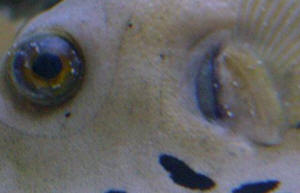
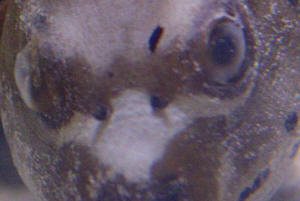 Crypt. Crypt. |
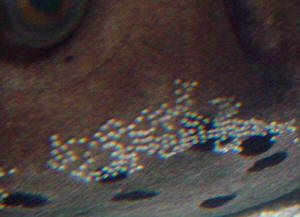 Discrete markings
 |
 Grey
stuff... silt? Grey
stuff... silt? |
Longhorn cowfish w/ich -- 01/21/2008 Hello all,
great site you have here! I am just going to dive right in here. I have
been trying to fight what I think is ich since September. I currently
have a 1.5" valentini puffer and a 3-4" longhorn cowfish in a
20 gallon. I have tried hypo twice...I will skip to the last time I
tried hypo. <Have you consistently kept the salinity below 15 ppt
(SG < 1.011) for at least 4-6 weeks? Higher salinities won't
work with normal Cryptocaryon isolates. A few will even live in
brackish water with a lower salinity and can only be treated with
copper (or formalin, which is more difficult and potentially dangerous
to apply).> After I brought the salt back up I did not see any
spots, and everything seemed ok until the cowfish (bugar) would eat.
Every time bugar would eat shrimp or scallops after a few bites he
would start darting and flashing around the tank. <Something may be
wrong with his nervous system, but that is more a guess than a
diagnosis.> He did not do this when eating pellet food only the raw
frozen foods. (The puffer has not shown any signs)...for two weeks I
carefully watched the longhorn, and all day he would not show any signs
of ich not one single spot in two weeks was seen on his fins or body. I
do realize that there are certain stages of ich that you cannot see,
and the gills are one of the commonly attacked places, but to not see a
spot in two weeks? <It can take 4-6 weeks until spots occur again.
Please get familiar with the life cycle of the parasite here:
http://www.wetwebmedia.com/ichart2mar.htm and
http://www.wetwebmedia.com/ichartmar.htm . However, darting alone is
not enough in my opinion to state this is ich.> Another site
suggested that it probably was ich, and so I began some other
treatments. I first used stop parasite, this did nothing to the problem
when the cowfish was eating, next I tried Nox-ich...The cow did fine,
but I lost a dwarf lion...not sure if it was the medicine or not, but
it seemed logical. The other site then suggested that I use Cupramine.
<If it was ich, this would be a good medication probably in contrast
to the ones mentioned before.> I tried this med a few months ago,
and the cowfish did not like it. For the first time since I had bugar
he did not eat, so I pulled the med. <It had no chance to work.>
The other site said that this is a common side effect and should only
last a couple of days. So I thought I would try Cupramine another shot.
Currently I just added my second treatment of Cupramine last night. The
first treatment that is supposed to take the level to .25 did not
bother the cow, but taking it to .5 did. I added it last night, and
this morning his color was very dark all over his body, and again he is
not eating. <Puffers, boxfish and other sensitive fishes should be
treated at lower levels slightly above the minimum level recommended by
the manufacturer.> I am currently pulling the copper. At least he
eats when I don't have that in there. I did notice today that bugar
is darting, though he is not eating so this is not linked. I am at a
loss as to what to do? <Darting alone is not enough for a proper
diagnosis. Without knowing at least roughly what to treat, I would not
treat on suspicion.> Not sure if I should be doing anything? <If
spots occur, treat with a copper product as indicated by the articles
mentioned above. Aside that feed a vitamin rich varied diet to boost
the immune system.> I have tried hypo twice, I have used a battery
of meds. I don't see spots on these fish. The valentini still shows
no spots does not dart around. I have had them in a qt since Sept. I
want to get them back into my dt, but don't want to introduce
anything bad back into it. Any suggestion or insight would be greatly
appreciated. <See above if your hyposalinity treatment was effective
at all. If salinity was too high or duration of the treatment was too
short, Cryptocaryon is likely still in the system, even if you do not
see spots. In this case or if you see any spots treat with Cupramine as
indicated above and in the linked articles. After at least 4-6 weeks
without spots the fish can probably go back to the main system, which
also was free of fish hosts for at least 4-6 weeks. With regard to the
darting: as long as no other symptoms occur, I would not specifically
address this issue, only provide superb water quality and a vitamin
enriched diet. Good luck, Marco.>
|
Canthigaster valentini with
Crypt -- 01/02/2008 Hi, <Hello.> I have a Valentini
Puffer fish that has ich and has had it for about 2 weeks.
He's doing fine, been eating well and looking healthy other
than the white spots. I first tried soaking all his food in
garlic and Zoë« and then went about using some organic
rid ich med (because it was more an organic deal and not a med).
The tank he's in is a FOWLR tank and some of the live rock
was more base rock then anything. I decided to use CopperSafe in
the DT tank (don't kill me) <I won't, but just can
tell you that quarantine tanks are much more efficient.> and
have a chelated copper test kit for API to watch closely. After
looking all over the web, it seems that I should keep this
particular brand copper at about 1.4-2ppm. I have kept it about
1.5 or so as I'm worried about using copper with this puffer
as it is. <Should be okay. This is a chelated product (those
chelated molecules are heavier than ionic copper) that aside of
copper consist of other chemicals. Therefore the necessary level
is high compared to ionic copper recommendations. The good thing
with chelated products is that they release the copper over time.
However, substrate and rock will influence the copper efficiency,
one reason why all copper products should only be used in
quarantine tanks.> I think that CopperSafe is the least toxic
copper treatment out there. This morning he puffed up for the
first time when no other fish was around or messing with him.
I've heard that this is normal but that it might also be
stress. What should be my next steps? Thanks. <Monitor with
your chelated copper test kit, keep the level, and also check
your ammonia level daily. Read
http://www.wetwebmedia.com/ichartmar.htm and the linked FAQs to
learn about the life cycle of the parasite. Keep the copper level
for at least 7-10 days. After that time and if the spots
disappear use activated carbon to remove the copper from the
system. Change the carbon every 14 days. If the spots come back
in a new cycle use a quarantine tank without rocks and substrate
for treatment. Cheers und good luck, Marco.>
Canthigaster valentini with
Crypt -- follow up -- 01/02/2008 So it's now day 5 of
copper treatment and everybody is doing great. The spots on the
puffer are gone and I test for copper both AM and PM and test
daily for the ammonia levels and PH levels. I will probably go
through day 10 before I start using the carbon and after a while
I will add some more live rock to seed the, now, base rock. If my
research is correct, I will have killed off the parasites and,
unless brought in to the tank again by a fish, should never see
ich again... correct? <Yes, hopefully!> Its my
understanding that fish don't create ich out of nothing, but
that they get it from somewhere and pass it along.... <Right,
these are ciliate Protozoans, they have to come from somewhere.
Only their free swimming stage (theronts) is affected effectively
by chemical treatments. In a bare bottom tank you'd also have
the possibility to remove many/all of the protomont and tomont
stage (by siphoning the bottom every day), which are encysted and
now my rest in the substrate. I do hope none of them survives the
10 days of treatment in your tank, chances are not too bad.
However, if the spots (this is the Trophont stage infesting the
fish) return, because a few tomonts survived in the substrate,
move the puffer to a bare bottom quarantine tank and treat, while
the display stays fallow for at least 4 weeks. This seems to be
the most effective procedure. Good luck, Marco.>
Canthigaster valentini with Crypt -- follow up
II... Cu use... same as it ever was f' -- 01/02/2008 Well
I have more than just the puffer in the tank, so I'm going to
continue to treat in the display. <Okay, but be prepared that
the substrate might absorb some of the copper and release it over
time.> I read yesterday where the life cycle of the parasite
is about 3 weeks so 4 weeks of copper should do. However they
also say that you should treat the fish 3 weeks more after the
last time you see white spots, so it might be longer. Fortunately
the ich spots are gone and I'm now just waiting the 3 weeks
and testing ammonia/PH/copper levels every evening. <Okay, but
do not use the copper for more than the planned 4 entire weeks.
Besides killing the parasite, it also affects the health of the
fishes. Copper treatments should be as long as necessary, but
also as short as possible. I'd consider 7-10 days as the
minimum and 4 weeks as the maximum, depending on the copper
level. Anything in between can work. Marco.>
|
|
Puffer... Crypt, med., stkg. mistakes
11/19/07 I have a puffer that is like a mappa...I sent in
pictures and y'all gave me a few possibilities. ANYWAY I have
it in a new tank around 2 months old and it developed ich. due to
stress ( a cryserus <Chrysurus? The angel?> and grouper
issues) I took the grouper out an began treating the tank with
Quick cure. <... a huge mistake. You put formalin in a main
display?> The tank is a 120 with a doss skimmer and fluidized
sand filter. it has live rock <Had> in it with the angel a
wrasse and a Huma. The quick cure worked the ick spots have gone
away <Uh, no> but the eyes are a bit cloudy and I am
noticing that it is breathing a lot more with one side of his
gills than the other a very noticeable difference.( like you can
see in the gill of one and the other is almost closed) ITs
appetite is still the same. I have a little ammonia spike going
on in between a .00 an .25 and treating with AmQuel + any
suggestions? <Yes...> We love this guy <Again... no, not
by my definition of love... IF something is loved, one does their
best to look after it for its sake... Not here> he is great
and would hate to loose <... lose> him. Thanks Marcus
<... you've poisoned your mis-stocked, over-crowded
system... Read here: http://wetwebmedia.com/cryptformcures.htm
and the linked files above. Bob Fenner>
Re: puffer 11/19/07 I understand that you
are one of the leading fish experts in the country but you are
assuming a lot of things and you know what assuming does. Where
do you get my system is overstocked. I have a fluidized
sand filter that is meant for a 300 gallons and very efficient
protein skimmer not to mention a 57 watt sterilizer. Again ITs a
fish only with Rock in it. I could care less about if its
"alive" or not. WITH ONLY 4 fish in it. <... read re
these animals natural habitats, size of system requirements... IS
psychologically crowded now... Will be physiologically soon>
Sorry you are having a bad morning but the reason for all my
cluttered typing on the previous email is that due to me not
loving my fish I read your website for 3 hours looking for
something to help and it was really late for me. P.S. If I wanted
a grammer <grammar> lesson I would asked Calfo (the
educated one) for help. You do not have permission to publish any
of my emails to you. <Live, and hopefully learn. BobF>
| Re: Please help... formalin,
puffer... -11/19/07 This the guy your <...
you're> not helping. <Good pix of a nice
specimen... Please... read beginning where you were
referred... There is too much to relate to you via email...
RMF> |
|
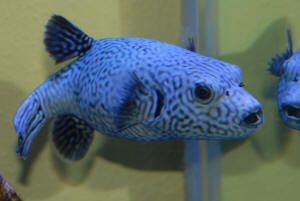 .JPG)
|
|
|
Puffer with suspected Ich 11/16/07
Hi guys <Debs> I hope you can help me. I have researched
your site and found many partial answers to my problem but would
really appreciate some definitive advice. I purchased a porcupine
puffer 12 days ago, about 5 inches long and placed him in QT tank
of 25g with external filter, protein skimmer, large UV skimmer
and air stones. I know the tank is too small for him but I was
prepared to do daily water changes while he was in there to
control the ammonia/nitrates. My other tank is 7ft long, approx
150g with yellow tang, Sailfin tang, 2 Anthias, tomato clown,
Clarkii clown and a humbug, all quite large fish, and a sump with
trickle flow over bio filters, 2 large UVs, protein skimmer,
carbon and potassium filters and a calcium reactor. There are a
few corals and snails and a sea urchin but no shrimps. <The
Puffer may chomp on the invertebrates listed...> In the QT I
have been doing daily water changes 25% , as there was an ammonia
spike when I originally put him in. I bought some
"bactinettes" from LFS and now ammonia is at zero,
nitrite at 0.25 and nitrates (just before water change) are about
80. <Yikes! Too high> In The LFS he was in 28 degrees temp,
but I have gradually lowered him to 26 degrees in preparation for
going in main tank. <S/b fine> Anyhow, the puffer was fine
until 2 days ago when I noticed a couple of white spots on his
tail and above his eye. I have read that they are susceptible to
Ich so I decided to try and nip it in the bud and gave him a
freshwater dip. <Mmmm> I caught him in a plastic container
and it all went fine, he didn't seem stressed at all. Only
problem was, I had to put him back in the QT. The next morning,
he looked fine. But the following morning, he was covered in
little white spots !! <Now, this IS likely Crypt> I did
another freshwater bath (temp and PH adjusted) and decided to
leave him in longer this time, got him to 8 min.s when he blew
himself up, so removed him and put him back in the QT. This time
I have decided to do a 100% water change, using 75% water from
main tank and 25% new water. I couldn't do this yesterday
because it takes a while to make the RO water. Now I'm ready
to do this, I want to remove him to another tank with medication
while I do the complete water change. The question is, what
medication do I use ? I know from your website not to use copper.
Can I use formalin, if so, how long can he stay in it? <I
would use an emersion bath...> Or can I use Methylene blue,
again how long? <Just the formalin> Or should I just do
another freshwater dip? <No, I would add the formalin> This
time he is going to return to a cleaned tank. My other question
is what do I need to remove from this tank to make sure I remove
all the Ich? <? I would perform one last pH adjusted
Freshwater and formalin dip enroute to moving the puffer to the
main display, dump, air-dry the treatment tank> At the moment,
it has some liverock and some sand. I know I should remove the
sand but should I also remove the liverock? <Oh! I would just
let the material run "fallow", sans fish hosts for a
couple months> Should I also clean out all equipment that has
come into contact with this water, i.e. filters, tubing, etc with
tap water? <No... the absence of fish hosts...> All this
time, he has behaved normally and eats well. So last question, is
there anything that could be confused with Ich ? ( they
definitely aren't water bubbles !) <All sorts of
Protozoans, some worms and crustacean parasites... and spurious
"dots" from stress...> Did I react too quickly to
those first few spots and make matters worse by stressing him ?
<Maybe... but the Crypt is good to catch at this stage...>
I would really appreciate some straightforward answers , even
better, direct instructions on how to proceed with this? <I
would also treat with quinine, and vacuum the bottom of the
treatment tank during the dip/bath procedures (to remove
cysts)...> Apologies for sounding like an ignoramus but
different LFS's give out different advice (often dud) and I
never know who to believe, except you guys of course ! Many
thanks Debs <Is this all clear? There is a large amount of
material to understand, counting cautionary statements,
remarks... Bob Fenner>
Re: Puffer with suspected Ich- please reply ASAP - I need
to move puffer today - thank you ! -- 11/17/07 Hi
again- thanks for your advice. <Welcome Debs> I have
refrained from doing anything until I got your reply which is
just as well as I had decided to use Methylene blue as LFS had
urged me NOT to use formalin. Can I just ask a couple more
questions, just to be sure ? When you say 'immersion bath
' with formalin, how long does he stay in for? An hour ? And
then followed by a freshwater dip, presumably the 8 min.s he
managed last time was about right ? <Mmm, no... Please read
here: http://wetwebmedia.com/formalinart.htm and the linked files
above> And you definitely think I should put him in the main
display with the other fish? <Yes> Is that because of the
chance of this reoccurring due to the QT tank being so small?
<In part... more to be gained by moving> I raised the temp
overnight by 1 degree to 27 degrees, but the puffer is currently
at 27.9 degrees ( I have a Aquastar system) - will this drop in
temp bother him? <No, not likely> I'm a bit worried
because I don't have a hospital tank big enough for all the
fishes if it reoccurs. Thank you so much ! Debs <Welcome.
BobF>
Re: Puffer with suspected Ich - further question --
11/17/07 Hi again Bob, <Debs> Just thought, if I'm
going to put the puffer in the main tank , would it be a better
idea to add formalin to the QT tank he is already in to make it
less stressful, i.e. one less move? <Could do> I will remove
the live rock and biofilter before doing this, and then replace
them when I've completed the treatment and cleaned out the
tank and filled it with new water. Or is it wiser to mix the
formalin in a separate tank and move him to it ? Also, formalin
strength, should I go for half normal dosage ? Thanks ! Debs
<... posted... BobF>
Re: Puffer with suspected Ich -- 11/17/07 Hi Bob
, Sorry to pester you again with a third follow up e-mail but I
forgot to mention something !! Since we got him, the puffer has
crisscross scratches on both his eyes. I looked it up and found
that they can get this from being netted, which the LFS guy did
to get him in the bag. I was hoping it would heal on its own, but
hasn't. Any idea what it could be ? Sorry to be such a
persistent pest !! Debs <Likely are scratches, as you state.
RMF>
|
Burrfish With "Ich"? 8/7/07 <Hi Mark,
Pufferpunk here> I was trying to find out if a burr puffer could get
ick? <Actually ich, which is a freshwater disease, short for
Ichthyophthirius multifiliis.><<Mmm, both fresh and marine are
commonly called "ich". RMF>> I have had him for a month
or two, its doing great, eating fine. I just started seeing little
white dots on its fins and body. Could you help me and what could I
do. <Yes they can get crypt, short for Cryptocaryon irritans (the
marine form of ich). Best treatment is hyposalinity. You can look here:
http://www.wetwebmedia.com/ichartmar.htm in addition to countless other
articles at WWM on the subject. Also:
http://www.thepufferforum.com/forum/library/hospital/swich/ How long
have you had this fish? There is a high death rate of this fish in
captivity, due to refusal to eat. ~PP> Thank you, Mark.
Re: Burr Puffer with SW "Ich"
8/9/07 <Hi Mark> I have had him for about two months and he
has no problem eating and even takes food from my hand. He is always
looking, for or eating food non-stop. Will the puffer work thru this or
should I do something? He is housed with a Huma trigger, Yellow tang,
Snowflake eel, Lyretail wrasse and a pair of Maroon Clows. <Maroon
clowns?> Should I worry about any of these fish? <It's up to
you, whether you should treat all the fish or wait it out to see if the
Burrfish gets any worse. He's more sensitive to the parasite, since
he has no scales. Sometimes I have seen a light case of crypt goes away
on it's own but you are chancing all the inhabitants getting it.
I'd at least QT the puffer & treat it. If you see the parasite
on any of the other fish, then you will have to follow the instructions
for hyposalinity for everyone (in QT of course) & leave the main
tank fallow. Were there any new tank mates added recently? ~PP>
Thank you for all your help, Mark
|
Boxfish 911 to advanced issue, apparently Crypt Hello All,
Please help with the following: Longhorn Cowfish has been picture
of health in home tank for 3+ years. He has grown from (body/non
horned) 1.5-2" up to nearly 8" body length. In the last
48 hours the fish has taken a rapid change for the worse. Before
the 48 hour first observation the critter was eating greedily,
swimming normally, etc. Symptoms of slime coat sloughing were
observed yesterday then actual skin sloughing(?) today to where
it looks like patches of his yellow skin are now gone or
translucent white. (see attached pics) <I see this... and a
whitening of the cornea> He is usually the color of the area
immediately around his pectoral fin. Initially only slime coat
was affected but today there are a TON of white spots on the
fins/tail. They seem smaller than "ick" size but see
for yourself. He is not eating and he normally out eats a puffer
on nearly anything. <I see these as well... do appear to be a
protozoan infestation> There have been zero introductions or
anything coming/going from the tank/household but we did move
just under a month ago. All live rock, bioballs, etc was kept wet
and only a barely measurable mini cycle occurred. Current water
parameters are ~78 degrees F, .020 salinity, <A bit low... see
WWM re spg...> zero ammonia, barely traceable nitrite (if
any), nitrates under 12.5, ph about 8.1. (Tetra test kit) His
current tank is a 75 gallon AGA with 20 gallon sump, about 65 lbs
liverock, CoraLife 220 skimmer, gallon of bioballs, and a carbon
sock which was removed when disease was first observed. He lives
w' a small dogface who is showing signs of white spots but is
otherwise the same. These two have lived together for all of the
last 3 years and believe it or not the cowfish will stop eating
and lay on the bottom for hours/days if the puffer isn't in
the tank with him. (???!) <Mmm, something introduced this
parasite... I do doubt if it was resident this whole interval...
Some live food perhaps... most anything "wet" from a
biological setting could be a source> So far we have done low
salinity w' quick cure dip about 15 min.s, half strength
quick cure in tank yesterday. <And returned the animals to the
infested system? This won't help> Today we have done
Furazone dip in under .010 salinity for 10 min.s. <A good
try...> Any medical suggestions or plans of action would be
greatly appreciated. Can you diagnose from pics and info?
<Mmm, not determinately... But does appear to be Cryptocaryon
superficially> This animal has tolerated/recovered w'
flying colors from medicating before so there is a history of
successful tolerance to treatments that most boxfish do not
tolerate. Is there any further info or advice you can provide?
Thanks a million, Lee <Mmm, unfortunately at this point, and
in the short term, to urge you to read quickly here:
http://www.wetwebmedia.com/mardisindex.htm Scroll down to the
royal blue line, tray below... And write back just as soon if you
have questions, concerns. I'll be out a good part of the next
day. Bob Fenner>
Re: Boxfish 911 to advanced issue
7/7/07 Mr. Fenner, Thank you so much for your time and reply.
My fiancé©' (copied above) has almost two decades
pet store and wholesaler experience. She has probably seen nearly
anything/everything in that time. However this one stumps us. I
agree the salinity is a bit low per oceanic norm (i.e. 0.20 vs. .023
to .26) but that is the salinity this cowfish has thrived in for
the last 3 years. <These sorts of "chemical
challenges" have ways of "catching up", expressing
themselves... What I really suspect is Mycobacterium marinum...
or possibly Vibriosis... but these are secondary to whatever
causative factors here... and need to be addressed> I
don't dispute some sort of infestation but I cannot pinpoint
a cause. <I can see the infestation, but as you, have no idea
of the vector/etiology> There have been zero live or other
introductions. We literally set up QT/holding tanks from tanks
that have been dry for years, moved the fish to the holding
tanks, tore down and set up their old tanks, and reintroduced the
fish with a 45 minute bucket ride from start to finish.
<Well... my best guess is that the Cryptocaryon (likely) is
resultant from a resident sub-symptomatic infestation... That it
"was" always present... and that the added stress...
triggered a full-blown high-population episode> All my fish
(~500+ gallons) eat fresh/organic market mussels, cherrystone
clams, shrimp, spectrum pellets, and/or Mysis (MYSIS brand).
<These can also be a source...> All of these come from the
same sources. Fresh/Organic from the same high end grocery store
that has been supplying us for the last few years (and all the
other stores who sell "fresh" in the area). <The
Protozoans can/do encyst on hard materials...> The Mysis comes
frozen from the LFS but is otherwise sealed. <Not likely this
if frozen> While possible, one of these introduced a pathogen
to no other tank (knocking daggone hard on wood) that has shown
signs. This fish in question has always been the picture of greed
and social interaction. <Yes... otherwise appeared as a nice,
just-sub-adult specimen... always like seeing these in the
wild...> Since the Furazone dip his attitude has been much
improved but the spots remain. <Need to be treated differently
than with an anti-microbial... Unfortunately either with
successive dips (formalin likely), and being moved to other
non-infested settings, or careful (chelated and tested for)
copper...> He is still in a weak quick cure solution <Mmm,
please see my notes re this mixture on WWM... I would NOT
continuously expose any life to Formalin> for his holding tank
but that can be "upped" to full strength or a copper
(SeaCure brand) can be added. <This IS what I would do> The
Furazone dip seems to not make nearly the difference the
antibiotic dip made but the visible symptoms seem protozoan.
<No; again, it will not> We did not dip tonight and are
letting the fish have some recovery time but are still observing
VERY closely. Only other physical symptom is respiration seems to
be elevated. In the meantime his spots on fins are still very
visible and his color has not changed meaningfully. I do not want
to dose with meds to the point of stressing or injuring the fish
worse than what his infection might yield. <Well-stated. I
agree> The symptoms seem protozoan but the best results seem
to come from antibiotic treatments. <The operative word here
is "seem"... Do you have access to a microscope? I
would be looking for definitive identification here...> Do you
think switching to hypo-salinity would be the answer? <No>
Please advise... This fish has been a happy/healthy specimen for
the last 3 years and is near enough to my best "wet"
friend. What should we do from here? Thanks immeasurably, Lee PS
Tasida aka "petstorejunkie" above. <I see... There
is much, likely too much to relate through this process (emailing
daily)... and I want to add my note re being EXTREMELY careful in
NOT compounding your troubles by moving any water, anything wet
twixt your systems and to be VERY observant re your other fish
livestock... Once such an infestation become hyperinfective, it
is very virulent... Otherwise, what little I know re such
incidents IS archived on WWM. I ask that you use the search tool,
indices... and write back with specific questions if there is
something that is unclear, insufficiently detailed. Bob
Fenner.
|
|
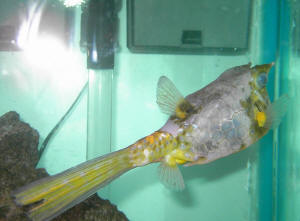 
|
Puffer in Quarantine 6/21/07 Hi Bob
and Crew; First, of course, I want to thank you for the service that
you provide to the Aquarium Hobby. As a refresher, the tank is 90 Gal
FOWLR, Corner Overflow with a Tidepool 2 Sump, Tunze DOC 9005 Skimmer
in sump (not collecting much skimmate), Prizm Skimmer in tank (actually
working very well). Tank, being repopulated after sitting fallow for 6
weeks following an Ich outbreak, currently contains only a 10 inch
Snowflake Moray. I currently have a Dog face puffer in quarantine (only
20 gal), where s/he has been for about 12 days. I feed the Puffer every
other day, with a feeding stick, so nothing remains in the tank
uneaten. The problem I am having is keeping Nitrates down in the QT
tank, even with daily 50% - 75% water changes. In fact, the DFP chooses
to "poop" right after the water change, which doesn't
help the Nitrates. Based on the fact that the Puffer appears free of
external parasites, but must be suffering from the Nitrates, would you
curtail the QT and add him/her to the display, or would you wait 30
days? Thanks Again. Roy <I would end the quarantine, dip this fish
in transit and place this Tetraodont. BobF>
Re: Puffer in Quarantine 6/21/07 Bob,
Thanks for the quick reply. When I got home last night, much to my
chagrin, I notice Ich on the DPF's Dorsal and Pectoral fins in the
QT tank! S/he had been perfectly clean, but maybe because of the stress
of the high Nitrates? <Maybe a factor... but the Crypt would have
had to be present...> Since I do not want to use copper, I gave the
DFP a PH adjusted Freshwater Formalin dip, while I changed the QT tank
water. I then removed the carbon and treated with 2 tsp Formalin per 10
gallons? <Yikes! Way too much... see WWM re formalin use> To you
think this in any way will be efficacious? I should have moved him a
day sooner! <Ah, decidedly NOT! You would have introduced the
asymptomatic infestation! RMF> Roy
Re: Puffer in Quarantine Bob, The Kordon's
Formalin 3 Bottles says that it can be used up to double the usual
dosage of 1 tsp per 10 gallons. I actually used something closer to 1
1/2 Tsp per 20 Gallons. <... Please read where you were referred
to... 37% stock soln... too much... DO increase aeration, DO keep an
eye on the animals exposed...> Has anyone ever had luck with
nosickfish Ich cure, aside/since last posted in FAQ? I wouldn't use
it in my display, but id it works in the QT the $52.00 may be worth it.
Roy <See our notes re... the search tool, indices. RMF>
Re: Puffer in Quarantine Bob, Thanks again, When I
saw him last night all the spots on his fins were gone <... likely
just cycled off...> and he was actually hungry for the first time
since I got him. He had one remaining embedded cyst that came of this
morning after doing a 50 percent change and re-dosing appropriately. My
tank sat fallow for 8 weeks, and reintroduced my snowflake (which was
treated for Ich in the qt while the display sat) 4 weeks ago. Since I
originally used water from my display for my quarantine tank, it is
conceivable that my display still has a sub clinical infestation (the
moray does not look or act infested, although the Ich could have come
in with the Puffer (he looked clean and was dipped before QT). <Is
possible> Based on this I was thinking of adding the Puffer to the
display as soon as all external signs are gone, <Please... stop...
READ re Cryptocaryon life cycle... on WWM, elsewhere... You do NOT want
an ongoing infested system...> immediately breaking down the QT
tank, sterilizing it, and re-preparing and cycling with non-display
water, so I would have it available immediately if I needed to either
let the display sit fallow one more time, or nuke it and start it up
again. <No sense... you won't be able to safely add any more
fish life to your display system> Since it isn't unusual to have
some parasites in an otherwise healthy system, since I keep up my
husbandry, healthy specimens should stay that way. I only plan to add a
3 or so specimens of a smaller shoaling species when I find something
that can coexists with the snowflake and puffer? Does this idea have
any merit or am I just rationalizing a way to add a possibly diseased
specimen to my display. Indebted as always, Roy <Have just skipped
down... Read. BobF>
Re: Tetraodont Crypt Trtmt. 5/20/07 Thanks
for the quick reply. I did read the FAQ's, but that made me more
confused. <Yikes! How about the articles?> The first FAQ titled
Tank with puffers, a moray eel and Amyloodinium (velvet) -- 05/08/07
states : "My quarantine tank is only 25 gallons and if I stick all
of them in there, besides being stressed, doesn't it defeat the
purpose of the quarantine by only treating the fish? <No. The best
would be to treat the two puffers in a bare bottom quarantine tank with
copper and to let the display tank run fallow for about 6 weeks
(without using copper in this tank). If the moray eel does not show
symptoms, I'd leave it in the display." The following FAQ
titled Dog faced Puffer OD on copper says: "We noticed some white
spots on his fins and was treated with copper at least 3 times now.
<Big no-no! Puffers are extremely sensitive to copper,
and it should never be used on puffers (or other sensitive animals like
inverts/corals etc...). It will be best to stop treatments
like that ASAP.> " <I am of the opinion (note there are many
other folks here presently and in the past that make/made up our Crew)
that puffers CAN benefit from Careful exposure to copper... given
initial good health, monitoring...> Then another FAQ about cowfish
titled 'Gentle' Ich treatment for cowfish? (Tetrasomus
gibbosus) 6/25/06 says: "I don't know what to
do: half the crowd says that treating ich with hyposalinity
is Great and Good, especially for copper-sensitive cowfish; the other
half says that hyposalinity "treatments" are a waste of time,
because they aren't curing anything. <I prefer hyposalinity as a
dip or bath.>" Would you suggest a long FW dip?
<Me? No> I'm really not sure what to do here! Personal
experience says that hyposalinity will kill ick on a fish, <Mmm, not
often> but then it will often return once salinity has hit around
1.018. But I've also read over and over that copper is not good for
puffers. <Is actually "not good" for any life... all
fishes experience discomfort, poisoning to a degree with exposure...
Not unlike the use of mercuricals and arsenicals for humans...> I
really don't want to use formalin. Is a long FW dip my only safe
option here? <No> or should just go ahead and use a weaker
solution of copper? (Re: urgent _ seriously ... Crypt - 04/24/2006
<My friend... this is posted over and over on our site... with
cautionary remarks as you suggest here. I would not use
formalin/formaldehyde... or formalin... I would use a minimum
concentration (due to the puffers mainly) of a chelated copper
commercial product here... with twice daily testing with a matched test
kit... Read on first! Bob Fenner>) I don't want to seen
confrontational or ungrateful here. <Nor I... and you don't come
off as this at all. I also only seek to render useful, practical,
semi-immediate information... Formalin dips/baths might be efficacious,
given movement of the fish subsequently to a non-infested setting...
FW/hypo treatments I do not find to be usually (much less than 1%) of
the time to be useful... as you state above... Only weakening hosts...
forestalling their ultimate re-infestation, increasing morbidity,
leading to death> And I know why you stress time and time again to
read FAQs first. The more knowledge your readers have the more success
they will have. I understand that, and agree! : ) It's just that
there are so many opinions on the web... in books... it's hard to
know who is MORE right than who. <I do agree with you here... Absent
some sort of "Vulcan Mind Meld", am at a loss of how to
enhance our experiences thus far...> Ahhhh... it would seem that
keeping fish is not an exact science after all. Thanks for the
info. -Jay
<Thank you for your earnest sharing, intelligent discourse... I do
hope my input is more to the point here... I WOULD use a chelated
copper solution, at a lower/est concentration... Perhaps 0.20 ppm free
copper equivalent, no lower than 0.15 ppm. Bob Fenner>
Tank with puffers, a moray eel and Amyloodinium (velvet) --
05/08/07 Hello <Hi Amanda.>, I believe that our tank has
velvet. We have a dogface puffer, a stars-n-stripes puffer, a tiger
reef eel, live rock, snails and hermit crabs. Our tank is 125 gallons.
I want to use CopperSafe to clean out the whole tank. The directions
say to add it only once and it treats for a whole month. <If you
treat your display tank, you will kill a lot of your beneficial
bacteria. Monitor ammonia and nitrite if you treat it that way.> I
know I need to take out the live rock, snails, and hermit crabs and I
need to clean out the tank very well after the treatment is
over. My questions are - Can I leave my puffers and eel in
their 125 gal tank while I am treating it? <The moray eel should not
be treated with copper, except if it shows symptoms. Puffers can be
treated carefully, but bare in mind that overdosing can be lethal.
It's appropriate to get a testing kit that can be used with your
copper product and to monitor the copper concentration at least once
daily.> My quarantine tank is only 25 gallons and if I stick all of
them in there, besides being stressed, doesn't it defeat the
purpose of the quarantine by only treating the fish? <No. The best
would be to treat the two puffers in a bare bottom quarantine tank with
copper and to let the display tank run fallow for about 6 weeks
(without using copper in this tank). If the moray eel does not show
symptoms, I'd leave it in the display. That way you are taking the
risk that the parasites may use the moray as a host, but this case is
rather improbable due to the high resistance of these fish against
Amyloodinium. If you do not want to take this risk, you need a second
quarantine tank for the eel, which is not treated with copper.> Do I
still give them freshwater dips to get the parasite <off>, while
I am treating their tank? <Such dips can be done in severe cases to
get rid of some of the parasites.> Do I dip the eel? <If it shows
any symptoms: yes.> How do I dip an eel? <A bucket of well
aerated, pH and temperature adjusted freshwater. Catch the eel with a
net and transfer it to the bucket. If you cannot catch it with a net,
lure it out into a clean bottle with a large enough opening and a piece
of its favourite food and transfer it. Put a lid on the bucket. Leave
it there for about half an hour to one hour. Return it to the tank.>
Do I also have to wait a month before putting the live rock and the
invertebrates back in or how long do I have to wait? <If you treat
your display with copper, you should filter with fresh activated carbon
after 4 weeks and hope none of the copper remains in the substrate.>
I know this needs to be treated now, but my puffers are my babies and I
don't want to hurt them. <I'd consider what I described
above as the best way. Also read http://www.wetwebmedia.com/cuduration.htm and http://www.wetwebmedia.com/amylloodiniumart.htm and the
related FAQs.> I know I have a lot of questions for y'all. I
would appreciate your help, so I can make my fish happy again. <Hope
they pull through.> Thank you so much for your time. <You are
welcome. Marco.> Sincerely, Amanda.
Dog faced Puffer OD on copper My office has a saltwater tank
professionally cleaned and cared for once a week. We have grown very
attached to our fish and have recently enjoyed the addition of an
adorable dog faced puffer. <Congrats, Dogface puffers are one of my
favorite fish!> We noticed some white spots on his fins and was
treated with copper at least 3 times now. <Big
no-no! Puffers are extremely sensitive to copper, and it
should never be used on puffers (or other sensitive animals like
inverts/corals etc...). It will be best to stop treatments
like that ASAP.> I have noticed each time it is treated our dog
faced puffer will become very immobile and has some discoloration,
changing to a darker color. <That is a typical reaction to
copper.> After checking your website I am afraid this
"professional" company has no idea what they are doing to our
adorable dog faced puffer. <This sounds that way. I
learned back that many of the "professionals" aren't that
professional. They don't know everything, and it's
best if you do your research to be sure that accidents like this
don't happen.> Please offer any advice on how to save our puffer
and possibly a new truly professional company in Salt Lake City, Utah.
<Sadly I'm not sure of any professional companies in Salt Lake,
I had done a search on Aquarium Maintenance online to see if I could
help, but it gave me a list. I wasn't sure who would be
good or not, so perhaps if it's best if you ask around. As for you
puffer care, the simple act of giving you puffer a freshwater dip for
5-10 minutes and placing him in a tank that is copper free will be the
best way to help your little dog-face. Here are some great
places to start learning about puffers. http://www.reefnut.com/Puffer%20Article.htm
This is a handy article dealing with puffer care and info. http://puffer.proboards2.com/index.cgi?board=faq
A puffer board. Totally devoted to puffer care. A
very good place to start getting info.> Thank you for your time.
-Sarah <Good luck with your dog-face puffer! I do hope
that it gets better, these are some of the best fish I have ever had
the pleasure to keep. I'll keep my fingers crossed for
you. -Magnus>
Spiny Box Puffer with Ich - 5/17/2006 What is the best way to
treat a Spiny Box Puffer that has ich? It is currently in a
quarantine tank. <<Read here: http://www.thepufferforum.com/forum/viewtopic.php?t=9.
>> Thanks! <<Glad to help. Lisa.>> Re: Spiny Box
Puffer with Ich - 5/28/2006 I started the treatment described in
the link you gave me for Hyposalinity last week. For the
first few days the ich started to clear up nicely, but over the last
two days it has gotten progressively worse. It is now much
worse than it was before I started the Hyposalinity treatment.
<<What SG is the puffer in now?>> The Spiny Box Puffer will
no longer accept food. Is there something else I can do?
<<He is very, very stressed. It sounds to me like
something is off in your water parameters. Are you keeping a
close eye on water quality? Please search WWM re
hyposalinity.>> Thanks! <<Glad to help. Lisa.>> -
Ich never to cease and barrel-rolling boxfish 6/23/06 - Hello
WetWebMedia Crew! <Hello.> I'm an avid reader of your site! I
hope you can help me like you've helped so many others. I have a 55
gallon tank with a male and female spotted boxfish, and a lionfish. Up
until last week, it was just the female box and lion--both were eating
and doing fine. However, I did notice some ich spots on the female box,
so I removed the live rock, (considering this was a new tank, I left
the base rock in, as I believed it didn't have enough time to have
any of the nitrifying bacteria on it) and lowered the salinity down to
about 1.011. The tank was left like this for a week, and I thought the
ich had gone. Last week I added a male boxfish, quite a bit bigger than
the female, to my tank by acclimating it in a separate quarantine tank
to get it adjusted to my current salinity. Well the fish was added, and
every one went back to their normal fish lives. However, the new male
boxfish hasn't eaten a bite of food since I've gotten him more
than a week ago. I've offered frozen and fresh mussel, a blend of
frozen algae, Mysis and brine shrimp, Marine Cuisine, krill pieces,
algae sheets, etc. It has thus far refused them all, but the female
continues to feed eagerly. I wanted to try live black/bloodworms, but
my LFS won't be able to get them in until next Tuesday. Anyways,
the ich has come back within the last few days and viciously attacked
both boxfish, covering them completely. They also both seem to have
somewhat cloudy eyes, and the male will swim, and then do half of a
"barrel-roll" in the water. Sometimes he'll swim down
towards the rocks and do this, but he doesn't rub against them. So
today I was reading around on the internet, and found somewhere that
said hyposalinity wouldn't be effective unless the salinity was at
1.009. Well it made sense to me, since I've had the salinity at
1.011 for a good week, maybe more, and the ich was still there, strong
as ever, so I did a water change and lowered it yet again down to
1.009. As we both know, it would be very unfortunate for one of my
boxfish, (more than likely my male, as he's the one not eating and
rolling around), to die and nuke out the rest of my tank. Is there
anything I can do to get him to eat and make his odd behavior, as well
as the ich on both boxfish go away? <How about bringing up the
salinity to something marine fish can tolerate without excessive
stress?> A hospital tank really isn't an option, as the only
other tank I have at the moment is a 10 gallon quarantining a filefish,
and both boxes would probably get even more stressed being in that
small of a tank. <As opposed to the stress of 1.009 salinity?> I
really thought the ich would have gone by now, maybe not out of the
tank, but at least off the fish.... Please help! <This situation
sounds to me like what they call "A one legged man in a butt
kicking contest." You've got too many things going on here
that you are the point of doing more harm than good. It is my
considered opinion that there is likely nothing you can do for this one
box fish - it is dancing what is known in the hobby as the spiral of
death, and if has not yet passed on, it will do so soon. I would even
go so far as to suggest that you preempt this fish's suffering and
freeze it and move on to solving some other problems. Hyposalinity is
useful as a bath/dip but not as ongoing treatment. Saltwater fish
actually need the salt - they drink their water and use the salts to
regulate things inside their bodies. Without enough salt, things go
wrong from the inside out and you find yourself where you are now.
Preventing ich is as much about managing stress as it is killing
parasites and if you only work on one side of this problem, then
you're likely to never solve the problem. Consider doing this - put
the remaining boxfish in with the Firefish in quarantine. Try to get
the salinity up to at least 1.018 (and very slowly - not all in one
day). Then, let your main tank go fallow - no fish - for at least one
month, six weeks would be better. Likewise, slowly bring the salinity
back to a normal range in the main tank (1.023-ish).> Thank You!
Neil <I suggest you read here: http://www.wetwebmedia.com/mardisease.htm Cheers, J --
>
- 'Gentle' Ich treatment for cowfish? (Tetrasomus
gibbosus) 6/25/06 - Hello, <Good morning.> Have you ever had
one of those frustrating days wherein the more you try to learn, the
less you're sure of what you know? <Often.> Dear oh dear.
<Bear with it.> I'm having one of them, and I really hope you
can help. <I will do my best.> My problem, in brief, is a cowfish
(Tetrasomus gibbosus.. common names pretty much too numerous to list!)
with what has all the earmarks of a burgeoning ich
infestation. It started as one dot, vanished, came back as
two, vanished.. etc. until he was covered with dots. Hoping
that I "hadn't seen that" was, in hindsight, a mistake.
The cowfish is about an inch-and-half long; we've had him for about
four months. He is the sole inhabitant of a four year old 54
gallon (yes, 54.. corner bowfront) tank with around 20 pounds of
liverock, about two inches of aragonite sand, and a large clump of
cheerful and fast-growing Caulerpa (LFS calls it "saw
tooth".. pretty accurate description of its narrow, jagged
leaves). The skimmer is a CPR Bakpak2, and the filter is an
Eheim 2213. My Visitherm heater has given me so little
trouble that I cannot remember its wattage, and lighting is provided by
aging PC bulbs (1 actinic, 1 daylight, 55w each.) Salinity
is 1.023, Ammonia and Nitrites are at 0, and Nitrates hover around
15-20ish. Temp. is 78 F. pH is about 8.2. Current
moment finds "Roz" in a five-gallon Q tank, awaiting his
fate. He acts completely normal, and eats well, but the dots
persist (I did try turning off the skimmer.. alas, it wasn't
bubbles). I don't know what to do: half the
crowd says that treating ich with hyposalinity is Great and Good,
especially for copper-sensitive cowfish; the other half says that
hyposalinity "treatments" are a waste of time, because they
aren't curing anything. <I prefer hyposalinity as a dip or
bath.> Everyone says "..and for the love of God, be CAREFUL
with formalin if you haven't used it before, it is extremely
toxic!" <THAT is for certain.> Aaahh, what to do!? <You
actually have the answers right there.> I am slowly raising the temp
in the empty main tank (had to crack coralline off the Visitherm to do
so. haven't changed it since I set it out of the box!), to
encourage the ich to 'cycle' itself and die, but I'm not
sure what to do with the cowfish. Mr. LFS sold me a wee
bottle of Cupramine, but I haven't used it. I also
haven't dipped the cowfish, as Mr. LFS said there was no point in
doing so (parasites under slime coat, etc.) <Even so, often
remarkably effective.> Well, he was wrong about that, it seems.
Drat. <Ahh... no worries, live and learn, right? We'll get Roz
hooked up.> So.. what treatment course would you recommend,
here? The cowfish is well, hale and happy; but I know he
won't stay that way without help. <Or will he? It's been my
observation that some of the scaleless fishes are always carrying
around something on their skin - not all of this group, but mostly the
advanced ones (boxfish, puffers, etc.). In spite of these parasites,
they always seem to keep on trucking and behave/eat like they always do
with what seem to be no long term ill effects or contamination of
tankmates. Could be that Roz is like this...> I've warmed the Q
tank up a little, to about 80 F.. already there are fewer visible dots
on him. I did put gravel in the Q tank. a scant double
handful of new, freshly washed coral gravel, because the shiny bottom
appeared to be upsetting Roz quite badly. <Yes - is my strong belief
that while some fish may react to their reflection in the side glass,
many more are completely freaked by their reflection in the bottom
glass. I paint my quarantine tanks or put contact paper on at least the
bottom (outside).> That 'other cowfish' was talking trash,
it would seem.. Should I remove it? <Without a doubt.>
Would Paraguard/similar Malachite green formulation be a better choice
than the Cupramine/copper formulation? <If things seem out of
control, then yes, but I'm not sure we're at that point.> At
this point, the wisest treatment course seems to be the gentlest, most
patient one: if I'm starting with a healthy fish, then perhaps I
can afford to expend more time/effort on my part to spare him a harsh,
"last ditch" style of treatment... I have the luxury of a
ich-y (haha!) fish who is still in good health... but I'm not sure
how to be 'gentle' and still get rid of the ich. <It seems
to me you had the answer all along. This is an otherwise healthy fish
in an ideal situation - he has a 54 corner all to himself. I'd
leave him be if he eats and behaves normally. If the spots are frequent
and increasing, then I'd give it a long, pH/temperature-adjusted
freshwater dip and then return to the main tank. If things move beyond
that, I'd consider a Quick Cure/Paraguard bath in a bucket of tank
water, treated for the amount of water in the bucket, perhaps an hour
if the fish seems otherwise fine. But for now, a freshwater dip, return
to the tank, and the resultant reduction in stress should work well.
Perhaps some more live rock at some point down the line would help, but
not right now. Keep on a good water change regimen (10% every 2 weeks)
and I think Roz will be fine.> Thank you very, very much in advance!
Ramie <Cheers, J -- > Crypt...urgent _
seriously - 4/24/2006 Good Morning <Still> I have been
reading ich and puffer FAQs for the last 7 hours. I think I have
the groundwork covered. I had a small outbreak about a
year or so ago and came out with no losses. That was partly a
result of very diligent dips etc but a lot of luck too: You've
heard this story a thousand times but yeah, <Likely more> I
used CopperSafe on the advice of LFS guy and my 2 puffers and 1
trigger made it. And that was in my display tank - even all of the
hermits survived. The live rock is back now. but that took
forever. I'll chalk that up to luck. These fish have been there
before and after looking at some risk management, they (some our
fish are going on three years old) have decided copper is an
unacceptable risk. I would love a response this morning. Here are the
details - '¢ 180g + 50g sump. '¢ A few damsels
'¢ Small Heniochus pair '¢ S&S Puffer
9" (This is his tank of course) '¢ Tiny
dogface puffer '¢ Small flame angel
'¢ 4" Huma Huma '¢ 2 small yellow
tangs '¢ mediumish snowflake moray
'¢ lots of crabs and liverock My wife spotted an
ich outbreak this morning, so at least we have the head start.
I'm pretty shocked at how quickly it manifested though;
<Mmm, has been there all this time... just some trigger... not the
fish.> this wasn't here on Friday evening. This is the early
stage, everyone is behaving normally but I know I need to move
quick. Both puffers have light spotting on fins - same for both
Henis. Damsels are all clear. The angel and the trigger already
have body spots. I bought a good hospital setup after I found out
today. 55 gal generic with decent hardware. <... not so sure all
these fishes will go/get along here> I have a good understanding of
hyposalinity and temp etc. We are pretty good dippers too. I really
just want to know what product to pick up..? <?>
I'm thinking no copper, no malachite green, Methylene
blue is a maybe but Formalin at 37% is a good idea. Yes? No? <...
Please read here: http://wetwebmedia.com/formalinart.htm
and the linked files above...> I need to start this now, advice
would be appreciated beyond words. I'm scared for there
guys. <More knowledge will lessen to almost completely diminish your
fear> Cheers, Christopher <Bob Fenner>
Re: urgent _ seriously ... Crypt - 04/24/2006 Thank you for
your quick reply but I'm confused I have re-read the
formalin page; is this a cautious endorsement? <Perhaps>
I guess to distill my question to it's essence: I would like
to know specifically which product would be best to start
treatment now; Methylene, formalin or something else? Thanks in
advance, c. Christopher Roberts <My friend... this is posted over
and over on our site... with cautionary remarks as you suggest here. I
would not use formalin/formaldehyde... or formalin... I would use a
minimum concentration (due to the puffers mainly) of a chelated copper
commercial product here... with twice daily testing with a matched test
kit... Read on first! Bob Fenner>
Re: urgent _ seriously... Crypt - 04/24/2006 Thank you
Bob <Welcome> I appreciate your directness. Do realize that many
many WetWeb crew posts here absolutely forbid the use of copper with
puffers (in ALL CAPS)- period. <Yes... am fully aware of some others
opinions here (have placed almost all materials on WWM... over the last
decade)... My opinion, experience varies you might say> But yes, I
was aware that you are a proponent of it. <Oh! Good> I am out the
door to pick up a good copper test kit in a moment. Please advise a
suggested dosage. 1 ppm, monitored 2x daily over a 2 week
period? <... no... posted on WWM for all's review though>
Many Thanks. *Hopefully I won't write you again until I just drop a
brief Thank You that all my guys are flourishing. Cheers, c.
<Write away. Just do please search and read first. Bob
Fenner>
Ichy Porcupine Puffer <Hi, MikeD here> I purchased a
3.5" porcupine puffer about 5 weeks ago. I named him
Gizmo<LOL! That's a very popular porcupine name!> and placed
him into a 20 gallon tank that had been set up with a considerable
amount of live rock and a Fluval 304 cartridge filter. The
tank was set up about a month before introducing him to the
tank. I already had some hermit crabs in there, and believed
the tank to be stable. Approximately 4 days after
introducing Gizmo to the tank, I had a considerable ammonia spike which
prompted me to move him over to my 30 gallon tank which had been fully
cycled<Not surprising. The meaty foods required and the bad foods
many people buy from LFS will frequently cause the system to
overload>. Gizmo stayed in that tank for approximately
two days when I noticed the telltale signs of Ich on his skin and
fins<Yep. Porcupines are quite delicate in regards to
ich>. Not wanting to expose the other fish, I moved Gizmo
back into the 20 gallon tank after doing a 50% water change and
verifying that the ammonia was sufficiently low (almost 0)<OUCH!
Almost is still enough to break down the fish and weaken it for further
attacks>. I went to the LFS and they gave me a bottle of
medication. Before medicating I decided to investigate the
treatment on the web. After reading some horror stories
regarding puffer susceptibility to Ich treatment toxicity, I hesitated
to use the treatment. Ultimately I opted to begin freshwater
dips instead.<To me, freshwater dips are too hazardous for
puffers> I prepared the bath with deionized water,
buffered the water to achieve an pH of 8.3, and then raised the
temperature to match the tank's. I performed a
freshwater dip for 10 minutes with no apparent ill effects to the fish,
and continued to do dips once every 24 hours for the next
week. All signs of Ich disappeared from Gizmo, and I thought
that I had it licked. Unfortunately, my freshwater dips were
postponed for 3 days because I had to travel for
business. During that time my girlfriend did the feeding for
me, and she reported no visible signs of Ich while I was
gone. She did say, however, that Gizmo didn't want to
eat on one occasion, which was strange for him. The evening
that I returned from my trip, I arrived home to find Gizmo covered with
more white spots! I immediately resumed the freshwater bath
routine, initially doing it once every 12 hours, and later only once
every 24 hours. This routine once again resulted in the
elimination of Ich spots.<Ich has a cycle where the spots disappear,
then reappear in about 3-4 days> I kept up the freshwater
baths for another 10 days after seeing the last signs of Ich on
Gizmo. All was going well until yesterday when I came home
from work to find Gizmo covered with spots again! When I
left for work that morning, he had almost no visible signs of anything
that resembled a spot. I gave him another freshwater dip,
and this morning the spots were still there. I gave him
another freshwater dip today, yet the spots still
remain. Additionally, he didn't want to eat very much
today, and I fear that he is getting weak.<Very
likely> I don't know what to do at this
point. I don't want to give him chemicals, as I'm
afraid that it might kill him.<The ich and stress is already killing
him> I'm also worried that he is excessively stressed
from the daily freshwater dips. He actually puffed up twice
while in the freshwater dip two days ago<very bad, only worse if
they puff up with air while being dipped. I'm surprised that he
hasn't>, and he bit at the bucket wall. He now also
swims frantically for his life at any time that I put anything into the
tank.<That's just absolute terror> My contingency
plan has been to set up a 30 gallon tank and artificially cycle it with
ammonia so that I can use it to put Gizmo in after the freshwater dips
leave him spot free. Unfortunately, Gizmo needs to go into
it NOW, and the tank is not yet stable enough. Please
help! What should I do to keep Gizmo from
dying? I'm already so attached to the little guy, and I
don't want anything bad to happen to him. <OK, with puffers,
being scaleless fish, they are very sensitive to copper, but they do
handle the formalin treatments, particularly if used half strength,
which is what I suggest. The brand name of the formalin treatment
available in this area is "Quick Cure" and needs to be used
in a separate hospital tank. Don't be surprised if he makes several
trips back and forth but he will eventually settle in and toughen up
once you quit the dips. Use caution in what you feed him as too small
of foods (brine shrimp, poor quality or unrinsed Mysis, etc. will cause
a spike very quickly. If you switch to frozen shrimp from the Seafood
section of your supermarket as a primary food you should find him
easier to care for> Lou
Ich Counter-Attack...Follow Up Hey crew, <Hi there! Scott
F. here again> Well the good news is that the fish in the main tank
are looking 100% better, no visible signs except for the tang. <Good
to hear that...Give the treatment its full course, and I'm sure
that the tang will follow suit> The bad news is that
this morning I lost the puffer, I guess that the copper treatment
wasn't so good. But what I read in
Mr. Fenner's book said puffers are ok with
copper. <Some are- some aren't...> Well at least
now if the ich has a comeback, I can quarantine all of the fish. Best
regards. Ryan King <Hang in there, Ryan- and follow the
manufacturer's full treatment course...Regards, Scott F>
Another Ich Battle... To my wonderful and resourceful crew,
<I like that one! Scott F. with you today!> I have had an
outbreak of marine ick in my main display tank. I believe my
Yellow Tang started it after I introduced a new Flame Angel to the
tank. <Uh- oh..> My problem is that I only have a 20 gallon
quarantine tank and too many fish. I have a 3.5" porcupine puffer,
3" yellow tank, 2.5" flame angle and two 2" damsels. I
have about 30lbs of live rock and a few hermit crabs. The puffer has
the worst case of ick followed by the tang and angel, the damsels seem
to be fine. To fight this plague I first lowered my SG to
about 1.018 and also took my temp up to 80F. I gave all of
the fish a freshwater dip. I set up the quarantine tank and
put in "SeaCure" copper treatment and I put in the
puffer. I was thinking of leaving the puffer in for two days
and than putting in the tang and the angle for two days. <You really
may want to refrain from using copper on puffers. They do not always
take well to this treatment. Formalin-based products might be a better
choice> Back in the main tank I cleaned out all/most of the
substrate and did about an 8 gallon water change. Will this
treatment be good enough or should I buy another tank (really don't
want to but would to save the fish) so that I can quarantine all of the
fish for the month and let the main clean up? <Personally, I would
remove all of the fish for observation and/or treatment (if necessary)
to a separate tank (or even large Rubbermaid containers). The
"fallow tank" technique is generally the most successful
method, IMO. As long as there are fish in the display tank, the
causative protozoan can complete its life cycle, assuring you of more
rounds of misery with the disease.> Thankfully, Ryan King
P.S. --- Is there any trick for moving the puffer from tank
to tank? Right now I catch him in a 1.5 gallon bag and it
works ok but there is probably a better way. <I like that idea- it
keeps them submersed at all times, which seems to be less stressful.
Perhaps Jeni (Pufferpunk) or Ananda, (who have forgotten more about
puffers than I'll ever know) can chime in if they know of a better
way? Good luck! Regards, Scott F>
Ich Meds for Puffers I have two dog face puffers with ich and
was glad to find such detailed articles on how to treat for it. I have
been looking for the product mentioned in three articles, Mardel Marine
Maracide. I can't find the "Marine" version at any local
fish stores or on the web. <Well, time to come clean, I said
that had been a mis-type on my fault. Please read below my improved
method of treating puffers.. I have been doing some heavy duty research
and work studying ich. My marine puffers have recently come down with
it. With my puffers I have been doing different methods for treating
ich! and have been very happy with the results. I was turned on to a
product called Stop Parasites or Biospheres Antibacterial for
treatment, following directions exactly. The person that I had learned
this trick from had said to turn off the lights during treatment. I
originally thought it was just a bit of superstition but after chatting
with a microbiologist on the matter he gave me this bit of advice. Free
Swimming Ich is attracted to light, the parasites swim up towards the
source of the light were it expects to find a host. Keeping the lights
of just makes it more difficult for the ich to find a house and failure
to do that within a day or so cause the ich cyst to die without
reproducing. (interesting bit of trivia that might make a difference
when treating medicinally). I have raised the tank temperature during
treatment which speeds up the metabolic processes of the parasite as
well as the fish to help in immune systems. Also I have found that
puffers do quite well if you begin to SLOWLY lower your specific
gravity to somewhere around 1.016-1.018. the lower salinity is safe for
puffers, but ich cysts will not survive the reduced salt levels. I have
also found that giving my puffers a 10-15 minute freshwater bath VERY
helpful. Most marine fish should only be given 5-8 minute freshwater
dips, but with puffers they seem to handle it quite well, and the
freshwater dips of 10+ minutes really work great at removing the
parasites from the fish. While you treat the tank for the remaining
parasites with the medicines listed above. Also during this time vacuum
the substrate to remove the fallen cysts, it's something that is
over looked frequently. I do like the "Stop Parasites"
medication. because it's a natural product. made from a hot-pepper,
mint based liquid. It's reef safe (even said to be human safe).
Have Tetracycline on hand in case you need to help with secondary
bacterial infections.> Thanks in advance for you help!
Kim <sorry for the confusion, but I have been treating my
puffers this way and have been extremely happy with the results. in
fact I have been keeping my puffer's tank at a slightly lower
salinity and it seems to be keeping them quite happy and healthy. I was
amazed at how well the freshwater dips worked on my fish! Good luck
with your puffers. Magnus>
Thanks for the reply. (Boxfish, ich concerns) Thanks for the
quick reply- spent all day reading on the WWM site.
EXCELLENT resource, we are lucky to have you. Saturday-
moved the fish to the LFS. Separated the YP Box (he is in
his own tank at the LFS), the SF tang and 2 Clowns are in another tank,
and the Auriga and L. Blenny are in another. The thing is,
the LFS here in town have 1200 gallon system that circulates amongst
the entire store- If the boxfish dies will this contaminate
the entire store?<possibly if he is not taken out of the aquarium
ASAP> Not only that- there is no way to up the temp and
lower the salinity for an individual tank- they are all
linked. They seemed unconcerned when I pointed out this
detail. They are unable to diagnose specifically (though
they seem to think ICH because of the small spots on the Percula), but
were quick to asses Copper treatment for the tang and clownfish
(moderate copper for the Auriga and the blenny). but after
reading all day I am kind of freaked out- These are not
quarantine tanks and they have gravel bottoms, so I'm pretty much
assured that the copper will be absorbed by the gravel and it will be
filtered through (no constant copper) because of the water system set
up (so totally ineffective?). <not necessarily> The LFS also said
to treat there 3-5 days and back to our tank. I (now) know
4-6 week minimum to run the course of the parasite- (at home while
awaiting fish we can) lower the salinity to 1.021 (says bob) 1.018
(says Steven pro) and raise the temp. (no higher than 84f) since we
have 2 cleaner shrimp (already) and 2 emerald crabs and 20 lbs LR (no
copper here thank you!!) we are sort of stuck unless we move everyone
to the LFS or get 3/4 QT.<agreed> But I am still concerned
for our fish at the LFS.<I would be also> I know now
(add another to the list) that I should have had a Quarantine tank all
set up and ready to go and I think I need to go back and pick up my
fish- like right now.<agreed> Should I have two QT?
One set up for the box fish (and blenny? he is scale-less
right?<yeah this sounds like a good idea> maybe they should be
separate if the box fish doesn't make it) and one for the tang,
Auriga?<yea> (Is the butterfly more sensitive?)
<probably so> I would like to set up the QT and treat the Tang,
Clowns, Butterfly with Copper. (right?)<yes> Then
does everyone stay in the QT for 4-6 weeks?<yup> I love my fish-
I will be very sad if they die (I already feel incredibly guilty- why
aren't there laws pet stores selling SWF without a license of some
sort???<I honestly cannot answer that one> we bought the tank
with fish already from people who were moving and have had to learn
everything the hard way- and the LFS has pretty much told us ALL THE
WRONG THINGS).<most of them normally do, there are some exceptions
but normally they tell you false info to make the quick
sale> So how many QT? <2 of them would be an excellent
idea> Should I move them again from the LFS to home?<this may
stress them out again, I would wait a while and see if they progress at
the LFS, because you are probably going to stress the crap out of them
shipping them back and forth, etc> I called the LFS
today- and the owner said they looked fine (moron) and I don't
trust them to treat our fish... what do you recommend?<well you
pretty much have to trust them right now, because again you don't
want to stress them out more than they already are> Thanks for the
website- you are all excellent to have this website and answer all of
these questions... Thanks again.<your welcome my friend, just wait
and see how the fish look at the LFS-with your own eyes might I add!!
lol. If they start to look worse I would setup my own QT aquarium and
treat the fish there. Hopefully your LFS at least knows the basics of
marine fish keeping and treating of parasitic infections/ich. IanB>
-Erin
Alternative Therapies For Ich (1/27/04)
Greetings WWM Crew! <To You as Well. Steve Allen
here.> I seem to have gotten into an Ich mess
despite my best attempts at quarantine. Here is my current
situation - I have a 150 fish only system housing 5 fish - a damsel, a
striped puffer and a longhorn cowfish from another tank in my house, a
yellow tang and a juvenile queen angel, both recent
purchases. The tang entered near the end of cycling, the
angel shortly there after, followed last week by the three
others. Nitrites and Ammonia are zero, Nitrate just barely
registers. I've never seen Ich in my old tank,
and I guess I wrongly assumed that I was okay... and of course failed
to quarantine the last 3 fish. <Live and learn.> Yesterday I
noticed a couple white spots on the fins of the puffer and cowfish, and
they sure look like Ich. <You are almost certainly right.>
I'm now in the situation of having 5 large-ish fish to house and
treat. with only a 15 gallon hospital / QT tank (my secondary QT is
also my water mixing trash can). I definitely can't house 5
separately, and I think the stability of the big tank is best for the
fish. <Big Rubbermaid tubs with biofiltration, circulation &
heat work well.> I travel quite a bit for work,
and don't have anyone I trust to do daily water changes, etc - my
girlfriend has learned to feed correctly, but that's about it.
<Understood.> I know you're against
treating in the main tank, but I guess I'm looking for some
alternatives. I like the idea of hyposalinity, but I've
found a lot of conflicting information on the
subject. <Many opinions out there.> I've already
started to lower the salinity <Do you have inverts?--could be
dangerous to them>, and I'm now running the UV sterilizer 24
hours a day. <May kill the free-swimming organisms if flow rate
correct. The theory then is that if few are able to get to your fish,
most eventually die for lack of a host.> I'm also tempted to try
copper. <Resist this with all your strength. This will be
nothing but trouble and disaster. Will kill your biofilter and inverts.
May kill your cowfish and thus wipe out your tank. Will ruin your sand
and rock, causing them to leach toxic copper forever. Should only be
used in QT.> What exactly are the detrimental effects of doing these
in my main system? <As above.> Am I just wasting time, or is
there viable "if-you-have-to-do-it" alternative? <The
QT/fallow method is the only proven way.> I'd love to run fallow
for weeks, but I just don't think my fish would make it. <I
understand your predicament. I can tell you that I had a few spots of
ich on two fish in my tank last July. I was very careful about water
quality and ran UV for several weeks. I have not seen a spot of ich on
any fish since. A word of warning: ich will "disappear" after
a few days and then may come back a hundred fold a couple of weeks
later when the next, bigger generation is ready to leave the substrate
and infest fish. It may then be too late to save your fish. That's
the risk you take if you do not immediately treat aggressively. You
have to weigh the factors and decide what's best for your
situation. There was a good article by Scott Michael in Aquarium USA
2004. You should be able to find this at Petco or PetSmart. Advanced
Aquarist Online is running a good series of articles right now too.
Unfortunately, this month's is only number 3 of 5. Check here:
http://www.advancedaquarist.com/issues/jan2004/toc.htm>
Many Thanks, Dave <Hope this helps.>
Porcupine puffer with ich (08/28/03) <Hi! Ananda here
tonight...> I have been reading your puffer FAQs.. but yet to find
any help for my problem. I have an 80 gallon tank w/a porcupine puffer
fish, a lionfish, a trigger fish and a yellow tang (the latter have
been moved to a non-infected tank). my puffer has had ich for
about two weeks now...other than the obvious visible symptoms, and
heavy breathing and sometimes twitch- like movements he is eating and
functioning fine. <So you have just the puffer in the 80 gallon
tank? I would put him in his own hospital tank and let the display go
fallow for at least a month.> After calling my local fish store as
advised I turned up the heat to around 82 degrees, kept the lights off
and have done a few water changes. The levels test
fine. My boyfriend has gone several dips that while clearing the
fish up a bit...still has not gotten rid of the problem. We were
advised not to do anymore for fear of stressing them out even more.
<Dips alone will not get rid of ich if you're putting the fish
back into an infested system.> We treated the tank with Marisol (I
believe that was the name) for a week daily, and it seemed to have no
helpful effect. The lionfish has gotten worse w/one clouded
eye now, and the puffer's white patches are getting more dense in
some areas (make sense)??? <Cloudy eyes are usually a symptom of
poor water quality. You might want to check your test kits.> We are
trying to stabilize a hospital tank to put them in...but it probably
won't be ready for a month. <Good grief, don't bother trying
to cycle a hospital tank right now. Get the infected fish in there
ASAP. Then you'll do daily water changes to keep the
ammonia/nitrites/nitrates under control and bring the specific gravity
down to 1.010. And keep the tank temp up.> I really don't want
my fish to die...please please please email me back with any
suggestions...I will appreciate it indefinitely!!! Thanks
again, Bonnie <Do check out the ich articles and FAQs on the
WetWebMedia site, starting here: http://www.wetwebmedia.com/ichartmar.htm.
--Ananda>
Ich? on Yellow Boxfish <Hello! Ananda here tonight> We
have had our boxfish in our tank for about a month. He has
been very healthy with no signs of disease until today when we noticed
about 30 or more white dots all over his body. We suspect
ich, but the dots do not seem to be clustered around his
fins....yet? He is still eating, breathing and swimming as
usual. <Those are good signs.> We know not to treat
him with copper since he is a scaleless fish, and we know he secretes a
toxin, which could kill everything in our tank, when he becomes
stressed. <Yup.> Our concern is will he release this
toxin if we try to remove him from the tank to do freshwater
dips? Should we do freshwater dips? <Yes,
it's possible that your cowfish might release toxins if the
freshwater dip stresses it sufficiently. You can minimize the stress of
a freshwater dip by ensuring that the dip temperature and pH exactly
match that of the display tank, and by aerating the dip tank. However,
some people prefer to save freshwater dips as a last resort for these
fish.> Is there any other way to treat this fish? We have
already started to raise the temperature to 80 degrees and are starting
to lower the salinity as well. <You've already
started on the primary treatment: lower salinity and higher
temperatures. These would be best carried out in a bare-bottomed
hospital tank, along with daily water changes, siphoning from the
bottom of the tank to get the greatest number of ich cysts. I've
read that people with cowfish are more likely to use UV sterilizers --
which are good only against the free-swimming stage of the parasite,
mind you -- to help combat ich. Another favorite of the crew on the
Cowfish, Puffers, & More discussion group seems to be StopParasite.
I have no experience with that particular product, so I suggest you
check the Cowfish etc. discussion group for peoples' opinions:
http://groups.yahoo.com/group/CowfishPuffers_andMore/
> Is it possible that this is something other than
ich? His tankmates are a Foxface, a damsel, a Kole tang and
a couple of snails. Thanks for any advice you can give.
<More on Boxfishes here: http://www.wetwebmedia.com/boxfshfaqs.htm
... --Ananda>
Puffer With Ich Recently I emailed you guys about my puffer
getting stuck in my uv sterilizer pump, well now he has healed up
great, but now has a pretty good case of ich. I just came
off a week of using Melafix, and performed about a 20 percent water
change for the wound. Now I want to address the ich problem,
tonight I soaked his food in garlic juice. The remainder of
the fish have no signs of ich. The ich on the puffer has
reached his eye. In addition I have one star polyp and 1
xenia. I would like to keep them. Plus I don't have a
separate tank, and at this time of year I don't know whether I can
afford another one, however this is my favorite fish. Thanks a ton.
David White, Ann Arbor MI <Well, David- treating ich really requires
a separate aquarium to do the job. My concern is that once ich is in
your system, the parasites have the potential to affect all of the
fishes unless you treat them, or leave the tank "fallow" for
at least a month to deprive the causative parasites their hosts, the
fishes. If you absolutely cannot get a treatment tank for these fishes,
perhaps you could try an inexpensive plastic garbage can, or a
Rubbermaid type container of known volume, equipped with a simple
inside filter and heater? Copper sulphate is the generally accepted
treatment for ich, and should never be administered in the display
tank, particularly if you have inverts and corals present. Garlic as a
treatment is not 100% proven to be effective. Much of the evidence for
garlic's use as an ich "treatment" is anecdotal. In
theory, a substance produced by crushing fresh garlic has some
properties which can mask the receptor mechanism of the parasites,
making them unable to find their hosts. While the theory seems to have
some validity, much more refinement and research is yet to be done
before garlic can be considered a "treatment", rather than a
preventative. I guess another treatment option would be daily
freshwater dips of the puffer for about 5 minutes, if you cannot treat
him in another tank. Do keep a careful eye on the other fishes in the
tank...There is a distinct possibility that they may become infected,
too. Please do not use one of the allegedly "reef safe"
treatments- they can be really ineffective and wasteful, IMO. Do some
research on ich in the wetwebmedia.com site using the Google search
feature for more info. Good luck! Regards, Scott
F>
Re: Help with Dogface Puffer Hi Bob, Leslie here.
<Hi Leslie, Craig here> You helped me a while back with a tank
that had unsuccessfully gone through treatment for Amyloodinium
infestations on 3 successive occasions. I asked about microwaving the
contents of the tank, my Dad's suggestion..... since I had tried
everything else I could think of to kill the darn bug. <I can relate
to the desperation!> Anyway...... I have had my Dogface Puffer for
about 6 weeks. He is a real looker. Pitch Black with clear black
speckled fins and a white caudal fin with black speckles. Several weeks
ago he developed some of what I believe to be Ich spots on his pectoral
and dorsal fins. I saw him flash a couple of times, nothing continuous.
He developed an occasional spot on his body which have disappeared.
This is a FO tank 50g. I know small for him, but he is only 4" at
this time. I have plans for a bigger tank. The thought of investing in
a huge tank for this fish, after all those tank crashes didn't seem
to sensible. I figured I will get the BIG tank if I can keep him alive
long enough to need one. I hope not a stupid mistake. At the suggestion
of a highly respected published friend in the marine community I have
been using something called OST....osmotic shock therapy. Are you
familiar with this? If so what are your feelings about using it
prophylactically in a Q tank as well as to treat parasites?
<Lowered SG in conjunction with copper and temp raised to 83F in a
QT is the preferred treatment. This is fine if done over
time....days.> The recommended specific gravity for FO tanks is
1.010. for 3 to 4 weeks. So I had this guy at that specific gravity for
about 3 weeks, when I slowly slowly increased the specific gravity to
1.018 the spots began to appear. He otherwise looks and acts very
healthy. The spots have been quite stubborn. I panicked at first
because the Amyloodinium outbreaks started like this. I have since
increased the temp of the tank....slowly to 80 to 81 degrees, fed
garlic laced food and treated the tank with a product called Stop
Parasites. The spots look about the same. One of the spots on the
pectoral fin is a bit bigger, perhaps looking like 4 or 5 coalescing
spots, but not as bright as the other spots. On that fin there is a
tiny area at the fin tip directly in line with the bigger spot, that
looks like it is worn away, just a very small area. I placed a 15w UV
unit with a 90gph flow rate on the tank 3 days ago and FW dipped him
last night for 15 min. He did very well......not even phased by it.
They look a bit better today. Is it possible this is not Ich or perhaps
something in conjunction with Ich? What else would you recommend I do
for him. Thank you so much for your help :) Leslie <Yes, remove to
quarantine tank and treat with copper @0.25 ppm free copper as above.
For more on this go to WetWebMedia.com and enter "copper"
into the Google search. I wouldn't advise any of the stop parasite
type treatments. Craig>
Tang and puffer disease question Hi, I have a hippo tang,
yellow tang, maroon clown, Huma Huma trigger, and dogface puffer. My
hippo tang and puffer seem to have Ich, that won't go away. All
other fish are fine. On the hippo tang, I noticed what appeared to be a
pimple next to one of his gills and then he broke out with ich. One of
his eyes is also starting to become cloudy. The puffer develops ich in
one location and the next day it is in another location. I don't
understand? <Completely normal. Ich has a short lifespan and is
constantly dropping off the fish, depositing eggs (cysts), and then
reinfecting in a different place.> I dropped my salinity to 1.021
<I would go lower, 1.018.> and raised my temp to 83 F. All fish
are eating well, and swimming like crazy! I have been doing fresh water
baths for the hippo tang and puffer for 9 min each for the past 2 days.
<Good> Neither fish seems to be getting better? <Two days is
not enough time to effect a cure. You will be battling this for at
least one month.> Does this seem like ich, or something worse?
<No, sounds like Ich.> Will the freshwater baths be fine for
treating or do I need to add medication? <I would stick with them
for the time being. If you do decide to medicate, please do so in a
separate quarantine/hospital tank, not the main, display tank.>
Thank you. JPK <You are welcome. -Steven Pro>
Ich again Hi WWM guys, <greetings from friend/author
Anthony Calfo!> First off, thank you for all you do for aquarists
and our livestock. You save many lives in your endeavor. <thank
you... I chose this career exactly for that reason...and the fact that
I was to short to be a fireman...hehe> I have what appears to
be a common ich infestation, <yes, but have your fish caught
it from you yet... and just how itchy are you?> but with an
additional variable that I'd like to run by you. <this
doesn't involve a story about the south side of town and a tutu
does it?> I believed that my infestation was cured (rather in check)
by lowering spg, maintaining high temp, and adding a UV
sterilizer. <OK...perhaps> I returned spg to 1.020 and temp
to 78ish. I also removed 1/2 of the bio-balls from my sump in
preparation for mud/LR/Caulerpa filtration. My nitrates came down from
about 80, to 40 within a week or so, with my water changes. My nitrites
have risen to .25 pH is 8.4-8.6 For the record, I have dipped and
quarantined all new additions, but the ich-prone tang must have carried
enough to infest my tank. I've never treated with copper. <I
hope you don't most likely> I assume that my nitrite rising is
affecting the fish health, <not so much as any one water
change with water accidentally 3+ degrees cooler... that is the easiest
way to flare Ich in marine aquaria...are you checking the temperature
of your evaporation and water change waters?> and a contributor to
the ich problem. <unlikely at this level> If I return the
bio-balls, will the bacterial level re-establish quickly, or would I be
as well to wait without re-introducing the bio-balls? <shouldn't
need the bio-balls with enough live rock> I have a host of inverts,
50lbs LR, <get more please> and only 3 fish in my 72 gallon
aquarium: 1 clown, 1 blue tang, and 1 lionfish. My quarantine tank is a
30 gal hex (not having expected to put multiple fish in at one time,
live and learn...). My tang has a serious infestation, and has shown
many spots every morning for the past 5 days or so. My lionfish may
have developed some spots overnight, last night. The clown looks fine.
Since the spots returned on the tang, I have reduced spg to 1.017, and
raised temp to 83. The tang shows no improvement, actually
deterioration. <do look at today's post called Re: Cowfish II
for protocol on meds, QT WC's and the like> I am unable to fit
all of the LR into the QTank in order to introduce copper into the main
system. < actually a bucket or plastic garbage can (new... no
chemicals) with strong water movement will be fine instead> Ideally,
I would treat all fishes with copper in my quarantine tank, but I'm
not comfortable with all 3 fish in a 30 hex, it's rather tall and
narrow. <agreed> I'm afraid the tang's activity will be
too stressful for all. If you think this is worth trying, I plan to put
the wet/dry on the 30, and run my cc skimmer & Caulerpa only on the
main tank during this period, and probably ever after. <copper is
not your med of choice , however...the lionfish is quite sensitive as a
scale less fish to it, and any remaining calcareous media (gravel) will
just suck it up... what you need is a bare-bottomed aquarium and daily
water changes from the bottom for 8 days to remove the larval
tomites> Secondly, I could remove the lionfish to the quarantine,
monitor him, and possibly adding copper to his water. <see
above> This would allow for a cleaner shrimp in the main tank, and
after 6 weeks or so, I could switch the lion and cleaner - and maybe
find the cleaner a new home. <OK... may help, but don't count on
to effect a cure> Thirdly, should I spring for a 20long or what
recommended size, and quarantine all 3 fish in that? I'd rather not
buy yet another aquarium, but will if that's the best course of
action for my fish. <admirable> I love this hobby, but really had
no idea what I was getting into a year ago. I would support legislation
to mandate reading of your FAQs and horror stories of livestock losses
to anyone interesting in a marine aquarium! <even with me
participating now?> Thank you again for all the help I've
received from you in the past, and going forward. <kind regards,
Anthony Calfo>
Re: Ich again Hi Anthony, <Salute, Daron> As you have
noted, I sympathize with my fish - I've been itching for weeks.
<And I bet you the rapid breathing from the gill parasites is quite
embarrassing for you on the phone...hehe> Is copper a safe treatment
for me? I don't have scales either, but I've been carrying
pennies around in my pockets for a few days. <copper bracelets will
be sufficient...they help with joint aches as well> Seriously, you
gentlemen at WWM have definitely made my life easier, but it's
still stressful and expensive to keep these guys happy. Without your
FAQs and answers, I would probably have already lost all my fish a few
times over, then taken up bowling. <"the horror...the
horror..." signed, "Kurtz"> Thank you for your advice
- I do have a few questions about my course of action, though.
<OK...buy your own shoes if you must bowl> I am deciding between
removing the (bought as dead, but now very alive with copepods) sand
substrate, LR, and inverts from my 72 and the choice of purchasing a
q-tank for the 3 fish. <believe it or not.. here's the
suggestion if we must move the fish... leave the rock and sand
untouched...buy/borrow a 55 gall food grade plastic drum (or like
vessel(s))...kill the poser on the tank momentarily and drain into the
drum... with the last remaining water, the fish will be easier to catch
and lower stressed in your doing so...remove the fish to the bare
bottomed quarantine and proceed as normal. And simply pump the water
from the drum right back into the display tank. A fast water/sump pump
for the drain and fill will make very short work of this. The full
4-week quarantine period will leave the display fallow/without a viable
fish host and reduce the parasites sufficiently> Will I need to keep
the current sand, LR, and Inverts fallow for a month or so? <as
above but leave undisturbed> If I run filtration such as my wet/dry
on the FO, will that support the tomites, similar to how the substrate
does? Sponge filter? <best bet is a bare bottomed hospital tank with
a sponge filter suspended off the bottom...and rinsed gently in the old
daily water just before that water is discarded> I'm thinking my
best approach may be to move the inverts, sand and some of the LR to
the hex, and the rest of the LR to a trash can. <sounds like
too much work to me> I can then keep my wet/dry on the 72, so I it
won't have to cycle with my sick fish in it - <the need for
filtration for the fish will be tempered in QT by the daily WCs>
unless I change more water than I am foreseeing. <daily for
more than a week in QT> And, I'd might as well circulate water
through my UV sterilizer - I know it isn't the cure-all I once
thought it was, but it should help. <agreed> Thank you for your
insight, it is much appreciated. <you are quite welcome...good luck.
Anthony>
|
|